Microlearning within
          Web-Based
    Communities of Practice:
Microlearning for on-the-job practices and development
                of skills and knowledge

                  November 19, 2009
           Janet Clarey, Researcher and Analyst
                  Brandon Hall Research
                     LearnTrends09
…occurring at
 the most
 minute of
 levels…minutes
 or seconds of
 time.”
– Hug & Friesen,
2009
• Low time
  commitment
• small chunks
• short effort
• narrow topics
  (but complex as
  a whole)
Hug & Friesen, 2009
Learning Object?
Just-in-time?
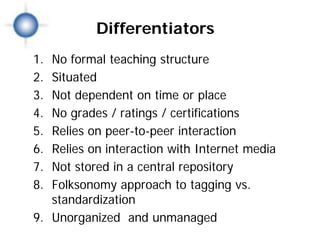
Differentiators
1. No formal teaching structure
2. Situated
3. Not dependent on time or place
4. No grades / ratings / certifications
5. Relies on peer-to-peer interaction
6. Relies on interaction with Internet media
7. Not stored in a central repository
8. Folksonomy approach to tagging vs.
   standardization
9. Unorganized and unmanaged
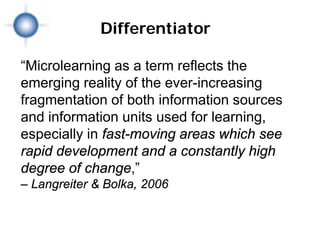
Differentiator

“Microlearning as a term reflects the
emerging reality of the ever-increasing
fragmentation of both information sources
and information units used for learning,
especially in fast-moving areas which see
rapid development and a constantly high
degree of change,”
– Langreiter & Bolka, 2006
Knowledge worker
Process is controlled
Conversations get smaller


 Classes get fragmented


Courses
get shorter
“I’m only as good as my
                     network.”


© Photographer: Geotrac | Agency: Dreamstime.com
Summary
1. Research in this area is new and minimal.
2. Many people are exchanging ideas about
   microlearning but it lacks a consistent
   definition.
3. The microlearning process can be studied in
   the framework of learning in communities of
   practice (social).
4. There is a need to address the realities of
   learning in the digital age.
Microlearning References
Brown, J.S. (2006). New learning environments for the 21st century: Exploring the edge. Change. September/October
2006

Güler, C., Altun, A., & Aşkar, P. (2008). Teacher trainees as learning object designers. (Paper) Microlearning and Capacity
Building. Proceedings of the 4th International Microlearning 2008 Conference. Innsbruck, Austria.
http://www.microlearning.org/proceedings2008/ml2008_proceedings_final.pdf

Hierdeis, H. (2005). From meno to microlearning: A historical survey. Didactics of Microlearning: Concepts, discourses and
examples. Waxmann Verlag. http://books.google.com/books?id=E5hUxZjy4JAC

Huberman, B.A., Romero, D.M. & Fang, W. (2008). Social networks that matter: Twitter under the microscope. Social
Computing Lab, HP Laboratories, Palo Alto, CA and Cornell University, Ithaca, NY.

Hug, T. & Friesen, N. (2007). Outline of a microlearning agenda. Didactics of Microlearning: Concepts, discourses and
examples. Waxmann Verlag. http://books.google.com/books?id=E5hUxZjy4JAC

Hug, T. & Friesen, N. (2009) Outline of a Microlearning Agenda. eLearning Papers, September 2009.
http://www.elearningeuropa.info/files/media/media20252.pdf

Lave, J. & Wenger, E. (1991). Situated learning: Legitimate peripheral participation. Cambridge, UK: Cambridge University
Press.

Linder, M. (2008). The shift toward microinformation. Microlearning and Capacity Building. Proceedings of the 4th
International Microlearning 2008 Conference. Innsbruck, Austria. Retrieved April 5, 2009 from
http://www.microlearning.org/proceedings2008/ml2008_proceedings_final.pdf

Microlearning

  • 1.
    Microlearning within Web-Based Communities of Practice: Microlearning for on-the-job practices and development of skills and knowledge November 19, 2009 Janet Clarey, Researcher and Analyst Brandon Hall Research LearnTrends09
  • 4.
    …occurring at themost minute of levels…minutes or seconds of time.” – Hug & Friesen, 2009
  • 5.
    • Low time commitment • small chunks • short effort • narrow topics (but complex as a whole) Hug & Friesen, 2009
  • 7.
  • 8.
  • 9.
    Differentiators 1. No formalteaching structure 2. Situated 3. Not dependent on time or place 4. No grades / ratings / certifications 5. Relies on peer-to-peer interaction 6. Relies on interaction with Internet media 7. Not stored in a central repository 8. Folksonomy approach to tagging vs. standardization 9. Unorganized and unmanaged
  • 10.
    Differentiator “Microlearning as aterm reflects the emerging reality of the ever-increasing fragmentation of both information sources and information units used for learning, especially in fast-moving areas which see rapid development and a constantly high degree of change,” – Langreiter & Bolka, 2006
  • 11.
  • 13.
    Process is controlled Conversationsget smaller Classes get fragmented Courses get shorter
  • 15.
    “I’m only asgood as my network.” © Photographer: Geotrac | Agency: Dreamstime.com
  • 18.
    Summary 1. Research inthis area is new and minimal. 2. Many people are exchanging ideas about microlearning but it lacks a consistent definition. 3. The microlearning process can be studied in the framework of learning in communities of practice (social). 4. There is a need to address the realities of learning in the digital age.
  • 19.
    Microlearning References Brown, J.S.(2006). New learning environments for the 21st century: Exploring the edge. Change. September/October 2006 Güler, C., Altun, A., & Aşkar, P. (2008). Teacher trainees as learning object designers. (Paper) Microlearning and Capacity Building. Proceedings of the 4th International Microlearning 2008 Conference. Innsbruck, Austria. http://www.microlearning.org/proceedings2008/ml2008_proceedings_final.pdf Hierdeis, H. (2005). From meno to microlearning: A historical survey. Didactics of Microlearning: Concepts, discourses and examples. Waxmann Verlag. http://books.google.com/books?id=E5hUxZjy4JAC Huberman, B.A., Romero, D.M. & Fang, W. (2008). Social networks that matter: Twitter under the microscope. Social Computing Lab, HP Laboratories, Palo Alto, CA and Cornell University, Ithaca, NY. Hug, T. & Friesen, N. (2007). Outline of a microlearning agenda. Didactics of Microlearning: Concepts, discourses and examples. Waxmann Verlag. http://books.google.com/books?id=E5hUxZjy4JAC Hug, T. & Friesen, N. (2009) Outline of a Microlearning Agenda. eLearning Papers, September 2009. http://www.elearningeuropa.info/files/media/media20252.pdf Lave, J. & Wenger, E. (1991). Situated learning: Legitimate peripheral participation. Cambridge, UK: Cambridge University Press. Linder, M. (2008). The shift toward microinformation. Microlearning and Capacity Building. Proceedings of the 4th International Microlearning 2008 Conference. Innsbruck, Austria. Retrieved April 5, 2009 from http://www.microlearning.org/proceedings2008/ml2008_proceedings_final.pdf