How SMBs Can Leverage Social
   Media Tools to Improve
    Workplace Learning
            Wednesday, April 1, 2009
     By Janet Clarey, Analyst & Sr. Researcher
              Brandon Hall Research
Ways to Participate
1. E-mail your questions and
   comments to janet@brandon-
   hall.com
2. TWEET! – send Twitter messages
   to your followers, and to me at
   @jclarey - use #BrandonHall in
   your tweets so I can find them
3. Text Chat during the webinar –
   use NOTES (upper left)
Agenda
•About You
•Definitions
•Benefits & Challenges for SMBs
•How SMBs are using social learning
technologies
•How your organization can get started
with social learning technologies
You?
1. Learning &
   Development
2.Human Resources
3. Information Technology
   (IT)
4.Learning Services
  Provider
5.Other
How Many
    Employees
      in your
   Organization?
1.Under 100
2.100 – 500
3.500-1,000
4.1,000-2,000
5.More than 2,000
Primary learning
       delivery channels
1.Instructor-led classroom training
2.Instructor-led online training
3.On-the-job training
4.Self-paced E-Learning Courses
5.Other
Where are your
       learners physically
            located?
1.Employees at one location
2.Dispersed employees
3.Unknown (customers)
4.Combination of any of the above
Your current goals
1.Rapid E-Learning (consumption and
  development)
2.Reduce Costs
3.Support Informal Learning
4.Improve Productivity
5.Other (type in chat)
Acronyms and Buzzwords
       for $1000
SMB
Social media
What are social
                                                      media?
        Participatory online media that utilizes the
        group to write and direct content, rather than a
        read-only media. Allows for direct contact
        between participants. (Early List Servs but
        faster) – Urban Dictionary, a participatory online
        slang dictionary
© Photographer: Geotrac | Agency: Dreamstime.com
What does SMB
                                                     stand for?
        Small-to-Medium Business (also known as
        Small-to-Medium Enterprise, SME) are defined
        based on size (and there is no universal size
        definition). – Wikipedia, a participatory online
        dictionary

© Photographer: Geotrac | Agency: Dreamstime.com
Quote
“Because they can respond so quickly as business
conditions change, small and midsize companies
have an advantage in a volatile and uncertain
economic climate. The right information technology
tools and solutions lets them build on this advantage
by helping them cut costs and improve productivity
today, while enabling them to stay focused on
innovation so they will be poised for growth when
the economy begins to turn around.”
                        Steve Ballmer, CEO, Microsoft
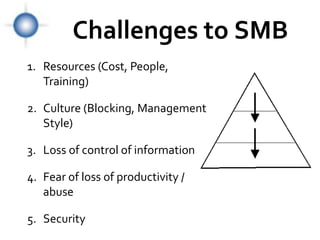
Challenges to SMB
1. Resources (Cost, People,
   Training)

2. Culture (Blocking, Management
   Style)

3. Loss of control of information

4. Fear of loss of productivity /
   abuse

5. Security
Benefits to SMB
1. Faster Response

2. Resilient

3. Lower costs without sacrificing
   learning

4. Increased productivity

5. Supplements other training
Where we
are today
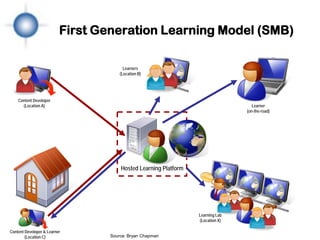
First Generation Learning Model (SMB)

                                        Learners
                                      (Location B)


    Content Developer
      (Location A)                                                                 Learner
                                                                                (on-the-road)


                                      Hosted Learning Platform


                                                                 Learning Lab
                                                                 (Location X)

Content Developer & Learner
        (Location C)              Source: Bryan Chapman
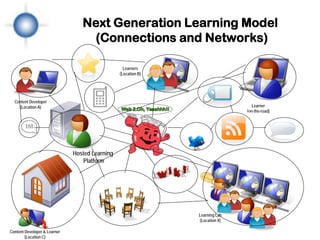
Next Generation Learning Model
                                  (Connections and Networks)

                                                  Learners
                                                (Location B)


  Content Developer
    (Location A)                                                                 Learner
                                                                              (on-the-road)


                              Hosted Learning
                                 Platform


                                                               Learning Lab
                                                               (Location X)

Content Developer & Learner
        (Location C)
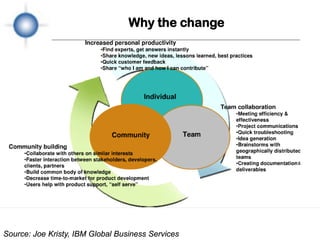
Why the change


                                                   Supports


Source: Joe Kristy, IBM Global Business Services
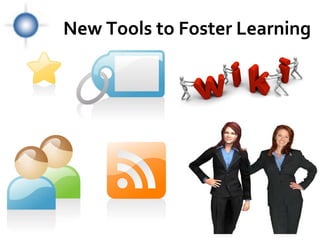
New Tools to Foster Learning
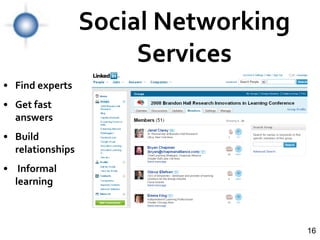
Social Networking
                       Services
• Find experts
• Get fast
  answers
• Build
  relationships
• Informal
  learning


                                      16
Blogs
• Capture knowledge
• Reflection
• Feedback
• Professional Development


                                     16
Wikis
• Manage information
• Provide documentation
• Share resources
• Knowledge repository


                                  16
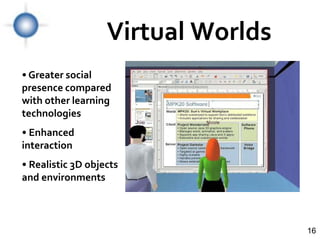
Virtual Worlds
• Greater social
presence compared
with other learning
technologies
• Enhanced
interaction
• Realistic 3D objects
and environments


                                    16
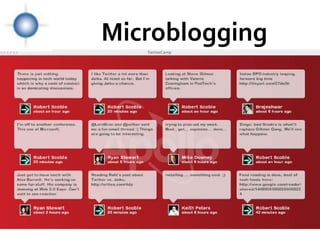
Microblogging
Tagging /
Bookmarking
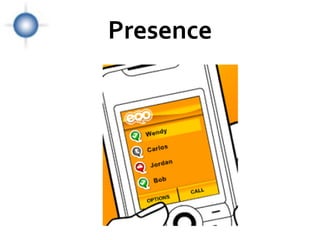
Presence
Does your organization
have a strategy for social
         media?
Strategies for Using
      Social Learning Technologies
• As part of a blended learning strategy

• To provide a community for learning
  professionals

• To provide a collaborative learning
  environment among cross-functional
  groups

• For knowledge management
Strategies for Using
      Social Learning Technologies
• As part of a blended learning strategy

• To provide a community for learning
  professionals

• To provide a collaborative learning
  environment among cross-functional
  groups

• For knowledge management
Strategies for Using
      Social Learning Technologies
• As part of a blended learning strategy

• To provide a community for learning
  professionals

• To provide a collaborative learning
  environment among cross-functional
  groups

• For knowledge management
Strategies for Using
      Social Learning Technologies
• As part of a blended learning strategy

• To provide a community for learning
  professionals

• To provide a collaborative learning
  environment among cross-functional
  groups

• For knowledge management
Strategies for Using
     Social Learning Technologies
• As part of a learning plan

• To create a place for informal learning

• For leadership development

• For professional development

• To develop and retain talent
Strategies for Using
     Social Learning Technologies
• As part of a learning plan

• To create a place for informal learning

• For leadership development

• For professional development

• To develop and retain talent
Strategies for Using
     Social Learning Technologies
• As part of a learning plan

• To create a place for informal learning

• For leadership development

• For professional development

• To develop and retain talent
Strategies for Using
     Social Learning Technologies
• As part of a learning plan

• To create a place for informal learning

• For leadership development

• For professional development

• To develop and retain talent
Strategies for Using
     Social Learning Technologies
• As part of a learning plan

• To create a place for informal learning

• For leadership development

• For professional development

• To develop and retain talent
Summary
1. There are benefits and challenges for SMBs in
   today’s environment.
2. Social media tools for learning are a cost-
   effective solution for maximizing effectiveness.
3. There are an abundance of social media tools
   available.
4. There are multiple strategies for using social
   media.
5. A supportive culture is the most significant factor
   for implementing social learning technologies.
Good Use Case
1. Distributed Learners
2.Information / Knowledge Workers
3. Need for Peer-to-Peer Collaboration
4.Need Easy/Anywhere Access to Information
5.Need Access to Subject Matter Experts
6.Supportive Culture
Action Plan
Action Plan
1. Start small. Find opportunities where social
   learning tools will foster learning. (blended with
   instructor-led, etc.)
2. Become an expert on the learners within your
   organizational communities.
3. Use the tools yourself. Join a social network. If
   you’re already a member of one, connect with
   someone in this presentation.
4. Develop a strategy.
5. Incorporate into people’s daily work. Make it “real
   work.”
                          Action Plan
Follow-up questions?
 1. E-mail your questions and
    comments to janet@brandon-
    hall.com


 2. TWEET! @jclarey

SMBs & Social Media sponsored by Sum Total

  • 1.
    How SMBs CanLeverage Social Media Tools to Improve Workplace Learning Wednesday, April 1, 2009 By Janet Clarey, Analyst & Sr. Researcher Brandon Hall Research
  • 2.
    Ways to Participate 1.E-mail your questions and comments to janet@brandon- hall.com 2. TWEET! – send Twitter messages to your followers, and to me at @jclarey - use #BrandonHall in your tweets so I can find them 3. Text Chat during the webinar – use NOTES (upper left)
  • 3.
    Agenda •About You •Definitions •Benefits &Challenges for SMBs •How SMBs are using social learning technologies •How your organization can get started with social learning technologies
  • 4.
    You? 1. Learning & Development 2.Human Resources 3. Information Technology (IT) 4.Learning Services Provider 5.Other
  • 5.
    How Many Employees in your Organization? 1.Under 100 2.100 – 500 3.500-1,000 4.1,000-2,000 5.More than 2,000
  • 6.
    Primary learning delivery channels 1.Instructor-led classroom training 2.Instructor-led online training 3.On-the-job training 4.Self-paced E-Learning Courses 5.Other
  • 7.
    Where are your learners physically located? 1.Employees at one location 2.Dispersed employees 3.Unknown (customers) 4.Combination of any of the above
  • 8.
    Your current goals 1.RapidE-Learning (consumption and development) 2.Reduce Costs 3.Support Informal Learning 4.Improve Productivity 5.Other (type in chat)
  • 9.
    Acronyms and Buzzwords for $1000 SMB Social media
  • 10.
    What are social media? Participatory online media that utilizes the group to write and direct content, rather than a read-only media. Allows for direct contact between participants. (Early List Servs but faster) – Urban Dictionary, a participatory online slang dictionary © Photographer: Geotrac | Agency: Dreamstime.com
  • 11.
    What does SMB stand for? Small-to-Medium Business (also known as Small-to-Medium Enterprise, SME) are defined based on size (and there is no universal size definition). – Wikipedia, a participatory online dictionary © Photographer: Geotrac | Agency: Dreamstime.com
  • 12.
    Quote “Because they canrespond so quickly as business conditions change, small and midsize companies have an advantage in a volatile and uncertain economic climate. The right information technology tools and solutions lets them build on this advantage by helping them cut costs and improve productivity today, while enabling them to stay focused on innovation so they will be poised for growth when the economy begins to turn around.” Steve Ballmer, CEO, Microsoft
  • 13.
    Challenges to SMB 1.Resources (Cost, People, Training) 2. Culture (Blocking, Management Style) 3. Loss of control of information 4. Fear of loss of productivity / abuse 5. Security
  • 14.
    Benefits to SMB 1.Faster Response 2. Resilient 3. Lower costs without sacrificing learning 4. Increased productivity 5. Supplements other training
  • 15.
  • 16.
    First Generation LearningModel (SMB) Learners (Location B) Content Developer (Location A) Learner (on-the-road) Hosted Learning Platform Learning Lab (Location X) Content Developer & Learner (Location C) Source: Bryan Chapman
  • 17.
    Next Generation LearningModel (Connections and Networks) Learners (Location B) Content Developer (Location A) Learner (on-the-road) Hosted Learning Platform Learning Lab (Location X) Content Developer & Learner (Location C)
  • 18.
    Why the change Supports Source: Joe Kristy, IBM Global Business Services
  • 19.
    New Tools toFoster Learning
  • 20.
    Social Networking Services • Find experts • Get fast answers • Build relationships • Informal learning 16
  • 21.
    Blogs • Capture knowledge •Reflection • Feedback • Professional Development 16
  • 22.
    Wikis • Manage information •Provide documentation • Share resources • Knowledge repository 16
  • 23.
    Virtual Worlds • Greatersocial presence compared with other learning technologies • Enhanced interaction • Realistic 3D objects and environments 16
  • 24.
  • 25.
  • 26.
  • 27.
    Does your organization havea strategy for social media?
  • 28.
    Strategies for Using Social Learning Technologies • As part of a blended learning strategy • To provide a community for learning professionals • To provide a collaborative learning environment among cross-functional groups • For knowledge management
  • 29.
    Strategies for Using Social Learning Technologies • As part of a blended learning strategy • To provide a community for learning professionals • To provide a collaborative learning environment among cross-functional groups • For knowledge management
  • 30.
    Strategies for Using Social Learning Technologies • As part of a blended learning strategy • To provide a community for learning professionals • To provide a collaborative learning environment among cross-functional groups • For knowledge management
  • 31.
    Strategies for Using Social Learning Technologies • As part of a blended learning strategy • To provide a community for learning professionals • To provide a collaborative learning environment among cross-functional groups • For knowledge management
  • 32.
    Strategies for Using Social Learning Technologies • As part of a learning plan • To create a place for informal learning • For leadership development • For professional development • To develop and retain talent
  • 33.
    Strategies for Using Social Learning Technologies • As part of a learning plan • To create a place for informal learning • For leadership development • For professional development • To develop and retain talent
  • 34.
    Strategies for Using Social Learning Technologies • As part of a learning plan • To create a place for informal learning • For leadership development • For professional development • To develop and retain talent
  • 35.
    Strategies for Using Social Learning Technologies • As part of a learning plan • To create a place for informal learning • For leadership development • For professional development • To develop and retain talent
  • 36.
    Strategies for Using Social Learning Technologies • As part of a learning plan • To create a place for informal learning • For leadership development • For professional development • To develop and retain talent
  • 37.
    Summary 1. There arebenefits and challenges for SMBs in today’s environment. 2. Social media tools for learning are a cost- effective solution for maximizing effectiveness. 3. There are an abundance of social media tools available. 4. There are multiple strategies for using social media. 5. A supportive culture is the most significant factor for implementing social learning technologies.
  • 38.
    Good Use Case 1.Distributed Learners 2.Information / Knowledge Workers 3. Need for Peer-to-Peer Collaboration 4.Need Easy/Anywhere Access to Information 5.Need Access to Subject Matter Experts 6.Supportive Culture
  • 39.
  • 40.
    Action Plan 1. Startsmall. Find opportunities where social learning tools will foster learning. (blended with instructor-led, etc.) 2. Become an expert on the learners within your organizational communities. 3. Use the tools yourself. Join a social network. If you’re already a member of one, connect with someone in this presentation. 4. Develop a strategy. 5. Incorporate into people’s daily work. Make it “real work.” Action Plan
  • 41.
    Follow-up questions? 1.E-mail your questions and comments to janet@brandon- hall.com 2. TWEET! @jclarey