International Journal of Engineering Research and Development 
e-ISSN: 2278-067X, p-ISSN: 2278-800X, www.ijerd.com 
Volume 10, Issue 6 (June 2014), PP.18-25 
A Proposal for Security Oversight at Automated Teller 
Machine System 
Srinivasa G1, Sridevi N2, Sarvesh A3, kulkarni varsha4 
1Asst.prof Dept of CSE, SVCE 
2Asst.prof Dept of CSE, SVCE 
3Asst.prof Dept of ISE, SVCE 
4Asst.prof Dept of CSE, SVCE 
Abstract:- Face Recognition is an emerging field of research with many challenges such as large set of images, 
improper illuminating conditions. Eigen face approach is one of the simplest and most efficient methods to 
overcome these obstacles in developing a system for Face Recognition. Various summarization techniques are 
used for preprocessing the image in order to handle bad illumination and face recognition. Eigen faces are 
eigenvectors of covariance matrix, representing given image space. Any new face image can be then represented 
as a linear combination of these Eigen faces. This makes it easier to match any two given images and thus face 
recognition process. The paper gives a basic knowledge of Eigen values and Eigenvectors. It covers various 
steps involved in face recognition using Eigen face approach along with its significance and some results. It 
mainly focuses on Eigen face approach for Face Recognition. 
Keywords:- Face recognition, biometric, automated teller machine, person identification 
I. INTRODUCTION 
The main purpose of this paper is to develop a complete system for ATM Transaction Processing with 
the face recognition security using Eigen Faces which includes: 
Cash Withdrawal 
Balance Enquiry etc. 
Whenever the user perform a transaction, the user will be asked to enter the card and pin number as 
well as it will check the valid user with his face image stored in the database at the time of account creation. 
Experimental results suggest that the computer had more difficulty in distinguishing faces from each other than 
just identifying whether or not a random face matched a particular face. As the number of subjects increase it is 
suspected that the recognition performance will decrease. Thus the correlation technique used here needs to be 
enhanced with facial features like eyes, nose, lips, and etc. Also another question that is planned on researching 
is the performance of face recognition by humans and understanding the human brain. 
18 
1.1 EIGEN FACE APPROACH 
Face Recognition is an emerging field of research with many challenges such as large set of images, 
improper illuminating conditions. Eigen face approach is one of the simplest and most efficient methods to 
overcome these obstacles in developing a system for Face Recognition. Various summarization techniques are 
used for preprocessing the image in order to handle bad illumination and face alignment problem. Then, Eigen 
face approach can be used for face recognition. Eigen faces are eigenvectors of covariance matrix, representing 
given image space. Any new face image can be then represented as a linear combination of these Eigen faces. 
This makes it easier to match any two given images and thus face recognition process. The report gives a basic 
knowledge of Eigen values and Eigenvectors. It covers various steps involved in face recognition using Eigen 
face approach along with it's significance and some results. It mainly focuses on Eigen face approach for Face 
Recognition. 
II. LITERATURE REVIEW 
2.1” Recognizability assessment of facial images for automated teller machine application”. 
Crimes related to automated teller machines (ATMs) have increased as a result of the recent popularity 
in the devices. One of the most practical approaches for preventing such crimes is the installation of cameras in 
ATMs to capture the facial images of users for follow-up criminal investigations. However, this approach is 
vulnerable in cases where a criminal’s face is occluded. Therefore, this paper proposes a system which assesses 
the recognizability of facial images of ATM users to determine whether their faces are severely occluded. The 
proposed system uses a component-based face candidate generation and verification approach to handle various
A Proposal For Security Oversight At Automated Teller Machine System 
facial postures and acceptable partial occlusions. Element techniques are implemented via grayscale image-based 
methods which are robust against illumination conditions compared to skin color detection approach. The 
system architecture for achieving both high performance and cost-efficiency is proposed to make the system 
applicable to practical ATM environments. In the experiment, the feasibility of the proposed system was 
evaluated using a large scale facial occlusion database consisting of 3168 image sequences including 21 facial 
occlusions, 8 illumination conditions, and 2 acquisition scenarios. Based on the results, we drew up the 
guidelines of recognizability assessment systems for ATM applications. 
19 
2.2 “Face Recognition using Eigen face approach.” 
Face Recognition is an emerging field of research with many challenges such as large set of images, 
improper illuminating conditions. Eigen face approach is one of the simplest and most efficient methods to 
overcome these obstacles in developing a system for Face Recognition. Various summarization techniques are 
used for preprocessing the image in order to handle bad illumination and face alignment problem. Then, Eigen 
face approach can be used for face recognition. Eigenfaces are eigenvectors of covariance matrix, representing 
given image space. Any new face image can be then represented as a linear combination of these Eigenfaces. 
This makes it easier to match any two given images and thus face recognition process. The report gives a basic 
knowledge of Eigenvalues and Eigenvectors. It covers various steps involved in face recognition using Eigen 
face approach along with it's significance and some results. It mainly focuses on Eigen face approach for Face 
Recognition. 
III. PROBLEM STATEMENT 
The face recognition problem can be formulated as follows: Given an input face image and a database 
of face images of known individuals, how can we verify or determine the identity of the person in the input 
image. 
Given is a training set of face images. These represent some face space with high dimensionality. For 
given new face image, we need to classify this new image among the face classes and check for face 
recognition. Here we need to match this new image to one of existing face images in database and perform face 
recognition making use of Eigen faces Approach 
IV. EXISTING SYSTEM 
Recent work by Burt et al. uses a "smart sensing" approach based on multi-resolution template 
matching. This coarse-to-fine strategy uses a special purpose computer built to calculate multi-resolution 
pyramid images quickly, and has been demonstrated identifying people in near-real-time. The face models are 
built by hand from face images 
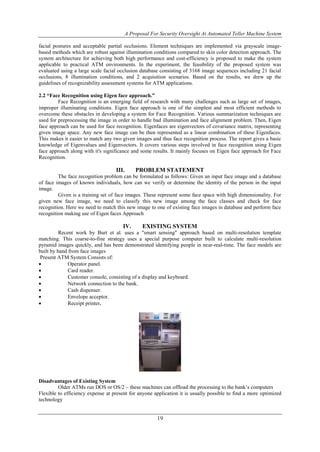
Present ATM System Consists of: 
 Operator panel. 
 Card reader. 
 Customer console, consisting of a display and keyboard. 
 Network connection to the bank. 
 Cash dispenser. 
 Envelope acceptor. 
 Receipt printer. 
Disadvantages of Existing System 
Older ATMs run DOS or OS/2 – these machines can offload the processing to the bank’s computers 
Flexible to efficiency expense at present for anyone application it is usually possible to find a more optimized 
technology
A Proposal For Security Oversight At Automated Teller Machine System 
V. DESIGN AND IMPLEMENTATION 
Crimes related to automated teller machine (ATM’S) have increased as a result of recent popularity in 
the devices. 
One of the most practical approaches for preventing such crimes is the installation of cameras in ATM’S to 
capture the facial images of users for follow up criminal investigation. 
Biometric-based techniques have emerged as the most promising option for recognizing individuals. 
Biometric-based technologies include identification based on physiological characteristics and behavioral. 
Before discussing on the face recognizability, it is required to define what a recognizable facial image is. A 
facial image that contains a mouth and at least an eye visible is defined as recognizable. 
There are many different types of algorithms used for face recognition. Some of them are listed below: 
 Image-Based Face Recognition. 
 Video-Based Face Recognition. 
 A standard PCA or Eigen Faces Algorithm. 
 A combination PCA and LDA Algorithm. 
 An Elastic Bunch Graph Matching Algorithm. 
 Histogram processed Face Recognition with adaboost algorithm. 
 Kernel methods. 
 3-D Morphable model. 
 3-D Face Recognition. 
 Boosting and Ensemble Algorithm Comparison. 
20 
5.1 Eigen face algorithm 
Developed in 2005 by M. Turk Based on PCA (Principal Component Analysis). It is relatively simple, 
fast and robust. 
All the algorithms have their own advantages and disadvantages. Controlling ATM Fraud using Face 
Recognition is done based on the Eigen Face Algorithm. Eigen Face Algorithm is used mainly due to its 
Authentication purpose. In Eigen Face Algorithm we make use of concept of Eigen Vectors and Eigen Values. 
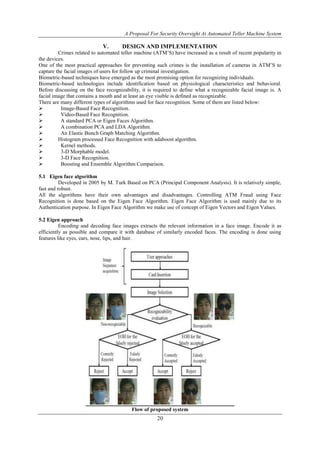
5.2 Eigen approach 
Encoding and decoding face images extracts the relevant information in a face image. Encode it as 
efficiently as possible and compare it with database of similarly encoded faces. The encoding is done using 
features like eyes, ears, nose, lips, and hair. 
Flow of proposed system
A Proposal For Security Oversight At Automated Teller Machine System 
21 
IMPLEMENTATION 
Implementation is the stage of the project when the theoretical design is turned out into a working 
system. Thus it can be considered to be the most critical stage in achieving a successful new system and in 
giving the user, confidence that the new system will work and be effective. 
The implementation stage involves careful planning, investigation of the existing system and its 
constraints on implementation, designing of methods to achieve changeover and evaluations of changeover 
methods. 
FUNCTIONAL REQUIREMENTS 
The functional requirements are the following 
 The recognition algorithm provides its users with the ability to recognize a new image which is not 
present in the database. 
 The front-end of the product will give the information about training the system, a start button which is 
used to start capturing the new image and recognizing it. 
Depending on the result of recognition the valid face is displayed 
7.1.1 MAIN MODULES 
 User Login 
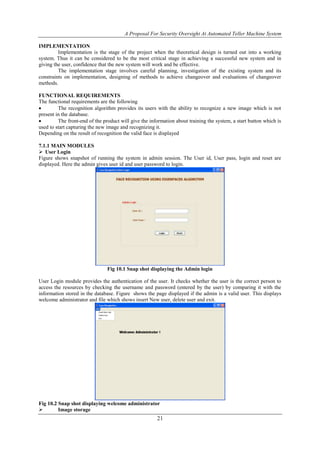
Figure shows snapshot of running the system in admin session. The User id, User pass, login and reset are 
displayed. Here the admin gives user id and user password to login. 
Fig 10.1 Snap shot displaying the Admin login 
User Login module provides the authentication of the user. It checks whether the user is the correct person to 
access the resources by checking the username and password (entered by the user) by comparing it with the 
information stored in the database. Figure shows the page displayed if the admin is a valid user. This displays 
welcome administrator and file which shows insert New user, delete user and exit. 
Fig 10.2 Snap shot displaying welcome administrator 
 Image storage
A Proposal For Security Oversight At Automated Teller Machine System 
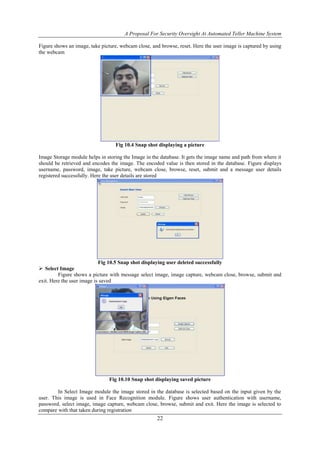
Figure shows an image, take picture, webcam close, and browse, reset. Here the user image is captured by using 
the webcam 
Fig 10.4 Snap shot displaying a picture 
Image Storage module helps in storing the Image in the database. It gets the image name and path from where it 
should be retrieved and encodes the image. The encoded value is then stored in the database. Figure displays 
username, password, image, take picture, webcam close, browse, reset, submit and a message user details 
registered successfully. Here the user details are stored 
Fig 10.5 Snap shot displaying user deleted successfully 
22 
 Select Image 
Figure shows a picture with message select image, image capture, webcam close, browse, submit and 
exit. Here the user image is saved 
Fig 10.10 Snap shot displaying saved picture 
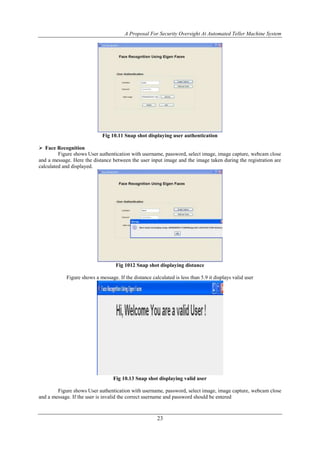
In Select Image module the image stored in the database is selected based on the input given by the 
user. This image is used in Face Recognition module. Figure shows user authentication with username, 
password, select image, image capture, webcam close, browse, submit and exit. Here the image is selected to 
compare with that taken during registration
A Proposal For Security Oversight At Automated Teller Machine System 
Fig 10.11 Snap shot displaying user authentication 
23 
 Face Recognition 
Figure shows User authentication with username, password, select image, image capture, webcam close 
and a message. Here the distance between the user input image and the image taken during the registration are 
calculated and displayed. 
Fig 1012 Snap shot displaying distance 
Figure shows a message. If the distance calculated is less than 5.9 it displays valid user 
Fig 10.13 Snap shot displaying valid user 
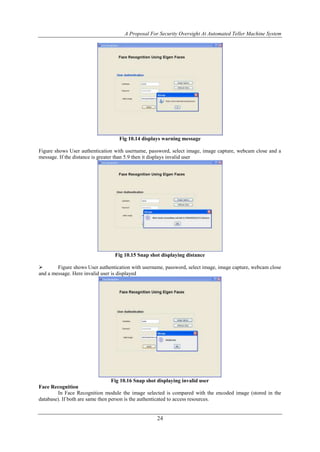
Figure shows User authentication with username, password, select image, image capture, webcam close 
and a message. If the user is invalid the correct username and password should be entered
A Proposal For Security Oversight At Automated Teller Machine System 
Fig 10.14 displays warning message 
Figure shows User authentication with username, password, select image, image capture, webcam close and a 
message. If the distance is greater than 5.9 then it displays invalid user 
Fig 10.15 Snap shot displaying distance 
 Figure shows User authentication with username, password, select image, image capture, webcam close 
and a message. Here invalid user is displayed 
Fig 10.16 Snap shot displaying invalid user 
24 
Face Recognition 
In Face Recognition module the image selected is compared with the encoded image (stored in the 
database). If both are same then person is the authenticated to access resources.
A Proposal For Security Oversight At Automated Teller Machine System 
VI. CONCLUSION 
For most of the past ten years, the majority of ATMs used worldwide ran under IBM’s now-defunct OS/2. 
However, IBM hasn’t issued a major update to the operating system in over six years. 
Movement in the banking world is now going in two directions: 
o Windows 
o Linux. 
NCR, a leading world-wide ATM manufacturer, recently announced an agreement to use Windows XP 
Embedded in its next generation of personalized ATMs. 
Windows XP Embedded allows OEMs to pick and choose from the thousands of components that make up 
Windows XP Professional, including integrated multimedia, networking and database management 
functionality. 
This makes the use of off-the-shelf facial recognition code more desirable because it could easily be compiled 
for the Windows XP environment and the networking and database tools will already be in place. 
FUTURE ENHANCEMENT 
To improve the performance of the Eigenfaces recognition approach, a couple of things can be done. 
1. To reduce the false-positive rate, we can make the system return a number of candidates from the 
existing face classes instead of a single face class. And the remaining work is left to human. 
2. Regarding the pattern vector representing a face class, we can make each face class consist of several 
pattern vectors, each constructed from a face image of the same individual under a certain condition, 
rather than taking the average of these vectors to represent the face class. 
REFERENCES 
[1]. “Face recognition using eigenfaces”, M. Turk and A. Pentland, Proc. IEEE Conf. on Computer Vision 
and Pattern Recognition, pages 586-591, 1991 
[2]. “Face recognition for smart environments”, A. Pentland and T. Choudhury, Computer, Vol.33 Iss.2, 
25 
Feb. 2000 
[3]. “Face recognition: Features versus templates”, R. Brunelli and T. Poggio, IEEE Trans. Pattern Analysis 
and Machine Intelligence, 15(10): 1042-1052, 1993 
[4]. “Human and machine recognition of faces: A survey”, R. Chellappa, C. L. Wilson, and S. Sirohey, 
Proc. of IEEE, volume 83, pages 705-740, 1995 
[5]. “Eigenfaces vs. fisherfaces: Recognition using class specific linear projection”, P. N. Belhumeur, J. P. 
Hespanha, and D. J. Kriegman, IEEE Trans. Pattern Analysis and Machine Intelligence, 19(7):711-720, 
1997 
[6]. “Illumination cones for recognition under variable lighting: Faces”, A. S. Georghiades, D. J. Kriegman, 
and P. N. Belhumeur, Proc. IEEE Conf. on Computer Vision and Pattern Recognition, pages 52-59, 
1998 
[7]. “Human face segmentation and identification”, S. A. Sirohey, Technical Report CAR-TR-695, Center 
for Automation Research, University of Maryland, College Park, MD, 1993 
[8]. “Automatic recognition and analysis of human faces and facial expressions: A survey”, A. Samal and 
P. A. Iyengar, Pattern Recognition, 25(1): 65-77, 1992

International Journal of Engineering Research and Development

  • 1.
    International Journal ofEngineering Research and Development e-ISSN: 2278-067X, p-ISSN: 2278-800X, www.ijerd.com Volume 10, Issue 6 (June 2014), PP.18-25 A Proposal for Security Oversight at Automated Teller Machine System Srinivasa G1, Sridevi N2, Sarvesh A3, kulkarni varsha4 1Asst.prof Dept of CSE, SVCE 2Asst.prof Dept of CSE, SVCE 3Asst.prof Dept of ISE, SVCE 4Asst.prof Dept of CSE, SVCE Abstract:- Face Recognition is an emerging field of research with many challenges such as large set of images, improper illuminating conditions. Eigen face approach is one of the simplest and most efficient methods to overcome these obstacles in developing a system for Face Recognition. Various summarization techniques are used for preprocessing the image in order to handle bad illumination and face recognition. Eigen faces are eigenvectors of covariance matrix, representing given image space. Any new face image can be then represented as a linear combination of these Eigen faces. This makes it easier to match any two given images and thus face recognition process. The paper gives a basic knowledge of Eigen values and Eigenvectors. It covers various steps involved in face recognition using Eigen face approach along with its significance and some results. It mainly focuses on Eigen face approach for Face Recognition. Keywords:- Face recognition, biometric, automated teller machine, person identification I. INTRODUCTION The main purpose of this paper is to develop a complete system for ATM Transaction Processing with the face recognition security using Eigen Faces which includes: Cash Withdrawal Balance Enquiry etc. Whenever the user perform a transaction, the user will be asked to enter the card and pin number as well as it will check the valid user with his face image stored in the database at the time of account creation. Experimental results suggest that the computer had more difficulty in distinguishing faces from each other than just identifying whether or not a random face matched a particular face. As the number of subjects increase it is suspected that the recognition performance will decrease. Thus the correlation technique used here needs to be enhanced with facial features like eyes, nose, lips, and etc. Also another question that is planned on researching is the performance of face recognition by humans and understanding the human brain. 18 1.1 EIGEN FACE APPROACH Face Recognition is an emerging field of research with many challenges such as large set of images, improper illuminating conditions. Eigen face approach is one of the simplest and most efficient methods to overcome these obstacles in developing a system for Face Recognition. Various summarization techniques are used for preprocessing the image in order to handle bad illumination and face alignment problem. Then, Eigen face approach can be used for face recognition. Eigen faces are eigenvectors of covariance matrix, representing given image space. Any new face image can be then represented as a linear combination of these Eigen faces. This makes it easier to match any two given images and thus face recognition process. The report gives a basic knowledge of Eigen values and Eigenvectors. It covers various steps involved in face recognition using Eigen face approach along with it's significance and some results. It mainly focuses on Eigen face approach for Face Recognition. II. LITERATURE REVIEW 2.1” Recognizability assessment of facial images for automated teller machine application”. Crimes related to automated teller machines (ATMs) have increased as a result of the recent popularity in the devices. One of the most practical approaches for preventing such crimes is the installation of cameras in ATMs to capture the facial images of users for follow-up criminal investigations. However, this approach is vulnerable in cases where a criminal’s face is occluded. Therefore, this paper proposes a system which assesses the recognizability of facial images of ATM users to determine whether their faces are severely occluded. The proposed system uses a component-based face candidate generation and verification approach to handle various
  • 2.
    A Proposal ForSecurity Oversight At Automated Teller Machine System facial postures and acceptable partial occlusions. Element techniques are implemented via grayscale image-based methods which are robust against illumination conditions compared to skin color detection approach. The system architecture for achieving both high performance and cost-efficiency is proposed to make the system applicable to practical ATM environments. In the experiment, the feasibility of the proposed system was evaluated using a large scale facial occlusion database consisting of 3168 image sequences including 21 facial occlusions, 8 illumination conditions, and 2 acquisition scenarios. Based on the results, we drew up the guidelines of recognizability assessment systems for ATM applications. 19 2.2 “Face Recognition using Eigen face approach.” Face Recognition is an emerging field of research with many challenges such as large set of images, improper illuminating conditions. Eigen face approach is one of the simplest and most efficient methods to overcome these obstacles in developing a system for Face Recognition. Various summarization techniques are used for preprocessing the image in order to handle bad illumination and face alignment problem. Then, Eigen face approach can be used for face recognition. Eigenfaces are eigenvectors of covariance matrix, representing given image space. Any new face image can be then represented as a linear combination of these Eigenfaces. This makes it easier to match any two given images and thus face recognition process. The report gives a basic knowledge of Eigenvalues and Eigenvectors. It covers various steps involved in face recognition using Eigen face approach along with it's significance and some results. It mainly focuses on Eigen face approach for Face Recognition. III. PROBLEM STATEMENT The face recognition problem can be formulated as follows: Given an input face image and a database of face images of known individuals, how can we verify or determine the identity of the person in the input image. Given is a training set of face images. These represent some face space with high dimensionality. For given new face image, we need to classify this new image among the face classes and check for face recognition. Here we need to match this new image to one of existing face images in database and perform face recognition making use of Eigen faces Approach IV. EXISTING SYSTEM Recent work by Burt et al. uses a "smart sensing" approach based on multi-resolution template matching. This coarse-to-fine strategy uses a special purpose computer built to calculate multi-resolution pyramid images quickly, and has been demonstrated identifying people in near-real-time. The face models are built by hand from face images Present ATM System Consists of:  Operator panel.  Card reader.  Customer console, consisting of a display and keyboard.  Network connection to the bank.  Cash dispenser.  Envelope acceptor.  Receipt printer. Disadvantages of Existing System Older ATMs run DOS or OS/2 – these machines can offload the processing to the bank’s computers Flexible to efficiency expense at present for anyone application it is usually possible to find a more optimized technology
  • 3.
    A Proposal ForSecurity Oversight At Automated Teller Machine System V. DESIGN AND IMPLEMENTATION Crimes related to automated teller machine (ATM’S) have increased as a result of recent popularity in the devices. One of the most practical approaches for preventing such crimes is the installation of cameras in ATM’S to capture the facial images of users for follow up criminal investigation. Biometric-based techniques have emerged as the most promising option for recognizing individuals. Biometric-based technologies include identification based on physiological characteristics and behavioral. Before discussing on the face recognizability, it is required to define what a recognizable facial image is. A facial image that contains a mouth and at least an eye visible is defined as recognizable. There are many different types of algorithms used for face recognition. Some of them are listed below:  Image-Based Face Recognition.  Video-Based Face Recognition.  A standard PCA or Eigen Faces Algorithm.  A combination PCA and LDA Algorithm.  An Elastic Bunch Graph Matching Algorithm.  Histogram processed Face Recognition with adaboost algorithm.  Kernel methods.  3-D Morphable model.  3-D Face Recognition.  Boosting and Ensemble Algorithm Comparison. 20 5.1 Eigen face algorithm Developed in 2005 by M. Turk Based on PCA (Principal Component Analysis). It is relatively simple, fast and robust. All the algorithms have their own advantages and disadvantages. Controlling ATM Fraud using Face Recognition is done based on the Eigen Face Algorithm. Eigen Face Algorithm is used mainly due to its Authentication purpose. In Eigen Face Algorithm we make use of concept of Eigen Vectors and Eigen Values. 5.2 Eigen approach Encoding and decoding face images extracts the relevant information in a face image. Encode it as efficiently as possible and compare it with database of similarly encoded faces. The encoding is done using features like eyes, ears, nose, lips, and hair. Flow of proposed system
  • 4.
    A Proposal ForSecurity Oversight At Automated Teller Machine System 21 IMPLEMENTATION Implementation is the stage of the project when the theoretical design is turned out into a working system. Thus it can be considered to be the most critical stage in achieving a successful new system and in giving the user, confidence that the new system will work and be effective. The implementation stage involves careful planning, investigation of the existing system and its constraints on implementation, designing of methods to achieve changeover and evaluations of changeover methods. FUNCTIONAL REQUIREMENTS The functional requirements are the following  The recognition algorithm provides its users with the ability to recognize a new image which is not present in the database.  The front-end of the product will give the information about training the system, a start button which is used to start capturing the new image and recognizing it. Depending on the result of recognition the valid face is displayed 7.1.1 MAIN MODULES  User Login Figure shows snapshot of running the system in admin session. The User id, User pass, login and reset are displayed. Here the admin gives user id and user password to login. Fig 10.1 Snap shot displaying the Admin login User Login module provides the authentication of the user. It checks whether the user is the correct person to access the resources by checking the username and password (entered by the user) by comparing it with the information stored in the database. Figure shows the page displayed if the admin is a valid user. This displays welcome administrator and file which shows insert New user, delete user and exit. Fig 10.2 Snap shot displaying welcome administrator  Image storage
  • 5.
    A Proposal ForSecurity Oversight At Automated Teller Machine System Figure shows an image, take picture, webcam close, and browse, reset. Here the user image is captured by using the webcam Fig 10.4 Snap shot displaying a picture Image Storage module helps in storing the Image in the database. It gets the image name and path from where it should be retrieved and encodes the image. The encoded value is then stored in the database. Figure displays username, password, image, take picture, webcam close, browse, reset, submit and a message user details registered successfully. Here the user details are stored Fig 10.5 Snap shot displaying user deleted successfully 22  Select Image Figure shows a picture with message select image, image capture, webcam close, browse, submit and exit. Here the user image is saved Fig 10.10 Snap shot displaying saved picture In Select Image module the image stored in the database is selected based on the input given by the user. This image is used in Face Recognition module. Figure shows user authentication with username, password, select image, image capture, webcam close, browse, submit and exit. Here the image is selected to compare with that taken during registration
  • 6.
    A Proposal ForSecurity Oversight At Automated Teller Machine System Fig 10.11 Snap shot displaying user authentication 23  Face Recognition Figure shows User authentication with username, password, select image, image capture, webcam close and a message. Here the distance between the user input image and the image taken during the registration are calculated and displayed. Fig 1012 Snap shot displaying distance Figure shows a message. If the distance calculated is less than 5.9 it displays valid user Fig 10.13 Snap shot displaying valid user Figure shows User authentication with username, password, select image, image capture, webcam close and a message. If the user is invalid the correct username and password should be entered
  • 7.
    A Proposal ForSecurity Oversight At Automated Teller Machine System Fig 10.14 displays warning message Figure shows User authentication with username, password, select image, image capture, webcam close and a message. If the distance is greater than 5.9 then it displays invalid user Fig 10.15 Snap shot displaying distance  Figure shows User authentication with username, password, select image, image capture, webcam close and a message. Here invalid user is displayed Fig 10.16 Snap shot displaying invalid user 24 Face Recognition In Face Recognition module the image selected is compared with the encoded image (stored in the database). If both are same then person is the authenticated to access resources.
  • 8.
    A Proposal ForSecurity Oversight At Automated Teller Machine System VI. CONCLUSION For most of the past ten years, the majority of ATMs used worldwide ran under IBM’s now-defunct OS/2. However, IBM hasn’t issued a major update to the operating system in over six years. Movement in the banking world is now going in two directions: o Windows o Linux. NCR, a leading world-wide ATM manufacturer, recently announced an agreement to use Windows XP Embedded in its next generation of personalized ATMs. Windows XP Embedded allows OEMs to pick and choose from the thousands of components that make up Windows XP Professional, including integrated multimedia, networking and database management functionality. This makes the use of off-the-shelf facial recognition code more desirable because it could easily be compiled for the Windows XP environment and the networking and database tools will already be in place. FUTURE ENHANCEMENT To improve the performance of the Eigenfaces recognition approach, a couple of things can be done. 1. To reduce the false-positive rate, we can make the system return a number of candidates from the existing face classes instead of a single face class. And the remaining work is left to human. 2. Regarding the pattern vector representing a face class, we can make each face class consist of several pattern vectors, each constructed from a face image of the same individual under a certain condition, rather than taking the average of these vectors to represent the face class. REFERENCES [1]. “Face recognition using eigenfaces”, M. Turk and A. Pentland, Proc. IEEE Conf. on Computer Vision and Pattern Recognition, pages 586-591, 1991 [2]. “Face recognition for smart environments”, A. Pentland and T. Choudhury, Computer, Vol.33 Iss.2, 25 Feb. 2000 [3]. “Face recognition: Features versus templates”, R. Brunelli and T. Poggio, IEEE Trans. Pattern Analysis and Machine Intelligence, 15(10): 1042-1052, 1993 [4]. “Human and machine recognition of faces: A survey”, R. Chellappa, C. L. Wilson, and S. Sirohey, Proc. of IEEE, volume 83, pages 705-740, 1995 [5]. “Eigenfaces vs. fisherfaces: Recognition using class specific linear projection”, P. N. Belhumeur, J. P. Hespanha, and D. J. Kriegman, IEEE Trans. Pattern Analysis and Machine Intelligence, 19(7):711-720, 1997 [6]. “Illumination cones for recognition under variable lighting: Faces”, A. S. Georghiades, D. J. Kriegman, and P. N. Belhumeur, Proc. IEEE Conf. on Computer Vision and Pattern Recognition, pages 52-59, 1998 [7]. “Human face segmentation and identification”, S. A. Sirohey, Technical Report CAR-TR-695, Center for Automation Research, University of Maryland, College Park, MD, 1993 [8]. “Automatic recognition and analysis of human faces and facial expressions: A survey”, A. Samal and P. A. Iyengar, Pattern Recognition, 25(1): 65-77, 1992