FACIAL
NERVE
PARALYSIS
PARVATHI JAYAGOPALAN
DEPT OF OMFS
INTRODUCTION
 Nerve of second branchial arch.
 Mixed nerve
 Course:
 Intracranial
 Intratemporal
 Extratemporal
Supranuclear pathway
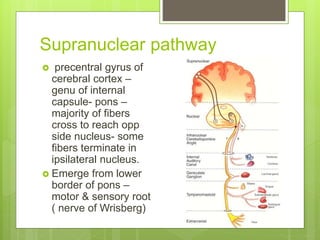
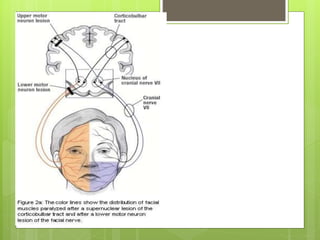
 precentral gyrus of
cerebral cortex –
genu of internal
capsule- pons –
majority of fibers
cross to reach opp
side nucleus- some
fibers terminate in
ipsilateral nucleus.
 Emerge from lower
border of pons –
motor & sensory root
( nerve of Wrisberg)
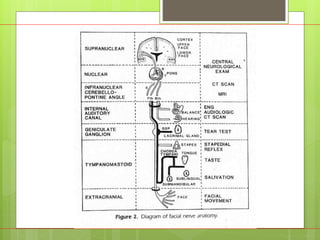
Infranuclear pathway
 Leaves nucleus with 8th nerve in cerebellopontine
angle- enter IAC
 Motor root:
 Muscles of facial expression
 Scalp
 Auricle
 Stylohyoid
 Stapedius
 Post belly of digastric
 Sensory root:
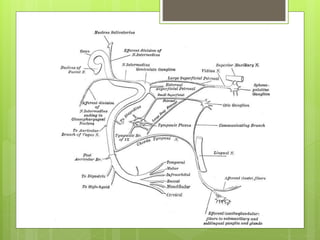
 Special visceral afferent : taste to ant 2/3rd of
tongue via chorda tympani
 General visceral efferent: salivary glands via
petrosal
 Special visceral efferent: to facial muscles
 Enter IAC- 7th nerve joins nervus intermedius
– form common trunk- leaves IAC- enters
fallopian canal in temporal bone.
 Total length in temporal bone- 22-33 mm.
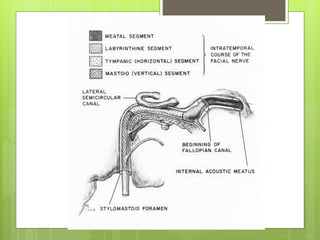
 Subdivided segments:
 Horizontal segment
from fundus of internal
acoustic meatus to
geniculate gang.- 3-
4mm “
LABYRINTHINE
SEGMENT”
 Acute angle turn to
enter tympanic cavity-
“FIRST GENU”
 Post on medial wall of
middle ear above
promontory- “
TYMPANIC SEGMENT”
( 10-12mm)
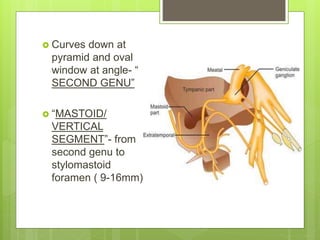
 Curves down at
pyramid and oval
window at angle- “
SECOND GENU”
 “MASTOID/
VERTICAL
SEGMENT”- from
second genu to
stylomastoid
foramen ( 9-16mm). `
 Facial ( fallopian ) canal ( Gerrier 1977):
 Individual sheath of pia mater curves up and
continues with arachnoid.
 Slight constriction of nerve seen just prior to it
labyrinthine segment 0.68 ( Fisch U, 1981) in
diameter.
 Change in direction of the nerve that produces
an angle of 132 deg, open anteriorly and
medially.
Branches of facial nerve
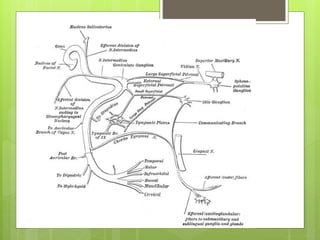
 Intracranial:
 Greater superficial petrosal nerve ( secretomotor-
lacrimal gland)
 Intratemporal:
 Nerve to stapedius- from mastoid segment ( supplies
stapedius)
 Chorda tympani nerve- from mastoid segment- joins
lingual nerve to supple ant 2/3rd of tongue,
secretomotor to submand. Gland.
 Sensory branches join auricular branch of vagus to
supply external auditory canal.
Branches in head & neck
 Ansa Haller ( inconstant)- immediately below
stylomastoid foramen, anastomses with
glossopharyngeal nerve.
 Posterior auricular nerve- 1-2mm below
stylomastoid foramen.
 Styloid branch- enters styloid muscle.
 Branch to post belly of digastric.
Branches in parotid plexus
 Temporal branch
 Zygomatic branch
 Buccal
 Marginal mandibular
 Cervical
Landmarks of facial nerve
 Tragal pointer: 1 cm inf to tragal cartilage
 Tympanomastoid suture: angle where the
vaginal process of tympanic portion of
temporal bone meets mastoid process.
 Styloid process: lateral to styloid process.
 Tracing terminal branch backwards:
 Ramus frontalis: tragus to lateral canthus
 Ramus buccalis: tragus to alar nose, parallel to
zygoma.
 Ramus mandibularis: angle of mand. at pont 4-
4.5cm from attachment of lobule of pinna.
 Tendon of post belly of digastric
 Post auricular vein/ retromandibular vein
• Distance of FN from anatomical structures
• Tragal pointer, 24.3 to 49.2 (mean 34)
• Posterior belly of digastric, 9.7 to 24.3 (mean 14.6)
• External auditory canal, 7.3 to 21.9 (mean 13.4)
• Tympanomastoid suture, 4.9 to 18.6 (mean 10.0)
• Styloid process, 4.3 to 18.6 (mean 9.8)
• Transverse process of the axis, 9.7 to 36.8 (mean 16.9)
• Angle of the mandible, 25.3 to 48.69 (mean 38.1).
• The length of the facial nerve trunk from its point of exit from the
stylomastoid foramen to its bifurcation into upper and lower divisions
ranged from (mm) 8.6 to 22.8 (mean 14.0).
Surg Radiol Anat. 2006 May;28(2):170-5. Epub 2006 Apr 20.
Landmarks of the facial nerve: implications for parotidectomy.
Pather N, Osman M.
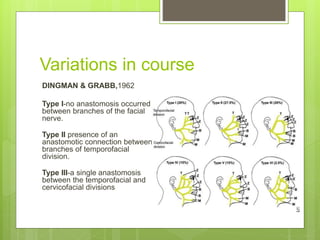
Variations in course
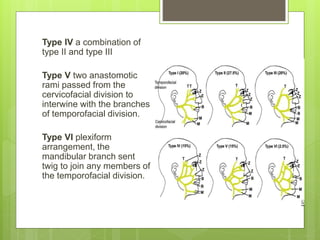
DINGMAN & GRABB,1962
Type I-no anastomosis occurred
between branches of the facial
nerve.
Type II presence of an
anastomotic connection between
branches of temporofacial
division.
Type III-a single anastomosis
between the temporofacial and
cervicofacial divisions
Type IV a combination of
type II and type III
Type V two anastomotic
rami passed from the
cervicofacial division to
interwine with the branches
of temporofacial division.
Type VI plexiform
arrangement, the
mandibular branch sent
twig to join any members of
the temporofacial division.
Neurophysiology & nerve
regeneration
 Facial expression depends
on 7000 motor fibres- muscle
contractions.
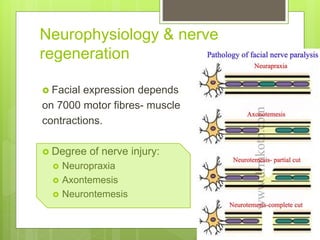
 Degree of nerve injury:
 Neuropraxia
 Axontemesis
 Neurontemesis
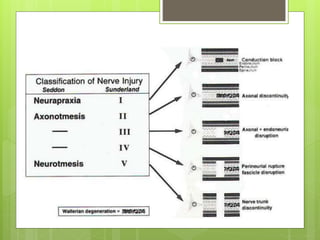
Seddon classification
 Seddon, 1978
 1st degree: compression, reversible,
recovery complete.
 2nd degree: interruption of axoplasm &
myelin, persistent compression,
recovery 1-2 months
 3rd degree: increased intraneural pressure,
loss of myelin tubes, recovery
2-4 months, incomplete recovery
 4th degree: partial transection, recovery-
poor
 5th degree: complete transection, no
recovery
 Bells palsy & herpes zoster- 1-3 deg
 Trauma, tumour or cholesteatoma- 4th- 5th
deg
Nerve regeneration
 Def: “ complex interactions of neurons,
schwann cells, extracellular matrix &
neurotrophic substances.
 Regeneration follows degeneration
 Sprouting at axonal end
 3 major changes:
 Distance bet node of Ranvier is altered
 Myelin covering axon is thinner
 Slitting & crossing of axons
 Factors affecting regeneration:
 Site of lesion
 Duration of injury
 Age
 Nutrition
 Blood supply
 Associated injury/ infection
 Gangliosides: agents used invivo for
aiding regeneration
 2 properties:
 Neuronotrophic
 Neuritogenic
 Bovine origin- used in peripheral neuropathies
 Immunomodulators:
 Nerve injury- release of nerve proteins –
‘foreign antigens’- leads to neuritis.
 Azathioprine, Hydrocortisone- aid nerve
regen.
 Growth factors:
 NGF- nerve growth factor
 NPF- neurite promoting factor
 NGF: inc. axonal branching
inc. dentritic branching
prevention of death of neurons
Grading system of facial nerve
 HOUSE & BRACKMAN’S:
1984- Facial Nerve Disorder Committee of American
Academy of Otolaryngology
 Grade 1: normal
 Grade 2: mild dysfunction
slight weakness
normal symmetry & tone
motion in forehead- moderate to good,
eye closure- complete
slight asymmetry of mouth
 Grade 3: moderate dysfunction
no disfiguring difference
Motion of forehead- slight to
moderate
Weakness of angle of mouth
Eye closure- incomplete
Grade 4: moderately severe dysfunction
obvious asymmetry
Rest- normal symmetry & tone
No motion in forehead
Eye closure- complete
Mouth movement with max effort
 Grade 5: severe dysfunction
barely perceptible motion at rest
Forehead motion-none
Eye closure- incomplete
Very slight mouth movement
o Grade 6: total paralysis
no movement
Causes of facial palsy
 BIRTH:
 Forceps delivery
 Moebius syndrome
 Dystrophia
myotonica
 TRAUMA
 Accidental
 Skull base #
 Penerating injury to
middle ear
 Barotrauma
 Scuba diving
 Iatrogenic
 Mastoid surgery
 Parotid surgery
 Postaural LA
 Antitetanus serum
 Rabies vaccine
 Embolization
 INFECTIONS:
 Bacterial
 Malignant otitis
externa
 Otitis media
 Tuberculosis
 Botulism
 Lyme disease
 Mostoiditis
 Viral
 Herpes zoster
cephalicus
 Poliomyelitis
 Encephalitis
 Fungal
 Mucormycosis
 NEOPLASTIC
 Cerebellopontine angle
tumours
 Vestibular schwannoma
 Facial nerve tumours
 Cochlear neuromas
 Meningioma
 Ependymoma
 Arachnoid cyst
 Temporal bone tumours
 Primary
 Glomus jugulare
 Von Recklinghausen’s
disease
 Hans- Schuller-
Christian disease
 Secondary
 Teratoma
 Leukemia
 Sarcoma
 Parotid tumours
 Benign
 Pleomorphic
adenoma
 Adenolymphoma
 Oxyphil adenoma
 Malignant
 Mucoepidermoid
carcinoma
 Acinic cell
carcinoma
 Adenocarcinoma
 Eoidermoid
carcinoma
 Neurological
 Opercular syndrome
 Milliard- Gabler
syndrome
 Encephalitis
 Multiple sclerosis
 Myasthenia gravis
 Charot- Marie- Tooth
disease
 Miscellaneous
 Toxic
 Tetanus
 Diphtheria
 Metabolic
 Diabetes
Testing of facial nerve
 Depends upon:
 Determining degree of axonal degeneration- “
electrodiagnosis”
 Function of accessory branches –
“ topognosis”
 Topognostic tests
 Lacrimation tests (
Schirmer’s test)
 Stapedial reflex
 Salivary flow test
 Sensation test
 CT
 Prognostic tests
 EMG
 NET
 NCT
 MST
 ENoG
 Diagnostic
assessment
 Blink reflex
 EMG
 EnoG
 Intraoperative
monitoring
 Electrically evoked
potential
 Mechanically
evoked potential
Topognostic tests
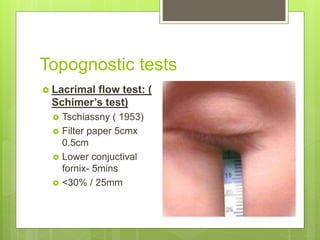
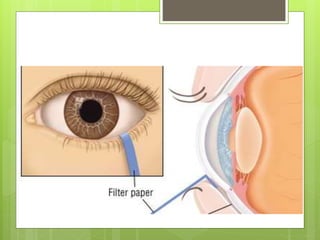
 Lacrimal flow test: (
Schimer’s test)
 Tschiassny ( 1953)
 Filter paper 5cmx
0.5cm
 Lower conjuctival
fornix- 5mins
 <30% / 25mm
 Salivary flow test:
 Magielski & Blatt
(1958)
 No. 50/60
polyethylene catheter-
Whartons papilla
 Lemon drops- suck for
1 min
 1-5 mins- monitor
 <25%
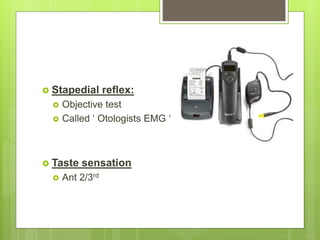
 Stapedial reflex:
 Objective test
 Called ‘ Otologists EMG ‘
 Taste sensation
 Ant 2/3rd
Electrodiagnostic tools
 2 types:
A) Orthodromic conduction tests: nerve
stimulated proximally, muscle response
distally
B) Antidromic conduction test: nerve stimulated
in retrograde manner
Disadv- artifacts, difficult to detect
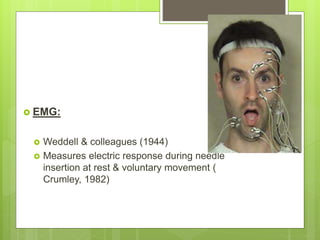
 EMG:
 Weddell & colleagues (1944)
 Measures electric response during needle
insertion at rest & voluntary movement (
Crumley, 1982)
 Merits:
 Detect subclinical evidence of early regeneration
 Differentiate birth trauma from embryological
etiology
 Determine completeness of neural blockade
 Demerits:
 Use only after 14- 21 days of nerve injury
 False response
 Nerve conduction time:
 ~ to EMG
 Tests latency response of a muscle
 EMG- stimulates nerve at stylomastoid
foramen.
 ‘latency’- time bet onset of stimulus & onset of
response
 Reliable
 Nerve excitibility test:
 Stimulating nerve at stylomastoid foramen-
twitch reflex
 Easy to perform, easily available, inexpensive.
 Difference of 3.5 mA bet sides- poor prognosis.
 Dermertis: small fibers- higher threshold
50% fibers have to be lost – best
results
 Maximal stimulation test:
 Modified NET
 Uses max stimulation to peripheral branches
 Current 5mA- increased slowly
 Electroneurography:
 Esselen, 1977
 Bipolar electrodes used
 2 techniques:
 Standard lead placement ( Hughes, 1981)
 Optimized lead placement ( Kartush, 1985)
 OPL more reliable- better subject tolerance
 Alar nasi- optimum site
 Magnetic stimulation:
 Barker (1985)
 Stimulate motor cortex by time varying magnetic fields
to induce electrical depolarization.
 At REZ- by transcranial penetration
 Blink reflex:
 Overend (1896)
 Tapping glabellar surface
 Electrically- stimulating supraorbital foramen- response
of orbicularis oculi
 Trigeminal- afferent, facial- efferent
 Test for intracranial & intratemporal portion
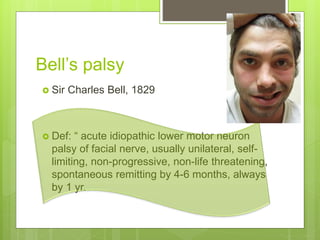
Bell’s palsy
 Sir Charles Bell, 1829
 Def: “ acute idiopathic lower motor neuron
palsy of facial nerve, usually unilateral, self-
limiting, non-progressive, non-life threatening,
spontaneous remitting by 4-6 months, always
by 1 yr.
 THEORIES:
 Vascular ischemia theory
 Viral theory
 Hereditary theory
 Vascular ischemia theory:
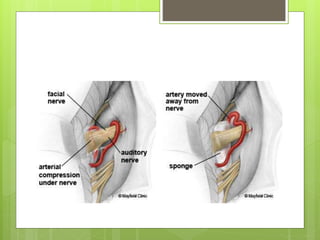
 Dec circulation to facial nerve.
 Interruption of major vessels/ sec to
compression within fallopian canal
 Primary: vasospasm of blood vessels
 Opposition: rich supply from stylomastoid &
petrossal vessels.
 Proponents: lack of anastomosis, dec vascularity
of horizontal segment, embolization of middle
meningeal artery
 Secondary: arterial constriction- capillary
dilatation- inc permeability- transudation
 Capillary dilatation- ischemic damage/ reflex from
fall in venous pressure
 Pressure from transudate- walls of lymph
capillaries- closed by compression.
 Fluid accumulates- compressed venules &
capillaries within fallopian canal- “ zonal ischemia”
 Teritiary: strangulation effect produces residual
facial paresis.
 Viral theory:
 Titer to herpes simplex virus/ herpes zoster
 Adour et al- acute benign cranial polyneuritis caused
by reactivation of herpes simplex virus.
 Virus replicates in ganglion cells causing local
damage & hypofunction of nerves.
 Passes down to axons- Radiculitis
 Infects schwann cells causing inflammation &
autoimmune response
 Lymphocytic infiltration- fragmentation of myelin-
demyelination
 Hereditary theory:
 Osteoporosis- fallopian canal – abnormal
small diameter
 Prone to ischemia/ viral infections
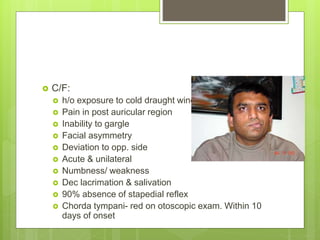
 C/F:
 h/o exposure to cold draught wind
 Pain in post auricular region
 Inability to gargle
 Facial asymmetry
 Deviation to opp. side
 Acute & unilateral
 Numbness/ weakness
 Dec lacrimation & salivation
 90% absence of stapedial reflex
 Chorda tympani- red on otoscopic exam. Within 10
days of onset
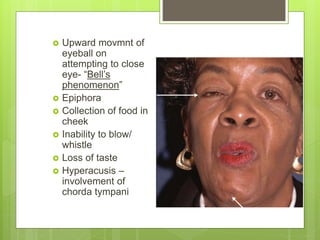
 Upward movmnt of
eyeball on
attempting to close
eye- “Bell’s
phenomenon”
 Epiphora
 Collection of food in
cheek
 Inability to blow/
whistle
 Loss of taste
 Hyperacusis –
involvement of
chorda tympani
 Management:
 Medical:
 Steroids: prednisolone, 60 mg for 3 wks (tapering)
 Acyclovir- 200- 400mg, 5 times /day
 Vasodilators: xanitol nicotinate, ascorbic acid,
multivitamins (B1,B6, B12)
 Eye care
 Active/ passive physiotherapy
 Surgical decompression:
 Criteria ( Marsh & Coker)
 Complete denervation
 Paralysis >4-6 wks
 Incomplete return of function in 60 days
 Recurrent facial palsy
 NET diff of 3.5mA bet both sides
Facial nerve in Temporal bone
fractures
 Longitudinal
 Transverse
 Mixed
 Longitudinal fractures:
 Results from blows ( temporal/ parietal)
 Fracture line: ant to otic capsule, involves
external & middle ear
 Bleeding from ear
 Conductive hearing loss- ossicular disruption
 Does not involve otic capsule
 No sensorineural hearing loss
 Facial nerve canal spared.
 Delay onset- nerve edema
 Transverse fractures:
 Frontal/ occipital blows
 Fracture line: through otic capsule
 Damages inner ear
 Hemotympanum
 Tympanic membrane intact- no bleeding from
ear
 Sensorineural hearing loss
 Tinnitus, nausea, vomiting, vertigo, facial palsy
 Mixed fractures:
 Comb of longitudinal & transverse
 Fragments of bone lies over facial nerve
 Comminuted fractures
 Brain edema/ pneumocranium
 Prolonged unconsciousness
 CSF leakage
 C/F:
 Deafness- conductive/ sensorineural/ mixed
 Hemotympanum/ bleeding from ear
 Facial palsy- lower motor neuron type
 Vertigo- subside in 2-3 wks
 Lateral rectus palsy- on opp side, intraorbital
hematoma
 CSF otorrhea & otorhinorrhea
 Discoloration of skin over mastoid- Battle’s sign
 Unconsciousness, neurological deficit.
 Management:
 HRCT
 X rays
 Facial nerve decompression
 Canal wall down technique
Iatrogenic injury of facial nerve
Methods to restore functional continuity:
a) Nerve intact but edematous- nerve
decompression , widening of fallopian canal-
slitting of nerve sheath- drain intraneural
hematoma.
b) Partial cut- suturing with 8-0 nylon/prolene
c) Complete transection- length of damage < 5mm,
re-routing, end to end anastomosis.
d) Complete transection- cut ends are apart- nerve
grafting with greater auricular nerve.
 keep upper end of anastomotic site more stable-
axonal nerve regeneration from above
downwards.
 Remove 1mm of neurilemmal sheath at
anastomotic ends, bevel cut ends.
 Complete transection with upper stump not
available for re-innervation, duration of palsy>
18 months – “facio-hypoglossal anastomosis”
 Disadv: mass movmnt, lack of emotion, paralysis
of tongue.
 Regeneration- 1mm/ day
 Other techniques:
 Sling operation using tendon/fascia
 Free neurovascular repair
 Muscle transposition
 Protection of eye:
 Dark goggles
 Tarsorrhaphy
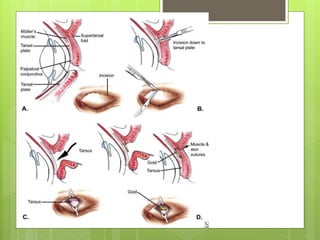
 Gold weight for upper eyelid
 Eyelid spring
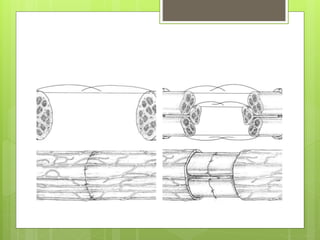
 Technique of nerve repair:
 Suturing:
 No loss of facial nerve segment
 Bleeding granulation- difficult identification
 8-0 nylon/prolene- no knots
 Tagged under nerve sheath- reposited back over
nerve
 Supported by temporalis fascia graft.
 Serves as splint- nerve ends stable, in approximation
 Scaffolding- guide cut ends to re-unite
Choice of procedure
 Dynamic & neuronal reconstruction
 Static methods
Dynamic reconstruction
 NEURAL REPAIR:
1) Direct nerve repair & grafting:
 Direct approximation/ autogenous nerve grafting
 Main trunk re-approximated with no tension
 Autografting- branches from cervical plexus
ipsilateral/ contralateral
 Sutured to terminal branches
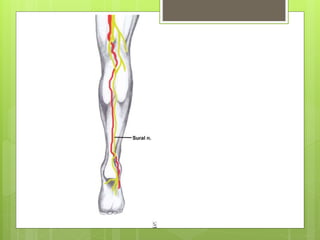
 Alternative- sural nerve
 Recovery- 6 to 24 months
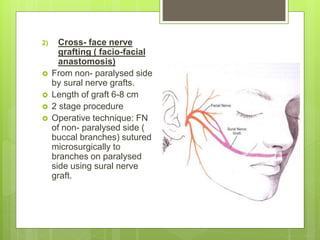
2) Cross- face nerve
grafting ( facio-facial
anastomosis)
 From non- paralysed side
by sural nerve grafts.
 Length of graft 6-8 cm
 2 stage procedure
 Operative technique: FN
of non- paralysed side (
buccal branches) sutured
microsurgically to
branches on paralysed
side using sural nerve
graft.
 Disadv:
 Long operating time
 Muscles undergo atrophy
 Only 50% fibers from normal side can be used
 2 suture lines of each graft
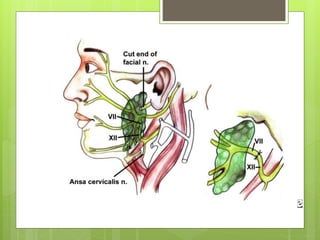
3) Nerve crossover:
 Adv: only one anastomosis
 Used when direct anastomosis is not feasible
 Nerves used: glossopharyngeal, accessory,
phrenic, hypoglossal
 Hypoglossal- facial cross over- most popular.
 Adv: simple, single suture line, powerful
innervation
 Disadv: uncooradinated movmnts, loss of
emotion, loss of function of donor nerve.
 MUSCLE REPAIR:
 Muscle transfer:
 Long standing muscle atrophy
 To mimetic muscles
 In combination with nerve graft
 Masseter & temporalis- commonly used
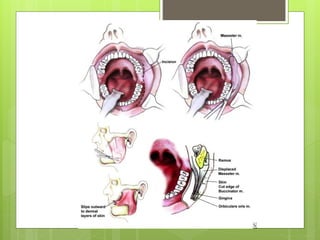
a) Masseter muscle transposition:
 Ideally suited to give motion of lower face (
De Castro & Zani 1993)
 3 muscle slips sutured to dermis of lower lip,
oral commissure & upper lip.
 Over correction- must be accomplished
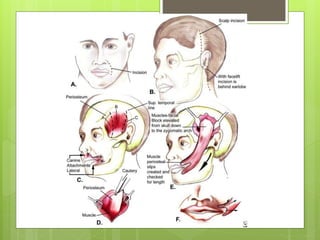
b) Temporalis muscle transposition:
 Facilitate grater excursive movements.
 Adaptibility to orbit
 2 temporal musculofacial trips- reconstruct
upper lip, lower lip & eyelids
 Adv:
 good muscle bulk, compensate lack of fullness
 Direct muscular insertion- greater range of
motion.
 Best suited for ocular paralysis
 Transfer muscles- from trigeminal nerve
 Facial movmnt on chewing, clenching &
moving mandible.
c) Free muscle graft:
 Muscle denervated 14 days before
transplantation
 Full length of muscle is preserved
 Denervated mucle is placed in direct contact
with normal vascularized muscle at recepient
site.
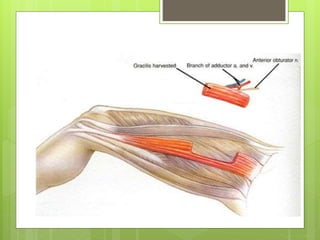
d) Free microneurovascular muscle
transfer:
 In combination with cross- face nerve graft/
ipsilateral nerve graft/ split hypoglossal
anastomosis.
 Provide new, vascularized muscle of face.
 Adv: transferred muscle reinnervated by cross
face nerve graft.
 Choices of donor muscles:
 Gracilis muscle
 Pectoralis minor
 Latissimus dorsi
 Serratus
 Rectus abdominis
 Platysma
 2 stage:
 1st stage- one/ more cross face nerve graft
 2nd stage- 9-12 months later vascularized
muscle transferred, neuronal element sutured
to distal end of cross face nerve graft
 Disadv:
 2 donor site scars
 2 yrs elapse before return to normal movmnt
Static methods of reconstruction
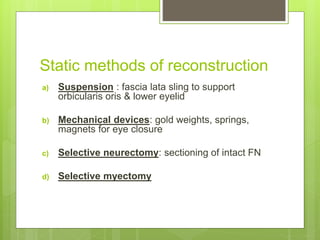
a) Suspension : fascia lata sling to support
orbicularis oris & lower eyelid
b) Mechanical devices: gold weights, springs,
magnets for eye closure
c) Selective neurectomy: sectioning of intact FN
d) Selective myectomy
e) Surgery for correction to camouflage
deformity: excision of nasolabial skin, face
lift, brow lift
f) Botulinum toxin: interfere ACH release
from motor nerve endplates causing
paralysis, 4-6 months
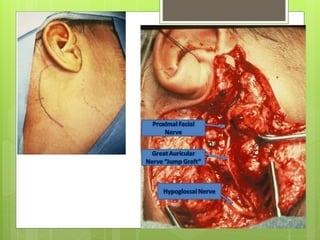
 Fascio- hypoglossal jump anastomoses
 End – to end anastomosis- no epineurium.
 Skin incision from insertion of lobule of ear,
curved backward & downward distance of 4 cm.
 Greater auricular nerve- identified, dissected,
obtain graft of 6cm length.
 FN stump identified & transected near
stylomastoid foramen.
 Hypoglossal nerve- identified, beneath digastric
muscle
 Distal end of graft of greater auricular nerve
interpositioned, end- to end to distal stump of
FN.
 Other end end- to side to obliquely transected
hypoglossal nerve.
 10-0 nylon sutures used- tension free approx.
facial nerve paralysis.pptx

facial nerve paralysis.pptx

  • 1.
  • 2.
    INTRODUCTION  Nerve ofsecond branchial arch.  Mixed nerve  Course:  Intracranial  Intratemporal  Extratemporal
  • 3.
    Supranuclear pathway  precentralgyrus of cerebral cortex – genu of internal capsule- pons – majority of fibers cross to reach opp side nucleus- some fibers terminate in ipsilateral nucleus.  Emerge from lower border of pons – motor & sensory root ( nerve of Wrisberg)
  • 5.
    Infranuclear pathway  Leavesnucleus with 8th nerve in cerebellopontine angle- enter IAC  Motor root:  Muscles of facial expression  Scalp  Auricle  Stylohyoid  Stapedius  Post belly of digastric
  • 7.
     Sensory root: Special visceral afferent : taste to ant 2/3rd of tongue via chorda tympani  General visceral efferent: salivary glands via petrosal  Special visceral efferent: to facial muscles
  • 8.
     Enter IAC-7th nerve joins nervus intermedius – form common trunk- leaves IAC- enters fallopian canal in temporal bone.  Total length in temporal bone- 22-33 mm.
  • 10.
     Subdivided segments: Horizontal segment from fundus of internal acoustic meatus to geniculate gang.- 3- 4mm “ LABYRINTHINE SEGMENT”  Acute angle turn to enter tympanic cavity- “FIRST GENU”  Post on medial wall of middle ear above promontory- “ TYMPANIC SEGMENT” ( 10-12mm)
  • 11.
     Curves downat pyramid and oval window at angle- “ SECOND GENU”  “MASTOID/ VERTICAL SEGMENT”- from second genu to stylomastoid foramen ( 9-16mm). `
  • 12.
     Facial (fallopian ) canal ( Gerrier 1977):  Individual sheath of pia mater curves up and continues with arachnoid.  Slight constriction of nerve seen just prior to it labyrinthine segment 0.68 ( Fisch U, 1981) in diameter.  Change in direction of the nerve that produces an angle of 132 deg, open anteriorly and medially.
  • 14.
    Branches of facialnerve  Intracranial:  Greater superficial petrosal nerve ( secretomotor- lacrimal gland)  Intratemporal:  Nerve to stapedius- from mastoid segment ( supplies stapedius)  Chorda tympani nerve- from mastoid segment- joins lingual nerve to supple ant 2/3rd of tongue, secretomotor to submand. Gland.  Sensory branches join auricular branch of vagus to supply external auditory canal.
  • 15.
    Branches in head& neck  Ansa Haller ( inconstant)- immediately below stylomastoid foramen, anastomses with glossopharyngeal nerve.  Posterior auricular nerve- 1-2mm below stylomastoid foramen.  Styloid branch- enters styloid muscle.  Branch to post belly of digastric.
  • 16.
    Branches in parotidplexus  Temporal branch  Zygomatic branch  Buccal  Marginal mandibular  Cervical
  • 18.
    Landmarks of facialnerve  Tragal pointer: 1 cm inf to tragal cartilage  Tympanomastoid suture: angle where the vaginal process of tympanic portion of temporal bone meets mastoid process.  Styloid process: lateral to styloid process.
  • 19.
     Tracing terminalbranch backwards:  Ramus frontalis: tragus to lateral canthus  Ramus buccalis: tragus to alar nose, parallel to zygoma.  Ramus mandibularis: angle of mand. at pont 4- 4.5cm from attachment of lobule of pinna.  Tendon of post belly of digastric  Post auricular vein/ retromandibular vein
  • 20.
    • Distance ofFN from anatomical structures • Tragal pointer, 24.3 to 49.2 (mean 34) • Posterior belly of digastric, 9.7 to 24.3 (mean 14.6) • External auditory canal, 7.3 to 21.9 (mean 13.4) • Tympanomastoid suture, 4.9 to 18.6 (mean 10.0) • Styloid process, 4.3 to 18.6 (mean 9.8) • Transverse process of the axis, 9.7 to 36.8 (mean 16.9) • Angle of the mandible, 25.3 to 48.69 (mean 38.1). • The length of the facial nerve trunk from its point of exit from the stylomastoid foramen to its bifurcation into upper and lower divisions ranged from (mm) 8.6 to 22.8 (mean 14.0). Surg Radiol Anat. 2006 May;28(2):170-5. Epub 2006 Apr 20. Landmarks of the facial nerve: implications for parotidectomy. Pather N, Osman M.
  • 21.
    Variations in course DINGMAN& GRABB,1962 Type I-no anastomosis occurred between branches of the facial nerve. Type II presence of an anastomotic connection between branches of temporofacial division. Type III-a single anastomosis between the temporofacial and cervicofacial divisions
  • 22.
    Type IV acombination of type II and type III Type V two anastomotic rami passed from the cervicofacial division to interwine with the branches of temporofacial division. Type VI plexiform arrangement, the mandibular branch sent twig to join any members of the temporofacial division.
  • 24.
    Neurophysiology & nerve regeneration Facial expression depends on 7000 motor fibres- muscle contractions.  Degree of nerve injury:  Neuropraxia  Axontemesis  Neurontemesis
  • 25.
    Seddon classification  Seddon,1978  1st degree: compression, reversible, recovery complete.  2nd degree: interruption of axoplasm & myelin, persistent compression, recovery 1-2 months  3rd degree: increased intraneural pressure, loss of myelin tubes, recovery 2-4 months, incomplete recovery
  • 27.
     4th degree:partial transection, recovery- poor  5th degree: complete transection, no recovery  Bells palsy & herpes zoster- 1-3 deg  Trauma, tumour or cholesteatoma- 4th- 5th deg
  • 28.
    Nerve regeneration  Def:“ complex interactions of neurons, schwann cells, extracellular matrix & neurotrophic substances.  Regeneration follows degeneration  Sprouting at axonal end
  • 29.
     3 majorchanges:  Distance bet node of Ranvier is altered  Myelin covering axon is thinner  Slitting & crossing of axons
  • 30.
     Factors affectingregeneration:  Site of lesion  Duration of injury  Age  Nutrition  Blood supply  Associated injury/ infection
  • 31.
     Gangliosides: agentsused invivo for aiding regeneration  2 properties:  Neuronotrophic  Neuritogenic  Bovine origin- used in peripheral neuropathies
  • 32.
     Immunomodulators:  Nerveinjury- release of nerve proteins – ‘foreign antigens’- leads to neuritis.  Azathioprine, Hydrocortisone- aid nerve regen.
  • 33.
     Growth factors: NGF- nerve growth factor  NPF- neurite promoting factor  NGF: inc. axonal branching inc. dentritic branching prevention of death of neurons
  • 34.
    Grading system offacial nerve  HOUSE & BRACKMAN’S: 1984- Facial Nerve Disorder Committee of American Academy of Otolaryngology  Grade 1: normal  Grade 2: mild dysfunction slight weakness normal symmetry & tone motion in forehead- moderate to good, eye closure- complete slight asymmetry of mouth
  • 35.
     Grade 3:moderate dysfunction no disfiguring difference Motion of forehead- slight to moderate Weakness of angle of mouth Eye closure- incomplete Grade 4: moderately severe dysfunction obvious asymmetry Rest- normal symmetry & tone No motion in forehead Eye closure- complete Mouth movement with max effort
  • 36.
     Grade 5:severe dysfunction barely perceptible motion at rest Forehead motion-none Eye closure- incomplete Very slight mouth movement o Grade 6: total paralysis no movement
  • 37.
    Causes of facialpalsy  BIRTH:  Forceps delivery  Moebius syndrome  Dystrophia myotonica  TRAUMA  Accidental  Skull base #  Penerating injury to middle ear  Barotrauma  Scuba diving  Iatrogenic  Mastoid surgery  Parotid surgery  Postaural LA  Antitetanus serum  Rabies vaccine  Embolization
  • 38.
     INFECTIONS:  Bacterial Malignant otitis externa  Otitis media  Tuberculosis  Botulism  Lyme disease  Mostoiditis  Viral  Herpes zoster cephalicus  Poliomyelitis  Encephalitis  Fungal  Mucormycosis  NEOPLASTIC  Cerebellopontine angle tumours  Vestibular schwannoma  Facial nerve tumours  Cochlear neuromas  Meningioma  Ependymoma  Arachnoid cyst  Temporal bone tumours  Primary  Glomus jugulare  Von Recklinghausen’s disease  Hans- Schuller- Christian disease  Secondary  Teratoma  Leukemia  Sarcoma
  • 39.
     Parotid tumours Benign  Pleomorphic adenoma  Adenolymphoma  Oxyphil adenoma  Malignant  Mucoepidermoid carcinoma  Acinic cell carcinoma  Adenocarcinoma  Eoidermoid carcinoma  Neurological  Opercular syndrome  Milliard- Gabler syndrome  Encephalitis  Multiple sclerosis  Myasthenia gravis  Charot- Marie- Tooth disease  Miscellaneous  Toxic  Tetanus  Diphtheria  Metabolic  Diabetes
  • 40.
    Testing of facialnerve  Depends upon:  Determining degree of axonal degeneration- “ electrodiagnosis”  Function of accessory branches – “ topognosis”
  • 41.
     Topognostic tests Lacrimation tests ( Schirmer’s test)  Stapedial reflex  Salivary flow test  Sensation test  CT  Prognostic tests  EMG  NET  NCT  MST  ENoG  Diagnostic assessment  Blink reflex  EMG  EnoG  Intraoperative monitoring  Electrically evoked potential  Mechanically evoked potential
  • 43.
    Topognostic tests  Lacrimalflow test: ( Schimer’s test)  Tschiassny ( 1953)  Filter paper 5cmx 0.5cm  Lower conjuctival fornix- 5mins  <30% / 25mm
  • 45.
     Salivary flowtest:  Magielski & Blatt (1958)  No. 50/60 polyethylene catheter- Whartons papilla  Lemon drops- suck for 1 min  1-5 mins- monitor  <25%
  • 46.
     Stapedial reflex: Objective test  Called ‘ Otologists EMG ‘  Taste sensation  Ant 2/3rd
  • 47.
    Electrodiagnostic tools  2types: A) Orthodromic conduction tests: nerve stimulated proximally, muscle response distally B) Antidromic conduction test: nerve stimulated in retrograde manner Disadv- artifacts, difficult to detect
  • 48.
     EMG:  Weddell& colleagues (1944)  Measures electric response during needle insertion at rest & voluntary movement ( Crumley, 1982)
  • 49.
     Merits:  Detectsubclinical evidence of early regeneration  Differentiate birth trauma from embryological etiology  Determine completeness of neural blockade  Demerits:  Use only after 14- 21 days of nerve injury  False response
  • 50.
     Nerve conductiontime:  ~ to EMG  Tests latency response of a muscle  EMG- stimulates nerve at stylomastoid foramen.  ‘latency’- time bet onset of stimulus & onset of response  Reliable
  • 51.
     Nerve excitibilitytest:  Stimulating nerve at stylomastoid foramen- twitch reflex  Easy to perform, easily available, inexpensive.  Difference of 3.5 mA bet sides- poor prognosis.  Dermertis: small fibers- higher threshold 50% fibers have to be lost – best results
  • 52.
     Maximal stimulationtest:  Modified NET  Uses max stimulation to peripheral branches  Current 5mA- increased slowly  Electroneurography:  Esselen, 1977  Bipolar electrodes used  2 techniques:  Standard lead placement ( Hughes, 1981)  Optimized lead placement ( Kartush, 1985)  OPL more reliable- better subject tolerance  Alar nasi- optimum site
  • 53.
     Magnetic stimulation: Barker (1985)  Stimulate motor cortex by time varying magnetic fields to induce electrical depolarization.  At REZ- by transcranial penetration  Blink reflex:  Overend (1896)  Tapping glabellar surface  Electrically- stimulating supraorbital foramen- response of orbicularis oculi  Trigeminal- afferent, facial- efferent  Test for intracranial & intratemporal portion
  • 54.
    Bell’s palsy  SirCharles Bell, 1829  Def: “ acute idiopathic lower motor neuron palsy of facial nerve, usually unilateral, self- limiting, non-progressive, non-life threatening, spontaneous remitting by 4-6 months, always by 1 yr.
  • 55.
     THEORIES:  Vascularischemia theory  Viral theory  Hereditary theory
  • 56.
     Vascular ischemiatheory:  Dec circulation to facial nerve.  Interruption of major vessels/ sec to compression within fallopian canal  Primary: vasospasm of blood vessels  Opposition: rich supply from stylomastoid & petrossal vessels.  Proponents: lack of anastomosis, dec vascularity of horizontal segment, embolization of middle meningeal artery
  • 57.
     Secondary: arterialconstriction- capillary dilatation- inc permeability- transudation  Capillary dilatation- ischemic damage/ reflex from fall in venous pressure  Pressure from transudate- walls of lymph capillaries- closed by compression.  Fluid accumulates- compressed venules & capillaries within fallopian canal- “ zonal ischemia”  Teritiary: strangulation effect produces residual facial paresis.
  • 58.
     Viral theory: Titer to herpes simplex virus/ herpes zoster  Adour et al- acute benign cranial polyneuritis caused by reactivation of herpes simplex virus.  Virus replicates in ganglion cells causing local damage & hypofunction of nerves.  Passes down to axons- Radiculitis  Infects schwann cells causing inflammation & autoimmune response  Lymphocytic infiltration- fragmentation of myelin- demyelination
  • 59.
     Hereditary theory: Osteoporosis- fallopian canal – abnormal small diameter  Prone to ischemia/ viral infections
  • 60.
     C/F:  h/oexposure to cold draught wind  Pain in post auricular region  Inability to gargle  Facial asymmetry  Deviation to opp. side  Acute & unilateral  Numbness/ weakness  Dec lacrimation & salivation  90% absence of stapedial reflex  Chorda tympani- red on otoscopic exam. Within 10 days of onset
  • 61.
     Upward movmntof eyeball on attempting to close eye- “Bell’s phenomenon”  Epiphora  Collection of food in cheek  Inability to blow/ whistle  Loss of taste  Hyperacusis – involvement of chorda tympani
  • 62.
     Management:  Medical: Steroids: prednisolone, 60 mg for 3 wks (tapering)  Acyclovir- 200- 400mg, 5 times /day  Vasodilators: xanitol nicotinate, ascorbic acid, multivitamins (B1,B6, B12)  Eye care  Active/ passive physiotherapy
  • 63.
     Surgical decompression: Criteria ( Marsh & Coker)  Complete denervation  Paralysis >4-6 wks  Incomplete return of function in 60 days  Recurrent facial palsy  NET diff of 3.5mA bet both sides
  • 65.
    Facial nerve inTemporal bone fractures  Longitudinal  Transverse  Mixed
  • 66.
     Longitudinal fractures: Results from blows ( temporal/ parietal)  Fracture line: ant to otic capsule, involves external & middle ear  Bleeding from ear  Conductive hearing loss- ossicular disruption  Does not involve otic capsule  No sensorineural hearing loss  Facial nerve canal spared.  Delay onset- nerve edema
  • 67.
     Transverse fractures: Frontal/ occipital blows  Fracture line: through otic capsule  Damages inner ear  Hemotympanum  Tympanic membrane intact- no bleeding from ear  Sensorineural hearing loss  Tinnitus, nausea, vomiting, vertigo, facial palsy
  • 68.
     Mixed fractures: Comb of longitudinal & transverse  Fragments of bone lies over facial nerve  Comminuted fractures  Brain edema/ pneumocranium  Prolonged unconsciousness  CSF leakage
  • 69.
     C/F:  Deafness-conductive/ sensorineural/ mixed  Hemotympanum/ bleeding from ear  Facial palsy- lower motor neuron type  Vertigo- subside in 2-3 wks  Lateral rectus palsy- on opp side, intraorbital hematoma  CSF otorrhea & otorhinorrhea  Discoloration of skin over mastoid- Battle’s sign  Unconsciousness, neurological deficit.
  • 70.
     Management:  HRCT X rays  Facial nerve decompression  Canal wall down technique
  • 71.
    Iatrogenic injury offacial nerve Methods to restore functional continuity: a) Nerve intact but edematous- nerve decompression , widening of fallopian canal- slitting of nerve sheath- drain intraneural hematoma. b) Partial cut- suturing with 8-0 nylon/prolene
  • 72.
    c) Complete transection-length of damage < 5mm, re-routing, end to end anastomosis. d) Complete transection- cut ends are apart- nerve grafting with greater auricular nerve.  keep upper end of anastomotic site more stable- axonal nerve regeneration from above downwards.  Remove 1mm of neurilemmal sheath at anastomotic ends, bevel cut ends.
  • 73.
     Complete transectionwith upper stump not available for re-innervation, duration of palsy> 18 months – “facio-hypoglossal anastomosis”  Disadv: mass movmnt, lack of emotion, paralysis of tongue.  Regeneration- 1mm/ day
  • 74.
     Other techniques: Sling operation using tendon/fascia  Free neurovascular repair  Muscle transposition  Protection of eye:  Dark goggles  Tarsorrhaphy  Gold weight for upper eyelid  Eyelid spring
  • 75.
     Technique ofnerve repair:  Suturing:  No loss of facial nerve segment  Bleeding granulation- difficult identification  8-0 nylon/prolene- no knots  Tagged under nerve sheath- reposited back over nerve  Supported by temporalis fascia graft.  Serves as splint- nerve ends stable, in approximation  Scaffolding- guide cut ends to re-unite
  • 77.
    Choice of procedure Dynamic & neuronal reconstruction  Static methods
  • 78.
    Dynamic reconstruction  NEURALREPAIR: 1) Direct nerve repair & grafting:  Direct approximation/ autogenous nerve grafting  Main trunk re-approximated with no tension  Autografting- branches from cervical plexus ipsilateral/ contralateral  Sutured to terminal branches  Alternative- sural nerve  Recovery- 6 to 24 months
  • 80.
    2) Cross- facenerve grafting ( facio-facial anastomosis)  From non- paralysed side by sural nerve grafts.  Length of graft 6-8 cm  2 stage procedure  Operative technique: FN of non- paralysed side ( buccal branches) sutured microsurgically to branches on paralysed side using sural nerve graft.
  • 81.
     Disadv:  Longoperating time  Muscles undergo atrophy  Only 50% fibers from normal side can be used  2 suture lines of each graft
  • 82.
    3) Nerve crossover: Adv: only one anastomosis  Used when direct anastomosis is not feasible  Nerves used: glossopharyngeal, accessory, phrenic, hypoglossal  Hypoglossal- facial cross over- most popular.  Adv: simple, single suture line, powerful innervation  Disadv: uncooradinated movmnts, loss of emotion, loss of function of donor nerve.
  • 84.
     MUSCLE REPAIR: Muscle transfer:  Long standing muscle atrophy  To mimetic muscles  In combination with nerve graft  Masseter & temporalis- commonly used
  • 85.
    a) Masseter muscletransposition:  Ideally suited to give motion of lower face ( De Castro & Zani 1993)  3 muscle slips sutured to dermis of lower lip, oral commissure & upper lip.  Over correction- must be accomplished
  • 87.
    b) Temporalis muscletransposition:  Facilitate grater excursive movements.  Adaptibility to orbit  2 temporal musculofacial trips- reconstruct upper lip, lower lip & eyelids  Adv:  good muscle bulk, compensate lack of fullness  Direct muscular insertion- greater range of motion.  Best suited for ocular paralysis  Transfer muscles- from trigeminal nerve  Facial movmnt on chewing, clenching & moving mandible.
  • 89.
    c) Free musclegraft:  Muscle denervated 14 days before transplantation  Full length of muscle is preserved  Denervated mucle is placed in direct contact with normal vascularized muscle at recepient site.
  • 90.
    d) Free microneurovascularmuscle transfer:  In combination with cross- face nerve graft/ ipsilateral nerve graft/ split hypoglossal anastomosis.  Provide new, vascularized muscle of face.  Adv: transferred muscle reinnervated by cross face nerve graft.
  • 92.
     Choices ofdonor muscles:  Gracilis muscle  Pectoralis minor  Latissimus dorsi  Serratus  Rectus abdominis  Platysma
  • 93.
     2 stage: 1st stage- one/ more cross face nerve graft  2nd stage- 9-12 months later vascularized muscle transferred, neuronal element sutured to distal end of cross face nerve graft  Disadv:  2 donor site scars  2 yrs elapse before return to normal movmnt
  • 94.
    Static methods ofreconstruction a) Suspension : fascia lata sling to support orbicularis oris & lower eyelid b) Mechanical devices: gold weights, springs, magnets for eye closure c) Selective neurectomy: sectioning of intact FN d) Selective myectomy
  • 96.
    e) Surgery forcorrection to camouflage deformity: excision of nasolabial skin, face lift, brow lift f) Botulinum toxin: interfere ACH release from motor nerve endplates causing paralysis, 4-6 months
  • 97.
     Fascio- hypoglossaljump anastomoses  End – to end anastomosis- no epineurium.  Skin incision from insertion of lobule of ear, curved backward & downward distance of 4 cm.  Greater auricular nerve- identified, dissected, obtain graft of 6cm length.  FN stump identified & transected near stylomastoid foramen.  Hypoglossal nerve- identified, beneath digastric muscle
  • 100.
     Distal endof graft of greater auricular nerve interpositioned, end- to end to distal stump of FN.  Other end end- to side to obliquely transected hypoglossal nerve.  10-0 nylon sutures used- tension free approx.