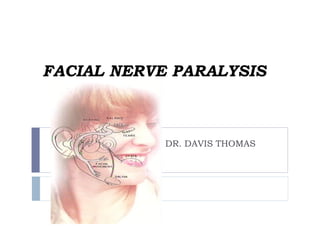
FACIAL NERVE PARALYSIS
DR. DAVIS THOMAS
ANATOMY OF FACIAL NERVE
Facial nerve is the 7th
cranial nerve.
It is a mixed nerve.
Has a motor & a sensory root.
Motor root supplies all the mimetic muscles of the face
which develop from the 2nd
branchial arch.
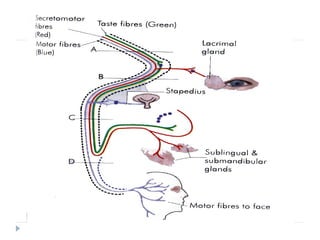
Sensory root (nerve of Wrisberg) carries secretomotor
fibres to the lacrimal, submandibular & sublingual
glands.
Also to nose & palate.
Carries taste sensation to the anterior 2/3rd
of the
tongue.
General sensation of the concha & retroauricular skin.
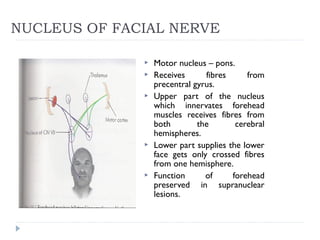
NUCLEUS OF FACIAL NERVE
 Motor nucleus – pons.
 Receives fibres from
precentral gyrus.
 Upper part of the nucleus
which innervates forehead
muscles receives fibres from
both the cerebral
hemispheres.
 Lower part supplies the lower
face gets only crossed fibres
from one hemisphere.
 Function of forehead
preserved in supranuclear
lesions.
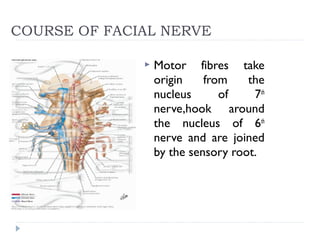
COURSE OF FACIAL NERVE
 Motor fibres take
origin from the
nucleus of 7th
nerve,hook around
the nucleus of 6th
nerve and are joined
by the sensory root.
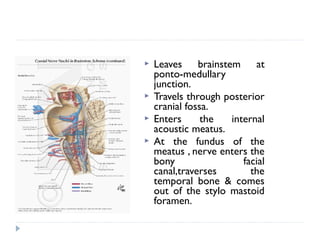
 Leaves brainstem at
ponto-medullary
junction.
 Travels through posterior
cranial fossa.
 Enters the internal
acoustic meatus.
 At the fundus of the
meatus , nerve enters the
bony facial
canal,traverses the
temporal bone & comes
out of the stylo mastoid
foramen.
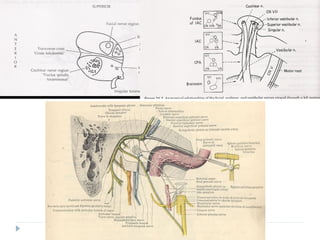
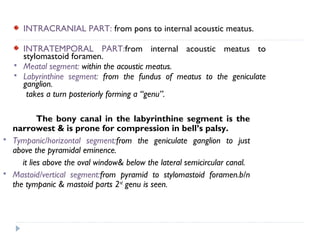
INTRACRANIAL PART: from pons to internal acoustic meatus.
INTRATEMPORAL PART:from internal acoustic meatus to
stylomastoid foramen.
 Meatal segment: within the acoustic meatus.
 Labyrinthine segment: from the fundus of meatus to the geniculate
ganglion.
takes a turn posteriorly forming a “genu”.
The bony canal in the labyrinthine segment is the
narrowest & is prone for compression in bell’s palsy.
 Tympanic/horizontal segment:from the geniculate ganglion to just
above the pyramidal eminence.
it lies above the oval window& below the lateral semicircular canal.
 Mastoid/vertical segment:from pyramid to stylomastoid foramen.b/n
the tympanic & mastoid parts 2nd
genu is seen.
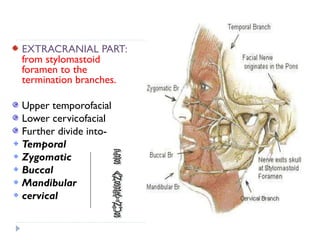
EXTRACRANIAL PART:
from stylomastoid
foramen to the
termination branches.
Upper temporofacial
Lower cervicofacial
Further divide into-
Temporal
Zygomatic
Buccal
Mandibular
cervical
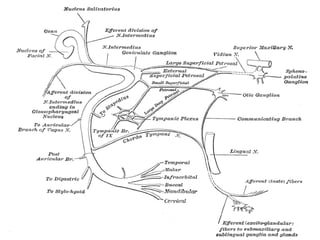
BRANCHES OF FACIAL NERVE
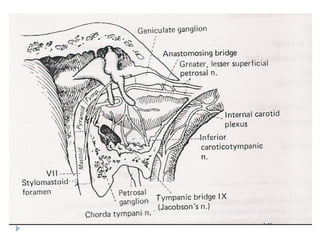
 GREATER SUPERFICIAL PETROSAL NERVE: it arises from the
geniculate ganglion and carries the secretomotor fibres to the
lacrimal gland and the glands of nasal mucosa.
 NERVE TO STAPEDIUS: it arises at the level of second genu and
supplies the stapedius muscle.
 CHORDA TYMPANI: it arises from the middle of vertical
segment
-passes between the incus and neck of malleus and leaves
the tympanic cavity through petrotympanic fissure.
-carries secretomotor fibres to sublingual and
submandibular salivary glands and brings taste to anterior 2/3rd
of the tongue.
 COMMUNICATING BRANCH:it joins the auricular
branch of vagus and supplies the
concha,retroauricular groove,posterior meatus and
the outer surface of the tympanic membrane.
 POSTERIOR AURICULAR NERVE:it supplies the muscles
of pinna, occipital belly of occipitofrontalis nad
communicates with auricular branch of vagus.
 MUSCULAR BRANCHES:stylohyoid and posterior belly
of digastric.
 PERIPHERAL BRANCHES.
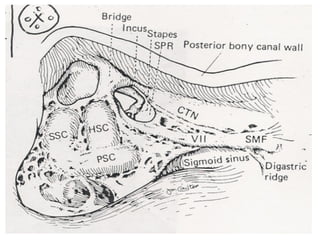
SURGICAL LANDMARKS OF FACIAL
NERVE
 FOR EAR & MASTOID SURGERY
1) Processus cochleariformis-it demarcates the
geniculate ganglion which just lies anterior to
it.tympanic segment of the nerve starts at this level.
2) Oval window & horizontal canal-it runs above the
stapes and below the horizontal canal.
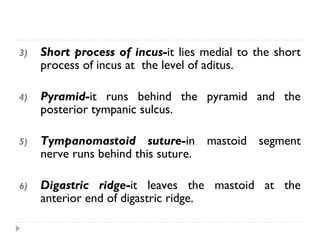
3) Short process of incus-it lies medial to the short
process of incus at the level of aditus.
4) Pyramid-it runs behind the pyramid and the
posterior tympanic sulcus.
5) Tympanomastoid suture-in mastoid segment
nerve runs behind this suture.
6) Digastric ridge-it leaves the mastoid at the
anterior end of digastric ridge.
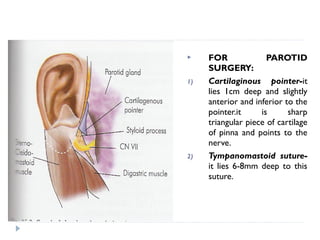
 FOR PAROTID
SURGERY:
1) Cartilaginous pointer-it
lies 1cm deep and slightly
anterior and inferior to the
pointer.it is sharp
triangular piece of cartilage
of pinna and points to the
nerve.
2) Tympanomastoid suture-
it lies 6-8mm deep to this
suture.
3) Styloid process-it crosses lateral to styloid process
4) Posterior belly of digastric-if posterior belly of
digastric is traced backwards along its upper border to
its attachment to the digastric groove,nerve is found to
lie between it and the styloid process.
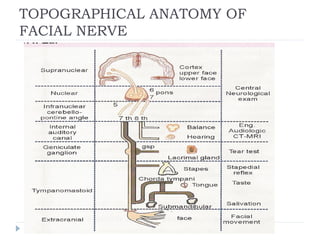
TOPOGRAPHICAL ANATOMY OF
FACIAL NERVE
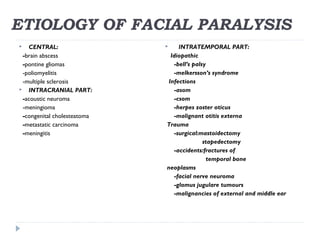
ETIOLOGY OF FACIAL PARALYSIS
 CENTRAL:
-brain abscess
-pontine gliomas
-poliomyelitis
-multiple sclerosis
 INTRACRANIAL PART:
-acoustic neuroma
-meningioma
-congenital cholesteatoma
-metastatic carcinoma
-meningitis
 INTRATEMPORAL PART:
Idiopathic
-bell’s palsy
-melkersson’s syndrome
Infections
-asom
-csom
-herpes zoster oticus
-malignant otitis externa
Trauma
-surgical:mastoidectomy
stapedectomy
-accidents:fractures of
temporal bone
neoplasms
-facial nerve neuroma
-glomus jugulare tumours
-malignancies of external and middle ear
 EXTRACRANIAL PART:
malignancy of parotid
surgery of parotid
accidental injury in parotid region
neonatal facial injury.
 SYSTEMIC DISEASES:
diabetes mellitus
hypothyroidism
uraemia
polyarteritis nodosa
wegener’s
granulomatosis
sarcoidosis
leprosy
leukemia
demyelinating disease
 IDIOPATHIC BELL’S PALSY
 Idiopathic, peripheral facial paralysis of acute onset.
 Incidence  male = female
< 13 yrs & > 65 yrs
 Aetiology :
 Viral  Herpes simplex, Herpes Zoster & Ebstein – Barr Virus
 Vascular ischemia
 Hereditary
 Auto immune disorder
 Diagnosis :
Always by exclusion
Careful history, complete otological & head & neck examination, x-ray studies,
blood test
Net & Topodiagnosis
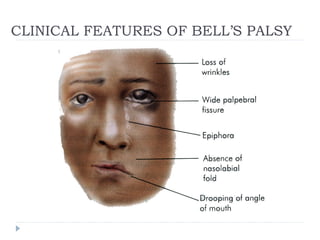
CLINICAL FEATURES OF BELL’S PALSY
BELL’S PALSY
 Treatment :
General : (1) Reassurance
(2) Relief of ear pain by analgesics
(3) Care of eye
(4) Physotherapy or Massage of facial
muscles
 Medical Management :
-Steroids – Prednisolone 1 mg / kg / day divided into morning & evening
doses for 5 days
-If recovery occurs, taper the dose.
-Can be combined with acyclovir.
-Other drugs – Vasodilators, mast cell inhibitors, vitamins
BELL’S PALSY
 Surgical treatment :
-Nerve decompression of vertical & tympanic segment of
nerve
 Prognosis
-85 – 90% recover fully.
 INFECTIONS
-Ramsay – Hunt Syndrome :
Facial paralysis along with vesicular rash in EAC & Pinna
Mgt. as in bells palsy
 Infection of middle ear :
ASOM – Bony canal in dehiscent inflammation of middle ear spreads to
epineurium & perineurium causing facial paralysis
Mgt : Treat ASOM - systemic antibiotics
Myringotomy / cortical mastoidectomy
CSOM : due to cholesteatoma / penetrating granulation tissue.
Mgt : Urgent exploration of middle ear & mastoid
 Trauma
-Fracture of temporal bone
-Common in transverse type.
- Mgt. : Surgical decompression, re-anastomosis of cut
ends or cable nerve graft.
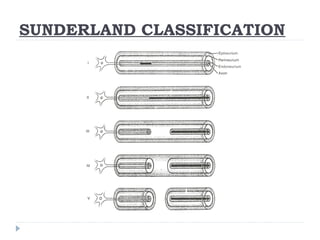
SUNDERLAND CLASSIFICATION
 5 Classes of Injury
 Class 1 : Partial block to flow of axoplasm ; no morphological
changes are seen. Recovery of function is complete (Neuropraxia)
 Class 2 : Loss of axoplasm ; but endoneural tube remain intact.
During recovery axons will grow into the respective tubes and the result is
good (axonotemesis)
 Class 3 : Injury to endoneurium ; during recovery axons of one tube
can grow into another synkinesis can occur (Neurotemesis)
 Class 4 : Injury to Perineurium ; in addition to above scarring will
impair regeneration of fibers (Partial Transection)

 Class 5 : Injury to epineurium in addition to above. (Complete
nerve transection)
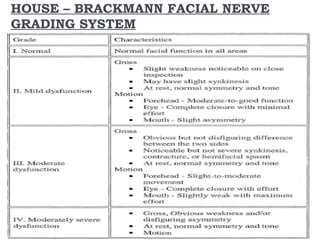
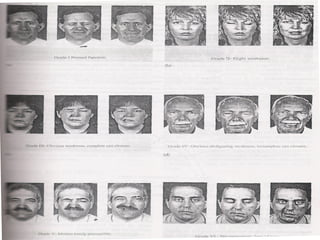
HOUSE – BRACKMANN FACIAL NERVE
GRADING SYSTEM
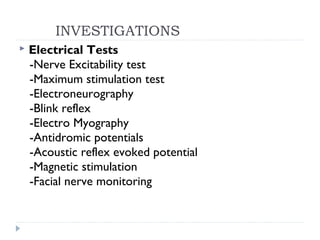
INVESTIGATIONS
 Electrical Tests
-Nerve Excitability test
-Maximum stimulation test
-Electroneurography
-Blink reflex
-Electro Myography
-Antidromic potentials
-Acoustic reflex evoked potential
-Magnetic stimulation
-Facial nerve monitoring
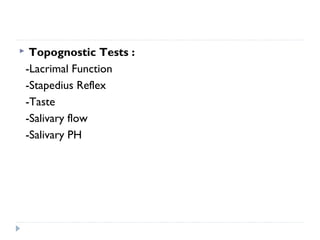
 Topognostic Tests :
-Lacrimal Function
-Stapedius Reflex
-Taste
-Salivary flow
-Salivary PH
 NERVE EXCITABILITY TEST [NET]
-When the difference between 2 sides exceed 3.5 MA the test is positive
for degeneration.
-Degeneration of fibres cannot be detected earlier than 48 to 72 hours of
its commencement
 MAXIMUM STIMULATION TEST [MST]
-The movements on the paralysed side are subjectively expressed as a
percentage (0%, 25%, 50%, 75% & 100%) of the movement on the healthy
side.
 ELECTRO NEUROGRAPHY [ENOG]
 Evoked electromyography
 Nerve is stimulated and the compound action potentials from facial muscles are
recorded and measured objectively & compared with normal side.
 The average difference in healthy is only 3%
 > 30% considered as abnormal
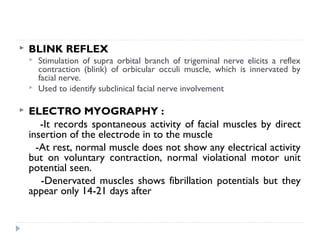
 BLINK REFLEX
 Stimulation of supra orbital branch of trigeminal nerve elicits a reflex
contraction (blink) of orbicular occuli muscle, which is innervated by
facial nerve.
 Used to identify subclinical facial nerve involvement
 ELECTRO MYOGRAPHY :
-It records spontaneous activity of facial muscles by direct
insertion of the electrode in to the muscle
-At rest, normal muscle does not show any electrical activity
but on voluntary contraction, normal violational motor unit
potential seen.
-Denervated muscles shows fibrillation potentials but they
appear only 14-21 days after
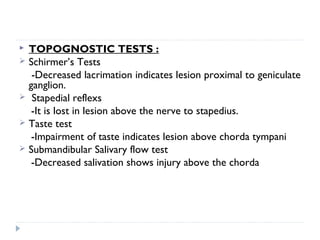
 TOPOGNOSTIC TESTS :
 Schirmer’s Tests
-Decreased lacrimation indicates lesion proximal to geniculate
ganglion.
 Stapedial reflexs
-It is lost in lesion above the nerve to stapedius.
 Taste test
-Impairment of taste indicates lesion above chorda tympani
 Submandibular Salivary flow test
-Decreased salivation shows injury above the chorda
COMPLICATIONS FOLLOWING FACIAL PALSY
 Incomplete recovery
 Exposure Keratitis
– incomplete closure of eyes
– leads to dryness
– exposure keratitis & corneal ulcers
- Prevented my methylcellulore drops, eye ointment & proper cover for the eye at night
 Temporary tarsorrhaphy may also be indicated
 Synkinesis (mass movement)
 Tics & spasms
 Contractures
 Crocodile tears (gustatory lacrimation)
-Treated by section of greater superficial petrosal nerve or tympanic neurectomy
 Frey’s Syndrone (Gustatory sweating)
 Psychological & social problem
SURGICAL MANAGEMENT
 Decompression
 End to end anastomosis
 Nerve graft – graft taken from greater auricular, lateral
cutaneous nerve of thigh or sural nerve
 Hypoglossal facial anastomossis
THANK YOU

Facial nerve paralysis dr.davis -11.04.16

  • 1.
  • 2.
    ANATOMY OF FACIALNERVE Facial nerve is the 7th cranial nerve. It is a mixed nerve. Has a motor & a sensory root. Motor root supplies all the mimetic muscles of the face which develop from the 2nd branchial arch. Sensory root (nerve of Wrisberg) carries secretomotor fibres to the lacrimal, submandibular & sublingual glands. Also to nose & palate. Carries taste sensation to the anterior 2/3rd of the tongue. General sensation of the concha & retroauricular skin.
  • 3.
    NUCLEUS OF FACIALNERVE  Motor nucleus – pons.  Receives fibres from precentral gyrus.  Upper part of the nucleus which innervates forehead muscles receives fibres from both the cerebral hemispheres.  Lower part supplies the lower face gets only crossed fibres from one hemisphere.  Function of forehead preserved in supranuclear lesions.
  • 4.
    COURSE OF FACIALNERVE  Motor fibres take origin from the nucleus of 7th nerve,hook around the nucleus of 6th nerve and are joined by the sensory root.
  • 5.
     Leaves brainstemat ponto-medullary junction.  Travels through posterior cranial fossa.  Enters the internal acoustic meatus.  At the fundus of the meatus , nerve enters the bony facial canal,traverses the temporal bone & comes out of the stylo mastoid foramen.
  • 7.
    INTRACRANIAL PART: frompons to internal acoustic meatus. INTRATEMPORAL PART:from internal acoustic meatus to stylomastoid foramen.  Meatal segment: within the acoustic meatus.  Labyrinthine segment: from the fundus of meatus to the geniculate ganglion. takes a turn posteriorly forming a “genu”. The bony canal in the labyrinthine segment is the narrowest & is prone for compression in bell’s palsy.  Tympanic/horizontal segment:from the geniculate ganglion to just above the pyramidal eminence. it lies above the oval window& below the lateral semicircular canal.  Mastoid/vertical segment:from pyramid to stylomastoid foramen.b/n the tympanic & mastoid parts 2nd genu is seen.
  • 8.
    EXTRACRANIAL PART: from stylomastoid foramento the termination branches. Upper temporofacial Lower cervicofacial Further divide into- Temporal Zygomatic Buccal Mandibular cervical
  • 10.
    BRANCHES OF FACIALNERVE  GREATER SUPERFICIAL PETROSAL NERVE: it arises from the geniculate ganglion and carries the secretomotor fibres to the lacrimal gland and the glands of nasal mucosa.  NERVE TO STAPEDIUS: it arises at the level of second genu and supplies the stapedius muscle.  CHORDA TYMPANI: it arises from the middle of vertical segment -passes between the incus and neck of malleus and leaves the tympanic cavity through petrotympanic fissure. -carries secretomotor fibres to sublingual and submandibular salivary glands and brings taste to anterior 2/3rd of the tongue.
  • 11.
     COMMUNICATING BRANCH:itjoins the auricular branch of vagus and supplies the concha,retroauricular groove,posterior meatus and the outer surface of the tympanic membrane.  POSTERIOR AURICULAR NERVE:it supplies the muscles of pinna, occipital belly of occipitofrontalis nad communicates with auricular branch of vagus.  MUSCULAR BRANCHES:stylohyoid and posterior belly of digastric.  PERIPHERAL BRANCHES.
  • 12.
    SURGICAL LANDMARKS OFFACIAL NERVE  FOR EAR & MASTOID SURGERY 1) Processus cochleariformis-it demarcates the geniculate ganglion which just lies anterior to it.tympanic segment of the nerve starts at this level. 2) Oval window & horizontal canal-it runs above the stapes and below the horizontal canal.
  • 15.
    3) Short processof incus-it lies medial to the short process of incus at the level of aditus. 4) Pyramid-it runs behind the pyramid and the posterior tympanic sulcus. 5) Tympanomastoid suture-in mastoid segment nerve runs behind this suture. 6) Digastric ridge-it leaves the mastoid at the anterior end of digastric ridge.
  • 16.
     FOR PAROTID SURGERY: 1)Cartilaginous pointer-it lies 1cm deep and slightly anterior and inferior to the pointer.it is sharp triangular piece of cartilage of pinna and points to the nerve. 2) Tympanomastoid suture- it lies 6-8mm deep to this suture.
  • 17.
    3) Styloid process-itcrosses lateral to styloid process 4) Posterior belly of digastric-if posterior belly of digastric is traced backwards along its upper border to its attachment to the digastric groove,nerve is found to lie between it and the styloid process.
  • 18.
  • 19.
    ETIOLOGY OF FACIALPARALYSIS  CENTRAL: -brain abscess -pontine gliomas -poliomyelitis -multiple sclerosis  INTRACRANIAL PART: -acoustic neuroma -meningioma -congenital cholesteatoma -metastatic carcinoma -meningitis  INTRATEMPORAL PART: Idiopathic -bell’s palsy -melkersson’s syndrome Infections -asom -csom -herpes zoster oticus -malignant otitis externa Trauma -surgical:mastoidectomy stapedectomy -accidents:fractures of temporal bone neoplasms -facial nerve neuroma -glomus jugulare tumours -malignancies of external and middle ear
  • 20.
     EXTRACRANIAL PART: malignancyof parotid surgery of parotid accidental injury in parotid region neonatal facial injury.  SYSTEMIC DISEASES: diabetes mellitus hypothyroidism uraemia polyarteritis nodosa wegener’s granulomatosis sarcoidosis leprosy leukemia demyelinating disease
  • 21.
     IDIOPATHIC BELL’SPALSY  Idiopathic, peripheral facial paralysis of acute onset.  Incidence  male = female < 13 yrs & > 65 yrs  Aetiology :  Viral  Herpes simplex, Herpes Zoster & Ebstein – Barr Virus  Vascular ischemia  Hereditary  Auto immune disorder  Diagnosis : Always by exclusion Careful history, complete otological & head & neck examination, x-ray studies, blood test Net & Topodiagnosis
  • 22.
    CLINICAL FEATURES OFBELL’S PALSY
  • 23.
    BELL’S PALSY  Treatment: General : (1) Reassurance (2) Relief of ear pain by analgesics (3) Care of eye (4) Physotherapy or Massage of facial muscles  Medical Management : -Steroids – Prednisolone 1 mg / kg / day divided into morning & evening doses for 5 days -If recovery occurs, taper the dose. -Can be combined with acyclovir. -Other drugs – Vasodilators, mast cell inhibitors, vitamins
  • 24.
    BELL’S PALSY  Surgicaltreatment : -Nerve decompression of vertical & tympanic segment of nerve  Prognosis -85 – 90% recover fully.
  • 25.
     INFECTIONS -Ramsay –Hunt Syndrome : Facial paralysis along with vesicular rash in EAC & Pinna Mgt. as in bells palsy  Infection of middle ear : ASOM – Bony canal in dehiscent inflammation of middle ear spreads to epineurium & perineurium causing facial paralysis Mgt : Treat ASOM - systemic antibiotics Myringotomy / cortical mastoidectomy CSOM : due to cholesteatoma / penetrating granulation tissue. Mgt : Urgent exploration of middle ear & mastoid
  • 26.
     Trauma -Fracture oftemporal bone -Common in transverse type. - Mgt. : Surgical decompression, re-anastomosis of cut ends or cable nerve graft.
  • 27.
  • 28.
     5 Classesof Injury  Class 1 : Partial block to flow of axoplasm ; no morphological changes are seen. Recovery of function is complete (Neuropraxia)  Class 2 : Loss of axoplasm ; but endoneural tube remain intact. During recovery axons will grow into the respective tubes and the result is good (axonotemesis)  Class 3 : Injury to endoneurium ; during recovery axons of one tube can grow into another synkinesis can occur (Neurotemesis)  Class 4 : Injury to Perineurium ; in addition to above scarring will impair regeneration of fibers (Partial Transection)   Class 5 : Injury to epineurium in addition to above. (Complete nerve transection)
  • 29.
    HOUSE – BRACKMANNFACIAL NERVE GRADING SYSTEM
  • 31.
    INVESTIGATIONS  Electrical Tests -NerveExcitability test -Maximum stimulation test -Electroneurography -Blink reflex -Electro Myography -Antidromic potentials -Acoustic reflex evoked potential -Magnetic stimulation -Facial nerve monitoring
  • 32.
     Topognostic Tests: -Lacrimal Function -Stapedius Reflex -Taste -Salivary flow -Salivary PH
  • 34.
     NERVE EXCITABILITYTEST [NET] -When the difference between 2 sides exceed 3.5 MA the test is positive for degeneration. -Degeneration of fibres cannot be detected earlier than 48 to 72 hours of its commencement  MAXIMUM STIMULATION TEST [MST] -The movements on the paralysed side are subjectively expressed as a percentage (0%, 25%, 50%, 75% & 100%) of the movement on the healthy side.  ELECTRO NEUROGRAPHY [ENOG]  Evoked electromyography  Nerve is stimulated and the compound action potentials from facial muscles are recorded and measured objectively & compared with normal side.  The average difference in healthy is only 3%  > 30% considered as abnormal
  • 35.
     BLINK REFLEX Stimulation of supra orbital branch of trigeminal nerve elicits a reflex contraction (blink) of orbicular occuli muscle, which is innervated by facial nerve.  Used to identify subclinical facial nerve involvement  ELECTRO MYOGRAPHY : -It records spontaneous activity of facial muscles by direct insertion of the electrode in to the muscle -At rest, normal muscle does not show any electrical activity but on voluntary contraction, normal violational motor unit potential seen. -Denervated muscles shows fibrillation potentials but they appear only 14-21 days after
  • 36.
     TOPOGNOSTIC TESTS:  Schirmer’s Tests -Decreased lacrimation indicates lesion proximal to geniculate ganglion.  Stapedial reflexs -It is lost in lesion above the nerve to stapedius.  Taste test -Impairment of taste indicates lesion above chorda tympani  Submandibular Salivary flow test -Decreased salivation shows injury above the chorda
  • 38.
    COMPLICATIONS FOLLOWING FACIALPALSY  Incomplete recovery  Exposure Keratitis – incomplete closure of eyes – leads to dryness – exposure keratitis & corneal ulcers - Prevented my methylcellulore drops, eye ointment & proper cover for the eye at night  Temporary tarsorrhaphy may also be indicated  Synkinesis (mass movement)  Tics & spasms  Contractures  Crocodile tears (gustatory lacrimation) -Treated by section of greater superficial petrosal nerve or tympanic neurectomy  Frey’s Syndrone (Gustatory sweating)  Psychological & social problem
  • 39.
    SURGICAL MANAGEMENT  Decompression End to end anastomosis  Nerve graft – graft taken from greater auricular, lateral cutaneous nerve of thigh or sural nerve  Hypoglossal facial anastomossis
  • 40.