PLC PROJECT
SKYSCRAPER GLASS CLEANING ROBOT
INTRODUCTION
 There exists an increasing demand for the development of various service
robots to relieve human beings from hazardous jobs, such as cleaning glass-
surface of skyscrapers, fire rescue, and inspection of high pipes and walls.
 This application is based on a climbing robotic system aimed to clean glasses
of high-rise buildings, using suction cups for adhering to the glass.
INTRODUCTION
 Based on the results of interdisciplinary fields like mechanics, electronics and
informatics the autonomous mobile robots are gaining more and more
attention. The methods used for movement, actuation and none the last the
ability to operate in unknown and dynamic environments give them a great
complexity and a certain level of intelligence.
SKYSCRAPER GLASS CLEANING ROBOT
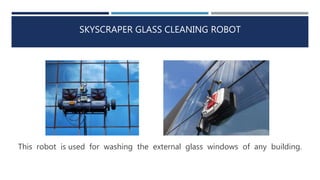
This robot is used for washing the external glass windows of any building.
CONSTRUCTION
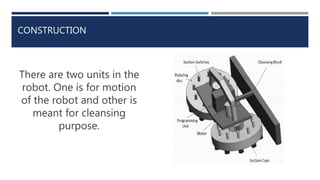
There are two units in the
robot. One is for motion
of the robot and other is
meant for cleansing
purpose.
CONSTRUCTION “MOTION PART”
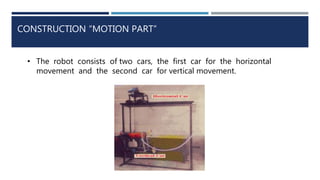
• The robot consists of two cars, the first car for the horizontal
movement and the second car for vertical movement.
CONSTRUCTION “MOTION PART”
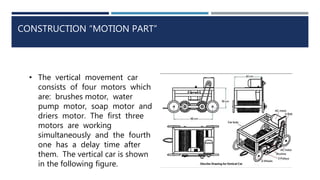
• The vertical movement car
consists of four motors which
are: brushes motor, water
pump motor, soap motor and
driers motor. The first three
motors are working
simultaneously and the fourth
one has a delay time after
them. The vertical car is shown
in the following figure.
CONSTRUCTION “MOTION PART”
• The car of horizontal motion consists of two motors, one motor
for horizontal direction movement, and the other for carrying the
car which move in the vertical direction.
CONSTRUCTION “CLEANING PART”
The robot has 2 cylindrical rotors, a wiper, and a
water dripping mechanism.
COMPONENTS
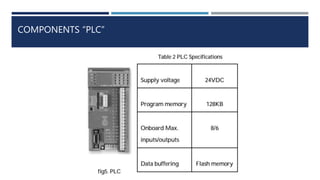
COMPONENTS “PLC”
HOW IT WORKS ?!
 When the PLC gives command to motor to rotate in either forward or reverse
direction, the motor rotates. A gear is attached with shaft of the motor which
drives the rotating disc.
 Suction-cups are attached to the bottom of this disc. There are 10 suction-cups
under each disc, which makes a total of 20 suction-cups. And the arrangement
is made such
that, at a time 4 suction-cups from each disc gets active. So, total 8 suction-
cups are active at a time.
HOW IT WORKS ?!
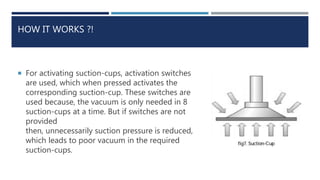
 For activating suction-cups, activation switches
are used, which when pressed activates the
corresponding suction-cup. These switches are
used because, the vacuum is only needed in 8
suction-cups at a time. But if switches are not
provided
then, unnecessarily suction pressure is reduced,
which leads to poor vacuum in the required
suction-cups.
HOW IT WORKS ?!
• Water continuously drips on the glass surface. The 2 rotors rotate
continuously. Both are attached back to back. The first cylindrical rotor is
meant to remove the solid dust particles. The second one is made-up of
sponge, which provides a smooth cleaning. And at the end wiper is
attached which wipes the glass-surface evenly.
HOW IT WORKS ?!
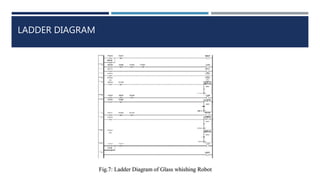
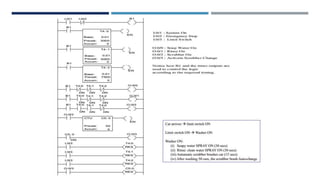
LADDER DIAGRAM
Thanks

Plc (skyscraper glass cleaning robot)

  • 1.
  • 2.
    INTRODUCTION  There existsan increasing demand for the development of various service robots to relieve human beings from hazardous jobs, such as cleaning glass- surface of skyscrapers, fire rescue, and inspection of high pipes and walls.  This application is based on a climbing robotic system aimed to clean glasses of high-rise buildings, using suction cups for adhering to the glass.
  • 3.
    INTRODUCTION  Based onthe results of interdisciplinary fields like mechanics, electronics and informatics the autonomous mobile robots are gaining more and more attention. The methods used for movement, actuation and none the last the ability to operate in unknown and dynamic environments give them a great complexity and a certain level of intelligence.
  • 4.
    SKYSCRAPER GLASS CLEANINGROBOT This robot is used for washing the external glass windows of any building.
  • 5.
    CONSTRUCTION There are twounits in the robot. One is for motion of the robot and other is meant for cleansing purpose.
  • 6.
    CONSTRUCTION “MOTION PART” •The robot consists of two cars, the first car for the horizontal movement and the second car for vertical movement.
  • 7.
    CONSTRUCTION “MOTION PART” •The vertical movement car consists of four motors which are: brushes motor, water pump motor, soap motor and driers motor. The first three motors are working simultaneously and the fourth one has a delay time after them. The vertical car is shown in the following figure.
  • 8.
    CONSTRUCTION “MOTION PART” •The car of horizontal motion consists of two motors, one motor for horizontal direction movement, and the other for carrying the car which move in the vertical direction.
  • 9.
    CONSTRUCTION “CLEANING PART” Therobot has 2 cylindrical rotors, a wiper, and a water dripping mechanism.
  • 10.
  • 11.
  • 12.
    HOW IT WORKS?!  When the PLC gives command to motor to rotate in either forward or reverse direction, the motor rotates. A gear is attached with shaft of the motor which drives the rotating disc.  Suction-cups are attached to the bottom of this disc. There are 10 suction-cups under each disc, which makes a total of 20 suction-cups. And the arrangement is made such that, at a time 4 suction-cups from each disc gets active. So, total 8 suction- cups are active at a time.
  • 13.
    HOW IT WORKS?!  For activating suction-cups, activation switches are used, which when pressed activates the corresponding suction-cup. These switches are used because, the vacuum is only needed in 8 suction-cups at a time. But if switches are not provided then, unnecessarily suction pressure is reduced, which leads to poor vacuum in the required suction-cups.
  • 14.
    HOW IT WORKS?! • Water continuously drips on the glass surface. The 2 rotors rotate continuously. Both are attached back to back. The first cylindrical rotor is meant to remove the solid dust particles. The second one is made-up of sponge, which provides a smooth cleaning. And at the end wiper is attached which wipes the glass-surface evenly.
  • 15.
  • 16.
  • 18.