FUZZY LOGIC
CONTROL
Anti-lock Braking System(ABS)
Team members :
Mohamed Khalil
MohamedTaman
Ahmed El-Shal
Mahmoud El-Shaer
NagwaGamal
Anti-Lock Braking System
This system allows the wheels of a motor vehicle to
maintain frictional contact with the road surface according to
the inputs by the driver, while the breaking prevents the
wheels from locking up.”[13] This locking up of wheels occurs
when the rotation of the wheels comes to a halt. The system
is designed in a way that it prevents the wheels to stop
rotating instantly which could cause the vehicle to skid and
the driver could loose control of the vehicle
Objectives of Anti Lock Breaking Systems
■ Reduction in Stopping Distance
■ Vehicle Stability
■ Steerability
Slip Ratio % = [(vehicle speed - wheel speed) / (vehicle speed)] x 100
The Fuzzy Controller
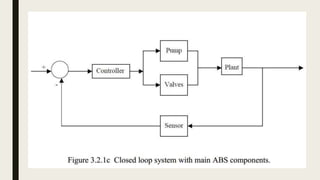
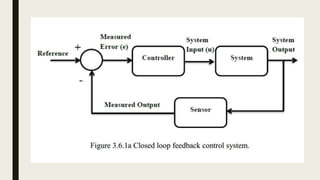
The control objective of the ABS controller is to maintain the wheel slip as
close as possible to the fixed value. The fixed value of the slip has proven to
provide optimal friction between tire and road surface under varying road conditions.
Fuzzy controllers are based on rule bases and membership functions for their
design aspect.
Fuzzy controllers are more robust and easier to implement as compared to classical
control schemes.
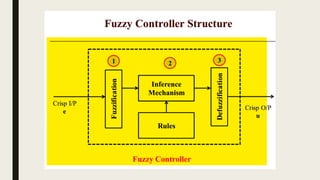
The fuzzy controller contain three stages:
■ Fuzzification
■ Inference Mechanism
■ Defuzzification
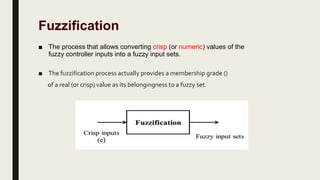
Fuzzification
■ The process that allows converting crisp (or numeric) values of the
fuzzy controller inputs into a fuzzy input sets.
■ The fuzzification process actually provides a membership grade ()
of a real (or crisp) value as its belongingness to a fuzzy set.
The Fuzzy Inference System Design of the
Controller
Has two inputs
■ Input 1 : error in slip
slip minus the fixed slip ratio of 0.2
■ Input 2 : the rate of change of this slip
the deceleration of the vehicle
■ The purpose of the
controller is to maintain the vehicle slip as close as possible to the value of 0.2
■ vehicle stability is maintained best when the actual
calculated slip is maintained as close as possible to this desired value of 0.2. A
set of
38
fuzzy rules were defined to get the vehicle to operate in the stable range when
braking
action took place
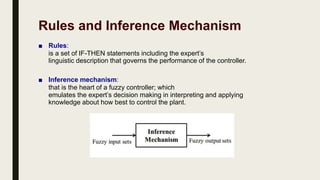
Rules and Inference Mechanism
■ Rules:
is a set of IF-THEN statements including the expert’s
linguistic description that governs the performance of the controller.
■ Inference mechanism:
that is the heart of a fuzzy controller; which
emulates the expert’s decision making in interpreting and applying
knowledge about how best to control the plant.
■ the nomenclature used for the membership functions is as follows:
NB: Negative Big
NS: Negative Small
ZO: Zero
PB: Positive Big
PS: Positive small
■ The rule base:
There were two inputs used namely Slip Error and Rate of change of Error. The
output of the controller is the braking pressure which varies with corresponding
changes in inputs. Five states were considered while forming the rule base
namely
negative small (NS), negative big (NB), positive small (PS), positive big (PB)
and
zero(ZO).
The rules for the fuzzy controller are as
follows:
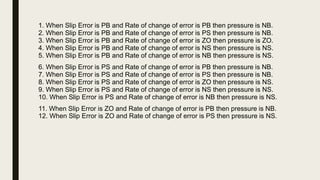
1. When Slip Error is PB and Rate of change of error is PB then pressure is NB.
2. When Slip Error is PB and Rate of change of error is PS then pressure is NB.
3. When Slip Error is PB and Rate of change of error is ZO then pressure is ZO.
4. When Slip Error is PB and Rate of change of error is NS then pressure is NS.
5. When Slip Error is PB and Rate of change of error is NB then pressure is NS.
6. When Slip Error is PS and Rate of change of error is PB then pressure is NB.
7. When Slip Error is PS and Rate of change of error is PS then pressure is NB.
8. When Slip Error is PS and Rate of change of error is ZO then pressure is NS.
9. When Slip Error is PS and Rate of change of error is NS then pressure is NS.
10. When Slip Error is PS and Rate of change of error is NB then pressure is NS.
11. When Slip Error is ZO and Rate of change of error is PB then pressure is NB.
12. When Slip Error is ZO and Rate of change of error is PS then pressure is NS.
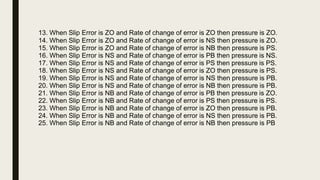
13. When Slip Error is ZO and Rate of change of error is ZO then pressure is ZO.
14. When Slip Error is ZO and Rate of change of error is NS then pressure is ZO.
15. When Slip Error is ZO and Rate of change of error is NB then pressure is PS.
16. When Slip Error is NS and Rate of change of error is PB then pressure is NS.
17. When Slip Error is NS and Rate of change of error is PS then pressure is PS.
18. When Slip Error is NS and Rate of change of error is ZO then pressure is PS.
19. When Slip Error is NS and Rate of change of error is NS then pressure is PB.
20. When Slip Error is NS and Rate of change of error is NB then pressure is PB.
21. When Slip Error is NB and Rate of change of error is PB then pressure is ZO.
22. When Slip Error is NB and Rate of change of error is PS then pressure is PS.
23. When Slip Error is NB and Rate of change of error is ZO then pressure is PB.
24. When Slip Error is NB and Rate of change of error is NS then pressure is PB.
25. When Slip Error is NB and Rate of change of error is NB then pressure is PB

Fuzzy logic control (ABS)

  • 1.
  • 2.
    Team members : MohamedKhalil MohamedTaman Ahmed El-Shal Mahmoud El-Shaer NagwaGamal
  • 3.
    Anti-Lock Braking System Thissystem allows the wheels of a motor vehicle to maintain frictional contact with the road surface according to the inputs by the driver, while the breaking prevents the wheels from locking up.”[13] This locking up of wheels occurs when the rotation of the wheels comes to a halt. The system is designed in a way that it prevents the wheels to stop rotating instantly which could cause the vehicle to skid and the driver could loose control of the vehicle
  • 4.
    Objectives of AntiLock Breaking Systems ■ Reduction in Stopping Distance ■ Vehicle Stability ■ Steerability Slip Ratio % = [(vehicle speed - wheel speed) / (vehicle speed)] x 100
  • 9.
  • 11.
    The control objectiveof the ABS controller is to maintain the wheel slip as close as possible to the fixed value. The fixed value of the slip has proven to provide optimal friction between tire and road surface under varying road conditions. Fuzzy controllers are based on rule bases and membership functions for their design aspect. Fuzzy controllers are more robust and easier to implement as compared to classical control schemes.
  • 12.
    The fuzzy controllercontain three stages: ■ Fuzzification ■ Inference Mechanism ■ Defuzzification
  • 13.
    Fuzzification ■ The processthat allows converting crisp (or numeric) values of the fuzzy controller inputs into a fuzzy input sets. ■ The fuzzification process actually provides a membership grade () of a real (or crisp) value as its belongingness to a fuzzy set.
  • 14.
    The Fuzzy InferenceSystem Design of the Controller Has two inputs ■ Input 1 : error in slip slip minus the fixed slip ratio of 0.2 ■ Input 2 : the rate of change of this slip the deceleration of the vehicle
  • 15.
    ■ The purposeof the controller is to maintain the vehicle slip as close as possible to the value of 0.2 ■ vehicle stability is maintained best when the actual calculated slip is maintained as close as possible to this desired value of 0.2. A set of 38 fuzzy rules were defined to get the vehicle to operate in the stable range when braking action took place
  • 16.
    Rules and InferenceMechanism ■ Rules: is a set of IF-THEN statements including the expert’s linguistic description that governs the performance of the controller. ■ Inference mechanism: that is the heart of a fuzzy controller; which emulates the expert’s decision making in interpreting and applying knowledge about how best to control the plant.
  • 17.
    ■ the nomenclatureused for the membership functions is as follows: NB: Negative Big NS: Negative Small ZO: Zero PB: Positive Big PS: Positive small ■ The rule base: There were two inputs used namely Slip Error and Rate of change of Error. The output of the controller is the braking pressure which varies with corresponding changes in inputs. Five states were considered while forming the rule base namely negative small (NS), negative big (NB), positive small (PS), positive big (PB) and zero(ZO).
  • 18.
    The rules forthe fuzzy controller are as follows:
  • 19.
    1. When SlipError is PB and Rate of change of error is PB then pressure is NB. 2. When Slip Error is PB and Rate of change of error is PS then pressure is NB. 3. When Slip Error is PB and Rate of change of error is ZO then pressure is ZO. 4. When Slip Error is PB and Rate of change of error is NS then pressure is NS. 5. When Slip Error is PB and Rate of change of error is NB then pressure is NS. 6. When Slip Error is PS and Rate of change of error is PB then pressure is NB. 7. When Slip Error is PS and Rate of change of error is PS then pressure is NB. 8. When Slip Error is PS and Rate of change of error is ZO then pressure is NS. 9. When Slip Error is PS and Rate of change of error is NS then pressure is NS. 10. When Slip Error is PS and Rate of change of error is NB then pressure is NS. 11. When Slip Error is ZO and Rate of change of error is PB then pressure is NB. 12. When Slip Error is ZO and Rate of change of error is PS then pressure is NS.
  • 20.
    13. When SlipError is ZO and Rate of change of error is ZO then pressure is ZO. 14. When Slip Error is ZO and Rate of change of error is NS then pressure is ZO. 15. When Slip Error is ZO and Rate of change of error is NB then pressure is PS. 16. When Slip Error is NS and Rate of change of error is PB then pressure is NS. 17. When Slip Error is NS and Rate of change of error is PS then pressure is PS. 18. When Slip Error is NS and Rate of change of error is ZO then pressure is PS. 19. When Slip Error is NS and Rate of change of error is NS then pressure is PB. 20. When Slip Error is NS and Rate of change of error is NB then pressure is PB. 21. When Slip Error is NB and Rate of change of error is PB then pressure is ZO. 22. When Slip Error is NB and Rate of change of error is PS then pressure is PS. 23. When Slip Error is NB and Rate of change of error is ZO then pressure is PB. 24. When Slip Error is NB and Rate of change of error is NS then pressure is PB. 25. When Slip Error is NB and Rate of change of error is NB then pressure is PB