DESINGED BY
Sunil Kumar
Research Scholar/ Food Production Faculty
Institute of Hotel and Tourism Management,
MAHARSHI DAYANAND UNIVERSITY, ROHTAK
Haryana- 124001 INDIA Ph. No. 09996000499
email: skihm86@yahoo.com , balhara86@gmail.com
linkedin:- in.linkedin.com/in/ihmsunilkumar
facebook: www.facebook.com/ihmsunilkumar
webpage: chefsunilkumar.tripod.com
Fabric and Fibres
arpita
learning objectives
 To understand the meaning of the term textile.
 Classify different types of fibers , yarns and to learn at least
two examples of each type.
 Make wise selection of textile products for specific uses in
our day to day life.
 To learn about the fabric construction and finishes given to
each type.
 Care of textile products.
arpita
What is a textile??
 A textile is a flexible material comprised of a
network of natural or artificial fibers often
referred to as thread or yarn. Yarn is
produced by spinning raw wool
fibers, linen, cotton, or other material on a
spinning wheel to produce long strands
known as yarn.[1] Textiles are formed by
weaving, knitting, crocheting, knotting, or
pressing
arpita
Classification and identification of
textile fibers
arpita
Textile fibres ( based on source)
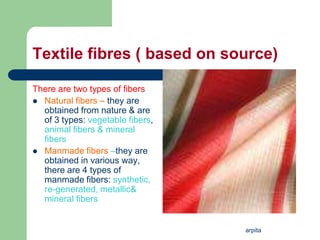
There are two types of fibers
 Natural fibers – they are
obtained from nature & are
of 3 types: vegetable fibers,
animal fibers & mineral
fibers
 Manmade fibers –they are
obtained in various way,
there are 4 types of
manmade fibers: synthetic,
re-generated, metallic&
mineral fibers
arpita
Length based classification
 Based on there length they are staple
or filament .
 Staple are short, all natural fibres
except silk are staple
 Filament fibres are continuous and are
measured in metres,
 All manmade fibres are filament
arpita
Content based classification (they can
be both natural or man made fibres)
Cellulose
Fibres
Protein
fibres
Mineral
fibres
arpita
Examples:
 Cellulose----- cotton rayon
 Protein ----- silk wool,
 Mineral------ asbestos
arpita
Identification of fibre
By feel
By length
By lustre
By texture
arpita
Characteristics of vegetable& animal
fibers
 Vegetable fibers are strong
with a crisp feel
 Good heat
 Non resilient and crease
easily
 Stronger when wet than dry
 Moth proof
 Affected by mildew in damp
conditions
 Can be bleached
 Not harmed by alkalis
 Affected by acids
 Animal fibers are soft to feel
 Poor heat
 Stronger wet when dry
 Absorbent
 Attacked by moths
 Not affected by mildew
easily
 Damaged by sunlight&
alkalis
 Affected by chlorine bleach
arpita
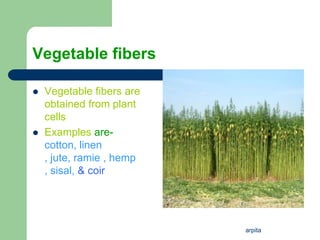
Vegetable fibers
 Vegetable fibers are
obtained from plant
cells
 Examples are-
cotton, linen
, jute, ramie , hemp
, sisal, & coir
arpita
Cotton fibers
 This fibre is
obtained from the
seeds of cotton
plant, which
grows 1-2 meters
tall .
arpita
Advantages & limitations
of cotton fibers
 Advantages are-------
 -can be dyed easily
 Good conductor of heat
 Durable since fibre is strong
 Easily dry- cleaned.
 Good absorbency power
 Textured effects are easily
available.
 Highly versatile
 Processed into wide range of
fabrics
 limitations are:--------
 Cotton creases easily
 Tends to shrink when
washed
 Sheds lint
 Prone to mildew attacks
 Flammable
 Damaged by acids
 Takes longer time to dry
 When exposed to sunlight it
turns yellow .
arpita
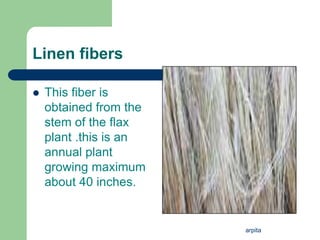
Linen fibers
 This fiber is
obtained from the
stem of the flax
plant .this is an
annual plant
growing maximum
about 40 inches.
arpita
Advantages & limitations of linen
fibre
 Advantages are-----
 More durable then cotton
also.
 Withstands constant
washing .
 Soiling is easily removed
from this.
 Easy to launder .
 Stronger when in wet
condition.
 Not effected by sunlight.
 Good conductor of heat.
 Can withstand high ironing
temperatures .
 Limitations are:----------
 Creases & shrinks
easily
 Prone to mildew attacks
 It does not have good
affinity for dyes
 Takes long time to dry
 Linen is flammable
 It is expensive
arpita
JUTE
 Obtained from stems of
jute plant
 Advantages---it is
inexpensive & can be
blended with other
fibres,it resists
water, fire, mildew and
rot.
 It dyes easily.
 Dis advantages---are
weak & non-
durable, difficult to
bleach, difficult to
arpita
Ramie, hemp, sisal, & kapok
 Ramie is obtained from stems of plant, it is a woody fibre , it is
also known as china grass & is used for making rope, twine,
sacking & nets.
 Hemp is also obtained from stems of plant & is used for
manufacturing carpets & rags, its used to to make sacks &
canvas
 Sisal is obtained from the leaves of a plant, resembles cactus
.it is used to make twine , rope, sacking& nets
 Kapok is obtained from seeds of the cotton tree& are smooth &
light, it is used for filling of cushions.
arpita
Coir & Pina
 It is obtained from coconut
husk
 It is used in making rope &
mats
 It is also used for stuffing
upholstered furniture's
 used for making bags too.
 Pina obtained from the
leaves of pineapple plants
 Used for mats& bags
arpita
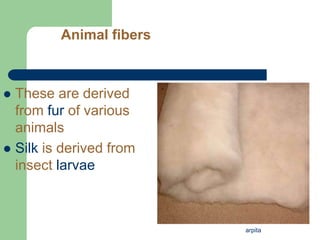
Animal fibers
 These are derived
from fur of various
animals
 Silk is derived from
insect larvae
arpita
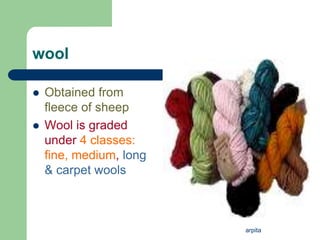
wool
 Obtained from
fleece of sheep
 Wool is graded
under 4 classes:
fine, medium, long
& carpet wools
arpita
Advantages & limitations of
wool
 Advantages--------
 Comfortable for wear
 Dyes easily
 Does not soil easily
 Can be laundered easily
 Flameproof
 Shrink proof
 Moth resistant
 Limitations--------
 Takes long time to dry
 Weak fibers
 Stretches easily
 Good quality is
expensive
 damaged by moth
 May produce allergic
reaction to skin
arpita
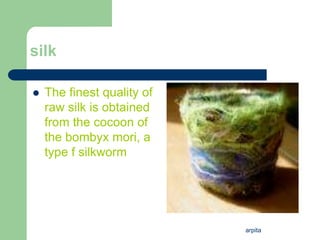
silk
 The finest quality of
raw silk is obtained
from the cocoon of
the bombyx mori, a
type f silkworm
arpita
Silk is of 2 types cultivated& wild silk
 Important wild silks are ---
 Tussar from india & china , they have a tan
colour
 Muga silk from assam
 Others-- dupionsilk, rawsilk, spun silk
arpita
Advantages & limitations of
silk
 Advantages—
 Soft feel & lustre
 Elegant to look at
 Strongest natural fibre
 Bad conductor of heat
 White silk can be
bleached
 Limitations----
 Silk is weakened by
sunlight
 Becomes weaker when
wet
 Weakened at high
temperatures
 Sensitive to acid
 Very costly
arpita
NATURAL MINERAL FIBRES
 Asbestos is a natural
mineral fibre
 It is obtained from rocks
 It is acid proof , rust proof &
flame proof
 Can withstand extreme
temperatures
 It is used for making fire
fighting suits
arpita
Man- made
1. Synthetic fibre
2. Re- generated fibers
3. Metallic fibers
4. Mineral fibers
arpita
Synthetic fibers
1. Polyester .
2. Nylon ( polyamide)
3. Others are----- polyethylene,polyvinyl,
polypropylene,polyacrylon,,acrylics&
mod acrylics,
arpita
Polyester fibres-------------------
is composed by mixing alcohol with
acid
 Advantages
 Fibre is very strong
 Crease resistant
 Requires no ironing
 Resists soiling as the fibers
are very smooth
 Dries rapidly
 Can be washed easily
 Resistant to acids & alkalis
 Can be blended with other
fibers
 Limitations
 attracts dust
 Has low absorbency
 Does not dye easily
 Attracts grease
 Has low melting points
 At high temperatures
produces poisonous fumes
arpita
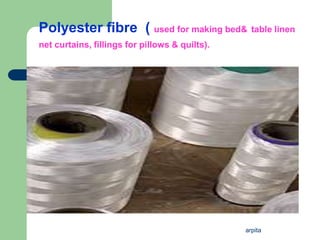
Polyester fibre ( used for making bed& table linen
net curtains, fillings for pillows & quilts).
arpita
Nylon fibres
 Advantages
 Strong & durable
 Crease resistant
 Moth & mildew resistant
 Easy to launder
 Dries quickly
 Fabrics needs no
ironing
 Limitations
 Damaged by sunlight
 Melts in fire
 Hard to remove stains
from it
 Produces harmful
fumes
arpita
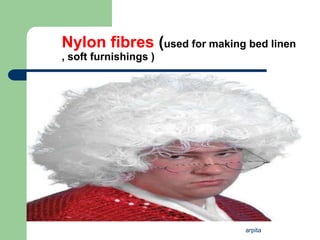
Nylon fibres (used for making bed linen
, soft furnishings )
arpita
Other synthetic fibres are :
 Acrylics trade names are dralon, courtelle,
orlon, acrilan – blankets , carpets .
 Mod acrylics trade names are teklan. Used
for soft furnishings, upholstery , blankets.
 Polypropylene such as spunstron used for
making of carpets .
 Polyethylene such as courlene used for
upholstery
arpita
Re-generated fibres
 A) Re generated cellulosic fibres : These are made
from a substance retrieved from natural sources ,
most commonly cellulose, which is converted into
fibre form( Example is viscose rayon) . Used for
making soft furnishings & carpets .the trade
name of viscose rayon is viloft
 Other forms of rayon are: acetate & tri – acetate
 B) Re generated protein fibres : These fibres have
been obtained from protein such as milk, corn,
soyabeans.
arpita
Regenerated fibres
 Cellulosic fibres  Protein fibre
arpita
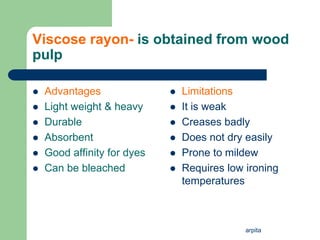
Viscose rayon- is obtained from wood
pulp
 Advantages
 Light weight & heavy
 Durable
 Absorbent
 Good affinity for dyes
 Can be bleached
 Limitations
 It is weak
 Creases badly
 Does not dry easily
 Prone to mildew
 Requires low ironing
temperatures
arpita
Man made mineral fibres
 Glass fibres –
produced by heating
silica, sand, limeston
e & other minerals
 These are non
absorbent, easily
laundered ,& highly
fire proof
arpita
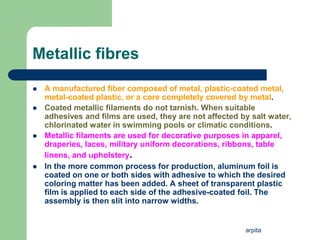
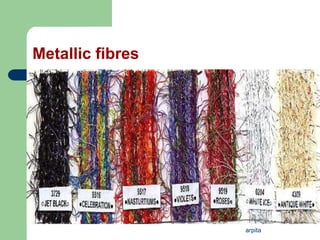
Metallic fibres
 A manufactured fiber composed of metal, plastic-coated metal,
metal-coated plastic, or a core completely covered by metal.
 Coated metallic filaments do not tarnish. When suitable
adhesives and films are used, they are not affected by salt water,
chlorinated water in swimming pools or climatic conditions.
 Metallic filaments are used for decorative purposes in apparel,
draperies, laces, military uniform decorations, ribbons, table
linens, and upholstery.
 In the more common process for production, aluminum foil is
coated on one or both sides with adhesive to which the desired
coloring matter has been added. A sheet of transparent plastic
film is applied to each side of the adhesive-coated foil. The
assembly is then slit into narrow widths.
arpita
Metallic fibres
arpita
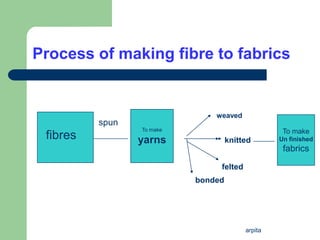
Process of making fibre to fabrics
fibres
To make
yarns
spun
weaved
knitted
felted
bonded
To make
Un finished
fabrics
arpita
Conti ………
Several treatments
Given to make
Textile fabrics
arpita
what are yarns?
 Yarn is a long continuous length of interlocked fibers, suitable for
use in the production of textiles, sewing, knitting, weaving and
rope making. Yarn can be made from any number of synthetic or
natural fibers. Very thin yarn is referred to as thread.
 Types of Yarns :
 Staple (Short fibers)
 single
 Simple (Same appearance along length)
 Filament (Continuous Filaments)
 Plied (Two or more strands, twisted)
 Complex ( irregular in size & twist)
arpita
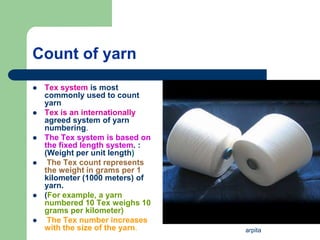
Count of yarn
 Tex system is most
commonly used to count
yarn
 Tex is an internationally
agreed system of yarn
numbering.
 The Tex system is based on
the fixed length system. :
(Weight per unit length)
 The Tex count represents
the weight in grams per 1
kilometer (1000 meters) of
yarn.
 (For example, a yarn
numbered 10 Tex weighs 10
grams per kilometer)
 The Tex number increases
with the size of the yarn.
arpita
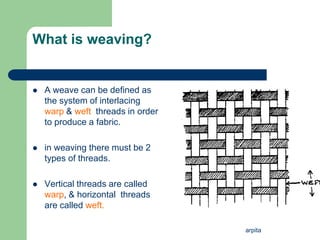
What is weaving?
 A weave can be defined as
the system of interlacing
warp & weft threads in order
to produce a fabric.
 in weaving there must be 2
types of threads.
 Vertical threads are called
warp, & horizontal threads
are called weft.
arpita
Types of weaves
1. Plain weave
2. Satin weave
3. Figured weave
4. Twill weave
5. Cellular weave
6. Pile weave
arpita
Plain weave

The weft goes over &
under alternate warp
threads, as done in
darning.
arpita
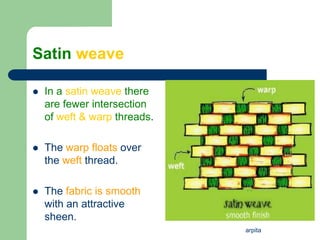
Satin weave
 In a satin weave there
are fewer intersection
of weft & warp threads.
 The warp floats over
the weft thread.
 The fabric is smooth
with an attractive
sheen.
arpita
Finished product of a satin weave
arpita
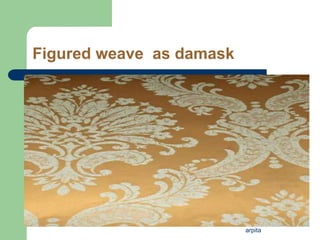
Figured weave
 This introduces a
pattern into the fabrics.
 For figured weaves two
types of previously
mentioned weaves are
combined.
 Fabrics woven in this
weaves are
huckaback,brocatelle,
damask.
arpita
Figured weave as damask
arpita
Figured weave as huckaback fabric
arpita
Twill weave
 The weft crosses the warp
at different intervals in
different rows so that
series of diagonal line is
produced.
 The threads are normally
close to each other
 Drill & gaberdine are
fabrics in twill weave.
arpita
Fabrics made from twill weave
 gaberdine  drill
arpita
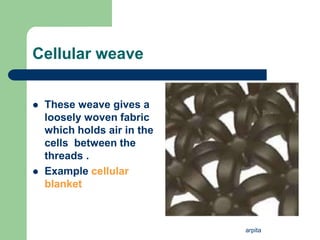
Cellular weave
 These weave gives a
loosely woven fabric
which holds air in the
cells between the
threads .
 Example cellular
blanket
arpita
Cellular blanket made from cellular
arpita
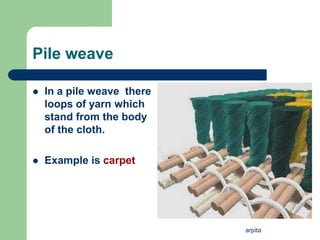
Pile weave
 In a pile weave there
loops of yarn which
stand from the body
of the cloth.
 Example is carpet
arpita
Knitting
.
•A method of constructing fabric by
interlocking a series of loops of one or
more yarns.
•Only one thread is used in knitting.
•Knitting is one of several ways to turn thread or
yarn into cloth
arpita
Knitting machine
arpita
What is felting?
 In this method , fibres are directly
converted into fabric without being spun
into yarns .
 Generally wool is used for felting.
 In this process a number of needles is
punched into fibres.
 They lack strength.
 Are comparatively cheaper.
arpita
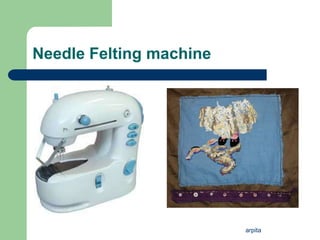
Needle Felting machine
arpita
Bonded fibres
 Bonded fibres are
made from natural &
manmade fibres.
 The fibres are bonded
either by using
adhesive, by heating
or by laminating.
arpita
Finishes given to fabrics
 Mechanical finishes
1. Beetling
2. Sanforizing
3. Embossing
4. Moiering
5. Calendering
6. Crinkling
7. Napping
8. Glazing
9. creping
 Chemical finishes
1. Anti- crease treatment
2. Creping
3. Fire proofing
4. mercerizing
5. Shrink resistant
6. Mothproofing
7. Oil repellant
8. Water repellant
arpita
Apart from the above mentioned
finishes we have
 Dyeing-----
 This processes
generally enhance the
appearance of a fabric
by adding colour &
pattern
 Printing--- 3 types
 Block printing
 Screen printing
 Roller printing
arpita
Chemical finishes
8 chemical finishes
are there
arpita
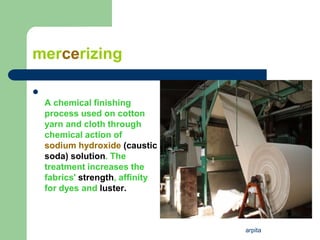
mercerizing

A chemical finishing
process used on cotton
yarn and cloth through
chemical action of
sodium hydroxide (caustic
soda) solution. The
treatment increases the
fabrics' strength, affinity
for dyes and luster.
arpita
Anti – crease treatment
 Used for cotton fabrics
usually this chemical
finish method is
produced by treating
fabrics with a solution
of synthetic resin, the
fabric is then dried at a
high temperature
arpita
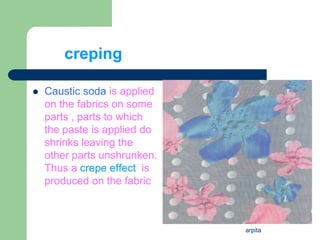
creping
 Caustic soda is applied
on the fabrics on some
parts , parts to which
the paste is applied do
shrinks leaving the
other parts unshrunken.
Thus a crepe effect is
produced on the fabric
arpita
Fire proofing
 This chemical finish is
also known as the
flame retardant finish.
 in this method the fabric
is dipped in a solution
of borax & boric acid
dissolved in water.
 Even bed linen such as
duvets , pillows, etc are
made flame retardant
arpita
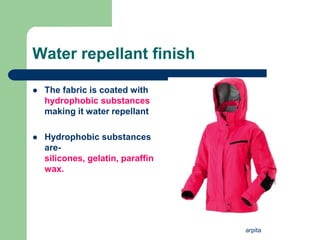
Water repellant finish
 The fabric is coated with
hydrophobic substances
making it water repellant
 Hydrophobic substances
are-
silicones, gelatin, paraffin
wax.
arpita
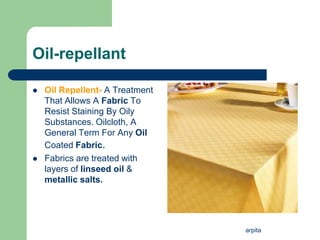
Oil-repellant
 Oil Repellent- A Treatment
That Allows A Fabric To
Resist Staining By Oily
Substances. Oilcloth, A
General Term For Any Oil
Coated Fabric.
 Fabrics are treated with
layers of linseed oil &
metallic salts.
arpita
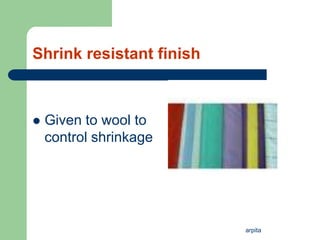
Shrink resistant finish
 Given to wool to
control shrinkage
arpita
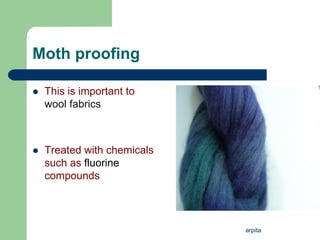
Moth proofing
 This is important to
wool fabrics
 Treated with chemicals
such as fluorine
compounds
arpita
Mechanical finishes–
machine is used to produce different
effects on fabrics
arpita
Beetling
 Originally carried out by beating the
fabric surface.
 Modern era a machine is used to give a
flattened impact, thus a desired lustrous
effect is produced
arpita
Brushing & shearing
 Cuts out the short end of fibres which are
sticking out of the fabric
 The fabric is passed through two roller
brushes
 In this process the material gets cleaned
arpita
calendering
 Removes wrinkles, adds sheen & gives a
smooth effect.
 This finish is produced by passing the
fabric between to highly polished rollers
arpita
sanforizing
 To overcome the defect of shrinkage
fabrics are sanforized
 Sanforized articles are passed through
the surface of a steam heated rollers
 The process ensures less then 1%
shrinkages for fabrics after washing
arpita
crinkling
 Also known as creping
 By this process a wavy crepe effect is
produced on the fabric
 The material is passed between two hot
rollers
arpita
glazing
 This produces a high sheen on the fabrics
 in this process also the material is
passed through a machine consisting of
three rollers
arpita
napping
 This produces a raised effect on fabrics &
makes it soft & warm
 In this method the fabric passed through
a revolving cylinder
 Cotton & wool fabrics are given this finish
arpita
moireing
 Produces watery line effect on fabrics
 Machine consists of three steam rollers&
rotates at high speed to get the desired
effects on fabrics

Fabric & fibres

  • 1.
    DESINGED BY Sunil Kumar ResearchScholar/ Food Production Faculty Institute of Hotel and Tourism Management, MAHARSHI DAYANAND UNIVERSITY, ROHTAK Haryana- 124001 INDIA Ph. No. 09996000499 email: skihm86@yahoo.com , balhara86@gmail.com linkedin:- in.linkedin.com/in/ihmsunilkumar facebook: www.facebook.com/ihmsunilkumar webpage: chefsunilkumar.tripod.com Fabric and Fibres
  • 2.
    arpita learning objectives  Tounderstand the meaning of the term textile.  Classify different types of fibers , yarns and to learn at least two examples of each type.  Make wise selection of textile products for specific uses in our day to day life.  To learn about the fabric construction and finishes given to each type.  Care of textile products.
  • 3.
    arpita What is atextile??  A textile is a flexible material comprised of a network of natural or artificial fibers often referred to as thread or yarn. Yarn is produced by spinning raw wool fibers, linen, cotton, or other material on a spinning wheel to produce long strands known as yarn.[1] Textiles are formed by weaving, knitting, crocheting, knotting, or pressing
  • 4.
  • 5.
    arpita Textile fibres (based on source) There are two types of fibers  Natural fibers – they are obtained from nature & are of 3 types: vegetable fibers, animal fibers & mineral fibers  Manmade fibers –they are obtained in various way, there are 4 types of manmade fibers: synthetic, re-generated, metallic& mineral fibers
  • 6.
    arpita Length based classification Based on there length they are staple or filament .  Staple are short, all natural fibres except silk are staple  Filament fibres are continuous and are measured in metres,  All manmade fibres are filament
  • 7.
    arpita Content based classification(they can be both natural or man made fibres) Cellulose Fibres Protein fibres Mineral fibres
  • 8.
    arpita Examples:  Cellulose----- cottonrayon  Protein ----- silk wool,  Mineral------ asbestos
  • 9.
    arpita Identification of fibre Byfeel By length By lustre By texture
  • 10.
    arpita Characteristics of vegetable&animal fibers  Vegetable fibers are strong with a crisp feel  Good heat  Non resilient and crease easily  Stronger when wet than dry  Moth proof  Affected by mildew in damp conditions  Can be bleached  Not harmed by alkalis  Affected by acids  Animal fibers are soft to feel  Poor heat  Stronger wet when dry  Absorbent  Attacked by moths  Not affected by mildew easily  Damaged by sunlight& alkalis  Affected by chlorine bleach
  • 11.
    arpita Vegetable fibers  Vegetablefibers are obtained from plant cells  Examples are- cotton, linen , jute, ramie , hemp , sisal, & coir
  • 12.
    arpita Cotton fibers  Thisfibre is obtained from the seeds of cotton plant, which grows 1-2 meters tall .
  • 13.
    arpita Advantages & limitations ofcotton fibers  Advantages are-------  -can be dyed easily  Good conductor of heat  Durable since fibre is strong  Easily dry- cleaned.  Good absorbency power  Textured effects are easily available.  Highly versatile  Processed into wide range of fabrics  limitations are:--------  Cotton creases easily  Tends to shrink when washed  Sheds lint  Prone to mildew attacks  Flammable  Damaged by acids  Takes longer time to dry  When exposed to sunlight it turns yellow .
  • 14.
    arpita Linen fibers  Thisfiber is obtained from the stem of the flax plant .this is an annual plant growing maximum about 40 inches.
  • 15.
    arpita Advantages & limitationsof linen fibre  Advantages are-----  More durable then cotton also.  Withstands constant washing .  Soiling is easily removed from this.  Easy to launder .  Stronger when in wet condition.  Not effected by sunlight.  Good conductor of heat.  Can withstand high ironing temperatures .  Limitations are:----------  Creases & shrinks easily  Prone to mildew attacks  It does not have good affinity for dyes  Takes long time to dry  Linen is flammable  It is expensive
  • 16.
    arpita JUTE  Obtained fromstems of jute plant  Advantages---it is inexpensive & can be blended with other fibres,it resists water, fire, mildew and rot.  It dyes easily.  Dis advantages---are weak & non- durable, difficult to bleach, difficult to
  • 17.
    arpita Ramie, hemp, sisal,& kapok  Ramie is obtained from stems of plant, it is a woody fibre , it is also known as china grass & is used for making rope, twine, sacking & nets.  Hemp is also obtained from stems of plant & is used for manufacturing carpets & rags, its used to to make sacks & canvas  Sisal is obtained from the leaves of a plant, resembles cactus .it is used to make twine , rope, sacking& nets  Kapok is obtained from seeds of the cotton tree& are smooth & light, it is used for filling of cushions.
  • 18.
    arpita Coir & Pina It is obtained from coconut husk  It is used in making rope & mats  It is also used for stuffing upholstered furniture's  used for making bags too.  Pina obtained from the leaves of pineapple plants  Used for mats& bags
  • 19.
    arpita Animal fibers  Theseare derived from fur of various animals  Silk is derived from insect larvae
  • 20.
    arpita wool  Obtained from fleeceof sheep  Wool is graded under 4 classes: fine, medium, long & carpet wools
  • 21.
    arpita Advantages & limitationsof wool  Advantages--------  Comfortable for wear  Dyes easily  Does not soil easily  Can be laundered easily  Flameproof  Shrink proof  Moth resistant  Limitations--------  Takes long time to dry  Weak fibers  Stretches easily  Good quality is expensive  damaged by moth  May produce allergic reaction to skin
  • 22.
    arpita silk  The finestquality of raw silk is obtained from the cocoon of the bombyx mori, a type f silkworm
  • 23.
    arpita Silk is of2 types cultivated& wild silk  Important wild silks are ---  Tussar from india & china , they have a tan colour  Muga silk from assam  Others-- dupionsilk, rawsilk, spun silk
  • 24.
    arpita Advantages & limitationsof silk  Advantages—  Soft feel & lustre  Elegant to look at  Strongest natural fibre  Bad conductor of heat  White silk can be bleached  Limitations----  Silk is weakened by sunlight  Becomes weaker when wet  Weakened at high temperatures  Sensitive to acid  Very costly
  • 25.
    arpita NATURAL MINERAL FIBRES Asbestos is a natural mineral fibre  It is obtained from rocks  It is acid proof , rust proof & flame proof  Can withstand extreme temperatures  It is used for making fire fighting suits
  • 26.
    arpita Man- made 1. Syntheticfibre 2. Re- generated fibers 3. Metallic fibers 4. Mineral fibers
  • 27.
    arpita Synthetic fibers 1. Polyester. 2. Nylon ( polyamide) 3. Others are----- polyethylene,polyvinyl, polypropylene,polyacrylon,,acrylics& mod acrylics,
  • 28.
    arpita Polyester fibres------------------- is composedby mixing alcohol with acid  Advantages  Fibre is very strong  Crease resistant  Requires no ironing  Resists soiling as the fibers are very smooth  Dries rapidly  Can be washed easily  Resistant to acids & alkalis  Can be blended with other fibers  Limitations  attracts dust  Has low absorbency  Does not dye easily  Attracts grease  Has low melting points  At high temperatures produces poisonous fumes
  • 29.
    arpita Polyester fibre (used for making bed& table linen net curtains, fillings for pillows & quilts).
  • 30.
    arpita Nylon fibres  Advantages Strong & durable  Crease resistant  Moth & mildew resistant  Easy to launder  Dries quickly  Fabrics needs no ironing  Limitations  Damaged by sunlight  Melts in fire  Hard to remove stains from it  Produces harmful fumes
  • 31.
    arpita Nylon fibres (usedfor making bed linen , soft furnishings )
  • 32.
    arpita Other synthetic fibresare :  Acrylics trade names are dralon, courtelle, orlon, acrilan – blankets , carpets .  Mod acrylics trade names are teklan. Used for soft furnishings, upholstery , blankets.  Polypropylene such as spunstron used for making of carpets .  Polyethylene such as courlene used for upholstery
  • 33.
    arpita Re-generated fibres  A)Re generated cellulosic fibres : These are made from a substance retrieved from natural sources , most commonly cellulose, which is converted into fibre form( Example is viscose rayon) . Used for making soft furnishings & carpets .the trade name of viscose rayon is viloft  Other forms of rayon are: acetate & tri – acetate  B) Re generated protein fibres : These fibres have been obtained from protein such as milk, corn, soyabeans.
  • 34.
  • 35.
    arpita Viscose rayon- isobtained from wood pulp  Advantages  Light weight & heavy  Durable  Absorbent  Good affinity for dyes  Can be bleached  Limitations  It is weak  Creases badly  Does not dry easily  Prone to mildew  Requires low ironing temperatures
  • 36.
    arpita Man made mineralfibres  Glass fibres – produced by heating silica, sand, limeston e & other minerals  These are non absorbent, easily laundered ,& highly fire proof
  • 37.
    arpita Metallic fibres  Amanufactured fiber composed of metal, plastic-coated metal, metal-coated plastic, or a core completely covered by metal.  Coated metallic filaments do not tarnish. When suitable adhesives and films are used, they are not affected by salt water, chlorinated water in swimming pools or climatic conditions.  Metallic filaments are used for decorative purposes in apparel, draperies, laces, military uniform decorations, ribbons, table linens, and upholstery.  In the more common process for production, aluminum foil is coated on one or both sides with adhesive to which the desired coloring matter has been added. A sheet of transparent plastic film is applied to each side of the adhesive-coated foil. The assembly is then slit into narrow widths.
  • 38.
  • 39.
    arpita Process of makingfibre to fabrics fibres To make yarns spun weaved knitted felted bonded To make Un finished fabrics
  • 40.
  • 41.
    arpita what are yarns? Yarn is a long continuous length of interlocked fibers, suitable for use in the production of textiles, sewing, knitting, weaving and rope making. Yarn can be made from any number of synthetic or natural fibers. Very thin yarn is referred to as thread.  Types of Yarns :  Staple (Short fibers)  single  Simple (Same appearance along length)  Filament (Continuous Filaments)  Plied (Two or more strands, twisted)  Complex ( irregular in size & twist)
  • 42.
    arpita Count of yarn Tex system is most commonly used to count yarn  Tex is an internationally agreed system of yarn numbering.  The Tex system is based on the fixed length system. : (Weight per unit length)  The Tex count represents the weight in grams per 1 kilometer (1000 meters) of yarn.  (For example, a yarn numbered 10 Tex weighs 10 grams per kilometer)  The Tex number increases with the size of the yarn.
  • 43.
    arpita What is weaving? A weave can be defined as the system of interlacing warp & weft threads in order to produce a fabric.  in weaving there must be 2 types of threads.  Vertical threads are called warp, & horizontal threads are called weft.
  • 44.
    arpita Types of weaves 1.Plain weave 2. Satin weave 3. Figured weave 4. Twill weave 5. Cellular weave 6. Pile weave
  • 45.
    arpita Plain weave  The weftgoes over & under alternate warp threads, as done in darning.
  • 46.
    arpita Satin weave  Ina satin weave there are fewer intersection of weft & warp threads.  The warp floats over the weft thread.  The fabric is smooth with an attractive sheen.
  • 47.
  • 48.
    arpita Figured weave  Thisintroduces a pattern into the fabrics.  For figured weaves two types of previously mentioned weaves are combined.  Fabrics woven in this weaves are huckaback,brocatelle, damask.
  • 49.
  • 50.
    arpita Figured weave ashuckaback fabric
  • 51.
    arpita Twill weave  Theweft crosses the warp at different intervals in different rows so that series of diagonal line is produced.  The threads are normally close to each other  Drill & gaberdine are fabrics in twill weave.
  • 52.
    arpita Fabrics made fromtwill weave  gaberdine  drill
  • 53.
    arpita Cellular weave  Theseweave gives a loosely woven fabric which holds air in the cells between the threads .  Example cellular blanket
  • 54.
  • 55.
    arpita Pile weave  Ina pile weave there loops of yarn which stand from the body of the cloth.  Example is carpet
  • 56.
    arpita Knitting . •A method ofconstructing fabric by interlocking a series of loops of one or more yarns. •Only one thread is used in knitting. •Knitting is one of several ways to turn thread or yarn into cloth
  • 57.
  • 58.
    arpita What is felting? In this method , fibres are directly converted into fabric without being spun into yarns .  Generally wool is used for felting.  In this process a number of needles is punched into fibres.  They lack strength.  Are comparatively cheaper.
  • 59.
  • 60.
    arpita Bonded fibres  Bondedfibres are made from natural & manmade fibres.  The fibres are bonded either by using adhesive, by heating or by laminating.
  • 61.
    arpita Finishes given tofabrics  Mechanical finishes 1. Beetling 2. Sanforizing 3. Embossing 4. Moiering 5. Calendering 6. Crinkling 7. Napping 8. Glazing 9. creping  Chemical finishes 1. Anti- crease treatment 2. Creping 3. Fire proofing 4. mercerizing 5. Shrink resistant 6. Mothproofing 7. Oil repellant 8. Water repellant
  • 62.
    arpita Apart from theabove mentioned finishes we have  Dyeing-----  This processes generally enhance the appearance of a fabric by adding colour & pattern  Printing--- 3 types  Block printing  Screen printing  Roller printing
  • 63.
  • 64.
    arpita mercerizing  A chemical finishing processused on cotton yarn and cloth through chemical action of sodium hydroxide (caustic soda) solution. The treatment increases the fabrics' strength, affinity for dyes and luster.
  • 65.
    arpita Anti – creasetreatment  Used for cotton fabrics usually this chemical finish method is produced by treating fabrics with a solution of synthetic resin, the fabric is then dried at a high temperature
  • 66.
    arpita creping  Caustic sodais applied on the fabrics on some parts , parts to which the paste is applied do shrinks leaving the other parts unshrunken. Thus a crepe effect is produced on the fabric
  • 67.
    arpita Fire proofing  Thischemical finish is also known as the flame retardant finish.  in this method the fabric is dipped in a solution of borax & boric acid dissolved in water.  Even bed linen such as duvets , pillows, etc are made flame retardant
  • 68.
    arpita Water repellant finish The fabric is coated with hydrophobic substances making it water repellant  Hydrophobic substances are- silicones, gelatin, paraffin wax.
  • 69.
    arpita Oil-repellant  Oil Repellent-A Treatment That Allows A Fabric To Resist Staining By Oily Substances. Oilcloth, A General Term For Any Oil Coated Fabric.  Fabrics are treated with layers of linseed oil & metallic salts.
  • 70.
    arpita Shrink resistant finish Given to wool to control shrinkage
  • 71.
    arpita Moth proofing  Thisis important to wool fabrics  Treated with chemicals such as fluorine compounds
  • 72.
    arpita Mechanical finishes– machine isused to produce different effects on fabrics
  • 73.
    arpita Beetling  Originally carriedout by beating the fabric surface.  Modern era a machine is used to give a flattened impact, thus a desired lustrous effect is produced
  • 74.
    arpita Brushing & shearing Cuts out the short end of fibres which are sticking out of the fabric  The fabric is passed through two roller brushes  In this process the material gets cleaned
  • 75.
    arpita calendering  Removes wrinkles,adds sheen & gives a smooth effect.  This finish is produced by passing the fabric between to highly polished rollers
  • 76.
    arpita sanforizing  To overcomethe defect of shrinkage fabrics are sanforized  Sanforized articles are passed through the surface of a steam heated rollers  The process ensures less then 1% shrinkages for fabrics after washing
  • 77.
    arpita crinkling  Also knownas creping  By this process a wavy crepe effect is produced on the fabric  The material is passed between two hot rollers
  • 78.
    arpita glazing  This producesa high sheen on the fabrics  in this process also the material is passed through a machine consisting of three rollers
  • 79.
    arpita napping  This producesa raised effect on fabrics & makes it soft & warm  In this method the fabric passed through a revolving cylinder  Cotton & wool fabrics are given this finish
  • 80.
    arpita moireing  Produces wateryline effect on fabrics  Machine consists of three steam rollers& rotates at high speed to get the desired effects on fabrics