1 
COSTS OF PRODUCTION 
Dr.Sunitha.S 
Assistant Professor 
School of Management Studies, 
National Institute of Technology (NIT) Calicut
Explicit & Implicit Cost 
2 
 Explicit cost refers to the making of actual payments in 
the process of production. 
Whereas Implicit cost implies that although the work gets 
done yet there is no corresponding payment for it in terms of 
money.
Private and Social Cost 
3 
Private costs are those that accrue directly to the 
individuals or firms engaged in relevant activity. 
External costs on the other hand are are passed on to persons 
not involved in the activity in any direct way (ie they are 
passed to society at large)
Sunk Cost 
4 
A sunk cost is an expenditure that has been made and cannot 
be recovered. 
Since it cannot be recovered, it should be ignored while 
taking economic decisions. 
Eg: a firm buys a highly specialized machine for a plant. It can 
be used only what it was designed for. That is, it cannot be put 
in alternative uses. Its opportunity cost is zero.
Money cost 
5 
Money cost refers to the payments made to the factors of 
production in terms of money proper in return for their 
services enjoyed by the producer in his process of 
production. For e.g. payments made for purchasing raw 
material, rent of land, wages for labour.
Opportunity Cost (Alternative or 
Transfer Cost) 
6 
“The opportunity cost of anything produced can thus be defined as 
the next best alternative that can be produced instead by the same 
factors or by an equivalent group of factors costing the same 
amount of money.” 
 Resources are limited and therefore they cannot be used for 
more than one purpose at the same time. E.g. If land is used for 
building a house, the same land cannot be used for agricultural 
purpose. In general terms, if a resource can produce either ‘A’ or 
‘B’, then the opportunity cost of producing ‘A’ is the loss of ‘B’.
Discussion 
7 
Three Industries 
Personal computers 
Software 
Restaurant
Costs 
8 
Total fixed costs (TFC) 
Average fixed costs (AFC) 
Total variable costs (TVC) 
Average variable cost (AVC) 
Total cost (TC) 
Average total cost (ATC) 
Marginal cost (MC)
Short-Run & Long-Run 
9 
“Time concepts” rather than fixed periods. 
Short-run: 
One or more production input is fixed: 
Increasing cropland? 
One crop or livestock production cycle. 
Long-run: 
The quantity of all necessary production inputs can 
be changed. 
Expand or acquire additional inputs.
Fixed Costs 
(Overhead costs) 
10 
Result from owning a fixed input or resource. 
Incurred even if the resource isn’t used. 
Don’t change as the level of production changes 
(in the short run). 
Exist only in the short run. 
Not under the control of the manager in the 
short run. 
The only way to avoid fixed costs is to sell the 
item.
Fixed cost 
11 
Examples: 
Taxes on property 
Interest 
Depreciation 
Rent 
Insurance
Important Fixed Costs 
12 
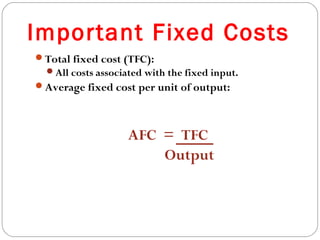
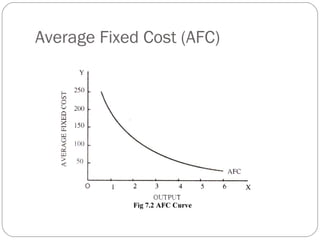
Total fixed cost (TFC): 
All costs associated with the fixed input. 
Average fixed cost per unit of output: 
AFC = TFC 
Output
Variable Costs 
13 
Can be increased or decreased by the manager. 
Variable costs will increase as production increases. 
Variable costs exist in the short-run 
and long-run: 
In fact, all costs are considered to be 
variable costs in the long run.
Variable Costs 
14 
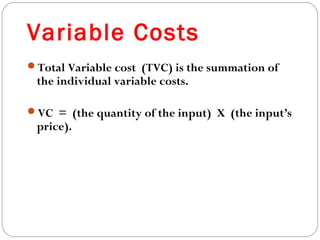
Total Variable cost (TVC) is the summation of 
the individual variable costs. 
VC = (the quantity of the input) X (the input’s 
price).
Variable Costs 
15 
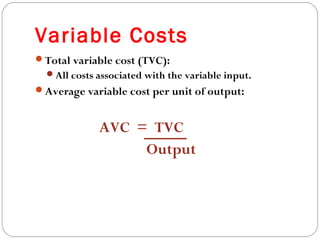
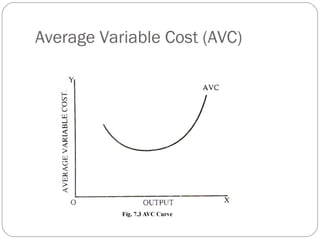
Total variable cost (TVC): 
All costs associated with the variable input. 
Average variable cost per unit of output: 
AVC = TVC 
Output
Total Cost 
16 
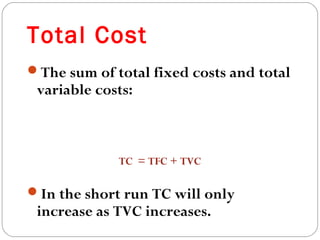
The sum of total fixed costs and total 
variable costs: 
TC = TFC + TVC 
In the short run TC will only 
increase as TVC increases.
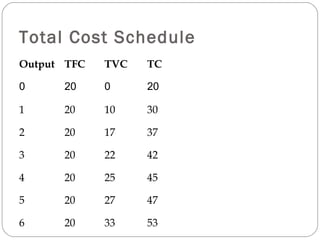
Total Cost Schedule 
Output TFC TVC TC 
0 20 0 20 
1 20 10 30 
2 20 17 37 
3 20 22 42 
4 20 25 45 
5 20 27 47 
17 6 20 33 53
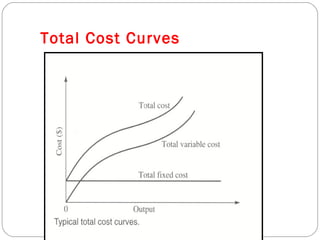
Total Cost Curves 
18
Typical Total Cost Curves 
(selected attributes) 
19 
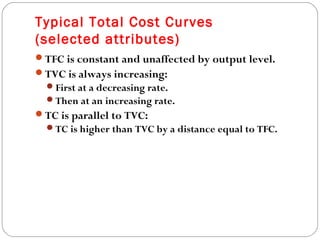
TFC is constant and unaffected by output level. 
TVC is always increasing: 
First at a decreasing rate. 
Then at an increasing rate. 
TC is parallel to TVC: 
TC is higher than TVC by a distance equal to TFC.
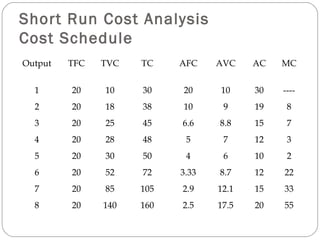
Short Run Cost Analysis 
Cost Schedule 
Output TFC TVC TC AFC AVC AC MC 
1 20 10 30 20 10 30 ---- 
2 20 18 38 10 9 19 8 
3 20 25 45 6.6 8.8 15 7 
4 20 28 48 5 7 12 3 
5 20 30 50 4 6 10 2 
6 20 52 72 3.33 8.7 12 22 
7 20 85 105 2.9 12.1 15 33 
8 20 140 160 2.5 17.5 20 55 
20
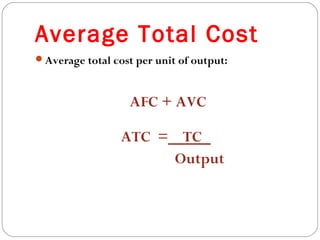
Average Total Cost 
21 
Average total cost per unit of output: 
AFC + AVC 
ATC = TC 
Output
Average Fixed Cost (AFC) 
22
Average Variable Cost (AVC) 
23
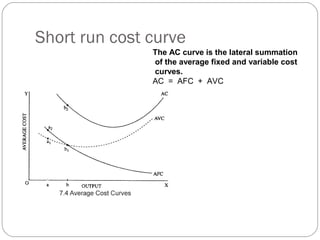
Short run cost curve 
24 
The AC curve is the lateral summation 
of the average fixed and variable cost 
curves. 
AC = AFC + AVC
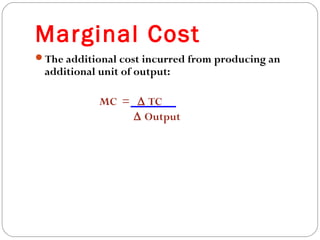
Marginal Cost 
25 
The additional cost incurred from producing an 
additional unit of output: 
MC = D TC 
D Output
Discussion 
26 
Three Industries 
Personal computers 
Software 
Restaurant
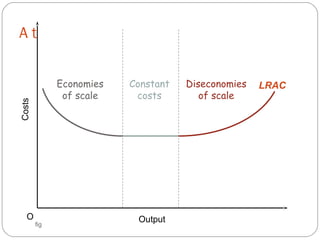
Economies of Scale 
27 
Economies arise from the firm increasing its plant size. 
Classified into 
Real economies 
Benefits that cannot be measured in monetary terms which 
accrue to the firm when it expands its scale of operations eg: 
goodwill of a firm 
Pecuniary economies 
These are benefits /economies accruing to the firm due to discounts that 
it can obtain due to its large scale operations.
Diseconomies of scale 
28 
Losses or increase in costs of production for a firm when it 
expands its scale of operation.
29 
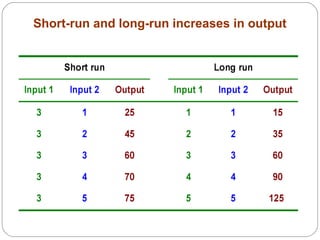
Short-run and long-run increases in output
Production and Cost in the Long 
Run 
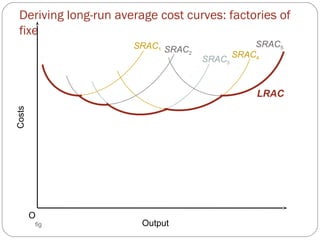
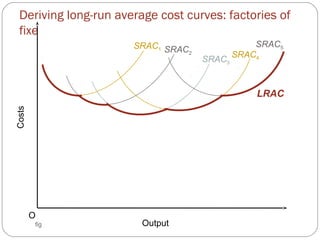
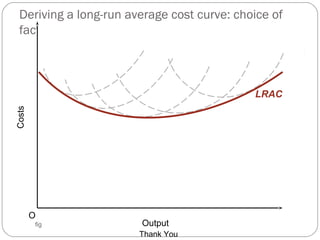
The key difference between the short run and the long run 
is that there are no diminishing returns in the long run. 
 Diminishing returns occur because workers 
share a fixed facility. In the long run the firm can 
expand its production facility as its workforce 
grows. 
 Short run average cost curves are U shaped 
owing diminishing marginal returns while long 
run average cost curves are U shaped due to 
economies of scale.
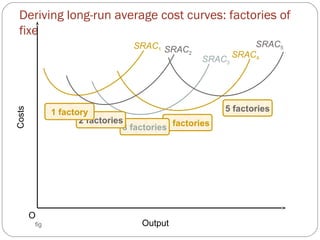
Deriving long-run average cost curves: factories of 
fixed size 
fig 
SRAC3 
Costs Output 
O 
SRAC5 
SRAC4 
5 factories 
2 factories 
3 factories4 factories 
1 factory 
SRAC1 SRAC2
Deriving long-run average cost curves: factories of 
fixed size 
fig 
SRAC1 
SRAC2 SRAC4 
SRAC3 
SRAC5 
LRAC 
Costs Output 
O
Deriving long-run average cost curves: factories of 
fixed size 
fig 
SRAC1 
SRAC2 SRAC4 
SRAC3 
SRAC5 
LRAC 
Costs Output 
O
Deriving a long-run average cost curve: choice of 
factory size 
fig 
LRAC 
Costs Output 
O 
Thank You
A typical long-run average cost curve 
Economies Constant 
LRAC 
of scale 
costs 
fig Output OCosts 
Diseconomies 
of scale

Lecture 5 cost analysis

  • 1.
    1 COSTS OFPRODUCTION Dr.Sunitha.S Assistant Professor School of Management Studies, National Institute of Technology (NIT) Calicut
  • 2.
    Explicit & ImplicitCost 2  Explicit cost refers to the making of actual payments in the process of production. Whereas Implicit cost implies that although the work gets done yet there is no corresponding payment for it in terms of money.
  • 3.
    Private and SocialCost 3 Private costs are those that accrue directly to the individuals or firms engaged in relevant activity. External costs on the other hand are are passed on to persons not involved in the activity in any direct way (ie they are passed to society at large)
  • 4.
    Sunk Cost 4 A sunk cost is an expenditure that has been made and cannot be recovered. Since it cannot be recovered, it should be ignored while taking economic decisions. Eg: a firm buys a highly specialized machine for a plant. It can be used only what it was designed for. That is, it cannot be put in alternative uses. Its opportunity cost is zero.
  • 5.
    Money cost 5 Money cost refers to the payments made to the factors of production in terms of money proper in return for their services enjoyed by the producer in his process of production. For e.g. payments made for purchasing raw material, rent of land, wages for labour.
  • 6.
    Opportunity Cost (Alternativeor Transfer Cost) 6 “The opportunity cost of anything produced can thus be defined as the next best alternative that can be produced instead by the same factors or by an equivalent group of factors costing the same amount of money.”  Resources are limited and therefore they cannot be used for more than one purpose at the same time. E.g. If land is used for building a house, the same land cannot be used for agricultural purpose. In general terms, if a resource can produce either ‘A’ or ‘B’, then the opportunity cost of producing ‘A’ is the loss of ‘B’.
  • 7.
    Discussion 7 ThreeIndustries Personal computers Software Restaurant
  • 8.
    Costs 8 Totalfixed costs (TFC) Average fixed costs (AFC) Total variable costs (TVC) Average variable cost (AVC) Total cost (TC) Average total cost (ATC) Marginal cost (MC)
  • 9.
    Short-Run & Long-Run 9 “Time concepts” rather than fixed periods. Short-run: One or more production input is fixed: Increasing cropland? One crop or livestock production cycle. Long-run: The quantity of all necessary production inputs can be changed. Expand or acquire additional inputs.
  • 10.
    Fixed Costs (Overheadcosts) 10 Result from owning a fixed input or resource. Incurred even if the resource isn’t used. Don’t change as the level of production changes (in the short run). Exist only in the short run. Not under the control of the manager in the short run. The only way to avoid fixed costs is to sell the item.
  • 11.
    Fixed cost 11 Examples: Taxes on property Interest Depreciation Rent Insurance
  • 12.
    Important Fixed Costs 12 Total fixed cost (TFC): All costs associated with the fixed input. Average fixed cost per unit of output: AFC = TFC Output
  • 13.
    Variable Costs 13 Can be increased or decreased by the manager. Variable costs will increase as production increases. Variable costs exist in the short-run and long-run: In fact, all costs are considered to be variable costs in the long run.
  • 14.
    Variable Costs 14 Total Variable cost (TVC) is the summation of the individual variable costs. VC = (the quantity of the input) X (the input’s price).
  • 15.
    Variable Costs 15 Total variable cost (TVC): All costs associated with the variable input. Average variable cost per unit of output: AVC = TVC Output
  • 16.
    Total Cost 16 The sum of total fixed costs and total variable costs: TC = TFC + TVC In the short run TC will only increase as TVC increases.
  • 17.
    Total Cost Schedule Output TFC TVC TC 0 20 0 20 1 20 10 30 2 20 17 37 3 20 22 42 4 20 25 45 5 20 27 47 17 6 20 33 53
  • 18.
  • 19.
    Typical Total CostCurves (selected attributes) 19 TFC is constant and unaffected by output level. TVC is always increasing: First at a decreasing rate. Then at an increasing rate. TC is parallel to TVC: TC is higher than TVC by a distance equal to TFC.
  • 20.
    Short Run CostAnalysis Cost Schedule Output TFC TVC TC AFC AVC AC MC 1 20 10 30 20 10 30 ---- 2 20 18 38 10 9 19 8 3 20 25 45 6.6 8.8 15 7 4 20 28 48 5 7 12 3 5 20 30 50 4 6 10 2 6 20 52 72 3.33 8.7 12 22 7 20 85 105 2.9 12.1 15 33 8 20 140 160 2.5 17.5 20 55 20
  • 21.
    Average Total Cost 21 Average total cost per unit of output: AFC + AVC ATC = TC Output
  • 22.
  • 23.
  • 24.
    Short run costcurve 24 The AC curve is the lateral summation of the average fixed and variable cost curves. AC = AFC + AVC
  • 25.
    Marginal Cost 25 The additional cost incurred from producing an additional unit of output: MC = D TC D Output
  • 26.
    Discussion 26 ThreeIndustries Personal computers Software Restaurant
  • 27.
    Economies of Scale 27 Economies arise from the firm increasing its plant size. Classified into Real economies Benefits that cannot be measured in monetary terms which accrue to the firm when it expands its scale of operations eg: goodwill of a firm Pecuniary economies These are benefits /economies accruing to the firm due to discounts that it can obtain due to its large scale operations.
  • 28.
    Diseconomies of scale 28 Losses or increase in costs of production for a firm when it expands its scale of operation.
  • 29.
    29 Short-run andlong-run increases in output
  • 30.
    Production and Costin the Long Run The key difference between the short run and the long run is that there are no diminishing returns in the long run.  Diminishing returns occur because workers share a fixed facility. In the long run the firm can expand its production facility as its workforce grows.  Short run average cost curves are U shaped owing diminishing marginal returns while long run average cost curves are U shaped due to economies of scale.
  • 31.
    Deriving long-run averagecost curves: factories of fixed size fig SRAC3 Costs Output O SRAC5 SRAC4 5 factories 2 factories 3 factories4 factories 1 factory SRAC1 SRAC2
  • 32.
    Deriving long-run averagecost curves: factories of fixed size fig SRAC1 SRAC2 SRAC4 SRAC3 SRAC5 LRAC Costs Output O
  • 33.
    Deriving long-run averagecost curves: factories of fixed size fig SRAC1 SRAC2 SRAC4 SRAC3 SRAC5 LRAC Costs Output O
  • 34.
    Deriving a long-runaverage cost curve: choice of factory size fig LRAC Costs Output O Thank You
  • 35.
    A typical long-runaverage cost curve Economies Constant LRAC of scale costs fig Output OCosts Diseconomies of scale