CS 640: Introduction to Computer Networks Aditya Akella Lecture 6 - Ethernet, Multiple Access and Bridging
The Road Ahead Multiple access protocols Ethernet’s CSMA/CD Bridging Spanning tree protocol
Multiple Access Protocols Prevent two or more nodes from transmitting at the same time over a  broadcast  channel. If they do, we have a  collision , and receivers will not be able to interpret the signal Several classes of multiple access protocols. Partitioning the channel, e.g. frequency-division or time division multiplexing Taking turns, e.g. token-based, reservation-based protocols, polling based Contention based protocols, e.g. Aloha, Ethernet
Desirable MAC Properties Broadcast channel of capacity R bps. 1 node    throughput = R bps N nodes    throughput = R/N bps, on average Decentralized Simple, inexpensive
Contention-Based Protocols Idea: access the channel in a “random” way - when collisions occur, recover. Each node transmits at highest rate of R bps Collision: two or more nodes transmitting at the same time Each node retransmits until collided packet gets through Key: don’t retransmit right away Wait a random interval of time first Examples Aloha Ethernet – focus today
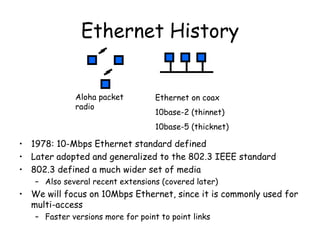
Ethernet History 1978: 10-Mbps Ethernet standard defined Later adopted and generalized to the 802.3 IEEE standard 802.3 defined a much wider set of media Also several recent extensions (covered later) We will focus on 10Mbps Ethernet, since it is commonly used for multi-access Faster versions more for point to point links Aloha packet radio Ethernet on coax 10base-2 (thinnet) 10base-5 (thicknet)
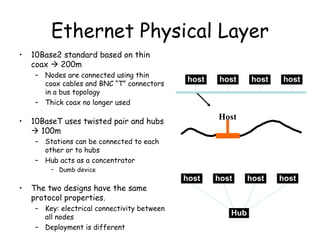
Ethernet Physical Layer 10Base2 standard based on thin coax    200m Nodes are connected using thin coax cables and BNC “T” connectors in a bus topology Thick coax no longer used 10BaseT uses twisted pair and hubs    100m Stations can be connected to each other or to hubs Hub acts as a concentrator Dumb device The two designs have the same protocol properties. Key: electrical connectivity between all nodes Deployment is different host host host host host host host host Hub Host
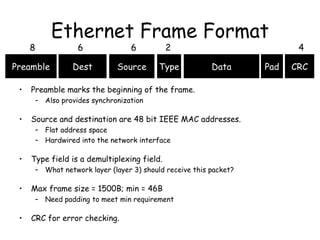
Ethernet Frame Format Preamble marks the beginning of the frame. Also provides synchronization Source and destination are 48 bit IEEE MAC addresses. Flat address space Hardwired into the network interface Type field is a demultiplexing field. What network layer (layer 3) should receive this packet? Max frame size = 1500B; min = 46B Need padding to meet min requirement CRC for error checking. Preamble Type Pad Dest Source Data CRC 8 6 6 2 4
Ethernet host side Transceiver: detects when the medium is idle and transmits the signal when host wants to send Connected to “Ethernet adaptor” Sits on the host Any host signal broadcast to everybody But transceiver accepts frames addressed to itself Also frames sent to broadcast medium All frames, if in promiscuous mode When transmitting, all hosts on the same segment, or connected to the same hub, compete for medium Same collision domain Bad for efficiency!
Sender-side: MAC Protocol Carrier-sense multiple access with collision detection (CSMA/CD).  MA = multiple access CS = carrier sense CD = collision detection
CSMA/CD Algorithm Overview Sense for carrier. “ Medium idle”? If medium busy, wait until idle. Sending would force a collision and waste time Send packet and sense for collision. If no collision detected, consider packet delivered. Otherwise, abort immediately, perform  exponential back off  and send packet again. Start to send after a random time picked from an interval Length of the interval increases with every collision, retransmission attempt
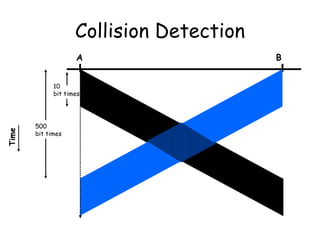
Collision Detection Time A B 10 bit times 500  bit times
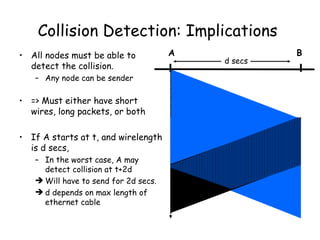
Collision Detection: Implications  All nodes must be able to detect the collision. Any node can be sender => Must either have short wires, long packets, or both If A starts at t, and wirelength is d secs,  In the worst case, A may detect collision at t+2d Will have to send for 2d secs. d depends on max length of ethernet cable A B d secs
Minimum Packet Size Give a host enough time to detect a collision. In Ethernet, the minimum packet size is 64 bytes. 18 bytes of header and 46 data bytes If the host has less than 46 bytes to send, the adaptor pads bytes to increase the length to 46 bytes What is the relationship between the minimum packet size and the size of LAN? How did they pick the minimum packet size? LAN size = (min frame size) * light speed / (2 * bandwidth)
CSMA/CD: Some Details When a sender detects a collision, it sends a “jam signal”. Make sure that all nodes are aware of the collision Length of the jam signal is 32 bit times Permits early abort - don’t waste max transmission time Exponential backoff operates in multiples of 512 bit times. RTT= 256bit times    backoff time > Longer than a roundtrip time Guarantees that nodes that back off will notice the earlier retransmission before starting to send Successive frames are separated by an “inter-frame” gap. to allow devices to prepare for reception of the next frame Set to 9.6   sec or 96 bit times
Why Ethernet? Easy to manage. You plug in the host and it basically works No configuration at the datalink layer Cheap No switches; only cables Broadcast-based. In part explains the easy management Some of the LAN protocols rely on broadcast Resource discovery Decide discovery (ARP) Naturally fit with broadcast Not having natural broadcast capabilities adds a lot of complexity to a LAN Drawbacks. Broadcast-based: limits bandwidth since each packets consumes the bandwidth of the entire network Works best under light loads Limit on number of hosts Distance
802.3u Fast Ethernet Apply original CSMA/CD medium access protocol at 100Mbps Must change either minimum frame or maximum diameter: change diameter No more “shared wire” connectivity. Hubs and switches only
802.3z Gigabit Ethernet Same frame format and size as Ethernet. This is what makes it Ethernet Full duplex point-to-point links in the backbone are likely the most common use. Added flow control to deal with congestion Alternative is half-duplex shared-medium access. Cannot cut the diameter any more (set to 200m) Raise the frame size to 512B Choice of a range of fiber and copper transmission media. Defining “jumbo frames” for higher efficiency.
LAN Properties Exploit physical proximity. Often a limitation on the physical distance  E.g. to detect collisions in a contention based network Relies on single administrative control and some level of trust. Broadcasting packets to everybody and hoping everybody (other than the receiver) will ignore the packet Broadcast: nodes can send messages that can be heard by all nodes on the network. Almost essential for network administration Can also be used for applications, e.g. video conferencing But broadcast fundamentally does not scale.
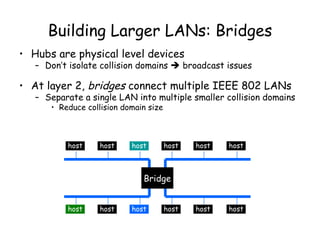
Building Larger LANs: Bridges Hubs are physical level devices Don’t isolate collision domains    broadcast issues At layer 2,  bridges  connect multiple IEEE 802 LANs Separate a single LAN into multiple smaller collision domains Reduce collision domain size host host host host host host host host host host host host Bridge
Basic Bridge Functionality Bridges are full fledged packet switches Saw bridge structure last class Frame comes in on an interface Switch looks at destination LAN address Determines port on which host connected Only forward packets to the right port Must run CSMA/CD with hosts connected to same LAN
“Transparent” Bridges Design features: “ Plug and play” capability Self-configuring without hardware or software changes Bridge do not impact the operation of the individual LANs Three components of transparent bridges: Forwarding of frames Learning of addresses Spanning tree algorithm
Frame Forwarding Each switch maintains a forwarding database: <MAC address, port, age>   MAC address: host or group address   Port: port number on the bridge   Age: age of the entry Meaning: A machine with  MAC address  lies in the direction of number  port  of the bridge For every packet, the bridge “looks up” the entry for the packet’s destination MAC address and forwards the packet on that port. No entry    packets are broadcasted
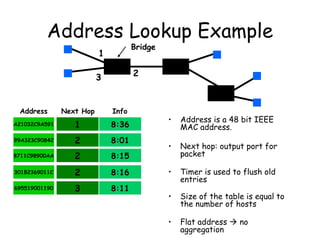
Address Lookup Example Address is a 48 bit IEEE MAC address. Next hop: output port for packet Timer is used to flush old entries Size of the table is equal to the number of hosts Flat address    no aggregation Bridge 8711C98900AA 2 Address Next Hop A21032C9A591 1 99A323C90842 2 301B2369011C 2 695519001190 3 8:15 Info 8:36 8:01 8:16 8:11 1 3 2
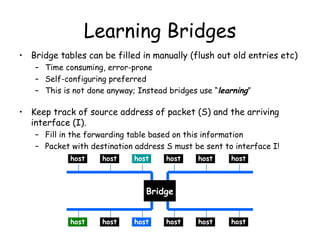
Learning Bridges Bridge tables can be filled in manually (flush out old entries etc) Time consuming, error-prone Self-configuring preferred This is not done anyway; Instead bridges use “ learning ” Keep track of source address of packet (S) and the arriving interface (I). Fill in the forwarding table based on this information Packet with destination address S must be sent to interface I! host host host host host host host host host host host host Bridge
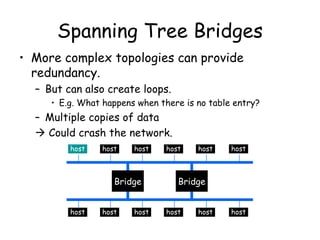
Spanning Tree Bridges More complex topologies can provide redundancy. But can also create loops. E.g. What happens when there is no table entry? Multiple copies of data     Could crash the network. host host host host host host host host host host host host Bridge Bridge
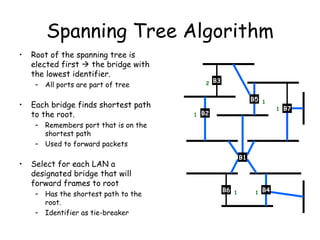
Spanning Tree Protocol Overview Embed a tree that provides a single unique path to each destination: Bridges designated ports over which they will or will not forward frames By removing ports, extended LAN is reduced to a tree
Spanning Tree Algorithm Root of the spanning tree is elected first    the bridge with the lowest identifier. All ports are part of tree Each bridge finds shortest path to the root. Remembers port that is on the shortest path Used to forward packets Select for each LAN a designated bridge that will forward frames to root Has the shortest path to the root. Identifier as tie-breaker B3 B7 B5 B2 B1 B4 B6 1 2 1 1 1 1
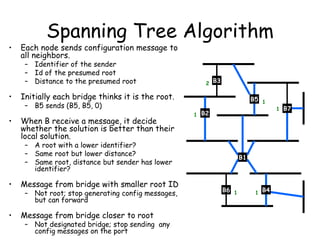
Spanning Tree Algorithm Each node sends configuration message to all neighbors. Identifier of the sender Id of the presumed root Distance to the presumed root Initially each bridge thinks it is the root. B5 sends (B5, B5, 0) When B receive a message, it decide whether the solution is better than their local solution. A root with a lower identifier? Same root but lower distance? Same root, distance but sender has lower identifier? Message from bridge with smaller root ID Not root; stop generating config messages, but can forward Message from bridge closer to root  Not designated bridge; stop sending  any config messages on the port B3 B7 B5 B2 B1 B4 B6 1 2 1 1 1 1
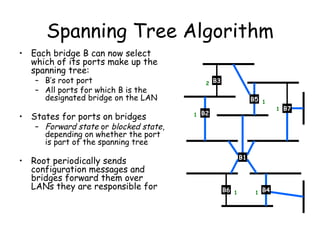
Spanning Tree Algorithm Each bridge B can now select which of its ports make up the spanning tree: B’s root port All ports for which B is the designated bridge on the LAN States for ports on bridges Forward state  or  blocked state , depending on whether the port is part of the spanning tree Root periodically sends configuration messages and bridges forward them over LANs they are responsible for B3 B7 B5 B2 B1 B4 B6 1 2 1 1 1 1
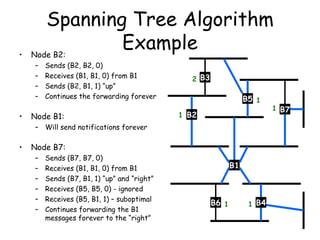
Spanning Tree Algorithm Example Node B2: Sends (B2, B2, 0) Receives (B1, B1, 0) from B1 Sends (B2, B1, 1) “up” Continues the forwarding forever Node B1: Will send notifications forever Node B7: Sends (B7, B7, 0) Receives (B1, B1, 0) from B1 Sends (B7, B1, 1) “up” and “right” Receives (B5, B5, 0) - ignored Receives (B5, B1, 1) – suboptimal Continues forwarding the B1 messages forever to the “right” B3 B7 B5 B2 B1 B4 B6 1 2 1 1 1 1
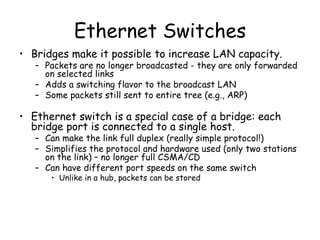
Ethernet Switches Bridges make it possible to increase LAN capacity. Packets are no longer broadcasted - they are only forwarded on selected links Adds a switching flavor to the broadcast LAN Some packets still sent to entire tree (e.g., ARP) Ethernet switch is a special case of a bridge: each bridge port is connected to a single host. Can make the link full duplex (really simple protocol!) Simplifies the protocol and hardware used (only two stations on the link) – no longer full CSMA/CD Can have different port speeds on the same switch Unlike in a hub, packets can be stored
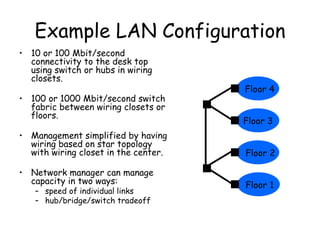
Example LAN Configuration 10 or 100 Mbit/second connectivity to the desk top using switch or hubs in wiring closets. 100 or 1000 Mbit/second switch fabric between wiring closets or floors. Management simplified by having wiring based on star topology with wiring closet in the center. Network manager can manage capacity in two ways:  speed of individual links hub/bridge/switch tradeoff Floor 3 Floor 1 Floor 2 Floor 4
A Word about  “Taking Turn” Protocols First option: Polling-based  Central entity polls stations, inviting them to transmit. Simple design – no conflicts Not very efficient – overhead of polling operation Still better than TDM or FDM Central point of failure Second (similar) option: Stations reserve a slot for transmission. For example, break up the transmission time in contention-based and reservation based slots Contention based slots can be used for short messages or to reserve time  Communication in reservation based slots only allowed after a reservation is made Issues: fairness, efficiency
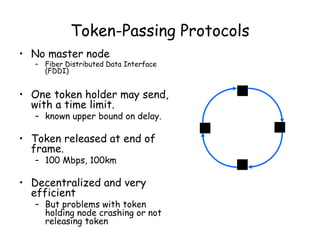
Token-Passing Protocols No master node Fiber Distributed Data Interface (FDDI) One token holder may send, with a time limit.  known upper bound on delay.  Token released at end of frame. 100 Mbps, 100km Decentralized and very efficient But problems with token holding node crashing or not releasing token
Next Lecture The IP layer lecture series begins.. Addressing Forwarding in IP

F06_Lecture7_etherne..

  • 1.
    CS 640: Introductionto Computer Networks Aditya Akella Lecture 6 - Ethernet, Multiple Access and Bridging
  • 2.
    The Road AheadMultiple access protocols Ethernet’s CSMA/CD Bridging Spanning tree protocol
  • 3.
    Multiple Access ProtocolsPrevent two or more nodes from transmitting at the same time over a broadcast channel. If they do, we have a collision , and receivers will not be able to interpret the signal Several classes of multiple access protocols. Partitioning the channel, e.g. frequency-division or time division multiplexing Taking turns, e.g. token-based, reservation-based protocols, polling based Contention based protocols, e.g. Aloha, Ethernet
  • 4.
    Desirable MAC PropertiesBroadcast channel of capacity R bps. 1 node  throughput = R bps N nodes  throughput = R/N bps, on average Decentralized Simple, inexpensive
  • 5.
    Contention-Based Protocols Idea:access the channel in a “random” way - when collisions occur, recover. Each node transmits at highest rate of R bps Collision: two or more nodes transmitting at the same time Each node retransmits until collided packet gets through Key: don’t retransmit right away Wait a random interval of time first Examples Aloha Ethernet – focus today
  • 6.
    Ethernet History 1978:10-Mbps Ethernet standard defined Later adopted and generalized to the 802.3 IEEE standard 802.3 defined a much wider set of media Also several recent extensions (covered later) We will focus on 10Mbps Ethernet, since it is commonly used for multi-access Faster versions more for point to point links Aloha packet radio Ethernet on coax 10base-2 (thinnet) 10base-5 (thicknet)
  • 7.
    Ethernet Physical Layer10Base2 standard based on thin coax  200m Nodes are connected using thin coax cables and BNC “T” connectors in a bus topology Thick coax no longer used 10BaseT uses twisted pair and hubs  100m Stations can be connected to each other or to hubs Hub acts as a concentrator Dumb device The two designs have the same protocol properties. Key: electrical connectivity between all nodes Deployment is different host host host host host host host host Hub Host
  • 8.
    Ethernet Frame FormatPreamble marks the beginning of the frame. Also provides synchronization Source and destination are 48 bit IEEE MAC addresses. Flat address space Hardwired into the network interface Type field is a demultiplexing field. What network layer (layer 3) should receive this packet? Max frame size = 1500B; min = 46B Need padding to meet min requirement CRC for error checking. Preamble Type Pad Dest Source Data CRC 8 6 6 2 4
  • 9.
    Ethernet host sideTransceiver: detects when the medium is idle and transmits the signal when host wants to send Connected to “Ethernet adaptor” Sits on the host Any host signal broadcast to everybody But transceiver accepts frames addressed to itself Also frames sent to broadcast medium All frames, if in promiscuous mode When transmitting, all hosts on the same segment, or connected to the same hub, compete for medium Same collision domain Bad for efficiency!
  • 10.
    Sender-side: MAC ProtocolCarrier-sense multiple access with collision detection (CSMA/CD). MA = multiple access CS = carrier sense CD = collision detection
  • 11.
    CSMA/CD Algorithm OverviewSense for carrier. “ Medium idle”? If medium busy, wait until idle. Sending would force a collision and waste time Send packet and sense for collision. If no collision detected, consider packet delivered. Otherwise, abort immediately, perform exponential back off and send packet again. Start to send after a random time picked from an interval Length of the interval increases with every collision, retransmission attempt
  • 12.
    Collision Detection TimeA B 10 bit times 500 bit times
  • 13.
    Collision Detection: Implications All nodes must be able to detect the collision. Any node can be sender => Must either have short wires, long packets, or both If A starts at t, and wirelength is d secs, In the worst case, A may detect collision at t+2d Will have to send for 2d secs. d depends on max length of ethernet cable A B d secs
  • 14.
    Minimum Packet SizeGive a host enough time to detect a collision. In Ethernet, the minimum packet size is 64 bytes. 18 bytes of header and 46 data bytes If the host has less than 46 bytes to send, the adaptor pads bytes to increase the length to 46 bytes What is the relationship between the minimum packet size and the size of LAN? How did they pick the minimum packet size? LAN size = (min frame size) * light speed / (2 * bandwidth)
  • 15.
    CSMA/CD: Some DetailsWhen a sender detects a collision, it sends a “jam signal”. Make sure that all nodes are aware of the collision Length of the jam signal is 32 bit times Permits early abort - don’t waste max transmission time Exponential backoff operates in multiples of 512 bit times. RTT= 256bit times  backoff time > Longer than a roundtrip time Guarantees that nodes that back off will notice the earlier retransmission before starting to send Successive frames are separated by an “inter-frame” gap. to allow devices to prepare for reception of the next frame Set to 9.6  sec or 96 bit times
  • 16.
    Why Ethernet? Easyto manage. You plug in the host and it basically works No configuration at the datalink layer Cheap No switches; only cables Broadcast-based. In part explains the easy management Some of the LAN protocols rely on broadcast Resource discovery Decide discovery (ARP) Naturally fit with broadcast Not having natural broadcast capabilities adds a lot of complexity to a LAN Drawbacks. Broadcast-based: limits bandwidth since each packets consumes the bandwidth of the entire network Works best under light loads Limit on number of hosts Distance
  • 17.
    802.3u Fast EthernetApply original CSMA/CD medium access protocol at 100Mbps Must change either minimum frame or maximum diameter: change diameter No more “shared wire” connectivity. Hubs and switches only
  • 18.
    802.3z Gigabit EthernetSame frame format and size as Ethernet. This is what makes it Ethernet Full duplex point-to-point links in the backbone are likely the most common use. Added flow control to deal with congestion Alternative is half-duplex shared-medium access. Cannot cut the diameter any more (set to 200m) Raise the frame size to 512B Choice of a range of fiber and copper transmission media. Defining “jumbo frames” for higher efficiency.
  • 19.
    LAN Properties Exploitphysical proximity. Often a limitation on the physical distance E.g. to detect collisions in a contention based network Relies on single administrative control and some level of trust. Broadcasting packets to everybody and hoping everybody (other than the receiver) will ignore the packet Broadcast: nodes can send messages that can be heard by all nodes on the network. Almost essential for network administration Can also be used for applications, e.g. video conferencing But broadcast fundamentally does not scale.
  • 20.
    Building Larger LANs:Bridges Hubs are physical level devices Don’t isolate collision domains  broadcast issues At layer 2, bridges connect multiple IEEE 802 LANs Separate a single LAN into multiple smaller collision domains Reduce collision domain size host host host host host host host host host host host host Bridge
  • 21.
    Basic Bridge FunctionalityBridges are full fledged packet switches Saw bridge structure last class Frame comes in on an interface Switch looks at destination LAN address Determines port on which host connected Only forward packets to the right port Must run CSMA/CD with hosts connected to same LAN
  • 22.
    “Transparent” Bridges Designfeatures: “ Plug and play” capability Self-configuring without hardware or software changes Bridge do not impact the operation of the individual LANs Three components of transparent bridges: Forwarding of frames Learning of addresses Spanning tree algorithm
  • 23.
    Frame Forwarding Eachswitch maintains a forwarding database: <MAC address, port, age> MAC address: host or group address Port: port number on the bridge Age: age of the entry Meaning: A machine with MAC address lies in the direction of number port of the bridge For every packet, the bridge “looks up” the entry for the packet’s destination MAC address and forwards the packet on that port. No entry  packets are broadcasted
  • 24.
    Address Lookup ExampleAddress is a 48 bit IEEE MAC address. Next hop: output port for packet Timer is used to flush old entries Size of the table is equal to the number of hosts Flat address  no aggregation Bridge 8711C98900AA 2 Address Next Hop A21032C9A591 1 99A323C90842 2 301B2369011C 2 695519001190 3 8:15 Info 8:36 8:01 8:16 8:11 1 3 2
  • 25.
    Learning Bridges Bridgetables can be filled in manually (flush out old entries etc) Time consuming, error-prone Self-configuring preferred This is not done anyway; Instead bridges use “ learning ” Keep track of source address of packet (S) and the arriving interface (I). Fill in the forwarding table based on this information Packet with destination address S must be sent to interface I! host host host host host host host host host host host host Bridge
  • 26.
    Spanning Tree BridgesMore complex topologies can provide redundancy. But can also create loops. E.g. What happens when there is no table entry? Multiple copies of data  Could crash the network. host host host host host host host host host host host host Bridge Bridge
  • 27.
    Spanning Tree ProtocolOverview Embed a tree that provides a single unique path to each destination: Bridges designated ports over which they will or will not forward frames By removing ports, extended LAN is reduced to a tree
  • 28.
    Spanning Tree AlgorithmRoot of the spanning tree is elected first  the bridge with the lowest identifier. All ports are part of tree Each bridge finds shortest path to the root. Remembers port that is on the shortest path Used to forward packets Select for each LAN a designated bridge that will forward frames to root Has the shortest path to the root. Identifier as tie-breaker B3 B7 B5 B2 B1 B4 B6 1 2 1 1 1 1
  • 29.
    Spanning Tree AlgorithmEach node sends configuration message to all neighbors. Identifier of the sender Id of the presumed root Distance to the presumed root Initially each bridge thinks it is the root. B5 sends (B5, B5, 0) When B receive a message, it decide whether the solution is better than their local solution. A root with a lower identifier? Same root but lower distance? Same root, distance but sender has lower identifier? Message from bridge with smaller root ID Not root; stop generating config messages, but can forward Message from bridge closer to root Not designated bridge; stop sending any config messages on the port B3 B7 B5 B2 B1 B4 B6 1 2 1 1 1 1
  • 30.
    Spanning Tree AlgorithmEach bridge B can now select which of its ports make up the spanning tree: B’s root port All ports for which B is the designated bridge on the LAN States for ports on bridges Forward state or blocked state , depending on whether the port is part of the spanning tree Root periodically sends configuration messages and bridges forward them over LANs they are responsible for B3 B7 B5 B2 B1 B4 B6 1 2 1 1 1 1
  • 31.
    Spanning Tree AlgorithmExample Node B2: Sends (B2, B2, 0) Receives (B1, B1, 0) from B1 Sends (B2, B1, 1) “up” Continues the forwarding forever Node B1: Will send notifications forever Node B7: Sends (B7, B7, 0) Receives (B1, B1, 0) from B1 Sends (B7, B1, 1) “up” and “right” Receives (B5, B5, 0) - ignored Receives (B5, B1, 1) – suboptimal Continues forwarding the B1 messages forever to the “right” B3 B7 B5 B2 B1 B4 B6 1 2 1 1 1 1
  • 32.
    Ethernet Switches Bridgesmake it possible to increase LAN capacity. Packets are no longer broadcasted - they are only forwarded on selected links Adds a switching flavor to the broadcast LAN Some packets still sent to entire tree (e.g., ARP) Ethernet switch is a special case of a bridge: each bridge port is connected to a single host. Can make the link full duplex (really simple protocol!) Simplifies the protocol and hardware used (only two stations on the link) – no longer full CSMA/CD Can have different port speeds on the same switch Unlike in a hub, packets can be stored
  • 33.
    Example LAN Configuration10 or 100 Mbit/second connectivity to the desk top using switch or hubs in wiring closets. 100 or 1000 Mbit/second switch fabric between wiring closets or floors. Management simplified by having wiring based on star topology with wiring closet in the center. Network manager can manage capacity in two ways: speed of individual links hub/bridge/switch tradeoff Floor 3 Floor 1 Floor 2 Floor 4
  • 34.
    A Word about “Taking Turn” Protocols First option: Polling-based Central entity polls stations, inviting them to transmit. Simple design – no conflicts Not very efficient – overhead of polling operation Still better than TDM or FDM Central point of failure Second (similar) option: Stations reserve a slot for transmission. For example, break up the transmission time in contention-based and reservation based slots Contention based slots can be used for short messages or to reserve time Communication in reservation based slots only allowed after a reservation is made Issues: fairness, efficiency
  • 35.
    Token-Passing Protocols Nomaster node Fiber Distributed Data Interface (FDDI) One token holder may send, with a time limit. known upper bound on delay. Token released at end of frame. 100 Mbps, 100km Decentralized and very efficient But problems with token holding node crashing or not releasing token
  • 36.
    Next Lecture TheIP layer lecture series begins.. Addressing Forwarding in IP