Mobile Transport Layer
-Sonali Ajankar
VJTI, Mumbai
10.0.1
Mobile transport layer
Traditional TCP
 Congestion control
 Slow start
 Fast retransmit / fast recovery
Transport protocols typically designed for
 Fixed end-systems
 Fixed wired networks
 Implication on mobile
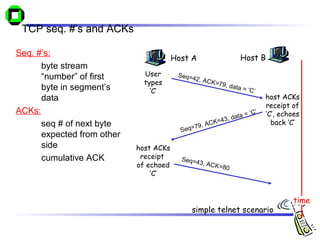
TCP seq. #’s and ACKs
Seq. #’s:
byte stream
“number” of first
byte in segment’s
data
ACKs:
seq # of next byte
expected from other
side
cumulative ACK
Host A Host B
Seq=42, ACK=79, data = ‘C’
Seq=79, ACK=43, data = ‘C’
Seq=43, ACK=80
User
types
‘C’
host ACKs
receipt
of echoed
‘C’
host ACKs
receipt of
‘C’, echoes
back ‘C’
time
simple telnet scenario
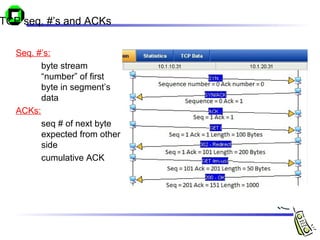
TCP seq. #’s and ACKs
Seq. #’s:
byte stream
“number” of first
byte in segment’s
data
ACKs:
seq # of next byte
expected from other
side
cumulative ACK
host ACKs
receipt
of echoed
‘C’
Motivation II
TCP congestion control
 packet loss in fixed networks typically due to (temporary) overload
situations
 router have to discard packets as soon as the buffers are full
 TCP recognizes congestion only indirect via missing
acknowledgements, timeout, they would only contribute to the
congestion and make it even worse
10.2.1
Motivation II
TCP slow-start algorithm
 sender calculates a congestion window for a receiver
 start with a congestion window size equal to one segment
 exponential increase of the congestion window up to the
congestion threshold, then linear increase
 missing acknowledgement causes the reduction of the
congestion threshold to one half of the current congestion
window
 congestion window starts again with one segment
10.2.1
TCP Slow Start cont…
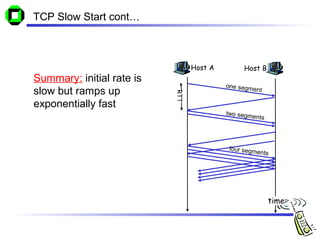
Summary: initial rate is
slow but ramps up
exponentially fast
Host A
one segment
RTT
Host B
time
two segments
four segments
TCP Slow Start cont…
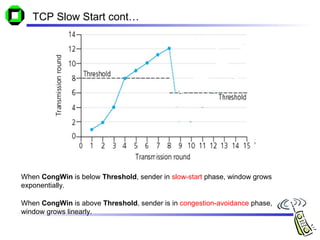
When CongWin is below Threshold, sender in slow-start phase, window grows
exponentially.
When CongWin is above Threshold, sender is in congestion-avoidance phase,
window grows linearly.
TCP fast retransmit/fast recovery:
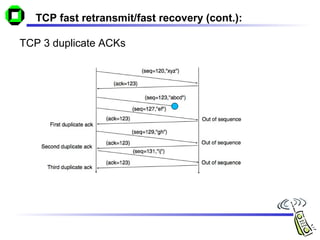
continuous receiving of ACK for the same
packet.
receipt of ACK shows that there is no
congestion to justify slow start.
timeout indicates a “more alarming”
congestion scenario
When a triple duplicate ACK occurs,
Threshold set to CongWin/2 and CongWin
set to Threshold.
 3 dup ACKs indicates network capable of delivering some
segments
 In short - resend segment before timer expires because of the
receipt of same ACK multiple times
10.2.1
TCP 3 duplicate ACKs
TCP fast retransmit/fast recovery (cont.):
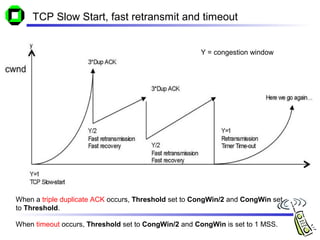
TCP Slow Start, fast retransmit and timeout
Y = congestion window
When a triple duplicate ACK occurs, Threshold set to CongWin/2 and CongWin set
to Threshold.
When timeout occurs, Threshold set to CongWin/2 and CongWin is set to 1 MSS.
Influences of mobility on TCP-mechanisms
TCP assumes congestion if packets are dropped
 typically wrong in wireless networks, here we often have packet
loss due to transmission errors
 furthermore, mobility itself can cause packet loss, if e.g. a mobile
node roams from one access point (e.g. foreign agent in Mobile IP)
to another while there are still packets in transit to the wrong access
point and forwarding is not possible
The performance of an unchanged TCP degrades severely
 however, TCP cannot be changed fundamentally due to the large
base of installation in the fixed network, TCP for mobility has to
remain compatible
 the basic TCP mechanisms keep the whole Internet together
10.3.1
Classical TCP improvements
Indirect TCP
Snooping TCP
Mobile TCP
Indirect TCP I
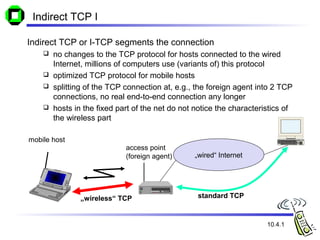
Indirect TCP or I-TCP segments the connection
 no changes to the TCP protocol for hosts connected to the wired
Internet, millions of computers use (variants of) this protocol
 optimized TCP protocol for mobile hosts
 splitting of the TCP connection at, e.g., the foreign agent into 2 TCP
connections, no real end-to-end connection any longer
 hosts in the fixed part of the net do not notice the characteristics of
the wireless part
mobile host
access point
(foreign agent) „wired“ Internet
„wireless“ TCP standard TCP
10.4.1
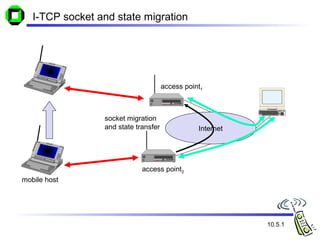
I-TCP socket and state migration
mobile host
access point2
Internet
access point1
socket migration
and state transfer
10.5.1
Indirect TCP II
Advantages
 no changes in the fixed network necessary, no changes for the hosts
(TCP protocol) necessary, all current optimizations to TCP still work
 transmission errors on the wireless link do not propagate into the fixed
network
 simple to control, mobile TCP is used only for one hop between, e.g., a
foreign agent and mobile host
 therefore, a very fast retransmission of packets is possible, the short
delay on the mobile hop is known
Disadvantages
 loss of end-to-end semantics, an acknowledgement to a sender does
now not any longer mean that a receiver really got a packet, foreign
agents might crash
 higher latency possible due to buffering of data within the foreign agent
and forwarding to a new foreign agent
10.6.1
Snooping TCP I
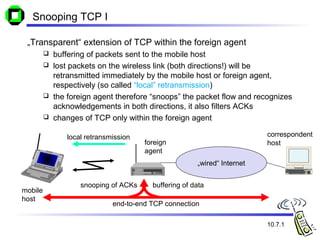
„Transparent“ extension of TCP within the foreign agent
 buffering of packets sent to the mobile host
 lost packets on the wireless link (both directions!) will be
retransmitted immediately by the mobile host or foreign agent,
respectively (so called “local” retransmission)
 the foreign agent therefore “snoops” the packet flow and recognizes
acknowledgements in both directions, it also filters ACKs
 changes of TCP only within the foreign agent
„wired“ Internet
buffering of data
end-to-end TCP connection
local retransmission
10.7.1
correspondent
hostforeign
agent
mobile
host
snooping of ACKs
Snooping TCP II
Data transfer to the mobile host
 FA buffers data until it receives ACK of the MH, FA detects packet
loss via duplicated ACKs or time-out
 fast retransmission possible, transparent for the fixed network
Data transfer from the mobile host
 FA detects packet loss on the wireless link via sequence numbers,
FA answers directly with a NACK to the MH
 MH can now retransmit data with only a very short delay
Integration of the MAC layer
 MAC layer often has similar mechanisms to those of TCP
 thus, the MAC layer can already detect duplicated packets due to
retransmissions and discard them
Problems
 snooping TCP does not isolate the wireless link as good as I-TCP
 snooping might be useless depending on encryption schemes
10.8.1
Mobile TCP
Special handling of lengthy and/or frequent disconnections
M-TCP splits as I-TCP does
 unmodified TCP fixed network to supervisory host (SH)
 optimized TCP SH to MH
Supervisory host
 no caching, no retransmission
 monitors all packets, if disconnection detected
 set sender window size to 0
 sender automatically goes into persistent mode
 old or new SH reopen the window
Advantages
 maintains semantics, supports disconnection, no buffer forwarding
Disadvantages
 loss on wireless link propagated into fixed network
 adapted TCP on wireless link
10.9.1

Mobile transport layer

  • 1.
    Mobile Transport Layer -SonaliAjankar VJTI, Mumbai 10.0.1
  • 2.
    Mobile transport layer TraditionalTCP  Congestion control  Slow start  Fast retransmit / fast recovery Transport protocols typically designed for  Fixed end-systems  Fixed wired networks  Implication on mobile
  • 3.
    TCP seq. #’sand ACKs Seq. #’s: byte stream “number” of first byte in segment’s data ACKs: seq # of next byte expected from other side cumulative ACK Host A Host B Seq=42, ACK=79, data = ‘C’ Seq=79, ACK=43, data = ‘C’ Seq=43, ACK=80 User types ‘C’ host ACKs receipt of echoed ‘C’ host ACKs receipt of ‘C’, echoes back ‘C’ time simple telnet scenario
  • 4.
    TCP seq. #’sand ACKs Seq. #’s: byte stream “number” of first byte in segment’s data ACKs: seq # of next byte expected from other side cumulative ACK host ACKs receipt of echoed ‘C’
  • 5.
    Motivation II TCP congestioncontrol  packet loss in fixed networks typically due to (temporary) overload situations  router have to discard packets as soon as the buffers are full  TCP recognizes congestion only indirect via missing acknowledgements, timeout, they would only contribute to the congestion and make it even worse 10.2.1
  • 6.
    Motivation II TCP slow-startalgorithm  sender calculates a congestion window for a receiver  start with a congestion window size equal to one segment  exponential increase of the congestion window up to the congestion threshold, then linear increase  missing acknowledgement causes the reduction of the congestion threshold to one half of the current congestion window  congestion window starts again with one segment 10.2.1
  • 7.
    TCP Slow Startcont… Summary: initial rate is slow but ramps up exponentially fast Host A one segment RTT Host B time two segments four segments
  • 8.
    TCP Slow Startcont… When CongWin is below Threshold, sender in slow-start phase, window grows exponentially. When CongWin is above Threshold, sender is in congestion-avoidance phase, window grows linearly.
  • 9.
    TCP fast retransmit/fastrecovery: continuous receiving of ACK for the same packet. receipt of ACK shows that there is no congestion to justify slow start. timeout indicates a “more alarming” congestion scenario When a triple duplicate ACK occurs, Threshold set to CongWin/2 and CongWin set to Threshold.  3 dup ACKs indicates network capable of delivering some segments  In short - resend segment before timer expires because of the receipt of same ACK multiple times 10.2.1
  • 10.
    TCP 3 duplicateACKs TCP fast retransmit/fast recovery (cont.):
  • 11.
    TCP Slow Start,fast retransmit and timeout Y = congestion window When a triple duplicate ACK occurs, Threshold set to CongWin/2 and CongWin set to Threshold. When timeout occurs, Threshold set to CongWin/2 and CongWin is set to 1 MSS.
  • 12.
    Influences of mobilityon TCP-mechanisms TCP assumes congestion if packets are dropped  typically wrong in wireless networks, here we often have packet loss due to transmission errors  furthermore, mobility itself can cause packet loss, if e.g. a mobile node roams from one access point (e.g. foreign agent in Mobile IP) to another while there are still packets in transit to the wrong access point and forwarding is not possible The performance of an unchanged TCP degrades severely  however, TCP cannot be changed fundamentally due to the large base of installation in the fixed network, TCP for mobility has to remain compatible  the basic TCP mechanisms keep the whole Internet together 10.3.1
  • 13.
    Classical TCP improvements IndirectTCP Snooping TCP Mobile TCP
  • 14.
    Indirect TCP I IndirectTCP or I-TCP segments the connection  no changes to the TCP protocol for hosts connected to the wired Internet, millions of computers use (variants of) this protocol  optimized TCP protocol for mobile hosts  splitting of the TCP connection at, e.g., the foreign agent into 2 TCP connections, no real end-to-end connection any longer  hosts in the fixed part of the net do not notice the characteristics of the wireless part mobile host access point (foreign agent) „wired“ Internet „wireless“ TCP standard TCP 10.4.1
  • 15.
    I-TCP socket andstate migration mobile host access point2 Internet access point1 socket migration and state transfer 10.5.1
  • 16.
    Indirect TCP II Advantages no changes in the fixed network necessary, no changes for the hosts (TCP protocol) necessary, all current optimizations to TCP still work  transmission errors on the wireless link do not propagate into the fixed network  simple to control, mobile TCP is used only for one hop between, e.g., a foreign agent and mobile host  therefore, a very fast retransmission of packets is possible, the short delay on the mobile hop is known Disadvantages  loss of end-to-end semantics, an acknowledgement to a sender does now not any longer mean that a receiver really got a packet, foreign agents might crash  higher latency possible due to buffering of data within the foreign agent and forwarding to a new foreign agent 10.6.1
  • 17.
    Snooping TCP I „Transparent“extension of TCP within the foreign agent  buffering of packets sent to the mobile host  lost packets on the wireless link (both directions!) will be retransmitted immediately by the mobile host or foreign agent, respectively (so called “local” retransmission)  the foreign agent therefore “snoops” the packet flow and recognizes acknowledgements in both directions, it also filters ACKs  changes of TCP only within the foreign agent „wired“ Internet buffering of data end-to-end TCP connection local retransmission 10.7.1 correspondent hostforeign agent mobile host snooping of ACKs
  • 18.
    Snooping TCP II Datatransfer to the mobile host  FA buffers data until it receives ACK of the MH, FA detects packet loss via duplicated ACKs or time-out  fast retransmission possible, transparent for the fixed network Data transfer from the mobile host  FA detects packet loss on the wireless link via sequence numbers, FA answers directly with a NACK to the MH  MH can now retransmit data with only a very short delay Integration of the MAC layer  MAC layer often has similar mechanisms to those of TCP  thus, the MAC layer can already detect duplicated packets due to retransmissions and discard them Problems  snooping TCP does not isolate the wireless link as good as I-TCP  snooping might be useless depending on encryption schemes 10.8.1
  • 19.
    Mobile TCP Special handlingof lengthy and/or frequent disconnections M-TCP splits as I-TCP does  unmodified TCP fixed network to supervisory host (SH)  optimized TCP SH to MH Supervisory host  no caching, no retransmission  monitors all packets, if disconnection detected  set sender window size to 0  sender automatically goes into persistent mode  old or new SH reopen the window Advantages  maintains semantics, supports disconnection, no buffer forwarding Disadvantages  loss on wireless link propagated into fixed network  adapted TCP on wireless link 10.9.1

Editor's Notes

  • #2 Motivation TCP-mechanisms Indirect TCP Snooping TCP Mobile TCP Fast retransmit/recovery Transmission freezing Selective retransmission Transaction oriented TCP
  • #3 Research activities Performance Congestion control Efficient retransmissions
  • #7 Q: how receiver handles out-of-order segments A: TCP spec doesn’t say, - up to implementor
  • #8 Q: how receiver handles out-of-order segments A: TCP spec doesn’t say, - up to implementor
  • #9 three mechanisms: AIMD slow start conservative after timeout events
  • #11 The overall concept to the TCP Slow Start process is very simple -- probe the path to the destination to find an optimal send rate to where packet loss can be kept at a minimum
  • #14 fast retrasmit this is due to a gap in received packets at the receiver. The sender perform fast recovery from the packet loss before timer expires. therefore, packet loss is not due to congestion, continue with current congestion window
  • #15 When CongWin is below Threshold, sender in slow-start phase, window grows exponentially. When CongWin is above Threshold, sender is in congestion-avoidance phase, window grows linearly. When a triple duplicate ACK occurs, Threshold set to CongWin/2 and CongWin set to Threshold. When timeout occurs, Threshold set to CongWin/2 and CongWin is set to 1 MSS.
  • #16 When CongWin is below Threshold, sender in slow-start phase, window grows exponentially. When CongWin is above Threshold, sender is in congestion-avoidance phase, window grows linearly. When a triple duplicate ACK occurs, Threshold set to CongWin/2 and CongWin set to Threshold. When timeout occurs, Threshold set to CongWin/2 and CongWin is set to 1 MSS.