IOSR Journal of Mechanical and Civil Engineering (IOSR-JMCE)
e-ISSN: 2278-1684,p-ISSN: 2320-334X, Volume 12, Issue 4 Ver. VII (Jul. - Aug. 2015), PP 56-64
www.iosrjournals.org
DOI: 10.9790/1684-12475664 www.iosrjournals.org 56 | Page
Analysis and Design of Multi Cell Post-Tensioned PSC Box
Girder
Chetan T Naik1
, Dr.M M Achar2
, K Lakshmi3
1
M-tech Student, Dept. of Civil Engg., Alpha College of Engineering, Bengaluru, Karnataka, India
2
Associate Vice President, India International Infrastructure Engineers Ltd, Bengaluru, Karnataka, India
3
Assistant Professor, Dept. of Civil Engg., Alpha College of Engineering, Bengaluru, Karnataka, India
Abstract: In the present work, analysis and design of box girder has been done, consideringtwo different
sheathing pipes namely HDPE and corrugated Bright metal pipes. These sheathing pipes have been used to find
the economic solution of design of multi-cell box girder. CSI-bridge modular software has been used for
carrying out analysis. Multi-cell PSC box girder design has been performed at various locations along the span
so as to consider maximum or critical locations of the PSC box girder due to various loading conditions, the
post tensioning of cables is done for jacking load at 0.765 times the UTS and jacking is done at both ends of the
PSC box girder simultaneously., Various losses that occur due to different phenomena such as elastic
shortening, Creep, shrinkage, friction and wobble loss have been considered. The results obtained on the two
sheathing pipes are compared and are tabulated and graph gas been plotted. Encouraging results have been
obtained.
Keywords: High density polyethylene (HDPE), Bright metal, Indian road congress (IRC), Pre-stressed
concrete (PSC),
I. Introduction
A Bridge or flyover can be defined as a structure including supports erected over a gorge or an
obstruction, such as water, highway, or railway, and having a track or passageway for carrying traffic or other
moving loads. A box girder bridge is an apparent bridge sector in which main beams contain girders in the
hollow box shape. The box girder usually includes either structural steel, pre-stressed concrete or in the form of
reinforced concrete or composite section. It is typically trapezoidal, square or rectangular in cross-section. Box
girder bridges are normally used for bridges, flyovers and at grade separators. Normally pre-stressed box girders
are adopted for longer spans only (span range 30 to 90m) due to the fact that pre-stressed concrete box girder the
depth of the box girder can be reduced drastically when compared to normal I-girders and the depth of the box
girder again depends on the number of webs provided. As the number of web increases the depth of the box
girder also reduces. Box girders a most suitable for spans in curved alignment due to their high torsional
rigidity. In this present work, one such multi-cell box girder for a span of 35m has considered. Fig 1 shows a
schematic representation of multi cell box girder.
Fig.1 longitudinal view of Multi cell box girder
II. Literature Review
C. Mortensen et., al.,(2003)1
presented the paper about the effect of creep, shrinkage Losses in Pre-
stressed Concrete Bridges in highly changing Variable Climates in this study is also clarifies about the moist
curing after the stressing is also causes in the reduction of the long term losses.
P. J. Barret., al.,(2005)2
in their paper studied temperature variations effects on precast pre-stressed
concrete girders bridges. During manufacturing time and during its service life of pre-stressed girder the effect
temperature variations in the girder member can be seen and to calculate exact strains developed in the girders,
using of curing with high temperatures during the girder fabrications may cause the thermal expansion in the
pre-stressed girders due to the cable which is used for pre-stress is steel due to high temperature elongation of
Analysis and Design of Multi Cell Post-Tensioned PSC Box Girder
DOI: 10.9790/1684-12475664 www.iosrjournals.org 57 | Page
cable will occur and loss of pre-stress may occur to overcome this problems using more quantity of steel and
concrete quantity if increased in girders it may decreases simultaneously.
G. Venkata Siva Reddyet., al., (2014)3
presented the paper regarding the response of the box girder
bridge based on the moving load analysis. Models and analysis has been carried out using FEM based software
influence surfaces and influence lines are generalised to analyse the bridge structure subjected to moving
loadings with in the lanes defined.Based on the obtained results some of the conclusions they have drawn that
asfor multiple cell box girders are having good resistance in the performance of the box girder.
III. Methodology
A. Modelling
Modelling is carried out using CSI-Bridge 2015 (Structural Analysis Programming) software of version
17.2.0 this software is basicallyfinite element method software and Finite element method is the most versatile
method, which can easily handle structures of complicated shapes, and boundary conditions. It involves
subdivision of the whole structure into number of small elements. Before modelling all the parameters of box
girder structure has to be decided based on the IRC standards. In modelling of box girder, main parameter is
input of the sizes of box girder and its supporting property and after assigning section property parameter next
step part is loading part where lane justification live load application and super imposed dead load application
on box girder, different live load application is done to get worst case of live load. In this case, two 70R loading
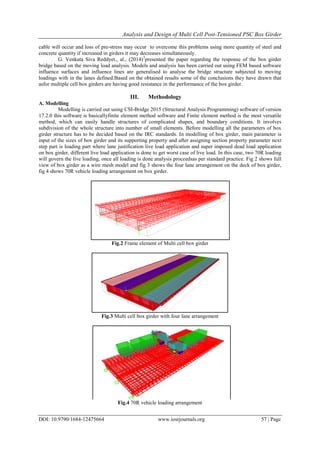
will govern the live loading, once all loading is done analysis proceedsas per standard practice. Fig 2 shows full
view of box girder as a wire mesh model and fig 3 shows the four lane arrangement on the deck of box girder,
fig 4 shows 70R vehicle loading arrangement on box girder.
Fig.2 Frame element of Multi cell box girder
Fig.3 Multi cell box girder with four lane arrangement
Fig.4 70R vehicle loading arrangement
Analysis and Design of Multi Cell Post-Tensioned PSC Box Girder
DOI: 10.9790/1684-12475664 www.iosrjournals.org 58 | Page
B. Design
The design of PSC box girder is performed using self-developed spread sheets. The design is done as
per IRC stipulations, the design procedure comprises of the following units.
1. Calculation of section properties
2. Tabulation of summary of bending moment and shear force
3. Calculation of stress developed due to bending moment and shear force
4. Cable profiling to suit the geometry
5. Calculation of loss of pre-stress due to friction, wobble effect and slip loss
6. Design of end block
7. Calculation of time dependent losses
8. Check for stresses in service and other cases
9. Calculation of temperature stresses
10. Stress check for permissible limit in service case as per IRC
11. Check for deflection
12. Check for ultimate strength
13. Check for ultimate shear strength
C. Salient Features Of The Pscbox Girder
1. Type of the structure is multi cell post tensioned PSC boxgirder
2. Length of box girder = 35.0m
3. Depth of box girder = 2.0m
4. Total top width of box girder = 16.6m
5. Total bottom width of box girder = 13.10m
6. Thickness of web = 0.325m
(At running section)
7. Thickness of web = 0.600m
(At end section)
8. Thickness of bottom slab = 0.325m
(At running section)
9. Thickness of bottom slab = 0.750m
(At end section)
10. Thickness of top slab = 0.275m
11. Effective width of top slab = 6.550m
12. End diaphragm thickness = 0.75m (2 no’s)
13. Mid diaphragm thickness = 0.75m (2 no’s)
14. Number of cells = 2no’s
15. Grade of concrete = M45
16. Grade of steel = Fe500
17. Type of strands = 19T15 (main cable )
18. Type of strands = 19T15 (dummy cable )
19. Type of sheathing duct = HDPE/Bright Metal
20. Total number of cable used = 18 No’s
21. Method of pre-stressing = Post tensioning
IV. Results And Discussions
A. Bendging Moment And Shear Force
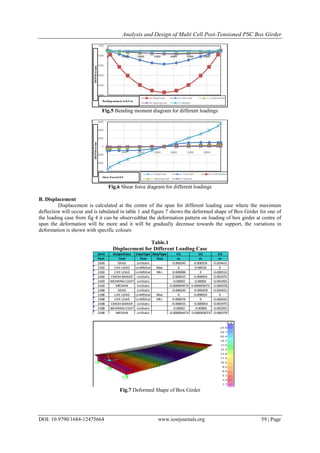
Variation of bending moment and shear force in full span for different loading cases is shown in fig 5
and fig 6.For dead load the bending moment and shear force value will be more and minimum bending moment
and shear force for median, the box girder is analysed as a simply supported and maximum moments will be at
midspan and there will be negative moments at supports and maximum shear force at support and there will be
minimum shear force at midspan.
Analysis and Design of Multi Cell Post-Tensioned PSC Box Girder
DOI: 10.9790/1684-12475664 www.iosrjournals.org 59 | Page
Fig.5 Bending moment diagram for different loadings
Fig.6 Shear force diagram for different loadings
B. Displacement
Displacement is calculated at the centre of the span for different loading case where the maximum
deflection will occur and is tabulated in table 1 and figure 7 shows the deformed shape of Box Girder for one of
the loading case from fig 4 it can be observedthat the deformation pattern on loading of box girder at centre of
span the deformation will be more and it will be gradually decrease towards the support, the variations in
deformation is shown with specific colours
Table.1
Displacement for Different Loading Case
Fig.7 Deformed Shape of Box Girder
-45000
-35000
-25000
-15000
-5000
5000
0 5000 10000 15000 20000 25000 30000
Dead Load Live Load Crash Barieer
wearingcoat Median
DEPTHinmm
Bending moment in KN-m
-6000
-4000
-2000
0
2000
4000
6000
0 5000 10000 15000 20000 25000 30000
Dead Load Live Load Crash Barieer
Wearing Coat Median
DEPTHinmm
Shear Forcein KN
Joint OutputCase CaseType StepType U1 U2 U3
Text Text Text Text m m m
2160 DEAD LinStatic -0.000245 0.000259 -0.024431
2160 LIVE LOAD LinMSStat Max 0 0.00018 0
2160 LIVE LOAD LinMSStat Min -0.000086 0 -0.008316
2160 CRASH BARIER LinStatic -0.000015 0.000054 -0.001975
2160 WEARING COAT LinStatic -0.00002 0.00002 -0.001955
2160 MEDIAN LinStatic -0.000004473 0.000003073 -0.000378
2188 DEAD LinStatic -0.000245 -0.000259 -0.024431
2188 LIVE LOAD LinMSStat Max 0 0.000024 0
2188 LIVE LOAD LinMSStat Min -0.000076 0 -0.006563
2188 CRASH BARIER LinStatic -0.000015 -0.000054 -0.001975
2188 WEARING COAT LinStatic -0.00002 -0.00002 -0.001955
2188 MEDIAN LinStatic -0.000004473 -0.000003073 -0.000378
Analysis and Design of Multi Cell Post-Tensioned PSC Box Girder
DOI: 10.9790/1684-12475664 www.iosrjournals.org 60 | Page
C. Cable Profile
The variation of cable is shown in the fig 8 the arrangement of cable in y-direction and there will be
parabolic curve for all set of cables as shown in the fig8 and in fig 9 it is shown that how cables are arranged in
box girder at end section an in running section.In all 18no’s of main cable are provided in three webs of the box
girder and also on the bottom soffit slab of the box girder two emergency cable are provided in the outer web of
the box girder, cables provided in the webs will be more effective than the cables provided in the bottom soffit
slab.
Fig.8 Cable Profile for Half Length of Box girder
Fig.9 Cable arrangement at End block and Running section
D. Elongation Of Cable
The total elongation variations in all cables due to pre-stressing is shown in fig 10.From the figure it is
concluded that HDPE sheathing material have more elongation than the Bright Metal by this we can reduce the
pre-stressing force in HDPE and one can achieve an economic design.
Fig.10 Total Elongation of Cables
E. Time Depandent Loses
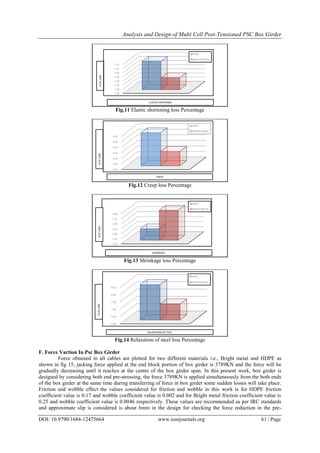
The losses due to the time dependent factors such as elastic shortening, creep, shrinkage, relaxation are
shown in fig 11 to 14, it is observed that the percentage of loss except due toshrinkage loss in box girder when
two different material is used , HDPE will be more than bright metal but in shrinkage the loss in HDPE will be
less when compared to bright metal, so by comparing these losses we can reduce the pre-stressing steel by
which force reduction can be achieved and corresponding time dependent losses can be lowered and economic
design of pre-stressed box girder can be achieved.
122.00
123.00
124.00
125.00
126.00
127.00
128.00
129.00
1 2 3 4 5
ELONGATIONLENGTHINMM
T O T A L E L O N G A T I O N F O R H D P E A N D B R I G H T M E T A L
HDPE
BRIGHT METAL
Analysis and Design of Multi Cell Post-Tensioned PSC Box Girder
DOI: 10.9790/1684-12475664 www.iosrjournals.org 61 | Page
Fig.11 Elastic shortening loss Percentage
Fig.12 Creep loss Percentage
Fig.13 Shrinkage loss Percentage
Fig.14 Relaxation of steel loss Percentage
F. Force Vartion In Psc Box Girder
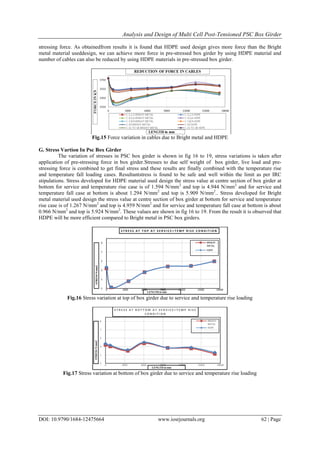
Force obtained in all cables are plotted for two different materials i.e., Bright metal and HDPE as
shown in fig 15, jacking force applied at the end block portion of box girder is 3789KN and the force will be
gradually decreasing until it reaches at the centre of the box girder span. In this present work, box girder is
designed by considering both end pre-stressing, the force 3789KN is applied simultaneously from the both ends
of the box girder at the same time during transferring of force in box girder some sudden losses will take place.
Friction and wobble effect the values considered for friction and wobble in this work is for HDPE friction
coefficient value is 0.17 and wobble coefficient value is 0.002 and for Bright metal friction coefficient value is
0.25 and wobble coefficient value is 0.0046 respectively. These values are recommended as per IRC standards
and approximate slip is considered is about 6mm in the design for checking the force reduction in the pre-
1.28
1.28
1.29
1.29
1.30
1.30
1.31
1.31
HDPE
BRIGHT METAL
%OFLOSS
ELASTIC SHORTNING
4.36
4.38
4.40
4.42
4.44
4.46
4.48
HDPE
BRIGHT METAL
CREEP
%OFLOSS
3.50
3.55
3.60
3.65
3.70
3.75
3.80
HDPE
BRIGHT METAL
SHRINKAGE
%OFLOSS
6.00
6.50
7.00
7.50
8.00
8.50
HDPE
BRIGHT METAL
RALAXATION OF STEEL
%OFLOSS
Analysis and Design of Multi Cell Post-Tensioned PSC Box Girder
DOI: 10.9790/1684-12475664 www.iosrjournals.org 62 | Page
stressing force. As obtainedfrom results it is found that HDPE used design gives more force than the Bright
metal material useddesign, we can achieve more force in pre-stressed box girder by using HDPE material and
number of cables can also be reduced by using HDPE materials in pre-stressed box girder.
Fig.15 Force variation in cables due to Bright metal and HDPE
G. Stress Vartion In Psc Box Girder
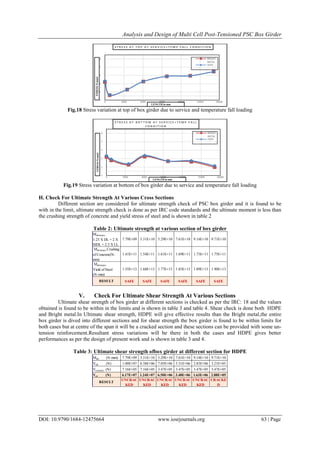
The variation of stresses in PSC box girder is shown in fig 16 to 19, stress variations is taken after
application of pre-stressing force in box girder.Stresses to due self weight of box girder, live load and pre-
stressing force is combined to get final stress and these results are finally combined with the temperature rise
and temperature fall loading cases. Resultantstress is found to be safe and well within the limit as per IRC
stipulations. Stress developed for HDPE material used design the stress value at centre section of box girder at
bottom for service and temperature rise case is of 1.594 N/mm2
and top is 4.944 N/mm2
and for service and
temperature fall case at bottom is about 1.294 N/mm2
and top is 5.909 N/mm2
.. Stress developed for Bright
metal material used design the stress value at centre section of box girder at bottom for service and temperature
rise case is of 1.267 N/mm2
and top is 4.959 N/mm2
and for service and temperature fall case at bottom is about
0.966 N/mm2
and top is 5.924 N/mm2
. These values are shown in fig 16 to 19. From the result it is observed that
HDPE will be more efficient compared to Bright metal in PSC box girders.
Fig.16 Stress variation at top of box girder due to service and temperature rise loading
Fig.17 Stress variation at bottom of box girder due to service and temperature rise loading
-1
1
3
5
7
9
0 3000 6000 9000 12000 15000 18000
S T R E S S A T T O P A T S E R V I C E + T E M P R I S E C O N D I T I O N
BRIGHT
METAL
HDPE
STRESS-N/mm2
LENGTH in mm
-1
1
3
5
7
9
0 3000 6000 9000 12000 15000 18000
S T R E S S A T B O T T O M A T S E R V I C E + T E M P R I S E
C O N D I T I O N
BRIGHT
METAL
HDPE
STRESS-N/mm2
LENGTH in mm
Analysis and Design of Multi Cell Post-Tensioned PSC Box Girder
DOI: 10.9790/1684-12475664 www.iosrjournals.org 63 | Page
Fig.18 Stress variation at top of box girder due to service and temperature fall loading
Fig.19 Stress variation at bottom of box girder due to service and temperature fall loading
H. Check For Ultimate Strength At Various Cross Sections
Different section are considered for ultimate strength check of PSC box girder and it is found to be
with in the limit, ultimate strength check is done as per IRC code standards and the ultimate moment is less than
the crushing strength of concrete and yield stress of steel and is shown in table 2
Table 2: Ultimate strength at various section of box girder
V. Check For Ultimate Shear Strength At Various Sections
Ultimate shear strength of box girder at different sections is checked as per the IRC: 18 and the values
obtained is found to be within in the limits and is shown in table 3 and table 4. Shear check is done both HDPE
and Bright metal.In Ultimate shear strength, HDPE will give effective results than the Bright metal,the entire
box girder is dived into different sections and for shear strength the box girder is found to be within limits for
both cases but at centre of the span it will be a cracked section and these sections can be provided with some un-
tension reinforcement.Resultant stress variations will be there in both the cases and HDPE gives better
performances as per the design of present work and is shown in table 3 and 4.
Table 3: Ultimate shear strength ofbox girder at different section for HDPE
-1
1
3
5
7
9
0 3000 6000 9000 12000 15000 18000
S T R E S S A T T O P A T S E R V I C E + T E M P F A L L C O N D I T I O N
BRIGHT
METAL
HDPE
STRESS-N/mm2
LENGTH in mm
-1
1
3
5
7
9
0 3000 6000 9000 12000 15000 18000
S T R E S S A T B O T T O M A T S E R V I C E + T E M P F A L L
C O N D I T I O N
BRIGHT
METAL
HDPE
STRESS-N/mm2
LENGTH in mm
7.79E+09 3.31E+10 5.29E+10 7.61E+10 9.14E+10 9.71E+10
1.41E+11 1.54E+11 1.61E+11 1.69E+11 1.73E+11 1.75E+11
1.55E+13 1.68E+13 1.77E+13 1.85E+13 1.89E+13 1.90E+13
SAFE SAFE SAFE SAFE SAFE SAFE
Multimate Crushing
of Concrete(N-
mm)
Multimate
1.25 X DL + 2 X
SIDL + 2.5 X LL
Multimate
Yield of Steel
(N-mm)
RESULT
7.79E+09 3.31E+10 5.29E+10 7.61E+10 9.14E+10 9.71E+10
1.00E+07 8.38E+06 7.05E+06 5.31E+06 2.83E+06 3.21E+05
7.16E+05 7.16E+05 3.47E+05 3.47E+05 3.47E+05 3.47E+05
6.17E+07 1.24E+07 6.50E+06 3.48E+06 1.63E+06 2.88E+05
UNCRAC
KED
UNCRAC
KED
UNCRAC
KED
UNCRAC
KED
UNCRAC
KED
CRACKE
D
Vcr(min) (N)
Vcr (N)
RESULT
Mult (N-mm)
Vult (N)
Analysis and Design of Multi Cell Post-Tensioned PSC Box Girder
DOI: 10.9790/1684-12475664 www.iosrjournals.org 64 | Page
Table 4: Ultimate shear strength of box girder at different section for Bright metal
J. Check For Deflection At Midspan
Deflection check is done for both the cases at centre of the span which is critical, the net downward defection is
32.205mm and net upward deflection due to PSC for HDPE is 24.126mm and resultant will be 8.08mm
downward which is within the limits as per IRC standards( L/500=68.5mm) and Bright metal it is about
23.378mm and resultant will be about 8.83mm downward which is within the limit of 68.55mm and it is
observed that HDPE will give less deflection than the Bright metal and hence in this case,structural stability will
be more effective.
VI. Conclusions
1. The design of PSC multi-cell box girder performed is found to be an economical design corresponding
critical bending moment and shear forces developed due to various load combinations as per IRC
specifications in comparison with the design of similar span configuration using I girders with Cast In Situ
(C.I.S) deck slab.
2. Two types of sheathing pipes have been used for cable ducts of PSC box girder modelling. The first type
being HDPE pipes whereas second type is of corrugated bright metal sheathing pipes. The results obtained
in girder with HDPE pipes are found to be more viable than corrugated bright metal pipes since the loss of
pre-stress is much less in case of HDPE pipes thereby increasing the stress levels in the concrete sections.
3. The cable profile has been determined so as to suit the bending moment diagram and cable profile adopted
in the box girder is found to be most suitable considering the kern distances of the PSC section.
4. The stresses that are developed in the box girder at service condition is found to be well within the
permissible limits as per IRC specifications and no tension being developed at any cross section in the
girder at service condition.
5. Finite Element Analysis of Box Girder from CSI Bridge modeler software is found to be more accurate and
close to reality in comparison to other analysis methods. The FEA results are in good agreement with the
results obtained from other methods.
6. It is found that the deflection obtained due to various loading conditions and at service condition is well
within permissible limits as per IRC. The maximum vertical deflection is found to occur near mid-span
location of the girder.
7. The temperature stresses that are developed due to temperature gradient as per IRC have been checked and
combined with the final stresses. The maximum final stresses are found to be in good agreement with the
allowable values.
8. The design has also been checked for Ultimate moment and Ultimate shear cases separately as per IRC
guidelines and the design is found to be safe in all respects.
References
[1]. C. Mortensen, M. Saiidi, and S. Ladkany - Creep and Shrinkage Losses in Prestressed Concrete Bridges in Highly Variable
Climates- TRB 2003 Annual Meeting CD-ROM
[2]. P. J. Barr, J. F. Stantonand M. O. Eberhard Effects of Temperature Variations on Precast Pre-stressed Concrete Bridge Girders-
journal of bridge engineering © asce / march/April 2005
[3]. Venkata Siva Reddy, P. Chandan Kumar - Response of box girder bridge spans-g. - International Journal of Bridge Engineering
(IJBE), Vol. 2, No. 2-2014
[4]. Khaled M. Sennah and John B. Kennedy - Literature Review in Analysis of Box-Girder Bridges- Journal of Bridge Engineering,
Vol. 7, No. 2, March 1- 2002.
[5]. Erin Hughs and RolaIdriss -Live-Load Distribution Factors for PrestressedConcrete,Spread Box-Girder Bridge- Journal of Bridge
Engineering, Vol. 11, No. 5, September 1-2006
[6]. Dr. Husain M. Husain and Mohanned I. Mohammed Hussein - Finite element analysis of post-tensioned concrete box girders- -
Journal of Bridge Engineering (2007)
[7]. Hiroshi Mutsuyoshi& Nguyen DucHai - Recent technology of prestressed concrete bridges in Japan- - IABSE-JSCE Joint
Conference on Advances in Bridge Engineering-II, August 8-10-2010
[8]. Ali FadhilNaser and Wang Zonglin-Finite Element and Experimental Analysis and Evaluation of Static and Dynamic Responses of
Oblique Pre-stressed Concrete Box Girder Bridge- Research Journal of Applied Sciences, Engineering and Technology 6(19):
3642-3657- 2013
[9]. T Y lin and A P burns, Design of Pre-stressed Concrete Structures, John Wiley & Sons, 3rd Edition edition,12 August 1981
[10]. N Krishna Raju, pre-stressed concrete, Tata McGraw-Hill Education, 01-Dec-2006
[11]. DR. V. K. Raina, Concrete bridges hand book, Galgotia publications, first edition, 1999
[12]. IRC:6-2000 standard specification and code of practice for road bridges
[13]. IRC:18-2000 design criteria for pre-stressed concrete road bridges
7.79E+09 3.31E+10 5.29E+10 7.61E+10 9.14E+10 9.71E+10
1.00E+07 8.38E+06 7.05E+06 5.31E+06 2.83E+06 3.21E+05
7.16E+05 7.16E+05 3.47E+05 3.47E+05 3.47E+05 3.47E+05
5.91E+07 1.20E+07 6.31E+06 3.43E+06 1.59E+06 2.83E+05
UNCRAC
KED
UNCRAC
KED
UNCRAC
KED
UNCRAC
KED
UNCRAC
KED
CRACKE
D
RESULT
Vult (N)
Vcr (N)
Vcr(min) (N)
Mult (N-mm)

F012475664

  • 1.
    IOSR Journal ofMechanical and Civil Engineering (IOSR-JMCE) e-ISSN: 2278-1684,p-ISSN: 2320-334X, Volume 12, Issue 4 Ver. VII (Jul. - Aug. 2015), PP 56-64 www.iosrjournals.org DOI: 10.9790/1684-12475664 www.iosrjournals.org 56 | Page Analysis and Design of Multi Cell Post-Tensioned PSC Box Girder Chetan T Naik1 , Dr.M M Achar2 , K Lakshmi3 1 M-tech Student, Dept. of Civil Engg., Alpha College of Engineering, Bengaluru, Karnataka, India 2 Associate Vice President, India International Infrastructure Engineers Ltd, Bengaluru, Karnataka, India 3 Assistant Professor, Dept. of Civil Engg., Alpha College of Engineering, Bengaluru, Karnataka, India Abstract: In the present work, analysis and design of box girder has been done, consideringtwo different sheathing pipes namely HDPE and corrugated Bright metal pipes. These sheathing pipes have been used to find the economic solution of design of multi-cell box girder. CSI-bridge modular software has been used for carrying out analysis. Multi-cell PSC box girder design has been performed at various locations along the span so as to consider maximum or critical locations of the PSC box girder due to various loading conditions, the post tensioning of cables is done for jacking load at 0.765 times the UTS and jacking is done at both ends of the PSC box girder simultaneously., Various losses that occur due to different phenomena such as elastic shortening, Creep, shrinkage, friction and wobble loss have been considered. The results obtained on the two sheathing pipes are compared and are tabulated and graph gas been plotted. Encouraging results have been obtained. Keywords: High density polyethylene (HDPE), Bright metal, Indian road congress (IRC), Pre-stressed concrete (PSC), I. Introduction A Bridge or flyover can be defined as a structure including supports erected over a gorge or an obstruction, such as water, highway, or railway, and having a track or passageway for carrying traffic or other moving loads. A box girder bridge is an apparent bridge sector in which main beams contain girders in the hollow box shape. The box girder usually includes either structural steel, pre-stressed concrete or in the form of reinforced concrete or composite section. It is typically trapezoidal, square or rectangular in cross-section. Box girder bridges are normally used for bridges, flyovers and at grade separators. Normally pre-stressed box girders are adopted for longer spans only (span range 30 to 90m) due to the fact that pre-stressed concrete box girder the depth of the box girder can be reduced drastically when compared to normal I-girders and the depth of the box girder again depends on the number of webs provided. As the number of web increases the depth of the box girder also reduces. Box girders a most suitable for spans in curved alignment due to their high torsional rigidity. In this present work, one such multi-cell box girder for a span of 35m has considered. Fig 1 shows a schematic representation of multi cell box girder. Fig.1 longitudinal view of Multi cell box girder II. Literature Review C. Mortensen et., al.,(2003)1 presented the paper about the effect of creep, shrinkage Losses in Pre- stressed Concrete Bridges in highly changing Variable Climates in this study is also clarifies about the moist curing after the stressing is also causes in the reduction of the long term losses. P. J. Barret., al.,(2005)2 in their paper studied temperature variations effects on precast pre-stressed concrete girders bridges. During manufacturing time and during its service life of pre-stressed girder the effect temperature variations in the girder member can be seen and to calculate exact strains developed in the girders, using of curing with high temperatures during the girder fabrications may cause the thermal expansion in the pre-stressed girders due to the cable which is used for pre-stress is steel due to high temperature elongation of
  • 2.
    Analysis and Designof Multi Cell Post-Tensioned PSC Box Girder DOI: 10.9790/1684-12475664 www.iosrjournals.org 57 | Page cable will occur and loss of pre-stress may occur to overcome this problems using more quantity of steel and concrete quantity if increased in girders it may decreases simultaneously. G. Venkata Siva Reddyet., al., (2014)3 presented the paper regarding the response of the box girder bridge based on the moving load analysis. Models and analysis has been carried out using FEM based software influence surfaces and influence lines are generalised to analyse the bridge structure subjected to moving loadings with in the lanes defined.Based on the obtained results some of the conclusions they have drawn that asfor multiple cell box girders are having good resistance in the performance of the box girder. III. Methodology A. Modelling Modelling is carried out using CSI-Bridge 2015 (Structural Analysis Programming) software of version 17.2.0 this software is basicallyfinite element method software and Finite element method is the most versatile method, which can easily handle structures of complicated shapes, and boundary conditions. It involves subdivision of the whole structure into number of small elements. Before modelling all the parameters of box girder structure has to be decided based on the IRC standards. In modelling of box girder, main parameter is input of the sizes of box girder and its supporting property and after assigning section property parameter next step part is loading part where lane justification live load application and super imposed dead load application on box girder, different live load application is done to get worst case of live load. In this case, two 70R loading will govern the live loading, once all loading is done analysis proceedsas per standard practice. Fig 2 shows full view of box girder as a wire mesh model and fig 3 shows the four lane arrangement on the deck of box girder, fig 4 shows 70R vehicle loading arrangement on box girder. Fig.2 Frame element of Multi cell box girder Fig.3 Multi cell box girder with four lane arrangement Fig.4 70R vehicle loading arrangement
  • 3.
    Analysis and Designof Multi Cell Post-Tensioned PSC Box Girder DOI: 10.9790/1684-12475664 www.iosrjournals.org 58 | Page B. Design The design of PSC box girder is performed using self-developed spread sheets. The design is done as per IRC stipulations, the design procedure comprises of the following units. 1. Calculation of section properties 2. Tabulation of summary of bending moment and shear force 3. Calculation of stress developed due to bending moment and shear force 4. Cable profiling to suit the geometry 5. Calculation of loss of pre-stress due to friction, wobble effect and slip loss 6. Design of end block 7. Calculation of time dependent losses 8. Check for stresses in service and other cases 9. Calculation of temperature stresses 10. Stress check for permissible limit in service case as per IRC 11. Check for deflection 12. Check for ultimate strength 13. Check for ultimate shear strength C. Salient Features Of The Pscbox Girder 1. Type of the structure is multi cell post tensioned PSC boxgirder 2. Length of box girder = 35.0m 3. Depth of box girder = 2.0m 4. Total top width of box girder = 16.6m 5. Total bottom width of box girder = 13.10m 6. Thickness of web = 0.325m (At running section) 7. Thickness of web = 0.600m (At end section) 8. Thickness of bottom slab = 0.325m (At running section) 9. Thickness of bottom slab = 0.750m (At end section) 10. Thickness of top slab = 0.275m 11. Effective width of top slab = 6.550m 12. End diaphragm thickness = 0.75m (2 no’s) 13. Mid diaphragm thickness = 0.75m (2 no’s) 14. Number of cells = 2no’s 15. Grade of concrete = M45 16. Grade of steel = Fe500 17. Type of strands = 19T15 (main cable ) 18. Type of strands = 19T15 (dummy cable ) 19. Type of sheathing duct = HDPE/Bright Metal 20. Total number of cable used = 18 No’s 21. Method of pre-stressing = Post tensioning IV. Results And Discussions A. Bendging Moment And Shear Force Variation of bending moment and shear force in full span for different loading cases is shown in fig 5 and fig 6.For dead load the bending moment and shear force value will be more and minimum bending moment and shear force for median, the box girder is analysed as a simply supported and maximum moments will be at midspan and there will be negative moments at supports and maximum shear force at support and there will be minimum shear force at midspan.
  • 4.
    Analysis and Designof Multi Cell Post-Tensioned PSC Box Girder DOI: 10.9790/1684-12475664 www.iosrjournals.org 59 | Page Fig.5 Bending moment diagram for different loadings Fig.6 Shear force diagram for different loadings B. Displacement Displacement is calculated at the centre of the span for different loading case where the maximum deflection will occur and is tabulated in table 1 and figure 7 shows the deformed shape of Box Girder for one of the loading case from fig 4 it can be observedthat the deformation pattern on loading of box girder at centre of span the deformation will be more and it will be gradually decrease towards the support, the variations in deformation is shown with specific colours Table.1 Displacement for Different Loading Case Fig.7 Deformed Shape of Box Girder -45000 -35000 -25000 -15000 -5000 5000 0 5000 10000 15000 20000 25000 30000 Dead Load Live Load Crash Barieer wearingcoat Median DEPTHinmm Bending moment in KN-m -6000 -4000 -2000 0 2000 4000 6000 0 5000 10000 15000 20000 25000 30000 Dead Load Live Load Crash Barieer Wearing Coat Median DEPTHinmm Shear Forcein KN Joint OutputCase CaseType StepType U1 U2 U3 Text Text Text Text m m m 2160 DEAD LinStatic -0.000245 0.000259 -0.024431 2160 LIVE LOAD LinMSStat Max 0 0.00018 0 2160 LIVE LOAD LinMSStat Min -0.000086 0 -0.008316 2160 CRASH BARIER LinStatic -0.000015 0.000054 -0.001975 2160 WEARING COAT LinStatic -0.00002 0.00002 -0.001955 2160 MEDIAN LinStatic -0.000004473 0.000003073 -0.000378 2188 DEAD LinStatic -0.000245 -0.000259 -0.024431 2188 LIVE LOAD LinMSStat Max 0 0.000024 0 2188 LIVE LOAD LinMSStat Min -0.000076 0 -0.006563 2188 CRASH BARIER LinStatic -0.000015 -0.000054 -0.001975 2188 WEARING COAT LinStatic -0.00002 -0.00002 -0.001955 2188 MEDIAN LinStatic -0.000004473 -0.000003073 -0.000378
  • 5.
    Analysis and Designof Multi Cell Post-Tensioned PSC Box Girder DOI: 10.9790/1684-12475664 www.iosrjournals.org 60 | Page C. Cable Profile The variation of cable is shown in the fig 8 the arrangement of cable in y-direction and there will be parabolic curve for all set of cables as shown in the fig8 and in fig 9 it is shown that how cables are arranged in box girder at end section an in running section.In all 18no’s of main cable are provided in three webs of the box girder and also on the bottom soffit slab of the box girder two emergency cable are provided in the outer web of the box girder, cables provided in the webs will be more effective than the cables provided in the bottom soffit slab. Fig.8 Cable Profile for Half Length of Box girder Fig.9 Cable arrangement at End block and Running section D. Elongation Of Cable The total elongation variations in all cables due to pre-stressing is shown in fig 10.From the figure it is concluded that HDPE sheathing material have more elongation than the Bright Metal by this we can reduce the pre-stressing force in HDPE and one can achieve an economic design. Fig.10 Total Elongation of Cables E. Time Depandent Loses The losses due to the time dependent factors such as elastic shortening, creep, shrinkage, relaxation are shown in fig 11 to 14, it is observed that the percentage of loss except due toshrinkage loss in box girder when two different material is used , HDPE will be more than bright metal but in shrinkage the loss in HDPE will be less when compared to bright metal, so by comparing these losses we can reduce the pre-stressing steel by which force reduction can be achieved and corresponding time dependent losses can be lowered and economic design of pre-stressed box girder can be achieved. 122.00 123.00 124.00 125.00 126.00 127.00 128.00 129.00 1 2 3 4 5 ELONGATIONLENGTHINMM T O T A L E L O N G A T I O N F O R H D P E A N D B R I G H T M E T A L HDPE BRIGHT METAL
  • 6.
    Analysis and Designof Multi Cell Post-Tensioned PSC Box Girder DOI: 10.9790/1684-12475664 www.iosrjournals.org 61 | Page Fig.11 Elastic shortening loss Percentage Fig.12 Creep loss Percentage Fig.13 Shrinkage loss Percentage Fig.14 Relaxation of steel loss Percentage F. Force Vartion In Psc Box Girder Force obtained in all cables are plotted for two different materials i.e., Bright metal and HDPE as shown in fig 15, jacking force applied at the end block portion of box girder is 3789KN and the force will be gradually decreasing until it reaches at the centre of the box girder span. In this present work, box girder is designed by considering both end pre-stressing, the force 3789KN is applied simultaneously from the both ends of the box girder at the same time during transferring of force in box girder some sudden losses will take place. Friction and wobble effect the values considered for friction and wobble in this work is for HDPE friction coefficient value is 0.17 and wobble coefficient value is 0.002 and for Bright metal friction coefficient value is 0.25 and wobble coefficient value is 0.0046 respectively. These values are recommended as per IRC standards and approximate slip is considered is about 6mm in the design for checking the force reduction in the pre- 1.28 1.28 1.29 1.29 1.30 1.30 1.31 1.31 HDPE BRIGHT METAL %OFLOSS ELASTIC SHORTNING 4.36 4.38 4.40 4.42 4.44 4.46 4.48 HDPE BRIGHT METAL CREEP %OFLOSS 3.50 3.55 3.60 3.65 3.70 3.75 3.80 HDPE BRIGHT METAL SHRINKAGE %OFLOSS 6.00 6.50 7.00 7.50 8.00 8.50 HDPE BRIGHT METAL RALAXATION OF STEEL %OFLOSS
  • 7.
    Analysis and Designof Multi Cell Post-Tensioned PSC Box Girder DOI: 10.9790/1684-12475664 www.iosrjournals.org 62 | Page stressing force. As obtainedfrom results it is found that HDPE used design gives more force than the Bright metal material useddesign, we can achieve more force in pre-stressed box girder by using HDPE material and number of cables can also be reduced by using HDPE materials in pre-stressed box girder. Fig.15 Force variation in cables due to Bright metal and HDPE G. Stress Vartion In Psc Box Girder The variation of stresses in PSC box girder is shown in fig 16 to 19, stress variations is taken after application of pre-stressing force in box girder.Stresses to due self weight of box girder, live load and pre- stressing force is combined to get final stress and these results are finally combined with the temperature rise and temperature fall loading cases. Resultantstress is found to be safe and well within the limit as per IRC stipulations. Stress developed for HDPE material used design the stress value at centre section of box girder at bottom for service and temperature rise case is of 1.594 N/mm2 and top is 4.944 N/mm2 and for service and temperature fall case at bottom is about 1.294 N/mm2 and top is 5.909 N/mm2 .. Stress developed for Bright metal material used design the stress value at centre section of box girder at bottom for service and temperature rise case is of 1.267 N/mm2 and top is 4.959 N/mm2 and for service and temperature fall case at bottom is about 0.966 N/mm2 and top is 5.924 N/mm2 . These values are shown in fig 16 to 19. From the result it is observed that HDPE will be more efficient compared to Bright metal in PSC box girders. Fig.16 Stress variation at top of box girder due to service and temperature rise loading Fig.17 Stress variation at bottom of box girder due to service and temperature rise loading -1 1 3 5 7 9 0 3000 6000 9000 12000 15000 18000 S T R E S S A T T O P A T S E R V I C E + T E M P R I S E C O N D I T I O N BRIGHT METAL HDPE STRESS-N/mm2 LENGTH in mm -1 1 3 5 7 9 0 3000 6000 9000 12000 15000 18000 S T R E S S A T B O T T O M A T S E R V I C E + T E M P R I S E C O N D I T I O N BRIGHT METAL HDPE STRESS-N/mm2 LENGTH in mm
  • 8.
    Analysis and Designof Multi Cell Post-Tensioned PSC Box Girder DOI: 10.9790/1684-12475664 www.iosrjournals.org 63 | Page Fig.18 Stress variation at top of box girder due to service and temperature fall loading Fig.19 Stress variation at bottom of box girder due to service and temperature fall loading H. Check For Ultimate Strength At Various Cross Sections Different section are considered for ultimate strength check of PSC box girder and it is found to be with in the limit, ultimate strength check is done as per IRC code standards and the ultimate moment is less than the crushing strength of concrete and yield stress of steel and is shown in table 2 Table 2: Ultimate strength at various section of box girder V. Check For Ultimate Shear Strength At Various Sections Ultimate shear strength of box girder at different sections is checked as per the IRC: 18 and the values obtained is found to be within in the limits and is shown in table 3 and table 4. Shear check is done both HDPE and Bright metal.In Ultimate shear strength, HDPE will give effective results than the Bright metal,the entire box girder is dived into different sections and for shear strength the box girder is found to be within limits for both cases but at centre of the span it will be a cracked section and these sections can be provided with some un- tension reinforcement.Resultant stress variations will be there in both the cases and HDPE gives better performances as per the design of present work and is shown in table 3 and 4. Table 3: Ultimate shear strength ofbox girder at different section for HDPE -1 1 3 5 7 9 0 3000 6000 9000 12000 15000 18000 S T R E S S A T T O P A T S E R V I C E + T E M P F A L L C O N D I T I O N BRIGHT METAL HDPE STRESS-N/mm2 LENGTH in mm -1 1 3 5 7 9 0 3000 6000 9000 12000 15000 18000 S T R E S S A T B O T T O M A T S E R V I C E + T E M P F A L L C O N D I T I O N BRIGHT METAL HDPE STRESS-N/mm2 LENGTH in mm 7.79E+09 3.31E+10 5.29E+10 7.61E+10 9.14E+10 9.71E+10 1.41E+11 1.54E+11 1.61E+11 1.69E+11 1.73E+11 1.75E+11 1.55E+13 1.68E+13 1.77E+13 1.85E+13 1.89E+13 1.90E+13 SAFE SAFE SAFE SAFE SAFE SAFE Multimate Crushing of Concrete(N- mm) Multimate 1.25 X DL + 2 X SIDL + 2.5 X LL Multimate Yield of Steel (N-mm) RESULT 7.79E+09 3.31E+10 5.29E+10 7.61E+10 9.14E+10 9.71E+10 1.00E+07 8.38E+06 7.05E+06 5.31E+06 2.83E+06 3.21E+05 7.16E+05 7.16E+05 3.47E+05 3.47E+05 3.47E+05 3.47E+05 6.17E+07 1.24E+07 6.50E+06 3.48E+06 1.63E+06 2.88E+05 UNCRAC KED UNCRAC KED UNCRAC KED UNCRAC KED UNCRAC KED CRACKE D Vcr(min) (N) Vcr (N) RESULT Mult (N-mm) Vult (N)
  • 9.
    Analysis and Designof Multi Cell Post-Tensioned PSC Box Girder DOI: 10.9790/1684-12475664 www.iosrjournals.org 64 | Page Table 4: Ultimate shear strength of box girder at different section for Bright metal J. Check For Deflection At Midspan Deflection check is done for both the cases at centre of the span which is critical, the net downward defection is 32.205mm and net upward deflection due to PSC for HDPE is 24.126mm and resultant will be 8.08mm downward which is within the limits as per IRC standards( L/500=68.5mm) and Bright metal it is about 23.378mm and resultant will be about 8.83mm downward which is within the limit of 68.55mm and it is observed that HDPE will give less deflection than the Bright metal and hence in this case,structural stability will be more effective. VI. Conclusions 1. The design of PSC multi-cell box girder performed is found to be an economical design corresponding critical bending moment and shear forces developed due to various load combinations as per IRC specifications in comparison with the design of similar span configuration using I girders with Cast In Situ (C.I.S) deck slab. 2. Two types of sheathing pipes have been used for cable ducts of PSC box girder modelling. The first type being HDPE pipes whereas second type is of corrugated bright metal sheathing pipes. The results obtained in girder with HDPE pipes are found to be more viable than corrugated bright metal pipes since the loss of pre-stress is much less in case of HDPE pipes thereby increasing the stress levels in the concrete sections. 3. The cable profile has been determined so as to suit the bending moment diagram and cable profile adopted in the box girder is found to be most suitable considering the kern distances of the PSC section. 4. The stresses that are developed in the box girder at service condition is found to be well within the permissible limits as per IRC specifications and no tension being developed at any cross section in the girder at service condition. 5. Finite Element Analysis of Box Girder from CSI Bridge modeler software is found to be more accurate and close to reality in comparison to other analysis methods. The FEA results are in good agreement with the results obtained from other methods. 6. It is found that the deflection obtained due to various loading conditions and at service condition is well within permissible limits as per IRC. The maximum vertical deflection is found to occur near mid-span location of the girder. 7. The temperature stresses that are developed due to temperature gradient as per IRC have been checked and combined with the final stresses. The maximum final stresses are found to be in good agreement with the allowable values. 8. The design has also been checked for Ultimate moment and Ultimate shear cases separately as per IRC guidelines and the design is found to be safe in all respects. References [1]. C. Mortensen, M. Saiidi, and S. Ladkany - Creep and Shrinkage Losses in Prestressed Concrete Bridges in Highly Variable Climates- TRB 2003 Annual Meeting CD-ROM [2]. P. J. Barr, J. F. Stantonand M. O. Eberhard Effects of Temperature Variations on Precast Pre-stressed Concrete Bridge Girders- journal of bridge engineering © asce / march/April 2005 [3]. Venkata Siva Reddy, P. Chandan Kumar - Response of box girder bridge spans-g. - International Journal of Bridge Engineering (IJBE), Vol. 2, No. 2-2014 [4]. Khaled M. Sennah and John B. Kennedy - Literature Review in Analysis of Box-Girder Bridges- Journal of Bridge Engineering, Vol. 7, No. 2, March 1- 2002. [5]. Erin Hughs and RolaIdriss -Live-Load Distribution Factors for PrestressedConcrete,Spread Box-Girder Bridge- Journal of Bridge Engineering, Vol. 11, No. 5, September 1-2006 [6]. Dr. Husain M. Husain and Mohanned I. Mohammed Hussein - Finite element analysis of post-tensioned concrete box girders- - Journal of Bridge Engineering (2007) [7]. Hiroshi Mutsuyoshi& Nguyen DucHai - Recent technology of prestressed concrete bridges in Japan- - IABSE-JSCE Joint Conference on Advances in Bridge Engineering-II, August 8-10-2010 [8]. Ali FadhilNaser and Wang Zonglin-Finite Element and Experimental Analysis and Evaluation of Static and Dynamic Responses of Oblique Pre-stressed Concrete Box Girder Bridge- Research Journal of Applied Sciences, Engineering and Technology 6(19): 3642-3657- 2013 [9]. T Y lin and A P burns, Design of Pre-stressed Concrete Structures, John Wiley & Sons, 3rd Edition edition,12 August 1981 [10]. N Krishna Raju, pre-stressed concrete, Tata McGraw-Hill Education, 01-Dec-2006 [11]. DR. V. K. Raina, Concrete bridges hand book, Galgotia publications, first edition, 1999 [12]. IRC:6-2000 standard specification and code of practice for road bridges [13]. IRC:18-2000 design criteria for pre-stressed concrete road bridges 7.79E+09 3.31E+10 5.29E+10 7.61E+10 9.14E+10 9.71E+10 1.00E+07 8.38E+06 7.05E+06 5.31E+06 2.83E+06 3.21E+05 7.16E+05 7.16E+05 3.47E+05 3.47E+05 3.47E+05 3.47E+05 5.91E+07 1.20E+07 6.31E+06 3.43E+06 1.59E+06 2.83E+05 UNCRAC KED UNCRAC KED UNCRAC KED UNCRAC KED UNCRAC KED CRACKE D RESULT Vult (N) Vcr (N) Vcr(min) (N) Mult (N-mm)