IJRET: International Journal of Research in Engineering and Technology eISSN: 2319-1163 | pISSN: 2321-7308
_______________________________________________________________________________________________
Volume: 09 Issue: 09 | September-2015, Available @ http://www.ijret.org 435
BEHAVIOURAL STUDIES OF FLOATING COLUMN ON FRAMED
STRUCTURE
Shiwli Roy1
, Gargi Danda de2
1
ME Scholar - BIT Durg, Civil Engg, BIT Durg, CG
2
Assistant Professor (Civil Engg dept.)
Abstract
RCC concrete column means cement concrete reinforced with steel bars, steel plates, steel mesh etc. to increase the tension
withstanding capacity of the structure. The term floating column means that the column is floated between two floors. Various
types of structures G+3, G+5 and G+10 for RCC column and floating column are analyzed. The difference between G+3, G+5
and G+ 10 structures are shown by graphs and charts. Comparison will be done on bending moment and shear force between these
structures. This paper presents the analysis of floating column and RCC column by using STAAD PRO V8i.
Keywords: Floating Column, RCC column shear force and bending moment.
--------------------------------------------------------------------***----------------------------------------------------------------------
I. INTRODUCTION
Column in structural engineering is a structural element that
transmits the weight of the structure to its lower structural
elements. In other words, compression members are often
termed "columns" because of the stress conditions. Columns
are frequently used to support beams or arches on which the
upper parts of walls or ceilings rest. A column is supposed
to be a vertical member starting from foundation level and
transferring the load to the ground. The term floating
column is also a vertical element which ends (due to
architectural design/ site situation) at its lower level
(termination Level) rests on a beam which is a horizontal
member. The beams in turn transfer the load to other
columns below it. Such columns where the load was
considered as point load. Theoretically such structures can
be analyzed and designed. This paper presents the floating
column and RCC column analysis on multistoried building
and analyzed by STAAD PRO V8i. Here G+3, G+5 and
G+10 structures are analyzed and compared with parameters
shear force and bending moment.
II. BUILDING DESCRIPTION
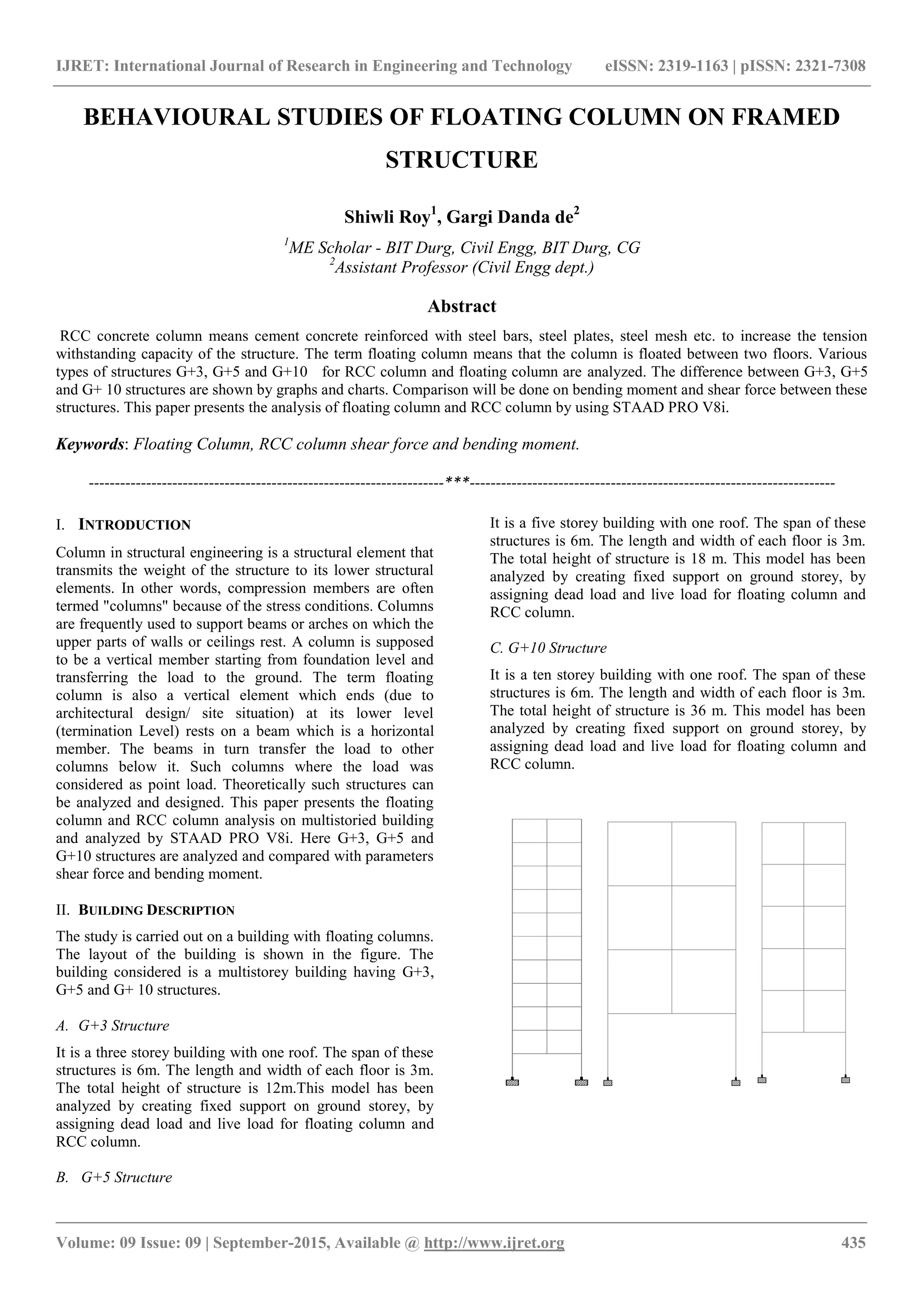
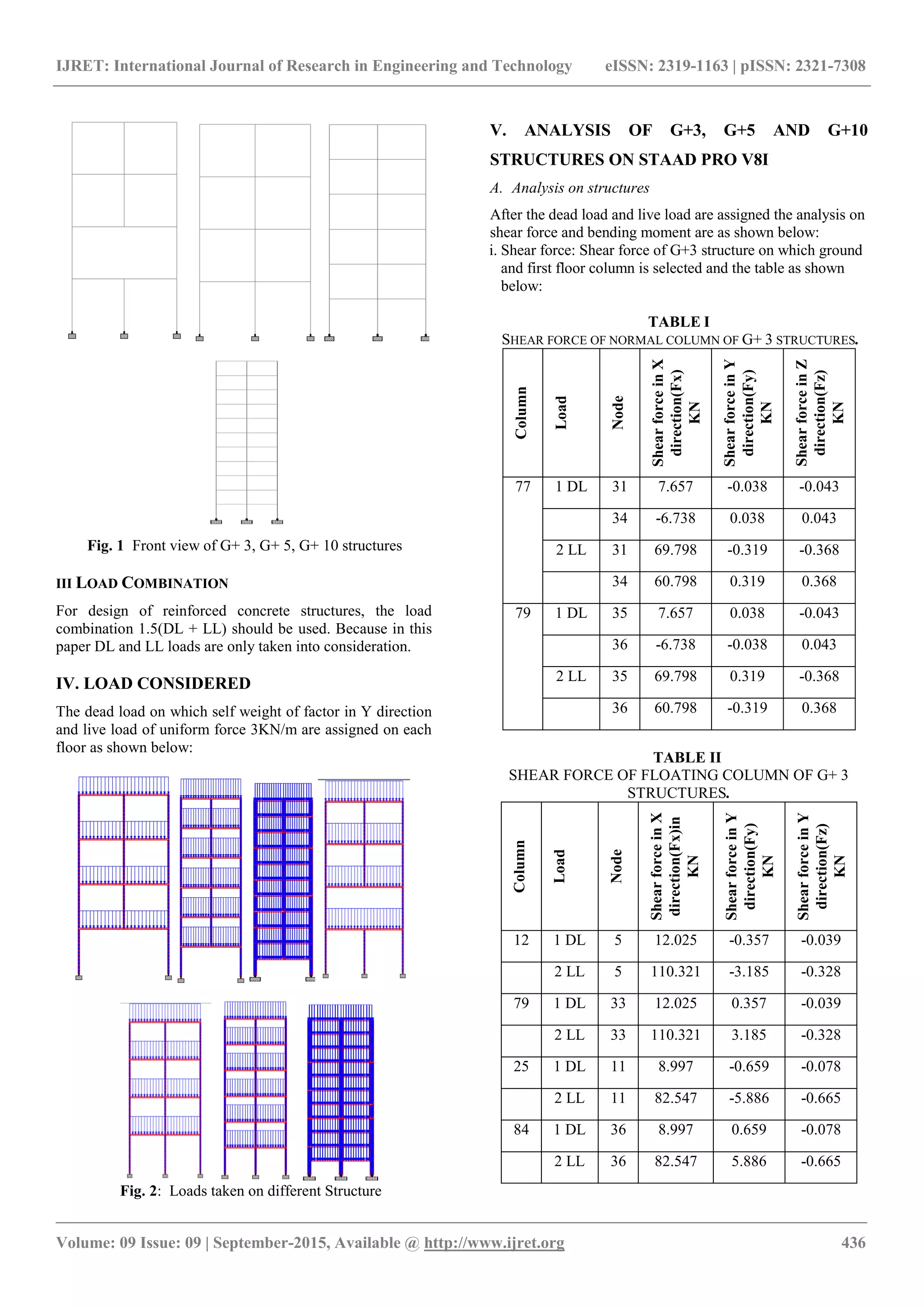
The study is carried out on a building with floating columns.
The layout of the building is shown in the figure. The
building considered is a multistorey building having G+3,
G+5 and G+ 10 structures.
A. G+3 Structure
It is a three storey building with one roof. The span of these
structures is 6m. The length and width of each floor is 3m.
The total height of structure is 12m.This model has been
analyzed by creating fixed support on ground storey, by
assigning dead load and live load for floating column and
RCC column.
B. G+5 Structure
It is a five storey building with one roof. The span of these
structures is 6m. The length and width of each floor is 3m.
The total height of structure is 18 m. This model has been
analyzed by creating fixed support on ground storey, by
assigning dead load and live load for floating column and
RCC column.
C. G+10 Structure
It is a ten storey building with one roof. The span of these
structures is 6m. The length and width of each floor is 3m.
The total height of structure is 36 m. This model has been
analyzed by creating fixed support on ground storey, by
assigning dead load and live load for floating column and
RCC column.
IJRET: International Journal of Research in Engineering and Technology eISSN: 2319-1163 | pISSN: 2321-7308
_______________________________________________________________________________________________
Volume: 09 Issue: 09 | September-2015, Available @ http://www.ijret.org 436
Fig. 1 Front view of G+ 3, G+ 5, G+ 10 structures
III LOAD COMBINATION
For design of reinforced concrete structures, the load
combination 1.5(DL + LL) should be used. Because in this
paper DL and LL loads are only taken into consideration.
IV. LOAD CONSIDERED
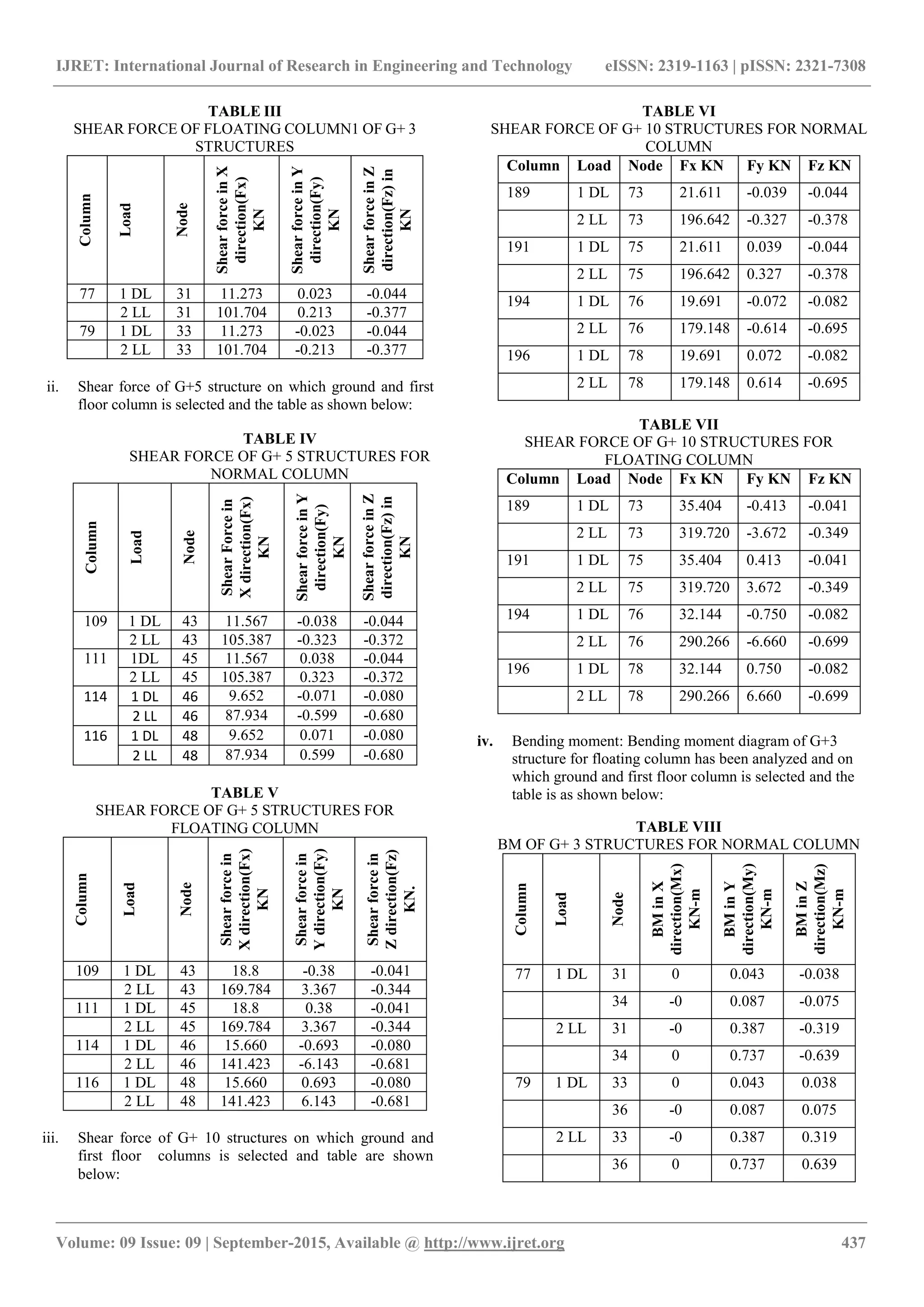
The dead load on which self weight of factor in Y direction
and live load of uniform force 3KN/m are assigned on each
floor as shown below:
Fig. 2: Loads taken on different Structure
V. ANALYSIS OF G+3, G+5 AND G+10
STRUCTURES ON STAAD PRO V8I
A. Analysis on structures
After the dead load and live load are assigned the analysis on
shear force and bending moment are as shown below:
i. Shear force: Shear force of G+3 structure on which ground
and first floor column is selected and the table as shown
below:
TABLE I
SHEAR FORCE OF NORMAL COLUMN OF G+ 3 STRUCTURES.
Column
Load
Node
ShearforceinX
direction(Fx)
KN
ShearforceinY
direction(Fy)
KN
ShearforceinZ
direction(Fz)
KN
77 1 DL 31 7.657 -0.038 -0.043
34 -6.738 0.038 0.043
2 LL 31 69.798 -0.319 -0.368
34 60.798 0.319 0.368
79 1 DL 35 7.657 0.038 -0.043
36 -6.738 -0.038 0.043
2 LL 35 69.798 0.319 -0.368
36 60.798 -0.319 0.368
TABLE II
SHEAR FORCE OF FLOATING COLUMN OF G+ 3
STRUCTURES.
Column
Load
Node
ShearforceinX
direction(Fx)in
KN
ShearforceinY
direction(Fy)
KN
ShearforceinY
direction(Fz)
KN
12 1 DL 5 12.025 -0.357 -0.039
2 LL 5 110.321 -3.185 -0.328
79 1 DL 33 12.025 0.357 -0.039
2 LL 33 110.321 3.185 -0.328
25 1 DL 11 8.997 -0.659 -0.078
2 LL 11 82.547 -5.886 -0.665
84 1 DL 36 8.997 0.659 -0.078
2 LL 36 82.547 5.886 -0.665
IJRET: International Journal of Research in Engineering and Technology eISSN: 2319-1163 | pISSN: 2321-7308
_______________________________________________________________________________________________
Volume: 09 Issue: 09 | September-2015, Available @ http://www.ijret.org 437
TABLE III
SHEAR FORCE OF FLOATING COLUMN1 OF G+ 3
STRUCTURES
Column
Load
Node
ShearforceinX
direction(Fx)
KN
ShearforceinY
direction(Fy)
KN
ShearforceinZ
direction(Fz)in
KN
77 1 DL 31 11.273 0.023 -0.044
2 LL 31 101.704 0.213 -0.377
79 1 DL 33 11.273 -0.023 -0.044
2 LL 33 101.704 -0.213 -0.377
ii. Shear force of G+5 structure on which ground and first
floor column is selected and the table as shown below:
TABLE IV
SHEAR FORCE OF G+ 5 STRUCTURES FOR
NORMAL COLUMN
Column
Load
Node
ShearForcein
Xdirection(Fx)
KN
ShearforceinY
direction(Fy)
KN
ShearforceinZ
direction(Fz)in
KN
109 1 DL 43 11.567 -0.038 -0.044
2 LL 43 105.387 -0.323 -0.372
111 1DL 45 11.567 0.038 -0.044
2 LL 45 105.387 0.323 -0.372
114 1 DL 46 9.652 -0.071 -0.080
2 LL 46 87.934 -0.599 -0.680
116 1 DL 48 9.652 0.071 -0.080
2 LL 48 87.934 0.599 -0.680
TABLE V
SHEAR FORCE OF G+ 5 STRUCTURES FOR
FLOATING COLUMN
Column
Load
Node
Shearforcein
Xdirection(Fx)
KN
Shearforcein
Ydirection(Fy)
KN
Shearforcein
Zdirection(Fz)
KN.
109 1 DL 43 18.8 -0.38 -0.041
2 LL 43 169.784 3.367 -0.344
111 1 DL 45 18.8 0.38 -0.041
2 LL 45 169.784 3.367 -0.344
114 1 DL 46 15.660 -0.693 -0.080
2 LL 46 141.423 -6.143 -0.681
116 1 DL 48 15.660 0.693 -0.080
2 LL 48 141.423 6.143 -0.681
iii. Shear force of G+ 10 structures on which ground and
first floor columns is selected and table are shown
below:
TABLE VI
SHEAR FORCE OF G+ 10 STRUCTURES FOR NORMAL
COLUMN
Column Load Node Fx KN Fy KN Fz KN
189 1 DL 73 21.611 -0.039 -0.044
2 LL 73 196.642 -0.327 -0.378
191 1 DL 75 21.611 0.039 -0.044
2 LL 75 196.642 0.327 -0.378
194 1 DL 76 19.691 -0.072 -0.082
2 LL 76 179.148 -0.614 -0.695
196 1 DL 78 19.691 0.072 -0.082
2 LL 78 179.148 0.614 -0.695
TABLE VII
SHEAR FORCE OF G+ 10 STRUCTURES FOR
FLOATING COLUMN
Column Load Node Fx KN Fy KN Fz KN
189 1 DL 73 35.404 -0.413 -0.041
2 LL 73 319.720 -3.672 -0.349
191 1 DL 75 35.404 0.413 -0.041
2 LL 75 319.720 3.672 -0.349
194 1 DL 76 32.144 -0.750 -0.082
2 LL 76 290.266 -6.660 -0.699
196 1 DL 78 32.144 0.750 -0.082
2 LL 78 290.266 6.660 -0.699
iv. Bending moment: Bending moment diagram of G+3
structure for floating column has been analyzed and on
which ground and first floor column is selected and the
table is as shown below:
TABLE VIII
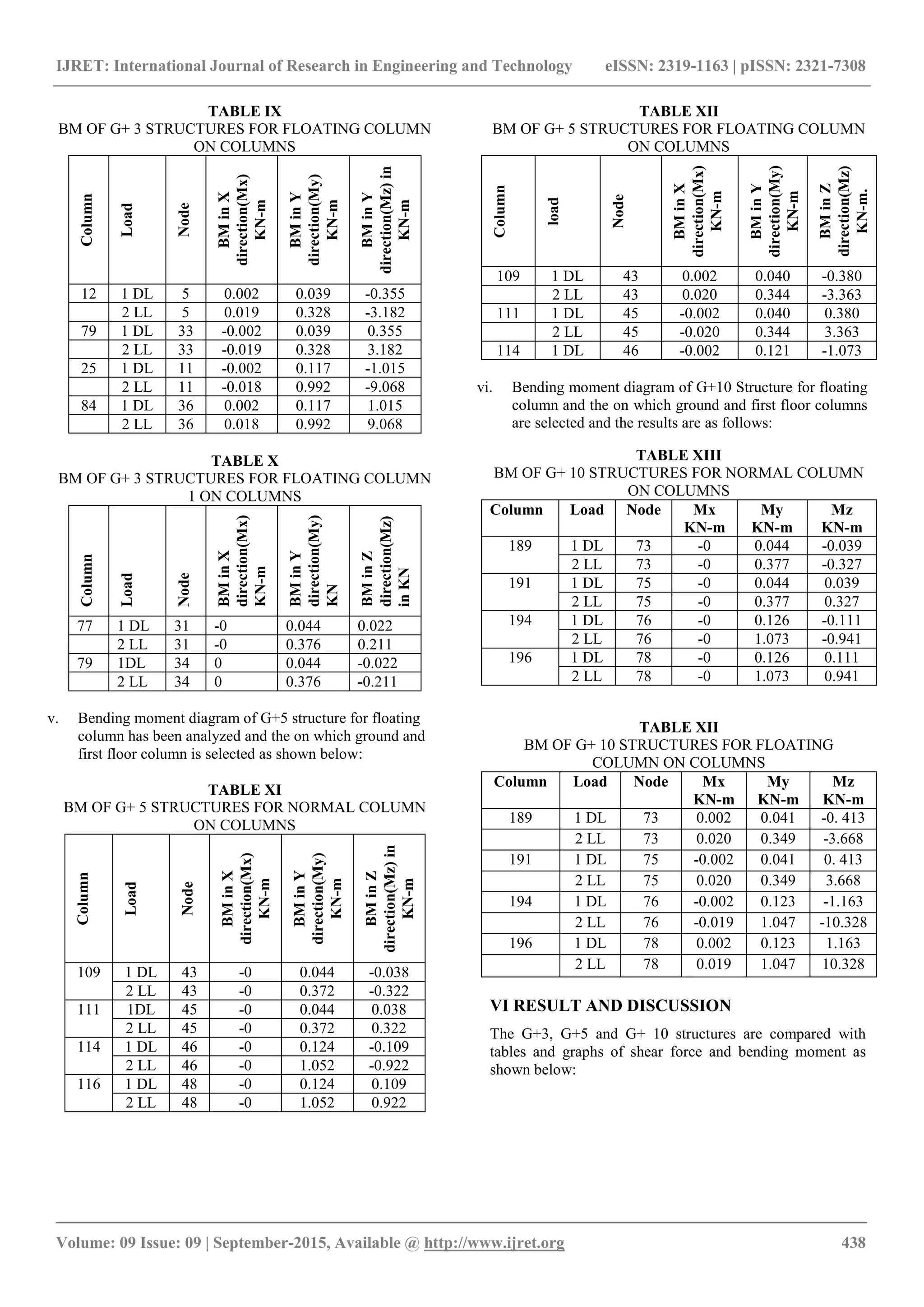
BM OF G+ 3 STRUCTURES FOR NORMAL COLUMN
Column
Load
Node
BMinX
direction(Mx)
KN-m
BMinY
direction(My)
KN-m
BMinZ
direction(Mz)
KN-m
77 1 DL 31 0 0.043 -0.038
34 -0 0.087 -0.075
2 LL 31 -0 0.387 -0.319
34 0 0.737 -0.639
79 1 DL 33 0 0.043 0.038
36 -0 0.087 0.075
2 LL 33 -0 0.387 0.319
36 0 0.737 0.639
IJRET: International Journal of Research in Engineering and Technology eISSN: 2319-1163 | pISSN: 2321-7308
_______________________________________________________________________________________________
Volume: 09 Issue: 09 | September-2015, Available @ http://www.ijret.org 438
TABLE IX
BM OF G+ 3 STRUCTURES FOR FLOATING COLUMN
ON COLUMNS
Column
Load
Node
BMinX
direction(Mx)
KN-m
BMinY
direction(My)
KN-m
BMinY
direction(Mz)in
KN-m
12 1 DL 5 0.002 0.039 -0.355
2 LL 5 0.019 0.328 -3.182
79 1 DL 33 -0.002 0.039 0.355
2 LL 33 -0.019 0.328 3.182
25 1 DL 11 -0.002 0.117 -1.015
2 LL 11 -0.018 0.992 -9.068
84 1 DL 36 0.002 0.117 1.015
2 LL 36 0.018 0.992 9.068
TABLE X
BM OF G+ 3 STRUCTURES FOR FLOATING COLUMN
1 ON COLUMNS
Column
Load
Node
BMinX
direction(Mx)
KN-m
BMinY
direction(My)
KN
BMinZ
direction(Mz)
inKN
77 1 DL 31 -0 0.044 0.022
2 LL 31 -0 0.376 0.211
79 1DL 34 0 0.044 -0.022
2 LL 34 0 0.376 -0.211
v. Bending moment diagram of G+5 structure for floating
column has been analyzed and the on which ground and
first floor column is selected as shown below:
TABLE XI
BM OF G+ 5 STRUCTURES FOR NORMAL COLUMN
ON COLUMNS
Column
Load
Node
BMinX
direction(Mx)
KN-m
BMinY
direction(My)
KN-m
BMinZ
direction(Mz)in
KN-m
109 1 DL 43 -0 0.044 -0.038
2 LL 43 -0 0.372 -0.322
111 1DL 45 -0 0.044 0.038
2 LL 45 -0 0.372 0.322
114 1 DL 46 -0 0.124 -0.109
2 LL 46 -0 1.052 -0.922
116 1 DL 48 -0 0.124 0.109
2 LL 48 -0 1.052 0.922
TABLE XII
BM OF G+ 5 STRUCTURES FOR FLOATING COLUMN
ON COLUMNS
Column
load
Node
BMinX
direction(Mx)
KN-m
BMinY
direction(My)
KN-m
BMinZ
direction(Mz)
KN-m.
109 1 DL 43 0.002 0.040 -0.380
2 LL 43 0.020 0.344 -3.363
111 1 DL 45 -0.002 0.040 0.380
2 LL 45 -0.020 0.344 3.363
114 1 DL 46 -0.002 0.121 -1.073
vi. Bending moment diagram of G+10 Structure for floating
column and the on which ground and first floor columns
are selected and the results are as follows:
TABLE XIII
BM OF G+ 10 STRUCTURES FOR NORMAL COLUMN
ON COLUMNS
Column Load Node Mx
KN-m
My
KN-m
Mz
KN-m
189 1 DL 73 -0 0.044 -0.039
2 LL 73 -0 0.377 -0.327
191 1 DL 75 -0 0.044 0.039
2 LL 75 -0 0.377 0.327
194 1 DL 76 -0 0.126 -0.111
2 LL 76 -0 1.073 -0.941
196 1 DL 78 -0 0.126 0.111
2 LL 78 -0 1.073 0.941
TABLE XII
BM OF G+ 10 STRUCTURES FOR FLOATING
COLUMN ON COLUMNS
Column Load Node Mx
KN-m
My
KN-m
Mz
KN-m
189 1 DL 73 0.002 0.041 -0. 413
2 LL 73 0.020 0.349 -3.668
191 1 DL 75 -0.002 0.041 0. 413
2 LL 75 0.020 0.349 3.668
194 1 DL 76 -0.002 0.123 -1.163
2 LL 76 -0.019 1.047 -10.328
196 1 DL 78 0.002 0.123 1.163
2 LL 78 0.019 1.047 10.328
VI RESULT AND DISCUSSION
The G+3, G+5 and G+ 10 structures are compared with
tables and graphs of shear force and bending moment as
shown below:
IJRET: International Journal of Research in Engineering and Technology eISSN: 2319-1163 | pISSN: 2321-7308
_______________________________________________________________________________________________
Volume: 09 Issue: 09 | September-2015, Available @ http://www.ijret.org 439
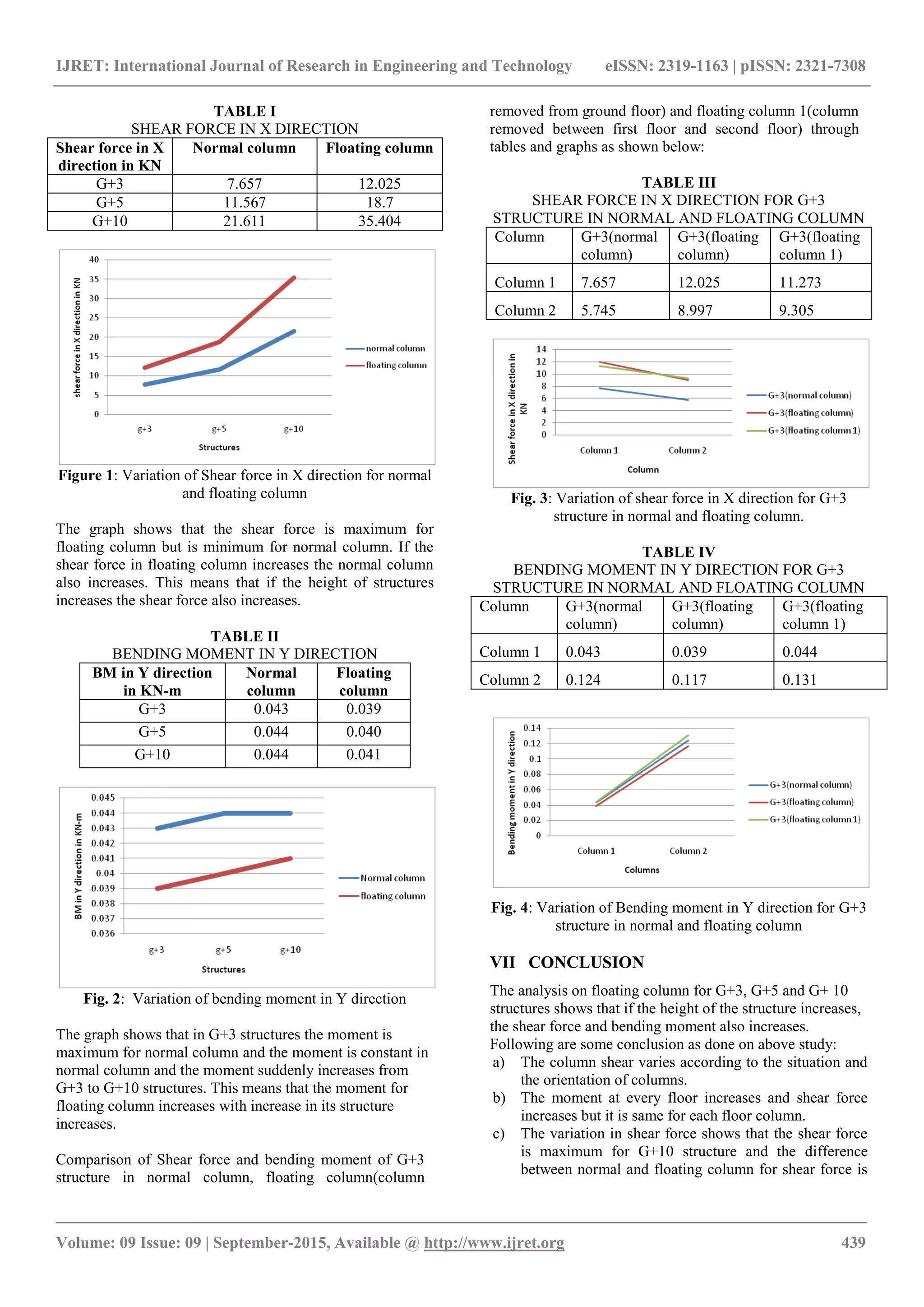
TABLE I
SHEAR FORCE IN X DIRECTION
Shear force in X
direction in KN
Normal column Floating column
G+3 7.657 12.025
G+5 11.567 18.7
G+10 21.611 35.404
Figure 1: Variation of Shear force in X direction for normal
and floating column
The graph shows that the shear force is maximum for
floating column but is minimum for normal column. If the
shear force in floating column increases the normal column
also increases. This means that if the height of structures
increases the shear force also increases.
TABLE II
BENDING MOMENT IN Y DIRECTION
BM in Y direction
in KN-m
Normal
column
Floating
column
G+3 0.043 0.039
G+5 0.044 0.040
G+10 0.044 0.041
Fig. 2: Variation of bending moment in Y direction
The graph shows that in G+3 structures the moment is
maximum for normal column and the moment is constant in
normal column and the moment suddenly increases from
G+3 to G+10 structures. This means that the moment for
floating column increases with increase in its structure
increases.
Comparison of Shear force and bending moment of G+3
structure in normal column, floating column(column
removed from ground floor) and floating column 1(column
removed between first floor and second floor) through
tables and graphs as shown below:
TABLE III
SHEAR FORCE IN X DIRECTION FOR G+3
STRUCTURE IN NORMAL AND FLOATING COLUMN
Column G+3(normal
column)
G+3(floating
column)
G+3(floating
column 1)
Column 1 7.657 12.025 11.273
Column 2 5.745 8.997 9.305
Fig. 3: Variation of shear force in X direction for G+3
structure in normal and floating column.
TABLE IV
BENDING MOMENT IN Y DIRECTION FOR G+3
STRUCTURE IN NORMAL AND FLOATING COLUMN
Column G+3(normal
column)
G+3(floating
column)
G+3(floating
column 1)
Column 1 0.043 0.039 0.044
Column 2 0.124 0.117 0.131
Fig. 4: Variation of Bending moment in Y direction for G+3
structure in normal and floating column
VII CONCLUSION
The analysis on floating column for G+3, G+5 and G+ 10
structures shows that if the height of the structure increases,
the shear force and bending moment also increases.
Following are some conclusion as done on above study:
a) The column shear varies according to the situation and
the orientation of columns.
b) The moment at every floor increases and shear force
increases but it is same for each floor column.
c) The variation in shear force shows that the shear force
is maximum for G+10 structure and the difference
between normal and floating column for shear force is
IJRET: International Journal of Research in Engineering and Technology eISSN: 2319-1163 | pISSN: 2321-7308
_______________________________________________________________________________________________
Volume: 09 Issue: 09 | September-2015, Available @ http://www.ijret.org 440
4.368KN for G+3 structure, 7.133 KN for G+5
structure and 13.793KN for G+10 structure.
d) The variation in shear force shows that the Bending
moment is maximum for G+10 structure and the
difference between normal and floating column for
bending moment is 0.004KN for G+3 structure, 0.004
KN for G+5 structure and 0.003KN for G+10 structure.
e) For comparison between shear force for G+3 structure
in normal column, floating column(column removed
from ground floor) and floating column 1(column
removed between first floor and second floor) the
variation in shear force shows that the shear force is
maximum in floating column(column removed from
ground floor) the shear force increases by 57% for G+3
(normal column)to G+3(floating column) structures
and 6.67% for G+3(floating column) to G+3( floating
column1)structures in column1(column for ground
floor) and in column2(column for first floor) it
increases by 56% for G+ 3(normal column) to
G+3(floating column)structures and 3.42% for
G+3(floating column) to G+3( floating
column1)structures.
f) For comparison between bending moment for G+3
structure in normal column, floating column(column
removed from ground floor) and floating column
1(column removed between first floor and second
floor) the variation in bending moment shows that the
bending moment is maximum in floating column
1(column removed between first floor and second
floor) the bending moment increases by 10.25% for
G+3 (normal column)to G+3(floating column)
structures and 12.82% for G+3(floating column) to
G+3( floating column1)structures in column1(column
for ground floor) and in column2(column for first
floor) it increases by 5.98% for G+ 3(normal column)
to G+3(floating column)structures and 11.96% for
G+3(floating column) to G+3( floating
column1)structures.
VIII REFERENCES
[1] Behera Sukumar Seismic analysis of multistoried
building[Journal]. Rourkela:[s.n.],2012. –May.
[2] A.P. Mundada and S.G. Sawdatkar Comparative
Seismic Analysis of Multistorey Building with and
without Floating Column[Journal]. Buldana:[s.n],2014.
–October.
[3] Sreekanth Gandla Nanabala Seismic Analysis of A
Normal Building and Floating Column
Building[Journal]. Andhra Pradesh:[s.n],2014. –
September.
[4] Prerna Nautiyal Seismic Response Evaluation of RC
frame building with Floating Column considering
different Soil Conditions[Journal]. Bhopal:[s.n],2014. –
February.
[5] Pankaj Agrawal, S.K Thakkar & R.N.Dubey,
“Dynamic analysis of a damaged building on floating
column”. paper no. 24, vol.39, September 2002
[6] Pratyush Malaviya, Saurav ,”Comparative study of
Effect of Floating Columns on the cost analysis of a
structure designed ”,Volume 5, Issue 5, May-2014
[7] Srikanth.M.K, Yogendra.R.Holebagilu, “Seismic
response of complex building with floating column for
zone II and zone V, International journal of
Engineering Research, ISSN: 2321-7758 Vol.2.,
Issue.4, 2014
[8] Dr. Mohammed Y. Fattah & Qutaiba G. Majeed,”
Behaviour of Encased Floating Stone Columns”, Eng.
& Tech. Journal, Vol.27, No.-7, 2009
[9] Susanta Banerjee, Sanjaya Kumar Patro,” Structural
analysis and design” Vol:8 No:6, 2014

Behavioural studies of floating column on framed structure

  • 1.
    IJRET: International Journalof Research in Engineering and Technology eISSN: 2319-1163 | pISSN: 2321-7308 _______________________________________________________________________________________________ Volume: 09 Issue: 09 | September-2015, Available @ http://www.ijret.org 435 BEHAVIOURAL STUDIES OF FLOATING COLUMN ON FRAMED STRUCTURE Shiwli Roy1 , Gargi Danda de2 1 ME Scholar - BIT Durg, Civil Engg, BIT Durg, CG 2 Assistant Professor (Civil Engg dept.) Abstract RCC concrete column means cement concrete reinforced with steel bars, steel plates, steel mesh etc. to increase the tension withstanding capacity of the structure. The term floating column means that the column is floated between two floors. Various types of structures G+3, G+5 and G+10 for RCC column and floating column are analyzed. The difference between G+3, G+5 and G+ 10 structures are shown by graphs and charts. Comparison will be done on bending moment and shear force between these structures. This paper presents the analysis of floating column and RCC column by using STAAD PRO V8i. Keywords: Floating Column, RCC column shear force and bending moment. --------------------------------------------------------------------***---------------------------------------------------------------------- I. INTRODUCTION Column in structural engineering is a structural element that transmits the weight of the structure to its lower structural elements. In other words, compression members are often termed "columns" because of the stress conditions. Columns are frequently used to support beams or arches on which the upper parts of walls or ceilings rest. A column is supposed to be a vertical member starting from foundation level and transferring the load to the ground. The term floating column is also a vertical element which ends (due to architectural design/ site situation) at its lower level (termination Level) rests on a beam which is a horizontal member. The beams in turn transfer the load to other columns below it. Such columns where the load was considered as point load. Theoretically such structures can be analyzed and designed. This paper presents the floating column and RCC column analysis on multistoried building and analyzed by STAAD PRO V8i. Here G+3, G+5 and G+10 structures are analyzed and compared with parameters shear force and bending moment. II. BUILDING DESCRIPTION The study is carried out on a building with floating columns. The layout of the building is shown in the figure. The building considered is a multistorey building having G+3, G+5 and G+ 10 structures. A. G+3 Structure It is a three storey building with one roof. The span of these structures is 6m. The length and width of each floor is 3m. The total height of structure is 12m.This model has been analyzed by creating fixed support on ground storey, by assigning dead load and live load for floating column and RCC column. B. G+5 Structure It is a five storey building with one roof. The span of these structures is 6m. The length and width of each floor is 3m. The total height of structure is 18 m. This model has been analyzed by creating fixed support on ground storey, by assigning dead load and live load for floating column and RCC column. C. G+10 Structure It is a ten storey building with one roof. The span of these structures is 6m. The length and width of each floor is 3m. The total height of structure is 36 m. This model has been analyzed by creating fixed support on ground storey, by assigning dead load and live load for floating column and RCC column.
  • 2.
    IJRET: International Journalof Research in Engineering and Technology eISSN: 2319-1163 | pISSN: 2321-7308 _______________________________________________________________________________________________ Volume: 09 Issue: 09 | September-2015, Available @ http://www.ijret.org 436 Fig. 1 Front view of G+ 3, G+ 5, G+ 10 structures III LOAD COMBINATION For design of reinforced concrete structures, the load combination 1.5(DL + LL) should be used. Because in this paper DL and LL loads are only taken into consideration. IV. LOAD CONSIDERED The dead load on which self weight of factor in Y direction and live load of uniform force 3KN/m are assigned on each floor as shown below: Fig. 2: Loads taken on different Structure V. ANALYSIS OF G+3, G+5 AND G+10 STRUCTURES ON STAAD PRO V8I A. Analysis on structures After the dead load and live load are assigned the analysis on shear force and bending moment are as shown below: i. Shear force: Shear force of G+3 structure on which ground and first floor column is selected and the table as shown below: TABLE I SHEAR FORCE OF NORMAL COLUMN OF G+ 3 STRUCTURES. Column Load Node ShearforceinX direction(Fx) KN ShearforceinY direction(Fy) KN ShearforceinZ direction(Fz) KN 77 1 DL 31 7.657 -0.038 -0.043 34 -6.738 0.038 0.043 2 LL 31 69.798 -0.319 -0.368 34 60.798 0.319 0.368 79 1 DL 35 7.657 0.038 -0.043 36 -6.738 -0.038 0.043 2 LL 35 69.798 0.319 -0.368 36 60.798 -0.319 0.368 TABLE II SHEAR FORCE OF FLOATING COLUMN OF G+ 3 STRUCTURES. Column Load Node ShearforceinX direction(Fx)in KN ShearforceinY direction(Fy) KN ShearforceinY direction(Fz) KN 12 1 DL 5 12.025 -0.357 -0.039 2 LL 5 110.321 -3.185 -0.328 79 1 DL 33 12.025 0.357 -0.039 2 LL 33 110.321 3.185 -0.328 25 1 DL 11 8.997 -0.659 -0.078 2 LL 11 82.547 -5.886 -0.665 84 1 DL 36 8.997 0.659 -0.078 2 LL 36 82.547 5.886 -0.665
  • 3.
    IJRET: International Journalof Research in Engineering and Technology eISSN: 2319-1163 | pISSN: 2321-7308 _______________________________________________________________________________________________ Volume: 09 Issue: 09 | September-2015, Available @ http://www.ijret.org 437 TABLE III SHEAR FORCE OF FLOATING COLUMN1 OF G+ 3 STRUCTURES Column Load Node ShearforceinX direction(Fx) KN ShearforceinY direction(Fy) KN ShearforceinZ direction(Fz)in KN 77 1 DL 31 11.273 0.023 -0.044 2 LL 31 101.704 0.213 -0.377 79 1 DL 33 11.273 -0.023 -0.044 2 LL 33 101.704 -0.213 -0.377 ii. Shear force of G+5 structure on which ground and first floor column is selected and the table as shown below: TABLE IV SHEAR FORCE OF G+ 5 STRUCTURES FOR NORMAL COLUMN Column Load Node ShearForcein Xdirection(Fx) KN ShearforceinY direction(Fy) KN ShearforceinZ direction(Fz)in KN 109 1 DL 43 11.567 -0.038 -0.044 2 LL 43 105.387 -0.323 -0.372 111 1DL 45 11.567 0.038 -0.044 2 LL 45 105.387 0.323 -0.372 114 1 DL 46 9.652 -0.071 -0.080 2 LL 46 87.934 -0.599 -0.680 116 1 DL 48 9.652 0.071 -0.080 2 LL 48 87.934 0.599 -0.680 TABLE V SHEAR FORCE OF G+ 5 STRUCTURES FOR FLOATING COLUMN Column Load Node Shearforcein Xdirection(Fx) KN Shearforcein Ydirection(Fy) KN Shearforcein Zdirection(Fz) KN. 109 1 DL 43 18.8 -0.38 -0.041 2 LL 43 169.784 3.367 -0.344 111 1 DL 45 18.8 0.38 -0.041 2 LL 45 169.784 3.367 -0.344 114 1 DL 46 15.660 -0.693 -0.080 2 LL 46 141.423 -6.143 -0.681 116 1 DL 48 15.660 0.693 -0.080 2 LL 48 141.423 6.143 -0.681 iii. Shear force of G+ 10 structures on which ground and first floor columns is selected and table are shown below: TABLE VI SHEAR FORCE OF G+ 10 STRUCTURES FOR NORMAL COLUMN Column Load Node Fx KN Fy KN Fz KN 189 1 DL 73 21.611 -0.039 -0.044 2 LL 73 196.642 -0.327 -0.378 191 1 DL 75 21.611 0.039 -0.044 2 LL 75 196.642 0.327 -0.378 194 1 DL 76 19.691 -0.072 -0.082 2 LL 76 179.148 -0.614 -0.695 196 1 DL 78 19.691 0.072 -0.082 2 LL 78 179.148 0.614 -0.695 TABLE VII SHEAR FORCE OF G+ 10 STRUCTURES FOR FLOATING COLUMN Column Load Node Fx KN Fy KN Fz KN 189 1 DL 73 35.404 -0.413 -0.041 2 LL 73 319.720 -3.672 -0.349 191 1 DL 75 35.404 0.413 -0.041 2 LL 75 319.720 3.672 -0.349 194 1 DL 76 32.144 -0.750 -0.082 2 LL 76 290.266 -6.660 -0.699 196 1 DL 78 32.144 0.750 -0.082 2 LL 78 290.266 6.660 -0.699 iv. Bending moment: Bending moment diagram of G+3 structure for floating column has been analyzed and on which ground and first floor column is selected and the table is as shown below: TABLE VIII BM OF G+ 3 STRUCTURES FOR NORMAL COLUMN Column Load Node BMinX direction(Mx) KN-m BMinY direction(My) KN-m BMinZ direction(Mz) KN-m 77 1 DL 31 0 0.043 -0.038 34 -0 0.087 -0.075 2 LL 31 -0 0.387 -0.319 34 0 0.737 -0.639 79 1 DL 33 0 0.043 0.038 36 -0 0.087 0.075 2 LL 33 -0 0.387 0.319 36 0 0.737 0.639
  • 4.
    IJRET: International Journalof Research in Engineering and Technology eISSN: 2319-1163 | pISSN: 2321-7308 _______________________________________________________________________________________________ Volume: 09 Issue: 09 | September-2015, Available @ http://www.ijret.org 438 TABLE IX BM OF G+ 3 STRUCTURES FOR FLOATING COLUMN ON COLUMNS Column Load Node BMinX direction(Mx) KN-m BMinY direction(My) KN-m BMinY direction(Mz)in KN-m 12 1 DL 5 0.002 0.039 -0.355 2 LL 5 0.019 0.328 -3.182 79 1 DL 33 -0.002 0.039 0.355 2 LL 33 -0.019 0.328 3.182 25 1 DL 11 -0.002 0.117 -1.015 2 LL 11 -0.018 0.992 -9.068 84 1 DL 36 0.002 0.117 1.015 2 LL 36 0.018 0.992 9.068 TABLE X BM OF G+ 3 STRUCTURES FOR FLOATING COLUMN 1 ON COLUMNS Column Load Node BMinX direction(Mx) KN-m BMinY direction(My) KN BMinZ direction(Mz) inKN 77 1 DL 31 -0 0.044 0.022 2 LL 31 -0 0.376 0.211 79 1DL 34 0 0.044 -0.022 2 LL 34 0 0.376 -0.211 v. Bending moment diagram of G+5 structure for floating column has been analyzed and the on which ground and first floor column is selected as shown below: TABLE XI BM OF G+ 5 STRUCTURES FOR NORMAL COLUMN ON COLUMNS Column Load Node BMinX direction(Mx) KN-m BMinY direction(My) KN-m BMinZ direction(Mz)in KN-m 109 1 DL 43 -0 0.044 -0.038 2 LL 43 -0 0.372 -0.322 111 1DL 45 -0 0.044 0.038 2 LL 45 -0 0.372 0.322 114 1 DL 46 -0 0.124 -0.109 2 LL 46 -0 1.052 -0.922 116 1 DL 48 -0 0.124 0.109 2 LL 48 -0 1.052 0.922 TABLE XII BM OF G+ 5 STRUCTURES FOR FLOATING COLUMN ON COLUMNS Column load Node BMinX direction(Mx) KN-m BMinY direction(My) KN-m BMinZ direction(Mz) KN-m. 109 1 DL 43 0.002 0.040 -0.380 2 LL 43 0.020 0.344 -3.363 111 1 DL 45 -0.002 0.040 0.380 2 LL 45 -0.020 0.344 3.363 114 1 DL 46 -0.002 0.121 -1.073 vi. Bending moment diagram of G+10 Structure for floating column and the on which ground and first floor columns are selected and the results are as follows: TABLE XIII BM OF G+ 10 STRUCTURES FOR NORMAL COLUMN ON COLUMNS Column Load Node Mx KN-m My KN-m Mz KN-m 189 1 DL 73 -0 0.044 -0.039 2 LL 73 -0 0.377 -0.327 191 1 DL 75 -0 0.044 0.039 2 LL 75 -0 0.377 0.327 194 1 DL 76 -0 0.126 -0.111 2 LL 76 -0 1.073 -0.941 196 1 DL 78 -0 0.126 0.111 2 LL 78 -0 1.073 0.941 TABLE XII BM OF G+ 10 STRUCTURES FOR FLOATING COLUMN ON COLUMNS Column Load Node Mx KN-m My KN-m Mz KN-m 189 1 DL 73 0.002 0.041 -0. 413 2 LL 73 0.020 0.349 -3.668 191 1 DL 75 -0.002 0.041 0. 413 2 LL 75 0.020 0.349 3.668 194 1 DL 76 -0.002 0.123 -1.163 2 LL 76 -0.019 1.047 -10.328 196 1 DL 78 0.002 0.123 1.163 2 LL 78 0.019 1.047 10.328 VI RESULT AND DISCUSSION The G+3, G+5 and G+ 10 structures are compared with tables and graphs of shear force and bending moment as shown below:
  • 5.
    IJRET: International Journalof Research in Engineering and Technology eISSN: 2319-1163 | pISSN: 2321-7308 _______________________________________________________________________________________________ Volume: 09 Issue: 09 | September-2015, Available @ http://www.ijret.org 439 TABLE I SHEAR FORCE IN X DIRECTION Shear force in X direction in KN Normal column Floating column G+3 7.657 12.025 G+5 11.567 18.7 G+10 21.611 35.404 Figure 1: Variation of Shear force in X direction for normal and floating column The graph shows that the shear force is maximum for floating column but is minimum for normal column. If the shear force in floating column increases the normal column also increases. This means that if the height of structures increases the shear force also increases. TABLE II BENDING MOMENT IN Y DIRECTION BM in Y direction in KN-m Normal column Floating column G+3 0.043 0.039 G+5 0.044 0.040 G+10 0.044 0.041 Fig. 2: Variation of bending moment in Y direction The graph shows that in G+3 structures the moment is maximum for normal column and the moment is constant in normal column and the moment suddenly increases from G+3 to G+10 structures. This means that the moment for floating column increases with increase in its structure increases. Comparison of Shear force and bending moment of G+3 structure in normal column, floating column(column removed from ground floor) and floating column 1(column removed between first floor and second floor) through tables and graphs as shown below: TABLE III SHEAR FORCE IN X DIRECTION FOR G+3 STRUCTURE IN NORMAL AND FLOATING COLUMN Column G+3(normal column) G+3(floating column) G+3(floating column 1) Column 1 7.657 12.025 11.273 Column 2 5.745 8.997 9.305 Fig. 3: Variation of shear force in X direction for G+3 structure in normal and floating column. TABLE IV BENDING MOMENT IN Y DIRECTION FOR G+3 STRUCTURE IN NORMAL AND FLOATING COLUMN Column G+3(normal column) G+3(floating column) G+3(floating column 1) Column 1 0.043 0.039 0.044 Column 2 0.124 0.117 0.131 Fig. 4: Variation of Bending moment in Y direction for G+3 structure in normal and floating column VII CONCLUSION The analysis on floating column for G+3, G+5 and G+ 10 structures shows that if the height of the structure increases, the shear force and bending moment also increases. Following are some conclusion as done on above study: a) The column shear varies according to the situation and the orientation of columns. b) The moment at every floor increases and shear force increases but it is same for each floor column. c) The variation in shear force shows that the shear force is maximum for G+10 structure and the difference between normal and floating column for shear force is
  • 6.
    IJRET: International Journalof Research in Engineering and Technology eISSN: 2319-1163 | pISSN: 2321-7308 _______________________________________________________________________________________________ Volume: 09 Issue: 09 | September-2015, Available @ http://www.ijret.org 440 4.368KN for G+3 structure, 7.133 KN for G+5 structure and 13.793KN for G+10 structure. d) The variation in shear force shows that the Bending moment is maximum for G+10 structure and the difference between normal and floating column for bending moment is 0.004KN for G+3 structure, 0.004 KN for G+5 structure and 0.003KN for G+10 structure. e) For comparison between shear force for G+3 structure in normal column, floating column(column removed from ground floor) and floating column 1(column removed between first floor and second floor) the variation in shear force shows that the shear force is maximum in floating column(column removed from ground floor) the shear force increases by 57% for G+3 (normal column)to G+3(floating column) structures and 6.67% for G+3(floating column) to G+3( floating column1)structures in column1(column for ground floor) and in column2(column for first floor) it increases by 56% for G+ 3(normal column) to G+3(floating column)structures and 3.42% for G+3(floating column) to G+3( floating column1)structures. f) For comparison between bending moment for G+3 structure in normal column, floating column(column removed from ground floor) and floating column 1(column removed between first floor and second floor) the variation in bending moment shows that the bending moment is maximum in floating column 1(column removed between first floor and second floor) the bending moment increases by 10.25% for G+3 (normal column)to G+3(floating column) structures and 12.82% for G+3(floating column) to G+3( floating column1)structures in column1(column for ground floor) and in column2(column for first floor) it increases by 5.98% for G+ 3(normal column) to G+3(floating column)structures and 11.96% for G+3(floating column) to G+3( floating column1)structures. VIII REFERENCES [1] Behera Sukumar Seismic analysis of multistoried building[Journal]. Rourkela:[s.n.],2012. –May. [2] A.P. Mundada and S.G. Sawdatkar Comparative Seismic Analysis of Multistorey Building with and without Floating Column[Journal]. Buldana:[s.n],2014. –October. [3] Sreekanth Gandla Nanabala Seismic Analysis of A Normal Building and Floating Column Building[Journal]. Andhra Pradesh:[s.n],2014. – September. [4] Prerna Nautiyal Seismic Response Evaluation of RC frame building with Floating Column considering different Soil Conditions[Journal]. Bhopal:[s.n],2014. – February. [5] Pankaj Agrawal, S.K Thakkar & R.N.Dubey, “Dynamic analysis of a damaged building on floating column”. paper no. 24, vol.39, September 2002 [6] Pratyush Malaviya, Saurav ,”Comparative study of Effect of Floating Columns on the cost analysis of a structure designed ”,Volume 5, Issue 5, May-2014 [7] Srikanth.M.K, Yogendra.R.Holebagilu, “Seismic response of complex building with floating column for zone II and zone V, International journal of Engineering Research, ISSN: 2321-7758 Vol.2., Issue.4, 2014 [8] Dr. Mohammed Y. Fattah & Qutaiba G. Majeed,” Behaviour of Encased Floating Stone Columns”, Eng. & Tech. Journal, Vol.27, No.-7, 2009 [9] Susanta Banerjee, Sanjaya Kumar Patro,” Structural analysis and design” Vol:8 No:6, 2014