International Journal of Trend in Scientific Research and Development (IJTSRD)
Volume 6 Issue 5, July-August 2022 Available Online: www.ijtsrd.com e-ISSN: 2456 – 6470
@ IJTSRD | Unique Paper ID – IJTSRD51773 | Volume – 6 | Issue – 5 | July-August 2022 Page 1801
Design and Analysis of a Girder Bridge for
Highway Structures using SAP 2000
Lekha Malviya1
, Dr. A. K. Jha2
, Dr. R. S. Parihar2
1
M. Tech Scholar, 2
Professor,
1,2
Department of Civil Engineering, LNCT University, Bhopal, Madhya Pradesh, India
ABSTRACT
In this work, a comparison of two different bridge types—the deck
type and the pre-stressed deck type—using finite element analysis in
SAP 2000 is complete, taking into account the same loading class 70-
R according to I.R.C. loading. Using S.O.R. C.P.W.D. 2014, we will
also prepare a price analysis of both structures during this
investigation. When connecting to short distances, this type of bridge
is more preferred. Therefore, it's important to upgrade the analysis
and styling techniques.
In this work, an attempt is made to compare the maximum bending
moment caused by the super load on a girder and slab bridge. An
equivalent bridge is analysed as a three-dimensional model in finite
element software such as SAP2000, apply an equivalent loading
finished conventional methods, and compare the results. The finite
element model yields the maximum bending moment.
KEYWORDS: IRC Live loadings, Longitudinal girder, SAP2000,
Bending moment, Connectivity, Stressed
How to cite this paper: Lekha Malviya |
Dr. A. K. Jha | Dr. R. S. Parihar "Design
and Analysis of a Girder Bridge for
Highway Structures using SAP 2000"
Published in
International Journal
of Trend in
Scientific Research
and Development
(ijtsrd), ISSN: 2456-
6470, Volume-6 |
Issue-5, August
2022, pp.1801-1806, URL:
www.ijtsrd.com/papers/ijtsrd51773.pdf
Copyright © 2022 by author (s) and
International Journal of Trend in
Scientific Research and Development
Journal. This is an
Open Access article
distributed under the
terms of the Creative Commons
Attribution License (CC BY 4.0)
(http://creativecommons.org/licenses/by/4.0)
I. INTRODUCTION
A Girder bridge is a bridge that utilizations braces as
the methods for supporting the deck. A bridge
comprises of three sections: The Foundation of
projections and wharfs and Substructure of projection
and dock and The Superstructure (brace, bracket, or
curve) and deck. A Girder bridge is likely the most
usually fabricated and used bridge on the planet. Its
fundamental plan,in the most improved frame, can be
contrasted with a log extending from one side to
alternate over a stream or river. All bridges comprise
of two principle parts: the substructure, and the
superstructure. The Superstructure is everything from
the bearing cushions, up - it is the thing that backings
the heaps and is the most unmistakable piece of the
bridge. The Substructure is the establishment, what
exchanges the heaps from the superstructure to the
ground. The two sectionsmust cooperate to make a
solid, durable bridge. Pre-stressed Concrete is
fundamentally concrete in which interior worry of
reasonable extent and dispersion are presented
pressure coming about because of outer load are
concentrated to wanted degree. In this dissertation
work we will analyze a girder bridge with the effect
of Pre-stressed concrete and compare it with general
deck bridge. In terms of finite elemental analysis,
forces and cost analysis.
Fig 1.1 View of Ancient Bridge
Type of Bridges
A Bridge is a structure that is built over physical
obstacles such as railway, river, or road for thepurpose
of providing passage over the obstacle without closing
the way underneath.
IJTSRD51773
International Journal of Trend in Scientific Research and Development @ www.ijtsrd.com eISSN: 2456-6470
@ IJTSRD | Unique Paper ID – IJTSRD51773 | Volume – 6 | Issue – 5 | July-August 2022 Page 1802
There are many types of bridges.
Beam / Deck slab Bridge
Arch Bridge
Truss Bridge
Suspension Bridge
Cantilever Bridge
Cable stayed Bridge
Modeling of structure psc
superstructure in the SAP 2000.
FEBRAUARY-
2022
To analyze psc and deck type
bridge super structure.
MARCH-2022
To compare both the cases and
cost analysis.
MAY-2022
Thesis writing
JUNE, JULY-
2022
Table 1.1 Planning of work
II. LITRATURE REVIEW:
Neeladharan et al. (2017) (optimization and
analysis of cable suspension bridges) In general, a
suspension bridge, the pinnacle of bridge technology
is highly capable of spanning upto 7000 feet
managing such feat dealing with the two forces
namely compression and tension. The authors report is
based on a Suspension Cable Bridge of 1000m span
with singlelane road where the intensity of road was
captured as 20 number of vehicles each loading with
350 KN using the application SAP1000. The
maximum bending moment along with the values of
shear force were analyzed on the application software
SAP 1000 and a detailed comparison was done with
the manual design of Suspension Cable Bridge.
Shrivastava (2017) (analysis of Box culvert minor
bridge under the action of vehicular and seismic
loads) The author demonstrated the structure analysis
and design of RCC box type minor bridge using MDR
Method along with computational approach using
IRS-CBC codes. The results generated from the
author’s analysis proved that the maximum design
forces developed for the loading conditions when the
top slab was subjected to the dead load and live load
and sidewall was subjected to earth pressure and
surcharges when the culvert was empty. While
estimating the positives and negative’s it was
observed that Computational method (Stadd.pro) was
comparatively more competent than Moment
Distribution Method (MDM) in terms of time
consumption along with efficiency of results.
Manohar et al. (2018) (Finite Element Analysis of
slabs, cross girders and main girders in RC T-
Beam Deck Slab Bridge) Studied that the analysis of
a single span two lane T- beam bridge is carried out
by varying the span of 8m, 28m for analysis of girders
and size of slab 3x2, 3.5x2.5, 4x3, 4.5x3.5, 5x4m by
varying the spans of the bridges, deck slab depth as
200,225,250,275,300mm using software SAP 2000. In
order to obtain maximum bending moment shear force
and deflection, the bridge models are subjected to the
IRC class AA Tracked, IRC class 70R and IRC class
A loading system. The cross girders and deck slab of
varying depth for different live loadings also
presented in the study. It can be observed that with the
increase in the span shear force, bending moment and
deflection in the girder increases and also the models
subjected to the IRC Class AA Tracked vehicle gives
higher values of shear force, bending moment and
deflection in comparison to those subjected to theIRC
Class 70 R and IRC class A loadings.
Patel and Jamle (2019) Researched the analysis and
design of box culverts using the manual approach. In
this study, the design parameters of box culverts are
considered, including earth pressure effect, the depth
of cushion at the top slab, braking force, impact load,
live load, dispersion of loads through tracked or
wheeled vehicles, effective width, and so on. The
objective of this work is to analyse culverts with and
without cushions to obtain bending moments and
shear forces with and without culvert cushions under
different types of IRC loading conditions. The paper
provides a detailed discussion of the provisions and
justifications provided by Indian Standards while
considering their design implications.
Bhujade and Gaikwad (2020) Researched the design
of a RCC box culvert with and without a cushion. The
purpose of this paper is to compare the performance of
reinforced concrete box culverts without and with a
cushion using the limit state method. In accordance
with IRC, the culvert section is designed on the basis
of vehicular loads. The thick culvert section and
vehicular loads combined create a harmful effect for
the structure. Using STAAD Pro, the engineering
elements and requirements of steel are designed to
withstand maximum bending moments and shear
forces.
Chaithra et al. (2021) Discussion on "Parametric
Study on Single Cell Box Culvert Design
Considerations" and the fact that box culverts are a
cost-effective alternative to bridges and an important
part of transportation networks. The stiffness matrix
method is used in this paper to analyse box culverts.
Assume discrete boundary conditions for box culverts.
Specifically, we assume that the structure consists of a
top slab, bottom slab, and two vertical side walls that
form a closed rigid box frame. We also assume that
the structure has an external design.
III. EXPERIMENTAL PROGRAM:
No detailed study on suitability of materials has been
done in past researches were conducted on different
International Journal of Trend in Scientific Research and Development @ www.ijtsrd.com eISSN: 2456-6470
@ IJTSRD | Unique Paper ID – IJTSRD51773 | Volume – 6 | Issue – 5 | July-August 2022 Page 1803
materials including RCC, prestress foam concrete
however information on techno-economic feasibility
of materials to be used in bridges is lacking.
In this paper, a comparative study based on two
different types of bridges i.e. Deck type and Pre-
stressed deck type using finite element analysis in
SAP2000 is prepared, considering same loading class
70-R as per I.R.C. loading. In this study we will also
prepare a cost analysis of both the structures using
S.O.R. C.P.W.D. 2014.
SAP2000: SAP2000 speaks to the most modern and
easy to understand arrival of the SAP arrangement of
PC programs. At the point when at first discharged in
1996, SAP2000 was the primary rendition of SAP to
be totally coordinated inside Microsoft Windows. It
includes an amazing graphical UI that is unequaled as
far as usability and efficiency. Creation and change of
the model, execution of the investigation, and
checking and advancement of the plan, and
generation of the yield are altogether cultivated
utilizing this single interface. A solitary basic model
can be utilized for a wide range of sorts of
examination and structure. The SAP2000 Advanced
level expands the PLUS abilities by including a
nonlinear connection component (holes, snares,
isolators, dampers, and multi-direct pliancy), a multi-
straight plastic pivot for use in edge components, link
conduct, geometric nonlinearity, and recurrence ward
springs. Investigation capacities incorporate static
nonlinear examination for material and geometric
impacts, including weakling examination; nonlinear
time-history examination by modular superposition or
direct reconciliation; clasping investigation; and
recurrence area examination (both unfaltering state
and power-phantom thickness types.) All of the above
projects highlight ground-breaking and totally
coordinated plan for steel, solid, aluminum, and cold-
shaped steel, all accessible from inside a similar
interface used to make and dissect the model. The
structure of steel and aluminum outline individuals
highlights introductory part measuring and iterative
improvement.
IV. METHODOLOGY:
In this research work our motive is to justify the
variation in strength and cost of four cases of bridges
for same loading and hydraulic conditions to carry
out the best of them.
In this study, I am focusing the analysis using finite
element method using analysis tool SAP 2000, which
is capable of applying all conditions and methods
with respect to preferred standard code.
Following steps are required in a sequence for proper
completion:
Step-1 Determine the site condition and position
for casting bridge.
Step-2 Hydraulic design to determine required
Bridge length and profile grade.
Fig 4.2: Topography Sheet of Proposed Site
International Journal of Trend in Scientific Research and Development @ www.ijtsrd.com eISSN: 2456-6470
@ IJTSRD | Unique Paper ID – IJTSRD51773 | Volume – 6 | Issue – 5 | July-August 2022 Page 1804
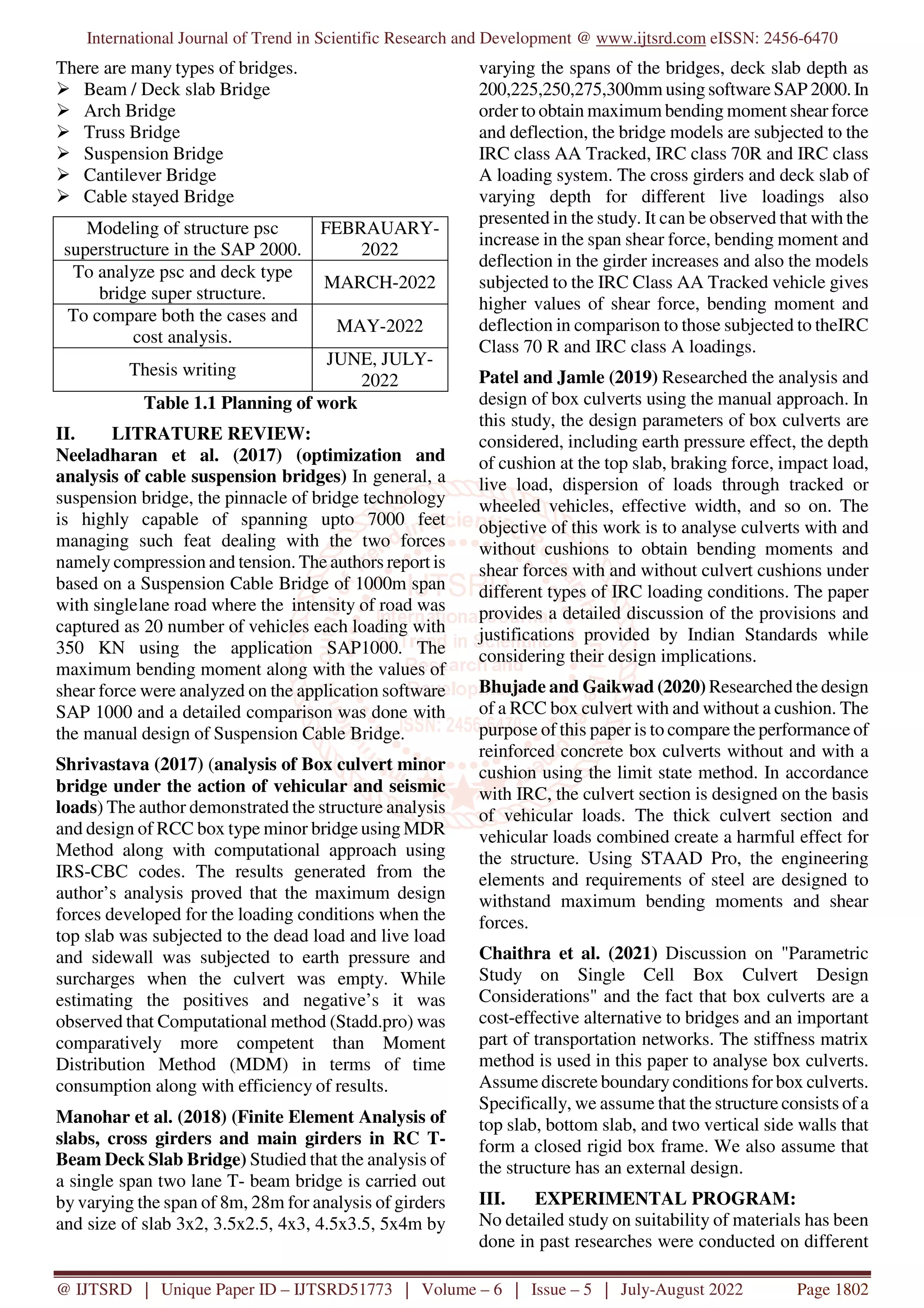
Fig: 4.8 Flow Chart of Activities
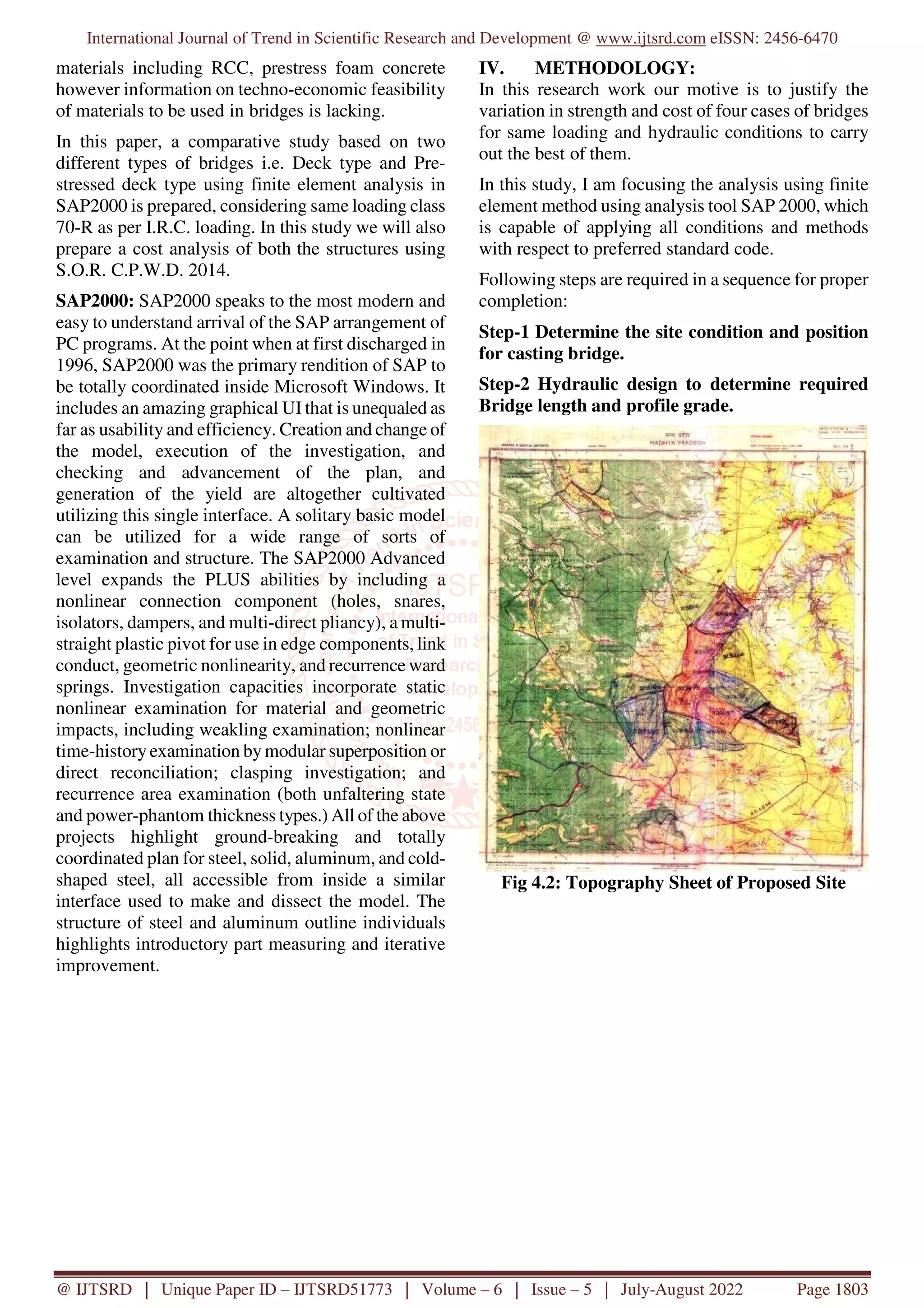
Fig 4.13 Site working
V. RESULT AND DISCUSSION
Finite element results
Fig 5.1 FEM
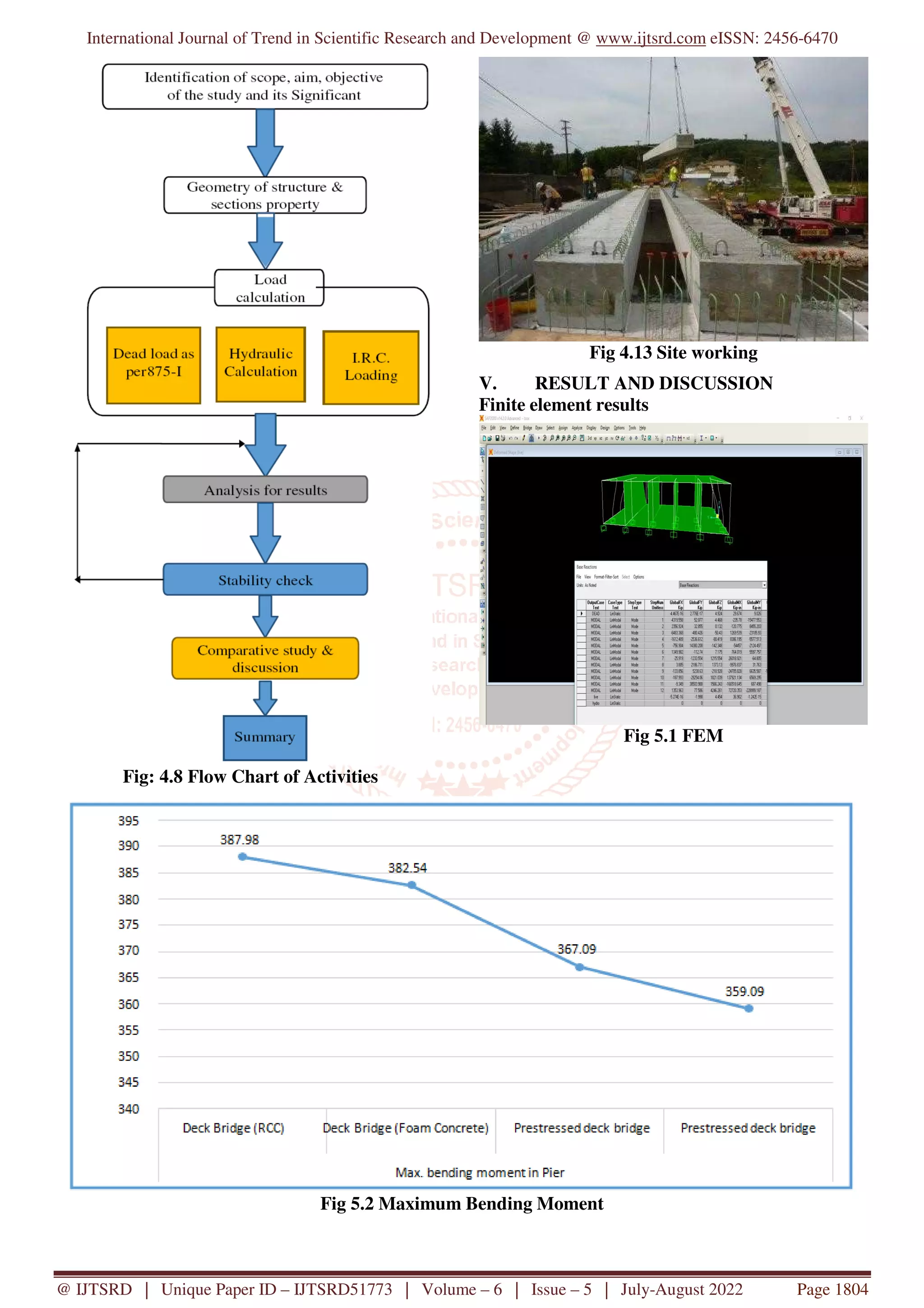
Fig 5.2 Maximum Bending Moment
International Journal of Trend in Scientific Research and Development @ www.ijtsrd.com eISSN: 2456-6470
@ IJTSRD | Unique Paper ID – IJTSRD51773 | Volume – 6 | Issue – 5 | July-August 2022 Page 1805
VI. CONCLUSION:
In this comparative analysis it is clearly stated that
Pre-stressed Bridge (Foam concrete)is more stable in
resisting load.
In this study Hydraulic calculation is determined
using topography sheet available as per Indian
standard using dickens formulae.
In this studywe manuallycalculate the total discharge
and assigned it in software.
It is concluded that in terms of cost Deck type
bridge R.C.C. is comparatively morecostlythan Pre-
stressed Bridge.
I.R.C. loading is applied for justification of vehicular
load analysis.
VII. SCOPE FOR FURTHER STUDY
1. Cable suspension bridge or any other type can
be considered.
2. Seismic analysis can be proceed.
3. AASHTO specification can be preferred instead
of I.R.C.
Midas Bridge designer can be used for analysis in
future.
REFERENCES:
[1] Alvarez J. J and Aparicio A. C: “Seismic
Response of Cable-Stay Bridges for Different
Layout Conditions: A Comparative Analysis”
15 WCEW, LISBOA, 2012.
[2] Amita H. Bhujade. “Design of RCC box culvert
with cushion and without cushion” Journal of
Interdisciplinary Cycle Research, May/2020,
ISSN NO: 0022-1945.
[3] Bridge rules (Railway Board). Rules
specifying the loads for design of super
structure and substructure of bridges and for
assessment of the strength of existing bridges.
[4] Chaithra U, Chandrakant Jadekar,
Channaveeresha Havanagi, and Charankumar
Kamble (2021) “parametric study on single cell
box culvert design considerations-a review”,
International Journal of Engineering Research
& Technology (IJERT), Volume 9, Issue 1,
2021, ISSN: 2278-0181.
[5] Coenraad ESVELD and Valéri MARKINE,
SLAB TRACK DESIGN FOR HIGH-SPEED.
Vol 1, 1999.
[6] Coenraad Esveld, MODERN RAILWAY
TRACK, MRT - Productions, Vol 2, 1989.
[7] D. Johnson Victor, “Essentials of Bridge
Engineering”, Fifth Edition. 2014.
[8] David N. Bilow, P. E., S. E. and Gene M.
Randich, P. E., SLAB TRACK FOR THE
NEXT 100 YEARS, Portland Cement
Association, Skokie, IL. ISSN1874: 2334, Vol.
7, 2011.
[9] Desai A K, Savaliya G. M, Vasanwala S. A:
“static and dynamic analysis of cable-stay
suspension hybrid bridge &validation, Vol. 6,
Issue 11, 2015.
[10] EN 1991-2 Euro code for traffic loads on
bridges.
[11] Indian railway standards-Steel Bridge Code
indian railway standard code of practice for the
design of steel or wrought iron bridges carrying
International Journal of Trend in Scientific Research and Development @ www.ijtsrd.com eISSN: 2456-6470
@ IJTSRD | Unique Paper ID – IJTSRD51773 | Volume – 6 | Issue – 5 | July-August 2022 Page 1806
rail, road or pedestrian traffic 2007.
[12] IRC: 21-2014 Section –III Cement Concrete
(plain and reinforced) standard specifications
and code of practice for road bridges.
[13] IRC: 6-2014 Section –II (Loads and Stesses)
standard specifications and code of practice for
road bridges.
[14] IRS Bridge Manual : 1998
[15] IRS Bridge Rules : 2008 Rules specifying the
loads for Design of super-structure and sub-
structure of Bridges and for assessment of the
strength of Existing bridges.

Design and Analysis of a Girder Bridge for Highway Structures using SAP 2000

  • 1.
    International Journal ofTrend in Scientific Research and Development (IJTSRD) Volume 6 Issue 5, July-August 2022 Available Online: www.ijtsrd.com e-ISSN: 2456 – 6470 @ IJTSRD | Unique Paper ID – IJTSRD51773 | Volume – 6 | Issue – 5 | July-August 2022 Page 1801 Design and Analysis of a Girder Bridge for Highway Structures using SAP 2000 Lekha Malviya1 , Dr. A. K. Jha2 , Dr. R. S. Parihar2 1 M. Tech Scholar, 2 Professor, 1,2 Department of Civil Engineering, LNCT University, Bhopal, Madhya Pradesh, India ABSTRACT In this work, a comparison of two different bridge types—the deck type and the pre-stressed deck type—using finite element analysis in SAP 2000 is complete, taking into account the same loading class 70- R according to I.R.C. loading. Using S.O.R. C.P.W.D. 2014, we will also prepare a price analysis of both structures during this investigation. When connecting to short distances, this type of bridge is more preferred. Therefore, it's important to upgrade the analysis and styling techniques. In this work, an attempt is made to compare the maximum bending moment caused by the super load on a girder and slab bridge. An equivalent bridge is analysed as a three-dimensional model in finite element software such as SAP2000, apply an equivalent loading finished conventional methods, and compare the results. The finite element model yields the maximum bending moment. KEYWORDS: IRC Live loadings, Longitudinal girder, SAP2000, Bending moment, Connectivity, Stressed How to cite this paper: Lekha Malviya | Dr. A. K. Jha | Dr. R. S. Parihar "Design and Analysis of a Girder Bridge for Highway Structures using SAP 2000" Published in International Journal of Trend in Scientific Research and Development (ijtsrd), ISSN: 2456- 6470, Volume-6 | Issue-5, August 2022, pp.1801-1806, URL: www.ijtsrd.com/papers/ijtsrd51773.pdf Copyright © 2022 by author (s) and International Journal of Trend in Scientific Research and Development Journal. This is an Open Access article distributed under the terms of the Creative Commons Attribution License (CC BY 4.0) (http://creativecommons.org/licenses/by/4.0) I. INTRODUCTION A Girder bridge is a bridge that utilizations braces as the methods for supporting the deck. A bridge comprises of three sections: The Foundation of projections and wharfs and Substructure of projection and dock and The Superstructure (brace, bracket, or curve) and deck. A Girder bridge is likely the most usually fabricated and used bridge on the planet. Its fundamental plan,in the most improved frame, can be contrasted with a log extending from one side to alternate over a stream or river. All bridges comprise of two principle parts: the substructure, and the superstructure. The Superstructure is everything from the bearing cushions, up - it is the thing that backings the heaps and is the most unmistakable piece of the bridge. The Substructure is the establishment, what exchanges the heaps from the superstructure to the ground. The two sectionsmust cooperate to make a solid, durable bridge. Pre-stressed Concrete is fundamentally concrete in which interior worry of reasonable extent and dispersion are presented pressure coming about because of outer load are concentrated to wanted degree. In this dissertation work we will analyze a girder bridge with the effect of Pre-stressed concrete and compare it with general deck bridge. In terms of finite elemental analysis, forces and cost analysis. Fig 1.1 View of Ancient Bridge Type of Bridges A Bridge is a structure that is built over physical obstacles such as railway, river, or road for thepurpose of providing passage over the obstacle without closing the way underneath. IJTSRD51773
  • 2.
    International Journal ofTrend in Scientific Research and Development @ www.ijtsrd.com eISSN: 2456-6470 @ IJTSRD | Unique Paper ID – IJTSRD51773 | Volume – 6 | Issue – 5 | July-August 2022 Page 1802 There are many types of bridges. Beam / Deck slab Bridge Arch Bridge Truss Bridge Suspension Bridge Cantilever Bridge Cable stayed Bridge Modeling of structure psc superstructure in the SAP 2000. FEBRAUARY- 2022 To analyze psc and deck type bridge super structure. MARCH-2022 To compare both the cases and cost analysis. MAY-2022 Thesis writing JUNE, JULY- 2022 Table 1.1 Planning of work II. LITRATURE REVIEW: Neeladharan et al. (2017) (optimization and analysis of cable suspension bridges) In general, a suspension bridge, the pinnacle of bridge technology is highly capable of spanning upto 7000 feet managing such feat dealing with the two forces namely compression and tension. The authors report is based on a Suspension Cable Bridge of 1000m span with singlelane road where the intensity of road was captured as 20 number of vehicles each loading with 350 KN using the application SAP1000. The maximum bending moment along with the values of shear force were analyzed on the application software SAP 1000 and a detailed comparison was done with the manual design of Suspension Cable Bridge. Shrivastava (2017) (analysis of Box culvert minor bridge under the action of vehicular and seismic loads) The author demonstrated the structure analysis and design of RCC box type minor bridge using MDR Method along with computational approach using IRS-CBC codes. The results generated from the author’s analysis proved that the maximum design forces developed for the loading conditions when the top slab was subjected to the dead load and live load and sidewall was subjected to earth pressure and surcharges when the culvert was empty. While estimating the positives and negative’s it was observed that Computational method (Stadd.pro) was comparatively more competent than Moment Distribution Method (MDM) in terms of time consumption along with efficiency of results. Manohar et al. (2018) (Finite Element Analysis of slabs, cross girders and main girders in RC T- Beam Deck Slab Bridge) Studied that the analysis of a single span two lane T- beam bridge is carried out by varying the span of 8m, 28m for analysis of girders and size of slab 3x2, 3.5x2.5, 4x3, 4.5x3.5, 5x4m by varying the spans of the bridges, deck slab depth as 200,225,250,275,300mm using software SAP 2000. In order to obtain maximum bending moment shear force and deflection, the bridge models are subjected to the IRC class AA Tracked, IRC class 70R and IRC class A loading system. The cross girders and deck slab of varying depth for different live loadings also presented in the study. It can be observed that with the increase in the span shear force, bending moment and deflection in the girder increases and also the models subjected to the IRC Class AA Tracked vehicle gives higher values of shear force, bending moment and deflection in comparison to those subjected to theIRC Class 70 R and IRC class A loadings. Patel and Jamle (2019) Researched the analysis and design of box culverts using the manual approach. In this study, the design parameters of box culverts are considered, including earth pressure effect, the depth of cushion at the top slab, braking force, impact load, live load, dispersion of loads through tracked or wheeled vehicles, effective width, and so on. The objective of this work is to analyse culverts with and without cushions to obtain bending moments and shear forces with and without culvert cushions under different types of IRC loading conditions. The paper provides a detailed discussion of the provisions and justifications provided by Indian Standards while considering their design implications. Bhujade and Gaikwad (2020) Researched the design of a RCC box culvert with and without a cushion. The purpose of this paper is to compare the performance of reinforced concrete box culverts without and with a cushion using the limit state method. In accordance with IRC, the culvert section is designed on the basis of vehicular loads. The thick culvert section and vehicular loads combined create a harmful effect for the structure. Using STAAD Pro, the engineering elements and requirements of steel are designed to withstand maximum bending moments and shear forces. Chaithra et al. (2021) Discussion on "Parametric Study on Single Cell Box Culvert Design Considerations" and the fact that box culverts are a cost-effective alternative to bridges and an important part of transportation networks. The stiffness matrix method is used in this paper to analyse box culverts. Assume discrete boundary conditions for box culverts. Specifically, we assume that the structure consists of a top slab, bottom slab, and two vertical side walls that form a closed rigid box frame. We also assume that the structure has an external design. III. EXPERIMENTAL PROGRAM: No detailed study on suitability of materials has been done in past researches were conducted on different
  • 3.
    International Journal ofTrend in Scientific Research and Development @ www.ijtsrd.com eISSN: 2456-6470 @ IJTSRD | Unique Paper ID – IJTSRD51773 | Volume – 6 | Issue – 5 | July-August 2022 Page 1803 materials including RCC, prestress foam concrete however information on techno-economic feasibility of materials to be used in bridges is lacking. In this paper, a comparative study based on two different types of bridges i.e. Deck type and Pre- stressed deck type using finite element analysis in SAP2000 is prepared, considering same loading class 70-R as per I.R.C. loading. In this study we will also prepare a cost analysis of both the structures using S.O.R. C.P.W.D. 2014. SAP2000: SAP2000 speaks to the most modern and easy to understand arrival of the SAP arrangement of PC programs. At the point when at first discharged in 1996, SAP2000 was the primary rendition of SAP to be totally coordinated inside Microsoft Windows. It includes an amazing graphical UI that is unequaled as far as usability and efficiency. Creation and change of the model, execution of the investigation, and checking and advancement of the plan, and generation of the yield are altogether cultivated utilizing this single interface. A solitary basic model can be utilized for a wide range of sorts of examination and structure. The SAP2000 Advanced level expands the PLUS abilities by including a nonlinear connection component (holes, snares, isolators, dampers, and multi-direct pliancy), a multi- straight plastic pivot for use in edge components, link conduct, geometric nonlinearity, and recurrence ward springs. Investigation capacities incorporate static nonlinear examination for material and geometric impacts, including weakling examination; nonlinear time-history examination by modular superposition or direct reconciliation; clasping investigation; and recurrence area examination (both unfaltering state and power-phantom thickness types.) All of the above projects highlight ground-breaking and totally coordinated plan for steel, solid, aluminum, and cold- shaped steel, all accessible from inside a similar interface used to make and dissect the model. The structure of steel and aluminum outline individuals highlights introductory part measuring and iterative improvement. IV. METHODOLOGY: In this research work our motive is to justify the variation in strength and cost of four cases of bridges for same loading and hydraulic conditions to carry out the best of them. In this study, I am focusing the analysis using finite element method using analysis tool SAP 2000, which is capable of applying all conditions and methods with respect to preferred standard code. Following steps are required in a sequence for proper completion: Step-1 Determine the site condition and position for casting bridge. Step-2 Hydraulic design to determine required Bridge length and profile grade. Fig 4.2: Topography Sheet of Proposed Site
  • 4.
    International Journal ofTrend in Scientific Research and Development @ www.ijtsrd.com eISSN: 2456-6470 @ IJTSRD | Unique Paper ID – IJTSRD51773 | Volume – 6 | Issue – 5 | July-August 2022 Page 1804 Fig: 4.8 Flow Chart of Activities Fig 4.13 Site working V. RESULT AND DISCUSSION Finite element results Fig 5.1 FEM Fig 5.2 Maximum Bending Moment
  • 5.
    International Journal ofTrend in Scientific Research and Development @ www.ijtsrd.com eISSN: 2456-6470 @ IJTSRD | Unique Paper ID – IJTSRD51773 | Volume – 6 | Issue – 5 | July-August 2022 Page 1805 VI. CONCLUSION: In this comparative analysis it is clearly stated that Pre-stressed Bridge (Foam concrete)is more stable in resisting load. In this study Hydraulic calculation is determined using topography sheet available as per Indian standard using dickens formulae. In this studywe manuallycalculate the total discharge and assigned it in software. It is concluded that in terms of cost Deck type bridge R.C.C. is comparatively morecostlythan Pre- stressed Bridge. I.R.C. loading is applied for justification of vehicular load analysis. VII. SCOPE FOR FURTHER STUDY 1. Cable suspension bridge or any other type can be considered. 2. Seismic analysis can be proceed. 3. AASHTO specification can be preferred instead of I.R.C. Midas Bridge designer can be used for analysis in future. REFERENCES: [1] Alvarez J. J and Aparicio A. C: “Seismic Response of Cable-Stay Bridges for Different Layout Conditions: A Comparative Analysis” 15 WCEW, LISBOA, 2012. [2] Amita H. Bhujade. “Design of RCC box culvert with cushion and without cushion” Journal of Interdisciplinary Cycle Research, May/2020, ISSN NO: 0022-1945. [3] Bridge rules (Railway Board). Rules specifying the loads for design of super structure and substructure of bridges and for assessment of the strength of existing bridges. [4] Chaithra U, Chandrakant Jadekar, Channaveeresha Havanagi, and Charankumar Kamble (2021) “parametric study on single cell box culvert design considerations-a review”, International Journal of Engineering Research & Technology (IJERT), Volume 9, Issue 1, 2021, ISSN: 2278-0181. [5] Coenraad ESVELD and Valéri MARKINE, SLAB TRACK DESIGN FOR HIGH-SPEED. Vol 1, 1999. [6] Coenraad Esveld, MODERN RAILWAY TRACK, MRT - Productions, Vol 2, 1989. [7] D. Johnson Victor, “Essentials of Bridge Engineering”, Fifth Edition. 2014. [8] David N. Bilow, P. E., S. E. and Gene M. Randich, P. E., SLAB TRACK FOR THE NEXT 100 YEARS, Portland Cement Association, Skokie, IL. ISSN1874: 2334, Vol. 7, 2011. [9] Desai A K, Savaliya G. M, Vasanwala S. A: “static and dynamic analysis of cable-stay suspension hybrid bridge &validation, Vol. 6, Issue 11, 2015. [10] EN 1991-2 Euro code for traffic loads on bridges. [11] Indian railway standards-Steel Bridge Code indian railway standard code of practice for the design of steel or wrought iron bridges carrying
  • 6.
    International Journal ofTrend in Scientific Research and Development @ www.ijtsrd.com eISSN: 2456-6470 @ IJTSRD | Unique Paper ID – IJTSRD51773 | Volume – 6 | Issue – 5 | July-August 2022 Page 1806 rail, road or pedestrian traffic 2007. [12] IRC: 21-2014 Section –III Cement Concrete (plain and reinforced) standard specifications and code of practice for road bridges. [13] IRC: 6-2014 Section –II (Loads and Stesses) standard specifications and code of practice for road bridges. [14] IRS Bridge Manual : 1998 [15] IRS Bridge Rules : 2008 Rules specifying the loads for Design of super-structure and sub- structure of Bridges and for assessment of the strength of Existing bridges.