Eclipse your competition by leveraging social mediaPrepared for the International Enterprise 2.0 Forum – Milan, June 10th, 2010@fgossieaux
OverviewWhat is actually happening out there?Understanding the true drivers of Social MediaHow do Hyper-Social Organizations think about their business?What do Hyper-Social Organizations do Differently, and WHY?Marketing 2.0 in a Hyper-Social world
Let’s start off with a little example Human 1.0 vs. Web 2.0The SAP Developer Community
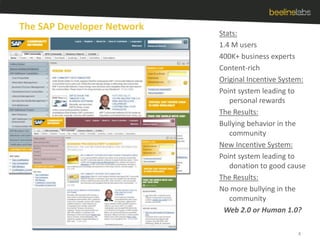
The SAP Developer Network4Stats:1.4 M users400K+ business expertsContent-richOriginal Incentive System:Point system leading to personal rewardsThe Results:Bullying behavior in the communityNew Incentive System:Point system leading to donation to good causeThe Results:No more bullying in the communityWeb 2.0 or Human 1.0?
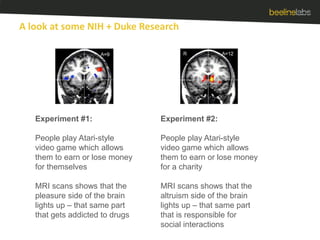
A look at some NIH + Duke ResearchExperiment #1:People play Atari-style video game which allows them to earn or lose money for themselvesMRI scans shows that the pleasure side of the brain lights up – that same part that gets addicted to drugsExperiment #2:People play Atari-style video game which allows them to earn or lose money for a charityMRI scans shows that the altruism side of the brain lights up – that same part that is responsible for social interactions
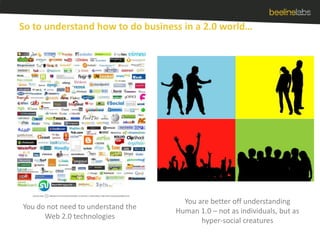
So to understand how to do business in a 2.0 world…You are better off understanding Human 1.0 – not as individuals, but as hyper-social creaturesYou do not need to understand the Web 2.0 technologies
Let’s get a level deeper on the Human 1.0…
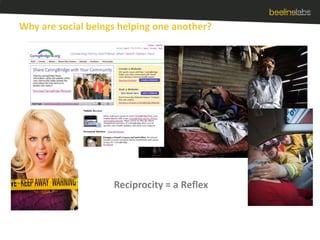
Why are social beings helping one another?Reciprocity = a Reflex
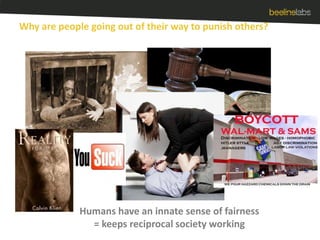
Why are people going out of their way to punish others?Humans have an innate sense of fairness = keeps reciprocal society working
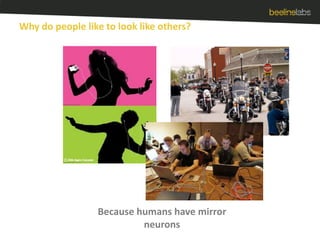
Why do people like to look like others?Because humans have mirror neurons
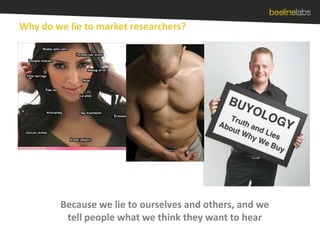
Why do we lie to market researchers?Because we lie to ourselves and others, and we tell people what we think they want to hear
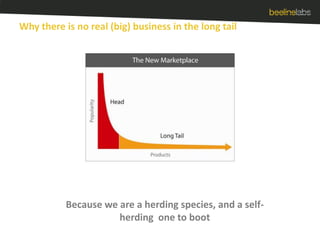
Why there is no real (big) business in the long tailBecause we are a herding species, and a self-herding  one to boot
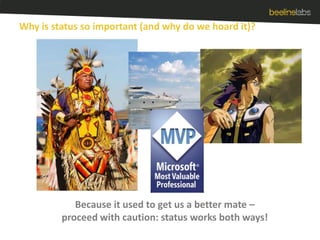
Why is status so important (and why do we hoard it)?Because it used to get us a better mate – proceed with caution: status works both ways!
What are the important Human 1.0 Hyper-Social TraitsReciprocity – it’s a reflex that allows us to be the only super-social species without all being brothers and sistersSocial framework of evaluating things vs. market frameworkThe role of fairness in assessing situationsThe importance of looking cool and mimicking othersHerding and self-herding(early research shows that social behavior does not change when it scales)So to the extent that we can basically be human with what we know, and share it as freely as we possibly can, I think we’ll go a long way towards gaining a higher or stronger level of trust with the consumers.Barry Judge, CMO Best Buyhttp://www.cmotwo.com
They think differently about their businessSuccessful Hyper-Social OrganizationsInformed by Tribalization of Business Study:2009 – 430 Companies took the survey (52% external communities, 32 hybrid, and 12 internal)
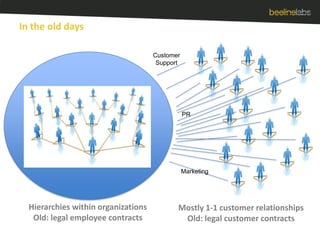
In the old daysCustomer SupportPRMarketingHierarchies within organizationsOld: legal employee contractsMostly 1-1 customer relationshipsOld: legal customer contracts
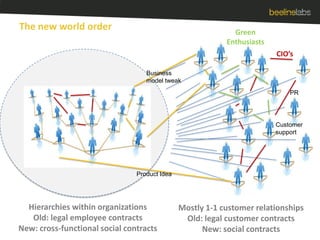
The new world orderGreen EnthusiastsCIO’sBusiness model tweakPRCustomer supportProduct IdeaHierarchies within organizationsOld: legal employee contractsNew: cross-functional social contractsMostly 1-1 customer relationshipsOld: legal customer contractsNew: social contracts
Hyper-Social companies think differently: a recapThink tribe – not market segmentWe need to find groups of people who have something in common based on their behavior, not their market characteristicsThink knowledge network – not information channelThe most important conversations in communities happen in networks of people, not between the company and the community.Think human-centricity – not company-centricityThe human has to be at the center of everything you do, not the companyThink emergent messiness – not hierarchical fixed processesPeople will want to see responses to their suggestions, even if it does not fit your community goals – FAST“…affinity groups will quickly become the dominant social force in the emerging world economy, changing how we think about markets, fads, social movements, and, ultimately, power” - Tom Hayes, Jump Point: How Network Culture is Revolutionizing Business – 2008
What is it that they do different?Hyper-Social Organizations
Hyper-Social Orgs – Leveraging Social Business ProcessesSuccessful Hyper-Social organizations turn their business processes into “social” processesWhy?ScaleIncreased qualityIncreased passionIncreased WOM
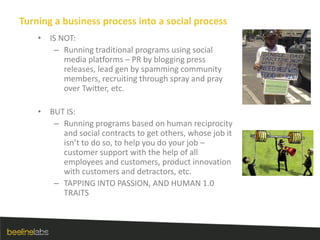
Turning a business process into a social processIS NOT:Running traditional programs using social media platforms – PR by blogging press releases, lead gen by spamming community members, recruiting through spray and pray over Twitter, etc.BUT IS:Running programs based on human reciprocity and social contracts to get others, whose job it isn’t to do so, to help you do your job – customer support with the help of all employees and customers, product innovation with customers and detractors, etc.TAPPING INTO PASSION, AND HUMAN 1.0 TRAITS
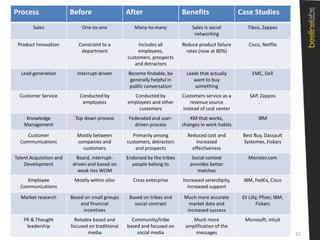
22
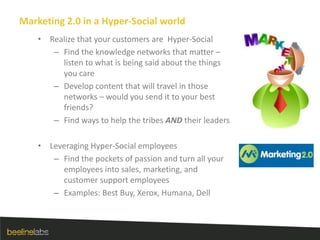
Marketing 2.0 in a Hyper-Social worldRealize that your customers are  Hyper-SocialFind the knowledge networks that matter – listen to what is being said about the things you careDevelop content that will travel in those networks – would you send it to your best friends?Find ways to help the tribes AND their leadersLeveraging Hyper-Social employeesFind the pockets of passion and turn all your employees into sales, marketing, and customer support employeesExamples: Best Buy, Xerox, Humana, Dell
Any questions?	Francois GossieauxPartner, Beeline Labse. francois@beelinelabs.comw. http://www.beelinelabs.comb. http://www.emergencemarketing.comc. http://www.marketingtwo.netp. http://www.cmotwo.comt. http://twitter.com/fgossieauxOur new book: The Hyper-Social Organizationhttp://www.hypersocialorg.com24

Francois Gossieaux - International Forum on E 2.0

  • 1.
    Eclipse your competitionby leveraging social mediaPrepared for the International Enterprise 2.0 Forum – Milan, June 10th, 2010@fgossieaux
  • 2.
    OverviewWhat is actuallyhappening out there?Understanding the true drivers of Social MediaHow do Hyper-Social Organizations think about their business?What do Hyper-Social Organizations do Differently, and WHY?Marketing 2.0 in a Hyper-Social world
  • 3.
    Let’s start offwith a little example Human 1.0 vs. Web 2.0The SAP Developer Community
  • 4.
    The SAP DeveloperNetwork4Stats:1.4 M users400K+ business expertsContent-richOriginal Incentive System:Point system leading to personal rewardsThe Results:Bullying behavior in the communityNew Incentive System:Point system leading to donation to good causeThe Results:No more bullying in the communityWeb 2.0 or Human 1.0?
  • 5.
    A look atsome NIH + Duke ResearchExperiment #1:People play Atari-style video game which allows them to earn or lose money for themselvesMRI scans shows that the pleasure side of the brain lights up – that same part that gets addicted to drugsExperiment #2:People play Atari-style video game which allows them to earn or lose money for a charityMRI scans shows that the altruism side of the brain lights up – that same part that is responsible for social interactions
  • 6.
    So to understandhow to do business in a 2.0 world…You are better off understanding Human 1.0 – not as individuals, but as hyper-social creaturesYou do not need to understand the Web 2.0 technologies
  • 7.
    Let’s get alevel deeper on the Human 1.0…
  • 8.
    Why are socialbeings helping one another?Reciprocity = a Reflex
  • 9.
    Why are peoplegoing out of their way to punish others?Humans have an innate sense of fairness = keeps reciprocal society working
  • 10.
    Why do peoplelike to look like others?Because humans have mirror neurons
  • 11.
    Why do welie to market researchers?Because we lie to ourselves and others, and we tell people what we think they want to hear
  • 12.
    Why there isno real (big) business in the long tailBecause we are a herding species, and a self-herding one to boot
  • 13.
    Why is statusso important (and why do we hoard it)?Because it used to get us a better mate – proceed with caution: status works both ways!
  • 14.
    What are theimportant Human 1.0 Hyper-Social TraitsReciprocity – it’s a reflex that allows us to be the only super-social species without all being brothers and sistersSocial framework of evaluating things vs. market frameworkThe role of fairness in assessing situationsThe importance of looking cool and mimicking othersHerding and self-herding(early research shows that social behavior does not change when it scales)So to the extent that we can basically be human with what we know, and share it as freely as we possibly can, I think we’ll go a long way towards gaining a higher or stronger level of trust with the consumers.Barry Judge, CMO Best Buyhttp://www.cmotwo.com
  • 15.
    They think differentlyabout their businessSuccessful Hyper-Social OrganizationsInformed by Tribalization of Business Study:2009 – 430 Companies took the survey (52% external communities, 32 hybrid, and 12 internal)
  • 16.
    In the olddaysCustomer SupportPRMarketingHierarchies within organizationsOld: legal employee contractsMostly 1-1 customer relationshipsOld: legal customer contracts
  • 17.
    The new worldorderGreen EnthusiastsCIO’sBusiness model tweakPRCustomer supportProduct IdeaHierarchies within organizationsOld: legal employee contractsNew: cross-functional social contractsMostly 1-1 customer relationshipsOld: legal customer contractsNew: social contracts
  • 18.
    Hyper-Social companies thinkdifferently: a recapThink tribe – not market segmentWe need to find groups of people who have something in common based on their behavior, not their market characteristicsThink knowledge network – not information channelThe most important conversations in communities happen in networks of people, not between the company and the community.Think human-centricity – not company-centricityThe human has to be at the center of everything you do, not the companyThink emergent messiness – not hierarchical fixed processesPeople will want to see responses to their suggestions, even if it does not fit your community goals – FAST“…affinity groups will quickly become the dominant social force in the emerging world economy, changing how we think about markets, fads, social movements, and, ultimately, power” - Tom Hayes, Jump Point: How Network Culture is Revolutionizing Business – 2008
  • 19.
    What is itthat they do different?Hyper-Social Organizations
  • 20.
    Hyper-Social Orgs –Leveraging Social Business ProcessesSuccessful Hyper-Social organizations turn their business processes into “social” processesWhy?ScaleIncreased qualityIncreased passionIncreased WOM
  • 21.
    Turning a businessprocess into a social processIS NOT:Running traditional programs using social media platforms – PR by blogging press releases, lead gen by spamming community members, recruiting through spray and pray over Twitter, etc.BUT IS:Running programs based on human reciprocity and social contracts to get others, whose job it isn’t to do so, to help you do your job – customer support with the help of all employees and customers, product innovation with customers and detractors, etc.TAPPING INTO PASSION, AND HUMAN 1.0 TRAITS
  • 22.
  • 23.
    Marketing 2.0 ina Hyper-Social worldRealize that your customers are Hyper-SocialFind the knowledge networks that matter – listen to what is being said about the things you careDevelop content that will travel in those networks – would you send it to your best friends?Find ways to help the tribes AND their leadersLeveraging Hyper-Social employeesFind the pockets of passion and turn all your employees into sales, marketing, and customer support employeesExamples: Best Buy, Xerox, Humana, Dell
  • 24.
    Any questions? Francois GossieauxPartner,Beeline Labse. francois@beelinelabs.comw. http://www.beelinelabs.comb. http://www.emergencemarketing.comc. http://www.marketingtwo.netp. http://www.cmotwo.comt. http://twitter.com/fgossieauxOur new book: The Hyper-Social Organizationhttp://www.hypersocialorg.com24