

New England ChapterSocial NetworkingSerious BusinessPresented:  January 15, 2010Russ Edelman - russ.edelman@corridorconsulting.comTwitter: russECM
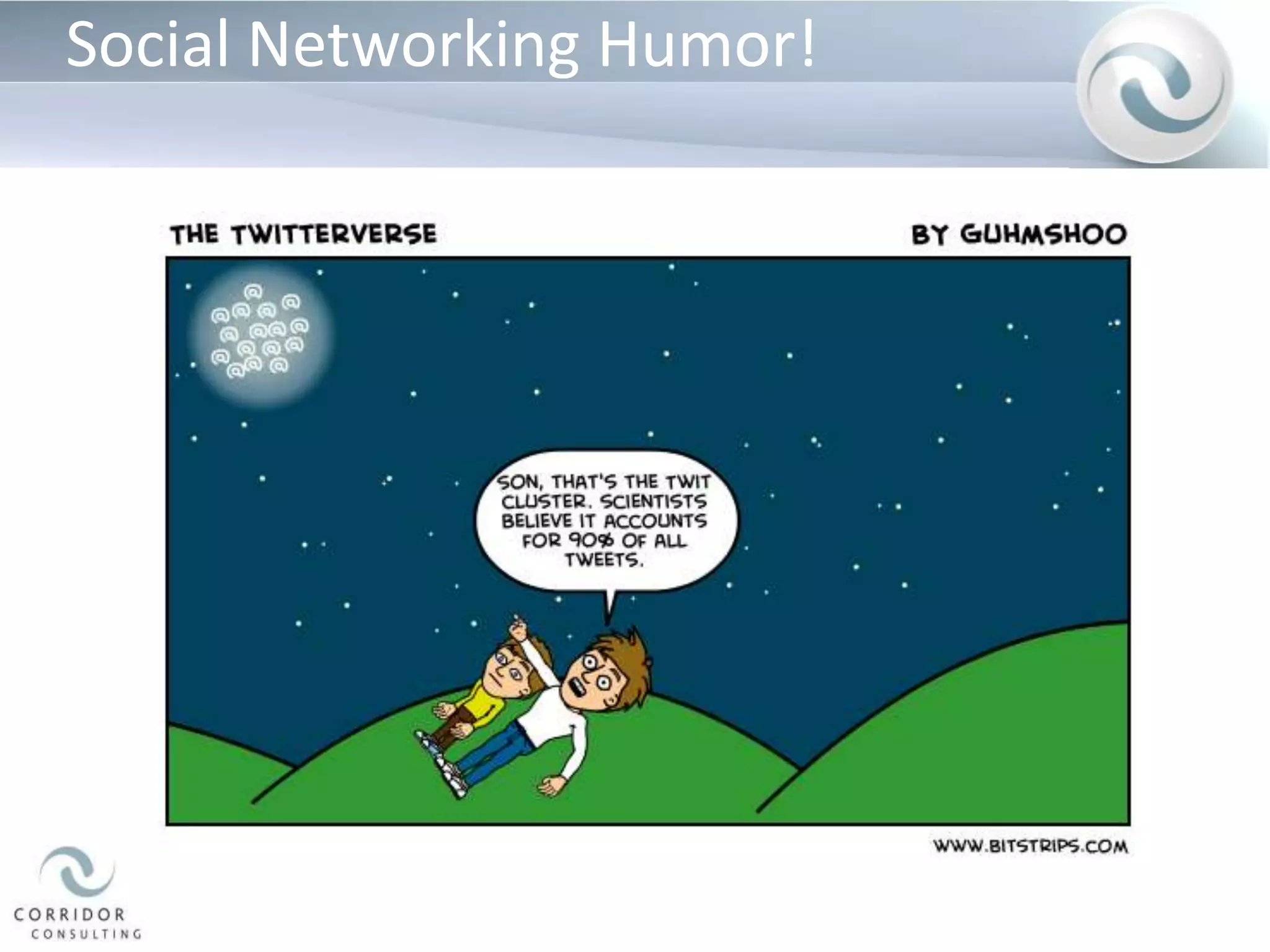
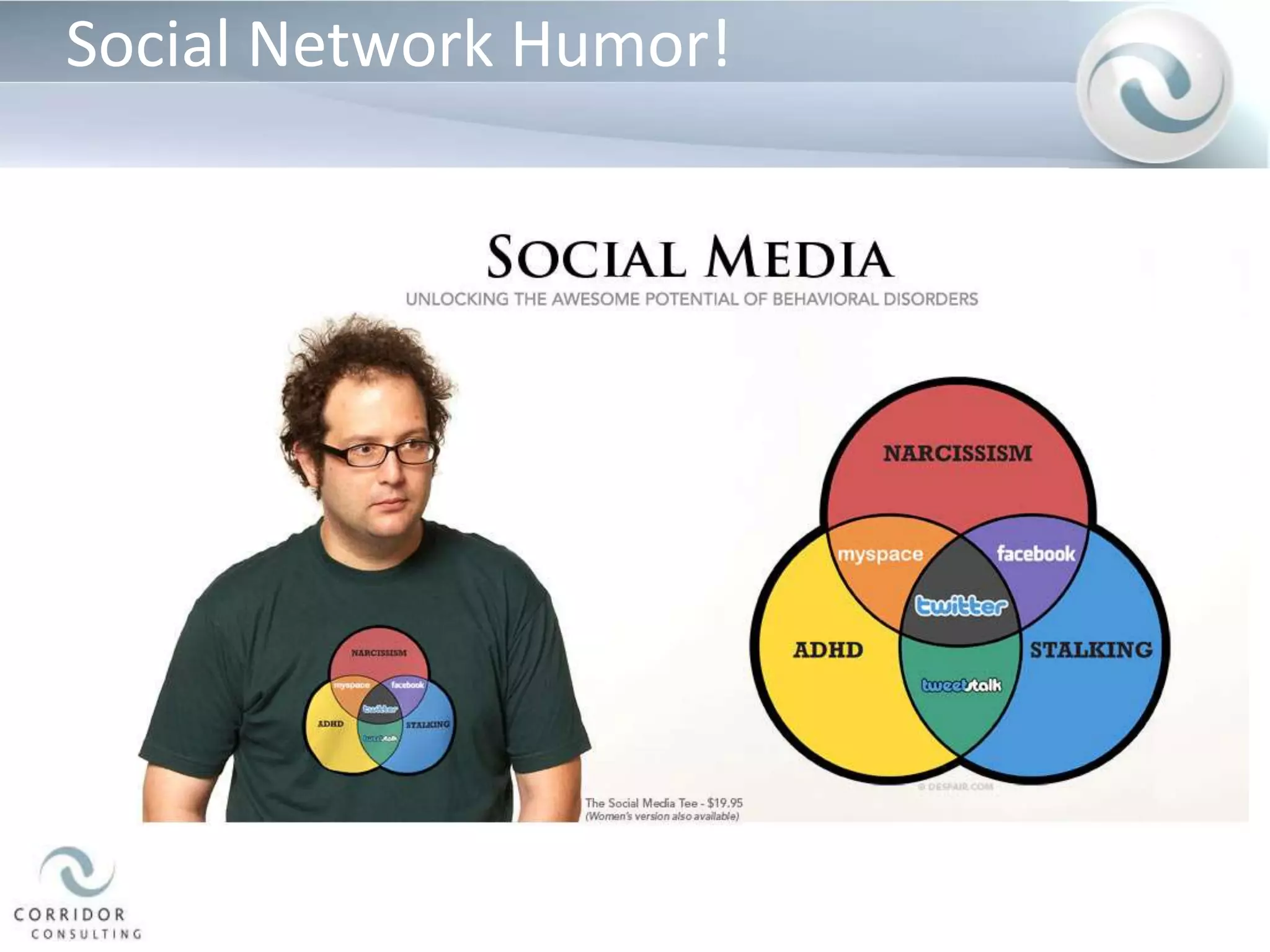
Social Networking Humor!
Social-Social NetworkingDefined…A social network is a social structure made of individuals (or organizations) called "nodes," which are tied (connected) by one or more specific types of interdependency, such as friendship, kinship, financial exchange, dislike, sexual relationships, or relationships of beliefs, knowledge or prestige.The power of social network analysis stems from its difference from traditional social scientific studies, which assume that it is the attributes of individual actors—whether they are friendly or unfriendly, smart or dumb, etc.—that matter. Social network analysis produces an alternate view, where the attributes of individuals are less important than their relationships and ties with other actors within the network. This approach has turned out to be useful for explaining many real-world phenomena, but leaves less room for individual agency, the ability for individuals to influence their success, because so much of it rests within the structure of their network.
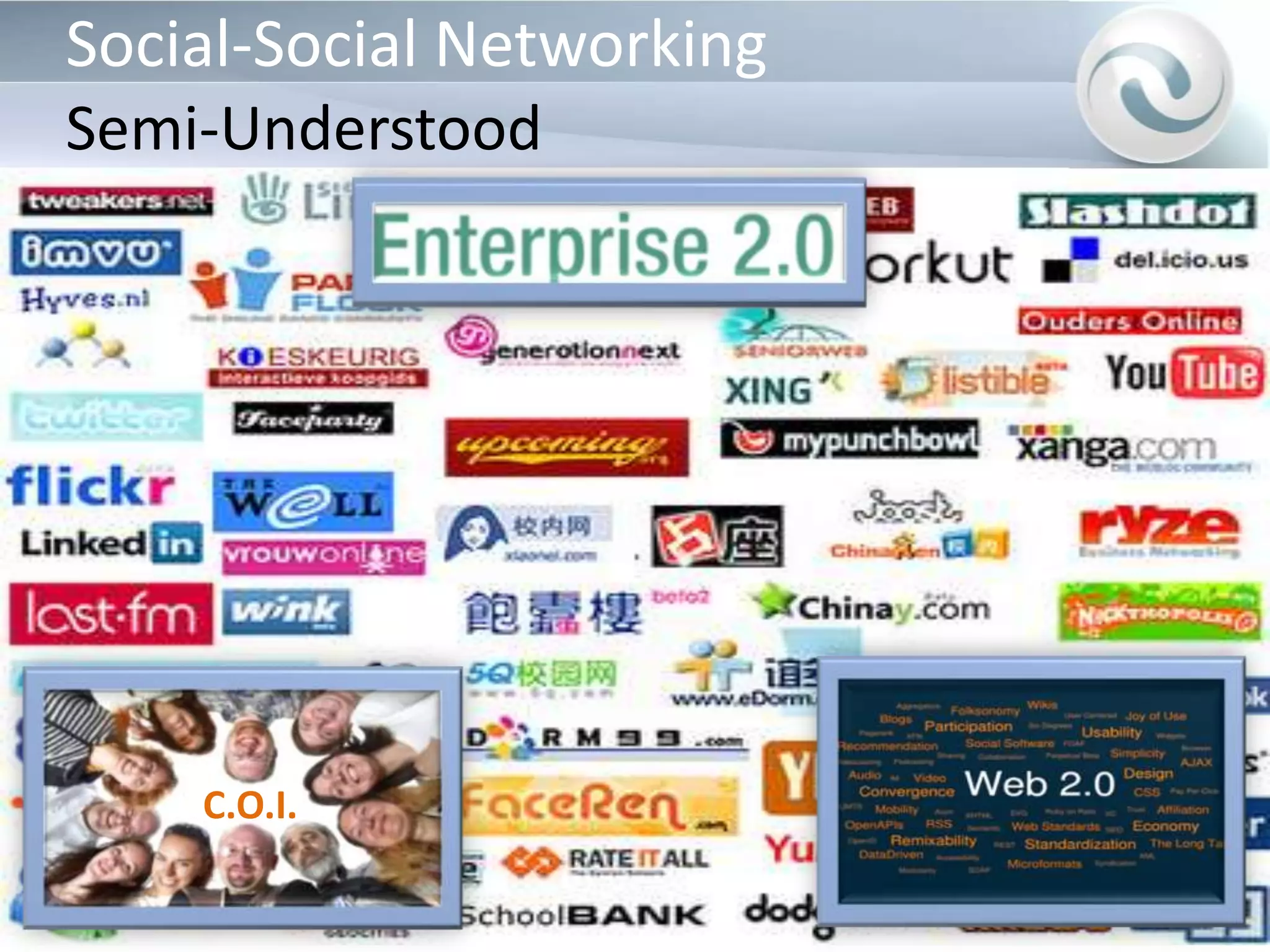
Social-Social NetworkingSemi-UnderstoodC.O.I.
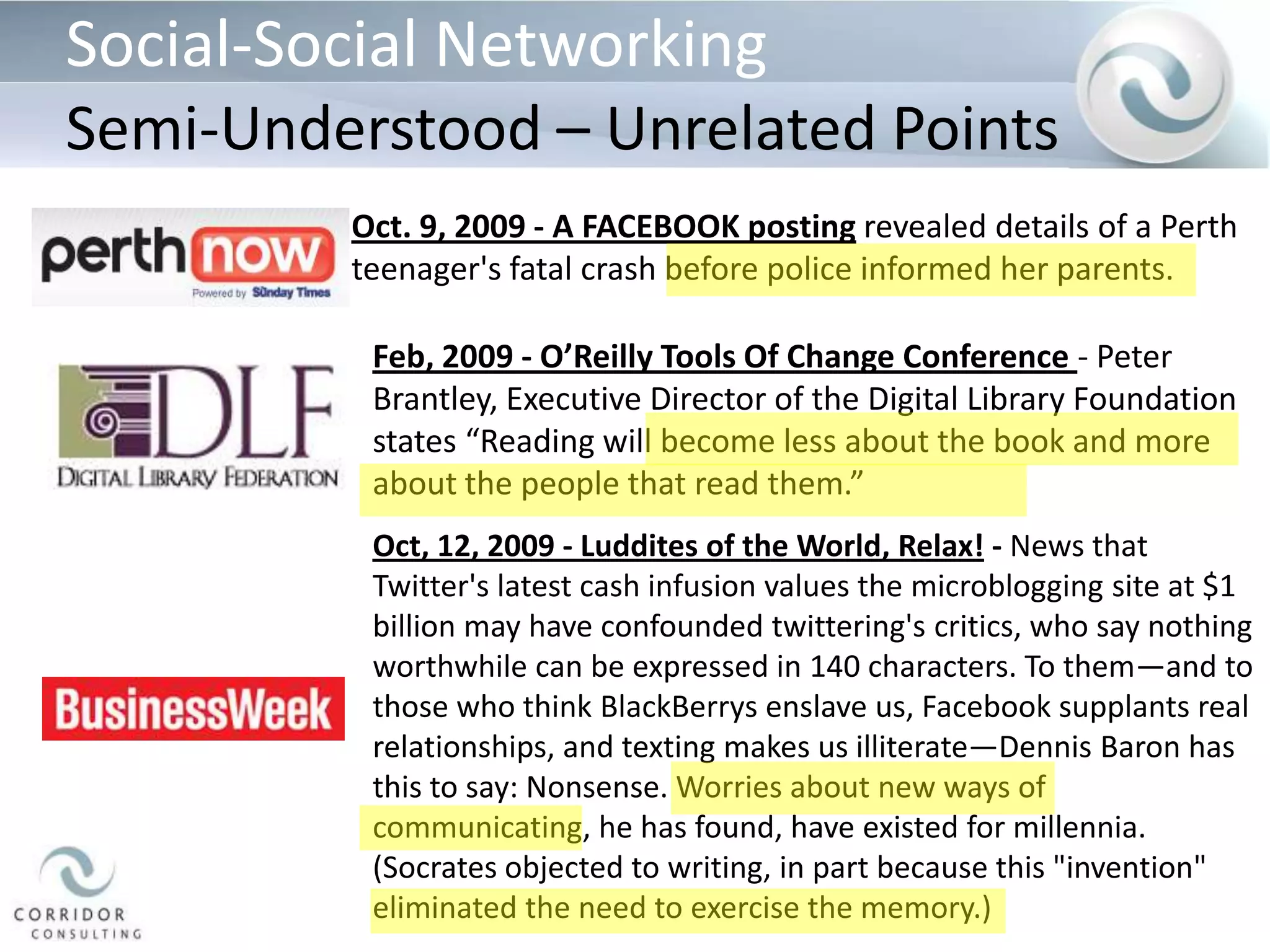
Social-Social NetworkingSemi-Understood – Unrelated PointsOct. 9, 2009 - A FACEBOOK posting revealed details of a Perth teenager's fatal crash before police informed her parents.Feb, 2009 - O’Reilly Tools Of Change Conference- Peter Brantley, Executive Director of the Digital Library Foundation states “Reading will become less about the book and more about the people that read them.” Oct, 12, 2009 - Luddites of the World, Relax! - News that Twitter's latest cash infusion values the microblogging site at $1 billion may have confounded twittering's critics, who say nothing worthwhile can be expressed in 140 characters. To them—and to those who think BlackBerrys enslave us, Facebook supplants real relationships, and texting makes us illiterate—Dennis Baron has this to say: Nonsense. Worries about new ways of communicating, he has found, have existed for millennia. (Socrates objected to writing, in part because this "invention" eliminated the need to exercise the memory.)
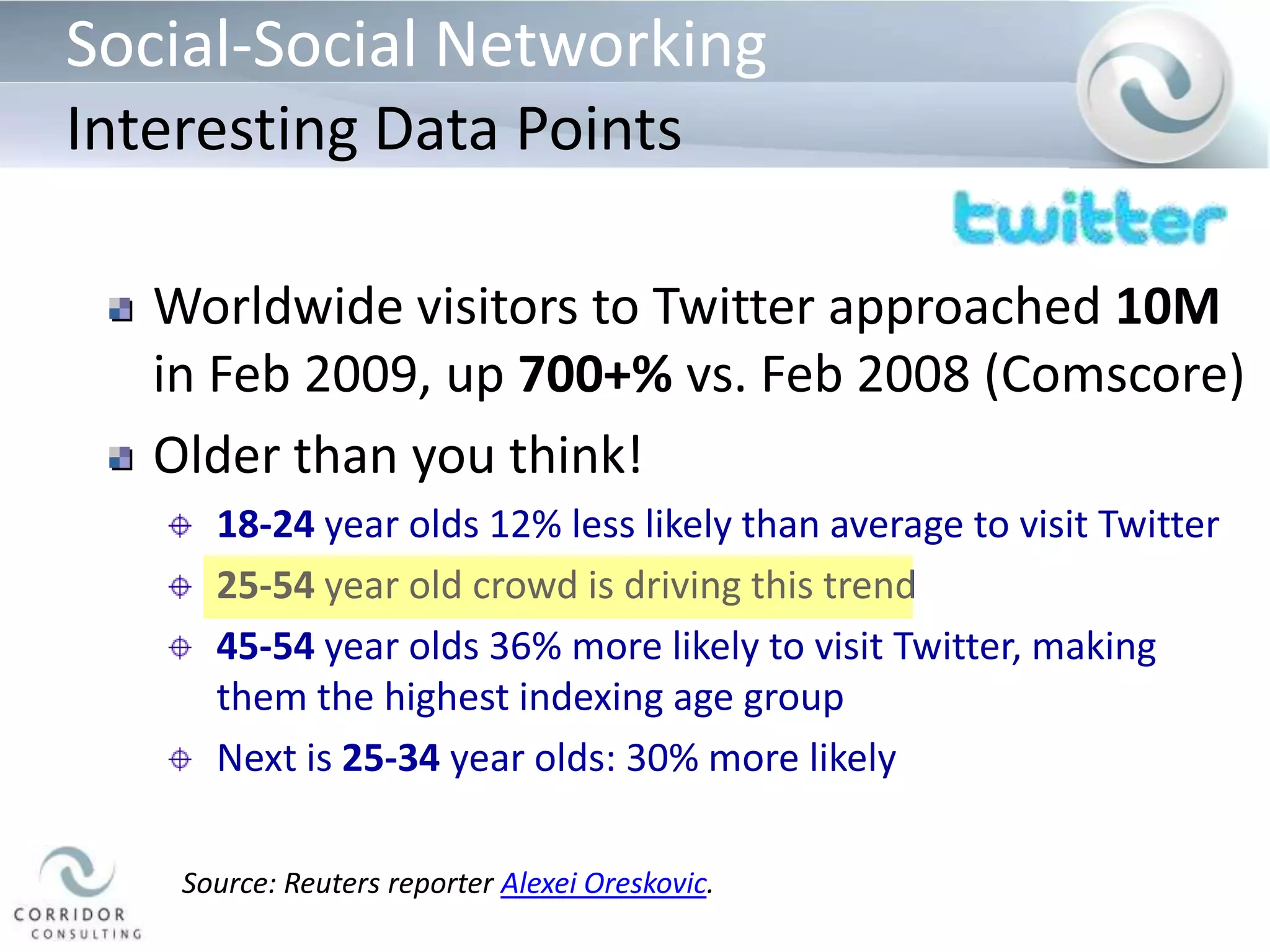
Social-Social NetworkingInteresting Data PointsWorldwide visitors to Twitter approached 10M in Feb 2009, up 700+% vs. Feb 2008 (Comscore)Older than you think!18-24 year olds 12% less likely than average to visit Twitter25-54 year old crowd is driving this trend45-54 year olds 36% more likely to visit Twitter, making them the highest indexing age groupNext is 25-34 year olds: 30% more likelySource: Reuters reporter Alexei Oreskovic.
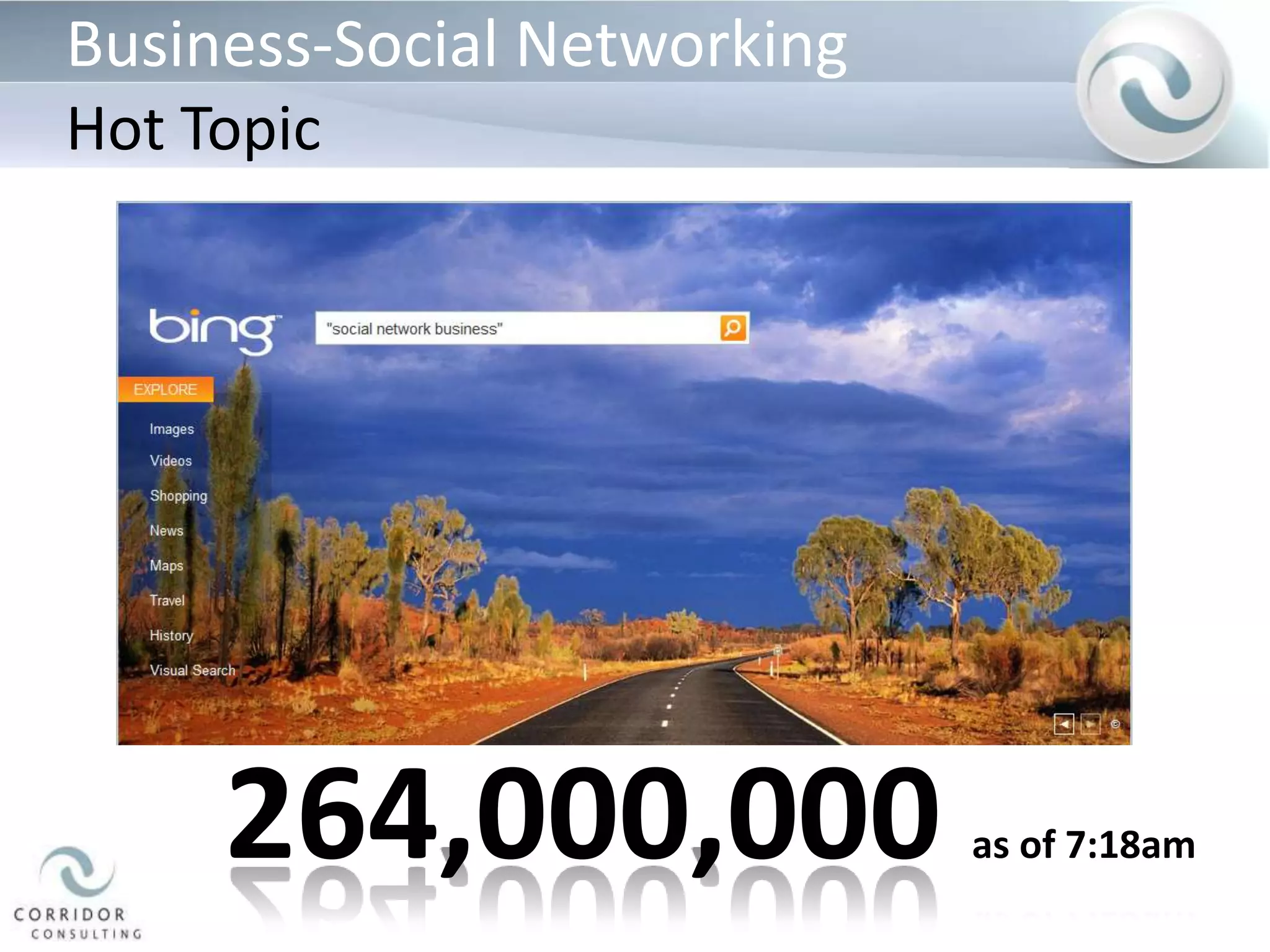
Business-Social NetworkingHot Topic264,000,000 as of 7:18am
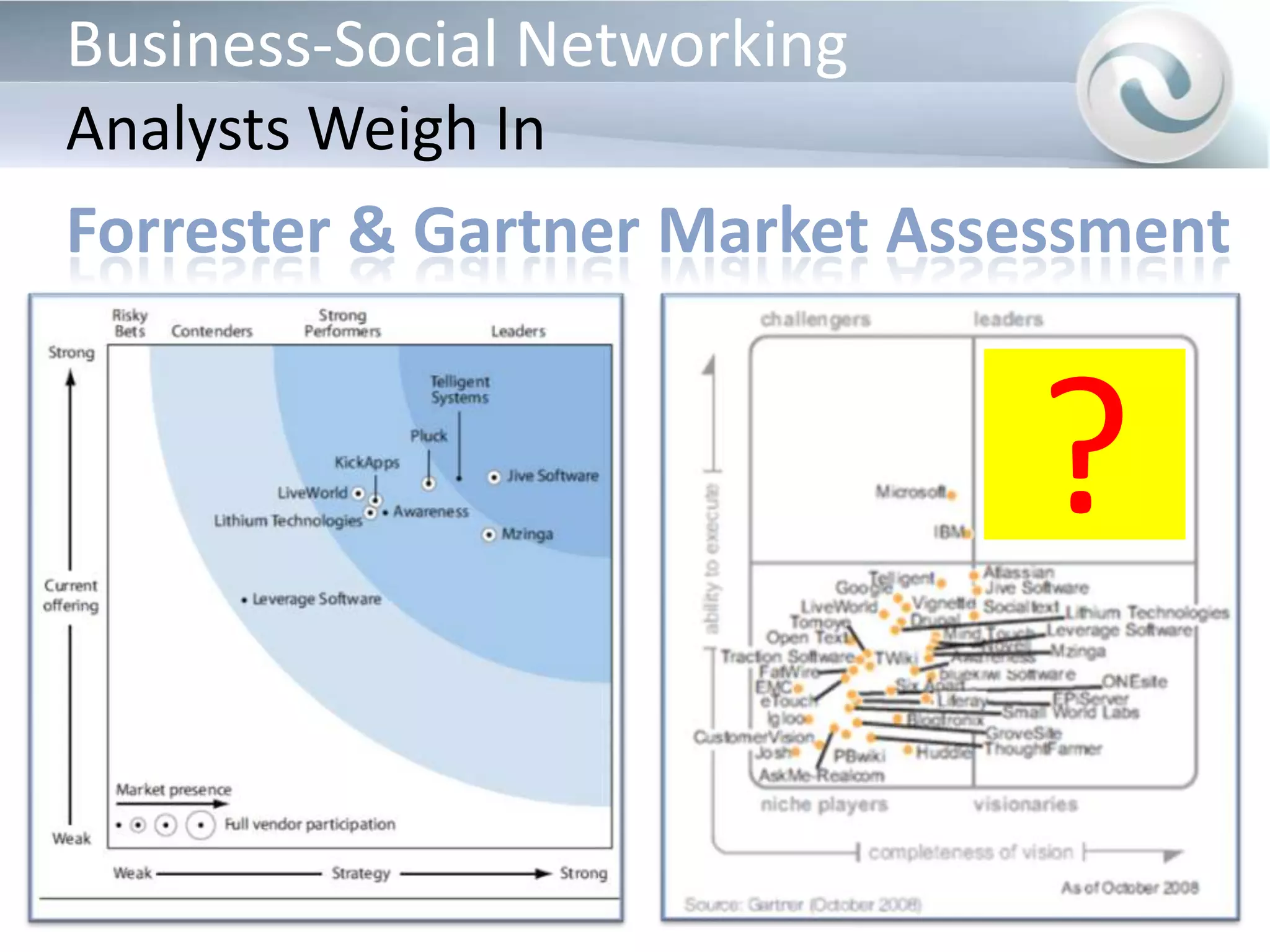
Business-Social NetworkingAnalysts Weigh InForrester & Gartner Market Assessment?
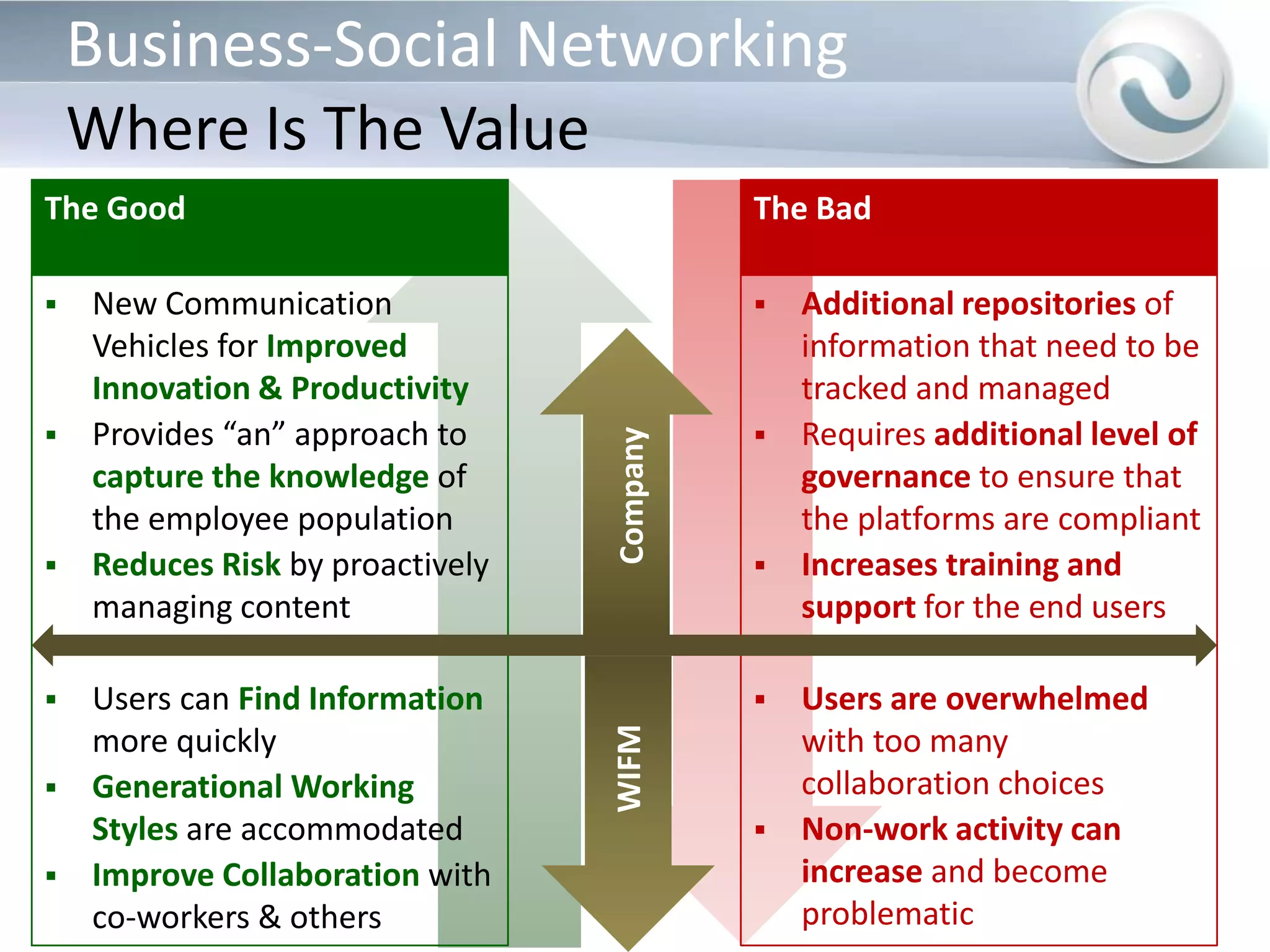
Business-Social NetworkingWhere Is The ValueThe GoodThe BadNew Communication Vehicles for Improved Innovation & Productivity
Provides “an” approach to capture the knowledgeof the employee population
Reduces Risk by proactively managing content
Users can Find Information more quickly
Generational Working Styles are accommodated
Improve Collaboration with co-workers & others
Additional repositories of information that need to be tracked and managed
Requires additional level of governance to ensure that the platforms are compliant
Increases training and support for the end users
Users are overwhelmed with too many collaboration choices
Non-work activity can increase and become problematicCompanyWIFM
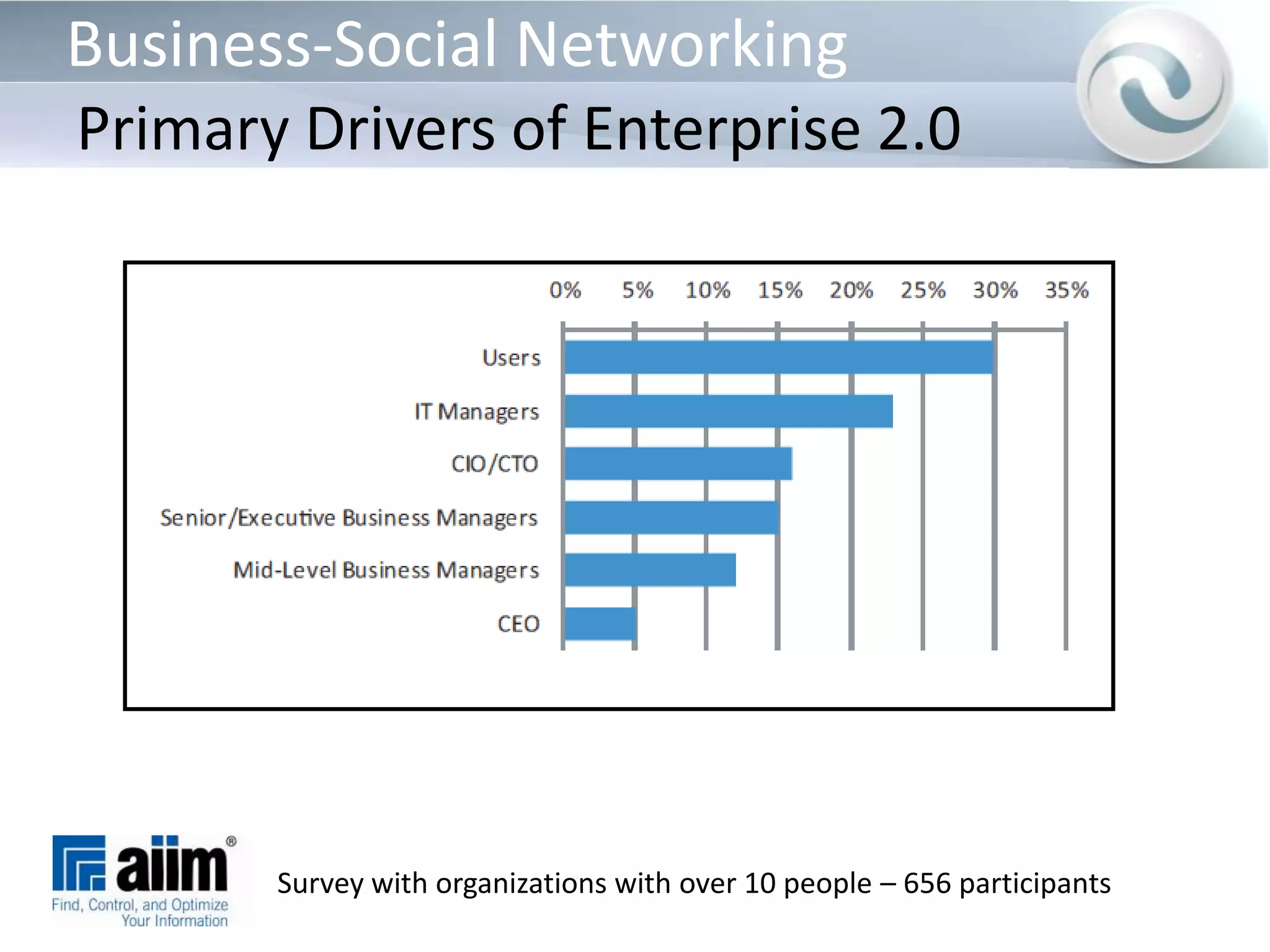
Business-Social NetworkingPrimary Drivers of Enterprise 2.0Survey with organizations with over 10 people – 656 participants
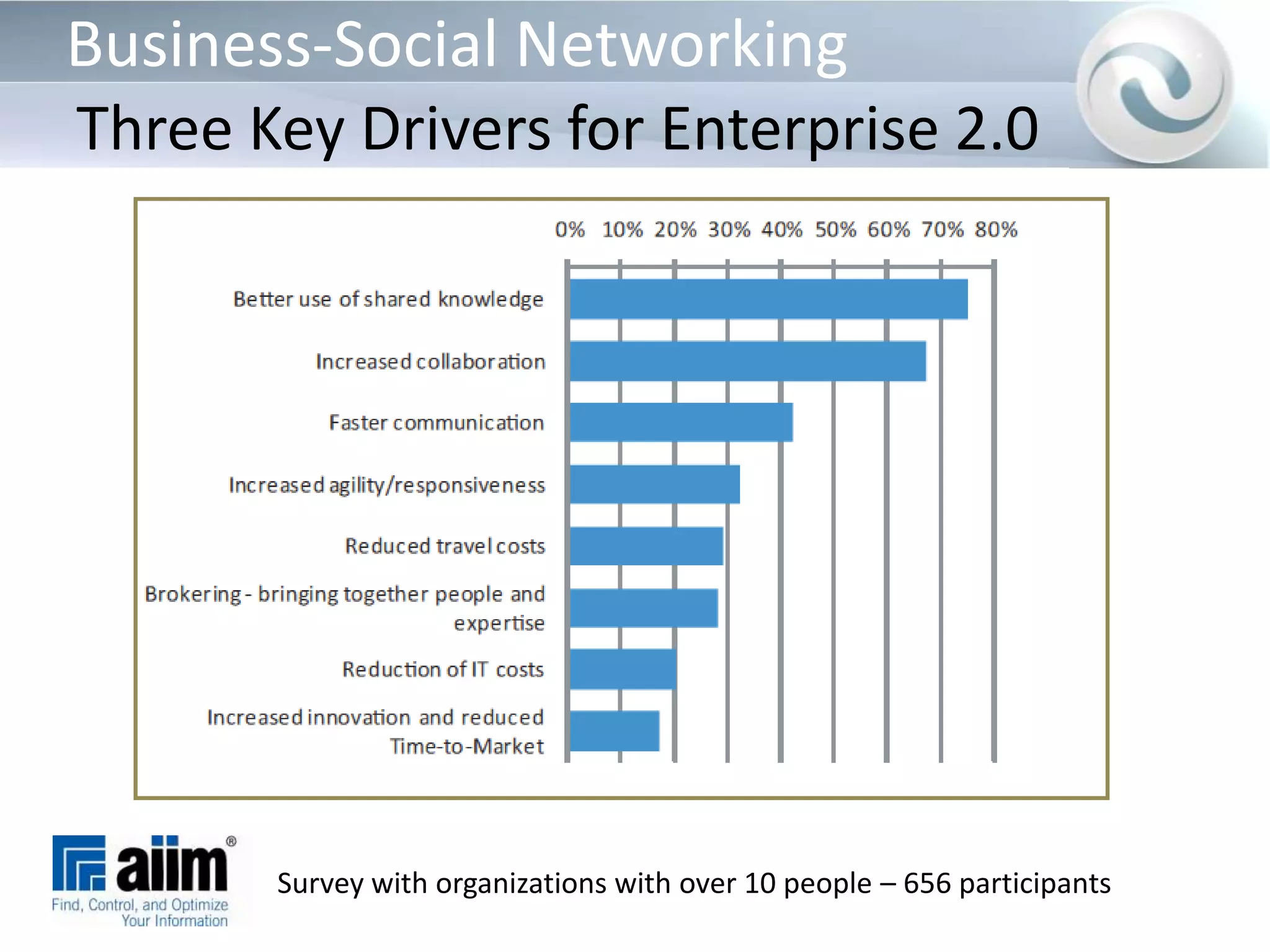
Business-Social NetworkingThree Key Drivers for Enterprise 2.0Survey with organizations with over 10 people – 656 participants
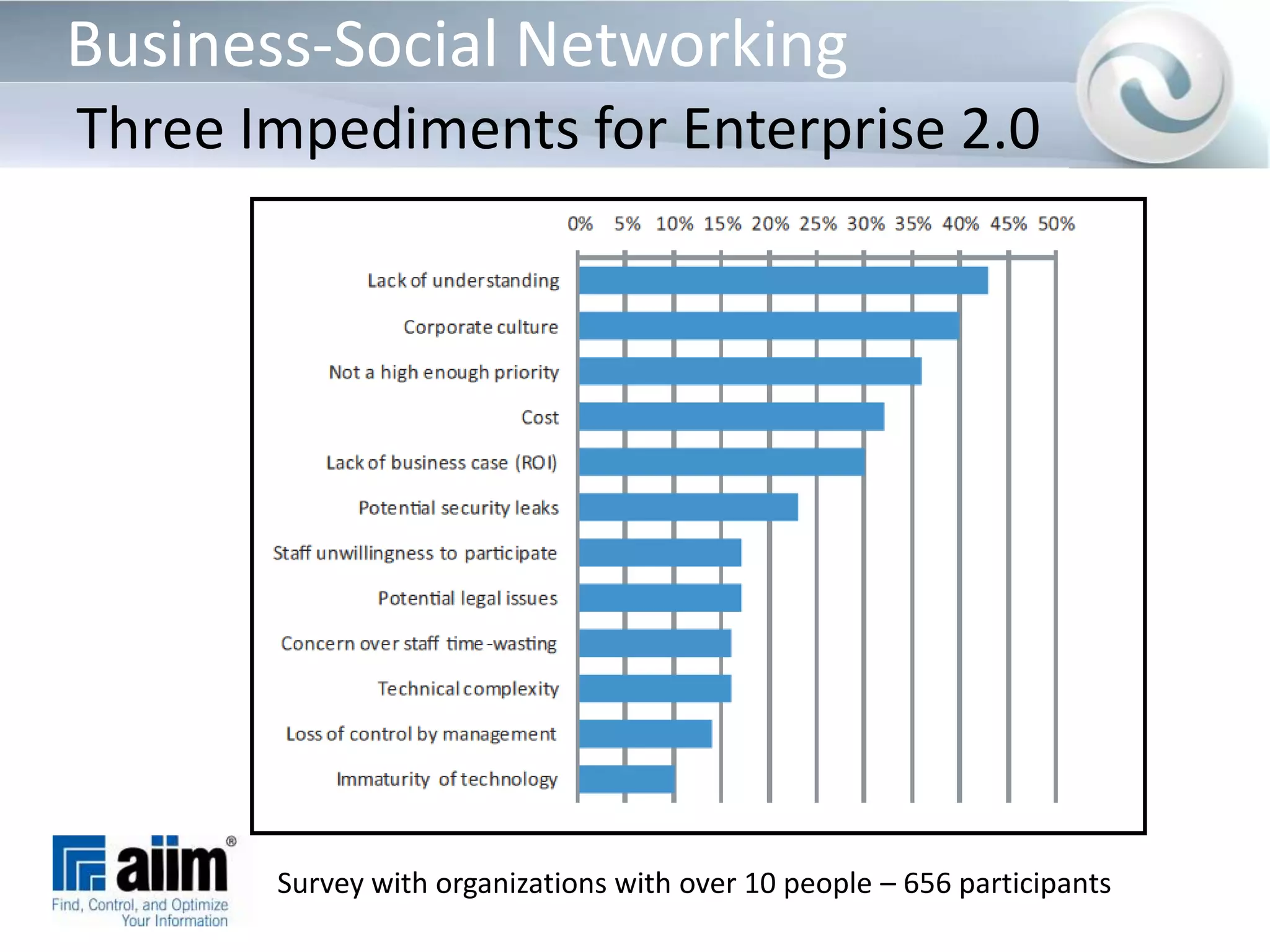
Business-Social NetworkingThree Impediments for Enterprise 2.0Survey with organizations with over 10 people – 656 participants
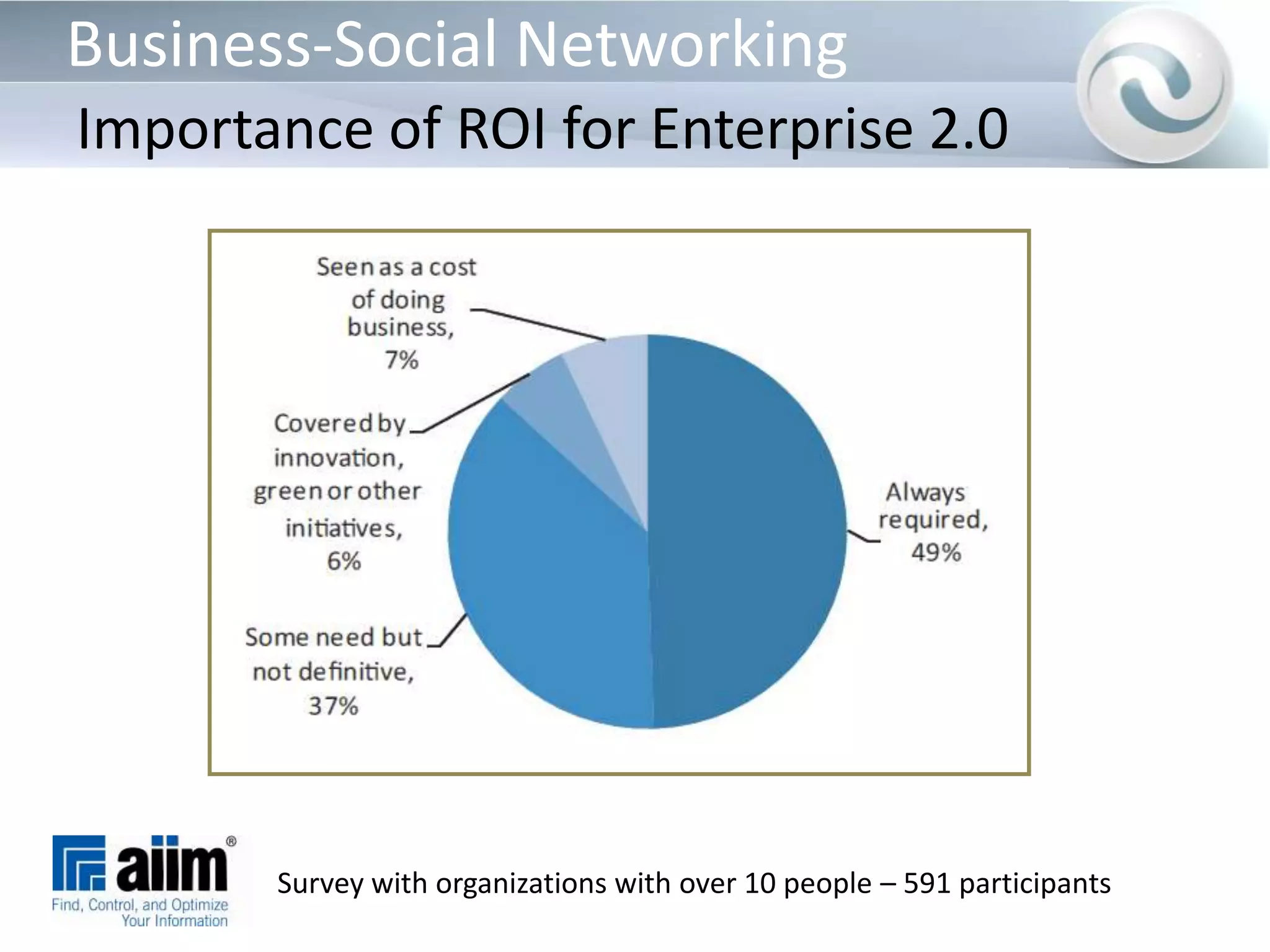
Business-Social NetworkingImportance of ROI for Enterprise 2.0Survey with organizations with over 10 people – 591 participants
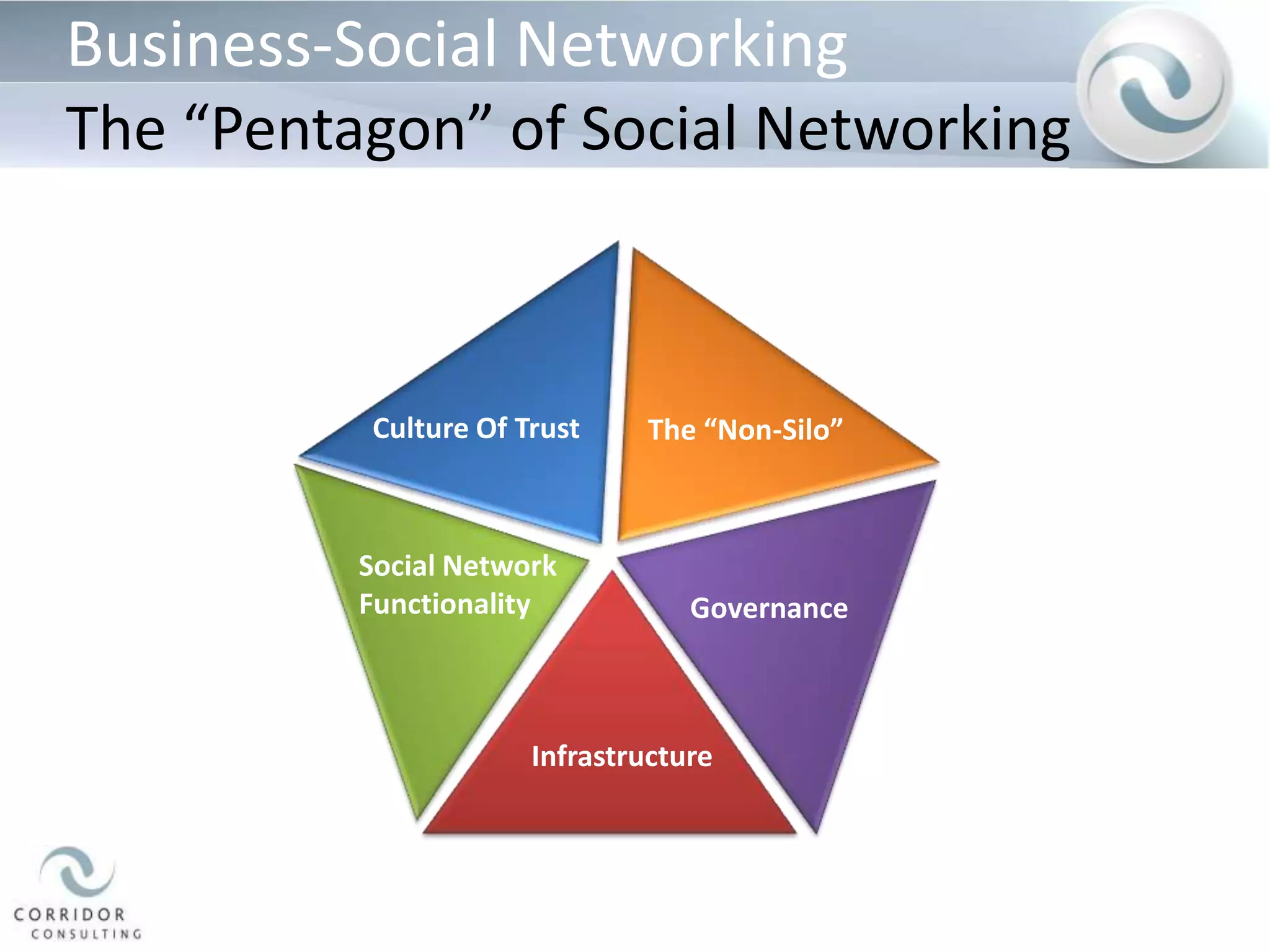
Business-Social NetworkingThe “Pentagon” of Social NetworkingCulture Of TrustThe “Non-Silo”Social NetworkFunctionalityGovernanceInfrastructure
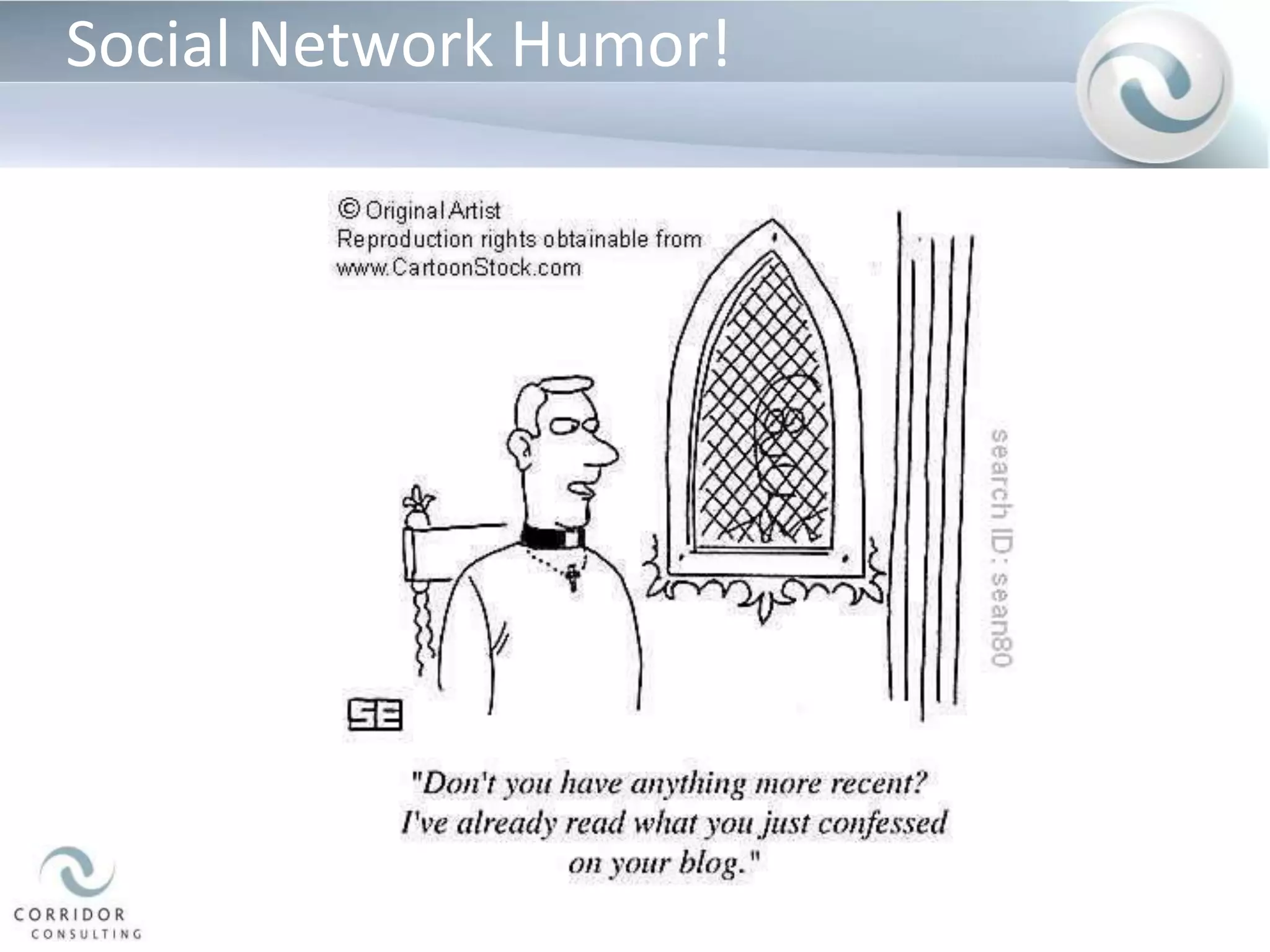
Social Network Humor!
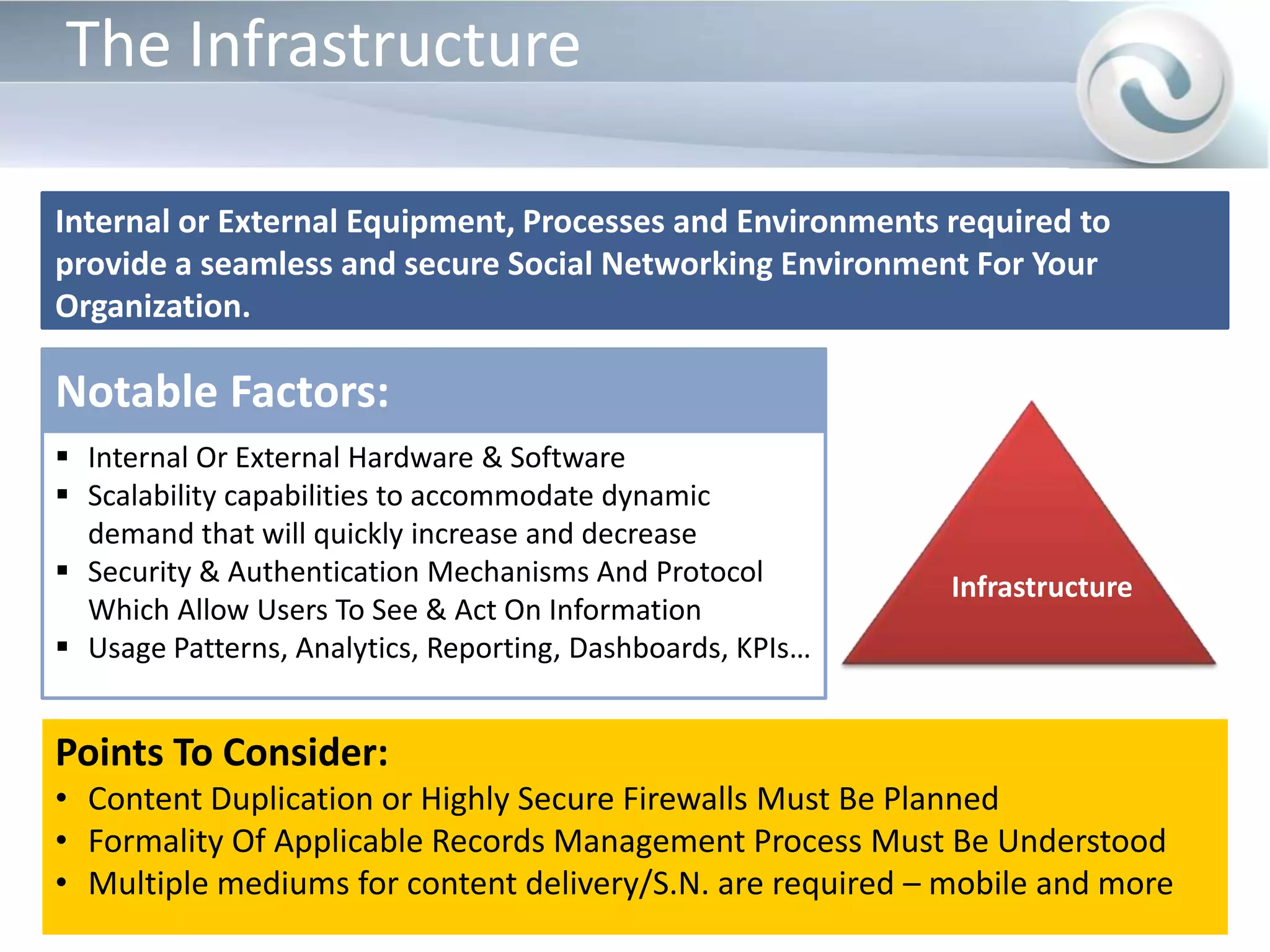
Internal or External Equipment, Processes and Environments required to provide a seamless and secure Social Networking Environment For Your Organization.  Notable Factors:Internal Or External Hardware & Software
Scalability capabilities to accommodate dynamic demand that will quickly increase and decrease
Security & Authentication Mechanisms And Protocol Which Allow Users To See & Act On Information
Usage Patterns, Analytics, Reporting, Dashboards, KPIs…Points To Consider:Content Duplication or Highly Secure Firewalls Must Be Planned
Formality Of Applicable Records Management Process Must Be Understood
Multiple mediums for content delivery/S.N. are required – mobile and moreThe InfrastructureInfrastructure
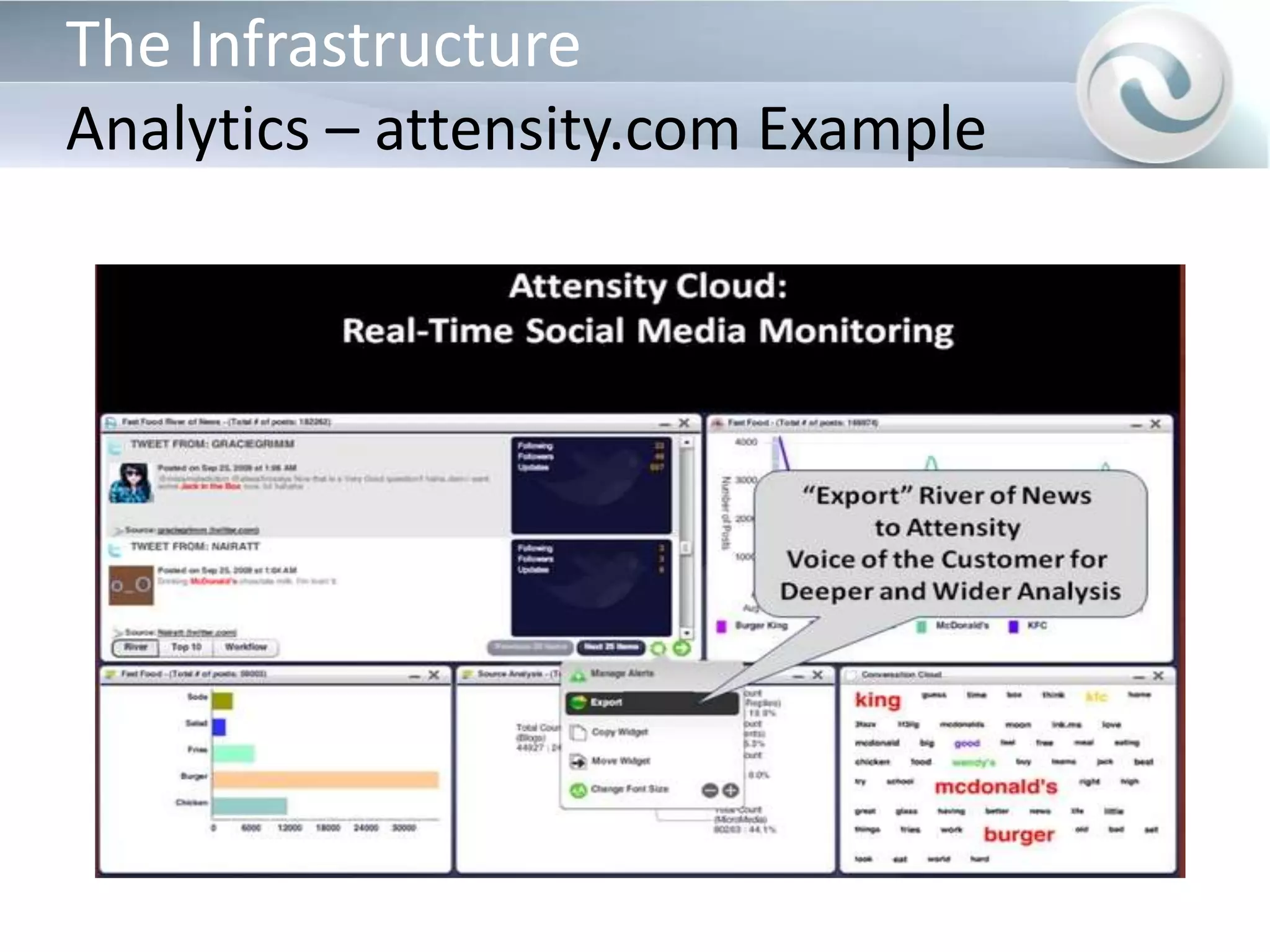
The InfrastructureAnalytics – attensity.com Example
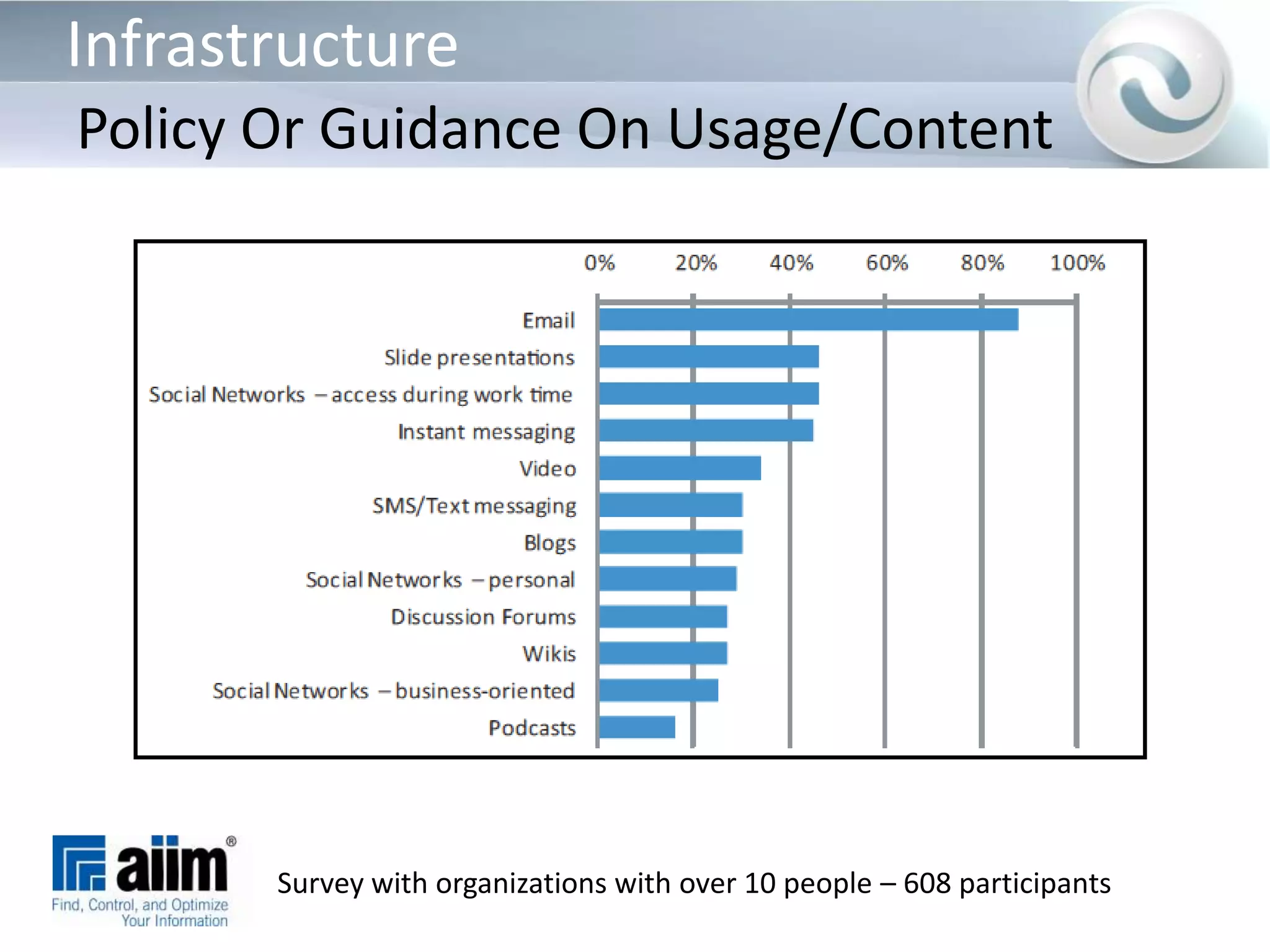
InfrastructurePolicy Or Guidance On Usage/ContentSurvey with organizations with over 10 people – 608 participants

AIIM New England Social Networking Presentation

  • 1.
    New England ChapterSocialNetworkingSerious BusinessPresented: January 15, 2010Russ Edelman - russ.edelman@corridorconsulting.comTwitter: russECM
  • 2.
  • 3.
    Social-Social NetworkingDefined…A socialnetwork is a social structure made of individuals (or organizations) called "nodes," which are tied (connected) by one or more specific types of interdependency, such as friendship, kinship, financial exchange, dislike, sexual relationships, or relationships of beliefs, knowledge or prestige.The power of social network analysis stems from its difference from traditional social scientific studies, which assume that it is the attributes of individual actors—whether they are friendly or unfriendly, smart or dumb, etc.—that matter. Social network analysis produces an alternate view, where the attributes of individuals are less important than their relationships and ties with other actors within the network. This approach has turned out to be useful for explaining many real-world phenomena, but leaves less room for individual agency, the ability for individuals to influence their success, because so much of it rests within the structure of their network.
  • 4.
  • 5.
    Social-Social NetworkingSemi-Understood –Unrelated PointsOct. 9, 2009 - A FACEBOOK posting revealed details of a Perth teenager's fatal crash before police informed her parents.Feb, 2009 - O’Reilly Tools Of Change Conference- Peter Brantley, Executive Director of the Digital Library Foundation states “Reading will become less about the book and more about the people that read them.” Oct, 12, 2009 - Luddites of the World, Relax! - News that Twitter's latest cash infusion values the microblogging site at $1 billion may have confounded twittering's critics, who say nothing worthwhile can be expressed in 140 characters. To them—and to those who think BlackBerrys enslave us, Facebook supplants real relationships, and texting makes us illiterate—Dennis Baron has this to say: Nonsense. Worries about new ways of communicating, he has found, have existed for millennia. (Socrates objected to writing, in part because this "invention" eliminated the need to exercise the memory.)
  • 6.
    Social-Social NetworkingInteresting DataPointsWorldwide visitors to Twitter approached 10M in Feb 2009, up 700+% vs. Feb 2008 (Comscore)Older than you think!18-24 year olds 12% less likely than average to visit Twitter25-54 year old crowd is driving this trend45-54 year olds 36% more likely to visit Twitter, making them the highest indexing age groupNext is 25-34 year olds: 30% more likelySource: Reuters reporter Alexei Oreskovic.
  • 7.
  • 8.
    Business-Social NetworkingAnalysts WeighInForrester & Gartner Market Assessment?
  • 9.
    Business-Social NetworkingWhere IsThe ValueThe GoodThe BadNew Communication Vehicles for Improved Innovation & Productivity
  • 10.
    Provides “an” approachto capture the knowledgeof the employee population
  • 11.
    Reduces Risk byproactively managing content
  • 12.
    Users can FindInformation more quickly
  • 13.
  • 14.
    Improve Collaboration withco-workers & others
  • 15.
    Additional repositories ofinformation that need to be tracked and managed
  • 16.
    Requires additional levelof governance to ensure that the platforms are compliant
  • 17.
    Increases training andsupport for the end users
  • 18.
    Users are overwhelmedwith too many collaboration choices
  • 19.
    Non-work activity canincrease and become problematicCompanyWIFM
  • 20.
    Business-Social NetworkingPrimary Driversof Enterprise 2.0Survey with organizations with over 10 people – 656 participants
  • 21.
    Business-Social NetworkingThree KeyDrivers for Enterprise 2.0Survey with organizations with over 10 people – 656 participants
  • 22.
    Business-Social NetworkingThree Impedimentsfor Enterprise 2.0Survey with organizations with over 10 people – 656 participants
  • 23.
    Business-Social NetworkingImportance ofROI for Enterprise 2.0Survey with organizations with over 10 people – 591 participants
  • 24.
    Business-Social NetworkingThe “Pentagon”of Social NetworkingCulture Of TrustThe “Non-Silo”Social NetworkFunctionalityGovernanceInfrastructure
  • 25.
  • 26.
    Internal or ExternalEquipment, Processes and Environments required to provide a seamless and secure Social Networking Environment For Your Organization. Notable Factors:Internal Or External Hardware & Software
  • 27.
    Scalability capabilities toaccommodate dynamic demand that will quickly increase and decrease
  • 28.
    Security & AuthenticationMechanisms And Protocol Which Allow Users To See & Act On Information
  • 29.
    Usage Patterns, Analytics,Reporting, Dashboards, KPIs…Points To Consider:Content Duplication or Highly Secure Firewalls Must Be Planned
  • 30.
    Formality Of ApplicableRecords Management Process Must Be Understood
  • 31.
    Multiple mediums forcontent delivery/S.N. are required – mobile and moreThe InfrastructureInfrastructure
  • 32.
    The InfrastructureAnalytics –attensity.com Example
  • 33.
    InfrastructurePolicy Or GuidanceOn Usage/ContentSurvey with organizations with over 10 people – 608 participants
  • 34.
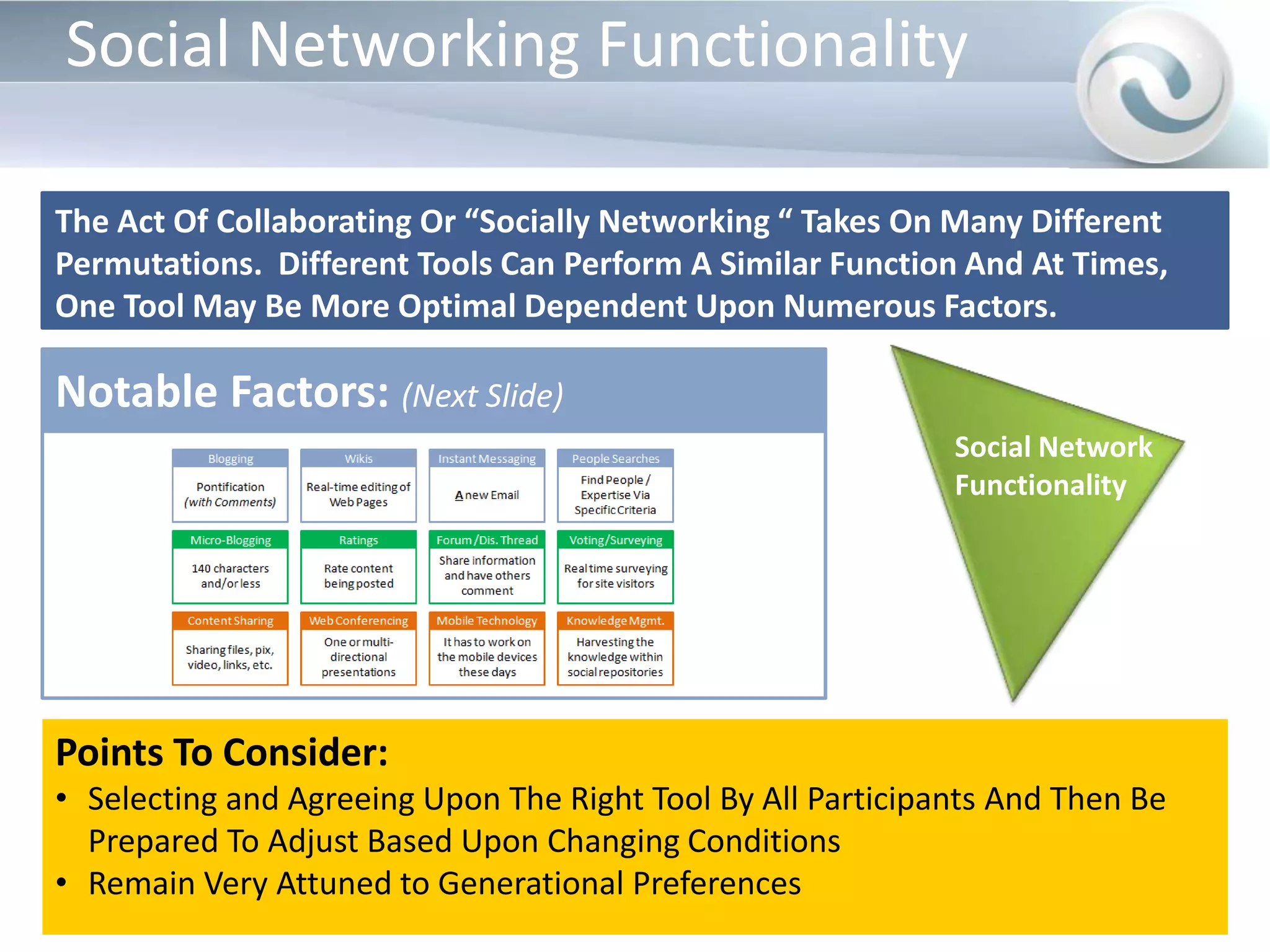
    Social Networking FunctionalityTheAct Of Collaborating Or “Socially Networking “ Takes On Many Different Permutations. Different Tools Can Perform A Similar Function And At Times, One Tool May Be More Optimal Dependent Upon Numerous Factors.Notable Factors: (Next Slide)Social NetworkFunctionalityPoints To Consider:Selecting and Agreeing Upon The Right Tool By All Participants And Then Be Prepared To Adjust Based Upon Changing Conditions
  • 35.
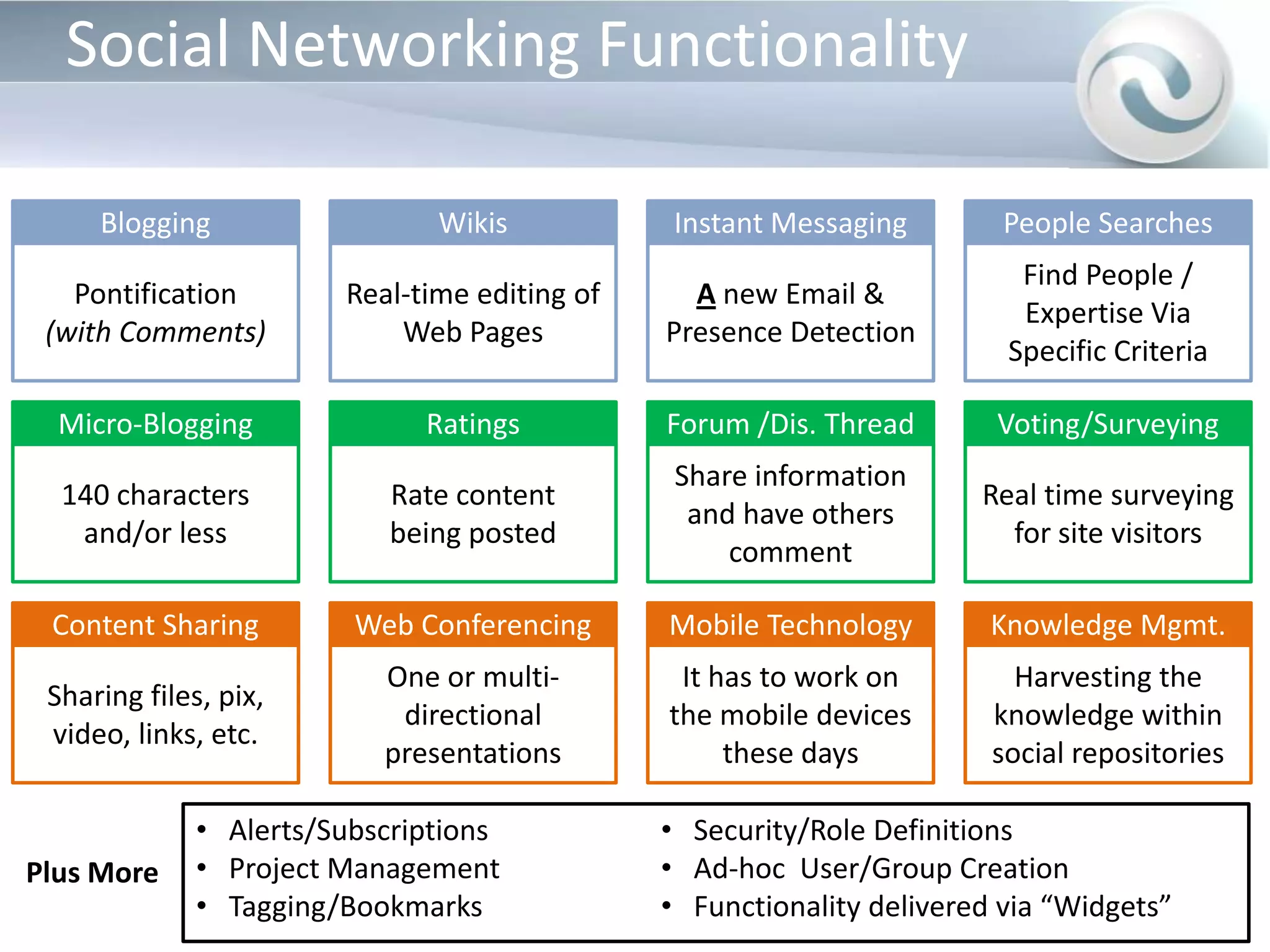
    Remain Very Attunedto Generational PreferencesSocial Networking FunctionalityBloggingWikisInstant MessagingPeople SearchesMicro-BloggingRatingsForum /Dis. ThreadVoting/SurveyingContent SharingWeb ConferencingMobile TechnologyKnowledge Mgmt.Pontification (with Comments)Real-time editing of Web PagesA new Email & Presence DetectionFind People / Expertise Via Specific Criteria140 characters and/or lessRate content being postedShare information and have others commentReal time surveying for site visitorsSharing files, pix, video, links, etc.One or multi-directional presentationsIt has to work on the mobile devices these daysHarvesting the knowledge within social repositoriesAlerts/Subscriptions
  • 36.
  • 37.
  • 38.
  • 39.
  • 40.
    Functionality delivered via“Widgets” Plus More
  • 41.
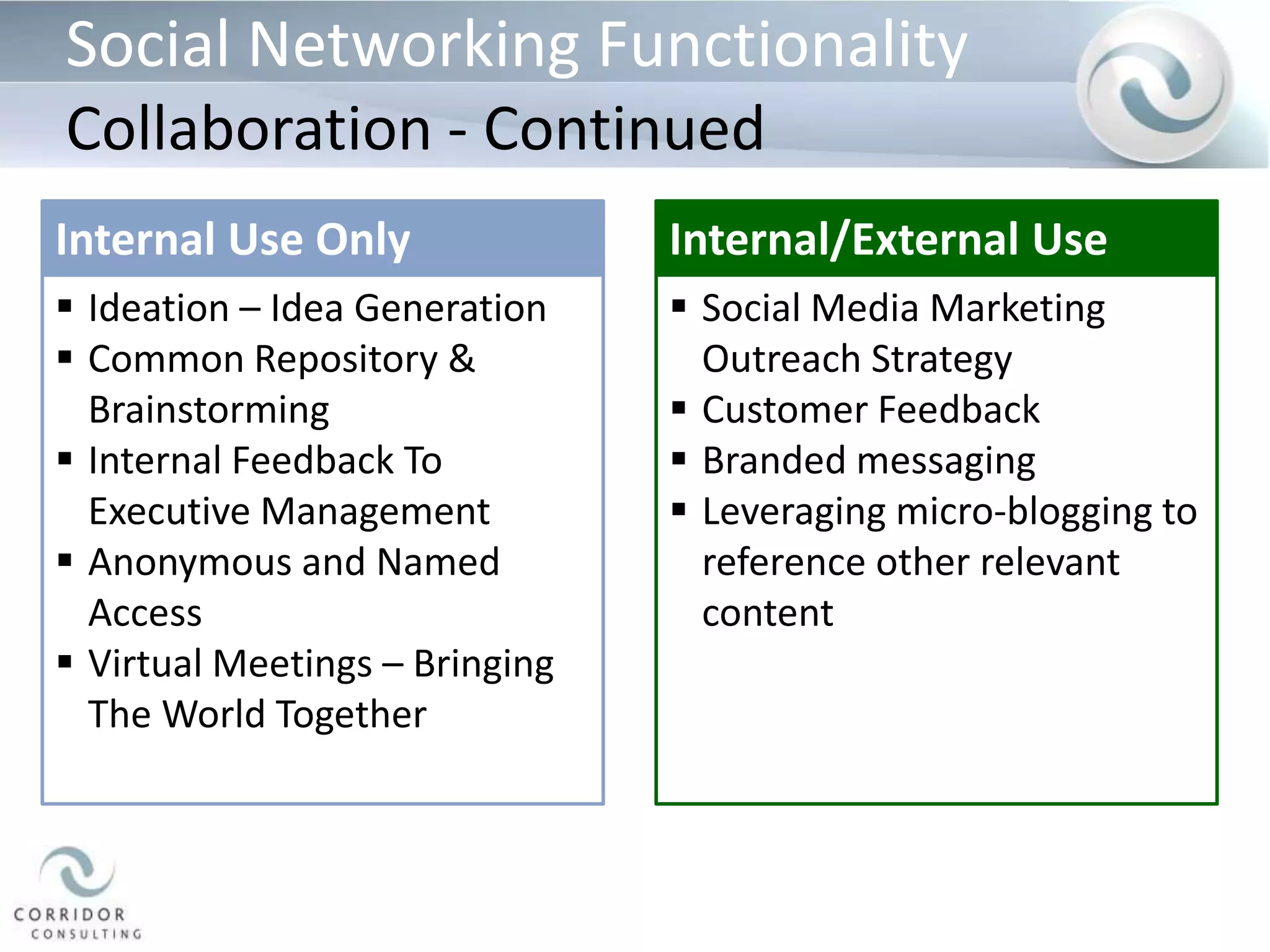
    Social Networking FunctionalityCollaboration- ContinuedInternal Use OnlyInternal/External UseIdeation – Idea Generation
  • 42.
    Common Repository &Brainstorming
  • 43.
    Internal Feedback ToExecutive Management
  • 44.
  • 45.
    Virtual Meetings –Bringing The World Together
  • 46.
    Social Media MarketingOutreach Strategy
  • 47.
  • 48.
  • 49.
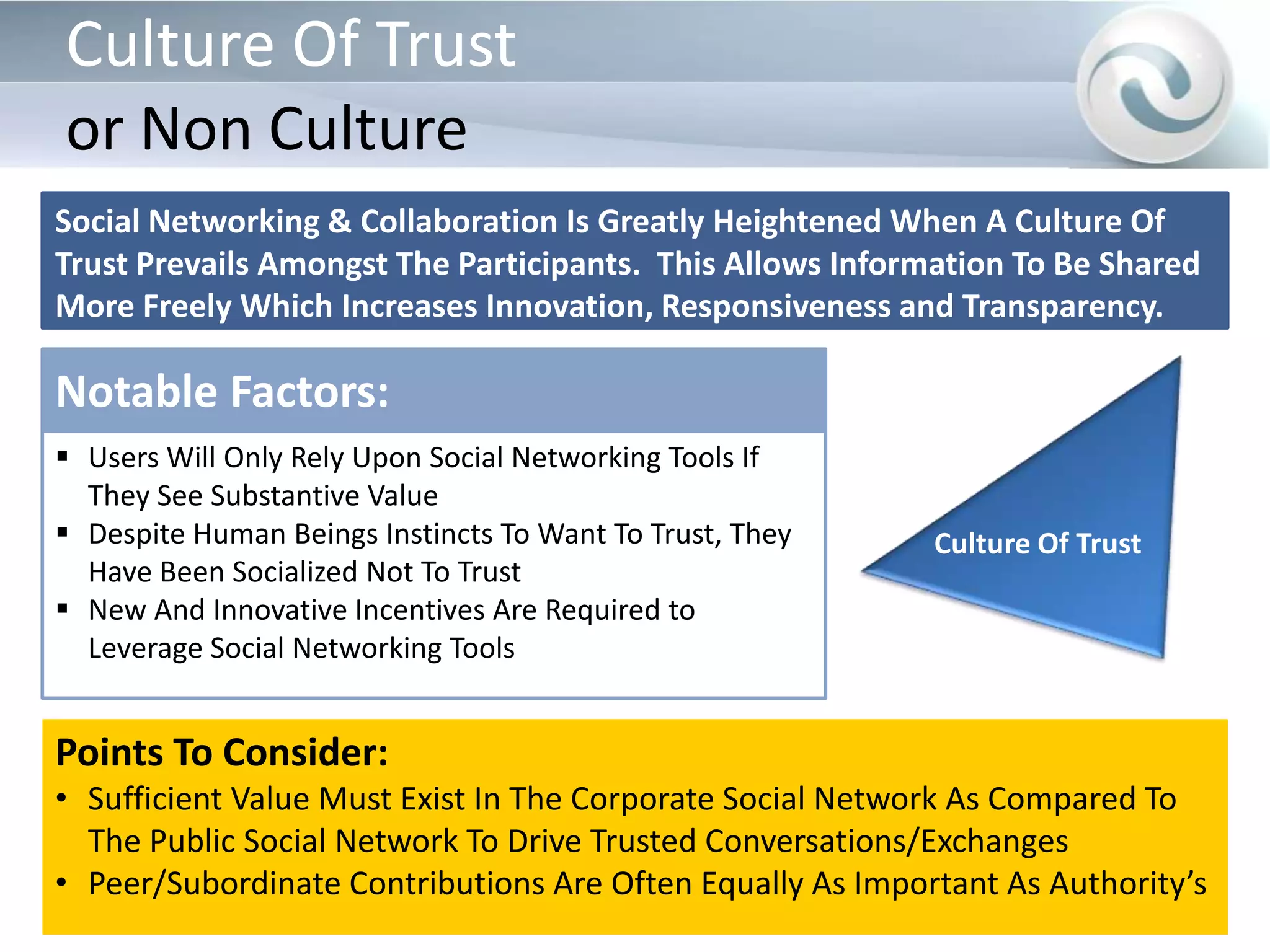
    Leveraging micro-blogging toreference other relevant contentCulture Of Trustor Non CultureSocial Networking & Collaboration Is Greatly Heightened When A Culture Of Trust Prevails Amongst The Participants. This Allows Information To Be Shared More Freely Which Increases Innovation, Responsiveness and Transparency.Notable Factors:Users Will Only Rely Upon Social Networking Tools If They See Substantive Value
  • 50.
    Despite Human BeingsInstincts To Want To Trust, They Have Been Socialized Not To Trust
  • 51.
    New And InnovativeIncentives Are Required to Leverage Social Networking ToolsCulture Of TrustPoints To Consider:Sufficient Value Must Exist In The Corporate Social Network As Compared To The Public Social Network To Drive Trusted Conversations/Exchanges
  • 52.
    Peer/Subordinate Contributions AreOften Equally As Important As Authority’sSocial Network Humor!
  • 53.
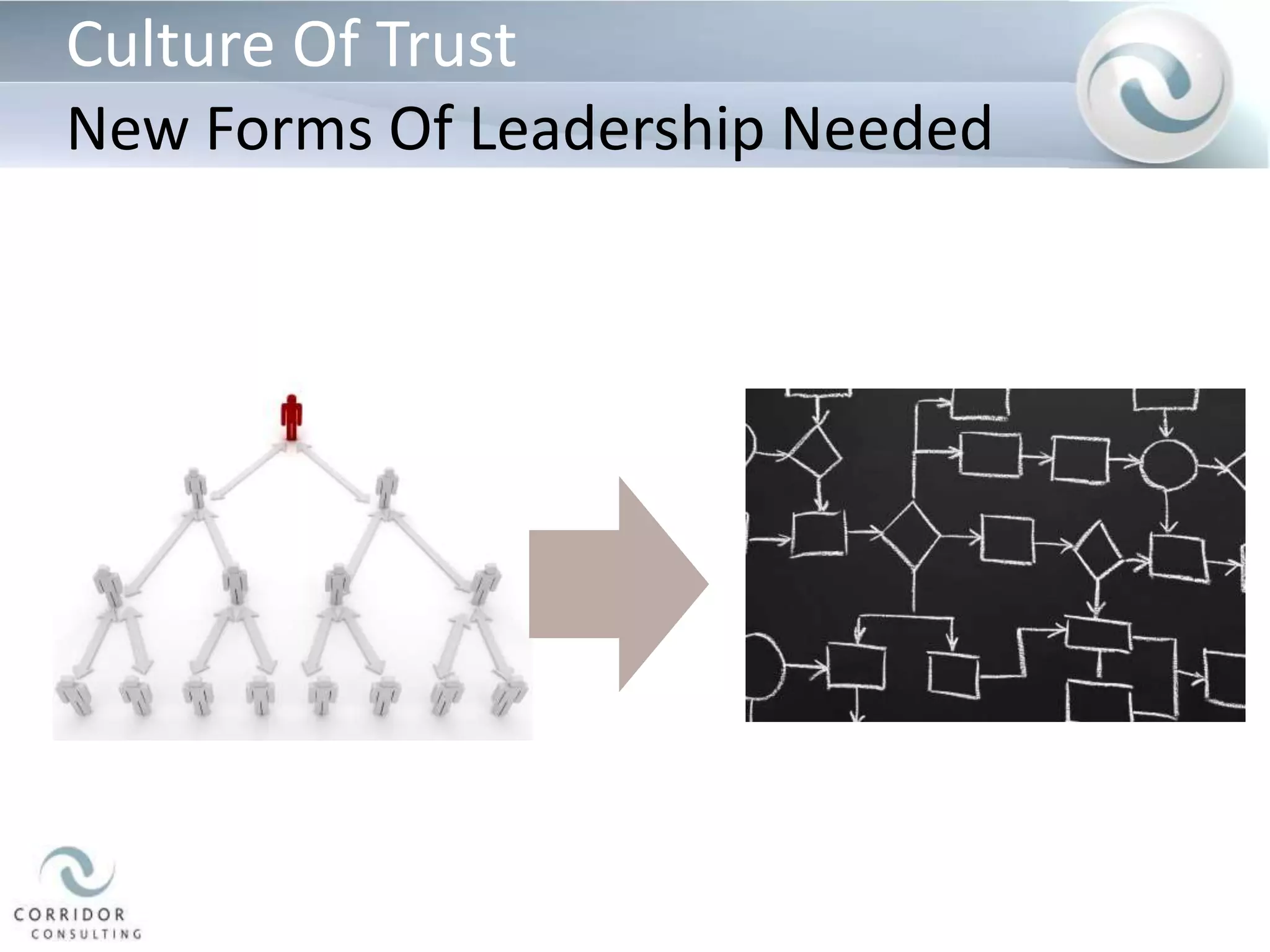
    Culture Of TrustNewForms Of Leadership Needed
  • 54.
    Culture Of TrustCanBloggers Be Trusted?October 6, 2009
  • 55.
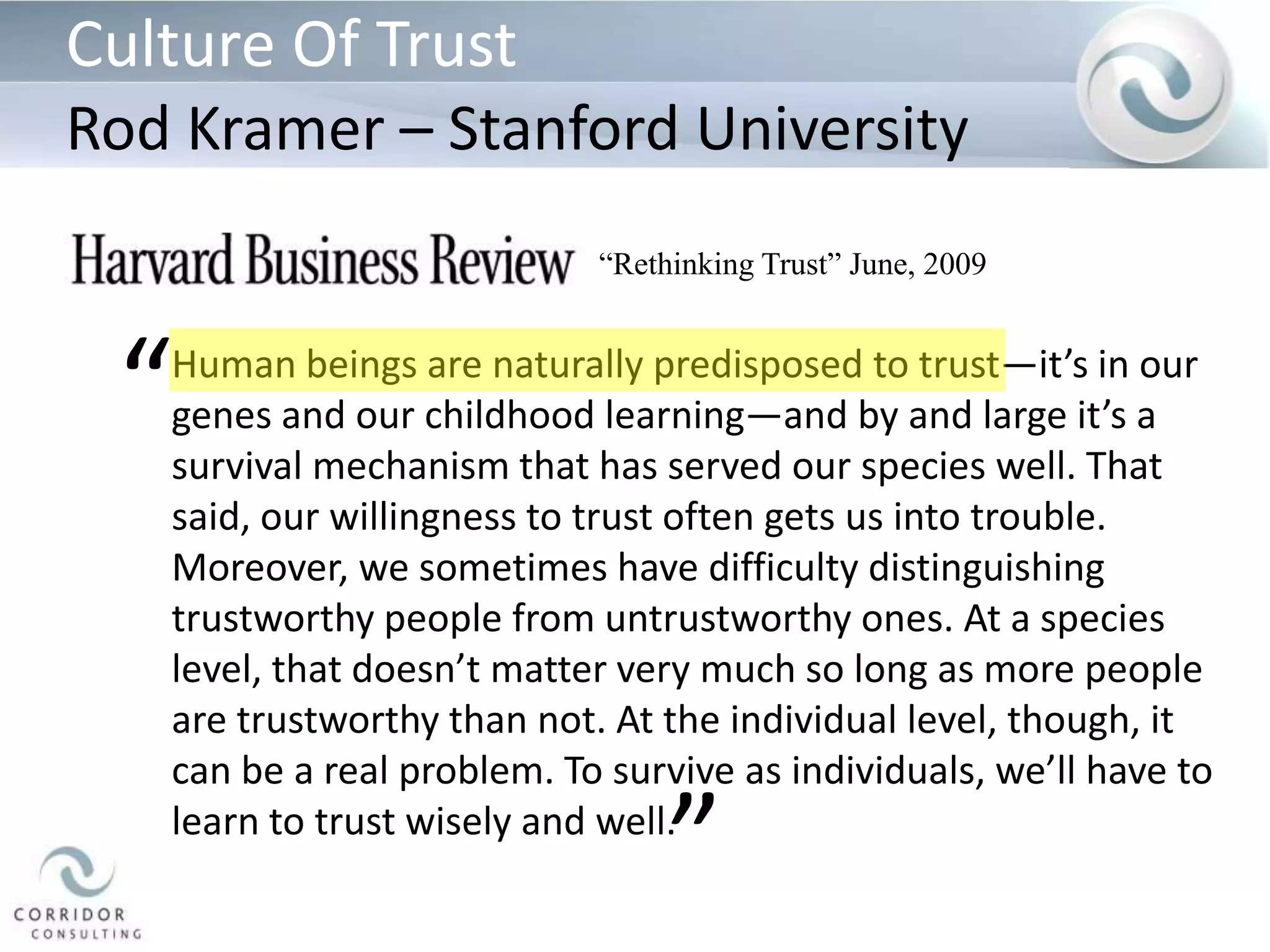
    Culture Of TrustRodKramer – Stanford University“Rethinking Trust” June, 2009“Human beings are naturally predisposed to trust—it’s in our genes and our childhood learning—and by and large it’s a survival mechanism that has served our species well. That said, our willingness to trust often gets us into trouble. Moreover, we sometimes have difficulty distinguishing trustworthy people from untrustworthy ones. At a species level, that doesn’t matter very much so long as more people are trustworthy than not. At the individual level, though, it can be a real problem. To survive as individuals, we’ll have to learn to trust wisely and well.”
  • 56.
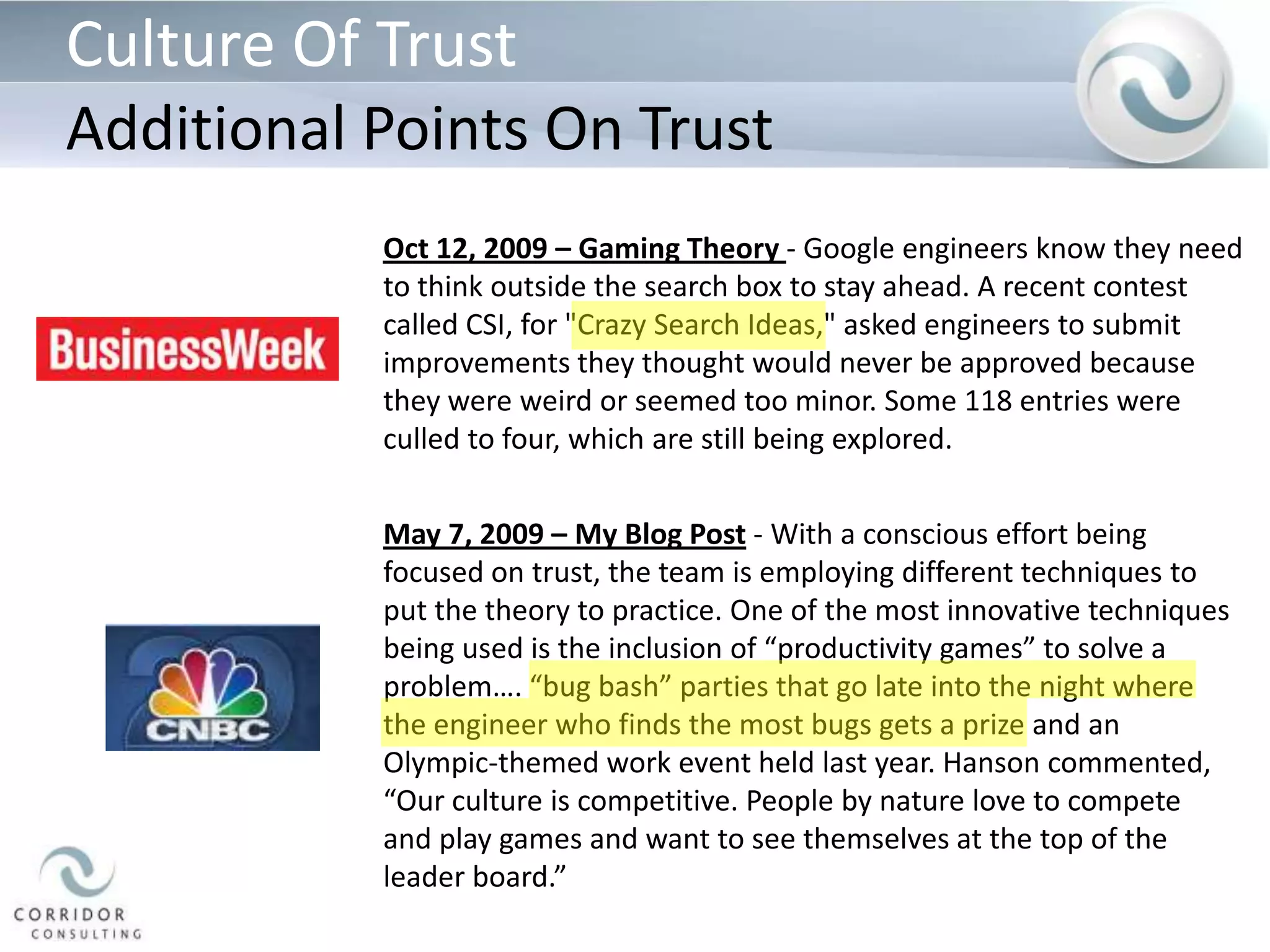
    Culture Of TrustAdditionalPoints On TrustOct 12, 2009 – Gaming Theory - Google engineers know they need to think outside the search box to stay ahead. A recent contest called CSI, for "Crazy Search Ideas," asked engineers to submit improvements they thought would never be approved because they were weird or seemed too minor. Some 118 entries were culled to four, which are still being explored. May 7, 2009 – My Blog Post - With a conscious effort being focused on trust, the team is employing different techniques to put the theory to practice. One of the most innovative techniques being used is the inclusion of “productivity games” to solve a problem…. “bug bash” parties that go late into the night where the engineer who finds the most bugs gets a prize and an Olympic-themed work event held last year. Hanson commented, “Our culture is competitive. People by nature love to compete and play games and want to see themselves at the top of the leader board.”
  • 57.
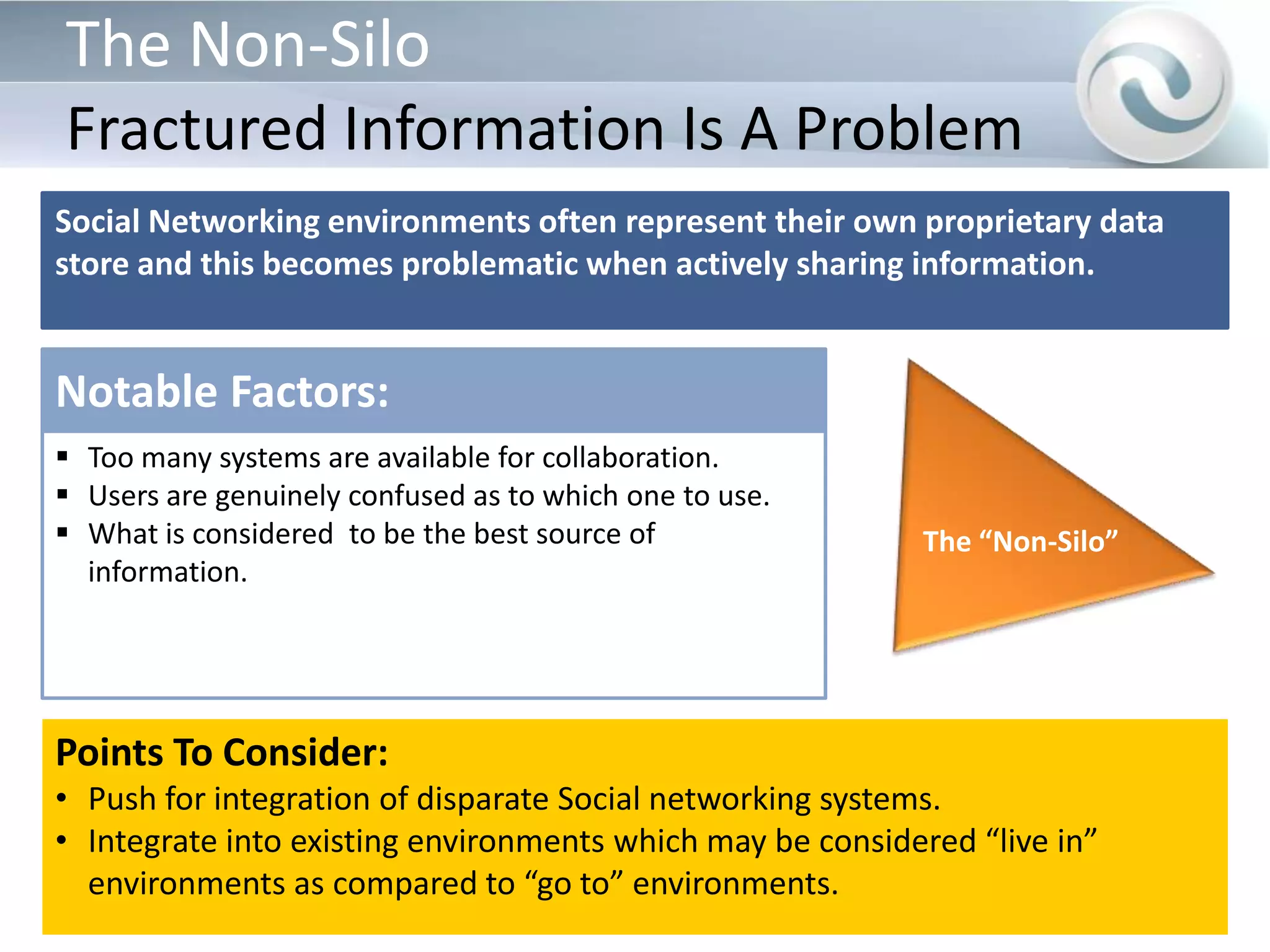
    The Non-SiloFractured InformationIs A ProblemSocial Networking environments often represent their own proprietary data store and this becomes problematic when actively sharing information.Notable Factors:Too many systems are available for collaboration.
  • 58.
    Users are genuinelyconfused as to which one to use.
  • 59.
    What is considered to be the best source of information.The “Non-Silo”Points To Consider:Push for integration of disparate Social networking systems.
  • 60.
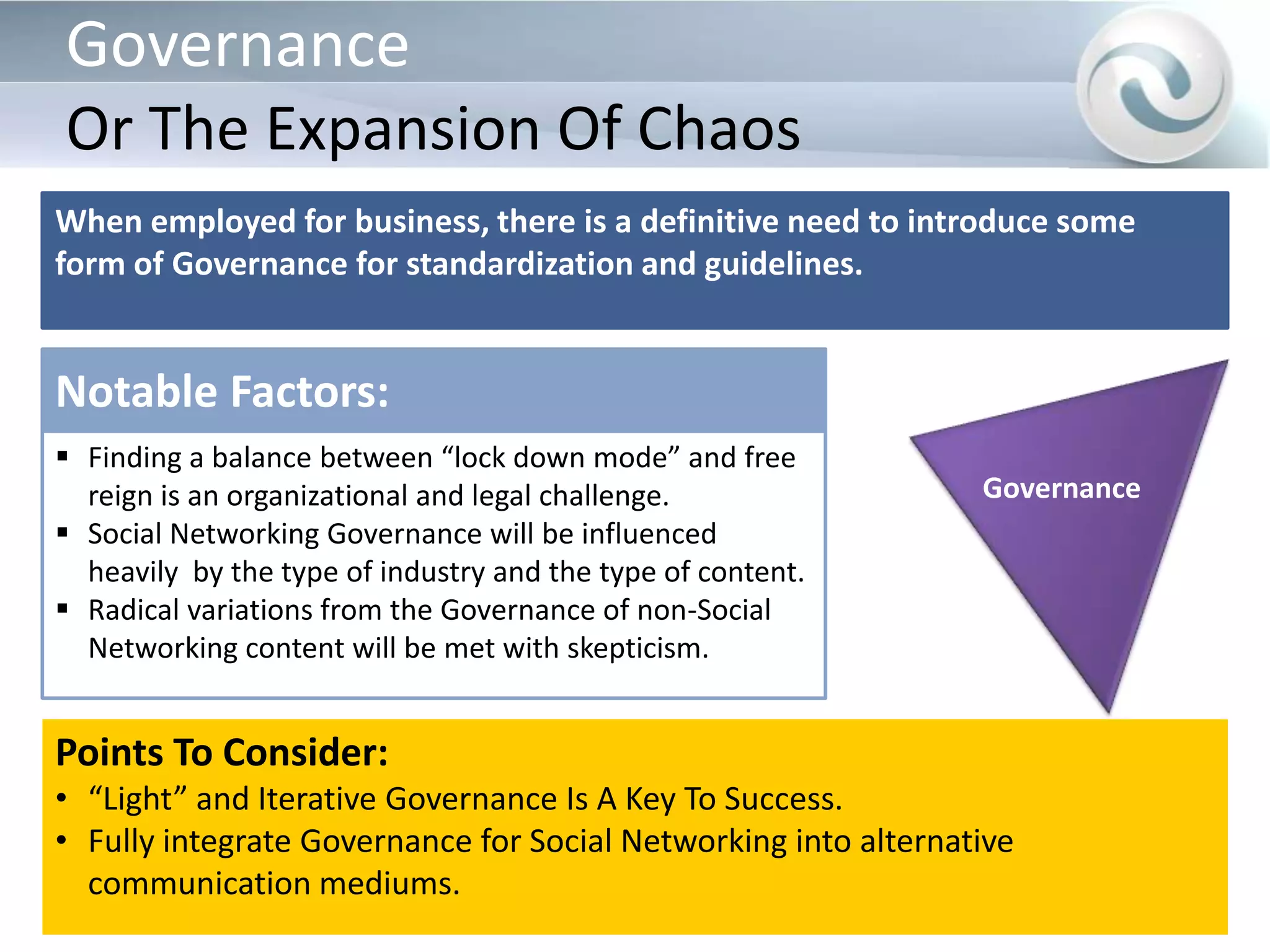
    Integrate into existingenvironments which may be considered “live in” environments as compared to “go to” environments.GovernanceOr The Expansion Of ChaosWhen employed for business, there is a definitive need to introduce some form of Governance for standardization and guidelines. Notable Factors:Finding a balance between “lock down mode” and free reign is an organizational and legal challenge.
  • 61.
    Social Networking Governancewill be influenced heavily by the type of industry and the type of content.
  • 62.
    Radical variations fromthe Governance of non-Social Networking content will be met with skepticism.GovernancePoints To Consider:“Light” and Iterative Governance Is A Key To Success.
  • 63.
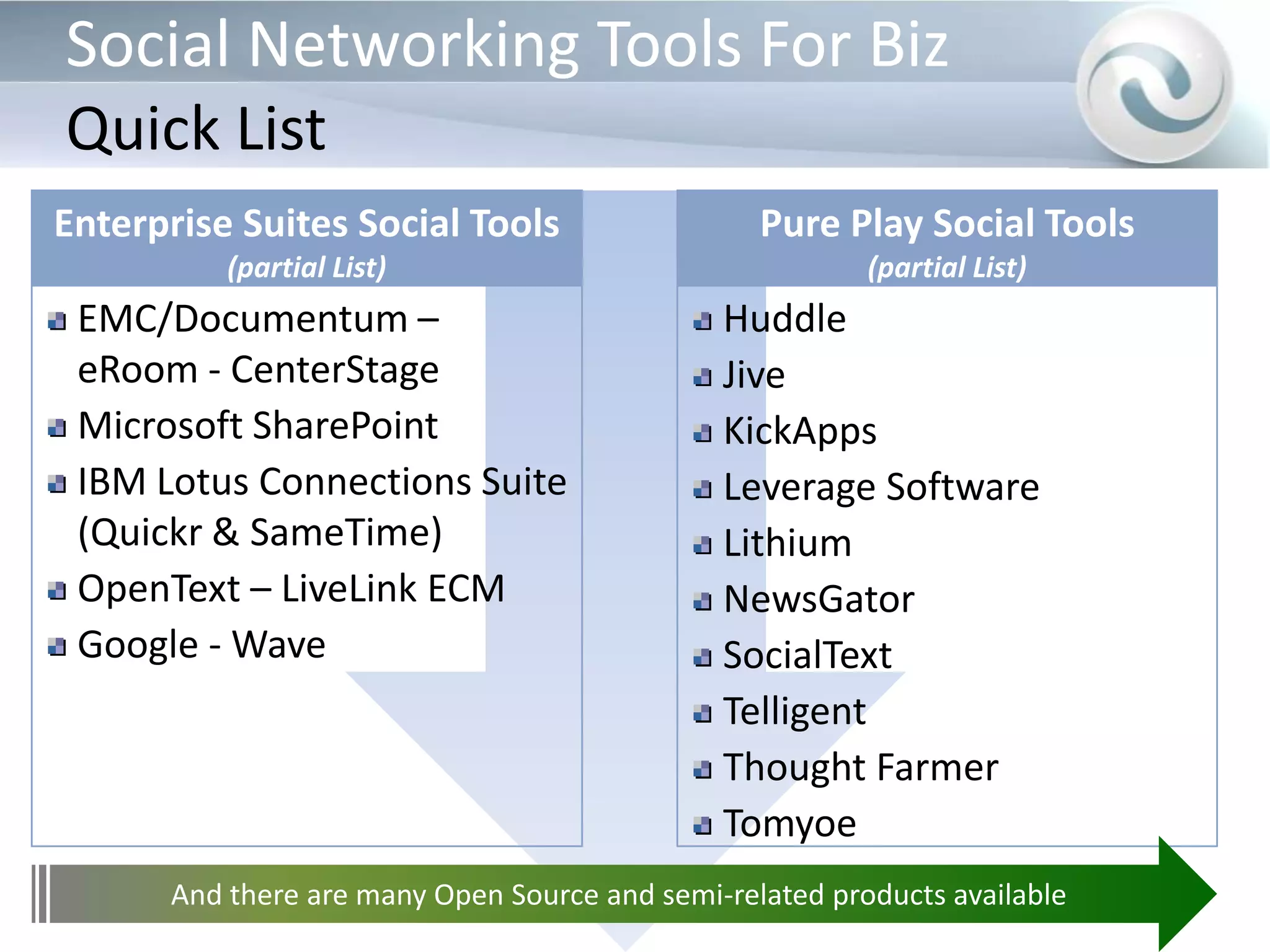
    Fully integrate Governancefor Social Networking into alternative communication mediums.Social Networking Tools For BizQuick ListEnterprise Suites Social Tools(partial List)Pure Play Social Tools(partial List)EMC/Documentum – eRoom - CenterStageMicrosoft SharePointIBM Lotus Connections Suite (Quickr & SameTime)OpenText – LiveLink ECMGoogle - WaveHuddleJiveKickAppsLeverage SoftwareLithiumNewsGatorSocialTextTelligentThought FarmerTomyoeAnd there are many Open Source and semi-related products available
  • 64.
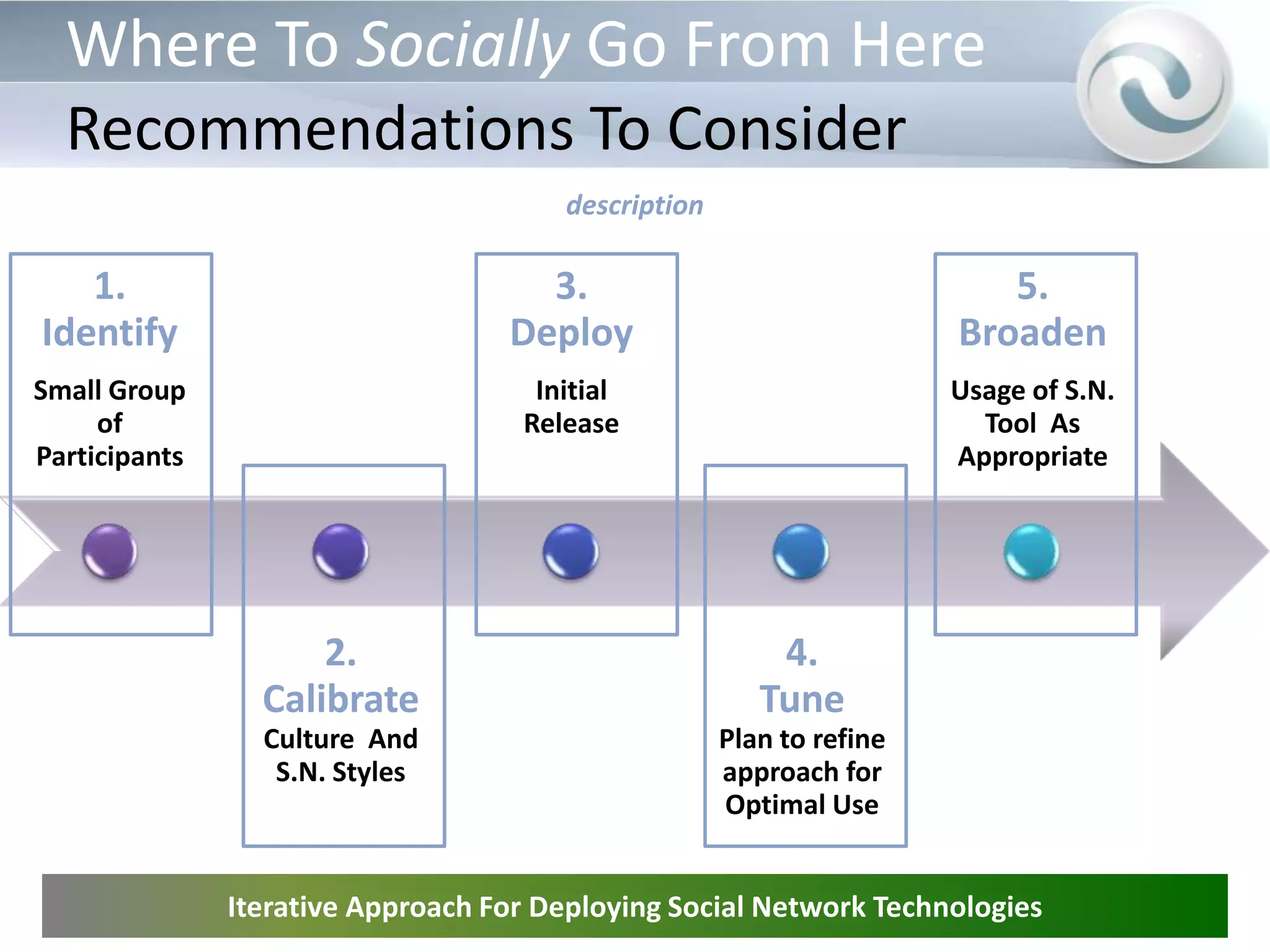
    Where To SociallyGo From HereRecommendations To ConsiderdescriptionIterative Approach For Deploying Social Network Technologies
  • 65.
    Corridor SnapshotHow WeCan Help You Corridor Service & Product OfferingsSharePoint Implementation Consulting & Product SalesContract Management
  • 66.
  • 67.
  • 68.
  • 69.
    Mission Critical SolutionsUsing SharePoint 2007 Implementations
  • 70.
  • 71.
    SharePoint Add-On ProductSalesECM/SharePoint Strategic ConsultingECM Knowledge Workshops
  • 72.
    Strategic Recommendations &Gap Analysis (SRGA)
  • 73.
  • 74.
    RFP Preparation andVendor Facilitation
  • 75.
  • 76.
    Microsoft SharePoint 2007Architecture & GovernanceAlso regular contributors to:InformationWeek, CIO MagazineAIIM Infonomics & More
  • 77.
    New England ChapterSocialNetworkingSerious BusinessPresented: January 15, 2010Russ Edelman - russ.edelman@corridorconsulting.comTwitter: russECM

Editor's Notes

  • #5 Last year – 40% of those surveyed had no idea of Enterprise 2.0 – now it is down to 17%
  • #9 Forrester has identified at least 90 players in or entering the Social Networking market place Forrester – US Online adults - 25% in 2007 using S.N. and in 35% in 2008.
  • #10 Good – Faster Better & Cheaper – And Reduced Risk
  • #11 Good – Faster Better & Cheaper – And Reduced Risk
  • #12 Good – Faster Better & Cheaper – And Reduced Risk
  • #13 Good – Faster Better & Cheaper – And Reduced Risk
  • #14 Good – Faster Better & Cheaper – And Reduced Risk
  • #19 Good – Faster Better & Cheaper – And Reduced Risk
  • #21 - The emphasis is placed not on technology, but instead, on relationships and connections and non-standard ways of sharing meaningful information
  • #22 Discuss Global India/ChinaDrafting Company – Collaborating – the draftsman’s table
  • #23 Discuss Examples: Global Advertising/Media Company Global Religious Organization And Lack Of Trust and Patience Sometimes better to establish Communities of Interest and Topics that are not business related to establish trust This has to be worked on regularly – Mike Armour – The weeds of mistrust Selective Democracy – not everyone has to be part of every decision Reference Cellular service company – everything was all about “Trust”