Enterprise Social Computing The Transformation of Collaboration & Communication Laurie Buczek
Legal Notices This presentation is for informational purposes only. INTEL MAKES NO WARRANTIES, EXPRESS OR IMPLIED, IN THIS SUMMARY. BunnyPeople, Celeron, Celeron Inside, Centrino, Centrino logo, Core Inside, FlashFile, i960, InstantIP, Intel, Intel logo, Intel386, Intel486, Intel740, IntelDX2, IntelDX4, IntelSX2, Intel Core, Intel Inside, Intel Inside logo, Intel.  Leap ahead., Intel. Leap ahead. logo, Intel NetBurst, Intel NetMerge, Intel NetStructure, Intel SingleDriver, Intel SpeedStep, Intel StrataFlash, Intel Viiv, Intel vPro, Intel XScale, IPLink, Itanium, Itanium Inside, MCS, MMX, Oplus, OverDrive, PDCharm, Pentium, Pentium Inside, skoool, Sound Mark, The Journey Inside, VTune, Xeon, and Xeon Inside are trademarks or registered trademarks of Intel Corporation or its subsidiaries in the United States and other countries. *Other names and brands may be claimed as the property of others. Copyright © 2009, Intel Corporation. All rights reserved.
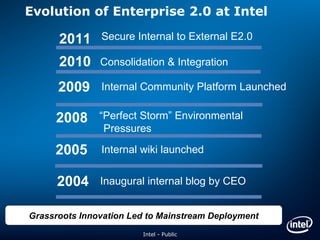
Evolution of Enterprise 2.0 at Intel Intel - Public 2004 2005 2008 2009 2010 2011 Inaugural internal blog by CEO “ Perfect Storm” Environmental  Pressures Internal wiki launched Internal Community Platform Launched Consolidation & Integration Secure Internal to External E2.0 Grassroots Innovation Led to Mainstream Deployment
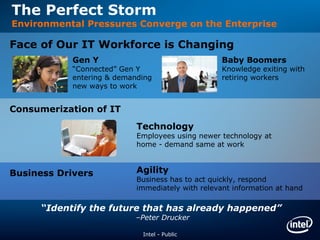
The Perfect Storm Environmental Pressures Converge on the Enterprise “ Identify the future that has already happened”  –Peter Drucker Intel - Public Business Drivers Agility Business has to act quickly, respond immediately with relevant information at hand Face of Our IT Workforce is Changing Gen Y “ Connected” Gen Y entering & demanding new ways to work Baby Boomers Knowledge exiting with retiring workers Consumerization of IT Technology Employees using newer technology at home - demand same at work
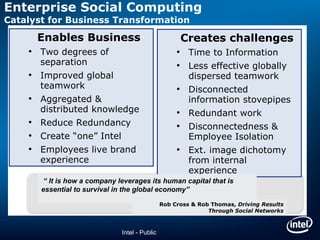
Enterprise Social Computing Catalyst for Business Transformation Enterprise 2.0 Aggregated; Employee Centered; Content User Generated; Transparency; Wisdom of Crowds; Six Degrees; Tacit Knowledge Traditional Enterprise   One-way communications, Content Repository Focused, Individual/Small Group Wisdom, Fragmented & Isolated Andrew McAfee, MIT Creates challenges Time to Information Less effective globally dispersed teamwork Disconnected information stovepipes Redundant work Disconnectedness & Employee Isolation Ext. image dichotomy from internal experience Rob Cross & Rob Thomas,  Driving Results Through Social Networks Enables Business Two degrees of separation Improved global teamwork Aggregated & distributed knowledge Reduce Redundancy Create “one” Intel Employees live brand experience Intel - Public “  The new technologies are significant because they can potentially knit together an enterprise and facilitate knowledge work in ways that were simply not possible previously”  “  It is how a company leverages its human capital that is essential to survival in the global economy”
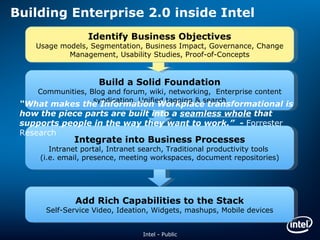
Building Enterprise 2.0 inside Intel Add Rich Capabilities to the Stack Self-Service Video, Ideation, Widgets, mashups, Mobile devices Intel - Public Identify Business Objectives Usage models, Segmentation, Business Impact, Governance, Change Management, Usability Studies, Proof-of-Concepts “ What makes the Information Workplace transformational is how the piece parts are built into a  seamless whole  that supports people in the way they want to work.”  -  Forrester Research Build a Solid Foundation Communities, Blog and forum, wiki, networking,  Enterprise content syndication, Unified tagging & search Integrate into Business Processes Intranet portal, Intranet search, Traditional productivity tools  (i.e. email, presence, meeting workspaces, document repositories)
Intel - Public
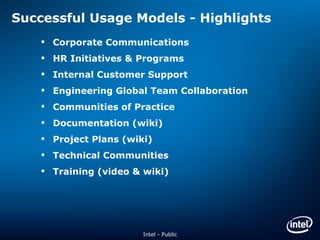
Successful Usage Models - Highlights Corporate Communications HR Initiatives & Programs Internal Customer Support Engineering Global Team Collaboration Communities of Practice Documentation (wiki) Project Plans (wiki) Technical Communities Training (video & wiki) Intel - Public
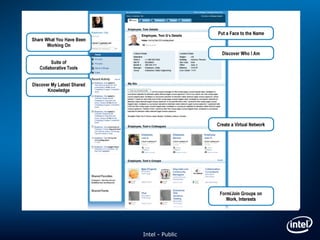
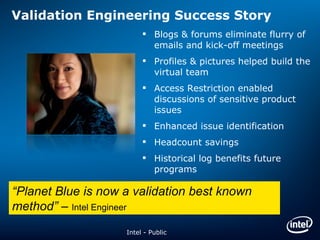
Validation Engineering Success Story Blogs & forums eliminate flurry of emails and kick-off meetings Profiles & pictures helped build the virtual team Access Restriction enabled discussions of sensitive product issues Enhanced issue identification Headcount savings Historical log benefits future programs “ Planet Blue is now a validation best known method”  –  Intel Engineer Intel - Public
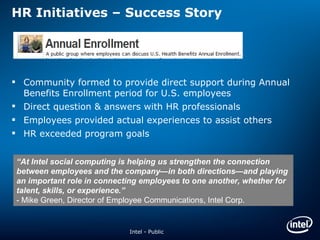
HR Initiatives – Success Story Community formed to provide direct support during Annual Benefits Enrollment period for U.S. employees Direct question & answers with HR professionals Employees provided actual experiences to assist others HR exceeded program goals “ At Intel social computing is helping us strengthen the connection between employees and the company—in both directions—and playing an important role in connecting employees to one another, whether for talent, skills, or experience.”   - Mike Green, Director of Employee Communications, Intel Corp. Intel - Public
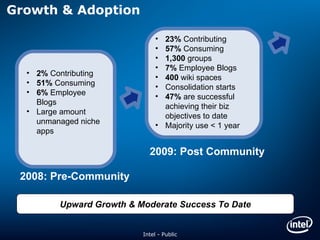
Growth & Adoption Intel - Public 2%  Contributing 51%  Consuming 6%  Employee Blogs Large amount unmanaged niche apps 23%  Contributing 57%  Consuming 1,300  groups 7%  Employee Blogs 400  wiki spaces Consolidation starts 47%  are successful achieving their biz objectives to date Majority use < 1 year Upward Growth & Moderate Success To Date 2008: Pre-Community 2009: Post Community
The Best Social Tools  Don’t Make a Social Enterprise Barriers to Transformation Lack of senior champions & leadership use Silos slow to dissolve Consumerism affects what we do inside our four walls – shiny object chasing Lack of integration with business applications and work flows Email culture Unintuitive & not easy to use applications Technology implementation lacks business objectives  Low investment in transition change management Governance is an after thought Intel - Public
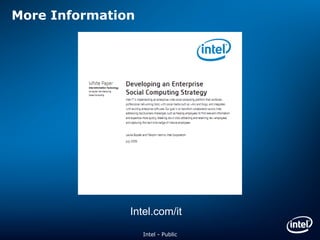
More Information Intel - Public Intel.com/it
Connect with Me [email_address] Twitter: @lauriegbuczek LinkedIn:  http://www.linkedin.com/in/laurieb Blogs:  http://communities.intel.com/community/it Intel - Public
 

International Forum on E 2.0 - Intel

  • 1.
    Enterprise Social ComputingThe Transformation of Collaboration & Communication Laurie Buczek
  • 2.
    Legal Notices Thispresentation is for informational purposes only. INTEL MAKES NO WARRANTIES, EXPRESS OR IMPLIED, IN THIS SUMMARY. BunnyPeople, Celeron, Celeron Inside, Centrino, Centrino logo, Core Inside, FlashFile, i960, InstantIP, Intel, Intel logo, Intel386, Intel486, Intel740, IntelDX2, IntelDX4, IntelSX2, Intel Core, Intel Inside, Intel Inside logo, Intel. Leap ahead., Intel. Leap ahead. logo, Intel NetBurst, Intel NetMerge, Intel NetStructure, Intel SingleDriver, Intel SpeedStep, Intel StrataFlash, Intel Viiv, Intel vPro, Intel XScale, IPLink, Itanium, Itanium Inside, MCS, MMX, Oplus, OverDrive, PDCharm, Pentium, Pentium Inside, skoool, Sound Mark, The Journey Inside, VTune, Xeon, and Xeon Inside are trademarks or registered trademarks of Intel Corporation or its subsidiaries in the United States and other countries. *Other names and brands may be claimed as the property of others. Copyright © 2009, Intel Corporation. All rights reserved.
  • 3.
    Evolution of Enterprise2.0 at Intel Intel - Public 2004 2005 2008 2009 2010 2011 Inaugural internal blog by CEO “ Perfect Storm” Environmental Pressures Internal wiki launched Internal Community Platform Launched Consolidation & Integration Secure Internal to External E2.0 Grassroots Innovation Led to Mainstream Deployment
  • 4.
    The Perfect StormEnvironmental Pressures Converge on the Enterprise “ Identify the future that has already happened” –Peter Drucker Intel - Public Business Drivers Agility Business has to act quickly, respond immediately with relevant information at hand Face of Our IT Workforce is Changing Gen Y “ Connected” Gen Y entering & demanding new ways to work Baby Boomers Knowledge exiting with retiring workers Consumerization of IT Technology Employees using newer technology at home - demand same at work
  • 5.
    Enterprise Social ComputingCatalyst for Business Transformation Enterprise 2.0 Aggregated; Employee Centered; Content User Generated; Transparency; Wisdom of Crowds; Six Degrees; Tacit Knowledge Traditional Enterprise One-way communications, Content Repository Focused, Individual/Small Group Wisdom, Fragmented & Isolated Andrew McAfee, MIT Creates challenges Time to Information Less effective globally dispersed teamwork Disconnected information stovepipes Redundant work Disconnectedness & Employee Isolation Ext. image dichotomy from internal experience Rob Cross & Rob Thomas, Driving Results Through Social Networks Enables Business Two degrees of separation Improved global teamwork Aggregated & distributed knowledge Reduce Redundancy Create “one” Intel Employees live brand experience Intel - Public “ The new technologies are significant because they can potentially knit together an enterprise and facilitate knowledge work in ways that were simply not possible previously” “ It is how a company leverages its human capital that is essential to survival in the global economy”
  • 6.
    Building Enterprise 2.0inside Intel Add Rich Capabilities to the Stack Self-Service Video, Ideation, Widgets, mashups, Mobile devices Intel - Public Identify Business Objectives Usage models, Segmentation, Business Impact, Governance, Change Management, Usability Studies, Proof-of-Concepts “ What makes the Information Workplace transformational is how the piece parts are built into a seamless whole that supports people in the way they want to work.” - Forrester Research Build a Solid Foundation Communities, Blog and forum, wiki, networking, Enterprise content syndication, Unified tagging & search Integrate into Business Processes Intranet portal, Intranet search, Traditional productivity tools (i.e. email, presence, meeting workspaces, document repositories)
  • 7.
  • 8.
    Successful Usage Models- Highlights Corporate Communications HR Initiatives & Programs Internal Customer Support Engineering Global Team Collaboration Communities of Practice Documentation (wiki) Project Plans (wiki) Technical Communities Training (video & wiki) Intel - Public
  • 9.
    Validation Engineering SuccessStory Blogs & forums eliminate flurry of emails and kick-off meetings Profiles & pictures helped build the virtual team Access Restriction enabled discussions of sensitive product issues Enhanced issue identification Headcount savings Historical log benefits future programs “ Planet Blue is now a validation best known method” – Intel Engineer Intel - Public
  • 10.
    HR Initiatives –Success Story Community formed to provide direct support during Annual Benefits Enrollment period for U.S. employees Direct question & answers with HR professionals Employees provided actual experiences to assist others HR exceeded program goals “ At Intel social computing is helping us strengthen the connection between employees and the company—in both directions—and playing an important role in connecting employees to one another, whether for talent, skills, or experience.” - Mike Green, Director of Employee Communications, Intel Corp. Intel - Public
  • 11.
    Growth & AdoptionIntel - Public 2% Contributing 51% Consuming 6% Employee Blogs Large amount unmanaged niche apps 23% Contributing 57% Consuming 1,300 groups 7% Employee Blogs 400 wiki spaces Consolidation starts 47% are successful achieving their biz objectives to date Majority use < 1 year Upward Growth & Moderate Success To Date 2008: Pre-Community 2009: Post Community
  • 12.
    The Best SocialTools Don’t Make a Social Enterprise Barriers to Transformation Lack of senior champions & leadership use Silos slow to dissolve Consumerism affects what we do inside our four walls – shiny object chasing Lack of integration with business applications and work flows Email culture Unintuitive & not easy to use applications Technology implementation lacks business objectives Low investment in transition change management Governance is an after thought Intel - Public
  • 13.
    More Information Intel- Public Intel.com/it
  • 14.
    Connect with Me[email_address] Twitter: @lauriegbuczek LinkedIn: http://www.linkedin.com/in/laurieb Blogs: http://communities.intel.com/community/it Intel - Public
  • 15.

Editor's Notes

  • #5 Face of Our IT Workforce is Changing (North America industry data) A perfect storm is brewing. By the end of 2012: GenY will be at parity with BabyBoomers GenY may approach 20% of the population Hiring and retention will be critical Gen Y workers have been connected to technology in a different way than Gen X and baby boomers. They expect to be connected and communicate in the same fashion within work. “ 90% of companies are already lagging behind the thinking and skills of the future worker.” - Mark Beyer, Gartner Business Intelligence Summit, Chicago, Mar.2007 in KM World Magazine, May 2007 Baby Boomers will be exiting the workforce enmasse. KM systems to date have not effectively captured tacit knowledge. Tacit knowledge is knowledge that people carry in their minds and is, therefore, difficult to access. Often, people are not aware of the knowledge they possess or how it can be valuable to others. Tacit knowledge is considered more valuable because it provides context for people, places, ideas, and experiences. Effective transfer of tacit knowledge generally requires extensive personal contact and trust. Consumerization of IT: Historically workers have used the latest and greatest technology at work. This has shifted. IT Requirements are become defined by the needs of the user, not by IT itself Employees bringing in their own tech to workplace Having higher expectations because the tech they use at home is better than at work
  • #6 It is how a company leverages its human capital that is essential to survival in the global economy . Rob Cross and Robert Thomas discuss in Driving Results Through Social Networks
  • #13 The challenge in deploying social tools and shifting to a social enterprise is more about cultural and behavioral change, then it is about the tools. Information silos must come down. Resist the “velvet ropes” and orgs wanting to apply a social tool over a silo. This doesn’t achieve the end state. Tools must be intuitive and easy to use- the performance bar has been set by the consumer tools. If it takes a manual to use – throw it out the door. The User Interface is critical for adoption. IT doesn’t act quickly… because of the accessibility of these tools- employees will bring them in-house. Business partners will demand them. If IT won’t implement them, individuals and biz groups will.