Ezra
A brief history: where Ezra fits in
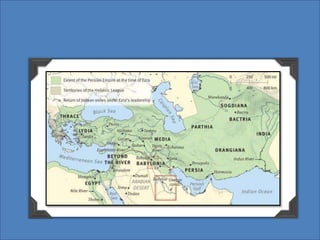
        586 BC:     The Babylonians destroyed
                    Jerusalem and took the Jews
                    captive
        538 BC:     After the Persians conquered
                    Babylon, the Persian king,
                    Cyrus, allowed the Jews to
                    return home.
        538-515 BC: The first group of exiles return
                    home and rebuild the temple
                    (told in Ezra 1-6).
        458 BC:     Ezra leads a second group of
                    exiles back to Jerusalem to
                    restore true worship in the
                    holy city.
Who was Ezra?
                 Ezra himself was a priest and a scribe
                 (the first great Bible scholar and
                 teacher). He returned with the goal of
                 restoring true worship of the Lord in
                 Jerusalem and teaching the Jewish
                 people the Law of the Lord.

                 Ezra’s story is told in Ezra 7–10. It makes
                 a great case study for pastors, since Ezra
                 embodies and models many of the
    Priest and   leadership traits and skills that we
      Scribe     would expect to find in a good New
                 Testament pastor. I want to draw your
                 attention to seven ways in which Ezra
                 can be a model for pastors.
Point 1


      Ezra counted the cost of
      God's call
Counting the cost of the call

   •   Ezra had position, power, prestige, popularity,
       and prosperity in Babylon.
   •   Why did he request permission to return to
       Jerusalem?
   •   He was responding in obedience to God's call. He
       made sacrifices to embrace God's purpose for his
       life.
   •   In an amazing act of obedience, he made himself
       nothing, but God has made him immortal!
What is God calling you to do this year?
• What is God calling you to
  do with your life?             Courage is fear
• What is he calling you to do   that has said its
  for him this year?                 prayers!
• What sacrifices are you
  going to have to make to             Anonymous

  say, ‘Yes, Lord’?
                                  Too much of our
To obey Christ will definitely   Christianity today is
cost you! Most will sing ‘yes      drenched with
Lord’, but say ‘no Lord’.          sentiment, but
                                 devoid of sacrifice.

                                       Frank Farley
Point 2


      Ezra set his heart to study, do,
      and teach the Word of God
Ezra, the first Bible scholar and teacher
                   ‘… skilled in the Law of Moses
                   that the LORD, the God of Israel,
                   had given’ (7:6).

                   ‘… the scribe of the Law of the
                   God of heaven’ (7:12).

                   For Ezra had set his heart to
                   study the Law of the LORD, and to
    Studying the
     Scriptures
                   do it and to teach his statutes
                   and rules in Israel (Ezra 7:10,
                   emphasis mine).
Studying, doing, and teaching

      1. Study: He set his heart to study the
         scriptures. There were no shortcuts.
         His expertise was the fruit of a
         lifetime of study.
      2. Do: Knowledge was not the goal. He
         studied the word of God so that he
         could do the will of God.
      3. Teach: To teach, in Hebrew, is ‘to
         cause to learn’. He studied to enrich
         others lives with the Word.
What about you?

God is calling us back to the
Bible.
 • Try to get yourself an ESV
   Study Bible (or LASB).
 • We should get our cell           Bible Study
   groups back to the Bible.
 • Get hold of great teaching   God’s Word is the
   material to fill your dead    instrument by
   times.                       which God’s Spirit
                                 transforms the
                                    Christian.

                                  Robert M. Horn
Point 3


      Ezra was a man of prayer
      and faith.
Imagine yourself in Ezra's shoes:

   •   You are travelling from Babylon to Jerusalem with
       2000 civilians.
   •   You are returning with some 3.4 tons of gold and
       22 tons of silver—you are a prime target for
       criminals.
   •   You have boasted to the king of Persia about
       Yahweh's almighty power, which works for his
       people and against his enemies.
   •   You cannot ask for a military escort! What do you
       do?
This is what Ezra did …
                 Ezra 8:21-23
                 Then I proclaimed a fast there, at the
                 river Ahava, that we might humble
                 ourselves before our God, to seek from
                 him a safe journey for ourselves, our
                 children, and all our goods. For I was
                 ashamed to ask the king for a band of
                 soldiers and horsemen to protect us
                 against the enemy on our way, since we
    He prayed    had told the king, ‘The hand of our God
    and fasted   is for good on all who seek him, and the
                 power of his wrath is against all who
                 forsake him.’ So we fasted and implored
                 our God for this, and he listened to our
                 entreaty.
This is what Ezra did next …
                 Ezra 8:24-25, 31-32
                 Then I set apart twelve of the leading
                 priests: … And I weighed out to them
                 the silver and the gold and the vessels,
                 the offering for the house of our God
                 that the king and his counsellors and his
                 lords and all Israel there present had
                 offered. …
                 Then we departed from the river Ahava
    He walked    on the twelfth day of the first month, to
     in faith    go to Jerusalem. The hand of our God
                 was on us, and he delivered us from the
                 hand of the enemy and from ambushes
                 by the way. We came to Jerusalem, and
                 there we remained three days.
Sequence: believe  pray  act
       1. He truly believed that ‘the hand of our
          God is for good on all who seek him’
          (8:22).
       Therefore,
       2. He organised a fast, ‘that we might
          humble ourselves before our God, to
          seek from him a safe journey. … we
          fasted and implored our God for this,
          and he listened to our entreaty’’ (8:21,
          23).
       Then,
       3. They departed in faith. They gambled
          their lives on God’s response to their
          payers.
What the Church needs today is
not more machinery or better, not
new organizations or more and
novel methods, but men whom the
Holy Ghost can use—men of
prayer, men mighty in prayer. The
Holy Ghost does not flow through
methods, but through men. He
does not come on machinery, but
on men. He does not anoint plans,
but men—men of prayer.
Prayer: some insightful comments

                            Nothing is
                       discussed more and
                       practiced less than
                             prayer.

     It is not well
                            Anonymous
     for a man to
      pray cream
        and live          When you pray,
                       rather let your heart
       skim milk.
                        be without words,
                         than your words
                          without heart.
       Henry Ward
        Beecher
                            John Bunyan
What about you?

1. Do you believe God enough    The mightier any is
   to be a man (or woman) of     in the Word, the
   prayer? (Rom. 10:17, NKJV)   more mighty he will
                                   be in prayer.
2. How do you intend to set
   aside time to spend with
                                   William Gurnall
   God this year?
3. Are you ready to take an
   umbrella when you pray for   Faith makes things
                                 possible—it does
   rain?
                                  not make them
                                       easy.

                                     Anonymous
1. What is God calling me to do this
   year? Am I prepared to say, ‘Yes
   Lord’?
2. What am I going to do to ensure that
   God’s Word is front and centre in my
   life?
3. What steps does God want me to
   take to remedy my lack of faith that
   causes my lack of prayer?
Point 4


      Ezra was painstakingly
      honest with money
The King's Commission
                 • Ezra returns with a small
    Ezra           fortune in gifts: 3.4 tons
                   of gold and 22 tons of
  7:11-24          silver.
                 • In essence, the king gave
                   Ezra licence to use the
                   money as he saw fit:
    Artaxerxes
   Commission      some was allocated, but
                   most was at his
                   discretion.
The Priest's Plan
                    Ezra "set apart twelve of the
    Ezra            leading priests" (8:24) to look
                    after the money. Every cent was
  8:24-34           carefully counted and recorded
                    before they departed. When
                    they arrived in Jerusalem, the
                    money was handed over to the
                    temple priests. Once again,
    Ezra's Plan     "The whole was counted and
                    weighed, and the weight of
                    everything was recorded"
                    (8:34).
Ezra was a steward of God's money
Ezra was careful to be a
                                 In the battle of
trustworthy steward of the
                                 faith, money is
money. He took pains to
                                usually the last
ensure that the money was
                               stronghold to fall.
handled with complete
integrity and that he was
                                   Ronald Dunn
absolutely blameless in his
management of it. He did not
take a cut for himself, but      The use of our
handed over all the money,     possessions shows
having accounted for every     us up for what we
cent.                              really are.

                                   Charles Ryrie
True statements about money

    Money      Money is like                   Our temporary
                               If faith does
     often    sea water; the                    stewardship
                                not make a
   unmakes     more a man
                               man honest,     will determine
   the man      drinks, the                          our
                                it is not an
  who makes    more thirsty                     permanent
                               honest faith.
       it.     he becomes                        ownership.

  Anonymous    Anonymous        Spurgeon        Blanchard


  Here are some insightful observations about the
    relationship between money and godliness.
1. Do you report and pay your taxes
   without fudging the truth?
2. If you run a business, do you
   handle the finance with purity?
3. Do you pay your domestic worker a
   humane wage?
4. Is your life consumed by a quest for
   more sea water?
Point 5


      Ezra mourned over the
      sins of his people
Ezra 9:1-15

     Ezra's Response:
     • "As soon as I heard this,
       I tore my garment and
       my cloak and pulled
       hair from my head and
       beard and sat appalled
       ... until the evening
       sacrifice" (9:3-4).
     • Then he fell on his
                                   Mourning over Sin
       knees and spread out
       his hands before God
       (at the temple), and
       prayed a great prayer.
Sin grieved Ezra deeply!
        1. As a student of scripture, he
           understood that Israel's
           unfaithfulness to the Lord
           brought exile upon the nation.
        2. As a man of prayer, he had a
           personal appreciation for the
           holiness of God and the
           horrors of sin.
        3. In short, Ezra had a God-
           centred perspective on sin.
" Only those who walk intimately
  with God can appreciate how
  heinous sin is; only they can
  truly grieve and mourn over it;
  only they can grasp his grace in
  pardoning sinners."
Three trends
 1. We avoid the subject
 2. We rename the sins
 3. We justify the sinners
We avoid the subject
We are into happy
Christianity, and
talking about sin and
grieving over it makes
people unhappy—so          This sells

we just don't go there.


                          This doesn't
We rename the sins
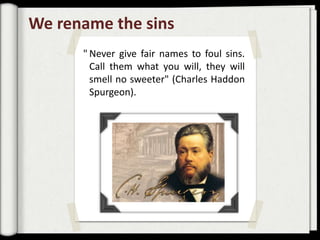
      " Never give fair names to foul sins.
        Call them what you will, they will
        smell no sweeter" (Charles Haddon
        Spurgeon).
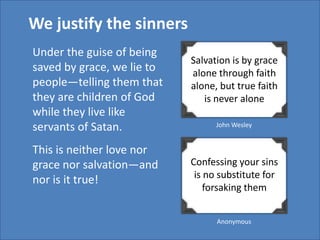
We justify the sinners
Under the guise of being
                            Salvation is by grace
saved by grace, we lie to   alone through faith
people—telling them that    alone, but true faith
they are children of God       is never alone
while they live like
servants of Satan.                John Wesley


This is neither love nor
grace nor salvation—and     Confessing your sins
                             is no substitute for
nor is it true!
                                forsaking them


                                  Anonymous
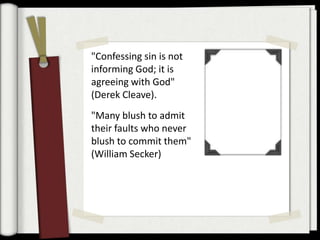
"Confessing sin is not
informing God; it is
agreeing with God"
(Derek Cleave).
"Many blush to admit
their faults who never
blush to commit them"
(William Secker)
Point 6


      Ezra acknowledged the
      sovereignty of God
"the hand of the Lord was upon us"
 • King Artaxerxes granted all Ezra's requests,
   "for the hand of the LORD his God was on
   him" (7:6).
 • Ezra arrived safely in Jerusalem "for the
   good hand of his God was on him" (7:9).
 • Ezra spoke boldly before the king, "for the
   hand of the LORD my God was on me"
   (7:28).
"the hand of the Lord was upon us"
 • The succeeded "by the good hand of our
   God on us" (8:18).
 • Ezra boldly told the king that "the hand of
   our God is for good on all who seek him"
   (8:22).
 • The returning exiles were delivered from
   enemies and ambushes, because "hand of
   our God was on us" (8:31).
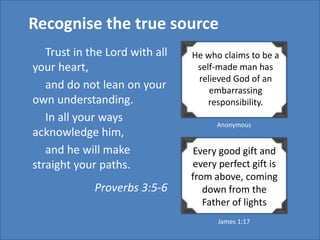
Recognise the true source
   Trust in the Lord with all   He who claims to be a
your heart,                      self-made man has
                                 relieved God of an
   and do not lean on your          embarrassing
own understanding.                  responsibility.
   In all your ways                   Anonymous
acknowledge him,
   and he will make             Every good gift and
straight your paths.            every perfect gift is
                                from above, coming
             Proverbs 3:5-6        down from the
                                   Father of lights
                                      James 1:17
Give thanks to God

                      Thanksgiving is
                     good, but thanks-
                      living is better.
         Those
     blessings are
                          Matthew Henry
     sweetest that
     are won with
                     You shall remember
      prayers and
                      the Lord your God,
       worn with
                     for it is he who gives
        thanks.
                       you power to get
        Thomas                wealth.
        Goodwin
                            Deut. 8:18
Summary
1. Count the cost of serving Jesus.

2. Study, do, and teach the Word.

3. Pray in dependence, act in faith.

4. Be honest in money matters.

5. Confess and forsake your sins.

6. Acknowledge the hand of God.

Ezra

  • 1.
  • 2.
    A brief history:where Ezra fits in 586 BC: The Babylonians destroyed Jerusalem and took the Jews captive 538 BC: After the Persians conquered Babylon, the Persian king, Cyrus, allowed the Jews to return home. 538-515 BC: The first group of exiles return home and rebuild the temple (told in Ezra 1-6). 458 BC: Ezra leads a second group of exiles back to Jerusalem to restore true worship in the holy city.
  • 4.
    Who was Ezra? Ezra himself was a priest and a scribe (the first great Bible scholar and teacher). He returned with the goal of restoring true worship of the Lord in Jerusalem and teaching the Jewish people the Law of the Lord. Ezra’s story is told in Ezra 7–10. It makes a great case study for pastors, since Ezra embodies and models many of the Priest and leadership traits and skills that we Scribe would expect to find in a good New Testament pastor. I want to draw your attention to seven ways in which Ezra can be a model for pastors.
  • 5.
    Point 1 Ezra counted the cost of God's call
  • 6.
    Counting the costof the call • Ezra had position, power, prestige, popularity, and prosperity in Babylon. • Why did he request permission to return to Jerusalem? • He was responding in obedience to God's call. He made sacrifices to embrace God's purpose for his life. • In an amazing act of obedience, he made himself nothing, but God has made him immortal!
  • 7.
    What is Godcalling you to do this year? • What is God calling you to do with your life? Courage is fear • What is he calling you to do that has said its for him this year? prayers! • What sacrifices are you going to have to make to Anonymous say, ‘Yes, Lord’? Too much of our To obey Christ will definitely Christianity today is cost you! Most will sing ‘yes drenched with Lord’, but say ‘no Lord’. sentiment, but devoid of sacrifice. Frank Farley
  • 8.
    Point 2 Ezra set his heart to study, do, and teach the Word of God
  • 9.
    Ezra, the firstBible scholar and teacher ‘… skilled in the Law of Moses that the LORD, the God of Israel, had given’ (7:6). ‘… the scribe of the Law of the God of heaven’ (7:12). For Ezra had set his heart to study the Law of the LORD, and to Studying the Scriptures do it and to teach his statutes and rules in Israel (Ezra 7:10, emphasis mine).
  • 10.
    Studying, doing, andteaching 1. Study: He set his heart to study the scriptures. There were no shortcuts. His expertise was the fruit of a lifetime of study. 2. Do: Knowledge was not the goal. He studied the word of God so that he could do the will of God. 3. Teach: To teach, in Hebrew, is ‘to cause to learn’. He studied to enrich others lives with the Word.
  • 11.
    What about you? Godis calling us back to the Bible. • Try to get yourself an ESV Study Bible (or LASB). • We should get our cell Bible Study groups back to the Bible. • Get hold of great teaching God’s Word is the material to fill your dead instrument by times. which God’s Spirit transforms the Christian. Robert M. Horn
  • 12.
    Point 3 Ezra was a man of prayer and faith.
  • 13.
    Imagine yourself inEzra's shoes: • You are travelling from Babylon to Jerusalem with 2000 civilians. • You are returning with some 3.4 tons of gold and 22 tons of silver—you are a prime target for criminals. • You have boasted to the king of Persia about Yahweh's almighty power, which works for his people and against his enemies. • You cannot ask for a military escort! What do you do?
  • 14.
    This is whatEzra did … Ezra 8:21-23 Then I proclaimed a fast there, at the river Ahava, that we might humble ourselves before our God, to seek from him a safe journey for ourselves, our children, and all our goods. For I was ashamed to ask the king for a band of soldiers and horsemen to protect us against the enemy on our way, since we He prayed had told the king, ‘The hand of our God and fasted is for good on all who seek him, and the power of his wrath is against all who forsake him.’ So we fasted and implored our God for this, and he listened to our entreaty.
  • 15.
    This is whatEzra did next … Ezra 8:24-25, 31-32 Then I set apart twelve of the leading priests: … And I weighed out to them the silver and the gold and the vessels, the offering for the house of our God that the king and his counsellors and his lords and all Israel there present had offered. … Then we departed from the river Ahava He walked on the twelfth day of the first month, to in faith go to Jerusalem. The hand of our God was on us, and he delivered us from the hand of the enemy and from ambushes by the way. We came to Jerusalem, and there we remained three days.
  • 16.
    Sequence: believe pray  act 1. He truly believed that ‘the hand of our God is for good on all who seek him’ (8:22). Therefore, 2. He organised a fast, ‘that we might humble ourselves before our God, to seek from him a safe journey. … we fasted and implored our God for this, and he listened to our entreaty’’ (8:21, 23). Then, 3. They departed in faith. They gambled their lives on God’s response to their payers.
  • 17.
    What the Churchneeds today is not more machinery or better, not new organizations or more and novel methods, but men whom the Holy Ghost can use—men of prayer, men mighty in prayer. The Holy Ghost does not flow through methods, but through men. He does not come on machinery, but on men. He does not anoint plans, but men—men of prayer.
  • 18.
    Prayer: some insightfulcomments Nothing is discussed more and practiced less than prayer. It is not well Anonymous for a man to pray cream and live When you pray, rather let your heart skim milk. be without words, than your words without heart. Henry Ward Beecher John Bunyan
  • 19.
    What about you? 1.Do you believe God enough The mightier any is to be a man (or woman) of in the Word, the prayer? (Rom. 10:17, NKJV) more mighty he will be in prayer. 2. How do you intend to set aside time to spend with William Gurnall God this year? 3. Are you ready to take an umbrella when you pray for Faith makes things possible—it does rain? not make them easy. Anonymous
  • 20.
    1. What isGod calling me to do this year? Am I prepared to say, ‘Yes Lord’? 2. What am I going to do to ensure that God’s Word is front and centre in my life? 3. What steps does God want me to take to remedy my lack of faith that causes my lack of prayer?
  • 21.
    Point 4 Ezra was painstakingly honest with money
  • 22.
    The King's Commission • Ezra returns with a small Ezra fortune in gifts: 3.4 tons of gold and 22 tons of 7:11-24 silver. • In essence, the king gave Ezra licence to use the money as he saw fit: Artaxerxes Commission some was allocated, but most was at his discretion.
  • 23.
    The Priest's Plan Ezra "set apart twelve of the Ezra leading priests" (8:24) to look after the money. Every cent was 8:24-34 carefully counted and recorded before they departed. When they arrived in Jerusalem, the money was handed over to the temple priests. Once again, Ezra's Plan "The whole was counted and weighed, and the weight of everything was recorded" (8:34).
  • 24.
    Ezra was asteward of God's money Ezra was careful to be a In the battle of trustworthy steward of the faith, money is money. He took pains to usually the last ensure that the money was stronghold to fall. handled with complete integrity and that he was Ronald Dunn absolutely blameless in his management of it. He did not take a cut for himself, but The use of our handed over all the money, possessions shows having accounted for every us up for what we cent. really are. Charles Ryrie
  • 25.
    True statements aboutmoney Money Money is like Our temporary If faith does often sea water; the stewardship not make a unmakes more a man man honest, will determine the man drinks, the our it is not an who makes more thirsty permanent honest faith. it. he becomes ownership. Anonymous Anonymous Spurgeon Blanchard Here are some insightful observations about the relationship between money and godliness.
  • 26.
    1. Do youreport and pay your taxes without fudging the truth? 2. If you run a business, do you handle the finance with purity? 3. Do you pay your domestic worker a humane wage? 4. Is your life consumed by a quest for more sea water?
  • 27.
    Point 5 Ezra mourned over the sins of his people
  • 28.
    Ezra 9:1-15 Ezra's Response: • "As soon as I heard this, I tore my garment and my cloak and pulled hair from my head and beard and sat appalled ... until the evening sacrifice" (9:3-4). • Then he fell on his Mourning over Sin knees and spread out his hands before God (at the temple), and prayed a great prayer.
  • 29.
    Sin grieved Ezradeeply! 1. As a student of scripture, he understood that Israel's unfaithfulness to the Lord brought exile upon the nation. 2. As a man of prayer, he had a personal appreciation for the holiness of God and the horrors of sin. 3. In short, Ezra had a God- centred perspective on sin.
  • 30.
    " Only thosewho walk intimately with God can appreciate how heinous sin is; only they can truly grieve and mourn over it; only they can grasp his grace in pardoning sinners."
  • 31.
    Three trends 1.We avoid the subject 2. We rename the sins 3. We justify the sinners
  • 32.
    We avoid thesubject We are into happy Christianity, and talking about sin and grieving over it makes people unhappy—so This sells we just don't go there. This doesn't
  • 33.
    We rename thesins " Never give fair names to foul sins. Call them what you will, they will smell no sweeter" (Charles Haddon Spurgeon).
  • 34.
    We justify thesinners Under the guise of being Salvation is by grace saved by grace, we lie to alone through faith people—telling them that alone, but true faith they are children of God is never alone while they live like servants of Satan. John Wesley This is neither love nor grace nor salvation—and Confessing your sins is no substitute for nor is it true! forsaking them Anonymous
  • 36.
    "Confessing sin isnot informing God; it is agreeing with God" (Derek Cleave). "Many blush to admit their faults who never blush to commit them" (William Secker)
  • 37.
    Point 6 Ezra acknowledged the sovereignty of God
  • 38.
    "the hand ofthe Lord was upon us" • King Artaxerxes granted all Ezra's requests, "for the hand of the LORD his God was on him" (7:6). • Ezra arrived safely in Jerusalem "for the good hand of his God was on him" (7:9). • Ezra spoke boldly before the king, "for the hand of the LORD my God was on me" (7:28).
  • 39.
    "the hand ofthe Lord was upon us" • The succeeded "by the good hand of our God on us" (8:18). • Ezra boldly told the king that "the hand of our God is for good on all who seek him" (8:22). • The returning exiles were delivered from enemies and ambushes, because "hand of our God was on us" (8:31).
  • 40.
    Recognise the truesource Trust in the Lord with all He who claims to be a your heart, self-made man has relieved God of an and do not lean on your embarrassing own understanding. responsibility. In all your ways Anonymous acknowledge him, and he will make Every good gift and straight your paths. every perfect gift is from above, coming Proverbs 3:5-6 down from the Father of lights James 1:17
  • 41.
    Give thanks toGod Thanksgiving is good, but thanks- living is better. Those blessings are Matthew Henry sweetest that are won with You shall remember prayers and the Lord your God, worn with for it is he who gives thanks. you power to get Thomas wealth. Goodwin Deut. 8:18
  • 42.
  • 43.
    1. Count thecost of serving Jesus. 2. Study, do, and teach the Word. 3. Pray in dependence, act in faith. 4. Be honest in money matters. 5. Confess and forsake your sins. 6. Acknowledge the hand of God.

Editor's Notes

  • #2 When preachers want a model of good leadership, they often turn to the book of Nehemiah, since Nehemiah models many outstanding qualities of godly leadership. Few are aware of another equally good model of pastoral leadership—Ezra. The books of Ezra and Nehemiah are twin volumes, since Nehemiah is the sequel to Ezra. In fact, Ezra and Nehemiah were co-labourers; their ministries in Jerusalem overlapped.
  • #7 In the eleventh century, King Henry III of Bavaria grew tired of court life and the pressures of being a monarch. He made application to Prior Richard at a local monastery, asking to be accepted as a contemplative and spend the rest of his life in the monastery.“Your Majesty,” said Prior Richard, “do you understand that the pledge here is one of obedience? That will be hard because you have been a king.”“I understand,” said Henry. “The rest of my life I will be obedient to you, as Christ leads you.”“Then I will tell you what to do,” said Prior Richard. “Go back to your throne and serve faithfully in the place where God has put you.”When King Henry died, a statement was written: “The King learned to rule by being obedient.”When we tire of our roles and responsibilities, it helps to remember God has planted us in a certain place and told us to be a good accountant or teacher or mother or father. Christ expects us to be faithful where he puts us, and when he returns, we’ll rule together with him.
  • #11 STUDY. His study of God’s word guided and inspired his devotion to the Lord; it did not undermine it. Why? Because he positioned himself under the scriptures, not above them. He studied with a heart of faith and an attitude of submission; modern Bible scholars often approach scripture with a proud and cold heart, and they give the serious study of God’s word a reputation for undermining a living faith and personal relationship with God. Because Ezra set his heart on doing what God taught in the word, his study enriched his faith.TEACH. He also carried a burden to teach the will and ways of God. In other words, Ezra studied the Bible with the twin goals of enriching his own relationship with God (‘to do’) and helping others to do the same (‘to teach’).
  • #14 Imagine yourself in Ezra's position:
  • #18 There is a great lesson in this for today’s church. Modern pastors are obsessed with management methods and leadership skills to grow their churches. Pastors flock to seminars oriented towards the ‘how to’ aspects of ministry, but by their prayerlessness they show that they are really trusting in human methods rather than God’s power to grow their churches. Many years ago, E. M. Bounds wrote:
  • #20 Our prayerlessness is not always rooted in laziness or indiscipline. Often the root problem is unbelief.I have found that a half-hour walk with Joshua is my best prayer time at the moment.
  • #22 The word painstaking is a combination of pains and taking
  • #25 I personally knew a pastor whose attitude was that God had called him to run the church with the Bible in one hand and the chequebook in the other. He lacked the financial know-how to manage the finances well, and he had a careless attitude towards his responsibility to do so. He failed to appoint competent and trustworthy men to manage the finances. He also neglected to implement measures to ensure that the money was properly counted and recorded. As a result, suspicions arose that the finances were being mismanaged. The pastor's integrity was seriously questioned, his credibility as a minister undermined, and many members left his church. Did he steal from the church? Nobody knows. He was certainly guilty of careless financial management, and it almost shipwrecked his ministry.Ezra was personally authorised by King Artaxerxes to spend the money; he could have taken a domineering, I-am-in-charge approach. As the leading scribe and priest in Israel, he could have adopted the attitude, "I am the man of God, so just trust me." Instead, he took every precaution to be blameless and transparent with the Lord's money. He appointed the best men and implemented a system of checks and balances to ensure that the money was properly managed.
  • #27 How about us?Here are some areas for personal reflection.
  • #28 Soon after Ezra's group of exiles arrived back in Jerusalem, he heard that the priests and people of Israel had been intermarrying with the idol-worshipping people of the surrounding regions. This was the very same sin that caused the exile, and Ezra feared that God's next judgement could be the end of Israel. Even without divine judgement, the natural result of merging with other peoples threatened to bring an end to Israel as God's people.READ EZRA 9Let me be crystal clear here: the issue is religious, not racial. They were marrying people who worshipped foreign gods, and God disapproves of such marriages. This leads to two practical truths for today: (1) God approves of a marriage between people of different races as long as they both worship Jesus Christ. (2) God does not approve of a disciple of Jesus Christ marrying a non-believer.
  • #29 This was Ezra's response to the news: "As soon as I heard this, I tore my garment and my cloak and pulled hair from my head and beard and sat appalled" (9:3, italics mine). He "sat appalled until the evening sacrifice" (9:4), when he fell on his knees and spread out his hands before God (at the temple). Then he prayed one of the Bible's great prayers of repentance on behalf of his people. What we have in chapter 9 is a short summary of his confession. It must have been an extended prayer, because people gathered around him when they saw the intensity of his prayers, and they "wept bitterly" (10:1). After this, he withdrew to a private place, and spent the night "neither eating bread nor drinking water, for he was mourning over the faithlessness of the exiles" (10:6).
  • #30 Sin grieved Ezra deeply. There was nothing contrived or put on about his response. As a student of scripture, he understood that Israel's unfaithfulness to the Lord brought exile upon the nation. As a man of prayer, he had a personal appreciation for the holiness of God and the horrors of sin. In short, Ezra had a God-centred perspective on sin.
  • #31 Only those who walk intimately with God can appreciate how heinous sin is; only they can truly grieve and mourn over it; only they can grasp his grace in pardoning sinners. If our relationship with God is not intimate, we tend to have a man-centred view of sin. We downplay its seriousness and defend its servants. When confronted with sin in the community, we choose a pragmatic course of action—how can we protect the image of the church and avoid losing members? We defend our soft line on sin under the guise of "grace", when often it reveals a failure to grasp God's holiness rather than a deep revelation of his mercy.
  • #32 How about us?Sadly, mourning deeply over sin is rare in the 21st-century church. We are into happy Christianity, and talking about sin and grieving for sin makes people unhappy—so we just don't go there. And if we do talk about it, two trends
  • #33 We are into happy Christianity, and talking about sin and grieving over it makes people unhappy—so we just don't go there.Think about it: how often do you hear strong sermons about sexual purity, financial honesty, gossip, pride, racism, and so on? The Bible talked about these subjects all the time. Why do pastors address them only rarely? Because they make people uncomfortable, and uncomfortable people move to the church next door—which doesn't preach unhappy sermons.By the way, Jesus never measured his success by attendance, followership, or the happy-metre in his after-sermon opinion poles!
  • #34 If do talk about sin, we do so euphemistically. We give sins nicer names so as not to make people feel bad or awkward.Examples: It's not fornication; it's pre-marital sex. Adultery has become extra-marital sex. It's not a lie, but an exaggeration. He's not arrogant; he's driven. She's not lying; she's shading the truth.
  • #35 Under the guise of being saved by grace, we lie to people—telling them that they are children of God while they live like servants of Satan.This is neither love nor grace nor salvation—and nor is it true! That is not the gospel. It is not true according to Jesus, John, Matthew, Peter, or Paul. The grace of God, when it infuses our souls, "teaches us to say 'No' to ungodliness and worldly passions, and to live self-controlled, upright and godly lives in this present age" (Titus 2:12). Jesus saves us from sin; he does not comfort us in it. When we tell people they can have fire insurance for hell while living like its citizens, we are loving them right into hell.
  • #36 There is only one right response to sin—mourn over it and then forsake it in the power of the Holy Spirit.
  • #38 Ezra did many things well. He was clearly a talented man and a skilled leader. Nevertheless, he recognised that his actions were not the primary cause of his successes. At every turn, he acknowledged that his successes were due to God's favour upon him. One of the recurring phrases in his memoirs is "the hand of the Lord was upon us".
  • #40 God worked with, for, and through Ezra—and Ezra acknowledged the hand of God in every success. As a man of prayer and the word, he was sensitive to the Lord's hand at work. He used every opportunity to give God credit and praise for his blessings. Here is an example of Ezra directing the glory towards God:Blessed be the Lord, the God of our fathers, who put such a thing as this into the heart of the king, to beautify the house of the Lord that is in Jerusalem, and who extended to me his steadfast love before the king and his counsellors, and before all the king's mighty officers (7:27-28).
  • #41 Proverbs 3:5-6Every good thing in your life is a gift of God (James 1:17). That is a biblical view of life. Every good thing is of God. Do you have food on the table each day? It is because the good hand of the Lord is upon you. Do you have healthy children? It is because the good hand of the Lord is upon you. Do you have the privilege of working? It is because the good hand of the Lord is upon you. Do you have a degree? It is because the good hand of the Lord is upon you.
  • #42 If God is the source of all good in our lives and our world, then God's giving deserves our thanks giving! The scripture says that God loves a cheerful giver, but it also teaches that he loves a cheerful thanksgiver.Deuteronomy 8:18Thomas Goodwin said, "Those blessings are sweetest that are won wit prayers and worn with thanks."Matthew Henry: Thanksgiving is good, but thanks-living is better. Family policy: count your blessings each day.