Ezra 7:6-10; 8:21-23
Prayer and Fasting
Call to Worship
Seek refuge in God!
Like green olive trees in the house of God, we dwell in the steadfast
love of God forever and ever.
Seek refuge in God!
We put our trust in God, because of God’s mighty deeds.
Seek refuge in God!
In the presence of the faithful, we proclaim God’s holy name.
Approaching God
From the demands and pressures of this past day, we come, O Lord,
seeking rest and renewal. Hear the cries of our hearts, our prayers,
and our needs.
Heal and restore us. For we ask this in Jesus’ Name. AMEN.
Introduction
The book of Ezra is composed of two sections: chapters 1–6 record
how the Jews returned from captivity to rebuild the temple; chapters
7–10 describe how Ezra came back to Jerusalem and led reforms.
Introduction
A period of some 57 years passed between the end of Ezra 6 (515 BC)
and the beginning of Ezra 7 (458 BC). During this time, the events
described in the book of Esther took place.
Introduction
It had been almost 80 years since the first return, and 147 years since
Daniel and his friends were taken to Babylon.
Ezra 7:6
This Ezra went up from Babylonia. He was a scribe skilled in the Law of
Moses that the LORD the God of Israel had given; and the king
granted him all that he asked, for the hand of the LORD his God was
upon him.
Ezra 7:6
Ezra wrote Ezra and Nehemiah. Ezra first appears in his history in
chapter 7 of the Book of Ezra.
Ezra was a priest (vv. 7, 11; 10:10), and v. 6 reports that he was also a
teacher well versed in the Law of Moses.
Ezra 7:6
Some suggest this is the first mention of a scribe in the Bible, a group
Ezra may have helped create. He not only copied the Law, but also
taught it to others.
The scribes made sure their history up to that time was carefully
recorded to serve as a warning to subsequent generations not to
commit sins against the Lord or rebel against God’s laws.
Ezra 7:6
We know from archaeological study that kings required careful
records to be kept of activities during their reign, and Ezra copied
some of these records as well as created some records to be sent
back to the king.
The Persian king is not given the credit for being generous; rather, he
was generous because the hand of the Lord directed his decisions.
Ezra 7:6
James Smith notes, ―Ezra was able in some unexplained way to
secure an appointment from the king to return to Jerusalem as a
religious reformer.‖ This blessing surely came from God.
Ezra 7:7
Some of the people of Israel, and some of the priests and Levites, the
singers and gatekeepers, and the temple servants also went up to
Jerusalem, in the seventh year of King Artaxerxes.
Ezra 7:7
Artaxerxes, the king of Persia, approved Ezra’s leading the Jews in
their return from Babylon to Palestine.
Scripture makes clear exactly how it happened that the king had
granted him everything he asked. Put simply, ―The hand of the Lord
his God was on him‖ (v. 6).
Ezra 7:7
Returning with him was a broad mix of Israelites—priests, Levites,
musicians, gatekeepers and temple servants. Especially mentioned
are those who would be serving God in the new temple there.
Ezra worshiped the true God and God directed his choices and
moved on others to give him what he needed to serve God or go
back with Ezra to serve God in Jerusalem.
Ezra 7:7
Notice the word ―some.‖ Not all of those who were priests or who had
other duties associated with temple worship returned with Ezra.
Later, when Nehemiah returned, he brought more priests and Levites
with him back to Jerusalem.
Ezra 7:8
They came to Jerusalem in the fifth month, which was in the seventh
year of the king.
Ezra 7:8
It took the Israelites four months to travel 900 miles following the trade
routes to travel from Babylon to Jerusalem. Ezra named the families
and the towns to which they returned.
They spread throughout the towns of Judah and Benjamin in order to
work and support themselves, but they would gather at the temple in
Jerusalem to worship God.
Ezra 7:8
It took the Israelites four months to travel 900 miles following the trade
routes to travel from Babylon to Jerusalem. Ezra named the families
and the towns to which they returned.
They spread throughout the towns of Judah and Benjamin in order to
work and support themselves, but they would gather at the temple in
Jerusalem to worship God.
Ezra 7:9
On the first day of the first month the journey up from Babylon was
begun, and on the first day of the fifth month he came to Jerusalem,
for the gracious hand of his God was upon him.
Ezra 7:9
During four months of travel, no doubt Ezra kept a daily journal and
continued to study the Law of God so he could lead God’s people
rightly.
Ezra 7:9
The Book of Ezra gives the reason he succeeded in all of his
endeavors; first, because God is gracious (the people did not deserve
this opportunity to return to Jerusalem), and second, God directed,
guided, and protected Ezra and the people each day.
Ezra 7:10
For Ezra had set his heart to study the law of the LORD, and to do it,
and to teach the statutes and ordinances in Israel.
Ezra 7:10
Why was God’s hand on Ezra? Ezra had made the choice to study
the Law of the Lord and after diligent study God knew that Ezra was
ready to teach others to do His law.
Ezra 7:10
Ezra had also made the choice to obey the Law of God as he
learned it; therefore, he would teach by example as well as by word.
Ezra was, then, prepared to persuade to obey and enforce God’s
law, even among the disobedient and unlearned in Judah.
Ezra 8:21
Then I proclaimed a fast there, at the river Ahava that we might deny
ourselves before our God, to seek from him a safe journey for
ourselves, our children, and all our possessions.
Ezra 8:21
Ezra now wrote in the first person. Before they left Babylon, Ezra
declared a fast day for all those returning to Jerusalem.
They prayed for a safe journey and the protection of children and
their possessions (which included immense wealth when they took
items set apart for temple worship).
Ezra 8:21
Remember that the Day of Atonement was the one fast required of
the people each year (see Leviticus 23:32).
The people could add other voluntary fasts, however.
C. F. Keil explains, ―Fasting, as a means of humbling themselves
before God, for the purpose of obtaining an answer to their petitions,
was an ancient custom of the Israelites (Judges 20:26; 1 Samuel 7:6;
Joel 1:14; 2 Chronicles 20:3).‖
Ezra 8:21
Years later when Jesus was on earth, fasting was widely practiced.
John the Baptist’s followers regularly participated in fasting (Luke 5:33-
35). Jesus himself fasted for 40 days and 40 nights in the wilderness
before beginning his earthly ministry (Matthew 4:2).
In the first-century church, people fasted when elders were
appointed (Acts 14:23) and before sending out Paul and Barnabas as
missionaries (Acts 13:1-3).
Ezra 8:21
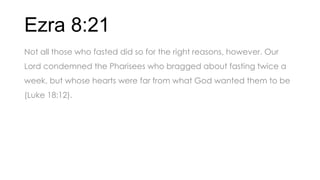
Not all those who fasted did so for the right reasons, however. Our
Lord condemned the Pharisees who bragged about fasting twice a
week, but whose hearts were far from what God wanted them to be
(Luke 18:12).
Ezra 8:21
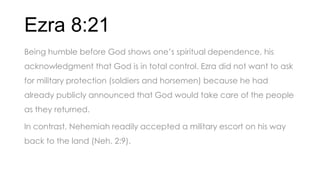
Being humble before God shows one’s spiritual dependence, his
acknowledgment that God is in total control. Ezra did not want to ask
for military protection (soldiers and horsemen) because he had
already publicly announced that God would take care of the people
as they returned.
In contrast, Nehemiah readily accepted a military escort on his way
back to the land (Neh. 2:9).
Ezra 8:22
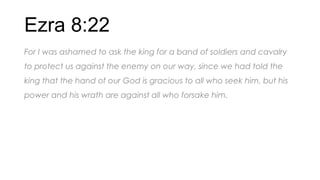
For I was ashamed to ask the king for a band of soldiers and cavalry
to protect us against the enemy on our way, since we had told the
king that the hand of our God is gracious to all who seek him, but his
power and his wrath are against all who forsake him.
Ezra 8:22
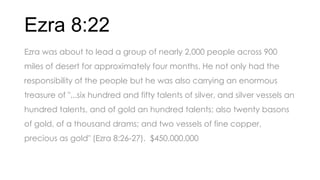
Ezra was about to lead a group of nearly 2,000 people across 900
miles of desert for approximately four months. He not only had the
responsibility of the people but he was also carrying an enormous
treasure of "...six hundred and fifty talents of silver, and silver vessels an
hundred talents, and of gold an hundred talents; also twenty basons
of gold, of a thousand drams; and two vessels of fine copper,
precious as gold" (Ezra 8:26-27). $450,000,000
Ezra 8:22
Ezra opens his heart when he admits that he didn’t want to ask the
king for military protection for them on the trip, since Ezra had assured
the king that God was with them!
Just as Moses did not request an escort from Pharaoh to help them
reach the Promised Land safely, Ezra did not request the protection of
a pagan king. Ezra acted on the truths he taught and trusted God
would keep them safe, which God did.
Ezra 8:22
Ezra’s decision not to ask for soldiers to protect him does not need to
be binding on all people, for later, Nehemiah returned to Jerusalem
with soldiers from the king to protect him and those who traveled with
him.
Ezra, who wrote Nehemiah, did not criticize Nehemiah for a lack of
faith. God works differently with different people and in different
times.
Ezra 8:23
So we fasted and petitioned our God for this, and he listened to our
entreaty.
Ezra 8:23
Ezra told the king that God would be gracious to him if he served
God. He also warned the king that the power and judgment of God is
against those who turn from God.
He prayed and fasted and asked God to demonstrate the truth of his
teachings to the king and others, which God did when Ezra and
God’s people travelled safely to Jerusalem.
Conclusions
After seventy years of captivity and months of preparation and travel,
Ezra and the exiles finally arrived at home. It is both encouraging and
challenging to see the way Ezra prepared himself and God's people
for the journey back to Jerusalem.
We can only guess at the dangers and difficulties involved in the four-
month, nine hundred-mile journey from Babylon to Jerusalem.
Conclusions
Our text shows that as God’s people seeking to do God’s work, we
need to recognize that there are enemies and ambushes along the
way (8:31), and thus we desperately need ―God’s hand over us‖ to
protect us.
The enemy is seeking to destroy us and our little ones (8:21) by tearing
apart families and by bringing down spiritual leaders.
Lessons
For the believer, fasting should be a sign of inward humility. (Ezra 8:21)
When in any need of anything, we should always start by asking God.
Be sure that your actions before men do not negate your witness for
God. (vs. 22)
Lessons
God always hears and answers the prayers of His people, but not
always as they might expect (vs. 23)
The almighty hand of God guides and guards His obedient children
(vs. 31)
When God starts a plan, He always finishes it (vs. 32)
Blessing
Be like olive trees in the house of God—green and flourishing, full and
strong.
We will grow strong in the house of God—deeply rooted, well
watered.
Be like olive trees in the house of God—seeking God’s refuge, trusting
God’s care.
We will dwell in the house of God and proclaim God’s name forever!

Prayer and fasting

  • 1.
  • 2.
    Call to Worship Seekrefuge in God! Like green olive trees in the house of God, we dwell in the steadfast love of God forever and ever. Seek refuge in God! We put our trust in God, because of God’s mighty deeds. Seek refuge in God! In the presence of the faithful, we proclaim God’s holy name.
  • 3.
    Approaching God From thedemands and pressures of this past day, we come, O Lord, seeking rest and renewal. Hear the cries of our hearts, our prayers, and our needs. Heal and restore us. For we ask this in Jesus’ Name. AMEN.
  • 4.
    Introduction The book ofEzra is composed of two sections: chapters 1–6 record how the Jews returned from captivity to rebuild the temple; chapters 7–10 describe how Ezra came back to Jerusalem and led reforms.
  • 5.
    Introduction A period ofsome 57 years passed between the end of Ezra 6 (515 BC) and the beginning of Ezra 7 (458 BC). During this time, the events described in the book of Esther took place.
  • 6.
    Introduction It had beenalmost 80 years since the first return, and 147 years since Daniel and his friends were taken to Babylon.
  • 7.
    Ezra 7:6 This Ezrawent up from Babylonia. He was a scribe skilled in the Law of Moses that the LORD the God of Israel had given; and the king granted him all that he asked, for the hand of the LORD his God was upon him.
  • 8.
    Ezra 7:6 Ezra wroteEzra and Nehemiah. Ezra first appears in his history in chapter 7 of the Book of Ezra. Ezra was a priest (vv. 7, 11; 10:10), and v. 6 reports that he was also a teacher well versed in the Law of Moses.
  • 9.
    Ezra 7:6 Some suggestthis is the first mention of a scribe in the Bible, a group Ezra may have helped create. He not only copied the Law, but also taught it to others. The scribes made sure their history up to that time was carefully recorded to serve as a warning to subsequent generations not to commit sins against the Lord or rebel against God’s laws.
  • 10.
    Ezra 7:6 We knowfrom archaeological study that kings required careful records to be kept of activities during their reign, and Ezra copied some of these records as well as created some records to be sent back to the king. The Persian king is not given the credit for being generous; rather, he was generous because the hand of the Lord directed his decisions.
  • 11.
    Ezra 7:6 James Smithnotes, ―Ezra was able in some unexplained way to secure an appointment from the king to return to Jerusalem as a religious reformer.‖ This blessing surely came from God.
  • 12.
    Ezra 7:7 Some ofthe people of Israel, and some of the priests and Levites, the singers and gatekeepers, and the temple servants also went up to Jerusalem, in the seventh year of King Artaxerxes.
  • 13.
    Ezra 7:7 Artaxerxes, theking of Persia, approved Ezra’s leading the Jews in their return from Babylon to Palestine. Scripture makes clear exactly how it happened that the king had granted him everything he asked. Put simply, ―The hand of the Lord his God was on him‖ (v. 6).
  • 14.
    Ezra 7:7 Returning withhim was a broad mix of Israelites—priests, Levites, musicians, gatekeepers and temple servants. Especially mentioned are those who would be serving God in the new temple there. Ezra worshiped the true God and God directed his choices and moved on others to give him what he needed to serve God or go back with Ezra to serve God in Jerusalem.
  • 15.
    Ezra 7:7 Notice theword ―some.‖ Not all of those who were priests or who had other duties associated with temple worship returned with Ezra. Later, when Nehemiah returned, he brought more priests and Levites with him back to Jerusalem.
  • 16.
    Ezra 7:8 They cameto Jerusalem in the fifth month, which was in the seventh year of the king.
  • 17.
    Ezra 7:8 It tookthe Israelites four months to travel 900 miles following the trade routes to travel from Babylon to Jerusalem. Ezra named the families and the towns to which they returned. They spread throughout the towns of Judah and Benjamin in order to work and support themselves, but they would gather at the temple in Jerusalem to worship God.
  • 18.
    Ezra 7:8 It tookthe Israelites four months to travel 900 miles following the trade routes to travel from Babylon to Jerusalem. Ezra named the families and the towns to which they returned. They spread throughout the towns of Judah and Benjamin in order to work and support themselves, but they would gather at the temple in Jerusalem to worship God.
  • 19.
    Ezra 7:9 On thefirst day of the first month the journey up from Babylon was begun, and on the first day of the fifth month he came to Jerusalem, for the gracious hand of his God was upon him.
  • 20.
    Ezra 7:9 During fourmonths of travel, no doubt Ezra kept a daily journal and continued to study the Law of God so he could lead God’s people rightly.
  • 21.
    Ezra 7:9 The Bookof Ezra gives the reason he succeeded in all of his endeavors; first, because God is gracious (the people did not deserve this opportunity to return to Jerusalem), and second, God directed, guided, and protected Ezra and the people each day.
  • 22.
    Ezra 7:10 For Ezrahad set his heart to study the law of the LORD, and to do it, and to teach the statutes and ordinances in Israel.
  • 23.
    Ezra 7:10 Why wasGod’s hand on Ezra? Ezra had made the choice to study the Law of the Lord and after diligent study God knew that Ezra was ready to teach others to do His law.
  • 24.
    Ezra 7:10 Ezra hadalso made the choice to obey the Law of God as he learned it; therefore, he would teach by example as well as by word. Ezra was, then, prepared to persuade to obey and enforce God’s law, even among the disobedient and unlearned in Judah.
  • 25.
    Ezra 8:21 Then Iproclaimed a fast there, at the river Ahava that we might deny ourselves before our God, to seek from him a safe journey for ourselves, our children, and all our possessions.
  • 26.
    Ezra 8:21 Ezra nowwrote in the first person. Before they left Babylon, Ezra declared a fast day for all those returning to Jerusalem. They prayed for a safe journey and the protection of children and their possessions (which included immense wealth when they took items set apart for temple worship).
  • 27.
    Ezra 8:21 Remember thatthe Day of Atonement was the one fast required of the people each year (see Leviticus 23:32). The people could add other voluntary fasts, however. C. F. Keil explains, ―Fasting, as a means of humbling themselves before God, for the purpose of obtaining an answer to their petitions, was an ancient custom of the Israelites (Judges 20:26; 1 Samuel 7:6; Joel 1:14; 2 Chronicles 20:3).‖
  • 28.
    Ezra 8:21 Years laterwhen Jesus was on earth, fasting was widely practiced. John the Baptist’s followers regularly participated in fasting (Luke 5:33- 35). Jesus himself fasted for 40 days and 40 nights in the wilderness before beginning his earthly ministry (Matthew 4:2). In the first-century church, people fasted when elders were appointed (Acts 14:23) and before sending out Paul and Barnabas as missionaries (Acts 13:1-3).
  • 29.
    Ezra 8:21 Not allthose who fasted did so for the right reasons, however. Our Lord condemned the Pharisees who bragged about fasting twice a week, but whose hearts were far from what God wanted them to be (Luke 18:12).
  • 30.
    Ezra 8:21 Being humblebefore God shows one’s spiritual dependence, his acknowledgment that God is in total control. Ezra did not want to ask for military protection (soldiers and horsemen) because he had already publicly announced that God would take care of the people as they returned. In contrast, Nehemiah readily accepted a military escort on his way back to the land (Neh. 2:9).
  • 31.
    Ezra 8:22 For Iwas ashamed to ask the king for a band of soldiers and cavalry to protect us against the enemy on our way, since we had told the king that the hand of our God is gracious to all who seek him, but his power and his wrath are against all who forsake him.
  • 32.
    Ezra 8:22 Ezra wasabout to lead a group of nearly 2,000 people across 900 miles of desert for approximately four months. He not only had the responsibility of the people but he was also carrying an enormous treasure of "...six hundred and fifty talents of silver, and silver vessels an hundred talents, and of gold an hundred talents; also twenty basons of gold, of a thousand drams; and two vessels of fine copper, precious as gold" (Ezra 8:26-27). $450,000,000
  • 33.
    Ezra 8:22 Ezra openshis heart when he admits that he didn’t want to ask the king for military protection for them on the trip, since Ezra had assured the king that God was with them! Just as Moses did not request an escort from Pharaoh to help them reach the Promised Land safely, Ezra did not request the protection of a pagan king. Ezra acted on the truths he taught and trusted God would keep them safe, which God did.
  • 34.
    Ezra 8:22 Ezra’s decisionnot to ask for soldiers to protect him does not need to be binding on all people, for later, Nehemiah returned to Jerusalem with soldiers from the king to protect him and those who traveled with him. Ezra, who wrote Nehemiah, did not criticize Nehemiah for a lack of faith. God works differently with different people and in different times.
  • 35.
    Ezra 8:23 So wefasted and petitioned our God for this, and he listened to our entreaty.
  • 36.
    Ezra 8:23 Ezra toldthe king that God would be gracious to him if he served God. He also warned the king that the power and judgment of God is against those who turn from God. He prayed and fasted and asked God to demonstrate the truth of his teachings to the king and others, which God did when Ezra and God’s people travelled safely to Jerusalem.
  • 37.
    Conclusions After seventy yearsof captivity and months of preparation and travel, Ezra and the exiles finally arrived at home. It is both encouraging and challenging to see the way Ezra prepared himself and God's people for the journey back to Jerusalem. We can only guess at the dangers and difficulties involved in the four- month, nine hundred-mile journey from Babylon to Jerusalem.
  • 38.
    Conclusions Our text showsthat as God’s people seeking to do God’s work, we need to recognize that there are enemies and ambushes along the way (8:31), and thus we desperately need ―God’s hand over us‖ to protect us. The enemy is seeking to destroy us and our little ones (8:21) by tearing apart families and by bringing down spiritual leaders.
  • 39.
    Lessons For the believer,fasting should be a sign of inward humility. (Ezra 8:21) When in any need of anything, we should always start by asking God. Be sure that your actions before men do not negate your witness for God. (vs. 22)
  • 40.
    Lessons God always hearsand answers the prayers of His people, but not always as they might expect (vs. 23) The almighty hand of God guides and guards His obedient children (vs. 31) When God starts a plan, He always finishes it (vs. 32)
  • 41.
    Blessing Be like olivetrees in the house of God—green and flourishing, full and strong. We will grow strong in the house of God—deeply rooted, well watered. Be like olive trees in the house of God—seeking God’s refuge, trusting God’s care. We will dwell in the house of God and proclaim God’s name forever!