Welcome to ourWelcome to our
Bible StudyBible Study
33rdrd
Sunday in Ordinary Time CSunday in Ordinary Time C
24 January 201624 January 2016
In preparation for this Sunday’s LiturgyIn preparation for this Sunday’s Liturgy
As aid in focusing our homilies and sharingAs aid in focusing our homilies and sharing
Prepared by Fr. Cielo R. Almazan, OFM
National Bible Sunday
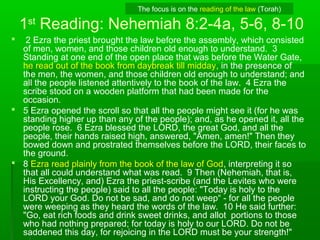
1st
Reading: Nehemiah 8:2-4a, 5-6, 8-10
 2 Ezra the priest brought the law before the assembly, which consisted
of men, women, and those children old enough to understand. 3
Standing at one end of the open place that was before the Water Gate,
he read out of the book from daybreak till midday, in the presence of
the men, the women, and those children old enough to understand; and
all the people listened attentively to the book of the law. 4 Ezra the
scribe stood on a wooden platform that had been made for the
occasion.
 5 Ezra opened the scroll so that all the people might see it (for he was
standing higher up than any of the people); and, as he opened it, all the
people rose. 6 Ezra blessed the LORD, the great God, and all the
people, their hands raised high, answered, "Amen, amen!" Then they
bowed down and prostrated themselves before the LORD, their faces to
the ground.
 8 Ezra read plainly from the book of the law of God, interpreting it so
that all could understand what was read. 9 Then (Nehemiah, that is,
His Excellency, and) Ezra the priest-scribe (and the Levites who were
instructing the people) said to all the people: "Today is holy to the
LORD your God. Do not be sad, and do not weep“ - for all the people
were weeping as they heard the words of the law. 10 He said further:
"Go, eat rich foods and drink sweet drinks, and allot portions to those
who had nothing prepared; for today is holy to our LORD. Do not be
saddened this day, for rejoicing in the LORD must be your strength!"
The focus is on the reading of the law (Torah)
1st
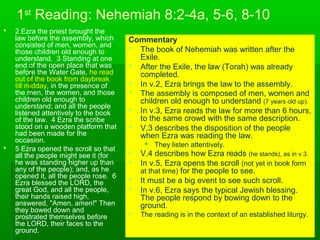
Reading: Nehemiah 8:2-4a, 5-6, 8-10
 2 Ezra the priest brought the
law before the assembly, which
consisted of men, women, and
those children old enough to
understand. 3 Standing at one
end of the open place that was
before the Water Gate, he read
out of the book from daybreak
till midday, in the presence of
the men, the women, and those
children old enough to
understand; and all the people
listened attentively to the book
of the law. 4 Ezra the scribe
stood on a wooden platform that
had been made for the
occasion.
 5 Ezra opened the scroll so that
all the people might see it (for
he was standing higher up than
any of the people); and, as he
opened it, all the people rose. 6
Ezra blessed the LORD, the
great God, and all the people,
their hands raised high,
answered, "Amen, amen!" Then
they bowed down and
prostrated themselves before
the LORD, their faces to the
ground.
Commentary
 The book of Nehemiah was written after the
Exile.
 After the Exile, the law (Torah) was already
completed.
 In v.2, Ezra brings the law to the assembly.
 The assembly is composed of men, women and
children old enough to understand (7 years old up).
 In v.3, Ezra reads the law for more than 6 hours,
to the same crowd with the same description.
 V.3 describes the disposition of the people
when Ezra was reading the law.
 They listen attentively.
 V.4 describes how Ezra reads (he stands), as in v.3.
 In v.5, Ezra opens the scroll (not yet in book form
at that time) for the people to see.
 It must be a big event to see such scroll.
 In v.6, Ezra says the typical Jewish blessing.
The people respond by bowing down to the
ground.
 The reading is in the context of an established liturgy.
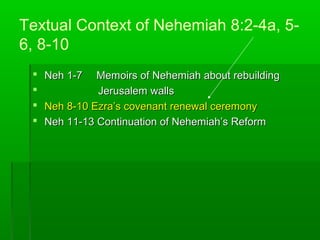
Textual Context of Nehemiah 8:2-4a, 5-
6, 8-10
 Neh 1-7Neh 1-7 Memoirs of Nehemiah about rebuildingMemoirs of Nehemiah about rebuilding
 Jerusalem wallsJerusalem walls
 Neh 8-10 Ezra’s covenant renewal ceremonyNeh 8-10 Ezra’s covenant renewal ceremony
 Neh 11-13 Continuation of Nehemiah’s ReformNeh 11-13 Continuation of Nehemiah’s Reform
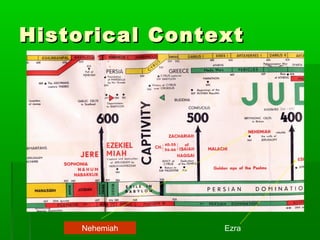
Historical ContextHistorical Context
Nehemiah Ezra
1st
Reading: Nehemiah 8:2-4a, 5-6, 8-10
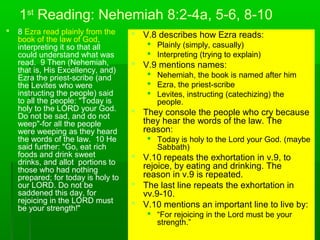
 8 Ezra read plainly from the
book of the law of God,
interpreting it so that all
could understand what was
read. 9 Then (Nehemiah,
that is, His Excellency, and)
Ezra the priest-scribe (and
the Levites who were
instructing the people) said
to all the people: "Today is
holy to the LORD your God.
Do not be sad, and do not
weep"-for all the people
were weeping as they heard
the words of the law. 10 He
said further: "Go, eat rich
foods and drink sweet
drinks, and allot portions to
those who had nothing
prepared; for today is holy to
our LORD. Do not be
saddened this day, for
rejoicing in the LORD must
be your strength!"
 V.8 describes how Ezra reads:
 Plainly (simply, casually)
 Interpreting (trying to explain)
 V.9 mentions names:
 Nehemiah, the book is named after him
 Ezra, the priest-scribe
 Levites, instructing (catechizing) the
people.
 They console the people who cry because
they hear the words of the law. The
reason:
 Today is holy to the Lord your God. (maybe
Sabbath)
 V.10 repeats the exhortation in v.9, to
rejoice, by eating and drinking. The
reason in v.9 is repeated.
 The last line repeats the exhortation in
vv.9-10.
 V.10 mentions an important line to live by:
 “For rejoicing in the Lord must be your
strength.”
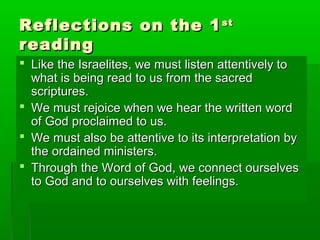
Reflections on the 1Reflections on the 1stst
readingreading
 Like the Israelites, we must listen attentively toLike the Israelites, we must listen attentively to
what is being read to us from the sacredwhat is being read to us from the sacred
scriptures.scriptures.
 We must rejoice when we hear the written wordWe must rejoice when we hear the written word
of God proclaimed to us.of God proclaimed to us.
 We must also be attentive to its interpretation byWe must also be attentive to its interpretation by
the ordained ministers.the ordained ministers.
 Through the Word of God, we connect ourselvesThrough the Word of God, we connect ourselves
to God and to ourselves with feelings.to God and to ourselves with feelings.
Resp. Psalm: 19:8, 9, 10, 15
 (cf John 6:63c)(cf John 6:63c) Your words, Lord, are Spirit and life.Your words, Lord, are Spirit and life.
 8 The law of the LORD is perfect,
refreshing the soul;
The decree of the LORD is trustworthy,
giving wisdom to the simple.
 9 The precepts of the LORD are right,
rejoicing the heart;
The command of the LORD is clear,
enlightening the eye.
 10The fear of the LORD is pure,
enduring forever;
The ordinances of the LORD are true,
all of them just.
 15 Let the words of my mouth and the thought of my heart
find favor before you,
O LORD, my rock and my redeemer.
Resp. Psalm: 19:8, 9, 10, 15
CommentaryCommentary
 The psalm is classified as the wisdomThe psalm is classified as the wisdom
psalm. It follows up the message of thepsalm. It follows up the message of the
11stst
reading.reading.
 In v.8, the wise man (psalmist) affirmsIn v.8, the wise man (psalmist) affirms
God’s law // decree as perfect //God’s law // decree as perfect //
trustworthy.trustworthy.
 Its effect: refreshes the soul // givesIts effect: refreshes the soul // gives
wisdom.wisdom.
 V.9 continues the wisdom saying aboutV.9 continues the wisdom saying about
the law.the law.
 The precepts are right // command clear.The precepts are right // command clear.
 Their effect: gives joy // enlightensTheir effect: gives joy // enlightens
 V.10 also continues the wisdom sayingV.10 also continues the wisdom saying
about the law.about the law.
 The fear of the Lord pure // ordinancesThe fear of the Lord pure // ordinances
true.true.
 They are described as for ever and just.They are described as for ever and just.
 V.15 is the prayer of the psalmist, thatV.15 is the prayer of the psalmist, that
his wisdom finds favor with God.his wisdom finds favor with God.
(cf John 6:63c)(cf John 6:63c) Your words, Lord, areYour words, Lord, are
Spirit and life.Spirit and life.
8 The law (torah) of the LORD is perfect,
refreshing the soul;
The decree of the LORD is trustworthy,
giving wisdom to the simple.
9 The precepts of the LORD are right,
rejoicing the heart;
The command of the LORD is clear,
enlightening the eye.
10The fear of the LORD is pure,
enduring forever;
The ordinances of the LORD are true,
all of them just.
15 Let the words of my mouth and the
thought of my heart
find favor before you,
O LORD, my rock and my redeemer.
Reflections on theReflections on the
PsalmPsalm
 Each Christian should be appreciative of God’sEach Christian should be appreciative of God’s
laws.laws.
 Observance of God’s laws makes us wise.Observance of God’s laws makes us wise.
 In God’s lawsIn God’s laws (decrees, ordinances, precepts, words),(decrees, ordinances, precepts, words),
there is truth, enlightenment, justice andthere is truth, enlightenment, justice and
happiness.happiness.
 How attracted are you to God’s Words?How attracted are you to God’s Words?
 Do you join Bible Study groups?Do you join Bible Study groups?
 What delights you more? Why?What delights you more? Why?
2nd
Reading: 1 Corinthians 12:12-14,27
 12 As a body is one though it has many parts,
and all the parts of the body, though many, are
one body, so also Christ. 13 For in one Spirit
we were all baptized into one body, whether
Jews or Greeks, slaves or free persons, and
we were all given to drink of one Spirit. 14 Now
the body is not a single part, but many.
 27 Now you are Christ's body, and individually
parts of it.
The focus is on belongingness to one body.
2nd
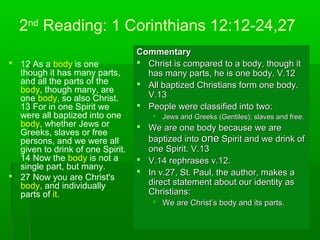
Reading: 1 Corinthians 12:12-24,27
 12 As a body is one
though it has many parts,
and all the parts of the
body, though many, are
one body, so also Christ.
13 For in one Spirit we
were all baptized into one
body, whether Jews or
Greeks, slaves or free
persons, and we were all
given to drink of one Spirit.
14 Now the body is not a
single part, but many.
 27 Now you are Christ's
body, and individually
parts of it.
CommentaryCommentary
 Christ is compared to a body, though itChrist is compared to a body, though it
has many parts, he is one body. V.12has many parts, he is one body. V.12
 All baptized Christians form one body.All baptized Christians form one body.
V.13V.13
 People were classified into two:People were classified into two:
 Jews and Greeks (Gentiles); slaves and free.Jews and Greeks (Gentiles); slaves and free.
 We are one body because we areWe are one body because we are
baptized intobaptized into oneone Spirit and we drink ofSpirit and we drink of
one Spirit. V.13one Spirit. V.13
 V.14 rephrases v.12.V.14 rephrases v.12.
 In v.27, St. Paul, the author, makes aIn v.27, St. Paul, the author, makes a
direct statement about our identity asdirect statement about our identity as
Christians:Christians:
 We are Christ’s body and its parts.We are Christ’s body and its parts.
Textual Context of 1 Corinthians
12:12-24,27
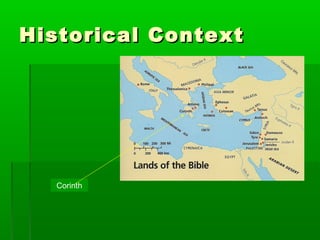
Historical ContextHistorical Context
Corinth
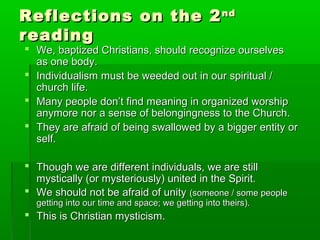
Reflections on the 2Reflections on the 2ndnd
readingreading
 We, baptized Christians, should recognize ourselvesWe, baptized Christians, should recognize ourselves
as one body.as one body.
 Individualism must be weeded out in our spiritual /Individualism must be weeded out in our spiritual /
church life.church life.
 Many people don’t find meaning in organized worshipMany people don’t find meaning in organized worship
anymore nor a sense of belongingness to the Church.anymore nor a sense of belongingness to the Church.
 They are afraid of being swallowed by a bigger entity orThey are afraid of being swallowed by a bigger entity or
self.self.
 Though we are different individuals, we are stillThough we are different individuals, we are still
mystically (or mysteriously) united in the Spirit.mystically (or mysteriously) united in the Spirit.
 We should not be afraid of unityWe should not be afraid of unity (someone / some people(someone / some people
getting into our time and space; we getting into theirs).getting into our time and space; we getting into theirs).
 This is Christian mysticism.This is Christian mysticism.
Gospel: Luke 1:1-4; 4:14-21
Prologue
 1 Since many have undertaken to compile a narrative of the events that
have been fulfilled among us, 2 just as those who were eyewitnesses from
the beginning and ministers of the word have handed them down to us, 3 I
too have decided, after investigating everything accurately anew, to write it
down in an orderly sequence for you, most excellent Theophilus, 4 so that
you may realize the certainty of the teachings you have received.
Inaugural Sermon in Nazareth
 14 Jesus returned to Galilee in the power of the Spirit, and news of him
spread throughout the whole region. 15 He taught in their synagogues and
was praised by all. 16 He came to Nazareth, where he had grown up, and
went according to his custom into the synagogue on the sabbath day. He
stood up to read 17 and was handed a scroll of the prophet Isaiah. He
unrolled the scroll and found the passage where it was written: 18 "The
Spirit of the Lord is upon me, because he has anointed me to bring glad
tidings to the poor. He has sent me to proclaim liberty to captives and
recovery of sight to the blind, to let the oppressed go free, 19 and to
proclaim a year acceptable to the Lord.“ 20 Rolling up the scroll, he handed
it back to the attendant and sat down, and the eyes of all in the synagogue
looked intently at him. 21 He said to them, "Today this scripture passage is
fulfilled in your hearing."
A simple outline!
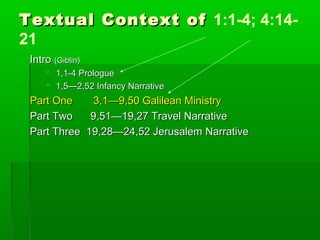
Textual Context ofTextual Context of 1:1-4; 4:14-
21
IntroIntro (Giblin)(Giblin)
 1,1-4 Prologue1,1-4 Prologue
 1,5—2,52 Infancy Narrative1,5—2,52 Infancy Narrative
Part One 3,1—9,50 Galilean MinistryPart One 3,1—9,50 Galilean Ministry
Part Two 9,51—19,27 Travel NarrativePart Two 9,51—19,27 Travel Narrative
Part Three 19,28—24,52 Jerusalem NarrativePart Three 19,28—24,52 Jerusalem Narrative
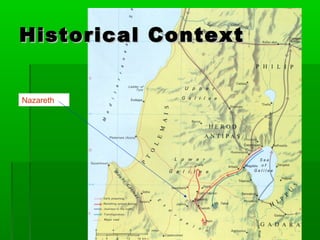
Nazareth
Historical ContextHistorical Context
Gospel: Luke 1:1-4; 4:14-21
 1 Since many have
undertaken to compile a
narrative of the events
that have been fulfilled
among us, 2 just as
those who were
eyewitnesses from the
beginning and ministers
of the word have
handed them down to
us, 3 I too have
decided, after
investigating everything
accurately anew, to
write it down in an
orderly sequence for
you, most excellent
Theophilus, 4 so that
you may realize the
certainty of the
teachings you have
received.
CommentaryCommentary
 Some commentators say that this prologueSome commentators say that this prologue
has put a Christian writing (Luke’s gospel)has put a Christian writing (Luke’s gospel)
into the map of a world class literature ininto the map of a world class literature in
those days, because of its elegant Greekthose days, because of its elegant Greek
formulation.formulation.
 V.1 indicates that Luke is not the only gospelV.1 indicates that Luke is not the only gospel
writer.writer.
 V.2 indicates how he came to know Jesus:V.2 indicates how he came to know Jesus:
from the eyewitnesses, who becamefrom the eyewitnesses, who became
ministers of the Word.ministers of the Word.
 V.3 indicates Luke’s own attempt to presentV.3 indicates Luke’s own attempt to present
his own version on the story of Jesushis own version on the story of Jesus
(Christ-events) for his friend Theophilus.(Christ-events) for his friend Theophilus.
 V.4 states the purpose of his gospel: toV.4 states the purpose of his gospel: to
confirm Theophilus’ or the readers’ faith.confirm Theophilus’ or the readers’ faith.
Gospel: Luke 1:1-4; 4:14-21
14 Jesus returned to Galilee in the
power of the Spirit, and news of him
spread throughout the whole region.
15 He taught in their synagogues
and was praised by all. 16 He came
to Nazareth, where he had grown up,
and went according to his custom
into the synagogue on the sabbath
day. He stood up to read 17 and
was handed a scroll of the prophet
Isaiah. He unrolled the scroll and
found the passage where it was
written: 18 "The Spirit of the Lord is
upon me, because he has anointed
me to bring glad tidings to the poor.
He has sent me to proclaim liberty to
captives and recovery of sight to the
blind, to let the oppressed go free,
19 and to proclaim a year acceptable
to the Lord.“ 20 Rolling up the scroll,
he handed it back to the attendant
and sat down, and the eyes of all in
the synagogue looked intently at him.
21 He said to them, "Today this
scripture passage is fulfilled in your
hearing."
 After the prologue, the liturgist dovetails thisAfter the prologue, the liturgist dovetails this
passage. In-between are the infancypassage. In-between are the infancy
narratives (chs 1-2), genealogy, baptism andnarratives (chs 1-2), genealogy, baptism and
temptations of Jesus.temptations of Jesus.
 In v.14, Jesus returns from the desert to hisIn v.14, Jesus returns from the desert to his
region Galilee.region Galilee.
 In v.15, Jesus teaches in the synagogues. HeIn v.15, Jesus teaches in the synagogues. He
is accepted.is accepted.
 In v.16, now he comes to preach in his ownIn v.16, now he comes to preach in his own
hometown Nazareth.hometown Nazareth.
 But first he reads from the scroll of Isaiah.But first he reads from the scroll of Isaiah.
V.17V.17
 Vv.18-19 are quotes from Isaiah.Vv.18-19 are quotes from Isaiah.
 V.20 is a rewind of v.17.V.20 is a rewind of v.17.
 In v.21, Jesus appropriates the words ofIn v.21, Jesus appropriates the words of
Isaiah.Isaiah.
 It is Jesus’ opening salvo (inaugural address),It is Jesus’ opening salvo (inaugural address),
his vision mission statement as he nowhis vision mission statement as he now
begins his ministry.begins his ministry.
 Jesus is like Ezra who reads the ScripturesJesus is like Ezra who reads the Scriptures
“for the first time” to the people.“for the first time” to the people.
Reflections on the gospelReflections on the gospel
readingreading
 The written Word of God is not just forThe written Word of God is not just for
Theophilus, but for us.Theophilus, but for us.
 Our faith is confirmed when we read the gospel.Our faith is confirmed when we read the gospel.
 The Word of God tells us of the life of Jesus andThe Word of God tells us of the life of Jesus and
his mission.his mission.
 We must become ministers of the Word, like theWe must become ministers of the Word, like the
eyewitnesses of Jesus.eyewitnesses of Jesus.
 As ministers of the Word, we must be engagedAs ministers of the Word, we must be engaged
in mission.in mission.
 Are you familiar with the Word of God?Are you familiar with the Word of God?
 Are you engaged in mission?Are you engaged in mission?
Tying the 3 readings and theTying the 3 readings and the
PsalmPsalm
 TheThe first readingfirst reading talks about the reading of thetalks about the reading of the
Torah for the first time.Torah for the first time.
 TheThe psalmpsalm rejoices over the Torah (law).rejoices over the Torah (law).
 TheThe second readingsecond reading talks about unity oftalks about unity of
Christians (keeping the law of the spirit).Christians (keeping the law of the spirit).
 TheThe gospel readinggospel reading talks about Jesus’talks about Jesus’
proclamation of the Word of God from theproclamation of the Word of God from the
prophets and his sermon for the first time.prophets and his sermon for the first time.
How to develop yourHow to develop your
homily/sharinghomily/sharing
 First of all, the preacher must be conscious ofFirst of all, the preacher must be conscious of
his daunting task as an evangelizer.his daunting task as an evangelizer.
 He is at the pulpit to proclaim theHe is at the pulpit to proclaim the Word of God.Word of God.
 The preacher must be prepared to develop hisThe preacher must be prepared to develop his
homily.homily. (He must organize his thoughts, follow a(He must organize his thoughts, follow a
certain outline.)certain outline.)
 TheThe first readingfirst reading narrates to us about thenarrates to us about the
reading of thereading of the TorahTorah, for the first time in the life, for the first time in the life
of the Israelites.of the Israelites.
 There was preparationThere was preparation (platform for all people to(platform for all people to
see the reader).see the reader).
 The people listened attentively andThe people listened attentively and
enthusiastically from early morning to midday.enthusiastically from early morning to midday.
 The people cried as a result of the reading ofThe people cried as a result of the reading of
thethe TorahTorah. They became emotional.. They became emotional.
 They responded with thanksgiving and hope.They responded with thanksgiving and hope.
 The psalm indicates a responsive writer whoThe psalm indicates a responsive writer who
has long meditated upon thehas long meditated upon the law of Godlaw of God..
 He findsHe finds itit helpful.helpful. ItIt makes him wise andmakes him wise and
happy.happy.
 TheThe second readingsecond reading presents the outcome ofpresents the outcome of
being baptized into the one Spirit.being baptized into the one Spirit.
 We become incorporated into the body of Christ.We become incorporated into the body of Christ.
 We become one, though many differentWe become one, though many different
individuals.individuals.
 It is not according toIt is not according to lawlaw (or to the(or to the spiritspirit), if we), if we
live in isolation, trying to preserve our “purity” bylive in isolation, trying to preserve our “purity” by
not associating with anyone, with the othernot associating with anyone, with the other
members of the Church.members of the Church.
 Listening to theListening to the Word of GodWord of God must keep usmust keep us
united in faith and action, with Jesus and with theunited in faith and action, with Jesus and with the
Church.Church.
 TheThe gospel readinggospel reading, like the 1, like the 1stst
reading, talksreading, talks
about Jesus’ reading of theabout Jesus’ reading of the sacred scripturessacred scriptures..
 Jesus’ appropriation of theJesus’ appropriation of the Word of GodWord of God fromfrom
Isaiah was well-received by the people.Isaiah was well-received by the people.
 Through theThrough the biblical textsbiblical texts, we come to know our, we come to know our
mission.mission.
 The prologue (1,1-4) indicates Luke’s passionThe prologue (1,1-4) indicates Luke’s passion
for thefor the Word of GodWord of God. He is compelled to write an. He is compelled to write an
account about Jesusaccount about Jesus for the sake of his reader.for the sake of his reader.
 If we are truly touched by the life of Jesus, weIf we are truly touched by the life of Jesus, we
feel obliged to sharefeel obliged to share itit to others, by writing, storyto others, by writing, story
telling or other means.telling or other means.
 Ordained ministers must take care to deliverOrdained ministers must take care to deliver
good homilies.good homilies.
 This is their primary task, toThis is their primary task, to evangelizeevangelize,,
according to canon law.according to canon law.
 Now they can employ modern technologyNow they can employ modern technology
(computers and LCDs)(computers and LCDs) when preaching.when preaching.
 However, academic preparation and gadgetsHowever, academic preparation and gadgets
are not enough.are not enough.
 The preacher’s good example and holy life areThe preacher’s good example and holy life are
far more necessary.far more necessary.
 Fr. Jim Ferry, MM, once said to the FranciscanFr. Jim Ferry, MM, once said to the Franciscan
priests: “Your preaching is determined by thepriests: “Your preaching is determined by the
way you live your priesthood.”way you live your priesthood.”
 Likewise, the faithful must take seriously theLikewise, the faithful must take seriously the
wordswords of the authentic preachers.of the authentic preachers.
 Catholics should know whom to listen toCatholics should know whom to listen to (their(their
pastors or some born-again tele-evangelists?).pastors or some born-again tele-evangelists?).
 The lay seem to prefer demagogues andThe lay seem to prefer demagogues and
entertainers, rather than serious proclaimers ofentertainers, rather than serious proclaimers of
thethe Word of GodWord of God, that challenge their old, that challenge their old
beliefs, old system and bad habits.beliefs, old system and bad habits.
 That’s why, they are never evangelized.That’s why, they are never evangelized.
 As a result, they can never be committed toAs a result, they can never be committed to
liberate people from sinliberate people from sin (oppression, blindness,(oppression, blindness,
ignorance, etc.).ignorance, etc.).
 They are just trained to say endlessly, “Amen, alleluia.”They are just trained to say endlessly, “Amen, alleluia.”
 TheThe eucharisteucharist is the food of committedis the food of committed
Christians, as a result of listening intently to theChristians, as a result of listening intently to the
Word of GodWord of God and good preaching.and good preaching.
 The holyThe holy eucharisteucharist is for those who love theis for those who love the
Word of GodWord of God and are engaged in the Newand are engaged in the New
Evangelization.Evangelization.
Our Context of Sin andOur Context of Sin and
GraceGrace
 Christians who don’t read theChristians who don’t read the
BibleBible
 Lousy homilistsLousy homilists
 Unprepared preachersUnprepared preachers
 Un-evangelized parishUn-evangelized parish
leaders (they should not lead)leaders (they should not lead)
 Intoxicated church (emphasisIntoxicated church (emphasis
only on receiving holyonly on receiving holy
communion, but does notcommunion, but does not
care about the Word of God)care about the Word of God)
 Decrepit seminaries andDecrepit seminaries and
convents, no good scripturalconvents, no good scriptural
librarylibrary
 FundamentalismFundamentalism
 Good listeners of the WordGood listeners of the Word
 Lectio divinaLectio divina
 Bible studies, groupsBible studies, groups
 Bible ReflectionsBible Reflections
 Biblical apostolateBiblical apostolate
 Bible TranslatorsBible Translators
 PBS, ECBAPBS, ECBA
 National Bible SundayNational Bible Sunday
 National Bible WeekNational Bible Week
 Liberation theologyLiberation theology
 MissionMission
 BECBEC
 Interpretation of the Bible in theInterpretation of the Bible in the
ChurchChurch
 Dei VerbumDei Verbum
 Verbum DominiVerbum Domini
 Year of FaithYear of Faith
“Proclaim the Word, Profess the Faith” – 2 Tim 4,2
Suggested SongsSuggested Songs
 SharingSharing
 http://www.youtube.com/watch?v=q1ij6D6EyeIhttp://www.youtube.com/watch?v=q1ij6D6EyeI
 One Bread One BodyOne Bread One Body
 http://www.youtube.com/watch?v=WIl8CHLR4CQhttp://www.youtube.com/watch?v=WIl8CHLR4CQ
Go Tell EveryoneGo Tell Everyone
 All that the Lord has spoken, slide to 7,52All that the Lord has spoken, slide to 7,52
 http://http://www.youtube.com/watch?v=e7fhhE7xhzEwww.youtube.com/watch?v=e7fhhE7xhzE
 Sumasaakin ang EspirituSumasaakin ang Espiritu by Vinteresby Vinteres
 Dear brothers and sisters,
 Let our faith grow mature by listening to
God and obeying him.
 Fr. Cielo


3rd Sunday C

  • 1.
    Welcome to ourWelcometo our Bible StudyBible Study 33rdrd Sunday in Ordinary Time CSunday in Ordinary Time C 24 January 201624 January 2016 In preparation for this Sunday’s LiturgyIn preparation for this Sunday’s Liturgy As aid in focusing our homilies and sharingAs aid in focusing our homilies and sharing Prepared by Fr. Cielo R. Almazan, OFM National Bible Sunday
  • 2.
    1st Reading: Nehemiah 8:2-4a,5-6, 8-10  2 Ezra the priest brought the law before the assembly, which consisted of men, women, and those children old enough to understand. 3 Standing at one end of the open place that was before the Water Gate, he read out of the book from daybreak till midday, in the presence of the men, the women, and those children old enough to understand; and all the people listened attentively to the book of the law. 4 Ezra the scribe stood on a wooden platform that had been made for the occasion.  5 Ezra opened the scroll so that all the people might see it (for he was standing higher up than any of the people); and, as he opened it, all the people rose. 6 Ezra blessed the LORD, the great God, and all the people, their hands raised high, answered, "Amen, amen!" Then they bowed down and prostrated themselves before the LORD, their faces to the ground.  8 Ezra read plainly from the book of the law of God, interpreting it so that all could understand what was read. 9 Then (Nehemiah, that is, His Excellency, and) Ezra the priest-scribe (and the Levites who were instructing the people) said to all the people: "Today is holy to the LORD your God. Do not be sad, and do not weep“ - for all the people were weeping as they heard the words of the law. 10 He said further: "Go, eat rich foods and drink sweet drinks, and allot portions to those who had nothing prepared; for today is holy to our LORD. Do not be saddened this day, for rejoicing in the LORD must be your strength!" The focus is on the reading of the law (Torah)
  • 3.
    1st Reading: Nehemiah 8:2-4a,5-6, 8-10  2 Ezra the priest brought the law before the assembly, which consisted of men, women, and those children old enough to understand. 3 Standing at one end of the open place that was before the Water Gate, he read out of the book from daybreak till midday, in the presence of the men, the women, and those children old enough to understand; and all the people listened attentively to the book of the law. 4 Ezra the scribe stood on a wooden platform that had been made for the occasion.  5 Ezra opened the scroll so that all the people might see it (for he was standing higher up than any of the people); and, as he opened it, all the people rose. 6 Ezra blessed the LORD, the great God, and all the people, their hands raised high, answered, "Amen, amen!" Then they bowed down and prostrated themselves before the LORD, their faces to the ground. Commentary  The book of Nehemiah was written after the Exile.  After the Exile, the law (Torah) was already completed.  In v.2, Ezra brings the law to the assembly.  The assembly is composed of men, women and children old enough to understand (7 years old up).  In v.3, Ezra reads the law for more than 6 hours, to the same crowd with the same description.  V.3 describes the disposition of the people when Ezra was reading the law.  They listen attentively.  V.4 describes how Ezra reads (he stands), as in v.3.  In v.5, Ezra opens the scroll (not yet in book form at that time) for the people to see.  It must be a big event to see such scroll.  In v.6, Ezra says the typical Jewish blessing. The people respond by bowing down to the ground.  The reading is in the context of an established liturgy.
  • 4.
    Textual Context ofNehemiah 8:2-4a, 5- 6, 8-10  Neh 1-7Neh 1-7 Memoirs of Nehemiah about rebuildingMemoirs of Nehemiah about rebuilding  Jerusalem wallsJerusalem walls  Neh 8-10 Ezra’s covenant renewal ceremonyNeh 8-10 Ezra’s covenant renewal ceremony  Neh 11-13 Continuation of Nehemiah’s ReformNeh 11-13 Continuation of Nehemiah’s Reform
  • 5.
  • 6.
    1st Reading: Nehemiah 8:2-4a,5-6, 8-10  8 Ezra read plainly from the book of the law of God, interpreting it so that all could understand what was read. 9 Then (Nehemiah, that is, His Excellency, and) Ezra the priest-scribe (and the Levites who were instructing the people) said to all the people: "Today is holy to the LORD your God. Do not be sad, and do not weep"-for all the people were weeping as they heard the words of the law. 10 He said further: "Go, eat rich foods and drink sweet drinks, and allot portions to those who had nothing prepared; for today is holy to our LORD. Do not be saddened this day, for rejoicing in the LORD must be your strength!"  V.8 describes how Ezra reads:  Plainly (simply, casually)  Interpreting (trying to explain)  V.9 mentions names:  Nehemiah, the book is named after him  Ezra, the priest-scribe  Levites, instructing (catechizing) the people.  They console the people who cry because they hear the words of the law. The reason:  Today is holy to the Lord your God. (maybe Sabbath)  V.10 repeats the exhortation in v.9, to rejoice, by eating and drinking. The reason in v.9 is repeated.  The last line repeats the exhortation in vv.9-10.  V.10 mentions an important line to live by:  “For rejoicing in the Lord must be your strength.”
  • 7.
    Reflections on the1Reflections on the 1stst readingreading  Like the Israelites, we must listen attentively toLike the Israelites, we must listen attentively to what is being read to us from the sacredwhat is being read to us from the sacred scriptures.scriptures.  We must rejoice when we hear the written wordWe must rejoice when we hear the written word of God proclaimed to us.of God proclaimed to us.  We must also be attentive to its interpretation byWe must also be attentive to its interpretation by the ordained ministers.the ordained ministers.  Through the Word of God, we connect ourselvesThrough the Word of God, we connect ourselves to God and to ourselves with feelings.to God and to ourselves with feelings.
  • 8.
    Resp. Psalm: 19:8,9, 10, 15  (cf John 6:63c)(cf John 6:63c) Your words, Lord, are Spirit and life.Your words, Lord, are Spirit and life.  8 The law of the LORD is perfect, refreshing the soul; The decree of the LORD is trustworthy, giving wisdom to the simple.  9 The precepts of the LORD are right, rejoicing the heart; The command of the LORD is clear, enlightening the eye.  10The fear of the LORD is pure, enduring forever; The ordinances of the LORD are true, all of them just.  15 Let the words of my mouth and the thought of my heart find favor before you, O LORD, my rock and my redeemer.
  • 9.
    Resp. Psalm: 19:8,9, 10, 15 CommentaryCommentary  The psalm is classified as the wisdomThe psalm is classified as the wisdom psalm. It follows up the message of thepsalm. It follows up the message of the 11stst reading.reading.  In v.8, the wise man (psalmist) affirmsIn v.8, the wise man (psalmist) affirms God’s law // decree as perfect //God’s law // decree as perfect // trustworthy.trustworthy.  Its effect: refreshes the soul // givesIts effect: refreshes the soul // gives wisdom.wisdom.  V.9 continues the wisdom saying aboutV.9 continues the wisdom saying about the law.the law.  The precepts are right // command clear.The precepts are right // command clear.  Their effect: gives joy // enlightensTheir effect: gives joy // enlightens  V.10 also continues the wisdom sayingV.10 also continues the wisdom saying about the law.about the law.  The fear of the Lord pure // ordinancesThe fear of the Lord pure // ordinances true.true.  They are described as for ever and just.They are described as for ever and just.  V.15 is the prayer of the psalmist, thatV.15 is the prayer of the psalmist, that his wisdom finds favor with God.his wisdom finds favor with God. (cf John 6:63c)(cf John 6:63c) Your words, Lord, areYour words, Lord, are Spirit and life.Spirit and life. 8 The law (torah) of the LORD is perfect, refreshing the soul; The decree of the LORD is trustworthy, giving wisdom to the simple. 9 The precepts of the LORD are right, rejoicing the heart; The command of the LORD is clear, enlightening the eye. 10The fear of the LORD is pure, enduring forever; The ordinances of the LORD are true, all of them just. 15 Let the words of my mouth and the thought of my heart find favor before you, O LORD, my rock and my redeemer.
  • 10.
    Reflections on theReflectionson the PsalmPsalm  Each Christian should be appreciative of God’sEach Christian should be appreciative of God’s laws.laws.  Observance of God’s laws makes us wise.Observance of God’s laws makes us wise.  In God’s lawsIn God’s laws (decrees, ordinances, precepts, words),(decrees, ordinances, precepts, words), there is truth, enlightenment, justice andthere is truth, enlightenment, justice and happiness.happiness.  How attracted are you to God’s Words?How attracted are you to God’s Words?  Do you join Bible Study groups?Do you join Bible Study groups?  What delights you more? Why?What delights you more? Why?
  • 11.
    2nd Reading: 1 Corinthians12:12-14,27  12 As a body is one though it has many parts, and all the parts of the body, though many, are one body, so also Christ. 13 For in one Spirit we were all baptized into one body, whether Jews or Greeks, slaves or free persons, and we were all given to drink of one Spirit. 14 Now the body is not a single part, but many.  27 Now you are Christ's body, and individually parts of it. The focus is on belongingness to one body.
  • 12.
    2nd Reading: 1 Corinthians12:12-24,27  12 As a body is one though it has many parts, and all the parts of the body, though many, are one body, so also Christ. 13 For in one Spirit we were all baptized into one body, whether Jews or Greeks, slaves or free persons, and we were all given to drink of one Spirit. 14 Now the body is not a single part, but many.  27 Now you are Christ's body, and individually parts of it. CommentaryCommentary  Christ is compared to a body, though itChrist is compared to a body, though it has many parts, he is one body. V.12has many parts, he is one body. V.12  All baptized Christians form one body.All baptized Christians form one body. V.13V.13  People were classified into two:People were classified into two:  Jews and Greeks (Gentiles); slaves and free.Jews and Greeks (Gentiles); slaves and free.  We are one body because we areWe are one body because we are baptized intobaptized into oneone Spirit and we drink ofSpirit and we drink of one Spirit. V.13one Spirit. V.13  V.14 rephrases v.12.V.14 rephrases v.12.  In v.27, St. Paul, the author, makes aIn v.27, St. Paul, the author, makes a direct statement about our identity asdirect statement about our identity as Christians:Christians:  We are Christ’s body and its parts.We are Christ’s body and its parts.
  • 13.
    Textual Context of1 Corinthians 12:12-24,27
  • 14.
  • 15.
    Reflections on the2Reflections on the 2ndnd readingreading  We, baptized Christians, should recognize ourselvesWe, baptized Christians, should recognize ourselves as one body.as one body.  Individualism must be weeded out in our spiritual /Individualism must be weeded out in our spiritual / church life.church life.  Many people don’t find meaning in organized worshipMany people don’t find meaning in organized worship anymore nor a sense of belongingness to the Church.anymore nor a sense of belongingness to the Church.  They are afraid of being swallowed by a bigger entity orThey are afraid of being swallowed by a bigger entity or self.self.  Though we are different individuals, we are stillThough we are different individuals, we are still mystically (or mysteriously) united in the Spirit.mystically (or mysteriously) united in the Spirit.  We should not be afraid of unityWe should not be afraid of unity (someone / some people(someone / some people getting into our time and space; we getting into theirs).getting into our time and space; we getting into theirs).  This is Christian mysticism.This is Christian mysticism.
  • 16.
    Gospel: Luke 1:1-4;4:14-21 Prologue  1 Since many have undertaken to compile a narrative of the events that have been fulfilled among us, 2 just as those who were eyewitnesses from the beginning and ministers of the word have handed them down to us, 3 I too have decided, after investigating everything accurately anew, to write it down in an orderly sequence for you, most excellent Theophilus, 4 so that you may realize the certainty of the teachings you have received. Inaugural Sermon in Nazareth  14 Jesus returned to Galilee in the power of the Spirit, and news of him spread throughout the whole region. 15 He taught in their synagogues and was praised by all. 16 He came to Nazareth, where he had grown up, and went according to his custom into the synagogue on the sabbath day. He stood up to read 17 and was handed a scroll of the prophet Isaiah. He unrolled the scroll and found the passage where it was written: 18 "The Spirit of the Lord is upon me, because he has anointed me to bring glad tidings to the poor. He has sent me to proclaim liberty to captives and recovery of sight to the blind, to let the oppressed go free, 19 and to proclaim a year acceptable to the Lord.“ 20 Rolling up the scroll, he handed it back to the attendant and sat down, and the eyes of all in the synagogue looked intently at him. 21 He said to them, "Today this scripture passage is fulfilled in your hearing." A simple outline!
  • 17.
    Textual Context ofTextualContext of 1:1-4; 4:14- 21 IntroIntro (Giblin)(Giblin)  1,1-4 Prologue1,1-4 Prologue  1,5—2,52 Infancy Narrative1,5—2,52 Infancy Narrative Part One 3,1—9,50 Galilean MinistryPart One 3,1—9,50 Galilean Ministry Part Two 9,51—19,27 Travel NarrativePart Two 9,51—19,27 Travel Narrative Part Three 19,28—24,52 Jerusalem NarrativePart Three 19,28—24,52 Jerusalem Narrative
  • 18.
  • 19.
    Gospel: Luke 1:1-4;4:14-21  1 Since many have undertaken to compile a narrative of the events that have been fulfilled among us, 2 just as those who were eyewitnesses from the beginning and ministers of the word have handed them down to us, 3 I too have decided, after investigating everything accurately anew, to write it down in an orderly sequence for you, most excellent Theophilus, 4 so that you may realize the certainty of the teachings you have received. CommentaryCommentary  Some commentators say that this prologueSome commentators say that this prologue has put a Christian writing (Luke’s gospel)has put a Christian writing (Luke’s gospel) into the map of a world class literature ininto the map of a world class literature in those days, because of its elegant Greekthose days, because of its elegant Greek formulation.formulation.  V.1 indicates that Luke is not the only gospelV.1 indicates that Luke is not the only gospel writer.writer.  V.2 indicates how he came to know Jesus:V.2 indicates how he came to know Jesus: from the eyewitnesses, who becamefrom the eyewitnesses, who became ministers of the Word.ministers of the Word.  V.3 indicates Luke’s own attempt to presentV.3 indicates Luke’s own attempt to present his own version on the story of Jesushis own version on the story of Jesus (Christ-events) for his friend Theophilus.(Christ-events) for his friend Theophilus.  V.4 states the purpose of his gospel: toV.4 states the purpose of his gospel: to confirm Theophilus’ or the readers’ faith.confirm Theophilus’ or the readers’ faith.
  • 20.
    Gospel: Luke 1:1-4;4:14-21 14 Jesus returned to Galilee in the power of the Spirit, and news of him spread throughout the whole region. 15 He taught in their synagogues and was praised by all. 16 He came to Nazareth, where he had grown up, and went according to his custom into the synagogue on the sabbath day. He stood up to read 17 and was handed a scroll of the prophet Isaiah. He unrolled the scroll and found the passage where it was written: 18 "The Spirit of the Lord is upon me, because he has anointed me to bring glad tidings to the poor. He has sent me to proclaim liberty to captives and recovery of sight to the blind, to let the oppressed go free, 19 and to proclaim a year acceptable to the Lord.“ 20 Rolling up the scroll, he handed it back to the attendant and sat down, and the eyes of all in the synagogue looked intently at him. 21 He said to them, "Today this scripture passage is fulfilled in your hearing."  After the prologue, the liturgist dovetails thisAfter the prologue, the liturgist dovetails this passage. In-between are the infancypassage. In-between are the infancy narratives (chs 1-2), genealogy, baptism andnarratives (chs 1-2), genealogy, baptism and temptations of Jesus.temptations of Jesus.  In v.14, Jesus returns from the desert to hisIn v.14, Jesus returns from the desert to his region Galilee.region Galilee.  In v.15, Jesus teaches in the synagogues. HeIn v.15, Jesus teaches in the synagogues. He is accepted.is accepted.  In v.16, now he comes to preach in his ownIn v.16, now he comes to preach in his own hometown Nazareth.hometown Nazareth.  But first he reads from the scroll of Isaiah.But first he reads from the scroll of Isaiah. V.17V.17  Vv.18-19 are quotes from Isaiah.Vv.18-19 are quotes from Isaiah.  V.20 is a rewind of v.17.V.20 is a rewind of v.17.  In v.21, Jesus appropriates the words ofIn v.21, Jesus appropriates the words of Isaiah.Isaiah.  It is Jesus’ opening salvo (inaugural address),It is Jesus’ opening salvo (inaugural address), his vision mission statement as he nowhis vision mission statement as he now begins his ministry.begins his ministry.  Jesus is like Ezra who reads the ScripturesJesus is like Ezra who reads the Scriptures “for the first time” to the people.“for the first time” to the people.
  • 21.
    Reflections on thegospelReflections on the gospel readingreading  The written Word of God is not just forThe written Word of God is not just for Theophilus, but for us.Theophilus, but for us.  Our faith is confirmed when we read the gospel.Our faith is confirmed when we read the gospel.  The Word of God tells us of the life of Jesus andThe Word of God tells us of the life of Jesus and his mission.his mission.  We must become ministers of the Word, like theWe must become ministers of the Word, like the eyewitnesses of Jesus.eyewitnesses of Jesus.  As ministers of the Word, we must be engagedAs ministers of the Word, we must be engaged in mission.in mission.  Are you familiar with the Word of God?Are you familiar with the Word of God?  Are you engaged in mission?Are you engaged in mission?
  • 22.
    Tying the 3readings and theTying the 3 readings and the PsalmPsalm  TheThe first readingfirst reading talks about the reading of thetalks about the reading of the Torah for the first time.Torah for the first time.  TheThe psalmpsalm rejoices over the Torah (law).rejoices over the Torah (law).  TheThe second readingsecond reading talks about unity oftalks about unity of Christians (keeping the law of the spirit).Christians (keeping the law of the spirit).  TheThe gospel readinggospel reading talks about Jesus’talks about Jesus’ proclamation of the Word of God from theproclamation of the Word of God from the prophets and his sermon for the first time.prophets and his sermon for the first time.
  • 23.
    How to developyourHow to develop your homily/sharinghomily/sharing  First of all, the preacher must be conscious ofFirst of all, the preacher must be conscious of his daunting task as an evangelizer.his daunting task as an evangelizer.  He is at the pulpit to proclaim theHe is at the pulpit to proclaim the Word of God.Word of God.  The preacher must be prepared to develop hisThe preacher must be prepared to develop his homily.homily. (He must organize his thoughts, follow a(He must organize his thoughts, follow a certain outline.)certain outline.)
  • 24.
     TheThe firstreadingfirst reading narrates to us about thenarrates to us about the reading of thereading of the TorahTorah, for the first time in the life, for the first time in the life of the Israelites.of the Israelites.  There was preparationThere was preparation (platform for all people to(platform for all people to see the reader).see the reader).  The people listened attentively andThe people listened attentively and enthusiastically from early morning to midday.enthusiastically from early morning to midday.  The people cried as a result of the reading ofThe people cried as a result of the reading of thethe TorahTorah. They became emotional.. They became emotional.  They responded with thanksgiving and hope.They responded with thanksgiving and hope.  The psalm indicates a responsive writer whoThe psalm indicates a responsive writer who has long meditated upon thehas long meditated upon the law of Godlaw of God..  He findsHe finds itit helpful.helpful. ItIt makes him wise andmakes him wise and happy.happy.
  • 25.
     TheThe secondreadingsecond reading presents the outcome ofpresents the outcome of being baptized into the one Spirit.being baptized into the one Spirit.  We become incorporated into the body of Christ.We become incorporated into the body of Christ.  We become one, though many differentWe become one, though many different individuals.individuals.  It is not according toIt is not according to lawlaw (or to the(or to the spiritspirit), if we), if we live in isolation, trying to preserve our “purity” bylive in isolation, trying to preserve our “purity” by not associating with anyone, with the othernot associating with anyone, with the other members of the Church.members of the Church.  Listening to theListening to the Word of GodWord of God must keep usmust keep us united in faith and action, with Jesus and with theunited in faith and action, with Jesus and with the Church.Church.
  • 26.
     TheThe gospelreadinggospel reading, like the 1, like the 1stst reading, talksreading, talks about Jesus’ reading of theabout Jesus’ reading of the sacred scripturessacred scriptures..  Jesus’ appropriation of theJesus’ appropriation of the Word of GodWord of God fromfrom Isaiah was well-received by the people.Isaiah was well-received by the people.  Through theThrough the biblical textsbiblical texts, we come to know our, we come to know our mission.mission.  The prologue (1,1-4) indicates Luke’s passionThe prologue (1,1-4) indicates Luke’s passion for thefor the Word of GodWord of God. He is compelled to write an. He is compelled to write an account about Jesusaccount about Jesus for the sake of his reader.for the sake of his reader.  If we are truly touched by the life of Jesus, weIf we are truly touched by the life of Jesus, we feel obliged to sharefeel obliged to share itit to others, by writing, storyto others, by writing, story telling or other means.telling or other means.
  • 27.
     Ordained ministersmust take care to deliverOrdained ministers must take care to deliver good homilies.good homilies.  This is their primary task, toThis is their primary task, to evangelizeevangelize,, according to canon law.according to canon law.  Now they can employ modern technologyNow they can employ modern technology (computers and LCDs)(computers and LCDs) when preaching.when preaching.  However, academic preparation and gadgetsHowever, academic preparation and gadgets are not enough.are not enough.  The preacher’s good example and holy life areThe preacher’s good example and holy life are far more necessary.far more necessary.  Fr. Jim Ferry, MM, once said to the FranciscanFr. Jim Ferry, MM, once said to the Franciscan priests: “Your preaching is determined by thepriests: “Your preaching is determined by the way you live your priesthood.”way you live your priesthood.”
  • 28.
     Likewise, thefaithful must take seriously theLikewise, the faithful must take seriously the wordswords of the authentic preachers.of the authentic preachers.  Catholics should know whom to listen toCatholics should know whom to listen to (their(their pastors or some born-again tele-evangelists?).pastors or some born-again tele-evangelists?).  The lay seem to prefer demagogues andThe lay seem to prefer demagogues and entertainers, rather than serious proclaimers ofentertainers, rather than serious proclaimers of thethe Word of GodWord of God, that challenge their old, that challenge their old beliefs, old system and bad habits.beliefs, old system and bad habits.  That’s why, they are never evangelized.That’s why, they are never evangelized.  As a result, they can never be committed toAs a result, they can never be committed to liberate people from sinliberate people from sin (oppression, blindness,(oppression, blindness, ignorance, etc.).ignorance, etc.).  They are just trained to say endlessly, “Amen, alleluia.”They are just trained to say endlessly, “Amen, alleluia.”
  • 29.
     TheThe eucharisteucharistis the food of committedis the food of committed Christians, as a result of listening intently to theChristians, as a result of listening intently to the Word of GodWord of God and good preaching.and good preaching.  The holyThe holy eucharisteucharist is for those who love theis for those who love the Word of GodWord of God and are engaged in the Newand are engaged in the New Evangelization.Evangelization.
  • 30.
    Our Context ofSin andOur Context of Sin and GraceGrace  Christians who don’t read theChristians who don’t read the BibleBible  Lousy homilistsLousy homilists  Unprepared preachersUnprepared preachers  Un-evangelized parishUn-evangelized parish leaders (they should not lead)leaders (they should not lead)  Intoxicated church (emphasisIntoxicated church (emphasis only on receiving holyonly on receiving holy communion, but does notcommunion, but does not care about the Word of God)care about the Word of God)  Decrepit seminaries andDecrepit seminaries and convents, no good scripturalconvents, no good scriptural librarylibrary  FundamentalismFundamentalism  Good listeners of the WordGood listeners of the Word  Lectio divinaLectio divina  Bible studies, groupsBible studies, groups  Bible ReflectionsBible Reflections  Biblical apostolateBiblical apostolate  Bible TranslatorsBible Translators  PBS, ECBAPBS, ECBA  National Bible SundayNational Bible Sunday  National Bible WeekNational Bible Week  Liberation theologyLiberation theology  MissionMission  BECBEC  Interpretation of the Bible in theInterpretation of the Bible in the ChurchChurch  Dei VerbumDei Verbum  Verbum DominiVerbum Domini  Year of FaithYear of Faith “Proclaim the Word, Profess the Faith” – 2 Tim 4,2
  • 31.
    Suggested SongsSuggested Songs SharingSharing  http://www.youtube.com/watch?v=q1ij6D6EyeIhttp://www.youtube.com/watch?v=q1ij6D6EyeI  One Bread One BodyOne Bread One Body  http://www.youtube.com/watch?v=WIl8CHLR4CQhttp://www.youtube.com/watch?v=WIl8CHLR4CQ Go Tell EveryoneGo Tell Everyone  All that the Lord has spoken, slide to 7,52All that the Lord has spoken, slide to 7,52  http://http://www.youtube.com/watch?v=e7fhhE7xhzEwww.youtube.com/watch?v=e7fhhE7xhzE  Sumasaakin ang EspirituSumasaakin ang Espiritu by Vinteresby Vinteres
  • 32.
     Dear brothersand sisters,  Let our faith grow mature by listening to God and obeying him.  Fr. Cielo 