EYEBALL
Chair Person: Dr. R.D. Virupaxi
Presenter: Dr. Kapil Amgain
Scheme of Presentation
•
•
•
•
•

Introduction
Structure
Blood supply
Nerve supply
Applied Anatomy
• The organ of
sight
• Occupies the
ant.1/3 of the
orbital cavity
• Embedded in
fat, separated
by a
membranous
sac, the fascia
bulbi.
• Eyeball
closely
resembles
the Camera

Introduction
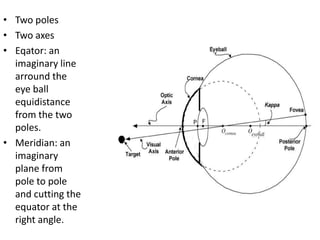
• Two poles
• Two axes
• Eqator: an
imaginary line
arround the
eye ball
equidistance
from the two
poles.
• Meridian: an
imaginary
plane from
pole to pole
and cutting the
equator at the
right angle.
Concentric coats/tunics of eyeball
• Outer fibrous coat: Sclera and Cornea
• Middle vascular coat: Choroid, Ciliary Body
and Iris
• Inner nervous coat: Retina
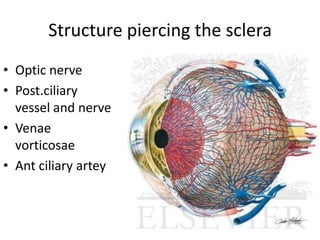
Structure piercing the sclera
• Optic nerve
• Post.ciliary
vessel and nerve
• Venae
vorticosae
• Ant ciliary artey
Cornea
• Structure
Histology of the cornea
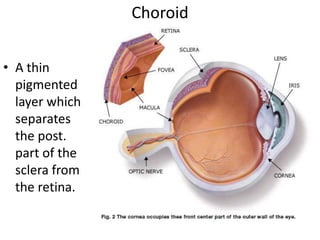
Choroid
• A thin
pigmented
layer which
separates
the post.
part of the
sclera from
the retina.
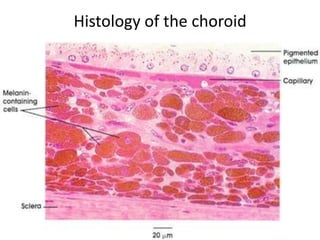
Histology of the choroid
Ciliary body
• A thickened
part of uveal
tract lying just
post.to the
corneal limbus.
• Pars plana
(ciliary ring)
• Pars plicata
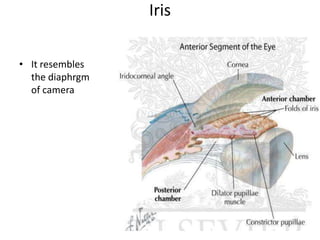
Iris
• It resembles
the diaphrgm
of camera
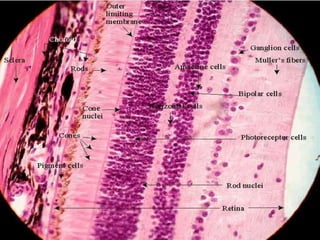
Inner coat or Retina
• It is the thin, delicate inner layer of the eyeball
• Continuous posteriorly with the optic nerve
Histology of the retina
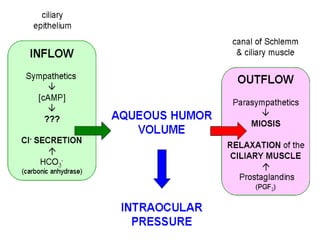
Aqueous humour
Composition
• Amino acids
transported by
cilliary muscles.
• 98% water
• Electrolytes
• Ascorbic acid
• Glutathione
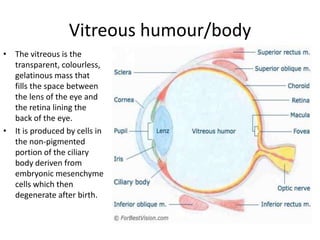
Vitreous humour/body
• The vitreous is the
transparent, colourless,
gelatinous mass that
fills the space between
the lens of the eye and
the retina lining the
back of the eye.
• It is produced by cells in
the non-pigmented
portion of the ciliary
body deriven from
embryonic mesenchyme
cells which then
degenerate after birth.
Vitreous Body
• Its composition is similar to the cornea, but contains
very few cells (mostly phagocytes which remove unwanted cellular
debris in the visual field, as well as the hyalocytes of the surface of the
vitreous, which reprocess the hyaluronic acid),

•
•
•
•
•
•
•

No blood vessels.
Water = 98-99% of its volume (75% in the cornea)
Salts, sugars, vitrosin (a type of collagen),
a network of collagen type II fibres
Glycosaminoglycan
Hyaluronic acid and many proteins in micro amounts.
The vitreous body has a viscosity two to four times
that of pure water, giving it a gelatinous consistency.
It also has a refractive index of 1.336
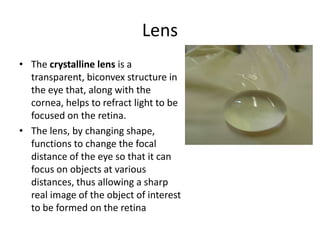
Lens
• The crystalline lens is a
transparent, biconvex structure in
the eye that, along with the
cornea, helps to refract light to be
focused on the retina.
• The lens, by changing shape,
functions to change the focal
distance of the eye so that it can
focus on objects at various
distances, thus allowing a sharp
real image of the object of interest
to be formed on the retina
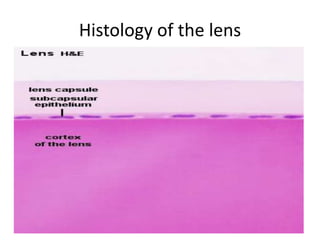
Histology of the lens
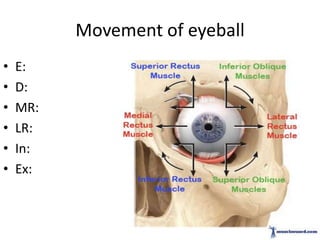
Movement of eyeball
•
•
•
•
•
•

E:
D:
MR:
LR:
In:
Ex:
Action of extraoccular Muscle
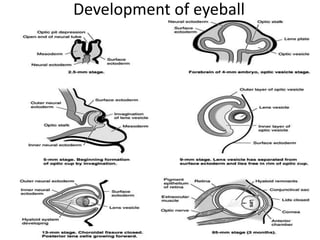
Development of eyeball
Light Reflex
• Shining light into
one eye causes
constriction of
iris muscles on
both sides
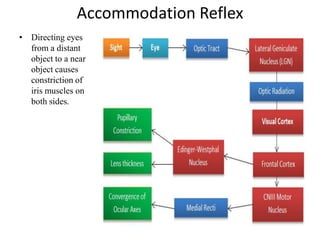
Accommodation Reflex
• Directing eyes
from a distant
object to a near
object causes
constriction of
iris muscles on
both sides.
Consensual light reflex
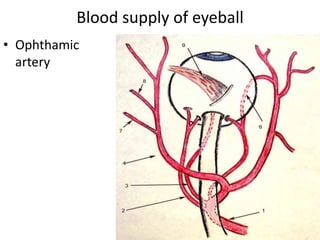
Blood Supply of eyeball
Blood supply of eyeball
• Ophthamic
artery
Nerve supply
• Sclera:
• Cornea:ophthalmic nerve through long
ciliary nerve which form 4 plexus as they
reach the cornea (anular, proprial,
subepithelial and intraepithelial
• Choroid:
• Ciliary muscle: parasympathetic nerve
• Iris:
Applied Anatomy
•
•
•
•
•

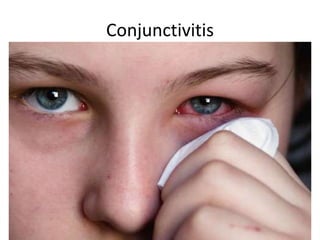
Conjunctivitis
Glaucoma
Corneal opacities
Corneal grafting
Jaundice can be visualized on the bulbar
conjuctive
• Myopia
• Hypermetropia
• Presbyopia/Astigmatism
Conjunctivitis
Closed angle glaucoma
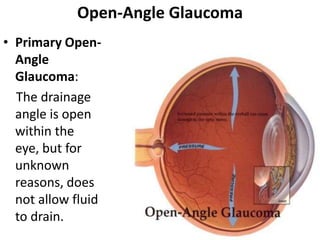
Open-Angle Glaucoma
• Primary OpenAngle
Glaucoma:
The drainage
angle is open
within the
eye, but for
unknown
reasons, does
not allow fluid
to drain.
Glaucoma: Open vs Closed angle
Papiloedema & Papillitis
• Cupping of
optic disc
• Atrophy of
optic nerve
due to chronic
pressure
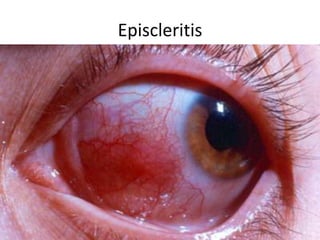
Episcleritis
Myopia vs Hypermetropia
Astigmatism
Eyeball  Anatomy with histology

Eyeball Anatomy with histology