Dr.Narang Retina
ANATOMY OF RETINA
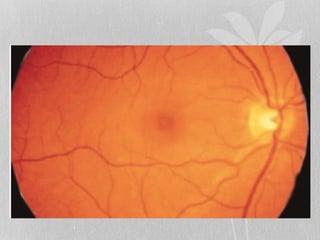
Gross Anatomy Retina extends from the optic disc to the ora serrata. It is divided into two distinct regions:  posterior pole and peripheral retina separated by the so called retinal equator.
Posterior pole  It refers to the area of the retina posterior to the retinal equator. The posterior pole of the retina includes two distinct areas:  optic disc and macula lutea
Macula lutea .  It is also called the  yellow spot . It is comparatively deeper red than the surrounding fundus and is situated at the posterior pole temporal to the optic disc. Fovea centralis  is the central depressed part of the macula. It is about 1.5 mm in diameter and is the most sensitive part of the retina. In its Center is a shining pit called  foveola . An area about 0.8 mm in diameter (including foveola and some surrounding area) does not contain any retinal capillaries and is called foveal avascular zone (FAZ). Surrounding the fovea are the parafoveal and perifoveal areas.
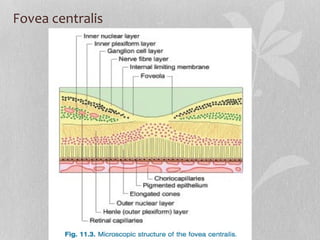
Structure of fovea centralis In this area, there are no rods. Cones are tightly packed and other layers of retina are very thin. Its central part (foveola) largely consists of cones and their nuclei covered by a thin internal limiting membrane. All other retinal layers are absent in this region. In the foveal region surrounding the foveola, the cone axons are arranged obliquely (Henle’s layer or outer plexiform layer) to reach the margin of the fovea.
Fovea centralis
Peripheral retina  It  refers to the area bounded posteriorly by the retinal equator and anteriorly by the ora serrata.
Optic disc It is a pink coloured , well-defined circular area of 1.5-mm diameter. At the optic disc all the retinal layers terminate except the nerve fibres, which pass through the lamina cribrosa to run into the optic nerve. A depression seen in the disc is called the  physiological cup . The central retinal artery and vein emerge through the centre of this cup.
 
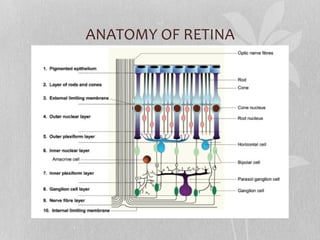
LAYERS OF RETINA : MNEMONIC: IN –INTERNAL LIMITING MEMBRANE NEW –NERVE FIBER LAYER GENERATION –GANGLIONIC LAYER IT –INTERNAL PLEXIFORM LAYER IS –INTERNAL NUCLEAR LAYER ONLY –OUTER PLEXIFORM LAYER OPHTHALMOLOGIST’S –OUTER NUCLEAR LAYER EXAMINING –EXTERNAL LIMITING MEMBRANE PATIENTS –PHOTORECEPTORS  RETINA –RETINAL PIGMENT EPITHELIUM
Internal limiting membrane It is the innermost layer and separates the retina from vitreous. It is formed by the union of terminal expansions of the Muller’s fibres. It is essentially a basement membrane.
Nerve fibre layer  (stratum opticum)  It  consists of axons of the ganglion cells, running parallel to retinal surface. The layers increase in depth as it converges to optic disc. The nerve fibers are fine and non-medullated  It pass through the lamina cribrosa to form the optic nerve
Ganglion cell layer It mainly contains the cell bodies of ganglion cells (the second order neurons of visual pathway). There are two types of ganglion cells: -  The  midget ganglion -cells  are present in the macular region. each such cell synapses with single bipolar cell. -  Polysynaptic ganglion - cells lie predominantly in peripheral retina .Each such cell may synapse with upto a hundred bipolar cells
Inner plexiform layer It essentially consists of connections of bipolar cells with the ganglion cells and amacrine cells.
Inner nuclear layer It mainly consists of nuclei of bipolar cells.  It also contains nuclei of amacrine and Muller’s cells  Capillaries of central artery of retina, but outer layers are avascular. The bipolar cells constitute the first order neurons.
Outer plexiform layer The Innermost portion of each rod and cone cell is swollen with lateral processes known as spherules and pedicles respectively. This layer consists of connections of rod spherules and cone pedicles with the dendrites of bipolar cells and horizontal cells.
Outer nuclear layer It consists of nuclei of the rods and cones. Cone nuclei are larger and more oval and carry a layer of cytoplasm
External limiting membrane It is a fenestrated membrane, on which rods and cones rest and their processes pierce
Photoreceptor layer Rods and cones are the end organs of vision and are also known as  photoreceptors . Rods  contain a photosensitive substance visual purple  (rhodopsin)  and subserve the peripheral vision and vision of low illumination ( scotopic vision). Cones  also contain a photosensitive substance and are primarily responsible for highly discriminatory central vision ( photopic vision ) and colour vision.
Pigment epithelium.  It is the outermost layer of retina. It consists of a single layer of cells containing pigment. The cells of RPE contain varying amount of melanin. Cells are taller at fovea and contain more pigment. Around the Optic disc they are heaped up as ‘ choroidal ring ’ It is firmly adherent to the underlying basal lamina (Bruch’s membrane) of the choroid.
Blood supply Outer four layers of the retina-  choroidal vessels Inner six layers-  central retinal artery, which is a branch of the ophthalmic  artery.
CRAO C entral retinal artery  emerges from centre of the physiological cup of the optic disc and divides into four branches. These are end arteries i.e., they do not anastomose with each other.
Predisposing factors: Hypertension Cardiovascular diseases
Etiology Thrombophilic disorders. Emboli  from the carotid artery and those of cardiac origin(20%) Atherosclerosis-related thrombosis  at the level of lamina cribrosa(75%). Arteritis with obliteration. Angiospasm Raised intraocular pressure
Symptoms : Sudden,painless loss of vision. Amaurosis fugax
Sign’s Red reflex absent. Marked narrowing of large arteries, arterioles invisible. Within few hours retina become milky white because of oedema. Within a day or two macular area show cherry red spots because of choroid shining through thin retina. When obstruction is incomplete, column of venous blood has cattle tract appearance. After few weeks oedema subsides , atrophic changes occur(optic nerve atrophy/attenuated thread like arteries). No PL/PR
Treatment Immediate lowering of IOP –massage /IV mannitol /A.C. paracentesis . Vasodilator and inhalation of mixture of 5%CO2 and 95%O2. Anticoagulants –IV heparin IV steroids –giant cell arteritis
Prognosis: >6 hours –No return of central vision.
CRVO The retinal veins:  These follow the pattern of the retinal arteries. The central retinal vein drains into the cavernous sinus directly or through the superior ophthalmic vein
Predisposing Factors Age :6 th /7 th  decade(2 nd  decade in case of non ischaemic) Systemic hypertension Raised IOP Diabetes Hyperviscosity syndrome Periphlebitis
Pathogenesis External compression on the vein Venous stasis Degenerative disease of venous endothelium
Types: Non Ischaemic/Venous stasis retinopathy/Partial CRVO=75% Ishchaemic CRVO/haemorrhagic CRVO/Complete CRVO=25%
Non Ischaemic Symptom: Vague U/L fogginess of vision initially. V/A remains good. Vitreous hemorrhage never present Mild pupillary defect
Signs: Mild tortuosity and dilatation of retinal veins. Dot and blot and flame shaped haemorrhage. Optic disc swelling Macular oedema may or not- permanent impaired vision but normally 50% regain VA as Macular oedema resolves. Circulating IgM raised in most,leading to phlebitis of central vein in optic head ,hence fundus picture resemble venous thrombosis
Ischaemic CRVO Symptoms : VA- marked reduced
Signs Marked tortuosity and engorged retinal veins. Massive superficial and deep haemorrhages. Cotton wool exudates. Optic disc swelling and hyperaemia. Macular oedema and haemorrhage. Bunches of tortuous new vessels formed upon optic disc. Eventual atrophy of affected retina. Fundus described as BLOOD AND THUNDER FUNDUS Obstruction of central vein just behind lamina cribrosa ,peripheral at bifurcation as in arterisclerotic
Prognosis: 50% develop rubeosis and neovascular glaucoma within 3 months of initial occlusion aka 90 days glaucoma. Pre-retinal or vitreous haemorrhage secondary to NVD
Management It is usually not required. The condition resolves with almost normal vision in about 50 percent cases. Visual loss in rest of the cases is due to chronic cystoid macular oedema, for which no treatment is effective. However, a course of oral steroids for 8-12 weeks may be effective. Patient should be followed up closely for rubeosis iridis, as prompt treatment in early cases by PRP.
THANKS FOR PATIENCE…!

Retina class 7th semester

  • 1.
  • 2.
  • 3.
    Gross Anatomy Retinaextends from the optic disc to the ora serrata. It is divided into two distinct regions: posterior pole and peripheral retina separated by the so called retinal equator.
  • 4.
    Posterior pole It refers to the area of the retina posterior to the retinal equator. The posterior pole of the retina includes two distinct areas: optic disc and macula lutea
  • 5.
    Macula lutea . It is also called the yellow spot . It is comparatively deeper red than the surrounding fundus and is situated at the posterior pole temporal to the optic disc. Fovea centralis is the central depressed part of the macula. It is about 1.5 mm in diameter and is the most sensitive part of the retina. In its Center is a shining pit called foveola . An area about 0.8 mm in diameter (including foveola and some surrounding area) does not contain any retinal capillaries and is called foveal avascular zone (FAZ). Surrounding the fovea are the parafoveal and perifoveal areas.
  • 6.
    Structure of foveacentralis In this area, there are no rods. Cones are tightly packed and other layers of retina are very thin. Its central part (foveola) largely consists of cones and their nuclei covered by a thin internal limiting membrane. All other retinal layers are absent in this region. In the foveal region surrounding the foveola, the cone axons are arranged obliquely (Henle’s layer or outer plexiform layer) to reach the margin of the fovea.
  • 7.
  • 8.
    Peripheral retina It refers to the area bounded posteriorly by the retinal equator and anteriorly by the ora serrata.
  • 9.
    Optic disc Itis a pink coloured , well-defined circular area of 1.5-mm diameter. At the optic disc all the retinal layers terminate except the nerve fibres, which pass through the lamina cribrosa to run into the optic nerve. A depression seen in the disc is called the physiological cup . The central retinal artery and vein emerge through the centre of this cup.
  • 10.
  • 11.
    LAYERS OF RETINA: MNEMONIC: IN –INTERNAL LIMITING MEMBRANE NEW –NERVE FIBER LAYER GENERATION –GANGLIONIC LAYER IT –INTERNAL PLEXIFORM LAYER IS –INTERNAL NUCLEAR LAYER ONLY –OUTER PLEXIFORM LAYER OPHTHALMOLOGIST’S –OUTER NUCLEAR LAYER EXAMINING –EXTERNAL LIMITING MEMBRANE PATIENTS –PHOTORECEPTORS RETINA –RETINAL PIGMENT EPITHELIUM
  • 12.
    Internal limiting membraneIt is the innermost layer and separates the retina from vitreous. It is formed by the union of terminal expansions of the Muller’s fibres. It is essentially a basement membrane.
  • 13.
    Nerve fibre layer (stratum opticum) It consists of axons of the ganglion cells, running parallel to retinal surface. The layers increase in depth as it converges to optic disc. The nerve fibers are fine and non-medullated It pass through the lamina cribrosa to form the optic nerve
  • 14.
    Ganglion cell layerIt mainly contains the cell bodies of ganglion cells (the second order neurons of visual pathway). There are two types of ganglion cells: - The midget ganglion -cells are present in the macular region. each such cell synapses with single bipolar cell. - Polysynaptic ganglion - cells lie predominantly in peripheral retina .Each such cell may synapse with upto a hundred bipolar cells
  • 15.
    Inner plexiform layerIt essentially consists of connections of bipolar cells with the ganglion cells and amacrine cells.
  • 16.
    Inner nuclear layerIt mainly consists of nuclei of bipolar cells. It also contains nuclei of amacrine and Muller’s cells Capillaries of central artery of retina, but outer layers are avascular. The bipolar cells constitute the first order neurons.
  • 17.
    Outer plexiform layerThe Innermost portion of each rod and cone cell is swollen with lateral processes known as spherules and pedicles respectively. This layer consists of connections of rod spherules and cone pedicles with the dendrites of bipolar cells and horizontal cells.
  • 18.
    Outer nuclear layerIt consists of nuclei of the rods and cones. Cone nuclei are larger and more oval and carry a layer of cytoplasm
  • 19.
    External limiting membraneIt is a fenestrated membrane, on which rods and cones rest and their processes pierce
  • 20.
    Photoreceptor layer Rodsand cones are the end organs of vision and are also known as photoreceptors . Rods contain a photosensitive substance visual purple (rhodopsin) and subserve the peripheral vision and vision of low illumination ( scotopic vision). Cones also contain a photosensitive substance and are primarily responsible for highly discriminatory central vision ( photopic vision ) and colour vision.
  • 21.
    Pigment epithelium. It is the outermost layer of retina. It consists of a single layer of cells containing pigment. The cells of RPE contain varying amount of melanin. Cells are taller at fovea and contain more pigment. Around the Optic disc they are heaped up as ‘ choroidal ring ’ It is firmly adherent to the underlying basal lamina (Bruch’s membrane) of the choroid.
  • 22.
    Blood supply Outerfour layers of the retina- choroidal vessels Inner six layers- central retinal artery, which is a branch of the ophthalmic artery.
  • 23.
    CRAO C entralretinal artery emerges from centre of the physiological cup of the optic disc and divides into four branches. These are end arteries i.e., they do not anastomose with each other.
  • 24.
    Predisposing factors: HypertensionCardiovascular diseases
  • 25.
    Etiology Thrombophilic disorders.Emboli from the carotid artery and those of cardiac origin(20%) Atherosclerosis-related thrombosis at the level of lamina cribrosa(75%). Arteritis with obliteration. Angiospasm Raised intraocular pressure
  • 26.
    Symptoms : Sudden,painlessloss of vision. Amaurosis fugax
  • 27.
    Sign’s Red reflexabsent. Marked narrowing of large arteries, arterioles invisible. Within few hours retina become milky white because of oedema. Within a day or two macular area show cherry red spots because of choroid shining through thin retina. When obstruction is incomplete, column of venous blood has cattle tract appearance. After few weeks oedema subsides , atrophic changes occur(optic nerve atrophy/attenuated thread like arteries). No PL/PR
  • 28.
    Treatment Immediate loweringof IOP –massage /IV mannitol /A.C. paracentesis . Vasodilator and inhalation of mixture of 5%CO2 and 95%O2. Anticoagulants –IV heparin IV steroids –giant cell arteritis
  • 29.
    Prognosis: >6 hours–No return of central vision.
  • 30.
    CRVO The retinalveins: These follow the pattern of the retinal arteries. The central retinal vein drains into the cavernous sinus directly or through the superior ophthalmic vein
  • 31.
    Predisposing Factors Age:6 th /7 th decade(2 nd decade in case of non ischaemic) Systemic hypertension Raised IOP Diabetes Hyperviscosity syndrome Periphlebitis
  • 32.
    Pathogenesis External compressionon the vein Venous stasis Degenerative disease of venous endothelium
  • 33.
    Types: Non Ischaemic/Venousstasis retinopathy/Partial CRVO=75% Ishchaemic CRVO/haemorrhagic CRVO/Complete CRVO=25%
  • 34.
    Non Ischaemic Symptom:Vague U/L fogginess of vision initially. V/A remains good. Vitreous hemorrhage never present Mild pupillary defect
  • 35.
    Signs: Mild tortuosityand dilatation of retinal veins. Dot and blot and flame shaped haemorrhage. Optic disc swelling Macular oedema may or not- permanent impaired vision but normally 50% regain VA as Macular oedema resolves. Circulating IgM raised in most,leading to phlebitis of central vein in optic head ,hence fundus picture resemble venous thrombosis
  • 36.
    Ischaemic CRVO Symptoms: VA- marked reduced
  • 37.
    Signs Marked tortuosityand engorged retinal veins. Massive superficial and deep haemorrhages. Cotton wool exudates. Optic disc swelling and hyperaemia. Macular oedema and haemorrhage. Bunches of tortuous new vessels formed upon optic disc. Eventual atrophy of affected retina. Fundus described as BLOOD AND THUNDER FUNDUS Obstruction of central vein just behind lamina cribrosa ,peripheral at bifurcation as in arterisclerotic
  • 38.
    Prognosis: 50% developrubeosis and neovascular glaucoma within 3 months of initial occlusion aka 90 days glaucoma. Pre-retinal or vitreous haemorrhage secondary to NVD
  • 39.
    Management It isusually not required. The condition resolves with almost normal vision in about 50 percent cases. Visual loss in rest of the cases is due to chronic cystoid macular oedema, for which no treatment is effective. However, a course of oral steroids for 8-12 weeks may be effective. Patient should be followed up closely for rubeosis iridis, as prompt treatment in early cases by PRP.
  • 40.