Adult
Extubation
in PACU
A PRESENTATION BY
KIM NESS, B.SC.N., RN 2014
Why is safe extubation
important?
Laryngospasm is the most
common cause of post
extubation airway obstruction
and can be life threatening
(Karmarkar, 2008).
RNs should not extubate
the following patients


Difficult mask ventilation



Difficult intubation



Residual neuromuscular block
present
RNs should not extubate
the following patients...cont’d


Deep anesthetized



Full stomach (i.e. pregnant,
obese, recent ingestion of
food, etc.)
Prior to Adult Extubation


VSS, awake



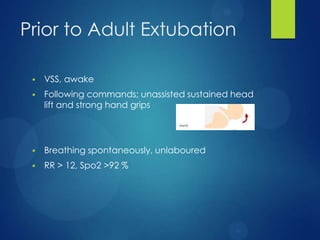
Following commands; unassisted
sustained head lift and strong hand grips



Breathing spontaneously, unlaboured



RR > 12, Spo2 >92 %



Give 100% O2
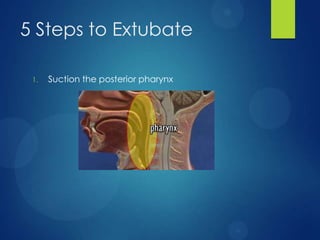
5 Steps to Extubate
1.

Suction the posterior pharynx
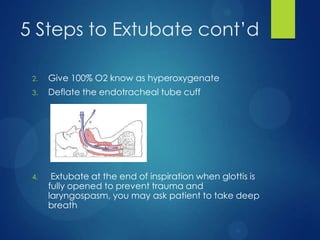
5 Steps to Extubate cont’d
2.

Remove tape

3.

Deflate the endotracheal
tube cuff
5 Steps to Extubate cont’d
4.

Extubate at the end of
inspiration, after deep breath

-glottis is fully opened to prevent
trauma and laryngospasm
5. Pull the endotracheal tube out
steadily
Video
http://www.youtube.com/watch?v=IBWwnyP3WKI
Post Extubation


Ask the patient to
cough, to clear airway



Apply oxygen



Monitor breathing, SpO2
and vital signs
References
Howie, W.O., & Dutton, R. P. (2012). Implementation of an
evidence-based extubation checklist to reduce extubation failure in
patients with trauma: A pilot study. AANA, 80(3), 179-184.
Retrieved from
http://www.aana.com/newsandjournal/Documents/extubationchecklist-0612-p179-184.pdf

Karmarkar, S., & Varshney, S. (2008). Tracheal extubation.
Retrieved January 2, 2014 from
http://ceaccp.oxfordjournals.org/content/8/6/214.extract
Unknown. (2009, November 19) Extubate. Retrieved from
http://www.youtube.com/watch?v=IBWwnyP3WKI

Extubation in pacu#1

  • 1.
    Adult Extubation in PACU A PRESENTATIONBY KIM NESS, B.SC.N., RN 2014
  • 2.
    Why is safeextubation important? Laryngospasm is the most common cause of post extubation airway obstruction and can be life threatening (Karmarkar, 2008).
  • 3.
    RNs should notextubate the following patients  Difficult mask ventilation  Difficult intubation  Residual neuromuscular block present
  • 4.
    RNs should notextubate the following patients...cont’d  Deep anesthetized  Full stomach (i.e. pregnant, obese, recent ingestion of food, etc.)
  • 5.
    Prior to AdultExtubation  VSS, awake  Following commands; unassisted sustained head lift and strong hand grips  Breathing spontaneously, unlaboured  RR > 12, Spo2 >92 %  Give 100% O2
  • 6.
    5 Steps toExtubate 1. Suction the posterior pharynx
  • 7.
    5 Steps toExtubate cont’d 2. Remove tape 3. Deflate the endotracheal tube cuff
  • 8.
    5 Steps toExtubate cont’d 4. Extubate at the end of inspiration, after deep breath -glottis is fully opened to prevent trauma and laryngospasm 5. Pull the endotracheal tube out steadily
  • 9.
  • 10.
    Post Extubation  Ask thepatient to cough, to clear airway  Apply oxygen  Monitor breathing, SpO2 and vital signs
  • 11.
    References Howie, W.O., &Dutton, R. P. (2012). Implementation of an evidence-based extubation checklist to reduce extubation failure in patients with trauma: A pilot study. AANA, 80(3), 179-184. Retrieved from http://www.aana.com/newsandjournal/Documents/extubationchecklist-0612-p179-184.pdf Karmarkar, S., & Varshney, S. (2008). Tracheal extubation. Retrieved January 2, 2014 from http://ceaccp.oxfordjournals.org/content/8/6/214.extract Unknown. (2009, November 19) Extubate. Retrieved from http://www.youtube.com/watch?v=IBWwnyP3WKI