PRESENTED BY
Swapnil S. Tirmanwar
Pharmacognosy
(M. Pharm 1st year)
PRIYADARSHINI J. L. COLLEGE OF
PHARMACY,
Electronic zone, MIDC, Hingna road
NAGPUR-440016
2022-2023
In vivo evaluation techniques, for
Antifertility agent/activity
EVALUATION
METHODS
 Antifertility activity(female rats)
 Antifertility activity(male rats )
WOX888 2
 Standard drug used :
• Norethindrone(is an synthetic progesterone )
• Ethynylestradiol is a combination of derivatives of estrogen and
progesterone
• Novestrol
 Dosage: 2 g/kg(no proper dosage of the drugs was confirmed as the std.
quantity)
ANTIFERTILITY
ACTIVITY(FEMALE RATS)
Principle:
After administration of test drugs, various effects like oestro-
genicity, anti-estrogenicity, anti-gonadotropic effects, mating,
contraception, bleeding, weight change, implantation etc., can give idea
about anti fertility effects of test drugs.
Procedure: Keep separately male and female healthy rats for 1-2 week.
Female rats should be confirmed for normal oestrous cycle. Now group
animals in ratio of 1:3 male to female. Start dosing of drugs to female
rats only. Observe female rats for following activities:
WOX888 3
Procedure:
Keep separately male and female healthy rats for 1-2 week.
Female rats should be confirmed for normal oestrous cycle. Now group
animals in ratio of 1:3 male to female. Start dosing of drugs to female
rats only. Observe female rats for following activities:
 Oestrogenicity:
Cornification of vagina and increase in weight of uterus indicates
oestrogenicity effects.
 Anti-gonadotropic effects:
Serum andpituitory harmone (e.g., LH, FSH)levels indicate antigonado-
tropiceffects
WOX888 4
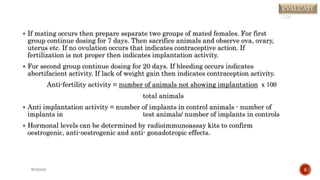
 If mating occurs then prepare separate two groups of mated females. For first
group continue dosing for 7 days. Then sacrifice animals and observe ova, ovary,
uterus etc. If no ovulation occurs that indicates contraceptive action. If
fertilization is not proper then indicates implantation activity.
 For second group continue dosing for 20 days. If bleeding occurs indicates
abortifacient activity. If lack of weight gain then indicates contraception activity.
Anti-fertility activity = number of animals not showing implantation ⅹ 100
total animals
 Anti implantation activity = number of implants in control animals - number of
implants in test animals/ number of implants in controls
 Hormonal levels can be determined by radioimmunoassay kits to confirm
oestrogenic, anti-oestrogenic and anti- gonadotropic effects.
WOX888 5
EVALUATI
ON
ANTI-FERTILITY ACTIVITY
(MALE RATS)
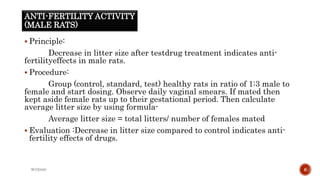
 Principle:
Decrease in litter size after testdrug treatment indicates anti-
fertilityeffects in male rats.
 Procedure:
Group (control, standard, test) healthy rats in ratio of 1:3 male to
female and start dosing. Observe daily vaginal smears. If mated then
kept aside female rats up to their gestational period. Then calculate
average litter size by using formula-
Average litter size = total litters/ number of females mated
 Evaluation :Decrease in litter size compared to control indicates anti-
fertility effects of drugs.
WOX888 6
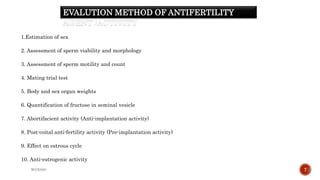
1.Estimation of sex
2. Assessment of sperm viability and morphology
3. Assessment of sperm motility and count
4. Mating trial test
5. Body and sex organ weights
6. Quantification of fructose in seminal vesicle
7. Abortifacient activity (Anti-implantation activity)
8. Post-coital anti-fertility activity (Pre-implantation activity)
9. Effect on estrous cycle
10. Anti-estrogenic activity
WOX888 7
EVALUTION METHOD OF ANTIFERTILITY
AGENT /ACTIVITY
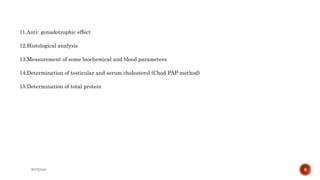
11.Anti- gonadotrophic effect
12.Histological analysis
13.Measurement of some biochemical and blood parameters
14.Determination of testicular and serum cholesterol (Chod PAP method)
15.Determination of total protein
WOX888 8
1. ESTIMATION OF SEX
HORMONES:
 Blood samples were collected from rats for estimations of serum levels
of sex hormones.
 Sera were separated into clean bottles, stored frozen and used within
12 h of preparation for the estimation of testosterone, estrogen level,
prolactin, follicle stimulating hormone (FSH) and
luteinizing hormone (LH).
WOX888 9
2. ASSESSMENT OF SPERM MOTILITY
AND COUNT:
 Progressive motility was tested immediately. The right caudal epididymis was
incised and semen was squeezed on a pre-warmed slide.
 Two drops of warm 2.9% sodium citrate was added to semen and mixed by a cover-
slip. The percentage of progressive sperm motility was evaluated visually at 400
magnification.
 Motility estimates were performed from three different fields in each sample. The
mean of the three successive estimations was used as the final motility score.
 For sperm count, the left caudal epididymis was incised and semen that oozed was
quickly sucked into a red blood pipette to the 0.5 mark, and then diluted with
warm normal saline up to the 100 mark. A drop of the semen mixture was placed
on the Neuberger counting chamber and viewed under the magnification of x40.
The total numbers of sperm cells were counted and expressed as 106/ml.
WOX888 10
3. ASSESSMENT OF SPERM VIABILITY
AND MORPHOLOGY:
 A viability study (percentage of live spermatozoa) was done using
eosin/ligroin stain. A drop of semen was squeezed onto a microscope
slide and two drops of the stain were added.
 Thin smears were then prepared and observed under a light microscope
at 100 magnification. Viable sperm remained colorless while non-viable
sperm stained red.
 The stained and the unstained sperm cells were counted using 40/100
microscope objectives and an average value for each was recorded from
which percentage viability was calculated.
 To determine the percentage of morphologically abnormal spermatozoa,
the slides stained with eosin-ligroin (5 slides/rat) viewed under a light
microscope at 100 magnifications.
WOX888 11
4. MATING TRIAL
TEST:
WOX888 12
• Mating trial test of male rats was done, 5 d before the
termination of the experiment.
• Each male rat was cohabitated overnight with
protestors females in a ratio of 1:2 and housed in a
single cage. Positive mating was confirmed by presence
of sperm and vaginal plug in the vaginal smear the
following morning. Each sperm positive female was
kept under observation and the resultant pregnancies
were noted, when dam gave birth. The following
reproductive parameters were then computed:
• Mating success % = number mated/number paired x
10
• Fertility success % = number pregnant/number paired
× 100
5. BODY AND SEX ORGAN
WEIGHTS:
 The initial and final body weights of the animals were recorded. The
testes, epididymides, seminal vesicle and ventral prostate were
dissected out, freed from adherent tissues and blood, and weighed to
the nearest milligram.
 Organ weights were reported as relative weights (organ
weight/body weight x 100).
WOX888 13
6. QUANTIFICATION OF FRUCTOSE IN
SEMINAL VESICLE:
 For fructose quantification, seminal vesicular homogenate was prepared at
a tissue concentration of 50 mg/ml.
 The supernatant (seminal plasma) was deproteinized by adding 50 mL of
zinc sulfate and sodium hydroxide to make a total dilution of seminal
plasma 1:16, followed by centrifugation at 2500 rpm for 15 min.
 For fructose measurement, 200 mL of clear seminal plasma was used and
the optical density of standard and samples were measured against blank
at 470 nm.
 The concentration of fructose was obtained by plotting the value in
standard curve and the value expressed in the unit of mmol/mL
of seminal plasma.
WOX888 14
7. ABORTIFACIENT ACTIVITY (ANTI-
IMPLANTATION ACTIVITY:
 The plant extracts were tested in female albino rats for abortifacient activity. The
vaginal smears of caged female rats of known fertility were monitored daily.
Unstained material was observed under a light microscope.
 The proportion among the cells observed was used for the determination of the
estrous cycle phases.
 Female rats were caged with males of proven fertility in the ratio of 2:1, in the
evening of proestrous and examined the following day for the evidence of
copulation.
 Rats exhibiting thick clumps of spermatozoa in their vaginal smears were
separated and that day was designated as day one of pregnancy. These rats were
randomly distributed into four groups, a control group and three experimental
groups of six animals each. Group I received vehicle only and served as control.
WOX888 15
 Groups II, III, and IV received different extracts. On the 10th day of
pregnancy the animals were laparotomies under light ether anesthesia
using sterile conditions. The two horns of uteri were examined to
determine the implantation sites.
 Thereafter the abdominal wound was sutured in layers. Post
operational care was taken to avoid any infection. The extract to be
tested were then fed to operated pregnant rats, specified by an
intragastric soft rubber catheter from day 11 up to the 15th day of
pregnancy. The animals were allowed to go to full term. After delivery
the pups were counted and the antifertility activity of extract was
evaluated. Litters were examined for any malformation.
 Percentage abortifacient activity = number of resorptions/number of
corpus luteum x 100
WOX888 16
8. POST-COITAL ANTIFERTILITY ACTIVITY (PRE
IMPLANTATION ACTIVITY:
 The anti-implantation activity is expressed as the percentage of
animals showing absence of implantations in uteri when
laparotomised on day 10 of pregnancy.
 Vaginal smears from each rat were monitored daily and the rats
with normal estrous cycle were selected.Rats found in proestrus
phase of cycle were caged with males of proven fertility, in the ratio
2:1 and examined the following morning for evidence of copulation.
 Rats exhibiting thick clumps of spermatozoa in their vaginal smears
were separated and that day was designated as day 1 of pregnancy
and those rats were divided into five groups containing six
rats in each group.
WOX888 17
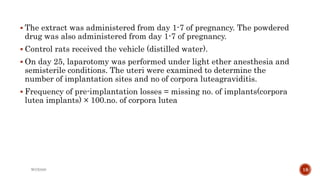
 The extract was administered from day 1-7 of pregnancy. The powdered
drug was also administered from day 1-7 of pregnancy.
 Control rats received the vehicle (distilled water).
 On day 25, laparotomy was performed under light ether anesthesia and
semisterile conditions. The uteri were examined to determine the
number of implantation sites and no of corpora luteagraviditis.
 Frequency of pre-implantation losses = missing no. of implants(corpora
lutea implants) × 100.no. of corpora lutea
WOX888 18
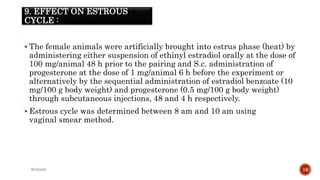
9. EFFECT ON ESTROUS
CYCLE :
 The female animals were artificially brought into estrus phase (heat) by
administering either suspension of ethinyl estradiol orally at the dose of
100 mg/animal 48 h prior to the pairing and S.c. administration of
progesterone at the dose of 1 mg/animal 6 h before the experiment or
alternatively by the sequential administration of estradiol benzoate (10
mg/100 g body weight) and progesterone (0.5 mg/100 g body weight)
through subcutaneous injections, 48 and 4 h respectively.
 Estrous cycle was determined between 8 am and 10 am using
vaginal smear method.
WOX888 19
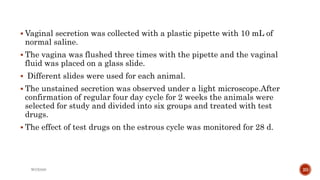
 Vaginal secretion was collected with a plastic pipette with 10 mL of
normal saline.
 The vagina was flushed three times with the pipette and the vaginal
fluid was placed on a glass slide.
 Different slides were used for each animal.
 The unstained secretion was observed under a light microscope.After
confirmation of regular four day cycle for 2 weeks the animals were
selected for study and divided into six groups and treated with test
drugs.
 The effect of test drugs on the estrous cycle was monitored for 28 d.
WOX888 20
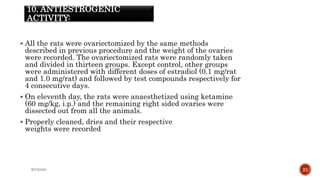
10. ANTIESTROGENIC
ACTIVITY:
 All the rats were ovariectomized by the same methods
described in previous procedure and the weight of the ovaries
were recorded. The ovariectomized rats were randomly taken
and divided in thirteen groups. Except control, other groups
were administered with different doses of estradiol (0.1 mg/rat
and 1.0 mg/rat) and followed by test compounds respectively for
4 consecutive days.
 On eleventh day, the rats were anaesthetized using ketamine
(60 mg/kg, i.p.) and the remaining right sided ovaries were
dissected out from all the animals.
 Properly cleaned, dries and their respective
weights were recorded
WOX888 21
 The ovaries weight variations prior to and after treatment with extracts were
calculated.
 Percentage inhibition of ovarian weight was calculated using the following equation:
 Percentage inhibition in ovarian weight = [1 - (XE - C)]/E- Cx 100.
Where, C = mean ovarian weight from rats treated with vehicle,
E = estradiol and-
XE = the mean ovarian weight of rats treated with
extract and estradiol
WOX888 22
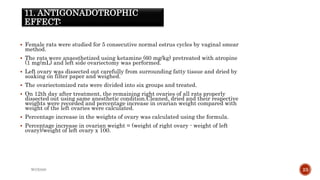
11. ANTIGONADOTROPHIC
EFFECT:
 Female rats were studied for 5 consecutive normal estrus cycles by vaginal smear
method.
 The rats were anaesthetized using ketamine (60 mg/kg) pretreated with atropine
(1 mg/mL) and left side ovariectomy was performed.
 Left ovary was dissected out carefully from surrounding fatty tissue and dried by
soaking on filter paper and weighed.
 The ovariectomized rats were divided into six groups and treated.
 On 12th day after treatment, the remaining right ovaries of all rats properly
dissected out using same anesthetic condition.Cleaned, dried and their respective
weights were recorded and percentage increase in ovarian weight compared with
weight of the left ovaries were calculated.
 Percentage increase in the weights of ovary was calculated using the formula.
 Percentage increase in ovarian weight = (weight of right ovary - weight of left
ovary)/weight of left ovary x 100.
WOX888 23
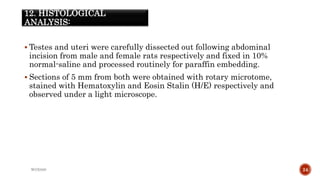
12. HISTOLOGICAL
ANALYSIS:
 Testes and uteri were carefully dissected out following abdominal
incision from male and female rats respectively and fixed in 10%
normal-saline and processed routinely for paraffin embedding.
 Sections of 5 mm from both were obtained with rotary microtome,
stained with Hematoxylin and Eosin Stalin (H/E) respectively and
observed under a light microscope.
WOX888 24
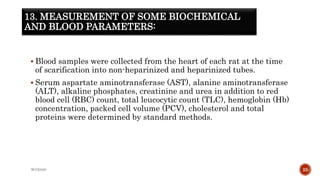
13. MEASUREMENT OF SOME BIOCHEMICAL
AND BLOOD PARAMETERS:
 Blood samples were collected from the heart of each rat at the time
of scarification into non-heparinized and heparinized tubes.
 Serum aspartate aminotransferase (AST), alanine aminotransferase
(ALT), alkaline phosphates, creatinine and urea in addition to red
blood cell (RBC) count, total leucocytic count (TLC), hemoglobin (Hb)
concentration, packed cell volume (PCV), cholesterol and total
proteins were determined by standard methods.
WOX888 25
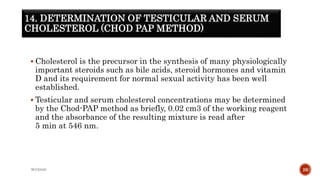
14. DETERMINATION OF TESTICULAR AND SERUM
CHOLESTEROL (CHOD PAP METHOD)
 Cholesterol is the precursor in the synthesis of many physiologically
important steroids such as bile acids, steroid hormones and vitamin
D and its requirement for normal sexual activity has been well
established.
 Testicular and serum cholesterol concentrations may be determined
by the Chod-PAP method as briefly, 0.02 cm3 of the working reagent
and the absorbance of the resulting mixture is read after
5 min at 546 nm.
WOX888 26
15. DETERMINATION OF TOTAL
PROTEIN :
 A timed rate biuret method was used to measure the concentration
of total protein in serum or plasma.
 Proteins in the sample combined with the reagent producing
alkaline copper-protein chelate.
 The rate change in absorbance was monitored by a detector at 545
nm.
 The observed rate of chelate formation is directly proportional to the
total protein concentration in the sample.
WOX888 27
REFERENCE
 K.D.Tripathi, "Essential of Medical Pharmacology", 6th edition
 Pharmacognosy and Phytochemistry: A Comprehensive Approach, eBook: S. L. Deore, S.
S. Khadabadi, B.A. Baviskar.
 Gerard A. Mckay, John L. Reid, Mathew R. Walters, "Clinical Pharmacology
& therapeutics", 8th Edition
WOX888 28
WOX888 29

In vivo evaluation techniques, for Antifertility agent/activity

  • 1.
    PRESENTED BY Swapnil S.Tirmanwar Pharmacognosy (M. Pharm 1st year) PRIYADARSHINI J. L. COLLEGE OF PHARMACY, Electronic zone, MIDC, Hingna road NAGPUR-440016 2022-2023 In vivo evaluation techniques, for Antifertility agent/activity
  • 2.
    EVALUATION METHODS  Antifertility activity(femalerats)  Antifertility activity(male rats ) WOX888 2  Standard drug used : • Norethindrone(is an synthetic progesterone ) • Ethynylestradiol is a combination of derivatives of estrogen and progesterone • Novestrol  Dosage: 2 g/kg(no proper dosage of the drugs was confirmed as the std. quantity)
  • 3.
    ANTIFERTILITY ACTIVITY(FEMALE RATS) Principle: After administrationof test drugs, various effects like oestro- genicity, anti-estrogenicity, anti-gonadotropic effects, mating, contraception, bleeding, weight change, implantation etc., can give idea about anti fertility effects of test drugs. Procedure: Keep separately male and female healthy rats for 1-2 week. Female rats should be confirmed for normal oestrous cycle. Now group animals in ratio of 1:3 male to female. Start dosing of drugs to female rats only. Observe female rats for following activities: WOX888 3
  • 4.
    Procedure: Keep separately maleand female healthy rats for 1-2 week. Female rats should be confirmed for normal oestrous cycle. Now group animals in ratio of 1:3 male to female. Start dosing of drugs to female rats only. Observe female rats for following activities:  Oestrogenicity: Cornification of vagina and increase in weight of uterus indicates oestrogenicity effects.  Anti-gonadotropic effects: Serum andpituitory harmone (e.g., LH, FSH)levels indicate antigonado- tropiceffects WOX888 4
  • 5.
     If matingoccurs then prepare separate two groups of mated females. For first group continue dosing for 7 days. Then sacrifice animals and observe ova, ovary, uterus etc. If no ovulation occurs that indicates contraceptive action. If fertilization is not proper then indicates implantation activity.  For second group continue dosing for 20 days. If bleeding occurs indicates abortifacient activity. If lack of weight gain then indicates contraception activity. Anti-fertility activity = number of animals not showing implantation ⅹ 100 total animals  Anti implantation activity = number of implants in control animals - number of implants in test animals/ number of implants in controls  Hormonal levels can be determined by radioimmunoassay kits to confirm oestrogenic, anti-oestrogenic and anti- gonadotropic effects. WOX888 5 EVALUATI ON
  • 6.
    ANTI-FERTILITY ACTIVITY (MALE RATS) Principle: Decrease in litter size after testdrug treatment indicates anti- fertilityeffects in male rats.  Procedure: Group (control, standard, test) healthy rats in ratio of 1:3 male to female and start dosing. Observe daily vaginal smears. If mated then kept aside female rats up to their gestational period. Then calculate average litter size by using formula- Average litter size = total litters/ number of females mated  Evaluation :Decrease in litter size compared to control indicates anti- fertility effects of drugs. WOX888 6
  • 7.
    1.Estimation of sex 2.Assessment of sperm viability and morphology 3. Assessment of sperm motility and count 4. Mating trial test 5. Body and sex organ weights 6. Quantification of fructose in seminal vesicle 7. Abortifacient activity (Anti-implantation activity) 8. Post-coital anti-fertility activity (Pre-implantation activity) 9. Effect on estrous cycle 10. Anti-estrogenic activity WOX888 7 EVALUTION METHOD OF ANTIFERTILITY AGENT /ACTIVITY
  • 8.
    11.Anti- gonadotrophic effect 12.Histologicalanalysis 13.Measurement of some biochemical and blood parameters 14.Determination of testicular and serum cholesterol (Chod PAP method) 15.Determination of total protein WOX888 8
  • 9.
    1. ESTIMATION OFSEX HORMONES:  Blood samples were collected from rats for estimations of serum levels of sex hormones.  Sera were separated into clean bottles, stored frozen and used within 12 h of preparation for the estimation of testosterone, estrogen level, prolactin, follicle stimulating hormone (FSH) and luteinizing hormone (LH). WOX888 9
  • 10.
    2. ASSESSMENT OFSPERM MOTILITY AND COUNT:  Progressive motility was tested immediately. The right caudal epididymis was incised and semen was squeezed on a pre-warmed slide.  Two drops of warm 2.9% sodium citrate was added to semen and mixed by a cover- slip. The percentage of progressive sperm motility was evaluated visually at 400 magnification.  Motility estimates were performed from three different fields in each sample. The mean of the three successive estimations was used as the final motility score.  For sperm count, the left caudal epididymis was incised and semen that oozed was quickly sucked into a red blood pipette to the 0.5 mark, and then diluted with warm normal saline up to the 100 mark. A drop of the semen mixture was placed on the Neuberger counting chamber and viewed under the magnification of x40. The total numbers of sperm cells were counted and expressed as 106/ml. WOX888 10
  • 11.
    3. ASSESSMENT OFSPERM VIABILITY AND MORPHOLOGY:  A viability study (percentage of live spermatozoa) was done using eosin/ligroin stain. A drop of semen was squeezed onto a microscope slide and two drops of the stain were added.  Thin smears were then prepared and observed under a light microscope at 100 magnification. Viable sperm remained colorless while non-viable sperm stained red.  The stained and the unstained sperm cells were counted using 40/100 microscope objectives and an average value for each was recorded from which percentage viability was calculated.  To determine the percentage of morphologically abnormal spermatozoa, the slides stained with eosin-ligroin (5 slides/rat) viewed under a light microscope at 100 magnifications. WOX888 11
  • 12.
    4. MATING TRIAL TEST: WOX88812 • Mating trial test of male rats was done, 5 d before the termination of the experiment. • Each male rat was cohabitated overnight with protestors females in a ratio of 1:2 and housed in a single cage. Positive mating was confirmed by presence of sperm and vaginal plug in the vaginal smear the following morning. Each sperm positive female was kept under observation and the resultant pregnancies were noted, when dam gave birth. The following reproductive parameters were then computed: • Mating success % = number mated/number paired x 10 • Fertility success % = number pregnant/number paired × 100
  • 13.
    5. BODY ANDSEX ORGAN WEIGHTS:  The initial and final body weights of the animals were recorded. The testes, epididymides, seminal vesicle and ventral prostate were dissected out, freed from adherent tissues and blood, and weighed to the nearest milligram.  Organ weights were reported as relative weights (organ weight/body weight x 100). WOX888 13
  • 14.
    6. QUANTIFICATION OFFRUCTOSE IN SEMINAL VESICLE:  For fructose quantification, seminal vesicular homogenate was prepared at a tissue concentration of 50 mg/ml.  The supernatant (seminal plasma) was deproteinized by adding 50 mL of zinc sulfate and sodium hydroxide to make a total dilution of seminal plasma 1:16, followed by centrifugation at 2500 rpm for 15 min.  For fructose measurement, 200 mL of clear seminal plasma was used and the optical density of standard and samples were measured against blank at 470 nm.  The concentration of fructose was obtained by plotting the value in standard curve and the value expressed in the unit of mmol/mL of seminal plasma. WOX888 14
  • 15.
    7. ABORTIFACIENT ACTIVITY(ANTI- IMPLANTATION ACTIVITY:  The plant extracts were tested in female albino rats for abortifacient activity. The vaginal smears of caged female rats of known fertility were monitored daily. Unstained material was observed under a light microscope.  The proportion among the cells observed was used for the determination of the estrous cycle phases.  Female rats were caged with males of proven fertility in the ratio of 2:1, in the evening of proestrous and examined the following day for the evidence of copulation.  Rats exhibiting thick clumps of spermatozoa in their vaginal smears were separated and that day was designated as day one of pregnancy. These rats were randomly distributed into four groups, a control group and three experimental groups of six animals each. Group I received vehicle only and served as control. WOX888 15
  • 16.
     Groups II,III, and IV received different extracts. On the 10th day of pregnancy the animals were laparotomies under light ether anesthesia using sterile conditions. The two horns of uteri were examined to determine the implantation sites.  Thereafter the abdominal wound was sutured in layers. Post operational care was taken to avoid any infection. The extract to be tested were then fed to operated pregnant rats, specified by an intragastric soft rubber catheter from day 11 up to the 15th day of pregnancy. The animals were allowed to go to full term. After delivery the pups were counted and the antifertility activity of extract was evaluated. Litters were examined for any malformation.  Percentage abortifacient activity = number of resorptions/number of corpus luteum x 100 WOX888 16
  • 17.
    8. POST-COITAL ANTIFERTILITYACTIVITY (PRE IMPLANTATION ACTIVITY:  The anti-implantation activity is expressed as the percentage of animals showing absence of implantations in uteri when laparotomised on day 10 of pregnancy.  Vaginal smears from each rat were monitored daily and the rats with normal estrous cycle were selected.Rats found in proestrus phase of cycle were caged with males of proven fertility, in the ratio 2:1 and examined the following morning for evidence of copulation.  Rats exhibiting thick clumps of spermatozoa in their vaginal smears were separated and that day was designated as day 1 of pregnancy and those rats were divided into five groups containing six rats in each group. WOX888 17
  • 18.
     The extractwas administered from day 1-7 of pregnancy. The powdered drug was also administered from day 1-7 of pregnancy.  Control rats received the vehicle (distilled water).  On day 25, laparotomy was performed under light ether anesthesia and semisterile conditions. The uteri were examined to determine the number of implantation sites and no of corpora luteagraviditis.  Frequency of pre-implantation losses = missing no. of implants(corpora lutea implants) × 100.no. of corpora lutea WOX888 18
  • 19.
    9. EFFECT ONESTROUS CYCLE :  The female animals were artificially brought into estrus phase (heat) by administering either suspension of ethinyl estradiol orally at the dose of 100 mg/animal 48 h prior to the pairing and S.c. administration of progesterone at the dose of 1 mg/animal 6 h before the experiment or alternatively by the sequential administration of estradiol benzoate (10 mg/100 g body weight) and progesterone (0.5 mg/100 g body weight) through subcutaneous injections, 48 and 4 h respectively.  Estrous cycle was determined between 8 am and 10 am using vaginal smear method. WOX888 19
  • 20.
     Vaginal secretionwas collected with a plastic pipette with 10 mL of normal saline.  The vagina was flushed three times with the pipette and the vaginal fluid was placed on a glass slide.  Different slides were used for each animal.  The unstained secretion was observed under a light microscope.After confirmation of regular four day cycle for 2 weeks the animals were selected for study and divided into six groups and treated with test drugs.  The effect of test drugs on the estrous cycle was monitored for 28 d. WOX888 20
  • 21.
    10. ANTIESTROGENIC ACTIVITY:  Allthe rats were ovariectomized by the same methods described in previous procedure and the weight of the ovaries were recorded. The ovariectomized rats were randomly taken and divided in thirteen groups. Except control, other groups were administered with different doses of estradiol (0.1 mg/rat and 1.0 mg/rat) and followed by test compounds respectively for 4 consecutive days.  On eleventh day, the rats were anaesthetized using ketamine (60 mg/kg, i.p.) and the remaining right sided ovaries were dissected out from all the animals.  Properly cleaned, dries and their respective weights were recorded WOX888 21
  • 22.
     The ovariesweight variations prior to and after treatment with extracts were calculated.  Percentage inhibition of ovarian weight was calculated using the following equation:  Percentage inhibition in ovarian weight = [1 - (XE - C)]/E- Cx 100. Where, C = mean ovarian weight from rats treated with vehicle, E = estradiol and- XE = the mean ovarian weight of rats treated with extract and estradiol WOX888 22
  • 23.
    11. ANTIGONADOTROPHIC EFFECT:  Femalerats were studied for 5 consecutive normal estrus cycles by vaginal smear method.  The rats were anaesthetized using ketamine (60 mg/kg) pretreated with atropine (1 mg/mL) and left side ovariectomy was performed.  Left ovary was dissected out carefully from surrounding fatty tissue and dried by soaking on filter paper and weighed.  The ovariectomized rats were divided into six groups and treated.  On 12th day after treatment, the remaining right ovaries of all rats properly dissected out using same anesthetic condition.Cleaned, dried and their respective weights were recorded and percentage increase in ovarian weight compared with weight of the left ovaries were calculated.  Percentage increase in the weights of ovary was calculated using the formula.  Percentage increase in ovarian weight = (weight of right ovary - weight of left ovary)/weight of left ovary x 100. WOX888 23
  • 24.
    12. HISTOLOGICAL ANALYSIS:  Testesand uteri were carefully dissected out following abdominal incision from male and female rats respectively and fixed in 10% normal-saline and processed routinely for paraffin embedding.  Sections of 5 mm from both were obtained with rotary microtome, stained with Hematoxylin and Eosin Stalin (H/E) respectively and observed under a light microscope. WOX888 24
  • 25.
    13. MEASUREMENT OFSOME BIOCHEMICAL AND BLOOD PARAMETERS:  Blood samples were collected from the heart of each rat at the time of scarification into non-heparinized and heparinized tubes.  Serum aspartate aminotransferase (AST), alanine aminotransferase (ALT), alkaline phosphates, creatinine and urea in addition to red blood cell (RBC) count, total leucocytic count (TLC), hemoglobin (Hb) concentration, packed cell volume (PCV), cholesterol and total proteins were determined by standard methods. WOX888 25
  • 26.
    14. DETERMINATION OFTESTICULAR AND SERUM CHOLESTEROL (CHOD PAP METHOD)  Cholesterol is the precursor in the synthesis of many physiologically important steroids such as bile acids, steroid hormones and vitamin D and its requirement for normal sexual activity has been well established.  Testicular and serum cholesterol concentrations may be determined by the Chod-PAP method as briefly, 0.02 cm3 of the working reagent and the absorbance of the resulting mixture is read after 5 min at 546 nm. WOX888 26
  • 27.
    15. DETERMINATION OFTOTAL PROTEIN :  A timed rate biuret method was used to measure the concentration of total protein in serum or plasma.  Proteins in the sample combined with the reagent producing alkaline copper-protein chelate.  The rate change in absorbance was monitored by a detector at 545 nm.  The observed rate of chelate formation is directly proportional to the total protein concentration in the sample. WOX888 27
  • 28.
    REFERENCE  K.D.Tripathi, "Essentialof Medical Pharmacology", 6th edition  Pharmacognosy and Phytochemistry: A Comprehensive Approach, eBook: S. L. Deore, S. S. Khadabadi, B.A. Baviskar.  Gerard A. Mckay, John L. Reid, Mathew R. Walters, "Clinical Pharmacology & therapeutics", 8th Edition WOX888 28
  • 29.