EXTRACTION AND
WASHING
EXTRACTION
• It is defined as the removal of solid
constituents from the solid or liquid or semi
solid by means of suitable solvents
• Extract- compound contain all the constituents
which are soluble in solvent
• Menstrum- Solvent used for extraction process
• Marc- residue obtained after the extraction
process
PRINCIPLE
• The solvent used for extraction which diffuse
into the compound to dissolve the desired
compounds
• The solution in compound pass in the opposite
direction and mix with the surrounding liquid .
• An equilibrium is established between the
solute inside the compound and the solvent
surrounding
• Rate of solution = driving force/resistance.
dw/dt = KlA(ys - y)
• dw/dt is the rate of solution
• Kl is the mass-transfer coefficient
• A is the interfacial area
• ys and y are the concentrations of the soluble
component in the bulk of the liquid and at the
interface. It is usually assumed that a saturated
solution is formed at the interface
• ys is the concentration of a saturated solution at
Rate of extraction
Rate of extraction
A mass balance on the solute gives the equation
dw = Vdy
V is the quantity of liquid in the liquid stream.
Vdy/dt = Kl A(ys - y)
which can then be integrated over time t during which time the
concentration goes from an initial value of y0 to a concentration
y, giving
loge [(ys - y0)/ (ys - y)] = tKlA/V.
Factors influence the extraction
process
• Nature of compound
• Type of Solvent used
• Temperature
• pH
• Size of particle
THEORIES
• Schoenemann’s Diffusion theory
The rate of extraction depends on the rate of
diffusion
• Soaking theory
Not only the rate of diffusion but also the rate
of dissolution of the substances in the solvent
critically affect the rate of extraction
• Karnowsky’s Capillary velocity Theory
It represents the rate of extraction as a
function of the rate of flow in the capillaries.
Methods of extraction
• Liquid–liquid extraction
• Solid-phase extraction
• Acid-base extraction
• Supercritical fluid extraction
• Ultrasound-assisted extraction
• Heat reflux extraction
• Microwave-assisted extraction
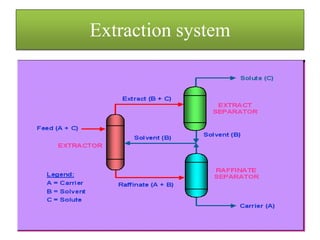
Extraction system
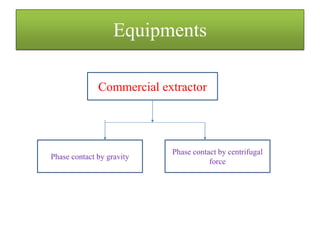
Equipments
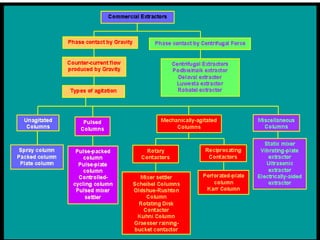
Commercial extractor
Phase contact by gravity
Phase contact by centrifugal
force
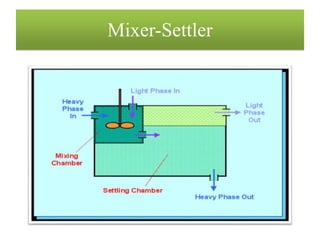
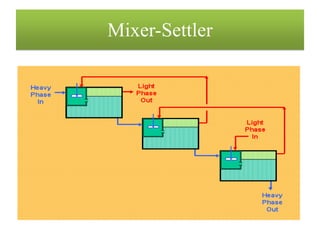
Mixer-Settler
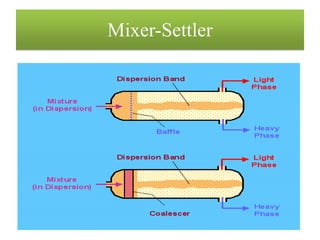
Mixer-Settler
Mixer-Settler
Advantage
reliability, operating flexibility, high
capacity,
It can handle difficult-to-disperse systems
such as those having high interfacial tension
and large phase density difference
Disadvantage
their size and the inventory of material held
up in the equipmen
Mixer-Settler
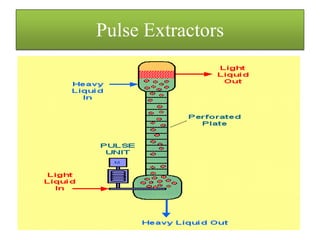
Pulse Extractors
• Low axial mixing
• High extraction efficiency which are due to
uniform distribution of energy over a cross-
section of the column
• Uniform distribution of droplets in the column.
Pulse Extractors
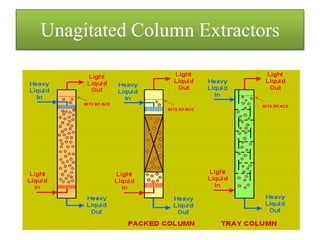
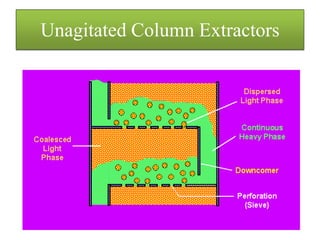
Unagitated Column Extractors
Mechanically Agitated Extractors
Classified according to mechanical motion
patterns
• Rotary-agitated columns
• Reciprocating or vibrating-plate columns.
Rotary-agitated columns
• Scheibel columns
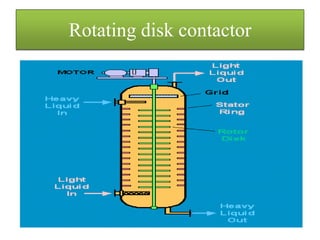
• Rotating disk contactor
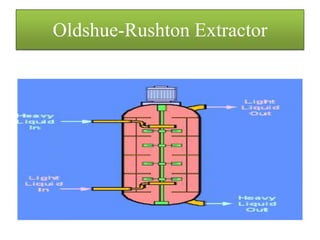
• Oldshue-Rushton Columns
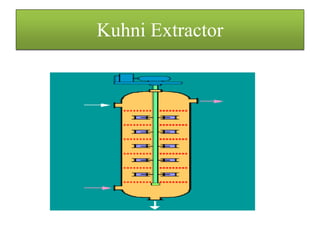
• Kuhni columns
Reciprocating column
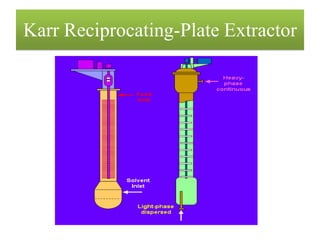
• Karr columns.
Mechanically Agitated Extractors
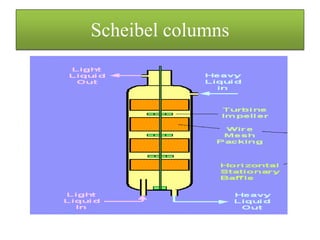
Scheibel columns
Rotating disk contactor
Oldshue-Rushton Extractor
Kuhni Extractor
Karr Reciprocating-Plate Extractor
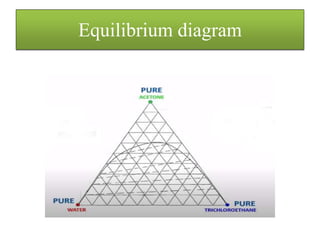
Equilibrium diagram
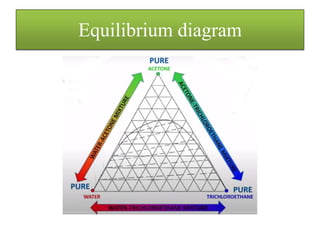
Equilibrium diagram
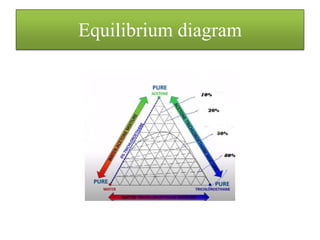
Equilibrium diagram
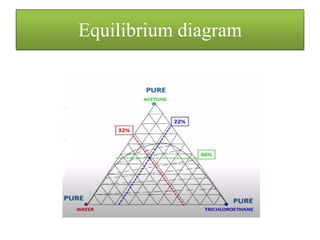
Equilibrium diagram
Washing
• Washing is identical to extraction
• Water is used as solvent
• Water is cheap and readily available
• The washing is designed to remove unwanted
residue material
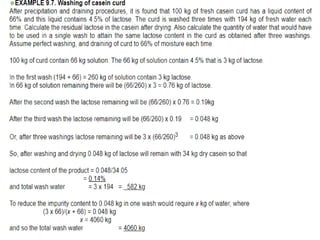
• The concentration remaining with the solid
after washing
x1 = x[xw /xw(1 + y)] = x[1/(1 + y)]
after two washings:
x2 = x1[1/(1 + y)] = x[1/(1 + y)]2
and so after n washings:
xn = x[1/(1 + y)]n
Washing
Extraction and washing

Extraction and washing

  • 1.
  • 2.
    EXTRACTION • It isdefined as the removal of solid constituents from the solid or liquid or semi solid by means of suitable solvents • Extract- compound contain all the constituents which are soluble in solvent • Menstrum- Solvent used for extraction process • Marc- residue obtained after the extraction process
  • 3.
    PRINCIPLE • The solventused for extraction which diffuse into the compound to dissolve the desired compounds • The solution in compound pass in the opposite direction and mix with the surrounding liquid . • An equilibrium is established between the solute inside the compound and the solvent surrounding
  • 5.
    • Rate ofsolution = driving force/resistance. dw/dt = KlA(ys - y) • dw/dt is the rate of solution • Kl is the mass-transfer coefficient • A is the interfacial area • ys and y are the concentrations of the soluble component in the bulk of the liquid and at the interface. It is usually assumed that a saturated solution is formed at the interface • ys is the concentration of a saturated solution at Rate of extraction
  • 6.
    Rate of extraction Amass balance on the solute gives the equation dw = Vdy V is the quantity of liquid in the liquid stream. Vdy/dt = Kl A(ys - y) which can then be integrated over time t during which time the concentration goes from an initial value of y0 to a concentration y, giving loge [(ys - y0)/ (ys - y)] = tKlA/V.
  • 7.
    Factors influence theextraction process • Nature of compound • Type of Solvent used • Temperature • pH • Size of particle
  • 8.
    THEORIES • Schoenemann’s Diffusiontheory The rate of extraction depends on the rate of diffusion • Soaking theory Not only the rate of diffusion but also the rate of dissolution of the substances in the solvent critically affect the rate of extraction • Karnowsky’s Capillary velocity Theory It represents the rate of extraction as a function of the rate of flow in the capillaries.
  • 9.
    Methods of extraction •Liquid–liquid extraction • Solid-phase extraction • Acid-base extraction • Supercritical fluid extraction • Ultrasound-assisted extraction • Heat reflux extraction • Microwave-assisted extraction
  • 10.
  • 11.
    Equipments Commercial extractor Phase contactby gravity Phase contact by centrifugal force
  • 13.
  • 14.
  • 15.
  • 16.
    Advantage reliability, operating flexibility,high capacity, It can handle difficult-to-disperse systems such as those having high interfacial tension and large phase density difference Disadvantage their size and the inventory of material held up in the equipmen Mixer-Settler
  • 17.
  • 18.
    • Low axialmixing • High extraction efficiency which are due to uniform distribution of energy over a cross- section of the column • Uniform distribution of droplets in the column. Pulse Extractors
  • 19.
  • 20.
  • 21.
    Mechanically Agitated Extractors Classifiedaccording to mechanical motion patterns • Rotary-agitated columns • Reciprocating or vibrating-plate columns.
  • 22.
    Rotary-agitated columns • Scheibelcolumns • Rotating disk contactor • Oldshue-Rushton Columns • Kuhni columns Reciprocating column • Karr columns. Mechanically Agitated Extractors
  • 23.
  • 24.
  • 25.
  • 26.
  • 27.
  • 28.
  • 29.
  • 30.
  • 31.
  • 32.
    Washing • Washing isidentical to extraction • Water is used as solvent • Water is cheap and readily available • The washing is designed to remove unwanted residue material
  • 33.
    • The concentrationremaining with the solid after washing x1 = x[xw /xw(1 + y)] = x[1/(1 + y)] after two washings: x2 = x1[1/(1 + y)] = x[1/(1 + y)]2 and so after n washings: xn = x[1/(1 + y)]n Washing