PRESENTED BY:
SOWMYA.S
CONTENTS
INTRODUCTION
WHAT IS EXTRACTION?
EXTRACTION METHODS
PARAMETERS FOR
SELECTION
 Plants – richest bioresource of drugs
 1st step is production of extracts
using appropriate extraction method.
 How to produce a good quality
extract?
INTRODUCTION
EXTRACTION
Extraction can be defined as the process
of obtaining constituents by separating it
from the crude material by the use of
solvent/s.
Criteria of extraction techniques is
separating the soluble and insoluble
components and leaving behind only
insoluble cellular marc.
SOLVENTSELECTION FOR
EXTRACTION
Selectivity : The ability to remove and concentrate the
solute from the other components in feed.
Availability
Immiscibility : If the solvent is not immiscible with the
feed, recovery of the solvent is required which causes
extra cost.
Density differential : Small density difference between
the solvent and the feed causes separation problems.
Toxicity
Corrosiveness
Ease of recovery
EXTRACTION METHODS
Maceration
Infusion
Digestion
Decoction
Percolation
Hot Continuous Extraction (Soxhlet)
Counter-current Extraction
Supercritical Fluid Extraction
Distilllation
Expression
Enfleurage
Ultrasound extraction
NEW METHODS
Phytonics Process
Solid phase micro-extraction and
Head-space trapping extraction
Micro-distillation
Microwave assisted extraction
MACERATION
The whole or coarsely
powdered crude drug is
placed in a stoppered
container with the solvent.
Allowed to stand at room
temperature for at least 3
days with frequent
agitation.
The mixture then is
strained, the marc is
pressed and the liquids are
combined.
Time consuming.
INFUSION
Fresh infusions are prepared by
macerating the crude drug for a
short period of time with cold or
boiling water.
DIGESTION
This is a form of maceration in which
gentle heat is used during the process of
extraction to increase the solvent
efficiency.
It is used when moderately elevated
temperature is not objectionable.
DECOCTION
The crude drug is boiled in a
specified volume of water for a
defined time.
Water-soluble,
heat-stable
constituents.
PERCOLATION
Solid material moistened with menstruum (allowed to stand for
4hrs)
Packed in a percolator and additional
menstruum added
Allowed to stand for 24hrs
Outlet of percolator is opened and liquid contained therein is allowed to
drip slowly.
Marc is pressed
HOT CONTINUOUS EXTRACTION
A solid material is placed inside a
thimble, into the main chamber.
The Soxhlet extractor is placed onto
a flask with extraction solvent. The
Soxhlet is then equipped with
a condenser.
The extracting solvent is heated, and
its vapors condense in condenser.
The condensed extractant drips into
the thimble containing the crude
drug, and extracts it by contact.
COUNTER CURRENT EXTRACTION
Solvent flows in the opposite
direction to material.
The further the starting
material moves, the more
concentrated the extract
becomes.
SUPERCRITICALFLUID
EXTRACTION
Super critical fluid (SCF) :
Any compound at a
temperature and
pressure above the
critical point. It can
effuse through solids like
a gas, and dissolve
materials like a liquid.
SCF can dissolve wide
variety of organic
compounds.
SFE : The process of separating one component
(extract) from another (matrix) using super
critical fluids as extracting solvents.
Principle of SFE : When the feed material is
contacted with the SCF, the volatile substances
will partition onto the SC phase. This SCF is
removed from the feed material and then the
extracted component is completely separated
from the SCF by means of temp. or pressure
change.
DISTILLATION
Distillation simply implies vaporizing the oils from the
plant cellular membranes in the presence of moisture,
by applying high temperature and then cooling the
vapor mixture to separate the oil from the water.
DISTILLATION
Distillation simply implies vaporizing the
oils from the plant cellular membranes in
the presence of moisture, by applying
high temperature and then cooling the
vapor mixture to separate the oil
from the water.
Three types
Water distillation
(hydrodistillation)
Direct steam distillation
Water and steam distillation
1. WATER DISTILLATION
Direct contact between boiling water and plant
material.
The water is made to boil along with the plant material
and thus the essential oil is carried over to condenser
with the steam which is formed.
2. Water and steam distillation
To eliminate some of the drawbacks of water
distillation, some modifications were made
to the distillation units.
A perforated grid was introduced in the still,
to support the plant material and to avoid its
direct contact with the hot furnace bottom.
When the water level is kept below the grid,
the essential oil is distilled by the rising
steam from the boiling water.
WATER AND STEAM DISTILLATION
Direct steam distillation is
the process of distilling
plant material with steam
generated outside the still.
The plant material is
heated no higher than
100° C
EXPRESSION
Used in the production of
citrus oils.
Term expression refers to
any physical process in
which the essential oil
glands in the peel are
crushed or broken to release
the oil.
Halving and
bending
equaling
Hand
pressing
ENFLEURAGE
Essential Oil Extraction with Cold Fat.
Fat possesses a high power of
absorption and, when brought in
contact with fragrant flowers, readily
absorbs the perfume emitted.
The oil is extracted from the fat with
alcohol and then isolated.
ULTRASOUND EXTRACTION
(SONICATION)
Sound waves above 2000 Hz
are used to accelerate the
extraction.
Ultrasound achieves great
penetration of a solvent
into a plant tissue and
improves the mass transfer.
Ultrasound waves
generating cavitations
disrupt cell walls and
facilitate the release of
components.
PHYTONICS METHOD
Some substances that are gaseous at room
temperature & atm. Pressure, by changing
the pressure, they become liquids of low
viscosity and have good penetration power.
Such obtained liquids are known as
‘phytosols’.
In this method phytosols are used as the
extraction fluids.
This method is mainly used for the extraction
of volatile oils.
SOLID PHASE
MICROEXTRACTION
In SPME a small amount of
extracting phase (fiber coating)
associated with a solid support
is placed in contact with the
sample matrix for a
predetermined amount of
time.
If the time is long enough, a
concentration equilibrium is
established between the
sample matrix and the
extraction phase.
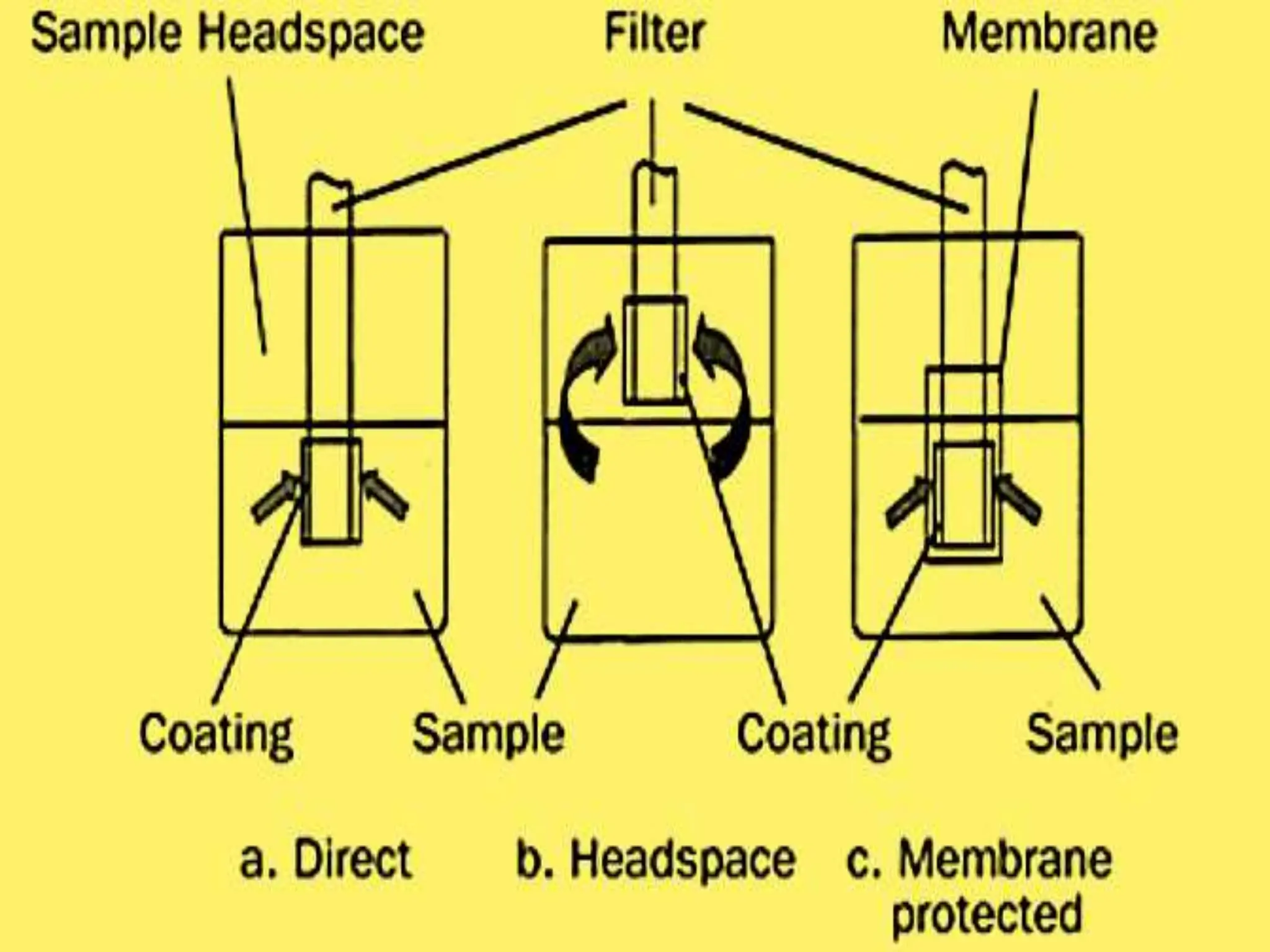
LAB SPME
DIRECT
• The coated
fiber is inserted
into the sample
• Agitation is
required
HEADSPACE
• The fiber is
exposed in the
vapor phase
above a
gaseous, liquid
or solid sample.
• Protect the
fiber
MEMBRANE
PROTECTED
• Fiber is
separated from
the sample
with a selective
membrane
• Protect the
fiber
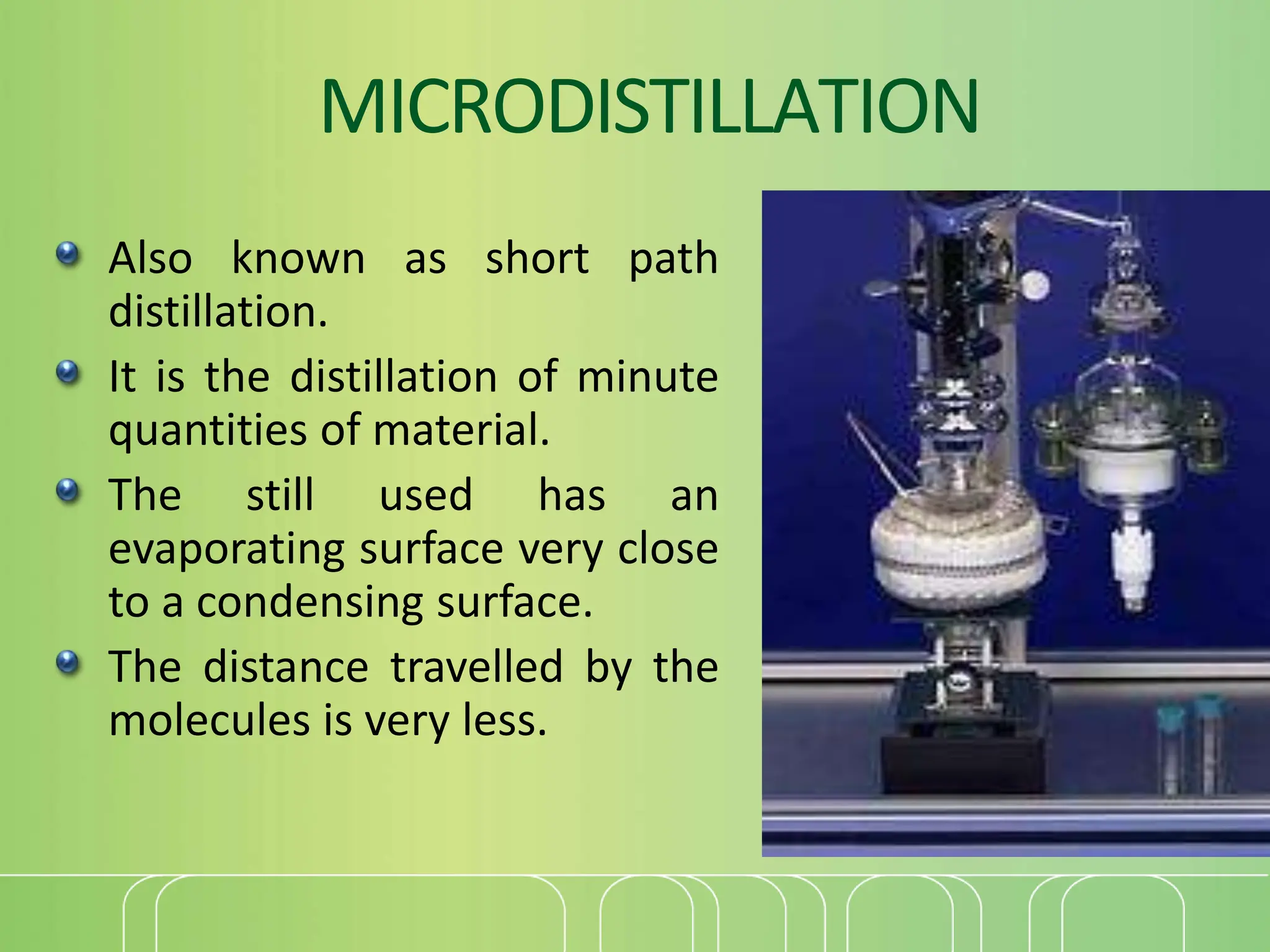
MICRODISTILLATION
Also known as short path
distillation.
It is the distillation of minute
quantities of material.
The still used has an
evaporating surface very close
to a condensing surface.
The distance travelled by the
molecules is very less.
MICROWAVE ASSISTED
EXTRACTION
The drug is subjected to microwave
irradiation.
The heated moisture evaporates, creating
a high vapor pressure.
The vapor pressure generated by the
moisture breaks the cell.
Breakage of cell walls releases the oil
trapped within it.
PARAMETERS FOR SELECTION
Authentication
Right plant part, age of plant and the time, season and
place of collection.
Drying - depend on the nature of its chemical
constituents.
Thermolabile - Cold maceration, percolation and CCE.
Thermostable - Soxhlet extraction (if non-aqueous
solvents are used) and decoction .
Precautions - constituents that degrade while being
kept in organic solvents. e.g. flavonoids and phenyl
propanoids.
Grinding methods
If the therapeutic value lies in non-polar
constituents, a non-polar solvent may be used.
For eg. , lupeol is the active constituent of
Crataeva nurvala - hexane is generally used.
Standardization of time of extraction.
Number of extractions.
Quality of water or menstrum.
The design and material of the extractor.
REFERENCE
Evans W.C., Trease, “Pharmacognosy”, 15th edition,
2007, Sort court Publishers, Page No. 167-165.
Sukhdev Swami Handa etal, “Extraction Technologies
for Medicinal and Aromatic Plants”, International
Centre for Science and High Technology Trieste, Italy,
2008.
Kokate C.K., Purohit A.P., “Pharmacognosy” 18th
edition , 2002, Nirali Prakashan, Page No. 303-311.
Jean Brunetton, “Phytochemistry & Pharmacognosy”,
page no 467-475.
Different Extraction methods, evaluatory ppt.pptx

Different Extraction methods, evaluatory ppt.pptx

  • 1.
  • 2.
  • 3.
     Plants –richest bioresource of drugs  1st step is production of extracts using appropriate extraction method.  How to produce a good quality extract? INTRODUCTION
  • 4.
    EXTRACTION Extraction can bedefined as the process of obtaining constituents by separating it from the crude material by the use of solvent/s. Criteria of extraction techniques is separating the soluble and insoluble components and leaving behind only insoluble cellular marc.
  • 5.
    SOLVENTSELECTION FOR EXTRACTION Selectivity :The ability to remove and concentrate the solute from the other components in feed. Availability Immiscibility : If the solvent is not immiscible with the feed, recovery of the solvent is required which causes extra cost. Density differential : Small density difference between the solvent and the feed causes separation problems. Toxicity Corrosiveness Ease of recovery
  • 6.
    EXTRACTION METHODS Maceration Infusion Digestion Decoction Percolation Hot ContinuousExtraction (Soxhlet) Counter-current Extraction Supercritical Fluid Extraction
  • 7.
  • 8.
    NEW METHODS Phytonics Process Solidphase micro-extraction and Head-space trapping extraction Micro-distillation Microwave assisted extraction
  • 9.
    MACERATION The whole orcoarsely powdered crude drug is placed in a stoppered container with the solvent. Allowed to stand at room temperature for at least 3 days with frequent agitation. The mixture then is strained, the marc is pressed and the liquids are combined. Time consuming.
  • 10.
    INFUSION Fresh infusions areprepared by macerating the crude drug for a short period of time with cold or boiling water.
  • 11.
    DIGESTION This is aform of maceration in which gentle heat is used during the process of extraction to increase the solvent efficiency. It is used when moderately elevated temperature is not objectionable.
  • 12.
    DECOCTION The crude drugis boiled in a specified volume of water for a defined time. Water-soluble, heat-stable constituents.
  • 13.
    PERCOLATION Solid material moistenedwith menstruum (allowed to stand for 4hrs) Packed in a percolator and additional menstruum added Allowed to stand for 24hrs Outlet of percolator is opened and liquid contained therein is allowed to drip slowly. Marc is pressed
  • 15.
    HOT CONTINUOUS EXTRACTION Asolid material is placed inside a thimble, into the main chamber. The Soxhlet extractor is placed onto a flask with extraction solvent. The Soxhlet is then equipped with a condenser. The extracting solvent is heated, and its vapors condense in condenser. The condensed extractant drips into the thimble containing the crude drug, and extracts it by contact.
  • 17.
    COUNTER CURRENT EXTRACTION Solventflows in the opposite direction to material. The further the starting material moves, the more concentrated the extract becomes.
  • 19.
    SUPERCRITICALFLUID EXTRACTION Super critical fluid(SCF) : Any compound at a temperature and pressure above the critical point. It can effuse through solids like a gas, and dissolve materials like a liquid. SCF can dissolve wide variety of organic compounds.
  • 20.
    SFE : Theprocess of separating one component (extract) from another (matrix) using super critical fluids as extracting solvents. Principle of SFE : When the feed material is contacted with the SCF, the volatile substances will partition onto the SC phase. This SCF is removed from the feed material and then the extracted component is completely separated from the SCF by means of temp. or pressure change.
  • 22.
    DISTILLATION Distillation simply impliesvaporizing the oils from the plant cellular membranes in the presence of moisture, by applying high temperature and then cooling the vapor mixture to separate the oil from the water. DISTILLATION Distillation simply implies vaporizing the oils from the plant cellular membranes in the presence of moisture, by applying high temperature and then cooling the vapor mixture to separate the oil from the water.
  • 23.
    Three types Water distillation (hydrodistillation) Directsteam distillation Water and steam distillation
  • 24.
    1. WATER DISTILLATION Directcontact between boiling water and plant material. The water is made to boil along with the plant material and thus the essential oil is carried over to condenser with the steam which is formed.
  • 25.
    2. Water andsteam distillation To eliminate some of the drawbacks of water distillation, some modifications were made to the distillation units. A perforated grid was introduced in the still, to support the plant material and to avoid its direct contact with the hot furnace bottom. When the water level is kept below the grid, the essential oil is distilled by the rising steam from the boiling water.
  • 26.
    WATER AND STEAMDISTILLATION
  • 27.
    Direct steam distillationis the process of distilling plant material with steam generated outside the still. The plant material is heated no higher than 100° C
  • 28.
    EXPRESSION Used in theproduction of citrus oils. Term expression refers to any physical process in which the essential oil glands in the peel are crushed or broken to release the oil.
  • 29.
  • 30.
    ENFLEURAGE Essential Oil Extractionwith Cold Fat. Fat possesses a high power of absorption and, when brought in contact with fragrant flowers, readily absorbs the perfume emitted. The oil is extracted from the fat with alcohol and then isolated.
  • 32.
    ULTRASOUND EXTRACTION (SONICATION) Sound wavesabove 2000 Hz are used to accelerate the extraction. Ultrasound achieves great penetration of a solvent into a plant tissue and improves the mass transfer. Ultrasound waves generating cavitations disrupt cell walls and facilitate the release of components.
  • 33.
    PHYTONICS METHOD Some substancesthat are gaseous at room temperature & atm. Pressure, by changing the pressure, they become liquids of low viscosity and have good penetration power. Such obtained liquids are known as ‘phytosols’. In this method phytosols are used as the extraction fluids. This method is mainly used for the extraction of volatile oils.
  • 34.
    SOLID PHASE MICROEXTRACTION In SPMEa small amount of extracting phase (fiber coating) associated with a solid support is placed in contact with the sample matrix for a predetermined amount of time. If the time is long enough, a concentration equilibrium is established between the sample matrix and the extraction phase.
  • 36.
  • 37.
    DIRECT • The coated fiberis inserted into the sample • Agitation is required HEADSPACE • The fiber is exposed in the vapor phase above a gaseous, liquid or solid sample. • Protect the fiber MEMBRANE PROTECTED • Fiber is separated from the sample with a selective membrane • Protect the fiber
  • 39.
    MICRODISTILLATION Also known asshort path distillation. It is the distillation of minute quantities of material. The still used has an evaporating surface very close to a condensing surface. The distance travelled by the molecules is very less.
  • 40.
    MICROWAVE ASSISTED EXTRACTION The drugis subjected to microwave irradiation. The heated moisture evaporates, creating a high vapor pressure. The vapor pressure generated by the moisture breaks the cell. Breakage of cell walls releases the oil trapped within it.
  • 43.
    PARAMETERS FOR SELECTION Authentication Rightplant part, age of plant and the time, season and place of collection. Drying - depend on the nature of its chemical constituents. Thermolabile - Cold maceration, percolation and CCE. Thermostable - Soxhlet extraction (if non-aqueous solvents are used) and decoction . Precautions - constituents that degrade while being kept in organic solvents. e.g. flavonoids and phenyl propanoids.
  • 44.
    Grinding methods If thetherapeutic value lies in non-polar constituents, a non-polar solvent may be used. For eg. , lupeol is the active constituent of Crataeva nurvala - hexane is generally used. Standardization of time of extraction. Number of extractions. Quality of water or menstrum. The design and material of the extractor.
  • 45.
    REFERENCE Evans W.C., Trease,“Pharmacognosy”, 15th edition, 2007, Sort court Publishers, Page No. 167-165. Sukhdev Swami Handa etal, “Extraction Technologies for Medicinal and Aromatic Plants”, International Centre for Science and High Technology Trieste, Italy, 2008. Kokate C.K., Purohit A.P., “Pharmacognosy” 18th edition , 2002, Nirali Prakashan, Page No. 303-311. Jean Brunetton, “Phytochemistry & Pharmacognosy”, page no 467-475.