
•Normality (N)
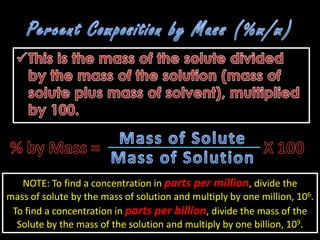
NOTE: To find a concentration in parts per million, divide the
mass of solute by the mass of solution and multiply by one million, 106.
 To find a concentration in parts per billion, divide the mass of the
  Solute by the mass of the solution and multiply by one billion, 109.
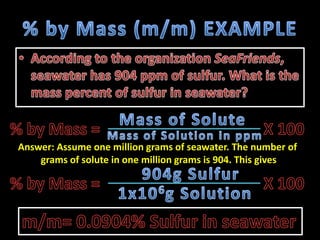
Answer: Assume one million grams of seawater. The number of
    grams of solute in one million grams is 904. This gives
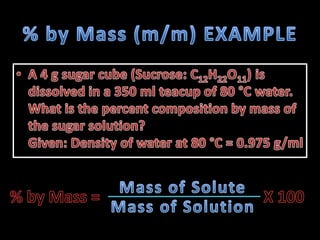
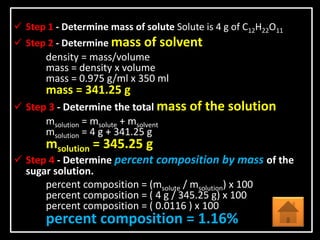
 Step 1 - Determine mass of solute Solute is 4 g of C12H22O11
 Step 2 - Determine mass of solvent
      density = mass/volume
      mass = density x volume
      mass = 0.975 g/ml x 350 ml
       mass = 341.25 g
 Step 3 - Determine the total mass of the solution
      msolution = msolute + msolvent
      msolution = 4 g + 341.25 g
       msolution = 345.25 g
 Step 4 - Determine percent composition by mass of the
  sugar solution.
      percent composition = (msolute / msolution) x 100
      percent composition = ( 4 g / 345.25 g) x 100
      percent composition = ( 0.0116 ) x 100
       percent composition = 1.16%
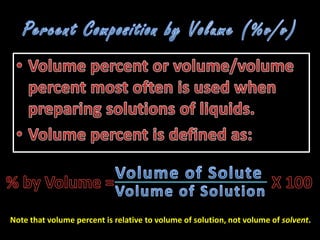
Note that volume percent is relative to volume of solution, not volume of solvent.
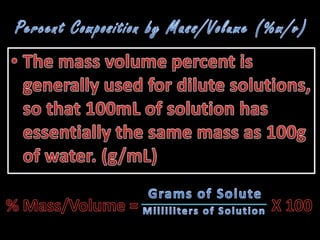
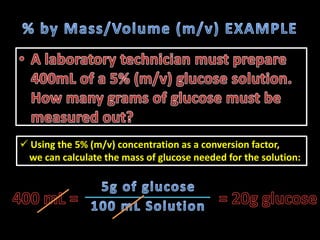
 Using the 5% (m/v) concentration as a conversion factor,
 we can calculate the mass of glucose needed for the solution:
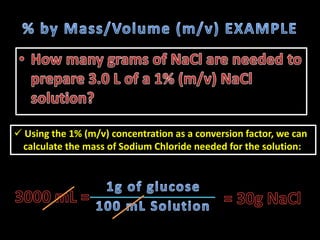
 Using the 1% (m/v) concentration as a conversion factor, we can
 calculate the mass of Sodium Chloride needed for the solution:
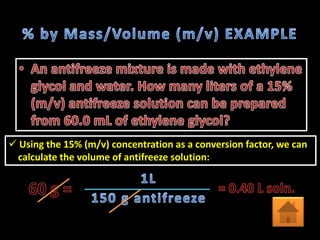
 Using the 15% (m/v) concentration as a conversion factor, we can
 calculate the volume of antifreeze solution:
Expressing solutions

Expressing solutions

  • 2.
  • 3.
    NOTE: To finda concentration in parts per million, divide the mass of solute by the mass of solution and multiply by one million, 106. To find a concentration in parts per billion, divide the mass of the Solute by the mass of the solution and multiply by one billion, 109.
  • 6.
    Answer: Assume onemillion grams of seawater. The number of grams of solute in one million grams is 904. This gives
  • 8.
     Step 1- Determine mass of solute Solute is 4 g of C12H22O11  Step 2 - Determine mass of solvent density = mass/volume mass = density x volume mass = 0.975 g/ml x 350 ml mass = 341.25 g  Step 3 - Determine the total mass of the solution msolution = msolute + msolvent msolution = 4 g + 341.25 g msolution = 345.25 g  Step 4 - Determine percent composition by mass of the sugar solution. percent composition = (msolute / msolution) x 100 percent composition = ( 4 g / 345.25 g) x 100 percent composition = ( 0.0116 ) x 100 percent composition = 1.16%
  • 9.
    Note that volumepercent is relative to volume of solution, not volume of solvent.
  • 16.
     Using the5% (m/v) concentration as a conversion factor, we can calculate the mass of glucose needed for the solution:
  • 17.
     Using the1% (m/v) concentration as a conversion factor, we can calculate the mass of Sodium Chloride needed for the solution:
  • 18.
     Using the15% (m/v) concentration as a conversion factor, we can calculate the volume of antifreeze solution: