Exploring Substances:
Acidic, Basic, and
Neutral
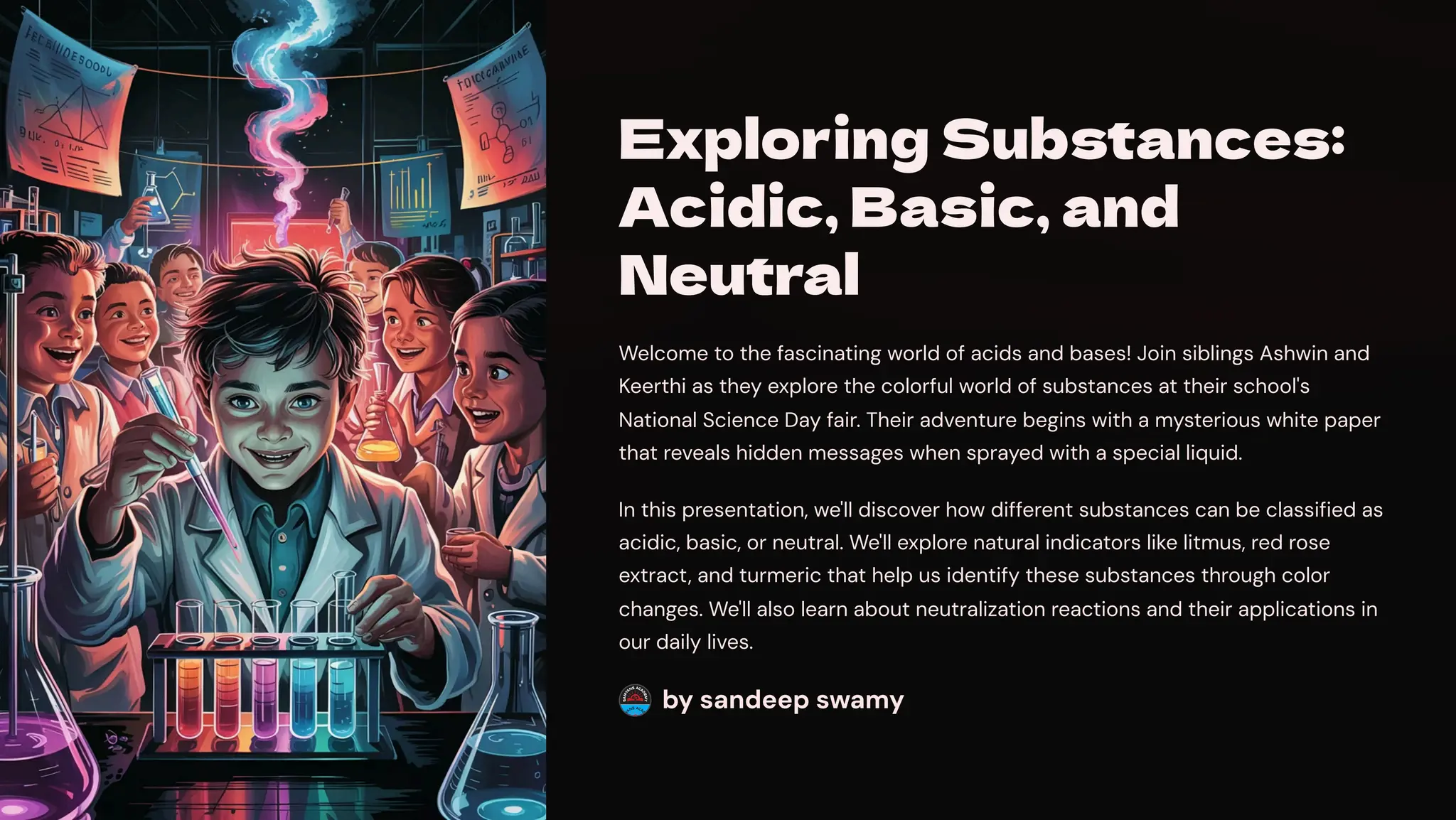
Welcome to the fascinating world of acids and bases! Join siblings Ashwin and
Keerthi as they explore the colorful world of substances at their school's
National Science Day fair. Their adventure begins with a mysterious white paper
that reveals hidden messages when sprayed with a special liquid.
In this presentation, we'll discover how different substances can be classified as
acidic, basic, or neutral. We'll explore natural indicators like litmus, red rose
extract, and turmeric that help us identify these substances through color
changes. We'll also learn about neutralization reactions and their applications in
our daily lives.
by sandeep swamy
The Mystery of the Appearing Message
The White Paper
At the science fair entry, Ashwin and
Keerthi received blank white sheets
of paper, wondering about their
purpose.
The Magic Spray
A volunteer sprayed a mysterious
liquid on their papers, causing
hidden words to appear: "Welcome
to the Wonderful World of Science."
The Science Behind
It
This fascinating demonstration
showcased acid-base indicators -
substances that change color when
they come in contact with acids or
bases.
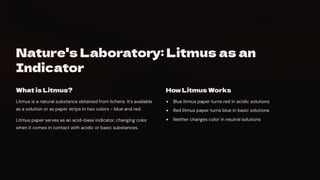
Nature's Laboratory: Litmus as an
Indicator
What is Litmus?
Litmus is a natural substance obtained from lichens. It's available
as a solution or as paper strips in two colors - blue and red.
Litmus paper serves as an acid-base indicator, changing color
when it comes in contact with acidic or basic substances.
How Litmus Works
Blue litmus paper turns red in acidic solutions
Red litmus paper turns blue in basic solutions
Neither changes color in neutral solutions
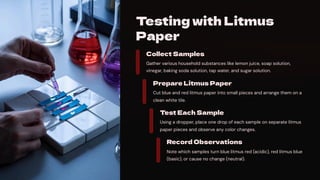
Testing with Litmus
Paper
Collect Samples
Gather various household substances like lemon juice, soap solution,
vinegar, baking soda solution, tap water, and sugar solution.
Prepare Litmus Paper
Cut blue and red litmus paper into small pieces and arrange them on a
clean white tile.
Test Each Sample
Using a dropper, place one drop of each sample on separate litmus
paper pieces and observe any color changes.
Record Observations
Note which samples turn blue litmus red (acidic), red litmus blue
(basic), or cause no change (neutral).
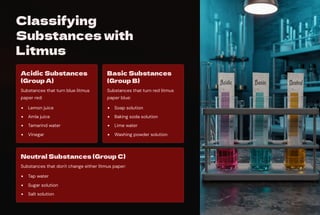
Classifying
Substances with
Litmus
Acidic Substances
(Group A)
Substances that turn blue litmus
paper red:
Lemon juice
Amla juice
Tamarind water
Vinegar
Basic Substances
(Group B)
Substances that turn red litmus
paper blue:
Soap solution
Baking soda solution
Lime water
Washing powder solution
Neutral Substances (Group C)
Substances that don't change either litmus paper:
Tap water
Sugar solution
Salt solution
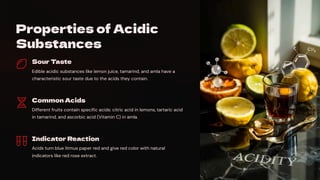
Properties of Acidic
Substances
Sour Taste
Edible acidic substances like lemon juice, tamarind, and amla have a
characteristic sour taste due to the acids they contain.
Common Acids
Different fruits contain specific acids: citric acid in lemons, tartaric acid
in tamarind, and ascorbic acid (Vitamin C) in amla.
Indicator Reaction
Acids turn blue litmus paper red and give red color with natural
indicators like red rose extract.
Properties of Basic Substances
Slippery Feel
Basic substances like soap and baking
soda solution feel slippery or soapy
when rubbed between fingers.
Bitter Taste
Many basic substances taste bitter,
though not everything bitter contains a
base (e.g., bitter gourd).
Indicator Reaction
Bases turn red litmus paper blue and
give green color with red rose extract.
Turmeric Reaction
Bases turn yellow turmeric paper or
solution to reddish color.
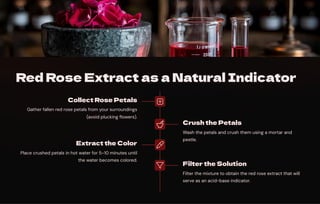
Red Rose Extract as a Natural Indicator
Collect Rose Petals
Gather fallen red rose petals from your surroundings
(avoid plucking flowers).
Crush the Petals
Wash the petals and crush them using a mortar and
pestle.
Extract the Color
Place crushed petals in hot water for 5-10 minutes until
the water becomes colored.
Filter the Solution
Filter the mixture to obtain the red rose extract that will
serve as an acid-base indicator.
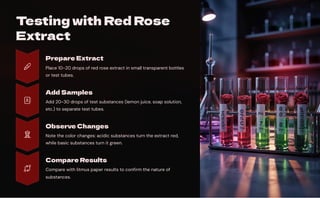
Testing with Red Rose
Extract
Prepare Extract
Place 10-20 drops of red rose extract in small transparent bottles
or test tubes.
Add Samples
Add 20-30 drops of test substances (lemon juice, soap solution,
etc.) to separate test tubes.
Observe Changes
Note the color changes: acidic substances turn the extract red,
while basic substances turn it green.
Compare Results
Compare with litmus paper results to confirm the nature of
substances.
Other Natural Indicators
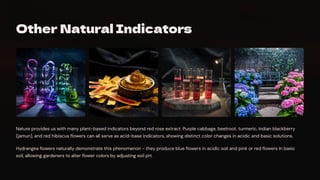
Nature provides us with many plant-based indicators beyond red rose extract. Purple cabbage, beetroot, turmeric, Indian blackberry
(jamun), and red hibiscus flowers can all serve as acid-base indicators, showing distinct color changes in acidic and basic solutions.
Hydrangea flowers naturally demonstrate this phenomenon - they produce blue flowers in acidic soil and pink or red flowers in basic
soil, allowing gardeners to alter flower colors by adjusting soil pH.
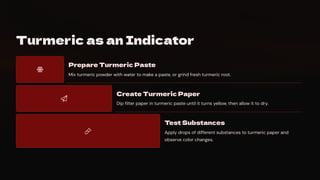
Turmeric as an Indicator
Prepare Turmeric Paste
Mix turmeric powder with water to make a paste, or grind fresh turmeric root.
Create Turmeric Paper
Dip filter paper in turmeric paste until it turns yellow, then allow it to dry.
Test Substances
Apply drops of different substances to turmeric paper and
observe color changes.
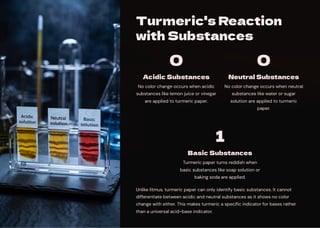
Turmeric's Reaction
with Substances
0
Acidic Substances
No color change occurs when acidic
substances like lemon juice or vinegar
are applied to turmeric paper.
0
Neutral Substances
No color change occurs when neutral
substances like water or sugar
solution are applied to turmeric
paper.
1
Basic Substances
Turmeric paper turns reddish when
basic substances like soap solution or
baking soda are applied.
Unlike litmus, turmeric paper can only identify basic substances. It cannot
differentiate between acidic and neutral substances as it shows no color
change with either. This makes turmeric a specific indicator for bases rather
than a universal acid-base indicator.
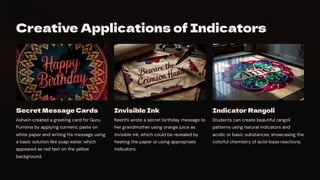
Creative Applications of Indicators
Secret Message Cards
Ashwin created a greeting card for Guru
Purnima by applying turmeric paste on
white paper and writing his message using
a basic solution like soap water, which
appeared as red text on the yellow
background.
Invisible Ink
Keerthi wrote a secret birthday message to
her grandmother using orange juice as
invisible ink, which could be revealed by
heating the paper or using appropriate
indicators.
Indicator Rangoli
Students can create beautiful rangoli
patterns using natural indicators and
acidic or basic substances, showcasing the
colorful chemistry of acid-base reactions.
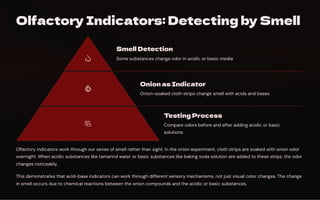
Olfactory Indicators: Detecting by Smell
Smell Detection
Some substances change odor in acidic or basic media
Onion as Indicator
Onion-soaked cloth strips change smell with acids and bases
Testing Process
Compare odors before and after adding acidic or basic
solutions
Olfactory indicators work through our sense of smell rather than sight. In the onion experiment, cloth strips are soaked with onion odor
overnight. When acidic substances like tamarind water or basic substances like baking soda solution are added to these strips, the odor
changes noticeably.
This demonstrates that acid-base indicators can work through different sensory mechanisms, not just visual color changes. The change
in smell occurs due to chemical reactions between the onion compounds and the acidic or basic substances.
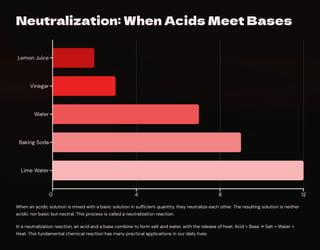
Neutralization: When Acids Meet Bases
Lemon Juice
Vinegar
Water
Baking Soda
Lime Water
0 4 8 12
When an acidic solution is mixed with a basic solution in sufficient quantity, they neutralize each other. The resulting solution is neither
acidic nor basic but neutral. This process is called a neutralization reaction.
In a neutralization reaction, an acid and a base combine to form salt and water, with the release of heat: Acid + Base ³ Salt + Water +
Heat. This fundamental chemical reaction has many practical applications in our daily lives.
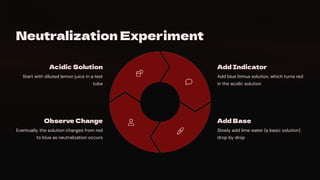
Neutralization Experiment
Acidic Solution
Start with diluted lemon juice in a test
tube
Add Indicator
Add blue litmus solution, which turns red
in the acidic solution
Add Base
Slowly add lime water (a basic solution)
drop by drop
Observe Change
Eventually, the solution changes from red
to blue as neutralization occurs
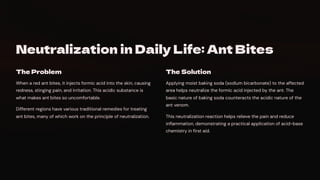
Neutralization in Daily Life: Ant Bites
The Problem
When a red ant bites, it injects formic acid into the skin, causing
redness, stinging pain, and irritation. This acidic substance is
what makes ant bites so uncomfortable.
Different regions have various traditional remedies for treating
ant bites, many of which work on the principle of neutralization.
The Solution
Applying moist baking soda (sodium bicarbonate) to the affected
area helps neutralize the formic acid injected by the ant. The
basic nature of baking soda counteracts the acidic nature of the
ant venom.
This neutralization reaction helps relieve the pain and reduce
inflammation, demonstrating a practical application of acid-base
chemistry in first aid.
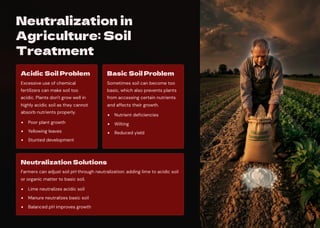
Neutralization in
Agriculture: Soil
Treatment
Acidic Soil Problem
Excessive use of chemical
fertilizers can make soil too
acidic. Plants don't grow well in
highly acidic soil as they cannot
absorb nutrients properly.
Poor plant growth
Yellowing leaves
Stunted development
Basic Soil Problem
Sometimes soil can become too
basic, which also prevents plants
from accessing certain nutrients
and affects their growth.
Nutrient deficiencies
Wilting
Reduced yield
Neutralization Solutions
Farmers can adjust soil pH through neutralization: adding lime to acidic soil
or organic matter to basic soil.
Lime neutralizes acidic soil
Manure neutralizes basic soil
Balanced pH improves growth
Environmental Applications of
Neutralization
Industrial Waste
Treatment
Factory waste that is acidic in nature can
harm aquatic life when released into lakes
and rivers. Treatment facilities neutralize
this waste by adding basic substances
before releasing it, protecting the
ecosystem and fish population.
Acid Rain Mitigation
Acid rain caused by industrial emissions
can damage plants, buildings, and water
bodies. Neutralization techniques like
adding limestone to lakes or using alkaline
substances in soil can help counteract
these effects.
Water Quality Monitoring
Testing the acidic, basic, or neutral nature
of water from various sources like rain,
taps, and rivers helps monitor
environmental health and ensure water
safety for consumption and agriculture.
Solving the Science Fair Mystery
1
The Secret Message
The science fair demonstration used acid-
base indicators to reveal hidden messages
on white paper.
2
The Chemistry
One possibility: the message was written
using a basic solution like soap water on
turmeric-coated paper.
3
The Revelation
When sprayed, the basic solution reacted
with turmeric to create a visible color
change, revealing the hidden message.
This fascinating demonstration showcases the practical application of acid-base indicators in creating "invisible ink" that becomes
visible through chemical reactions. The same principles that help us classify substances as acidic, basic, or neutral can be used in
creative and entertaining ways.
As we've learned throughout this presentation, the chemistry of acids and bases is not just a laboratory curiosity but a fundamental
aspect of our daily lives - from the foods we eat to the soils we grow them in, from treating ant bites to protecting our environment.

Exploring-Substances-Acidic-Basic-and-Neutral.pdf

  • 1.
    Exploring Substances: Acidic, Basic,and Neutral Welcome to the fascinating world of acids and bases! Join siblings Ashwin and Keerthi as they explore the colorful world of substances at their school's National Science Day fair. Their adventure begins with a mysterious white paper that reveals hidden messages when sprayed with a special liquid. In this presentation, we'll discover how different substances can be classified as acidic, basic, or neutral. We'll explore natural indicators like litmus, red rose extract, and turmeric that help us identify these substances through color changes. We'll also learn about neutralization reactions and their applications in our daily lives. by sandeep swamy
  • 2.
    The Mystery ofthe Appearing Message The White Paper At the science fair entry, Ashwin and Keerthi received blank white sheets of paper, wondering about their purpose. The Magic Spray A volunteer sprayed a mysterious liquid on their papers, causing hidden words to appear: "Welcome to the Wonderful World of Science." The Science Behind It This fascinating demonstration showcased acid-base indicators - substances that change color when they come in contact with acids or bases.
  • 3.
    Nature's Laboratory: Litmusas an Indicator What is Litmus? Litmus is a natural substance obtained from lichens. It's available as a solution or as paper strips in two colors - blue and red. Litmus paper serves as an acid-base indicator, changing color when it comes in contact with acidic or basic substances. How Litmus Works Blue litmus paper turns red in acidic solutions Red litmus paper turns blue in basic solutions Neither changes color in neutral solutions
  • 4.
    Testing with Litmus Paper CollectSamples Gather various household substances like lemon juice, soap solution, vinegar, baking soda solution, tap water, and sugar solution. Prepare Litmus Paper Cut blue and red litmus paper into small pieces and arrange them on a clean white tile. Test Each Sample Using a dropper, place one drop of each sample on separate litmus paper pieces and observe any color changes. Record Observations Note which samples turn blue litmus red (acidic), red litmus blue (basic), or cause no change (neutral).
  • 5.
    Classifying Substances with Litmus Acidic Substances (GroupA) Substances that turn blue litmus paper red: Lemon juice Amla juice Tamarind water Vinegar Basic Substances (Group B) Substances that turn red litmus paper blue: Soap solution Baking soda solution Lime water Washing powder solution Neutral Substances (Group C) Substances that don't change either litmus paper: Tap water Sugar solution Salt solution
  • 6.
    Properties of Acidic Substances SourTaste Edible acidic substances like lemon juice, tamarind, and amla have a characteristic sour taste due to the acids they contain. Common Acids Different fruits contain specific acids: citric acid in lemons, tartaric acid in tamarind, and ascorbic acid (Vitamin C) in amla. Indicator Reaction Acids turn blue litmus paper red and give red color with natural indicators like red rose extract.
  • 7.
    Properties of BasicSubstances Slippery Feel Basic substances like soap and baking soda solution feel slippery or soapy when rubbed between fingers. Bitter Taste Many basic substances taste bitter, though not everything bitter contains a base (e.g., bitter gourd). Indicator Reaction Bases turn red litmus paper blue and give green color with red rose extract. Turmeric Reaction Bases turn yellow turmeric paper or solution to reddish color.
  • 8.
    Red Rose Extractas a Natural Indicator Collect Rose Petals Gather fallen red rose petals from your surroundings (avoid plucking flowers). Crush the Petals Wash the petals and crush them using a mortar and pestle. Extract the Color Place crushed petals in hot water for 5-10 minutes until the water becomes colored. Filter the Solution Filter the mixture to obtain the red rose extract that will serve as an acid-base indicator.
  • 9.
    Testing with RedRose Extract Prepare Extract Place 10-20 drops of red rose extract in small transparent bottles or test tubes. Add Samples Add 20-30 drops of test substances (lemon juice, soap solution, etc.) to separate test tubes. Observe Changes Note the color changes: acidic substances turn the extract red, while basic substances turn it green. Compare Results Compare with litmus paper results to confirm the nature of substances.
  • 10.
    Other Natural Indicators Natureprovides us with many plant-based indicators beyond red rose extract. Purple cabbage, beetroot, turmeric, Indian blackberry (jamun), and red hibiscus flowers can all serve as acid-base indicators, showing distinct color changes in acidic and basic solutions. Hydrangea flowers naturally demonstrate this phenomenon - they produce blue flowers in acidic soil and pink or red flowers in basic soil, allowing gardeners to alter flower colors by adjusting soil pH.
  • 11.
    Turmeric as anIndicator Prepare Turmeric Paste Mix turmeric powder with water to make a paste, or grind fresh turmeric root. Create Turmeric Paper Dip filter paper in turmeric paste until it turns yellow, then allow it to dry. Test Substances Apply drops of different substances to turmeric paper and observe color changes.
  • 12.
    Turmeric's Reaction with Substances 0 AcidicSubstances No color change occurs when acidic substances like lemon juice or vinegar are applied to turmeric paper. 0 Neutral Substances No color change occurs when neutral substances like water or sugar solution are applied to turmeric paper. 1 Basic Substances Turmeric paper turns reddish when basic substances like soap solution or baking soda are applied. Unlike litmus, turmeric paper can only identify basic substances. It cannot differentiate between acidic and neutral substances as it shows no color change with either. This makes turmeric a specific indicator for bases rather than a universal acid-base indicator.
  • 13.
    Creative Applications ofIndicators Secret Message Cards Ashwin created a greeting card for Guru Purnima by applying turmeric paste on white paper and writing his message using a basic solution like soap water, which appeared as red text on the yellow background. Invisible Ink Keerthi wrote a secret birthday message to her grandmother using orange juice as invisible ink, which could be revealed by heating the paper or using appropriate indicators. Indicator Rangoli Students can create beautiful rangoli patterns using natural indicators and acidic or basic substances, showcasing the colorful chemistry of acid-base reactions.
  • 14.
    Olfactory Indicators: Detectingby Smell Smell Detection Some substances change odor in acidic or basic media Onion as Indicator Onion-soaked cloth strips change smell with acids and bases Testing Process Compare odors before and after adding acidic or basic solutions Olfactory indicators work through our sense of smell rather than sight. In the onion experiment, cloth strips are soaked with onion odor overnight. When acidic substances like tamarind water or basic substances like baking soda solution are added to these strips, the odor changes noticeably. This demonstrates that acid-base indicators can work through different sensory mechanisms, not just visual color changes. The change in smell occurs due to chemical reactions between the onion compounds and the acidic or basic substances.
  • 15.
    Neutralization: When AcidsMeet Bases Lemon Juice Vinegar Water Baking Soda Lime Water 0 4 8 12 When an acidic solution is mixed with a basic solution in sufficient quantity, they neutralize each other. The resulting solution is neither acidic nor basic but neutral. This process is called a neutralization reaction. In a neutralization reaction, an acid and a base combine to form salt and water, with the release of heat: Acid + Base ³ Salt + Water + Heat. This fundamental chemical reaction has many practical applications in our daily lives.
  • 16.
    Neutralization Experiment Acidic Solution Startwith diluted lemon juice in a test tube Add Indicator Add blue litmus solution, which turns red in the acidic solution Add Base Slowly add lime water (a basic solution) drop by drop Observe Change Eventually, the solution changes from red to blue as neutralization occurs
  • 17.
    Neutralization in DailyLife: Ant Bites The Problem When a red ant bites, it injects formic acid into the skin, causing redness, stinging pain, and irritation. This acidic substance is what makes ant bites so uncomfortable. Different regions have various traditional remedies for treating ant bites, many of which work on the principle of neutralization. The Solution Applying moist baking soda (sodium bicarbonate) to the affected area helps neutralize the formic acid injected by the ant. The basic nature of baking soda counteracts the acidic nature of the ant venom. This neutralization reaction helps relieve the pain and reduce inflammation, demonstrating a practical application of acid-base chemistry in first aid.
  • 18.
    Neutralization in Agriculture: Soil Treatment AcidicSoil Problem Excessive use of chemical fertilizers can make soil too acidic. Plants don't grow well in highly acidic soil as they cannot absorb nutrients properly. Poor plant growth Yellowing leaves Stunted development Basic Soil Problem Sometimes soil can become too basic, which also prevents plants from accessing certain nutrients and affects their growth. Nutrient deficiencies Wilting Reduced yield Neutralization Solutions Farmers can adjust soil pH through neutralization: adding lime to acidic soil or organic matter to basic soil. Lime neutralizes acidic soil Manure neutralizes basic soil Balanced pH improves growth
  • 19.
    Environmental Applications of Neutralization IndustrialWaste Treatment Factory waste that is acidic in nature can harm aquatic life when released into lakes and rivers. Treatment facilities neutralize this waste by adding basic substances before releasing it, protecting the ecosystem and fish population. Acid Rain Mitigation Acid rain caused by industrial emissions can damage plants, buildings, and water bodies. Neutralization techniques like adding limestone to lakes or using alkaline substances in soil can help counteract these effects. Water Quality Monitoring Testing the acidic, basic, or neutral nature of water from various sources like rain, taps, and rivers helps monitor environmental health and ensure water safety for consumption and agriculture.
  • 20.
    Solving the ScienceFair Mystery 1 The Secret Message The science fair demonstration used acid- base indicators to reveal hidden messages on white paper. 2 The Chemistry One possibility: the message was written using a basic solution like soap water on turmeric-coated paper. 3 The Revelation When sprayed, the basic solution reacted with turmeric to create a visible color change, revealing the hidden message. This fascinating demonstration showcases the practical application of acid-base indicators in creating "invisible ink" that becomes visible through chemical reactions. The same principles that help us classify substances as acidic, basic, or neutral can be used in creative and entertaining ways. As we've learned throughout this presentation, the chemistry of acids and bases is not just a laboratory curiosity but a fundamental aspect of our daily lives - from the foods we eat to the soils we grow them in, from treating ant bites to protecting our environment.