10.Light: Mirrors and Lenses
8th science curiosity
By:K Sandeep Swamy(M.Sc,B.Ed)
For Online Classes (IITJEE & NEET foundation and academics) contact : 9491878325
Subscribe Samyans Eduhub youtube channel
This document explores the fascinating world of mirrors and lenses, examining how they form images and manipulate
light. We'll investigate spherical mirrors (both concave and convex), understand the laws of reflection, and explore the
properties of convex and concave lenses. Through hands-on activities and real-world applications, we'll discover how
these optical devices work and where they're used in our daily lives.
Spherical Mirrors: An Introduction
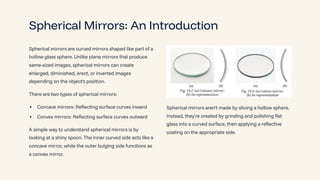
Spherical mirrors are curved mirrors shaped like part of a
hollow glass sphere. Unlike plane mirrors that produce
same-sized images, spherical mirrors can create
enlarged, diminished, erect, or inverted images
depending on the object's position.
There are two types of spherical mirrors:
Concave mirrors: Reflecting surface curves inward
Convex mirrors: Reflecting surface curves outward
A simple way to understand spherical mirrors is by
looking at a shiny spoon. The inner curved side acts like a
concave mirror, while the outer bulging side functions as
a convex mirror.
Spherical mirrors aren't made by slicing a hollow sphere.
Instead, they're created by grinding and polishing flat
glass into a curved surface, then applying a reflective
coating on the appropriate side.
Images in Spherical Mirrors
1
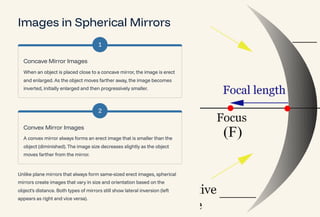
Concave Mirror Images
When an object is placed close to a concave mirror, the image is erect
and enlarged. As the object moves farther away, the image becomes
inverted, initially enlarged and then progressively smaller.
2
Convex Mirror Images
A convex mirror always forms an erect image that is smaller than the
object (diminished). The image size decreases slightly as the object
moves farther from the mirror.
Unlike plane mirrors that always form same-sized erect images, spherical
mirrors create images that vary in size and orientation based on the
object's distance. Both types of mirrors still show lateral inversion (left
appears as right and vice versa).
Real-World Applications of Spherical Mirrors
Concave Mirrors
Torch and vehicle headlight reflectors
Dental mirrors (providing enlarged views)
Reflecting telescopes
Solar concentrators (focusing sunlight)
Concave mirrors are excellent at concentrating light,
making them useful in applications requiring focused
illumination or magnification when objects are placed
close to the mirror.
Convex Mirrors
Side-view mirrors on vehicles
Road safety mirrors at intersections
Security mirrors in stores
Blind spot mirrors
Convex mirrors provide a wider field of view than plane
mirrors, making them ideal for situations requiring
visibility of larger areas, though objects appear smaller
than they actually are.
Laws of Reflection
First Law
The angle of incidence (i) is equal to the angle of
reflection (r).
Second Law
The incident ray, the normal to the mirror at the point
of incidence, and the reflected ray all lie in the same
plane.
These laws apply to all types of mirrors4plane, concave, and convex. When light strikes a mirror, it bounces off following
these precise rules, regardless of the mirror's shape. The angle is always measured between the ray and the normal
(perpendicular line) at the point where light hits the mirror.
Behavior of Light Beams with Different Mirrors
When multiple parallel beams of light fall on different
types of mirrors, they behave distinctively:
Plane mirror: Reflected beams remain parallel
Concave mirror: Reflected beams converge (come
together)
Convex mirror: Reflected beams diverge (spread
apart)
This behavior occurs because each individual ray follows
the laws of reflection, but the curved surface of spherical
mirrors causes the overall pattern of reflection to either
converge or diverge.
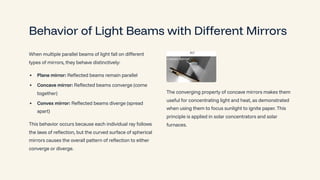
The converging property of concave mirrors makes them
useful for concentrating light and heat, as demonstrated
when using them to focus sunlight to ignite paper. This
principle is applied in solar concentrators and solar
furnaces.
Introduction to Lenses
What is a Lens?
A lens is a piece of transparent
material, usually glass or plastic,
with curved surfaces that allow
light to pass through while
changing its direction.
Convex Lens
Thicker at the middle than at the
edges. Also called a converging
lens because it brings light rays
together.
Concave Lens
Thicker at the edges than at the
middle. Also called a diverging
lens because it spreads light rays
apart.
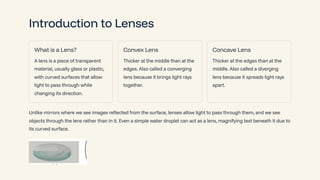
Unlike mirrors where we see images reflected from the surface, lenses allow light to pass through them, and we see
objects through the lens rather than in it. Even a simple water droplet can act as a lens, magnifying text beneath it due to
its curved surface.
Images Formed by Lenses
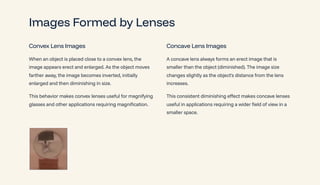
Convex Lens Images
When an object is placed close to a convex lens, the
image appears erect and enlarged. As the object moves
farther away, the image becomes inverted, initially
enlarged and then diminishing in size.
This behavior makes convex lenses useful for magnifying
glasses and other applications requiring magnification.
Concave Lens Images
A concave lens always forms an erect image that is
smaller than the object (diminished). The image size
changes slightly as the object's distance from the lens
increases.
This consistent diminishing effect makes concave lenses
useful in applications requiring a wider field of view in a
smaller space.
Light Behavior Through Lenses
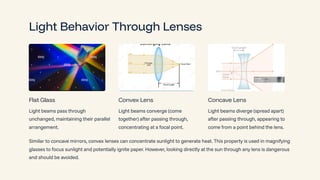
Flat Glass
Light beams pass through
unchanged, maintaining their parallel
arrangement.
Convex Lens
Light beams converge (come
together) after passing through,
concentrating at a focal point.
Concave Lens
Light beams diverge (spread apart)
after passing through, appearing to
come from a point behind the lens.
Similar to concave mirrors, convex lenses can concentrate sunlight to generate heat. This property is used in magnifying
glasses to focus sunlight and potentially ignite paper. However, looking directly at the sun through any lens is dangerous
and should be avoided.
Real-World Applications of Lenses
Everyday Uses
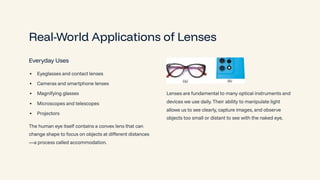
Eyeglasses and contact lenses
Cameras and smartphone lenses
Magnifying glasses
Microscopes and telescopes
Projectors
The human eye itself contains a convex lens that can
change shape to focus on objects at different distances
4a process called accommodation.
Lenses are fundamental to many optical instruments and
devices we use daily. Their ability to manipulate light
allows us to see clearly, capture images, and observe
objects too small or distant to see with the naked eye.
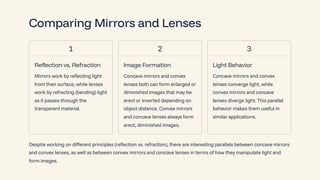
Comparing Mirrors and Lenses
1
Reflection vs. Refraction
Mirrors work by reflecting light
from their surface, while lenses
work by refracting (bending) light
as it passes through the
transparent material.
2
Image Formation
Concave mirrors and convex
lenses both can form enlarged or
diminished images that may be
erect or inverted depending on
object distance. Convex mirrors
and concave lenses always form
erect, diminished images.
3
Light Behavior
Concave mirrors and convex
lenses converge light, while
convex mirrors and concave
lenses diverge light. This parallel
behavior makes them useful in
similar applications.
Despite working on different principles (reflection vs. refraction), there are interesting parallels between concave mirrors
and convex lenses, as well as between convex mirrors and concave lenses in terms of how they manipulate light and
form images.
Practical Applications of Spherical Mirrors
Safety Applications
Convex mirrors on vehicles have the warning "Objects in
mirror are closer than they appear" because they form
diminished images, making objects seem farther away
than they actually are. This wider field of view comes at
the cost of accurate distance perception.
At road intersections, convex mirrors help drivers see
around corners and blind spots, preventing accidents by
providing visibility of approaching traffic from multiple
directions.
Scientific and Medical Uses
Concave mirrors in dental instruments provide magnified
views of teeth, making examination easier. Similarly, ENT
specialists use small concave mirrors to examine the
throat and other areas.
In astronomy, large concave mirrors in reflecting
telescopes gather and focus light from distant celestial
objects, allowing us to observe stars and planets that
would otherwise be invisible to the naked eye.
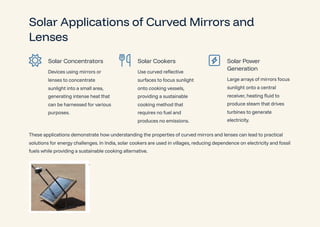
Solar Applications of Curved Mirrors and
Lenses
Solar Concentrators
Devices using mirrors or
lenses to concentrate
sunlight into a small area,
generating intense heat that
can be harnessed for various
purposes.
Solar Cookers
Use curved reflective
surfaces to focus sunlight
onto cooking vessels,
providing a sustainable
cooking method that
requires no fuel and
produces no emissions.
Solar Power
Generation
Large arrays of mirrors focus
sunlight onto a central
receiver, heating fluid to
produce steam that drives
turbines to generate
electricity.
These applications demonstrate how understanding the properties of curved mirrors and lenses can lead to practical
solutions for energy challenges. In India, solar cookers are used in villages, reducing dependence on electricity and fossil
fuels while providing a sustainable cooking alternative.
Historical Perspective on Mirrors and Lenses
More than 800 years ago, during the time of the great Indian mathematician Bhskara II, astronomers used shallow
bowls of water to observe stars and planets. By carefully looking at their reflected images through tubes placed at
appropriate angles, they could measure the positions of celestial bodies in the sky.
Although the laws of reflection aren't explicitly mentioned in ancient literature, the sophisticated instruments and
methods used by early astronomers suggest they understood these principles in practice. This historical approach
demonstrates how scientific understanding often begins with practical applications before formal theories are
developed.
Throughout history, mirrors and lenses have played crucial roles in scientific discovery, from early astronomical
observations to the development of microscopes that revealed previously invisible worlds. The evolution of these optical
devices continues to influence modern technology and scientific exploration.
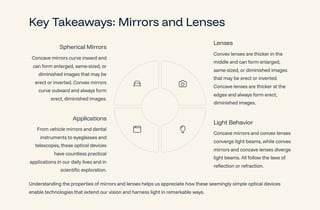
Key Takeaways: Mirrors and Lenses
Understanding the properties of mirrors and lenses helps us appreciate how these seemingly simple optical devices
enable technologies that extend our vision and harness light in remarkable ways.
Spherical Mirrors
Concave mirrors curve inward and
can form enlarged, same-sized, or
diminished images that may be
erect or inverted. Convex mirrors
curve outward and always form
erect, diminished images.
Lenses
Convex lenses are thicker in the
middle and can form enlarged,
same-sized, or diminished images
that may be erect or inverted.
Concave lenses are thicker at the
edges and always form erect,
diminished images.
Light Behavior
Concave mirrors and convex lenses
converge light beams, while convex
mirrors and concave lenses diverge
light beams. All follow the laws of
reflection or refraction.
Applications
From vehicle mirrors and dental
instruments to eyeglasses and
telescopes, these optical devices
have countless practical
applications in our daily lives and in
scientific exploration.