9.The Amazing World of Solutes, Solvents, and
Solutions
8th science curiosity
By:K Sandeep Swamy(M.Sc,B.Ed)
For Online Classes (IITJEE & NEET foundation and academics) contact : 9491878325
Subscribe Samyans Eduhub youtube channel
This document explores the fascinating science of solutions, examining how substances dissolve, mix, and interact. We'll
investigate the relationships between solutes and solvents, understand saturation and concentration, and discover how
temperature affects solubility. We'll also explore density and its role in determining whether objects float or sink in liquids.
Through hands-on activities and real-world examples, we'll uncover the principles that govern these everyday phenomena.
Understanding Solutions: Uniform vs. Non-
Uniform Mixtures
When substances like salt and sugar are mixed with water,
they form uniform mixtures where components are evenly
distributed throughout. This is why every sip of homemade
Oral Rehydration Solution (ORS) tastes the same - the salt and
sugar are uniformly dissolved.
In contrast, when substances like chalk powder, sand, or
sawdust are mixed with water, they form non-uniform
mixtures where components are not evenly distributed.
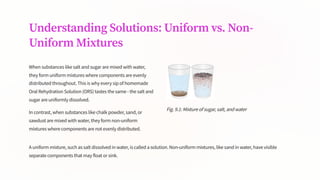
Fig. 9.1: Mixture of sugar, salt, and water
A uniform mixture, such as salt dissolved in water, is called a solution. Non-uniform mixtures, like sand in water, have visible
separate components that may float or sink.
Solute, Solvent, and Solution:
The Basic Components
Solute
The substance that dissolves in a liquid to form a solution. In salt water, salt
is the solute.
Solvent
The liquid in which a solute dissolves. In salt water, water is the solvent.
Solution
The uniform mixture formed when a solute dissolves in a solvent. Salt water
is a solution.
When a solution is formed by mixing two liquids, the substance present in smaller
amount is called the solute, while the one in larger amount is called the solvent.
In gaseous solutions like air, nitrogen (the most abundant component) is
considered the solvent, while oxygen, carbon dioxide, and other gases are the
solutes.
Saturation: When Solutions Reach Their Limit
When you add salt to water and stir, it initially dissolves
completely. However, if you continue adding more salt,
eventually it will stop dissolving and begin to settle at the
bottom. This happens because the water has reached its limit
for dissolving salt.
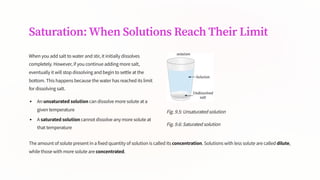
An unsaturated solution can dissolve more solute at a
given temperature
A saturated solution cannot dissolve any more solute at
that temperature
Fig. 9.5: Unsaturated solution
Fig. 9.6: Saturated solution
The amount of solute present in a fixed quantity of solution is called its concentration. Solutions with less solute are called dilute,
while those with more solute are concentrated.
Solubility: How Much Can Dissolve?
The maximum amount of solute that can dissolve in a fixed quantity of solvent at a specific temperature is called its solubility.
Increase Temperature
For most solid solutes, solubility
increases as temperature rises
More Dissolves
A saturated solution at one
temperature becomes unsaturated at
a higher temperature
Practical Applications
This principle is used in making
candy, crystallization, and many
industrial processes
This is why hot tea can dissolve more sugar than iced tea, and why hot water is often more effective for cleaning - it can dissolve
more substances.
Traditional Uses of Solvents in Medicine
Water has primarily been used as a solvent for the
preparation of medicinal formulations in Ayurveda, Siddha,
and other traditional systems of medicine in India. These
ancient practices recognized the importance of proper
solvents for extracting medicinal compounds from herbs.
Beyond water, traditional Indian medicine also utilized:
Hydro-alcoholic extracts
Oils
Ghee
Milk
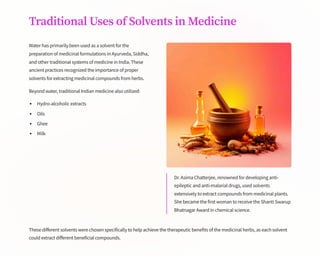
Dr. Asima Chatterjee, renowned for developing anti-
epileptic and anti-malarial drugs, used solvents
extensively to extract compounds from medicinal plants.
She became the first woman to receive the Shanti Swarup
Bhatnagar Award in chemical science.
These different solvents were chosen specifically to help achieve the therapeutic benefits of the medicinal herbs, as each solvent
could extract different beneficial compounds.
Solubility of Gases in Liquids
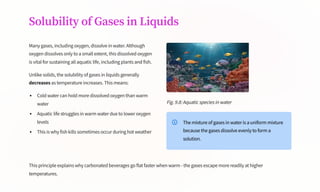
Many gases, including oxygen, dissolve in water. Although
oxygen dissolves only to a small extent, this dissolved oxygen
is vital for sustaining all aquatic life, including plants and fish.
Unlike solids, the solubility of gases in liquids generally
decreases as temperature increases. This means:
Cold water can hold more dissolved oxygen than warm
water
Aquatic life struggles in warm water due to lower oxygen
levels
This is why fish kills sometimes occur during hot weather
Fig. 9.8: Aquatic species in water
The mixture of gases in water is a uniform mixture
because the gases dissolve evenly to form a
solution.
This principle explains why carbonated beverages go flat faster when warm - the gases escape more readily at higher
temperatures.
Why Do Objects Float or Sink in Water?
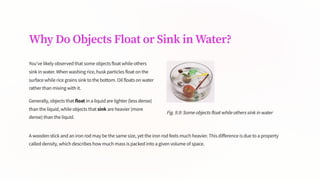
You've likely observed that some objects float while others
sink in water. When washing rice, husk particles float on the
surface while rice grains sink to the bottom. Oil floats on water
rather than mixing with it.
Generally, objects that float in a liquid are lighter (less dense)
than the liquid, while objects that sink are heavier (more
dense) than the liquid.
Fig. 9.9: Some objects float while others sink in water
A wooden stick and an iron rod may be the same size, yet the iron rod feels much heavier. This difference is due to a property
called density, which describes how much mass is packed into a given volume of space.
Understanding Density: Mass per Unit Volume
Definition
Density is the mass present in a unit
volume of a substance.
Density = Mass ÷ Volume
Units
SI unit: kilogram per cubic meter
(kg/m³)
Common units: gram per milliliter
(g/mL) or gram per cubic centimeter
(g/cm³)
Properties
Independent of shape or size
Dependent on temperature and
pressure
Unique for each substance
Just as a crowded bus has a high density of people while an empty bus has a low density, materials can have different densities
based on how tightly their particles are packed together. A dense forest has trees growing close together, while a less dense forest
has trees spaced further apart.
Measuring Mass: The First Step to Calculate
Density
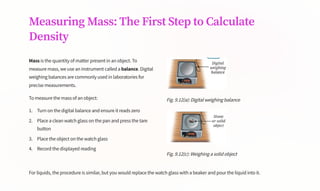
Mass is the quantity of matter present in an object. To
measure mass, we use an instrument called a balance. Digital
weighing balances are commonly used in laboratories for
precise measurements.
To measure the mass of an object:
Turn on the digital balance and ensure it reads zero
1.
Place a clean watch glass on the pan and press the tare
button
2.
Place the object on the watch glass
3.
Record the displayed reading
4.
Fig. 9.12(a): Digital weighing balance
Fig. 9.12(c): Weighing a solid object
For liquids, the procedure is similar, but you would replace the watch glass with a beaker and pour the liquid into it.
Measuring Volume: The Second Step to Calculate
Density
Volume is the space occupied by an object. The SI unit is
cubic meter (m³), but smaller units like cubic centimeter (cm³)
and milliliter (mL) are commonly used.
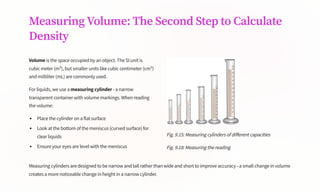
For liquids, we use a measuring cylinder - a narrow
transparent container with volume markings. When reading
the volume:
Place the cylinder on a flat surface
Look at the bottom of the meniscus (curved surface) for
clear liquids
Ensure your eyes are level with the meniscus
Fig. 9.15: Measuring cylinders of different capacities
Fig. 9.18: Measuring the reading
Measuring cylinders are designed to be narrow and tall rather than wide and short to improve accuracy - a small change in volume
creates a more noticeable change in height in a narrow cylinder.
Measuring Volume of Irregular Solids
For regular objects like cubes or rectangular prisms, volume
can be calculated using formulas (length × width × height).
But how do we measure the volume of irregular objects like
stones?
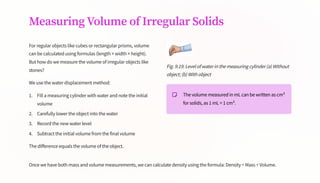
We use the water displacement method:
Fill a measuring cylinder with water and note the initial
volume
1.
Carefully lower the object into the water
2.
Record the new water level
3.
Subtract the initial volume from the final volume
4.
The difference equals the volume of the object.
Fig. 9.19: Level of water in the measuring cylinder (a) Without
object; (b) With object
The volume measured in mL can be written as cm³
for solids, as 1 mL = 1 cm³.
Once we have both mass and volume measurements, we can calculate density using the formula: Density = Mass ÷ Volume.
Calculating Density: Putting It All Together
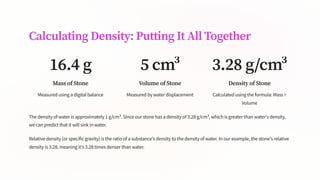
16.4 g
Mass of Stone
Measured using a digital balance
5 cm³
Volume of Stone
Measured by water displacement
3.28 g/cm³
Density of Stone
Calculated using the formula: Mass ÷
Volume
The density of water is approximately 1 g/cm³. Since our stone has a density of 3.28 g/cm³, which is greater than water's density,
we can predict that it will sink in water.
Relative density (or specific gravity) is the ratio of a substance's density to the density of water. In our example, the stone's relative
density is 3.28, meaning it's 3.28 times denser than water.
Earth's Density Layers: A Natural Example
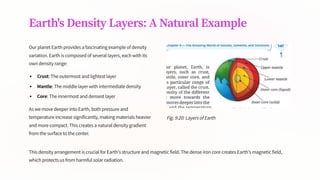
Our planet Earth provides a fascinating example of density
variation. Earth is composed of several layers, each with its
own density range:
Crust: The outermost and lightest layer
Mantle: The middle layer with intermediate density
Core: The innermost and densest layer
As we move deeper into Earth, both pressure and
temperature increase significantly, making materials heavier
and more compact. This creates a natural density gradient
from the surface to the center.
Fig. 9.20: Layers of Earth
This density arrangement is crucial for Earth's structure and magnetic field. The dense iron core creates Earth's magnetic field,
which protects us from harmful solar radiation.
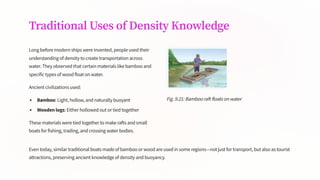
Traditional Uses of Density Knowledge
Long before modern ships were invented, people used their
understanding of density to create transportation across
water. They observed that certain materials like bamboo and
specific types of wood float on water.
Ancient civilizations used:
Bamboo: Light, hollow, and naturally buoyant
Wooden logs: Either hollowed out or tied together
These materials were tied together to make rafts and small
boats for fishing, trading, and crossing water bodies.
Fig. 9.21: Bamboo raft floats on water
Even today, similar traditional boats made of bamboo or wood are used in some regions4not just for transport, but also as tourist
attractions, preserving ancient knowledge of density and buoyancy.
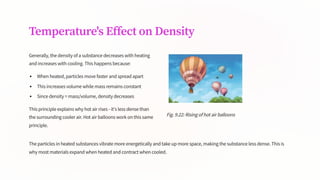
Temperature's Effect on Density
Generally, the density of a substance decreases with heating
and increases with cooling. This happens because:
When heated, particles move faster and spread apart
This increases volume while mass remains constant
Since density = mass/volume, density decreases
This principle explains why hot air rises - it's less dense than
the surrounding cooler air. Hot air balloons work on this same
principle.
Fig. 9.22: Rising of hot air balloons
The particles in heated substances vibrate more energetically and take up more space, making the substance less dense. This is
why most materials expand when heated and contract when cooled.
Pressure's Effect on Density
Gases
Highly affected by pressure.
Increasing pressure pushes gas
particles closer together,
decreasing volume and increasing
density.
Liquids
Slightly affected by pressure.
Liquids are nearly incompressible,
so pressure has minimal effect on
their density.
Solids
Least affected by pressure. Solid
particles are already tightly
packed, so changes in their density
due to pressure are usually
negligible.
This difference in compressibility explains why air in a bicycle tire can be compressed, but water in a water balloon cannot be
squeezed into a smaller volume. It also explains why deep-sea creatures can withstand enormous pressures - the water and their
bodies are relatively incompressible.
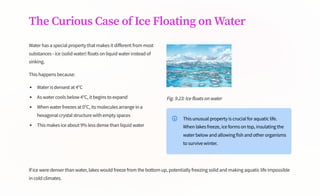
The Curious Case of Ice Floating on Water
Water has a special property that makes it different from most
substances - ice (solid water) floats on liquid water instead of
sinking.
This happens because:
Water is densest at 4°C
As water cools below 4°C, it begins to expand
When water freezes at 0°C, its molecules arrange in a
hexagonal crystal structure with empty spaces
This makes ice about 9% less dense than liquid water
Fig. 9.23: Ice floats on water
This unusual property is crucial for aquatic life.
When lakes freeze, ice forms on top, insulating the
water below and allowing fish and other organisms
to survive winter.
If ice were denser than water, lakes would freeze from the bottom up, potentially freezing solid and making aquatic life impossible
in cold climates.
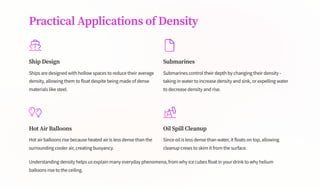
Practical Applications of Density
Ship Design
Ships are designed with hollow spaces to reduce their average
density, allowing them to float despite being made of dense
materials like steel.
Submarines
Submarines control their depth by changing their density -
taking in water to increase density and sink, or expelling water
to decrease density and rise.
Hot Air Balloons
Hot air balloons rise because heated air is less dense than the
surrounding cooler air, creating buoyancy.
Oil Spill Cleanup
Since oil is less dense than water, it floats on top, allowing
cleanup crews to skim it from the surface.
Understanding density helps us explain many everyday phenomena, from why ice cubes float in your drink to why helium
balloons rise to the ceiling.
Density in Food Science
Density plays an important role in cooking and food science:
Oil floats on water when making salad dressings
Cream rises to the top of unhomogenized milk
Egg whites can be whipped to incorporate air, decreasing
their density
The density of sugar syrup determines candy texture
Chefs use these principles to create layered drinks, separate
ingredients, and achieve specific textures in foods.
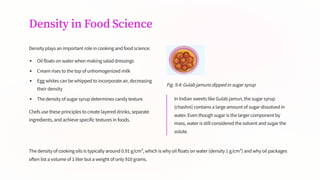
Fig. 9.4: Gulab jamuns dipped in sugar syrup
In Indian sweets like Gulab jamun, the sugar syrup
(chashni) contains a large amount of sugar dissolved in
water. Even though sugar is the larger component by
mass, water is still considered the solvent and sugar the
solute.
The density of cooking oils is typically around 0.91 g/cm³, which is why oil floats on water (density 1 g/cm³) and why oil packages
often list a volume of 1 liter but a weight of only 910 grams.
The Floating Egg Experiment
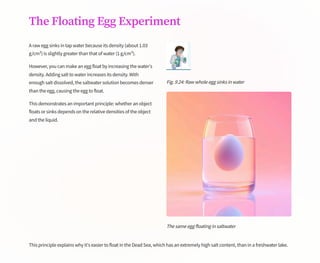
A raw egg sinks in tap water because its density (about 1.03
g/cm³) is slightly greater than that of water (1 g/cm³).
However, you can make an egg float by increasing the water's
density. Adding salt to water increases its density. With
enough salt dissolved, the saltwater solution becomes denser
than the egg, causing the egg to float.
This demonstrates an important principle: whether an object
floats or sinks depends on the relative densities of the object
and the liquid.
Fig. 9.24: Raw whole egg sinks in water
The same egg floating in saltwater
This principle explains why it's easier to float in the Dead Sea, which has an extremely high salt content, than in a freshwater lake.
Traditional Salt Production in Ningel Village
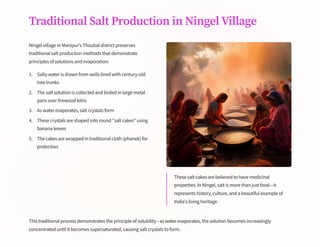
Ningel village in Manipur's Thoubal district preserves
traditional salt production methods that demonstrate
principles of solutions and evaporation:
Salty water is drawn from wells lined with century-old
tree trunks
1.
The salt solution is collected and boiled in large metal
pans over firewood kilns
2.
As water evaporates, salt crystals form
3.
These crystals are shaped into round "salt cakes" using
banana leaves
4.
The cakes are wrapped in traditional cloth (phanek) for
protection
5.
These salt cakes are believed to have medicinal
properties. In Ningel, salt is more than just food4it
represents history, culture, and a beautiful example of
India's living heritage.
This traditional process demonstrates the principle of solubility - as water evaporates, the solution becomes increasingly
concentrated until it becomes supersaturated, causing salt crystals to form.
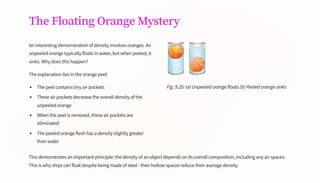
The Floating Orange Mystery
An interesting demonstration of density involves oranges. An
unpeeled orange typically floats in water, but when peeled, it
sinks. Why does this happen?
The explanation lies in the orange peel:
The peel contains tiny air pockets
These air pockets decrease the overall density of the
unpeeled orange
When the peel is removed, these air pockets are
eliminated
The peeled orange flesh has a density slightly greater
than water
Fig. 9.25: (a) Unpeeled orange floats (b) Peeled orange sinks
This demonstrates an important principle: the density of an object depends on its overall composition, including any air spaces.
This is why ships can float despite being made of steel - their hollow spaces reduce their average density.
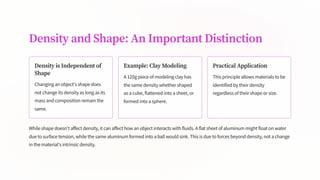
Density and Shape: An Important Distinction
Density is Independent of
Shape
Changing an object's shape does
not change its density as long as its
mass and composition remain the
same.
Example: Clay Modeling
A 120g piece of modeling clay has
the same density whether shaped
as a cube, flattened into a sheet, or
formed into a sphere.
Practical Application
This principle allows materials to be
identified by their density
regardless of their shape or size.
While shape doesn't affect density, it can affect how an object interacts with fluids. A flat sheet of aluminum might float on water
due to surface tension, while the same aluminum formed into a ball would sink. This is due to forces beyond density, not a change
in the material's intrinsic density.
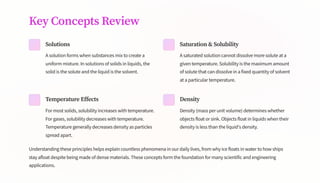
Key Concepts Review
Solutions
A solution forms when substances mix to create a
uniform mixture. In solutions of solids in liquids, the
solid is the solute and the liquid is the solvent.
Saturation & Solubility
A saturated solution cannot dissolve more solute at a
given temperature. Solubility is the maximum amount
of solute that can dissolve in a fixed quantity of solvent
at a particular temperature.
Temperature Effects
For most solids, solubility increases with temperature.
For gases, solubility decreases with temperature.
Temperature generally decreases density as particles
spread apart.
Density
Density (mass per unit volume) determines whether
objects float or sink. Objects float in liquids when their
density is less than the liquid's density.
Understanding these principles helps explain countless phenomena in our daily lives, from why ice floats in water to how ships
stay afloat despite being made of dense materials. These concepts form the foundation for many scientific and engineering
applications.