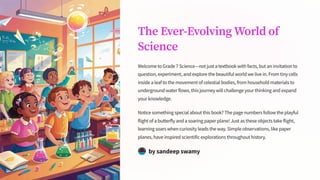
The Ever-Evolving World of
Science
Welcome to Grade 7 Science4not just a textbook with facts, but an invitation to
question, experiment, and explore the beautiful world we live in. From tiny cells
inside a leaf to the movement of celestial bodies, from household materials to
underground water flows, this journey will challenge your thinking and expand
your knowledge.
Notice something special about this book? The page numbers follow the playful
flight of a butterfly and a soaring paper plane! Just as these objects take flight,
learning soars when curiosity leads the way. Simple observations, like paper
planes, have inspired scientific explorations throughout history.
by sandeep swamy
Science as a Process of Discovery
Ask Deeper Questions
How do things work? Why do events
happen the way they do? What
patterns can we observe in nature?
Experience Through
Activities
Step out of the classroom to engage
with hands-on experiments that
serve as stepping stones to
understanding our environment.
Develop Responsibility
Recognize how human activities
connect to the natural world and
how science can address
environmental challenges.
Science in Grade 7 goes beyond discovering facts4it's about developing a way of thinking that welcomes curiosity and remains open to the
unknown. This approach helps you see science as an ongoing process of discovery and responsibility.
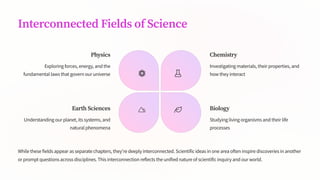
Interconnected Fields of Science
While these fields appear as separate chapters, they're deeply interconnected. Scientific ideas in one area often inspire discoveries in another
or prompt questions across disciplines. This interconnection reflects the unified nature of scientific inquiry and our world.
Physics
Exploring forces, energy, and the
fundamental laws that govern our universe
Chemistry
Investigating materials, their properties, and
how they interact
Biology
Studying living organisms and their life
processes
Earth Sciences
Understanding our planet, its systems, and
natural phenomena
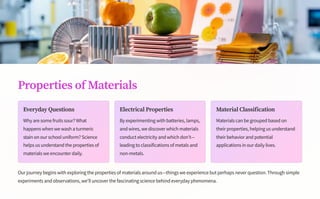
Properties of Materials
Everyday Questions
Why are some fruits sour? What
happens when we wash a turmeric
stain on our school uniform? Science
helps us understand the properties of
materials we encounter daily.
Electrical Properties
By experimenting with batteries, lamps,
and wires, we discover which materials
conduct electricity and which don't4
leading to classifications of metals and
non-metals.
Material Classification
Materials can be grouped based on
their properties, helping us understand
their behavior and potential
applications in our daily lives.
Our journey begins with exploring the properties of materials around us4things we experience but perhaps never question. Through simple
experiments and observations, we'll uncover the fascinating science behind everyday phenomena.
Changes in Materials
Reversible Changes
Changes that can be undone, returning materials to their original
state
Irreversible Changes
Permanent transformations where materials cannot return to
their original form
Heat-Induced Changes
Transformations that occur or accelerate when materials are
heated
We'll explore different types of changes happening around us. Some changes, like
melting ice, can be reversed, while others, like a battery running out, cannot.
We'll investigate how heat influences these changes, whether it's an ice cube
melting in a glass or a glacier melting due to global warming.
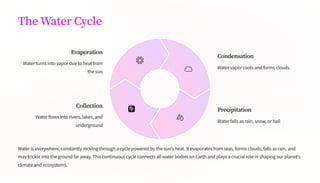
The Water Cycle
Water is everywhere, constantly moving through a cycle powered by the sun's heat. It evaporates from seas, forms clouds, falls as rain, and
may trickle into the ground far away. This continuous cycle connects all water bodies on Earth and plays a crucial role in shaping our planet's
climate and ecosystems.
Evaporation
Water turns into vapor due to heat from
the sun
Condensation
Water vapor cools and forms clouds
Precipitation
Water falls as rain, snow, or hail
Collection
Water flows into rivers, lakes, and
underground
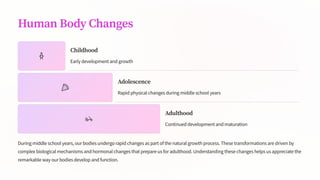
Human Body Changes
Childhood
Early development and growth
Adolescence
Rapid physical changes during middle school years
Adulthood
Continued development and maturation
During middle school years, our bodies undergo rapid changes as part of the natural growth process. These transformations are driven by
complex biological mechanisms and hormonal changes that prepare us for adulthood. Understanding these changes helps us appreciate the
remarkable way our bodies develop and function.
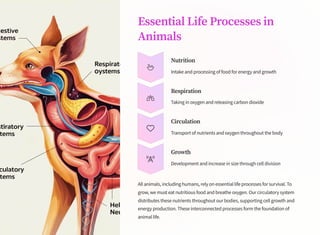
Essential Life Processes in
Animals
Nutrition
Intake and processing of food for energy and growth
Respiration
Taking in oxygen and releasing carbon dioxide
Circulation
Transport of nutrients and oxygen throughout the body
Growth
Development and increase in size through cell division
All animals, including humans, rely on essential life processes for survival. To
grow, we must eat nutritious food and breathe oxygen. Our circulatory system
distributes these nutrients throughout our bodies, supporting cell growth and
energy production. These interconnected processes form the foundation of
animal life.
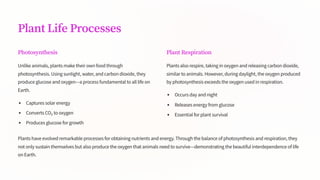
Plant Life Processes
Photosynthesis
Unlike animals, plants make their own food through
photosynthesis. Using sunlight, water, and carbon dioxide, they
produce glucose and oxygen4a process fundamental to all life on
Earth.
Captures solar energy
Converts CO¢ to oxygen
Produces glucose for growth
Plant Respiration
Plants also respire, taking in oxygen and releasing carbon dioxide,
similar to animals. However, during daylight, the oxygen produced
by photosynthesis exceeds the oxygen used in respiration.
Occurs day and night
Releases energy from glucose
Essential for plant survival
Plants have evolved remarkable processes for obtaining nutrients and energy. Through the balance of photosynthesis and respiration, they
not only sustain themselves but also produce the oxygen that animals need to survive4demonstrating the beautiful interdependence of life
on Earth.
Measuring Time
Humans have developed various methods to measure time throughout history. Long before electric clocks and digital watches, early
civilizations observed shadows cast by objects in sunlight to tell time. From sundials to hourglasses, pendulum clocks to atomic timepieces,
our methods have evolved dramatically.
But what exactly is time? The clock on the wall tells us how it passes, guiding our daily activities from morning to night. Yet time
measurement is a profound concept that has fascinated scientists and philosophers for centuries.
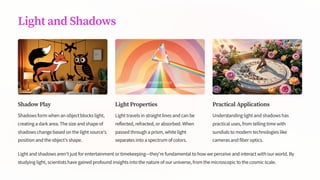
Light and Shadows
Shadow Play
Shadows form when an object blocks light,
creating a dark area. The size and shape of
shadows change based on the light source's
position and the object's shape.
Light Properties
Light travels in straight lines and can be
reflected, refracted, or absorbed. When
passed through a prism, white light
separates into a spectrum of colors.
Practical Applications
Understanding light and shadows has
practical uses, from telling time with
sundials to modern technologies like
cameras and fiber optics.
Light and shadows aren't just for entertainment or timekeeping4they're fundamental to how we perceive and interact with our world. By
studying light, scientists have gained profound insights into the nature of our universe, from the microscopic to the cosmic scale.
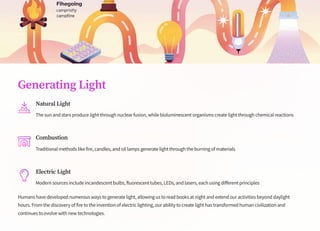
Generating Light
Natural Light
The sun and stars produce light through nuclear fusion, while bioluminescent organisms create light through chemical reactions
Combustion
Traditional methods like fire, candles, and oil lamps generate light through the burning of materials
Electric Light
Modern sources include incandescent bulbs, fluorescent tubes, LEDs, and lasers, each using different principles
Humans have developed numerous ways to generate light, allowing us to read books at night and extend our activities beyond daylight
hours. From the discovery of fire to the invention of electric lighting, our ability to create light has transformed human civilization and
continues to evolve with new technologies.
Celestial Shadows: Eclipses
Lunar Eclipse
Earth casts shadow on the Moon
Solar Eclipse
Moon casts shadow on Earth
Planetary Alignment
Precise positioning required
Light and shadows extend beyond our immediate surroundings to create fascinating celestial phenomena. During a solar eclipse, the Moon
passes between Earth and the Sun, casting its shadow on Earth's surface. In a lunar eclipse, Earth blocks sunlight from reaching the Moon,
casting its shadow on the lunar surface.
These spectacular events have captivated humans throughout history and helped us understand the movements of celestial bodies in our
solar system.
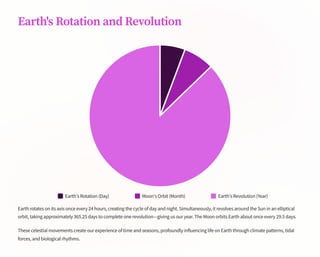
Earth's Rotation and Revolution
Earth's Rotation (Day) Moon's Orbit (Month) Earth's Revolution (Year)
Earth rotates on its axis once every 24 hours, creating the cycle of day and night. Simultaneously, it revolves around the Sun in an elliptical
orbit, taking approximately 365.25 days to complete one revolution4giving us our year. The Moon orbits Earth about once every 29.5 days.
These celestial movements create our experience of time and seasons, profoundly influencing life on Earth through climate patterns, tidal
forces, and biological rhythms.
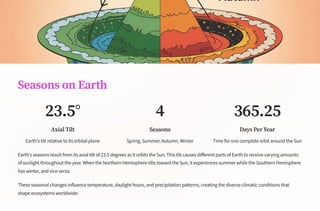
Seasons on Earth
23.5°
Axial Tilt
Earth's tilt relative to its orbital plane
4
Seasons
Spring, Summer, Autumn, Winter
365.25
Days Per Year
Time for one complete orbit around the Sun
Earth's seasons result from its axial tilt of 23.5 degrees as it orbits the Sun. This tilt causes different parts of Earth to receive varying amounts
of sunlight throughout the year. When the Northern Hemisphere tilts toward the Sun, it experiences summer while the Southern Hemisphere
has winter, and vice versa.
These seasonal changes influence temperature, daylight hours, and precipitation patterns, creating the diverse climatic conditions that
shape ecosystems worldwide.
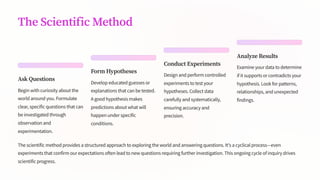
The Scientific Method
Ask Questions
Begin with curiosity about the
world around you. Formulate
clear, specific questions that can
be investigated through
observation and
experimentation.
Form Hypotheses
Develop educated guesses or
explanations that can be tested.
A good hypothesis makes
predictions about what will
happen under specific
conditions.
Conduct Experiments
Design and perform controlled
experiments to test your
hypotheses. Collect data
carefully and systematically,
ensuring accuracy and
precision.
Analyze Results
Examine your data to determine
if it supports or contradicts your
hypothesis. Look for patterns,
relationships, and unexpected
findings.
The scientific method provides a structured approach to exploring the world and answering questions. It's a cyclical process4even
experiments that confirm our expectations often lead to new questions requiring further investigation. This ongoing cycle of inquiry drives
scientific progress.
Thinking Like a Scientist
Curiosity
Scientists maintain a sense of wonder about the world. They
ask questions about everyday phenomena that others might
take for granted, like "Why are some fruits sour?" or "How does
a paper plane fly?"
Critical Thinking
Scientists evaluate evidence carefully before drawing
conclusions. They consider alternative explanations and
recognize that initial ideas may need revision based on new
information.
Open-Mindedness
Scientists remain open to unexpected results and new ideas.
They understand that being wrong is part of the learning
process and that scientific knowledge evolves over time.
Persistence
Scientists don't give up when experiments fail or questions
remain unanswered. They modify their approaches, try new
methods, and continue investigating until they find solutions.
Thinking like a scientist involves more than following procedures4it's a mindset characterized by curiosity, critical thinking, open-
mindedness, and persistence. By developing these qualities, you'll become better at solving problems and understanding the world,
regardless of whether you pursue a career in science.
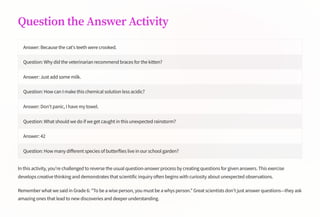
Question the Answer Activity
Answer: Because the cat's teeth were crooked.
Question: Why did the veterinarian recommend braces for the kitten?
Answer: Just add some milk.
Question: How can I make this chemical solution less acidic?
Answer: Don't panic, I have my towel.
Question: What should we do if we get caught in this unexpected rainstorm?
Answer: 42
Question: How many different species of butterflies live in our school garden?
In this activity, you're challenged to reverse the usual question-answer process by creating questions for given answers. This exercise
develops creative thinking and demonstrates that scientific inquiry often begins with curiosity about unexpected observations.
Remember what we said in Grade 6: "To be a wise person, you must be a whys person." Great scientists don't just answer questions4they ask
amazing ones that lead to new discoveries and deeper understanding.
The Joy of Scientific Exploration
Discover Through Doing
Hands-on experiments allow you to experience scientific
principles firsthand, making abstract concepts concrete and
memorable.
Solve Real Problems
Scientific thinking helps you approach challenges
methodically, breaking them down into manageable parts
and testing possible solutions.
Connect With Nature
Scientific exploration deepens your appreciation for the
natural world and your place within it, fostering
environmental awareness.
Collaborate With Others
Science is often a team effort, with different perspectives and
skills combining to achieve greater understanding than any
individual could alone.
Scientific exploration brings joy through discovery, problem-solving, and connection with both nature and fellow explorers. The excitement
of making even small discoveries for yourself creates memorable learning experiences that extend far beyond memorizing facts.
Your Scientific Journey Begins
Observe the Unseen
Science reveals worlds too small, too large,
or too complex to perceive with our unaided
senses. Through tools and techniques, you'll
discover hidden realities all around you.
Experiment Boldly
Each experiment is an adventure with the
potential for unexpected discoveries. Even
when results don't match predictions,
valuable learning occurs in the process.
Share Your Discoveries
Science advances through communication.
By sharing your observations, methods, and
conclusions, you contribute to collective
knowledge and inspire others.
As you embark on your Grade 7 science journey, remember that you're not just learning facts4you're developing skills and perspectives that
will serve you throughout life. The chapters ahead will challenge your thinking, expand your knowledge, and help you become an explorer
making discoveries for yourself.