Here are the key points from the provided chapters, focusing on the fundamental concepts, effects, applications, and related phenomena of pressure, winds, storms, cyclones, electricity (magnetic and heating effects), and forces.
### Chapter Notes: Pressure, Winds, Storms, and Cyclones
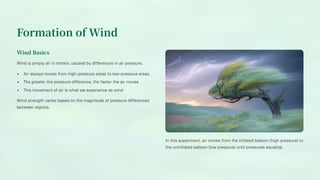
This chapter explores the concepts of pressure, how it is influenced by force and area, and its role in natural phenomena like winds, thunderstorms, and cyclones.
* **Pressure Defined**
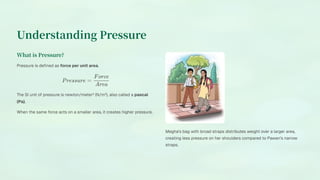
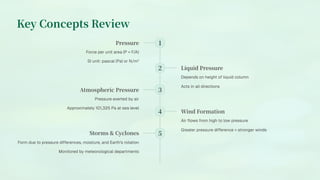
* **Definition**: Pressure is defined as **force per unit area**.
* **Formula**: Pressure = Force / Area.
* **SI Unit**: The SI unit of pressure is newton/metre² (N/m²), also called a **pascal (Pa)**. Practical units for air pressure include millibar (mb) and hectopascal (hPa), both equal to 100 Pa.
* **Effect of Area**: Broad straps on bags or handles on buckets reduce pressure by spreading the force over a larger area, making them more comfortable to carry. Conversely, a smaller area over which force is applied results in higher pressure, making tasks like driving a nail or cutting an apple easier with pointed/sharp ends.
* **Liquid Pressure**
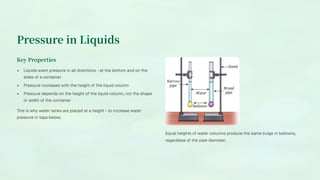
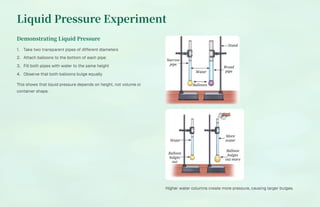
* **Principle**: Liquids exert pressure. The pressure exerted by a liquid in a vessel depends on the **height of its column**.
* **Demonstration**: Equal heights of water columns produce the same bulge in balloons, regardless of pipe diameter, indicating pressure from the water column. Increasing the water column height increases the bulge, confirming the direct relationship between height and pressure at the bottom.
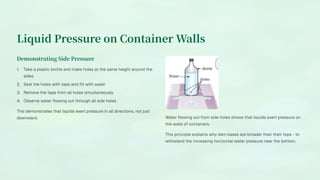
* **Pressure in All Directions**: Liquids exert pressure not only at the bottom of a container but also on its sides and, in fact, in all directions. This is why water spurts out from holes on the sides of a bottle or from leaking pipe joints.
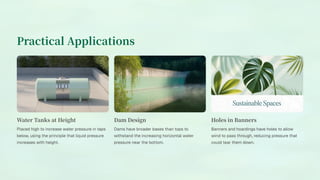
* **Application**: Overhead water tanks are placed at a height to increase water pressure in taps, providing a good stream of water. Dams are built with broader bases to withstand the large horizontal water pressure near the bottom, which increases with water height.
* **Air Pressure (Atmospheric Pressure)**
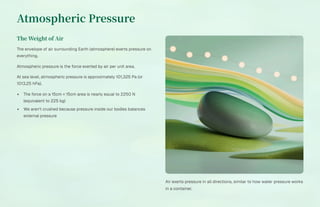
* **Definition**: The envelope of air surrounding the Earth is called the **atmosphere**. The pressure exerted by this air around us is known as the **atmospheric pressure**.
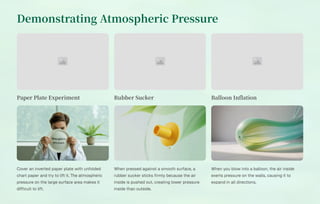
* **Evidence**: Air exerts force on objects, and this force increases with the area of contact. When air is blown into a balloon, it inflates because the air inside exerts pressure on its walls in all directions.
* **Suction Cups**: A rubber sucker sticks to a smooth flat surface because pressing it firmly pushes out most of the air inside, reducing internal pressure. The higher external atmospheric pressure then holds it in place. Significant force is needed to pull it off, highlighting the magnitude of atmospheric pressure.
* **Balance with Internal Pressure**: We are not crushed by the immense atmospheric pressure because the pres