The Invisible Living World: Beyond
Our Naked Eye
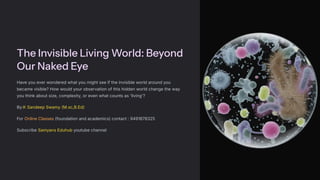
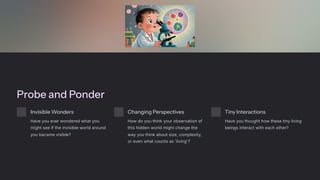
Have you ever wondered what you might see if the invisible world around you
became visible? How would your observation of this hidden world change the way
you think about size, complexity, or even what counts as 'living'?
By:K Sandeep Swamy (M.sc,B.Ed)
For Online Classes (foundation and academics) contact : 9491878325
Subscribe Samyans Eduhub youtube channel
The Invisible Living World: Beyond Our Naked Eye
1 source
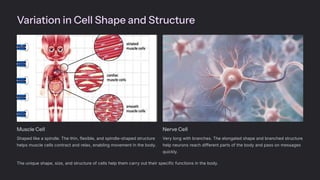
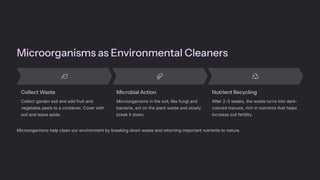
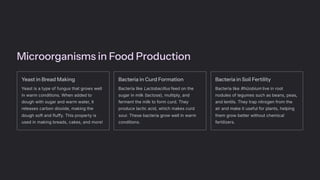
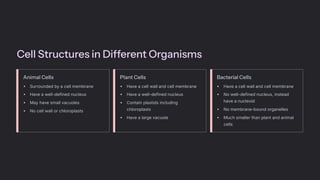
This source, "The Invisible Living World: Beyond Our Naked Eye," explores the microscopic universe, beginning with the historical development of tools like lenses and microscopes that allowed humans to observe previously unseen organisms. It explains that all living things are composed of cells, from the simplest unicellular organisms to complex multicellular plants and animals, and details the basic components of a cell such as the cell membrane, cytoplasm, and nucleus. The text further discusses the organisation of life from cells to organ systems, introduces microorganisms like bacteria, fungi, and algae, and highlights their beneficial roles in environmental cleaning, food production (e.g., bread and curd), and nutrient cycling. It concludes by reinforcing the cell as the fundamental unit of life and noting the diversity in cell shapes, sizes, and structures across different organisms.I understand you're looking for notes in PDF format about "The Invisible Living World: Beyond Our Naked Eye" from an 8th-grade science curiosity perspective. However, I cannot directly create or provide PDF files. My capabilities are limited to generating text-based responses.
To help you with your curiosity, I can offer comprehensive notes on this topic, covering key concepts typically found in an 8th-grade science curriculum. You can then copy and paste these notes into a document and save it as a PDF yourself.
Here's an outline of the notes I can provide:
The Invisible Living World: Beyond Our Naked Eye (8th Grade Science Curiosity)
1. Introduction to the Invisible World:
* What does "invisible" mean in this context?
* Why can't we see these organisms with our naked eye?
* The importance of understanding this invisible world.
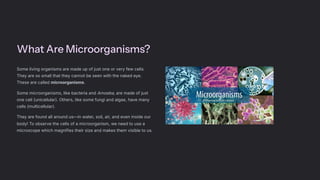
2. What are Microorganisms?
* Definition and basic characteristics.
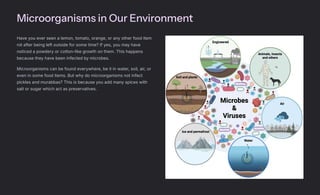
* Where are they found? (Ubiquitous nature)
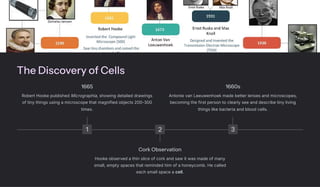
* Brief history of their discovery (Antonie van Leeuwenhoek).
3. Types of Microorganisms (with simple examples):
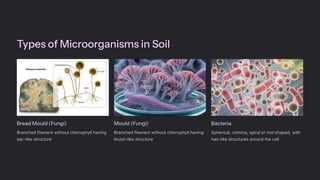
* Bacteria:
* Unicellular nature.
* Different shapes (rod, spherical, spiral).
* Examples: Lactobacillus (curd), Rhizobium (nitrogen fixation), E. coli (intestine - both beneficial and harmful strains).
* Fungi:
* Unicellular and multicellular forms.
* Examples: Yeast (bread making), Penicillium (antibiotic), Mushrooms (some edible, some poisonous).
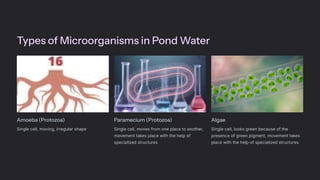
* Protozoa:
* Unicellular animal-like organisms.
* Examples: Amoeba (pseudopods), Paramecium (cilia).
* Algae:
* Plant-like organisms, some microscopic.
* Examples: Chlamydomonas, Spirogyra.
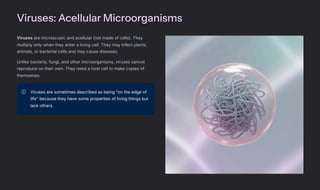
* Viruses