7.Particulate Nature of Matter
8th class science curiosity
Understanding how matter exists in different states and the behavior of particles
that compose all substances around us.
By : K Sandeep Swamy(M.Sc,B.Ed)
For Online Classes (IITJEE & NEET foundation and academics) contact :
9491878325
Subscribe Samyans Eduhub youtube channel
Probe and Ponder
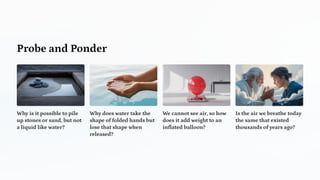
Why is it possible to pile
up stones or sand, but not
a liquid like water?
Why does water take the
shape of folded hands but
lose that shape when
released?
We cannot see air, so how
does it add weight to an
inflated balloon?
Is the air we breathe today
the same that existed
thousands of years ago?
The Origin of Pebbles and Sand
You might have collected pebbles and stones from the sand while
playing on a riverbank or a beach. Where do these pebbles, stones,
and sand come from?
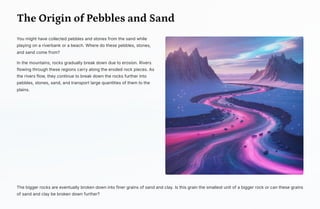
In the mountains, rocks gradually break down due to erosion. Rivers
flowing through these regions carry along the eroded rock pieces. As
the rivers flow, they continue to break down the rocks further into
pebbles, stones, sand, and transport large quantities of them to the
plains.
The bigger rocks are eventually broken down into finer grains of sand and clay. Is this grain the smallest unit of a bigger rock or can these grains
of sand and clay be broken down further?
What Is Matter Composed of?
Let's explore the fundamental nature of matter through a simple activity:
Breaking the Chalk
Begin by taking a stick of chalk and breaking
it into two pieces. Continue breaking the chalk
until it becomes difficult to fragment further
by hand.
Grinding the Fragments
Next, use a mortar and pestle to grind these
small pieces of chalk into an even finer
powder, reducing their size significantly.
Observing the Powder
Finally, examine the fine chalk powder closely
with a magnifying glass. Notice the tiny grains
that make up the powder.
Each tiny grain you observe is still a speck of chalk. The chalk does not change into a new substance on grinding; it's merely a physical change
where only the size of each speck has reduced.
These specks of chalk powder can be broken further into smaller particles by continued grinding. Eventually, we would reach a stage where the
individual chalk particles cannot be broken down any further, illustrating that matter is composed of incredibly tiny, fundamental units.
Constituent Particles
Let's delve deeper into the fundamental units that compose all matter.
When a substance like chalk is broken down
to its absolute smallest possible parts, these
tiny, fundamental units are revealed as its
basic building blocks.
These incredibly tiny, fundamental units are
called constituent particles. They are the
essential components that make up any larger
piece of a substance or material.
The concept of constituent particles applies
universally to all matter. Just as chalk is made
of these particles, so too are larger formations
like grains of sand and clay, which are
themselves composed of countless smaller,
fundamental units.
Dissolving Sugar in Water
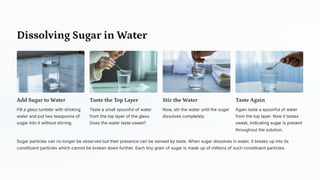
Add Sugar to Water
Fill a glass tumbler with drinking
water and put two teaspoons of
sugar into it without stirring.
Taste the Top Layer
Taste a small spoonful of water
from the top layer of the glass.
Does the water taste sweet?
Stir the Water
Now, stir the water until the sugar
dissolves completely.
Taste Again
Again taste a spoonful of water
from the top layer. Now it tastes
sweet, indicating sugar is present
throughout the solution.
Sugar particles can no longer be observed but their presence can be sensed by taste. When sugar dissolves in water, it breaks up into its
constituent particles which cannot be broken down further. Each tiny grain of sugar is made up of millions of such constituent particles.
Interparticle Spaces
Occupying the Gaps
The tiny sugar particles separate and spread out, occupying the
minute spaces found between the water particles. These spaces
between the particles are known as interparticle spaces.
Holding Particles Together
We've seen that chalk and sugar can be broken down into their
constituent particles. But what forces are at play, holding these
incredibly tiny fundamental units together to form the solid pieces we
observe?
Interparticle Attractions
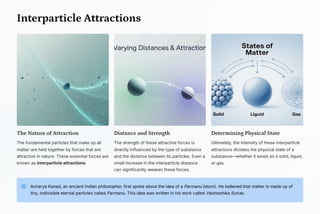
The Nature of Attraction
The fundamental particles that make up all
matter are held together by forces that are
attractive in nature. These essential forces are
known as interparticle attractions.
Distance and Strength
The strength of these attractive forces is
directly influenced by the type of substance
and the distance between its particles. Even a
small increase in the interparticle distance
can significantly weaken these forces.
Determining Physical State
Ultimately, the intensity of these interparticle
attractions dictates the physical state of a
substance4whether it exists as a solid, liquid,
or gas.
Acharya Kanad, an ancient Indian philosopher, first spoke about the idea of a Parmanu (atom). He believed that matter is made up of
tiny, indivisible eternal particles called Parmanu. This idea was written in his work called Vaisheshika Sutras.
The Solid State
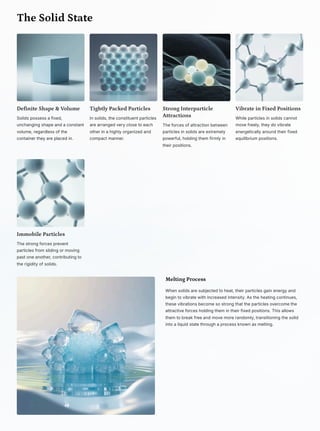
Definite Shape & Volume
Solids possess a fixed,
unchanging shape and a constant
volume, regardless of the
container they are placed in.
Tightly Packed Particles
In solids, the constituent particles
are arranged very close to each
other in a highly organized and
compact manner.
Strong Interparticle
Attractions
The forces of attraction between
particles in solids are extremely
powerful, holding them firmly in
their positions.
Vibrate in Fixed Positions
While particles in solids cannot
move freely, they do vibrate
energetically around their fixed
equilibrium positions.
Immobile Particles
The strong forces prevent
particles from sliding or moving
past one another, contributing to
the rigidity of solids.
Melting Process
When solids are subjected to heat, their particles gain energy and
begin to vibrate with increased intensity. As the heating continues,
these vibrations become so strong that the particles overcome the
attractive forces holding them in their fixed positions. This allows
them to break free and move more randomly, transitioning the solid
into a liquid state through a process known as melting.
Melting Point
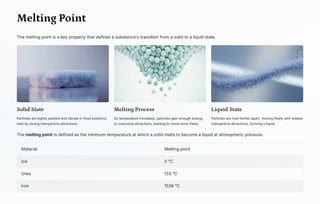
The melting point is a key property that defines a substance's transition from a solid to a liquid state.
Solid State
Particles are tightly packed and vibrate in fixed positions,
held by strong interparticle attractions.
Melting Process
As temperature increases, particles gain enough energy
to overcome attractions, starting to move more freely.
Liquid State
Particles are now farther apart, moving freely with weaker
interparticle attractions, forming a liquid.
The melting point is defined as the minimum temperature at which a solid melts to become a liquid at atmospheric pressure.
Material Melting point
Ice 0 °C
Urea 133 °C
Iron 1538 °C
The Liquid State
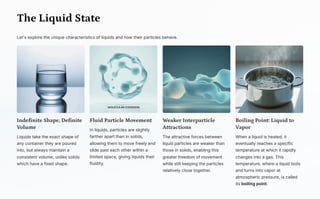
Let's explore the unique characteristics of liquids and how their particles behave.
Indefinite Shape, Definite
Volume
Liquids take the exact shape of
any container they are poured
into, but always maintain a
consistent volume, unlike solids
which have a fixed shape.
Fluid Particle Movement
In liquids, particles are slightly
farther apart than in solids,
allowing them to move freely and
slide past each other within a
limited space, giving liquids their
fluidity.
Weaker Interparticle
Attractions
The attractive forces between
liquid particles are weaker than
those in solids, enabling this
greater freedom of movement
while still keeping the particles
relatively close together.
Boiling Point: Liquid to
Vapor
When a liquid is heated, it
eventually reaches a specific
temperature at which it rapidly
changes into a gas. This
temperature, where a liquid boils
and turns into vapor at
atmospheric pressure, is called
its boiling point.
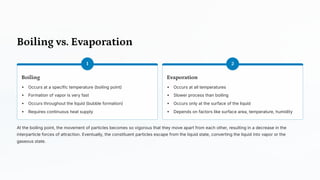
Boiling vs. Evaporation
1
Boiling
Occurs at a specific temperature (boiling point)
Formation of vapor is very fast
Occurs throughout the liquid (bubble formation)
Requires continuous heat supply
2
Evaporation
Occurs at all temperatures
Slower process than boiling
Occurs only at the surface of the liquid
Depends on factors like surface area, temperature, humidity
At the boiling point, the movement of particles becomes so vigorous that they move apart from each other, resulting in a decrease in the
interparticle forces of attraction. Eventually, the constituent particles escape from the liquid state, converting the liquid into vapor or the
gaseous state.
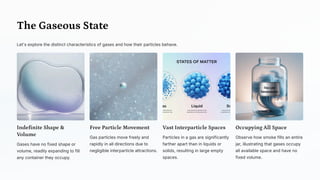
The Gaseous State
Let's explore the distinct characteristics of gases and how their particles behave.
Indefinite Shape &
Volume
Gases have no fixed shape or
volume, readily expanding to fill
any container they occupy.
Free Particle Movement
Gas particles move freely and
rapidly in all directions due to
negligible interparticle attractions.
Vast Interparticle Spaces
Particles in a gas are significantly
farther apart than in liquids or
solids, resulting in large empty
spaces.
Occupying All Space
Observe how smoke fills an entire
jar, illustrating that gases occupy
all available space and have no
fixed volume.
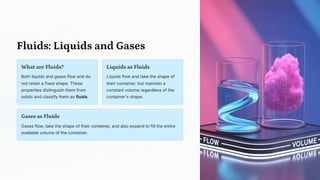
Fluids: Liquids and Gases
What are Fluids?
Both liquids and gases flow and do
not retain a fixed shape. These
properties distinguish them from
solids and classify them as fluids.
Liquids as Fluids
Liquids flow and take the shape of
their container, but maintain a
constant volume regardless of the
container's shape.
Gases as Fluids
Gases flow, take the shape of their container, and also expand to fill the entire
available volume of the container.
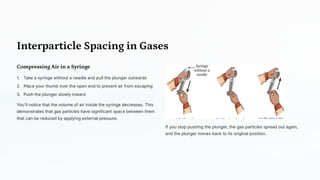
Interparticle Spacing in Gases
Compressing Air in a Syringe
Take a syringe without a needle and pull the plunger outwards
1.
Place your thumb over the open end to prevent air from escaping
2.
Push the plunger slowly inward
3.
You'll notice that the volume of air inside the syringe decreases. This
demonstrates that gas particles have significant space between them
that can be reduced by applying external pressure.
If you stop pushing the plunger, the gas particles spread out again,
and the plunger moves back to its original position.
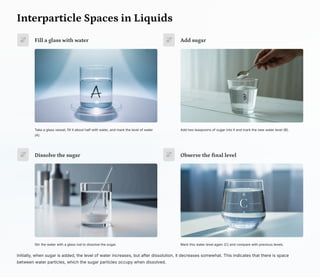
Interparticle Spaces in Liquids
Fill a glass with water
Take a glass vessel, fill it about half with water, and mark the level of water
(A).
Add sugar
Add two teaspoons of sugar into it and mark the new water level (B).
Dissolve the sugar
Stir the water with a glass rod to dissolve the sugar.
Observe the final level
Mark this water level again (C) and compare with previous levels.
Initially, when sugar is added, the level of water increases, but after dissolution, it decreases somewhat. This indicates that there is space
between water particles, which the sugar particles occupy when dissolved.
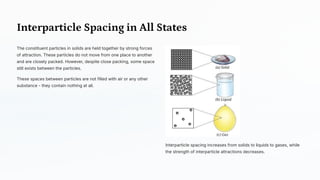
Interparticle Spacing in All States
The constituent particles in solids are held together by strong forces
of attraction. These particles do not move from one place to another
and are closely packed. However, despite close packing, some space
still exists between the particles.
These spaces between particles are not filled with air or any other
substance - they contain nothing at all.
Interparticle spacing increases from solids to liquids to gases, while
the strength of interparticle attractions decreases.
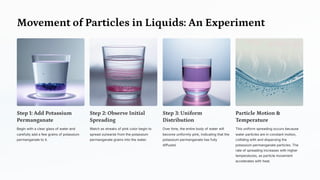
Movement of Particles in Liquids: An Experiment
Step 1: Add Potassium
Permanganate
Begin with a clear glass of water and
carefully add a few grains of potassium
permanganate to it.
Step 2: Observe Initial
Spreading
Watch as streaks of pink color begin to
spread outwards from the potassium
permanganate grains into the water.
Step 3: Uniform
Distribution
Over time, the entire body of water will
become uniformly pink, indicating that the
potassium permanganate has fully
diffused.
Particle Motion &
Temperature
This uniform spreading occurs because
water particles are in constant motion,
colliding with and dispersing the
potassium permanganate particles. The
rate of spreading increases with higher
temperatures, as particle movement
accelerates with heat.
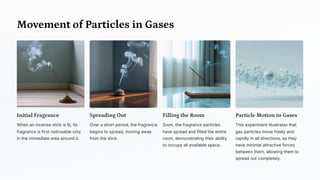
Movement of Particles in Gases
Initial Fragrance
When an incense stick is lit, its
fragrance is first noticeable only
in the immediate area around it.
Spreading Out
Over a short period, the fragrance
begins to spread, moving away
from the stick.
Filling the Room
Soon, the fragrance particles
have spread and filled the entire
room, demonstrating their ability
to occupy all available space.
Particle Motion in Gases
This experiment illustrates that
gas particles move freely and
rapidly in all directions, as they
have minimal attractive forces
between them, allowing them to
spread out completely.
Practical Applications
Soap Cleaning Action
When we wash clothes stained with
oil using soap, numerous soap
particles surround the oil particles on
the fabric. One end of the soap
particle attaches to the oil, and the
other mixes with water, helping lift the
oil off and wash it away.
Perfumes and Fragrances
Perfumes contain volatile substances
whose particles easily escape into the
air and spread throughout a room,
allowing us to smell them from a
distance.
Cooking and Dissolution
When we add salt or sugar to food,
their particles dissolve and spread
throughout, evenly distributing the
flavor due to the movement of
particles in the liquid or semi-solid
food.
Thermal Energy and States of Matter
1
Solid
Low thermal energy
2
Liquid
Medium thermal energy
3
Gas
High thermal energy
Matter is made up of small particles held together by forces of attraction. The strength of these attractive forces depends on the distance
between particles, which in turn depends on their thermal (heat) energy. Thus, it is the thermal energy of the particles that determines the
physical state of matter.
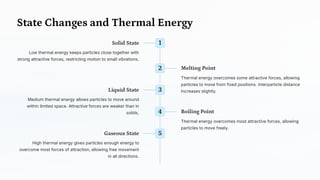
State Changes and Thermal Energy
1
Solid State
Low thermal energy keeps particles close together with
strong attractive forces, restricting motion to small vibrations.
2 Melting Point
Thermal energy overcomes some attractive forces, allowing
particles to move from fixed positions. Interparticle distance
increases slightly.
3
Liquid State
Medium thermal energy allows particles to move around
within limited space. Attractive forces are weaker than in
solids. 4 Boiling Point
Thermal energy overcomes most attractive forces, allowing
particles to move freely.
5
Gaseous State
High thermal energy gives particles enough energy to
overcome most forces of attraction, allowing free movement
in all directions.
Summary: Particle Nature of Matter
Composition of Matter
Matter is composed of extremely small particles that are held
together by interparticle forces of attractions.
Solids
Strong interparticle attraction, minimum interparticle space, and
no free movement of particles give solids a fixed shape and size.
Liquids
Slightly weaker interparticle attraction allows particles to move
within a limited space, giving liquids a definite volume but no
fixed shape.
Gases
Negligible interparticle attractions allow particles to move freely
with maximum interparticle space, giving gases no fixed shape or
volume.
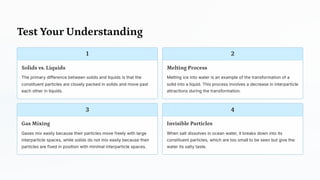
Test Your Understanding
1
Solids vs. Liquids
The primary difference between solids and liquids is that the
constituent particles are closely packed in solids and move past
each other in liquids.
2
Melting Process
Melting ice into water is an example of the transformation of a
solid into a liquid. This process involves a decrease in interparticle
attractions during the transformation.
3
Gas Mixing
Gases mix easily because their particles move freely with large
interparticle spaces, while solids do not mix easily because their
particles are fixed in position with minimal interparticle spaces.
4
Invisible Particles
When salt dissolves in ocean water, it breaks down into its
constituent particles, which are too small to be seen but give the
water its salty taste.
Explore Further
Balloon Experiment
Fix a balloon over the neck of a bottle and put
the bottle in hot water. Observe what happens
as the air inside expands due to increased
thermal energy.
Create Models
Design and create simple models to represent
particles of solids, liquids, and gases showing
interparticle spacing using clay balls, beads,
etc.
Atoms and Molecules
The tiny particles that make up all matter are
atoms and molecules. For example, iron is
made up of atoms of iron, and water
molecules are made up of two hydrogen
atoms and one oxygen atom.
Continue your exploration of the particulate nature of matter by conducting these activities and researching more about atoms and molecules,
which you will study in greater detail in higher grades.