4.The World of Metals and
Non-metals
(7th science/curiosity)
Metals and non-metals are fundamental materials that shape our daily lives.
From cooking utensils to electrical wires, from construction materials to
jewelry, these elements play crucial roles in human civilization. This
presentation explores the fascinating properties of metals and non-metals,
their behaviors, and their significance in our everyday experiences.
Join Yashwant and Anandi as they visit a local ironsmith in Rajasthan to learn
about metalworking and discover the science behind these essential
materials. Through their journey, we'll uncover the unique characteristics
that distinguish metals from non-metals and understand why these
properties make them suitable for specific applications.
by sandeep swamy
The Village Ironsmith
Traditional Metalworking
Yashwant and Anandi visit Sudarshan, a local ironsmith in their
Rajasthan village, to learn about metal crafts. They discover
that ironsmiths create everyday items like flat pans (tawas),
buckets (baltis), tongs (chimtas), and farming tools including
spades (phawras), axes (kulhadis), and rakes (jelees).
The craftsmen primarily use iron metal for these items, with
wood for handles where needed. Coal fuels their furnaces to
heat the iron to high temperatures before shaping.
The Shaping Process
During their visit, the children observe Sudarshan heating an
iron block in the furnace until it becomes red hot. He then
beats it with a hammer to shape it into an axe. This
demonstration reveals one of the key properties of metals -
they can be beaten into different shapes.
This observation sparks curiosity in Anandi, who wonders if
other metals can be shaped similarly, leading them to explore
more properties of metals and non-metals.
Malleability: A Key Property of Metals
What is Malleability?
Malleability is the property that allows
materials to be beaten into thin
sheets without breaking. Most metals
possess this property, which makes
them valuable for creating various
objects like utensils, tools, and
decorative items.
Experimental Observations
When objects like copper pieces, iron
nails, and aluminum fragments are
hammered, they flatten rather than
break. In contrast, non-metals like
coal and sulfur break into pieces
when hammered, showing they are
brittle rather than malleable.
Applications of Malleability
This property enables the creation of
thin metal sheets like silver foil used
on sweets and aluminum foil for
wrapping food. Gold and silver are
considered the most malleable
metals, capable of being hammered
into extremely thin sheets.
Ductility: Drawing Metals
into Wires
Definition of Ductility
Ductility is the property that
allows materials to be drawn
into wires. This property is
primarily found in metals,
making them essential for
electrical wiring, jewelry
making, and structural
applications.
Gold: The Ultimate
Ductile Metal
Gold demonstrates
exceptional ductility - just one
gram can be drawn into a
wire stretching two
kilometers in length! This
remarkable property makes
gold valuable for specialized
applications despite its high
cost.
Practical Applications
Steel wires (a mixture of iron and carbon) support heavy loads in
suspension bridges and cranes. Copper and aluminum wires are
essential for electrical installations, while metal wires are also used in
musical instruments like veena, sitar, and guitar.
Sonority: The Ringing Sound
of Metals
1 Observation
When metal objects like spoons or coins are dropped on a
hard surface, they produce a distinctive ringing sound, unlike
the dull thud of non-metals like wood or coal.
2 Definition
This property of producing a ringing sound when struck is
called sonority. Metals are described as sonorous due to this
characteristic vibration pattern when they receive impact.
3 Applications
The sonority of metals makes them ideal for musical
instruments like bells, cymbals, and ghungroos (ankle bells
used in Indian classical dance), as well as for school bells and
other sound-producing devices.
Conduction of Heat in Metals
The Experiment
When a metal spoon and a wooden spoon are placed in hot water, the metal spoon's handle becomes hot quickly
while the wooden spoon's handle remains relatively cool, even though both are exposed to the same heat source.
Heat Conduction
This demonstrates that metals are good conductors of heat, transferring thermal energy efficiently from one end to
another. Non-metals like wood are poor heat conductors, which is why they feel cooler to touch even in identical
conditions.
Practical Applications
This property explains why cooking vessels are typically made of metals - they efficiently transfer heat from the
flame to the food. Conversely, handles are often made of wood or plastic to prevent burns, utilizing the poor heat
conduction of these materials.
Electrical Conductivity of Materials
Testing Conductivity
Using a simple electric circuit with a
bulb, various materials can be tested
for their ability to conduct electricity.
When the material completes the
circuit and allows current to flow, the
bulb glows.
Metals as Conductors
Materials like aluminum, iron, and
copper allow electricity to flow through
them easily, making the bulb glow.
These metals are classified as good
conductors of electricity.
Non-metals as Insulators
Materials like sulfur, coal, wood, stone,
rubber, and nylon prevent electricity
from flowing through them, so the bulb
doesn't glow. These are poor
conductors or insulators.
Safety Applications
Understanding electrical conductivity
is crucial for safety. Electricians use
tools with insulated handles and wear
rubber gloves to prevent electric
shocks, as these materials don't
conduct electricity.
Rusting: The Effect of Air and Water on Iron
The Rusting Experiment
An experiment with three iron nails in
different conditions reveals that rusting
requires both air and water. The nail kept
in dry air (with silica gel) and the nail
submerged in boiled water (covered with
oil to prevent air contact) don't rust, while
the nail exposed to both air and water
develops brown deposits.
Understanding Rusting
Rusting is a form of corrosion specific to
iron. The brown deposit called rust forms
when iron reacts with oxygen in the
presence of moisture. This process
gradually weakens iron structures and is
a significant economic problem in many
countries.
Preventing Rusting
Several methods can prevent rusting,
including painting, oiling, greasing, and
galvanization (applying a protective layer
of zinc). These techniques create
barriers that prevent iron from coming
into contact with both air and moisture
simultaneously.
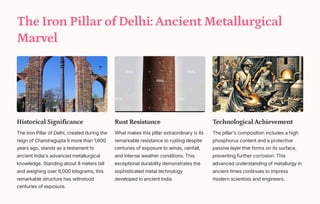
The Iron Pillar of Delhi: Ancient Metallurgical
Marvel
Historical Significance
The Iron Pillar of Delhi, created during the
reign of Chandragupta II more than 1,600
years ago, stands as a testament to
ancient India's advanced metallurgical
knowledge. Standing about 8 meters tall
and weighing over 6,000 kilograms, this
remarkable structure has withstood
centuries of exposure.
Rust Resistance
What makes this pillar extraordinary is its
remarkable resistance to rusting despite
centuries of exposure to winds, rainfall,
and intense weather conditions. This
exceptional durability demonstrates the
sophisticated metal technology
developed in ancient India.
Technological Achievement
The pillar's composition includes a high
phosphorus content and a protective
passive layer that forms on its surface,
preventing further corrosion. This
advanced understanding of metallurgy in
ancient times continues to impress
modern scientists and engineers.
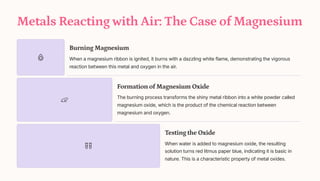
Metals Reacting with Air: The Case of Magnesium
Burning Magnesium
When a magnesium ribbon is ignited, it burns with a dazzling white flame, demonstrating the vigorous
reaction between this metal and oxygen in the air.
Formation of Magnesium Oxide
The burning process transforms the shiny metal ribbon into a white powder called
magnesium oxide, which is the product of the chemical reaction between
magnesium and oxygen.
Testing the Oxide
When water is added to magnesium oxide, the resulting
solution turns red litmus paper blue, indicating it is basic in
nature. This is a characteristic property of metal oxides.
Reactive Metals: The Case of Sodium
1
Extreme Reactivity
Sodium is so reactive that it must be
stored under kerosene to prevent contact
with air and moisture, which would
trigger vigorous reactions.
2
Reaction with Water
When sodium comes in contact with
water, it reacts violently, producing
significant heat and forming sodium
hydroxide, a strong base.
3
Reaction with Air
Exposed to air, sodium quickly tarnishes
as it reacts with oxygen to form sodium
oxide, which is basic in nature like other
metal oxides.
Non-metals Reacting with Air: The Case of Sulfur
Acidic Nature
Unlike metal oxides, non-metal oxides form acidic solutions in water
Sulfur Dioxide Formation
Burning sulfur produces sulfur dioxide gas
Combustion Process
Sulfur burns with a blue flame in air
When sulfur is burned in air, it combines with oxygen to form sulfur dioxide gas. When this gas dissolves in water, it produces
sulfurous acid, which turns blue litmus paper red, confirming its acidic nature. This behavior contrasts sharply with metals like
magnesium, whose oxides form basic solutions.
Interestingly, unlike some reactive metals, sulfur does not react with water alone. When sulfur powder is added to water without
burning it first, no reaction occurs, demonstrating another difference between metals and non-metals.
Characteristics of Non-metals
Physical Appearance
Non-metals are typically dull in appearance
(not lustrous like metals) and are often soft
in texture.
Mechanical Properties
They are neither malleable nor ductile,
meaning they cannot be hammered into
sheets or drawn into wires. Many non-
metals are brittle and break when force is
applied.
Sound Properties
Non-metals are not sonorous - they
produce dull sounds when struck rather
than the ringing sounds characteristic of
metals.
Conduction Properties
They are poor conductors of both heat and
electricity, making them useful as insulators
in various applications.
Chemical Properties
Their oxides are typically acidic in nature,
unlike the basic oxides formed by metals.
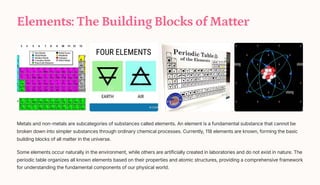
Elements: The Building Blocks of Matter
Metals and non-metals are subcategories of substances called elements. An element is a fundamental substance that cannot be
broken down into simpler substances through ordinary chemical processes. Currently, 118 elements are known, forming the basic
building blocks of all matter in the universe.
Some elements occur naturally in the environment, while others are artificially created in laboratories and do not exist in nature. The
periodic table organizes all known elements based on their properties and atomic structures, providing a comprehensive framework
for understanding the fundamental components of our physical world.
Essential Non-metals in Our Lives
Oxygen
Essential for
respiration in living
organisms, oxygen is
also used in medical
treatments, industrial
processes, and
combustion. Without
this non-metal, human
life would be
impossible.
Carbon
The building block of
all life forms, carbon is
a key component of
proteins, fats, and
carbohydrates. Its
unique bonding
properties allow for
the formation of
millions of different
organic compounds.
Nitrogen
Used in
manufacturing
fertilizers, nitrogen is
an essential nutrient
for plant growth. It
makes up about 78%
of Earth's atmosphere
and is crucial for
protein synthesis in
living organisms.
Chlorine &
Iodine
Chlorine is commonly
used in water
purification, while
iodine solutions serve
as antiseptics for
wound treatment.
Both these halogens
play vital roles in
public health and
safety.
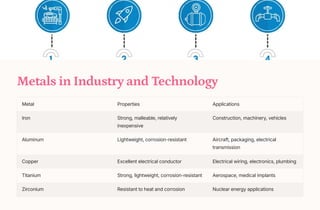
Metals in Industry and Technology
Metal Properties Applications
Iron Strong, malleable, relatively
inexpensive
Construction, machinery, vehicles
Aluminum Lightweight, corrosion-resistant Aircraft, packaging, electrical
transmission
Copper Excellent electrical conductor Electrical wiring, electronics, plumbing
Titanium Strong, lightweight, corrosion-resistant Aerospace, medical implants
Zirconium Resistant to heat and corrosion Nuclear energy applications
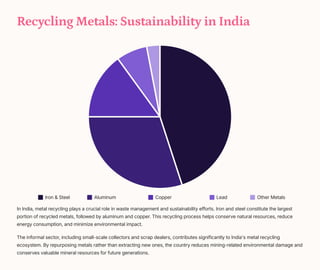
Recycling Metals: Sustainability in India
Iron & Steel Aluminum Copper Lead Other Metals
In India, metal recycling plays a crucial role in waste management and sustainability efforts. Iron and steel constitute the largest
portion of recycled metals, followed by aluminum and copper. This recycling process helps conserve natural resources, reduce
energy consumption, and minimize environmental impact.
The informal sector, including small-scale collectors and scrap dealers, contributes significantly to India's metal recycling
ecosystem. By repurposing metals rather than extracting new ones, the country reduces mining-related environmental damage and
conserves valuable mineral resources for future generations.
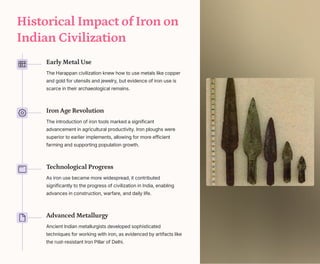
Historical Impact of Iron on
Indian Civilization
Early Metal Use
The Harappan civilization knew how to use metals like copper
and gold for utensils and jewelry, but evidence of iron use is
scarce in their archaeological remains.
Iron Age Revolution
The introduction of iron tools marked a significant
advancement in agricultural productivity. Iron ploughs were
superior to earlier implements, allowing for more efficient
farming and supporting population growth.
Technological Progress
As iron use became more widespread, it contributed
significantly to the progress of civilization in India, enabling
advances in construction, warfare, and daily life.
Advanced Metallurgy
Ancient Indian metallurgists developed sophisticated
techniques for working with iron, as evidenced by artifacts like
the rust-resistant Iron Pillar of Delhi.
Comparing Metals and Non-metals
Metals
Generally lustrous in appearance
Typically malleable and ductile
Good conductors of heat and electricity
Sonorous (produce ringing sounds when struck)
React with oxygen to form basic oxides
Many react with water
Susceptible to corrosion in moist air
Non-metals
Usually dull in appearance
Neither malleable nor ductile; often brittle
Poor conductors of heat and electricity
Not sonorous (produce dull sounds when struck)
React with oxygen to form acidic oxides
Generally do not react with water
Do not undergo corrosion like metals
Key Takeaways: The World of Metals and Non-
metals
Distinctive Properties
Metals and non-metals have characteristic properties
that make them suitable for specific applications.
Understanding these properties helps us select the right
materials for different purposes.
Chemical Behavior
The chemical reactions of metals and non-metals,
particularly with oxygen and water, reveal fundamental
differences in their nature. Metal oxides are typically
basic, while non-metal oxides are acidic.
Everyday Applications
Both metals and non-metals are essential in our daily
lives. From structural materials to life-sustaining
elements, these fundamental substances form the
backbone of modern civilization and natural processes.
Sustainability Considerations
As we continue to use metals and non-metals,
understanding their properties, reactions, and
environmental impacts becomes increasingly important
for developing sustainable practices and technologies.