Teacher Study Group Summer 2008 Focus Group Thursday, August 28, 2008
Standardized Testing - NCLB & AYP  According to UbD, assessment is the backbone of authentic instruction When done effectively, formative assessment (criterion referenced feedback) can  double the speed of student learning . Why focus on assessment?
Research of assessment practices for the last 40 years Black, P. & Wiliam, D. (1998b). Assessment and classroom  learning.  Assessment in Education, 5 (1), 7-74. Brookhart, S. M. (2004). Classroom assessment: tensions and  intersections in theory and practice.  Teachers College  Record,   106 (3), 429 – 458. Crooks, T.J. (1988).The impact of classroom evaluation practices on  students,  Review of Educational Research ,  58 (4), 438-481. Kluger, A. N., & DeNisi, A. (1996). The effects of feedback  interventions on performance: a historical review, meta- analysis, and a preliminary feedback intervention theory.  Psychological Bulletin, 119 (2), 254-284. Natriello, G. (1987). The impact of evaluation processes on  students.  Educational Psychologist, 22 (2), 155-157. Why focus on assessment?
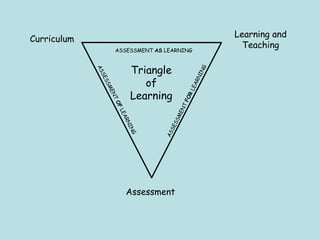
Curriculum Learning and Teaching Assessment ASSESSMENT  FOR  LEARNING ASSESSMENT  OF  LEARNING ASSESSMENT  AS  LEARNING Triangle of Learning
What is formative assessment? If we think of our children as plants …  Summative assessment  of the plants is the process of simply measuring them. It might be interesting to compare and analyze measurements but, in themselves, these do not affect the growth of the plants. Formative assessment , on the other hand, is the equivalent of feeding and watering the plants appropriate to their needs - directly affecting their growth. The garden analogy
Students and teachers must recognize a gap between actual and desired performance and take action to close the gap (Black & Wiliam, 1998) Formative Assessment is a cycle
Students and Teachers Focus on and understand learning goals;  Compare current work to the goal and identify the gap; and  Take action to close the gap and move closer to the goal.
ASSESSMENT APPETIZER   Factors that improve learning through assessment 2-4-8 Groups Questions: What are the key ideas?  What are the implications for your classroom practice?
Self-evaluation How well do you: Share learning goals with students in their terms? Involve students in self assessment? Provide timely focused feedback? Do you have confidence that every student in your class can improve? Think now about some of the things that prevent us from assessing in a formative manner. Rate yourself from:  5  –   I do this consistently well  to: 0  –   I don’t do this at all
Activity Reflections Excerpts from The “Black Box” studies Paul Black and Dylan Wiliam from Kings College, London, began a series of important studies in the 1990s. Their famous paper, “Inside the Black Box”, was published in 1998 and became the first in an important research series.  This activity helps you explore the focus of that research: how assessment interacts with learning. Black, P., & Wiliam, D. (1998). Inside the Black Box: Raising standards through classroom assessment.  Phi Delta Kappan, 80  (2), 139-148.
Discussion – Whole group What are the key ideas?  What are the implications for your classroom practice?
Reflections What are your beliefs about learning? Does your classroom reflect your beliefs? What are the assessment issues in our school? What are the ‘obstacles to learning’ in your classroom?  How can they be cleared away? How do you use formative assessment in your classroom? How can you improve assessment practices in your classroom to affect student learning?
Conclusion
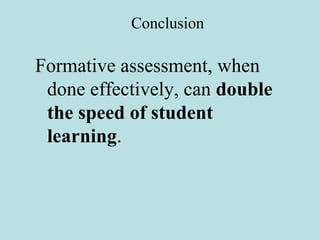
Formative assessment, when done effectively, can  double the speed of student learning . Conclusion
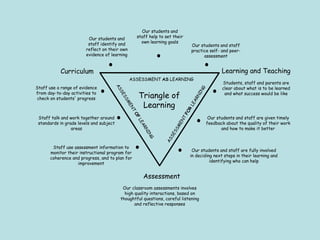
Students, staff and parents are clear about what is to be learned and what success would be like Curriculum Learning and Teaching Assessment Our students and staff help to set their own learning goals Our students and staff identify and reflect on their own evidence of learning Our students and staff practice self- and peer- assessment Staff use a range of evidence from day-to-day activities to check on students' progress Staff talk and work together around standards in grade levels and subject areas Staff use assessment information to monitor their instructional program for coherence and progress, and to plan for improvement Our students and staff are given timely feedback about the quality of their work and how to make it better Our students and staff are fully involved in deciding next steps in their learning and identifying who can help Our classroom assessments involves high quality interactions, based on thoughtful questions, careful listening and reflective responses ASSESSMENT  FOR  LEARNING ASSESSMENT  OF  LEARNING ASSESSMENT  AS  LEARNING Triangle of Learning
 
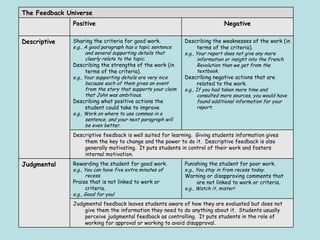
Judgmental feedback leaves students aware of how they are evaluated but does not give them the information they need to do anything about it.  Students usually perceive judgmental feedback as controlling.  It puts students in the role of working for approval or working to avoid disapproval. Punishing the student for poor work. e.g., You stay in from recess today. Warning or disapproving comments that are not linked to work or criteria. e.g., Watch it, mister! Rewarding the student for good work. e.g., You can have five extra minutes of recess. Praise that is not linked to work or criteria. e.g., Good for you! Judgmental Descriptive feedback is well suited for learning.  Giving students information gives them the key to change and the power to do it.  Descriptive feedback is also generally motivating.  It puts students in control of their work and fosters internal motivation. Describing the weaknesses of the work (in terms of the criteria). e.g., Your report does not give any more information or insight into the French Revolution than we get from the textbook. Describing negative actions that are related to the work. e.g., If you had taken more time and consulted more sources, you would have found additional information for your report. Sharing the criteria for good work. e.g., A good paragraph has a topic sentence and several supporting details that clearly relate to the topic. Describing the strengths of the work (in terms of the criteria). e.g., Your supporting details are very nice because each of them gives an event from the story that supports your claim that John was ambitious. Describing what positive actions the student could take to improve. e.g., Work on where to use commas in a sentence, and your next paragraph will be even better. Descriptive Negative Positive The Feedback Universe
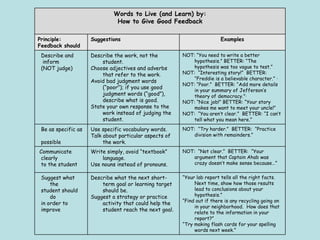
“ Your lab report tells all the right facts.  Next time, show how those results lead to conclusions about your hypothesis.” “ Find out if there is any recycling going on in your neighborhood.  How does that relate to the information in your report?” “ Try making flash cards for your spelling words next week.”  Describe what the next short-term goal or learning target should be. Suggest a strategy or practice activity that could help the student reach the next goal. Suggest what the  student should do  in order to  improve NOT:  “Not clear.”  BETTER:  “Your argument that Captain Ahab was crazy doesn’t make sense because…” Write simply, avoid “textbook” language. Use nouns instead of pronouns. Communicate  clearly to the student NOT:  “Try harder.”  BETTER:  “Practice division with remainders.” Use specific vocabulary words. Talk about particular aspects of the work. Be as specific as  possible NOT: “You need to write a better hypothesis.” BETTER: “The hypothesis was too vague to test.” NOT:  “Interesting story!”  BETTER: “Freddie is a believable character.” · NOT: “Poor.”  BETTER: “Add more details in your summary of Jefferson’s theory of democracy.”· NOT: “Nice job!” BETTER: “Your story makes me want to meet your uncle!” NOT:  “You aren’t clear.”  BETTER: “I can’t tell what you mean here.” Describe the work, not the student. Choose adjectives and adverbs that refer to the work. Avoid bad judgment words (“poor”); if you use good judgment words (“good”), describe what is good.  State your own response to the work instead of judging the student. Describe and  inform (NOT judge) Examples Suggestions Principle: Feedback should Words to Live (and Learn) by: How to Give Good Feedback

Tsg Aug 28 Presentation

  • 1.
    Teacher Study GroupSummer 2008 Focus Group Thursday, August 28, 2008
  • 2.
    Standardized Testing -NCLB & AYP According to UbD, assessment is the backbone of authentic instruction When done effectively, formative assessment (criterion referenced feedback) can double the speed of student learning . Why focus on assessment?
  • 3.
    Research of assessmentpractices for the last 40 years Black, P. & Wiliam, D. (1998b). Assessment and classroom learning. Assessment in Education, 5 (1), 7-74. Brookhart, S. M. (2004). Classroom assessment: tensions and intersections in theory and practice. Teachers College Record, 106 (3), 429 – 458. Crooks, T.J. (1988).The impact of classroom evaluation practices on students, Review of Educational Research , 58 (4), 438-481. Kluger, A. N., & DeNisi, A. (1996). The effects of feedback interventions on performance: a historical review, meta- analysis, and a preliminary feedback intervention theory. Psychological Bulletin, 119 (2), 254-284. Natriello, G. (1987). The impact of evaluation processes on students. Educational Psychologist, 22 (2), 155-157. Why focus on assessment?
  • 4.
    Curriculum Learning andTeaching Assessment ASSESSMENT FOR LEARNING ASSESSMENT OF LEARNING ASSESSMENT AS LEARNING Triangle of Learning
  • 5.
    What is formativeassessment? If we think of our children as plants … Summative assessment of the plants is the process of simply measuring them. It might be interesting to compare and analyze measurements but, in themselves, these do not affect the growth of the plants. Formative assessment , on the other hand, is the equivalent of feeding and watering the plants appropriate to their needs - directly affecting their growth. The garden analogy
  • 6.
    Students and teachersmust recognize a gap between actual and desired performance and take action to close the gap (Black & Wiliam, 1998) Formative Assessment is a cycle
  • 7.
    Students and TeachersFocus on and understand learning goals; Compare current work to the goal and identify the gap; and Take action to close the gap and move closer to the goal.
  • 8.
    ASSESSMENT APPETIZER Factors that improve learning through assessment 2-4-8 Groups Questions: What are the key ideas? What are the implications for your classroom practice?
  • 9.
    Self-evaluation How welldo you: Share learning goals with students in their terms? Involve students in self assessment? Provide timely focused feedback? Do you have confidence that every student in your class can improve? Think now about some of the things that prevent us from assessing in a formative manner. Rate yourself from: 5 – I do this consistently well to: 0 – I don’t do this at all
  • 10.
    Activity Reflections Excerptsfrom The “Black Box” studies Paul Black and Dylan Wiliam from Kings College, London, began a series of important studies in the 1990s. Their famous paper, “Inside the Black Box”, was published in 1998 and became the first in an important research series. This activity helps you explore the focus of that research: how assessment interacts with learning. Black, P., & Wiliam, D. (1998). Inside the Black Box: Raising standards through classroom assessment. Phi Delta Kappan, 80 (2), 139-148.
  • 11.
    Discussion – Wholegroup What are the key ideas? What are the implications for your classroom practice?
  • 12.
    Reflections What areyour beliefs about learning? Does your classroom reflect your beliefs? What are the assessment issues in our school? What are the ‘obstacles to learning’ in your classroom? How can they be cleared away? How do you use formative assessment in your classroom? How can you improve assessment practices in your classroom to affect student learning?
  • 13.
  • 14.
    Formative assessment, whendone effectively, can double the speed of student learning . Conclusion
  • 15.
    Students, staff andparents are clear about what is to be learned and what success would be like Curriculum Learning and Teaching Assessment Our students and staff help to set their own learning goals Our students and staff identify and reflect on their own evidence of learning Our students and staff practice self- and peer- assessment Staff use a range of evidence from day-to-day activities to check on students' progress Staff talk and work together around standards in grade levels and subject areas Staff use assessment information to monitor their instructional program for coherence and progress, and to plan for improvement Our students and staff are given timely feedback about the quality of their work and how to make it better Our students and staff are fully involved in deciding next steps in their learning and identifying who can help Our classroom assessments involves high quality interactions, based on thoughtful questions, careful listening and reflective responses ASSESSMENT FOR LEARNING ASSESSMENT OF LEARNING ASSESSMENT AS LEARNING Triangle of Learning
  • 16.
  • 17.
    Judgmental feedback leavesstudents aware of how they are evaluated but does not give them the information they need to do anything about it. Students usually perceive judgmental feedback as controlling. It puts students in the role of working for approval or working to avoid disapproval. Punishing the student for poor work. e.g., You stay in from recess today. Warning or disapproving comments that are not linked to work or criteria. e.g., Watch it, mister! Rewarding the student for good work. e.g., You can have five extra minutes of recess. Praise that is not linked to work or criteria. e.g., Good for you! Judgmental Descriptive feedback is well suited for learning. Giving students information gives them the key to change and the power to do it. Descriptive feedback is also generally motivating. It puts students in control of their work and fosters internal motivation. Describing the weaknesses of the work (in terms of the criteria). e.g., Your report does not give any more information or insight into the French Revolution than we get from the textbook. Describing negative actions that are related to the work. e.g., If you had taken more time and consulted more sources, you would have found additional information for your report. Sharing the criteria for good work. e.g., A good paragraph has a topic sentence and several supporting details that clearly relate to the topic. Describing the strengths of the work (in terms of the criteria). e.g., Your supporting details are very nice because each of them gives an event from the story that supports your claim that John was ambitious. Describing what positive actions the student could take to improve. e.g., Work on where to use commas in a sentence, and your next paragraph will be even better. Descriptive Negative Positive The Feedback Universe
  • 18.
    “ Your labreport tells all the right facts. Next time, show how those results lead to conclusions about your hypothesis.” “ Find out if there is any recycling going on in your neighborhood. How does that relate to the information in your report?” “ Try making flash cards for your spelling words next week.” Describe what the next short-term goal or learning target should be. Suggest a strategy or practice activity that could help the student reach the next goal. Suggest what the student should do in order to improve NOT: “Not clear.” BETTER: “Your argument that Captain Ahab was crazy doesn’t make sense because…” Write simply, avoid “textbook” language. Use nouns instead of pronouns. Communicate clearly to the student NOT: “Try harder.” BETTER: “Practice division with remainders.” Use specific vocabulary words. Talk about particular aspects of the work. Be as specific as possible NOT: “You need to write a better hypothesis.” BETTER: “The hypothesis was too vague to test.” NOT: “Interesting story!” BETTER: “Freddie is a believable character.” · NOT: “Poor.” BETTER: “Add more details in your summary of Jefferson’s theory of democracy.”· NOT: “Nice job!” BETTER: “Your story makes me want to meet your uncle!” NOT: “You aren’t clear.” BETTER: “I can’t tell what you mean here.” Describe the work, not the student. Choose adjectives and adverbs that refer to the work. Avoid bad judgment words (“poor”); if you use good judgment words (“good”), describe what is good. State your own response to the work instead of judging the student. Describe and inform (NOT judge) Examples Suggestions Principle: Feedback should Words to Live (and Learn) by: How to Give Good Feedback