Exploiting the potential of blogs and social networks Austin Court, Birmingham 26 November 2007
Exploiting The Potential  Of Blogs and Social Networks:  Introduction Brian Kelly UKOLN University of Bath Bath, UK Email [email_address] UKOLN is supported by: http://www.ukoln.ac.uk/web-focus/events/workshops/blogs-social-networks-2007/talks/introduction/ Acceptable Use Policy Recording/broadcasting of this talk, taking photographs, discussing the content using email, instant messaging, blogs, social networks, etc. is permitted providing distractions to others is minimised. This work is licensed under a Attribution-NonCommercial-ShareAlike 2.0 licence (but note caveat) Resources bookmarked using ' blogs-social-networks-workshop-2007 ' tag
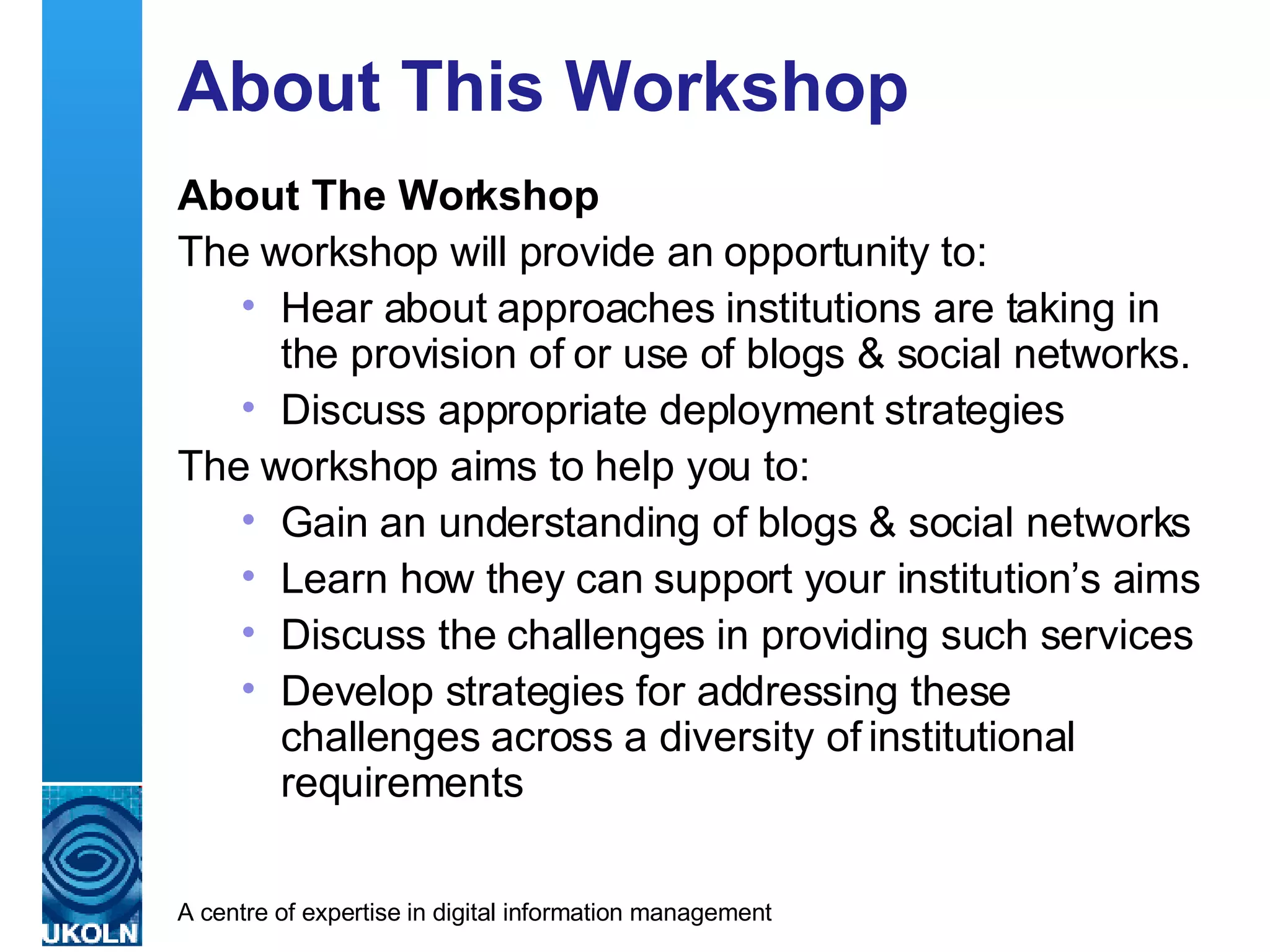
About This Workshop About The Workshop The workshop will provide an opportunity to: Hear about approaches institutions are taking in the provision of or use of blogs & social networks. Discuss appropriate deployment strategies  The workshop aims to help you to: Gain an understanding of blogs & social networks  Learn how they can support your institution’s aims  Discuss the challenges in providing such services Develop strategies for addressing these challenges across a diversity of institutional requirements
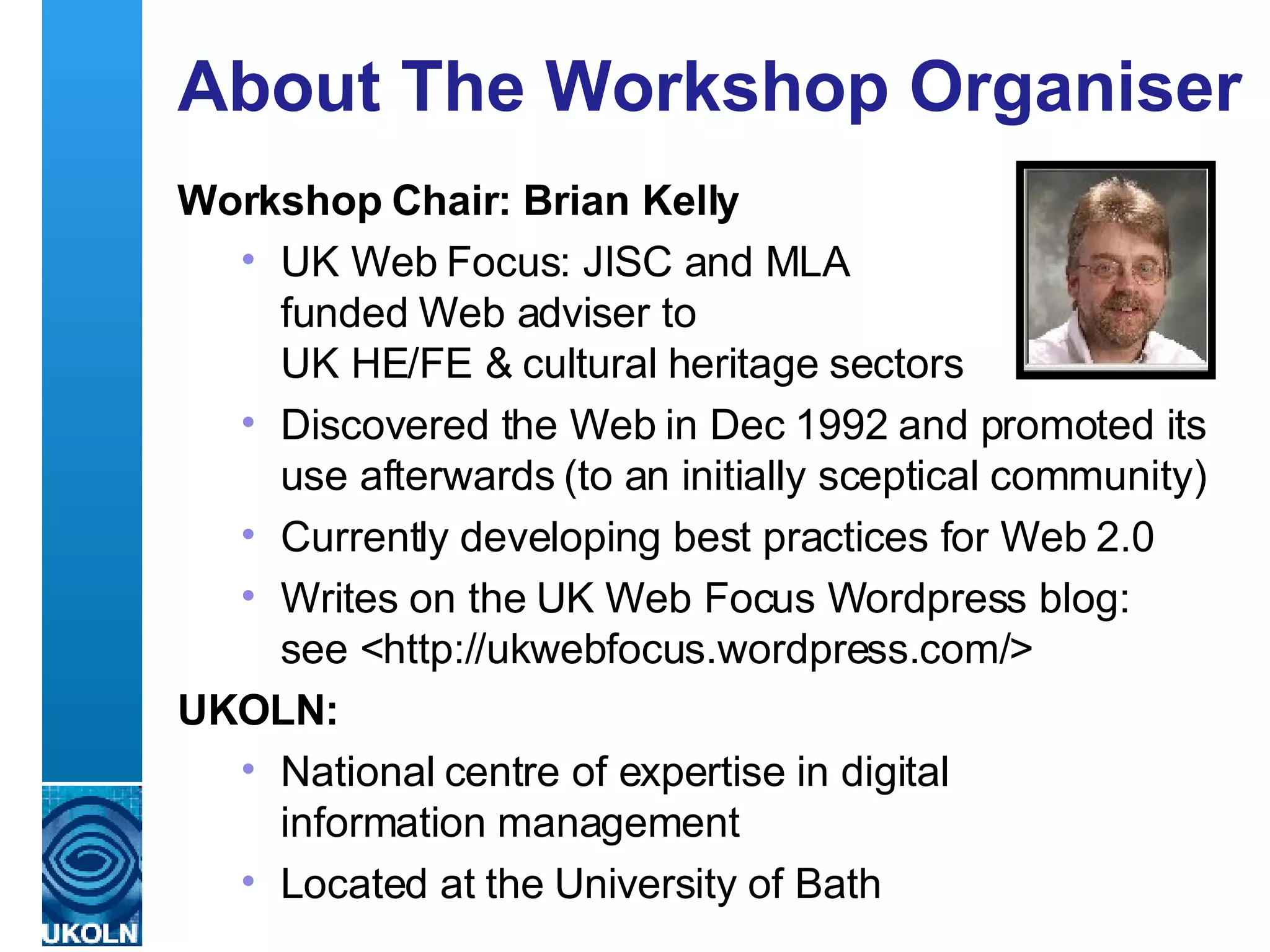
About The Workshop Organiser Workshop Chair: Brian Kelly UK Web Focus: JISC and MLA  funded Web adviser to  UK HE/FE & cultural heritage sectors Discovered the Web in Dec 1992 and promoted its use afterwards (to an initially sceptical community) Currently developing best practices for Web 2.0 Writes on the UK Web Focus Wordpress blog:  see <http://ukwebfocus.wordpress.com/> UKOLN: National centre of expertise in digital  information management Located at the University of Bath
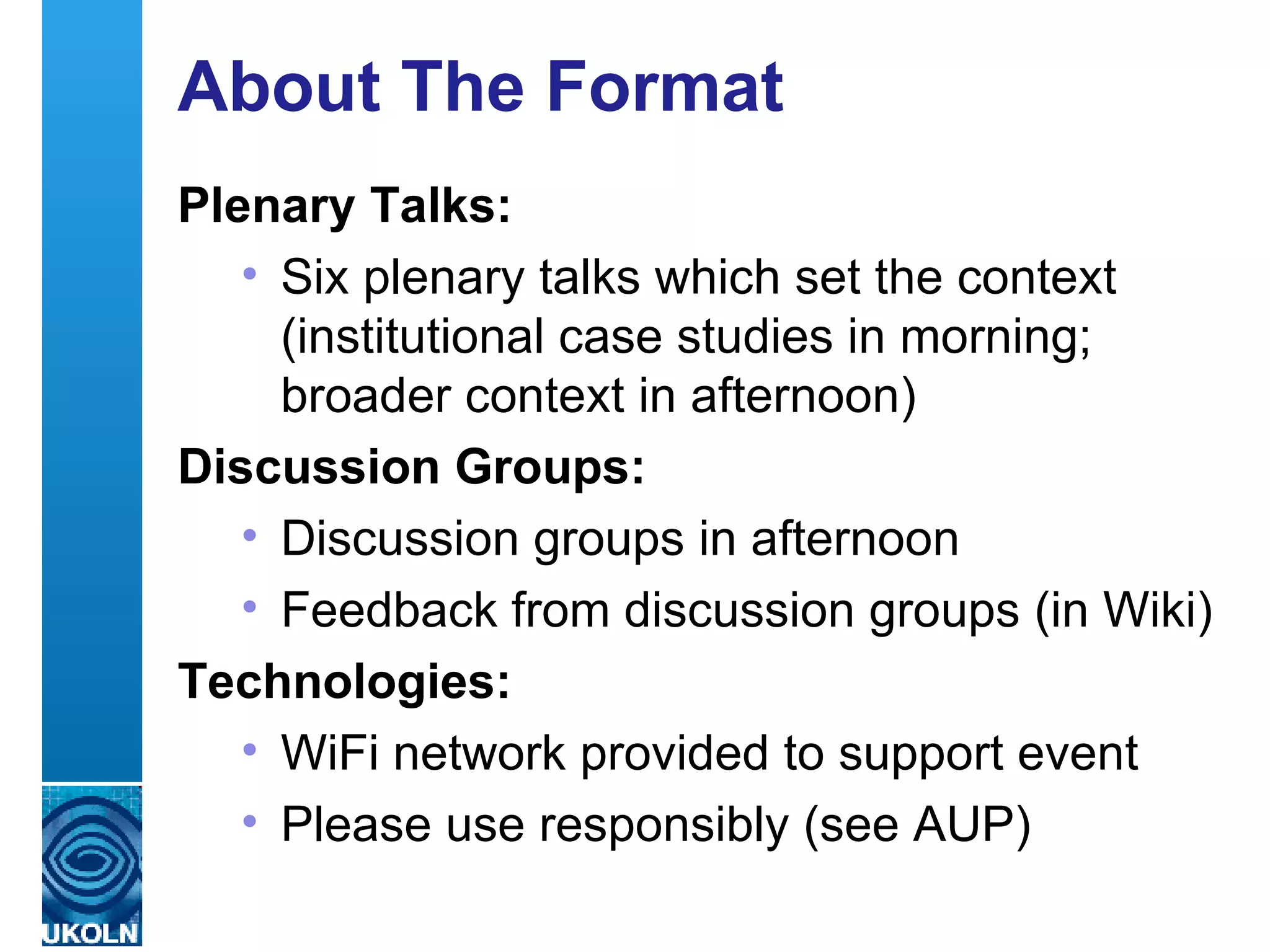
About The Format Plenary Talks: Six plenary talks which set the context (institutional case studies in morning; broader context in afternoon) Discussion Groups: Discussion groups in afternoon Feedback from discussion groups (in Wiki) Technologies: WiFi network provided to support event Please use responsibly (see AUP)
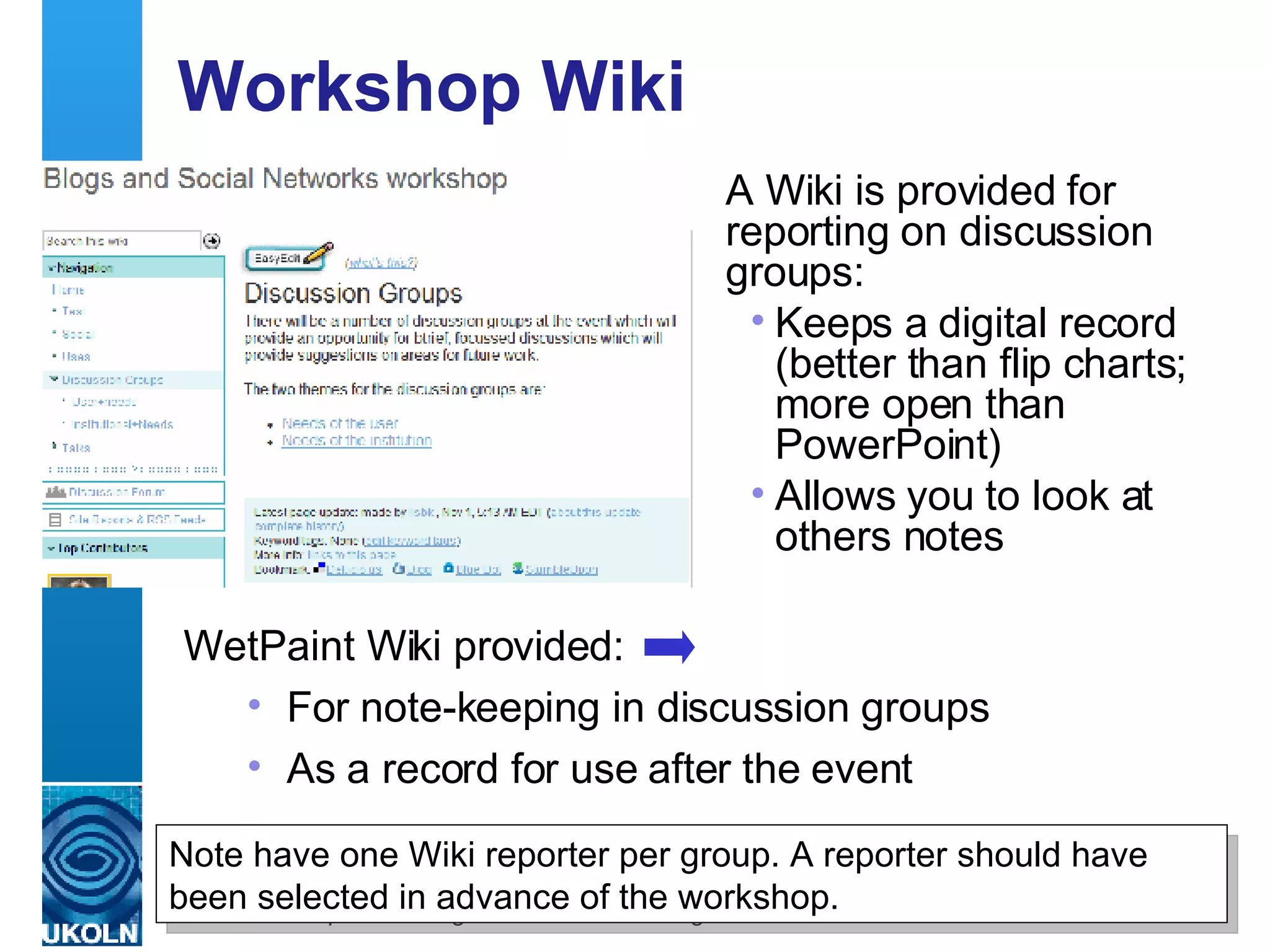
Workshop Wiki  A Wiki is provided for reporting on discussion groups: Keeps a digital record  (better than flip charts; more open than PowerPoint) Allows you to look at others notes Note have one Wiki reporter per group. A reporter should have been selected in advance of the workshop. WetPaint Wiki provided: For note-keeping in discussion groups  As a record for use after the event
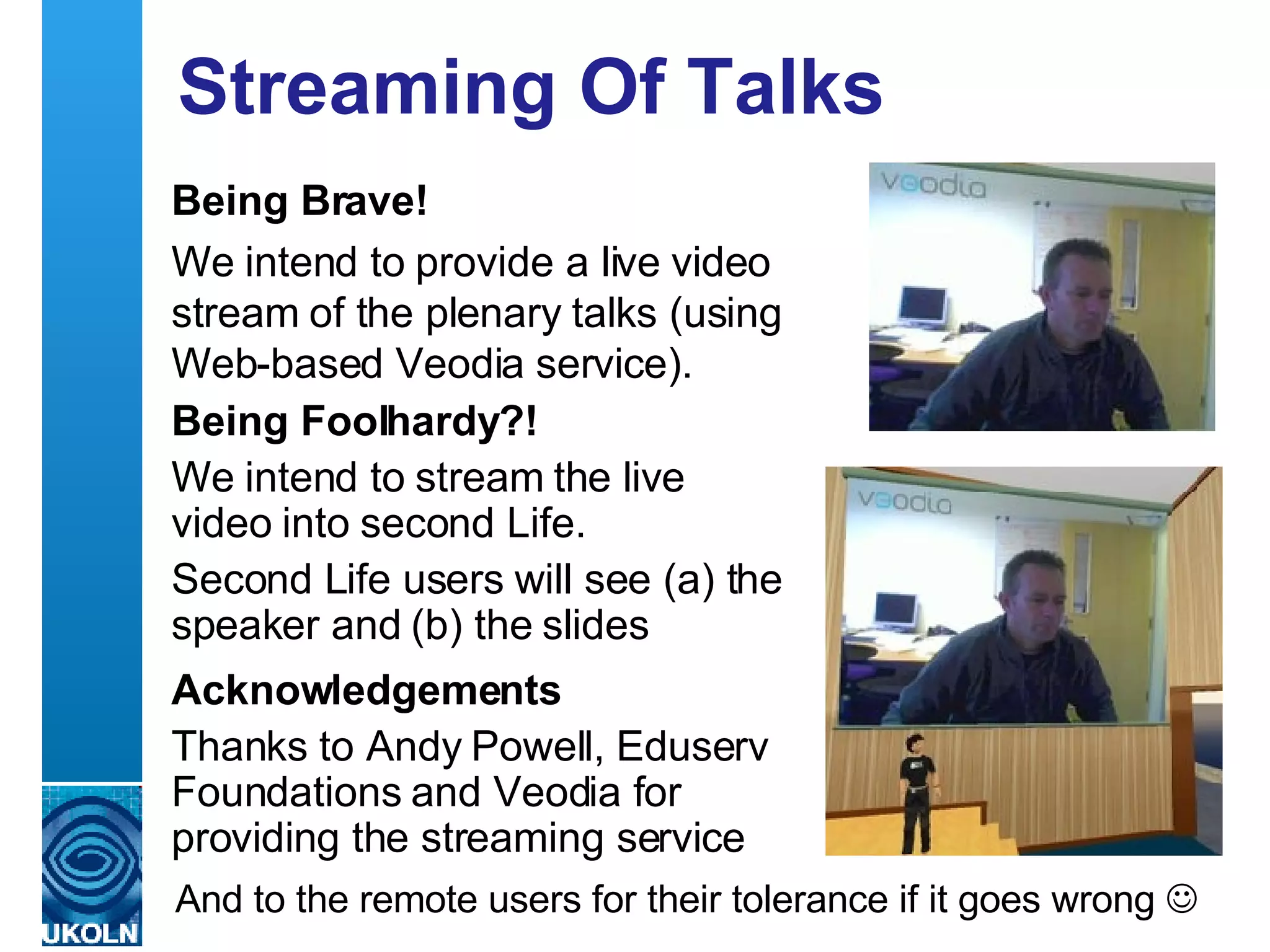
Streaming Of Talks Being Brave! We intend to provide a live video stream of the plenary talks (using Web-based Veodia service). Being Foolhardy?! We intend to stream the live video into second Life. Second Life users will see (a) the speaker and (b) the slides Acknowledgements Thanks to Andy Powell, Eduserv Foundations and Veodia for providing the streaming service And to the remote users for their tolerance if it goes wrong  
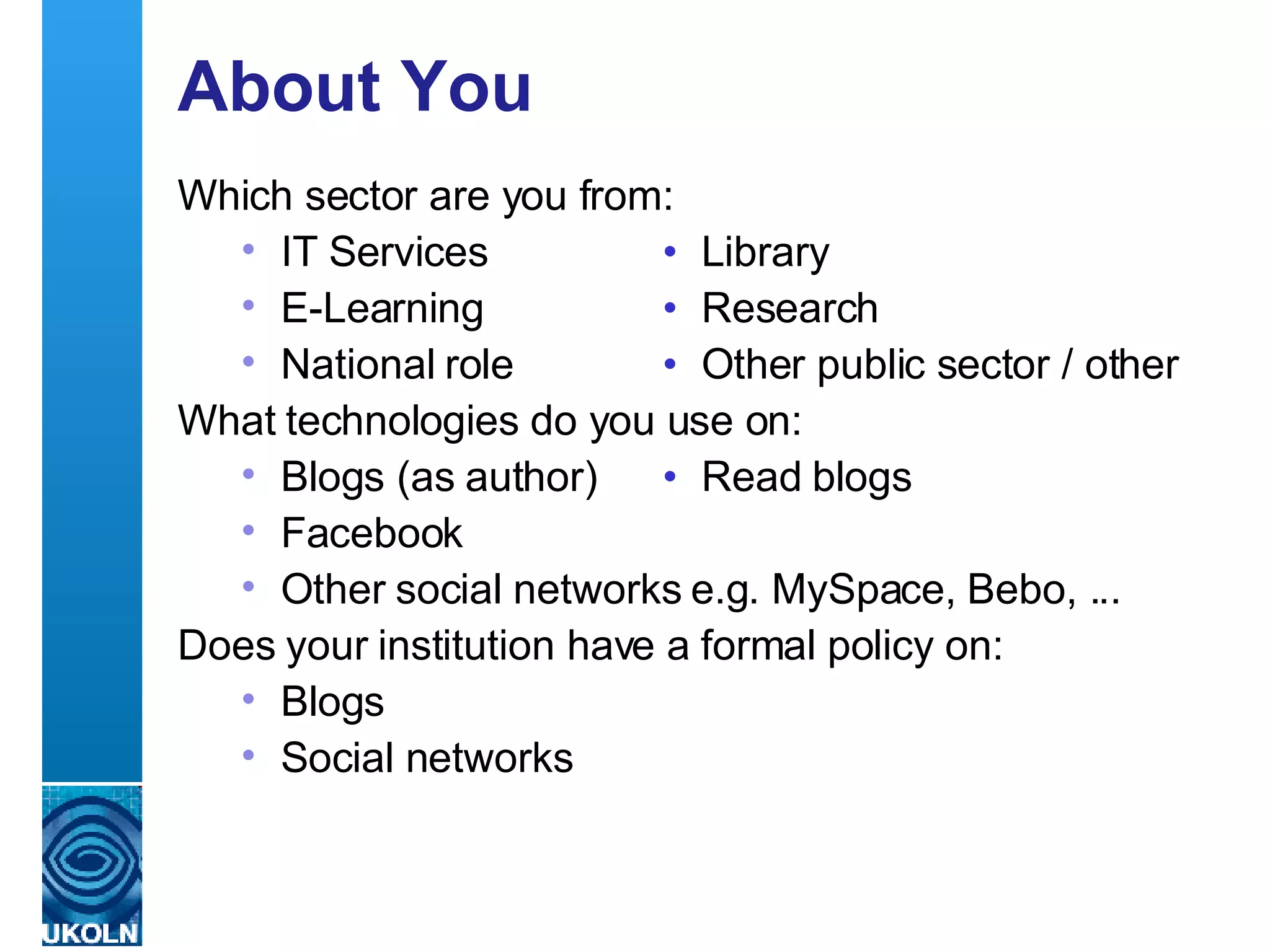
About You Which sector are you from: IT Services • Library E-Learning •   Research National role •   Other public sector / other What technologies do you use on: Blogs (as author) • Read blogs Facebook Other social networks e.g. MySpace, Bebo, ... Does your institution have a formal policy on: Blogs  S ocial networks
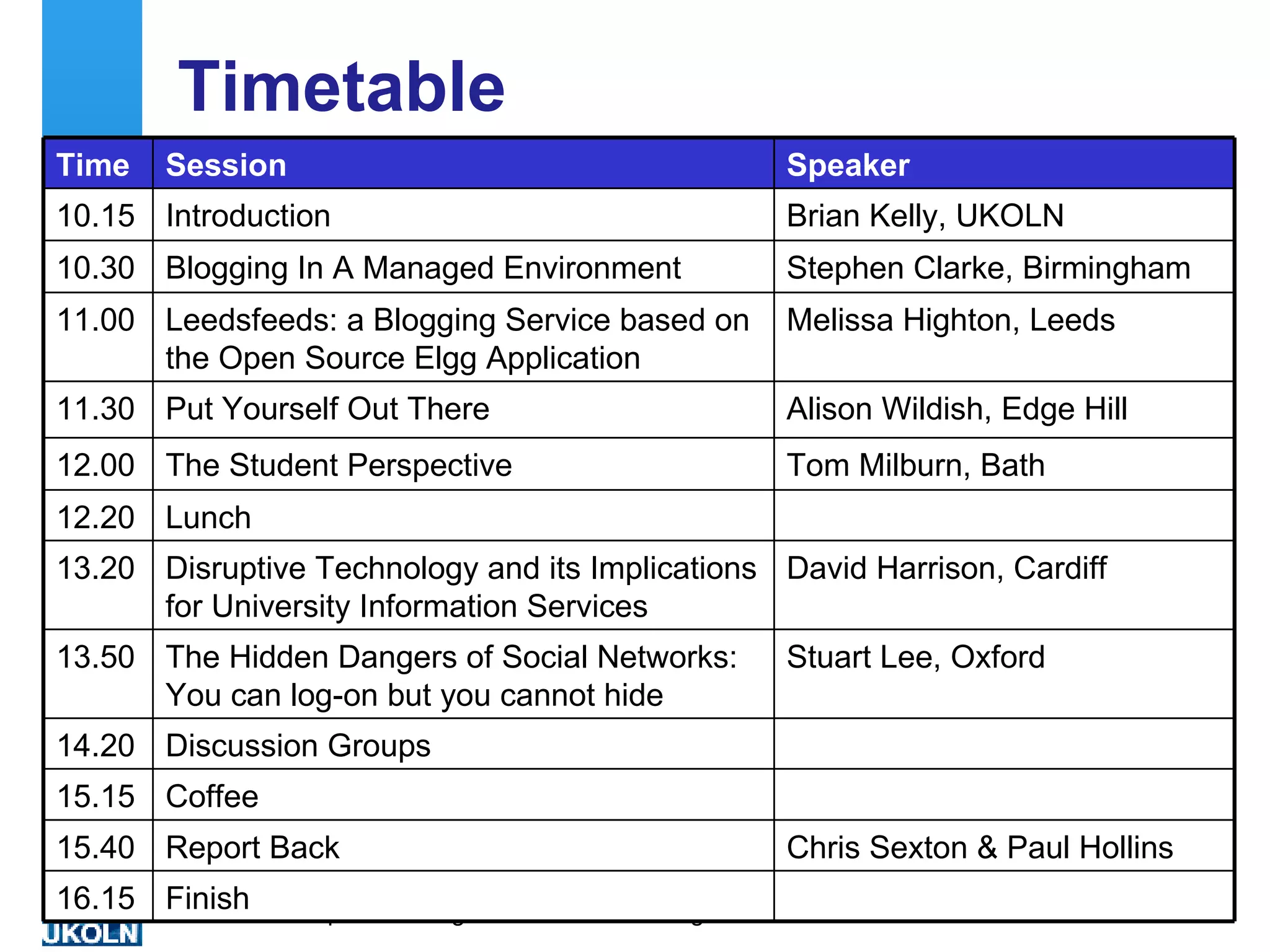
Timetable Chris Sexton & Paul Hollins Report Back 15.40 Coffee 15.15 David Harrison, Cardiff Disruptive Technology and its Implications for University Information Services 13.20 Lunch 12.20 Stuart Lee, Oxford The Hidden Dangers of Social Networks: You can log-on but you cannot hide 13.50 Discussion Groups 14.20 Tom Milburn, Bath The Student Perspective 12.00 Finish  16.15 Alison Wildish, Edge Hill Put Yourself Out There 11.30 Melissa Highton, Leeds Leedsfeeds: a Blogging Service based on the Open Source Elgg Application 11.00 Stephen Clarke, Birmingham  Blogging In A Managed Environment  10.30 Brian Kelly, UKOLN Introduction 10.15 Speaker Session Time
What as a Blog / Social Network? “ A  blog  (a portmanteau of  web log ) is a Web site where entries are written in chronological order and commonly displayed in reverse chronological order.  ”   “ A  social network service  focuses on the building and verifying of online social networks for communities of people who share interests and activities, or who are interested in exploring the interests and activities of others, and which necessitates the use of software.” Wikipedia Wikipedia
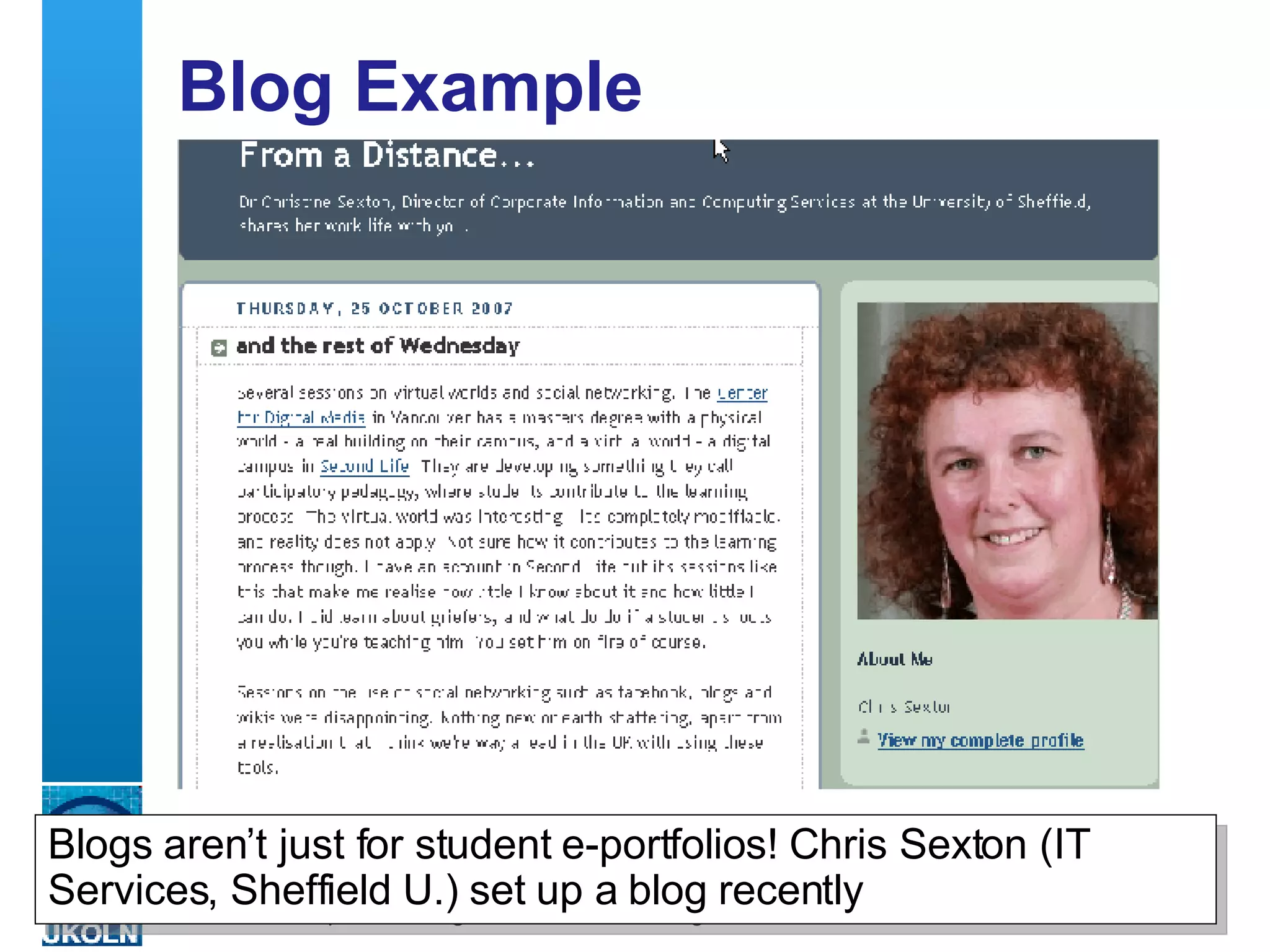
Blog Example  Blogs aren’t just for student e-portfolios! Chris Sexton (IT Services, Sheffield U.) set up a blog recently
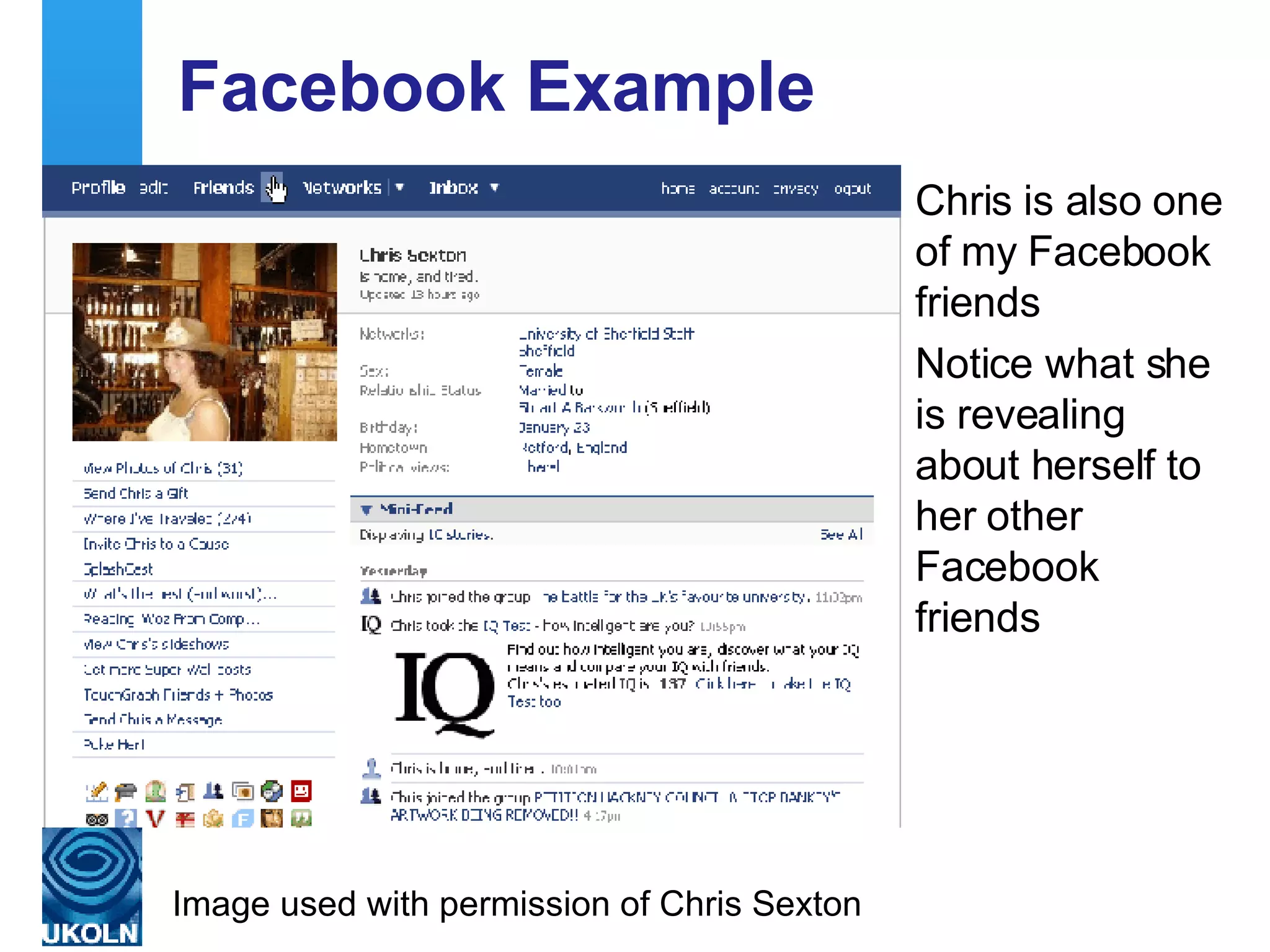
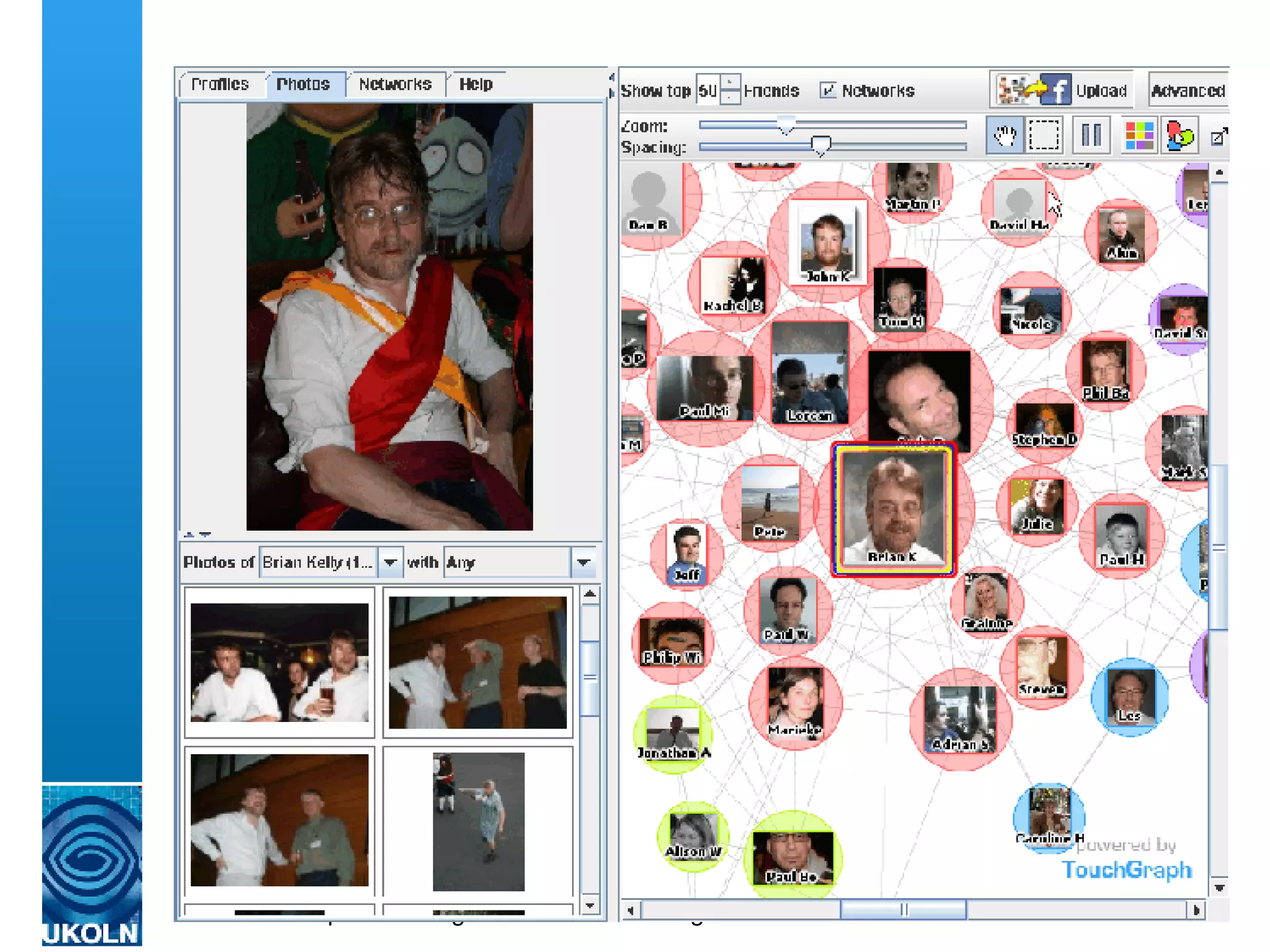
Facebook Example Chris is also one of my Facebook friends Notice what she is revealing about herself to her other Facebook friends Image used with permission of Chris Sexton
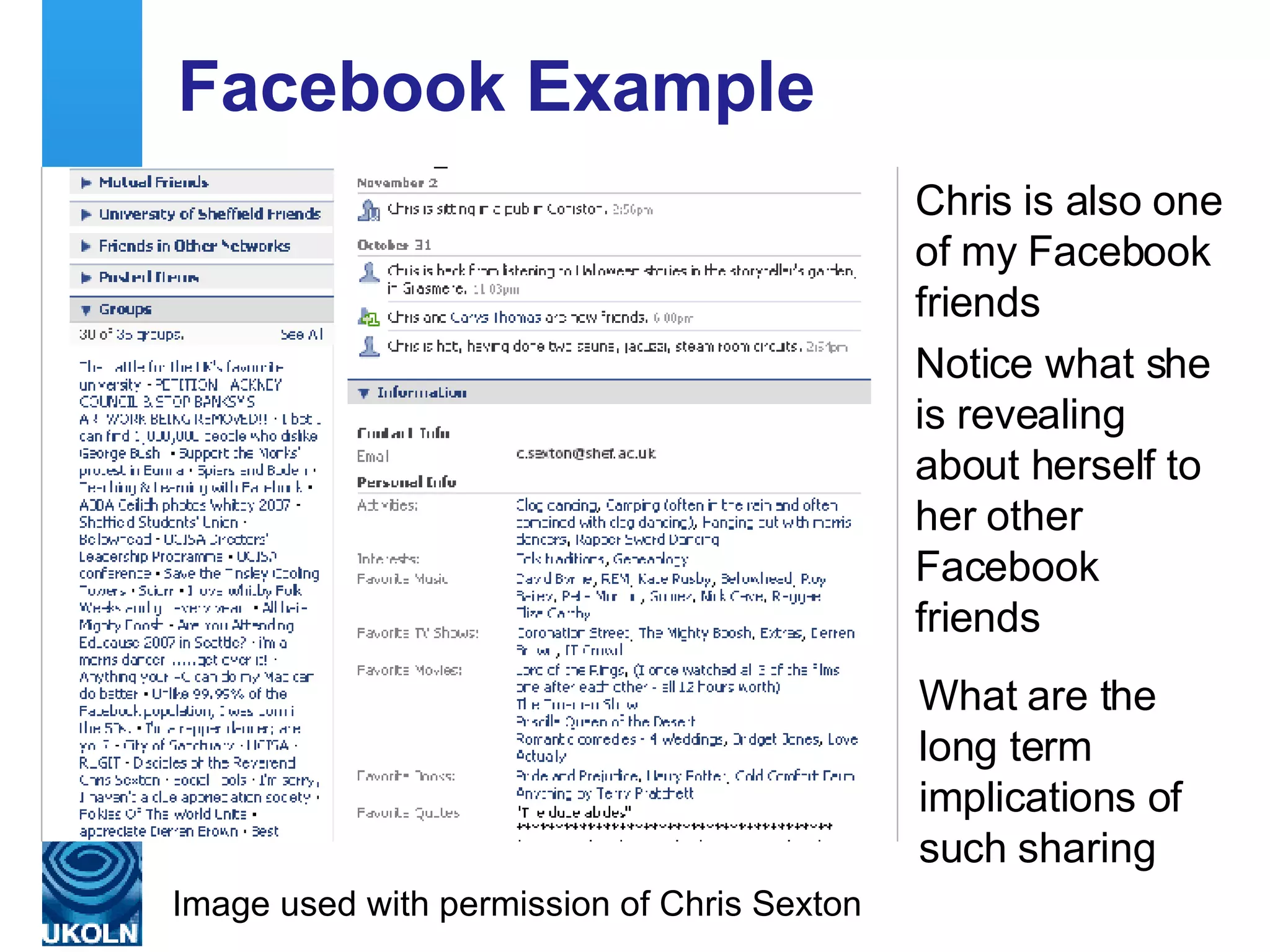
Facebook Example Chris is also one of my Facebook friends Notice what she is revealing about herself to her other Facebook friends What are the long term implications of such sharing Image used with permission of Chris Sexton
 
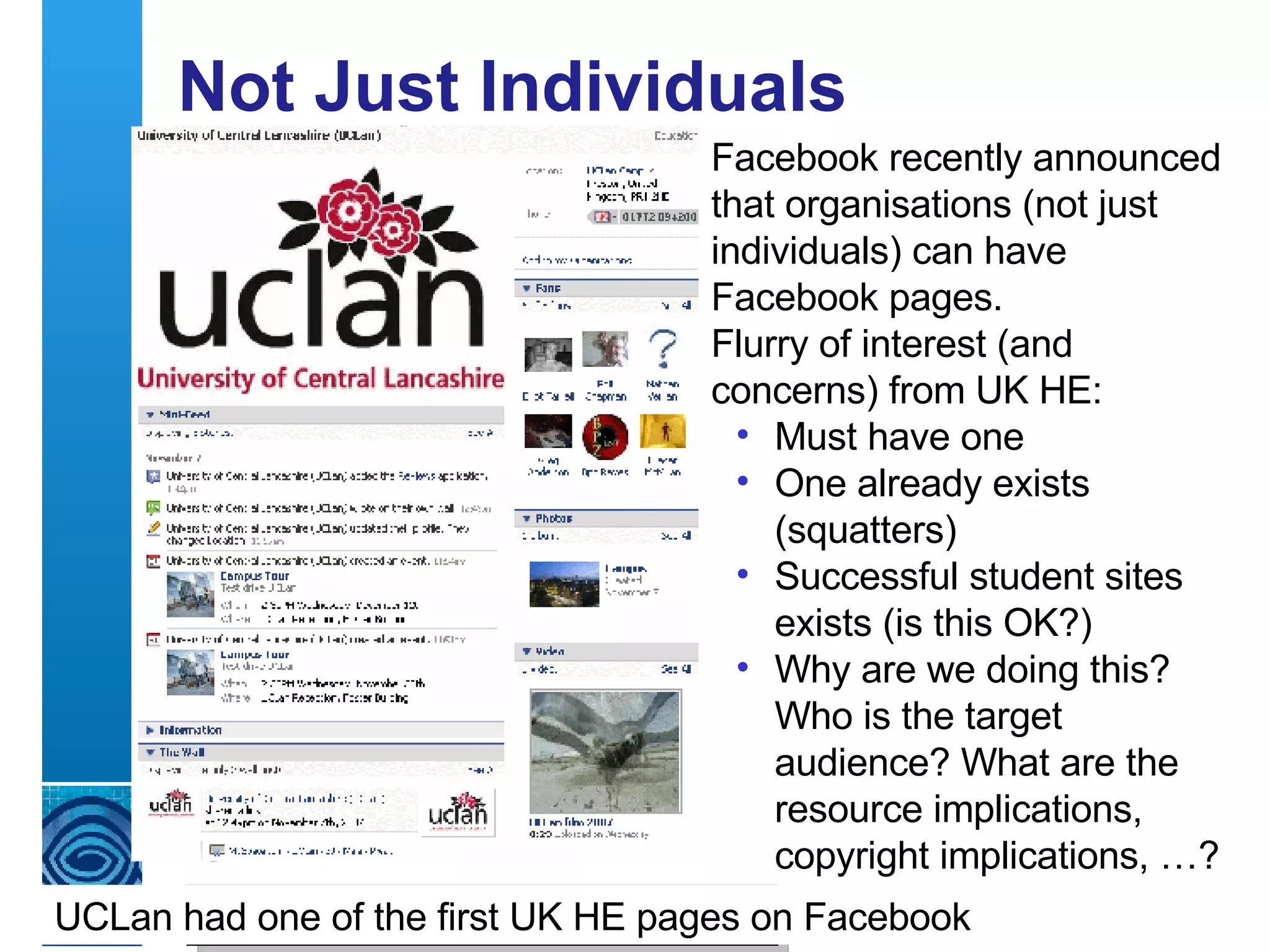
Not Just Individuals Warwick University’s MySpace page Aberdeen University’s Bebo page Facebook recently announced that organisations (not just individuals) can have Facebook pages. Flurry of interest (and concerns) from UK HE: Must have one One already exists (squatters) Successful student sites exists (is this OK?) Why are we doing this?  Who is the target audience? What are the resource implications, copyright implications, …? UCLan had one of the first UK HE pages on Facebook
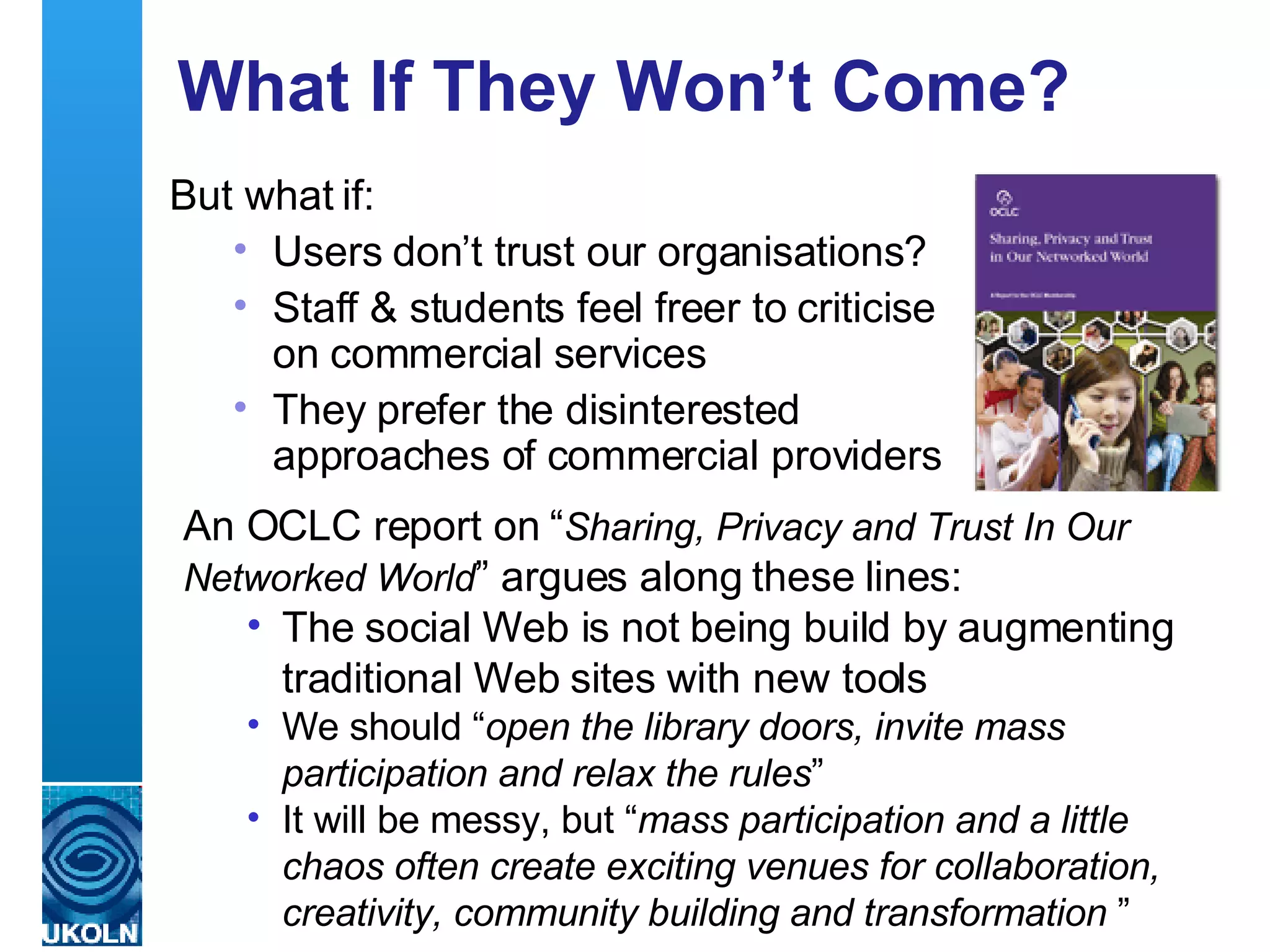
What If They Won’t Come? But what if: Users don’t trust our organisations?  Staff & students feel freer to criticise on commercial services They prefer the disinterested approaches of commercial providers An OCLC report on “ Sharing, Privacy and Trust In Our Networked World ” argues along these lines: The social Web is not being build by augmenting traditional Web sites with new tools  We should “ open the library doors, invite mass participation and relax the rules ”  It will be messy, but “ mass participation and a little chaos often create exciting venues for collaboration, creativity, community building and transformation   ”
What’s Our Interests? Why should institutions have an interest in blogs and social networks? Enhance learning They can enrich learning: e-learning portfolios, collaborative learning, informal learning, … Enhance research They can enrich research: engagement with peers, feedback, social support, … Community benefits Engagement & dissemination e.g. by support departments (IT services, library, …) Role of institutions in developing digital citizens
What Are The Challenges? Many challenges (real and imaginary): The purpose(s) of the service The resource implications The deployment strategies (in-house vs external)  The evaluation and selection  The training and support The legal issues: privacy, copyright, accessibility, … The institutional concerns: reputation management, sustainability, preservation, … … “ I don't see the point in ISS running blogging servers unless we want to automatically create and populate groups based on modules. Why not just encourage people to sign up for an account with Wordpress? It's better than anything we could offer. ” Nigel Bruce, ISS, Leeds Uni.
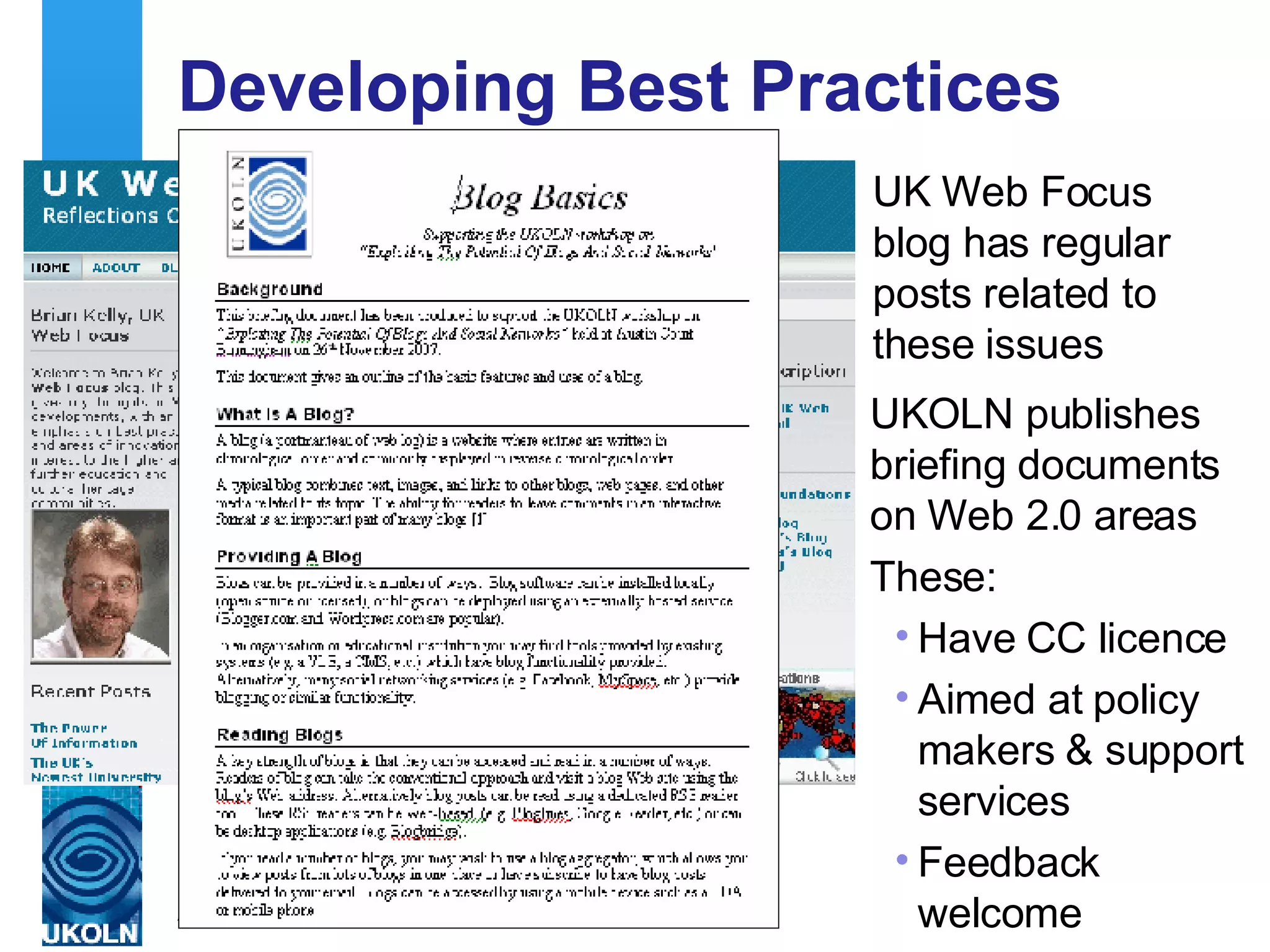
Developing Best Practices UK Web Focus blog has regular posts related to these issues UKOLN publishes briefing documents on Web 2.0 areas These: Have CC licence Aimed at policy makers & support services Feedback welcome
Community Development  The workshop provides a forum: To be informed by case studies illustrated diversity of approaches being taken To hear about the broader challenges to be addressed  which aims to lead to Agreement on the key issues which need to be addressed Identification of the key players who can support a community-wide approach to resolution of the issues (JISC, UCISA, UKOLN, JISC CETIS,  JISC infoNet…?) As well as providing an informative and enjoyable event for the participants
Questions? Any questions
Exploiting the potential of blogs and social networks Austin Court, Birmingham 26 November 2007
University of Birmingham Blogging in a Managed Environment Stephen Clarke, Head of eLearning University of Birmingham 0
What is a blog? Blog A  blog  (a portmanteau of  web log ) is a website where entries are written in chronological order and commonly displayed in reverse chronological order. &quot;Blog&quot; can also be used as a verb, meaning  to maintain or add content to a blog. Many blogs provide commentary or news on a particular subject; others function as more personal online diaries. A typical blog combines text, images, and links to other blogs, web pages, and other media related to its topic. The ability for readers to leave comments in an interactive format is an important part of many blogs. Most blogs are primarily textual, although some focus on art (artlog), photographs (photoblog), sketchblog, videos (vlog), music (MP3 blog), audio (podcasting) and are part of a wider network of social media. Micro-blogging is another type of blogging which consists of blogs with very short posts. As of September 2007, blog search engine Technorati was tracking more than 106 million blogs. [1] http:// en.wikipedia.org/wiki/Blog
Educational Blogging Weblogs in the Classroom Blogs provide a communication space that teachers can utilise with students whenever there is a curriculum need to develop writing, share ideas and reflect on work being undertaken in the classroom.  Definition Blog/WebLog: a web page containing brief, chronologically arranged items of information. A blog can take the form of a diary, journal, what's new page, or links to other web sites. Peter Scott, Internet Librarian 2001   From an education perspective the availability and ease of use of blogging software makes creating Weblogs a viable classroom activity and a means for teachers to communicate with other teachers.  http://www.det.wa.edu.au/education/cmis/eval/curriculum/ict/weblogs/
Educational Blogging Is it all ‘win-win?’ Blogs have educational value But there are risks
On the nature of risk… Most human activities involve risk Innovations are particularly risky Risk aversion slows innovation BUT Poor risk management reverses innovation Risk management is about recognising risks and guarding against them
Good Blog Bad Blog A few examples of blogs These blogs contain both positive and negative features Opinions may vary
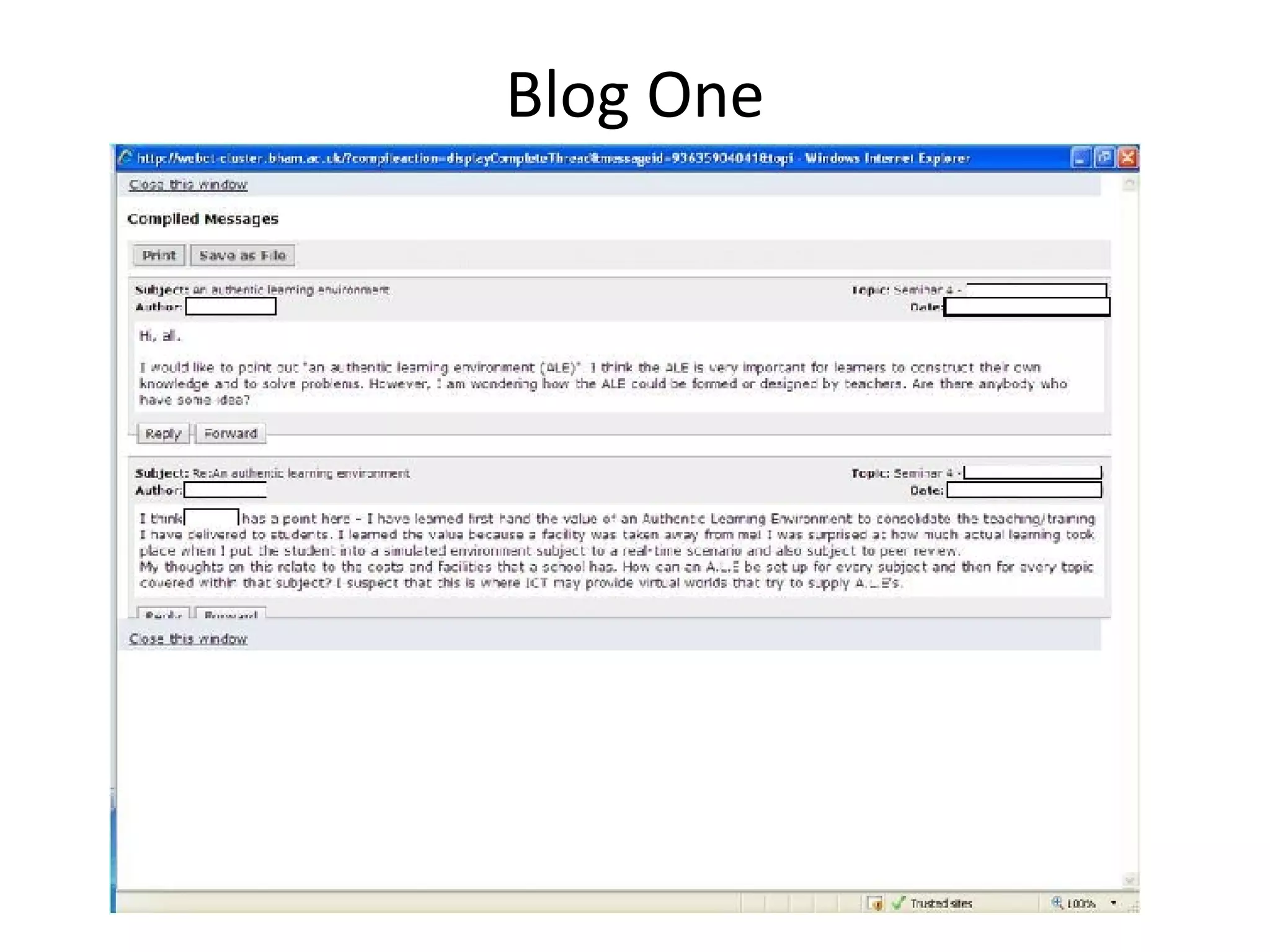
Blog One
Blog One Focused on learning Core part of the course May be assessed Archived, supported etc Maintained throughout course Safe and Secure
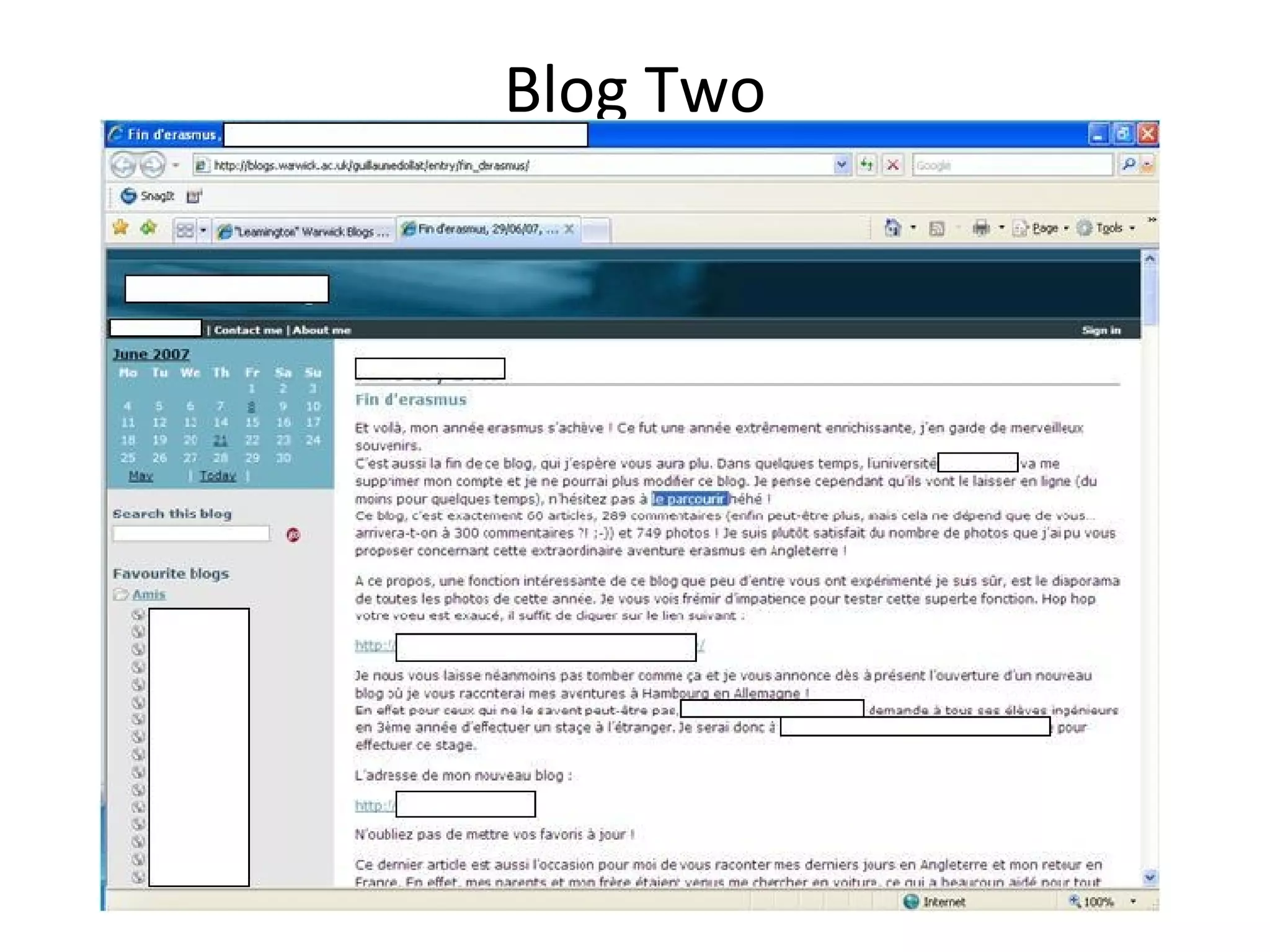
Blog Two
Blog Two Good quality Builds cohesion Enhances student life Can be transient Independent of learning activities
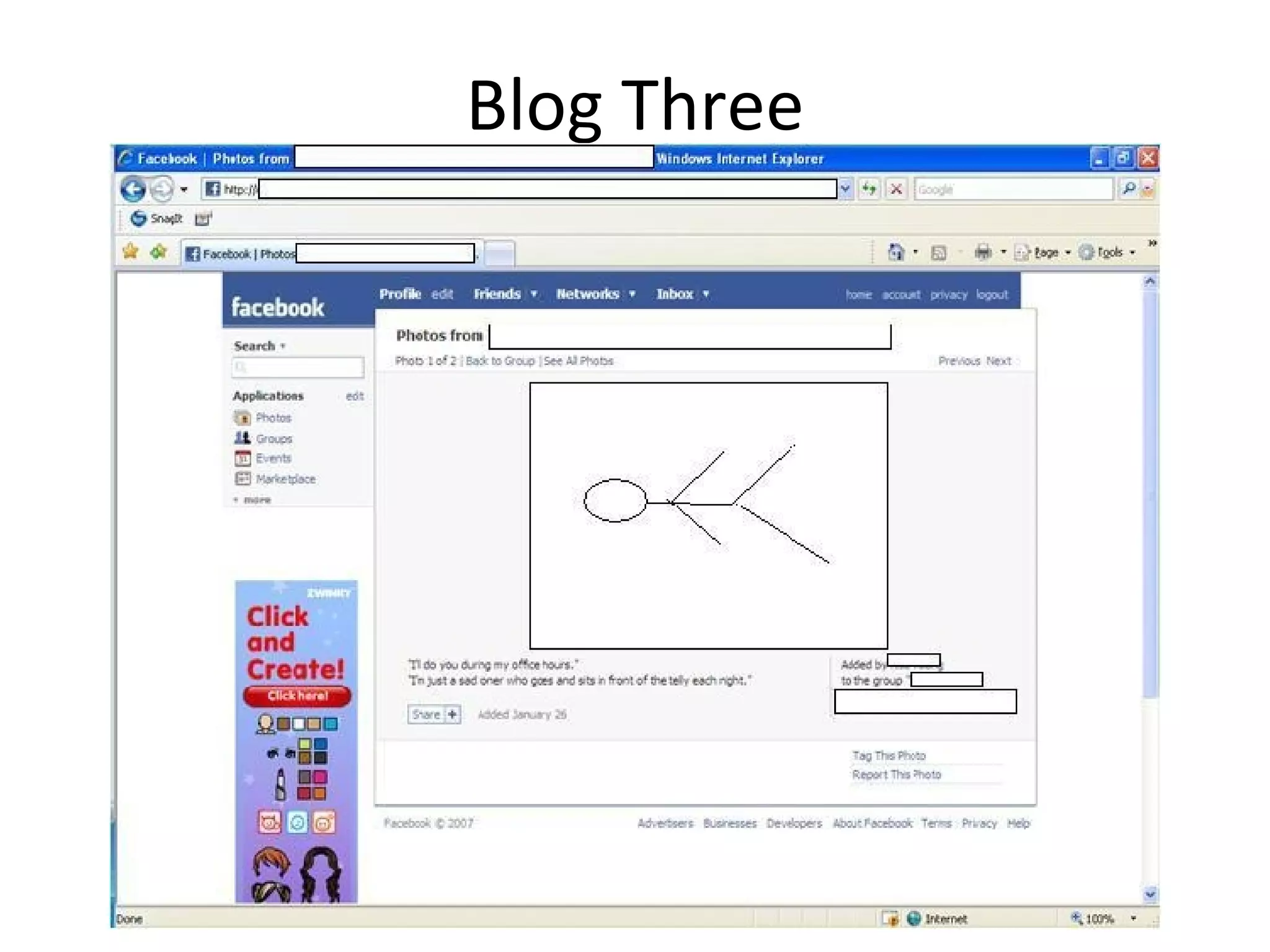
Blog Three
Blog Three Disrespectful Rude Spreads a poor image University can not intervene Created by students
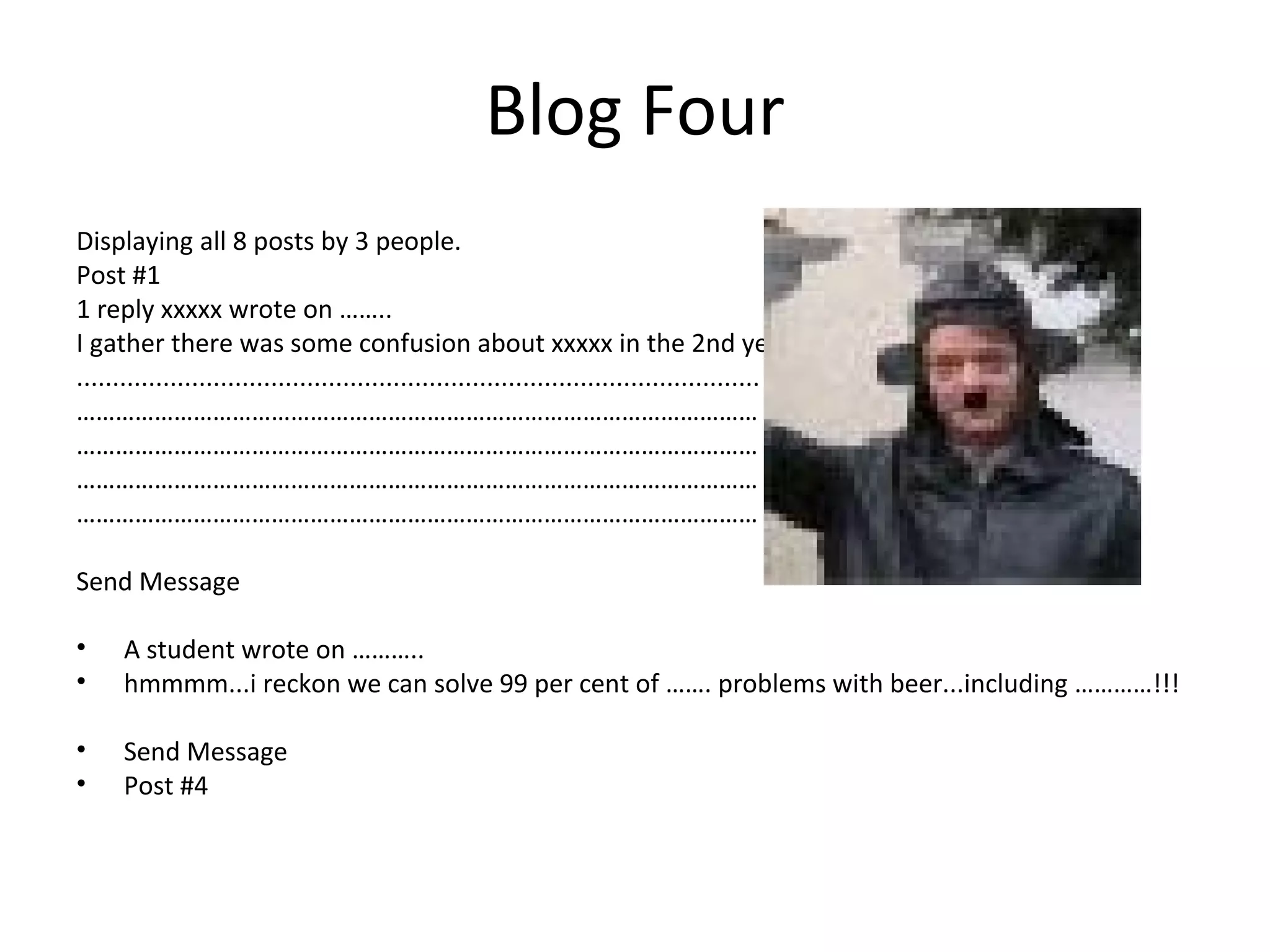
Blog Four Displaying all 8 posts by 3 people. Post #1 1 reply xxxxx wrote on …….. I gather there was some confusion about xxxxx in the 2nd year lecture last week.  ............................................................................................... …………………………………………………………………………………………… …………………………………………………………………………………………… …………………………………………………………………………………………… …………………………………………………………………………………………… Send Message  A student wrote on ……….. hmmmm...i reckon we can solve 99 per cent of ……. problems with beer...including …………!!!  Send Message  Post #4
Blog Four Could cause offence Contains material that could be regarded as ‘core’ content Learners could lose access Created by staff
Further Risks Universal loss of service http://news.bbc.co.uk/1/hi/business/6914843.stm Individual loss of service Facebook is now banning names such as Lord (20) Gay (11) Beta (0) http://news.bbc.co.uk/1/hi/technology/7067150.stm
Moving Forward and Managing Risks All activities have some risk Agree an acceptable level of risk Manage the risks
Good Blogs Secure, safe and reliable Inappropriate use can be stopped The institution Controls access Sets the ‘acceptable use’ policy Support institutional goals
Bad Blogs Are a fact of life Institutions need to maintain distance Should not be imposed on learners
Conclusions Blogging in a Managed Environment: Supports Good Blogs Protects Users Protects Content Carries Responsibility
Exploiting the potential of blogs and social networks Austin Court, Birmingham 26 November 2007
Leedsfeeds: a blogging service based on the open source Elgg application Melissa Highton Senior Staff Development Officer University of Leeds
The provision and use of blogs and social networks How they support institutional aims  Challenges in providing such services Strategies and success
“ A  social network service  focuses on the building and verifying of online social networks for communities of people who share interests and activities, or who are interested in exploring the interests and activities of others, and which necessitates the use of software.” (quote copied and reused from Brian’s slides)
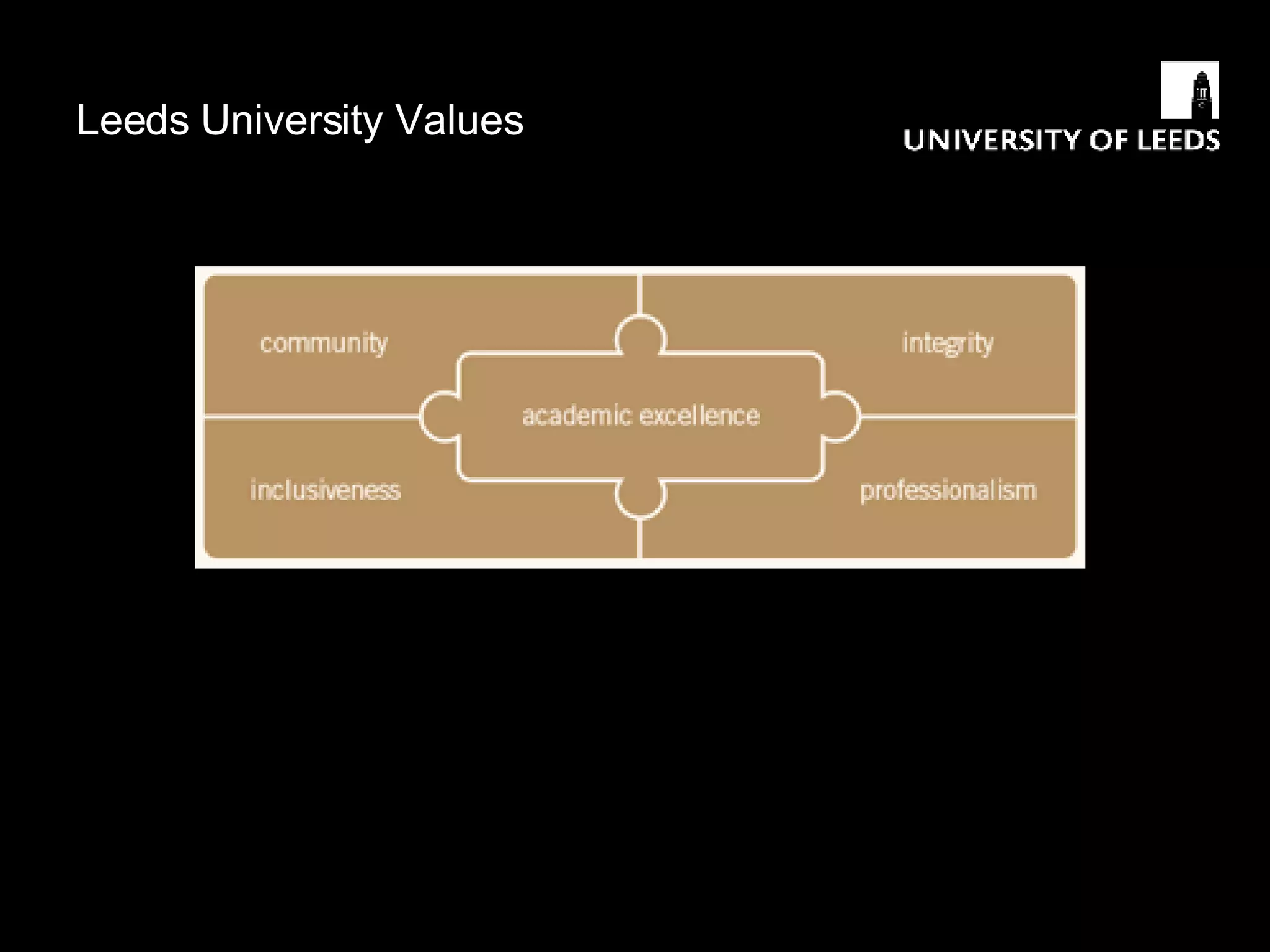
Leeds University Values
 
Networking  “ networking with people there is far more productive than anything that comes out of meetings…  “ “ Having people you can ring up about issues that you are both having to deal with is very helpful.”   “ Now I will have to put systems in place to do something about that.  It is an important part of the job knowing who is where, who is doing what and what they are thinking.  “ Leeds and Loughborough Universities for JISC (2006)  -An investigation of the staff development issues relating to i-skills development  of Higher Education non-academic staff


What are our interests? Why should institutions have an interest in blogs and social networks? Enhance learning They can enrich learning: e-learning portfolios, collaborative learning, informal learning, … Enhance research They can enrich research: engagement with peers, feedback, social support, … Community benefits Engagement & dissemination e.g. by support departments (IT services, library, …) Role of institutions in developing digital citizens (list copied and reused from Brian’s slides)
Is this true? But what if: Users don’t trust our organisations?  Staff & students feel more free to criticise on commercial services They prefer the disinterested approaches of commercial providers
What are your questions about LeedsCommunityBlogs? The purpose(s) of the service The resource implications The deployment strategies: Inhouse vs external (& associated concerns)  The evaluation and selection  The deployment The training and support The legal issues: privacy, copyright, IPR,  defamation, accessibility, … The institutional concerns: reputation management, sustainability, preservation, … (list copied and reused from Brian’s slides)
Credits Images in this presentation belong to the University of Leeds and members of the ‘Fans of the Roger Stevens Building - the 8th wonder of the architectural world’ Facebook Community.
Exploiting the potential of blogs and social networks Austin Court, Birmingham 26 November 2007
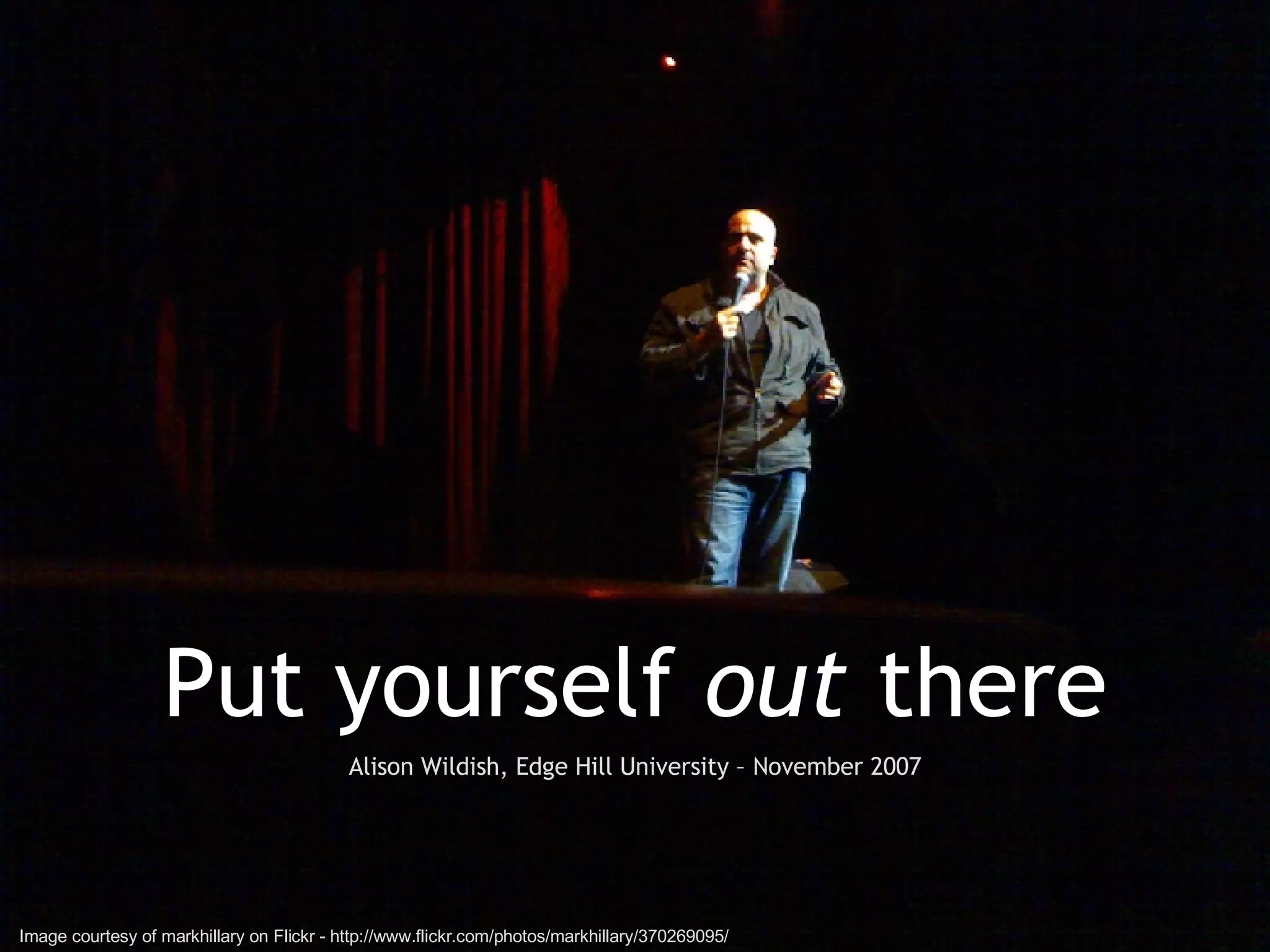
Put yourself  out  there Alison Wildish, Edge Hill University – November 2007 Image courtesy of markhillary on Flickr - http://www.flickr.com/photos/markhillary/370269095/
Edge Hill University : in context Awareness raising Garden Fence Test Word of Mouth Image courtesy of ~k~ on Flickr - http://www.flickr.com/photos/clovermountain/114775265/
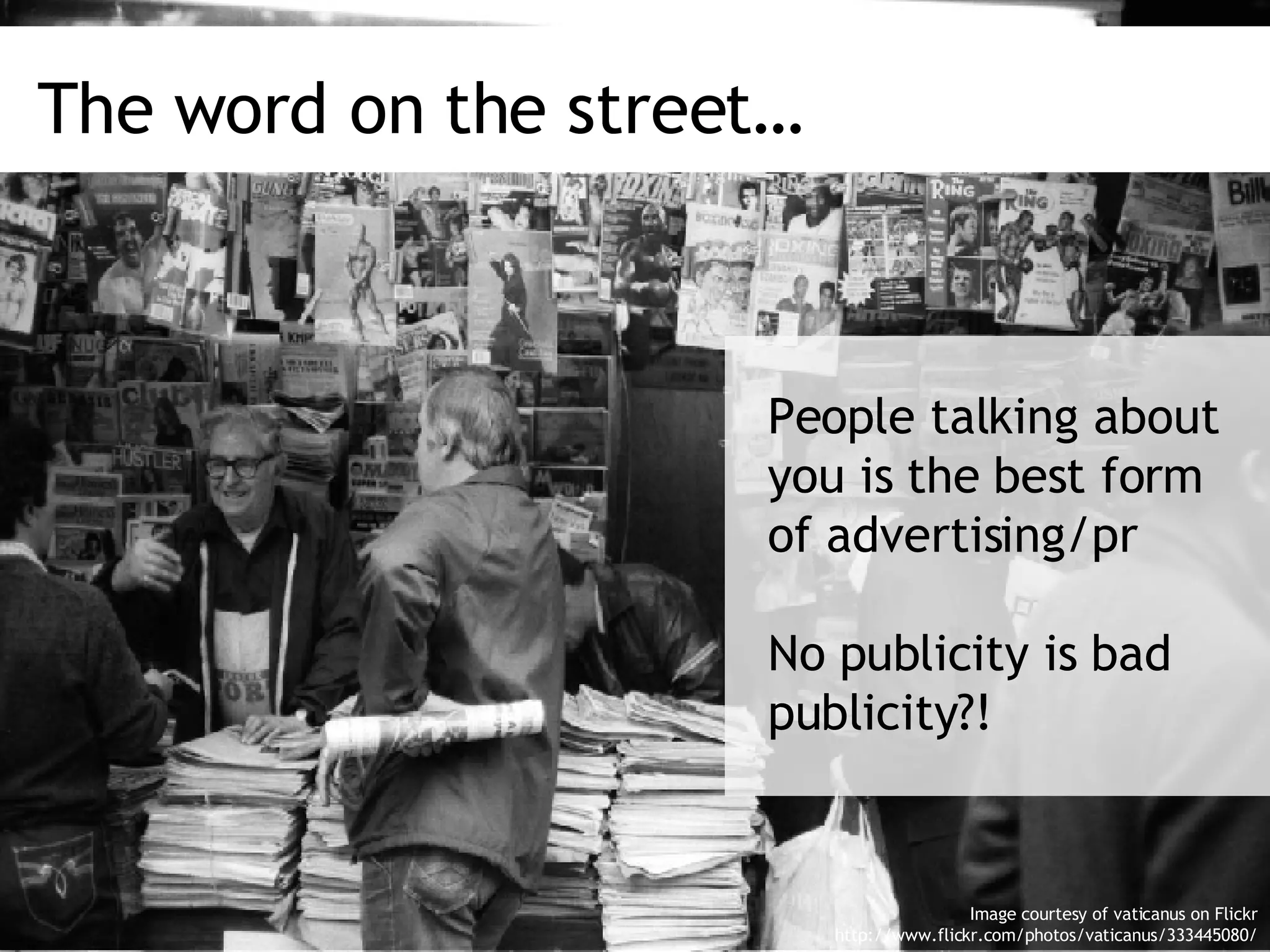
The word on the street… People talking about you is the best form of advertising/pr No publicity is bad publicity?!  Image courtesy of vaticanus on Flickr http://www.flickr.com/photos/vaticanus/333445080/
Some facts People are going to talk about you… …  down the pub, in the local post office or on a social networking site or blog… they’ll still talk… they still say the same things… The boundaries are blurred; it’s common to mix business/study with pleasure Students don’t come into Uni and leave their personal lives at home… …  but  neither do staff!!! Image courtesy of kuyttendaele on Flickr http://www.flickr.com/photos/kuyttendaele/1195473901/
Regardless of any institutional policy our students  and staff   will use  social networking sites Image courtesy of Wanderer and Wonderer on Flickr http://www.flickr.com/photos/global-wandering/1171829609/
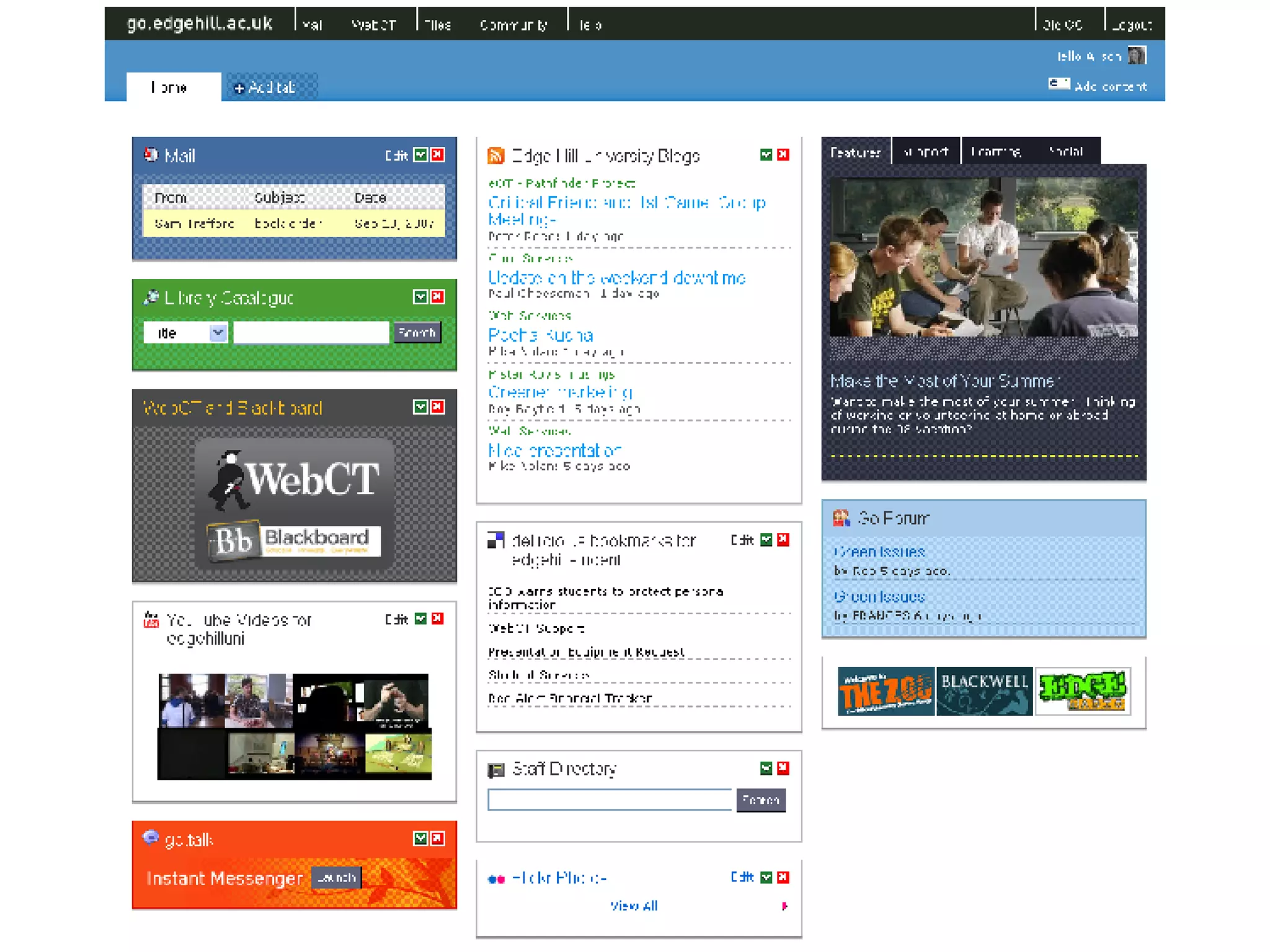
Our approach… Great! We’ll make it even easier for you! We have a range of communication channels but we’ll plug them into Facebook (and the like) and plug your social networking tools into our portal(s) too “  Everyone’s on it ” “  Really useful ” Image courtesy of redking on Flickr http://www.flickr.com/photos/redking/1934240/
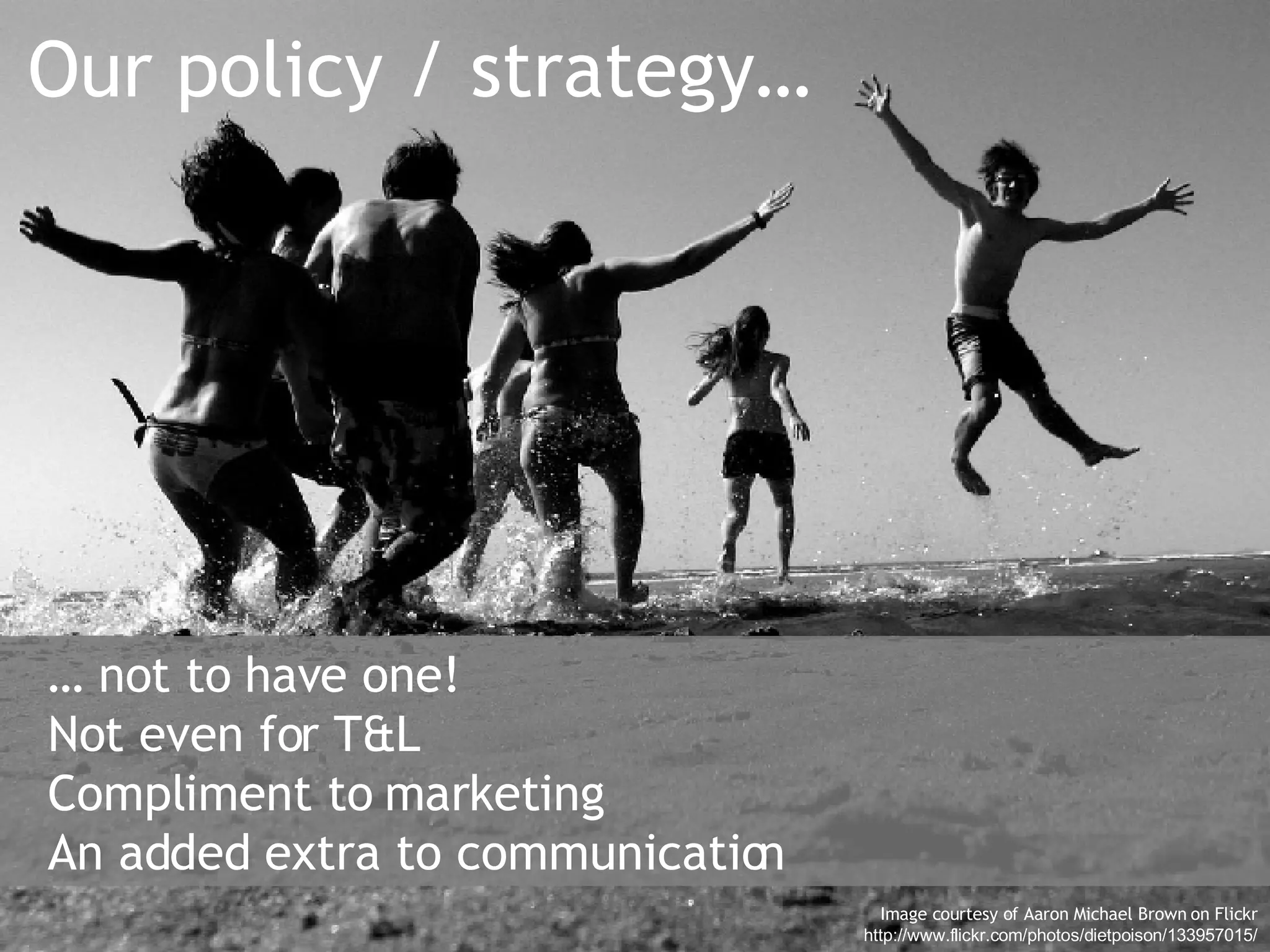
Our policy / strategy… Image courtesy of Aaron Michael Brown on Flickr http://www.flickr.com/photos/dietpoison/133957015/ …  not to have one! Not even for T&L Compliment to marketing An added extra to communication
If they want it they’ve got it - If they don’t then no problem - If putting things in social networking (or using Facebook)  IS  your strategy then you start to have a problem… Image courtesy of terwilliger911 on Flickr http://www.flickr.com/photos/terwilliger911/446710944/
Concerns… Image courtesy of Fiona Macginty on Flickr http://www.flickr.com/photos/fionamacginty/296872194/
The problem Named individual inc. photographs False allegations The solution Proper channels – report group AUP Libel and defamation laws “  Edge Hill students being  molestered by security!  ” Image courtesy of beckaramie on Flickr http://www.flickr.com/photos/beckeramie/393255114/
 
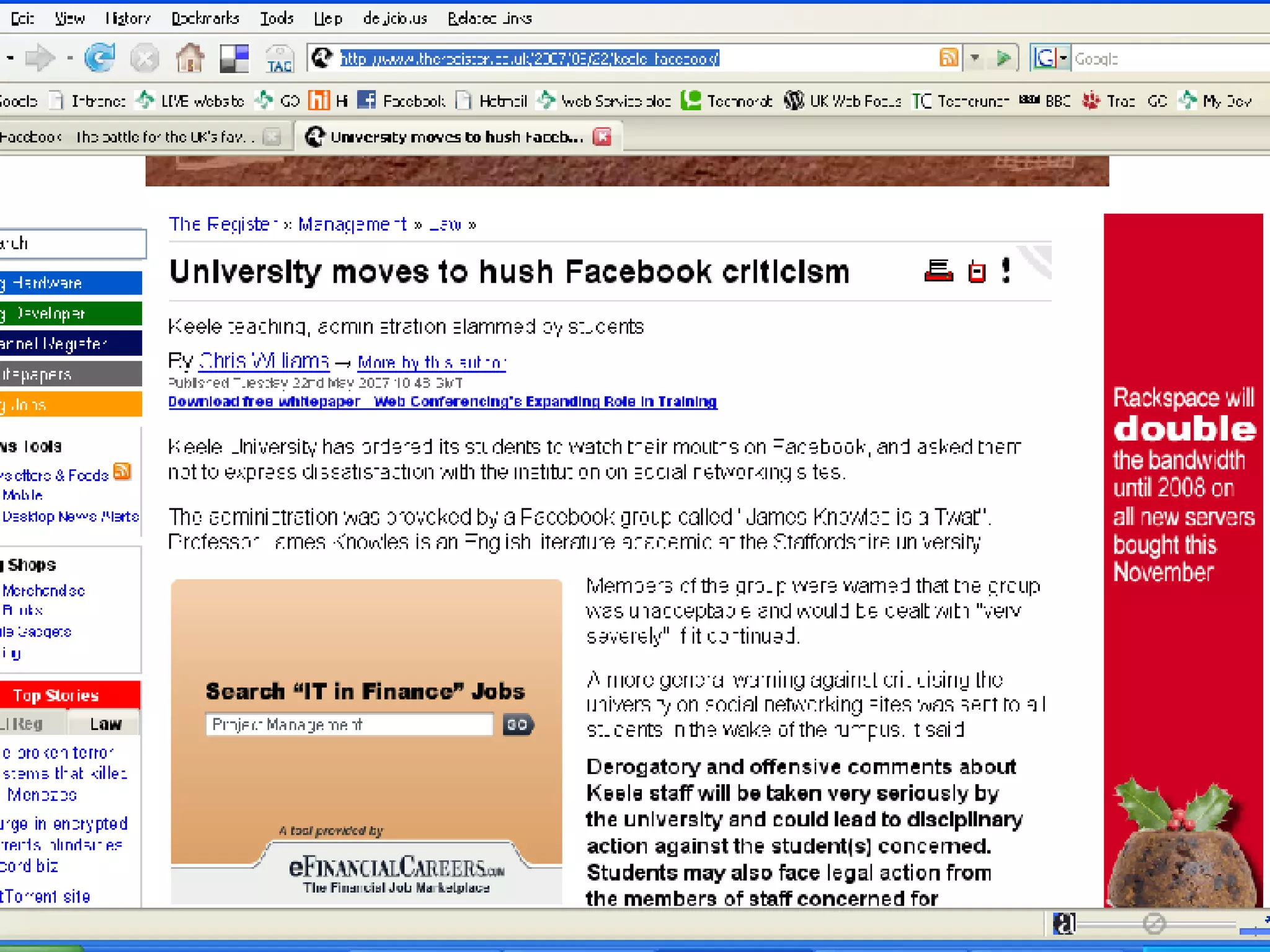
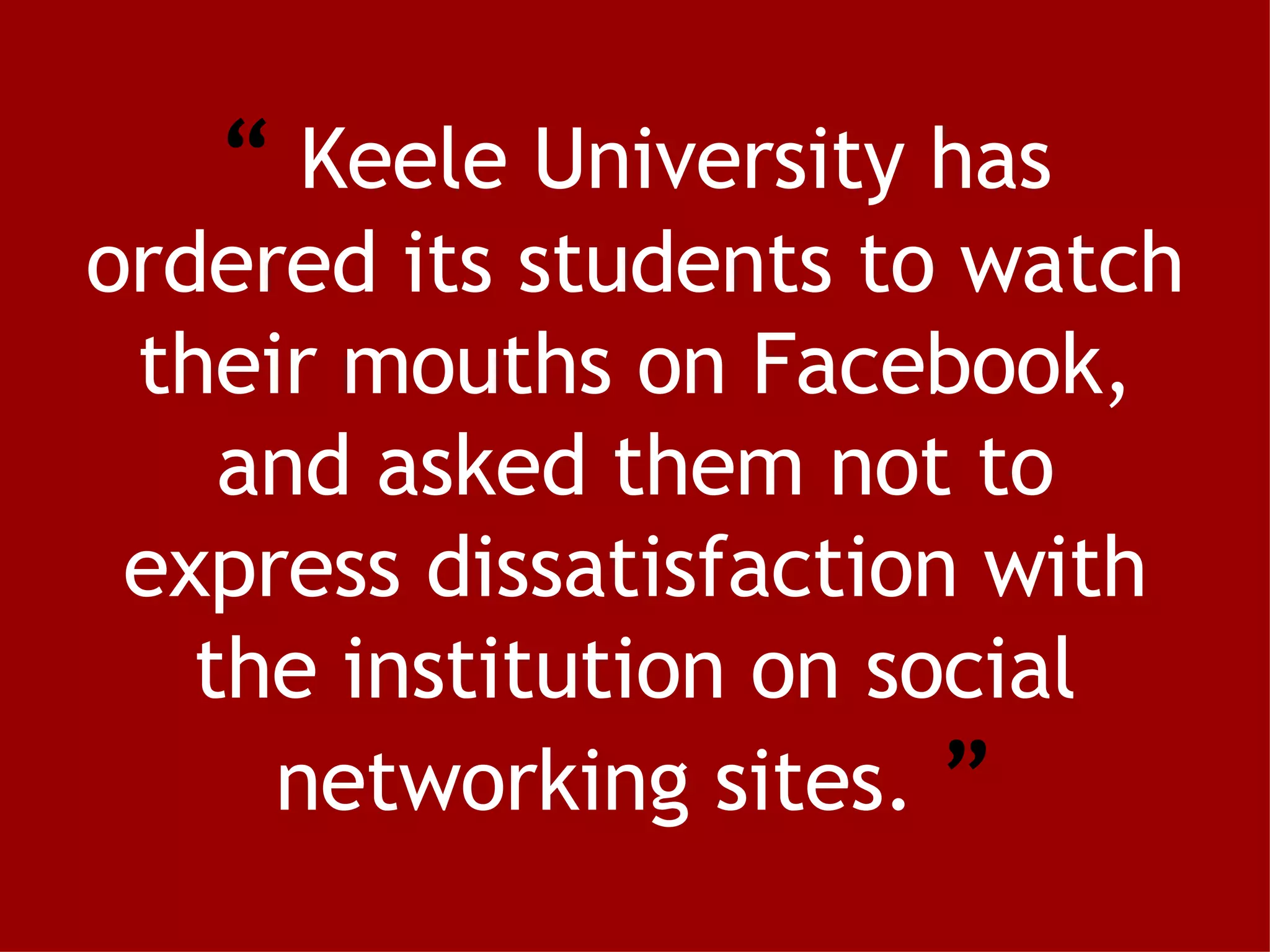
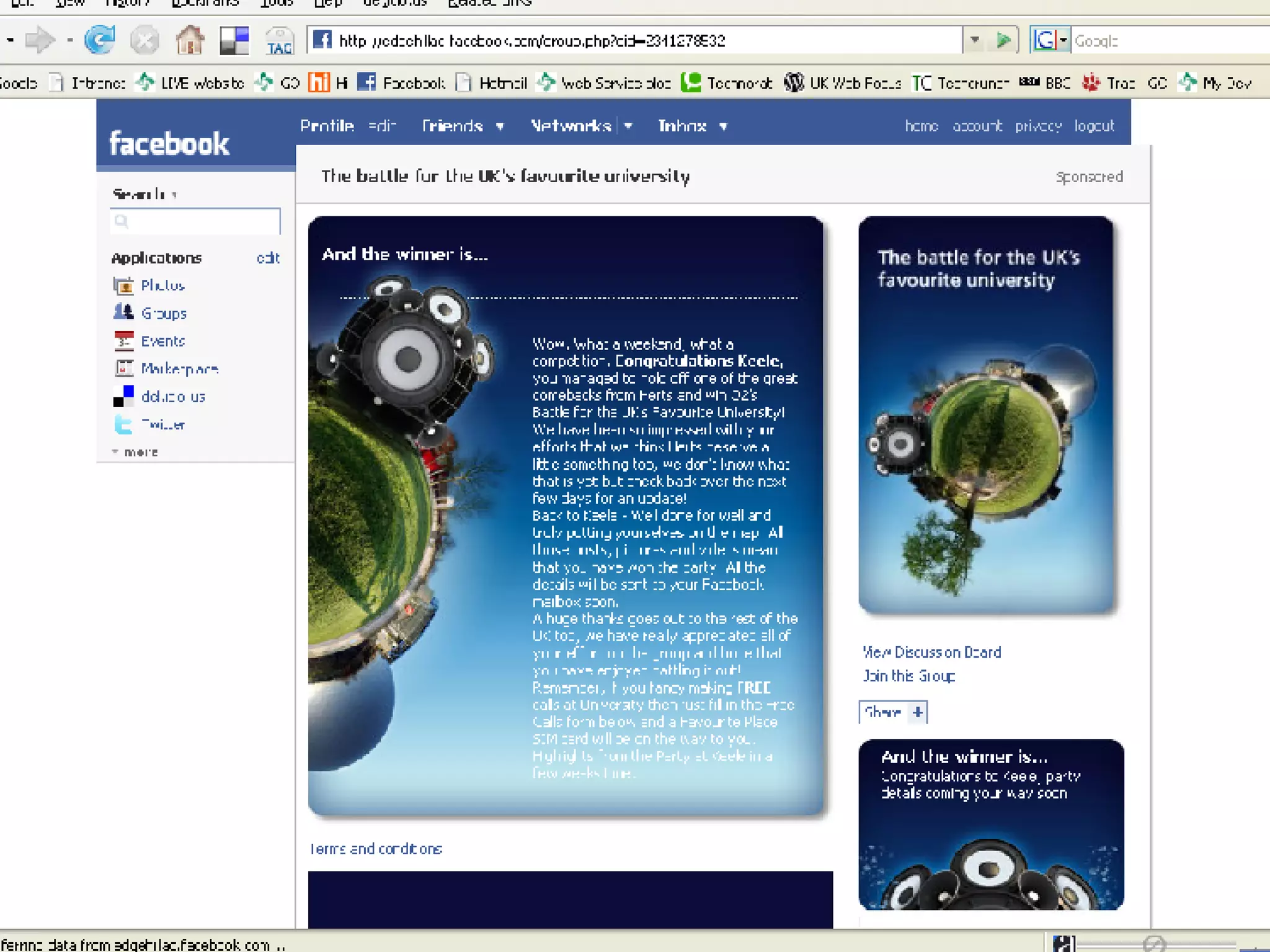
“   Keele University has ordered its students to watch their mouths on Facebook, and asked them not to express dissatisfaction with the institution on social networking sites.  ”
 
Image courtesy of MsAnthea &quot;Anthéaïs&quot; on Flickr http://www.flickr.com/photos/anthea/84090626/
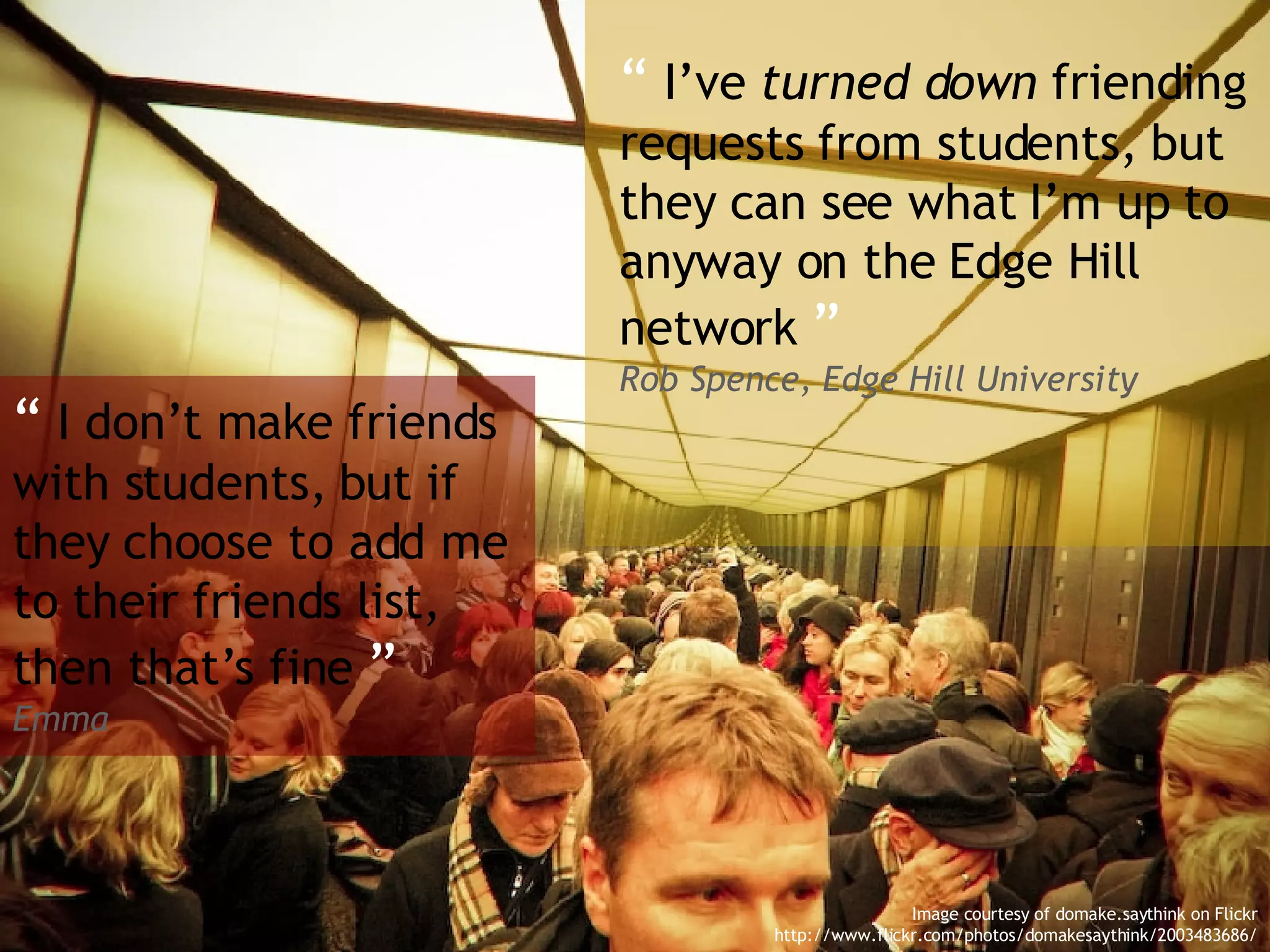
“   I’ve  turned down  friending requests from students, but they can see what I’m up to anyway on the Edge Hill network  ” Rob Spence, Edge Hill University “   I don’t make friends with students, but if they choose to add me to their friends list, then that’s fine  ”  Emma Image courtesy of domake.saythink on Flickr http://www.flickr.com/photos/domakesaythink/2003483686/
It’s just a compliment to other services What can you ACTUALLY guarantee anyway?! Image courtesy of philcampbell on Flickr http://www.flickr.com/photos/clanlife/1517564618/
Open | Accept  Allow | Encourage Image courtesy of emdot on Flickr http://www.flickr.com/photos/emdot/13519557/
 
Thanks for listening Any questions? Alison Wildish Head of Web Services Edge Hill University blogs.edgehill.ac.uk/webservices Image courtesy of halighalie on Flickr http://www.flickr.com/photos/halighalie/112410629/
Exploiting the potential of blogs and social networks Austin Court, Birmingham 26 November 2007
Blogs & Social Networks – “The Students Perspective” Tom Milburn – VP Education
General use of social networks Ways to use social networks Problems that can arise Blogs Summary Content
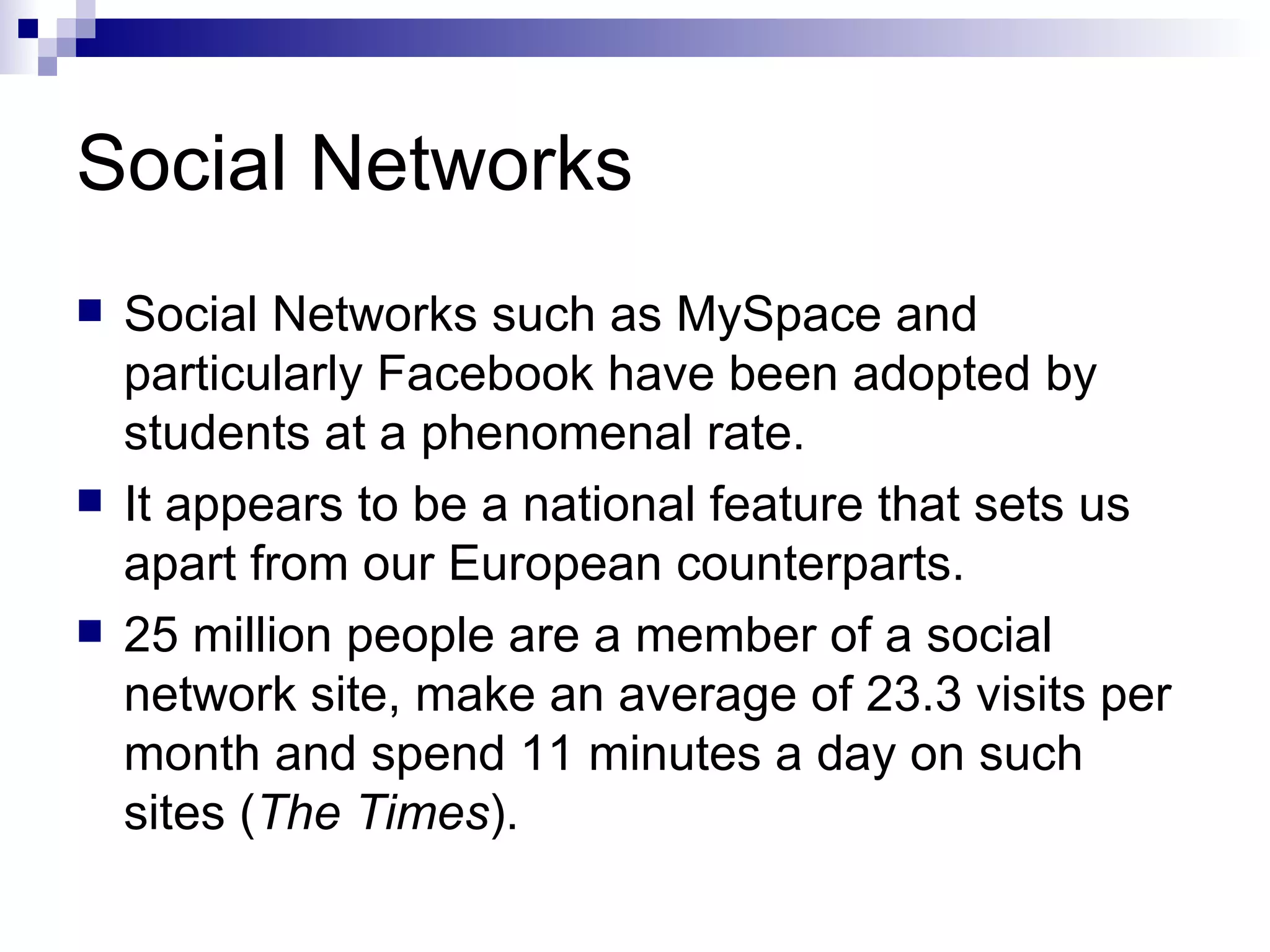
Social Networks  Social Networks such as MySpace and particularly Facebook have been adopted by students at a phenomenal rate. It appears to be a national feature that sets us apart from our European counterparts. 25 million people are a member of a social network site, make an average of 23.3 visits per month and spend 11 minutes a day on such sites ( The Times ).
Potential These networks offer huge potential because of the frequency of visits and high retention rates of users. They are also a limitless resource that are used by all ages, classes, genders etc. This gives any user the chance to reach a huge audience that is not constrained to any particular demographic.
Students’ Use and Perspective
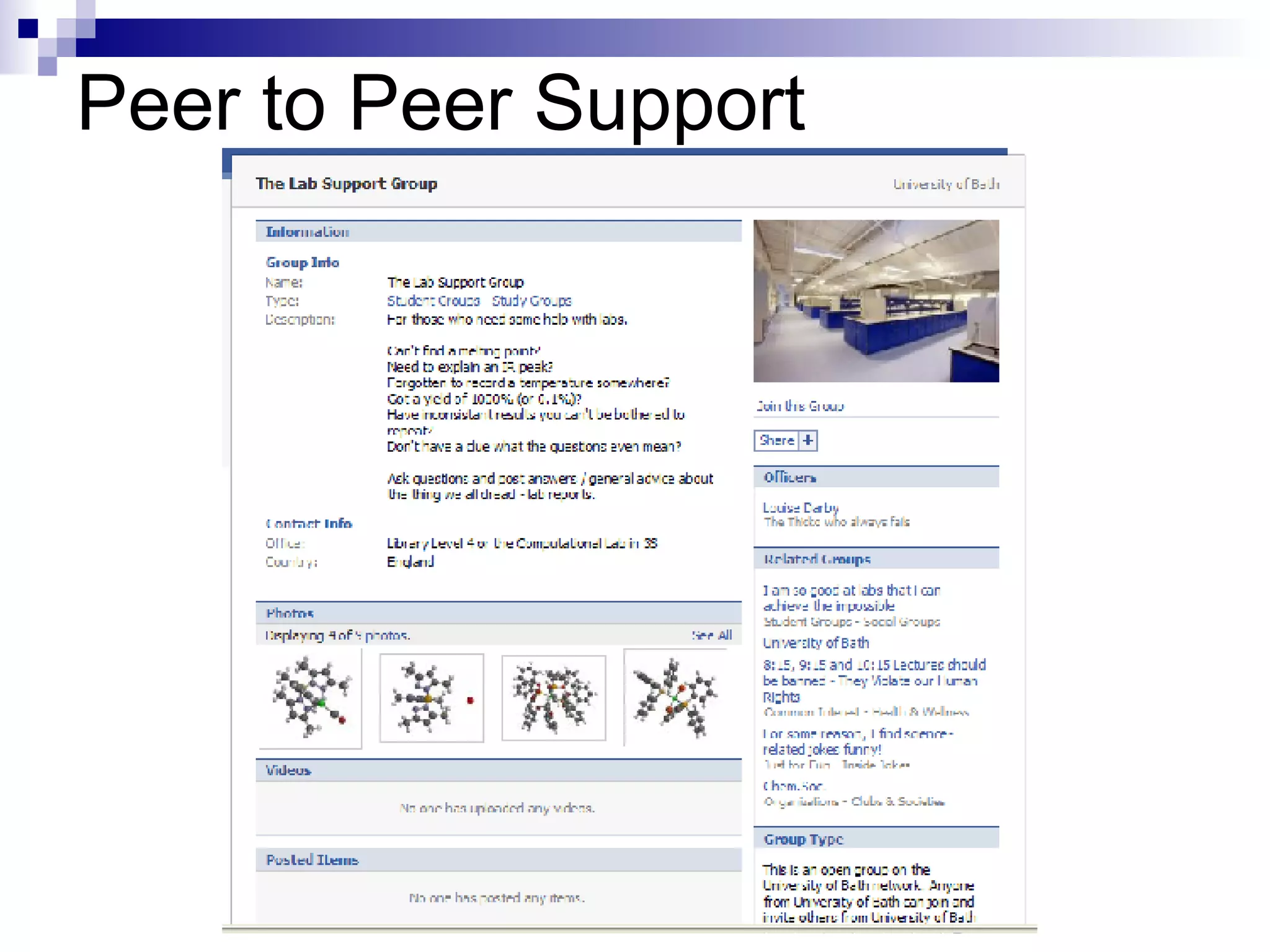
Peer to Peer Support
Benefits Social networks can provide students with the support of their cohort in a structured environment. It can also provide constant support that is not bound by office hours. This can ease pressure on staff with older students helping to ‘teach’ younger students. Discussion boards are used by students to set the topic of a discussion and are valued by students to focus any discussions.
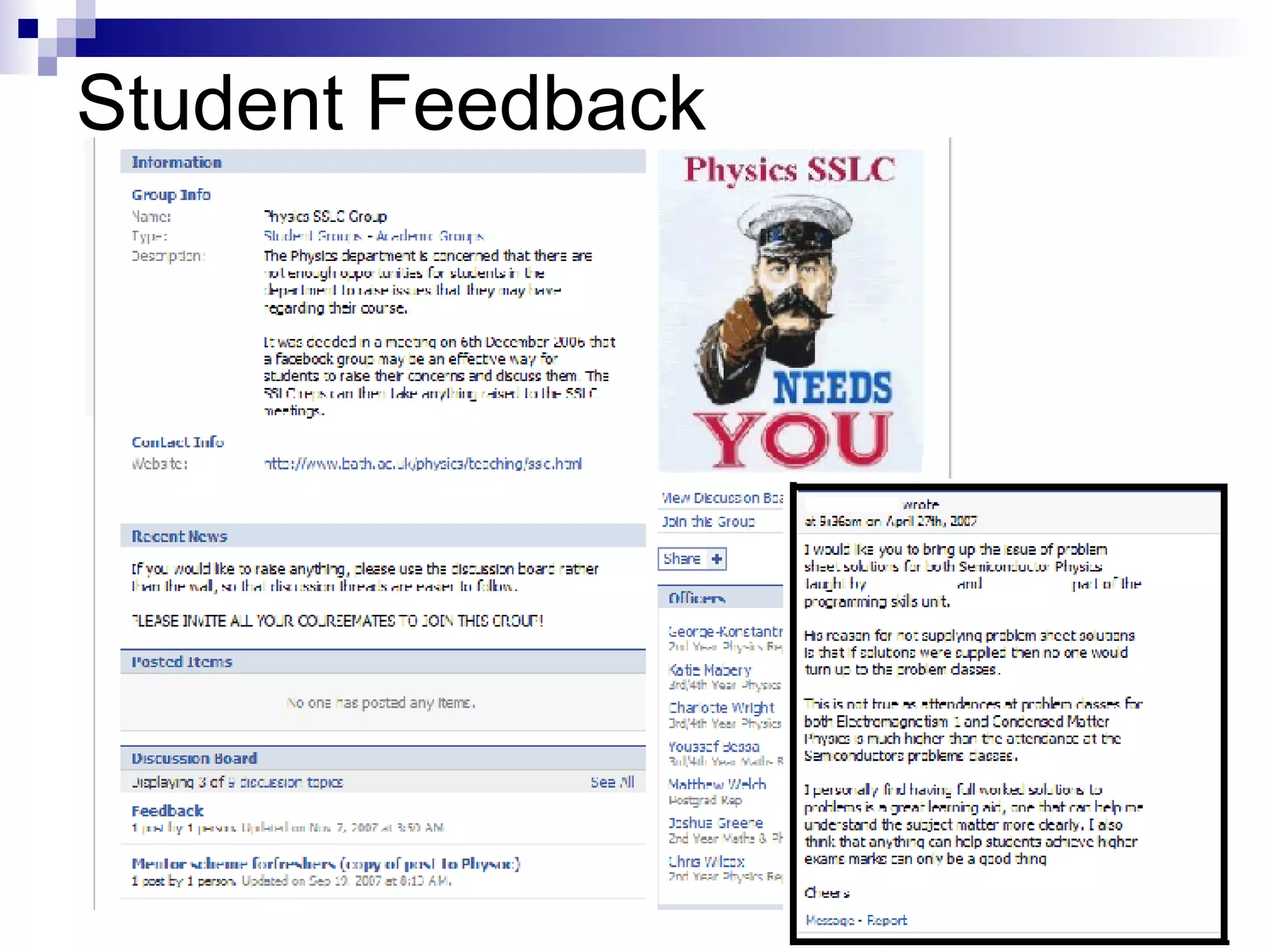
Student Feedback
Benefits Social networks can provide an excellent centre for any Staff/Student Liaison Committees. They provide an open forum that is easily accessible to students. Students have commented how easy it is to voice opinion, view what is going on and to have open communication channels with staff. Staff can also easily run things past students and gauge opinion.
Multimedia Learning and teaching can often be enhanced by being offered in various formats. Social networks allow flexible use of images and videos that can help deliver material to students. Questionnaires can be linked to Facebook, which can aid research for students’ projects.
Problems for Staff and Students
Network Problems They can be perceived as closed communication channels. The consequences of actions can become distant as social networks can be turned off. The need for a username and password can give a false sense of security. There can be a lack of clarity from Universities on what the consequences of actions on social networks can be.
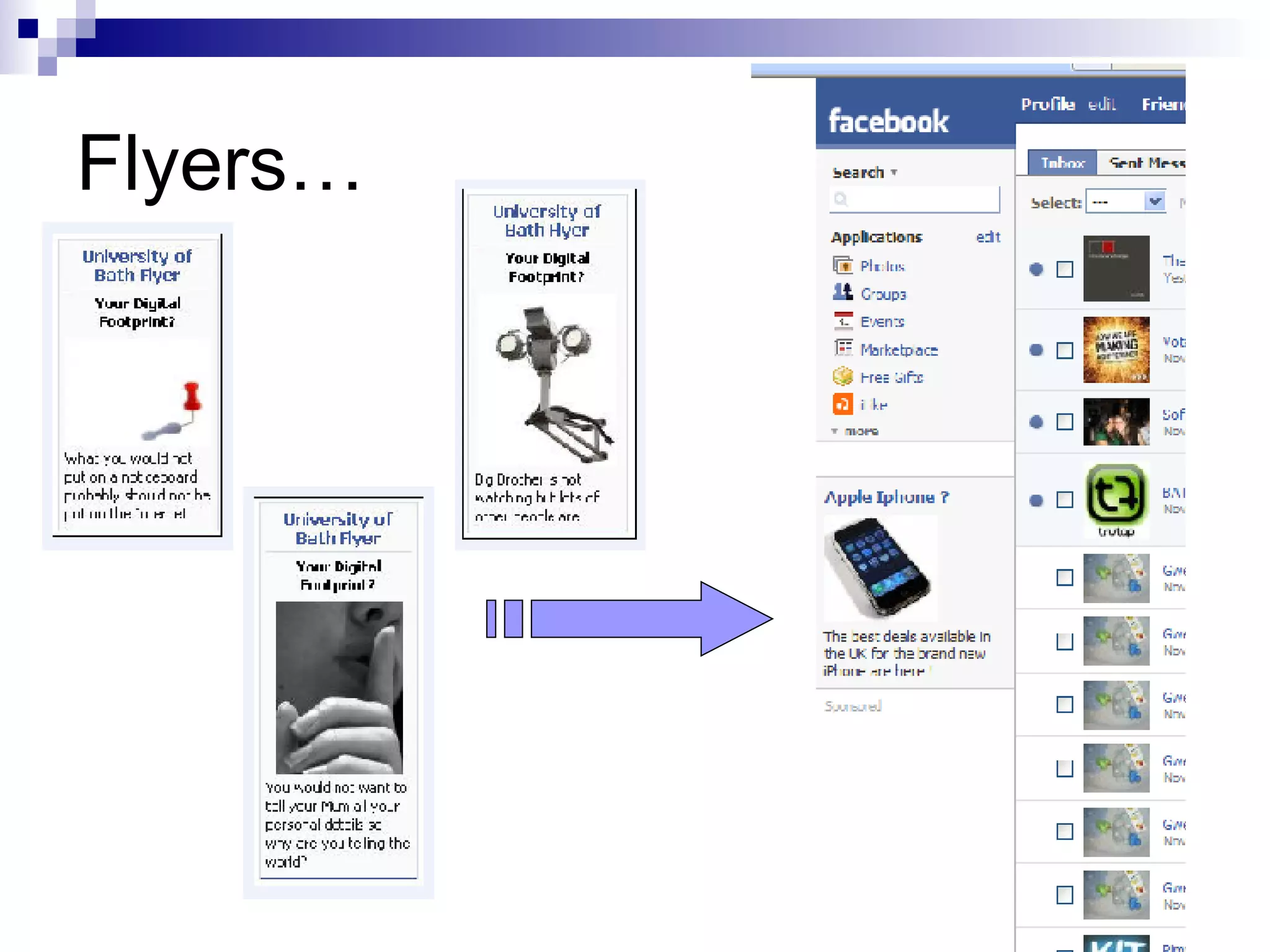
Advice Statements Universities and Students’ Unions are now producing advice statements. These often detail what students should be wary of when using social network sites. At Bath these were delivered as ‘Flyers’ on Facebook.
Flyers…
Student Views on Blogs
Blogs Blogs can be an excellent way to keep students up to date with developments at University. However they usually suffer from: Being hard to find Not being updated regularly Not being used by students themselves
Summary There is great potential for social networks to be used to engage students and enhance their experience of university life. It will depend on how much effort staff put in and the culture of students on various courses. They can be of great value to any institution.
Any Questions?
Exploiting the potential of blogs and social networks Austin Court, Birmingham 26 November 2007
The Hidden Dangers: You can Log-on But You Cannot Hide Dr Stuart D Lee Oxford University Computing Services
Overview The importance of Web 2.0 The impact on a central IT service Changing expectations Some Concerns Issues of identity
“ Web 2.0, refers to a perceived second generation of Web-based communities and hosted services — such as social-networking sites, wikis and folksonomies — which aim to facilitate collaboration and sharing between users” + usually free
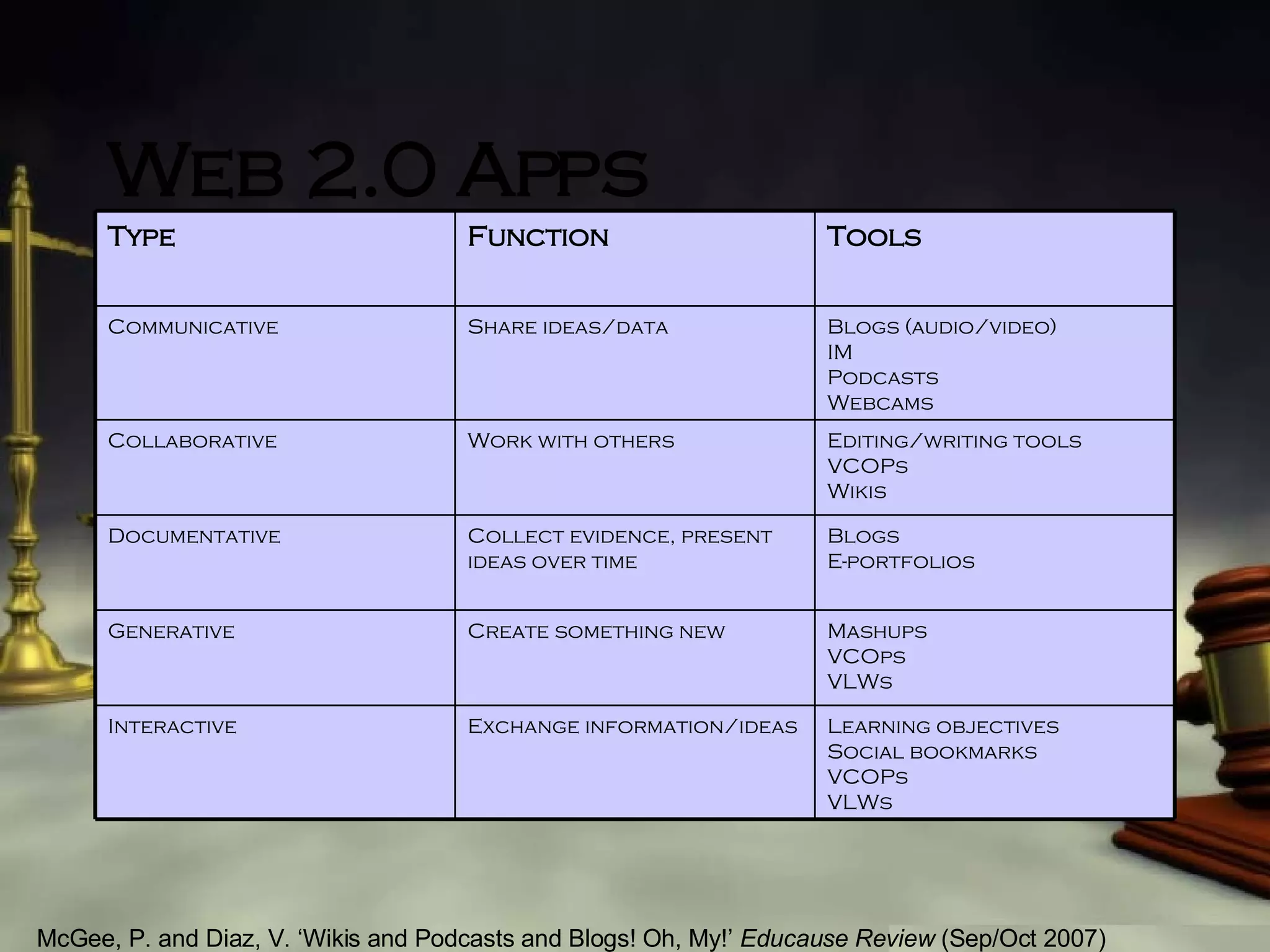
Web 2.0 Apps McGee, P. and Diaz, V. ‘Wikis and Podcasts and Blogs! Oh, My!’  Educause Review  (Sep/Oct 2007)   Learning objectives Social bookmarks VCOPs VLWs Exchange information/ideas Interactive Mashups VCOps VLWs Create something new Generative Blogs E-portfolios Collect evidence, present ideas over time Documentative Editing/writing tools VCOPs Wikis Work with others Collaborative Blogs (audio/video) IM Podcasts Webcams Share ideas/data Communicative Tools Function Type
‘ 5-Factors Driving Change in IT’ Gartner Web 2.0 - disrupts existing models: ‘Web 2.0 communities, such as MySpace and wikis, connect people in ways that many companies hadn't anticipated when they began to develop their online strategies.’ Experiment with free-form environments. &quot; Social environments&quot; are the wave of the future. Companies should provide interactive tools, such as content tagging systems, RSS feeds, blogs, wikis, etc. http://www.campustechnology.com/articles/52239
Not just IT services Stephens, M. Web 2.0 and Libraries: Best Practices for Social Software (Library 2.0) McKiernan, G. ‘Social Networking Sites for Engaged Library Services’ - http://www.public.iastate.edu/~gerrymck/LITANationalForum2007.ppt
Impact on Central IT Increased burden on services Increased demand for new services - changing user expectations Out-sourcing, and increased demands for justifying central services Hidden perils
Impact on Central IT Increased burden on services Increased demand for new services -  changing user expectations Out-sourcing, and increased demands for justifying central services Hidden perils
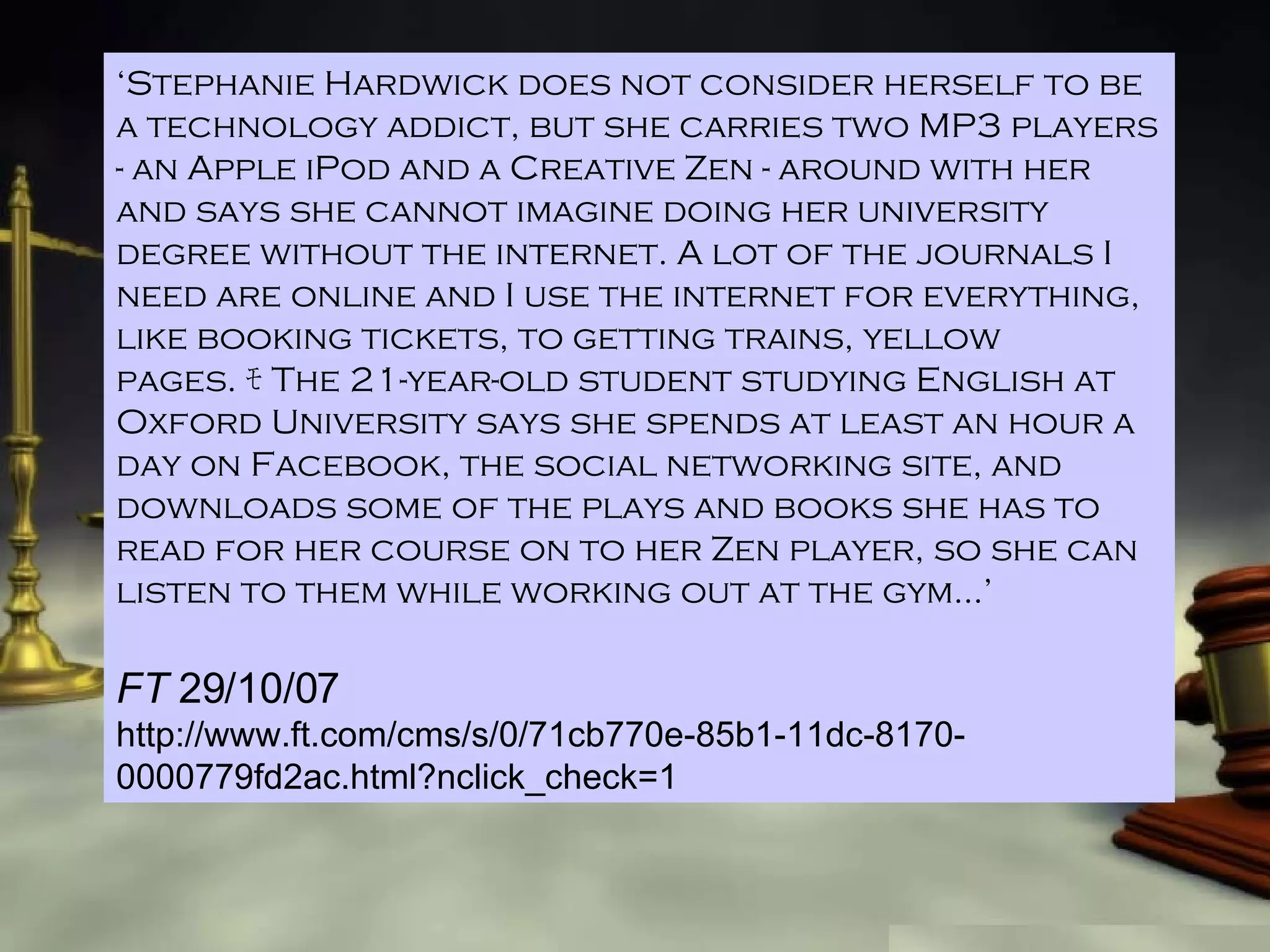
‘ Stephanie Hardwick does not consider herself to be a technology addict, but she carries two MP3 players  -  an Apple iPod and a Creative Zen  -  around with her and says she cannot imagine doing her university degree without the internet.  A  lot of the journals I need are online and I use the internet for everything, like booking tickets, to getting trains, yellow pages. モ T he 21-year-old student studying English at Oxford University says she spends at least an hour a day on Facebook, the social networking site, and downloads some of the plays and books she has to read for her course on to her Zen player, so she can listen to them while working out at the gym…’ FT  29/10/07 http://www.ft.com/cms/s/0/71cb770e-85b1-11dc-8170-0000779fd2ac.html?nclick_check=1
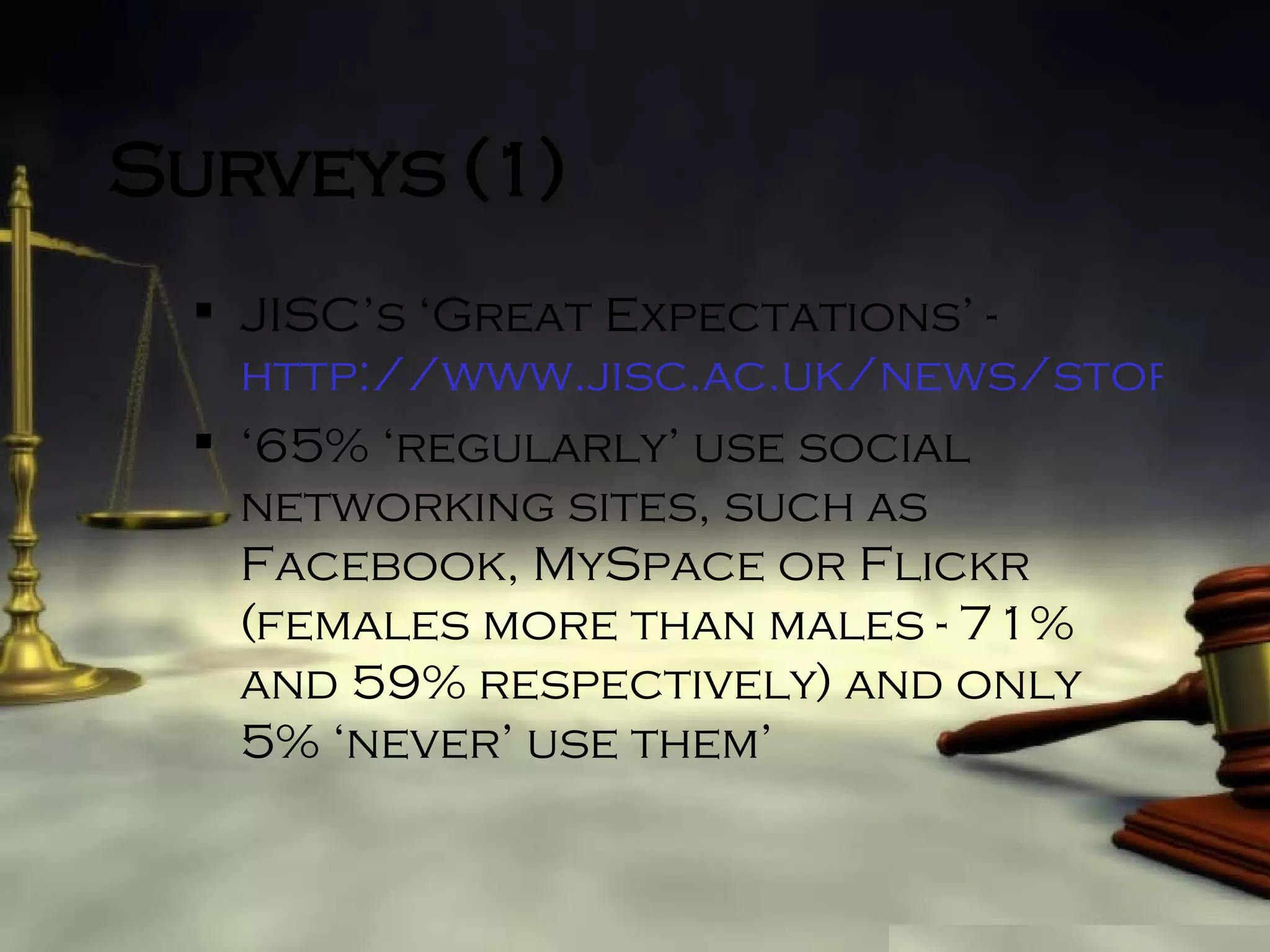
Surveys (1) JISC’s ‘Great Expectations’ -  http://www.jisc.ac.uk/news/stories/2007/09/expectations ‘ 65%  ‘r egularly’   use social networking sites, such as Facebook, MySpace or Flickr (females more than males - 71% and 59% respectively) and only 5% ‘ n ever’   use them’
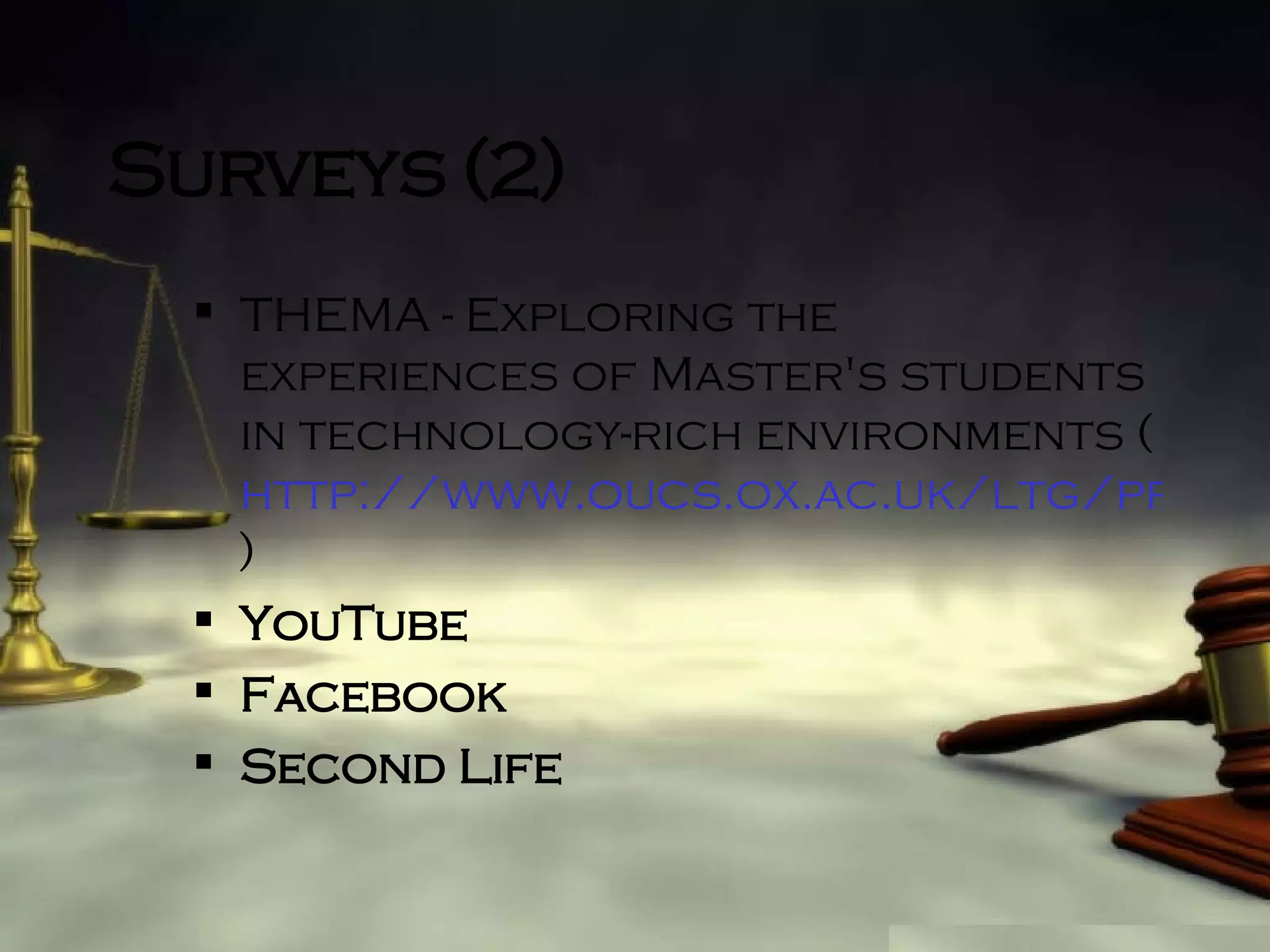
Surveys (2) THEMA - Exploring the experiences of Master's students in technology-rich environments ( http://www.oucs.ox.ac.uk/ltg/projects/thema/ ) YouTube Facebook Second Life
But … Educause Centre for Applied Research (ECAR) 2006 showed 70.6% use Facebook several times a week, same number download music/videos But students prefer moderate technology use, and new students prefer even less. ‘ Don’t bother with IM or Facebook - that’s our network. Leave us alone’ ‘ Don’t enter our world to [contact us] … we’ll come to you’ Berg, J., Berquam, L., and Christoph, K. ‘Social Networking Technologies: a “poke” for Campus Services’  Educause Review  (March/April 2007)
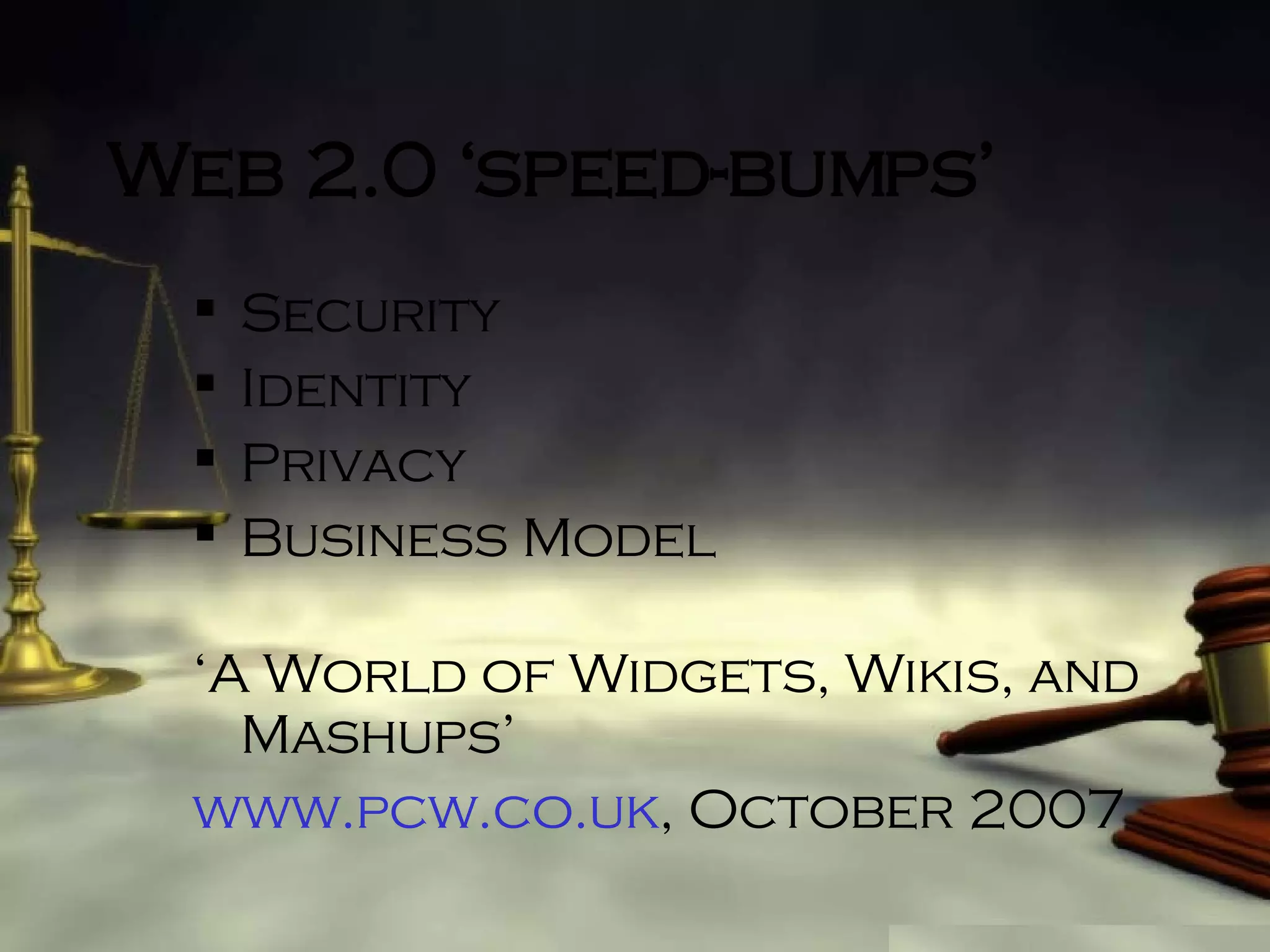
Web 2.0 ‘speed-bumps’ Security Identity Privacy Business Model ‘ A World of Widgets, Wikis, and Mashups’ www.pcw.co.uk , October 2007
Concerns (1) ‘…  we are currently looking into using external Web 2.0 services as part of and after our online courses. Obviously as part of this we need to consider the legal/institutional aspects of this provision’
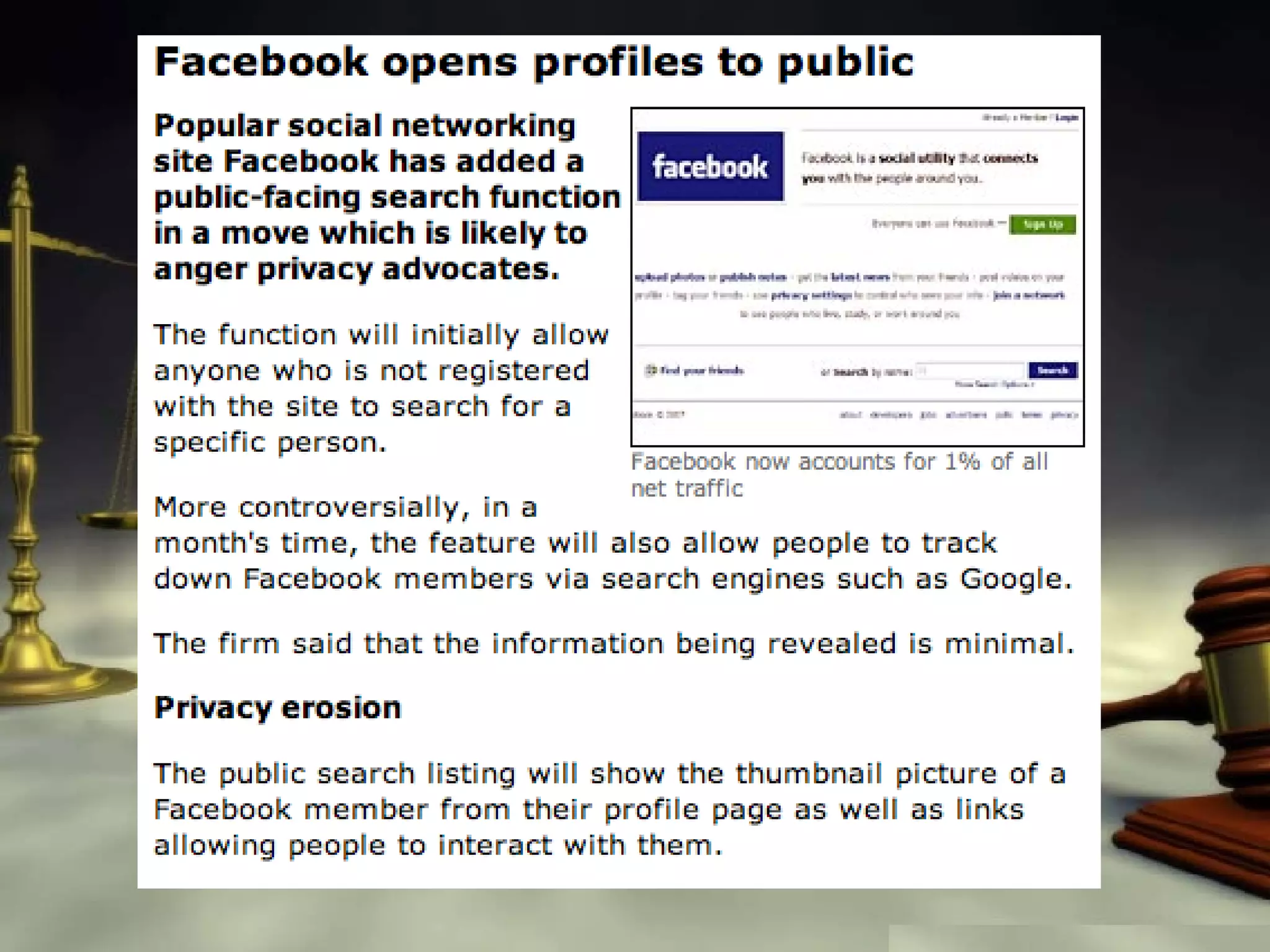
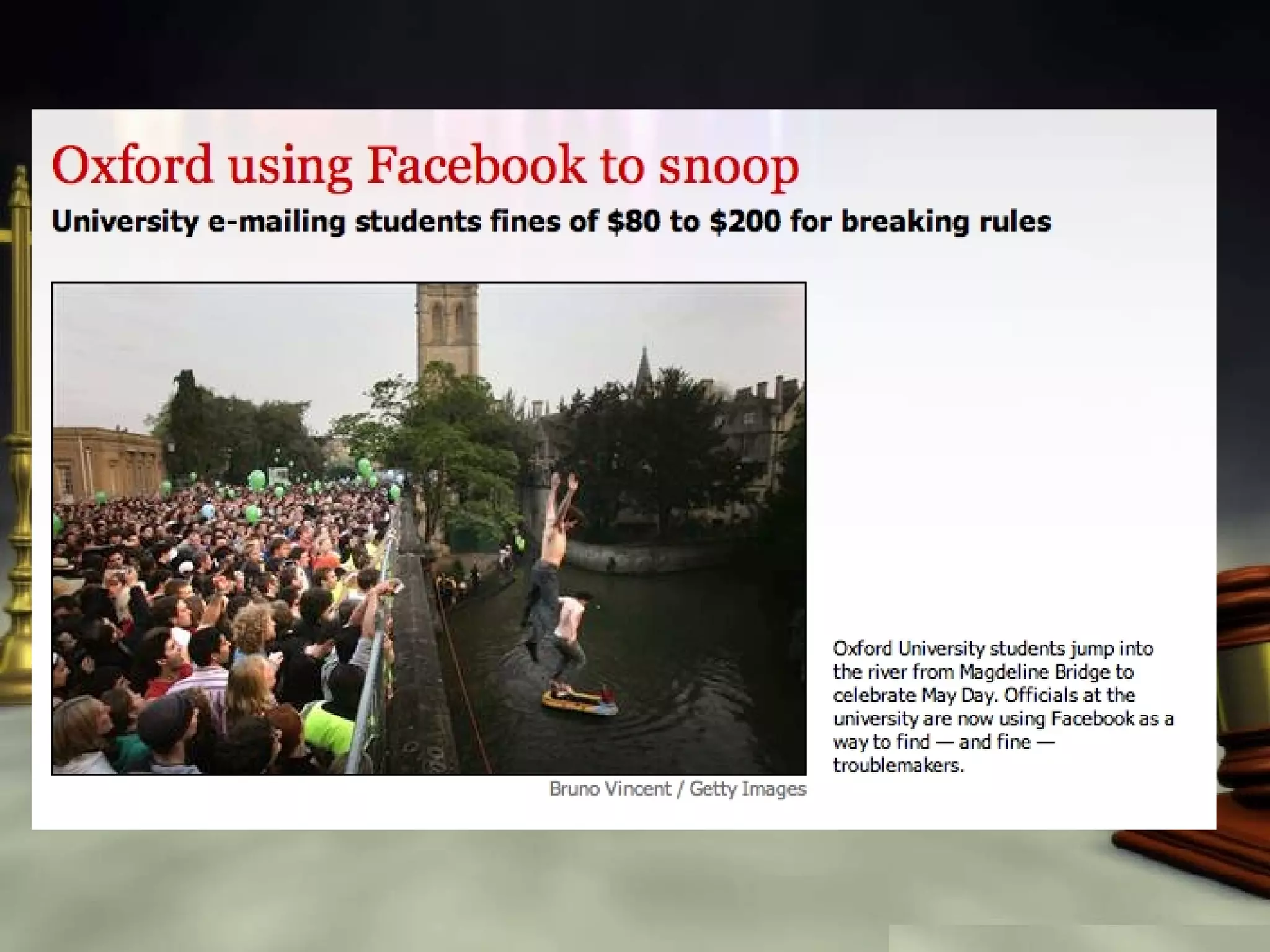
Concerns (2) ‘ What shocked me about the Facebook audience was how willing they were - and are - to provide information about themselves for benefits that you and I might consider questionable.’ Appvertising ‘ Facebookers abandon online privacy for virtual doo-doo’ October 2007, http://www.theregister.co.uk/2007/10/09/facebookers_throw_virtual_feces/
Concerns (3) ‘ Web 2.0 and client-side attacks on social networking technologies, aimed at &quot;stealing private data, hijacking Web transactions, executing phishing scams, and perpetrating corporate espionage’ ‘ Web 2.0 tops emerging cyber-threats’ http://www.campustechnology.com/articles/51890
 
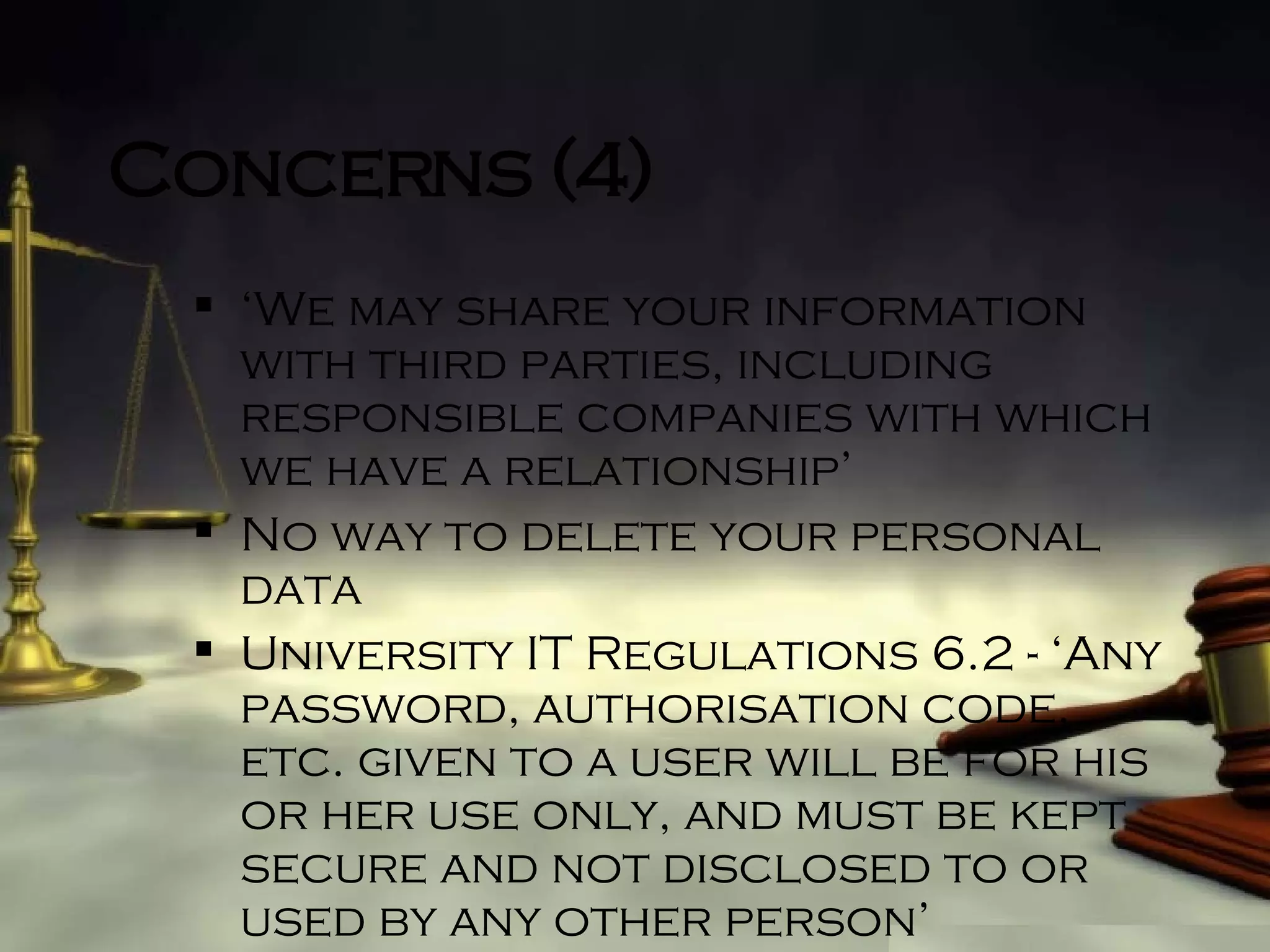
Concerns (4) ‘ We may share your information with third parties, including responsible companies with which we have a relationship’ No way to delete your personal data University IT Regulations 6.2 - ‘Any password, authorisation code, etc. given to a user will be for his or her use only, and must be kept secure and not disclosed to or used by any other person’
 
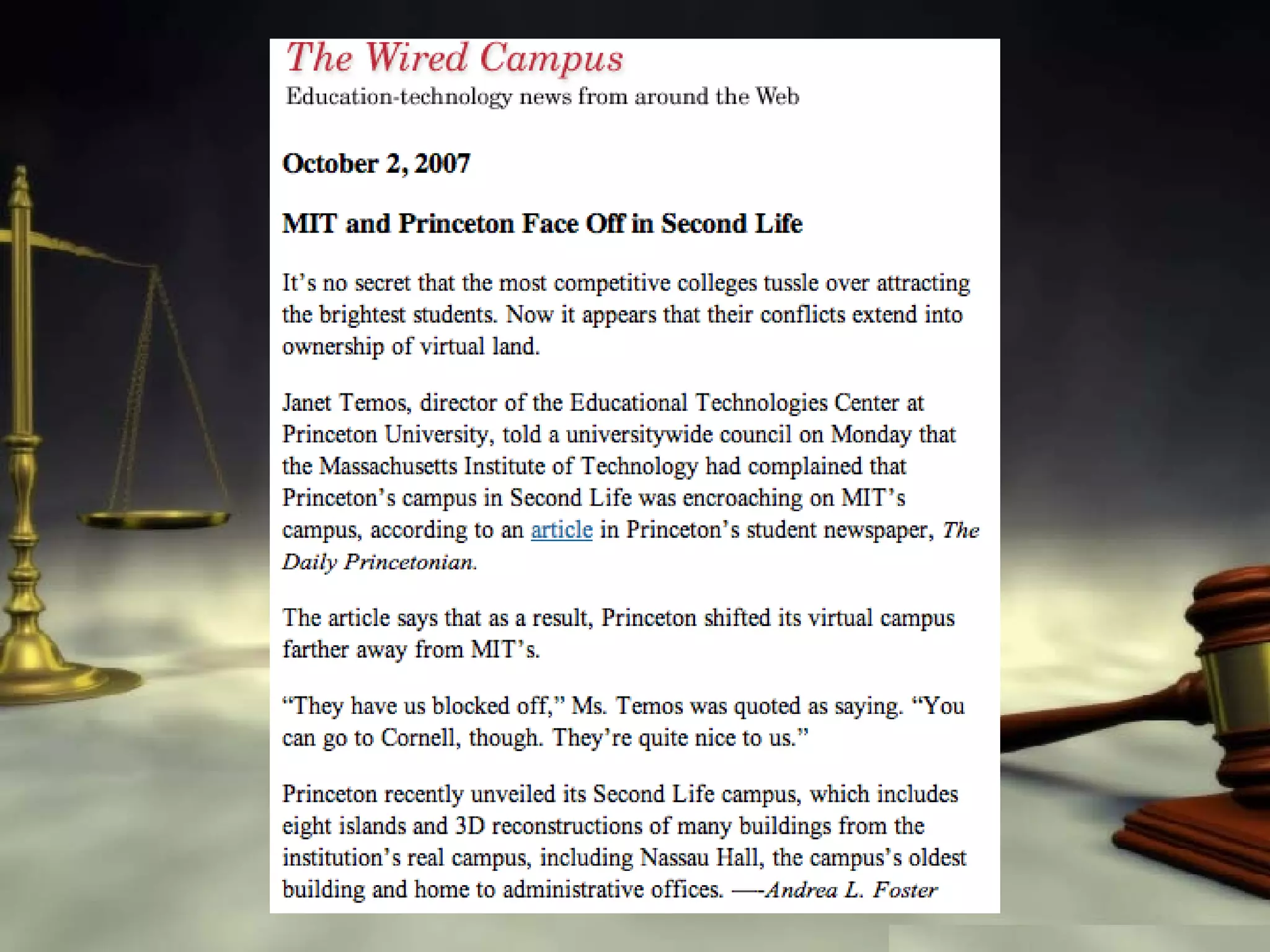
SecondLife Kirriemuir’s snapshot (Sep, 2007): http://www.eduserv.org.uk/upload/foundation/sl/uksnapshot092007/final.pdf
 
SecondLife It’s a waste of money It damages the University’s reputation (it’s a game, it’s full of porn …)
What is an IT provider to do? Explore  provision (e.g. PP and iTunesU) but also welcome SaaS Tread carefully - ‘fad from future’ Educate re privacy Educate re libel Educate re copyright Use tools themselves: - Director’s Blog -  Wikinomics - ‘Crowd-sourcing’
Stuart Lee [email_address]
Exploiting the potential of blogs and social networks Austin Court, Birmingham 26 November 2007
Disruptive Technology and its Implications for University Information Services David Harrison, Cardiff University “ Exploiting the Potential of Blogs & Social Networks” UKOLN Workshop: November 2007
Disclaimer Everything I’m saying is informed by my employment at Cardiff and the networks I’m part of and have involved myself in whether real (UCISA) or virtual (Facebook). Everything I’m saying is a personal view or reflection upon what I’ve learnt or experienced, unless directly attributed to another person or organisation. I’m wholly responsible for the contents of this session; it does not represent the views or policies of either Cardiff University or UCISA.
Why the need for a disclaimer? Talking about things outside the “service offering”. Talking about “user-centric” rather than “organisation-centric” issues. Talking about issues that transcend organisational boundaries. Talking about issues that break the traditional security and privacy models. Talking about different ways of visualising the way Information Services operate. …  none of which have any substance in standards, services, or policies … yet!
Starting point … Briefing Paper with the same name as this presentation – conceived in November 2006 as a response to a presentation from Brian Kelly and John Heaps at an earlier UKOLN Workshop. A first draft authored by Dr Joe Nicholls appeared in January 2007, first released in April 2007 for comment within UCISA Executive. Part 1 of the Briefing Paper  available at  http:// insrvblogs.cf.ac.uk /roller/disruptive   . No intention to go through this but it provides the background for the thought processes being followed by many in Cardiff University. This presentation considers some of the issues discussed in Part 2 of the paper.
Preparation and engagement Get the buy-in of “corporate compliance” … make the IT Regulations - institutional ones - NOT just ones that refer to the use of central facilities. Establish the principle (through practice and “case law” if necessary) that there’s nothing the user can do with “disruptive technology” that is different from their use of traditional technology … the location might be different but the primacy of the AUP remains and the referral to existing disciplinary processes should not change. Be prepared therefore to relinquish sole responsibility for IT Regulations – your first lesson in partnership.
Practicing Safe IT Users need protecting against themselves – if email was comparable to sending a postcard, then social networking is comparable to a night out in the pub! Guidance and advice on appropriateness of content, privacy and security is required … but not control. Focus should be upon EDUCATION. http:// www.cardiff.ac.uk/insrv/it/help/safe /   .
Differing realms, identities and blogs We work in different realms Sometimes on our own and in a personal capacity Sometimes in a way that shields our true identity Sometimes in a work-related capacity Sometimes as a member of an internal work group Sometimes as a member of an external collaboration group Sometimes as a member of an organisation Sometimes as a contributor to someone else’s work We work differently and use different language depending upon the context we find ourselves in
Corporate response to blogging IBM have taken a lead in encouraging employees to blog  http://terranova.blogs.com/terra_nova/2007/08/ibms-virtual-wo.html   They have provided guidelines for blogging  http://www-128.ibm.com/developerworks/blogs/page/jasnell?entry= blogging_ibm   And engagement in virtual worlds  http://domino.research.ibm.com/comm/research_projects.nsf/pages/virtualworlds.IBMVirtualWorldGuidelines.html   Worth also looking at  http:// www.iet.tv/search/index.html?spres =5723
Different types of “blog” Personal (but not corporate) – no need for this type of page to be hosted on corporate systems any more – eg for me  http:// diharrison.wordpress.com   and for IBM  http:// rooreynolds.com   or  http:// epredator.blogspot.com /   Personal or Group (work-related) – corporate intranet for internal collaboration hosted on the corporate system – eg within Cardiff  https:// quickplace.cardiff.ac.uk Group Internet Presence – for external collaboration with others of a “like mind” possibly hosted on an independent system – eg for UCISA  http:// www.facebook.com/group.php?gid =2395812380 ,  or for Cardiff  http://insrvblogs.cf.ac.uk/roller/Educause2007/   and for IBM  http:// eightbar.co.uk /   Corporate Internet – in support of the business hosted on the corporate system
It’s just common sense Need to adopt suitable language, style and identity depending on where you are Need to have guidelines on usage and on what type of collaborative tool is best for what purpose – this goes across the whole gamut from IM, through chat rooms, email, shared workspaces to blogs and wikis Need to be supportive, rather than prevent
Concluding thoughts There’s nothing different in Web 2.0 to what’s already being done – it’s just the medium that’s different  Users need protecting against their own foolishness – thus EDUCATION is the most important thing Institutions should begin to trust their staff and students more but be also prepared to use existing disciplinary codes where the trust is betrayed Must embrace and engage – to do otherwise would be counter-productive and make us look foolish – consider the concept of enablement Should consider a partnership rather than service provider role and be customer-centric Must consider where we’re going with work-life balance; for some they want separation – for others they want the flexibility at work that they give to work at home.
Use of Collaborative Workspace The following guidelines apply: each virtual workspace must be owned by a named member of staff (the Quickplace owner). This person is ultimately responsible for ensuring all content in the collaborative space meets the University regulations and JANET guidelines (see below). the content of the workspace must not contravene the University regulations as outlined below and found in full on the Corporate Compliance Unit web pages at http://www.cf.ac.uk/insrv/ aboutus/regulations/index.html the owner of the workspace space must designate a ‘Workspace Administrator’ (this can be the same person). They are the main point of contact for the workspace, and as such are responsible for managing all activity including membership and permissions. The Workspace Administrator must be a current member of staff or a research postgraduate student. At this time, it is recommended that taught postgraduate and undergraduate students are not to be directly responsible for the administration of a virtual workspace.  Where the theme or template of a workspace has been modified or customised, the Workspace Administrator is responsible for ensuring compliance with University regulations and legal requirements such as accessibility legislation. Spaces will reside at http://quickplace.cardiff.ac.uk/ Spaces hosted on this service are intended for uses associated with University business (i.e., academic) only. The use of Workspace for non-work related, personal or private purposes is not expected. Collaborative space owners will be required to confirm that the space is still required every 12 months. Failure to confirm will result in the workspace being disabled.
Exploiting the potential of blogs and social networks Austin Court, Birmingham 26 November 2007

UKOLN Blogs and Social Networks workshop - all presentations

  • 1.
    Exploiting the potentialof blogs and social networks Austin Court, Birmingham 26 November 2007
  • 2.
    Exploiting The Potential Of Blogs and Social Networks: Introduction Brian Kelly UKOLN University of Bath Bath, UK Email [email_address] UKOLN is supported by: http://www.ukoln.ac.uk/web-focus/events/workshops/blogs-social-networks-2007/talks/introduction/ Acceptable Use Policy Recording/broadcasting of this talk, taking photographs, discussing the content using email, instant messaging, blogs, social networks, etc. is permitted providing distractions to others is minimised. This work is licensed under a Attribution-NonCommercial-ShareAlike 2.0 licence (but note caveat) Resources bookmarked using ' blogs-social-networks-workshop-2007 ' tag
  • 3.
    About This WorkshopAbout The Workshop The workshop will provide an opportunity to: Hear about approaches institutions are taking in the provision of or use of blogs & social networks. Discuss appropriate deployment strategies The workshop aims to help you to: Gain an understanding of blogs & social networks Learn how they can support your institution’s aims Discuss the challenges in providing such services Develop strategies for addressing these challenges across a diversity of institutional requirements
  • 4.
    About The WorkshopOrganiser Workshop Chair: Brian Kelly UK Web Focus: JISC and MLA funded Web adviser to UK HE/FE & cultural heritage sectors Discovered the Web in Dec 1992 and promoted its use afterwards (to an initially sceptical community) Currently developing best practices for Web 2.0 Writes on the UK Web Focus Wordpress blog: see <http://ukwebfocus.wordpress.com/> UKOLN: National centre of expertise in digital information management Located at the University of Bath
  • 5.
    About The FormatPlenary Talks: Six plenary talks which set the context (institutional case studies in morning; broader context in afternoon) Discussion Groups: Discussion groups in afternoon Feedback from discussion groups (in Wiki) Technologies: WiFi network provided to support event Please use responsibly (see AUP)
  • 6.
    Workshop Wiki A Wiki is provided for reporting on discussion groups: Keeps a digital record (better than flip charts; more open than PowerPoint) Allows you to look at others notes Note have one Wiki reporter per group. A reporter should have been selected in advance of the workshop. WetPaint Wiki provided: For note-keeping in discussion groups As a record for use after the event
  • 7.
    Streaming Of TalksBeing Brave! We intend to provide a live video stream of the plenary talks (using Web-based Veodia service). Being Foolhardy?! We intend to stream the live video into second Life. Second Life users will see (a) the speaker and (b) the slides Acknowledgements Thanks to Andy Powell, Eduserv Foundations and Veodia for providing the streaming service And to the remote users for their tolerance if it goes wrong 
  • 8.
    About You Whichsector are you from: IT Services • Library E-Learning • Research National role • Other public sector / other What technologies do you use on: Blogs (as author) • Read blogs Facebook Other social networks e.g. MySpace, Bebo, ... Does your institution have a formal policy on: Blogs S ocial networks
  • 9.
    Timetable Chris Sexton& Paul Hollins Report Back 15.40 Coffee 15.15 David Harrison, Cardiff Disruptive Technology and its Implications for University Information Services 13.20 Lunch 12.20 Stuart Lee, Oxford The Hidden Dangers of Social Networks: You can log-on but you cannot hide 13.50 Discussion Groups 14.20 Tom Milburn, Bath The Student Perspective 12.00 Finish 16.15 Alison Wildish, Edge Hill Put Yourself Out There 11.30 Melissa Highton, Leeds Leedsfeeds: a Blogging Service based on the Open Source Elgg Application 11.00 Stephen Clarke, Birmingham Blogging In A Managed Environment 10.30 Brian Kelly, UKOLN Introduction 10.15 Speaker Session Time
  • 10.
    What as aBlog / Social Network? “ A blog (a portmanteau of web log ) is a Web site where entries are written in chronological order and commonly displayed in reverse chronological order. ” “ A social network service focuses on the building and verifying of online social networks for communities of people who share interests and activities, or who are interested in exploring the interests and activities of others, and which necessitates the use of software.” Wikipedia Wikipedia
  • 11.
    Blog Example Blogs aren’t just for student e-portfolios! Chris Sexton (IT Services, Sheffield U.) set up a blog recently
  • 12.
    Facebook Example Chrisis also one of my Facebook friends Notice what she is revealing about herself to her other Facebook friends Image used with permission of Chris Sexton
  • 13.
    Facebook Example Chrisis also one of my Facebook friends Notice what she is revealing about herself to her other Facebook friends What are the long term implications of such sharing Image used with permission of Chris Sexton
  • 14.
  • 15.
    Not Just IndividualsWarwick University’s MySpace page Aberdeen University’s Bebo page Facebook recently announced that organisations (not just individuals) can have Facebook pages. Flurry of interest (and concerns) from UK HE: Must have one One already exists (squatters) Successful student sites exists (is this OK?) Why are we doing this? Who is the target audience? What are the resource implications, copyright implications, …? UCLan had one of the first UK HE pages on Facebook
  • 16.
    What If TheyWon’t Come? But what if: Users don’t trust our organisations? Staff & students feel freer to criticise on commercial services They prefer the disinterested approaches of commercial providers An OCLC report on “ Sharing, Privacy and Trust In Our Networked World ” argues along these lines: The social Web is not being build by augmenting traditional Web sites with new tools We should “ open the library doors, invite mass participation and relax the rules ” It will be messy, but “ mass participation and a little chaos often create exciting venues for collaboration, creativity, community building and transformation ”
  • 17.
    What’s Our Interests?Why should institutions have an interest in blogs and social networks? Enhance learning They can enrich learning: e-learning portfolios, collaborative learning, informal learning, … Enhance research They can enrich research: engagement with peers, feedback, social support, … Community benefits Engagement & dissemination e.g. by support departments (IT services, library, …) Role of institutions in developing digital citizens
  • 18.
    What Are TheChallenges? Many challenges (real and imaginary): The purpose(s) of the service The resource implications The deployment strategies (in-house vs external) The evaluation and selection The training and support The legal issues: privacy, copyright, accessibility, … The institutional concerns: reputation management, sustainability, preservation, … … “ I don't see the point in ISS running blogging servers unless we want to automatically create and populate groups based on modules. Why not just encourage people to sign up for an account with Wordpress? It's better than anything we could offer. ” Nigel Bruce, ISS, Leeds Uni.
  • 19.
    Developing Best PracticesUK Web Focus blog has regular posts related to these issues UKOLN publishes briefing documents on Web 2.0 areas These: Have CC licence Aimed at policy makers & support services Feedback welcome
  • 20.
    Community Development The workshop provides a forum: To be informed by case studies illustrated diversity of approaches being taken To hear about the broader challenges to be addressed which aims to lead to Agreement on the key issues which need to be addressed Identification of the key players who can support a community-wide approach to resolution of the issues (JISC, UCISA, UKOLN, JISC CETIS, JISC infoNet…?) As well as providing an informative and enjoyable event for the participants
  • 21.
  • 22.
    Exploiting the potentialof blogs and social networks Austin Court, Birmingham 26 November 2007
  • 23.
    University of BirminghamBlogging in a Managed Environment Stephen Clarke, Head of eLearning University of Birmingham 0
  • 24.
    What is ablog? Blog A blog (a portmanteau of web log ) is a website where entries are written in chronological order and commonly displayed in reverse chronological order. &quot;Blog&quot; can also be used as a verb, meaning to maintain or add content to a blog. Many blogs provide commentary or news on a particular subject; others function as more personal online diaries. A typical blog combines text, images, and links to other blogs, web pages, and other media related to its topic. The ability for readers to leave comments in an interactive format is an important part of many blogs. Most blogs are primarily textual, although some focus on art (artlog), photographs (photoblog), sketchblog, videos (vlog), music (MP3 blog), audio (podcasting) and are part of a wider network of social media. Micro-blogging is another type of blogging which consists of blogs with very short posts. As of September 2007, blog search engine Technorati was tracking more than 106 million blogs. [1] http:// en.wikipedia.org/wiki/Blog
  • 25.
    Educational Blogging Weblogsin the Classroom Blogs provide a communication space that teachers can utilise with students whenever there is a curriculum need to develop writing, share ideas and reflect on work being undertaken in the classroom. Definition Blog/WebLog: a web page containing brief, chronologically arranged items of information. A blog can take the form of a diary, journal, what's new page, or links to other web sites. Peter Scott, Internet Librarian 2001 From an education perspective the availability and ease of use of blogging software makes creating Weblogs a viable classroom activity and a means for teachers to communicate with other teachers. http://www.det.wa.edu.au/education/cmis/eval/curriculum/ict/weblogs/
  • 26.
    Educational Blogging Isit all ‘win-win?’ Blogs have educational value But there are risks
  • 27.
    On the natureof risk… Most human activities involve risk Innovations are particularly risky Risk aversion slows innovation BUT Poor risk management reverses innovation Risk management is about recognising risks and guarding against them
  • 28.
    Good Blog BadBlog A few examples of blogs These blogs contain both positive and negative features Opinions may vary
  • 29.
  • 30.
    Blog One Focusedon learning Core part of the course May be assessed Archived, supported etc Maintained throughout course Safe and Secure
  • 31.
  • 32.
    Blog Two Goodquality Builds cohesion Enhances student life Can be transient Independent of learning activities
  • 33.
  • 34.
    Blog Three DisrespectfulRude Spreads a poor image University can not intervene Created by students
  • 35.
    Blog Four Displayingall 8 posts by 3 people. Post #1 1 reply xxxxx wrote on …….. I gather there was some confusion about xxxxx in the 2nd year lecture last week. ............................................................................................... …………………………………………………………………………………………… …………………………………………………………………………………………… …………………………………………………………………………………………… …………………………………………………………………………………………… Send Message A student wrote on ……….. hmmmm...i reckon we can solve 99 per cent of ……. problems with beer...including …………!!! Send Message Post #4
  • 36.
    Blog Four Couldcause offence Contains material that could be regarded as ‘core’ content Learners could lose access Created by staff
  • 37.
    Further Risks Universalloss of service http://news.bbc.co.uk/1/hi/business/6914843.stm Individual loss of service Facebook is now banning names such as Lord (20) Gay (11) Beta (0) http://news.bbc.co.uk/1/hi/technology/7067150.stm
  • 38.
    Moving Forward andManaging Risks All activities have some risk Agree an acceptable level of risk Manage the risks
  • 39.
    Good Blogs Secure,safe and reliable Inappropriate use can be stopped The institution Controls access Sets the ‘acceptable use’ policy Support institutional goals
  • 40.
    Bad Blogs Area fact of life Institutions need to maintain distance Should not be imposed on learners
  • 41.
    Conclusions Blogging ina Managed Environment: Supports Good Blogs Protects Users Protects Content Carries Responsibility
  • 42.
    Exploiting the potentialof blogs and social networks Austin Court, Birmingham 26 November 2007
  • 43.
    Leedsfeeds: a bloggingservice based on the open source Elgg application Melissa Highton Senior Staff Development Officer University of Leeds
  • 44.
    The provision anduse of blogs and social networks How they support institutional aims Challenges in providing such services Strategies and success
  • 45.
    “ A social network service focuses on the building and verifying of online social networks for communities of people who share interests and activities, or who are interested in exploring the interests and activities of others, and which necessitates the use of software.” (quote copied and reused from Brian’s slides)
  • 46.
  • 47.
  • 48.
    Networking “networking with people there is far more productive than anything that comes out of meetings… “ “ Having people you can ring up about issues that you are both having to deal with is very helpful.” “ Now I will have to put systems in place to do something about that. It is an important part of the job knowing who is where, who is doing what and what they are thinking. “ Leeds and Loughborough Universities for JISC (2006) -An investigation of the staff development issues relating to i-skills development of Higher Education non-academic staff
  • 49.
  • 50.
  • 51.
  • 52.
    What are ourinterests? Why should institutions have an interest in blogs and social networks? Enhance learning They can enrich learning: e-learning portfolios, collaborative learning, informal learning, … Enhance research They can enrich research: engagement with peers, feedback, social support, … Community benefits Engagement & dissemination e.g. by support departments (IT services, library, …) Role of institutions in developing digital citizens (list copied and reused from Brian’s slides)
  • 53.
    Is this true?But what if: Users don’t trust our organisations? Staff & students feel more free to criticise on commercial services They prefer the disinterested approaches of commercial providers
  • 54.
    What are yourquestions about LeedsCommunityBlogs? The purpose(s) of the service The resource implications The deployment strategies: Inhouse vs external (& associated concerns) The evaluation and selection The deployment The training and support The legal issues: privacy, copyright, IPR, defamation, accessibility, … The institutional concerns: reputation management, sustainability, preservation, … (list copied and reused from Brian’s slides)
  • 55.
    Credits Images inthis presentation belong to the University of Leeds and members of the ‘Fans of the Roger Stevens Building - the 8th wonder of the architectural world’ Facebook Community.
  • 56.
    Exploiting the potentialof blogs and social networks Austin Court, Birmingham 26 November 2007
  • 57.
    Put yourself out there Alison Wildish, Edge Hill University – November 2007 Image courtesy of markhillary on Flickr - http://www.flickr.com/photos/markhillary/370269095/
  • 58.
    Edge Hill University: in context Awareness raising Garden Fence Test Word of Mouth Image courtesy of ~k~ on Flickr - http://www.flickr.com/photos/clovermountain/114775265/
  • 59.
    The word onthe street… People talking about you is the best form of advertising/pr No publicity is bad publicity?! Image courtesy of vaticanus on Flickr http://www.flickr.com/photos/vaticanus/333445080/
  • 60.
    Some facts Peopleare going to talk about you… … down the pub, in the local post office or on a social networking site or blog… they’ll still talk… they still say the same things… The boundaries are blurred; it’s common to mix business/study with pleasure Students don’t come into Uni and leave their personal lives at home… … but neither do staff!!! Image courtesy of kuyttendaele on Flickr http://www.flickr.com/photos/kuyttendaele/1195473901/
  • 61.
    Regardless of anyinstitutional policy our students and staff will use social networking sites Image courtesy of Wanderer and Wonderer on Flickr http://www.flickr.com/photos/global-wandering/1171829609/
  • 62.
    Our approach… Great!We’ll make it even easier for you! We have a range of communication channels but we’ll plug them into Facebook (and the like) and plug your social networking tools into our portal(s) too “ Everyone’s on it ” “ Really useful ” Image courtesy of redking on Flickr http://www.flickr.com/photos/redking/1934240/
  • 63.
    Our policy /strategy… Image courtesy of Aaron Michael Brown on Flickr http://www.flickr.com/photos/dietpoison/133957015/ … not to have one! Not even for T&L Compliment to marketing An added extra to communication
  • 64.
    If they wantit they’ve got it - If they don’t then no problem - If putting things in social networking (or using Facebook) IS your strategy then you start to have a problem… Image courtesy of terwilliger911 on Flickr http://www.flickr.com/photos/terwilliger911/446710944/
  • 65.
    Concerns… Image courtesyof Fiona Macginty on Flickr http://www.flickr.com/photos/fionamacginty/296872194/
  • 66.
    The problem Namedindividual inc. photographs False allegations The solution Proper channels – report group AUP Libel and defamation laws “ Edge Hill students being molestered by security! ” Image courtesy of beckaramie on Flickr http://www.flickr.com/photos/beckeramie/393255114/
  • 67.
  • 68.
    Keele University has ordered its students to watch their mouths on Facebook, and asked them not to express dissatisfaction with the institution on social networking sites. ”
  • 69.
  • 70.
    Image courtesy ofMsAnthea &quot;Anthéaïs&quot; on Flickr http://www.flickr.com/photos/anthea/84090626/
  • 71.
    I’ve turned down friending requests from students, but they can see what I’m up to anyway on the Edge Hill network ” Rob Spence, Edge Hill University “ I don’t make friends with students, but if they choose to add me to their friends list, then that’s fine ” Emma Image courtesy of domake.saythink on Flickr http://www.flickr.com/photos/domakesaythink/2003483686/
  • 72.
    It’s just acompliment to other services What can you ACTUALLY guarantee anyway?! Image courtesy of philcampbell on Flickr http://www.flickr.com/photos/clanlife/1517564618/
  • 73.
    Open | Accept Allow | Encourage Image courtesy of emdot on Flickr http://www.flickr.com/photos/emdot/13519557/
  • 74.
  • 75.
    Thanks for listeningAny questions? Alison Wildish Head of Web Services Edge Hill University blogs.edgehill.ac.uk/webservices Image courtesy of halighalie on Flickr http://www.flickr.com/photos/halighalie/112410629/
  • 76.
    Exploiting the potentialof blogs and social networks Austin Court, Birmingham 26 November 2007
  • 77.
    Blogs & SocialNetworks – “The Students Perspective” Tom Milburn – VP Education
  • 78.
    General use ofsocial networks Ways to use social networks Problems that can arise Blogs Summary Content
  • 79.
    Social Networks Social Networks such as MySpace and particularly Facebook have been adopted by students at a phenomenal rate. It appears to be a national feature that sets us apart from our European counterparts. 25 million people are a member of a social network site, make an average of 23.3 visits per month and spend 11 minutes a day on such sites ( The Times ).
  • 80.
    Potential These networksoffer huge potential because of the frequency of visits and high retention rates of users. They are also a limitless resource that are used by all ages, classes, genders etc. This gives any user the chance to reach a huge audience that is not constrained to any particular demographic.
  • 81.
  • 82.
    Peer to PeerSupport
  • 83.
    Benefits Social networkscan provide students with the support of their cohort in a structured environment. It can also provide constant support that is not bound by office hours. This can ease pressure on staff with older students helping to ‘teach’ younger students. Discussion boards are used by students to set the topic of a discussion and are valued by students to focus any discussions.
  • 84.
  • 85.
    Benefits Social networkscan provide an excellent centre for any Staff/Student Liaison Committees. They provide an open forum that is easily accessible to students. Students have commented how easy it is to voice opinion, view what is going on and to have open communication channels with staff. Staff can also easily run things past students and gauge opinion.
  • 86.
    Multimedia Learning andteaching can often be enhanced by being offered in various formats. Social networks allow flexible use of images and videos that can help deliver material to students. Questionnaires can be linked to Facebook, which can aid research for students’ projects.
  • 87.
    Problems for Staffand Students
  • 88.
    Network Problems Theycan be perceived as closed communication channels. The consequences of actions can become distant as social networks can be turned off. The need for a username and password can give a false sense of security. There can be a lack of clarity from Universities on what the consequences of actions on social networks can be.
  • 89.
    Advice Statements Universitiesand Students’ Unions are now producing advice statements. These often detail what students should be wary of when using social network sites. At Bath these were delivered as ‘Flyers’ on Facebook.
  • 90.
  • 91.
  • 92.
    Blogs Blogs canbe an excellent way to keep students up to date with developments at University. However they usually suffer from: Being hard to find Not being updated regularly Not being used by students themselves
  • 93.
    Summary There isgreat potential for social networks to be used to engage students and enhance their experience of university life. It will depend on how much effort staff put in and the culture of students on various courses. They can be of great value to any institution.
  • 94.
  • 95.
    Exploiting the potentialof blogs and social networks Austin Court, Birmingham 26 November 2007
  • 96.
    The Hidden Dangers:You can Log-on But You Cannot Hide Dr Stuart D Lee Oxford University Computing Services
  • 97.
    Overview The importanceof Web 2.0 The impact on a central IT service Changing expectations Some Concerns Issues of identity
  • 98.
    “ Web 2.0,refers to a perceived second generation of Web-based communities and hosted services — such as social-networking sites, wikis and folksonomies — which aim to facilitate collaboration and sharing between users” + usually free
  • 99.
    Web 2.0 AppsMcGee, P. and Diaz, V. ‘Wikis and Podcasts and Blogs! Oh, My!’ Educause Review (Sep/Oct 2007) Learning objectives Social bookmarks VCOPs VLWs Exchange information/ideas Interactive Mashups VCOps VLWs Create something new Generative Blogs E-portfolios Collect evidence, present ideas over time Documentative Editing/writing tools VCOPs Wikis Work with others Collaborative Blogs (audio/video) IM Podcasts Webcams Share ideas/data Communicative Tools Function Type
  • 100.
    ‘ 5-Factors DrivingChange in IT’ Gartner Web 2.0 - disrupts existing models: ‘Web 2.0 communities, such as MySpace and wikis, connect people in ways that many companies hadn't anticipated when they began to develop their online strategies.’ Experiment with free-form environments. &quot; Social environments&quot; are the wave of the future. Companies should provide interactive tools, such as content tagging systems, RSS feeds, blogs, wikis, etc. http://www.campustechnology.com/articles/52239
  • 101.
    Not just ITservices Stephens, M. Web 2.0 and Libraries: Best Practices for Social Software (Library 2.0) McKiernan, G. ‘Social Networking Sites for Engaged Library Services’ - http://www.public.iastate.edu/~gerrymck/LITANationalForum2007.ppt
  • 102.
    Impact on CentralIT Increased burden on services Increased demand for new services - changing user expectations Out-sourcing, and increased demands for justifying central services Hidden perils
  • 103.
    Impact on CentralIT Increased burden on services Increased demand for new services - changing user expectations Out-sourcing, and increased demands for justifying central services Hidden perils
  • 104.
    ‘ Stephanie Hardwickdoes not consider herself to be a technology addict, but she carries two MP3 players - an Apple iPod and a Creative Zen - around with her and says she cannot imagine doing her university degree without the internet. A lot of the journals I need are online and I use the internet for everything, like booking tickets, to getting trains, yellow pages. モ T he 21-year-old student studying English at Oxford University says she spends at least an hour a day on Facebook, the social networking site, and downloads some of the plays and books she has to read for her course on to her Zen player, so she can listen to them while working out at the gym…’ FT 29/10/07 http://www.ft.com/cms/s/0/71cb770e-85b1-11dc-8170-0000779fd2ac.html?nclick_check=1
  • 105.
    Surveys (1) JISC’s‘Great Expectations’ - http://www.jisc.ac.uk/news/stories/2007/09/expectations ‘ 65% ‘r egularly’ use social networking sites, such as Facebook, MySpace or Flickr (females more than males - 71% and 59% respectively) and only 5% ‘ n ever’ use them’
  • 106.
    Surveys (2) THEMA- Exploring the experiences of Master's students in technology-rich environments ( http://www.oucs.ox.ac.uk/ltg/projects/thema/ ) YouTube Facebook Second Life
  • 107.
    But … EducauseCentre for Applied Research (ECAR) 2006 showed 70.6% use Facebook several times a week, same number download music/videos But students prefer moderate technology use, and new students prefer even less. ‘ Don’t bother with IM or Facebook - that’s our network. Leave us alone’ ‘ Don’t enter our world to [contact us] … we’ll come to you’ Berg, J., Berquam, L., and Christoph, K. ‘Social Networking Technologies: a “poke” for Campus Services’ Educause Review (March/April 2007)
  • 108.
    Web 2.0 ‘speed-bumps’Security Identity Privacy Business Model ‘ A World of Widgets, Wikis, and Mashups’ www.pcw.co.uk , October 2007
  • 109.
    Concerns (1) ‘… we are currently looking into using external Web 2.0 services as part of and after our online courses. Obviously as part of this we need to consider the legal/institutional aspects of this provision’
  • 110.
    Concerns (2) ‘What shocked me about the Facebook audience was how willing they were - and are - to provide information about themselves for benefits that you and I might consider questionable.’ Appvertising ‘ Facebookers abandon online privacy for virtual doo-doo’ October 2007, http://www.theregister.co.uk/2007/10/09/facebookers_throw_virtual_feces/
  • 111.
    Concerns (3) ‘Web 2.0 and client-side attacks on social networking technologies, aimed at &quot;stealing private data, hijacking Web transactions, executing phishing scams, and perpetrating corporate espionage’ ‘ Web 2.0 tops emerging cyber-threats’ http://www.campustechnology.com/articles/51890
  • 112.
  • 113.
    Concerns (4) ‘We may share your information with third parties, including responsible companies with which we have a relationship’ No way to delete your personal data University IT Regulations 6.2 - ‘Any password, authorisation code, etc. given to a user will be for his or her use only, and must be kept secure and not disclosed to or used by any other person’
  • 114.
  • 115.
    SecondLife Kirriemuir’s snapshot(Sep, 2007): http://www.eduserv.org.uk/upload/foundation/sl/uksnapshot092007/final.pdf
  • 116.
  • 117.
    SecondLife It’s awaste of money It damages the University’s reputation (it’s a game, it’s full of porn …)
  • 118.
    What is anIT provider to do? Explore provision (e.g. PP and iTunesU) but also welcome SaaS Tread carefully - ‘fad from future’ Educate re privacy Educate re libel Educate re copyright Use tools themselves: - Director’s Blog - Wikinomics - ‘Crowd-sourcing’
  • 119.
  • 120.
    Exploiting the potentialof blogs and social networks Austin Court, Birmingham 26 November 2007
  • 121.
    Disruptive Technology andits Implications for University Information Services David Harrison, Cardiff University “ Exploiting the Potential of Blogs & Social Networks” UKOLN Workshop: November 2007
  • 122.
    Disclaimer Everything I’msaying is informed by my employment at Cardiff and the networks I’m part of and have involved myself in whether real (UCISA) or virtual (Facebook). Everything I’m saying is a personal view or reflection upon what I’ve learnt or experienced, unless directly attributed to another person or organisation. I’m wholly responsible for the contents of this session; it does not represent the views or policies of either Cardiff University or UCISA.
  • 123.
    Why the needfor a disclaimer? Talking about things outside the “service offering”. Talking about “user-centric” rather than “organisation-centric” issues. Talking about issues that transcend organisational boundaries. Talking about issues that break the traditional security and privacy models. Talking about different ways of visualising the way Information Services operate. … none of which have any substance in standards, services, or policies … yet!
  • 124.
    Starting point …Briefing Paper with the same name as this presentation – conceived in November 2006 as a response to a presentation from Brian Kelly and John Heaps at an earlier UKOLN Workshop. A first draft authored by Dr Joe Nicholls appeared in January 2007, first released in April 2007 for comment within UCISA Executive. Part 1 of the Briefing Paper available at http:// insrvblogs.cf.ac.uk /roller/disruptive . No intention to go through this but it provides the background for the thought processes being followed by many in Cardiff University. This presentation considers some of the issues discussed in Part 2 of the paper.
  • 125.
    Preparation and engagementGet the buy-in of “corporate compliance” … make the IT Regulations - institutional ones - NOT just ones that refer to the use of central facilities. Establish the principle (through practice and “case law” if necessary) that there’s nothing the user can do with “disruptive technology” that is different from their use of traditional technology … the location might be different but the primacy of the AUP remains and the referral to existing disciplinary processes should not change. Be prepared therefore to relinquish sole responsibility for IT Regulations – your first lesson in partnership.
  • 126.
    Practicing Safe ITUsers need protecting against themselves – if email was comparable to sending a postcard, then social networking is comparable to a night out in the pub! Guidance and advice on appropriateness of content, privacy and security is required … but not control. Focus should be upon EDUCATION. http:// www.cardiff.ac.uk/insrv/it/help/safe / .
  • 127.
    Differing realms, identitiesand blogs We work in different realms Sometimes on our own and in a personal capacity Sometimes in a way that shields our true identity Sometimes in a work-related capacity Sometimes as a member of an internal work group Sometimes as a member of an external collaboration group Sometimes as a member of an organisation Sometimes as a contributor to someone else’s work We work differently and use different language depending upon the context we find ourselves in
  • 128.
    Corporate response toblogging IBM have taken a lead in encouraging employees to blog http://terranova.blogs.com/terra_nova/2007/08/ibms-virtual-wo.html They have provided guidelines for blogging http://www-128.ibm.com/developerworks/blogs/page/jasnell?entry= blogging_ibm And engagement in virtual worlds http://domino.research.ibm.com/comm/research_projects.nsf/pages/virtualworlds.IBMVirtualWorldGuidelines.html Worth also looking at http:// www.iet.tv/search/index.html?spres =5723
  • 129.
    Different types of“blog” Personal (but not corporate) – no need for this type of page to be hosted on corporate systems any more – eg for me http:// diharrison.wordpress.com and for IBM http:// rooreynolds.com or http:// epredator.blogspot.com / Personal or Group (work-related) – corporate intranet for internal collaboration hosted on the corporate system – eg within Cardiff https:// quickplace.cardiff.ac.uk Group Internet Presence – for external collaboration with others of a “like mind” possibly hosted on an independent system – eg for UCISA http:// www.facebook.com/group.php?gid =2395812380 , or for Cardiff http://insrvblogs.cf.ac.uk/roller/Educause2007/ and for IBM http:// eightbar.co.uk / Corporate Internet – in support of the business hosted on the corporate system
  • 130.
    It’s just commonsense Need to adopt suitable language, style and identity depending on where you are Need to have guidelines on usage and on what type of collaborative tool is best for what purpose – this goes across the whole gamut from IM, through chat rooms, email, shared workspaces to blogs and wikis Need to be supportive, rather than prevent
  • 131.
    Concluding thoughts There’snothing different in Web 2.0 to what’s already being done – it’s just the medium that’s different Users need protecting against their own foolishness – thus EDUCATION is the most important thing Institutions should begin to trust their staff and students more but be also prepared to use existing disciplinary codes where the trust is betrayed Must embrace and engage – to do otherwise would be counter-productive and make us look foolish – consider the concept of enablement Should consider a partnership rather than service provider role and be customer-centric Must consider where we’re going with work-life balance; for some they want separation – for others they want the flexibility at work that they give to work at home.
  • 132.
    Use of CollaborativeWorkspace The following guidelines apply: each virtual workspace must be owned by a named member of staff (the Quickplace owner). This person is ultimately responsible for ensuring all content in the collaborative space meets the University regulations and JANET guidelines (see below). the content of the workspace must not contravene the University regulations as outlined below and found in full on the Corporate Compliance Unit web pages at http://www.cf.ac.uk/insrv/ aboutus/regulations/index.html the owner of the workspace space must designate a ‘Workspace Administrator’ (this can be the same person). They are the main point of contact for the workspace, and as such are responsible for managing all activity including membership and permissions. The Workspace Administrator must be a current member of staff or a research postgraduate student. At this time, it is recommended that taught postgraduate and undergraduate students are not to be directly responsible for the administration of a virtual workspace. Where the theme or template of a workspace has been modified or customised, the Workspace Administrator is responsible for ensuring compliance with University regulations and legal requirements such as accessibility legislation. Spaces will reside at http://quickplace.cardiff.ac.uk/ Spaces hosted on this service are intended for uses associated with University business (i.e., academic) only. The use of Workspace for non-work related, personal or private purposes is not expected. Collaborative space owners will be required to confirm that the space is still required every 12 months. Failure to confirm will result in the workspace being disabled.
  • 133.
    Exploiting the potentialof blogs and social networks Austin Court, Birmingham 26 November 2007