Page 1
GIZ Bonn, 10th of July 2018
Sector Project ‘Agricultural Trade and Value Chains’
Heike Höffler, GIZ, Germany – heike.hoeffler@giz.de
Katharina Schlemper, GIZ, Germany – katharina.schlemper@giz.de
Sector Project ‘Agricultural Policies and Food Security’
Ousmane Djibo, GIZ, Germany – ousmane.djibo@giz.de
Petra Windisch-Stumpf, GIZ, Germany – petra.windisch@giz.de
Expert Talk
‘Contract farming as inclusive business model
for African smallholder farmers:
Results from recent stocktaking’
Page 2
Programme
Part I Presentation of learnings from stocktaking on contract farming (report 2018)
13:00 – 13:10 Word of Welcome Gerd Fleischer
Heike Hoeffler
13:10 – 14:15 ‘Promoting Contract Farming (CF) as inclusive business model:
Way forward for scaling up’
Contract Farming in selected partner countries - Experiences and
need for support
• ‘Good practices and experiences in Contract Farming in
Tunisia’, Initiative for Agricultural Value Chains (IFPA), GIZ Tunisia
• ‘Promoting Inclusive Contract Farming in Malawi: experiences
from technical cooperation – consolidating and scaling up
support’, More Income and Employment in Rural Areas of Malawi
(KULIMA MIERA), GIZ Malawi
Margret Will
Katharina Schlemper
Dr. Martin Baumgart
Neil Fourati
Paul Cronjaeger
Part II What next? Scaling-up contract farming
14.15 – 15:00 Open discussion to identify:
 Scaling-up: Opportunities and challenges
 Next steps
Wrap-up
Katharina Schlemper
Carolin Voigt
Page 3
Contract farming as inclusive business model for
African smallholder farmers:
Way forward for scaling up
Bonn, 10th of July 2018
Margret Will, Katharina Schlemper and Dr. Martin Baumgart
Page 4
Introduction to the GIZ methodology for promoting
Contract Farming as inclusive business model
Page 5
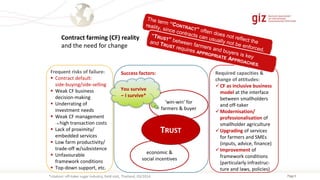
Success factors:
economic &
social incentives
‘win-win’ for
farmers & buyer
TRUST
Frequent risks of failure:
 Contract default:
side-buying/side-selling
 Weak CF business
decision-making
 Underrating of
investment needs
 Weak CF management
 high transaction costs
 Lack of proximity/
embedded services
 Low farm productivity/
trade-off w/subsistence
 Unfavourable
framework conditions
 Top-down support, etc.
Required capacities &
change of attitudes:
CF as inclusive business
model at the interface
between smallholders
and off-taker
Modernisation/
professionalisation of
smallholder agriculture
Upgrading of services
for farmers and SMEs
(inputs, advice, finance)
Improvement of
framework conditions
(particularly infrastruc-
ture and laws, policies)
You survive
– I survive*
*citation: off-taker sugar industry, field visit, Thailand, 03/2014
Contract farming (CF) reality
and the need for change
Page 6
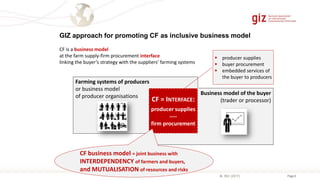
Business model of the buyer
(trader or processor)
CF is a business model
at the farm supply-firm procurement interface
linking the buyer’s strategy with the suppliers’ farming systems
Farming systems of producers
or business model
of producer organisations
CF = INTERFACE:
producer supplies
----
firm procurement
GIZ approach for promoting CF as inclusive business model
CF business model = joint business with
INTERDEPENDENCY of farmers and buyers,
and MUTUALISATION of resources and risks
 producer supplies
 buyer procurement
 embedded services of
the buyer to producers
M. Will (2017)
Page 7
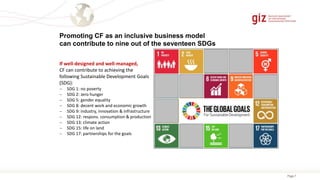
Promoting CF as an inclusive business model
can contribute to nine out of the seventeen SDGs
If well-designed and well-managed,
CF can contribute to achieving the
following Sustainable Development Goals
(SDG):
 SDG 1: no poverty
 SDG 2: zero hunger
 SDG 5: gender equality
 SDG 8: decent work and economic growth
 SDG 9: industry, innovation & infrastructure
 SDG 12: respons. consumption & production
 SDG 13: climate action
 SDG 15: life on land
 SDG 17: partnerships for the goals
Page 88/15
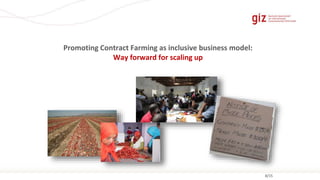
Promoting Contract Farming as inclusive business model:
Way forward for scaling up
Page 99/15
Who has done what so far using the GIZ CF product
Draft concept for scaling-up developed mid-2017, now to be finalised using the results
of:
 Survey of the
engagement and interest in promoting CF in the near future (presented mid-2017):
Questionnaire answered by 37 bilateral, regional, global GIZ projects/ programmes
(23 Africa, 12 Asia, 2 South East Europe)
 Stocktaking of the
experiences in using the GIZ approach (presented today):
In-depth surveys in Ghana, Kenya, Benin and Tunisia
At GIZ headquarters:
 Sector Project Agricultural Policy and Food Security,
 Sector Project Agricultural Trade and Value Chains,
in close collaboration with SNRD Agribusiness and Inclusive Value Chain Development (ABIVCD)
In partner countries (mainly in francophone and anglophone Africa and North Africa):
 GIZ departments involved: Rural Devmt/ Agriculture and Economic Devmt/ Employment
 Diverse project types: bilateral programmes, regional projects, GIAE, develoPPP, ATVET, etc.
 Some 40 trainings of practitioners, trainers and consultants/ coaches realised
 Consultancies/ coaching of CF business models ongoing in several countries
Page 10
Results in brief (1)
Challenges in promoting CF as inclusive business model
Opportunities for promoting CF as inclusive business model
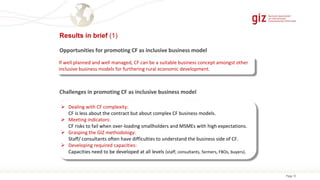
If well planned and well managed, CF can be a suitable business concept amongst other
inclusive business models for furthering rural economic development.
 Dealing with CF complexity:
CF is less about the contract but about complex CF business models.
 Meeting indicators:
CF risks to fail when over-loading smallholders and MSMEs with high expectations.
 Grasping the GIZ methodology:
Staff/ consultants often have difficulties to understand the business side of CF.
 Developing required capacities:
Capacities need to be developed at all levels (staff, consultants, farmers, FBOs, buyers).
Page 11
Survey results mid-2017
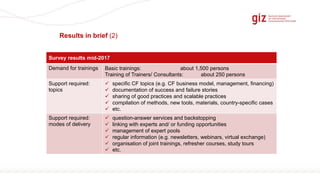
Demand for trainings Basic trainings: about 1,500 persons
Training of Trainers/ Consultants: about 250 persons
Support required:
topics
 specific CF topics (e.g. CF business model, management, financing)
 documentation of success and failure stories
 sharing of good practices and scalable practices
 compilation of methods, new tools, materials, country-specific cases
 etc.
Support required:
modes of delivery
 question-answer services and backstopping
 linking with experts and/ or funding opportunities
 management of expert pools
 regular information (e.g. newsletters, webinars, virtual exchange)
 organisation of joint trainings, refresher courses, study tours
 etc.
Results in brief (2)
Page 1212/15
Results in brief (3)
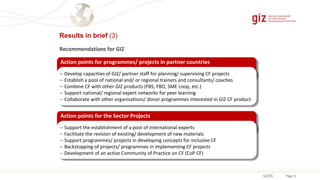
Action points for programmes/ projects in partner countries
 Develop capacities of GIZ/ partner staff for planning/ supervising CF projects
 Establish a pool of national and/ or regional trainers and consultants/ coaches
 Combine CF with other GIZ products (FBS, FBO, SME Loop, etc.)
 Support national/ regional expert networks for peer learning
 Collaborate with other organisations/ donor programmes interested in GIZ CF product
Action points for the Sector Projects
 Support the establishment of a pool of international experts
 Facilitate the revision of existing/ development of new materials
 Support programmes/ projects in developing concepts for inclusive CF
 Backstopping of projects/ programmes in implementing CF projects
 Development of an active Community of Practice on CF (CoP CF)
Recommendations for GIZ
Page 13
Sensitisation of projects and
partner organisations
 Dissemination of the
stocktaking report and fact sheets
 Relaunch of the
Community of Practice on CF (CoP CF)
Pool of international/ regional master
coaches/ consultants
 Training of trainers and consultants (ToTC)
for international experts
(ToTC I and ToTC II in Germany)
 Trainings of regional master trainers/ coaches
(one ToTC cycle in francophone Africa
and one in Anglophone Africa)
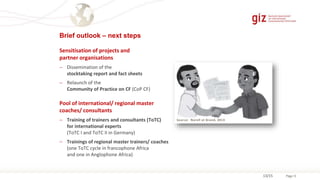
Source: Norell et Brand, 2013
13/15
Brief outlook – next steps
Page 14
Thank you for your attention!
Page 15
Good practices in promoting
Contract Farming
Experiences from Tunisia
Neil Fourati, July 2018
Initiative for the Promotion of Agricultural Value Chains (IPFA)
Page 16
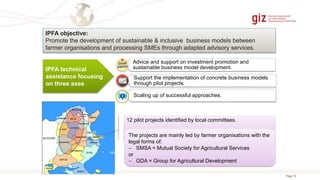
12 pilot projects identified by local committees.
The projects are mainly led by farmer organisations with the
legal forms of:
 SMSA = Mutual Society for Agricultural Services
or
 GDA = Group for Agricultural Development
Advice and support on investment promotion and
sustainable business model development.
Support the implementation of concrete business models
through pilot projects.
Scaling up of successful approaches.
IPFA objective:
Promote the development of sustainable & inclusive business models between
farmer organisations and processing SMEs through adapted advisory services.
IPFA technical
assistance focusing
on three axes
Page 17
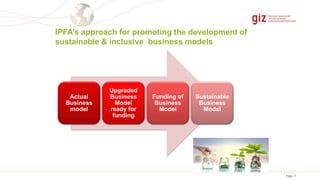
IPFA’s approach for promoting the development of
sustainable & inclusive business models
Actual
Business
model
Upgraded
Business
Model
ready for
funding
Funding of
Business
Model
Sustainable
Business
Model
Page 18
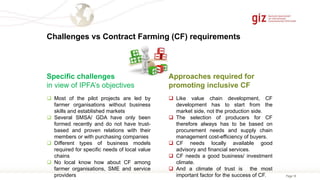
Challenges vs Contract Farming (CF) requirements
Approaches required for
promoting inclusive CF
Specific challenges
in view of IPFA’s objectives
 Most of the pilot projects are led by
farmer organisations without business
skills and established markets
 Several SMSA/ GDA have only been
formed recently and do not have trust-
based and proven relations with their
members or with purchasing companies
 Different types of business models
required for specific needs of local value
chains
 No local know how about CF among
farmer organisations, SME and service
providers
 Like value chain development, CF
development has to start from the
market side, not the production side.
 The selection of producers for CF
therefore always has to be based on
procurement needs and supply chain
management cost-efficiency of buyers.
 CF needs locally available good
advisory and financial services.
 CF needs a good business/ investment
climate.
 And a climate of trust is the most
important factor for the success of CF.
Page 19
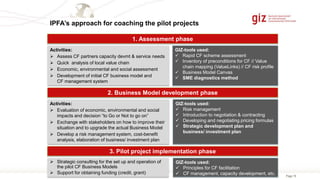
1. Assessment phase
Activities:
 Assess CF partners capacity devmt & service needs
 Quick analysis of local value chain
 Economic, environmental and social assessment
 Development of initial CF business model and
CF management system
GIZ-tools used:
 Rapid CF scheme assessment
 Inventory of preconditions for CF // Value
chain mapping (ValueLinks) // CF risk profile
 Business Model Canvas
 SME diagnostics method
2. Business Model development phase
Activities:
 Evaluation of economic, environmental and social
impacts and decision “to Go or Not to go on”
 Exchange with stakeholders on how to improve their
situation and to upgrade the actual Business Model
 Develop a risk management system, cost-benefit
analysis, elaboration of business/ investment plan
GIZ-tools used:
 Risk management
 Introduction to negotiation & contracting
 Developing and negotiating pricing formulas
 Strategic development plan and
business/ investment plan
3. Pilot project implementation phase
 Strategic consulting for the set up and operation of
the pilot CF Business Models
 Support for obtaining funding (credit, grant)
GIZ-tools used:
 Principles for CF facilitation
 CF management, capacity development, etc.
IPFA’s approach for coaching the pilot projects
Page 20
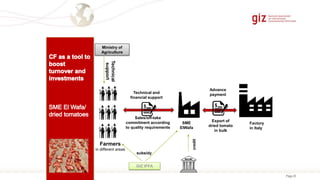
Ministry of
Agriculture
Farmers
in different areas
Technical
support
credit
Advance
payment
Export of
dried tomato
in bulk
Factory
in Italy
Technical and
financial support
Sales/off-take
commitment according
to quality requirements
GIZ IPFA
subsidy
SME
ElWafa
Page 21
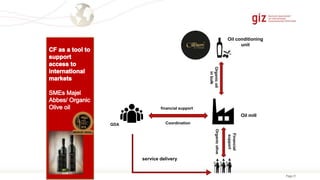
service delivery
financial support
CoordinationGDA
Oil mill
Oil conditioning
unit
Financial
support
OrganicoliveOrganicoil
inbulk
Page 22
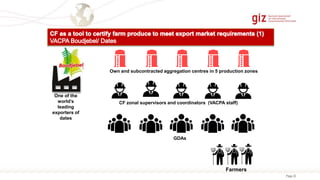
Own and subcontracted aggregation centres in 5 production zones
Farmers
One of the
world’s
leading
exporters of
dates
CF zonal supervisors and coordinators (VACPA staff)
GDAs
Page 23
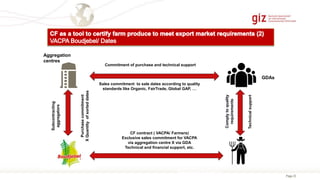
Subcontracting
aggregators
Purchasecommitment
XQuantityofsorteddates
Commitment of purchase and technical support
CF contract ( VACPA/ Farmers)
Exclusive sales commitment for VACPA
via aggregation centre X via GDA
Technical and financial support, etc.
Organismes financiers
Sales commitment to sale dates according to quality
standards like Organic, FairTrade, Global GAP, …
Complytoquality
requirements
Technicalsupport
GDAs
Aggregation
centres
Page 24
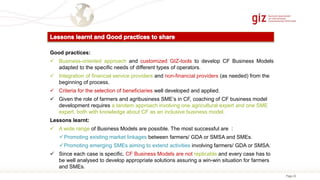
Good practices:
 Business-oriented approach and customized GIZ-tools to develop CF Business Models
adapted to the specific needs of different types of operators.
 Integration of financial service providers and non-financial providers (as needed) from the
beginning of process.
 Criteria for the selection of beneficiaries well developed and applied.
 Given the role of farmers and agribusiness SME’s in CF, coaching of CF business model
development requires a tandem approach involving one agricultural expert and one SME
expert, both with knowledge about CF as an inclusive business model.
Lessons learnt:
 A wide range of Business Models are possible. The most successful are :
Promoting existing market linkages between farmers/ GDA or SMSA and SMEs.
Promoting emerging SMEs aiming to extend activities involving farmers/ GDA or SMSA.
 Since each case is specific, CF Business Models are not replicable and every case has to
be well analysed to develop appropriate solutions assuring a win-win situation for farmers
and SMEs.
Page 25
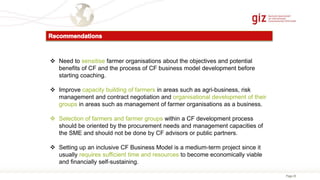
 Need to sensitise farmer organisations about the objectives and potential
benefits of CF and the process of CF business model development before
starting coaching.
 Improve capacity building of farmers in areas such as agri-business, risk
management and contract negotiation and organisational development of their
groups in areas such as management of farmer organisations as a business.
 Selection of farmers and farmer groups within a CF development process
should be oriented by the procurement needs and management capacities of
the SME and should not be done by CF advisors or public partners.
 Setting up an inclusive CF Business Model is a medium-term project since it
usually requires sufficient time and resources to become economically viable
and financially self-sustaining.
Page 26Contract Farming Promotion in Malawi05/09/2018
Implemented by
Promoting Inclusive Contract Farming in Malawi
experiences from technical cooperation –
consolidating and scaling up support
Expert Talk: Contract farming as inclusive business model for African smallholder
farmers: results from recent stocktaking
KULIMA More Income and Employment in Rural Areas of Malawi
Paul Cronjaeger, Advisor
10th July 2018
GIZ, Bonn
Page 27
Overview
Contract Farming Promotion in Malawi05.09.2018
 Background to Malawi
 Contract Farming in Malawi
 GIZ support to promote Contract Farming as an
Inclusive Business Model (IBM)
 Lessons learnt and good practices:
The example of two contract farming business
models operated by Exagris
 Way forward:
The Inclusive Business (IB) Advisory Facility
Page 28
Malawi
Contract Farming Promotion in Malawi05.09.2018
 ~18m population, landlocked, presidential
democracy, one of the poorest countries in
the world (170th out of 188 in the HDI)
 Most important export goods and forex
earners: tobacco (60%), tea (6%),
sugarcane (6%)
 ~80% of the population are smallholder
farmers relying mostly on subsistence
farming
 Typical smallholder crops are maize,
cassava, beans, groundnuts, soya,
irish/sweet potato, tobacco
Page 29
Contract Farming (CF) in Malawi
Contract Farming Promotion in Malawi05.09.2018
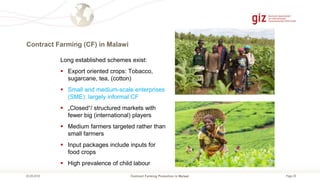
Long established schemes exist:
 Export oriented crops: Tobacco,
sugarcane, tea, (cotton)
 Small and medium-scale enterprises
(SME): largely informal CF
 „Closed“/ structured markets with
fewer big (international) players
 Medium farmers targeted rather than
small farmers
 Input packages include inputs for
food crops
 High prevalence of child labour
Page 30
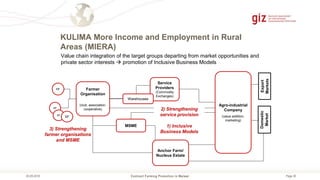
KULIMA More Income and Employment in Rural
Areas (MIERA)
Contract Farming Promotion in Malawi05.09.2018
MF
Domestic
Market
SF
SF
SF
Export
Markets
Service
Providers
(Commodity
Exchanges)
Farmer
Organisation
(club, association,
cooperative)
1) Inclusive
Business Models
3) Strengthening
farmer organisations
and MSME
Agro-industrial
Company
(value addition,
marketing)
MSME
Warehouses
Anchor Farm/
Nucleus Estate
2) Strengthening
service provision
Value chain integration of the target groups departing from market opportunities and
private sector interests  promotion of Inclusive Business Models
Page 31
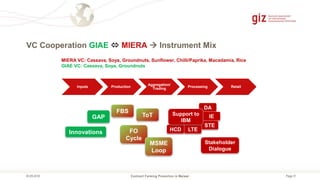
VC Cooperation GIAE  MIERA  Instrument Mix
Contract Farming Promotion in Malawi05.09.2018
Inputs Production
Aggregation/
Trading
Processing Retail
GAP
Innovations
FBS
FO
Cycle
Stakeholder
Dialogue
ToT
DA
IE
STE
LTEHCD
MIERA VC: Cassava, Soya, Groundnuts, Sunflower, Chilli/Paprika, Macadamia, Rice
GIAE VC: Cassava, Soya, Groundnuts
MSME
Loop
Support to
IBM
Page 32
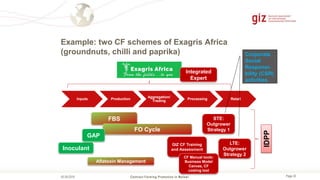
Example: two CF schemes of Exagris Africa
(groundnuts, chilli and paprika)
Contract Farming Promotion in Malawi05.09.2018
Inputs Production
Aggregation/
Trading
Processing Retail
Integrated
Expert
FBS
FO Cycle
Aflatoxin Management
Inoculant
STE:
Outgrower
Strategy 1
IDPP
GIZ CF Training
and Assessment
LTE:
Outgrower
Strategy 2
CF Manual tools:
Business Model
Canvas, CF
costing tool
GAP
Corporate
Social
Responsi-
bility (CSR)
activities
Page 33Contract Farming Promotion in Malawi05.09.2018
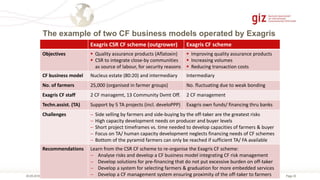
The example of two CF business models operated by Exagris
Exagris CSR CF scheme (outgrower) Exagris CF scheme
Objectives  Quality assurance products (Aflatoxin)
 CSR to integrate close-by communities
as source of labour, for security reasons
 Improving quality assurance products
 Increasing volumes
 Reducing transaction costs
CF business model Nucleus estate (80:20) and intermediary Intermediary
No. of farmers 25,000 (organised in farmer groups) No. fluctuating due to weak bonding
Exagris CF staff 2 CF managemt, 13 Community Dvmt Off. 2 CF management
Techn.assist. (TA) Support by 5 TA projects (incl. develoPPP) Exagris own funds/ financing thru banks
Challenges  Side selling by farmers and side-buying by the off-taker are the greatest risks
 High capacity development needs on producer and buyer levels
 Short project timeframes vs. time needed to develop capacities of farmers & buyer
 Focus on TA/ human capacity development neglects financing needs of CF schemes
 Bottom of the pyramid farmers can only be reached if sufficient TA/ FA available
Recommendations Learn from the CSR CF scheme to re-organise the Exagris CF scheme:
 Analyse risks and develop a CF business model integrating CF risk management
 Develop solutions for pre-financing that do not put excessive burden on off-taker
 Develop a system for selecting farmers & graduation for more embedded services
 Develop a CF management system ensuring proximity of the off-taker to farmers
Page 34
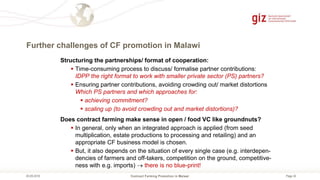
Further challenges of CF promotion in Malawi
Contract Farming Promotion in Malawi05.09.2018
Structuring the partnerships/ format of cooperation:
 Time-consuming process to discuss/ formalise partner contributions:
IDPP the right format to work with smaller private sector (PS) partners?
 Ensuring partner contributions, avoiding crowding out/ market distortions
Which PS partners and which approaches for:
 achieving commitment?
 scaling up (to avoid crowding out and market distortions)?
Does contract farming make sense in open / food VC like groundnuts?
 In general, only when an integrated approach is applied (from seed
multiplication, estate productions to processing and retailing) and an
appropriate CF business model is chosen.
 But, it also depends on the situation of every single case (e.g. interdepen-
dencies of farmers and off-takers, competition on the ground, competitive-
ness with e.g. imports)  there is no blue-print!
Page 35
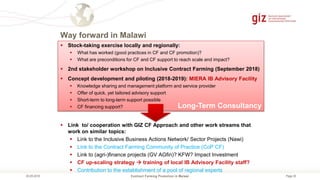
Long-Term Consultancy
Way forward in Malawi
Contract Farming Promotion in Malawi05.09.2018
 Stock-taking exercise locally and regionally:
 What has worked (good practices in CF and CF promotion)?
 What are preconditions for CF and CF support to reach scale and impact?
 2nd stakeholder workshop on Inclusive Contract Farming (September 2018)
 Concept development and piloting (2018-2019): MIERA IB Advisory Facility
 Knowledge sharing and management platform and service provider
 Offer of quick, yet tailored advisory support
 Short-term to long-term support possible
 CF financing support?
 Link to/ cooperation with GIZ CF Approach and other work streams that
work on similar topics:
 Link to the Inclusive Business Actions Network/ Sector Projects (Nawi)
 Link to the Contract Farming Community of Practice (CoP CF)
 Link to (agri-)finance projects (GV AGfin)? KFW? Impact Investment
 CF up-scaling strategy  training of local IB Advisory Facility staff?
 Contribution to the establishment of a pool of regional experts
Page 36
Thank you! Zikomo Kwambiri! Vielen Dank!
Contract Farming Promotion in Malawi05.09.2018

Contract Farming as an Inclusive Business Model for African Smallholder Farmers

  • 1.
    Page 1 GIZ Bonn,10th of July 2018 Sector Project ‘Agricultural Trade and Value Chains’ Heike Höffler, GIZ, Germany – heike.hoeffler@giz.de Katharina Schlemper, GIZ, Germany – katharina.schlemper@giz.de Sector Project ‘Agricultural Policies and Food Security’ Ousmane Djibo, GIZ, Germany – ousmane.djibo@giz.de Petra Windisch-Stumpf, GIZ, Germany – petra.windisch@giz.de Expert Talk ‘Contract farming as inclusive business model for African smallholder farmers: Results from recent stocktaking’
  • 2.
    Page 2 Programme Part IPresentation of learnings from stocktaking on contract farming (report 2018) 13:00 – 13:10 Word of Welcome Gerd Fleischer Heike Hoeffler 13:10 – 14:15 ‘Promoting Contract Farming (CF) as inclusive business model: Way forward for scaling up’ Contract Farming in selected partner countries - Experiences and need for support • ‘Good practices and experiences in Contract Farming in Tunisia’, Initiative for Agricultural Value Chains (IFPA), GIZ Tunisia • ‘Promoting Inclusive Contract Farming in Malawi: experiences from technical cooperation – consolidating and scaling up support’, More Income and Employment in Rural Areas of Malawi (KULIMA MIERA), GIZ Malawi Margret Will Katharina Schlemper Dr. Martin Baumgart Neil Fourati Paul Cronjaeger Part II What next? Scaling-up contract farming 14.15 – 15:00 Open discussion to identify:  Scaling-up: Opportunities and challenges  Next steps Wrap-up Katharina Schlemper Carolin Voigt
  • 3.
    Page 3 Contract farmingas inclusive business model for African smallholder farmers: Way forward for scaling up Bonn, 10th of July 2018 Margret Will, Katharina Schlemper and Dr. Martin Baumgart
  • 4.
    Page 4 Introduction tothe GIZ methodology for promoting Contract Farming as inclusive business model
  • 5.
    Page 5 Success factors: economic& social incentives ‘win-win’ for farmers & buyer TRUST Frequent risks of failure:  Contract default: side-buying/side-selling  Weak CF business decision-making  Underrating of investment needs  Weak CF management  high transaction costs  Lack of proximity/ embedded services  Low farm productivity/ trade-off w/subsistence  Unfavourable framework conditions  Top-down support, etc. Required capacities & change of attitudes: CF as inclusive business model at the interface between smallholders and off-taker Modernisation/ professionalisation of smallholder agriculture Upgrading of services for farmers and SMEs (inputs, advice, finance) Improvement of framework conditions (particularly infrastruc- ture and laws, policies) You survive – I survive* *citation: off-taker sugar industry, field visit, Thailand, 03/2014 Contract farming (CF) reality and the need for change
  • 6.
    Page 6 Business modelof the buyer (trader or processor) CF is a business model at the farm supply-firm procurement interface linking the buyer’s strategy with the suppliers’ farming systems Farming systems of producers or business model of producer organisations CF = INTERFACE: producer supplies ---- firm procurement GIZ approach for promoting CF as inclusive business model CF business model = joint business with INTERDEPENDENCY of farmers and buyers, and MUTUALISATION of resources and risks  producer supplies  buyer procurement  embedded services of the buyer to producers M. Will (2017)
  • 7.
    Page 7 Promoting CFas an inclusive business model can contribute to nine out of the seventeen SDGs If well-designed and well-managed, CF can contribute to achieving the following Sustainable Development Goals (SDG):  SDG 1: no poverty  SDG 2: zero hunger  SDG 5: gender equality  SDG 8: decent work and economic growth  SDG 9: industry, innovation & infrastructure  SDG 12: respons. consumption & production  SDG 13: climate action  SDG 15: life on land  SDG 17: partnerships for the goals
  • 8.
    Page 88/15 Promoting ContractFarming as inclusive business model: Way forward for scaling up
  • 9.
    Page 99/15 Who hasdone what so far using the GIZ CF product Draft concept for scaling-up developed mid-2017, now to be finalised using the results of:  Survey of the engagement and interest in promoting CF in the near future (presented mid-2017): Questionnaire answered by 37 bilateral, regional, global GIZ projects/ programmes (23 Africa, 12 Asia, 2 South East Europe)  Stocktaking of the experiences in using the GIZ approach (presented today): In-depth surveys in Ghana, Kenya, Benin and Tunisia At GIZ headquarters:  Sector Project Agricultural Policy and Food Security,  Sector Project Agricultural Trade and Value Chains, in close collaboration with SNRD Agribusiness and Inclusive Value Chain Development (ABIVCD) In partner countries (mainly in francophone and anglophone Africa and North Africa):  GIZ departments involved: Rural Devmt/ Agriculture and Economic Devmt/ Employment  Diverse project types: bilateral programmes, regional projects, GIAE, develoPPP, ATVET, etc.  Some 40 trainings of practitioners, trainers and consultants/ coaches realised  Consultancies/ coaching of CF business models ongoing in several countries
  • 10.
    Page 10 Results inbrief (1) Challenges in promoting CF as inclusive business model Opportunities for promoting CF as inclusive business model If well planned and well managed, CF can be a suitable business concept amongst other inclusive business models for furthering rural economic development.  Dealing with CF complexity: CF is less about the contract but about complex CF business models.  Meeting indicators: CF risks to fail when over-loading smallholders and MSMEs with high expectations.  Grasping the GIZ methodology: Staff/ consultants often have difficulties to understand the business side of CF.  Developing required capacities: Capacities need to be developed at all levels (staff, consultants, farmers, FBOs, buyers).
  • 11.
    Page 11 Survey resultsmid-2017 Demand for trainings Basic trainings: about 1,500 persons Training of Trainers/ Consultants: about 250 persons Support required: topics  specific CF topics (e.g. CF business model, management, financing)  documentation of success and failure stories  sharing of good practices and scalable practices  compilation of methods, new tools, materials, country-specific cases  etc. Support required: modes of delivery  question-answer services and backstopping  linking with experts and/ or funding opportunities  management of expert pools  regular information (e.g. newsletters, webinars, virtual exchange)  organisation of joint trainings, refresher courses, study tours  etc. Results in brief (2)
  • 12.
    Page 1212/15 Results inbrief (3) Action points for programmes/ projects in partner countries  Develop capacities of GIZ/ partner staff for planning/ supervising CF projects  Establish a pool of national and/ or regional trainers and consultants/ coaches  Combine CF with other GIZ products (FBS, FBO, SME Loop, etc.)  Support national/ regional expert networks for peer learning  Collaborate with other organisations/ donor programmes interested in GIZ CF product Action points for the Sector Projects  Support the establishment of a pool of international experts  Facilitate the revision of existing/ development of new materials  Support programmes/ projects in developing concepts for inclusive CF  Backstopping of projects/ programmes in implementing CF projects  Development of an active Community of Practice on CF (CoP CF) Recommendations for GIZ
  • 13.
    Page 13 Sensitisation ofprojects and partner organisations  Dissemination of the stocktaking report and fact sheets  Relaunch of the Community of Practice on CF (CoP CF) Pool of international/ regional master coaches/ consultants  Training of trainers and consultants (ToTC) for international experts (ToTC I and ToTC II in Germany)  Trainings of regional master trainers/ coaches (one ToTC cycle in francophone Africa and one in Anglophone Africa) Source: Norell et Brand, 2013 13/15 Brief outlook – next steps
  • 14.
    Page 14 Thank youfor your attention!
  • 15.
    Page 15 Good practicesin promoting Contract Farming Experiences from Tunisia Neil Fourati, July 2018 Initiative for the Promotion of Agricultural Value Chains (IPFA)
  • 16.
    Page 16 12 pilotprojects identified by local committees. The projects are mainly led by farmer organisations with the legal forms of:  SMSA = Mutual Society for Agricultural Services or  GDA = Group for Agricultural Development Advice and support on investment promotion and sustainable business model development. Support the implementation of concrete business models through pilot projects. Scaling up of successful approaches. IPFA objective: Promote the development of sustainable & inclusive business models between farmer organisations and processing SMEs through adapted advisory services. IPFA technical assistance focusing on three axes
  • 17.
    Page 17 IPFA’s approachfor promoting the development of sustainable & inclusive business models Actual Business model Upgraded Business Model ready for funding Funding of Business Model Sustainable Business Model
  • 18.
    Page 18 Challenges vsContract Farming (CF) requirements Approaches required for promoting inclusive CF Specific challenges in view of IPFA’s objectives  Most of the pilot projects are led by farmer organisations without business skills and established markets  Several SMSA/ GDA have only been formed recently and do not have trust- based and proven relations with their members or with purchasing companies  Different types of business models required for specific needs of local value chains  No local know how about CF among farmer organisations, SME and service providers  Like value chain development, CF development has to start from the market side, not the production side.  The selection of producers for CF therefore always has to be based on procurement needs and supply chain management cost-efficiency of buyers.  CF needs locally available good advisory and financial services.  CF needs a good business/ investment climate.  And a climate of trust is the most important factor for the success of CF.
  • 19.
    Page 19 1. Assessmentphase Activities:  Assess CF partners capacity devmt & service needs  Quick analysis of local value chain  Economic, environmental and social assessment  Development of initial CF business model and CF management system GIZ-tools used:  Rapid CF scheme assessment  Inventory of preconditions for CF // Value chain mapping (ValueLinks) // CF risk profile  Business Model Canvas  SME diagnostics method 2. Business Model development phase Activities:  Evaluation of economic, environmental and social impacts and decision “to Go or Not to go on”  Exchange with stakeholders on how to improve their situation and to upgrade the actual Business Model  Develop a risk management system, cost-benefit analysis, elaboration of business/ investment plan GIZ-tools used:  Risk management  Introduction to negotiation & contracting  Developing and negotiating pricing formulas  Strategic development plan and business/ investment plan 3. Pilot project implementation phase  Strategic consulting for the set up and operation of the pilot CF Business Models  Support for obtaining funding (credit, grant) GIZ-tools used:  Principles for CF facilitation  CF management, capacity development, etc. IPFA’s approach for coaching the pilot projects
  • 20.
    Page 20 Ministry of Agriculture Farmers indifferent areas Technical support credit Advance payment Export of dried tomato in bulk Factory in Italy Technical and financial support Sales/off-take commitment according to quality requirements GIZ IPFA subsidy SME ElWafa
  • 21.
    Page 21 service delivery financialsupport CoordinationGDA Oil mill Oil conditioning unit Financial support OrganicoliveOrganicoil inbulk
  • 22.
    Page 22 Own andsubcontracted aggregation centres in 5 production zones Farmers One of the world’s leading exporters of dates CF zonal supervisors and coordinators (VACPA staff) GDAs
  • 23.
    Page 23 Subcontracting aggregators Purchasecommitment XQuantityofsorteddates Commitment ofpurchase and technical support CF contract ( VACPA/ Farmers) Exclusive sales commitment for VACPA via aggregation centre X via GDA Technical and financial support, etc. Organismes financiers Sales commitment to sale dates according to quality standards like Organic, FairTrade, Global GAP, … Complytoquality requirements Technicalsupport GDAs Aggregation centres
  • 24.
    Page 24 Good practices: Business-oriented approach and customized GIZ-tools to develop CF Business Models adapted to the specific needs of different types of operators.  Integration of financial service providers and non-financial providers (as needed) from the beginning of process.  Criteria for the selection of beneficiaries well developed and applied.  Given the role of farmers and agribusiness SME’s in CF, coaching of CF business model development requires a tandem approach involving one agricultural expert and one SME expert, both with knowledge about CF as an inclusive business model. Lessons learnt:  A wide range of Business Models are possible. The most successful are : Promoting existing market linkages between farmers/ GDA or SMSA and SMEs. Promoting emerging SMEs aiming to extend activities involving farmers/ GDA or SMSA.  Since each case is specific, CF Business Models are not replicable and every case has to be well analysed to develop appropriate solutions assuring a win-win situation for farmers and SMEs.
  • 25.
    Page 25  Needto sensitise farmer organisations about the objectives and potential benefits of CF and the process of CF business model development before starting coaching.  Improve capacity building of farmers in areas such as agri-business, risk management and contract negotiation and organisational development of their groups in areas such as management of farmer organisations as a business.  Selection of farmers and farmer groups within a CF development process should be oriented by the procurement needs and management capacities of the SME and should not be done by CF advisors or public partners.  Setting up an inclusive CF Business Model is a medium-term project since it usually requires sufficient time and resources to become economically viable and financially self-sustaining.
  • 26.
    Page 26Contract FarmingPromotion in Malawi05/09/2018 Implemented by Promoting Inclusive Contract Farming in Malawi experiences from technical cooperation – consolidating and scaling up support Expert Talk: Contract farming as inclusive business model for African smallholder farmers: results from recent stocktaking KULIMA More Income and Employment in Rural Areas of Malawi Paul Cronjaeger, Advisor 10th July 2018 GIZ, Bonn
  • 27.
    Page 27 Overview Contract FarmingPromotion in Malawi05.09.2018  Background to Malawi  Contract Farming in Malawi  GIZ support to promote Contract Farming as an Inclusive Business Model (IBM)  Lessons learnt and good practices: The example of two contract farming business models operated by Exagris  Way forward: The Inclusive Business (IB) Advisory Facility
  • 28.
    Page 28 Malawi Contract FarmingPromotion in Malawi05.09.2018  ~18m population, landlocked, presidential democracy, one of the poorest countries in the world (170th out of 188 in the HDI)  Most important export goods and forex earners: tobacco (60%), tea (6%), sugarcane (6%)  ~80% of the population are smallholder farmers relying mostly on subsistence farming  Typical smallholder crops are maize, cassava, beans, groundnuts, soya, irish/sweet potato, tobacco
  • 29.
    Page 29 Contract Farming(CF) in Malawi Contract Farming Promotion in Malawi05.09.2018 Long established schemes exist:  Export oriented crops: Tobacco, sugarcane, tea, (cotton)  Small and medium-scale enterprises (SME): largely informal CF  „Closed“/ structured markets with fewer big (international) players  Medium farmers targeted rather than small farmers  Input packages include inputs for food crops  High prevalence of child labour
  • 30.
    Page 30 KULIMA MoreIncome and Employment in Rural Areas (MIERA) Contract Farming Promotion in Malawi05.09.2018 MF Domestic Market SF SF SF Export Markets Service Providers (Commodity Exchanges) Farmer Organisation (club, association, cooperative) 1) Inclusive Business Models 3) Strengthening farmer organisations and MSME Agro-industrial Company (value addition, marketing) MSME Warehouses Anchor Farm/ Nucleus Estate 2) Strengthening service provision Value chain integration of the target groups departing from market opportunities and private sector interests  promotion of Inclusive Business Models
  • 31.
    Page 31 VC CooperationGIAE  MIERA  Instrument Mix Contract Farming Promotion in Malawi05.09.2018 Inputs Production Aggregation/ Trading Processing Retail GAP Innovations FBS FO Cycle Stakeholder Dialogue ToT DA IE STE LTEHCD MIERA VC: Cassava, Soya, Groundnuts, Sunflower, Chilli/Paprika, Macadamia, Rice GIAE VC: Cassava, Soya, Groundnuts MSME Loop Support to IBM
  • 32.
    Page 32 Example: twoCF schemes of Exagris Africa (groundnuts, chilli and paprika) Contract Farming Promotion in Malawi05.09.2018 Inputs Production Aggregation/ Trading Processing Retail Integrated Expert FBS FO Cycle Aflatoxin Management Inoculant STE: Outgrower Strategy 1 IDPP GIZ CF Training and Assessment LTE: Outgrower Strategy 2 CF Manual tools: Business Model Canvas, CF costing tool GAP Corporate Social Responsi- bility (CSR) activities
  • 33.
    Page 33Contract FarmingPromotion in Malawi05.09.2018 The example of two CF business models operated by Exagris Exagris CSR CF scheme (outgrower) Exagris CF scheme Objectives  Quality assurance products (Aflatoxin)  CSR to integrate close-by communities as source of labour, for security reasons  Improving quality assurance products  Increasing volumes  Reducing transaction costs CF business model Nucleus estate (80:20) and intermediary Intermediary No. of farmers 25,000 (organised in farmer groups) No. fluctuating due to weak bonding Exagris CF staff 2 CF managemt, 13 Community Dvmt Off. 2 CF management Techn.assist. (TA) Support by 5 TA projects (incl. develoPPP) Exagris own funds/ financing thru banks Challenges  Side selling by farmers and side-buying by the off-taker are the greatest risks  High capacity development needs on producer and buyer levels  Short project timeframes vs. time needed to develop capacities of farmers & buyer  Focus on TA/ human capacity development neglects financing needs of CF schemes  Bottom of the pyramid farmers can only be reached if sufficient TA/ FA available Recommendations Learn from the CSR CF scheme to re-organise the Exagris CF scheme:  Analyse risks and develop a CF business model integrating CF risk management  Develop solutions for pre-financing that do not put excessive burden on off-taker  Develop a system for selecting farmers & graduation for more embedded services  Develop a CF management system ensuring proximity of the off-taker to farmers
  • 34.
    Page 34 Further challengesof CF promotion in Malawi Contract Farming Promotion in Malawi05.09.2018 Structuring the partnerships/ format of cooperation:  Time-consuming process to discuss/ formalise partner contributions: IDPP the right format to work with smaller private sector (PS) partners?  Ensuring partner contributions, avoiding crowding out/ market distortions Which PS partners and which approaches for:  achieving commitment?  scaling up (to avoid crowding out and market distortions)? Does contract farming make sense in open / food VC like groundnuts?  In general, only when an integrated approach is applied (from seed multiplication, estate productions to processing and retailing) and an appropriate CF business model is chosen.  But, it also depends on the situation of every single case (e.g. interdepen- dencies of farmers and off-takers, competition on the ground, competitive- ness with e.g. imports)  there is no blue-print!
  • 35.
    Page 35 Long-Term Consultancy Wayforward in Malawi Contract Farming Promotion in Malawi05.09.2018  Stock-taking exercise locally and regionally:  What has worked (good practices in CF and CF promotion)?  What are preconditions for CF and CF support to reach scale and impact?  2nd stakeholder workshop on Inclusive Contract Farming (September 2018)  Concept development and piloting (2018-2019): MIERA IB Advisory Facility  Knowledge sharing and management platform and service provider  Offer of quick, yet tailored advisory support  Short-term to long-term support possible  CF financing support?  Link to/ cooperation with GIZ CF Approach and other work streams that work on similar topics:  Link to the Inclusive Business Actions Network/ Sector Projects (Nawi)  Link to the Contract Farming Community of Practice (CoP CF)  Link to (agri-)finance projects (GV AGfin)? KFW? Impact Investment  CF up-scaling strategy  training of local IB Advisory Facility staff?  Contribution to the establishment of a pool of regional experts
  • 36.
    Page 36 Thank you!Zikomo Kwambiri! Vielen Dank! Contract Farming Promotion in Malawi05.09.2018

Editor's Notes

  • #17 In the North and center west of Tunisia which is an agricultural region but without enough added value in food processing
  • #18 step to reach the goal
  • #20 technical tools used by IPFA
  • #21 A young entrepreneur in Jandouba start’s a project to export dried tomatoes with an investment of 47 k€ and a FC with two local farmers on 1,5 ha. Contractred farmers with the SMES increased from 2 (2013), 6 (2016) to 16 ( 2017) up to 26 (2018) Centralized model , Wafa SARL give farmers technical and financial support along Tomates season In 2018, The companies is starting a new investment of 200 k€ to produce 300 Tones of dried tomatoes (X 3) and signed FC with 26 farmers to exploit 50 Ha
  • #22 A young entrepreneur in Jandouba start’s a project to export dried tomatoes with an investment of 47 k€ and a FC with two local farmers on 1,5 ha. Contractred farmers with the SMES increased from 2 (2013), 6 (2016) to 16 ( 2017) up to 26 (2018) Centralized model , Wafa SARL give farmers technical and financial support along Tomates season In 2018, The companies is starting a new investment of 200 k€ to produce 300 Tones of dried tomatoes (X 3) and signed FC with 26 farmers to exploit 50 Ha
  • #26 The advisory Mission was done in 9 menths
  • #31 Add slide on MIERA?
  • #33 INFO on EXAGRIS: Established in 2008, Exagris Africa Ltd. is one of the largest cropping and livestock businesses in Malawi, committed to the development of a multi-generational business that makes a meaningful difference to people and the environment. Exagris farms around 7,000 hectares on 14 estates, and specializes in seed production, export crops and agro-processing. 12 estates are fully operational cultivating on a cumulative 3,300 hectares out of the total 6,000 hectares. The farms are located in Mangochi, Salima, Lilongwe, Mchinji, Mzimba and Rumphi. A dynamic outgrower programme focuses on paprika, chillies and groundnuts. This involves around 15,000 smallholders from all three regions across Malawi. Furthermore, Exagris has invested in a peanut processing and export business called AfriNut and has a shareholding in Valid Nutrition, which further strengthens its presence in the groundnut value chain. Exagris´ mission statement is explicit on its intentions towards working with smallholder communities: ‘To be leaders in sustainable and innovative agriculture in Malawi and provide opportunities for farming communities’. This in turn is reflected further in its ‘triple bottom line’ based company strategy: Exagris seeks to find ways of engaging successfully with farming communities, and a wide range of stakeholders, to promote economic and social growth. Exagris, through its Development Services Unit (DSU) and outgrower programme is currently working with a total of 15,000 smallholder farmers and is geared to increase to 25,000 by 2020. The three crops promoted under its outgrower programme are groundnuts, birds’ eye chilies and paprika. Through this programme the smallholder farmers are encouraged to engage in market based agriculture. However, through the Development Services Unit the smallholder farmers are supported to engage in overall participatory community development including cultivation of food security crops that the company does not buy. In this regard the smallholder farmers are taken through the entire value chain of those crops from production through processing and marketing. As a way of training the smallholder farmers in Good Agricultural Practices (GAP), the smallholder farmers are trained through demonstrations plots and also beyond the demonstrations. On each of the farms a total of 5 hectares are allocated to the smallholder farmers for their training. The produce realized from these 5 hectares is shared by the smallholder farmers to be used for seed in their own farms in the subsequent season. More demonstrations are also established in the Lead Farmers fields in the community. Short training sessions and field days are organized at different stages of the season to impart specific skills to the smallholder farmers. Exagris is mainly using the lead-farmer approach in its extension services. Buying is mainly done from individuals which currently incurs high transaction costs for small amounts of produce. Working with better organised, well-managed groups could increase efficiency and reduce these costs. Through stronger relationships with contracted farmers and more targeted extension services, quality and efficiency of buying of groundnuts and paprika / chilies could still be improved and in turn improve the income situation of the farmers.