

Department of
  Agribusiness and
 Information System
                             PRESENTER
Faculty of Agriculture
        UPM


                             By: MAMMA SAWANEH
                                   GS31415
                         .
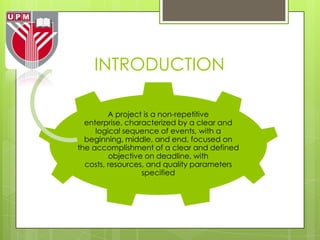
PRESENTATION OUTLINE
Introduction


     Why do some agricultural projects fail and some do not?


          Should we blame the failure and how to reward for the
          success?


               What actions or decisions should be taken?


                    Conclusion
INTRODUCTION

         A project is a non-repetitive
  enterprise, characterized by a clear and
     logical sequence of events, with a
  beginning, middle, and end, focused on
the accomplishment of a clear and defined
         objective on deadline, with
  costs, resources, and quality parameters
                  specified
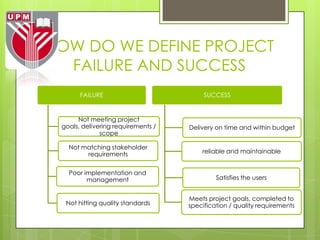
HOW DO WE DEFINE PROJECT
  FAILURE AND SUCCESS
       FAILURE                           SUCCESS


      Not meeting project
 goals, delivering requirements /   Delivery on time and within budget
              scope

   Not matching stakeholder
        requirements                    reliable and maintainable


   Poor implementation and
         management                          Satisfies the users


                                    Meets project goals, completed to
  Not hitting quality standards     specification / quality requirements
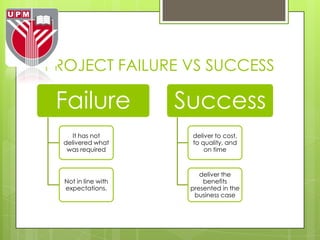
PROJECT FAILURE VS SUCCESS

 Failure             Success
     It has not       deliver to cost,
  delivered what      to quality, and
   was required           on time


                         deliver the
  Not in line with        benefits
  expectations.       presented in the
                       business case
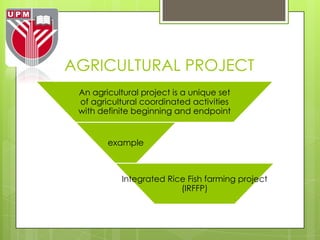
AGRICULTURAL PROJECT
 An agricultural project is a unique set
 of agricultural coordinated activities
 with definite beginning and endpoint


        example


            Integrated Rice Fish farming project
                          (IRFFP)
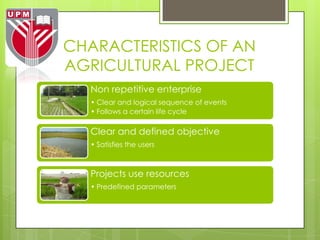
CHARACTERISTICS OF AN
AGRICULTURAL PROJECT
  Non repetitive enterprise
  • Clear and logical sequence of events
  • Follows a certain life cycle

  Clear and defined objective
  • Satisfies the users


  Projects use resources
  • Predefined parameters
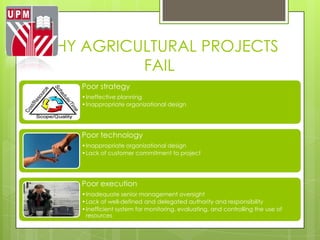
WHY AGRICULTURAL PROJECTS
          FAIL
    Poor strategy
    •Ineffective planning
    •Inappropriate organizational design


    Poor technology
    •Inappropriate organizational design
    •Lack of customer commitment to project


    Poor execution
    •Inadequate senior management oversight
    •Lack of well-defined and delegated authority and responsibility
    •Inefficient system for monitoring, evaluating, and controlling the use of
     resources
SHOULD WE BLAME FOR THE
         FAILURE?

 When   projects get behind schedule
  always find a solution rather than assign
  blame
 Blame should be assigned especially for
  poor strategic and execution of project
  plans.
ACTIONS/DECISIONS
 Insiston the right to select key project
  team members.
 Develop commitment and a sense of
  mission from the outset.
 Coordinate and maintain a good
  relationship with the farmers, government,
  and other stakeholders.
 Have key team members assist in
  decision-making and problem-solving.
ACTIONS/DECISIONS
 Develop  realistic cost, schedule, and
  performance estimates and goals.
 Employ a workable set of project planning
  and control tools.
 Avoid overreliance on one type of control
  tool.
 Give priority to achieving the mission or
  function of the end-item.
 Keep changes under control.
CONCLUSION

In conclusion, applying good strategy, the
    right technology, and good project
     management can ensure that the
organization performs agricultural projects
     that will provide the capacity and
    capabilities that stakeholders need
REWARD FOR SUCCESS
T HANK Y OU
REFERENCES
   http://www.articlesbase.com/training-articles/project-failure-what-
    are-the-reasons-for-and-statistics-on-it-871395.html

   Kerzner, H. (2003). Project Management: A Systems Approach to
    Planning, Scheduling, and Controlling. New York: Wiley, : New York:
    Wiley, .

   Lester, A. (2003). Project Planning and Control Fourth Edition

   Smith, P. (1984). Agricultural project management: monitoring and
    control of implementation Retrieved from
    http://books.google.com.my/books?id=AYftAAAAMAAJ

   Vargas, R. V. (2008). Practical Guide to Project Planning

Agricultural project planning

  • 1.
    Department of Agribusiness and Information System PRESENTER Faculty of Agriculture UPM By: MAMMA SAWANEH GS31415 .
  • 2.
    PRESENTATION OUTLINE Introduction Why do some agricultural projects fail and some do not? Should we blame the failure and how to reward for the success? What actions or decisions should be taken? Conclusion
  • 3.
    INTRODUCTION A project is a non-repetitive enterprise, characterized by a clear and logical sequence of events, with a beginning, middle, and end, focused on the accomplishment of a clear and defined objective on deadline, with costs, resources, and quality parameters specified
  • 4.
    HOW DO WEDEFINE PROJECT FAILURE AND SUCCESS FAILURE SUCCESS Not meeting project goals, delivering requirements / Delivery on time and within budget scope Not matching stakeholder requirements reliable and maintainable Poor implementation and management Satisfies the users Meets project goals, completed to Not hitting quality standards specification / quality requirements
  • 5.
    PROJECT FAILURE VSSUCCESS Failure Success It has not deliver to cost, delivered what to quality, and was required on time deliver the Not in line with benefits expectations. presented in the business case
  • 6.
    AGRICULTURAL PROJECT Anagricultural project is a unique set of agricultural coordinated activities with definite beginning and endpoint example Integrated Rice Fish farming project (IRFFP)
  • 7.
    CHARACTERISTICS OF AN AGRICULTURALPROJECT Non repetitive enterprise • Clear and logical sequence of events • Follows a certain life cycle Clear and defined objective • Satisfies the users Projects use resources • Predefined parameters
  • 8.
    WHY AGRICULTURAL PROJECTS FAIL Poor strategy •Ineffective planning •Inappropriate organizational design Poor technology •Inappropriate organizational design •Lack of customer commitment to project Poor execution •Inadequate senior management oversight •Lack of well-defined and delegated authority and responsibility •Inefficient system for monitoring, evaluating, and controlling the use of resources
  • 9.
    SHOULD WE BLAMEFOR THE FAILURE?  When projects get behind schedule always find a solution rather than assign blame  Blame should be assigned especially for poor strategic and execution of project plans.
  • 10.
    ACTIONS/DECISIONS  Insiston theright to select key project team members.  Develop commitment and a sense of mission from the outset.  Coordinate and maintain a good relationship with the farmers, government, and other stakeholders.  Have key team members assist in decision-making and problem-solving.
  • 11.
    ACTIONS/DECISIONS  Develop realistic cost, schedule, and performance estimates and goals.  Employ a workable set of project planning and control tools.  Avoid overreliance on one type of control tool.  Give priority to achieving the mission or function of the end-item.  Keep changes under control.
  • 12.
    CONCLUSION In conclusion, applyinggood strategy, the right technology, and good project management can ensure that the organization performs agricultural projects that will provide the capacity and capabilities that stakeholders need
  • 13.
  • 14.
  • 15.
    REFERENCES  http://www.articlesbase.com/training-articles/project-failure-what- are-the-reasons-for-and-statistics-on-it-871395.html  Kerzner, H. (2003). Project Management: A Systems Approach to Planning, Scheduling, and Controlling. New York: Wiley, : New York: Wiley, .  Lester, A. (2003). Project Planning and Control Fourth Edition  Smith, P. (1984). Agricultural project management: monitoring and control of implementation Retrieved from http://books.google.com.my/books?id=AYftAAAAMAAJ  Vargas, R. V. (2008). Practical Guide to Project Planning