 The experimental method involves manipulating one variable to determine if changes
in one variable cause changes in other variable.
STEPS:
 Question :
 Ask students to think of any questions they want to answer about the universe or
get them to think about questions they have about a particular topic.
 Hypothesis :
 Hypothesis is proposed explanation made on the basis of limited evidence as a
starting point for further investigation.
 A hypothesis should be a statement that can be tested scientifically.
 At the end of the experiment, look back to see whether the conclusion supports
the hypothesis or not.
 Explanation of hypothesis :
 Depending on their age and ability, students use their prior knowledge to
explain why they have chosen their hypothesis.
 Prediction :
 Prediction is more specific to the experiment.
 A prediction says what will happen in an experiment if the hypothesis is
correct.
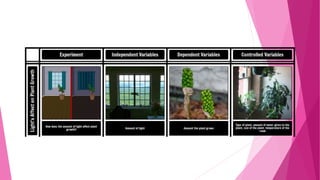
 Identification of variables :
 The three types of variables are dependent, independent and controlled
variable.
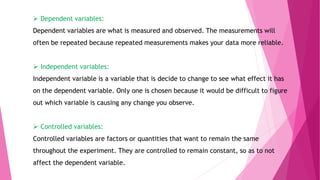
 Dependent variables:
Dependent variables are what is measured and observed. The measurements will
often be repeated because repeated measurements makes your data more reliable.
 Independent variables:
Independent variable is a variable that is decide to change to see what effect it has
on the dependent variable. Only one is chosen because it would be difficult to figure
out which variable is causing any change you observe.
 Controlled variables:
Controlled variables are factors or quantities that want to remain the same
throughout the experiment. They are controlled to remain constant, so as to not
affect the dependent variable.
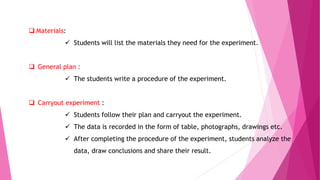
 Materials:
 Students will list the materials they need for the experiment.
 General plan :
 The students write a procedure of the experiment.
 Carryout experiment :
 Students follow their plan and carryout the experiment.
 The data is recorded in the form of table, photographs, drawings etc.
 After completing the procedure of the experiment, students analyze the
data, draw conclusions and share their result.
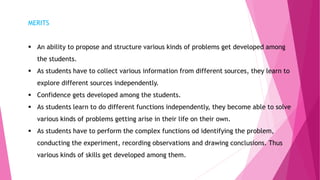
MERITS
 An ability to propose and structure various kinds of problems get developed among
the students.
 As students have to collect various information from different sources, they learn to
explore different sources independently.
 Confidence gets developed among the students.
 As students learn to do different functions independently, they become able to solve
various kinds of problems getting arise in their life on their own.
 As students have to perform the complex functions od identifying the problem,
conducting the experiment, recording observations and drawing conclusions. Thus
various kinds of skills get developed among them.
DEMERITS:
 This method can only be used by the teacher when he has enough time for teaching
purpose.
 Only intelligent and brilliant students can solve out the problem on their own, but
mental capacities of all the students in the same class differ as a result of which this
method can’t be used by teacher to impart education to different students.
 This method can only be used in schools where there is provision of well-equipped
laboratories.
Experimental method

Experimental method

  • 2.
     The experimentalmethod involves manipulating one variable to determine if changes in one variable cause changes in other variable. STEPS:  Question :  Ask students to think of any questions they want to answer about the universe or get them to think about questions they have about a particular topic.  Hypothesis :  Hypothesis is proposed explanation made on the basis of limited evidence as a starting point for further investigation.  A hypothesis should be a statement that can be tested scientifically.  At the end of the experiment, look back to see whether the conclusion supports the hypothesis or not.
  • 3.
     Explanation ofhypothesis :  Depending on their age and ability, students use their prior knowledge to explain why they have chosen their hypothesis.  Prediction :  Prediction is more specific to the experiment.  A prediction says what will happen in an experiment if the hypothesis is correct.  Identification of variables :  The three types of variables are dependent, independent and controlled variable.
  • 4.
     Dependent variables: Dependentvariables are what is measured and observed. The measurements will often be repeated because repeated measurements makes your data more reliable.  Independent variables: Independent variable is a variable that is decide to change to see what effect it has on the dependent variable. Only one is chosen because it would be difficult to figure out which variable is causing any change you observe.  Controlled variables: Controlled variables are factors or quantities that want to remain the same throughout the experiment. They are controlled to remain constant, so as to not affect the dependent variable.
  • 6.
     Materials:  Studentswill list the materials they need for the experiment.  General plan :  The students write a procedure of the experiment.  Carryout experiment :  Students follow their plan and carryout the experiment.  The data is recorded in the form of table, photographs, drawings etc.  After completing the procedure of the experiment, students analyze the data, draw conclusions and share their result.
  • 7.
    MERITS  An abilityto propose and structure various kinds of problems get developed among the students.  As students have to collect various information from different sources, they learn to explore different sources independently.  Confidence gets developed among the students.  As students learn to do different functions independently, they become able to solve various kinds of problems getting arise in their life on their own.  As students have to perform the complex functions od identifying the problem, conducting the experiment, recording observations and drawing conclusions. Thus various kinds of skills get developed among them.
  • 8.
    DEMERITS:  This methodcan only be used by the teacher when he has enough time for teaching purpose.  Only intelligent and brilliant students can solve out the problem on their own, but mental capacities of all the students in the same class differ as a result of which this method can’t be used by teacher to impart education to different students.  This method can only be used in schools where there is provision of well-equipped laboratories.