Classification of research designs
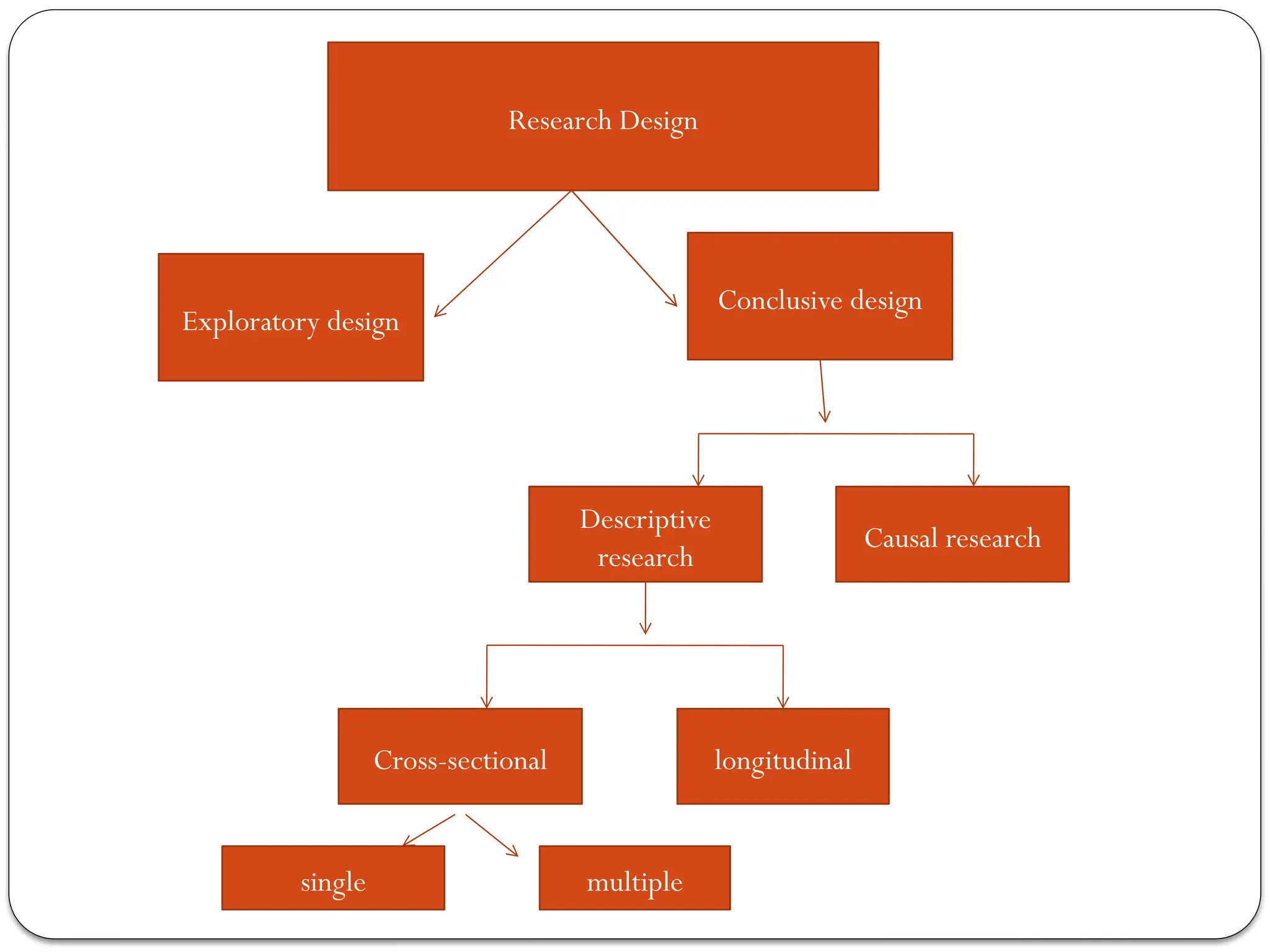
Research Design
Exploratory design
Conclusive design
Descriptive
research
Causal research
Cross-sectional longitudinal
single multiple
Exploratory research design
 Simplest
 Basic objective- to explore and obtain clarity about the
problem
 Flexible
 Secondary and primary data is used
Expert opinion survey
 When there is no previous information or data available on a
topic of research.
 Its formal and structured.
 For example in organic food products study. No secondary
data is available in the domestic Indian market.Therefore
doctors, dieticians as experts could be able to provide
information.
Focus group discussions
 It is a technique originally rooted in sociology and is most
staunchly advocated and used for consumer and motivational
research studies.
 It is an alternate approach to interviewing.
 It is to carry out discussions with individuals associated with
the problem under study.
 Usually the focus group comprises six to ten individuals.
 The selected members discuss the concerned topic for the
duration of 90 minutes to 2 hours.
 A moderator does not participate in the discussion.
 His objective is manage a non-structural and informal
discussion.
Descriptive research designs
 It is more structured and formal.
 As the name implies, the objective of these studies is to
provide a comprehensive and detailed explanation of the
phenomena under study.
 The objective is to give a detailed sketch or profile of the
respondent population being studied.
 Example:- A marketer to design his advertising and sales
promotion campaign for high end watches would require a
holistic profile of the population which buys high end luxury
products.
 Thus a descriptive study, which generates data on who, what,
where, why and how of luxury accessory brand purchase
would be the design necessary to fulfill the research
objectives.
 One drawback of descriptive design is that it lacks the
precision and accuracy of experimental designs
Cross-sectional studies
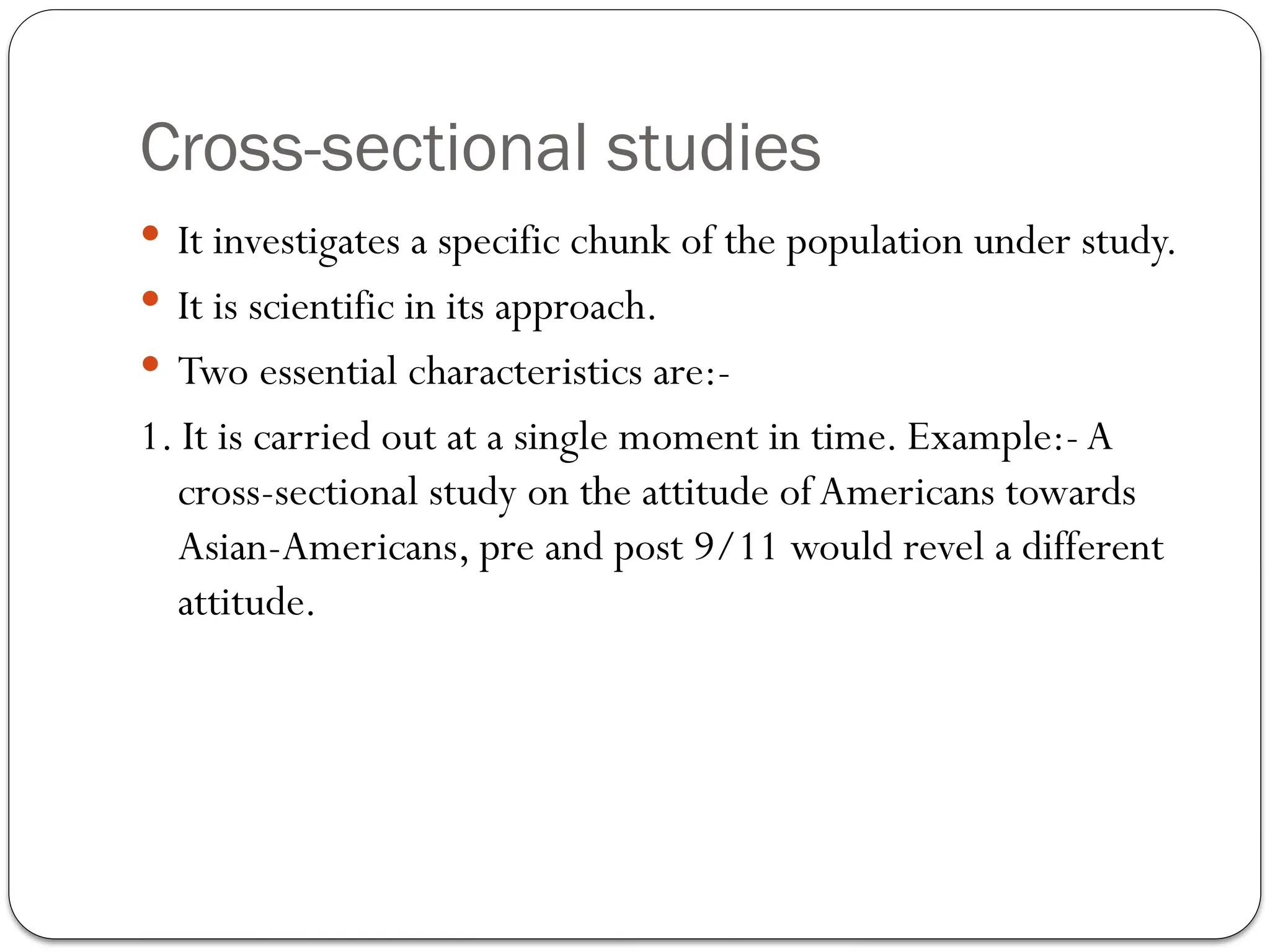
 It investigates a specific chunk of the population under study.
 It is scientific in its approach.
 Two essential characteristics are:-
1. It is carried out at a single moment in time. Example:- A
cross-sectional study on the attitude ofAmericans towards
Asian-Americans, pre and post 9/11 would revel a different
attitude.
2.These studies are carried out on a section of respondents
from the population units under study (eg.organizational
employees, voters, consumers, industry sectors)
Longitudinal studies
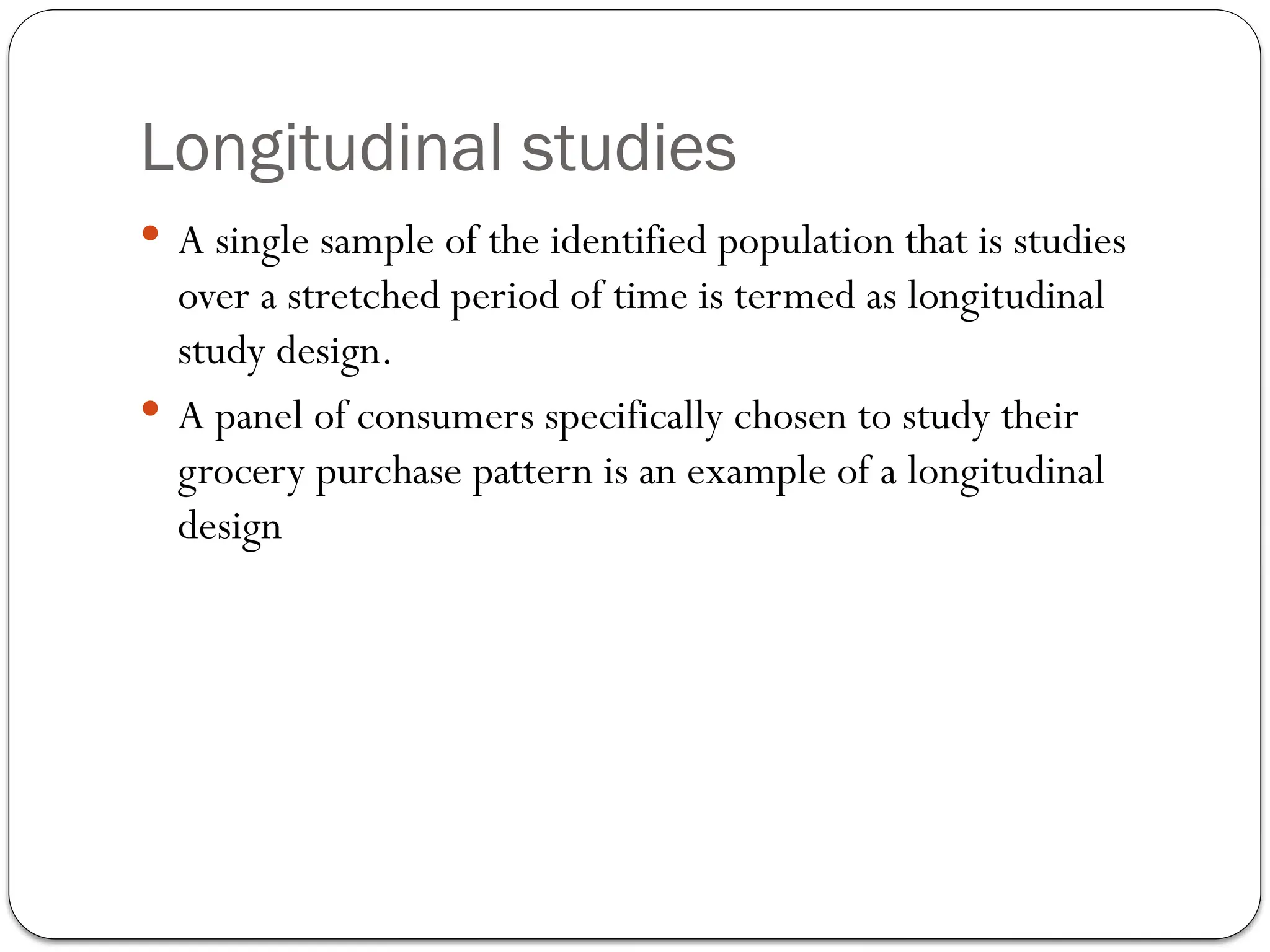
 A single sample of the identified population that is studies
over a stretched period of time is termed as longitudinal
study design.
 A panel of consumers specifically chosen to study their
grocery purchase pattern is an example of a longitudinal
design
Its features are:-
 It involves the selection of a representative panel.
 It involves the repeated measurement of the group over fixed
intervals of time.
 Once the sample is selected, it needs to stay constant over
the period of time.
 They are often referred to as time series design due to the
repeated measurements taken over time.
 Conclusive research could also be causal in nature.
 These are called experimental designs
 A number of subdivisions are possible in this category.
Assignment Questions
1. How would you define a research design?What are the
significant elements of a research design? Illustrate with
examples.
2. How are research designs classified?What are the
distinguishing feature of each? Differentiate by giving
appropriate examples?
3. Even though exploratory designs are lowest in terms of
accuracy of findings, it is recommended that no research
must be carried out without them. Examine the above
statement and justify with examples.
4. Majority of the research designs are exploratory cum
descriptive in nature in business research. How?
What is an experiment?
 An experiment is used to infer causality.
 The researcher actively manipulates one or more causal
variables and measures their effects on the dependents
variables.
 Example:- A sales manager of a soft drink bottling company
sends some of his sales personnel for a new sales training
programme.Three months after they return from training,
the sales in the territory went up by 20%.The sales manager
concludes that the training programme is very effective.
 Do u agree with this statement?
 The statement may not be true.
 As the increase in sales may not be due to the sales training
program alone.
 It could occur because of e.g., reduction in the price of the
soft drink, a strike at the competitor’s plant, increase in the
price of the competitor’s product and so on.
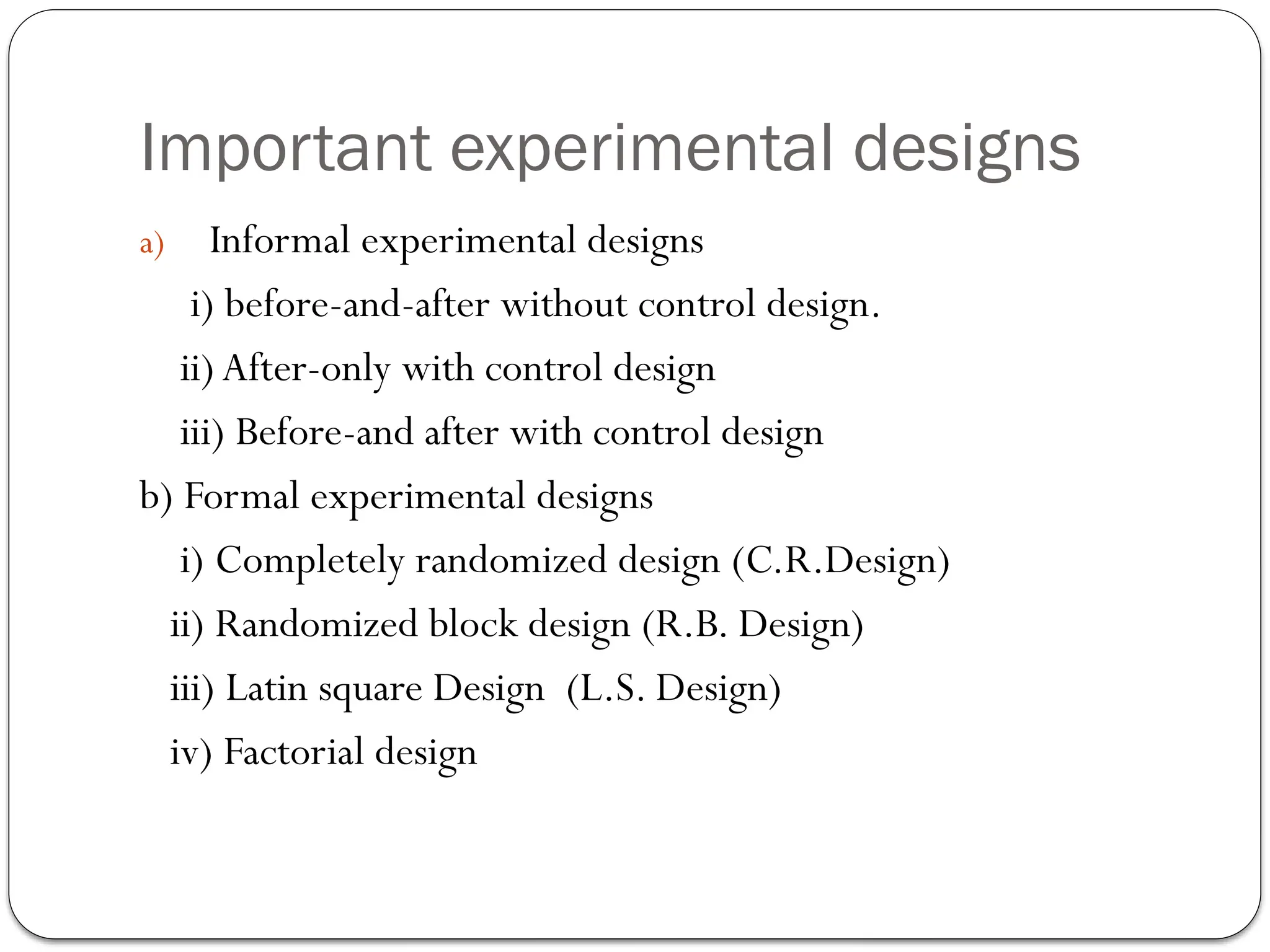
Important experimental designs
a) Informal experimental designs
i) before-and-after without control design.
ii) After-only with control design
iii) Before-and after with control design
b) Formal experimental designs
i) Completely randomized design (C.R.Design)
ii) Randomized block design (R.B. Design)
iii) Latin square Design (L.S. Design)
iv) Factorial design
Before and after without control design
 A single test group or area is selected.
 The dependent variable is measured before the introduction
of the treatment.
 The treatment is then introduced.
 The dependent variable is measured again after the
treatment.
 The effect of the treatment is equal to the level of the
phenomenon after the treatment minus the level of the
phenomenon before the treatment.
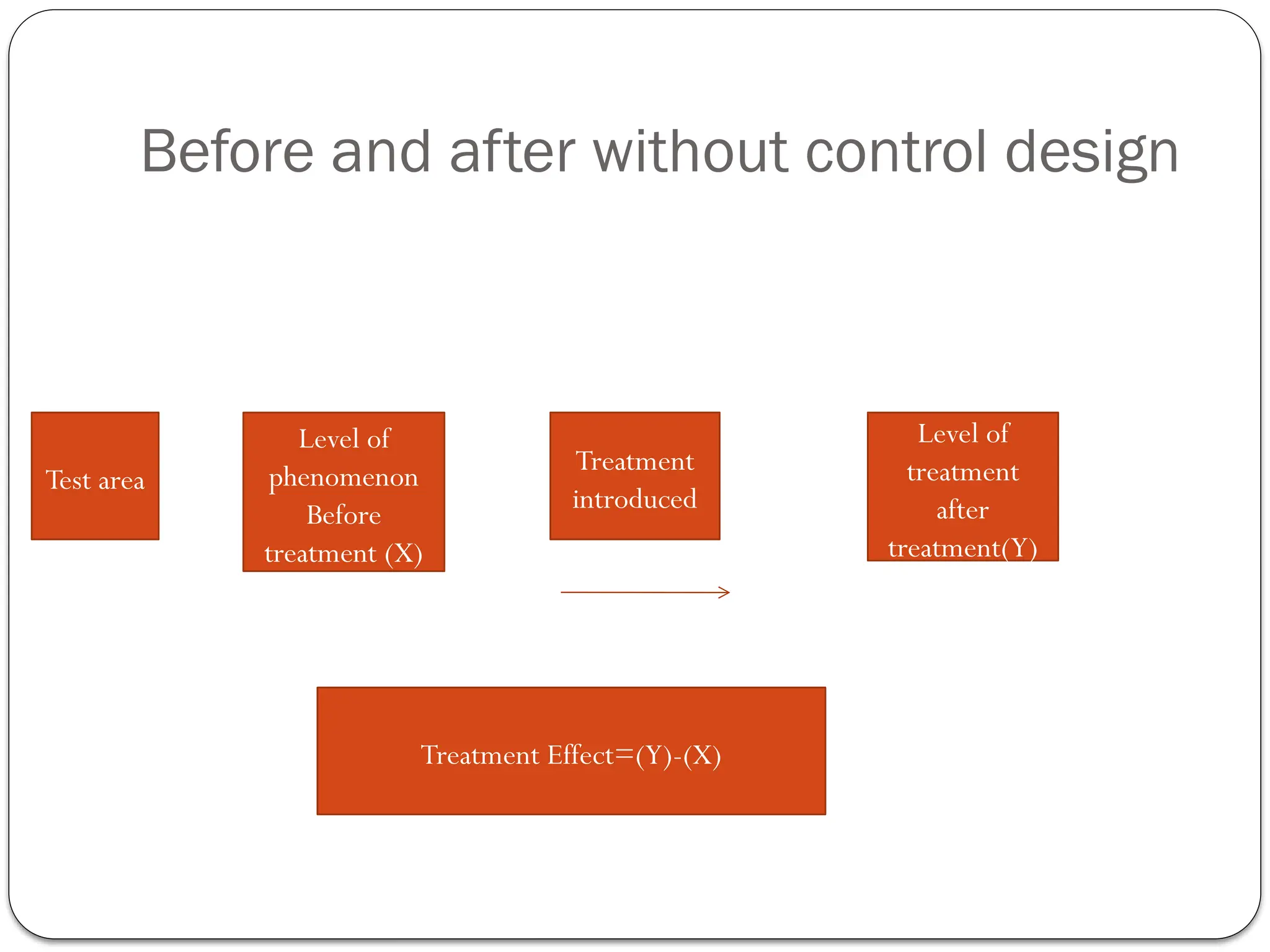
Before and after without control design
Test area
Level of
phenomenon
Before
treatment (X)
Treatment
introduced
Level of
treatment
after
treatment(Y)
Treatment Effect=(Y)-(X)
After-only with control design
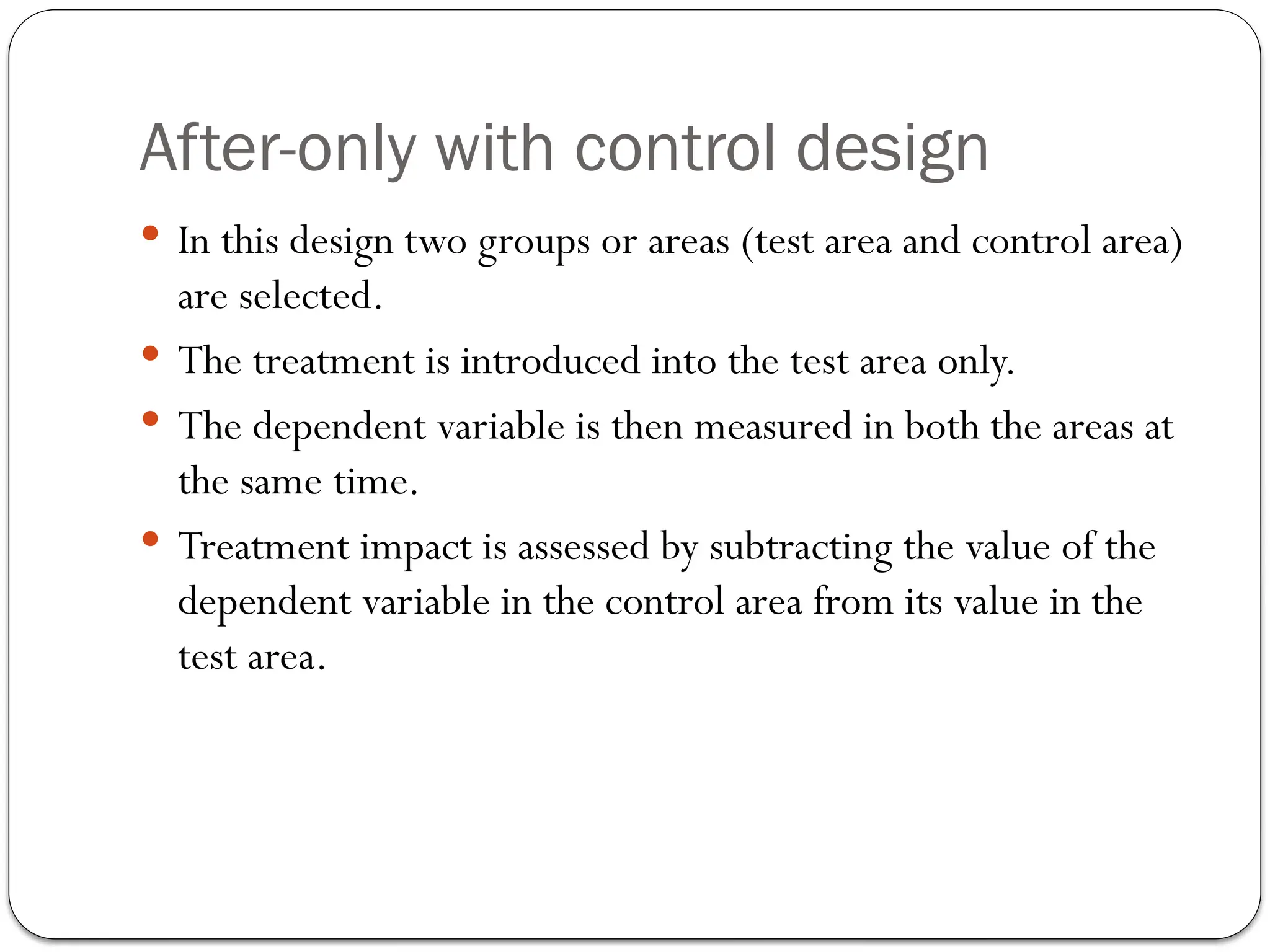
 In this design two groups or areas (test area and control area)
are selected.
 The treatment is introduced into the test area only.
 The dependent variable is then measured in both the areas at
the same time.
 Treatment impact is assessed by subtracting the value of the
dependent variable in the control area from its value in the
test area.
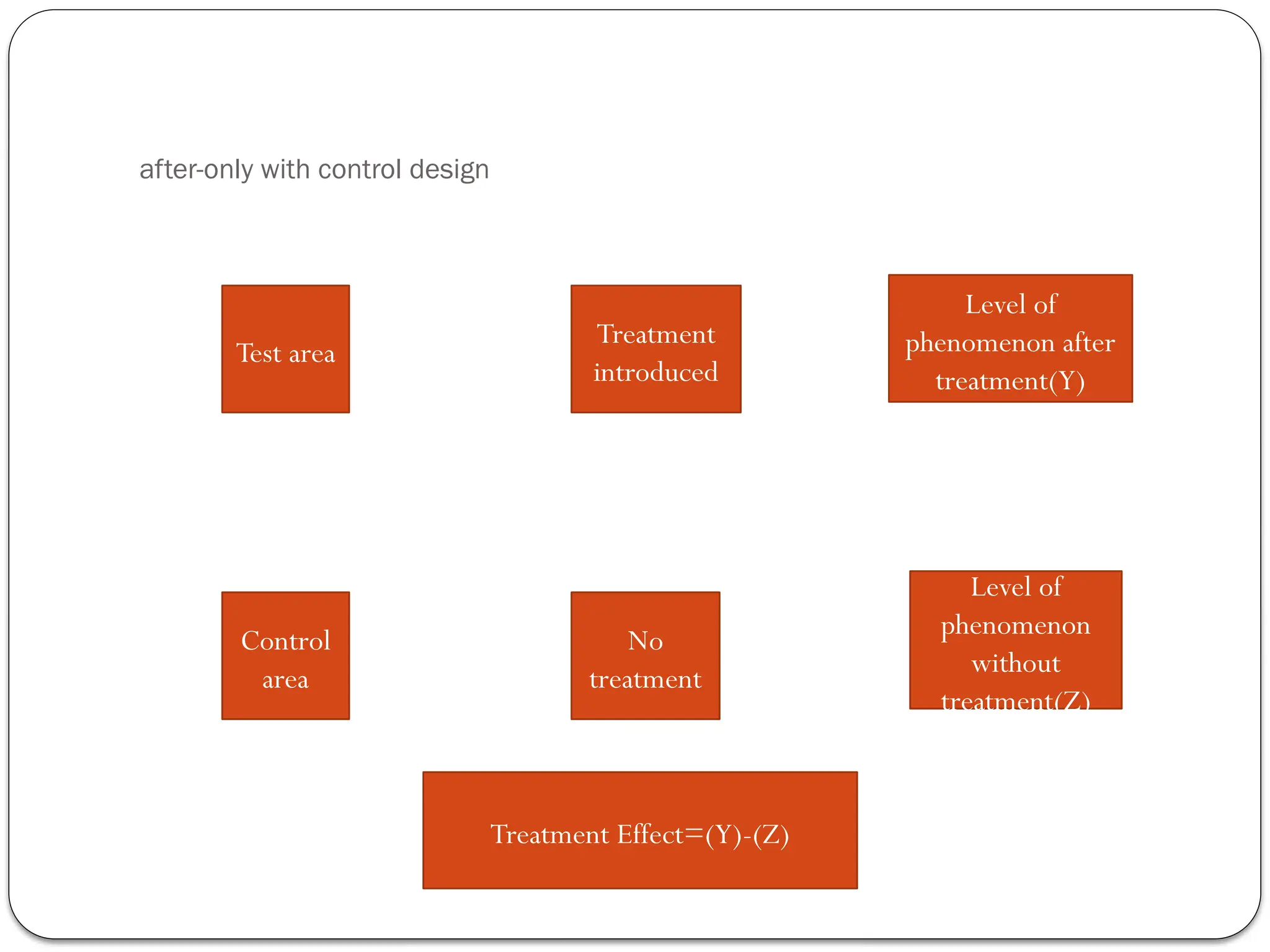
after-only with control design
Test area
Control
area
Treatment
introduced
No
treatment
Level of
phenomenon after
treatment(Y)
Level of
phenomenon
without
treatment(Z)
Treatment Effect=(Y)-(Z)
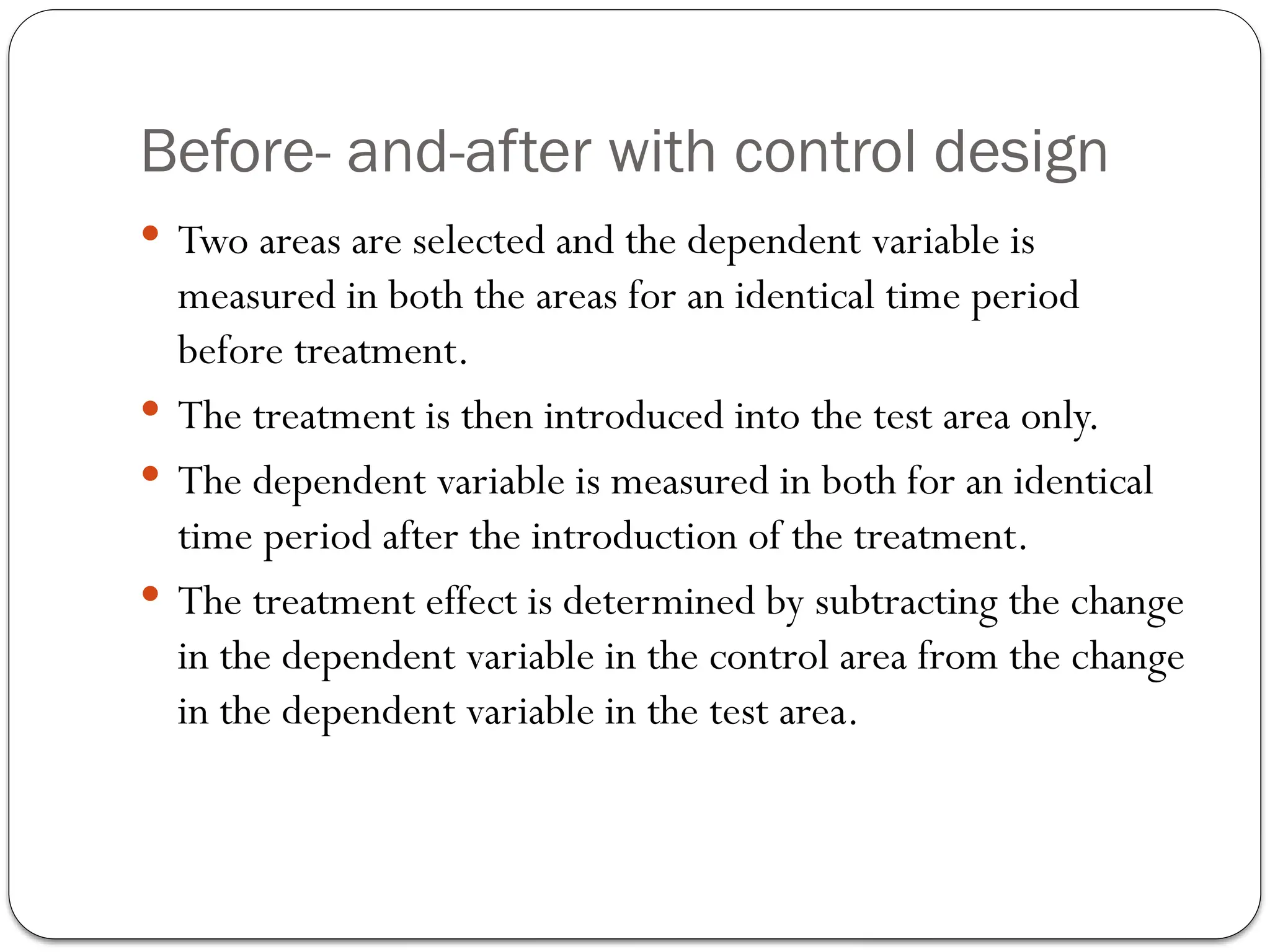
Before- and-after with control design
 Two areas are selected and the dependent variable is
measured in both the areas for an identical time period
before treatment.
 The treatment is then introduced into the test area only.
 The dependent variable is measured in both for an identical
time period after the introduction of the treatment.
 The treatment effect is determined by subtracting the change
in the dependent variable in the control area from the change
in the dependent variable in the test area.
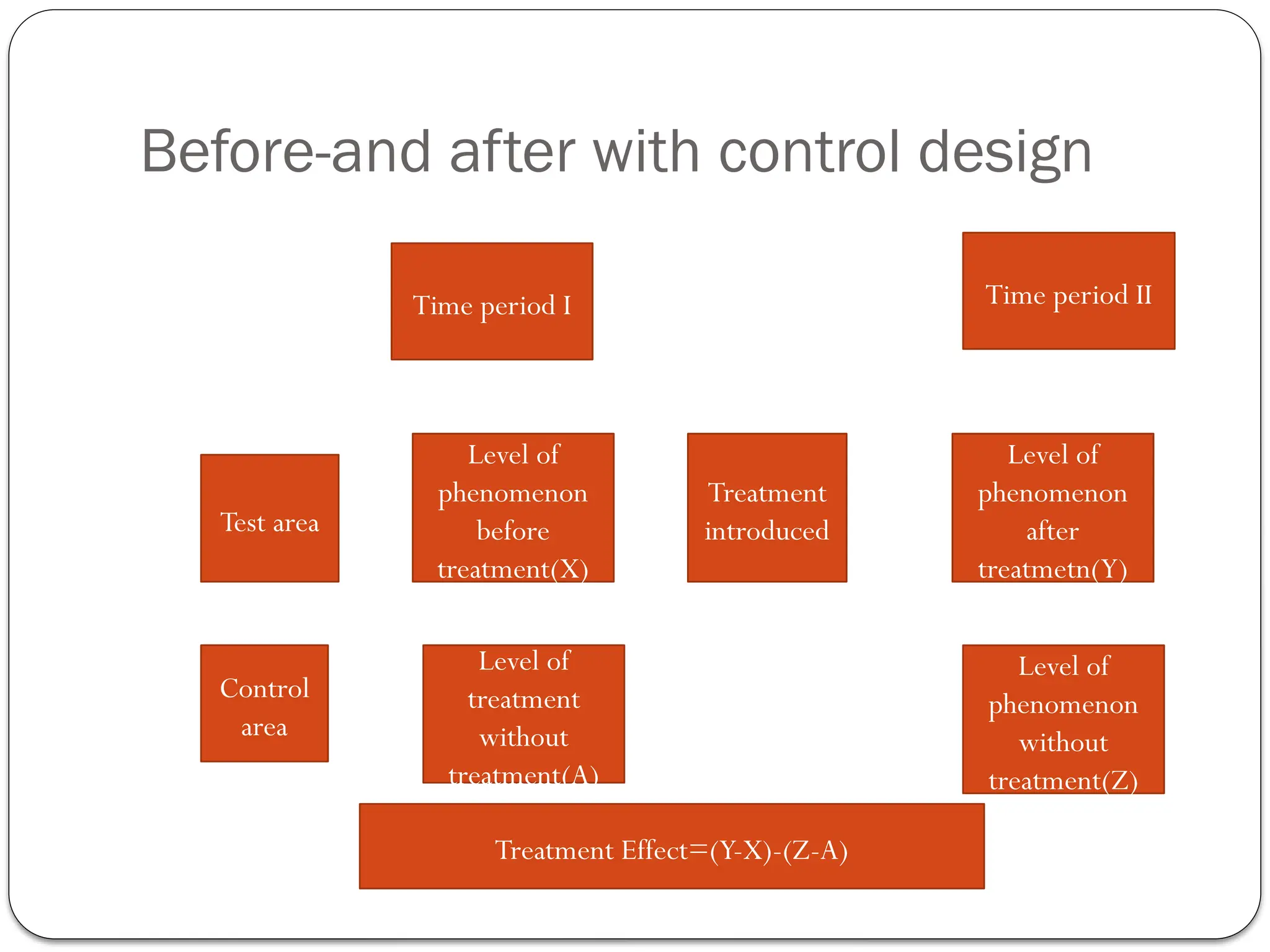
Before-and after with control design
Time period I Time period II
Test area
Control
area
Level of
phenomenon
before
treatment(X)
Level of
treatment
without
treatment(A)
Treatment
introduced
Level of
phenomenon
after
treatmetn(Y)
Level of
phenomenon
without
treatment(Z)
Treatment Effect=(Y-X)-(Z-A)
C.R. Design
 It is the simplest.
 The subjects are randomly assigned to experimental
treatments.
 Example:- if we have 10 subjects and we wish to test 5 under
treatmentA and 5 under treatment B, the randomization
process gives every possible group of 5 subjects selected from
a set of 10 an equal opportunity of being assigned to
treatmentA and treatment B.
 One way analysis of variance (ANOVA) is used to analyse
such a design.
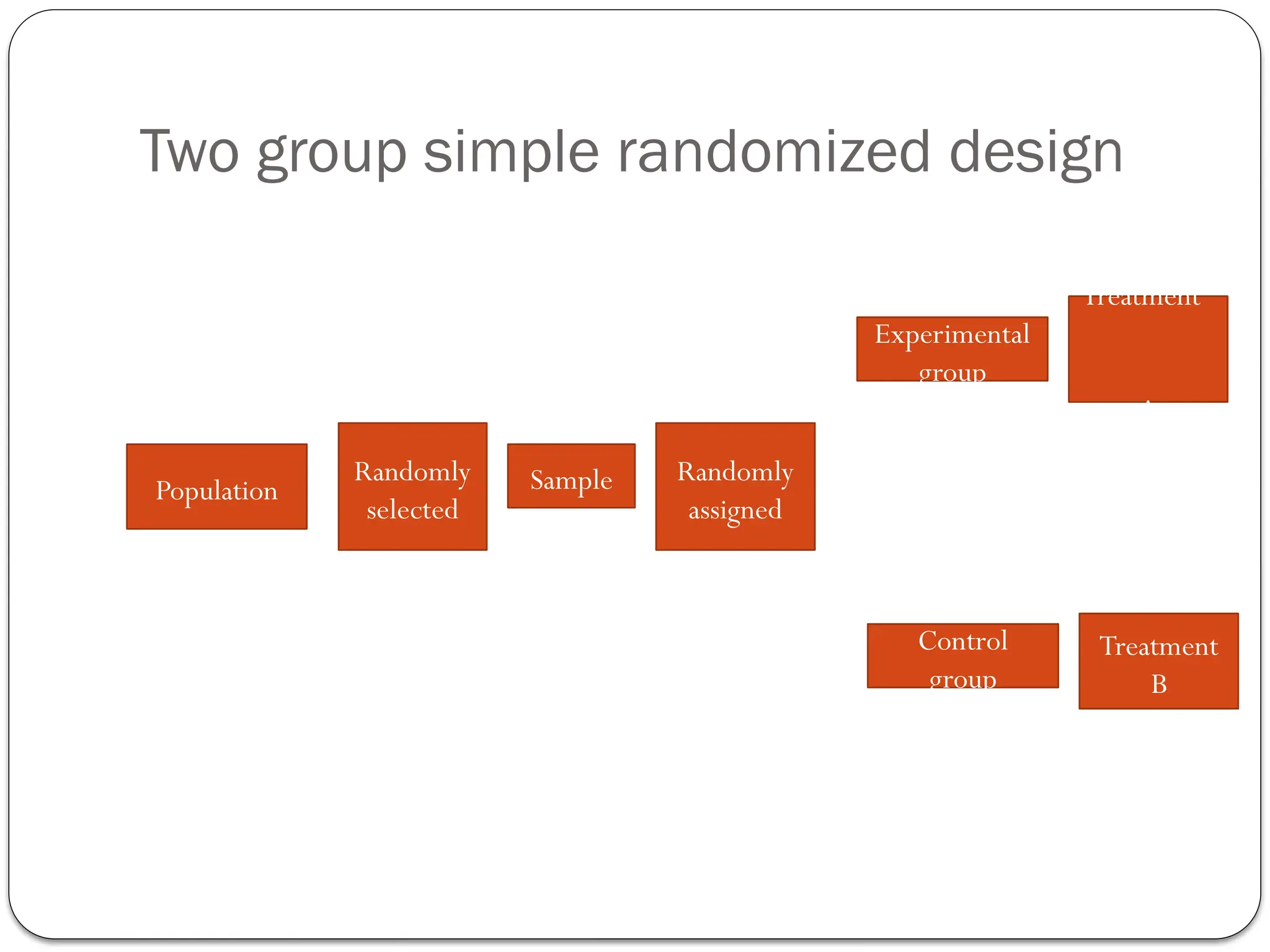
Two group simple randomized design
Population
Randomly
selected
Sample Randomly
assigned
Experimental
group
Control
group
Treatment
A
Treatment
B
Example
 Researcher wants to compare two groups of students who
have been randomly selected and randomly assigned.
 Two different treatments are usual training and the
specialized training are being given to the two groups.
 The researcher hypothesis greater gains for the group
receiving specialized training.
 To determine this, he tests each group before and after
training.
 Then he compares the amount of gain for the two groups to
accept or reject his hypothesis.
R.B Design
 It is an improvement over CR design.
 In the RB design subjects are first divided into groups,
known as blocks.
 Within each group the subjects are relatively homogeneous
in respect to some selected variables.
 The RB design is anayzed by two-way analysis of variance
(two-way ANOVA) .
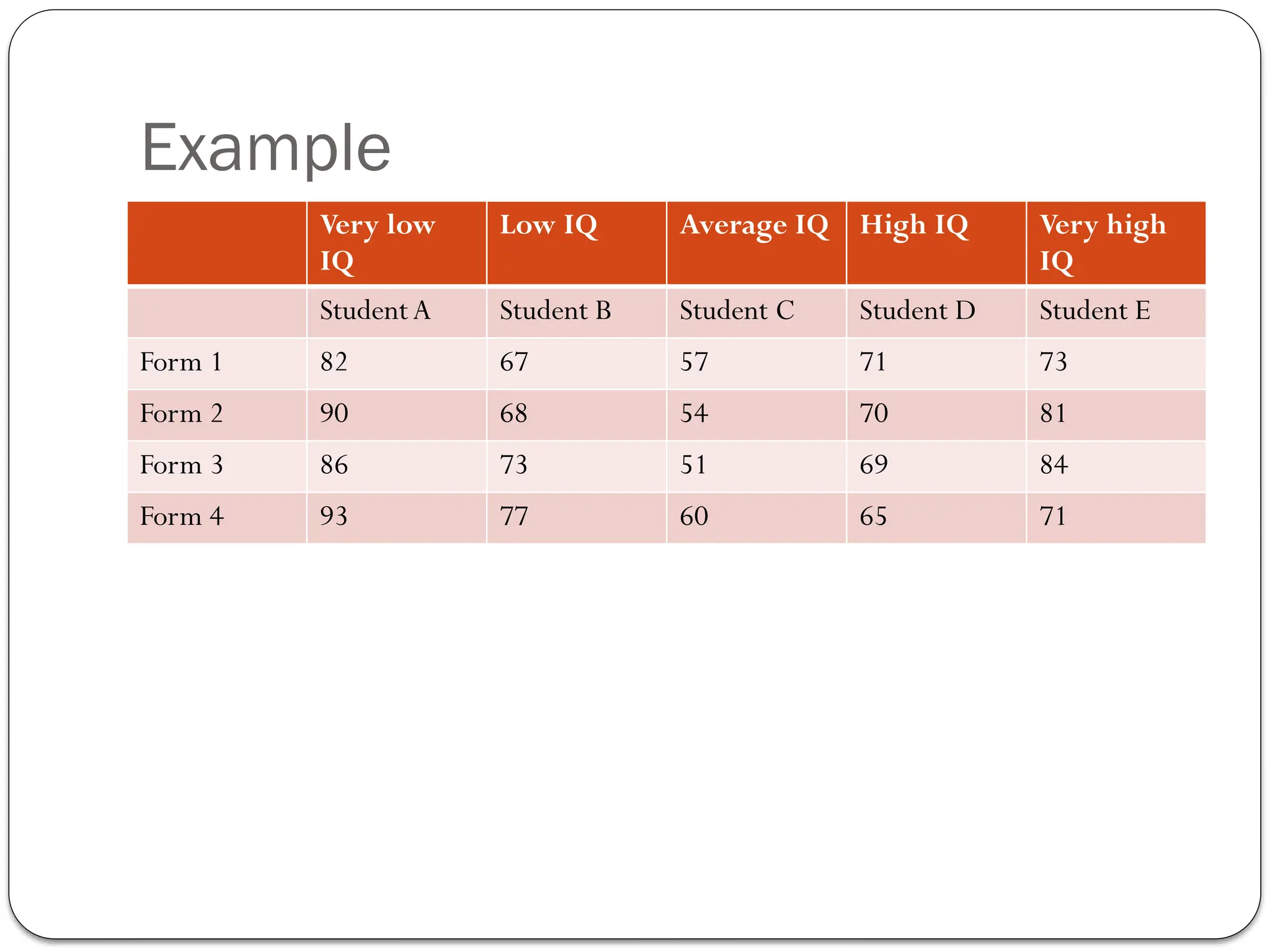
Example
Very low
IQ
Low IQ Average IQ High IQ Very high
IQ
StudentA Student B Student C Student D Student E
Form 1 82 67 57 71 73
Form 2 90 68 54 70 81
Form 3 86 73 51 69 84
Form 4 93 77 60 65 71
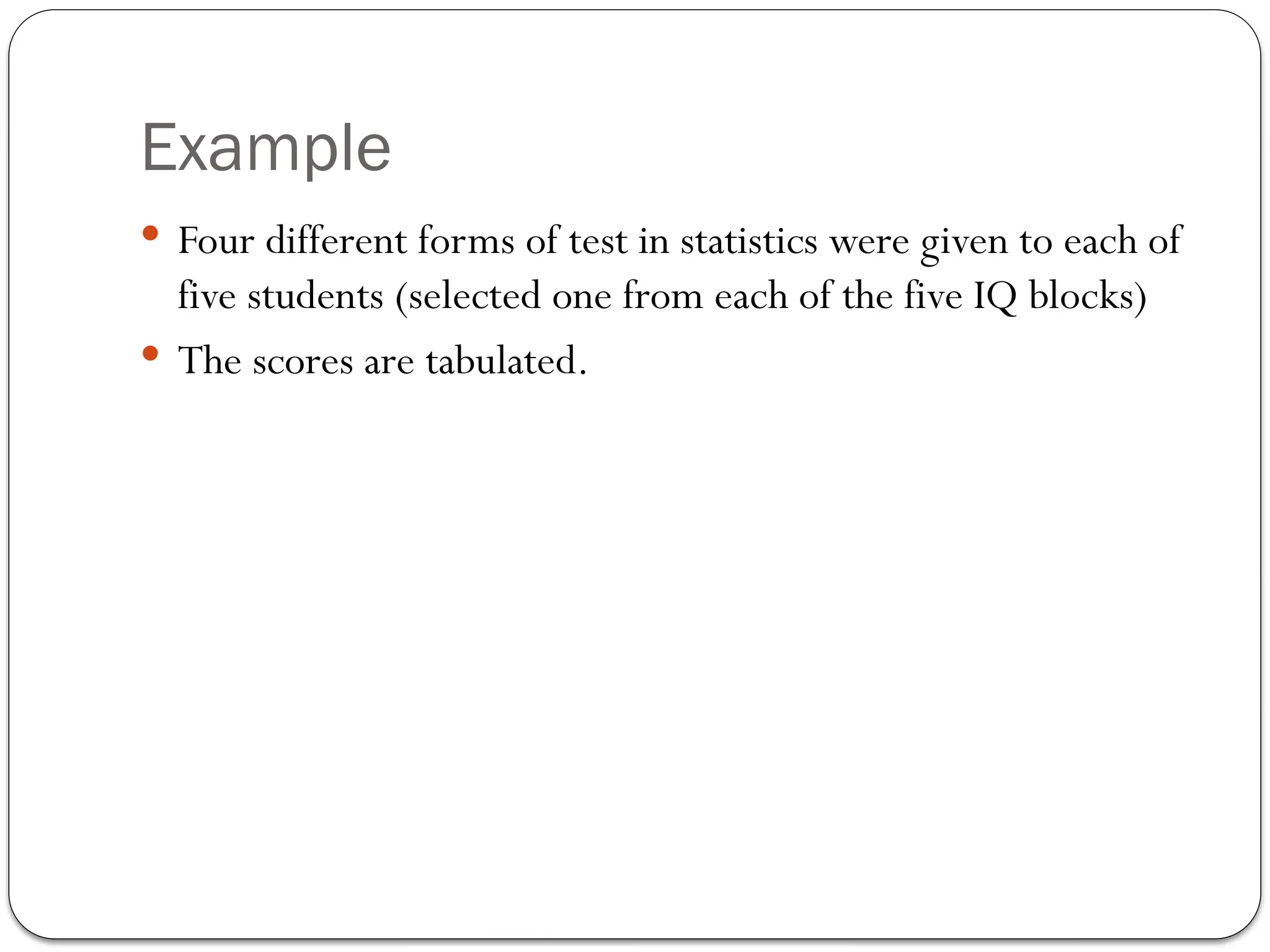
Example
 Four different forms of test in statistics were given to each of
five students (selected one from each of the five IQ blocks)
 The scores are tabulated.
Latin square design
 Frequently used in agricultural research.
 Example: an experiment has to be made through which the
effects of five different varieties of fertilizers on the yield of
certain crop, say wheat has to be judged.
 In such a case the varying fertility of the soil in different blocks
in which the experiment has to be performed must be taken
into consideration; otherwise the results obtained may not be
very dependable because the output happens to be the effect
not only of fertilizers, but it may also be the effect of the
fertility of soil.
 Similarly, there may be impact of varying seeds on the yield.
 To overcome such difficulties the LS design is used when
there are two major extraneous factors such as varying soil
fertility and varying seeds.
Factorial designs
 They are used in experiments where the effects of varying
more than one factor are to be determined.
 They are specially important in several economic and social
phenomena where usually a large number of factors affect a
particular problem.
 Factorial designs are of two types : (i) simple factorial designs
and (ii) complex factorial designs
Example
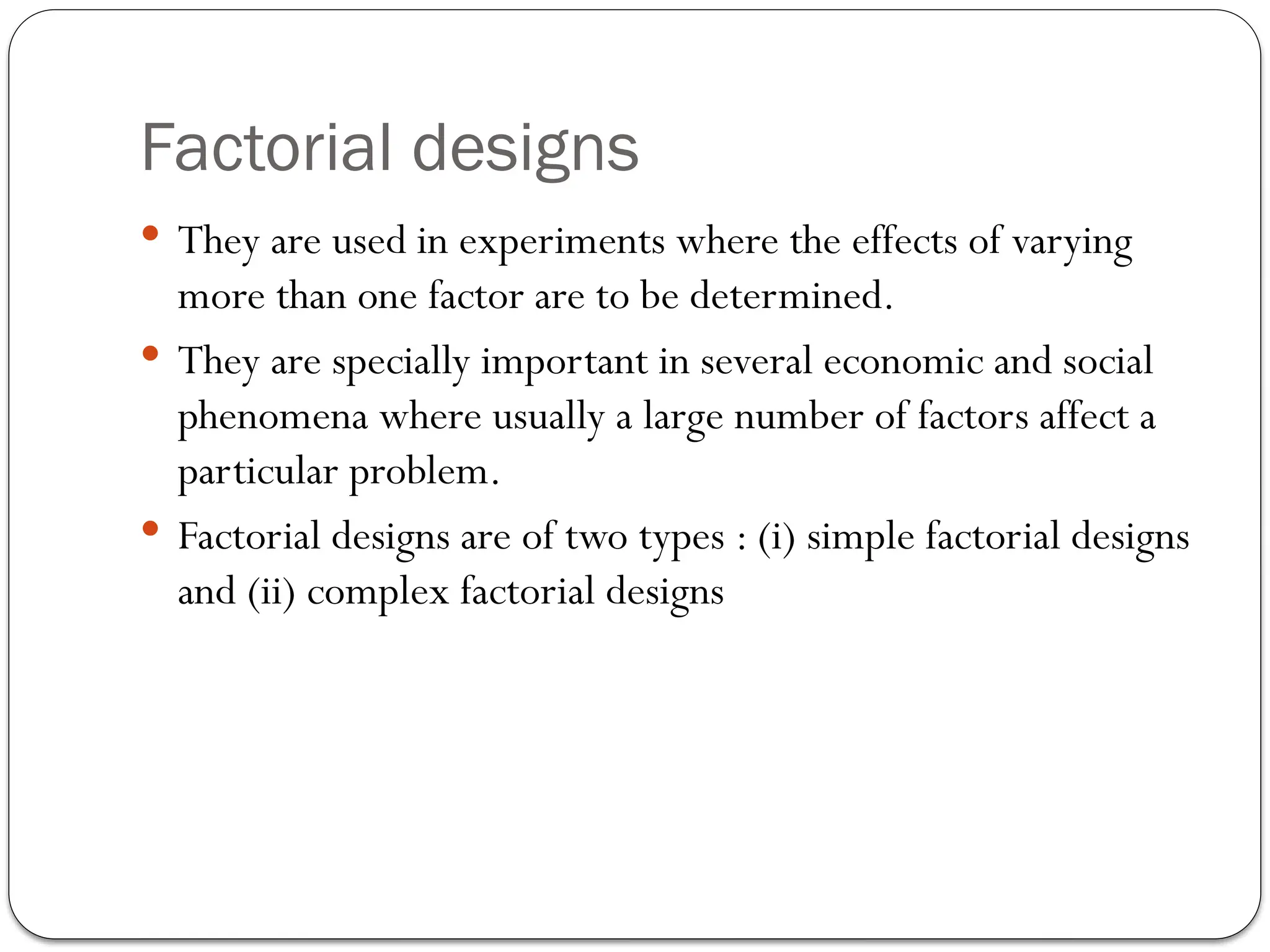
 A college teacher compared the effect of the class-size as well
as introduction of the new instruction technique on the
learning of research methodology. For this he conducted a
study using a 2x2 simple factorial design.
His design in the graphical form would be as follows:
Experimental variable I
(Class Size)
Small Usual
Experimental variable II New
(Instruction technique) Old
Conclusion
 There are several research designs and the researcher must
decide in advance as to which design would prove
appropriate for his research project.
 He must give due weight to various points such as the type of
universe and its nature, the objective of his study the
resource list or the sampling frame, desired standard of
accuracy when taking a decision in respect of the design for
his research project.
Questions
1. Explain the meaning and significance of research design.
2. Explain the meaning of the following in context of research
design.
a) extraneous variables
b) experiment and control groups
3. Describe some of the important research designs used in
experimental hypothesis-testing research study.

classification of research designs. exploratory design, descriptive design, causual design

  • 1.
  • 2.
    Research Design Exploratory design Conclusivedesign Descriptive research Causal research Cross-sectional longitudinal single multiple
  • 3.
    Exploratory research design Simplest  Basic objective- to explore and obtain clarity about the problem  Flexible  Secondary and primary data is used
  • 4.
    Expert opinion survey When there is no previous information or data available on a topic of research.  Its formal and structured.  For example in organic food products study. No secondary data is available in the domestic Indian market.Therefore doctors, dieticians as experts could be able to provide information.
  • 5.
    Focus group discussions It is a technique originally rooted in sociology and is most staunchly advocated and used for consumer and motivational research studies.  It is an alternate approach to interviewing.  It is to carry out discussions with individuals associated with the problem under study.
  • 6.
     Usually thefocus group comprises six to ten individuals.  The selected members discuss the concerned topic for the duration of 90 minutes to 2 hours.  A moderator does not participate in the discussion.  His objective is manage a non-structural and informal discussion.
  • 7.
    Descriptive research designs It is more structured and formal.  As the name implies, the objective of these studies is to provide a comprehensive and detailed explanation of the phenomena under study.  The objective is to give a detailed sketch or profile of the respondent population being studied.  Example:- A marketer to design his advertising and sales promotion campaign for high end watches would require a holistic profile of the population which buys high end luxury products.
  • 8.
     Thus adescriptive study, which generates data on who, what, where, why and how of luxury accessory brand purchase would be the design necessary to fulfill the research objectives.  One drawback of descriptive design is that it lacks the precision and accuracy of experimental designs
  • 9.
    Cross-sectional studies  Itinvestigates a specific chunk of the population under study.  It is scientific in its approach.  Two essential characteristics are:- 1. It is carried out at a single moment in time. Example:- A cross-sectional study on the attitude ofAmericans towards Asian-Americans, pre and post 9/11 would revel a different attitude.
  • 10.
    2.These studies arecarried out on a section of respondents from the population units under study (eg.organizational employees, voters, consumers, industry sectors)
  • 11.
    Longitudinal studies  Asingle sample of the identified population that is studies over a stretched period of time is termed as longitudinal study design.  A panel of consumers specifically chosen to study their grocery purchase pattern is an example of a longitudinal design
  • 12.
    Its features are:- It involves the selection of a representative panel.  It involves the repeated measurement of the group over fixed intervals of time.  Once the sample is selected, it needs to stay constant over the period of time.  They are often referred to as time series design due to the repeated measurements taken over time.
  • 13.
     Conclusive researchcould also be causal in nature.  These are called experimental designs  A number of subdivisions are possible in this category.
  • 14.
    Assignment Questions 1. Howwould you define a research design?What are the significant elements of a research design? Illustrate with examples. 2. How are research designs classified?What are the distinguishing feature of each? Differentiate by giving appropriate examples?
  • 15.
    3. Even thoughexploratory designs are lowest in terms of accuracy of findings, it is recommended that no research must be carried out without them. Examine the above statement and justify with examples. 4. Majority of the research designs are exploratory cum descriptive in nature in business research. How?
  • 16.
    What is anexperiment?  An experiment is used to infer causality.  The researcher actively manipulates one or more causal variables and measures their effects on the dependents variables.  Example:- A sales manager of a soft drink bottling company sends some of his sales personnel for a new sales training programme.Three months after they return from training, the sales in the territory went up by 20%.The sales manager concludes that the training programme is very effective.  Do u agree with this statement?
  • 17.
     The statementmay not be true.  As the increase in sales may not be due to the sales training program alone.  It could occur because of e.g., reduction in the price of the soft drink, a strike at the competitor’s plant, increase in the price of the competitor’s product and so on.
  • 18.
    Important experimental designs a)Informal experimental designs i) before-and-after without control design. ii) After-only with control design iii) Before-and after with control design b) Formal experimental designs i) Completely randomized design (C.R.Design) ii) Randomized block design (R.B. Design) iii) Latin square Design (L.S. Design) iv) Factorial design
  • 19.
    Before and afterwithout control design  A single test group or area is selected.  The dependent variable is measured before the introduction of the treatment.  The treatment is then introduced.  The dependent variable is measured again after the treatment.  The effect of the treatment is equal to the level of the phenomenon after the treatment minus the level of the phenomenon before the treatment.
  • 20.
    Before and afterwithout control design Test area Level of phenomenon Before treatment (X) Treatment introduced Level of treatment after treatment(Y) Treatment Effect=(Y)-(X)
  • 21.
    After-only with controldesign  In this design two groups or areas (test area and control area) are selected.  The treatment is introduced into the test area only.  The dependent variable is then measured in both the areas at the same time.  Treatment impact is assessed by subtracting the value of the dependent variable in the control area from its value in the test area.
  • 22.
    after-only with controldesign Test area Control area Treatment introduced No treatment Level of phenomenon after treatment(Y) Level of phenomenon without treatment(Z) Treatment Effect=(Y)-(Z)
  • 23.
    Before- and-after withcontrol design  Two areas are selected and the dependent variable is measured in both the areas for an identical time period before treatment.  The treatment is then introduced into the test area only.  The dependent variable is measured in both for an identical time period after the introduction of the treatment.  The treatment effect is determined by subtracting the change in the dependent variable in the control area from the change in the dependent variable in the test area.
  • 24.
    Before-and after withcontrol design Time period I Time period II Test area Control area Level of phenomenon before treatment(X) Level of treatment without treatment(A) Treatment introduced Level of phenomenon after treatmetn(Y) Level of phenomenon without treatment(Z) Treatment Effect=(Y-X)-(Z-A)
  • 25.
    C.R. Design  Itis the simplest.  The subjects are randomly assigned to experimental treatments.  Example:- if we have 10 subjects and we wish to test 5 under treatmentA and 5 under treatment B, the randomization process gives every possible group of 5 subjects selected from a set of 10 an equal opportunity of being assigned to treatmentA and treatment B.  One way analysis of variance (ANOVA) is used to analyse such a design.
  • 26.
    Two group simplerandomized design Population Randomly selected Sample Randomly assigned Experimental group Control group Treatment A Treatment B
  • 27.
    Example  Researcher wantsto compare two groups of students who have been randomly selected and randomly assigned.  Two different treatments are usual training and the specialized training are being given to the two groups.  The researcher hypothesis greater gains for the group receiving specialized training.  To determine this, he tests each group before and after training.  Then he compares the amount of gain for the two groups to accept or reject his hypothesis.
  • 28.
    R.B Design  Itis an improvement over CR design.  In the RB design subjects are first divided into groups, known as blocks.  Within each group the subjects are relatively homogeneous in respect to some selected variables.  The RB design is anayzed by two-way analysis of variance (two-way ANOVA) .
  • 29.
    Example Very low IQ Low IQAverage IQ High IQ Very high IQ StudentA Student B Student C Student D Student E Form 1 82 67 57 71 73 Form 2 90 68 54 70 81 Form 3 86 73 51 69 84 Form 4 93 77 60 65 71
  • 30.
    Example  Four differentforms of test in statistics were given to each of five students (selected one from each of the five IQ blocks)  The scores are tabulated.
  • 31.
    Latin square design Frequently used in agricultural research.  Example: an experiment has to be made through which the effects of five different varieties of fertilizers on the yield of certain crop, say wheat has to be judged.  In such a case the varying fertility of the soil in different blocks in which the experiment has to be performed must be taken into consideration; otherwise the results obtained may not be very dependable because the output happens to be the effect not only of fertilizers, but it may also be the effect of the fertility of soil.  Similarly, there may be impact of varying seeds on the yield.
  • 32.
     To overcomesuch difficulties the LS design is used when there are two major extraneous factors such as varying soil fertility and varying seeds.
  • 33.
    Factorial designs  Theyare used in experiments where the effects of varying more than one factor are to be determined.  They are specially important in several economic and social phenomena where usually a large number of factors affect a particular problem.  Factorial designs are of two types : (i) simple factorial designs and (ii) complex factorial designs
  • 34.
    Example  A collegeteacher compared the effect of the class-size as well as introduction of the new instruction technique on the learning of research methodology. For this he conducted a study using a 2x2 simple factorial design. His design in the graphical form would be as follows: Experimental variable I (Class Size) Small Usual Experimental variable II New (Instruction technique) Old
  • 35.
    Conclusion  There areseveral research designs and the researcher must decide in advance as to which design would prove appropriate for his research project.  He must give due weight to various points such as the type of universe and its nature, the objective of his study the resource list or the sampling frame, desired standard of accuracy when taking a decision in respect of the design for his research project.
  • 36.
    Questions 1. Explain themeaning and significance of research design. 2. Explain the meaning of the following in context of research design. a) extraneous variables b) experiment and control groups 3. Describe some of the important research designs used in experimental hypothesis-testing research study.