Instruction: Choose the letter of the correct
answer.
Pretest - Assessment
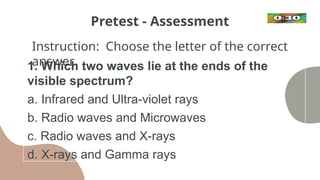
1. Which two waves lie at the ends of the
visible spectrum?
a. Infrared and Ultra-violet rays
b. Radio waves and Microwaves
c. Radio waves and X-rays
d. X-rays and Gamma rays
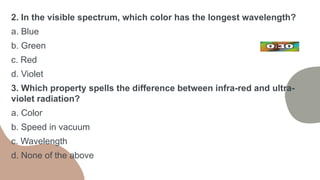
2. In the visible spectrum, which color has the longest wavelength?
a. Blue
b. Green
c. Red
d. Violet
3. Which property spells the difference between infra-red and ultra-
violet radiation?
a. Color
b. Speed in vacuum
c. Wavelength
d. None of the above
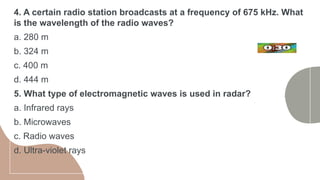
4. A certain radio station broadcasts at a frequency of 675 kHz. What
is the wavelength of the radio waves?
a. 280 m
b. 324 m
c. 400 m
d. 444 m
5. What type of electromagnetic waves is used in radar?
a. Infrared rays
b. Microwaves
c. Radio waves
d. Ultra-violet rays
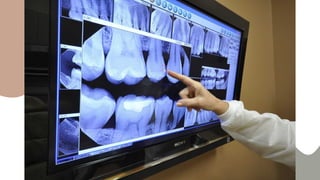
Directions: Show a pictures
of different communication
devices such as radio,
cellphones, TV and medical
equipment’s such as x -ray.
Ask the uses of it.
Next avatar
Direction: A group
of students will
arrange the
scramble words to
the correct
terminologies and
give a short
description about
Magneto electric CRUMPETS
ELEECTROMAGNETIC
SPECTRUM
DISAVOWERS
RADIO WAVES
MMGAA YASR
GAMMA RAYS
ERDANIFR YARS
INFRARED RAYS
OASCIRWEMV
MICROWAVES
spectrum with the
same group of
students. Create a
graphic organizer
indicating the list of
the wavelength,
frequency and
energy of each
electromagnetic
waves.
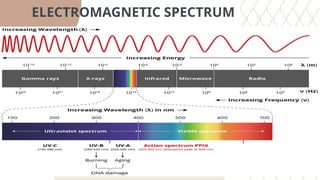
ELECTROMAGNETIC SPECTRUM
Explain the
following
questions that
refers to the
last activity we
had.
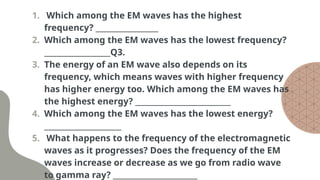
1. Which among the EM waves has the highest
frequency? _________________
2. Which among the EM waves has the lowest frequency?
__________________Q3.
3. The energy of an EM wave also depends on its
frequency, which means waves with higher frequency
has higher energy too. Which among the EM waves has
the highest energy? __________________________
4. Which among the EM waves has the lowest energy?
_____________________
5. What happens to the frequency of the electromagnetic
waves as it progresses? Does the frequency of the EM
waves increase or decrease as we go from radio wave
to gamma ray? _______________________
ELECTROMAGNETIC
SPECTRUM
-JEALLEA S. AENLLE
Objectives
At the end of this lesson, the students can:
a. describe how electromagnetic wave is
produced and propagate;
b. compare the relative wave of different
forms like wavelengths, frequencies, and
energies of the different regions of
electromagnetic spectrum;
c. appreciate the useful application of
electromagnetic waves in daily life activities
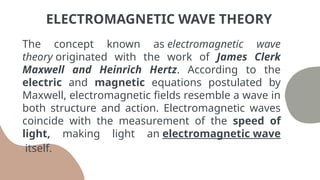
The concept known as electromagnetic wave
theory originated with the work of James Clerk
Maxwell and Heinrich Hertz. According to the
electric and magnetic equations postulated by
Maxwell, electromagnetic fields resemble a wave in
both structure and action. Electromagnetic waves
coincide with the measurement of the speed of
light, making light an electromagnetic wave
itself.
ELECTROMAGNETIC WAVE THEORY
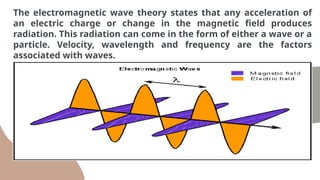
The electromagnetic wave theory states that any acceleration of
an electric charge or change in the magnetic field produces
radiation. This radiation can come in the form of either a wave or a
particle. Velocity, wavelength and frequency are the factors
associated with waves.
Electric field, an electric property associated
with each point in space when charge is
present in any form. The magnitude and
direction of the electric field are expressed
by the value of E, called
electric field strength or electric field
intensity or simply the electric field.
Magnetic fields - is a picture that we use
as a tool to describe how the magnetic
force is distributed in the space around
and within something magnetic. arise
from permanent magnets and electric
charges in motion. Magnetic fields
ultimately are the result of the motion
of charges.
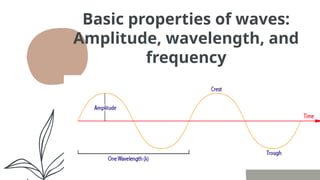
Basic properties of waves:
Amplitude, wavelength, and
frequency
All electromagnetic waves can travel
through a medium but unlike other types of
waves, they can also travel in vacuum. They
travel in vacuum at a speed of 3X10 m/s and
denoted as c the speed of light The wave
speed, frequency, and wavelength are
related by the following equation:
v=λf
where v is the wave speed or c (speed of
light) expressed in meters per second, the
frequency f is expressed in Hertz and the
wavelength A is expressed in meters
Since all the EM waves have the same speed
and that is equal to the speed of light, as
wavelength decreases, the frequency of the
wave increases
Through the years the advancement on the
knowledge about electromagnetic waves
led us to a modern technological world
Radio Waves
Refers to electromagnetic radiation with
wavelengths greater than about 0.1 m. Radio
waves are commonly used for audio
communications (i.e., for radios), but the term is
used for electromagnetic waves in this range
regardless of their application. Radio waves
typically result from an alternating current in
the wires of a broadcast antenna.
1. They cover a very broad wavelength range
and are divided into many subranges,
including microwaves, electromagnetic
Microwaves
The highest-frequency electromagnetic waves that can be
produced by currents in macroscopic circuits and devices.
Their high frequencies correspond to short wavelengths
compared with other radio waves hence the name
“microwave.” Microwaves also occur naturally as the cosmic
background radiation left over from the origin of the universe.
Along with other ranges of electromagnetic waves, they are
part of the radiation that any object above absolute zero
emits and absorbs because of thermal agitation, that is, from
the thermal motion of its atoms and molecules.
1. Most satellite-transmitted information is carried on
microwaves. Radar is a common application of microwaves.
2.
3. Other application includes: WiFi, Bluetooth and RFID (radio
frequency identification)
4.
Infrared Radiation “below red”
generally produced by thermal motion, and the
vibration and rotation of atoms and molecules.
Electronic transitions in atoms and molecules
can also produce infrared radiation. About half
of the solar energy arriving at Earth is in the
infrared region, with most of the rest in the
visible part of the spectrum.
Applications: Reconnaissance satellite, infrared
lamps and remote controls
Visible light
the narrow segment of the electromagnetic
spectrum between about and about to which
the normal human eye responds.
Red light has the lowest frequencies and longest
wavelengths, whereas violet has the highest
frequencies and shortest wavelengths.
Blackbody radiation from the Sun peaks in the
visible part of the spectrum but is more intense
in the red than in the violet, making the sun
Ultraviolet Radiation
Ultraviolet means “above violet.” The electromagnetic
frequencies of ultraviolet radiation (UV) extend upward from
violet, the highest-frequency visible light. The highest-
frequency ultraviolet overlaps with the lowest-frequency X-
rays. The wavelengths of ultraviolet extend from down to
about at its highest frequencies.
Low-intensity ultraviolet has applications such as providing
the energy to cause certain dyes to fluoresce and emit
visible light, for example, in printed money to display hidden
watermarks as counterfeit protection.
X-rays
have wavelengths from about to They have shorter
wavelengths, and higher frequencies, than ultraviolet, so that
the energy they transfer at an atomic level is greater.
The widest use of X-rays is for imaging objects that are opaque
to visible light, such as the human body or aircraft parts
Gamma Rays
The most penetrating nuclear radiation, the gamma ray, an
extremely high-frequency electromagnetic wave. Gamma rays
have characteristics identical to X-rays of the same frequency
—they differ only in source. The name “gamma rays” is
generally used for electromagnetic radiation emitted by a
nucleus, while X-rays are generally produced by bombarding a
target with energetic electrons in an X-ray tube. At higher
frequencies, gamma rays are more penetrating and more
damaging to living tissue.
They have many of the same uses as X-rays, including cancer
therapy. Gamma radiation from radioactive materials is used in
nuclear medicine

grade-10-electromagnetic-spectrum ..pptx

  • 5.
    Instruction: Choose theletter of the correct answer. Pretest - Assessment 1. Which two waves lie at the ends of the visible spectrum? a. Infrared and Ultra-violet rays b. Radio waves and Microwaves c. Radio waves and X-rays d. X-rays and Gamma rays
  • 6.
    2. In thevisible spectrum, which color has the longest wavelength? a. Blue b. Green c. Red d. Violet 3. Which property spells the difference between infra-red and ultra- violet radiation? a. Color b. Speed in vacuum c. Wavelength d. None of the above
  • 7.
    4. A certainradio station broadcasts at a frequency of 675 kHz. What is the wavelength of the radio waves? a. 280 m b. 324 m c. 400 m d. 444 m 5. What type of electromagnetic waves is used in radar? a. Infrared rays b. Microwaves c. Radio waves d. Ultra-violet rays
  • 8.
    Directions: Show apictures of different communication devices such as radio, cellphones, TV and medical equipment’s such as x -ray. Ask the uses of it.
  • 9.
  • 12.
    Direction: A group ofstudents will arrange the scramble words to the correct terminologies and give a short description about
  • 13.
  • 14.
  • 15.
  • 16.
  • 17.
  • 18.
    spectrum with the samegroup of students. Create a graphic organizer indicating the list of the wavelength, frequency and energy of each electromagnetic waves.
  • 19.
  • 20.
    Explain the following questions that refersto the last activity we had.
  • 21.
    1. Which amongthe EM waves has the highest frequency? _________________ 2. Which among the EM waves has the lowest frequency? __________________Q3. 3. The energy of an EM wave also depends on its frequency, which means waves with higher frequency has higher energy too. Which among the EM waves has the highest energy? __________________________ 4. Which among the EM waves has the lowest energy? _____________________ 5. What happens to the frequency of the electromagnetic waves as it progresses? Does the frequency of the EM waves increase or decrease as we go from radio wave to gamma ray? _______________________
  • 22.
  • 23.
    Objectives At the endof this lesson, the students can: a. describe how electromagnetic wave is produced and propagate; b. compare the relative wave of different forms like wavelengths, frequencies, and energies of the different regions of electromagnetic spectrum; c. appreciate the useful application of electromagnetic waves in daily life activities
  • 24.
    The concept knownas electromagnetic wave theory originated with the work of James Clerk Maxwell and Heinrich Hertz. According to the electric and magnetic equations postulated by Maxwell, electromagnetic fields resemble a wave in both structure and action. Electromagnetic waves coincide with the measurement of the speed of light, making light an electromagnetic wave itself. ELECTROMAGNETIC WAVE THEORY
  • 25.
    The electromagnetic wavetheory states that any acceleration of an electric charge or change in the magnetic field produces radiation. This radiation can come in the form of either a wave or a particle. Velocity, wavelength and frequency are the factors associated with waves.
  • 26.
    Electric field, anelectric property associated with each point in space when charge is present in any form. The magnitude and direction of the electric field are expressed by the value of E, called electric field strength or electric field intensity or simply the electric field. Magnetic fields - is a picture that we use as a tool to describe how the magnetic force is distributed in the space around and within something magnetic. arise from permanent magnets and electric charges in motion. Magnetic fields ultimately are the result of the motion of charges.
  • 27.
    Basic properties ofwaves: Amplitude, wavelength, and frequency
  • 28.
    All electromagnetic wavescan travel through a medium but unlike other types of waves, they can also travel in vacuum. They travel in vacuum at a speed of 3X10 m/s and denoted as c the speed of light The wave speed, frequency, and wavelength are related by the following equation: v=λf where v is the wave speed or c (speed of light) expressed in meters per second, the frequency f is expressed in Hertz and the wavelength A is expressed in meters
  • 29.
    Since all theEM waves have the same speed and that is equal to the speed of light, as wavelength decreases, the frequency of the wave increases Through the years the advancement on the knowledge about electromagnetic waves led us to a modern technological world
  • 30.
    Radio Waves Refers toelectromagnetic radiation with wavelengths greater than about 0.1 m. Radio waves are commonly used for audio communications (i.e., for radios), but the term is used for electromagnetic waves in this range regardless of their application. Radio waves typically result from an alternating current in the wires of a broadcast antenna. 1. They cover a very broad wavelength range and are divided into many subranges, including microwaves, electromagnetic
  • 31.
    Microwaves The highest-frequency electromagneticwaves that can be produced by currents in macroscopic circuits and devices. Their high frequencies correspond to short wavelengths compared with other radio waves hence the name “microwave.” Microwaves also occur naturally as the cosmic background radiation left over from the origin of the universe. Along with other ranges of electromagnetic waves, they are part of the radiation that any object above absolute zero emits and absorbs because of thermal agitation, that is, from the thermal motion of its atoms and molecules. 1. Most satellite-transmitted information is carried on microwaves. Radar is a common application of microwaves. 2. 3. Other application includes: WiFi, Bluetooth and RFID (radio frequency identification) 4.
  • 32.
    Infrared Radiation “belowred” generally produced by thermal motion, and the vibration and rotation of atoms and molecules. Electronic transitions in atoms and molecules can also produce infrared radiation. About half of the solar energy arriving at Earth is in the infrared region, with most of the rest in the visible part of the spectrum. Applications: Reconnaissance satellite, infrared lamps and remote controls
  • 33.
    Visible light the narrowsegment of the electromagnetic spectrum between about and about to which the normal human eye responds. Red light has the lowest frequencies and longest wavelengths, whereas violet has the highest frequencies and shortest wavelengths. Blackbody radiation from the Sun peaks in the visible part of the spectrum but is more intense in the red than in the violet, making the sun
  • 34.
    Ultraviolet Radiation Ultraviolet means“above violet.” The electromagnetic frequencies of ultraviolet radiation (UV) extend upward from violet, the highest-frequency visible light. The highest- frequency ultraviolet overlaps with the lowest-frequency X- rays. The wavelengths of ultraviolet extend from down to about at its highest frequencies. Low-intensity ultraviolet has applications such as providing the energy to cause certain dyes to fluoresce and emit visible light, for example, in printed money to display hidden watermarks as counterfeit protection.
  • 35.
    X-rays have wavelengths fromabout to They have shorter wavelengths, and higher frequencies, than ultraviolet, so that the energy they transfer at an atomic level is greater. The widest use of X-rays is for imaging objects that are opaque to visible light, such as the human body or aircraft parts
  • 36.
    Gamma Rays The mostpenetrating nuclear radiation, the gamma ray, an extremely high-frequency electromagnetic wave. Gamma rays have characteristics identical to X-rays of the same frequency —they differ only in source. The name “gamma rays” is generally used for electromagnetic radiation emitted by a nucleus, while X-rays are generally produced by bombarding a target with energetic electrons in an X-ray tube. At higher frequencies, gamma rays are more penetrating and more damaging to living tissue. They have many of the same uses as X-rays, including cancer therapy. Gamma radiation from radioactive materials is used in nuclear medicine