ELECTROMAGNET
IC SPECTRUM
Objectives
 Describe the 7 main components of the
electromagnetic spectrum
 State the properties of electromagnetic waves
(EM wave)
 State the applications of electromagnetic
waves
What are Electromagnetic
waves?
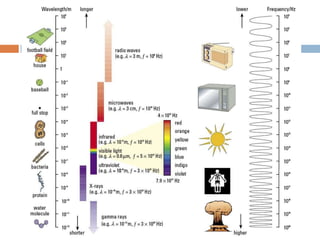
 Consist of 7 components
 Radio waves
 Microwaves
 Infra-red radiation
 Visible light
 Ultra-violet waves
 X-rays
 Gamma rays
105 m
10-14 m
Wavelength
Rich Men In Vegas Use X-ray
Goggles
How is electromagnetic waves
form?
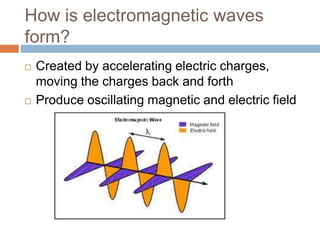
 Created by accelerating electric charges,
moving the charges back and forth
 Produce oscillating magnetic and electric field
Electromagnetic Waves
 Electromagnetic spectrum is continuous.
 No distinct boundaries between each
component.
 Gamma rays have the shortest wavelength
and highest frequency.
 Radio waves have the longest wavelength and
lowest frequency.
Properties of Electromagnetic
waves
 Transfer energy from one place to another
 They are transverse waves
 Travel through vacuum with the speed of light
(3 x 10⁸ m s-1)
 Show wave properties like reflection and
refraction
 Obey wave equation v = fλ
Application of Electromagnetic
waves
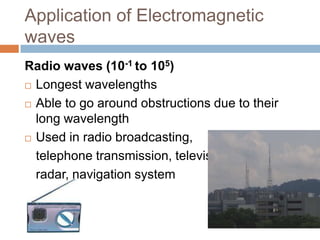
Radio waves (10-1 to 105)
 Longest wavelengths
 Able to go around obstructions due to their
long wavelength
 Used in radio broadcasting,
telephone transmission, television,
radar, navigation system
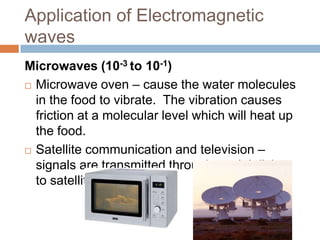
Microwaves (10-3 to 10-1)
 Microwave oven – cause the water molecules
in the food to vibrate. The vibration causes
friction at a molecular level which will heat up
the food.
 Satellite communication and television –
signals are transmitted through aerial dishes
to satellites in the space.
Application of Electromagnetic
waves
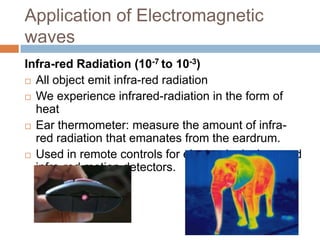
Infra-red Radiation (10-7 to 10-3)
 All object emit infra-red radiation
 We experience infrared-radiation in the form of
heat
 Ear thermometer: measure the amount of infra-
red radiation that emanates from the eardrum.
 Used in remote controls for electronic devices and
infra-red motion detectors.
Application of Electromagnetic
waves
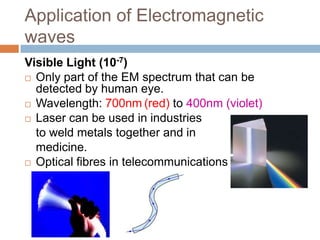
Visible Light (10-7)
 Only part of the EM spectrum that can be
detected by human eye.
 Wavelength: 700nm (red) to 400nm (violet)
 Laser can be used in industries
to weld metals together and in
medicine.
 Optical fibres in telecommunications
Application of Electromagnetic
waves
Application of Electromagnetic
waves
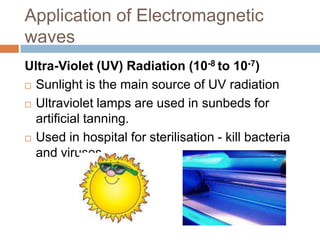
Ultra-Violet (UV) Radiation (10-8 to 10-7)
 Sunlight is the main source of UV radiation
 Ultraviolet lamps are used in sunbeds for
artificial tanning.
 Used in hospital for sterilisation - kill bacteria
and viruses
Application of Electromagnetic
waves
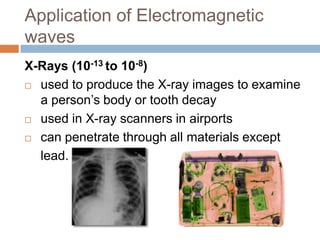
X-Rays (10-13 to 10-8)
 used to produce the X-ray images to examine
a person’s body or tooth decay
 used in X-ray scanners in airports
 can penetrate through all materials except
lead.
Application of Electromagnetic
waves
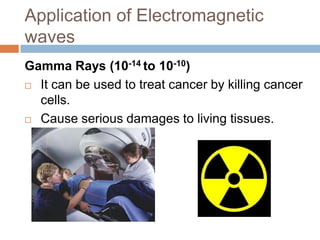
Gamma Rays (10-14 to 10-10)
 It can be used to treat cancer by killing cancer
cells.
 Cause serious damages to living tissues.

Electromagnetic spectrum e learning

  • 1.
  • 2.
    Objectives  Describe the7 main components of the electromagnetic spectrum  State the properties of electromagnetic waves (EM wave)  State the applications of electromagnetic waves
  • 3.
    What are Electromagnetic waves? Consist of 7 components  Radio waves  Microwaves  Infra-red radiation  Visible light  Ultra-violet waves  X-rays  Gamma rays 105 m 10-14 m Wavelength Rich Men In Vegas Use X-ray Goggles
  • 5.
    How is electromagneticwaves form?  Created by accelerating electric charges, moving the charges back and forth  Produce oscillating magnetic and electric field
  • 6.
    Electromagnetic Waves  Electromagneticspectrum is continuous.  No distinct boundaries between each component.  Gamma rays have the shortest wavelength and highest frequency.  Radio waves have the longest wavelength and lowest frequency.
  • 7.
    Properties of Electromagnetic waves Transfer energy from one place to another  They are transverse waves  Travel through vacuum with the speed of light (3 x 10⁸ m s-1)  Show wave properties like reflection and refraction  Obey wave equation v = fλ
  • 8.
    Application of Electromagnetic waves Radiowaves (10-1 to 105)  Longest wavelengths  Able to go around obstructions due to their long wavelength  Used in radio broadcasting, telephone transmission, television, radar, navigation system
  • 9.
    Microwaves (10-3 to10-1)  Microwave oven – cause the water molecules in the food to vibrate. The vibration causes friction at a molecular level which will heat up the food.  Satellite communication and television – signals are transmitted through aerial dishes to satellites in the space. Application of Electromagnetic waves
  • 10.
    Infra-red Radiation (10-7to 10-3)  All object emit infra-red radiation  We experience infrared-radiation in the form of heat  Ear thermometer: measure the amount of infra- red radiation that emanates from the eardrum.  Used in remote controls for electronic devices and infra-red motion detectors. Application of Electromagnetic waves
  • 11.
    Visible Light (10-7) Only part of the EM spectrum that can be detected by human eye.  Wavelength: 700nm (red) to 400nm (violet)  Laser can be used in industries to weld metals together and in medicine.  Optical fibres in telecommunications Application of Electromagnetic waves
  • 12.
    Application of Electromagnetic waves Ultra-Violet(UV) Radiation (10-8 to 10-7)  Sunlight is the main source of UV radiation  Ultraviolet lamps are used in sunbeds for artificial tanning.  Used in hospital for sterilisation - kill bacteria and viruses
  • 13.
    Application of Electromagnetic waves X-Rays(10-13 to 10-8)  used to produce the X-ray images to examine a person’s body or tooth decay  used in X-ray scanners in airports  can penetrate through all materials except lead.
  • 14.
    Application of Electromagnetic waves GammaRays (10-14 to 10-10)  It can be used to treat cancer by killing cancer cells.  Cause serious damages to living tissues.