ELECTROMAGNETIC WAVE THEORY
EM Theory begins with ancient measures to understand
atmospheric electricity, in particular, lightning. People then
had little understanding of electricity and were unable to
explain the phenomena. Oersted’s discovery which states
that “A changing electric field produces a magnetic field”. A
changing magnetic field is therefore produced around the
vibrating charge.
Proponents on the Formulation of EM Wave Theory
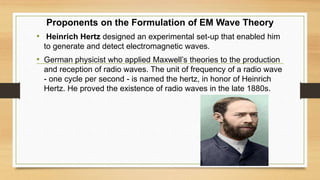
• Heinrich Hertz designed an experimental set-up that enabled him
to generate and detect electromagnetic waves.
• German physicist who applied Maxwell’s theories to the production
and reception of radio waves. The unit of frequency of a radio wave
- one cycle per second - is named the hertz, in honor of Heinrich
Hertz. He proved the existence of radio waves in the late 1880s.
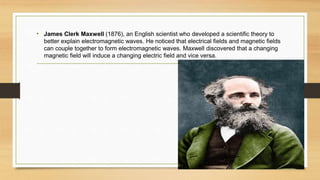
• James Clerk Maxwell (1876), an English scientist who developed a scientific theory to
better explain electromagnetic waves. He noticed that electrical fields and magnetic fields
can couple together to form electromagnetic waves. Maxwell discovered that a changing
magnetic field will induce a changing electric field and vice versa.
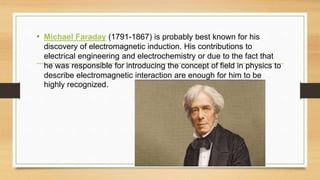
• Michael Faraday (1791-1867) is probably best known for his
discovery of electromagnetic induction. His contributions to
electrical engineering and electrochemistry or due to the fact that
he was responsible for introducing the concept of field in physics to
describe electromagnetic interaction are enough for him to be
highly recognized.
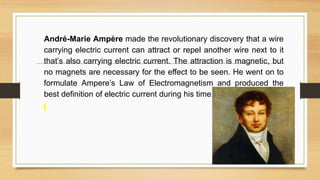
André-Marie Ampère made the revolutionary discovery that a wire
carrying electric current can attract or repel another wire next to it
that’s also carrying electric current. The attraction is magnetic, but
no magnets are necessary for the effect to be seen. He went on to
formulate Ampere’s Law of Electromagnetism and produced the
best definition of electric current during his time.
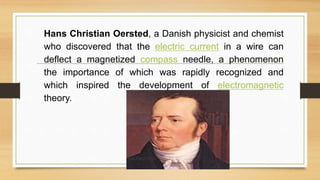
Hans Christian Oersted, a Danish physicist and chemist
who discovered that the electric current in a wire can
deflect a magnetized compass needle, a phenomenon
the importance of which was rapidly recognized and
which inspired the development of electromagnetic
theory.
The Basic Principles of EM Wave Theory
•
1. Many natural phenomena exhibit wave-like behaviors. All of them – water waves, earthquake waves, and
sound waves require a medium to propagate. These are examples of mechanical waves.
2. Light can also be described as a wave – a wave of changing electric and magnetic fields that propagate
outward from their sources. These waves, however, do not require a medium to propagate.
3. They propagate at 300,000,000 meters per second through a vacuum.
4. Electromagnetic waves are transverse waves. In simpler terms, the changing electric and magnetic fields
oscillate perpendicular to each other and to the direction of the propagating waves. These changing electric
and magnetic fields generate each other through Faraday’s Law of Induction and Ampere’s Law of
Electromagnetism. These changing fields dissociate from the oscillating charge and propagate out into space
at the speed of light.
5. When the oscillating charge accelerates, the moving charge’s electric fields change, too.
•
MATCHING TYPE
Directions: Match the scientists given below to their significant
contributions. Write the LETTER of your answer on a separate sheet
of paper.
•
• Scientists Contribution
• ________1. Heinrich Hertz A. Showed experimental evidence of
• electromagnetic waves and their link to
• light
• ________2. Hans Christian Oersted B. Contributed in developing equations
• that showed the relationship of electricity
• and magnetism
• ________3. André-Marie Ampere C. Formulated the principle behind
• electromagnetic induction
• ________4. James Clerk Maxwell D. Demonstrated the magnetic effect based
• on the direction of a current
• ________5. Michael Faraday E. Showed how a current - carrying wire
• behaves like a magnet
F. Developed the Theory of Relativity
•
EM Waves: Frequencies and Wavelengths
• The electromagnetic waves (EM) are often arranged in
the order of wavelength and frequency in what is known
as the electromagnetic (EM) spectrum.
• The term frequency describes how many waves per
second a wavelength produces. On the other hand, the
wavelength measures the length of an individual wave in
meters .
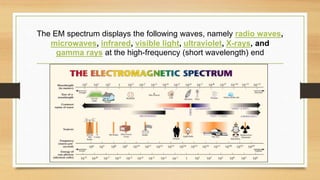
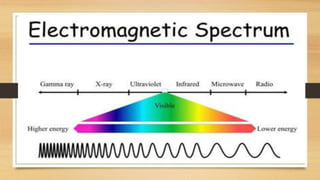
The EM spectrum displays the following waves, namely radio waves,
microwaves, infrared, visible light, ultraviolet, X-rays, and
gamma rays at the high-frequency (short wavelength) end
A. Fill in the Blanks: Compare the following EM waves and fill in the
missing word to complete the statement. Use the descriptions such
as lower, higher, shorter and longer. Write your answer on a
separate sheet of paper
1.Radio wave is _________ in wavelength than the gamma ray.
2.Microwave is __________ in frequency than infrared.
3.Infrared is _____________ in wavelength than visible light.
4.X-ray is ___________ in wavelength than gamma ray.
5.Gamma ray is ___________ in frequency than microwave.
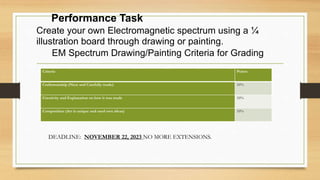
Performance Task
Create your own Electromagnetic spectrum using a ¼
illustration board through drawing or painting.
EM Spectrum Drawing/Painting Criteria for Grading
Criteria Points
Craftsmanship (Neat and Carefully made) 10%
Creativity and Explanation on how it was made 10%
Composition (Art is unique and used own ideas) 10%
DEADLINE: NOVEMBER 22, 2023 NO MORE EXTENSIONS.
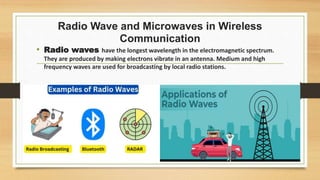
Radio Wave and Microwaves in Wireless
Communication
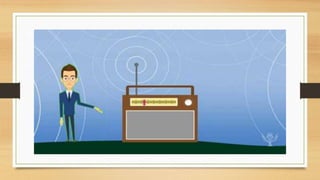
• Radio waves have the longest wavelength in the electromagnetic spectrum.
They are produced by making electrons vibrate in an antenna. Medium and high
frequency waves are used for broadcasting by local radio stations.
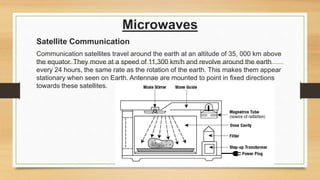
Microwaves
Satellite Communication
Communication satellites travel around the earth at an altitude of 35, 000 km above
the equator. They move at a speed of 11,300 km/h and revolve around the earth
every 24 hours, the same rate as the rotation of the earth. This makes them appear
stationary when seen on Earth. Antennae are mounted to point in fixed directions
towards these satellites.
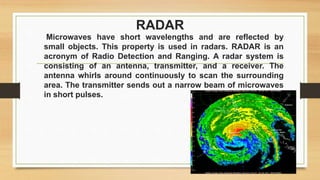
RADAR
Microwaves have short wavelengths and are reflected by
small objects. This property is used in radars. RADAR is an
acronym of Radio Detection and Ranging. A radar system is
consisting of an antenna, transmitter, and a receiver. The
antenna whirls around continuously to scan the surrounding
area. The transmitter sends out a narrow beam of microwaves
in short pulses.
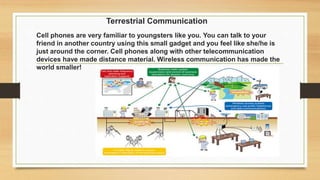
Terrestrial Communication
Cell phones are very familiar to youngsters like you. You can talk to your
friend in another country using this small gadget and you feel like she/he is
just around the corner. Cell phones along with other telecommunication
devices have made distance material. Wireless communication has made the
world smaller!
Applications of Infrared, Visible Light and UV
lights
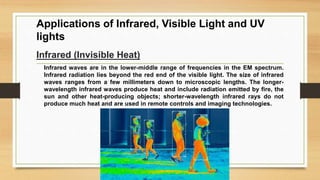
Infrared (Invisible Heat)
Infrared waves are in the lower-middle range of frequencies in the EM spectrum.
Infrared radiation lies beyond the red end of the visible light. The size of infrared
waves ranges from a few millimeters down to microscopic lengths. The longer-
wavelength infrared waves produce heat and include radiation emitted by fire, the
sun and other heat-producing objects; shorter-wavelength infrared rays do not
produce much heat and are used in remote controls and imaging technologies.
ELECTROMAGNETIC WAVE THEORY PPT.pptx

ELECTROMAGNETIC WAVE THEORY PPT.pptx

  • 1.
    ELECTROMAGNETIC WAVE THEORY EMTheory begins with ancient measures to understand atmospheric electricity, in particular, lightning. People then had little understanding of electricity and were unable to explain the phenomena. Oersted’s discovery which states that “A changing electric field produces a magnetic field”. A changing magnetic field is therefore produced around the vibrating charge.
  • 2.
    Proponents on theFormulation of EM Wave Theory • Heinrich Hertz designed an experimental set-up that enabled him to generate and detect electromagnetic waves. • German physicist who applied Maxwell’s theories to the production and reception of radio waves. The unit of frequency of a radio wave - one cycle per second - is named the hertz, in honor of Heinrich Hertz. He proved the existence of radio waves in the late 1880s.
  • 3.
    • James ClerkMaxwell (1876), an English scientist who developed a scientific theory to better explain electromagnetic waves. He noticed that electrical fields and magnetic fields can couple together to form electromagnetic waves. Maxwell discovered that a changing magnetic field will induce a changing electric field and vice versa.
  • 4.
    • Michael Faraday(1791-1867) is probably best known for his discovery of electromagnetic induction. His contributions to electrical engineering and electrochemistry or due to the fact that he was responsible for introducing the concept of field in physics to describe electromagnetic interaction are enough for him to be highly recognized.
  • 5.
    André-Marie Ampère madethe revolutionary discovery that a wire carrying electric current can attract or repel another wire next to it that’s also carrying electric current. The attraction is magnetic, but no magnets are necessary for the effect to be seen. He went on to formulate Ampere’s Law of Electromagnetism and produced the best definition of electric current during his time.
  • 6.
    Hans Christian Oersted,a Danish physicist and chemist who discovered that the electric current in a wire can deflect a magnetized compass needle, a phenomenon the importance of which was rapidly recognized and which inspired the development of electromagnetic theory.
  • 7.
    The Basic Principlesof EM Wave Theory • 1. Many natural phenomena exhibit wave-like behaviors. All of them – water waves, earthquake waves, and sound waves require a medium to propagate. These are examples of mechanical waves. 2. Light can also be described as a wave – a wave of changing electric and magnetic fields that propagate outward from their sources. These waves, however, do not require a medium to propagate. 3. They propagate at 300,000,000 meters per second through a vacuum. 4. Electromagnetic waves are transverse waves. In simpler terms, the changing electric and magnetic fields oscillate perpendicular to each other and to the direction of the propagating waves. These changing electric and magnetic fields generate each other through Faraday’s Law of Induction and Ampere’s Law of Electromagnetism. These changing fields dissociate from the oscillating charge and propagate out into space at the speed of light. 5. When the oscillating charge accelerates, the moving charge’s electric fields change, too. •
  • 8.
    MATCHING TYPE Directions: Matchthe scientists given below to their significant contributions. Write the LETTER of your answer on a separate sheet of paper. • • Scientists Contribution • ________1. Heinrich Hertz A. Showed experimental evidence of • electromagnetic waves and their link to • light • ________2. Hans Christian Oersted B. Contributed in developing equations • that showed the relationship of electricity • and magnetism • ________3. André-Marie Ampere C. Formulated the principle behind • electromagnetic induction • ________4. James Clerk Maxwell D. Demonstrated the magnetic effect based • on the direction of a current • ________5. Michael Faraday E. Showed how a current - carrying wire • behaves like a magnet F. Developed the Theory of Relativity •
  • 9.
    EM Waves: Frequenciesand Wavelengths • The electromagnetic waves (EM) are often arranged in the order of wavelength and frequency in what is known as the electromagnetic (EM) spectrum. • The term frequency describes how many waves per second a wavelength produces. On the other hand, the wavelength measures the length of an individual wave in meters .
  • 10.
    The EM spectrumdisplays the following waves, namely radio waves, microwaves, infrared, visible light, ultraviolet, X-rays, and gamma rays at the high-frequency (short wavelength) end
  • 12.
    A. Fill inthe Blanks: Compare the following EM waves and fill in the missing word to complete the statement. Use the descriptions such as lower, higher, shorter and longer. Write your answer on a separate sheet of paper 1.Radio wave is _________ in wavelength than the gamma ray. 2.Microwave is __________ in frequency than infrared. 3.Infrared is _____________ in wavelength than visible light. 4.X-ray is ___________ in wavelength than gamma ray. 5.Gamma ray is ___________ in frequency than microwave.
  • 13.
    Performance Task Create yourown Electromagnetic spectrum using a ¼ illustration board through drawing or painting. EM Spectrum Drawing/Painting Criteria for Grading Criteria Points Craftsmanship (Neat and Carefully made) 10% Creativity and Explanation on how it was made 10% Composition (Art is unique and used own ideas) 10% DEADLINE: NOVEMBER 22, 2023 NO MORE EXTENSIONS.
  • 14.
    Radio Wave andMicrowaves in Wireless Communication • Radio waves have the longest wavelength in the electromagnetic spectrum. They are produced by making electrons vibrate in an antenna. Medium and high frequency waves are used for broadcasting by local radio stations.
  • 16.
    Microwaves Satellite Communication Communication satellitestravel around the earth at an altitude of 35, 000 km above the equator. They move at a speed of 11,300 km/h and revolve around the earth every 24 hours, the same rate as the rotation of the earth. This makes them appear stationary when seen on Earth. Antennae are mounted to point in fixed directions towards these satellites.
  • 17.
    RADAR Microwaves have shortwavelengths and are reflected by small objects. This property is used in radars. RADAR is an acronym of Radio Detection and Ranging. A radar system is consisting of an antenna, transmitter, and a receiver. The antenna whirls around continuously to scan the surrounding area. The transmitter sends out a narrow beam of microwaves in short pulses.
  • 18.
    Terrestrial Communication Cell phonesare very familiar to youngsters like you. You can talk to your friend in another country using this small gadget and you feel like she/he is just around the corner. Cell phones along with other telecommunication devices have made distance material. Wireless communication has made the world smaller!
  • 20.
    Applications of Infrared,Visible Light and UV lights Infrared (Invisible Heat) Infrared waves are in the lower-middle range of frequencies in the EM spectrum. Infrared radiation lies beyond the red end of the visible light. The size of infrared waves ranges from a few millimeters down to microscopic lengths. The longer- wavelength infrared waves produce heat and include radiation emitted by fire, the sun and other heat-producing objects; shorter-wavelength infrared rays do not produce much heat and are used in remote controls and imaging technologies.