Page 1 of 2
Subject Code
CED1123 R12
VNR VIGNANA JYOTHI INSTITUTE OF ENGINEERING AND TECHNOLOGY
(AUTONOMOUS)
B.Tech. III Year II Semester Adv. Supplementary Examinations, June/July, 2015
TRANSPORTATION ENGINEERING
(CE)
Time: 3Hours Max. Marks: 70M
PART-A
(Answer ALL Questions)
1. Answer in one sentence 5X1=5M
a) Write the different modes of transportation and mostly used form.
b) What is a shoulder in a highway?
c) What does coning of wheel means? Why is it provided?
d) Differentiate between reception signal and dispatch signal.
e) Define the term cross wind component.
2. Answer the following very briefly 5X2=10M
a) Roads are considered as the arteries of a country - Justify the statement.
b) Differentiate between a flexible and rigid pavement with respect to their load transfer
behaviour.
c) Distinguish between railway station and railway yard.
d) Brief the importance of Track maintenance renewal.
e) Both landing and takeoff are made against the direction of prevailing wind - Justify the
statement if it is true.
3. Answer the following briefly 5X3=15M
a) State three objectives of traffic volume study.
b) Outline the principle of California Bearing Ratio (CBR) method of flexible pavement design.
c) Briefly outline the sleeper density.
d) State the necessity of gradients in railway tracks. List the types of gradients.
e) How is the junction of runway and taxiway formed?
Page 2 of 2
PART – B
Answer any FOUR Questions 4X10=40M
4. a) Discuss the different surveys to be undertaken in proper sequence for the alignment of
proposed new highway.
b) Discuss the Jayakar Committee and its recommendations in the development of highway in
India.
5. a) Calculate the super elevation rate 'e' required for a horizontal curve with a radius of 350 m
for a design speed of 120 kmph on a NH stretch in plain terrain. Compute the coefficient of
lateral friction mobilised if the value of 'e' is restricted to 0.07. 6M
b) Mention three grades of bitumen used in road works with their applications. 4M
6. a) What do you understand by a permanent way? Mention the requirements of an ideal
permanent way.
b) Compare the relative merits and demerits of wooden and concrete sleepers.
7. Determine the length of transition curve and draw the offsets at every 15 m. Given that the
design speed of the train on the curve is 90 kmph on a B.G. track.
8. a) Explain clearly the location and application of the Point - indicator signal.
b) Evaluate the factors influencing the capacity of an airport.
9. With the aid of a neat sketch, explain the various components of an Airport and the functions
carried out by each of them.
*****

Te

  • 1.
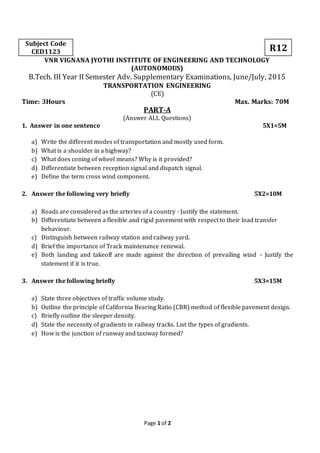
    Page 1 of2 Subject Code CED1123 R12 VNR VIGNANA JYOTHI INSTITUTE OF ENGINEERING AND TECHNOLOGY (AUTONOMOUS) B.Tech. III Year II Semester Adv. Supplementary Examinations, June/July, 2015 TRANSPORTATION ENGINEERING (CE) Time: 3Hours Max. Marks: 70M PART-A (Answer ALL Questions) 1. Answer in one sentence 5X1=5M a) Write the different modes of transportation and mostly used form. b) What is a shoulder in a highway? c) What does coning of wheel means? Why is it provided? d) Differentiate between reception signal and dispatch signal. e) Define the term cross wind component. 2. Answer the following very briefly 5X2=10M a) Roads are considered as the arteries of a country - Justify the statement. b) Differentiate between a flexible and rigid pavement with respect to their load transfer behaviour. c) Distinguish between railway station and railway yard. d) Brief the importance of Track maintenance renewal. e) Both landing and takeoff are made against the direction of prevailing wind - Justify the statement if it is true. 3. Answer the following briefly 5X3=15M a) State three objectives of traffic volume study. b) Outline the principle of California Bearing Ratio (CBR) method of flexible pavement design. c) Briefly outline the sleeper density. d) State the necessity of gradients in railway tracks. List the types of gradients. e) How is the junction of runway and taxiway formed?
  • 2.
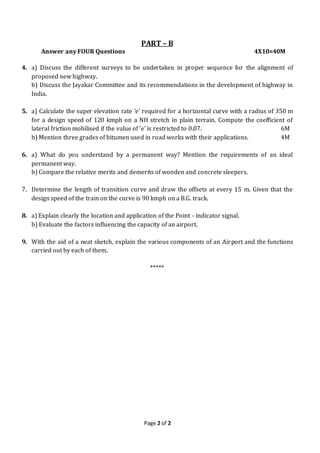
    Page 2 of2 PART – B Answer any FOUR Questions 4X10=40M 4. a) Discuss the different surveys to be undertaken in proper sequence for the alignment of proposed new highway. b) Discuss the Jayakar Committee and its recommendations in the development of highway in India. 5. a) Calculate the super elevation rate 'e' required for a horizontal curve with a radius of 350 m for a design speed of 120 kmph on a NH stretch in plain terrain. Compute the coefficient of lateral friction mobilised if the value of 'e' is restricted to 0.07. 6M b) Mention three grades of bitumen used in road works with their applications. 4M 6. a) What do you understand by a permanent way? Mention the requirements of an ideal permanent way. b) Compare the relative merits and demerits of wooden and concrete sleepers. 7. Determine the length of transition curve and draw the offsets at every 15 m. Given that the design speed of the train on the curve is 90 kmph on a B.G. track. 8. a) Explain clearly the location and application of the Point - indicator signal. b) Evaluate the factors influencing the capacity of an airport. 9. With the aid of a neat sketch, explain the various components of an Airport and the functions carried out by each of them. *****