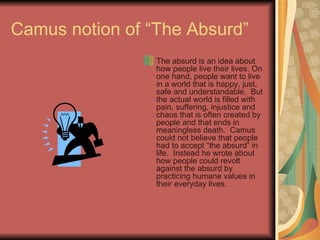
The document discusses existentialism through the lens of Albert Camus and his notion of "the absurd." It summarizes that Camus believed life is absurd and meaningless due to the suffering and injustice in the world. However, Camus argued that people can revolt against the absurd by practicing humane values in their daily lives. Existentialism holds that individuals are solely responsible for their own decisions and actions, and that people strive for meaning and purpose despite life's inherent absurdity and lack of external purpose or design. Existentialism promotes individual freedom and responsibility over social or religious doctrines.





![Voices and you[1]](https://cdn.slidesharecdn.com/ss_thumbnails/voicesandyou1-100529234259-phpapp01-thumbnail.jpg?width=640&height=640&fit=bounds)


