UTOPIANISM
WHAT IS UTOPIANISM? Where did it come from? What does it mean to me? CaN iT aCTuaLLY eXiST?
Utopia:  An ideally perfect place, especially in its social, political, and moral aspects.  Utopia can be defined as paradise on Earth, Nirvana or Heaven on Earth.
Background information: It was originally a word coined in 1516 by the author Sir Thomas More. “Utopia” was the title of his book, as was the name of the imaginary island that harbored the perfect society. The word “utopia” is derived from two Greek words.  The first is  eutopia , which means “good place”.  The second is  outopia , which means “no place”.
Early Roots: Talks of the “Perfect Society” - Plato’s  The Republic :  Plato sketches the basic political structure and laws of an ideal city named Magnesia.   - The Garden of Eden from  The Book of Genesis : Judeo-Christian Paradise; created by God, where all that inhabit in it live in harmony - Confucius’  The Book of Rites  (around Plato’s era) Talks about the final phase of human development and “the state of eternal peace” from the last stage of the ideal society.
Relevant Literary Works: Lost Horizon  (written by James Hilton - 1933): Shangri-La is a fictional place described in the novel. Hidden in the Tibetan mountains and synonymous as an earthly paradise, it suggests that such paradise on earth must be somewhere if only man were able to find it. Brave New World  (written by Aldous Huxley – 1932): A society in which babies are mass-produced and assigned social classes before they are infants. The idea behind this engineering of humans is for social stability.
1984  (written by George Orwell – 1949) Dystopia: An imaginary place or state in which the condition of life is extremely bad, as from deprivation, oppression, or terror.
GROUP DISCUSSION!
PROS  & CONS
PROS: Living in harmony with others No motivation for war or oppression No conflicts
CONS: Ethical concerns Differences with each individuals’ ideals Boring!
Experiments in Utopia: The Mormon Church (One of many communal utopias) - a) Orderville, Utah (experiment 1830s-1880s) b) Nauvoo, Illinois (1849-1856?) French Icarians? – Moved in when Mormons moved out (led by Brigham Young)? Current American Communal Communities (The Amish)
Examples of Utopianism/   Dystopia in Cinema
Demolition Man Equilibrium Fahrenheit 451 Gattaca The Matrix The Stepford Wives The Village
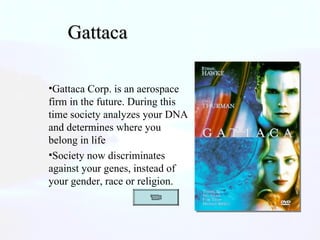
Gattaca  Gattaca Corp. is an aerospace firm in the future. During this time society analyzes your DNA and determines where you belong in life Society now discriminates against your genes, instead of your gender, race or religion.
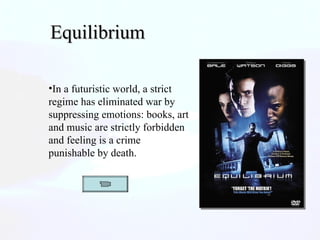
Equilibrium  In a futuristic world, a strict regime has eliminated war by suppressing emotions: books, art and music are strictly forbidden and feeling is a crime punishable by death.
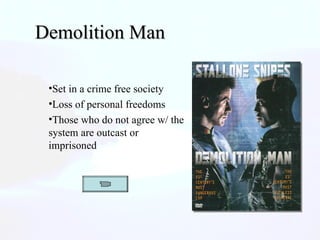
Demolition Man Set in a crime free society Loss of personal freedoms Those who do not agree w/ the system are outcast or imprisoned
THE END YAAAAAAY!

Ss388 utopianism presentation

  • 1.
  • 2.
    WHAT IS UTOPIANISM?Where did it come from? What does it mean to me? CaN iT aCTuaLLY eXiST?
  • 3.
    Utopia: Anideally perfect place, especially in its social, political, and moral aspects. Utopia can be defined as paradise on Earth, Nirvana or Heaven on Earth.
  • 4.
    Background information: Itwas originally a word coined in 1516 by the author Sir Thomas More. “Utopia” was the title of his book, as was the name of the imaginary island that harbored the perfect society. The word “utopia” is derived from two Greek words. The first is eutopia , which means “good place”. The second is outopia , which means “no place”.
  • 5.
    Early Roots: Talksof the “Perfect Society” - Plato’s The Republic : Plato sketches the basic political structure and laws of an ideal city named Magnesia. - The Garden of Eden from The Book of Genesis : Judeo-Christian Paradise; created by God, where all that inhabit in it live in harmony - Confucius’ The Book of Rites (around Plato’s era) Talks about the final phase of human development and “the state of eternal peace” from the last stage of the ideal society.
  • 6.
    Relevant Literary Works:Lost Horizon (written by James Hilton - 1933): Shangri-La is a fictional place described in the novel. Hidden in the Tibetan mountains and synonymous as an earthly paradise, it suggests that such paradise on earth must be somewhere if only man were able to find it. Brave New World (written by Aldous Huxley – 1932): A society in which babies are mass-produced and assigned social classes before they are infants. The idea behind this engineering of humans is for social stability.
  • 7.
    1984 (writtenby George Orwell – 1949) Dystopia: An imaginary place or state in which the condition of life is extremely bad, as from deprivation, oppression, or terror.
  • 8.
  • 9.
    PROS &CONS
  • 10.
    PROS: Living inharmony with others No motivation for war or oppression No conflicts
  • 11.
    CONS: Ethical concernsDifferences with each individuals’ ideals Boring!
  • 12.
    Experiments in Utopia:The Mormon Church (One of many communal utopias) - a) Orderville, Utah (experiment 1830s-1880s) b) Nauvoo, Illinois (1849-1856?) French Icarians? – Moved in when Mormons moved out (led by Brigham Young)? Current American Communal Communities (The Amish)
  • 13.
    Examples of Utopianism/ Dystopia in Cinema
  • 14.
    Demolition Man EquilibriumFahrenheit 451 Gattaca The Matrix The Stepford Wives The Village
  • 15.
    Gattaca GattacaCorp. is an aerospace firm in the future. During this time society analyzes your DNA and determines where you belong in life Society now discriminates against your genes, instead of your gender, race or religion.
  • 16.
    Equilibrium Ina futuristic world, a strict regime has eliminated war by suppressing emotions: books, art and music are strictly forbidden and feeling is a crime punishable by death.
  • 17.
    Demolition Man Setin a crime free society Loss of personal freedoms Those who do not agree w/ the system are outcast or imprisoned
  • 18.