GT01003
Macroeconomics
 Every day, news draws our attention to the
global economy
 The US sub-prime mortgage crisis of 2007 – 2008
quickly became a worldwide event because of the
trade in mortgage securities
 Since the mid 1980s, international trade has
grown faster than GDP
 Changing trading patterns have reduced the
sensitivity of foreign economies to the events in
the US
 Innovations in transportation and communication
can make events abroad an immediate issue
worldwide
1. Define the nominal exchange rate
 Use the terms appreciation and depreciation to
describe movements in exchange rates
2. Use supply and demand to analyze how the
nominal exchange rate is determined in the
short run
3. Distinguish between flexible and fixed
exchange rates
 Domestic purchases are made with local
currency
 Purchases of goods abroad requires converting
your local currency to their local currency
 The exchange rate is the price for that transaction
 Exchange rates are set in the foreign
exchange market, with a small number of
exceptions
 Rates are determined by supply and demand
 Affect the value of imported goods and the costs
of foreign investment
 Changes in exchange rates can have a significant
effect on most economies
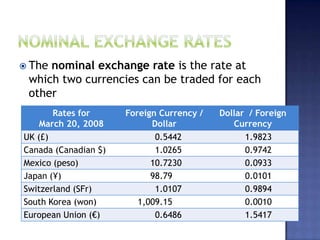
 The nominal exchange rate is the rate at
which two currencies can be traded for each
other
Rates for
March 20, 2008
Foreign Currency /
Dollar
Dollar / Foreign
Currency
UK (£) 0.5442 1.9823
Canada (Canadian $) 1.0265 0.9742
Mexico (peso) 10.7230 0.0933
Japan (¥) 98.79 0.0101
Switzerland (SFr) 1.0107 0.9894
South Korea (won) 1,009.15 0.0010
European Union (€) 0.6486 1.5417
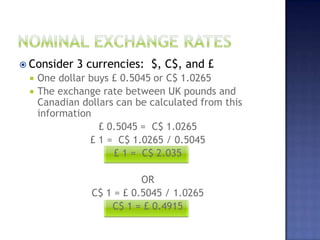
 Consider 3 currencies: $, C$, and £
 One dollar buys £ 0.5045 or C$ 1.0265
 The exchange rate between UK pounds and
Canadian dollars can be calculated from this
information
£ 0.5045 = C$ 1.0265
£ 1 = C$ 1.0265 / 0.5045
£ 1 = C$ 2.035
OR
C$ 1 = £ 0.5045 / 1.0265
C$ 1 = £ 0.4915
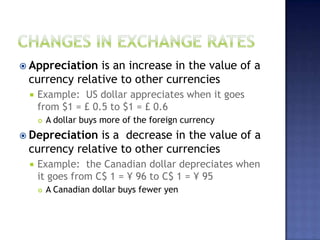
 Appreciation is an increase in the value of a
currency relative to other currencies
 Example: US dollar appreciates when it goes
from $1 = £ 0.5 to $1 = £ 0.6
 A dollar buys more of the foreign currency
 Depreciation is a decrease in the value of a
currency relative to other currencies
 Example: the Canadian dollar depreciates when
it goes from C$ 1 = ¥ 96 to C$ 1 = ¥ 95
 A Canadian dollar buys fewer yen
 Definition
 e = the number of units of foreign currency that
the domestic currency will buy
 Example, e is the number of Swiss francs you can buy
with $1
 e is the nominal exchange rate
 Domestic currency appreciates if e increases
 Domestic currency depreciates if e
decreases
 Foreign exchange market is the market on which
currencies of various nations are traded
 Flexible exchange rate is a system that sets
the exchange rate according to demand and
supply of a country's currency
 Fixed exchange rate is an exchange rate set
by official government policy
 Can be set independently or by agreement with a
number of other governments
 Fixed rates can be set relative to the dollar, the
euro, or even gold
 Countries that have flexible exchange rates
see the values of their currencies change
continually.
 Exchange rates are set by supply and demand
in the foreign exchange market
 US supplies dollars to buy foreign exchange
in order to buy foreign goods or foreign
assets
 Not the same as the money supply controlled by
the Fed
 Supply of dollars in the foreign exchange market
is the number of dollars offered for sale for a
given foreign currency
 Anyone who holds dollars is a potential
supplier
 US households and firms are the most common
suppliers
 Supply curve has a positive slope
 The more foreign currency per dollar, the larger
the quantity of dollars supplied
 This makes foreign goods cheaper
 When $1 = ¥ 100, a ¥ 5,000 item costs $50
 If $1 = ¥ 200, that same ¥ 5,000 item costs $25
 When the dollar appreciates, quantity of dollars
supplied increases
 Anyone who holds yen can demand dollars
 Japanese households and firms are the most
common demanders
 Demand curve has a negative slope
 The more foreign currency per dollar, the smaller
the quantity of dollars demanded
 This makes US goods more expensive
 When $1 = ¥ 100, a $30 item costs ¥ 3,000
 If $1 = ¥ 200, that same $30 item costs ¥ 6,000
 When the dollar appreciates, quantity of dollars
demanded decreases
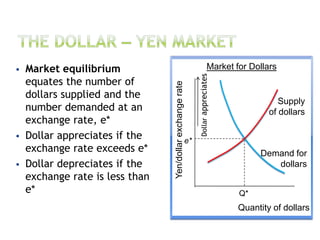
 Market equilibrium
equates the number of
dollars supplied and the
number demanded at an
exchange rate, e*
 Dollar appreciates if the
exchange rate exceeds e*
 Dollar depreciates if the
exchange rate is less than
e*
Market for Dollars
Quantity of dollars
Yen/dollarexchangerate
Demand for
dollars
Supply
of dollars
e*
Q*
Dollarappreciates
 Supply of dollars for Japanese yen is
determined by
 The preference for Japanese goods
 The stronger the preference, the greater the supply of
dollars
 US real GDP
 The higher GDP, the greater the supply of dollars
 Real interest rate on Japanese assets and the
real interest rate on US assets
 Supply of dollars will be greater if
 Real interest rate on Japanese assets are higher
 Real interest rate on US assets is lower
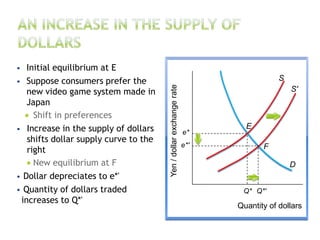
 Initial equilibrium at E
 Suppose consumers prefer the
new video game system made in
Japan
 Shift in preferences
 Increase in the supply of dollars
shifts dollar supply curve to the
right
 New equilibrium at F
 Dollar depreciates to e*'
 Quantity of dollars traded
increases to Q*'
Quantity of dollars
Yen/dollarexchangerate
D
S
e*
E
F
S'
Q*
e*'
Q*'
 Demand for dollars by holders of yen is
determined by
 The preference for US goods
 The stronger the preference, the greater the demand
for dollars
 Real GDP in Japan
 The higher GDP, the greater the demand for dollars
 Real interest rate on Japanese assets and real
interest rate on US assets
 Supply of dollars will be greater if
 Real interest rate on Japanese assets are lower
 Real interest rate on US assets is higher
 At the G8 Summit in Japan, July, 2008, President
Bush stated his support for a strong dollar
 A strong currency means its value is high in terms of
other countries
 A strong currency is unrelated to a strong
economy
 Dollar was strong in 1973, a time of recession
 The dollar was weak in 2007 but the domestic
economy was strong
 Strong currencies reduce net exports
 Japanese goods look cheap, so NX goes down
 NX affects spending and aggregate demand
 Monetary policy affects interest rates which
affect the exchange rate
 Tighter US monetary policy, leading to a higher
real interest rate
 Higher interest rates make US assets more
attractive than foreign assets
 Demand for the dollar increases by foreigners
 Demand curve shifts to the right
 Supply of dollars by US decreases
 Supply curve shifts to the left
 Dollar appreciates
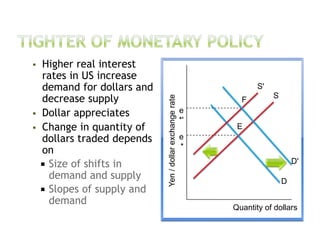
 Higher real interest
rates in US increase
demand for dollars and
decrease supply
 Dollar appreciates
 Change in quantity of
dollars traded depends
on
 Size of shifts in
demand and supply
 Slopes of supply and
demand
Quantity of dollars
Yen/dollarexchangerate
e
*'
F
S
D
e
*
E
S'
D'
 Monetary policy was the main cause of
recent changes in the dollar exchange rate
 Dollar appreciation in the early 1980s
 Real interest rate rose from negative values in 1979
and 1980 to 7% in 1983 and 1984
 Dollar depreciation 2002 - 2005
 US economy grew faster than our trading partners'
economies
 Foreign exchange demand for imports increased
 Fed funds rate went from 6% in 2001 to 1% in 2003
 Demand for US assets decreased
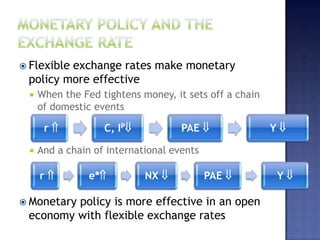
 Flexible exchange rates make monetary
policy more effective
 When the Fed tightens money, it sets off a chain
of domestic events
 And a chain of international events
 Monetary policy is more effective in an open
economy with flexible exchange rates
r  C, IP PAE  Y 
r  e* NX  PAE  Y 
 Most large industrial countries use a flexible
exchange rate
 Small and developing countries may use fixed
exchange rate
 Fixed rate system was set up after World War
II
 Began to break down in the 1960s
 Abandoned by 1976
 To establish a fixed exchange rate system,
the government states the value of its
currency in terms of a major currency
 May use an average of the currencies of its major
trading partners
 Government attempts to maintain fixed
exchange rate at its existing level
 The government may change the value of its
currency in response to market events
 Devaluation is a reduction in the official value
 Revaluation is an increase in the official value
 Analogous to depreciation and appreciation
 A flexible exchange rate actually strengthen the
impact of monetary policy on aggregate demand.
 However, a fixed exchange rate prevent
policymakers from using monetary policy to
stabilize the economy because they must use
monetary policy to ensure that the fundamental
value of the exchange rate equals to the official
value.
 In this case, monetary policy is no longer available for
stabilizing the domestic economy
 Limiting monetary policy as a stabilization tool is
a strong argument against fixed exchange rates
 Fixed exchange rates have benefits
 Predictability and stability in foreign transactions
 Certainty of future value of the currencies
 However, fixed rates are not fixed forever
 Sudden and unforeseen large changes are
possible. In 1997, the baht depreciated by over
67% in just two weeks.
 Predicting exchange rates over the long term is
difficult under either fixed or flexible rates
 The potential instability of fixed exchange rates
has led to the adoption of a common currency.
 European Common Market was formed in 1957
 Free trade between member countries
 Fixed exchange rate system stet up in the 1970s was
abandoned in 1992
 European Union was created by the Maastricht
Treaty in 1991
 Agreed to work toward adopting a common currency
 The euro was phased in
 Began as an accounting unit
 Euro currency was phased in and local currency phased
out in 11 member countries
 Countries with a single currency must have a
common monetary policy
 The European Central Bank became the central
bank for the euro countries
 Countries sacrifice some control to be part of
the euro
 Economic conditions vary between countries and
the central bank cannot respond to each
 Slow growth in Germany and rapid growth in Ireland
 Choose between a US computer and a
comparable Japanese computer, based on price
 US computer costs $2,400
 Japanese computer costs ¥ 242,000
 $1 = ¥ 110
 The Japanese computer cost is ¥ 242,000 / (¥
110/$1) or $2,200
 The Japanese computer is cheaper
 The relative price of the US computer to the
Japanese computer is $2,400 / $2,200 = 1.09
 US computer costs 9% more than the Japanese one
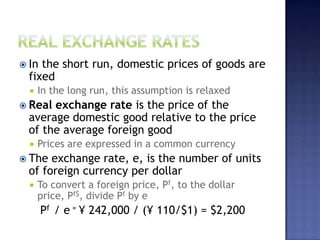
 In the short run, domestic prices of goods are
fixed
 In the long run, this assumption is relaxed
 Real exchange rate is the price of the
average domestic good relative to the price
of the average foreign good
 Prices are expressed in a common currency
 The exchange rate, e, is the number of units
of foreign currency per dollar
 To convert a foreign price, Pf, to the dollar
price, Pf$, divide Pf by e
Pf / e = ¥ 242,000 / (¥ 110/$1) = $2,200
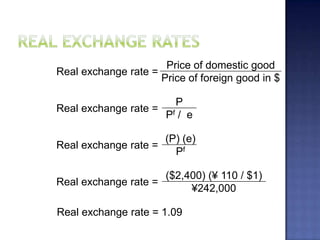
Price of domestic good
Price of foreign good in $
Real exchange rate =
P
Pf / e
Real exchange rate =
(P) (e)
Pf
Real exchange rate =
($2,400) (¥ 110 / $1)
¥242,000
Real exchange rate = 1.09
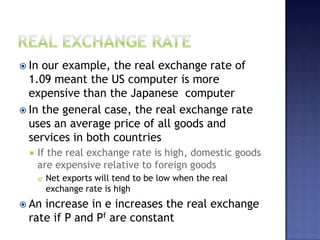
 In our example, the real exchange rate of
1.09 meant the US computer is more
expensive than the Japanese computer
 In the general case, the real exchange rate
uses an average price of all goods and
services in both countries
 If the real exchange rate is high, domestic goods
are expensive relative to foreign goods
 Net exports will tend to be low when the real
exchange rate is high
 An increase in e increases the real exchange
rate if P and Pf are constant
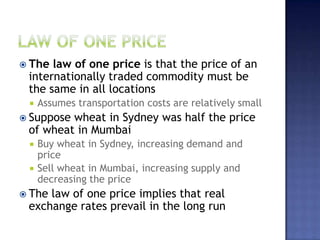
 The law of one price is that the price of an
internationally traded commodity must be
the same in all locations
 Assumes transportation costs are relatively small
 Suppose wheat in Sydney was half the price
of wheat in Mumbai
 Buy wheat in Sydney, increasing demand and
price
 Sell wheat in Mumbai, increasing supply and
decreasing the price
 The law of one price implies that real
exchange rates prevail in the long run
 Purchasing power parity is the theory that
nominal exchange rates are determined as
necessary for the law of one price to hold
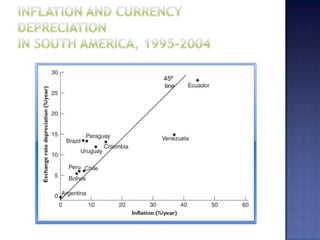
 In the long run, the currencies of countries that
experience significant inflation will tend to
depreciate
 A bushel of grain costs
 A$ 5 in Sydney and
 Rs 150 in Mumbai
 For the price of the bushel of grain to be the
same in both countries, the implied nominal
exchange rate is A$ 1 = Rs 30
 Suppose that India experiences inflation and
the bushel of grain now costs Rs 300 in
Mumbai
 The Australian dollar appreciates to A$ 1 = Rs 60
 Price of the wheat is the same in both countries
45º
line
 Shortcomings of the PPP Theory
 The theory predicts well in the long run but not
the short run
 Limits to the PPP Theory
 Not all goods and services are traded
internationally
 The greater the share of non-traded goods, the less
precise the PPP theory
 For example, the market for haircuts is very local
 Not all internationally traded goods and services
are perfectly standardized commodities

Exchange rates

  • 1.
  • 2.
     Every day,news draws our attention to the global economy  The US sub-prime mortgage crisis of 2007 – 2008 quickly became a worldwide event because of the trade in mortgage securities  Since the mid 1980s, international trade has grown faster than GDP  Changing trading patterns have reduced the sensitivity of foreign economies to the events in the US  Innovations in transportation and communication can make events abroad an immediate issue worldwide
  • 3.
    1. Define thenominal exchange rate  Use the terms appreciation and depreciation to describe movements in exchange rates 2. Use supply and demand to analyze how the nominal exchange rate is determined in the short run 3. Distinguish between flexible and fixed exchange rates
  • 4.
     Domestic purchasesare made with local currency  Purchases of goods abroad requires converting your local currency to their local currency  The exchange rate is the price for that transaction  Exchange rates are set in the foreign exchange market, with a small number of exceptions  Rates are determined by supply and demand  Affect the value of imported goods and the costs of foreign investment  Changes in exchange rates can have a significant effect on most economies
  • 5.
     The nominalexchange rate is the rate at which two currencies can be traded for each other Rates for March 20, 2008 Foreign Currency / Dollar Dollar / Foreign Currency UK (£) 0.5442 1.9823 Canada (Canadian $) 1.0265 0.9742 Mexico (peso) 10.7230 0.0933 Japan (¥) 98.79 0.0101 Switzerland (SFr) 1.0107 0.9894 South Korea (won) 1,009.15 0.0010 European Union (€) 0.6486 1.5417
  • 6.
     Consider 3currencies: $, C$, and £  One dollar buys £ 0.5045 or C$ 1.0265  The exchange rate between UK pounds and Canadian dollars can be calculated from this information £ 0.5045 = C$ 1.0265 £ 1 = C$ 1.0265 / 0.5045 £ 1 = C$ 2.035 OR C$ 1 = £ 0.5045 / 1.0265 C$ 1 = £ 0.4915
  • 8.
     Appreciation isan increase in the value of a currency relative to other currencies  Example: US dollar appreciates when it goes from $1 = £ 0.5 to $1 = £ 0.6  A dollar buys more of the foreign currency  Depreciation is a decrease in the value of a currency relative to other currencies  Example: the Canadian dollar depreciates when it goes from C$ 1 = ¥ 96 to C$ 1 = ¥ 95  A Canadian dollar buys fewer yen
  • 9.
     Definition  e= the number of units of foreign currency that the domestic currency will buy  Example, e is the number of Swiss francs you can buy with $1  e is the nominal exchange rate  Domestic currency appreciates if e increases  Domestic currency depreciates if e decreases
  • 11.
     Foreign exchangemarket is the market on which currencies of various nations are traded  Flexible exchange rate is a system that sets the exchange rate according to demand and supply of a country's currency  Fixed exchange rate is an exchange rate set by official government policy  Can be set independently or by agreement with a number of other governments  Fixed rates can be set relative to the dollar, the euro, or even gold
  • 12.
     Countries thathave flexible exchange rates see the values of their currencies change continually.  Exchange rates are set by supply and demand in the foreign exchange market  US supplies dollars to buy foreign exchange in order to buy foreign goods or foreign assets  Not the same as the money supply controlled by the Fed  Supply of dollars in the foreign exchange market is the number of dollars offered for sale for a given foreign currency
  • 13.
     Anyone whoholds dollars is a potential supplier  US households and firms are the most common suppliers  Supply curve has a positive slope  The more foreign currency per dollar, the larger the quantity of dollars supplied  This makes foreign goods cheaper  When $1 = ¥ 100, a ¥ 5,000 item costs $50  If $1 = ¥ 200, that same ¥ 5,000 item costs $25  When the dollar appreciates, quantity of dollars supplied increases
  • 14.
     Anyone whoholds yen can demand dollars  Japanese households and firms are the most common demanders  Demand curve has a negative slope  The more foreign currency per dollar, the smaller the quantity of dollars demanded  This makes US goods more expensive  When $1 = ¥ 100, a $30 item costs ¥ 3,000  If $1 = ¥ 200, that same $30 item costs ¥ 6,000  When the dollar appreciates, quantity of dollars demanded decreases
  • 15.
     Market equilibrium equatesthe number of dollars supplied and the number demanded at an exchange rate, e*  Dollar appreciates if the exchange rate exceeds e*  Dollar depreciates if the exchange rate is less than e* Market for Dollars Quantity of dollars Yen/dollarexchangerate Demand for dollars Supply of dollars e* Q* Dollarappreciates
  • 16.
     Supply ofdollars for Japanese yen is determined by  The preference for Japanese goods  The stronger the preference, the greater the supply of dollars  US real GDP  The higher GDP, the greater the supply of dollars  Real interest rate on Japanese assets and the real interest rate on US assets  Supply of dollars will be greater if  Real interest rate on Japanese assets are higher  Real interest rate on US assets is lower
  • 17.
     Initial equilibriumat E  Suppose consumers prefer the new video game system made in Japan  Shift in preferences  Increase in the supply of dollars shifts dollar supply curve to the right  New equilibrium at F  Dollar depreciates to e*'  Quantity of dollars traded increases to Q*' Quantity of dollars Yen/dollarexchangerate D S e* E F S' Q* e*' Q*'
  • 18.
     Demand fordollars by holders of yen is determined by  The preference for US goods  The stronger the preference, the greater the demand for dollars  Real GDP in Japan  The higher GDP, the greater the demand for dollars  Real interest rate on Japanese assets and real interest rate on US assets  Supply of dollars will be greater if  Real interest rate on Japanese assets are lower  Real interest rate on US assets is higher
  • 19.
     At theG8 Summit in Japan, July, 2008, President Bush stated his support for a strong dollar  A strong currency means its value is high in terms of other countries  A strong currency is unrelated to a strong economy  Dollar was strong in 1973, a time of recession  The dollar was weak in 2007 but the domestic economy was strong  Strong currencies reduce net exports  Japanese goods look cheap, so NX goes down  NX affects spending and aggregate demand
  • 21.
     Monetary policyaffects interest rates which affect the exchange rate  Tighter US monetary policy, leading to a higher real interest rate  Higher interest rates make US assets more attractive than foreign assets  Demand for the dollar increases by foreigners  Demand curve shifts to the right  Supply of dollars by US decreases  Supply curve shifts to the left  Dollar appreciates
  • 22.
     Higher realinterest rates in US increase demand for dollars and decrease supply  Dollar appreciates  Change in quantity of dollars traded depends on  Size of shifts in demand and supply  Slopes of supply and demand Quantity of dollars Yen/dollarexchangerate e *' F S D e * E S' D'
  • 23.
     Monetary policywas the main cause of recent changes in the dollar exchange rate  Dollar appreciation in the early 1980s  Real interest rate rose from negative values in 1979 and 1980 to 7% in 1983 and 1984  Dollar depreciation 2002 - 2005  US economy grew faster than our trading partners' economies  Foreign exchange demand for imports increased  Fed funds rate went from 6% in 2001 to 1% in 2003  Demand for US assets decreased
  • 24.
     Flexible exchangerates make monetary policy more effective  When the Fed tightens money, it sets off a chain of domestic events  And a chain of international events  Monetary policy is more effective in an open economy with flexible exchange rates r  C, IP PAE  Y  r  e* NX  PAE  Y 
  • 26.
     Most largeindustrial countries use a flexible exchange rate  Small and developing countries may use fixed exchange rate  Fixed rate system was set up after World War II  Began to break down in the 1960s  Abandoned by 1976
  • 27.
     To establisha fixed exchange rate system, the government states the value of its currency in terms of a major currency  May use an average of the currencies of its major trading partners  Government attempts to maintain fixed exchange rate at its existing level  The government may change the value of its currency in response to market events  Devaluation is a reduction in the official value  Revaluation is an increase in the official value  Analogous to depreciation and appreciation
  • 28.
     A flexibleexchange rate actually strengthen the impact of monetary policy on aggregate demand.  However, a fixed exchange rate prevent policymakers from using monetary policy to stabilize the economy because they must use monetary policy to ensure that the fundamental value of the exchange rate equals to the official value.  In this case, monetary policy is no longer available for stabilizing the domestic economy  Limiting monetary policy as a stabilization tool is a strong argument against fixed exchange rates
  • 29.
     Fixed exchangerates have benefits  Predictability and stability in foreign transactions  Certainty of future value of the currencies  However, fixed rates are not fixed forever  Sudden and unforeseen large changes are possible. In 1997, the baht depreciated by over 67% in just two weeks.  Predicting exchange rates over the long term is difficult under either fixed or flexible rates
  • 30.
     The potentialinstability of fixed exchange rates has led to the adoption of a common currency.  European Common Market was formed in 1957  Free trade between member countries  Fixed exchange rate system stet up in the 1970s was abandoned in 1992  European Union was created by the Maastricht Treaty in 1991  Agreed to work toward adopting a common currency  The euro was phased in  Began as an accounting unit  Euro currency was phased in and local currency phased out in 11 member countries
  • 31.
     Countries witha single currency must have a common monetary policy  The European Central Bank became the central bank for the euro countries  Countries sacrifice some control to be part of the euro  Economic conditions vary between countries and the central bank cannot respond to each  Slow growth in Germany and rapid growth in Ireland
  • 33.
     Choose betweena US computer and a comparable Japanese computer, based on price  US computer costs $2,400  Japanese computer costs ¥ 242,000  $1 = ¥ 110  The Japanese computer cost is ¥ 242,000 / (¥ 110/$1) or $2,200  The Japanese computer is cheaper  The relative price of the US computer to the Japanese computer is $2,400 / $2,200 = 1.09  US computer costs 9% more than the Japanese one
  • 34.
     In theshort run, domestic prices of goods are fixed  In the long run, this assumption is relaxed  Real exchange rate is the price of the average domestic good relative to the price of the average foreign good  Prices are expressed in a common currency  The exchange rate, e, is the number of units of foreign currency per dollar  To convert a foreign price, Pf, to the dollar price, Pf$, divide Pf by e Pf / e = ¥ 242,000 / (¥ 110/$1) = $2,200
  • 35.
    Price of domesticgood Price of foreign good in $ Real exchange rate = Real exchange rate = P Pf / e Real exchange rate = (P) (e) Pf Real exchange rate = ($2,400) (¥ 110 / $1) ¥242,000 Real exchange rate = 1.09
  • 36.
     In ourexample, the real exchange rate of 1.09 meant the US computer is more expensive than the Japanese computer  In the general case, the real exchange rate uses an average price of all goods and services in both countries  If the real exchange rate is high, domestic goods are expensive relative to foreign goods  Net exports will tend to be low when the real exchange rate is high  An increase in e increases the real exchange rate if P and Pf are constant
  • 37.
     The lawof one price is that the price of an internationally traded commodity must be the same in all locations  Assumes transportation costs are relatively small  Suppose wheat in Sydney was half the price of wheat in Mumbai  Buy wheat in Sydney, increasing demand and price  Sell wheat in Mumbai, increasing supply and decreasing the price  The law of one price implies that real exchange rates prevail in the long run
  • 38.
     Purchasing powerparity is the theory that nominal exchange rates are determined as necessary for the law of one price to hold  In the long run, the currencies of countries that experience significant inflation will tend to depreciate
  • 39.
     A bushelof grain costs  A$ 5 in Sydney and  Rs 150 in Mumbai  For the price of the bushel of grain to be the same in both countries, the implied nominal exchange rate is A$ 1 = Rs 30  Suppose that India experiences inflation and the bushel of grain now costs Rs 300 in Mumbai  The Australian dollar appreciates to A$ 1 = Rs 60  Price of the wheat is the same in both countries
  • 40.
  • 41.
     Shortcomings ofthe PPP Theory  The theory predicts well in the long run but not the short run  Limits to the PPP Theory  Not all goods and services are traded internationally  The greater the share of non-traded goods, the less precise the PPP theory  For example, the market for haircuts is very local  Not all internationally traded goods and services are perfectly standardized commodities

Editor's Notes

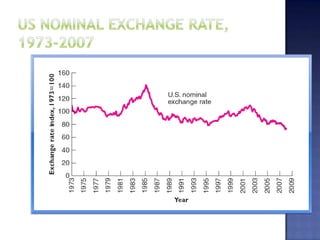
  • #8 Vertical axis is a weighted index of the dollar's value against other major currencies, 1973 = 100