WITH ANSWER KEY
FOR ADVANCED
Carole Allsop, Mark Little
and Anne Robinson
w
ith Audi
o
Cambridge University Press
www.cambridge.org/elt
Cambridge Assessment English
www.cambridgeenglish.org
Information on this title: www.cambridge.org/9781108349086
© Cambridge University Press and UCLES 2018
It is normally necessary for written permission for copying to be obtained in
advance from a publisher. The worksheets in this book are designed to be copied
and distributed in class. The normal requirements are waived here and it is not
necessary to write to Cambridge University Press for permission for an individual
teacher to make copies for use within his or her own classroom. Only those pages
that carry the wording ‘© Cambridge University Press and UCLES 2018’ may
be copied.
First published 2018
20 19 18 17 16 15 14 13 12 11 10 9 8 7 6 5 4 3 2 1
Printed in Dubai by Oriental Press
A catalogue record for this publication is available from the British Library
ISBN 978-1-108-34908-6
Additional resources for this publication at www.cambridge.org/advancedbooster
The publishers have no responsibility for the persistence or accuracy of URLs
for external or third-party internet websites referred to in this publication, and
do not guarantee that any content on such websites is, or will remain, accurate
or appropriate. Information regarding prices, travel timetables, and other factual
information given in this work is correct at the time of first printing but the
publishers do not guarantee the accuracy of such information thereafter.
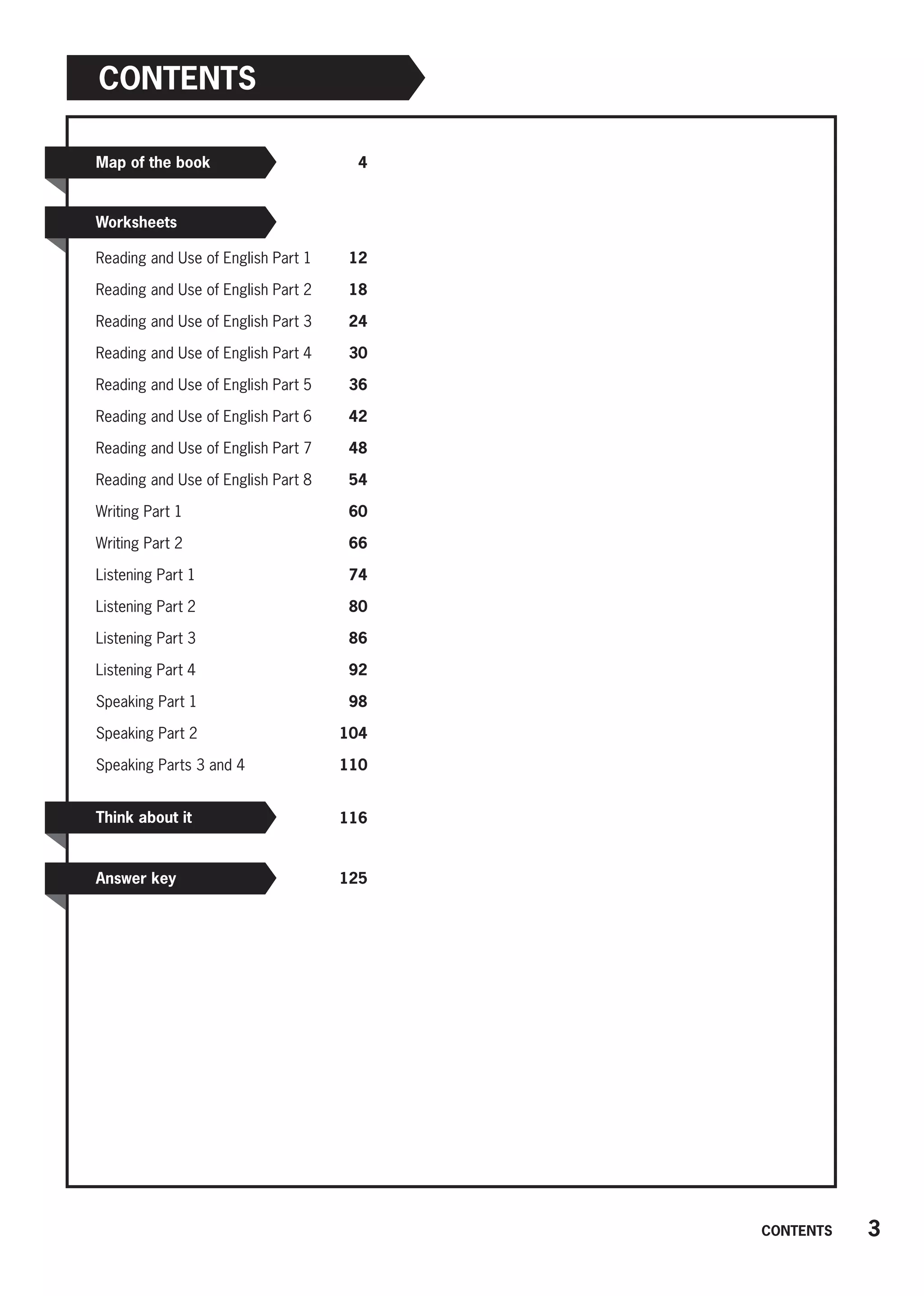
Contents
Map of the book
Worksheets
 4
Reading and Use of English Part 1 12
Reading and Use of English Part 2 18
Reading and Use of English Part 3 24
Reading and Use of English Part 4 30
Reading and Use of English Part 5 36
Reading and Use of English Part 6 42
Reading and Use of English Part 7 48
Reading and Use of English Part 8 54
Writing Part 1 60
Writing Part 2 66
Listening Part 1 74
Listening Part 2 80
Listening Part 3 86
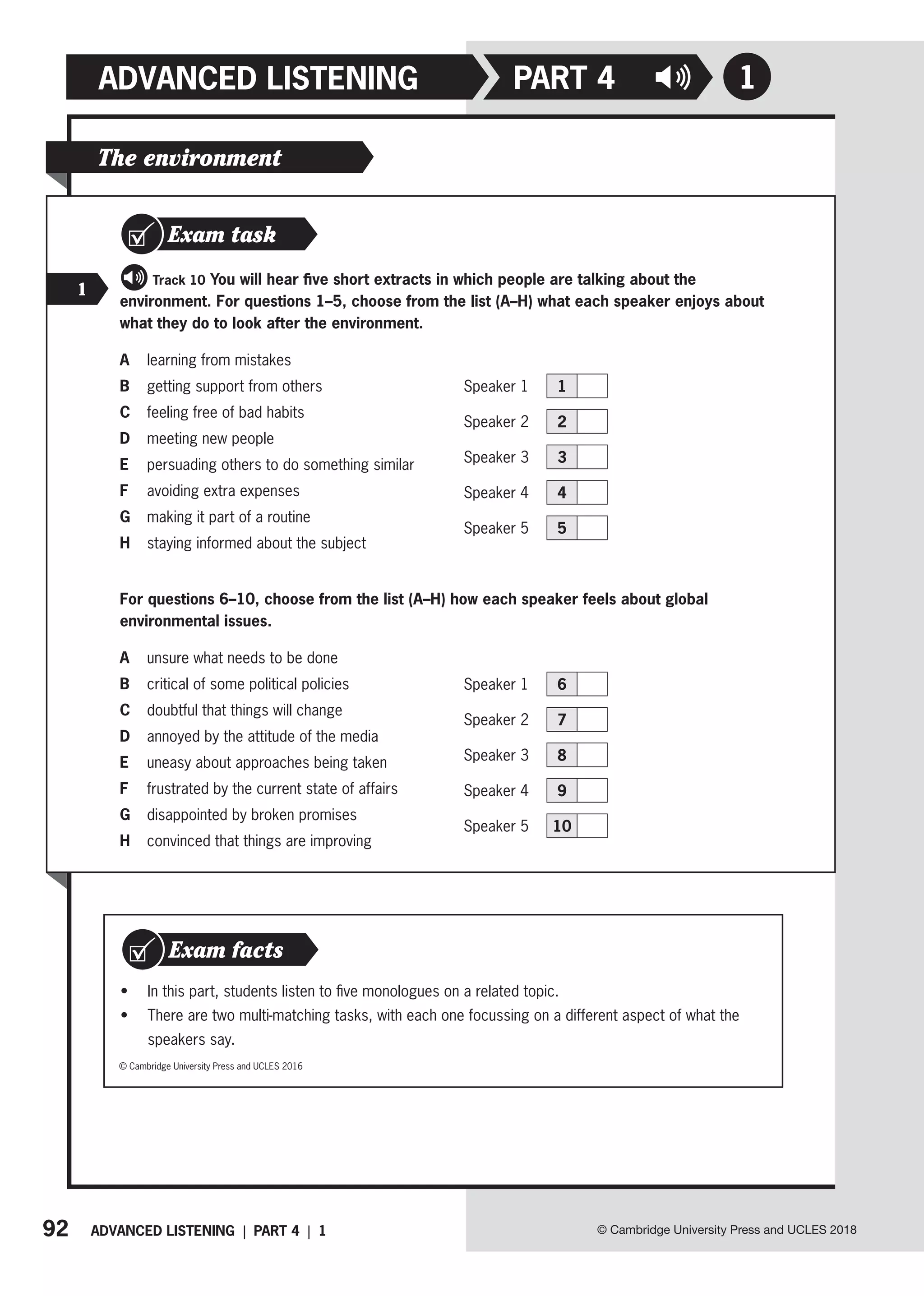
Listening Part 4 92
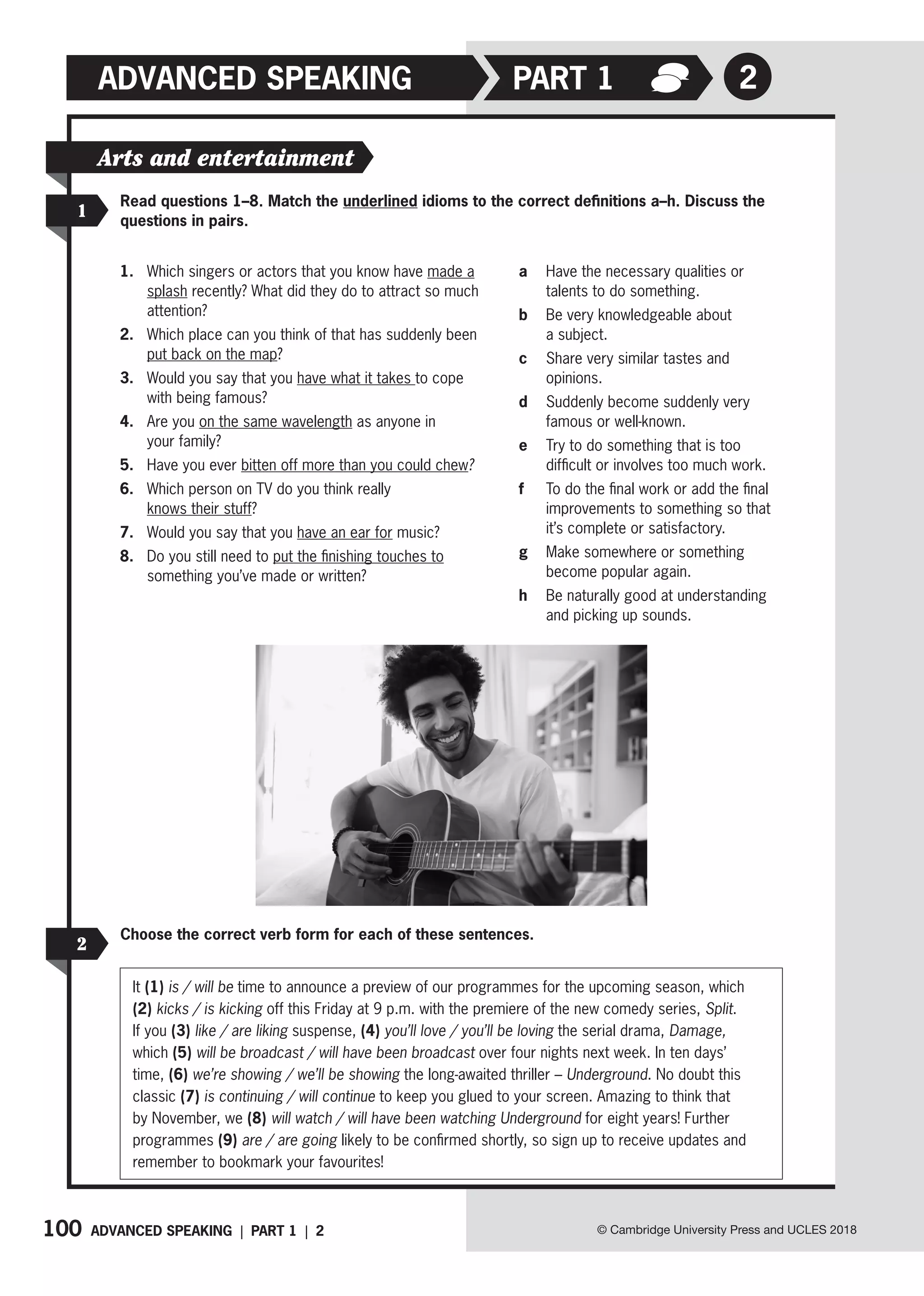
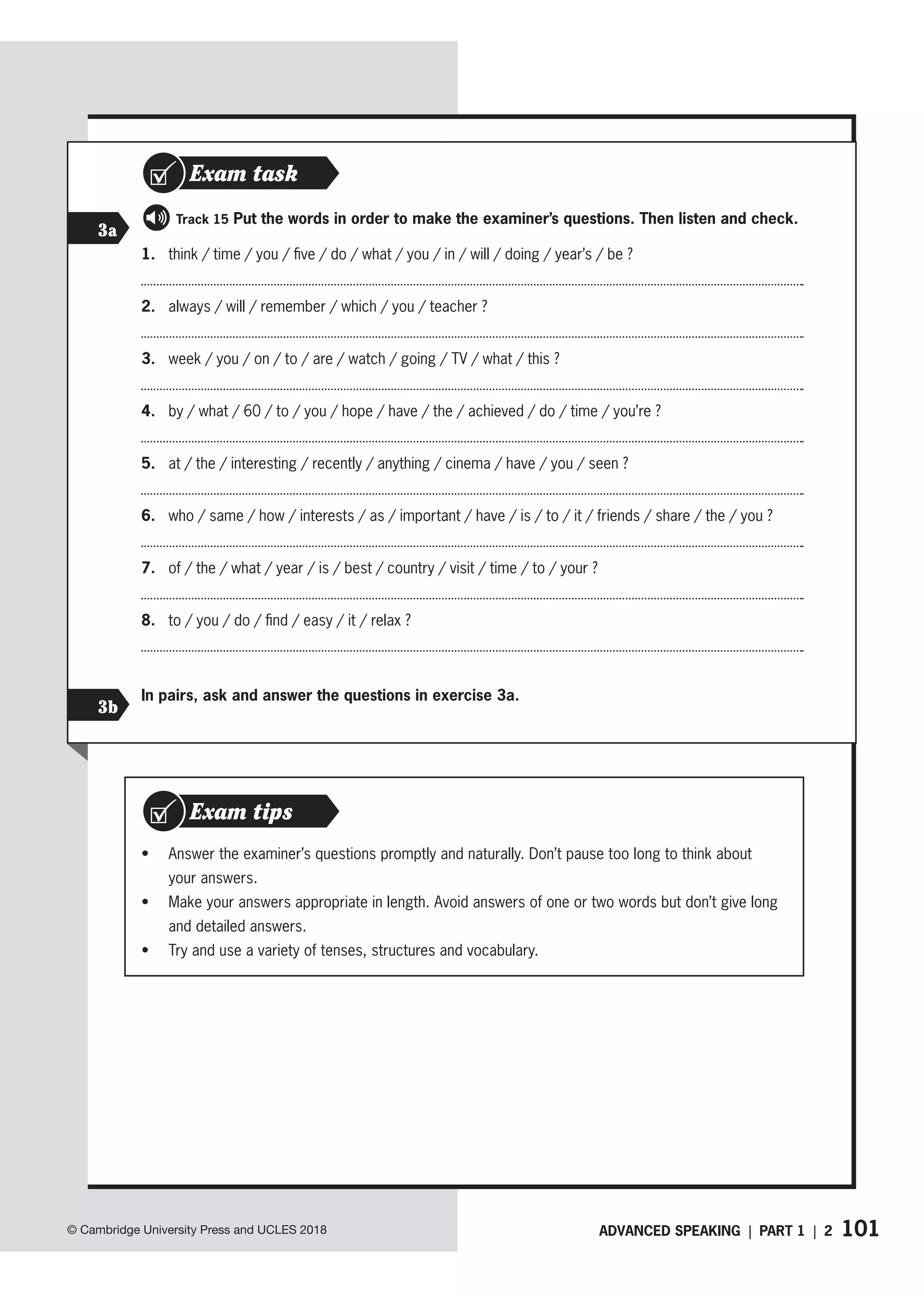
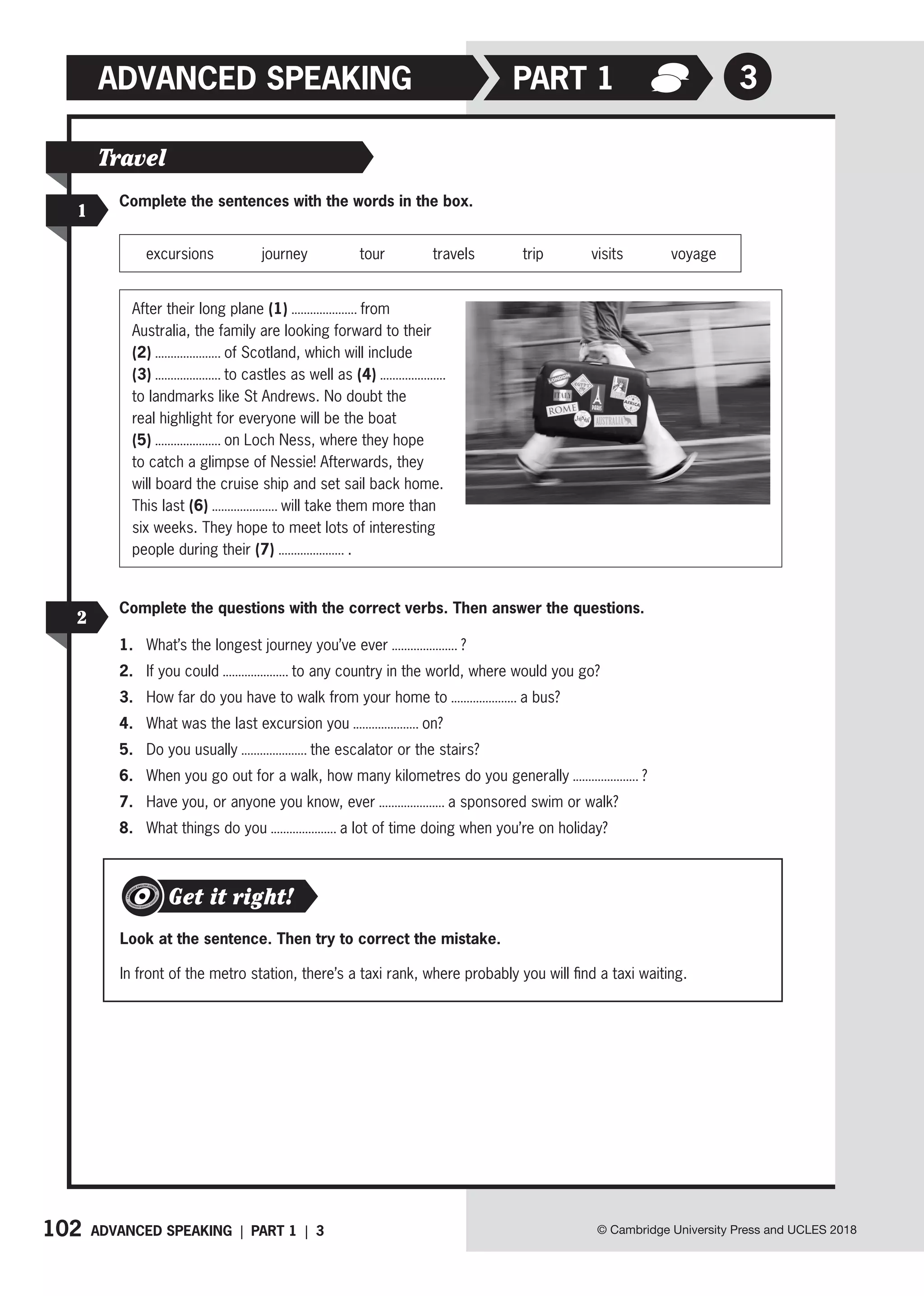
Speaking Part 1 98
Speaking Part 2 104
Speaking Parts 3 and 4 110
 116
125
Think about it
Answer key
3
CONTENTS
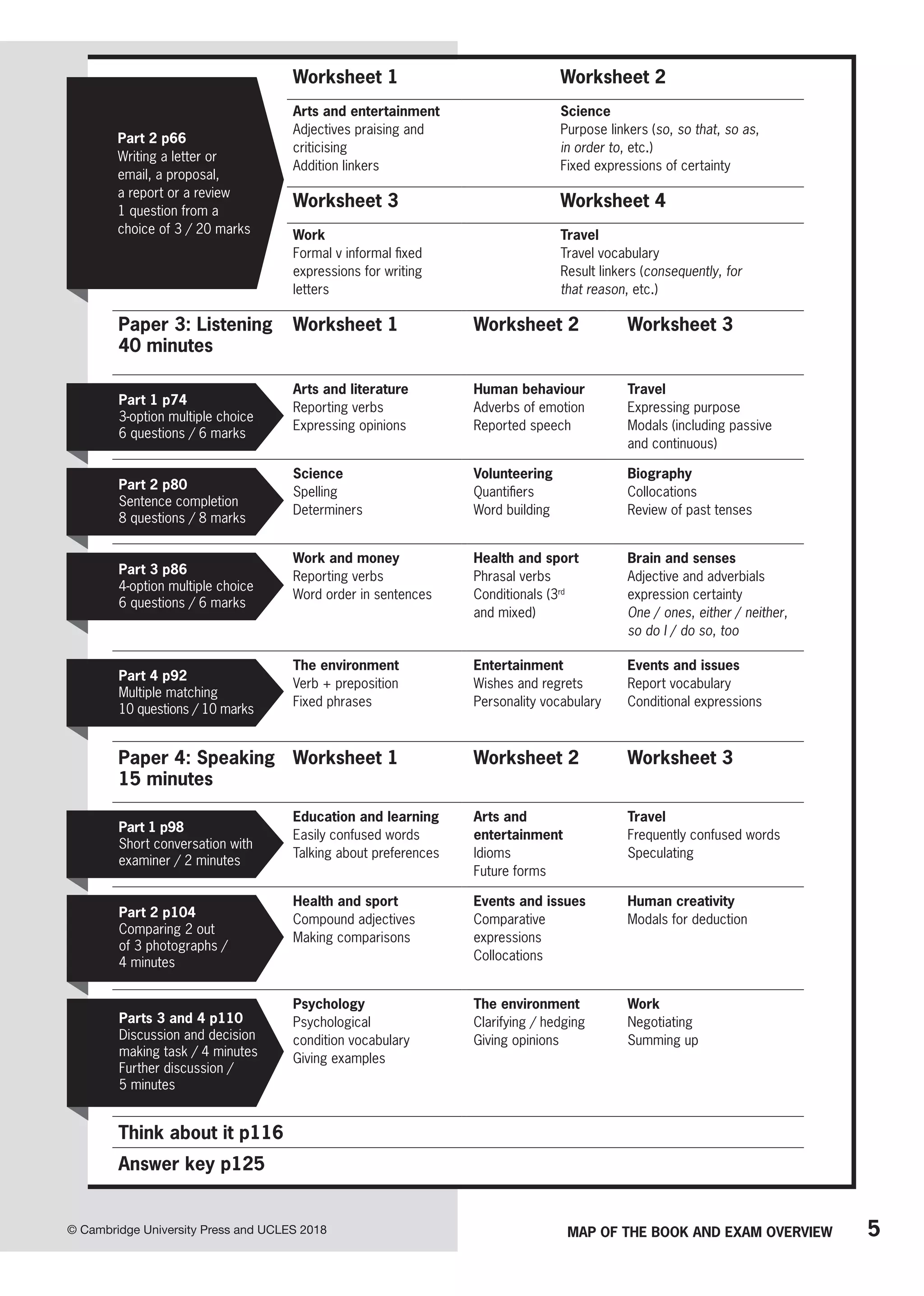
4 MAP OF THE BOOK AND EXAM OVERVIEW
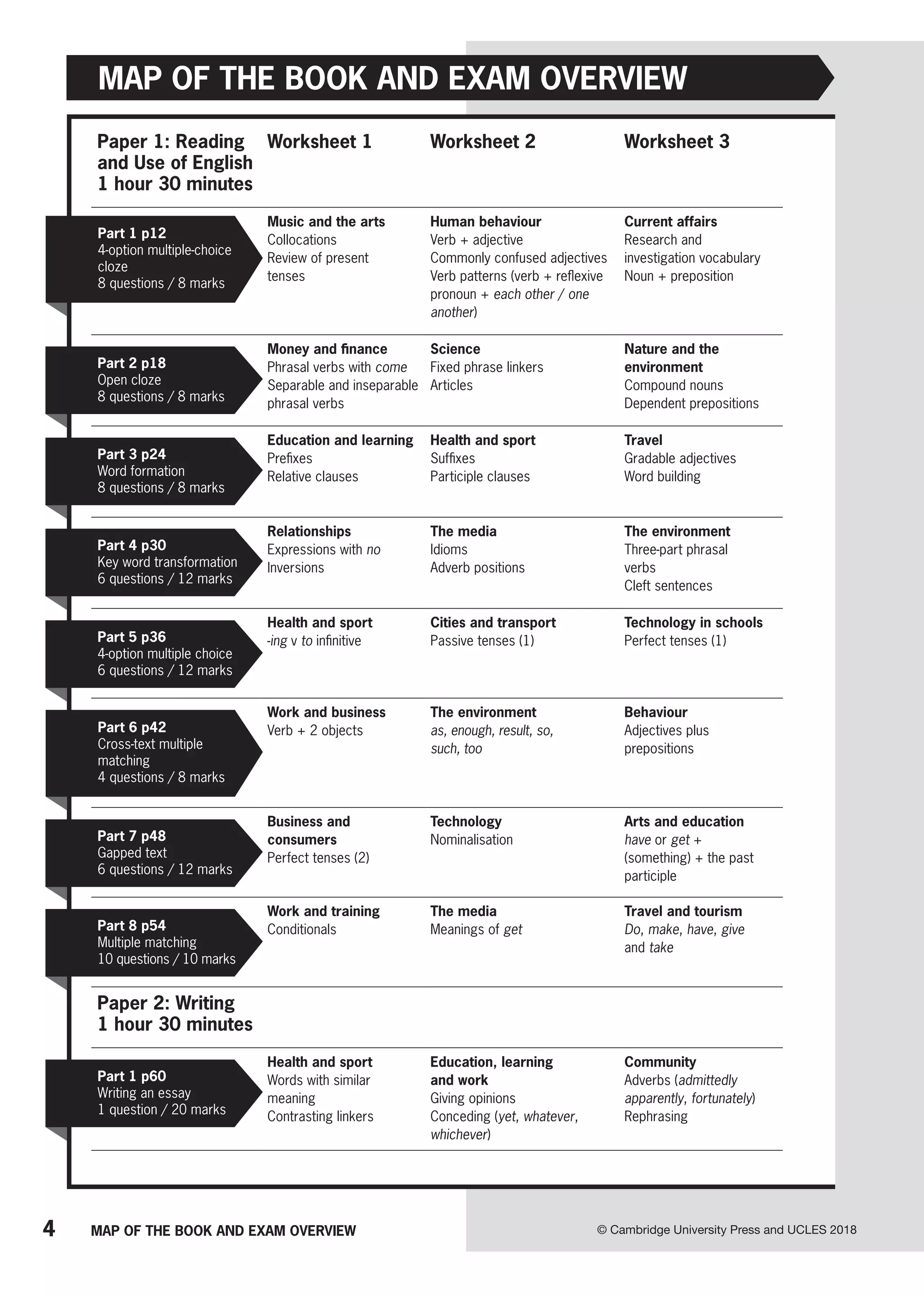
MAP OF THE BOOK AND EXAM OVERVIEW
Paper 1: Reading
and Use of English
1 hour 30 minutes
Worksheet 1 Worksheet 2 Worksheet 3
Music and the arts
Collocations
Review of present
tenses
Human behaviour
Verb + adjective
Commonly confused adjectives
Verb patterns (verb + reflexive
pronoun + each other / one
another)
Current affairs
Research and
investigation vocabulary
Noun + preposition
Money and finance
Phrasal verbs with come
Separable and inseparable
phrasal verbs
Science
Fixed phrase linkers
Articles
Nature and the
environment
Compound nouns
Dependent prepositions
Education and learning
Prefixes
Relative clauses
Health and sport
Suffixes
Participle clauses
Travel
Gradable adjectives
Word building
Relationships
Expressions with no
Inversions
The media
Idioms
Adverb positions
The environment
Three-part phrasal
verbs
Cleft sentences
Health and sport
-ing v to infinitive
Cities and transport
Passive tenses (1)
Technology in schools
Perfect tenses (1)
Work and business
Verb + 2 objects
The environment
as, enough, result, so,
such, too
Behaviour
Adjectives plus
prepositions
Business and
consumers
Perfect tenses (2)
Technology
Nominalisation
Arts and education
have or get +
(something) + the past
participle
Work and training
Conditionals
The media
Meanings of get
Travel and tourism
Do, make, have, give
and take
Paper 2: Writing
1 hour 30 minutes
Health and sport
Words with similar
meaning
Contrasting linkers
Education, learning
and work
Giving opinions
Conceding (yet, whatever,
whichever)
Community
Adverbs (admittedly
apparently, fortunately)
Rephrasing
Part 3 p24
Word formation
8 questions / 8 marks
Part 4 p30
Key word transformation
6 questions / 12 marks
Part 5 p36
4-option multiple choice
6 questions / 12 marks
Part 7 p48
Gapped text
6 questions / 12 marks
Part 8 p54
Multiple matching
10 questions / 10 marks
Part 1 p60
Writing an essay
1 question / 20 marks
Part 2 p18
Open cloze
8 questions / 8 marks
Part 1 p12
4-option multiple-choice
cloze
8 questions / 8 marks
Part 6 p42
Cross-text multiple
matching
4 questions / 8 marks
© Cambridge University Press and UCLES 2018
5
MAP OF THE BOOK AND EXAM OVERVIEW
Worksheet 1 Worksheet 2
Arts and entertainment
Adjectives praising and
criticising
Addition linkers
Science
Purpose linkers (so, so that, so as,
in order to, etc.)
Fixed expressions of certainty
Worksheet 3 Worksheet 4
Work
Formal v informal fixed
expressions for writing
letters
Travel
Travel vocabulary
Result linkers (consequently, for
that reason, etc.)
Paper 3: Listening
40 minutes
Worksheet 1 Worksheet 2 Worksheet 3
Arts and literature
Reporting verbs
Expressing opinions
Human behaviour
Adverbs of emotion
Reported speech
Travel
Expressing purpose
Modals (including passive
and continuous)
Science
Spelling
Determiners
Volunteering
Quantifiers
Word building
Biography
Collocations
Review of past tenses
Work and money
Reporting verbs
Word order in sentences
Health and sport
Phrasal verbs
Conditionals (3rd
and mixed)
Brain and senses
Adjective and adverbials
expression certainty
One / ones, either / neither,
so do I / do so, too
The environment
Verb + preposition
Fixed phrases
Entertainment
Wishes and regrets
Personality vocabulary
Events and issues
Report vocabulary
Conditional expressions
Paper 4: Speaking
15 minutes
Worksheet 1 Worksheet 2 Worksheet 3
Education and learning
Easily confused words
Talking about preferences
Arts and
entertainment
Idioms
Future forms
Travel
Frequently confused words
Speculating
Health and sport
Compound adjectives
Making comparisons
Events and issues
Comparative
expressions
Collocations
Human creativity
Modals for deduction
Psychology
Psychological
condition vocabulary
Giving examples
The environment
Clarifying / hedging
Giving opinions
Work
Negotiating
Summing up
Think about it p116
Answer key p125
Part 1 p74
3-option multiple choice
6 questions / 6 marks
Part 2 p80
Sentence completion
8 questions / 8 marks
Part 3 p86
4-option multiple choice
6 questions / 6 marks
Part 4 p92
Multiple matching
10 questions / 10 marks
Part 1 p98
Short conversation with
examiner / 2 minutes
Part 2 p104
Comparing 2 out
of 3 photographs /
4 minutes
Parts 3 and 4 p110
Discussion and decision
making task / 4 minutes
Further discussion /
5 minutes
Part 2 p66
Writing a letter or
email, a proposal,
a report or a review
1 question from a
choice of 3 / 20 marks
© Cambridge University Press and UCLES 2018
6 © Cambridge University Press and UCLES 2018
HOW TO USE THE EXAM BOOSTER
Welcome to the Cambridge English
76 ADVANCED LISTENING | PART 1 | 2
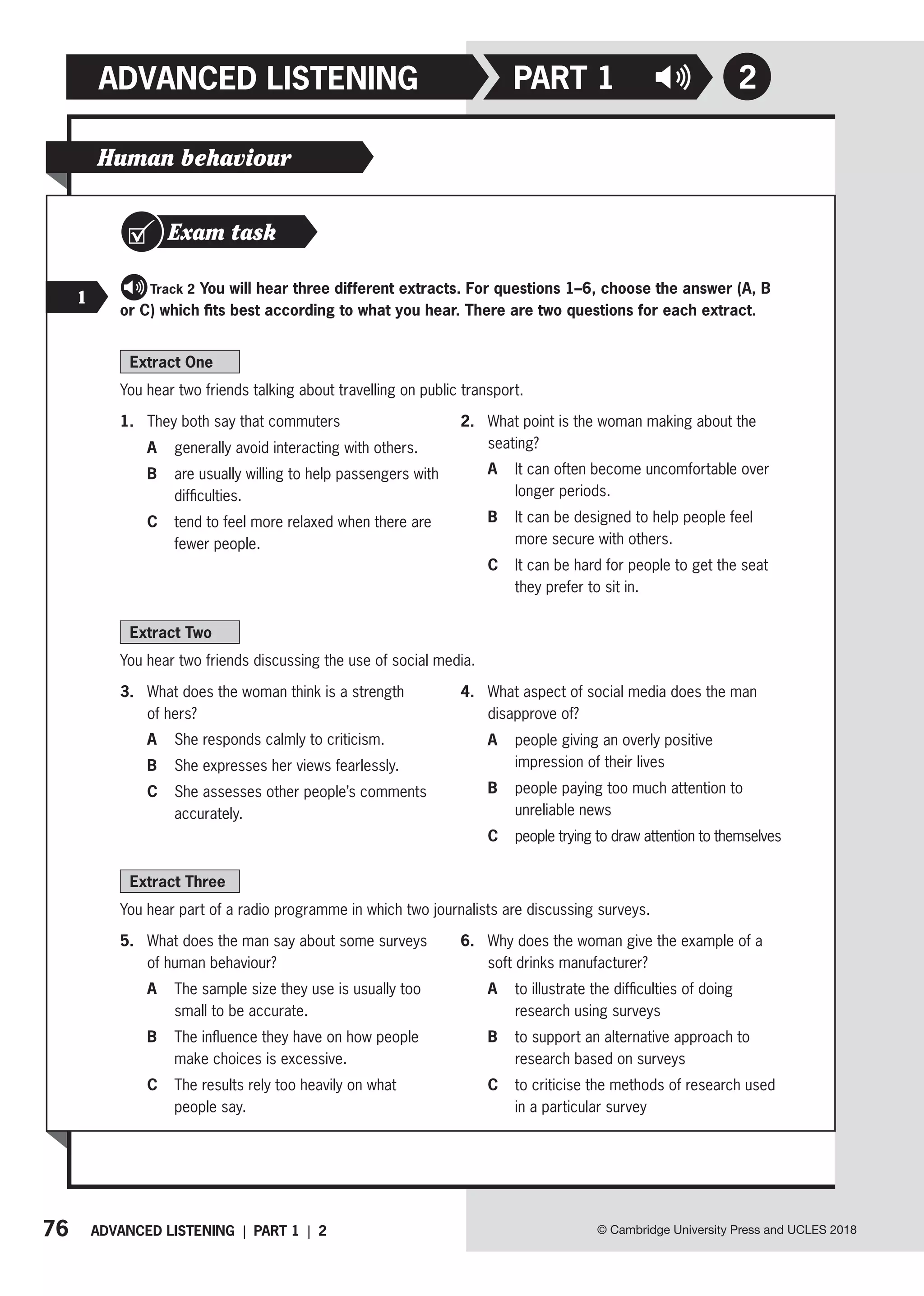
ADVANCED LISTENING PART 1
© Cambridge University Press and UCLES 2018
2
Extract One
You hear two friends talking about travelling on public transport.
1. They both say that commuters
A generally avoid interacting with others.
B are usually willing to help passengers with
difficulties.
C tend to feel more relaxed when there are
fewer people.
2. What point is the woman making about the
seating?
A It can often become uncomfortable over
longer periods.
B It can be designed to help people feel
more secure with others.
C It can be hard for people to get the seat
they prefer to sit in.
Extract Two
You hear two friends discussing the use of social media.
3. What does the woman think is a strength
of hers?
A She responds calmly to criticism.
B She expresses her views fearlessly.
C She assesses other people’s comments
accurately.
4. What aspect of social media does the man
disapprove of?
A people giving an overly positive
impression of their lives
B people paying too much attention to
unreliable news
C people trying to draw attention to themselves
Extract Three
You hear part of a radio programme in which two journalists are discussing surveys.
5. What does the man say about some surveys
of human behaviour?
A The sample size they use is usually too
small to be accurate.
B The influence they have on how people
make choices is excessive.
C The results rely too heavily on what
people say.
6. Why does the woman give the example of a
soft drinks manufacturer?
A to illustrate the difficulties of doing
research using surveys
B to support an alternative approach to
research based on surveys
C to criticise the methods of research used
in a particular survey
Human behaviour
Exam task
Track 2 You will hear three different extracts. For questions 1–6, choose the answer (A, B
or C) which fits best according to what you hear. There are two questions for each extract.
1
81
ADVANCED LISTENING | PART 2 | 1
© Cambridge University Press and UCLES 2018
• In this part, you will hear a monologue directed at a non-specialist audience.
• You have to complete eight gaps in the text with words you hear in the recording.
Exam facts
© Cambridge University Press and UCLES 2016
3
Exam task
For Track 4 You will hear a woman called Camilla Doyle introducing a science fair. For
questions 1–8, complete the sentences with a word or short phrase.
Science fairs
Camilla admits that she has seen rather a lot of (1) at previous
science fairs.
Camilla was amazed that one scientist, David Nelson, tried to construct a mini nuclear fusion reactor
in his (2) .
The scientists who created a diesel hybrid racing car are working on redeveloping its
(3) .
Camilla claims that there may be many possible uses in industry for Joe Higson’s machine that can
detect certain (4) .
Camilla thinks there will be developments in new (5) that helps
spacecraft avoid hitting objects in their path.
A group of students produced a (6) that recorded accurate
measurements of weather events.
Many journalists have shown an interest in a special type of underwater vehicle that may be used to
study the (7) .
While talking to scientists with exhibits at the science fair, Camilla was most impressed by their
(8) .
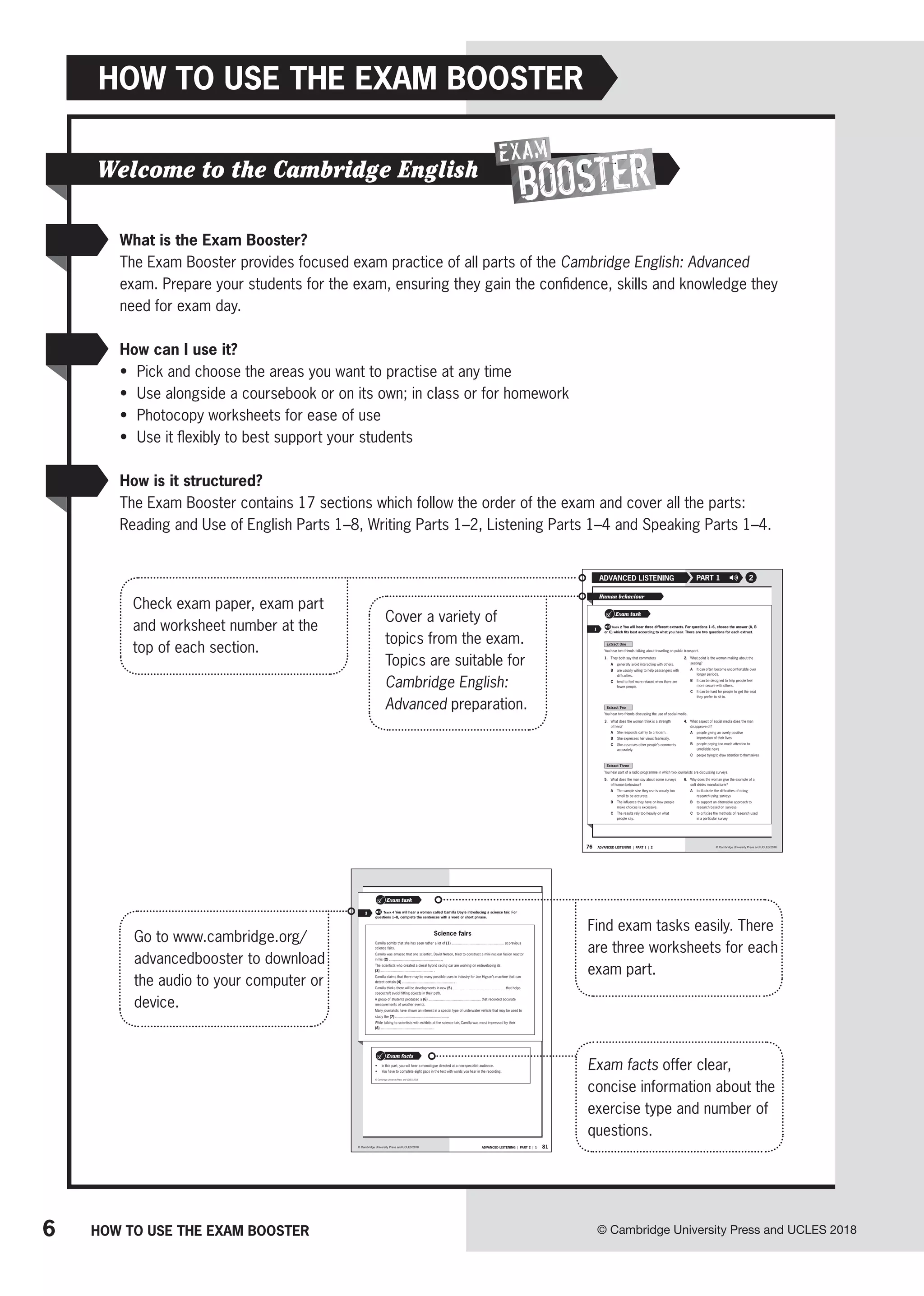
What is the Exam Booster?
The Exam Booster provides focused exam practice of all parts of the Cambridge English: Advanced
exam. Prepare your students for the exam, ensuring they gain the confidence, skills and knowledge they
need for exam day.
How can I use it?
• Pick and choose the areas you want to practise at any time
• Use alongside a coursebook or on its own; in class or for homework
• Photocopy worksheets for ease of use
• Use it flexibly to best support your students
How is it structured?
The Exam Booster contains 17 sections which follow the order of the exam and cover all the parts:
Reading and Use of English Parts 1–8, Writing Parts 1–2, Listening Parts 1–4 and Speaking Parts 1–4.
Check exam paper, exam part
and worksheet number at the
top of each section.
Cover a variety of
topics from the exam.
Topics are suitable for
Cambridge English:
Advanced preparation.
Find exam tasks easily. There
are three worksheets for each
exam part.
Go to www.cambridge.org/
advancedbooster to download
the audio to your computer or
device.
Exam facts offer clear,
concise information about the
exercise type and number of
questions.
7
© Cambridge University Press and UCLES 2018 HOW TO USE THE EXAM BOOSTER
45
ADVANCED READING AND USE OF ENGLISH | PART 6 | 2
© Cambridge University Press and UCLES 2018
2
Complete the sentences with the correct words from the box. You can use words more
than once.
as enough result so such too therefore
1. Plastic products can be produced cheaply that shops don’t usually charge for plastic bags.
2. Some tourists get a shock seeing just how much plastic there is in the sea that they start
to clean it up.
3. It was soon to know whether the new legislation limiting sale of plastic products had been
successful.
4. It’s unfortunately easy to foresee what will happen if we continue producing plastic
products at the same rate as today.
5. The shop started charging a dollar for a plastic bag and, a , 99% of customers
started to bring their own bags.
6. We have a rapidly increasing world population and we need more food to feed us all.
7. In many places, the ecological situation is changing quickly even for many of our most
esteemed scientists to keep up.
8. We need to demonstrate patience when seeking environmental change, as many
organisations and individuals are still resistant to it.
• For each question, look at the topic and quickly find the opinions of all of the writers on it before
you answer. Writers may not offer an opinion on every topic.
• Once you have located the writer’s opinion about a topic, read it in detail and watch out for traps
such as double negatives (which make a positive in English!).
Exam tips
23
ADVANCED READING AND USE OF ENGLISH | PART 2 | 3
© Cambridge University Press and UCLES 2018
Exam task
3
For questions 1–8, read the text below and think of the word which best fits each gap. Use
only one word in each gap. There is an example at the beginning (0).
Write your answers IN CAPITAL LETTERS.
Example: (0) HOW
National parks
You realise (0) truly incredible the natural environment is when you take a trip to one of the
world’s national parks. To be eligible for national park status, a place must possess a unique natural,
cultural or recreational resource and be considered in need (1) protection. Fortunately, a
considerable number of natural gems have been designated as national parks and (2) are also
World Heritage sites.
From hot springs (3) snowy peaks, these postcard-worthy destinations (4) definitely be
on your list of places to visit. Many are also home to some pretty amazing flora and fauna. The parks are
extremely popular (5) outdoor enthusiasts, who can indulge in their favourite activities like hiking
or rafting, surrounded (6) nature. The largest national park in the world isn’t easily accessible,
being in a remote area of Greenland and boasting a permanent population of zero. It’s also (7)
used to receiving visitors (around 500 a year). This is a long way from the estimated 11 million tourists
(8) flock to the Great Smoky Mountains of North Carolina and Tennessee in the United States.
Look at the sentences below. Then try and correct the mistake.
Our town is really full of tourists attractions. I mean all these marvellous monuments.
Get it right!
125
Answer key
Reading and Use of English Part 1:1
1 1 orchestra
4 exhibition
7 bill
2 stage
5 choir
8 camera
3 compilation
6 skills
2 1 are
2 are giving / give
3 are
4 are staying
5 books
6 take
7 head / are heading
8 make
9 kick off
10 rest / are resting
11 hit
You can use the present simple for all answers except 4.
3 1 C 2 D 3 C 4 B 5 A 6 C 7 B 8 D
Reading and Use of English Part 1:2
1 1 A 2 B 3 D 4 C 5 B 6 C 7 A 8 B
2 1 find, tricky 2 make, happy
3 considers /considered, fortunate
4 kept / keeps, busy 5 call, perfect
3 1 latest, Last, previous
2 common, regular,
normal
3 long, big, wide
4 significant, large, great
5 distant, far, remote
6 different, unique, varied
4 1 talk
4 introducing
2 learn
5 express
3 convince
6 treated
7 know
Reading and Use of English Part 1:3
1 1 on
5 for
2 for
6 in
3 against
7 of
4 for
8 to
2 1 occasions 2 incidents 3 cases
4 examples 5 investigation 6 research
7 survey 8 enquiry 9 attraction
10 attention 11 focus 12 interest
3 1 D 2 B 3 A 4 C 5 C 6 C 7 D 8 B
Get it right!
For most of people it seems to be so natural – animals
in cages.
Reading and Use of English Part 2:1
1 1 came into
2 come through
3 come under
4 come off
5 come up
6 came across
7 come between
8 coming down
2 1 both are correct 5 both are correct
2 both are correct 6 both are correct
3 b is wrong 7 b is wrong
4 b is wrong 8 a is wrong
3 1 YOURSELF/YOURSELVES 2 AT 3 FROM/BY
4 DO 5 PUT 6 IF/WHETHER 7 NOT
8 THANKS/DUE
Reading and Use of English Part 2:2
1 1 WHAT 2 WILL 3 WITH
4 A 5 AS 6 SAY
7 BECAUSE 8 ON/ABOUT
2 1 accounts 2 result 3 matter
4 words 5 happens 6 First
7 time 8 now
3 1 Has your personal experience of studying
(-) science subjects at (-) school been a
positive one?
2 How far would you say that (-) science fulfils a
useful role in (-) modern society?
3 Which discovery or invention do you think has had
the most positive effect on (-) society?
4 How do you think (-) medicine will develop in
future?
5 How strict do you think the/(-) controls on (-)
scientific experiments should be?
6 To what extent are (-) human beings to blame for
(-) climate change?
7 Do you think that (-) advances in (-) technology
will be sufficient to overcome the problem of the
world’s dwindling resources?
8 Some people say that the more we invent, the
lazier we become.
Reading and Use of English Part 2:3
1 1 coastal erosion
2 oil spill
3 rural areas
4 urban development
5 waste management
6 global warming
7 natural habitats
8 endangered species
2 1 eligible for
2 open-minded about, hostile to
3 prone to
4 restricted to
5 untouched by
6 lacking in
7 incompatible with
3 1 OF
2 SOME/MANY
3 TO
4 SHOULD/COULD
5 WITH
6 BY
7 NOT
8 WHO/THAT
Get it right!
Our town is really full of tourist attractions. I mean all
these marvellous monuments.
Reading and Use of English Part 3:1
1 1 immature
2 disorganised
3 unconventional
4 overcome
5 misbehaviour
6 Pre-booking
7 undertaken
8 inconvenient
AnswER kEy 123
© Cambridge University Press and UCLES 2018
Think about it
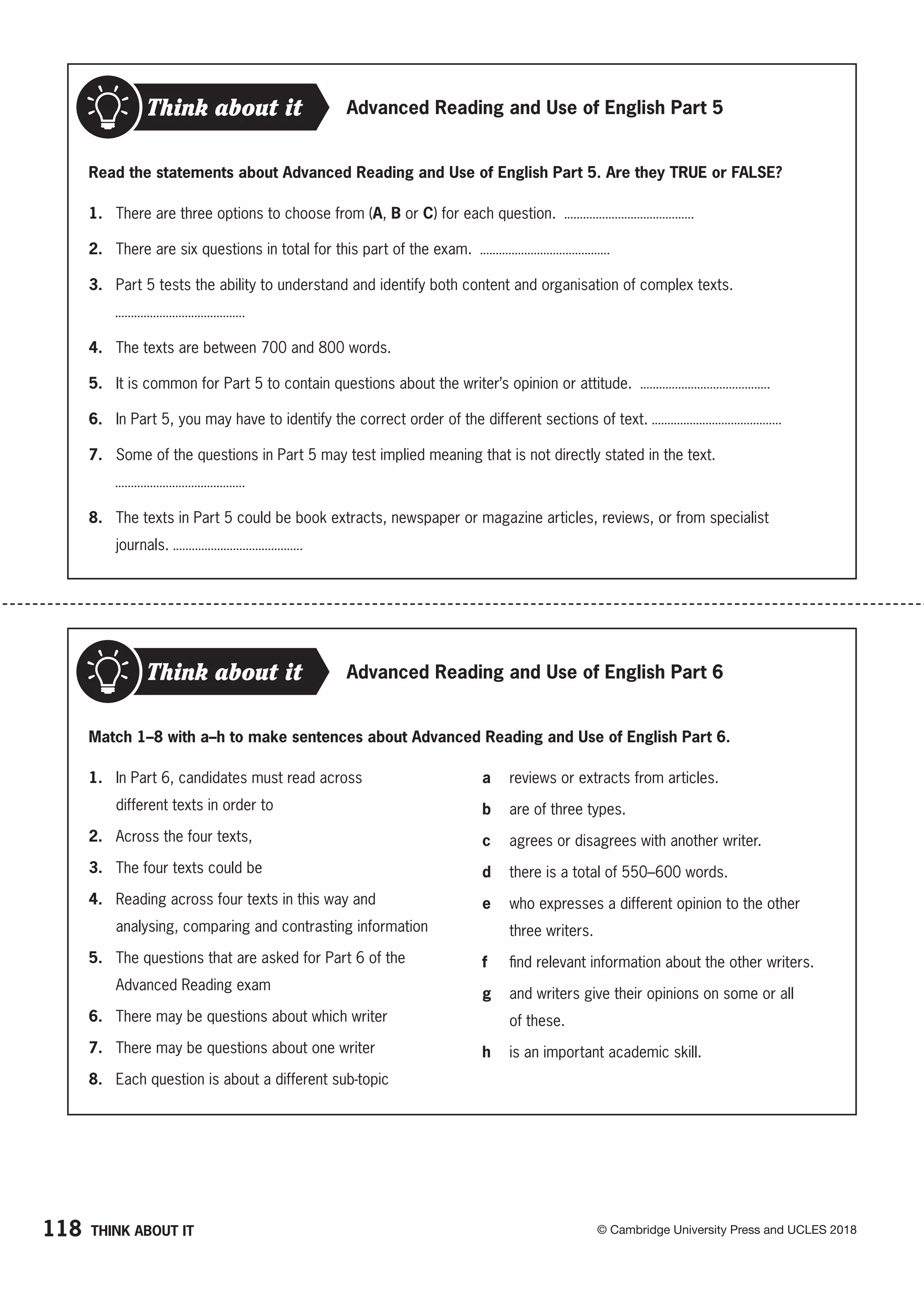
Read the tips and tick ✓ the tips which are good advice for things to do in Part 1 of the Advanced
Speaking Test.
1. Take time to think about your answers before you speak.
2. Give short answers (1–4 words) to the examiner’s questions.
3. It’s good to prepare some of your answers and learn them by heart.
4. If you don’t understand or haven’t heard something, ask the examiner to repeat it.
5. You should turn and talk to the other candidate(s) and involve them in a conversation in Part 1.
6. Try and use a range of verb tenses in this part of the exam.
7. Don’t try and use language that you are not 100% sure of. Stick to simple words.
8. For questions that you have never been asked or thought about before, there are some useful phrases to give
yourself thinking time that you can learn and practise using.
Advanced Speaking Part 1
Advanced Speaking Part 2
Think about it
Match 1–7 with a–g to make sentences about Advanced Speaking Part 2.
a and the examiner will mention this connection when
they give you the sheet with the pictures.
b one minute about two pictures.
c above the three pictures which you are given.
d a short question related to the pictures that you
have described.
e start by comparing the pictures and then move on
to answering the two questions above the pictures.
f about your partner’s pictures so make sure you
look at them and listen to what your partner says!
g two questions about another set of pictures.
1. In Part 2, you will have to speak for
2. You should answer two questions which the
examiner asks you and are printed
3. The three pictures are connected in some way
4. A good approach to this part is to
5. Your partner will answer
6. The other candidate will also speak for a minute
to answer
7. You will also have to give a short answer (about
30 seconds)
THINK ABOUT IT
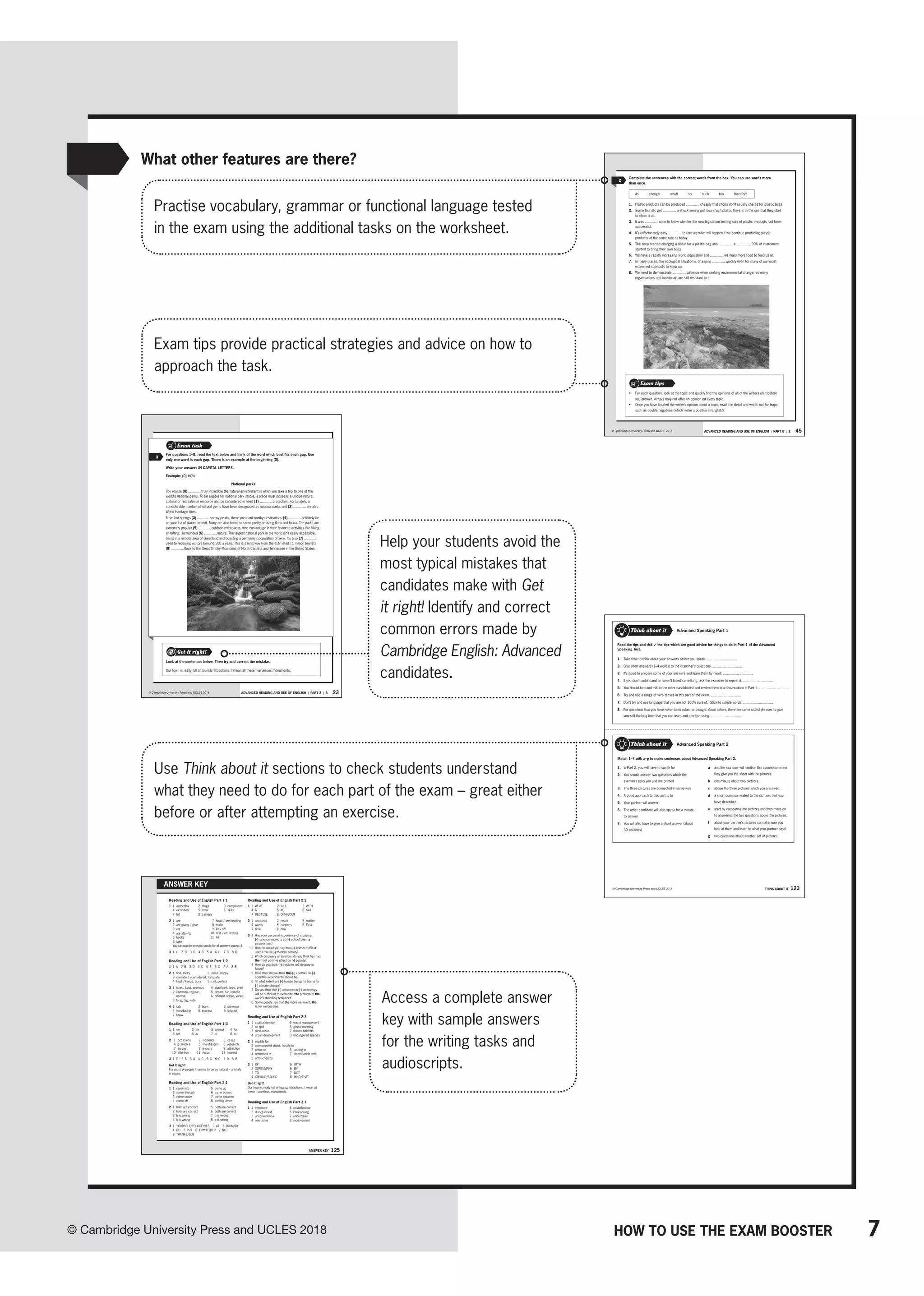
Practise vocabulary, grammar or functional language tested
in the exam using the additional tasks on the worksheet.
Use Think about it sections to check students understand
what they need to do for each part of the exam – great either
before or after attempting an exercise.
Access a complete answer
key with sample answers
for the writing tasks and
audioscripts.
Help your students avoid the
most typical mistakes that
candidates make with Get
it right! Identify and correct
common errors made by
Cambridge English: Advanced
candidates.
What other features are there?
Exam tips provide practical strategies and advice on how to
approach the task.
8 © Cambridge University Press and UCLES 2018
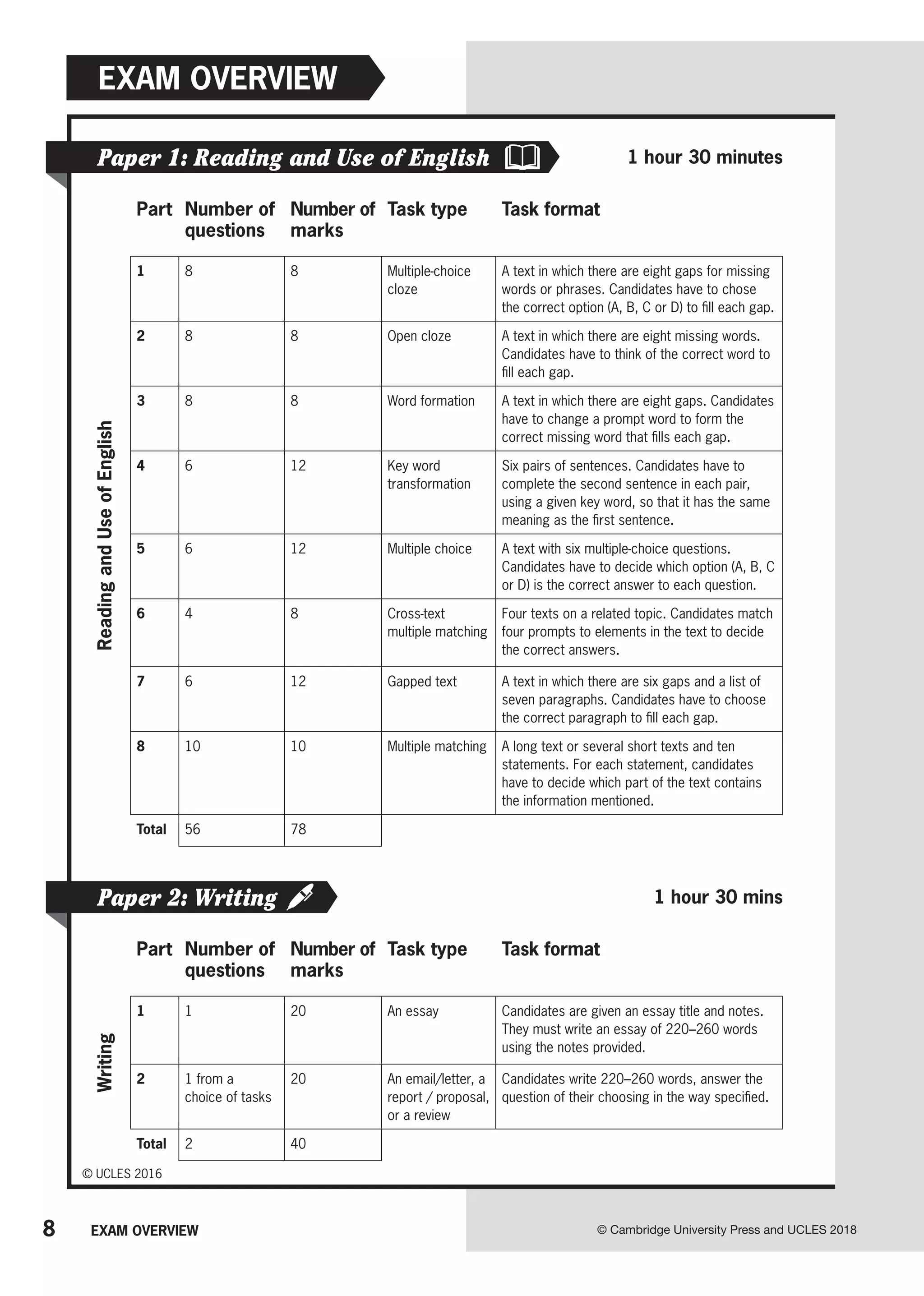
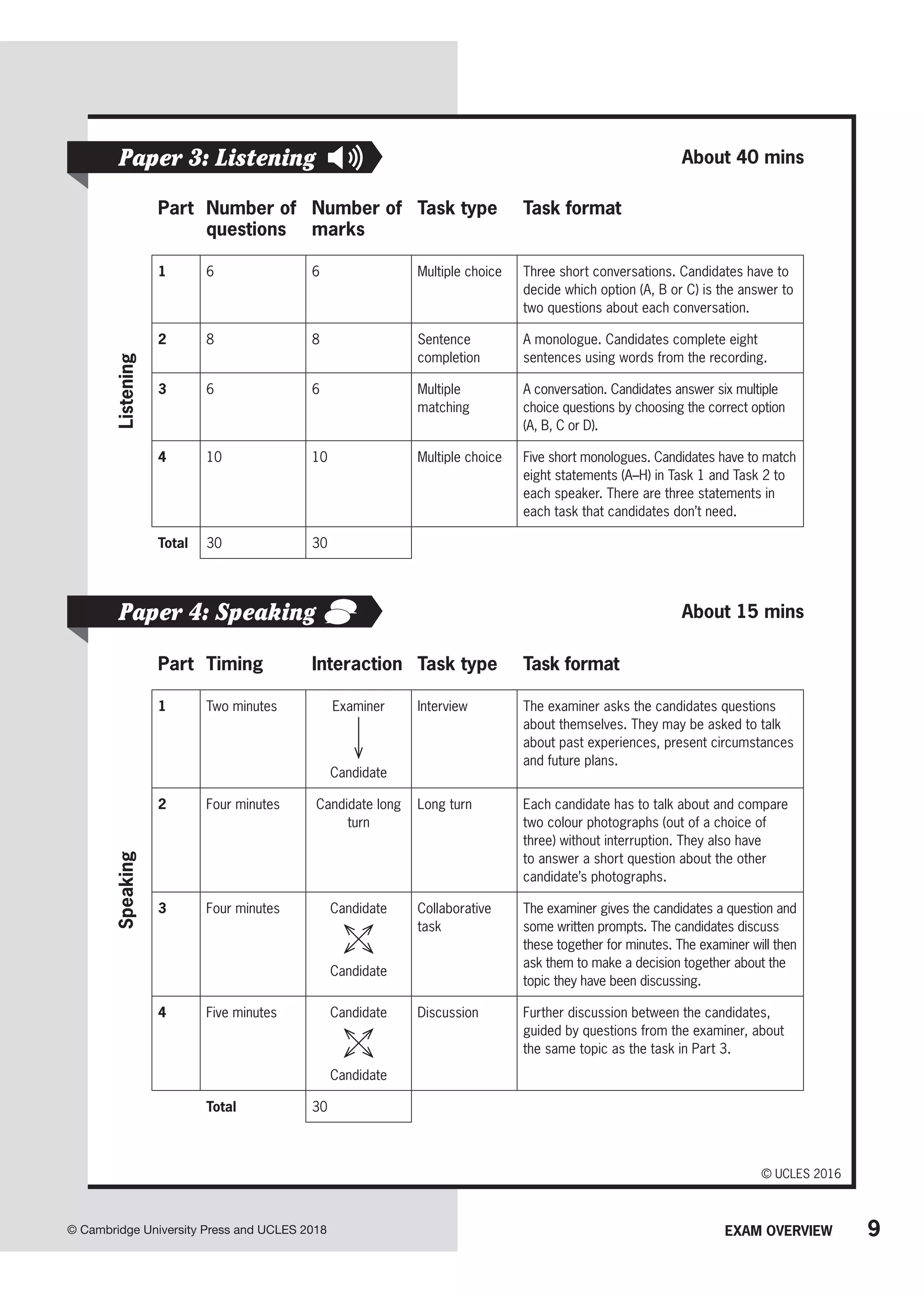
Exam overview
Part Number of
questions
Number of
marks
Task type Task format
Reading
and
Use
of
English
1 8 8 Multiple-choice
cloze
A text in which there are eight gaps for missing
words or phrases. Candidates have to chose
the correct option (A, B, C or D) to fill each gap.
2 8 8 Open cloze A text in which there are eight missing words.
Candidates have to think of the correct word to
fill each gap.
3 8 8 Word formation A text in which there are eight gaps. Candidates
have to change a prompt word to form the
correct missing word that fills each gap.
4 6 12 Key word
transformation
Six pairs of sentences. Candidates have to
complete the second sentence in each pair,
using a given key word, so that it has the same
meaning as the first sentence.
5 6 12 Multiple choice A text with six multiple-choice questions.
Candidates have to decide which option (A, B, C
or D) is the correct answer to each question.
6 4 8 Cross-text
multiple matching
Four texts on a related topic. Candidates match
four prompts to elements in the text to decide
the correct answers.
7 6 12 Gapped text A text in which there are six gaps and a list of
seven paragraphs. Candidates have to choose
the correct paragraph to fill each gap.
8 10 10 Multiple matching A long text or several short texts and ten
statements. For each statement, candidates
have to decide which part of the text contains
the information mentioned.
Total 56 78
Exam overview
Paper 1: Reading and Use of English 1 hour 30 minutes
© UCLES 2016
Part Number of
questions
Number of
marks
Task type Task format
Writing
1 1 20 An essay Candidates are given an essay title and notes.
They must write an essay of 220–260 words
using the notes provided.
2 1 from a
choice of tasks
20 An email/letter, a
report / proposal,
or a review
Candidates write 220–260 words, answer the
question of their choosing in the way specified.
Total 2 40
Paper 2: Writing 1 hour 30 mins
9
© Cambridge University Press and UCLES 2018
Part Number of
questions
Number of
marks
Task type Task format
Listening
1 6 6 Multiple choice Three short conversations. Candidates have to
decide which option (A, B or C) is the answer to
two questions about each conversation.
2 8 8 Sentence
completion
A monologue. Candidates complete eight
sentences using words from the recording.
3 6 6 Multiple
matching
A conversation. Candidates answer six multiple
choice questions by choosing the correct option
(A, B, C or D).
4 10 10 Multiple choice Five short monologues. Candidates have to match
eight statements (A–H) in Task 1 and Task 2 to
each speaker. There are three statements in
each task that candidates don’t need.
Total 30 30
Part Timing Interaction Task type Task format
Speaking
1 Two minutes Examiner
Candidate
Interview The examiner asks the candidates questions
about themselves. They may be asked to talk
about past experiences, present circumstances
and future plans.
2 Four minutes Candidate long
turn
Long turn Each candidate has to talk about and compare
two colour photographs (out of a choice of
three) without interruption. They also have
to answer a short question about the other
candidate’s photographs.
3 Four minutes Candidate
Candidate
Collaborative
task
The examiner gives the candidates a question and
some written prompts. The candidates discuss
these together for minutes. The examiner will then
ask them to make a decision together about the
topic they have been discussing.
4 Five minutes Candidate
Candidate
Discussion Further discussion between the candidates,
guided by questions from the examiner, about
the same topic as the task in Part 3.
Total 30
Exam overview
Paper 3: Listening
Paper 4: Speaking
About 40 mins
About 15 mins
© UCLES 2016
Converting Cambridge English: Advanced
practice test scores to Cambridge English Scale scores
10
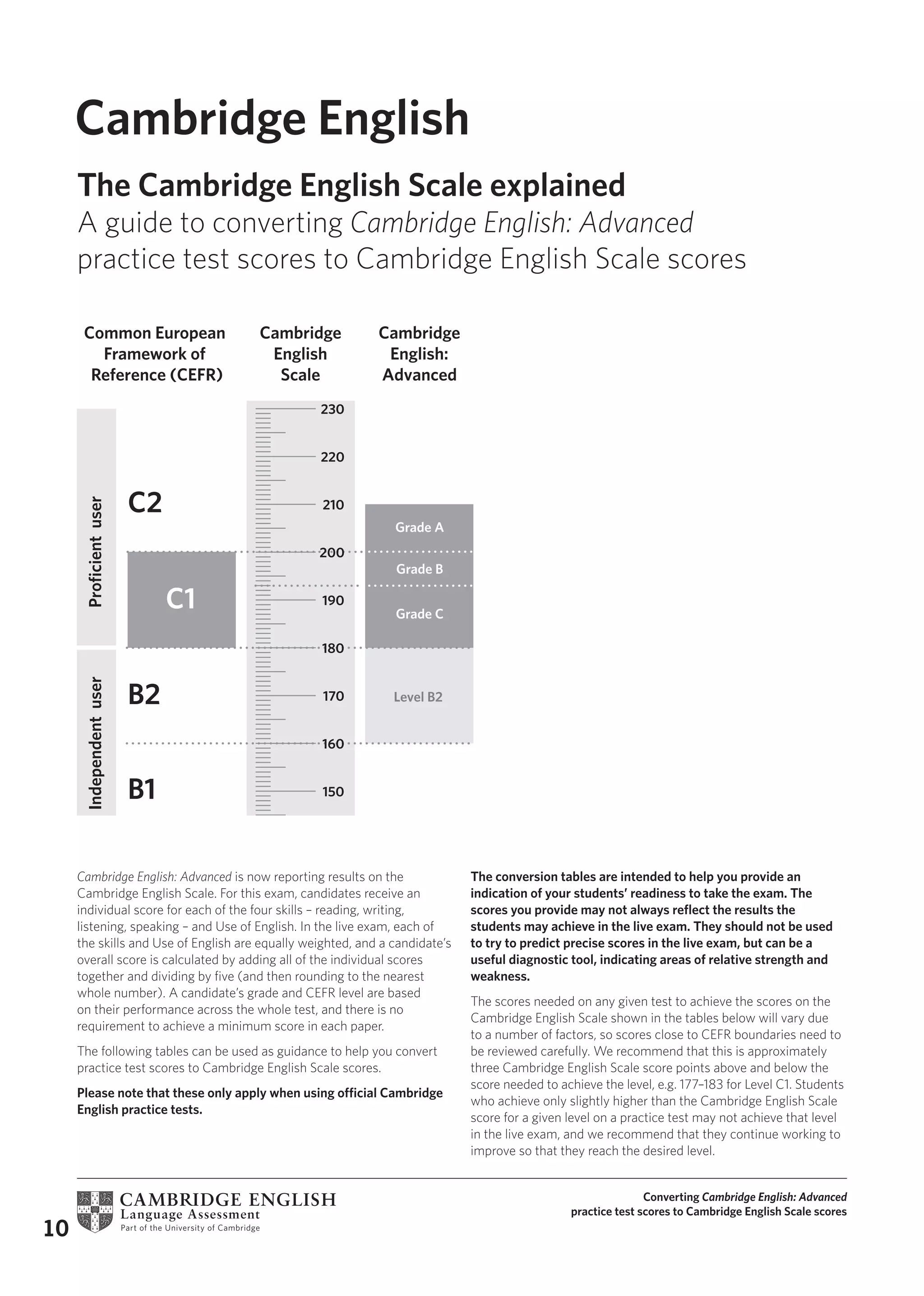
Cambridge English: Advanced is now reporting results on the
Cambridge English Scale. For this exam, candidates receive an
individual score for each of the four skills – reading, writing,
listening, speaking – and Use of English. In the live exam, each of
the skills and Use of English are equally weighted, and a candidate’s
overall score is calculated by adding all of the individual scores
together and dividing by five (and then rounding to the nearest
whole number). A candidate’s grade and CEFR level are based
on their performance across the whole test, and there is no
requirement to achieve a minimum score in each paper.
The following tables can be used as guidance to help you convert
practice test scores to Cambridge English Scale scores.
Please note that these only apply when using official Cambridge
English practice tests.
The conversion tables are intended to help you provide an
indication of your students’ readiness to take the exam. The
scores you provide may not always reflect the results the
students may achieve in the live exam. They should not be used
to try to predict precise scores in the live exam, but can be a
useful diagnostic tool, indicating areas of relative strength and
weakness.
The scores needed on any given test to achieve the scores on the
Cambridge English Scale shown in the tables below will vary due
to a number of factors, so scores close to CEFR boundaries need to
be reviewed carefully. We recommend that this is approximately
three Cambridge English Scale score points above and below the
score needed to achieve the level, e.g. 177–183 for Level C1. Students
who achieve only slightly higher than the Cambridge English Scale
score for a given level on a practice test may not achieve that level
in the live exam, and we recommend that they continue working to
improve so that they reach the desired level.
C1
Common European
Framework of
Reference (CEFR)
Cambridge
English:
Advanced
Cambridge
English
Scale
Grade A
Grade B
Grade C
150
160
170
180
190
200
210
220
230
Level B2
C2
B2
B1
Independent
user
Proficient
user
The Cambridge English Scale explained
A guide to converting Cambridge English: Advanced
practice test scores to Cambridge English Scale scores
Converting Cambridge English: Advanced
practice test scores to Cambridge English Scale scores
11
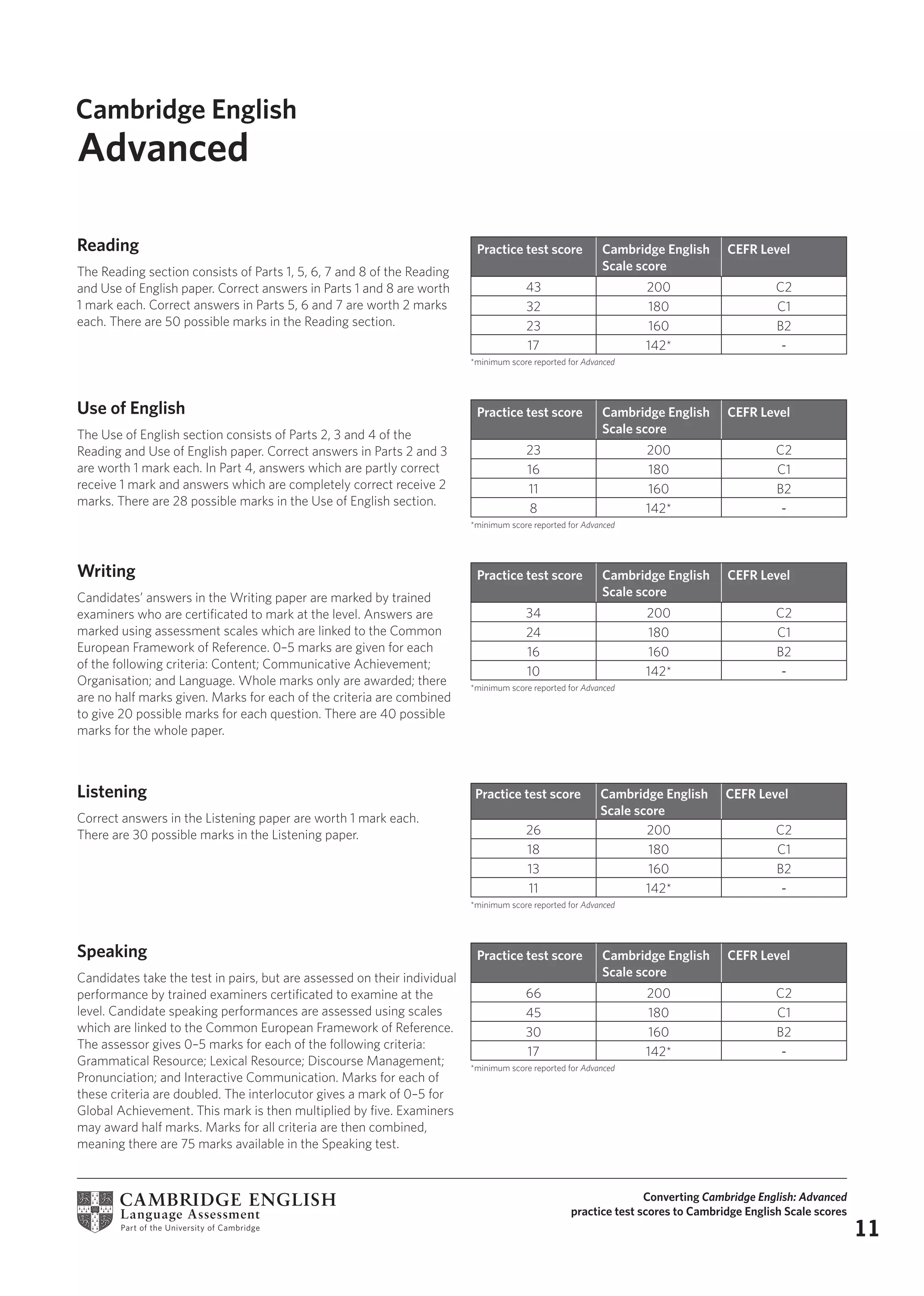
Practice test score Cambridge English
Scale score
CEFR Level
43 200 C2
32 180 C1
23 160 B2
17 142* -
*minimum score reported for Advanced
Practice test score Cambridge English
Scale score
CEFR Level
23 200 C2
16 180 C1
11 160 B2
8 142* -
*minimum score reported for Advanced
Practice test score Cambridge English
Scale score
CEFR Level
34 200 C2
24 180 C1
16 160 B2
10 142* -
*minimum score reported for Advanced
Practice test score Cambridge English
Scale score
CEFR Level
26 200 C2
18 180 C1
13 160 B2
11 142* -
*minimum score reported for Advanced
Practice test score Cambridge English
Scale score
CEFR Level
66 200 C2
45 180 C1
30 160 B2
17 142* -
*minimum score reported for Advanced
Reading
The Reading section consists of Parts 1, 5, 6, 7 and 8 of the Reading
and Use of English paper. Correct answers in Parts 1 and 8 are worth
1 mark each. Correct answers in Parts 5, 6 and 7 are worth 2 marks
each. There are 50 possible marks in the Reading section.
Use of English
The Use of English section consists of Parts 2, 3 and 4 of the
Reading and Use of English paper. Correct answers in Parts 2 and 3
are worth 1 mark each. In Part 4, answers which are partly correct
receive 1 mark and answers which are completely correct receive 2
marks. There are 28 possible marks in the Use of English section.
Writing
Candidates’ answers in the Writing paper are marked by trained
examiners who are certificated to mark at the level. Answers are
marked using assessment scales which are linked to the Common
European Framework of Reference. 0–5 marks are given for each
of the following criteria: Content; Communicative Achievement;
Organisation; and Language. Whole marks only are awarded; there
are no half marks given. Marks for each of the criteria are combined
to give 20 possible marks for each question. There are 40 possible
marks for the whole paper.
Listening
Correct answers in the Listening paper are worth 1 mark each.
There are 30 possible marks in the Listening paper.
Speaking
Candidates take the test in pairs, but are assessed on their individual
performance by trained examiners certificated to examine at the
level. Candidate speaking performances are assessed using scales
which are linked to the Common European Framework of Reference.
The assessor gives 0–5 marks for each of the following criteria:
Grammatical Resource; Lexical Resource; Discourse Management;
Pronunciation; and Interactive Communication. Marks for each of
these criteria are doubled. The interlocutor gives a mark of 0–5 for
Global Achievement. This mark is then multiplied by five. Examiners
may award half marks. Marks for all criteria are then combined,
meaning there are 75 marks available in the Speaking test.
Advanced
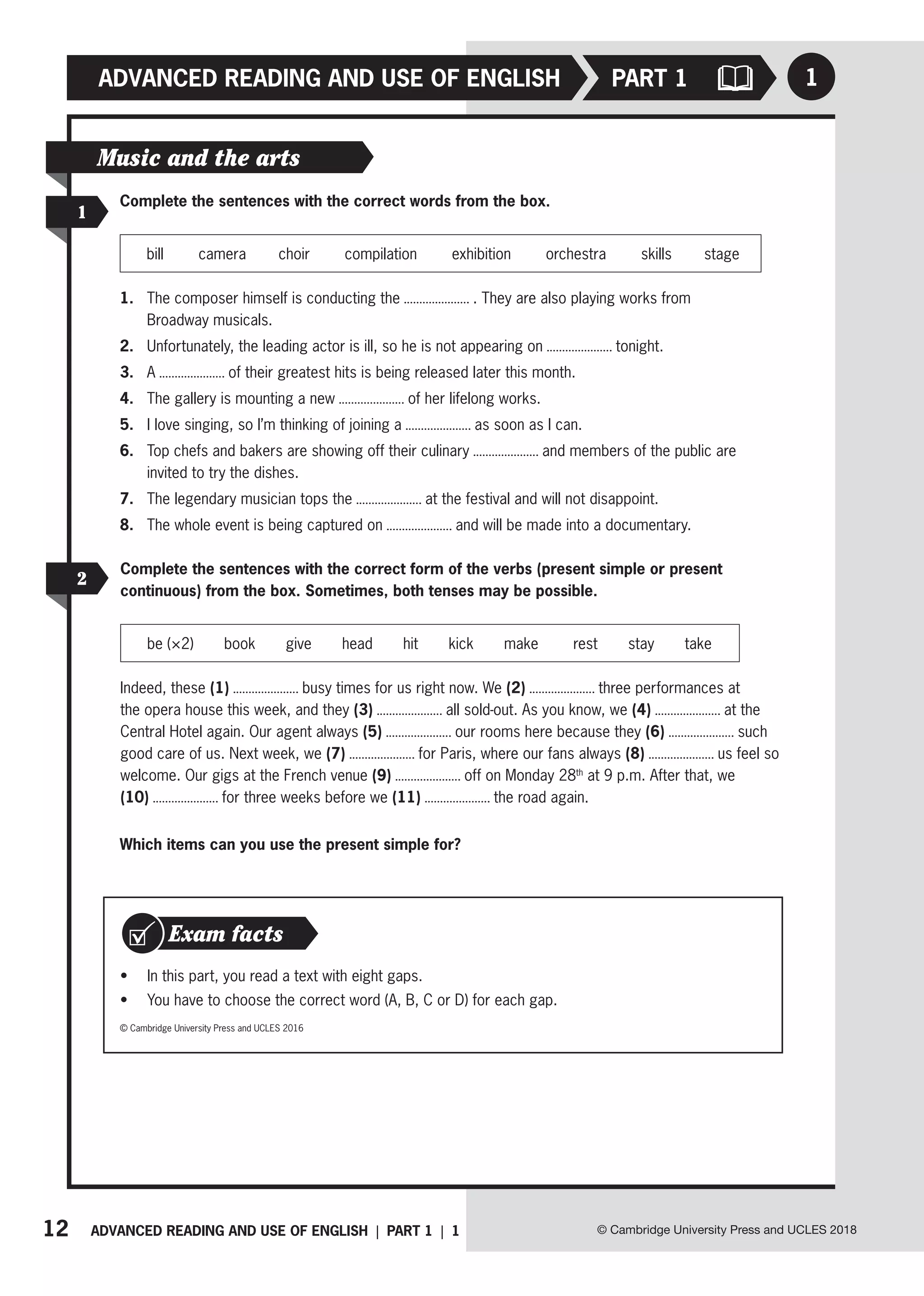
12 ADVANCED READING AND USE OF ENGLISH | PART 1 | 1 © Cambridge University Press and UCLES 2018
ADVANCED READING AND USE OF ENGLISH 1
PART 1
1
Music and the arts
Complete the sentences with the correct words from the box.
bill camera choir compilation exhibition orchestra skills stage
1. The composer himself is conducting the . They are also playing works from
Broadway musicals.
2. Unfortunately, the leading actor is ill, so he is not appearing on tonight.
3. A of their greatest hits is being released later this month.
4. The gallery is mounting a new of her lifelong works.
5. I love singing, so I’m thinking of joining a as soon as I can.
6. Top chefs and bakers are showing off their culinary and members of the public are
invited to try the dishes.
7. The legendary musician tops the at the festival and will not disappoint.
8. The whole event is being captured on and will be made into a documentary.
Which items can you use the present simple for?
• In this part, you read a text with eight gaps.
• You have to choose the correct word (A, B, C or D) for each gap.
Exam facts
© Cambridge University Press and UCLES 2016
Complete the sentences with the correct form of the verbs (present simple or present
continuous) from the box. Sometimes, both tenses may be possible.
be (×2) book give head hit kick make rest stay take
Indeed, these (1) busy times for us right now. We (2) three performances at
the opera house this week, and they (3) all sold-out. As you know, we (4) at the
Central Hotel again. Our agent always (5) our rooms here because they (6) such
good care of us. Next week, we (7) for Paris, where our fans always (8) us feel so
welcome. Our gigs at the French venue (9) off on Monday 28th
at 9 p.m. After that, we
(10) for three weeks before we (11) the road again.
2
13
ADVANCED READING AND USE OF ENGLISH | PART 1 | 1
© Cambridge University Press and UCLES 2018
Exam task
3
For questions 1–8, read the text below and
decide which answer (A, B, C or D) best
fits each gap. There is an example at the
beginning. (0)
Example:
0 A time B season C series D episode
Example answer: B
Don’t miss the event of the year!
Now in its seventh (0) , this year, the Rogers Estate Festival starts a day earlier: on Thursday,
which means visitors have a whole extra day to enjoy it. This showcase of art and music takes place in
a (1) like no other, with the castle ruins in the background. This year’s line-up includes an array
of talented actors alongside a very (2) selection of both local and international musicians and
visual artists.
Visitors can take (3) an impressive range of exhibits and experience both the permanent and
(4) collections through their five senses. In addition to large-audience sessions, there will be
more intimate moments, including poetry recitals, (5) by soloists plus painters and sculptors
at work. Last but not least, on Friday, we are in for a special (6) . Belinda Wilde, our guest of
honour this year, is (7) her debut at the festival, giving us a preview of a new (8) of her
famous symphony. If you still haven’t bought your pass to the festival, what are you waiting for?
1 A scenery B set C setting D stage
2 A supreme B high C luxury D elite
3 A off B up C in D on
4 A provisional B temporary C casual D momentary
5 A performances B productions C acts D presentations
6 A joy B bliss C treat D treatment
7 A giving B making C taking D doing
8 A constitution B distribution C organisation D arrangement
14 ADVANCED READING AND USE OF ENGLISH | PART 1 | 2
ADVANCED READING AND USE OF ENGLISH PART 1
© Cambridge University Press and UCLES 2018
2
Human behaviour
Exam task
1 For questions 1–8, read the text below and
decide which answer (A, B, C or D) best
fits each gap. There is an example at the
beginning. (0)
Example:
0 A fancy B inclined C tempting D dreamy
Example answer: B
Hobbyists around the world unite
No doubt you may be (0) to think that in this day and age, traditional pursuits are no longer ‘in’
and that we would have (1) away with old-fashioned hobbies that don’t involve computers. Nothing
of the (2) . If anything, the internet has made it easier for people with specialist hobbies in
different corners of the planet to (3) themselves to their passion and to support one another.
With one quick press of a key, (4) car collectors are online, comparing notes and restoration
(5) with enthusiasts in distant lands. If a part needs replacing, a vast electronic inventory is out
there (6) and waiting. After a day in the field, birdwatchers can post sightings they consider
worth sharing with likeminded enthusiasts who will immediately (7) to their passion.
Thankfully, face to face contact does still take place. Historic car rallies and races have a large following.
Come Sunday morning, children and adults alike still meet to swap, or perhaps even (8) , the
cards missing from their collections.
1 A done B taken C put D sent
2 A type B sort C variety D brand
3 A focus B present C stick D devote
4 A ancient B historical C classic D epic
5 A means B techniques C crafts D systems
6 A handy B willing C ready D open
7 A relate B share C connect D join
8 A bid B purchase C invest D subscribe
• Read through the whole text first for overall meaning.
• Read again and look at the words before and after the gaps in the text and check for clues like
determiners (that, this, etc.), verb forms, pronouns and prepositions. These words may be the
reason why one particular option is the correct word for the gap.
Exam tips
15
ADVANCED READING AND USE OF ENGLISH | PART 1 | 2
© Cambridge University Press and UCLES 2018
2
Complete the sentences with the correct form of a verb from the first box and an adjective
from the second to form common expressions.
busy happy fortunate perfect tricky
call consider find keep make
1. You might it to choose a flatmate. You can’t always rely on first impressions.
2. It would me so if you came to visit!
3. He himself very to still have a job.
4. She him all afternoon with a mountain of paperwork.
5. It’s okay, but I wouldn’t it . There are better films.
3
Complete the sentences with the correct adjective in each gap.
1. last / latest / previous
Her show of disrespect was to ignore me completely. time, she hung up the
phone and on a occasion, she shut the door in my face.
2. common / normal / regular
Why don’t you use your sense, on a basis, like a person?
3. big / long / wide
We still have a way to go! There’s a difference between short-term and long-term
success. At the moment, we don’t have the experience of dealing with customers which we need.
4. great / large / significant
There was disagreement among a number of members who showed
concern about the running of the club.
5. distant / far / remote
In the not too future, experts predict that it will be impossible to holiday from
civilization, but for now, there are still some places on the planet that are virtually impossible to
reach because they are so and inaccessible.
6. different / unique / varied
Many customers have submitted reviews praising the location of the restaurant
and the menu.
4
Complete the sentences with the correct form of the verbs from the box to form common
expressions.
convince express introduce know learn talk treat
1. Please among yourselves for a moment while I finish setting up.
2. Living under the same roof, different generations can a lot from each other.
3. He’s trying to himself that he’s capable of doing it.
4. Work in groups. Please start by yourselves to one another.
5. She finds it extremely hard to herself when she’s nervous and often stutters.
6. The two friends themselves to a spa day last week.
7. Over lunch, participants had the chance to get to each other a little better.
16 ADVANCED READING AND USE OF ENGLISH | PART 1 | 3
ADVANCED READING AND USE OF ENGLISH PART 1
© Cambridge University Press and UCLES 2018
3
Current affairs
Choose the correct preposition to complete the sentences.
1. The campaign is not making an impact in / on / to voters.
2. The government is unlikely to give in to the calls for / of / on a referendum.
3. Thousands of workers took part in a protest against / to / with pay cuts.
4. The press showed no regard at / for / on his privacy.
5. The campaigners received little support for / on / towards their proposals.
6. The company has reported a record-breaking increase in / of / up sales.
7. Has the committee considered the consequences for / of / on the changes on members?
8. Several players have expressed their desire for / of / to leave the club next season.
1
Complete the sentences with the correct words from the boxes.
cases examples incidents occasions
1. The company was accused of unfair use of personal data on a number of .
2. Serious of passenger misbehaviour include refusing to fasten their seatbelts and trying
to open the plane door mid-flight.
3. As many as a hundred people are thought to have been injured, in some , seriously.
4. Obvious of internet crimes are hacking, spreading viruses and piracy.
enquiry investigation research survey
5. The cause of the fire is currently under .
6. University scientists are carrying out into the side-effects of these drugs.
7. The authorities are conducting a of residents’ thoughts on the proposed changes.
8. The government has ordered a public to determine the reasons for the unrest.
attention attraction interest focus
9. At the core of the city is its castle, which is the main tourist .
10. The press has now turned its to other matters.
11. The media on politicians’ private lives means that many of the real, important issues are
not dealt with.
12. Readers have lost in the story.
2
17
ADVANCED READING AND USE OF ENGLISH | PART 1 | 3
© Cambridge University Press and UCLES 2018
Exam task
For questions 1–8, read the text below and
decide which answer (A, B, C or D) best
fits each gap. There is an example at the
beginning. (0)
Example:
0 A growing B evolving C moving D rising
Example answer: B
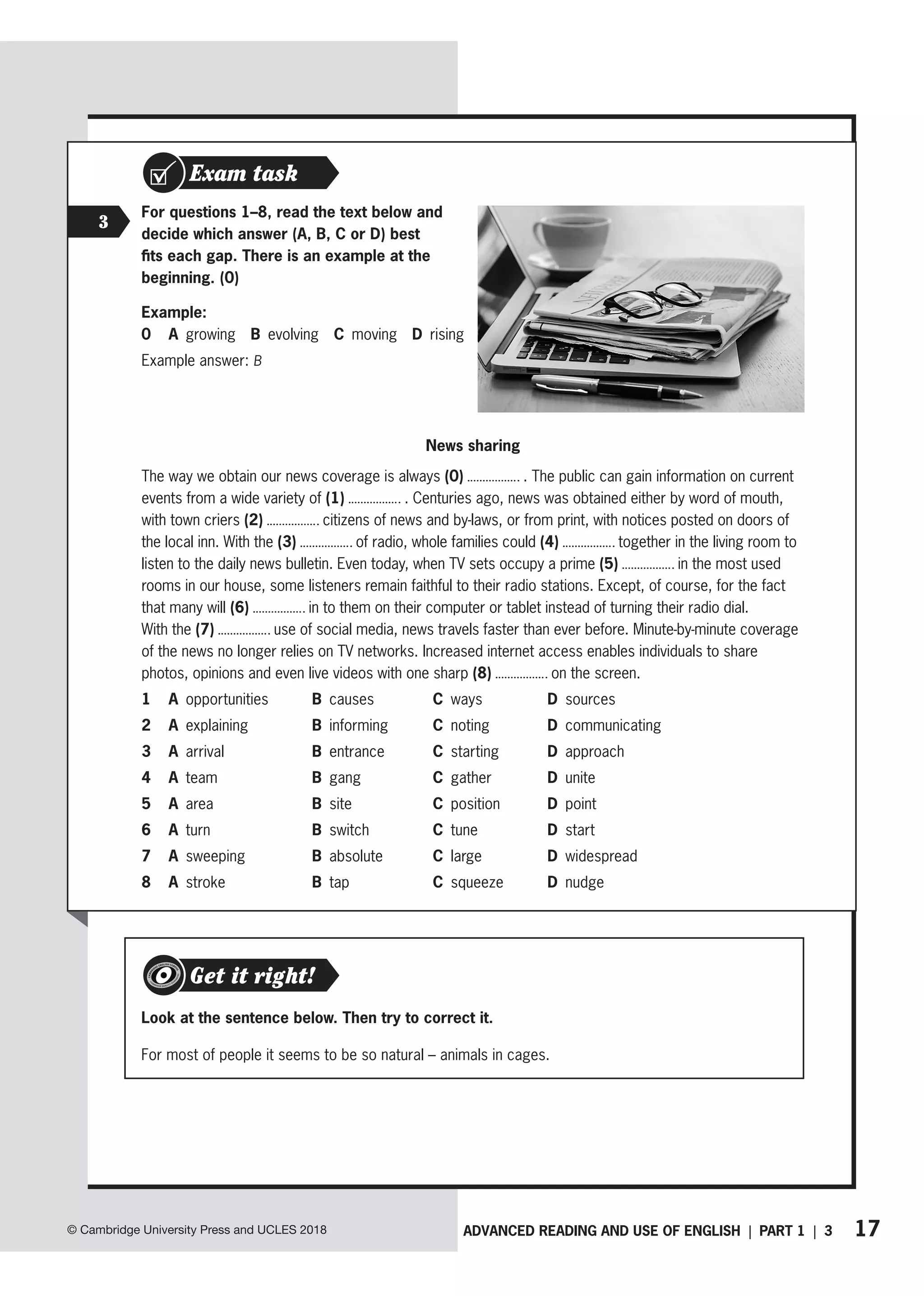
News sharing
The way we obtain our news coverage is always (0) . The public can gain information on current
events from a wide variety of (1) . Centuries ago, news was obtained either by word of mouth,
with town criers (2) citizens of news and by-laws, or from print, with notices posted on doors of
the local inn. With the (3) of radio, whole families could (4) together in the living room to
listen to the daily news bulletin. Even today, when TV sets occupy a prime (5) in the most used
rooms in our house, some listeners remain faithful to their radio stations. Except, of course, for the fact
that many will (6) in to them on their computer or tablet instead of turning their radio dial.
With the (7) use of social media, news travels faster than ever before. Minute-by-minute coverage
of the news no longer relies on TV networks. Increased internet access enables individuals to share
photos, opinions and even live videos with one sharp (8) on the screen.
1 A opportunities B causes C ways D sources
2 A explaining B informing C noting D communicating
3 A arrival B entrance C starting D approach
4 A team B gang C gather D unite
5 A area B site C position D point
6 A turn B switch C tune D start
7 A sweeping B absolute C large D widespread
8 A stroke B tap C squeeze D nudge
Look at the sentence below. Then try to correct it.
For most of people it seems to be so natural – animals in cages.
Get it right!
3
18 ADVANCED READING AND USE OF ENGLISH | PART 2 | 1 © Cambridge University Press and UCLES 2018
ADVANCED READING AND USE OF ENGLISH 1
PART 2
1
Money and finance
Complete each sentence with the correct form of come and the correct word from the box.
across between down into off through under up
1. The family a large amount of money when their grandmother passed away.
2. The company has seen some tough times, but has always them.
3. The minister has a lot of pressure to resign after the budget cuts.
4. The scheme will never . It’s just not feasible.
5. An opportunity to sell at this price may never again, so make the most of it.
6. I a pile of old bank statements in the filing cabinets.
7. The business partners vowed that nothing would them and that the company
would survive.
8. Inflation is at last. The economy might recover soon.
2
Read each pair of sentences and cross out any sentence which is wrong. Both sentences
may be correct.
1. a The government has put together a rescue plan to save the economy.
b The government has put a rescue plan together to save the economy.
2. a I had put money aside for a rainy day, so we used that.
b I had put aside money for a rainy day, so we used that.
3. a It’s very difficult to live on my salary.
b It’s very difficult to live my salary on.
4. a We’ve gone through some tough times, but things will start to pick up again.
b We’ve gone some tough times through, but things will start to pick up again.
5. a It took us eight years to pay off the debt.
b It took us eight years to pay the debt off.
6. a They are bringing down interest rates again.
b They are bringing interest rates down again.
7. a I’ll pay you back as soon as I get paid.
b I’ll pay back you as soon as I get paid.
8. a The financial adviser warned that businesses should not rush the deal into.
b The financial adviser warned that businesses should not rush into the deal.
19
ADVANCED READING AND USE OF ENGLISH | PART 2 | 1
© Cambridge University Press and UCLES 2018
Exam task
3
For questions 1–8, read the text below
and think of the word which best fits each
gap. Use only one word in each gap.
There is an example at the beginning (0).
Write your answers IN CAPITAL LETTERS.
Example: (0) WITH
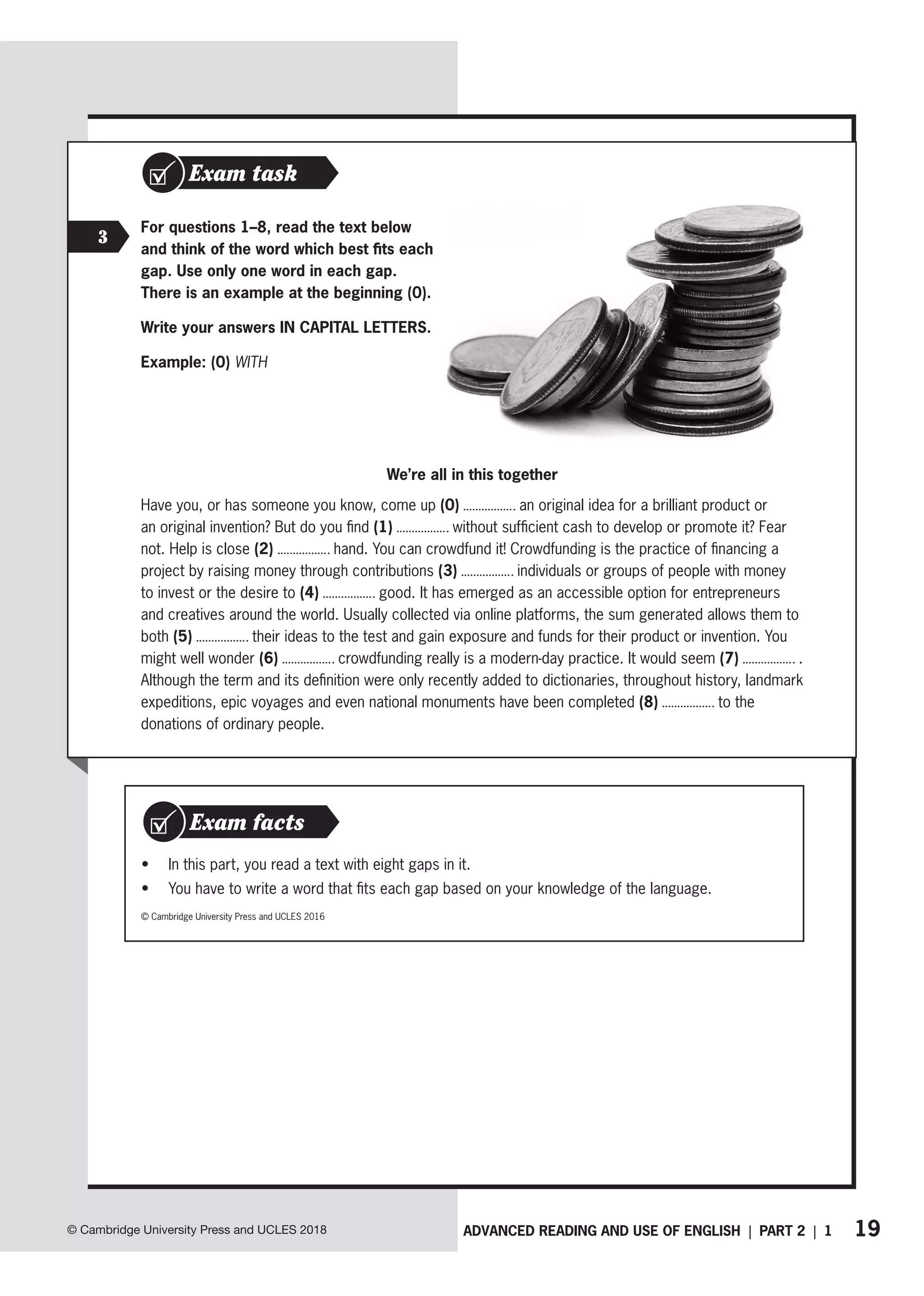
We’re all in this together
Have you, or has someone you know, come up (0) an original idea for a brilliant product or
an original invention? But do you find (1) without sufficient cash to develop or promote it? Fear
not. Help is close (2) hand. You can crowdfund it! Crowdfunding is the practice of financing a
project by raising money through contributions (3) individuals or groups of people with money
to invest or the desire to (4) good. It has emerged as an accessible option for entrepreneurs
and creatives around the world. Usually collected via online platforms, the sum generated allows them to
both (5) their ideas to the test and gain exposure and funds for their product or invention. You
might well wonder (6) crowdfunding really is a modern-day practice. It would seem (7) .
Although the term and its definition were only recently added to dictionaries, throughout history, landmark
expeditions, epic voyages and even national monuments have been completed (8) to the
donations of ordinary people.
• In this part, you read a text with eight gaps in it.
• You have to write a word that fits each gap based on your knowledge of the language.
Exam facts
© Cambridge University Press and UCLES 2016
20 ADVANCED READING AND USE OF ENGLISH | PART 2 | 2 © Cambridge University Press and UCLES 2018
ADVANCED READING AND USE OF ENGLISH 2
PART 2
Science
Exam task
1
For questions 1–8, read the text below and think of the word which best fits each gap. Use
only one word in each gap. There is an example at the beginning (0).
Write your answers IN CAPITAL LETTERS.
Example: (0) IT
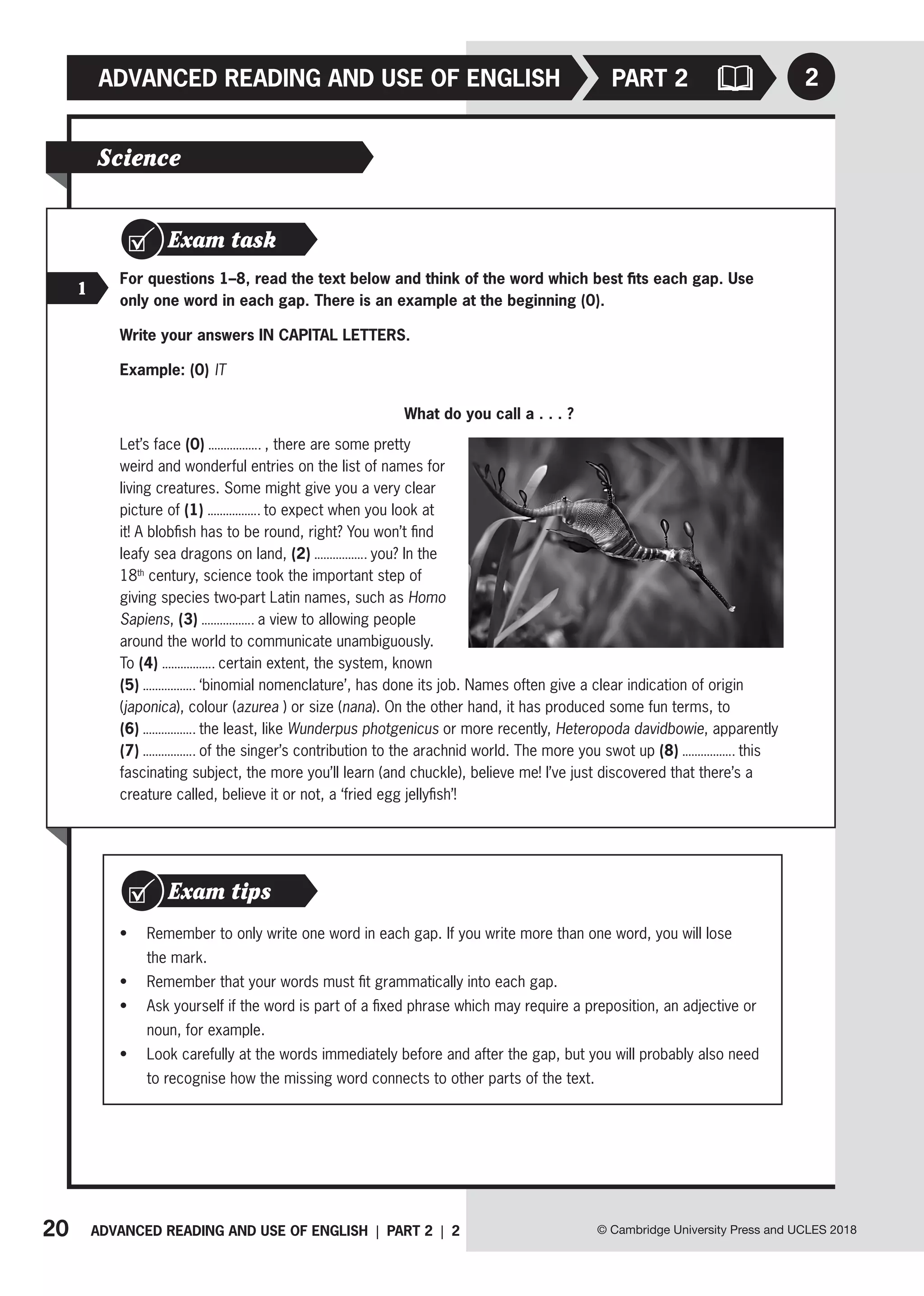
What do you call a . . . ?
Let’s face (0) , there are some pretty
weird and wonderful entries on the list of names for
living creatures. Some might give you a very clear
picture of (1) to expect when you look at
it! A blobfish has to be round, right? You won’t find
leafy sea dragons on land, (2) you? In the
18th
century, science took the important step of
giving species two-part Latin names, such as Homo
Sapiens, (3) a view to allowing people
around the world to communicate unambiguously.
To (4) certain extent, the system, known
(5) ‘binomial nomenclature’, has done its job. Names often give a clear indication of origin
(japonica), colour (azurea ) or size (nana). On the other hand, it has produced some fun terms, to
(6) the least, like Wunderpus photgenicus or more recently, Heteropoda davidbowie, apparently
(7) of the singer’s contribution to the arachnid world. The more you swot up (8) this
fascinating subject, the more you’ll learn (and chuckle), believe me! I’ve just discovered that there’s a
creature called, believe it or not, a ‘fried egg jellyfish’!
• Remember to only write one word in each gap. If you write more than one word, you will lose
the mark.
• Remember that your words must fit grammatically into each gap.
• Ask yourself if the word is part of a fixed phrase which may require a preposition, an adjective or
noun, for example.
• Look carefully at the words immediately before and after the gap, but you will probably also need
to recognise how the missing word connects to other parts of the text.
Exam tips
21
ADVANCED READING AND USE OF ENGLISH | PART 2 | 2
© Cambridge University Press and UCLES 2018
2
3
Complete the sentences with the correct words from the box.
accounts first happens matter now result time words
1. A signal from what might, by all , be a moon outside our solar system has been spotted.
Astronomers will use the Hubble Space Telescope to confirm whether this is the case.
2. Archaeologists have recently made major fossil finds and, as a , anthropologists have
been able to uncover further details regarding the decline of the Neanderthals.
3. As a of fact, our laboratory is on the brink of announcing a key breakthrough which is set
to change everything in this field.
4. Scientists are renowned for their curiosity or, in other , for the drive which propels their
quest for answers.
5. Whatever next, it is crucial that the researchers receive the necessary funding to keep
the project up and running.
6. and foremost, safety should be considered before proceeding with the tests.
7. Driverless cars. What’s next? Pilotless planes apparently. For the being, though, humans
are still needed in the cockpit.
8. Every and then, while studying a particular health disorder, scientists stumble upon a cure
for another condition.
Complete the sentences with an article (a, an, the) or (–) if no article is necessary.
1. Has your personal experience of studying science subjects at school been
positive one?
2. How far would you say that science fulfils useful role in modern
society?
3. Which discovery or invention do you think has had most positive effect on
society?
4. How do you think medicine will develop in future?
5. How strict do you think controls on scientific experiments should be?
6. To what extent are human beings to blame for climate change?
7. Do you think that advances in technology will be sufficient to overcome
problem of world’s dwindling resources?
8. Some people say that more we invent, lazier we become.
22 ADVANCED READING AND USE OF ENGLISH | PART 2 | 3 © Cambridge University Press and UCLES 2018
ADVANCED READING AND USE OF ENGLISH
2
Complete the sentences and questions with an adjective from the first box and the correct
preposition from the second box. The prepositions can be used more than once.
eligible hostile incompatible lacking open-minded prone restricted untouched
about by for in on to with
1. Not everyone who needs funds is grants to help them start a business.
2. Most people are generally change, but a minority are it
and try and resist it.
3. The country is natural disasters. There are often storms, hurricanes and floods.
4. Transport in the city centre is public transport or local residents’ vehicles.
5. Some parts of the country are still wild and humans.
6. The country is natural resources; it has to import its energy and other
necessities from other countries.
7. In some companies, long hours mean having a career is raising a family.
3
PART 2
Nature and the environment
1
Complete the sentences with a compound noun formed from a word from each of the
two boxes.
coastal   endangered   global   natural   oil   rural   urban   
waste
areas development erosion habitats management species spill warming
1. Recent reports state that many historical cultural heritage sites are in danger of disappearing
into the sea as a consequence of .
2. After the from a tanker, a massive clean-up operation was launched and a
group has been set up to monitor the impact on marine wildlife.
3. Many countries worldwide have witnessed the migration of millions of people from
to cities.
4. The construction of a forest city in China is a remarkable example of sustainable
. The buildings will include offices, schools and homes covered in trees
and plants.
5. Ordinary citizens are becoming key players in effective by making sure
rubbish from homes and offices is correctly sorted before it is collected.
6. The fight against has received a boost after the Governor signed a bill
targeting CO2
emissions in the state.
7. Unfortunately, various factors including population growth, poaching and deforestation have a
negative impact on the of many plants and animals.
8. Some kinds of tigers, gorillas and bears are on the list of the world’s most .
23
ADVANCED READING AND USE OF ENGLISH | PART 2 | 3
© Cambridge University Press and UCLES 2018
Exam task
3
For questions 1–8, read the text below and think of the word which best fits each gap. Use
only one word in each gap. There is an example at the beginning (0).
Write your answers IN CAPITAL LETTERS.
Example: (0) HOW
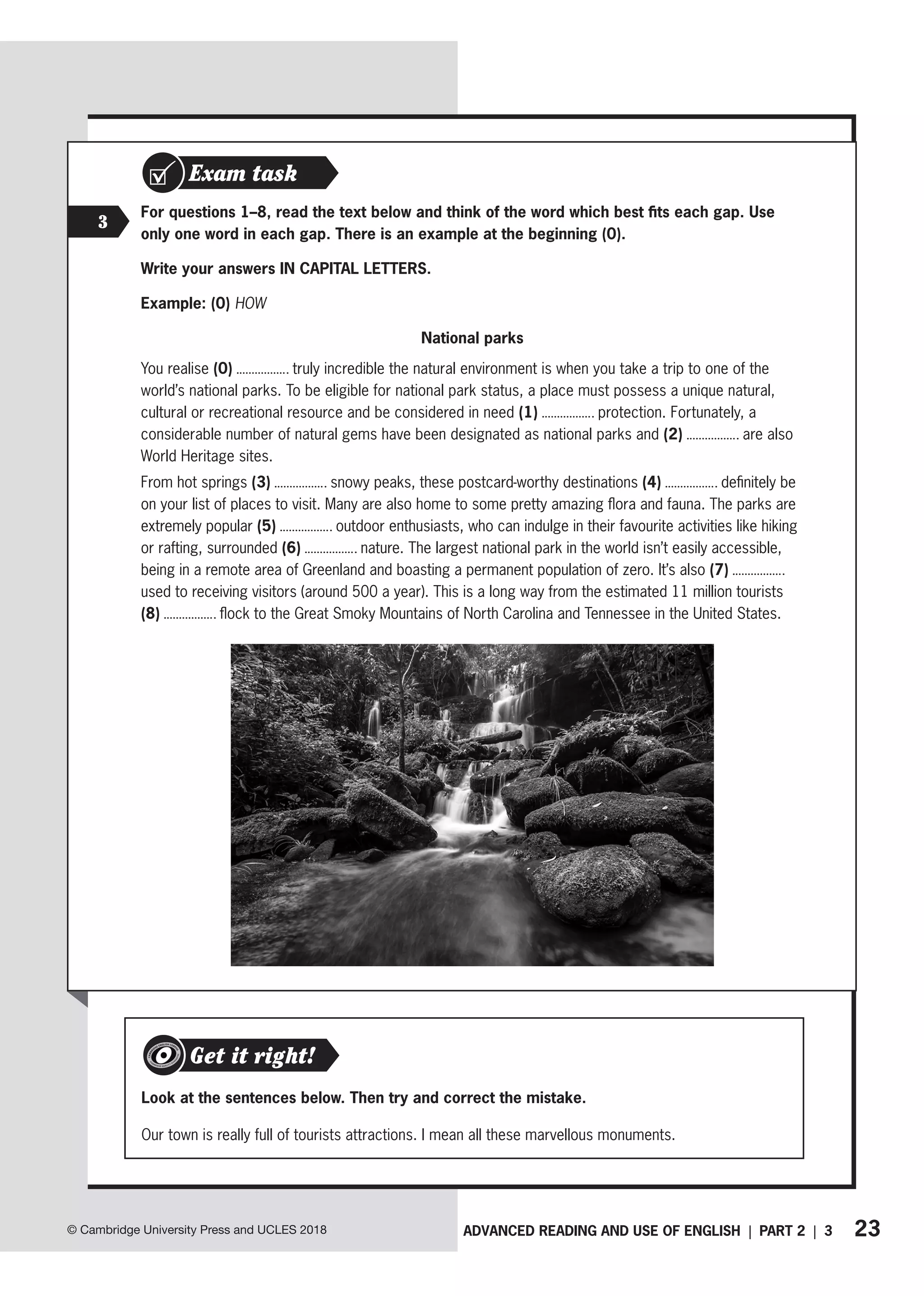
National parks
You realise (0) truly incredible the natural environment is when you take a trip to one of the
world’s national parks. To be eligible for national park status, a place must possess a unique natural,
cultural or recreational resource and be considered in need (1) protection. Fortunately, a
considerable number of natural gems have been designated as national parks and (2) are also
World Heritage sites.
From hot springs (3) snowy peaks, these postcard-worthy destinations (4) definitely be
on your list of places to visit. Many are also home to some pretty amazing flora and fauna. The parks are
extremely popular (5) outdoor enthusiasts, who can indulge in their favourite activities like hiking
or rafting, surrounded (6) nature. The largest national park in the world isn’t easily accessible,
being in a remote area of Greenland and boasting a permanent population of zero. It’s also (7)
used to receiving visitors (around 500 a year). This is a long way from the estimated 11 million tourists
(8) flock to the Great Smoky Mountains of North Carolina and Tennessee in the United States.
Look at the sentences below. Then try and correct the mistake.
Our town is really full of tourists attractions. I mean all these marvellous monuments.
Get it right!
24 ADVANCED READING AND USE OF ENGLISH | PART 3 | 1
ADVANCED READING AND USE OF ENGLISH
© Cambridge University Press and UCLES 2018
1
PART 3
1
2
Correct the prefixes in the words in brackets.
1. Many of the applicants for the course were considered either (inmature) or
lacking in relevant experience.
2. The whole programme was (misorganised) from start to finish. No one seemed
to know who was responsible for what.
3. The professor was renowned for her (imconventional) teaching methods.
4. Eventually, the student was able to (outcome) his shyness in class and speak
in public.
5. ‘I will not tolerate (disbehaviour) in my class,’ the tutor warned.
6. (Probooking) is extremely advisable as places are limited and will be assigned
on a first-come-first-served basis.
7. The most recent training was (untaken) more than four years ago. Further
familiarisation is urgently needed.
8. The dates of the course were (unconvenient) so we did not attend.
Complete the text with the correct relative pronouns from the box. Decide which, if any,
relative pronouns can be omitted.
that when where which who whose why
Example: (0) which
Choosing the university (0) is right for you is not
as easy as it may seem. (1) this might be the case
is (2) the prospectuses make all of them seem
attractive. Here are some tips to help you (3) it’s your
turn to decide:
• How far is it between the halls of residence and the place
(4) your lectures will take place? How will you
travel around? On foot? By bike? Using public transport?
• How old are the lecturers (5) will be teaching
you? Check to see if you can find any articles they’ve written
and how recent the publication dates are.
• Read comments on student chatrooms by anyone
(6) insights might prove valuable, such as
undergraduates doing the same course.
• Of course, the fees (7) the university charges are a big deciding factor. Check – there
may be grants available, in (8) case find out the requirements and apply.
Education and learning
25
ADVANCED READING AND USE OF ENGLISH | PART 3 | 1
© Cambridge University Press and UCLES 2018
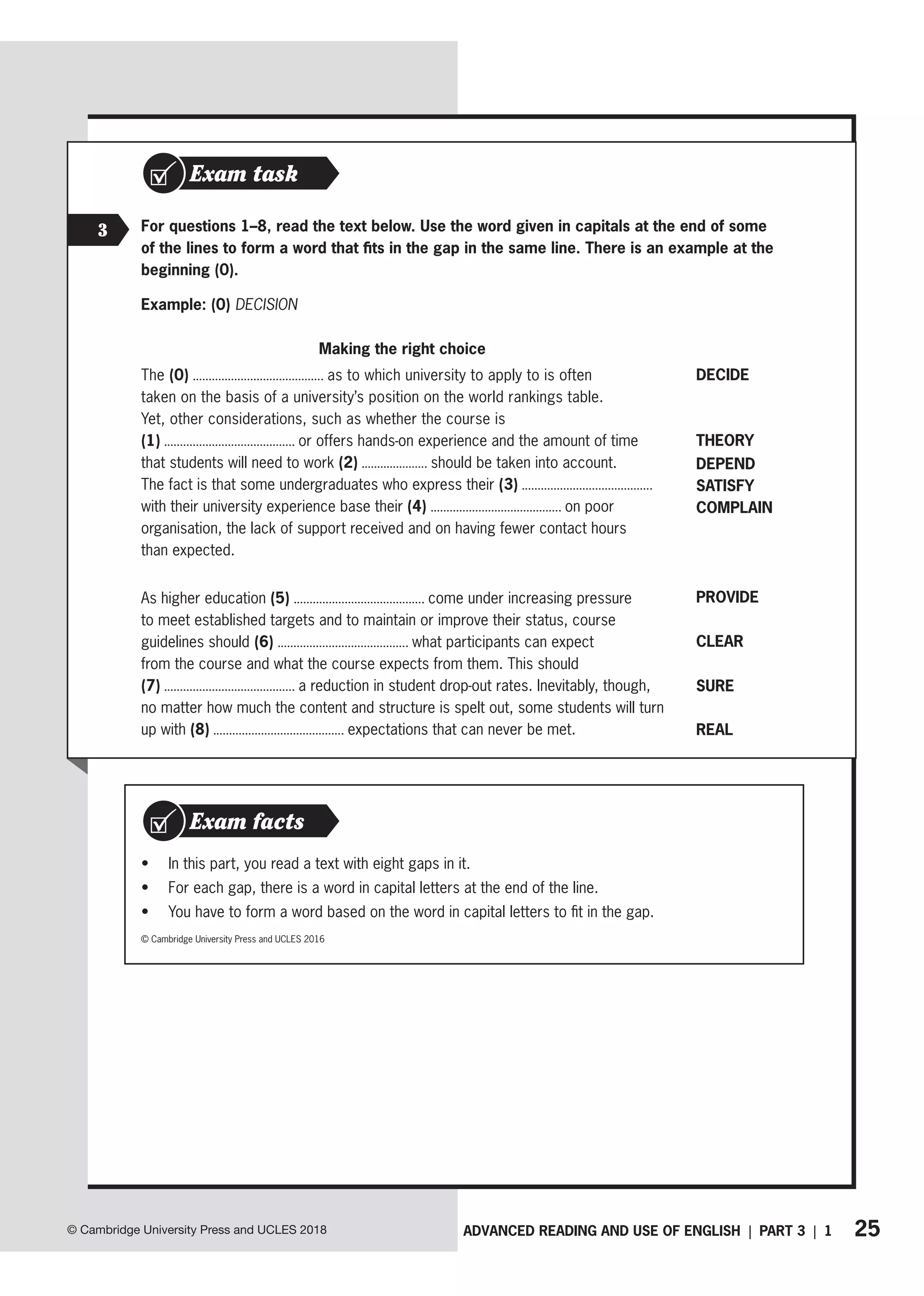
3
Exam task
For questions 1–8, read the text below. Use the word given in capitals at the end of some
of the lines to form a word that fits in the gap in the same line. There is an example at the
beginning (0).
Example: (0) DECISION
Making the right choice
The (0) as to which university to apply to is often
taken on the basis of a university’s position on the world rankings table.
Yet, other considerations, such as whether the course is
(1) or offers hands-on experience and the amount of time
that students will need to work (2) should be taken into account.
The fact is that some undergraduates who express their (3)
with their university experience base their (4) on poor
organisation, the lack of support received and on having fewer contact hours
than expected.
As higher education (5) come under increasing pressure
to meet established targets and to maintain or improve their status, course
guidelines should (6) what participants can expect
from the course and what the course expects from them. This should
(7) a reduction in student drop-out rates. Inevitably, though,
no matter how much the content and structure is spelt out, some students will turn
up with (8) expectations that can never be met.
DECIDE
THEORY
DEPEND
SATISFY
COMPLAIN
PROVIDE
CLEAR
SURE
REAL
• In this part, you read a text with eight gaps in it.
• For each gap, there is a word in capital letters at the end of the line.
• You have to form a word based on the word in capital letters to fit in the gap.
Exam facts
© Cambridge University Press and UCLES 2016
26 ADVANCED READING AND USE OF ENGLISH | PART 3 | 2
ADVANCED READING AND USE OF ENGLISH
© Cambridge University Press and UCLES 2018
2
PART 3
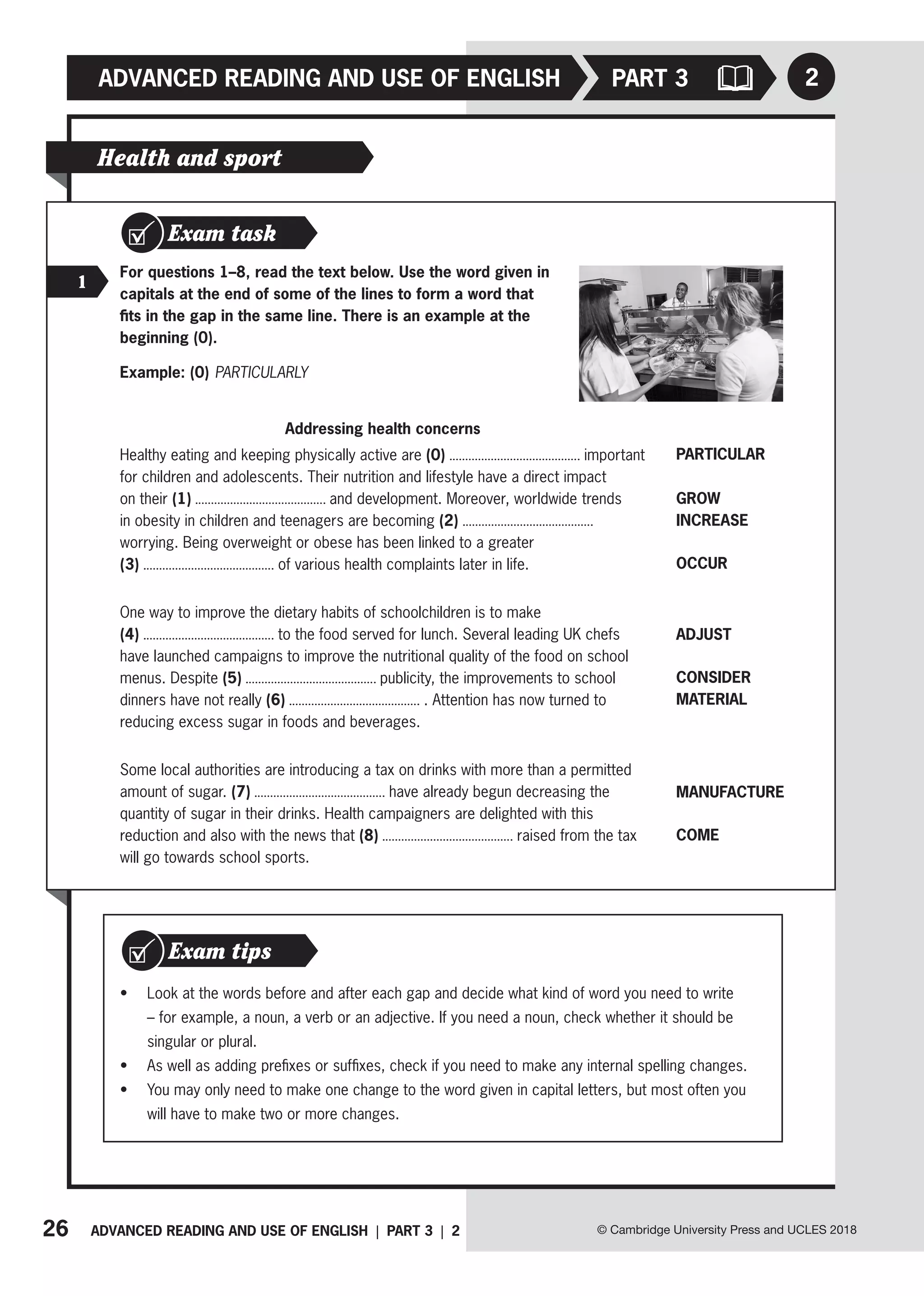
Health and sport
Exam task
1
For questions 1–8, read the text below. Use the word given in
capitals at the end of some of the lines to form a word that
fits in the gap in the same line. There is an example at the
beginning (0).
Example: (0) PARTICULARLY
Addressing health concerns
Healthy eating and keeping physically active are (0) important
for children and adolescents. Their nutrition and lifestyle have a direct impact
on their (1) and development. Moreover, worldwide trends
in obesity in children and teenagers are becoming (2)
worrying. Being overweight or obese has been linked to a greater
(3) of various health complaints later in life.
One way to improve the dietary habits of schoolchildren is to make
(4) to the food served for lunch. Several leading UK chefs
have launched campaigns to improve the nutritional quality of the food on school
menus. Despite (5) publicity, the improvements to school
dinners have not really (6) . Attention has now turned to
reducing excess sugar in foods and beverages.
Some local authorities are introducing a tax on drinks with more than a permitted
amount of sugar. (7) have already begun decreasing the
quantity of sugar in their drinks. Health campaigners are delighted with this
reduction and also with the news that (8) raised from the tax
will go towards school sports.
PARTICULAR
GROW
INCREASE
OCCUR
ADJUST
CONSIDER
MATERIAL
MANUFACTURE
COME
• Look at the words before and after each gap and decide what kind of word you need to write
– for example, a noun, a verb or an adjective. If you need a noun, check whether it should be
singular or plural.
• As well as adding prefixes or suffixes, check if you need to make any internal spelling changes.
• You may only need to make one change to the word given in capital letters, but most often you
will have to make two or more changes.
Exam tips
27
ADVANCED READING AND USE OF ENGLISH | PART 3 | 2
© Cambridge University Press and UCLES 2018
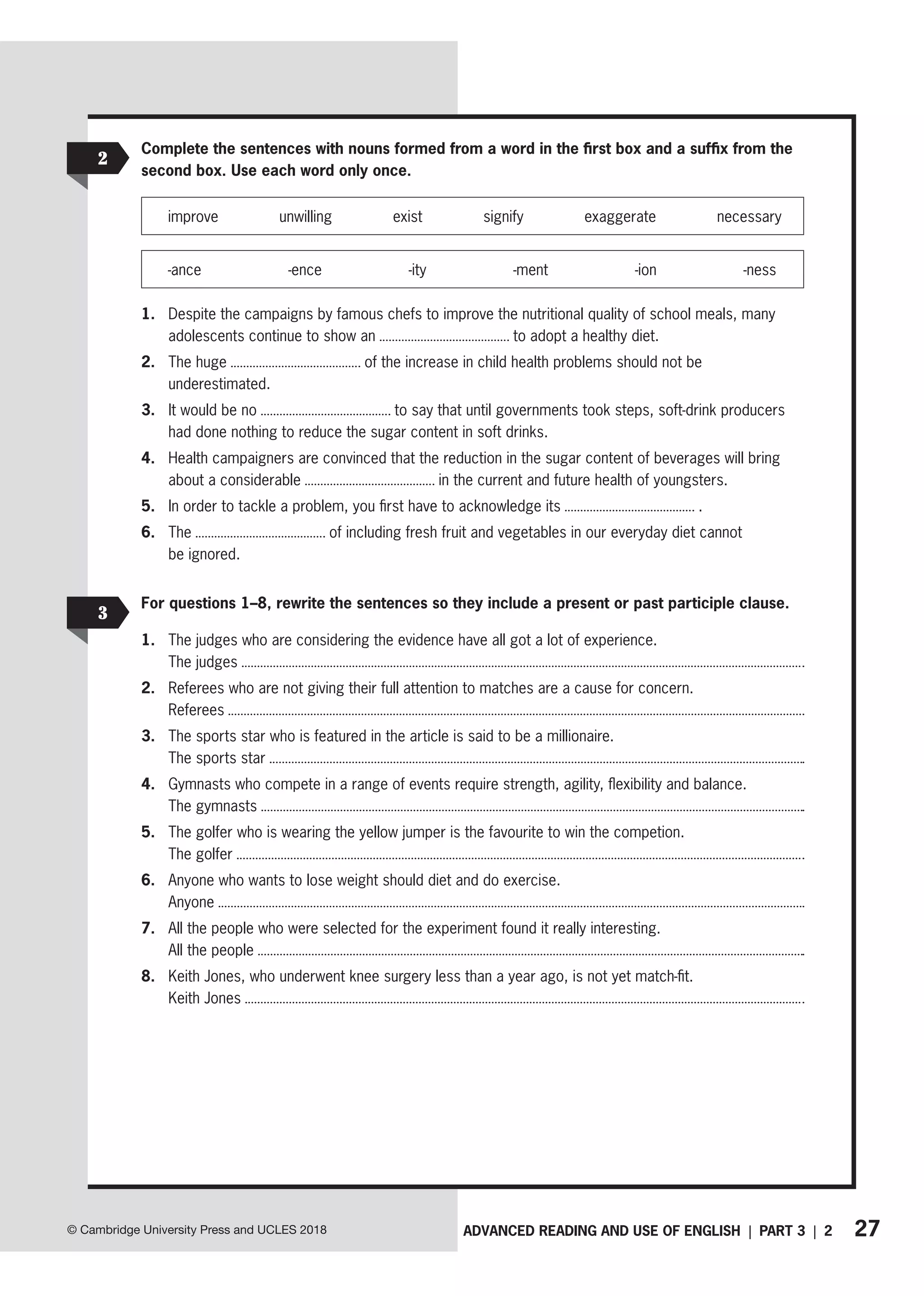
Complete the sentences with nouns formed from a word in the first box and a suffix from the
second box. Use each word only once.
improve unwilling exist signify exaggerate necessary
-ance -ence -ity -ment -ion -ness
1. Despite the campaigns by famous chefs to improve the nutritional quality of school meals, many
adolescents continue to show an to adopt a healthy diet.
2. The huge of the increase in child health problems should not be
underestimated.
3. It would be no to say that until governments took steps, soft-drink producers
had done nothing to reduce the sugar content in soft drinks.
4. Health campaigners are convinced that the reduction in the sugar content of beverages will bring
about a considerable in the current and future health of youngsters.
5. In order to tackle a problem, you first have to acknowledge its .
6. The of including fresh fruit and vegetables in our everyday diet cannot
be ignored.
For questions 1–8, rewrite the sentences so they include a present or past participle clause.
1. The judges who are considering the evidence have all got a lot of experience.
The judges
2. Referees who are not giving their full attention to matches are a cause for concern.
Referees
3. The sports star who is featured in the article is said to be a millionaire.
The sports star
4. Gymnasts who compete in a range of events require strength, agility, flexibility and balance.
The gymnasts
5. The golfer who is wearing the yellow jumper is the favourite to win the competion.
The golfer
6. Anyone who wants to lose weight should diet and do exercise.
Anyone
7. All the people who were selected for the experiment found it really interesting.
All the people
8. Keith Jones, who underwent knee surgery less than a year ago, is not yet match-fit.
Keith Jones
2
3
28 ADVANCED READING AND USE OF ENGLISH | PART 3 | 3
ADVANCED READING AND USE OF ENGLISH
© Cambridge University Press and UCLES 2018
3
PART 3
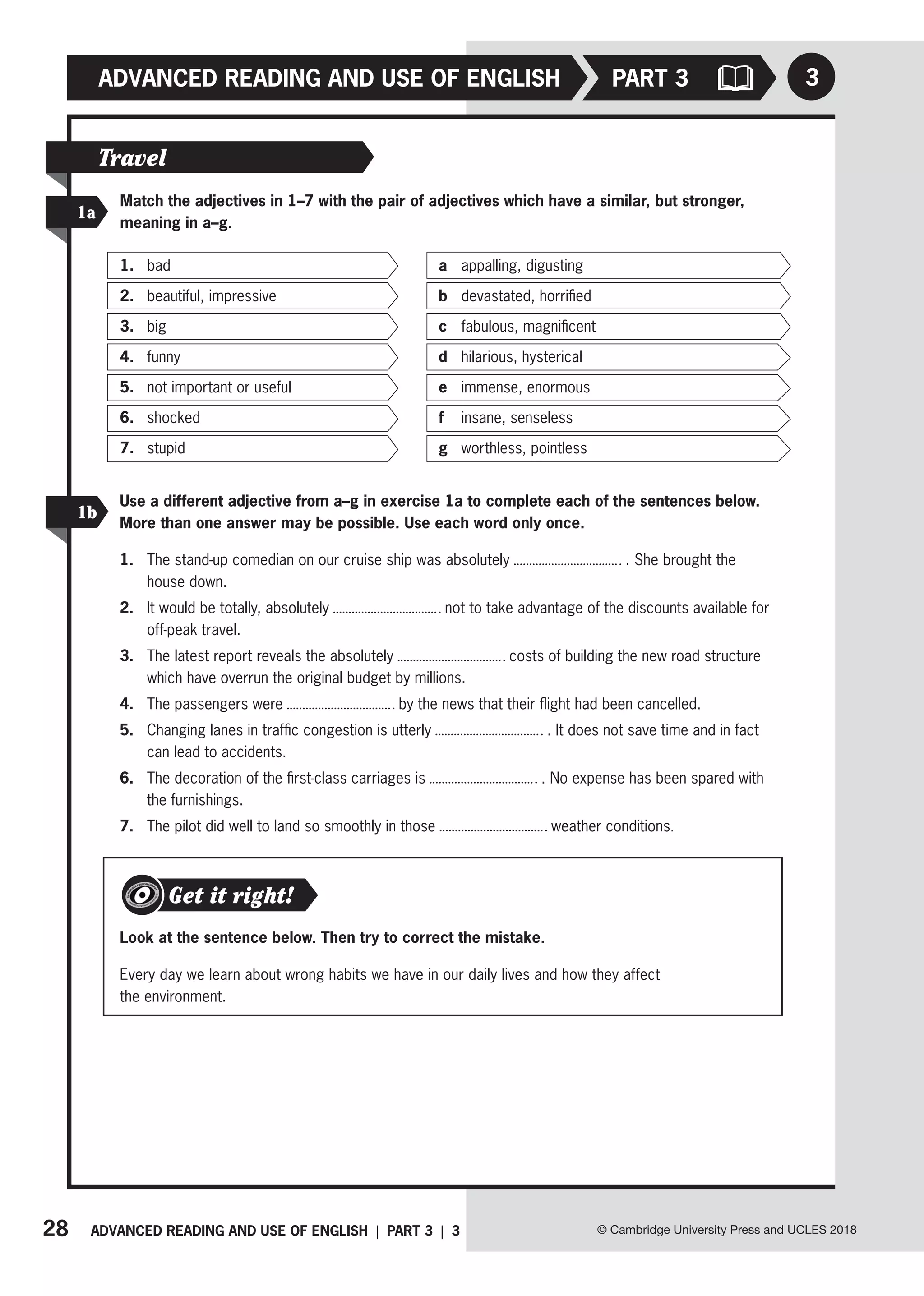
Travel
1a
1b
Use a different adjective from a–g in exercise 1a to complete each of the sentences below.
More than one answer may be possible. Use each word only once.
1. The stand-up comedian on our cruise ship was absolutely . She brought the
house down.
2. It would be totally, absolutely not to take advantage of the discounts available for
off-peak travel.
3. The latest report reveals the absolutely costs of building the new road structure
which have overrun the original budget by millions.
4. The passengers were by the news that their flight had been cancelled.
5. Changing lanes in traffic congestion is utterly . It does not save time and in fact
can lead to accidents.
6. The decoration of the first-class carriages is . No expense has been spared with
the furnishings.
7. The pilot did well to land so smoothly in those weather conditions.
Match the adjectives in 1–7 with the pair of adjectives which have a similar, but stronger,
meaning in a–g.
1. bad
2. beautiful, impressive
3. big
4. funny
5. not important or useful
6. shocked
7. stupid
a appalling, digusting
b devastated, horrified
c fabulous, magnificent
d hilarious, hysterical
e immense, enormous
f insane, senseless
g worthless, pointless
Get it right!
Look at the sentence below. Then try to correct the mistake.
Every day we learn about wrong habits we have in our daily lives and how they affect
the environment.
29
ADVANCED READING AND USE OF ENGLISH | PART 3 | 3
© Cambridge University Press and UCLES 2018
2
Complete each of the three sentences with a different word formed from the word in capitals.
HAND
1. The ground staff’s strike is set to continue, with accusations that the airline is totally
the situation.
2. First-time visitors to the area will find this guide particularly .
3. You wouldn’t guess this bike is . The previous owner obviously looked after it.
CHANGE
4. The weather at this time of the year can be very , so make sure you bring a waterproof.
5. The whole area remains virtually , thankfully. Tourism has hardly affected it.
6. There are now several websites where travellers can experiences and tips.
WORK
7. Being away from home doesn’t mean you have to miss out on your daily . Our gym
has everything you need.
8. Our staff are available 24 hours a day to help make your stay unique and memorable.
9. Thanks to great by the climbers, the expedition was a huge success.
Exam task
3
For questions 1–8, read the text below. Use the word given in
capitals at the end of some of the lines to form a word that fits in
the gap in the same line. There is an example at the beginning (0).
Example: (0) CHILDHOOD
How travel inspired my life
Today, I travel all around the world as a jewellery designer, but travel was also
central to my (0) . My parents encouraged my sister
and me to keep records of our (1) in journals and to put
together scrapbooks with souvenirs of our adventures. Before departure, a
private tutor was hired to equip us with the (2) of our
destination’s native tongue. My poor sister was not a (3)
brilliant linguist and found the whole process a considerable strain. My
experience was very different. My wanderlust was (4)
when, straight out of school, I had the opportunity to spend periods in India,
Eastern Europe, Africa and Asia. I travel like a (5) explorer,
absorbing the details of art and architecture, going into the local history and
traditions in (6) . I bring this approach to my work today.
I am constantly reading, researching and (7) my knowledge.
Not (8) , every jewellery collection I work on is an utterly
unique representation of a part of my life’s voyage.
CHILD
REFLECT
BASE
PARTICULAR
FORCE
REST
DEEP
BROAD
SURPRISE
30 ADVANCED READING AND USE OF ENGLISH | PART 4 | 1
ADVANCED READING AND USE OF ENGLISH
© Cambridge University Press and UCLES 2018
1
PART 4
1
2
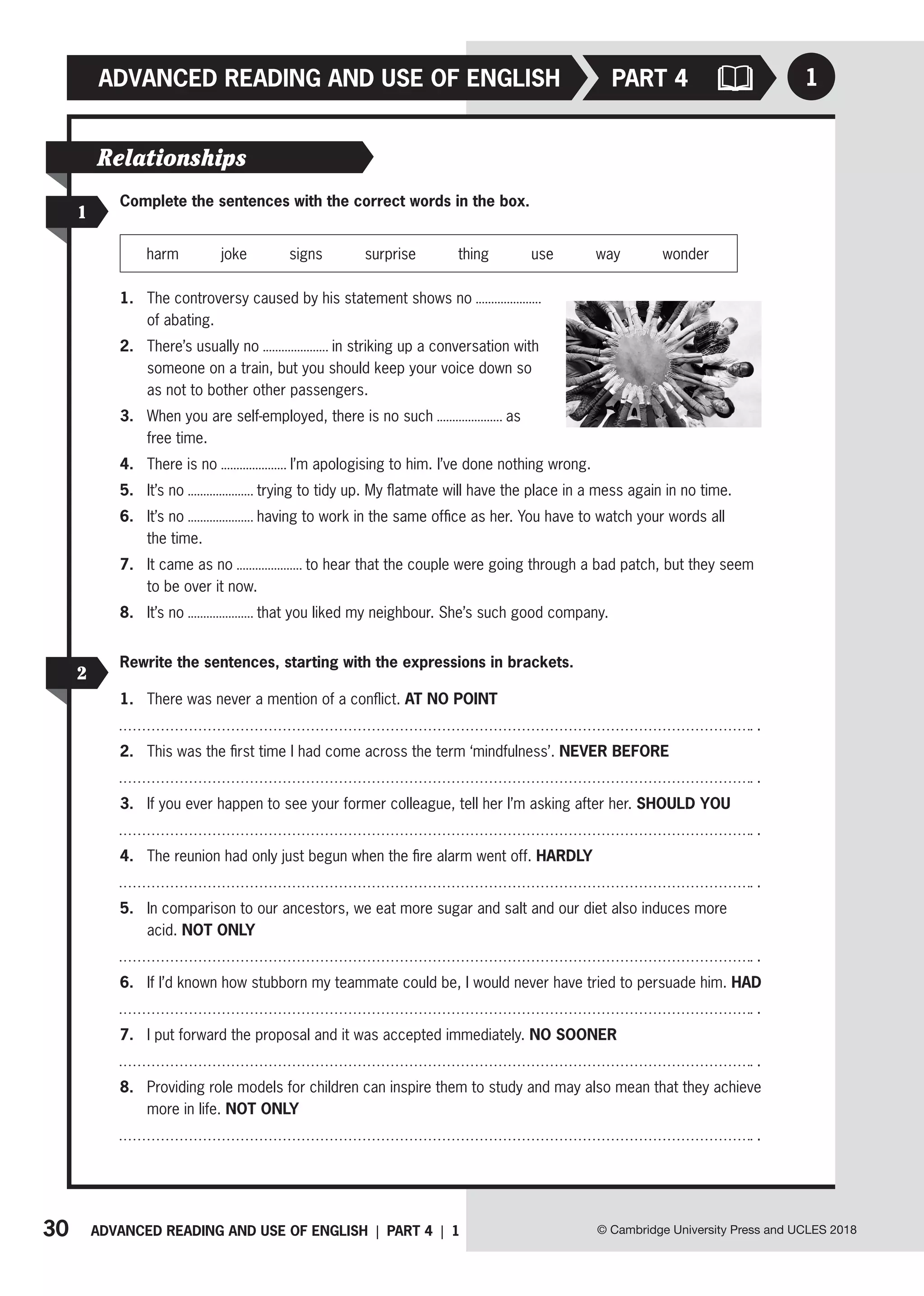
Relationships
Complete the sentences with the correct words in the box.
harm joke signs surprise thing use way wonder
1. The controversy caused by his statement shows no
of abating.
2. There’s usually no in striking up a conversation with
someone on a train, but you should keep your voice down so
as not to bother other passengers.
3. When you are self-employed, there is no such as
free time.
4. There is no I’m apologising to him. I’ve done nothing wrong.
5. It’s no trying to tidy up. My flatmate will have the place in a mess again in no time.
6. It’s no having to work in the same office as her. You have to watch your words all
the time.
7. It came as no to hear that the couple were going through a bad patch, but they seem
to be over it now.
8. It’s no that you liked my neighbour. She’s such good company.
Rewrite the sentences, starting with the expressions in brackets.
1. There was never a mention of a conflict. AT NO POINT
.
2. This was the first time I had come across the term ‘mindfulness’. NEVER BEFORE
.
3. If you ever happen to see your former colleague, tell her I’m asking after her. SHOULD YOU
.
4. The reunion had only just begun when the fire alarm went off. HARDLY
.
5. In comparison to our ancestors, we eat more sugar and salt and our diet also induces more
acid. NOT ONLY
.
6. If I’d known how stubborn my teammate could be, I would never have tried to persuade him. HAD
.
7. I put forward the proposal and it was accepted immediately. NO SOONER
.
8. Providing role models for children can inspire them to study and may also mean that they achieve
more in life. NOT ONLY
.
31
ADVANCED READING AND USE OF ENGLISH | PART 4 | 1
© Cambridge University Press and UCLES 2018
Exam task
3
For questions 1–6, complete the second sentence so that it has a similar meaning to the first
sentence, using the word given. Do not change the word given. You must use between three
and six words, including the word given. Here is an example (0).
Example:
0 The politician is not as popular now after the recession.
DECLINED
The politician’s popularity declined as a result of the recession.
1. The changes to the club had no effect on its existing members.
CONSEQUENCE
The changes to the club its existing members.
2. We need to completely overhaul the terms for new users.
THOROUGH
There needs the terms for new users.
3. I’m absolutely certain that she was involved in the decision.
WHATSOEVER
There that she was involved in the decision.
4. I was never consulted, so I couldn’t offer any advice on the matter.
ONCE
Never give my advice on the matter.
5. It’s a mystery to me how he found out about the surprise party.
CLUE
I he found out about the surprise party.
6. The professor’s reputation was such that he was nominated for the award.
REGARD
The professor was that he was nominated for the award.
• In this part, there are six questions.
• Each part has an initial sentence, a key word and a second sentence consisting of only the
beginning and end.
• You have to complete the second sentence so it means the same as the initial sentence using
the key word.
Exam facts
© Cambridge University Press and UCLES 2016
32 ADVANCED READING AND USE OF ENGLISH | PART 4 | 2
ADVANCED READING AND USE OF ENGLISH
© Cambridge University Press and UCLES 2018
PART 4 2
1
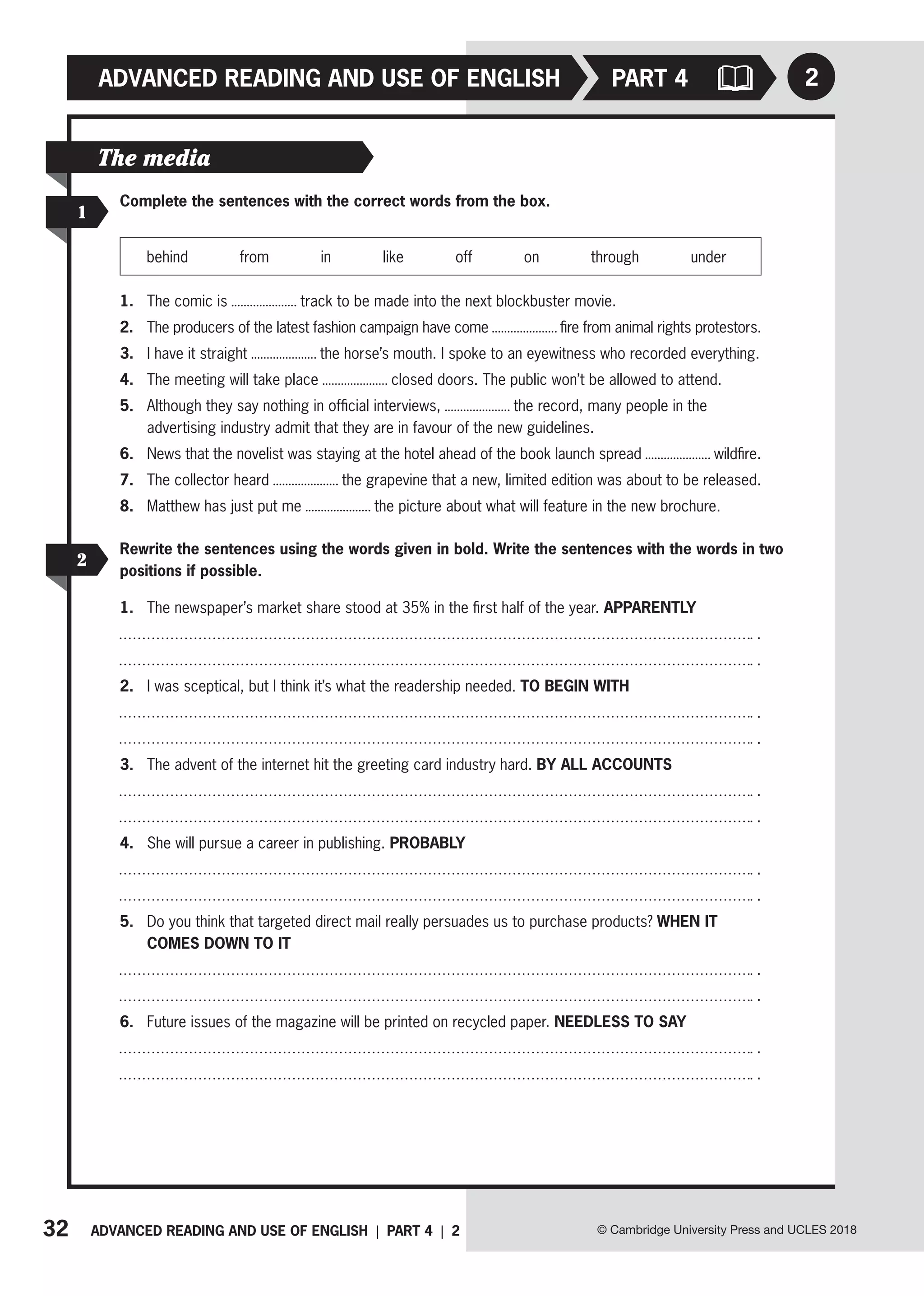
Complete the sentences with the correct words from the box.
behind from in like off on through under
1. The comic is track to be made into the next blockbuster movie.
2. The producers of the latest fashion campaign have come fire from animal rights protestors.
3. I have it straight the horse’s mouth. I spoke to an eyewitness who recorded everything.
4. The meeting will take place closed doors. The public won’t be allowed to attend.
5. Although they say nothing in official interviews, the record, many people in the
advertising industry admit that they are in favour of the new guidelines.
6. News that the novelist was staying at the hotel ahead of the book launch spread wildfire.
7. The collector heard the grapevine that a new, limited edition was about to be released.
8. Matthew has just put me the picture about what will feature in the new brochure.
The media
2
Rewrite the sentences using the words given in bold. Write the sentences with the words in two
positions if possible.
1. The newspaper’s market share stood at 35% in the first half of the year. APPARENTLY
.
.
2. I was sceptical, but I think it’s what the readership needed. TO BEGIN WITH
.
.
3. The advent of the internet hit the greeting card industry hard. BY ALL ACCOUNTS
.
.
4. She will pursue a career in publishing. PROBABLY
.
.
5. Do you think that targeted direct mail really persuades us to purchase products? WHEN IT
COMES DOWN TO IT
.
.
6. Future issues of the magazine will be printed on recycled paper. NEEDLESS TO SAY
.
.
33
ADVANCED READING AND USE OF ENGLISH | PART 4 | 2
© Cambridge University Press and UCLES 2018
Exam task
3
For questions 1–6, complete the second sentence
so that it has a similar meaning to the first sentence,
using the word given. Do not change the word given.
You must use between three and six words, including
the word given. Here is an example (0).
Example:
0 The press officer worked secretly on the campaign.
SCENES
The press officer worked behind the scenes on the campaign.
1. John reads what’s happening in the world on his commute to work.
DATE
John the news on his commute to work.
2. Without that promotional campaign, sales would never have been so high.
FOR
If that promotional campaign, sales would have been lower.
3. When it comes down to it, it’s not worth the money.
AMOUNTS
What it is too expensive.
4. Suddenly, the novelist became successful.
BLUE
Success for the novelist.
5. I think you may be right about that the whole story being a hoax.
INCLINED
I’m that the whole story is a hoax.
6. The organisers were not happy with the way the press covered the event.
ISSUE
The organisers of the event.
• Keep your focus on the key word in your answer and don’t change it in any way.
• You can use the other words in the first sentence to form the answer.
• Make sure the last word of your new phrase works with the parts of the sentence given at the
beginning and end.
Exam tips
34 ADVANCED READING AND USE OF ENGLISH | PART 4 | 3
ADVANCED READING AND USE OF ENGLISH
© Cambridge University Press and UCLES 2018
3
PART 4
1
2
The environment
Complete each sentence with the correct expression from the
box. Change the form of the verb where necessary.
brush up on   come up against   do away with   fit in with
get through to   stand up to   stay away from
1. The volunteer needed to her
Swahili before joining the fieldwork project.
2. The use of drones has the need for rescuers to risk their lives
searching treacherous mountain ranges.
3. The decision to make the area into a nature reserve is ideal because it
perfectly the conservation project.
4. Skiers have been warned to the area because of the risk of avalanches.
5. We need to the decision makers just how serious this problem is.
6. The area manages to pressure from ruthless developers and
preserve its roots.
7. The campaign organisers have tremendous problems and the
project has now been set back by several months.
Look at the sentences then rewrite each of these sentences beginning with What and It’s/It
was. You may need to add words.
1. The volcanic eruption forced the evacuation of hundreds of residents and the closure of the airport.
What
It was
2. The destruction of natural habitats causes animals to be added to the list of endangered species.
What
It’s
3. The public response to large-scale disasters never ceases to amaze me.
What
It’s
4. The ongoing drought has led to a ban on hose pipes for the foreseeable future.
What
It’s
5. The roads were flooded after the torrential rain and the rivers burst their banks.
What
It was
6. More severe measures are needed to tackle the issue of global warming.
What
It’s
35
ADVANCED READING AND USE OF ENGLISH | PART 4 | 3
© Cambridge University Press and UCLES 2018
Exam task
3
For questions 1–6, complete the second sentence so that it has a similar meaning to the first
sentence, using the word given. Do not change the word given. You must use between three
and six words, including the word given. Here is an example (0).
Example:
0 Some experts query the introduction of water restrictions during droughts.
SCEPTICAL
Some experts are sceptical about introducing water restrictions during droughts.
1. Before last Friday, representatives had not been able to reach an agreement.
UNTIL
It wasn’t able to reach an agreement.
2. The environmentalist supported his claims with scientific evidence.
BACKED
The environmentalist’s with scientific evidence.
3. If nothing is done to combat climate change, one tenth of the area will soon be under water.
STEPS
One tenth of the area will soon be underwater counteract climate
change.
4. I was totally amazed at how spectacularly beautiful the coastline was.
UTTERLY
What I found beauty of the coastline.
5. As long as you explain your proposal clearly, they will agree.
ACROSS
If , they will agree.
6. Solar panels and wind turbines are far more commonplace now.
SIGHT
Solar panels and wind turbines used to before.
Look at the sentence below. Then try to correct the mistake.
I was very excited and I was looking forward for their arrival.
Get it right!
36 ADVANCED READING AND USE OF ENGLISH | PART 5 | 1
ADVANCED READING AND USE OF ENGLISH
© Cambridge University Press and UCLES 2018
1
PART 5
Exam task
1
You are going to read a review of a book about sport and philosophy. For questions 1–6,
choose the answer (A, B, C or D) which you think fits best according to the text.
Knowing the score
Health and sport
William Skidelsky reviews David Papineau’s new
book, in which sport meets philosophy.
David Papineau is an eminent philosopher and a
passionate lover of sport. For much of his life, he has
kept the two spheres separate, fearing that to mix
them would produce a double negative in his readers’
appreciation of his work: philosophy robbed of its
seriousness and sport of its excitement. Then, in 2012,
a colleague invited him to contribute to a lecture series
titled ‘Philosophy and Sport’, organised to coincide with
that year’s Olympics. ‘I couldn’t really refuse’, Papineau
recalls. ‘I had an extensive knowledge of both philosophy
and sport. If I wasn’t going to say yes, who would?’
For his topic, he chose the role of conscious thought
in fast-reaction sports, such as tennis, cricket and
baseball. How, he wondered, do top tennis players like
Rafael Nadal and Serena Williams use anything other
than ‘automatic reflexes’ in the half-second (or less)
they have to return their opponent’s serve? How do they
choose to hit the ball this way or that, to apply topspin
or slice? Thinking about this not only proved ‘great
fun’, but allowed Papineau to come away with a series
of ‘substantial philosophical conclusions’ about the
relationship between intentions and action.
After this, the floodgates were open. Having breached
his self-imposed division, Papineau set about applying his
philosopher’s brain to a range of other sporting topics.
Five years on, those inquiries have resulted in a book,
Knowing the Score. This is essentially a collection of
essays on whatever sporting questions happen to interest
its author. It isn’t comprehensive, nor does it advance an
overarching argument. The tone – informal, anecdotal,
contrarian – is more popular philosophy than academic.
What unifies the book is the consistency of its approach
rather than of its content: he isn’t interested only in
applying philosophical ideas and principles to sport.
More importantly – and more originally – he wants to use
arguments about sport as a launching pad into philosophy.
A good example comes in a chapter dealing with rule-
breaking, in which Papineau sets off with a sporting
example in order to draw parallels with broader
contexts. He points out that what is acceptable in sport
isn’t defined by the rules alone. Sometimes it’s usual
to ignore them – as footballers do when they pull on
opponents’ shirts as the ball flies towards them. Other
actions stem from a sense of fair play – such as halting
the game when an opponent is lying injured – rather than
arising directly from rules. Rules are just one constraint
on behaviour; all sports also have codes of fair play,
which operate alongside the rules, and which, in some
cases, override them. Complicating matters further is
the fact that official authority ultimately has a force that
is greater than both. Whatever a sport’s rules or codes
specify, the referee or ruling body’s decision is final.
Papineau argues that there’s a ‘remarkably close’
analogy between sport’s multi-level structure and the
factors that constrain us in ordinary life. In sport, you can
ignore the rules and still play fairly, or obey the law while
being thought a cheat; similarly, in a society, citizens
can break the law and still do the right thing, or comply
with the law yet still indulge in objectionable behaviour.
A sport’s codes aren’t the same as its rules; likewise,
in life, we draw a distinction between virtue and legal
compliance. Papineau argues that we have no general
obligation to obey the law; only to do what we think is
right. Yet, saying that we’re not obliged to obey the law
isn’t the same as saying that we don’t have a duty to
respect the state’s authority. If people didn’t accept that
police officers are generally entitled to tell them what
to do, society might descend into chaos. Likewise, if
footballers stopped listening when referees blow their
whistles, the game would become a free-for-all.
Knowing the Score covers an impressive amount of
ground. At a time when data analysis dominates ‘serious’
discussion of sport, Papineau’s faith in the power of
anecdote and reasoning is refreshing. The author at
times gives the impression of being the sort of person
who knows he’s the cleverest in the room. For the most
part, however, he barely puts a foot wrong in what is a
blinder of a performance.
37
ADVANCED READING AND USE OF ENGLISH | PART 5 | 1
© Cambridge University Press and UCLES 2018
1. In the first paragraph, the reviewer suggests that
Papineau
A 	
was in two minds whether to take on the lectures
on sport and philosophy.
B 	
thought no one was better qualified than him to
combine sport and philosophy.
C 	
was disappointed with previous attempts to unite
sport and philosophy.
D 	
thought that philosophy was of greater value to
people’s lives than sport.
2. What does the reviewer say Papineau gained through
delivering his lecture series?
A 	
knowledge of how ‘automatic reflexes’ suppress
conscious thought in many situations
B 	
insight into the steps involved when sports stars
have to make choices under pressure
C 	
understanding of the connections between
people’s aims and what they subsequently do
D 	
awareness of why sports stars’ reactions are
superior to those of ordinary people
3. What point is made about Papineau’s book in the third
paragraph?
A 	
It examines previously overlooked aspects of
sport.
B 	
Its style is inappropriate for the subject matter.
C 	
It doesn’t convincingly link sport and philosophy.
D 	
The areas of sport that it covers are very diverse.
4. What does the reviewer suggest in the fourth
paragraph?
A 	
Breaking rules should be punished more
consistently by those in power.
B 	
Rules play only a partial role in defining what is
appropriate or inappropriate.
C 	
Many sportsmen and women abuse situations
which lack a clear set of rules.
D 	
Codes of fair play carry more weight with sports
stars than official rules.
5. In the fifth paragraph, the reviewer draws a
comparison between behaviour in sport and
A 	
a broad system of morality in society.
B 	
a deep respect for authority in society.
C 	
people’s tolerance of unreasonable laws.
D	
society’s attitudes towards rule-breakers.
6. In the final paragraph, the reviewer says that Papineau
A	
uses too lightweight an approach to deal with
philosophical issues.
B	
relies overly on insignificant detail to support
his opinions.
C	
comes across as somewhat arrogant in various
parts of the book.
D	
chooses some poor examples to illustrate points
he’s making.
• In this part, you read a long text.
• You have to choose the correct answer (A, B, C or D) for six questions.
Exam facts
© Cambridge University Press and UCLES 2016
2
Choose the correct alternative to complete these sentences.
1. He started his talk by point / to point / pointing out that he had worked as a professional coach.
2. To avoid / Avoid / Avoiding injury throughout a whole career is, of course, impossible.
3. After a few years in the game, players really ought know / to know / knowing what is acceptable
behaviour and what is not.
4. The team are so far ahead in the league that they really need not worry / to worry / worrying about
today’s result.
5. When join / to join / joining a new club, players always undergo a thorough medical examination.
6. Everybody was really looking forward watching / to watch / to watching the match.
7. If you look on the internet, you’re bound find / to find / to finding a club near where you live.
8. Their manager didn’t seem to mind me ask / to ask / asking him about his team’s poor result.
38 ADVANCED READING AND USE OF ENGLISH | PART 5 | 2
ADVANCED READING AND USE OF ENGLISH
© Cambridge University Press and UCLES 2018
2
PART 5
Exam task
1
You are going to read an article about solving traffic problems in cities. For questions 1–6
choose the answer (A, B, C or D) which you think fits best according to the text.
Reclaiming our city streets
Cities and transport
How two experiments could help urban dwellers
reclaim their streets from traffic.
Many city-dwellers around the world face a dilemma:
despite living a relatively short distance from local
shops and services, a wide dual-carriageway has to
be negotiated in order to get there. Whilst this poses
few problems for the vast majority of people, there are
those who can only make it as far as half way with each
push of the pedestrian crossing button. Running out of
milk has significant consequences.
In the Dutch city of Tilburg, ten people have been taking
part in a trial of Crosswalk, a smartphone app that gives
pedestrians with limited mobility extra crossing time.
This ground-breaking experiment enables participants to
cross the road in one go, without needing to dodge cars.
A sensor in the traffic lights is constantly on the lookout for
anyone with Crosswalk on their phone. It scans both sides
of the road and adjusts the crossing time automatically,
once a pedestrian carrying the app has been detected.
Each user triggers a specific time which is pre-installed
onto their phone and varies according to their level of
mobility. In this way, delays to traffic are also minimised.
The app works in combination with GPS and the software
that operates the traffic lights, thus getting around the
need to install further devices to control the system.
The pilot project is part of a 25-year plan to make Tilburg’s
road network more pedestrian and cycle-friendly. Another
system under development there senses when bikes are
approaching a junction and changes the lights sooner than
it otherwise would, thereby giving cyclists priority over
motorists. A logical extension of this technology could
trigger lights to green to let ambulance or fire crews pass
through. Smart traffic lights can also have environmental
benefits, for example, by giving lorries a clear run through
urban areas and reducing the frequency with which they
have to stop and start, they thereby reduce emissions,
noise pollution and damage to road surfaces. All of this
seems a far cry from the majority of urban centres.
The applications of the technology are virtually limitless and
could form a major weapon in the battle to recapture city
streets worldwide from motor vehicles and reduce pollution.
To put this into context, in Barcelona, which is anything but
large relative to many modern urban sprawls, air pollution
is estimated to cause around 3,500 premature deaths
per year out of a population of 1.6 million. Additionally,
it is responsible for severe effects on ecosystems and
agriculture. Traffic, which is the major contributor to
this problem, also causes noise pollution beyond levels
considered healthy. Scaling this bleak picture up for larger
metropolitan areas could be bad for your health!
The World Health Organisation recommends that every
city should have a minimum of 9 m2
of green space per
resident. While some places come out well relative to this
figure (London scores an impressive 27, and Amsterdam
an incredible 87.5), many do not. Tokyo currently has
around 3 m2
per person, and is far from alone in providing
insufficient ‘lungs’ for its population. Picture the effect
on these figures of banning traffic from the majority of a
city’s streets and allowing these roads to be converted
into community areas, such as parks and pedestrian
zones. Such a system, known as ‘superblocks’, is rapidly
gaining support in many of the world’s urban centres.
The idea has at its heart the notion that streets belong to
people and not cars. Roads are repurposed within an area
known as a superblock, leaving only the streets around
the perimeter accessible to vehicles. Taking up less
space than a neighbourhood, but larger than the blocks
in many cities, their design ensures that no one would
ever be more than 300 m from a road. This may mean
sacrificing the parking spaces assigned to properties
within them, but that’s a small price to pay. By increasing
the frequency of bus stops on the surrounding streets
and applying smart traffic management technology as
used in Tilburg, it would be possible to make public
transport more effective despite having significantly fewer
vehicle-accessible roads. This could be paired with a new
system of cycling lanes in the areas off-limits to traffic.
Given that the majority of the world’s population now lives
in an urban environment, imagine the number of people
who would benefit from this combination of ideas.
line 39
39
ADVANCED READING AND USE OF ENGLISH | PART 5 | 2
© Cambridge University Press and UCLES 2018
1. In paragraph 1, the writer is
A offering an opinion about city life.
B exemplifying one aspect of city life.
C	
giving a reason why city life can be
expensive.
D	
suggesting city life is hard for most people.
2. In the second paragraph, we learn that Crosswalk
A detects the presence of vehicles.
B can be programmed by its users.
C has been relatively easy to set up.
D is being trialled on one major road.
3. What is the writer emphasising in the sentence
‘All of this seems a far cry from the majority of
urban centres’ in line 39?
A	
the contrast between aims and the
current reality.
B how upsetting living in some cities can be.
C	
how advanced technology is in certain
regions.
D	
the technological changes happening
worldwide.
4. What point does the writer make in the fourth
paragraph?
A	
Smaller cities have relatively high levels of
pollution.
B	
Having farms near cities decreases
harmful pollution.
C	
Problems caused by pollution multiply with
city size.
D	
Embracing technology eases harmful
pollution levels.
5. What does the writer suggest about green
spaces in the fifth paragraph?
A	
Most cities exceed international green
space guidelines.
B	
Modern cities have fewer green spaces
than old ones.
C	
Much urban green space worldwide has
disappeared.
D	
Many city authorities should change their
green space policy.
6. According to the writer, all of the following
people would benefit from the introduction of
superblocks except
A bus users.
B residents.
C cyclists.
D pedestrians.
• Skim the text before answering the questions to get an idea of what it’s about.
• When trying to identify the correct answers, try to rule out the wrong answers too.
Exam tips
2
In a notebook, rewrite the sentences using the passive form of the verbs so they have the same
meaning as the first sentence. The number after the sentence tells you how many verbs you
need to change.
1. The bus company is considering proposals to increase the number of bus routes. (1)
2. People say that it’s the most cosmopolitan city on the planet. (1)
3. They told the mayor that he should create more parks. (2)
4. The city authorities will publish the results of the poll after they have counted the votes. (2)
5. They said that they couldn’t do anything until they had cleared the rubbish away. (2)
6. Vandals damaged the shopping centre after they had broken into it. (2)
7. The police arrested a man after they had stopped him for driving too fast. (2)
8. Mrs Evans has asked me to inform you that she has cancelled the next residents’ meeting. (2)
40 ADVANCED READING AND USE OF ENGLISH | PART 5 | 3
ADVANCED READING AND USE OF ENGLISH
© Cambridge University Press and UCLES 2018
3
PART 5
Exam task
1
You are going to read an article about using video games in education. For questions 1–6
choose the answer (A, B, C or D) which you think fits best according to the text.
Using video gaming in education
Technology in schools
It has become conventional wisdom that spending too
much time playing video games has a detrimental effect
on children’s studies and their social development.
However, some educationalists are now questioning
this theory and are using video games as effective
educational tools thus bridging the gap between
recreational and educational activities.
Due to the sophisticated nature of today’s games,
teachers are able to justify the inclusion of video and
online games for many pedagogical reasons. There may,
for example, be sociological, psychological, and ethical
implications built into the gameplay. Harvey Edwards, who
teaches IT classes in London, was one such educator
who decided to use video games in his lessons. To do
this, he chose Minecraft, an online game in which players
create and develop imaginary worlds. He was somewhat
uneasy about attempting such an unconventional
approach, not because of some students’ unfamiliarity
with the game but rather due to them not being able
to make sense of what he was trying to do with it. He
worried that it might interfere with his learners’ focus, but
he couldn’t have been more surprised by the results.
Minecraft is an example of a ‘sandbox game’, in which
gamers roam around and change a virtual world at will.
Instead of having to pass through numbered levels to reach
certain places, there’s full access from start to finish. The
original version can be adapted to control which characters
and content are left in. Each student can then be allocated
tasks – such as house-building, locating items or problem-
solving – which they must complete within the game.
Elements of more general skills can be subtly incorporated
into the lessons, such as online politeness and safety,
teamwork and resolving differences. Edwards feels that
presenting such lessons in the context of a game students
probably already know and enjoy enables him to connect
with them at greater depth, and in more motivational ways.
Bolstered by his success, Edwards introduced his approach
to another school nearby. He recalls that the first couple
of sessions didn’t live up to his expectations. Those who
had played Minecraft before were keen for others to adopt
their own style of play. Unsurprisingly, this assortment of
styles and opinions as to how the game should proceed
were far from harmonious. However, the sessions rapidly
transformed into something more cohesive, with the
learners driving the change. With minimal teacher input,
they set about choosing leaders and established several
teams, each with its own clearly-defined role. These teams,
now party to clear common goals, willingly cooperated
to ensure that their newborn world flourished, even when
faced with the toughest of challenges.
‘Human’ inhabitants in a Minecraft ‘society’ are very
primitive and wander around the imaginary world,
waiting for guidance from players. This dynamic bears
a resemblance to traditional education, an observation
highlighted by Martina Williams, one of the leaders of the
group. ‘Through the game, we were no longer passive
learners in the classroom, being told what and how to
learn, but active participants in our own society.’ Each
group member had ideas as to how their function should
develop. The leaders, meanwhile, had a vision for their
virtual world as a whole, encouraging everyone to play their
part in achieving the group’s goals. Through creating their
own characters and using these to build their own ‘world’,
students will have gained some experiential understanding
of societal structure and how communities work.
But not everyone is convinced by video games’ potential
academic value. While many progressive commentators
cite extensive evidence to maintain that video games
encourage collaboration and build problem-solving
skills, more traditional factions continue to insist they
are a distraction that do not merit inclusion in any
curriculum. Even less evangelical cynics, who may
grudgingly acknowledge games have some educational
benefit, assert that this is only the case in the hands
of creative educators. However, the accusation most
often levelled at video games is that they detract from
the social aspect of the classroom, particularly taking
part in discussions. Dr Helen Conway, an educational
researcher, argues that video games can be used to
promote social activities. ‘Students become animated
talking about the game and how to improve their game-
playing and problem-solving skills,’ she says. ‘I find it
strange, this image that many people have,’ Conway
says. ‘Children are often totally detached from their
peers when undertaking more traditional activities, like
reading books, but we never suggest that books are
harmful because they’re a solitary experience.’
41
ADVANCED READING AND USE OF ENGLISH | PART 5 | 3
© Cambridge University Press and UCLES 2018
1. The first time Edwards used a game in his
classes, he was
A	
convinced that learners would realise why
he wanted them to play it.
B	
convinced that learners would see the
reasons for playing it.
C	
anxious that he had chosen the wrong one
for learners to play.
D	
sure that his reasons for getting learners
to play it were valid.
2. The writer suggests that Minecraft is a good
choice of educational game because
A	
any number of learners can use it
simultaneously.
B	
teachers can remove any inappropriate
material.
C	
gamers can create educative tasks whilst
playing it.
D	
players can develop their skills in a step-by-
step way.
3. Which of the following words in the fourth
paragraph is used to convey a feeling of approval?
A keen
B harmonious
C driving
D newborn
4. In the fifth paragraph, the writer draws a
comparison between a Minecraft ‘society’ and
A	
relationships within the group as they
played.
B	
the way in which countries organise
themselves.
C typical students in a school environment.
D	
how leadership operates in different
situations.
5. In the sixth paragraph, the writer feels that
critics of video games in education
A	
are unwilling to admit that using them in
class has benefits.
B	
make accurate observations about
teachers who use them.
C	
use flawed research to support their
objections to using them.
D	
acknowledge the drawbacks of more
traditional teaching methods.
6. The words ‘this image’ in the sixth paragraph
refer to
A people who criticise gaming in education.
B students discussing a game in a group.
C a group of students reading individually.
D a solitary player absorbed in a game.
2
Complete the sentences with the correct perfect tense form of the verb in brackets.
1. The video game more money than any other game in history. (make)
2. The company estimates that it more than 200,000 laptops by the end of this
year. (sell)
3. The students told the teacher that they Minecraft many times before. (play)
4. We this topic for about four weeks now, and I find it really
interesting. (study)
5. I so many different computers over the last five years, but this one is the best. (try)
6. He music files for about ten minutes when his computer crashed.
(download)
7. Tony a lot of positive feedback about the new smart phone, so decided to buy it. (read)
8. At this rate, the lesson before we this software
working properly. (finish, get)
Look at the sentence below. Then try to correct the mistake.
Dear Alex, I am happy to receive a letter from you.
Get it right!
42 ADVANCED READING AND USE OF ENGLISH | PART 6 | 1
ADVANCED READING AND USE OF ENGLISH
© Cambridge University Press and UCLES 2018
1
PART 6
Work and business
Exam task
1
You are going to read four extracts from articles in which experts give their views on progress
and tradition. For questions 1–4, choose from the experts A–D. The experts may be chosen
more than once.
Which expert
expresses a different view to the others about how rapid progress has affected people’s
happiness?
expresses a similar view to B about the impact of rapid progress on economic prosperity?
has a different view to the others about the effect of rapid progress on working life?
expresses a different view to C about the rise in the age at which couples have children?
1
2
3
4
A Aloza Henry
A modern mythology has developed about
traditional customs holding up the financial evolution
of a country; it suggests that shedding them will
somehow prove liberating. There’s as much truth
in this as in most legends. This is in contrast to the
fears that many commentators raise about certain
patterns closer to home, such as the average
parental age for starting a family. Considering that
seeking to establish a career has gained priority
over committing to parenthood, I’m beginning to
wonder whether our ancestors had it right. No one
has ever satisfactorily explained the reason to me
as to why the balance between work and home life
has shifted so far towards the former. It stands to
reason, however, that those who love their jobs will
be more than content with this situation. On the
other hand, as the majority of our workforce don’t
share this luxury, there can only be one outcome in
terms of the population’s degree of contentment.
B Guillermo Alvarez
There are countless surveys carried out worldwide
every year which monitor the satisfaction levels
of different populations, and the majority of these
consistently demonstrate an upward trend. I can’t
help but think that there’s a strong correlation
between these figures and the increasing levels of
prosperity that most nations, and the individuals
within them, have experienced. This has come
about through rapid development, which has
inevitably meant sacrificing some old, well-loved
ways of doing things. I’m not sure many people
mourn the loss of the repetitive jobs of yesteryear,
but the shorter hours that went alongside them
have clearly been consigned to history. As people
are generally putting off starting a family far more
than in previous generations, this will bring them the
kind of maturity that will help to make what is a very
challenging few years more fruitful as their offspring
develop and grow.
C Kasper Voss
Whilst the average employee these days probably
rues the direction in which the length of their week
is going, I’d be surprised if they felt the same way
about its mundanity. Factory work has become
increasingly mechanised, leading to an expansion in
more gratifying work. Given that there are also far
more diverting leisure activities to occupy us these
days, it’s little wonder that there’s a tangibly more light-
hearted mood than 30 years ago. As with all changes,
there are inevitably losers as well as winners, and I’m
far from convinced that having close to middle-aged
The world we live in is changing fast – but is this a good thing?
43
ADVANCED READING AND USE OF ENGLISH | PART 6 | 1
© Cambridge University Press and UCLES 2018
Choose the correct alternative to complete the sentences, a or b.
1. He gave
a to his employees some advice. b his employees some advice.
2. Can you please explain
a this theory on development to the class? b the class this theory on development?
3. I’d like you to write
a to me a letter explaining the changes. b me a letter explaining the changes.
4. The professor asked
a the students their opinions on the trend. b to the students their opinions on the trend.
5. She described
a for him her family background. b her family background to him.
6. He took
a the report Mrs Green once it was finished. b Mrs Green the report once it was finished.
7. The teacher asked his colleague to
a leave him the book when she went. b leave the book to him when she went.
8. The company decided to offer
a staff an extra three days’ holiday. b to staff an extra three days’ holiday.
2
• In this part, you read four texts giving different opinions on a topic.
• You must read all the texts to be able to match questions summarising opinions to the texts.
Exam facts
© Cambridge University Press and UCLES 2016
parents is going to stand the newest generation in
good stead. That said, by the time the first child
arrives, both mother and father are generally some
way up the career ladder. This is one example of the
many ways in which swift development has contributed
to the enhancement of many nations’ wealth.
D Zhang Wei
The rapid progress we’ve seen over the last few
decades has been interesting to live through.
Despite some notable clouds on the horizon, it
has been an era which we have ended in a more
comfortable and optimistic frame of mind than
when we started. Most full-time employees’ hours
are gradually being reduced as some of what
has frankly been an over-stretched and untenable
workload is taken over by the rapidly increasing
cohort of part-time staff. It’s extremely hard to
judge whether the financial situation has improved
over that time for a majority of the world’s
population. What clouds the issue more than
anything is the astonishing rise in the number of
people on the planet. I’ve yet to be persuaded that
the recent rise in starting a family later in life will
spread sufficiently to control this. It’s my view that
starting a family when in your forties goes one step
too far against nature.
44 ADVANCED READING AND USE OF ENGLISH | PART 6 | 2
ADVANCED READING AND USE OF ENGLISH
© Cambridge University Press and UCLES 2018
2
PART 6
The environment
Exam task
1
You are going to read four extracts from articles in which experts give their views on banning
single-use plastic products such as shopping bags and drinks bottles. For questions 1–4,
choose from the experts A–D. The experts may be chosen more than once.
Which expert
shares B’s views regarding how easy it would be to implement any ban or restrictions?
has a different view to the others about adding charges to the prices of single-use
plastic products?
shares A’s views on the environmental impact of imposing a ban?
expresses a different view to D about the economic effects of introducing a ban?
A Doran Yusef
There has been little debate as to whether it actually
makes ecological sense to ban single-use plastic
products. I find this troublesome, given that the paper
and glass, which would presumably replace the plastic
used in bags and bottles respectively, use more energy
than plastic in their production, therefore contributing
more to global warming. Changing the material that these
products are created from will have minimal financial
impact, as income and employment losses in plastics
and packaging would be absorbed into the manufacturing
of whichever material takes its place. Costs imposed on
consumers at the point of sale for plastic bags have been
highly successful in reducing how many are used, so now
is the moment to enforce these on other items packaged
in disposable plastic. Any outright ban may be challenging
to police and would have to be instigated gradually, in
order to make it workable.
B Hideko Suzuki
Customers have little or no direct control over what
packaging a company sells its products in. It’s therefore
unfair to inflict additional expenses on buyers for decisions
made by the producer. Along similar lines, if shops want
to sell their goods, they should provide and pay for the
means of carrying it home. I think the financial implications
of a ban on the products are more far-reaching than
anyone has predicted. You can’t just remove an entire
industry from a nation and expect no repercussions.
What’s driving the call for a ban, of course, are the
catastrophic consequences to the planet of avoiding this
issue. I wholeheartedly go along with the view that it needs
to be addressed, but perhaps not so quickly that we end
up creating more problems than we solve. These sorts of
transitions take time, especially as the regulation of such a
ban is likely to be extraordinarily complex.
C Radislav Kovac
The majority of those calling for stopping short of
a ban on throwaway plastics claim that it would be
absurdly complicated to introduce and supervise. I
would beg to differ. Is it really such an effort to visit
a supermarket to see which manufacturers still use
plastic packaging, and whether customers are being
provided with plastic bags? There’s no reason why
they should be, as schemes worldwide whereby
customers pay for these have been immensely
effective and should now encompass other single-
use products. Having said that, although plastic is
undoubtedly a major pollutant, it would be wrong to
completely ignore the likely impact of producing other
more energy-intensive materials that might replace it.
However, I believe these would be the lesser of two
evils. Also, although the focus has largely been on
packaging and bags, there needs to be a widening
of the net to include other everyday items like
drinking straws.
D Joanna Muller
Even though sustainable industries are relatively
new, there are already sufficient examples where
any reductions in revenue caused by the termination
of a more traditional product are in effect cancelled
out by the success of its replacement. That said,
imposing an immediate ban on plastic bags may well
be a step too far especially if it were too sudden
for consumers to cope with. However, I’m all for an
obligatory raising of prices worldwide for products
sold in environmentally-unfriendly packaging, in
effect an extension of the highly fruitful policy of
making plastic bags prohibitively expensive. This
pricing strategy has been generally straightforward
to monitor and oversee, as spot checks on retailers
can quickly establish whether or not any legislation
is being followed. Another case for gradually
implementing controls is that replacing plastics,
which create physical pollution, with materials that
produce excessive harmful emissions during their
manufacture doesn’t currently make sense. Greener
alternatives need to be found.
Banning single-use plastic products
1
2
3
4
45
ADVANCED READING AND USE OF ENGLISH | PART 6 | 2
© Cambridge University Press and UCLES 2018
2
Complete the sentences with the correct words from the box. You can use words more
than once.
as enough result so such too therefore
1. Plastic products can be produced cheaply that shops don’t usually charge for plastic bags.
2. Some tourists get a shock seeing just how much plastic there is in the sea that they start
to clean it up.
3. It was soon to know whether the new legislation limiting sale of plastic products had been
successful.
4. It’s unfortunately easy to foresee what will happen if we continue producing plastic
products at the same rate as today.
5. The shop started charging a dollar for a plastic bag and, a , 99% of customers
started to bring their own bags.
6. We have a rapidly increasing world population and we need more food to feed us all.
7. In many places, the ecological situation is changing quickly even for many of our most
esteemed scientists to keep up.
8. We need to demonstrate patience when seeking environmental change, as many
organisations and individuals are still resistant to it.
• For each question, look at the topic and quickly find the opinions of all of the writers on it before
you answer. Writers may not offer an opinion on every topic.
• Once you have located the writer’s opinion about a topic, read it in detail and watch out for traps
such as double negatives (which make a positive in English!).
Exam tips
46 ADVANCED READING AND USE OF ENGLISH | PART 6 | 3
ADVANCED READING AND USE OF ENGLISH
© Cambridge University Press and UCLES 2018
3
PART 6
Behaviour
Exam task
1
You are going to read four extracts from articles in which academics give their views on
behaviour in schools. For questions 1–4, choose from the academic A–D. The academics may
be chosen more than once.
Which academic
has a different view to the others about the historical trends in student behaviour?
expresses a similar view to B about what should be done to improve student behaviour?
expresses a different view to A on the broader social consequences of poor
student behaviour?
has a similar view to B about the effect of behavioural issues on student achievement?
A Dorota Ignatieff
Student behaviour in schools is a topic that
many people are anxious about these days,
and rightly so. Recent surveys amongst
teachers have given me most cause for
concern, especially the reflections of those
who have been teaching ten years or more
who report a deterioration in standards of
behaviour. Although there’s no evidence as
yet of a concurrent increase in antisocial
activities outside of school among the age
group, I suspect we may see this emerge in
years to come. Despite this, concern about
pupils’ results seems to be largely unfounded,
as there has been a gradual improvement in
academic results over the last 20 years or so.
This is quite some attainment given that, over
the same period, funding for schools has fallen
in real terms. This shortfall is the underlying
cause of poor conduct, as support for more
disruptive students has been eroded, and
therefore is what those in power need to rectify.
B Sunil Kumble
Student behaviour has been an issue for
as long as schools have been in existence.
Teachers have more influence over their
students than anyone, so clearly filling the
apparent gap in their training would achieve
more than any government minister could. The
usual hysterical media coverage has made
it more or less impossible to ascertain the
actual extent of any fluctuation in standards
of student conduct, and indeed even to know
which direction it has taken over time. What
we can be sure of is that, in schools where
behaviour is an issue, levels of attainment for
learners from better-off families have fared
well, while their poorer counterparts have once
again lost out. It remains to be seen whether
this will lead to problems in the wider world.
Indicators such as petty crime levels are
currently stable, but I’d anticipate a sharp rise
if this is as big an issue as many suggest.
C Ruth Iveson
Some of the means by which it used to be
achieved in the past may not be particularly
palatable today, but there’s little doubt that
over two generations, respect for authority
in schools and associated standards of
behaviour has suffered a steep decline. The
root of the problem sits squarely on the
shoulders of those who deal with students
on a day-to-day basis. Qualifications for
educators clearly haven’t kept pace with the
speed at which life in schools is changing,
so this needs addressing. Although official
figures show a steady fall in problems such as
graffiti and vandalism, I believe the reverse to
be true. They’ve become such commonplace
occurrences now that they’re seldom reported,
and I can’t help but feel that this is not
unconnected to people becoming increasingly
tolerant of disrespect in schools. Clearly this
would also explain the decline in success rates
that’s starting to emerge. Students appear to
have lost their focus on learning.
Behaviour in schools
1
2
3
4
47
ADVANCED READING AND USE OF ENGLISH | PART 6 | 3
© Cambridge University Press and UCLES 2018
2
Complete the sentences with an adjective and preposition. Use one word from each box.
astonished capable famous furious involved keen opposed worried
about by for in of on to with
1. Only a handful of schools are truly their excellent standards of behaviour
and achievement.
2. Many school pupils are much better behaviour than they actually display.
3. If students feel that they are making decisions that affect their lives at
the school, behaviour generally improves.
4. Many people are school uniforms, but others believe they improve
standards of behaviour.
5. There’s no need to be behaviour in schools – it’s no worse than
50 years ago.
6. The parents were their daughter for always forgetting to pass on
important messages to them from her teacher.
7. The school inspectors were the improvement in behaviour since their last
visit and couldn’t believe how much progress had been made.
8. The head teacher was very pointing out to anyone who would listen the
link between bad behaviour in schools and academic achievement.
Look at the sentence below. Then try to correct the mistake.
The further education sector is much bigger as opposed to the university sector in the UK.
Get it right!
D Joao Rodrigues
When one analyses school results these days,
it’s always a good idea to dig a little deeper
than perhaps schools or the government
would want. On the surface, all appears to be
well, as overall pass rates continue to rise.
Nevertheless, the breakdown for how different
social classes perform shows the opposite to
be true for less affluent students. Behavioural
difficulties in schools are evident in students
from every strata of society, but clearly
they affect this group more than others.
Therefore, financial assistance needs to be
made available for schools to better support
these vulnerable learners and to help them
eradicate the underlying problem. Schools
simply don’t have the resources to do this
these days. I think it’s no coincidence that, as
government provision has declined, levels of
misconduct have done the contrary. Teachers
are generally devoted to their students yet
unfairly receive much of the blame when their
charges misbehave.
48 ADVANCED READING AND USE OF ENGLISH | PART 7 | 1
ADVANCED READING AND USE OF ENGLISH
© Cambridge University Press and UCLES 2018
1
PART 7
Business and consumers
Exam task
1
You are going to read a magazine article about green businesses. Six paragraphs have been
removed from the article. Choose from the paragraphs A–G the one which fits each gap (1–6).
There is one extra paragraph which you do not need to use.
Making profits from sustainable industry
Green companies have succeeded in doing what few
thought possible – making sustainability profitable.
Over the nine years I’ve spent trying to persuade
business leaders to embrace sustainability, the question
I’ve most often been asked is, ‘What’s the business case
for sustainability?’ This question is always delivered in
a sceptical tone, carrying the unspoken suggestion
that there is no business case, or at least not a very
compelling one. And, for those nine years, I’d always
wished I had a better answer.
1
These so-called green giants – which include electric
car maker Tesla – manufacture a stunning array of
goods, including burritos and beauty cream, sports
shoes and organic baby food. In the process, they
have succeeded in doing what the market long thought
impossible: they’ve made sustainability profitable.
2
Despite this, it’s not hard to see why so many people
are surprised by the idea that a sustainable business
could be profitable. In his 1970 essay, ‘The Social
Responsibility of Business is to Increase its Profits’,
American economist Milton Friedman dismissed any
business with a ‘social conscience’ as ‘unadulterated
socialism’. In the following years, the notion that
sustainability, or social good generally, and profit are
fundamentally opposing forces hardened into fact in the
minds of most business leaders.
3
For years, the conventional wisdom had been that
sustainability is likely to lose a company money.
Many still think that, at best, it’s a strategy to reduce
costs, through things like energy and water efficiency.
4
This phenomenon is also evident in companies which
have diversified to produce sustainable as well as
conventional brands. Many businesses, perhaps
sensing a change in people’s attitudes, now market
environmentally-friendly products alongside their
more well-established cousins. The greener products
are outselling their more traditional equivalents.
5
Such a demonstration of acceptance by the capitalist
establishment is profoundly important. It represents a
fundamental shift and evidence that this sector of the
market has long-term viability. For the green giants,
sustainability is not about how they save money, but
about how they make it. No longer are sustainability and
profit at odds; on the contrary, rather than being a drag
on profit, sustainability can drive it.
In many companies, sustainability is a department, but
for the green giants, it’s a value that is fully integrated
into how their business is organised.
6
Together, the green giants have proven that businesses
based on sustainability and social good are an extremely
viable alternative to business as usual. With global climate
change being taken increasingly seriously in many places
around the world, close your eyes, and the pace of
change will have only accelerated by the time you open
them again. Ignore the green giants’ example at your peril.
49
ADVANCED READING AND USE OF ENGLISH | PART 7 | 1
© Cambridge University Press and UCLES 2018
A This shift in consumer demand has led to a renewal
of stock market interest in these more traditional
firms. As is the case with the green giants, their
stock market value regularly and significantly
outperforms a portfolio of less forward-thinking
competitors.
B Thanks to the vision of these, and other, brave
entrepreneurs, they have silenced many of the
doubters by collectively generating over $100 billion
in annual revenue. Not only that, they do so with
profit margins that are generally wider than the
industry averages.
C That’s why these companies thrive even though
their ethical and humane raw ingredients are more
expensive. Their whole cost structure has been built
to accommodate these higher prices, so they still
command healthy profit margins nearly three times
the industry average.
D So if a product targets only a consumer niche, it’s
hard to make any significant revenue; there simply
aren’t enough people who take green values seriously
enough to get you there. Green giants, however,
appeal to mainstream customers or consumers.
E But while these perceived notions of it being an
exercise in saving rather than making money are
still widespread, they are not actually supported by
the overwhelming bulk of evidence. Several green
giants are actually growing faster than conventional
business lines.
F There are now, however, at least nine companies
globally that generate a billion dollars or more in
annual revenue from products or services that have
sustainability or social good at their core. They
perhaps provide the evidence needed to convince
even the hardest of these cynics.
G This fact is confirmed by numerous conversations
I’ve had with professionals who promote the cause of
the sustainable industry. Some are still struggling to
persuade many of their business colleagues of the
case for change.
2
Choose the correct alternative to complete the sentences.
1. Consumers have been demanding / had been demanding greener products for years before they
finally arrived.
2. By the time the product’s popularity peaks, it would have been / will have been on the market for
about a year.
3. The ‘green giants’ have traded / had traded in this country for about six or seven years now.
4. If the trend continues, by 2020 the company’s profits will have been continuously growing / have
been continuously growing for more than ten years.
5. Traditional industry has often considered / has often been considering changing its organisational
structure.
6. The stock market has been rising / had been rising for many years before the economic crash
happened.
7. Scientists had invented / might have invented more efficient batteries if there has been / had been
more funding.
8. If more money has been invested / had been invested in their development, low-energy lights would
have been developed / have been developed much sooner.
• In this part, there is one long-gapped text which has six paragraphs removed and placed in a
different order after the text, with an additional seventh paragraph to distract the reader.
• You have to decide which are the six correct paragraphs and where they go in the main text.
Exam facts
© Cambridge University Press and UCLES 2016
50 ADVANCED READING AND USE OF ENGLISH | PART 7 | 2
ADVANCED READING AND USE OF ENGLISH
© Cambridge University Press and UCLES 2018
2
PART 7
Exam task
1
You are going to read a magazine article about microwave ovens. Six paragraphs have been
removed from the article. Choose from the paragraphs A–G the one which fits each gap
(1–6). There is one extra paragraph which you do not need to use.
How the microwave oven was invented
Technology
The microwave is, these days, a common sight in
many kitchens around the world and cherished for the
speed at which it heats up food and drink. However,
it is a little-known fact that its creation came about
almost completely by accident, when a self-taught US
engineer named Percy Spencer, who was working on
improvements to military hardware, realised a snack he
had in his pocket had melted.
1
But Spencer’s experience and intelligence led him to
the realisation that there were domestic applications
for this discovery. He had grown up in a poor family in
the backwoods of Maine, in the eastern United States
and had minimal formal education. He had also had little
or no direct exposure to emerging technologies of the
time, such as cars and electrical power.
2
On joining the Navy at the age of 18, he gained a
fascination for the radio and taught himself everything
he could about the new technology, amongst other
things. This was to stand Spencer in good stead
after leaving the Navy. He gained employment at the
American Appliance Company, which was later renamed
the Raytheon Manufacturing Company. He rapidly gained
renown as one of their most accomplished engineers.
3
As he did so, he happened to put his hands into his
pockets, where he habitually kept his snack. That day,
it happened to be a candy bar made from peanuts and
caramel. To his surprise, he found that it had turned
into a warm, melted mess in his pocket whilst he had
been at work. Had it been a chocolate bar, this would
not have been so remarkable, as chocolate becomes
liquid at a relatively low temperature. Melting a peanut
and caramel bar, however, requires substantially larger
amounts of energy.
4
Recognising that it was microwaves produced by the
magnetron that had heated it to such a degree, his
employer immediately patented the invention. The launch
of the first commercial microwave oven came just two
years later. Costing around $5,000 (which equates to
well over $50,000 these days), it weighed about 340 kg
and was almost two metres tall.
5
Eventually, the company worked hard to bring down
the price and to create models of a more convenient
size, and sales of the microwave oven mushroomed.
According to US government figures, in excess of 90%
of American homes had microwaves by 1997. Although
not all countries have been so quick in embracing this
appliance, it’s acceptance is growing day by day and it
has rapidly become the quickest method of heating up
food and drink across the planet.
6
And all of this progress stems from Spencer’s realisation
that a melting candy bar in his pocket had far greater
significance than a trip to the dry cleaners! In 1999,
Percy Spencer was finally given his rightful place
alongside great inventors such as Thomas Edison
and the Wright Brothers in the National Inventors Hall
of Fame.
51
ADVANCED READING AND USE OF ENGLISH | PART 7 | 2
© Cambridge University Press and UCLES 2018
A But Spencer didn’t allow this to hold him back. He
possessed an unusual instinctive curiosity that led
him into employment at a textile mill in a nearby
town. This was followed by work at a nearby paper
mill. His role there was to assist with the installation
of electricity to the plant, despite having had no
formal training in electrical engineering.
B In addition to this increasingly-universal appeal,
Spencer’s work continues to influence research
into further uses for radar, especially those which
monitor global weather conditions and trap speeding
drivers: police radar guns detect the reflections of
microwaves to calculate a driver’s speed.
C His natural curiosity immediately led him to wonder
how exactly this had happened, so Spencer
conducted another experiment, this time with an
egg. He placed it close to the magnetron and within
seconds, it had exploded, splattering cooked egg
everywhere, including on his face. On a subsequent
occasion, he repeated the experiment with popping
corn and was soon sharing popcorn with his team.
D Radar, which had been used extensively by the
armed forces, detects enemy aircraft and allows
planes to fly at night. It was during his efforts to
develop this technology that the unusual side-effect
came to light.
E In the 1940s, however, little information was
available about the effect microwaves might have on
humans, so Spencer never took into account how
safe it might be to work and cook with microwaves.
Today, we know that the low doses of microwaves
generally do little or no harm.
F Developing a reputation there as someone who had
an uncanny ability to come up with straightforward
fixes to even the most complex of engineering
problems, his employer had given him the task of
improving radar technology that they were producing
for the military. On one occasion, he decided to run
some experiments using magnetrons, a high-powered
component found inside radars.
G As a consequence of these impracticalities, coupled
with the public’s mistrust of such a new technology,
sales were, perhaps unsurprisingly, poor. The
venture ended up losing the company a lot of money,
becoming their greatest business failure to date.
2
Rewrite these sentences by changing the underlined words into nouns.
1. The machine weighed about 340 kg.
The machine was .
2. The numbers of microwaves in homes is increasing around the world.
There is an in homes around the world.
3. There is nothing that indicates domestic microwaves pose a risk to health.
There is no .
4. Spencer’s work is still very relevant today.
Spencer’s work today.
5. Companies should invest more in finding new applications for microwave technology.
There should be new applications for microwave technology.
6. The public were very slow to accept Spencer’s discovery.
There was a Spencer’s discovery.
7. Spencer grew up in a very poor family.
Spencer grew up .
• Before you begin trying to find the answers, quickly read the whole text so you get a good idea
of its structure and how it develops.
• Pay particular attention to the sentences before and after each gap because a lot of the most
important information that helps you locate the missing paragraph will be there.
Exam tips
52 ADVANCED READING AND USE OF ENGLISH | PART 7 | 3
ADVANCED READING AND USE OF ENGLISH
© Cambridge University Press and UCLES 2018
3
PART 7
Exam task
1
You are going to read a newspaper article about the arts. Six paragraphs have been removed
from the article. Choose from the paragraphs A–G the one which fits each gap (1–6). There is
one extra paragraph which you do not need to use.
Replacing arts subjects in schools
Arts and education
Despite a lack of resources, we need a commitment to
creativity in schools.
In 2006, 84-year-old American novelist, Kurt Vonnegut,
wrote a letter to a class of schoolchildren who had
asked him to visit. He was too ill to travel, but offered
them instead the following lesson for life: ‘Practise any
art, music, singing, dancing, acting, drawing, painting,
sculpting, poetry, fiction, essays, reportage, not to
get money and fame, but to experience becoming, to
find out what’s inside you, to make your soul grow.’
1
Middle-class parents have long known this; it’s why they
get their children signed up for music groups before they
can walk. Being ‘cultured’ opens doors even if you don’t
pursue a career in the arts. Private schools know this
too, and usually offer a rich and varied extracurricular
programme of artistic activities. But Vonnegut’s advice is
not so easy to follow for those who have little opportunity
or guidance when it comes to the arts.
2
Perhaps an even greater worry is that creative writing,
art, drama and music, once an integral part of the
curriculum, are having their status reduced in favour of
more obviously ‘commercially useful’ subjects. In the
UK, for example, there has recently been a huge decline
in the number of pupils taking qualifications in arts
subjects. In a challenging global economy, the arts are
increasingly seen as ‘soft subjects’.
3
This observation was reinforced when my 14-year-
old son recently chose subject options for the two
subsequent academic years. The fact that his school
decided to send an accompanying letter assuring
parents that the ‘soft subjects’ would not be considered
inferior to maths and sciences by the top universities
was telling in itself.
4
So, if schools and government are unable or unwilling
to stem the tide in favour of more ‘commercially
useful’ subjects at the expense of artistic ones, where
do those whose career aims do not neatly fall into
the commercially useful category turn? Charitable
institutions which provide grants and bursaries for
talented young people are springing up in many
countries, or finding themselves in greater demand.
Students who were unable to develop their skills for
want of the most basic provision – the cost of a musical
instrument or the train fare to attend a drama school
audition – are getting their financial needs met, and are
also helped in other ways.
5
But the obvious problem with charities is that, by
definition, they can’t be everywhere and such an
approach is no substitute for a nationwide educational
commitment to the arts that reflects the value of
the creative sector to the economy and to personal
wellbeing. The performing arts should not become
luxuries for well-off children, because talent doesn’t go
with money.
6
To achieve this worthy aim, governments should
consider not only the inclusion of the expressive arts
in all state school curricula, but also investment in
teachers who can provide art, drama and music outside
the timetable, for the less tangible – but no less valuable
– purpose of expanding minds and, yes, growing souls.
53
ADVANCED READING AND USE OF ENGLISH | PART 7 | 3
© Cambridge University Press and UCLES 2018
A But the structure of the timetable they’d decided on,
which allowed students to select only one choice
between art, music and drama, and none of those if
the child also wanted to study a second language,
hardly seemed to support that view.
B It’s an oddly short-sighted view, and one which has
been the subject of campaigns which spell out
clearly the contribution of the creative sector to
the economy. Encouraging young people to study
creative arts is all well and good, but it’s also useful
to provide them with these figures, to reassure them
that there are jobs at the end of it.
C Schools used to provide these, often backed up by
community youth projects. But the latter have had
their funding cut, and many state-school teachers
find their time and resources stretched so thinly that
they are unable to provide the kind of music tuition,
theatre or gallery trips and after-school clubs that
were previously on offer.
D To bridge this potential inequality, carving out a
space for all young people to express themselves
creatively is essential. It is crucial to developing
imagination, curiosity and empathy. These are
qualities which can do much to shape a more
progressive society.
E This appears to be happening despite assurances
from politicians, who firmly reject the suggestion that
the arts are somehow considered less important than
subjects such as science and maths. The statistics
suggest, however, that whatever ministers or
congressmen say, a clear disparity appears to have
been created.
F One such organisation now supports more than
1,000 individuals through different projects, and
counts several established actors among its patrons.
Many of them say they wouldn’t have been able to
get started in their careers without similar backing.
G There’s no question that the opportunity to explore
creative expression can broaden people of any age’s
outlook and allow this to happen. And it comes
with some pretty positive side-effects: boosting
confidence and encouraging empathy and curiosity
about the wider world.
2
Complete each sentence 1–8 using the correct form of have or get + (something) + the past
participle of the verb given in brackets.
1. Students were far more likely to five years ago than they are now. (their college
fees / pay)
2. She even though she didn’t have much time before the exam. (her revision / do)
3. I don’t have a computer so I by someone at the college. (my letter of
application / type)
4. He when the phone call offering him the part came through. (his hair / cut)
5. The students three times in the four years before the new head teacher arrived.
(the number of drama classes / reduce)
6. The art teacher even though the school didn’t have much money. (the exhibition
trip / subsidise)
7. The theatre recently, meaning that it can stage one extra production per year.
(its funding / increase)
8. Even for the show cost an awful lot of money. (my costume / clean)
Look at the sentence below. Then try to correct the mistake.
The ladies go to make their hair nice.
Get it right!
54 ADVANCED READING AND USE OF ENGLISH | PART 8 | 1
ADVANCED READING AND USE OF ENGLISH
© Cambridge University Press and UCLES 2018
1
PART 8
1
Work and training
Complete the sentences in the correct tense to make conditional sentences using the verb
in brackets.
1. If I more training courses, I’d have a
better job by now. (do)
2. I always learn something when I on a
training course. (go)
3. If I so little time, I’d look for another
job. (not have)
4. The company has said that if the profits are good this
year, it all staff a bonus. (give)
5. If this computer worked properly, I to do my job much more effectively.
(be able to)
6. Unless you really change your attitude at work, you your job! (lose)
7. Most people highly unlikely to continue working if they won $10 million. (be)
8. If you should happen a set of keys, please hand them in at reception. (find)
Exam task
2
You are going to read four reviews of training courses from a training company website. For
questions 1–10, choose from the reviews (A–D). The reviews may be chosen more than once.
Which reviewer makes the following statements?
I’ve already recommended the course to several colleagues. 1
Being able to contact the trainer after the course has been extremely useful.  2
I thought that the pacing of the course was about right.  3
There was a bit too much theory and not enough practical work.  4
I would have preferred a face-to-face course.  5
I was grateful for having a choice of ways of attending the course.  6
Some of the materials didn’t seem to be particularly relevant.  7
The pre-course tasks weren’t especially useful.  8
I’m impressed by how knowledgeable the instructor was.  9
Booking a place on the course was remarkably easy.  10
55
ADVANCED READING AND USE OF ENGLISH | PART 8 | 1
© Cambridge University Press and UCLES 2018
A This was the first course I’d attended in
a while, so I was a bit apprehensive as
to whether I’d be able to keep up. There
appeared to be others, though, who weren’t
as familiar with the topic as I was, which
meant we spent more time than was intended
on learning about the underlying principles,
inevitably at the expense of putting what
we’d learnt into effect. As a result, we ended
up covering less ground than I’d hoped
overall. I chose the ‘Attend Online’ option.
If your company’s budgets are not high, as
was the case with me, not having to cost
in travel and accommodation is a real help.
From the perspective of viewing slides and
keeping up with demonstrations via the
virtual environment, it was pretty much as
straightforward as registering for the training
had been – everything was right there on the
screen in front of me, rather than straining to
see a whiteboard.
B I must admit, I wasn’t exactly filled with
optimism when the course information arrived
a couple of weeks beforehand. I’d been on
so many courses where you spend so much
time looking at the underpinning knowledge
that you never actually get to see how it
works in reality, and what they’d sent pointed
to that being the case again. If I wanted that,
I’d do a degree in the subject, not a training
course! This feeling continued when I had a
go at the exercises they’d asked us to do
before the first session. I’m pleased to report,
though, that all of the preconceptions I’d had
about the course were wide of the mark, and
several people at my company have applied
for it too, after what I’d said about it. The
instructor had a real knack of being able to
explain some quite complex concepts in such
an uncomplicated way and was really happy to
talk to people individually after each session.
C Prior to the first session, I was concerned
that there wouldn’t be sufficient opportunities
for questions if I wasn’t physically present
in the training room. My intuition proved to
be true, so I wouldn’t do it this way again.
That said, the instructor handled the mix of
online and face-to-face clients as best he
could, and the content was ideal for my line
of work. The course had come recommended
by my manager, and I appreciate him doing
so, as I could apply pretty much everything
we covered to my work, even some of
the assignments they asked us to do to in
preparation. I’ve exchanged quite a few emails
with our instructor since we finished, to clarify
a few of the techniques he mentioned, which
is above and beyond the call of duty, but
he hasn’t complained yet. I only wish fewer
people had applied as there were too many for
one single trainer to cope with, in my opinion.
D What I’ve often found on training courses is
that the promotional material is incredibly
appealing, and it’s made really simple to
reserve a place and pay, but then what you
study has little or nothing to do with what you
actually signed up for. I’d advise anyone who’s
interested to give this course a go, though.
The content was fascinating, and our course
leader was able to answer all of the questions
we threw at her, some of which were
extremely complex. If training such as this is
rushed, the participants can easily become
confused. Conversely, if too much time is
spent on the detail, everyone loses interest.
This avoided falling into either of these
traps. The tasks we did prior to the course
commencing were spot on, but I wish I could
say the same for some of the handouts we got
during the session. A minor point on what was
an otherwise excellent course.
© Cambridge University Press and UCLES 2016
• This part can be a continuous text or a group of short texts.
• The text or texts are divided into four to six parts, A–D or A–F.
• There are ten questions for all the texts. You have to match each question to the correct text.
Exam facts
Training course reviews
56 ADVANCED READING AND USE OF ENGLISH | PART 8 | 2 © Cambridge University Press and UCLES 2018
2
PART 8
ADVANCED READING AND USE OF ENGLISH
The media
Match sentences 1–8 with get (+ preposition) with the meaning of get in a–h.
1
1. All of the journalists’ computers got a virus so
the paper was late being published.
2. A lot of the readers didn’t get what she was
trying to say in the article.
3. The story about the little boy’s medical
condition really got to a lot of readers.
4. I’m currently researching a story about getting
ahead in business.
5. I’ve really got in with the editor – I think she
likes my attitude and the style of my writing.
6. Tim really gets around, doesn’t he? He’s just
done interviews with six famous musicians.
7. I got her in the end by phone – she’d been
away in America for a week.
8. How can I get around telling my boss about
the mistake with my expenses?
a to have a strong effect on
b to communicate with
c to be very active, especially socially
d to understand
e to avoid
f to catch or to be negatively affected by
g to become close to
h to be successful
Exam task
2 You are going to read an article about the rise and fall in popularity of newspapers. For
questions 1–10, choose from the sections (A–D). The sections may be chosen more
than once.
In which section does the author
suggest that media tycoons wield too much power? 1
mention the influence that systems of government have on methods of accessing the news?  2
explain how newspapers have adapted in order to survive?  3
describe how individuals’ lifestyles have altered the way they consume news media?  4
say that the success of newspapers benefitted another industry?  5
say that ease of access to news changes the level of trust people have in its accuracy?  6
claim that many people would have found living without a newspaper difficult?  7
explain why readers may not want to have access to longer news articles?  8
suggest that the transformation of the newspaper industry is not necessarily a bad thing?  9
suggest that the internet was not responsible for the initial decline in newspaper sales?  10
57
ADVANCED READING AND USE OF ENGLISH | PART 8 | 2
© Cambridge University Press and UCLES 2018
A Until relatively recently, newspapers were our
primary source of daily news. They must now
compete, however, with online news, social media
and television in a progressively digital age. The
internet is changing the way people get their news,
leaving a dwindling audience willing to pay for their
daily paper. But given that the form first emerged
in early-17th century Europe, it’s probably about
time the medium got overhauled. Newspapers have
witnessed an extraordinary era of change: from the
evolution of democratic institutions and political
parties to the reshaping of whole countries and
continents. The first daily newspaper, The Courant,
credited the reader with enough intelligence to
make up their own minds, printing factual details
rather than spinning stories according to any
particular opinion. Perhaps current sources could
learn something from this approach. However,
media magnates soon discovered that if these
reports appeared alongside more sensationalist
pieces focussing on scandal and gossip, they would
attract more interest. A greater readership led to
higher revenues from advertising, an industry that
grew rapidly alongside the newspaper.
B By the end of the 19th century, newspapers were
using a visual template not unlike those of today,
and had become the source of not only large profits
but also unaccountable political and social influence
for their owners – a trend that has continued to the
present day. Newspapers prospered in this form
for more than 150 years, and in many countries,
daily life would have been inconceivable without
access to one. But in many places, the continuing
existence of newspapers is under threat. The
internet has undoubtedly had a profound impact on
the industry. The number of sources of available
news has mushroomed, which potentially thins out
the readership of any one title. Advertisers who
once relied on newspapers to reach consumers
now prefer to invest on the internet. While printed
newspapers increasingly struggle to get by
financially, many have turned to the primary cause
of their decline in order to attract new revenue: by
launching online versions. By doing so, perhaps
even newspapers that have been around for
hundreds of years will get through this tough time.
C Circulation figures for all types of newspapers,
local, regional and national, bear out the fact that,
in many Western nations at least, sales of printed
newspapers had been falling for many years prior
to the emergence of the internet. What is also
beyond question, though, is that the arrival and
exponential growth of the World Wide Web, leading
to near-universal coverage, has accelerated
this process greatly. Observing the rapidity and
extent of this process around the world provides a
fascinating insight into social change. In countries
where it’s more expedient for people to access
news via the internet, this increased convenience
seems to also encourage the perception that
these online sources are somehow more reliable
than printed media. In other parts of the world,
however, where there are technological constraints
on accessing online sources, or reporting of news
is restricted, usually for political reasons, hard-
copy newspaper readership is increasing and
the printed news industry is flourishing. Globally,
therefore, newspapers have clearly not yet been
consigned to history.
D Yet we live in an age where speed and convenience
have gained precedence over reliability and quality
in most aspects of our existence. Regarding the
former, newspapers only allow readers to get
updated about events some considerable time after
they have actually happened, while online users can
access them more or less at the moment at which
they occur. Printed newspapers, therefore provide
a less efficient source of news and, furthermore,
do so in a less environmentally-friendly way than
the internet, and at a direct cost to the consumer.
Moreover, with news also available on tap
through social media, consumers are continually
bombarded from all sides, and therefore may not
wish to have each story explained in great detail,
as is the case in much of the printed media. Social
media sites have also proven to be one of the most
effective means of getting information out rapidly,
and on a huge scale: news can now be tweeted
before the mainstream media have even started
their coverage.
The rise and fall of the newspaper
• Study the questions carefully first, underlining any key words or phrases.
• Read each section carefully after you have read the questions and try to find the sections of text
that each question relates to. Remember that different words will be used in text and question.
Exam tips
58 ADVANCED READING AND USE OF ENGLISH | PART 8 | 3
ADVANCED READING AND USE OF ENGLISH
© Cambridge University Press and UCLES 2018
PART 8 3
Travel and tourism
Exam task
1 You are going to read an article about the pros and cons of ecotourism. For questions 1–10,
choose from the sections (A–D). The sections may be chosen more than once.
In which section does the writer
explain how some non-green businesses exploit the market for ecological holidays? 1
mention the nature of the relationship between travel firms and local people?  2
suggest that ecotourism is largely insignificant in solving the world’s
environmental problems? 
3
exemplify an effect of ecotourism on local wildlife?  4
describe a negative result of putting the preservation of nature above
economic well-being? 
5
explain why conventional tourism benefits a region less than it should?  6
states the proportion of tourism as a whole that ecotourism represents?  7
mention how the meaning of important cultural objects can change?  8
explain the underlying principle on which the ecotourism industry is based?  9
describe how the financial incentives of ecotourism encourage local people to
protect nature? 
10
A Ecotourism lacks a universally-accepted definition,
but is generally regarded as responsible and
sustainable travel to natural areas that both
conserves the environment and improves the
well-being of those living there. At the heart of it is
the assumption that in a predominantly capitalist
world where nature plays second fiddle to creating
wealth, any conservation needs to pay for itself.
Money generated from ecotourism is invested
back into the conservation of the environment
it impacts upon. Supporters argue that, by
involving residents in accommodating tourists and
acting as guides, for example, ecotourism aids
development, both regionally and nationally. In
many cases, communities work as equal partners
with ecotourism organisations rather than just as
employees. However, some detractors point out
that the environment is effectively prioritised above
the needs of residents. Ecotourism’s apparent
obsession with this, far from giving a boost to
the development of wealth in a community, can
actually damage the ability of the majority of
inhabitants to lift themselves out of poverty.
B The travel industry contributes over seven trillion
dollars to the world economy each year. Having
a holiday is big business! Despite what its critics
may say, giving a hand to nature in this way has
the potential to offer communities some serious
economic opportunities as it now accounts
for about a fifth of this total, and is continuing
to expand. It generates money from natural
environments by encouraging tourists to pay for
items like accommodation, souvenirs and entrance
fees during their stay. Seeing the environment as
a valuable resource that communities can use to
generate income encourages them to make choices
that will help them to take care of it. Yet, inevitably,
a fine balance has to be kept to prevent the influx of
eco-tourists from degrading the very environment
they came to see. Unleashing hundreds of visitors
on a delicate ecosystem can, even with the best of
intentions, lead to unforeseen environmental impact,
such as inadvertently encouraging the animals
that live there to become dependent on being fed
by tourists.
The pros and cons of ecotourism
59
ADVANCED READING AND USE OF ENGLISH | PART 8 | 3
© Cambridge University Press and UCLES 2018
C It’s estimated that, of all the money that travellers
spend on traditional holidays, only around half of
it stays in the area or country that they visit. The
remainder leaks out of the host region and through
the books of international hotel chains and tour
operators. One intention of ecotourism is to limit
as much of this bleeding away of capital from the
local economy as possible through maximising the
involvement of local businesses and people. The
recent wave of successful environmentally-friendly
commerce has also led some regular chains and
operators to label themselves as ecotourism-
friendly by making very minor changes to their
existing practices through a process known as
greenwashing. They can market themselves in
the same way as a genuinely sustainable project
by simply changing their cleaning products or
recycling more of their waste. Anyone seeking their
dream eco-holiday should check the credentials of
seemingly environmentally-friendly organisations
very carefully indeed. That said, sustainability is
becoming much more mainstream and increasing
numbers of businesses are genuinely adopting
good environmental and social practices.
D One powerful motivation that drives eco-tourism
is the chance for holidaymakers to take a look at
and experience civilisations that are very different
to their own, which in turn can have a positive and
affirming knock-on effect on that society. Allowing
local people to show their way of life to the world
not only tends to make them more positive about
tourism, but also empowers them as a community.
However, there can of course be less welcome
results, such as traditional symbols and artefacts
being transformed merely into merchandise to sell
to visitors. There can also be disharmony created
between previously friendly local factions if one
is seen or thought to benefit more than others.
Another question ecotourism raises is whether it
has a role to play in conservation on anything other
than a small scale. By its very nature, it can only
take place in a highly limited range of ecosystems
as issues of access, susceptibility to damage and
the elusive nature of wildlife make some areas
inappropriate for exploitation by ecotourism.
2
Complete the sentences with the correct form of do, make, have, give or take.
1. The travel company an appeal to its customers to take any rubbish they had
back the hotel and use the bins there.
2. We strongly advise all climbers not any unnecessary risks when ascending or
descending the mountain.
3. Our guide a loud laugh when he saw what we were all wearing.
4. Visitors should respect for the residents of the village and should not
photograph people or their homes without permission.
5. At the beginning of the holiday, we were required a promise that we would not
touch or harm any of the local plants or animals.
6. We all had jobs when we were on the trek, so after dinner I was often asked if I
the washing up yet!
7. We really a chance by trying such a different holiday this year, but I’m so glad
we did.
8. I was so glad that the guide us the advice about what to do if we saw a shark
because we encountered one on the first dive.
Look at the sentence below. Then try to correct the mistake.
If we think the club is boring, we should make something about it.
Get it right!
60 ADVANCED WRITING | PART 1 | 1 © Cambridge University Press and UCLES 2018
ADVANCED WRITING 1
PART 1
1
Health and sport
Complete the sentences with the correct form of the verbs from
the box. Use each word only once.
beat earn gain hurt injure reach win wound
1. The police officer in the shooting has been released
from hospital.
2. Our team was by two goals in the semi-finals of the
tournament.
3. The new star will far more money than any of the other
players on the team.
4. Thankfully, the supporters were a little shaken, but nobody got in the crash.
5. Fundraisers are halfway to the figure they need to save
the club.
6. The friendly games allow the younger players to the
experience they need.
7. He his wrist a year ago, but it’s still sore and stiff
some days.
8. We need to back fans who’ve stopped buying
season tickets.
2
Correct the common mistakes in the linking words in bold in the text.
In today’s society, with the wealth of health information and knowledge at their fingertips, individuals
really have no excuse for not making healthy lifestyle choices. For instance, they can ensure that their
diet includes all the necessary nutrients, (1) althought not everyone heeds
medical guidelines.
(2) Never the less, not everyone in the world has access to the full range of
foods which doctors recommend should appear on our dining table. The sad truth is that every day,
millions of people on earth go to bed on an empty stomach. For this second group, choosing to
eat well is not an option. (3) Either does this sector of our world population
have full access to health care, and they usually lack the supply of medicines that is available in the
western world.
Medical intervention is not always the answer. (4) Dispite the fact that
advances in medicine mean that there are drug treatments for a large number of illnesses, these
health problems have still not disappeared from our planet. (5) Eventhough
drugs or vaccines might be administered, they do not always work, (6) like,
in certain cases, bugs have evolved to become immune or resistant to the drugs prescribed. As
a consequence, medical scientists are faced with the challenge of developing new cures for old
illnesses.
In the final analysis, it is said that prevention is better (7) then cure. If we feed
our body with a variety of healthy foods, it will receive everything it needs to do its job properly, and
hopefully, we will not need to resort to dosing ourselves with pills.
61
ADVANCED WRITING | PART 1 | 1
© Cambridge University Press and UCLES 2018
3
The essay in exercise 2 answered the question below. Read the essay again and the notes in
the box, then complete the table.
Your class has attended a panel discussion about how people can look after their health.
How we can look after our health?
• eating well
• taking medicine
• keeping fit
Which two points did the writer write about? 1 2
Which words and expressions in the essay talk
about each point?
3 4
Which point did the writer feel has the greatest
impact on people’s health?
5
Exam task
4
Your class has listened to a radio programme discussing the ways that sport can benefit
people. You have made the notes below:
How can sport benefit people?
• building community spirit
• providing role models
• releasing emotions
Some opinions expressed in the discussion:
“Being able to cooperate in a team is essential in life.”
“Not all sports stars are good examples to follow.”
“Wanting to win can cause people to behave badly.”
• In this part, you write an essay based on two points.
• You have to identify what you think the more important point is, and give your opinion on it
explaining your reasons.
Exam facts
© Cambridge University Press and UCLES 2016
Write an essay discussing two of the ways that sport can benefit people. You should explain
which way you think is the most effective, giving reasons to support your opinion. Write your
answer in 220–260 words.
You may, if you wish, make use of the opinions expressed in the discussion, but you should use your
own words as far as possible.
62 ADVANCED WRITING | PART 1 | 2 © Cambridge University Press and UCLES 2018
ADVANCED WRITING 2
1a
1b
Education, learning and work
Use the words in the box to complete the expressions for giving opinions.
as case deny fact knowledge opinion seems view
1. It seems to be the that
2. In my ,
3. It to me that
4. It is common that
5. The is that
6. I see it,
7. Few people would that
8. In my ,
Complete the sentences 1–8 in exercise 1a expressing an opinion or giving a fact about
education and learning.
2
Read part of a Part 1 essay question and the notes in the box, then complete the sentences
with points you could include in the answer.
Your class has watched a studio discussion on what things a person should consider when choosing
a career.
What should you consider when choosing a career?
• qualifications
• pay
• job satisfaction
1. Whenever you decide to learn something new,
2. Getting into university can be tough, yet
3. Whichever subject you study,
4. However much you hate exams,
PART 1
63
ADVANCED WRITING | PART 1 | 2
© Cambridge University Press and UCLES 2018
Exam task
3
Your class has watched a documentary about how workplaces can be made more people-
friendly. You have made the notes below:
How can workplaces be made more people-friendly?
• light and ventilation
• exercise and breaks
• decoration
Some opinions expressed in the discussion:
“I find it difficult to see my computer screen.”
“Our office is so much better with these plants.”
“There’s nowhere to have a coffee except at our desks.”
Write an essay discussing two of the ways that workplaces can be made more people-friendly.
You should explain which way you think is more effective, giving reasons to support your
opinion. Write your answer in 220–260 words.
You may, if you wish, make use of the opinions expressed in the discussion, but you should use your
own words as far as possible.
• Underline the two points you are going to write about.
• Write a brief plan of the ideas you want to include.
• When you write your answer, make sure you include both underlined points, and give reasons for
your opinions.
Exam tips
5. Stress is bad for us, yet
6. No matter how much money you may make,
7. Whatever happens at work,
8. Wherever you end up working,
64 ADVANCED WRITING | PART 1 | 3 © Cambridge University Press and UCLES 2018
ADVANCED WRITING 3
PART 1
1
2
Rewrite the sentences below using adverbs from the box. Use each adverb once.
apparently coincidentally consequently fortunately
incredibly regrettably thankfully understandably
1. According to my neighbour, some thieves broke into the village shop last night.
2. The police were doing their rounds when the break-in took place.
3. They were able to stop the robbers from stealing anything from the store.
4. It was a shame that a police officer was slightly injured when making the arrest.
5. Her injuries are not thought to be serious.
6. As a result, she is expected to be released from hospital later today.
7. I’m surprised that the shop owners, who were sleeping upstairs, did not hear anything.
8. As to be expected, the incident has unsettled local residents, many of whom have been victims of
petty crime themselves in the past.
Match each of the verbs in brackets in sentences 1–8 to the verb or phrase that has a similar
meaning (a–h). Put the letters in the boxes. Then complete the sentences with the expressions
in the correct form.
a divide b join/come together c allow/approve d work together
e annoy/anger f take part in g decline/become worse h make something possible
1. If you would like to (participate) in the event, you have to fill in this form.
2. Everyone in the area (cooperated) in the clean-up operation after the floods.
3. Our town has (deteriorated) considerably in the last decade. Lots of buildings
are in need of repair.
4. The community is (split) over how much money should be allocated to the town
festival.
5. The neighbours (are united) in their concern about the new factory being built
near the neighbourhood.
6. The alterations will (facilitate) it to access the building in a wheelchair.
7. The committee (authorised) the plan for an extension.
8. Noisy neighbours can do more than just (irritate) you at night.
Community
65
ADVANCED WRITING | PART 1 | 3
© Cambridge University Press and UCLES 2018
3
You have been asked to write an essay about making your town more people-friendly.
Complete the mind map with ideas for and against suggestions with points from the box. Add
two of your own ideas.
encourage exercise   encourage outdoor play   increased social contact   less pollution
meeting places   positive for health   reduces fear of falling
Exam task
4
Your class has listened to a panel discussion about what to do with public buildings which are
no longer used. You have made the notes below:
What can be done with public buildings which
are no longer used?
• demolish
• convert into flats
• community centre
Some opinions expressed in the discussion:
“There aren’t enough places for people to live round here.”
“Renovating old buildings is expensive.”
“There’s nowhere for young people to go when the
weather’s bad.”
Write an essay discussing two of the things that can be done with disused buildings in your
notes. You should explain which way you think is more effective, giving reasons to support
your opinion. Write your answer in 220–260 words.
You may, if you wish, make use of the opinions expressed in the discussion, but you should use your
own words as far as possible.
Look at the sentence below. Then try to correct the mistake.
In some places it’s happening more quickly and in some places more slowlier.
Get it right!
children’s playground
more bike lanes
more street seating
people friendly
ideas
66 ADVANCED WRITING | PART 2 | 1 © Cambridge University Press and UCLES 2018
ADVANCED WRITING PART 2 1
1a
Arts and entertainment
Decide if the adjectives below are positive or negative
and write them in the correct column.
absorbing  contrived  disjointed  electric  
emotionally charged  family-friendly   original
implausible  mediocre  obvious  overrated  
refreshing  riveting  stereotypical  superficial
talented  tasteless  thought-provoking
touching  unconvincing  wooden
Positive Negative
1b
Which of the words above could you use to talk about
an actor’s performance?
the development of the story or plot?
the concept or approach?
67
ADVANCED WRITING | PART 2 | 1
© Cambridge University Press and UCLES 2018
2a
2b
Choose the correct alternative to complete the article.
Kevin Walters is, undoubtedly, one of the most skilful storytellers of our times. What makes his novels
so remarkable is the clever interweaving of multiple stories, (1) in addition to / what’s more his witty
comments and sharp insights into the characters’ actions and decisions. In his latest offering, Storm
Brewing, Walters picks up where his last novel finished: with the birth of Marigold, the newcomer to
the Reynold clan. (2) Moreover / Besides Marigold, there is another new arrival: a mysterious long-
lost cousin who no one even knew existed. Although the novel starts off well and we are intrigued
by this stranger, the initial buzz quickly wears off. (3) Not once / Not only do the new characters
not add anything special to the story, (4) but / than they are also devoted far too much importance.
(5) Moreover / Over, too many trivial anecdotes distract the reader’s attention away from the main
story thread. (6) Evermore / Furthermore, the hero (mine and everyone’s favourite) is killed off half way
through and that condemns the whole thing to failure. This is such a pity as his previous novels in the
series had had me glued to the page. Storm Brewing is not a book that I’ll be including in my list to
re-read. (7) Whatever / What’s more I won’t even be looking to keep my copy. I’m donating it to the local
second-hand bookshop (8) along with / moreover some other rejected tomes.
Read the review of the book again. What does the writer like? What does the writer not like?
Likes:
Dislikes:
Exam task
3
Read the task. Write your answer in 220–260 words in an appropriate style.
You see the following announcement on a website, ‘Fantastic films’.
Reader comments wanted
An entertainment website is putting together a collection of ‘greatest’ film moments and has
asked readers to comment on the website’s suggestions for clips. You decide to write a review
comparing two of the clips: one that you think should form part of the collection and another that
you think shouldn’t. Your review should briefly describe each of the clips and should explain why
you would recommend one and not the other.
• In this part, you choose one of three tasks. Each task gives the context and purpose for writing
and a target reader.
Exam fact
© Cambridge University Press and UCLES 2016
Write your review.
68 ADVANCED WRITING | PART 2 | 2 © Cambridge University Press and UCLES 2018
ADVANCED WRITING PART 2 2
1
Science
Read the following report and answer the questions below.
To: The College Principal
Re: The College Science Exhibition
Introduction
The purpose of this report is to consider the attendance
and interaction with the exhibits at our first College
Science Exhibition and to make some recommendations
for the future.
Findings
First and foremost, given the fact that this was the first science exhibition held by the
College, it is fair to say that the event exceeded all expectations in terms of visitor numbers.
The visitors
Over the course of five days, more than three hundred visitors passed through the doors.
For the most part, these were adults who are relatives of the College students. However,
there were also some small children present. Unfortunately, there was a shortage of
hands-on activities for this age group, so they soon became bored and restless.
The stands and exhibits
As previously mentioned, the exhibition had not been adequately prepared to cater
for small children. Unfortunately, the workshop in the college laboratory was not
appropriate for them, so the only attraction they could participate in was the mini hot
air balloon experiment. Nevertheless, it was obvious that everyone, including older
children, had a passion for science.
Recommendations for improvements
So as to attract a wider audience, I would suggest that the best course of action would be
to publicise the event in the local press and on relevant websites. With a view to catering
for all, I recommend that there should be more interactive exhibitions and experiments in
order to ensure that there is something suited to everyone. If we address these two areas,
I am sure that future science exhibitions will build on the success of this first edition.
What was good about the exhibition?
What could be improved?
2
Read the question the above report answered, then answer the questions on the next page.
You are on the student committee at the College where you study. The College recently held a
science exhibition. The College Principal has asked you to write a report on the exhibition, explaining
its strengths and weaknesses. You should also make recommendations for improvements for future
exhibitions.
69
ADVANCED WRITING | PART 2 | 2
© Cambridge University Press and UCLES 2018
3a
3b
Some of the words and phrases in the box below are in the report. Find them in the report
and underline them.
in order   in order not to   so   so as to   so as not to   so that   with a view to
Complete the questions using the words or phrases in the box in exercise 3a. Use each word
or phrase once.
1. Would you be prepared to pay more eat organic food?
2. Do you think robots should do unpleasant jobs humans don’t have to?
3. Do you agree that the use of cars should be restricted worsen
pollution and global warming?
4. In your opinion, should people be obliged to keep their mobiles for a stipulated length of time
we don’t have so many discarded phones?
5. Would you say that to discover more about Earth, we need to explore
other planets?
6. encouraging children to like science, what should be done?
7. What steps should science students take have an accident in the
laboratory?
4
Read the task. Write your answer in 220–260 words in an appropriate style.
You have just visited a science museum in the city where you are studying. The school principal has
asked you to write a report on the museum, describing what there is to see and do there and explaining
why it might or might not be a good place to organise group visits for students at the school.
Write your report.
Exam task
• Take a moment to think about the key features of the task type you have chosen to write about,
including the way they should be organised, layout, register, language used, etc.
• Underline the key points in the question and make sure you cover all the parts of the question in
your answer.
Exam tips
Did the report opposite:
1. make it clear who the report was for?
2. use headings and clear layout?
3. use a consistent and appropriate
register and tone?
4. use a range of language?
5. explain the exhibition strengths and weaknesses?
6. make recommendations for improvements?
70 ADVANCED WRITING | PART 2 | 3 © Cambridge University Press and UCLES 2018
ADVANCED WRITING PART 2 3
Work
1
2
Match 1–10 to a–j to form expressions used at the end of letters.
Read the two exam questions asking you to write a letter giving advice and answer
the questions.
1. Which one asks for the more formal letter?
2. Which of the questions asks you to do more than just give advice on things to do?
3. What language could you use to provide this other information?
Question 1
You work for an international company. A colleague from the New Zealand office of your company is
coming to work in your office for four months. Write a letter to this colleague, giving details of your
branch and the people who work there. You should also give some advice about the things he/she could
do in their free time while he/she is in your country.
Question 2
You have received a letter from an English-speaking friend:
My new job is great, and next month, my company is sending me to do a three-week language
course – guess where – in your town!
I’ll be free four evenings and one weekend, so I’d like your advice please on where to go, what to
do and the best way to practise my language while I’m there.
Thanks,
Rodrigo
Write a letter to your friend giving your opinion and advice.
Which of the endings are more formal, semi-formal or informal?
1. Yours
2. Best
3. Looking forward to
4. Yours
5. I hope
6. Keep
7. Kind
8. I look forward
9. All the
10. Write
a soon.
b sincerely,
c regards,
d	wishes,
e faithfully,
f best,
g hearing from you.
h to your reply.
i in touch!
j to hear from you soon.
71
ADVANCED WRITING | PART 2 | 3
© Cambridge University Press and UCLES 2018
3
Read the questions again and complete the table to say what language you would use for
each question.
Question 1, 2
or both?
greetings
a Dear Rodrigo,
b Dear Ms Baker,
starting the letter
a 
I am writing to give you information and my advice . . .
b 
Thanks for your letter. Great news that . . .
contractions
a yes (I’m, You’d, You’ll . . . )
b no (I am, You would, You will . . . )
language
for making
suggestions
a 
What about . . . ? Try . . . Take it from me . . . I’d say
that . . . You can take your pick . . .
b 
I would highly recommend . . . You could try . . . Might I
suggest . . . Another alternative might be . . .
phrases to talk
about suitability
a 
would be ideal for you might (not) appeal would suit
you best
b 
your sort of thing You might fancy might
tempt you
4
Read the task. Write your answer in 220–260 words in an appropriate style.
You are a university student and you see an advert for
teaching assistants with good sports or craft skills at an
international summer camp. You decide to apply for one of
the roles and write to the Human Resources Manager at the
company, explaining what your skills are and why you would
be suitable, what kind of work you would like to do and why
the company should consider your application.
Write your letter.
Exam task
Look at the sentence below. Then try and correct the mistake.
Me and my cousins used to collect all sorts of things.
Get it right!
72 ADVANCED WRITING | PART 2 | 4 © Cambridge University Press and UCLES 2018
4
ADVANCED WRITING PART 2
1
Travel
Complete the sentences with the expressions from the box.
at your leisure   low-cost   low season
off-the-beaten-track   on a shoestring   once-in-a-lifetime
overrun with tourists   uninterrupted views
1. At peak times, city hotspots which are totally
are facing angry
backlashes from residents who are tired of the crowds.
2. Travelling is not
for everyone, particularly those who find it hard to give up certain luxuries.
3. Later, you will have several hours to explore the area .
Your guide will not be accompanying you.
4. The best time to visit popular destinations is during the ,
when the tourist hordes are staying home.
5. The lakeside retreat offers across the valley.
6. Thanks to airlines, people who had previously never
been able to afford to fly are now doing so.
7. The resort’s location ensures complete tranquillity. No
major roads or airports are in sight.
8. A 12-year-old local dancer who has won a trip to the Big
Apple described it as ‘a dream come true’.
2
Complete sentences with the words and phrases from the boxes.
as a result for that reason in view of the fact that that is why
1. we have an early morning departure, we should all retire to bed.
2. On our arrival at the hotel, our rooms were not ready. we left our
luggage with the concierge and went to explore the town.
3. of not sticking to the speed limit, too many motorists are risking their
own lives as well as those of other road users.
4. There had been an accident. there was a tailback of traffic for
approximately a kilometre.
73
ADVANCED WRITING | PART 2 | 4
© Cambridge University Press and UCLES 2018
3
Read the task. Write your answer in 220–260 words in an appropriate style.
You study at an international college in your country. Your history teacher is planning a one-day study trip
for your class and has asked the students for suggestions. Write a proposal considering two or three
different places for history students to visit in the area and recommend which one of these places would
be preferable for a one-day study visit.
Write your proposal.
Exam task
After you have written your answer, check that you have done the following things:
A proposal
1. A proposal should be clearly organised, using headings.
Did you use headings?
Are the different sections in a logical order?
2. Candidates are expected to make suggestions and evaluations.
Did you suggest a destination, and the best way to get there?
Did you put forward some suggestions for activities to do?
Did you say why these ideas were good ones?
3. 
The recommended course of action should be clear to the reader, who could be a supervisor or
a classmate.
Did you write to the right person?
Do you think she/he could use the information in your proposal to make a decision?
4
consequently since therefore thanks to
5. The airport was closed due to fog. , there were huge delays to flights.
6. the locals are well-known for their hospitality, newcomers are being
attracted to this corner of the world.
7. the amenities it offers, this hotel ticks all the boxes.
8. Backpacking round different parts of the world is still relatively cheap. ,
many students do this in their gap year.
74 ADVANCED LISTENING | PART 1 | 1 © Cambridge University Press and UCLES 2018
ADVANCED LISTENING 1
PART 1
Arts and Literature
Extract One
You hear two friends discussing the topic of reading books in printed or electronic form.
1. The woman admits that when she reads
printed novels
A she misses out the more boring parts.
B she looks ahead to see what will happen.
C she fails to take care of the book.
2. Which aspect of their enjoyment of reading do
the friends agree about?
A how much it depends on the quality of writing
B how convenient electronic books are
C how pleasant it is to own a printed book
Extract Two
You hear a woman telling a friend about a book he gave her.
3. What is she doing in the conversation?
A describing the book’s plot
B describing the main characters’ behaviour
C describing her own reaction to the book
4. Why does she mention the book’s cover?
A to suggest that it failed to reflect its contents
B to criticise a weakness in the book’s plot
C to explain why the book has sold well
Extract Three
You hear two writers talking about their daily routine.
5. When talking about finding ideas for writing,
the man says that
A	
he uses emails as a source of stimulation
for stories.
B	
he looks for original plots in newspaper
stories.
C	
he avoids depending on the internet for
storylines.
6. They both think that taking exercise
A	
is a pleasant way of taking a break from
writing.
B	
is effective for helping to think
clearly.
C is necessary but unappealing.
Exam task
   Track 1 You will hear three different extracts. For questions 1–6, choose the answer
(A, B or C) which fits best according to what you hear. There are two questions for each extract.
1
• In this part you hear three unrelated texts.
• Each one involves two speakers.
• They are taken from a wide range of contexts.
Exam facts
© Cambridge University Press and UCLES 2016
75
ADVANCED LISTENING | PART 1 | 1
© Cambridge University Press and UCLES 2018
2
3
Choose the correct verb in each sentence.
1. Greg Parson’s book Charity At Home was declared / designated
winner of the National Literature Prize.
2. I really do indicate / urge you to read War and Peace – it’s one of
the greatest novels ever written.
3. Julie reassured / confided in me that she was thinking of giving up
her creative writing course.
4. ‘I hate having to write so many essays,’ grumbled / presumed Freddy.
5. Journalist Pete Withers is refusing to dispute / disclose his sources to the police.
6. Helen reasoned / vowed that the murderer in the whodunnit couldn’t be the cook as he had no
real motive.
7. The newspapers are mentioning / speculating that the book prize will be won by a relative newcomer.
8. The law stipulates / notifies that a journal cannot publish false information about a living person.
Complete the second sentence so that it is similar in meaning to the first sentence.
1. ‘I’ll send you a copy of my poem to read,’ Noah said to Dee.
Noah promised a copy of the poem he’d written.
2. ‘I don’t think Archer’s latest thriller will sell as well as his last one,’ said Sophie.
Sophie predicted that Archer’s latest thriller as well as his
previous one.
3. According to this article, they’re making the book Destination X into a film.
This article says that the book Destination X into a film.
4. ‘I’m finding writing my new novel rather boring,’ said Sam.
Sam complained that his new novel rather boring.
5. ‘Why don’t you join our reading group?’ Maria said to Anna.
Maria suggested to should join the reading group.
6. ‘My daughter has had a novel published,’ said Mrs Day.
Mrs Day boasted that a novel published.
7. ‘Don’t forget to take that book back to the library,’ Harry said to Ben.
Harry the book back to the library.
8. Everybody thought the book was far better than the film.
The book was said far better than the film.
9. ‘I honestly didn’t touch the painting!’ Martha said.
Martha completely the painting.
10. ‘I have the same opinion as you about Hamlet, Ruth. It’s Shakespeare’s greatest play,’ said Matt.
Matt that Hamlet was Shakespeare’s greatest play.
76 ADVANCED LISTENING | PART 1 | 2
ADVANCED LISTENING PART 1
© Cambridge University Press and UCLES 2018
2
Extract One
You hear two friends talking about travelling on public transport.
1. They both say that commuters
A generally avoid interacting with others.
B	
are usually willing to help passengers with
difficulties.
C	
tend to feel more relaxed when there are
fewer people.
2. What point is the woman making about the
seating?
A	
It can often become uncomfortable over
longer periods.
B	
It can be designed to help people feel
more secure with others.
C	
It can be hard for people to get the seat
they prefer to sit in.
Extract Two
You hear two friends discussing the use of social media.
3. What does the woman think is a strength
of hers?
A She responds calmly to criticism.
B She expresses her views fearlessly.
C	
She assesses other people’s comments
accurately.
4. What aspect of social media does the man
disapprove of?
A	
people giving an overly positive
impression of their lives
B	
people paying too much attention to
unreliable news
C	
people trying to draw attention to themselves
Extract Three
You hear part of a radio programme in which two journalists are discussing surveys.
5. What does the man say about some surveys
of human behaviour?
A	
The sample size they use is usually too
small to be accurate.
B	
The influence they have on how people
make choices is excessive.
C	
The results rely too heavily on what
people say.
6. Why does the woman give the example of a
soft drinks manufacturer?
A	
to illustrate the difficulties of doing
research using surveys
B	
to support an alternative approach to
research based on surveys
C	
to criticise the methods of research used
in a particular survey
Human behaviour
Exam task
   Track 2 You will hear three different extracts. For questions 1–6, choose the answer (A, B
or C) which fits best according to what you hear. There are two questions for each extract.
1
77
ADVANCED LISTENING | PART 1 | 2
© Cambridge University Press and UCLES 2018
2
Choose an appropriate adverb meaning the same as the words in brackets in each sentence.
reluctantly nostalgically helplessly aggressively willingly
fearlessly affectionately
1. People whose parents treated them (in a loving way) tend to have similar parenting
styles with their own children.
2. I was pleased to see a young man give up his seat (without reluctance) to an elderly
man on the bus.
3. Unfortunately, people are more likely to behave (in a hostile way) towards outsiders
than members of their own group.
4. (Showing little desire to do it) the young child handed over the money he’d just found
in the street to his mother.
5. Sally stood up (showing no signs of being frightened) at the meeting and said she
disagreed with the director.
6. The children were all giggling (without self-control) for most of the film.
7. The old man spoke (in a way that showed sadness at the passing of time) about his
childhood growing up in Kenya.
These sentences all contain reported speech. Decide whether the structures in each sentence
are correct (C) or not (N). Correct the incorrect sentences.
1. The 1989 study said that most respondents believe that their driving skills were above average.
2. Marcus said that he had tried to contact Gemma but that she had ignored his messages.
3. Our teacher told us that social psychology is the study of human behaviour in social settings.
4. Richard told me that he’s going to try to give up smoking before the course ended.
5. The psychologist B.F. Skinner said that if you are old, it is easier to change your environment than
your behaviour.
6. Liam said that he’s been having stress-related nightmares during the previous month.
3
• Focus on the stem or question rather than the options when you listen. Choose the option that
most closely matches what was said.
• The answers to the questions could come at any stage in the recording, so don’t expect to hear
things in the same order as in the questions.
Exam tips
78 ADVANCED LISTENING | PART 1 | 3
ADVANCED LISTENING PART 1
© Cambridge University Press and UCLES 2018
3
Extract One
You hear two students talking about spending a gap year in Australia before going to university.
1. The girl thinks most British teenagers she met
chose Australia because of
A the variety of things to do and see there.
B	
the lack of difficulties presented by the
language.
C	
the opportunities to visit Southeast Asia
on the way.
2. What was the biggest issue the boy faced
during his time in Australia?
A finding affordable accommodation
B having to do very long bus journeys
C getting suitable work to cover his costs
Extract Two
You hear two friends discussing the purpose of travelling.
3. What does the man consider important when
he travels?
A seeing as much as possible of a new place
B avoiding the routes taken by other travellers
C	
making friends with people from the
country he is in
4. Why does the woman mention getting lost?
A to suggest that a difficulty can bring benefits
B	
to illustrate a risk of travelling in unfamiliar
places
C	
to explain why people react to situations
differently
Extract Three
You hear two colleagues talking about a trip to a conference.
5. When discussing the talks they will give,
they both
A	
plan to improve the presentation of the
material for the talk.
B	
hope to get some feedback before giving
the talk.
C	
feel a need to do some more practice of
their talk.
6. What does the woman say about the trip?
A	
She is worried about what she needs
to pack.
B	
She is satisfied with the travel
arrangements.
C	
She is looking forward to being in a
different environment.
Travel
Exam task
   Track 3 You will hear three different extracts. For questions 1–6, choose the answer
(A, B or C) which fits best according to what you hear. There are two questions for each extract.
1
79
ADVANCED LISTENING | PART 1 | 3
© Cambridge University Press and UCLES 2018
2
Choose the correct word, a, b or c, for each space.
1. Claire’s main for going to Nepal was to see
the Himalayas.
a motivation b order c point
2. In to make the most of your visit to Canada,
I’d recommend going in summer when you’ll be able to travel
around more easily.
a purpose b intention c order
3. If you stay in a cheap hotel in New York, it really defeats the whole of flying there
business class.
a order b point c basis
4. Seeing new places and learning about their people and history gives me a real sense of
in life.
a grounds b motive c purpose
5. Tomasz always makes a of visiting the important museums when he goes to a
new city.
a purpose b point c motive
6. I have no of changing my ticket just because you’ve suddenly decided to go
somewhere different.
a grounds b motivation c intention
Complete the sentences with the phrases from the box.
could have been   needn’t be booked   will leave   would have enjoyed   would rather take
1. The plane journey from Dallas to Perth a lot more tiring
than it was.
2. They the camping trip more if it hadn’t rained the
whole time.
3. Your tickets any longer than a few days in advance of
your journey.
4. We a taxi than go to the airport by bus.
5. Kate it till the last minute before she books a plane ticket.
3
Look at the sentence below. Then try to correct the mistake.
A time in history in which I would liked to have been present is the Victorian era.
Get it right!
80 ADVANCED LISTENING | PART 2 | 1
ADVANCED LISTENING
© Cambridge University Press and UCLES 2018
1
PART 2
1
2
Complete each sentence with the correct spelling of the missing word. Three letters are
given for each word.
1. More investment will be n _ _ _ s _ _ _ y if we’re to develop effective sustainable energy sources.
2. The development of penicillin was one of the greatest a _ _ _ _ v _ _ _ _ _ s in the history
of medicine.
3. Science subjects at school are often divided into the three areas of biology, physics and
c _ _ _ _ s _ _ y.
4. The b _ s _ _ _ _ s community are always interested in the commercial potential of new
scientific developments.
5. Don’t attempt to do this experiment alone as you will need an a _ _ _ s _ _ _ t.
6. Joanna’s a _ _ _ m _ _ _ _ _ _ _ n on the university campus is a short walk from the science blocks.
7. Scientists are always eager to understand more about the b _ _ _ _ n _ _ g of the universe.
8. The standard scientific unit of m _ _ _ _ r _ _ _ _ t is the SI, for example, the metre, the second
or the kilogram.
9. Scientific r _ s _ _ _ _ h generally involves planning and conducting experiments and analysing
results.
10. A p _ _c _ _ _ _ _ _ _ t is a medical professional who evaluates and studies behaviour and
mental processes.
Choose the correct alternative for each sentence.
1. Haven’t some / these experiments like this been
done before? I’m sure I’ve read about them.
2. Scarcely some / any of the students had read the
professor’s book before his lecture.
3. There are countless sci-fi movies in which much / few
of the science fails to reflect what is really possible.
4. Unless science is taught in a way that encourages
pupils to participate, not all / every children will be
interested in it.
5. Both / Either scientists agreed that there is likely to
be more progress in this field next year.
6. Whether time travel is possible or not is an incredibly complex area, and there’s no / a simple
answer to the question.
7. At present we cannot look at a brain and know what it is thinking, though either / such things may
be possible one day.
8. Science is a / the time-consuming process, and it often takes decades for major discoveries to
translate into treatments.
9. When carrying out this experiment those / certain rules must be obeyed, and I will describe them
in detail shortly.
10. The questions in this survey take little / a little account of the results of the previous one.
Science
81
ADVANCED LISTENING | PART 2 | 1
© Cambridge University Press and UCLES 2018
• In this part, you will hear a monologue directed at a non-specialist audience.
• You have to complete eight gaps in the text with words you hear in the recording.
Exam facts
© Cambridge University Press and UCLES 2016
3
Exam task
For Track 4 You will hear a woman called Camilla Doyle introducing a science fair. For
questions 1–8, complete the sentences with a word or short phrase.
Science fairs
Camilla admits that she has seen rather a lot of (1) at previous
science fairs.
Camilla was amazed that one scientist, David Nelson, tried to construct a mini nuclear fusion reactor
in his (2) .
The scientists who created a diesel hybrid racing car are working on redeveloping its
(3) .
Camilla claims that there may be many possible uses in industry for Joe Higson’s machine that can
detect certain (4) .
Camilla thinks there will be developments in new (5) that helps
spacecraft avoid hitting objects in their path.
A group of students produced a (6) that recorded accurate
measurements of weather events.
Many journalists have shown an interest in a special type of underwater vehicle that may be used to
study the (7) .
While talking to scientists with exhibits at the science fair, Camilla was most impressed by their
(8) .
82 ADVANCED LISTENING | PART 2 | 2 © Cambridge University Press and UCLES 2018
ADVANCED LISTENING
Volunteering
Exam task
   Track 5 You will hear a young man called Sam Parker talking about doing volunteer work
in other countries. For questions 1–8, complete the sentences with a word or short phrase.
1
International volunteering
Some countries have specific rules about the (1) of people who volunteer for work
there.
Sam learnt most about (2) during his time at a safari park.
Sam appreciated being taught to use (3) and basic tools to build a hut.
Sam says that (4) is the minimum commitment recommended for a placement.
A volunteer should not expect an organisation to fit in with his or her (5) , according
to Sam.
Sam says that it is best to have a clear idea of who the (6) are of any agency that
finds a position for volunteers.
According to Sam, those volunteering projects that are most effective provide (7)
for volunteers to read before going.
Sam was surprised that he never suffered from (8) during his time volunteering.
• Look at the gaps and using the context of the sentence and words around them try to
guess what sort of words might fit there.
• Remember that most gaps will require just one word, though up to three may occasionally
be required.
• Do not try and paraphrase the information you hear. Instead, write the exact words that are
used in the text.
Exam tips
2
PART 2
83
ADVANCED LISTENING | PART 2 | 2
© Cambridge University Press and UCLES 2018
Now complete each sentence with an alternative word from exercise 2a to the one in brackets.
1. Volunteering has become
(terribly) popular as an activity for young people in their
gap year before university.
2. Although farmwork was
(somewhat) tiring initially, we soon got used to it.
3. ‘I’m (sort of) nervous about
heading off abroad on my own,’ Jilly admitted.
4. Joan (totally) enjoyed her time
working as a volunteer in a safari park in Kenya.
5. There were so many interesting activities on offer that it was (virtually)
impossible to decide which one to choose.
2b
3
Complete each sentence with the correct form of the word in brackets.
1. Volunteering abroad is an rewarding way to see the world and learn about different
cultures. (believe)
2. I never suffered from during my trip because I met so many other great people.
(lonely)
3. Juliette always writes about her volunteering experiences on her online blog. (passion)
4. Increased tourism has had huge economic for the country. (significant)
5. It’s really how good doing something worthwhile makes you feel. (notice)
6. If you don’t like being , why not head off abroad somewhere and do some
volunteering? (employ)
7. Although it may be hard work, being a volunteer, you live a more natural kind of if you
are doing physical work. (exist)
8. Volunteering may be a very solution to some of the world’s problems, but at least
people get the chance to learn how others live. (perfect)
9. During his gap year, Max helped in a free school for children. (advantage)
In each group, 1, 2 and 3, match the words that have similar meanings.
1. thoroughly / pretty / sort of / fairly / kind of / totally
a + b + c +
2. completely / rather / virtually / somewhat / almost / absolutely
a + b + c +
3. slightly / terribly / mostly / generally / awfully / a bit
a + b + c +
2a
84
ADVANCED LISTENING
© Cambridge University Press and UCLES 2018
ADVANCED LISTENING | PART 2 | 3
3
PART 2
Biography
Exam task
   Track 6 You will hear part of a talk by a woman called Ellie Matthews about her life
working as a writer and illustrator of children’s books. For questions 1–8, complete the
sentences with a word or short phrase.
1
Life as a children’s book author and illustrator
As a child, Ellie felt that adults saw her as having a strong (1) .
After studying at art college Ellie was disappointed to be turned down for a job at a gallery and an
(2) .
Ellie’s first well-paid piece of work was doing the illustrations for (3) .
The most striking feature of the character Carly in Ellie’s first successful book, Carly, was her
(4) .
Ellie found reading (5) from the time of her own schooldays helpful for
creating the details of Carly’s life.
The biggest factor in Ellie’s decision to move from Britain to live in the USA was her love of its
(6) .
When working on her illustrations, Ellie says she is very fussy about what kind of
(7) she uses.
Ellie feels that having children of her own has given her (8) that she
hopes to pass on to others.
Complete each sentence with the correct form of the verbs given in brackets.
1. Harold most weekends of first year of his university degree working
part time in a burger bar, but the need to do this when he inherited a
sum of money from his grandfather. (spend / remove)
2. Vernasso’s earliest works were shown at an art gallery in Paris that by a
German art collector who later one of the most important art dealers
in Europe. (open / become)
3. At the outbreak of war, they in the countryside, and unlike many writers
of the time both able to continue working throughout the period of the war. (live / be)
4. My husband and I until 1973, even though both of us
at the same university for three years. (meet / study)
5. Larkson’s talents as a footballer by a coach who contacted a major
team to say that he a potential star. (spot / find)
2
85
© Cambridge University Press and UCLES 2018 ADVANCED LISTENING | PART 2 | 3
Match the verbs 1–12 with the words they collocate with in each group.
1. draw concern
2. cause a move
3. make heart
4. take attention
5. draw a contribution
6. cause a conclusion
7. make exception
8. take distress
9. draw embarrassment
10. cause support
11. make charge
12. take a point
3a
Complete each sentence with the correct form of a suitable collocation from exercise 3a.
1. My mother always of escorting me to my
ballet classes, even when I was 14 years old and would have
preferred to go alone.
2. Her talents as a tennis player only started
from adults when she reached the age of 12.
3. I used to go red a lot as a teenager, as my father talking loudly
about my achievements frequently me .
4. Although her very first singing auditions were unsuccessful, she
from the fact that she received a lot of praise for the power of her voice.
3b
Look at the sentences below. Then try to correct the mistake.
It was planned for the next day, a boat trip on the River Thames, but the weather was terrible and we
couldn’t go.
Get it right!
86
ADVANCED LISTENING
© Cambridge University Press and UCLES 2018
ADVANCED LISTENING | PART 3 | 1
1
PART 3
Work and money
Exam task
1
Track 7 You will hear part of an interview with two graphic designers called Anita
Dickinson and Joe Connolly in which they talk about going freelance. For questions 1–6,
choose the answer (A, B, C or D) which fits best according to what you hear.
1.	
Anita admits feeling unsure about leaving her
job with a big company because
A she lacked sufficient experience in her field.
B 
she was concerned about her financial
prospects.
C she doubted her ability to work for herself.
D 
she was anxious about the opinion of her
colleagues.
2.	
What does Joe say about when he first started
working freelance?
A	
It was more complicated than he’d
expected.
B	
He resented having less free time than
before.
C	
It was necessary to have the right attitude
to work.
D	
He found it easy to find clients through his
website.
3.	
Joe confesses that having to work at home on
his own is
A a relief after working in a busy office.
B a cause of loneliness for him at times.
C something that he avoids as much as
possible.
D something that he thought he would dislike.
4.	
When asked about self-discipline, Anita claims that
A	
she checks her daily work output very
carefully.
B 
she is rarely tempted away from work by
social media.
C	
she needs certain apps to keep her
focussed on work.
D	
she is often forced to change her working
hours to fulfil contracts.
5.	
Anita and Joe agree that keeping up to date
with trends is
A	
less important than being a specialist in
one area.
B	
difficult when balanced against other
demands on time.
C	
one of the most enjoyable sides of their
work.
D	
not as challenging as they’d expected it
to be.
6.	
What does Joe think is the reason for his
success as a freelancer?
A He has effective negotiating skills.
B	
He makes sure he has good relations with
clients.
C	
He gets plenty of personal
recommendations.
D	
He offers his services at the right price.
• In this part, you listen to longer interviews and discussions and are tested how well you under-
stand the speakers’ attitudes and opinions.
• You may also be tested on whether they agree, their feelings, the purpose of the interaction and details.
Exam facts
© Cambridge University Press and UCLES 2016
87
© Cambridge University Press and UCLES 2018 ADVANCED LISTENING | PART 3 | 1
Choose the correct alternative to complete each sentence.
1. Roberta admitted / claimed feeling nervous
about leaving his job to start his own company.
2. The head of the sales department proposed /
confessed that she was disappointed with the
year’s results.
3. I acknowledge / recommend investing in a safe
fund that will give you a steady level of interest
on your money rather than a riskier fund with
higher potential earnings.
4. Although Mark denied / suggested exaggerating how much money he made when he sold his flat, it
was obvious the figure couldn’t be as high as he said.
5. Sean’s parents insisted / opposed that he should study law even though he wanted to study business.
6. My mother admitted / suggested that I get a part-time job to earn some extra money during the
summer holidays.
7. Many people oppose / contradict tax rises, despite wishing to see improved public services.
8. The company spokesperson claims / recommends that its products are fantastic value.
2
3
Look at the position of the adverbs (or adverbial phrases) underlined in each sentence. Decide
if the position is correct or incorrect. Match each sentence to one of the reasons below, a–h.
1. A large investment involves inevitably some risk.
2. Clearly, it’s impossible to avoid hard work if you want to be successful in life.
3. Nurses in most countries are predominantly female.
4. In its first year, the company made any money barely but things improved later.
5. Joe works a lot of the time from home.
6. The company made heavy spending cuts last year. As a result, over 10% of employees were laid off.
7. Thankfully, discrimination against women at work is decreasing in many countries.
8. Shareholders always are interested in getting a good return on their investment.
a Correct. A viewpoint adverb usually goes in front position in the sentence.
b Incorrect. Adverbs of frequency usually go before the main verb but after the verb be.
c Correct. Connecting adverbs usually go in front position.
d Correct. A focussing adverb often goes in mid-position before the main verb but after the verb be.
e Incorrect. An adverb of degree usually goes in mid-position before the main verb.
f Correct. Adverbs of place, especially longer ones, usually go in end position, but they can also go in
front position. In this case there is another adverb in front position, so it is not suitable.
g Incorrect. A viewpoint adverb usually goes in front position, but can also go in end position, or
midposition before the main verb.
h Incorrect. Adverbs of place usually go before adverbs of time, and longer adverbs usually go after
shorter ones.
88 ADVANCED LISTENING | PART 3 | 2
ADVANCED LISTENING
© Cambridge University Press and UCLES 2018
2
PART 3
Health and sport
Exam task
1
Track 8 You will hear an interview in which two people called Claire MacBride and Shaun
Kale are talking about training to run in a charity marathon. For questions 1–6, choose the
answer (A, B, C or D) which fits best according to what you hear.
1.	
When Claire started her marathon training
programme, she felt
A encouraged by the reaction of others.
B	
amazed at her own self-discipline.
C determined to establish new habits.
D	
aware of the size of the task ahead.
2.	
What mistake does Shaun believe he made in
his marathon preparation?
A not being sufficiently fit at the start
B overtraining in the early days
C	
not realising the importance of motivation
D	
choosing an unsuitable training plan at first
3.	
Claire says that after she got injured she
A	
considered the prospect of giving up
her training.
B	
accepted the necessity of getting plenty
of rest.
C	
paid attention to the recommendations of
a trainer.
D	
made the decision to modify her training
plan.
4.	
What does Claire suggest about training on
winter mornings?
A	
It was helpful to pay attention to the sounds
she heard.
B	
It was hard without a running companion.
C	
It was necessary to prepare herself mentally.
D	
It was depressing to be running in the dark.
5.	
When asked about his running speed on the
marathon, Shaun reveals his
A	
lack of faith in technology.
B	
desire to achieve a good race time.
C	
worries about finishing the race.
D	
pride in his increased fitness.
6.	
For both Claire and Shaun, their experience of
the marathon event as a whole was
A full of highly emotional moments.
B	
more satisfying than they had been led to
believe.
C	
made easier by the support they received
from the crowd.
D	
stressful as a result of unexpected issues.
2a
Match 1–7 to the most suitable definition a–g.
1. spur on
2. build up
3. wear off
4. factor in
5. refrain from
6. turn out
7. let oneself in for something
a gradually increase
b 
become involved in a difficult situation without
intending to
c avoid
d  
encourage
e include (when trying to understand something)
f gradually disappear
g go to watch an event
89
ADVANCED LISTENING | PART 3 | 2
© Cambridge University Press and UCLES 2018
• If the audio is an interview, use the interviewer’s questions to guide you through the six
­questions.
• If the audio text is a discussion between two speakers, listen carefully for cues to show that the
topic is moving on. This will guide you through the six multiple-choice questions.
• Remember that the correct option may be implied rather than clearly stated.
Exam tips
Complete the sentences with the correct form of the expressions in exercise 2a to complete
the sentences. You may need to change the form of the verb.
1. The noise and excitement of the crowd seemed to
the players to try even harder during the closing stages of the match.
2. The burning feeling in his shoulder began to return once the effect of the painkillers
.
3. These research results don’t make sense unless the age of the patients
.
4. You need to make sure you eat healthily to your
strength after your illness.
5. Andy decided not to get the annual gym membership because he didn’t want to
something he might regret.
6. Please smoking in both indoor and outdoor areas.
7. The number of people who to watch the
basketball final exceeded all expectations.
2b
Complete the sentence with the correct verb forms in brackets to make conditional sentences.
1. If I (factor) in the importance of mental training when I prepared for
the marathon, I (tackle) the race better.
2. I reckon they (score) another goal if they
(have) a couple more minutes of injury time in last night’s match.
3. Marta (not try) hypnotherapy in her efforts to quit smoking, if you
(not spend) as long as you did convincing her to give it a go.
4. I kept telling Ben that if he (not eat) that burger and chips so fast, he
(not end) up with indigestion, but he didn’t listen.
5. Vasilova (have) more chance in the match if she
(not be) injured for so much of the previous season.
6. There (be) many more unnecessary deaths from treatable diseases in
the 20th
century if it (not be) for the discovery of penicillin.
3
90 ADVANCED LISTENING | PART 3 | 3
ADVANCED LISTENING
© Cambridge University Press and UCLES 2018
3
PART 3
Brain and senses
Exam task
1
Track 9 You will hear two students called Jolie and Alan talking
about a TV series they watch called ‘The Sensing Brain’. For questions
1–6, choose the answer (A, B, C or D) which fits best according to
what you hear.
1.	
What point is made about a good sense of smell?
A It is a natural ability that is hard to improve.
B	
Some people have a far better one than
others.
C	
It can be developed in a similar way to
other abilities.
D	
Some people exaggerate how poor theirs is.
2.	
What does Jolie say about describing perfumes?
A	
Experts use a vocabulary that is hard for
people to understand.
B	
Some perfumes are too complex to be
described.
C	
Ordinary people sometimes fail to use
words appropriately.
D	
Some perfumes require a particularly
specialist vocabulary.
3.	
What does Alan say about synthetic smells?
A	
They are able to mislead people into
believing they are natural.
B	
They have a greater effect on people than
natural ones.
C	
They are seen as more unpleasant than
natural ones.
D	
They vary in their popularity with the public.
4.	
When talking about smell and the brain, Alan
reveals
A	
his belief that humans have superior smelling
abilities to some animals.
B	
his doubts about whether humans and
animals should be compared.
C	
his suspicion of those who report on
experiments in the media.
D	
his awareness of the problems of
conducting accurate studies.
5.	
Alan and Jolie agree that listening to music
while studying
A	
is beneficial if the music chosen is not
too emotional.
B	
has an undesirable effect on their powers
of concentration.
C	
helps the mind to focus on things that are
important.
D	
has different effects depending on the
material being studied.
6.	
When talking about the next episode of the
programme, Jolie shows that she
A	
is worried about the amount of information
there is on the internet.
B	
has doubts about how good the internet is
for people.
C	
believes the internet makes her own life
more difficult.
D	
trusts in her brain’s capacity to evaluate
information on the internet.
Look at the sentence below. Then try to correct it.
You can find out everything you want, if just you press the button.
Get it right!
91
ADVANCED LISTENING | PART 3 | 3
© Cambridge University Press and UCLES 2018
Complete the sentences with the correct words from the box.
one ones either neither not ours so such those
1. I don’t think the internet has a harmful effect on the brain. And it isn’t bad for your memory
.
2. ‘This new study about the brain is very interesting.’ ‘Yes, I gather.’ I’ve heard it’s worth
reading.
3. The brains of mice are much smaller than .
4. It seems everyone can improve their sense of smell. Even who have difficulty initially
show improvements with practice.
5. I’ve got a terrible memory. I’d love to have a better .
6. I adore light flowery perfumes, but I’m less keen on heavy spicy .
7. A: There’s this guy who can memorise a 50 digit number just by looking at it for a few seconds.
B: I find it hard to believe a thing.
8. Harvey doesn’t find music helps his concentration while studying, and does Becky.
9. A: Do you think your brainpower will improve as you get older?
B: I expect , unless, of course, I do regular brain training!
2
3
Complete the sentences with the words in brackets in the most appropriate order.
1. Lucy in brain surgery.
(almost / is / specialise / going / certainly / to)
2. There further research into this area.
(than / be / is / likely / to / more)
3. It ‘designer babies’ may become a reality.
(that / probable / increasingly / looks)
4. The doctors the new treatment will work.
(not / are / that / sure / absolutely)
5. The study shows that some people from
memory problems than others.
(more / far / likely / suffer / are / to)
6. There is a fire extinguisher system for use a fire
in the laboratory.
(of / event / the / unlikely / in)
7. It’s my opinion that many further developments in the field of genetics.
(undoubtedly / be / will / there)
8. It life will be found on other planets.
(improbable / me / seems / to / that / highly)
92 ADVANCED LISTENING | PART 4 | 1
ADVANCED LISTENING
© Cambridge University Press and UCLES 2018
1
PART 4
• In this part, students listen to five monologues on a related topic.
• There are two multi-matching tasks, with each one focussing on a different aspect of what the
speakers say.
Exam facts
© Cambridge University Press and UCLES 2016
The environment
Exam task
1
Track 10 You will hear five short extracts in which people are talking about the
environment. For questions 1–5, choose from the list (A–H) what each speaker enjoys about
what they do to look after the environment.
A learning from mistakes
B getting support from others
C feeling free of bad habits
D meeting new people
E persuading others to do something similar
F avoiding extra expenses
G making it part of a routine
H staying informed about the subject
For questions 6–10, choose from the list (A–H) how each speaker feels about global
environmental issues.
A unsure what needs to be done
B critical of some political policies
C doubtful that things will change
D annoyed by the attitude of the media
E uneasy about approaches being taken
F frustrated by the current state of affairs
G disappointed by broken promises
H convinced that things are improving
Speaker 1 1
Speaker 2 2
Speaker 3 3
Speaker 4 4
Speaker 5 5
Speaker 1 6
Speaker 2 7
Speaker 3 8
Speaker 4 9
Speaker 5 10
93
ADVANCED LISTENING | PART 4 | 1
© Cambridge University Press and UCLES 2018
Choose the correct preposition, a, b or c, to complete the
sentences.
1. The committee is enquiring the effects of pesticides
on human health.
a over b into c against
2. You must have heard the book Sustainable
Energy: Without the Hot Air – it’s essential reading on
environmental issues.
a from b by c of
3. People have been arguing for years who should pay for cleaning up the environment.
a about b with c against
4. If all the world’s leaders could agree take decisive action, we might be able to save
the planet.
a with b for c to
5. All my friends advised me buying a car that uses a lot of fuel.
a for b to c against
6. The future of tomorrow’s environment depends the actions we take today.
a on b from c of
7. All the evidence on climate change points it being the result of human activity.
a about b to c over
8. We need to decide a clear policy to help reduce carbon emissions.
a on b into c over
Complete the sentences with the most suitable word from the box.
bit board drive go grips line respect said trouble wake
1. There’s a thin between economic growth and unsustainable development.
2. It’s going to you mad when you read this report about waste in the ocean.
3. Companies need to take on the views of the public about pollution.
4. Many people believe that boosting economic growth and tackling climate change should
hand in hand.
5. People need to up to the fact that we’re all responsible for looking after our planet.
6. Everybody has to do their to reduce their carbon footprint.
7. The future must lie in developing renewable sources of power. In that , solar energy
needs much more investment.
8. Tackling the world’s environmental problems is easier than done.
9. The government hasn’t yet got to with the scale of the problem.
10. If we all took the to recycle more, there’d be far less waste.
2
3
94 ADVANCED LISTENING | PART 4 | 2
ADVANCED LISTENING
© Cambridge University Press and UCLES 2018
2
PART 4
Entertainment
Exam task
1
Track 11 You will hear five short extracts in which people are talking about working as
actors. For questions 1–5, choose from the list (A–H) what has helped the speaker to succeed.
A a calm personality
B a willingness to take risks
C an understanding of other people
D a lack of self-consciousness
E a love of music
F an ability to attract people
G an ability to be patient
H a constant wish to improve skills
For questions 6–10, choose from the list (A–H) what each speaker regrets about the past.
A studying the wrong subject
B deciding on a career too quickly
C being over-critical of others
D choosing an unsuitable first job
E mixing with unambitious people
F turning down a good offer of work
G being too competitive
H having fun instead of studying
Speaker 1 6
Speaker 2 7
Speaker 3 8
Speaker 4 9
Speaker 5 10
2
Match the adjectives 1–9 to their definitions a–i.
1. uncomfortable
2. devastated
3. outgoing
4. single-minded
5. magnetic
6. ruthless
7. modest
8. intense
9. conscientious
a having a personality that attracts people
b finding it easy and enjoyable to be with others
c slightly embarrassed or awkward
d  
very determined to achieve something
e very shocked and upset
f having extreme or strong emotions
g putting a lot of effort into one’s work
h not worried about causing pain to others
i not showing off one’s abilities and achievements
Speaker 1 1
Speaker 2 2
Speaker 3 3
Speaker 4 4
Speaker 5 5
95
ADVANCED LISTENING | PART 4 | 2
© Cambridge University Press and UCLES 2018
Complete the sentences with the correct form of the verb in brackets.
1. I wish I so much of my time when I was training to be an actor.
(not waste)
2. If only the director Jodorowsky the opportunity to make more
movies before his death. (have)
3. Although he’s a great guitarist, he often wishes he better.
(can / sing)
4. I wonder if Al Pacino regrets a major role in the film Star Wars.
(turn down)
5. The critic Nora Jewell should more generous in what she wrote
about the play. It was so much better than her review suggested. (be)
6. If I acting as a career, I might have been a lawyer. (not / choose)
7. Do you have any regrets about your hand at directing a film? (not / try)
8. If there had been more opportunities for female directors in the past, the history of Hollywood
very differently. (turn out)
3
• Try to listen for gist rather than detail, as you need to understand the speaker’s main point,
feeling, attitude or opinion.
• Remember that three of the options in each task will not be used.
• It can be helpful to do the easiest parts on the first listening, and the more challenging ones
when you listen for the second time, but choose an approach that suits you best.
Exam tips
96 ADVANCED LISTENING | PART 4 | 3
ADVANCED LISTENING
© Cambridge University Press and UCLES 2018
3
PART 4
Events and issues
Exam task
1
Track 12 You will hear five short extracts in which people are talking about taking part in
a public event. For questions 1–5, choose from the list (A–H) what each speaker feels about
what they are doing.
A relieved about the costs involved
B happy to give up free time
C surprised at the amount of preparation
D confident about being successful
E pleased by the media attention
F keen for it to be finished
G grateful for the help received
H determined to do it again
For questions 6–10, choose from the list (A–H) each speaker’s main reason for taking part.
A to avoid a sense of wasting time
B to obtain a better job
C to practise a skill
D to surprise a friend
E to prove a point
F to learn more about something
G to show off a talent
H to meet important people
Look at the sentences below. Then try to correct the mistake.
Empolyers won’t accept those excuses, and to be honest, I won’t accept them neither.
Get it right!
Speaker 1 1
Speaker 2 2
Speaker 3 3
Speaker 4 4
Speaker 5 5
Speaker 1 6
Speaker 2 7
Speaker 3 8
Speaker 4 9
Speaker 5 10
97
ADVANCED LISTENING | PART 4 | 3
© Cambridge University Press and UCLES 2018
Complete the sentences with the correct words from the boxes.
demonstrating seeking out simplifying socialising
1. This article about nuclear physics will need if ordinary people are to
understand it.
2. Marta began her talk by just how much the population has grown using graphs.
3. Politicians have to spend a lot of time with important people if they want to
have influence.
4. By people with the appropriate experience you might learn more than from
sitting at your desk.
drafting campaigning covering observing
5. James spent part of his degree in South America how climate change affects
wild birds.
6. Luke is very involved in to improve healthcare for the elderly in his area.
7. The journalist the floods in the south of the country was exceptionally
well-informed.
8. I always start a report by the main points and examples I want to include before
actually writing it in detail.
2
3
Complete the conditional sentences with the correct form of the verbs from the box.
avoid be (×2) do draw have
talk try
1. Unless something to prevent future flooding,
the same problem will arise again.
2. If the media were more attention to the
issue, people might give it more importance.
3. The meeting will continue for a further 20 minutes, so long as there any objections
to this.
4. Provided you too much about the problems but focus on the solutions, I think your
talk will go well.
5. Social inequality and injustice will continue unless more people access to
a decent education.
6. If it for the police arriving so quickly, the thieves could have got away.
7. Many people believe greater financial regulation is needed if another global economic crisis is
.
8. If the government to create more employment opportunities, there is a greater
danger of social unrest.
98 ADVANCED SPEAKING | PART 1 | 1 © Cambridge University Press and UCLES 2018
1
PART 1
ADVANCED SPEAKING
Education and learning
Complete each question using the correct form of a word from the boxes. Use each word once.
chance opportunity possibility prospect
1. Do you have many to practise your English where you live?
2. What do you think your are of passing the Advanced exam?
3. Do you know that there is a that there might be three candidates in your Advanced
speaking test?
4. Do you relish the of the exam day or are you dreading it?
important particular significant unique
5. Do you think you need to work on any areas of your English in ?
6. How is it to be very familiar with the format of the exam do you think?
7. Do a number of people take the Advanced exam in your country?
8. Would you say that you have had a opportunity to do something? If so, what was it?
How would you answer questions 1–8 in exercise 1a? Try and say two to four sentences in
reply to each of the questions.
   Track 13 Match the candidate’s answers to the examiner’s questions. Then listen
and check.
Examiner Candidate
1a
1b
2a
1. What is your favourite
free-time activity at
the moment?
2. What sort of work would you
most like to do in the future?
3. If you had the opportunity,
would you take a year out
and travel?
4. What sort of things do you
enjoy learning?
5. Do you like to give
yourself aims and targets?
6. Are you planning to do any
courses in the near future?
a That would be fantastic! Of course, I’d need to save up
beforehand. And maybe I’d need to do some work to survive
financially. As I love discovering new places, it would be
right up my street!
b Well, I’m studying economics, so I guess I’d prefer something
related to finance. Perhaps banking or accounting.
c Right now, I’m just hoping to pass this exam! Once I’ve
finished, I suppose I might take up another language.
I quite fancy that.
d Currently, I prefer to do outdoor activities, like hiking or
jogging. I try and keep myself fit. Sometimes I go alone
and other times with friends.
e It depends. I have work ambitions, but outside work
I like to take each day as it comes.
f When studying, I generally prefer figures to letters, but I do
enjoy a good history book. And I find documentaries intriguing.
Now answer questions 1–6 so they are true for you.
2b
99
© Cambridge University Press and UCLES 2018 ADVANCED SPEAKING | PART 1 | 1
In this part, you talk about yourself and things you are interested in to show your ability to use
general and social English.
© Cambridge University Press and UCLES 2016
Exam task
Exam fact
1. activity / most / do / what / free-time / enjoy / you ?
2. work / future / do / like / to / what / would / sort / you / of / the / in ?
3. take / if / opportunity / travel / you / year / had / you / a / would / out / to / the ?
4. learning / sort / do / what / enjoy / things / you / of ?
5. ideal / your / job / would / be / what ?
6. planning / do / near / courses / any / in / are / to / the / future / you ?
7. you / new / meet / where / live / easy / you / it / for / people / how / is / to ?
8. interest / about / find / you / out / that / do / you / things / how ?
   Track 14 Listen again to the questions and answer them.
Try and use phrases from the box below in your answers.
I’d rather … If I had the choice, I’d …
I love … I’m (not) suited to … I most enjoy …
I prefer … to … I’d prefer …
3a
   Track 14 Put the words in order to make examiner’s questions. Then listen and check.
3b
Exam task
100 © Cambridge University Press and UCLES 2018
2
ADVANCED SPEAKING PART 1
Read questions 1–8. Match the underlined idioms to the correct definitions a–h. Discuss the
questions in pairs.
1
Arts and entertainment
1. Which singers or actors that you know have made a
splash recently? What did they do to attract so much
attention?
2. Which place can you think of that has suddenly been
put back on the map?
3. Would you say that you have what it takes to cope
with being famous?
4. Are you on the same wavelength as anyone in
your family?
5. Have you ever bitten off more than you could chew?
6. Which person on TV do you think really
knows their stuff?
7. Would you say that you have an ear for music?
8. Do you still need to put the finishing touches to
something you’ve made or written?
a Have the necessary qualities or
talents to do something.
b Be very knowledgeable about
a subject.
c Share very similar tastes and
opinions.
d Suddenly become suddenly very
famous or well-known.
e Try to do something that is too
difficult or involves too much work.
f To do the final work or add the final
improvements to something so that
it’s complete or satisfactory.
g Make somewhere or something
become popular again.
h Be naturally good at understanding
and picking up sounds.
ADVANCED SPEAKING | PART 1 | 2
Choose the correct verb form for each of these sentences.
2
It (1) is / will be time to announce a preview of our programmes for the upcoming season, which
(2) kicks / is kicking off this Friday at 9 p.m. with the premiere of the new comedy series, Split.
If you (3) like / are liking suspense, (4) you’ll love / you’ll be loving the serial drama, Damage,
which (5) will be broadcast / will have been broadcast over four nights next week. In ten days’
time, (6) we’re showing / we’ll be showing the long-awaited thriller – Underground. No doubt this
classic (7) is continuing / will continue to keep you glued to your screen. Amazing to think that
by November, we (8) will watch / will have been watching Underground for eight years! Further
programmes (9) are / are going likely to be confirmed shortly, so sign up to receive updates and
remember to bookmark your favourites!
101
© Cambridge University Press and UCLES 2018
1. think / time / you / five / do / what / you / in / will / doing / year’s / be ?
2. always / will / remember / which / you / teacher ?
3. week / you / on / to / are / watch / going / TV / what / this ?
4. by / what / 60 / to / you / hope / have / the / achieved / do / time / you’re ?
5. at / the / interesting / recently / anything / cinema / have / you / seen ?
6. who / same / how / interests / as / important / have / is / to / it / friends / share / the / you ?
7. of / the / what / year / is / best / country / visit / time / to / your ?
8. to / you / do / find / easy / it / relax ?
3a
3b
   Track 15 Put the words in order to make the examiner’s questions. Then listen and check.
In pairs, ask and answer the questions in exercise 3a.
Exam task
• Answer the examiner’s questions promptly and naturally. Don’t pause too long to think about
your answers.
• Make your answers appropriate in length. Avoid answers of one or two words but don’t give long
and detailed answers.
• Try and use a variety of tenses, structures and vocabulary.
Exam tips
ADVANCED SPEAKING | PART 1 | 2
102 ADVANCED SPEAKING | PART 1 | 3 © Cambridge University Press and UCLES 2018
ADVANCED SPEAKING 3
PART 1
Complete the sentences with the words in the box.
excursions journey tour travels trip visits voyage
1
Travel
Look at the sentence. Then try to correct the mistake.
In front of the metro station, there’s a taxi rank, where probably you will find a taxi waiting.
Get it right!
Complete the questions with the correct verbs. Then answer the questions.
1. What’s the longest journey you’ve ever ?
2. If you could to any country in the world, where would you go?
3. How far do you have to walk from your home to a bus?
4. What was the last excursion you on?
5. Do you usually the escalator or the stairs?
6. When you go out for a walk, how many kilometres do you generally ?
7. Have you, or anyone you know, ever a sponsored swim or walk?
8. What things do you a lot of time doing when you’re on holiday?
2
After their long plane (1) from
Australia, the family are looking forward to their
(2) of Scotland, which will include
(3) to castles as well as (4)
to landmarks like St Andrews. No doubt the
real highlight for everyone will be the boat
(5) on Loch Ness, where they hope
to catch a glimpse of Nessie! Afterwards, they
will board the cruise ship and set sail back home.
This last (6) will take them more than
six weeks. They hope to meet lots of interesting
people during their (7) .
103
ADVANCED SPEAKING | PART 1 | 3
© Cambridge University Press and UCLES 2018
Complete the sentences with a verb from the first box and a word expressing a degree of
certainty from the second box.
could may might will won’t
certainly certainly not most definitely probably probably not possibly undoubtedly
1. I have to speak in the Cambridge English Advanced Speaking Test.
2. There be one or two other candidates in the Speaking Test.
3. The next time I fly, I check in a suitcase.
4. The Olympic Games take place in my country in the next 20 years.
5. I have time to relax next weekend.
6. English be useful to me in the future.
7. Someday, people move to live on another planet.
3
4a
4b
   Track 16 Complete the examiner’s questions and sentences with words from the box. Then
listen and check your answers.
affect celebrate change concerned important meet wish won
1. How do you think you might your next birthday?
2. Do you think we should live for today and not be about tomorrow?
3. How is being adventurous to you?
4. Which places are on your list?
5. If you could one thing about the area you live in, what would it be?
6. What would you do if you suddenly a lot of money?
7. Which famous person would you like to ?
8. If you were without internet for a week, how would it you?
In pairs, ask and answer the questions in exercise 4a.
Exam task
104
ADVANCED SPEAKING
ADVANCED SPEAKING | PART 2 | 1 © Cambridge University Press and UCLES 2018
1
PART 2
Health and sport
1a
1b
2
Match 1–6 with a–f to make compound adjectives.
Complete the sentences with the compound adjectives from exercise 1a.
1. The live event attracted a size of audience. Never before had so many
spectators turned up on the day.
2. skiing is a fantastic way to explore snowy landscapes.
3. A considerable amount of time and money is spent on the design of sports
equipment using the expertise of aeronautical engineers.
4. The moment you start exercising, you can feel its positive effects. benefits
include a reduced risk of disease and increased life expectancy.
5. Training and preparing for a marathon is , exhausting and at times, very dull.
6. Disappointed fans missed seeing their heroes after the team suddenly announced a
substitution of two of its players due to injury.
Correct the mistakes with the comparatives in the sentences.
1. Once the cause has been identified, doctors can prescribe the more suitable treatment.
2. The team’s performance today was the most clear sign yet that they are back and ready to
challenge the leaders.
3. The medical profession’s bigest challenge is to deal with the shortage of nursing staff in rural areas.
4. Ticket sales were much more lower and slowlier than expected.
5. Tennis is the world’s most favourite individual sport.
6. The city hospital is one of the bests in the country.
1. cross
2. cutting
3. last
4. long
5. record
6. time
a -breaking
b -consuming
c -country
d -edge
e -minute
f -term
105
ADVANCED SPEAKING | PART 2 | 1
© Cambridge University Press and UCLES 2018
3
   Track 17 Student A, compare two of the pictures and say how difficult it might be for the
people to do these different activities, and what benefits people might get from doing these
activities in groups.
Exam task
Picture 2
Student B, which activity do you think would be the most enjoyable for the people involved?
Student B, compare two of the pictures and say why people might enjoy going to these events,
and how difficult the events might be to organise.
• In this part, candidates speak without interruption to answer questions about two pictures out of
a choice of three. They are also asked to comment about their partner’s pictures.
Exam fact
© Cambridge University Press and UCLES 2016
Student A, which of these events do you think would attract the largest crowd?
Picture 4
Picture 3
Picture 1
Picture 5 Picture 6
106 ADVANCED SPEAKING | PART 2 | 2 © Cambridge University Press and UCLES 2018
2
PART 2
ADVANCED SPEAKING
1
2
Events and issues
Complete the text with phrases from the box.
a great deal as far back more straightforward more extraordinary
more and more much more thoughtful less spontaneous
Events, both personal and those which are (1) more public, can
have a dramatic impact on our lives. Sometimes, for whatever reason, an everyday occurrence can
suddenly stop us in our tracks and make us reflect or react. On other occasions, it is something far
(2) that captures our attention and sticks in our minds.
Artists have been illustrating these effects and reactions for (3) as we
have records. Cave paintings of birth, illness and death, together with contemporary photographs and
sketches of war or disaster demonstrate the desire and the need to raise awareness of issues and
events by illustrating them and leaving a record.
Thanks to the aid of technology, documenting and sharing events and reactions has become
(4) immediate and considerably (5) .
A small plea: Could these reactions be (6) and slightly
(7) (and edited!)?
Complete the questions with the correct form of the verbs in the box.
come forward keep leave print raise store verify
1. Which events do you feel their mark on your life so far?
2. How do you a record of special events?
3. When you receive a message, photo or video which shows a reaction to an event, do you usually
it to other people?
4. Do you ever check to see that something you have been sent or told really happened? How can we
facts?
5. Which famous painting or photo to mind when we talk about recording an event and
awareness?
6. With the use of mobile phones, photos and them in albums is nowhere near as
common as it used to be.
• Only talk about two of the pictures. Don’t just describe them and make sure you answer both
questions.
Exam tip
107
ADVANCED SPEAKING | PART 2 | 2
© Cambridge University Press and UCLES 2018
Exam task
3   Track 18 Student A, compare two of the pictures and say why the people might have
chosen to do these things together, and how the people might be feeling.
Student B, which activity do you think needed the longest preparation?
Student B, compare two of the pictures and say why these people might be making these
decisions, and how difficult it might be to make the decisions.
Picture 3
Picture 2
Picture 1
Picture 4
Student A, which decision do you think needs the most careful consideration?
Picture 5 Picture 6
108 ADVANCED SPEAKING | PART 2 | 3 © Cambridge University Press and UCLES 2018
ADVANCED SPEAKING 3
PART 2
1
2
Human creativity
Complete the text with an appropriate verb form from the box.
can (× 4) could have been may may have been may not
might might have been might not have must be
A masterpiece or fake?
Throughout history, works of art have been imitated and copied. Unfortunately, at times, they
(1) forged. With vast amounts of money at stake, how
(2) an investor tell if their purchase is genuine?
In the case of paintings, the details experts (3) decide to check
include the age of the materials used (the pigments and canvas (4) of
the kind used then); if the picture frame (5) changed; and whether the
signature is genuine.
However, some artists (6) signed their works and signatures
(7) easily be forged. Similarly, a full inventory of the works produced
(8) exist.
Nowadays, of course, technology (9) be used to detect fraud. Via
the internet, investigators (10) carry out research into a piece’s
history and forensic tests (11) reveal whether the materials present
(12) used at the time of creation.
Look at the picture of people involved in an activity. Answer the questions. Use modal
verbs to speculate.
1. How old do you think the children are?
2. How well do they know each other?
3. Where are they?
4. Are they alone or are there other people in the room?
5. What are they doing?
6. What are they supposed to be doing?
7. How long have they been here?
8. What will happen next?
Look at the sentences below. Then try and correct the mistake.
‘Do you see the baby foxes?’ I asked. Thomas was very excited and he said, ‘Yes, I see. But there
must be their mother somewhere too.’
Get it right!
109
ADVANCED SPEAKING | PART 2 | 3
© Cambridge University Press and UCLES 2018
3
   Track 19 Student A, compare two of the pictures and say why the people might be making
these things and what problems they might have.
Exam task
Student B, which of these things might take the longest to make? Why?
Candidate B, compare two of the pictures and say why the people might be restoring these
things and how patient they might need to be.
Picture 2
Picture 1 Picture 3
Picture 5
Candidate A, which of these things might be the most difficult to restore?
Picture 4 Picture 6
110 © Cambridge University Press and UCLES 2018
ADVANCED SPEAKING | PARTS 3  4 | 1
1
ADVANCED SPEAKING
1
2
Psychology
Match the definitions with the words in the box.
fear insecurity obsession phobia reaction sympathetic therapy upset
1. A treatment that helps a person grow stronger or feel better.
2. A word to describe a person who can relate to how another person is feeling and/or forgive them
if they do something wrong.
3. Something or someone that you think about all the time.
4. An unpleasant emotion you feel when you are frightened.
5. Sad and/or worried.
6. A feeling of not being safe or confident.
7. A form of behaviour or feeling in response to an event or situation.
8. An extreme (and sometimes irrational) dislike or fear of a particular thing.
Complete the sentences with your own ideas.
1. An obvious example of our lack of personal privacy online is
2. We can support people who are suffering in many ways, for instance, by
3. It’s vital to set aside time every day to do things such as
4. Sometimes parents do nothing to control their children’s behaviour. A case in point is
5. Spending time with your family is really important. We can do this in various ways. One way to do
this is
6. Having a down-to-earth approach to life is important. By this, what I mean to say is
7. Living mindfully includes living in the present. In other words,
PARTs 3  4
111
© Cambridge University Press and UCLES 2018 ADVANCED SPEAKING | PARTS 3  4 | 1
3a
3b
Track 20 Here are some things that can affect our mood and a question for you to discuss.
exercise
music
How can these things
affect our mood?
our lifestyle
the people we’re with
the weather
Talk to each other about how these different things can affect our mood. Then decide which
of these things you think the most affects people’s moods.
Track 21 Listen to the examiner’s questions and take turns answering them.
Exam task
• In Part 3, you perform two tasks with a partner. The first task is answering a central question
with the help of prompts. In the second task, you are asked to make a decision related to what
you discussed in the first task.
• In Part 4, you are asked additional questions to broaden the discussion in Part 3. This focusses
on more abstract issues.
© Cambridge University Press and UCLES 2016
Exam task
Exam facts
112 ADVANCED SPEAKING | PARTS 3  4 | 2 © Cambridge University Press and UCLES 2018
Rewrite the sentences using the words in brackets to make them less direct. You may need to
make some minor changes.
1. You’re right. (may well)
2. The best solution is for rubbish to be collected more frequently. (could be)
3. I would like to suggest an alternative. (just)
4. It’s difficult to choose. (sort of)
5. Could you give more details? (I wonder if)
6. I agree. (tend to)
7. That is not the case. (necessarily)
8. Temperatures are rising. (It may be argued that)
1
The environment
2
PARTs 3  4
ADVANCED SPEAKING
Complete the sentences with the words in the box.
disagree fair far look more see sure totally way wouldn’t
1. That’s a point.
2. I agree.
3. I what you mean.
4. I couldn’t agree .
5. I’m not I agree with you.
6. I’m afraid I have to with you here.
7. But you say that . . .
8. The I see things, . . .
9. The way I at it, . . .
10. As as I’m concerned, . . .
2a
2b
Answer the questions using the expressions in 2a.
1. The countryside is by far the best place to live.
What do you think?
2. The damage to the environment is irreversible.
Do you agree?
3. Most forest fires are caused by humans and
could be prevented. What’s your opinion?
4. Weather forecasts nowadays are more reliable
than ever before. Wouldn’t you agree?
5. Many more species of plants and animals will be
discovered in our lifetime. What are your thoughts on this?
6. Switching off our phones and laptops for a whole day per week would be good for everyone and for
the planet too. How do you feel about this idea?
113
ADVANCED SPEAKING | PARTS 3  4 | 2
© Cambridge University Press and UCLES 2018
3
3a
Track 22 Here are some things that we can do to help the environment and a question for
you to discuss.
buying local produce
not throwing away food
How useful are these
actions in helping the
environment?
recycling
switching off electric
appliances
using public transport
Exam task
Talk to each other about how useful these actions are in helping the environment. Then decide
which of these actions you think is the most important to do.
Track 23 Listen to the examiner’s questions and take turns answering them.
• Use the reading time before you start speaking to understand the task and to think of language
that you could use.
• Remember, the point of this task is for you to share opinions with the other candidate(s). You
should try and introduce new ideas, comment on your partner’s points and develop the interaction.
• Do not worry if you and the other candidate(s) do not reach a decision about the final question
you are asked to discuss. You will not be penalised.
Exam tips
3b
114 ADVANCED SPEAKING | PARTS 3  4 | 3 © Cambridge University Press and UCLES 2018
3
ADVANCED SPEAKING
Match the two halves of the sentence starts.
Write responses to the opinions using phrases from exercise 1a.
Use each phrase only once.
1. Anyone can multitask. You never need to only concentrate on one
thing at once.
2. School does not prepare you for the real world.
3. Earning a high salary is the biggest motivational factor there is.
4. After a long day at work, the last thing you want to do is go to an evening class.
5. Becoming rich and famous is everyone’s aim in life.
6. Working for a large company gives you far more opportunities than working for a small firm.
7. There comes a point when everyone would like to give up work and stay at home.
1a
1b
Work
1. Wouldn’t you agree a mean, but . . .
2. You have a point, but the b well, but . . .
3. I can see what you c and good. However, . . .
4. That’s all very d that . . .
5. That’s all well e admit that . . .
6. If I can just say f fact of the matter is that . . .
7. Yes. But you have to g something here.
Get it right!
Look at the sentences below. Then try to correct the mistake.
We want to build a school and a playground. Nevertheless we want to build shops near the new houses.
PARTs 3  4
115
ADVANCED SPEAKING | PARTS 3  4 | 3
© Cambridge University Press and UCLES 2018
2
Write suitable first sentences and link them to 1–6 using concluding phrases from the box.
all things considered at the end of the day in conclusion on balance
to conclude to sum up when all’s said and done
1.
anyone can multitask. You never need to only concentrate on one thing at once.
2.
school does not prepare you for the real world.
3.
earning a high salary is the biggest motivational factor there is.
4.
after a long day at work, the last thing you want to do is go to an evening class.
5.
becoming rich and famous is everyone’s aim in life.
6.
working for a large company gives you far more opportunities than working for a small firm.
Exam task
3a
3b
Track 24 Here are some skills that people think are important for their working lives today
and a question for you to discuss.
fast typing
speaking another
language
How important
are these skills for
people’s working lives
today and why?
public speaking
working well in a team
problem solving
Talk to each other about how important these skills are for people’s working lives today and
why. Then decide which of these skills you think will be the most important to have in the future.
Track 25 Listen to the examiner’s questions and take turns answering them.
116 © Cambridge University Press and UCLES 2018
Advanced Reading and Use of English Part 2
Complete the text about Advanced Reading and Use of English Part 2 by writing one word in each gap.
Part 2 consists (1) a text in which there are nine gaps (the first (2) is an
example). You have to complete the text by writing (3) one word in each gap.
The missing words (4) either grammatical, such (5) articles, auxiliaries,
prepositions, pronouns; (6) lexico-grammatical, for example, phrasal verbs and words within
fixed phrases.
The answer will (7) be a single word. In some (8) , there may be more
than one possible answer and (9) is allowed for in the mark scheme.
Spelling, as in (10) parts of the Use of English component, must be correct.
Think about it
Think about it
Read the sentences about Advanced Reading and Use of English Part 1. Are they TRUE or FALSE?
1. You read a text and answer questions about it.
2. The text is similar in length to Parts 2 and 3 of this Paper.
3. The first gap is already completed and is the example.
4. There are ten gaps to complete.
5. You have to choose from four options to fill each gap.
6. This part tests your lexical knowledge.
7. Most of the gaps are missing one word, but there may also be a short phrase missing.
8. Sometimes, more than one answer may be correct.
9. You have to write the missing word(s) on the separate answer sheet.
10. You get one mark for every correct answer.
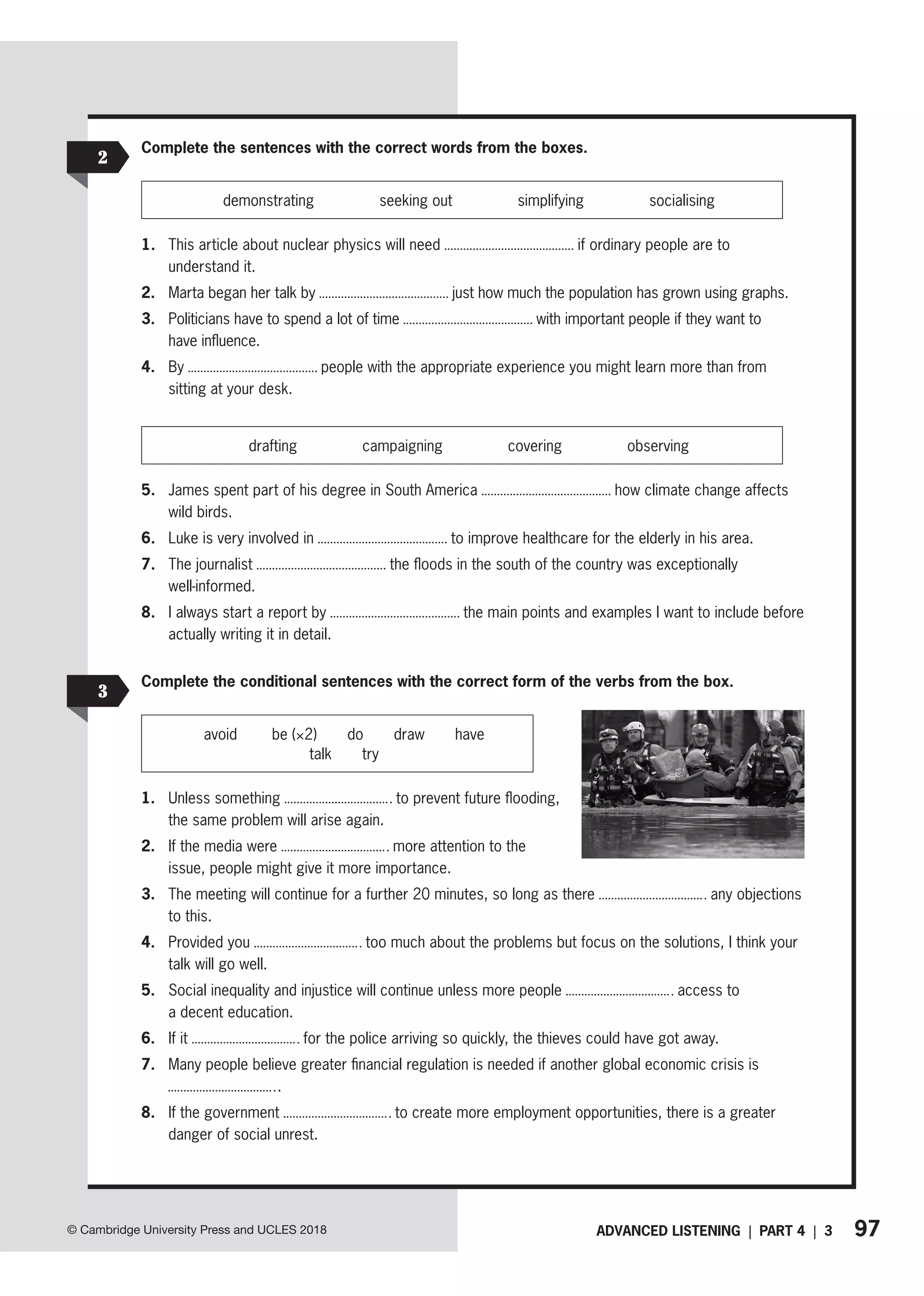
Advanced Reading and Use of English Part 1
THINK ABOUT IT
117
© Cambridge University Press and UCLES 2018
Think about it
Choose the correct alternative to complete the text about Advanced Reading and Use of English Part 3.
In Part 3, you have to read (0) sentences / a text and complete (1) it / them, using (2) one word / between three
and six words. There is (3) no / an example and then there are (4) 8 / 10 gaps to fill.
The (5) word / words that you need to write (6) is / are formed from the word which appears at the (7) start /
end of the line.
You might need to add a prefix to the (8) start / end of that word, to add a suffix to the (9) start / end of it, as well
as perhaps other, internal changes. Remember that suffixes often indicate the tense of a verb, or change the word
class (e.g. real → realise or real → reality).
You have to write your answers on the answer sheet and you should do this in (10) CAPITAL / lowercase letters.
You should check the spelling of all the words you write (11) carefully / carelessly because it must be correct.
Advanced Reading and Use of English Part 3
THINK ABOUT IT
Advanced Reading and Use of English Part 4
Think about it
Match 1–8 to a–h to make sentences about Advanced Reading and Use of English Part 4.
a fill the gap in the second sentence.
b both lexis and grammar.
c six questions, plus one example.
d of structures and lexis is tested.
e using between three and six words.
f three parts: a lead-in sentence, a key word and a
second sentence of which only the beginning and
end are given.
g available for each question and you might get one
of the marks if part of your answer is correct.
h must not be changed in any way.
1. Part 4 consists of
2. Each question contains
3. You have to
4. The gap must be filled
5. The key word
6. The focus is on
7. A range
8. There are two marks
118 © Cambridge University Press and UCLES 2018
Think about it Advanced Reading and Use of English Part 5
Read the statements about Advanced Reading and Use of English Part 5. Are they TRUE or FALSE?
1. There are three options to choose from (A, B or C) for each question.
2. There are six questions in total for this part of the exam.
3. Part 5 tests the ability to understand and identify both content and organisation of complex texts.
4. The texts are between 700 and 800 words.
5. It is common for Part 5 to contain questions about the writer’s opinion or attitude.
6. In Part 5, you may have to identify the correct order of the different sections of text.
7. Some of the questions in Part 5 may test implied meaning that is not directly stated in the text.
8. The texts in Part 5 could be book extracts, newspaper or magazine articles, reviews, or from specialist
journals.
Think about it Advanced Reading and Use of English Part 6
Match 1–8 with a–h to make sentences about Advanced Reading and Use of English Part 6.
a reviews or extracts from articles.
b are of three types.
c agrees or disagrees with another writer.
d there is a total of 550–600 words.
e who expresses a different opinion to the other
three writers.
f find relevant information about the other writers.
g and writers give their opinions on some or all
of these.
h is an important academic skill.
1. In Part 6, candidates must read across
different texts in order to
2. Across the four texts,
3. The four texts could be
4. Reading across four texts in this way and
analysing, comparing and contrasting information
5. The questions that are asked for Part 6 of the
Advanced Reading exam
6. There may be questions about which writer
7. There may be questions about one writer
8. Each question is about a different sub-topic
THINK ABOUT IT
119
© Cambridge University Press and UCLES 2018
Think about it
Read the text about the Advanced Reading and Use of English Part 7 and the following statements. Are
the statements TRUE or FALSE?
Part 7 of the Advanced Reading and Use of English exam consists of a long text from which six paragraphs have been
removed. The text can come from a wide variety of sources, such as articles and reviews. There are six numbered gaps
marked in the text to show where the missing paragraphs go. The six paragraphs that have been removed appear alongside
the main body of the text. To make things more difficult, the paragraphs are mixed up and an extra paragraph, which does
not fit into any of the gaps, is added. This part of the exam tests candidates’ awareness of how long texts are organised,
and their ability to recognise how language is used to carefully link all the sections of a text together in a coherent way. To
answer the questions, candidates write the letter of the paragraph they think fits in a gap next to the number of the gap. One
of the missing paragraphs may be a long single sentence, but the others are all two or more sentences long. The overall
text length is between 650 and 800 words, including the missing paragraphs. The main body of the text makes up about
60% of this word count, and the removed paragraphs around 40%.
1. The text for Part 7 is very long and is usually made up of six paragraphs.
2. The text is always an article or review.
3. There are six items to complete in this part of the test.
4. Paragraphs that have been removed are presented in random order.
5. There are six extra paragraphs added to the missing paragraphs to increase the difficulty.
6. Part 7 tests candidates’ understanding of the structure of a long text.
7. Most of the removed paragraphs consist of one long sentence.
8. The paragraphs that have been removed contain about 650 words.
Advanced Reading and Use of English Part 7
THINK ABOUT IT
Advanced Reading and Use of English Part 8
Complete the text about Advanced Reading and Use of English Part 8 using the correct words or
phrases from the box.
Think about it
letter   section   between 600 and 700 words   four to six
Part 6   ten questions   multiple matching   extracts
Part 8 of the Advanced Reading and Use of English exam is a (1) task.
Candidates have to pair questions with a short text or a (2) from a longer text.
There are three types of task. The first has (3) short texts usually written by
different people about a single topic (which is similar in some ways to (4)
of the exam). The second type is a long text split into four parts, A–D. The third type is made up of
(5) taken from different sources about the same topic. In each case,
the answer to each question is the (6) of the text or part of the text where
the information is found. There are (7) to answer and the text or texts are
(8) in total.
© Cambridge University Press and UCLES 2018
Think about it Advanced Writing Part 1
Match questions 1–6 about Advanced Writing Part 1 to answers a–f.
a 220–260.
b Reasons and examples to support and illustrate your
argument and make sure that you decide on one of your
points clearly in your conclusion.
c An essay.
d Two of the three points you are given related to the topic.
e An introduction, 2–3 paragraphs and a conclusion.
f If you like, use some of the opinions provided to develop
your points.
1. What do you have to write?
2. What do you have to write about?
3. What should you include?
4. How can you develop the given points?
5. How many words should you write?
6. What’s a good way to organise your essay?
Advanced Writing Part 2
Write the missing numbers in the sentence about Advanced Writing Part 2.
Think about it
In Advanced Writing Part 2, you have to choose (1) task from a choice of
(2) and write between (3) and (4) words.
Cross out the text types would NOT appear in Advanced Writing Part 2.
an article a report an email or letter a review
an essay a story a proposal
Complete the table with the text types.
email/letter proposal report review
Text type Layout, content and organisation
(5) Will include factual information and make suggestions or recommendations.
Clearly organised and will include headings.
(6) Similar to report.
Recommendations for course of action. Persuasive.
Clearly organised and will use headings.
(7) Will include description and explanation, positive and negative opinions and make a
recommendation.
(8) May be very formal or more informal.
Will include factual information or describe a personal experience.
Writing conventions (opening salutation, closing, clear paragraphing) should be used.
120 THINK ABOUT IT
121
© Cambridge University Press and UCLES 2018
Think about it Advanced Listening Part 1
Complete the text about Listening Part 1 with the correct words from the box.
agree attitudes detail dialogue multiple-choice purpose topics total three
In Part 1, you will listen to (1) short texts. Each text has two (2) questions
for you to answer. For each question, there are three options to choose from. There are six questions in
(3) to answer in Part 1.
Each text consists of a (4) between two speakers, and lasts about one minute. The texts will
cover a variety of possible (5) , and there will be different voices and styles of delivery. The
questions may test your understanding of the gist or (6) of what is said. The questions may
also test your understanding of what the speakers (7) or disagree about, the function or
(8) of what they say, their feelings, (9) and opinions.
Advanced Listening Part 2
Think about it
Complete the text about Listening Part 2 with the correct words from the box.
audience gap monologue order phrase specific spelling style talk
In Part 2, you will hear a (1) , in which a single speaker talks for around three minutes. The
listening text may be a (2) , lecture or part of a broadcast, and will be aimed at a non-specialist
(3) . The (4) of speech will be neutral or semi-formal. Part 2 tests your
ability to identify (5) information, and stated opinions.
The task consists of eight sentences, each with a (6) , where a piece of information is missing.
The missing information is contained in the recording that you will hear, and the sentences will come in the same
(7) as in the recording. You will have to write a single word or short (8) in
the gap. Your (9) should be correct, but both British and US forms are allowed.
THINK ABOUT IT
122 © Cambridge University Press and UCLES 2018
Think about it Advanced Listening Part 3
Read the information about Listening Part 3 and choose the correct word from the box for each space.
order six two read feelings options
agree three to four detailed purpose discussing interviewer
In Part 3, you will listen to an interview or discussion. There will usually be (1) speakers, who
will be (2) a topic. There may be a third speaker who is the (3) . This person
asks the other speakers short questions. The audio text will last approximately (4) minutes.
You will have (5) multiple-choice questions to answer. Each question has four
(6) The questions appear in the same (7) as the information given in
the recording.
The questions will test your ability to understand the speakers’ attitudes and opinions. The questions may focus on
(8) and gist understanding, and also the speaker’s attitudes, opinions and
(9) , or whether they (10) about something. Questions may also deal with
the (11) or function of what a speaker says.
Before you listen to the recording for the first time, you will have 70 seconds to (12) through
the questions. You will hear the recording twice.
Advanced Listening Part 4
Complete the text with the correct words from the box.
choose extra match order speaker theme twice use
Part 4 is a multiple matching task. You will hear five monologues about a particular (1) or
topic. Each of the five texts will have a different (2) , and will last approximately 30 seconds.
There are two tasks, each one consisting of eight options to (3) from. You will have to
(4) the correct option to each speaker for Task 1 and Task 2. There are also three
(5) options in each task that you will not need to (6) . You will hear the
series of monologues (7) , but you can do the tasks in any (8) .
Think about it
THINK ABOUT IT
123
© Cambridge University Press and UCLES 2018
Think about it
Read the tips and tick ✓ the tips which are good advice for things to do in Part 1 of the Advanced
Speaking Test.
1. Take time to think about your answers before you speak.
2. Give short answers (1–4 words) to the examiner’s questions.
3. It’s good to prepare some of your answers and learn them by heart.
4. If you don’t understand or haven’t heard something, ask the examiner to repeat it.
5. You should turn and talk to the other candidate(s) and involve them in a conversation in Part 1.
6. Try and use a range of verb tenses in this part of the exam.
7. Don’t try and use language that you are not 100% sure of. Stick to simple words.
8. For questions that you have never been asked or thought about before, there are some useful phrases to give
yourself thinking time that you can learn and practise using.
Advanced Speaking Part 1
Advanced Speaking Part 2
Think about it
Match 1–7 with a–g to make sentences about Advanced Speaking Part 2.
a and the examiner will mention this connection when
they give you the sheet with the pictures.
b one minute about two pictures.
c above the three pictures which you are given.
d a short question related to the pictures that you
have described.
e start by comparing the pictures and then move on
to answering the two questions above the pictures.
f about your partner’s pictures so make sure you
look at them and listen to what your partner says!
g two questions about another set of pictures.
1. In Part 2, you will have to speak for
2. You should answer two questions which the
examiner asks you and are printed
3. The three pictures are connected in some way
4. A good approach to this part is to
5. Your partner will answer
6. The other candidate will also speak for a minute
to answer
7. You will also have to give a short answer (about
30 seconds)
THINK ABOUT IT
124 © Cambridge University Press and UCLES 2018
Think about it Advanced Speaking Parts 3 and 4
Complete the text about Advanced Speaking Parts 3 and 4 using words from the box. Use each word
once only.
broaden discussed explaining focus giving look make refer tells telling
In Part 3, the examiner will give you some spoken instructions, (1) you that you should talk to
the other candidate for about two minutes and (2) briefly the theme of the discussion before
(3) you a sheet to look at.
On the sheet, there are some written prompts and a central question. You will have about 15 seconds to
(4) at these before the examiner (5) you what to talk about in relation to
the prompts.
After you and your partner have (6) this first question, the examiner will ask you to
(7) a decision related to the prompts you have just been discussing. You are not assessed on
your ability to reach an agreement.
In Part 4, the examiner will ask questions to (8) the topics introduced in Part 3. The questions
often (9) on more abstract issues, especially as the discussion continues. In this part,
you can and should interact with your partner and comment on and (10) the points that
they have mentioned. Do not, however, interrupt them abruptly before they have finished and avoid dominating
the conversation.
THINK ABOUT IT
125
Answer key
Reading and Use of English Part 1:1
1 1 orchestra
4 exhibition
7 bill
2 stage
5 choir
8 camera
3 compilation
6 skills
2 1 are
2 are giving / give
3 are
4 are staying
5 books
6 take
7 head / are heading
8 make
9 kick off
10 rest / are resting
11 hit
	
You can use the present simple for all answers except 4.
3 1 C 2 D 3 C 4 B 5 A 6 C 7 B 8 D
Reading and Use of English Part 1:2
1 1 A 2 B 3 D 4 C 5 B 6 C 7 A 8 B
2 1 find, tricky 2 make, happy
3 considers /considered, fortunate
4 kept / keeps, busy 5 call, perfect
3 1 latest, Last, previous
2	common, regular,
normal
3 long, big, wide
4 significant, large, great
5 distant, far, remote
6 different, unique, varied
4 1 talk
4 introducing
2 learn
5 express
3 convince
6 treated
7 know
Reading and Use of English Part 1:3
1 1 on
5 for
2 for
6 in
3 against
7 of
4 for
8 to
2 1 occasions 2 incidents 3 cases
4 examples 5 investigation 6 research
7 survey 8 enquiry 9 attraction
10 attention 11 focus 12 interest
3 1 D 2 B 3 A 4 C 5 C 6 C 7 D 8 B
Get it right!
For most of people it seems to be so natural – animals
in cages.
Reading and Use of English Part 2:1
1 1 came into
2 come through
3 come under
4 come off
5 come up
6 came across
7 come between
8 coming down
2 1 both are correct 5 both are correct
2 both are correct 6 both are correct
3 b is wrong 7 b is wrong
4 b is wrong 8 a is wrong
3 1 YOURSELF/YOURSELVES 2 AT 3 FROM/BY
4 DO 5 PUT 6 IF/WHETHER 7 NOT
8 THANKS/DUE
Reading and Use of English Part 2:2
1 1 WHAT 2 WILL 3 WITH
4 A 5 AS 6 SAY
7 BECAUSE 8 ON/ABOUT
2 1 accounts 2 result 3 matter
4 words 5 happens 6 First
7 time 8 now
3 1	
Has your personal experience of studying
(-) science subjects at (-) school been a
positive one?
2 
How far would you say that (-) science fulfils a
useful role in (-) modern society?
3	
Which discovery or invention do you think has had
the most positive effect on (-) society?
4	
How do you think (-) medicine will develop in
future?
5	
How strict do you think the/(-) controls on (-)
scientific experiments should be?
6	
To what extent are (-) human beings to blame for
(-) climate change?
7	
Do you think that (-) advances in (-) technology
will be sufficient to overcome the problem of the
world’s dwindling resources?
8	
Some people say that the more we invent, the
lazier we become.
Reading and Use of English Part 2:3
1 1 coastal erosion
2 oil spill
3 rural areas
4 urban development
5 waste management
6 global warming
7 natural habitats
8 endangered species
2 1 eligible for
2 open-minded about, hostile to
3 prone to
4 restricted to
5 untouched by
6 lacking in
7 incompatible with
3 1 OF
2 SOME/MANY
3 TO
4 SHOULD/COULD
5 WITH
6 BY
7 NOT
8 WHO/THAT
Get it right!
Our town is really full of tourist attractions. I mean all
these marvellous monuments.
Reading and Use of English Part 3:1
1 1 immature
2 disorganised
3 unconventional
4 overcome
5 misbehaviour
6 Pre-booking
7 undertaken
8 inconvenient
Answer key
126 Answer key
3 1 REFLECTIONS
2 BASICS
3 PARTICULARLY
4 REINFORCED
5 RESTLESS
6 DEPTH
7 BROADENING
8 SURPRISINGLY
Reading and Use of English Part 4:1
1 1 signs 2 harm 3 thing
4 way 5 use 6 joke
7 surprise 8 wonder
2 1 At no point was there (ever) a mention of a conflict.
2	
Never before had I come across the term
‘mindfulness’.
3	
Should you (ever) happen to see your former
colleague, tell her was asking after her.
4	
Hardly had the reunion begun when the fire alarm
went off.
5	
Not only do we eat more sugar and salt than our
ancestors, but our diet also induces more acid.
6	
Had I known how stubborn my teammate could be,
I would never have tried to persuade him.
7	
No sooner had I put forward the proposal than it
was accepted.
8	
Not only can providing role models for children
inspire them to study, but it may also mean that
they achieve more in life.
3 1	
WERE OF NO I CONSEQUENCE TO
2 TO BE A THOROUGH I OVERHAUL OF
3	
IS/CAN BE NO I DOUBT/QUESTION
WHATSOEVER
4 ONCE WAS I I (EVER) ASKED TO
5	
HAVEN’T A/THE SLIGHTEST I CLUE HOW / HAVE
NOT/HAVEN’T GOT A I CLUE HOW / HAVE NO
I CLUE HOW
6 HELD IN I SUCH (HIGH) REGARD
Reading and Use of English Part 4:2
1 1 on 2 under 3 from
4 behind
7 through/on
5 off
8 in
6 like
2 1	
Apparently, the newspaper’s market share stood at
35% in the first half of the year.
		
The newspaper’s market share apparently stood at
35% in the first half of the year.
2	
To begin with, I was sceptical, but I think it’s what
the readership needed.
		
I was sceptical to begin with, but I think it’s what
the readership needed.
3 
By all accounts, the advent of the internet hit the
greeting card industry hard.
		
The advent of the internet hit the greeting card
industry hard, by all accounts.
4	
She will probably pursue a career in publishing.
		 She will pursue a career in publishing, probably.
2 1 Why
2 (that)
3 when
4 where
5 who/that
6 whose
7 (which/that)
8 which
	
The pronouns that can be omitted are in brackets.
3 1 THEORETICAL
2 INDEPENDENTLY
3 DISSATISFACTION
4 COMPLAINTS
5 PROVIDERS
6 CLARIFY
7 ENSURE
8 UNREALISTIC/UNREAL
Reading and Use of English Part 3:2
1 1 GROWTH
2 INCREASINGLY
3 OCCURRENCE
4 ADJUSTMENTS
5 CONSIDERABLE
6	MATERIALISED/
MATERIALIZED
7 MANUFACTURERS
8 INCOME
2 1 unwillingness
2 significance
3 exaggeration
4 improvement
5 existence
6 necessity
3 1	
The judges considering the evidence have all got a
lot of experience.
2	
Referees not giving their full attention to a match
are a cause for concern.
3	
The sports star featured in the article is said to be
a millionaire.
4	
The gymnasts competing in a range of events
require strength, agility, flexibility and balance.
5	
The golfer wearing the yellow jumper is the
favourite to win the competition.
6	
Anyone wanting to lose weight should diet and do
exercise.
7	
All the people selected for the experiment found it
really interesting.
8	
Keith Jones is not yet match fit, having undergone
knee surgery less than a year ago.
Reading and Use of English Part 3:3
1 1 a 2 c 3 e 4 d 5 g 6 b 7 f
1b 1 hilarious/fabulous
2 insane
3 immense/enormous
4 devastated
5 pointless/senseless
6 fabulous/magnificent
7 appalling/disgusting
Get it right!
Every day we learn about bad habits we have in our daily
lives and how they affect the environment.
2 1 MISHANDLING
2 HANDY
3 SECOND-HAND
4 CHANGEABLE
5 UNCHANGED
6	EXCHANGE/
INTERCHANGE
7 WORKOUT
8 HARDWORKING
9 TEAMWORK
127
Answer key
5	
When it comes down to it, do you think that
targeted direct mail really persuades us to
purchase products?
		
Do you think that, when it comes down to it,
targeted direct mail really persuades us to
purchase products?
		
Do you think that targeted direct mail really
persuades us to purchase products, when it
comes down to it?
6	
Needless to say, future issues of the magazine will
be printed on recycled paper.
		
Future issues of the magazine will, needless to
say, be printed on recycled paper.
3 1	
KEEPS (HIMSELF)/ STAYS UP I TO DATE WITH
2	
IT HADN’T/HAD NOT I BEEN FOR / IT WERE
/WAS I ‘NT/NOT FOR
3 IT AMOUNTS TO I IS THAT IT
4 CAME OUT I OF THE BLUE
5 INCLINED TO I AGREE WITH YOU
6 TOOK ISSUE I WITH THE (PRESS) COVERAGE
Reading and Use of English Part 4:3
1 1 brush up on
2 done away with
3 fits in … with
4 stay away from
5 get through to
6 stand up to
7 come up against
2 1	
What forced the evacuation of hundreds of
residents and the closure of the airport was the
volcanic eruption.
		
It was the volcanic eruption that forced the
evacuation of hundreds of residents and the
closure of the airport.
2	
What causes animals to be added to the list of
endangered species is the destruction of the
natural habitats.
		
It’s the destruction of the natural habitats
that causes animals to be added to the list of
endangered species.
3	
What never ceases to amaze me is the public
response to large-scale disasters.
		
It’s the public response to large-scale disasters
that never ceases to amaze me.
4	
What has led to a ban on hose pipes for the
foreseeable future is the ongoing drought.
		
It’s the ongoing drought that has led to the ban on
hose pipes for the foreseeable future.
5	
What flooded the roads and made the rivers burst
their banks was the torrential rain.
		
It was the torrential rain that flooded the roads and
caused rivers to burst their banks.
6 
What is needed are more severe measures to
tackle the issue of global warming.
		
It’s more severe measures that are needed to
tackle the issue of global warming.
3 1 UNTIL LAST FRIDAY THAT I REPRESENTATIVES
WERE
2 CLAIMS WERE I BACKED UP
3	UNLESS/IF NO STEPS I ARE TAKEN TO /
UNLESS WE TAKE I STEPS TO
4 UTTERLY AMAZING I WAS THE (SPECTACULAR)
5	
YOU PUT/GET YOUR PROPOSAL I ACROSS
CLEARLY
6 BE A MUCH/FAR I LESS COMMON SIGHT
Get it right!
I was very excited and I was looking forward to their
arrival.
Reading and Use of English Part 5:1
1 1 B 2 C 3 D 4 B 5 A 6 C
2 1 pointing 2 Avoiding 3 to know
4 worry 5 joining 6 to watching
7 to find 8 asking
Reading and Use of English Part 5:2
1 1 B 2 C 3 A 4 C 5 D 6 B
2 1	
Proposals are being considered to increase the
number of bus routes.
2	
It’s said to be the most cosmopolitan city on
the planet.
3	
The mayor was told that more parks should
be created.
4	
The results of the poll will be published after the
votes have been counted.
5	
(They said that) nothing could be done until the
rubbish had been cleared away.
6	
The shopping centre was damaged after it had
been broken into (by vandals).
7	
A man was arrested after he had been stopped for
driving too fast.
8	
I have been asked to inform you that the next
residents’ meeting has been cancelled.
Reading and Use of English Part 5:3
1 1 D 2 B 3 C 4 C 5 A 6 D
2 1 has made
2 will have sold
3 had played
4 have been studying
5 have tried
6 had been downloading
7 had read
8	
will have finished/
have got
Get it right!
Dear Alex, I am happy to have received a letter from you.
Reading and Use of English Part 6:1
1 1 A 2 C 3 D 4 B
2 1 b 2 a 3 b 4 a 5 b 6 b 7 a 8 a
128 Answer key
Reading and Use of English Part 6:2
1 1 A 2 B 3 D 4 B
2 1 so 2 such 3 too
4 enough 5 as, result 6 therefore
7 too 8 such
Reading and Use of English Part 6:3
1 1 B 2 C 3 C 4 D
2 1 famous for
2 capable of
3 involved in
4 opposed to
5 worried about
6 furious with
7 astonished by
8 keen on
Get it right!
The further education sector is much bigger than the
university sector in the UK.
Reading and Use of English Part 7:1
1 1 F 2 B 3 G 4 E 5 A 6 C Distractor: D
2 1 had been demanding
2 will have been
3 have traded
4 will have been continuously growing
5 has often considered
6 had been rising
7 might have invented / had been
8 had been invested / would have been developed
Reading and Use of English Part 7:2
1 1 D 2 A 3 F 4 C 5 G 6 B Distractor: E
2 1 about 340 kg in weight
2 increase in the number of microwaves
3	
no indication that domestic microwaves pose a
risk to health
4 still has (great) relevance
5 more investment (by companies) in finding
6 very slow (public) acceptance of
7 in (great) poverty
Reading and Use of English Part 7:3
1 1 G 2 C 3 E 4 A 5 F 6 D Distractor: B
2 1 get/have their college fees paid
2 got her revision done
3 got/had my letter of application typed
4 was having/was getting his hair cut
5 had had the number of drama classes reduced
6 got the exhibition trip subsidised
7 has had its funding increased
8 getting/having my costume cleaned
Get it right!
The ladies have their hair done.
Reading and Use of English Part 8:1
1 1 had done
2 go
3 didn’t have
4 will give
5 would be able
6 will lose
7 would be
8 to find
2 1 B 2 C 3 D 4 A 5 C 6 A 7 D 8 B
9 D 10 A
Reading and Use of English Part 8:2
1 1 f 2 d 3 a 4 h 5 g 6 c 7 b 8 e
2 1 B 2 C 3 B 4 D 5 A 6 C 7 B 8 D
9 A 10 C
Reading and Use of English Part 8:3
1 1 C 2 A 3 D 4 B 5 A 6 C 7 B 8 D
9 A 10 B
2 1 made 2 to take 3 gave
4 have 5 to make 6 had done
7 took 8 gave
Get it right!
If we think the club is boring, we should do something
about it.
Writing Part 1:1
1 1 wounded
2 beaten
3 earn
4 hurt
5 reaching
6 gain
7 injured
8 win
2 1	
although (remove final ‘t’)
2 Nevertheless (one word)
3 Neither/Nor
4 Despite (spelling mistake – ‘e’ not ‘i’)
5 Even though (two words)
6 as/because
7 than
3 1 eating well
2 taking medicine
3	
diet, necessary nutrients, full range of foods which
doctors recommend, feed, variety of healthy foods
4	
access to health care, supply of medicines,
medical intervention, advances in medicine, drug
treatments, illnesses, health problems, diseases,
drugs, vaccines administered, bugs, immune,
resistant, prescribed, medical scientists, cures,
dosing, pills
5 eating well
129
Answer key
8	
In my opinion/view, everyone should be made to
learn to speak at least one foreign language.
2 Possible answers
1	
Whenever you decide to learn something new,
make sure you are aware of how much time
and dedication it will take.
2	
Getting into university can be tough, yet it is
worth the effort.
3	
Whichever subject you study, a degree will provide
useful skills and knowledge for the future.
4	
However much you hate exams, they are an
unavoidable part of the education system.
5	
Stress is bad for us, yet at the same time, can be
positive if experienced for just a short period.
6	
No matter how much money you may make, if
you don’t feel fulfilled in your job, you won’t
be happy.
7	
Whatever happens at work, try and not let it
interfere with your personal life.
8	
Wherever you end up working, make sure you
try and connect with the people around you.
3 Model answer
We spend around eight hours a day in our
workplaces, so having environments that are people
friendly is very important for our health and well-
being. Unfortunately, offices are too often harsh
environments, with florescent lights, bare walls and
unattractive views from the windows. However, there
are things that can be done to improve things.
One of the easiest things to do is improve the way
offices are decorated. Humans react to colours in
either positive or negative ways, so painting the walls
in colours that improve our mood and help make us
feel cheerful towards others would be a great help. In
addition, paintings or murals can make the walls look
more interesting and reduce the bleakness of large
areas of wall space.
In addition to improving the decoration, tackling
poor light and ventilation helps people feel better. In
gloomy offices where there is little fresh air, people
often get frequent headaches and generally feel ill, so
going to work becomes detrimental to their health.
Day-light balanced bulbs and improved air circulation
not only reduce these problems, but also increase
workers’ productivity.
Although improving all three factors is important, I
think improving the light and ventilation are probably
the most important, because the detrimental effect
of poor light and poor air is more significant than the
effect of looking at boring walls all day.
Writing Part 1:3
Possible answers (adverbs can go at front or end
position)
1 1	
Apparently, some thieves broke into the village
shop last night.
4 Model answer
It is widely accepted that sport benefits people. We
all know that it is good for our physical health, but it
also helps us in less obvious ways, in terms of our
mental health and in creating healthy communities by
building up a community spirit.
With regards to our mental health, sports often
require a focus on an activity, for example hitting a
ball or finding a foot hole in a rock face. This focus
means we have to forget about whatever problems or
emotions have been troubling us and concentrate on
the activity we’re involved in. It is hard to remember
your negative emotions when you have to return
a serve.
The focus on activity also helps us in team sports.
Winning as a team is more important than how you
feel about your fellow teammates. However, the
value to building community spirit is usually because
local people support their local teams. They feel
inspired by local action. The team doesn’t have to
be professional for this to happen. In fact, it doesn’t
have to be a team sport. Local fun runs in aid of
the local hospital or dads versus children football
matches all bring people together.
Both aspects are important benefits of sport, but I
think that probably community involvement provides
the greatest benefit because it helps everyone not
just those who are good at sports.
Writing Part 1:2
1a 1 case
2 opinion/view
3 seems
4 knowledge
5 fact
6 As
7 deny
8 opinion/view
1b Possible answers
1	
It seems to be the case that in poorer areas,
many students drop out of school for
financial reasons.
2	
In my opinion/view, many of the subjects we
study at school do not prepare us for the
real world.
3	
It seems to me that students are given far too
much homework. They end up going to bed
extremely late.
4	
It is common knowledge that many teachers
struggle with new technologies and do not
feel confident enough to use them in the
classroom.
5	
The fact is that there is a sizeable shortage
of skilled workers as fewer and fewer school
leavers take up a trade.
6	
As I see it, having a good teacher who
inspires you can make all the difference to
your success later in life.
7 
Few people would deny that a good education
can set you up for life.
130 Answer key
area in contrast to new builds are often bland and
characterless.
Get it right!
In some places it’s happening more quickly and in some
places more slowly.
Writing Part 2:1
1a	Positive: absorbing, electric, emotionally charged,
family-friendly, original, refreshing, riveting, talented,
thought-provoking, touching
	Negative: contrived, disjointed, implausible,
mediocre, obvious, overrated, stereotypical,
superficial, tasteless, unconvincing, wooden
1b Possible answers
An actor’s
performance
implausible, mediocre,
overrated, stereotypical,
talented, unconvincing, wooden
The development
of the story or plot,
treatment of the topic
absorbing, contrived,
disjointed, electric, obvious,
riveting
The concept/
approach
emotionally charged, family-
friendly, highly original,
refreshing, stereotypical,
superficial, tasteless, thought-
provoking
2a 1 in addition to
2 Besides
3 Not only
4 but
5 Moreover
6 Furthermore
7 What’s more
8 along with
2b	Likes: the clever interweaving of multiple stories,
witty comments and sharp insights into the
characters’ actions and decisions, novel starts off
well and has an initial buzz
	Dislikes: new characters don’t add anything special
and are given too much importance, too many trivial
anecdotes which distract
3 Model answer
There are so many great film moments. However,
for me one of the best candidates for the Fantastic
films website is the scene from Singing in the Rain
where Gene Kelly sings the title song, ‘Singing in
the Rain’. I know lots of people think the scene final
dance scene in Dirty Dancing where ‘Johnny’ played
by Patrick Swayze and ‘Baby’ (Jennifer Grey) dance to
‘The time of my life’ is the most iconic dance scene
of all time, but I disagree, and would go so far as to
suggest it’s not included.
In the Singing in the Rain scene, Don Lockwood
played by Gene Kelly breaks into song to express his
love for Kathy (Debbie Reynolds). He sings moving
from pavement to a road full of puddles. Gene Kelly’s
dancing is fantastic and entertaining. The audience
can also feel his happiness and can identify with his
expression of newly found love.
2	
Coincidentally, the police were doing their rounds
when the break-in took place.
3	
Fortunately, they were able to stop the robbers
from stealing anything from the store.
4	
Regrettably, a police officer was slightly injured
when making the arrest.
5	
Thankfully, her injuries are not thought to be
serious.
6	
Consequently, she is expected to be released from
hospital later today.
7	
Incredibly, the shop owners, who were sleeping
upstairs, did not hear anything.
8	
Understandably, the incident has unsettled local
residents, many of whom have been victims of
petty crime themselves in the past.
2 1 take part in f
2 worked together d
3 declined g
4 divided a
5 have come together b
6 make (it) possible h
7 approved c
8 annoy/anger e
3	
Children’s playground: encourage exercise,
encourage outdoor play, increased social contact,
positive for health
	
More bike lanes: encourage exercise, less pollution
	
More street seating: increased social contact,
meeting places, positive for health, reduces fear
of falling
4 Model answer
This essay looks at the question of what to do with
old buildings that have lost their use, for example old
churches that no one goes to or banks which have
closed. There is a range of options, and to some
extent the ideal solution will depend on the building
in question, but two of the main possibilities are to
demolish them or convert them into flats.
Looking at demolition first, it is easy to see that if
buildings are demolished, the space they leave can
be redeveloped into anything: an attractive square
with a garden, where people can meet and enjoy
local open space, or a new building for a new activity
the area and community needs. With regards to the
latter, this could be housing or a business use.
On the other hand, converting old buildings into flats
is also an attractive proposition. Much of our history
is contained in buildings and we can learn about our
neighbourhood’s past from learning about the former
use of buildings. Furthermore, old buildings often
have more character than new builds and create
more attractive, people-friendly spaces. The down-
side is they are often expensive to refurbish and the
layout of something like a church or office block may
not be easily adapted into flats.
From my point of view, I think conserving old
buildings is the most effective way of using
public buildings, as long as the building itself is
attractive. Old buildings embody the history of the
131
Answer key
In contrast, the dancing in Dirty Dancing while as
technically accurate as Gene Kelly’s lacks a sense of
joy. In this scene, Johnny goes on stage to perform the
last dance of the season at a holiday resort. He pulls
‘Baby’ on stage with him. The dance itself is nothing
special by today’s standards and not as entertaining.
I would also argue that the whole film is not as good as
Singing in the Rain, in terms of plot and entertainment
value. The latter is clearly an all-time classic, while
Dirty Dancing is just a typical film from the 1980s.
Writing Part 2:2
1 Positive aspects of the exhibition:
	
It exceeded expectations in terms of the number of
people who attended.
The people who came had a passion for science.
What could be improved:
More hands on activities for children
Press and online publicity to attract a wider variety of
visitors
2 Did the answer opposite:
1 make it clear who the report was for? ✓
2 use headings and clear layout? ✓
3	
use a consistent and appropriate register and tone? ✓
4 use a range of language? ✓
5 explain the exhibition strengths and weaknesses? ✓
6	
make recommendations for improvements? ✓
3a 
Words in the report are: so, so as to, with a view to
and in order to were in the report.
3b 1 so as to
2 so/so that
3 in order not to/so as not to
4 so/so that
5 in order
6 With a view to
7 so as not to
4 Model answer
Introduction
The purpose of this report is to assess the science
museum’s suitability for school visits.
Findings
The science museum is one of the largest of its type in
the country. It was recently renovated, and many new
exhibits have been installed which make the visitors’
experience a lot more ‘hands on’. As a result, it is
suitable for students with a range of learning styles.
Range of exhibits
The museum covers physics, biology (natural history)
and chemistry. The physics exhibits are particularly
interesting and clearly demonstrate the principles and
laws students will have come across in lessons, such
as Archimedes’ principle and Newton’s laws on gravity.
The natural history part of the museum contains the
oldest exhibits. Many of them, such as the dinosaur
bones, still maintain a fascination for students,
even if they don’t necessarily correspond to today’s
curriculum.
In addition, there are many interesting exhibits on
elements and chemical reactions.
Educational workshops
The museum has an educational department, which
is happy to work with teachers to come up with
worksheets and workshops specific to a school’s
needs. The worksheets are a very high standard and
they mean that any visit can reinforce and clarify
information learned in class.
Non-educational facilities
The museum has a room where students can eat
their packed lunches and have pre- or post-visit talks
and feedback. Furthermore, there is easy parking
for coaches and wheelchair access for disabled
students.
Conclusion
The museum provides an exceptional opportunity for
students to have an enjoyable and educational school
trip, because of the outstanding facilities on offer.
Writing Part 2:3
1 1 b/e 2 d/c 3 g 4 e/b
5 j 6 i 7 c 8 h
9 f 10 a
	Formal: I hope to hear from you soon. Yours
faithfully, Yours sincerely, I look forward to your reply.
	Semi-formal: Kind regards. All the best, Looking
forward to hearing from you.
Informal: Keep in touch! Best wishes, Write soon.
2 1 Question 1
2	
Question 1 (asks for details of the branch where
the writer works and the people who work there)
3	
Useful language could be: members of staff,
colleagues, team
a Dear Rodrigo, 2
b Dear Ms Baker, 1
a	
I am writing to give you information and my
advice …
1
b	
Thanks for your letter. Great news that … 2
a (I’m, You’d, You’ll … ) 2
b no (I am, You would, You will … ) 1
a	
What about … ? Try … Take it from me … I’d
say that … You can take your pick …
2
b	
I would highly recommend … You could
try … Might I suggest … Another alternative
might be …
1
a	
would be ideal for you
might (not) appeal would suit you best
1
b	
your sort of thing you might fancy might
tempt you
2
3
132 Answer key
4 Model answer
Dear Sir or Madam,
I am writing in response to your advert for teaching
assistants for the International Summer Camp your
company is organising this summer.
I am particularly interested in applying for a position
as a Sports Teaching Assistant, although I would be
willing to work on the crafts side too.
The reason why I think I would make a good member
of your teaching team is that I am a member of
several local sports clubs, including ones for
swimming, athletics and badminton and regularly
help with training sessions for new members.
Furthermore, last summer, I went on a training
course for badminton instructors and am now
qualified to teach juniors and adults.
On the crafts side, I can paint in a variety of media
and know how to weave, so I could help out with
these activities if necessary.
In addition to my qualifications, I have been to several
summer camps myself and know the problems young
people face when they are away from home. I think
this experience could prove invaluable, should I get
the opportunity to work for you.
Ideally, I’d like to use my skills teaching swimming and
badminton but, as I have a wide knowledge of sports,
I could help out with any sport from athletics to zorbing.
I have enclosed a cv with further details and hope you
find my application interesting.
I look forward to hearing from you.
Yours faithfully,
Get it right!
My cousins and I used to collect all sorts of things.
Writing Part 2:4
1 1 overrun with tourists
2 on a shoestring
3 at your leisure
4 low season
5 uninterrupted views
6 low-cost
7 off-the-beaten-track
8 once-in-a-lifetime
2 1 In view of the fact that
2 For that reason/That is why
3 As a result
4 That is why/For that reason
5 Consequently/Therefore
6 Since
7 Thanks to
8 Therefore/Consequently
3 Model answer
To: Mr Brown, Head of History
Re: Proposed History Trip
Introduction
This is a proposal for a one-day history study trip in
Liverpool.
Options
Looking at the options in the area, two attractions
come to mind for an educational trip focusing on
history: the Maritime Museum and Speke Hall.
The first option, the Maritime Museum tells the
story of Liverpool as a port. It also documents
world history through its focus on the growth of
international trade (including the slave trade) and
changes in maritime technology. It would be very
easy to create worksheets for individual groups,
who could then make presentations to the class in a
subsequent lesson.
The museum is easily accessible by local buses.
The alternative, Speke Hall, provides a very well-
preserved snapshot of what life was like in the
16th
century. This would be a very useful trip for
our students, as they study this period of history.
Students would be able to study individual aspects
of Tudor life (cooking, religion, transport) based on
exhibits in the house. The Hall’s education section
also gives excellent talks.
Unfortunately, the house is only accessible by coach,
which would add extra expense.
Recommendation
In my opinion, the most interesting option is the
Maritime Museum. The exhibits have a clear focus,
but at the same time cover in a lot of different
aspects of history: social, economic and cultural. The
Maritime Museum can also easily accommodate big
groups of students and has better rates for groups,
making it an ideal choice. It is also more easily
accessible by local transport.
4 Students’ own answers
Listening Part 1:1
1 1 B 2 C 3 C 4 A 5 B 6 C
Narrator: 
Track 1, Listening Part 1,
Worksheet 1
Narrator: 
You will hear three different extracts.
For questions 1–6, choose the answer
(A, B or C) which fits best according
to what you hear. There are two
questions for each extract.

Extract One. You hear two friends
discussing the topic of reading books
in printed or electronic form. Now
look at questions one and two.
Woman: What are you reading?
Man: 
It’s a novel … . quite gripping. Seeing me
reading on my phone screen you’d never
know what it was, would you? Anyway, it’s
nothing too cultured … It being electronic
is a plus if you don’t want people to see
133
Answer key
easily what you’re reading … . I mean, if
it isn’t some great work of literature but
something a bit trashy!
Woman: 
E-books have cured my terrible habit. I
tend to skip bits. Especially if it’s a thriller.
I’ll rush on, maybe 20 pages from where I
am in the plot, just to give myself an idea
of the ending. It can really spoil it though.
But, I haven’t figured out how to do it on
this electronic reader.
Man: 
These electronic books sure beat carrying
heavy books around, and if you decide
you’d like a particular book you can
just get it immediately, as long as you
have a Wi-fi connection. Though, there’s
something about turning the pages and
having a book in my hand that feels right.
Woman: 
And if you love a book, it stays on your
shelf, like an old friend you can stop by
and visit whenever you like.
Man: 
Of course e-books are always in your
library too. They don’t get battered like my
most treasured paperbacks do.
Narrator: Now listen again.
Narrator: 
Extract two. You hear a woman telling
a friend about a book he gave her.
Now look at questions three and four.
Man: 
So, what did you think of the book I gave
you?
Woman: 
The Man in the Forest? It was certainly an
emotion-packed tale. There wasn’t much
about the man in the first half. I thought
it got more gripping once he came into
it more. I really identified with the main
female character – the woman called Lucy.
I can see why you thought it’d be my sort
of thing – the blend of crime, mystery and
social issues. It was quite disturbing in
parts, as you suggested it would be. I did
wonder why they chose that cover for the
paperback edition though.
Man: 
What? The picture of the key? I thought it
made the book look quite intriguing.
Woman: 
It doesn’t really evoke the essence of
what it’s all about though. The book’s
chief strength is as a tightly plotted thriller
that also draws attention to certain social
injustices. I mean the image on the front
cover has the potential to summarise the
content or at least highlight the issues
the book tackles, which it totally missed
doing. If it had done, I’d have been more
convinced it was going to be the kind
of thing I’m typically drawn to. Still, it’s
sold over ten million copies, so what do I
know …
Narrator: Now listen again.
Narrator: 
Extract three. You hear two writers
talking about their daily routine. Now
look at questions five and six.
Man: 
My day starts with a look at the papers.
Woman: 
Oh, really? I deal with emails before
anything else.
Man: 
Emails used to be exciting … now it’s all
just stuff to clear. I’m pretty disciplined
about checking them, but I find it doesn’t
hurt to switch off the internet most of the
time … although I sometimes need to
consult it for reference. No, I start with
the news and concentrate on the human-
interest stories – I couldn’t make up that
kind of thing, so why bother, when I can
get a spark of inspiration so easily …
Woman: 
I’ve been meaning to tell you, I’ve started
to write standing, with my keyboard and
mouse at waist height. I reason that being
on my feet for hours is a form of exercise.
I think it wards off all those nasty things
that start happening in the body when
you’re seated, though I’m probably kidding
myself.
Man: 
Well, I force myself to take a long walk in
the afternoon, but I wouldn’t do it if I didn’t
have a voice in my head reminding me that
it’s also good for my brain. To be honest,
I jump at the chance to opt out, say, if it’s
raining. If that’s the case, I’ll sometimes do
some sit-ups indoors, but with a feeling of
resignation.
Narrator: 
Now listen again.
2 1 declared
2 urge
3 confided
4 grumbled
5 disclose
6 reasoned
7 speculating
8 stipulates
3 1 to send Dee/that he would send Dee
2 wouldn’t sell
3 is being made
4 he was finding writing
5 Anna (that) she
6 her daughter had had
7	
reminded Ben to take / reminded Ben about
taking / told Ben not to forget to take
8 to be
9 denied touching / denied having touched
10 agreed with Ruth
Listening Part 1:2
1 1 A 2 B 3 A 4 B 5 C 6 B
134 Answer key
Narrator: 
Track 2. Listening Part 1,
Worksheet 2
Narrator: 
You will hear three different extracts.
For questions 1–6, choose the answer
(A, B or C) which fits best according
to what you hear. There are two
questions for each extract.
Narrator: 
Extract one. You hear two friends
talking about travelling on public
transport. Now look at questions one
and two.
Man: 
I find commuter behaviour on public
transport fascinating, especially at rush
hour.
Woman: 
Yeah, it’s weird how uneasy it makes
people being forced into such intimacy
with strangers, all helplessly crowded in
together. I guess that’s why they read or
listen to music and engage with fellow
travellers so reluctantly … just to give up
a seat for someone elderly or disabled and
so on.
Man: 
People approach each other so
apologetically … mind you, half the time
nobody registers that there’s someone
speaking to them because they’re all
wearing earplugs or headphones. And
people put a bag on the seat next to them
just to lower the chance of someone
sitting there.
Woman: 
Yet, apparently chatting and positive body
language are actually more successful
ways of getting to feel at ease than
defensive strategies. I heard a radio
programme about it. It seems the seat
layout can be a problem: it’s awkward
to talk to anyone if you’re right next to
them, but if you’re facing each other you
can pick up key non-verbal signals which
makes you feel less vulnerable. You’d think
on regular commutes, where you often
see the same faces in the same seats, it
wouldn’t be such a problem and people
would be more at ease, but I’m not sure
that’s the case.
Narrator: 
Now listen again.
Narrator: 
Extract two. You hear two friends
discussing the use of social media.
Now look at questions three and four.
Woman:	
I do sometimes wonder about the value of
posting things on social media.
Man: 
What do you mean?
Woman: 
… so many people just give vent to anger
or frustration. At any given moment, with
all the different online platforms, there
are thousands of people, who often
don’t know anything about the subject
in question, telling others their ideas
are rubbish. They should at least check
their facts. I do. Anyway, I find it amazing
when people react aggressively in public
forums. I regularly post comments on
various blogs, and pride myself on not
over-reacting when someone has a go at
something I’ve said, but it’s hard not to.
I do get angry too, but. I really don’t …
Man: 
I guess there’s something to be said
for some sort of self-censoring rather
than posting too wildly. The thing I find
frustrating about social media is that it
encourages an insatiable supply of short
bits of infotainment – you know sharing
news bites that are witty or shocking, and
people tend not to think critically about
what they read, but most of it’s not even
interesting, let alone true. I’m not including
the kind of self-promotion a lot of people
go in for on social media, photos of their
wonderful holidays, or kids’ graduation.
That’s all about wanting to look good to
other people and mostly harmless.
Narrator: 
Now listen again.
Narrator:	
Extract three. You hear part of a radio
programme in which two journalists
are discussing surveys. Now look at
questions five and six.
Man: 
There’s so much we still have to learn
about what influences human behaviour.
We don’t really know how to effect positive
changes in what people do. Personally,
I don’t think our focus on large-scale
surveys as the main source of insight
into how people behave helps us. We
hear all these sweeping statements
about attitudes towards everything from
brands to climate change, but the majority
of research is built on self-reporting
methodologies like surveys in which
participants describe their own attitudes
themselves. That’s too narrow, because
people’s answers often depend on their
mood or what’s going on around them,
or how they think they should answer,
and that could certainly have implications
when it comes to interpreting the results,
especially if …
Woman: 
You mean they don’t tell what causes
people to change their behaviour?
Man: That’s right.
Woman: 
There are actually some very interesting
examples of companies adopting more
unconventional strategies to finding ways
to change behaviour. One soft drinks
manufacturer recently launched a project
with the aim of improving recycling
135
Answer key
additional lure is that there’s one obstacle
you don’t have to overcome … worrying
about asking for directions or how to get
around, which could be pretty daunting if
you’re staying somewhere for a while.
Man: 
It’s a massive country – and surprisingly
pricey. I took the bus between cities –
flying really defeats the object of travel
– so much of the country’s character is
revealed in those vast distances of pure
nothingness. … I did struggle to make
ends meet. I earned a bit doing bits and
pieces of work here and there. It wasn’t
easy to come by. Rather than pay high
rent, I stayed in basic hostels. But it
was good. I kept bumping into the same
people, all on a tight budget of course.
Narrator: 
Now listen again.
Narrator: 
Extract two. You will hear two friends
discussing the purpose of travelling.
Now listen to questions three and four.
Woman: 
You’re busy planning your next trip, Olly.
Do you always feel a sense of purpose to
your travels?
Man: 
To be honest, I might sometimes have
felt like I’ve been there, done that, got the
T-shirt. That’s not often the case, but I do
think you need to get off the beaten track.
I try to go to new places. Once there, I’m a
fan of just hanging out, and trying to get to
understand the vibe of a place, and observe
the way of life. I make a point of asking
questions, so I can find places where I
can chill out and discover what’s going on
… rather than ticking it off as a place I’ve
‘done’ because I went on some amazing
tour to a waterfall, or got a great picture of
a tiger. You travel, what motivates you?
Woman: 
For me, it’s about stepping out of my
comfort zone – travelling alone gives you
experiences that teach you about yourself.
It’s funny how what might have been a
really bad experience, say, getting lost,
or missing the only bus that day, can turn
into an anecdote, which makes you see
things differently. Having a story that ends
up making your friends laugh, is quite cool
really. Anyway, I’ve realised that although
I’m pretty tough, tears come too easily
when I’m tired and someone shouts at me.
Narrator: 
Now listen again.
Narrator: 	
Extract three. You will hear two
colleagues talking about a trip to a
conference. Now listen to questions
five and six.
Woman: 
So, flying to Edinburgh tomorrow for the
conference. I can’t wait.
behaviour. Rather than use the customary
strategy of a huge consumer survey,
the daily lifestyles of small samples of
people were observed closely. Then they
were invited to get involved in problem-
solving processes. Of course, it may turn
out to be ineffective, but I’d like to learn
more about the research findings. It’s all
still ongoing.
Narrator: 
Now listen again.
2 1 affectionately
2 willingly
3 aggressively
4 Reluctantly
5 fearlessly
6 helplessly
7 nostalgically
3 1	
Incorrect. The study said that most respondents
believed that their driving skills were above average.
2 Correct
3 Correct
4	
Incorrect. Richard told me that he was going to try
to give up smoking before the course ended.
5 Correct
6	
Incorrect. Liam said that he’d had stress-related
nightmares in the previous month.
Listening Part 1:3
1 1 B 2 C 3 B 4 A 5 B 6 C
Narrator: 
Track 3. Listening Part 1,
Worksheet 3
Narrator: 
You will hear three different extracts.
For questions 1–6, choose the answer
(A, B or C) which fits best according
to what you hear. There are two
questions for each extract.
Narrator: 
Extract one. You hear two students
talking about spending a gap year in
Australia before going to university.
Now look at questions one and two.
Woman: 
During my gap year in Australia, I met
so many other Brits my age doing the
same thing before going to uni back in
the UK. They’d all done the same journey
out there via Southeast Asia, stopping off
briefly in Thailand and Bali on the way …
really unmissable places with jaw-dropping
scenery … .
Man: 
I made some good friends travelling in
Australia in my gap year.
Woman: 
So often people claimed their main
motivation for going was the unspoilt
beaches, the wildlife, the rainforests – the
endless sunshine. But that’s true for lots
of destinations. I actually think the major
136 Answer key
Man: 
Why so keen? We’ve both got to give talks
tomorrow, that very afternoon.
Woman: 
I know. I should really be looking at my
presentation, and going over my latest
improvements, so I remember them. I’ve
been through it quite thoroughly, so I’m
happy that the slides won’t need to be
altered.
Man: 
You swore you’d listen to me go through
mine one more time today.
Woman: 
There’s no cause to doubt my word!
Man: 
You’d better not be joking about that!
Woman: 
On condition you listen to my delivery too.
Man: 
Sure. Anyway, I’ve no intention of making
any major adjustments, I’d just appreciate
some constructive criticism about whether
I’m pausing in the right places, or speaking
too fast, you know the sort of thing.
Woman: 
Absolutely. That’s what I need too. It’ll be
a relief not to be stuck in this cramped
office. The renovations to our old one
must have been going on for at least two
months now. The prospect of getting away
makes up for the weeks of preparation.
Anyway, I’ve made a point of packing light
so as not to have to drag a heavy case
onto the airport train. I’d far rather have
taken a taxi there … If only I’d been in
charge of organising things!
Narrator: 
Now listen again.
2 1 a 2 c 3 b 4 c 5 b 6 c
3 1 could have been
2 would have enjoyed
3 needn’t be booked
4 would rather take
5 will leave
Get it right!
A time in history in which I would have liked to have
been present is the Victorian era
Listening Part 2:1
1 1 necessary
2 achievement
3 chemistry
4 business
5 assistant
6 accommodation
7 beginning
8 measurement
9 research
10 psychologist
2	 1  some 2 any 3 much
	 4  
all 5 Both 6 no
	 7  
such 8 a 9 certain
10  little
3 1 robots 2 garage 3 engine
4 toxic substances		 5 software
6 (weather) balloon
7 ocean/ocean depths   8 attitude
Narrator: 
Track 4. Listening Part 2,
Worksheet 1
Narrator: 
You will hear a woman called Camilla
Doyle introducing a science fair.
For questions 1–8, complete the
sentences with a word or short
phrase.

Welcome to this annual innovation fair,
where we exhibit developments from the
world of science. I’m Camilla Doyle, from
the organising committee, and I’ll take you
through a few highlights, which I’m sure
you’re eager to learn more about.

If you’ve attended many science fairs
before, you may be expecting to see
such things as model volcanoes, crystals
in jars, or robots. And it has to be said
that a fair few robots have come under
my scrutiny in my role on the selection
committee over the years, but I’m certain
everything you’ll see today will give you
cause for excitement.

So, what will you see? I’ll start with an
exhibit demonstrating an astounding feat
by one young scientist, David Nelson,
and his attempt to build a nuclear fusion
reactor. One of the biggest challenges in
physics is to create nuclear energy not by
splitting atoms but fusing them together.
David used the garage next to his house,
rather than working in a science lab, to
create a device that, though not self-
sustaining, produces fusion on a tiny scale.
Let’s hope the neighbours don’t complain
of finding nuclear waste in his back garden!

If you’re interested in motor racing, you’ll
be impressed by the achievements of a
team who built a diesel-hybrid racing car
that goes from nought to a hundred in just
four seconds. They’ve developed a design
that can also drive for 100 km using just
4.5 litres of petrol. The prototype for the
engine is being refined, and they say their
enhanced version will soon be ready.

Many industries are interested in Joe
Higson’s work. There are many types
of chemicals, some more complex than
others. Whichever they are, if used in the
workplace, it’s crucial to keep people
safe, and Joe’s machine helps with this.
It sniffs out toxic substances in places
they shouldn’t be, a potential asset to any
industry with regard to improving safety.
I should say that Joe plans to adapt it for
other purposes too.

The work of Jenny Benson is likely to
yield huge dividends for space travel. It’s
137
Answer key
have qualifications or a particular skill.
If you don’t have these, it’s crucial to
consider what sort of impact you can have
as a volunteer. It’s also important to bear
in mind that there are age requirements in
certain countries.

My first volunteer experience was at a
safari park in Thailand. It was rescue work
taking care of birds that had been injured.
Besides learning a lot about the bird’s
names and habits as well as all the various
diseases they get, I also got to know more
about wild cats, as there was a section of
the park dedicated to them.

Teamwork’s vital for all projects, and
working on the project taught me an
invaluable amount about this. I really
developed my abilities in that respect.
I guess it was the biggest takeaway
thing for me.

Basically, when you volunteer you’re there
to get involved, and you’ll have a lot of
fun doing that. You might also pick up
odd things like how to make a fire without
matches, or how to build a hut with the
most basic equipment. I’d built one before
back home with my dad using screws
and nails, so it was a real eye-opener for
me when I was instructed in how to make
one stay up using just string to keep it
together. Volunteer work’s as tiring as any
job, but it can turn out to be a thoroughly
enlightening experience.

With so many organisations offering
volunteering placements abroad, it’s not
easy to determine which project might be
the most ethical, sustainable, or beneficial.
Generally speaking, the longer you stay
the better. Short-term volunteering can
be damaging to communities and it’s
generally advised that it’s not appropriate
to stay less than a month. It’s often said
that a commitment of around 12 weeks
allows enough time for you to integrate
with the local community and deliver useful
work, so bear that in mind.

Your commitment also depends on what
the organisation needs – it might need
help delivering a specific project, such
as reviewing the organisation’s accounts
or budgets, for example. Make sure
you’re working to their time frame, and
not forcing them to adapt to your travel
schedule.

Volunteer work abroad is sometimes
offered by for-profit agencies based
outside the country where the volunteer
work takes place. They can allocate you to
crucial to use as little fuel as possible
out in the depths of space, and there is a
constant search for new types of energy.
But efficiency is important too, and Jenny’s
ingenious software enables vehicles in
space travel at accelerated speeds more
economically, by navigating the obstacles
in space more efficiently.

Some meteorology students have
produced a balloon that’s out of this
world. They’ve created a camera-operated
weather balloon and sent it over 30 km
into the Earth’s atmosphere. The
readings they’ve got so far are incredibly
detailed and could be helpful for weather
forecasting and many other uses. The
photographs taken by the balloon’s
camera are stunning too.

Something that’s attracted media attention
is another type of vehicle – an underwater
rover that can operate in the harshest
conditions. It can explore the ocean depths
where there’s absolutely no light, and it’s
being used to learn about the behaviour
of the most difficult to reach marine life.
There are hopes of taking it to the polar
regions, where scientists hope to find out
more about what might be living there.

It’s been a privilege to chat to scientists
exhibiting here. Their ambitions to find
solutions to the problems on this planet
are wonderful to see. The originality is
extraordinary, though what shines through,
above all, is their attitude. If something
goes wrong, they work on it till they find
an answer.
Narrator: 
Now listen again.
Listening Part 2:2
1 1 age
2 teamwork
3 string
4 a/one month
5 (travel) schedule
6 (in-country) partners
7 case studies
8 loneliness
Narrator: 
Track 5. Listening Part 2,
Worksheet 2
Narrator: 	You will hear a man called Sam Parker
talking about doing volunteer work in
other countries. For questions 1–8,
complete the sentences with a word
or short phrase.
Woman: 
I’d like to tell you about some of the
opportunities there are for international
volunteering and a little about my own
experiences. I should say, first of all, that
most organisations prefer participants to
138 Answer key
specific projects, or place you with a local
organisation. If you use an agency, choose
one that’s transparent about its in-country
partners and specifies which particular
project you’ll be working on.

Always ask questions about the impact
of the volunteering programmes – the
best ones will have strong case studies
showing how well their projects are
doing, which you can ask to look at
prior to making any commitment. Look
for projects that promote the positive
integration of volunteers with the local
community.

You’ll usually have to pay a fee to
volunteer, but food and accommodation
are provided. I’ve volunteered all over the
place, and in all my time, despite a few
stomach aches and suffering from really
bad flu once, the one thing that I’d fully
expected to bother me didn’t. That was
loneliness. I always had people around
who made it a truly amazing experience.
Narrator: 
Now listen again.
Narrator: 
Track 6. Listening Part 2,
Worksheet 3
Narrator: 	You will hear a talk by a woman called
Ellie Matthews about her life working
as a writer and illustrator of children’s
books. For questions 1–8, complete
the sentences with a word or short
phrase.
Woman: 
It’s a pleasure to be here and tell you
about my life as an illustrator and
2a 1	a  thoroughly/totally		 b  pretty/fairly
		 c  sort of/kind of
2	a  completely/absolutely		 b  rather/somewhat
		 c  virtually/almost
3 a  slightly/a bit				 b  terribly/awfully
			 c  generally/mostly
2b 1 awfully 2 rather 3 kind of
4 thoroughly 5 almost
3 1 unbelievably
2 loneliness
3 passionately
4 significance
5 noticeable
6 unemployed
7 existence
8 imperfect
9 disadvantaged
Listening Part 2:3
1 1 imagination
2 advertising agency
3 travel brochures
4 red hair
5 letters
6 open spaces
7 paper
8 wisdom
children’s author … a profession I really
just fell into. It’s not as if my art teacher
or parents spotted any artistic skills in
me when I was a young girl. They tended
to focus on my vivid imagination … I
was always entertaining my friends with
outrageous stories and so not really seen
as a good influence at all!

However, I loved painting and opted
to attend Art College. By graduation
I’d accumulated a sizeable portfolio
of work to showcase my talents and
applied for jobs. I remember one was a
position at a major art gallery; I didn’t get
it – fortunately as it turns out, but I felt
crushed to be rejected for that and for
a role at a big advertising agency. I do
sometimes wonder how differently things
might have panned out for me.

Anyway, I earned virtually nothing for
two years, just bits and pieces doing
illustrations for magazines and some work
on a children’s comic. The only financially
rewarding thing I did in those early years
as an illustrator was for travel brochures,
but I wasn’t enamoured by the idea of
doing that forever.

Meanwhile, I’d been writing and drawing
pictures for a children’s book of my own
about a girl called Carly. I sent the finished
manuscript to various publishers and was
stunned one day to hear that one of them
wanted to publish it. To my amazement,
the first edition of Carly flew off the
shelves in bookshops. I think it was her
red hair that made her such a distinctive
character. She was a skinny little girl
with super-thick glasses − somewhat
based on my schoolgirl self. One source
of inspiration for things she did and
felt was going through letters written
to my grandmother by my mum when
I was young. They stirred my own vivid
recollections … like reading old diaries I
guess, where the mention of some event
or person triggers memories of a whole
period of childhood.
Anyway, after Carly, I left Britain for the
USA. I’d been taken there a lot as a
child – my mother’s parents lived there.
I don’t deal well with the cold in Britain,
and I loved the friendliness over there.
In addition, I’ve always adored its open
spaces, and that’s what influenced me to
make the move to live and work there,
rather than the weather. It’s just so vast.

I now share an apartment in New England
with my husband and kids. In my studio
139
Answer key
Narrator: 
Track 7. Listening Part 3,
Worksheet 1
Narrator: 	You will hear part of an interview with
two graphic designers called Anita
Dickinson and Joe Connolly in which
they talk about going freelance.
For questions 1–6, choose the
answer (A, B, C or D) which fits best
according to what you hear.
Interviewer: 
With me on ‘Work and Money’ are two
successful freelancers, Anita Dickinson
I have all the equipment I need. My
drawing tools are pretty standard, though
there are certain kinds of pens for fine
lines I prefer and one specific brand of
brush pens for more fluid lines. It’s paper
I’m terribly picky about. I can waste time
with false starts if it isn’t what I work best
on. Marker pens, coloured pencils and inks
are also essential tools of the trade.

Being a mother has changed me. I’ve
had to learn patience. I’ve always been
interested in the way children see things,
and I love their funny expressions. I see
every child as unique. That’s the wisdom
I’ve gained, and imparting it to my readers
is a mission of mine. People believe
children will bring them happiness, but it’s
more complex than that …
Narrator: 
Now listen again.
and Joe Connolly, who both worked as
graphic designers at major companies but
left to go it alone.
Woman: Hi.
Man: Hello.
Interviewer: 
Anita, tell us about your decision to go
freelance.
Woman: 
Basically, I’d been working in a well-
paid position for some time and I was
undeniably proud of the fact that people at
the company viewed the stuff I produced
very favourably. No job’s secure in today’s
economic climate, and I realised being
employed wasn’t necessarily as safe as
I’d thought. I began a transition, doing
freelance work on the side, and gradually
building up a client base. My only doubt
was whether this’d be enough to rely on
to cover the salary and perks I’d lose by
going it alone. Anyway, I’ve always been an
independent person and the idea of being
my own boss was ultimately irresistible.
Interviewer: 
What about you, Joe?
Man: 
One of the biggest excuses for not going
freelance is not knowing how to get
started. Clearly, you have to feel confident
you know the craft, but beyond that, I
simply exploited my own skills to the full
and ensured I had a website that I thought
would draw in clients. OK, so there was a
little more to it than that, but getting started
really wasn’t all that complex, even if it took
a while before business started pouring in.
Fundamentally, it was about a willingness
to sacrifice time, working evenings and
weekends. Unfortunately, there’s no room
for any reluctance on that score. Being
realistic about such things made it possible
for me to become a full-time freelancer.
Interviewer: 
Do you enjoy working alone rather than
with other people?
Man: 
Well, I thrived in the hustle and bustle
of an office setting – working in teams,
bouncing ideas off others, the odd joke
with a colleague. I did seriously wonder if
working alone would be my cup of tea. It
can certainly lead to a sense of isolation
for some. Whole days with just yourself
for company might become unbearable.
Fortunately for me, there are frequent
opportunities for human contact – meetings,
and consultations about certain contracts
– almost too many. Thankfully, I’ve barely
experienced any problems being on my own.
Interviewer: 
Is self-discipline very important, Anita?
Woman: 
As a freelancer, you’re completely
responsible for your own productivity.
2 1 spent, was removed
2 had been opened / was opened, became
3 were living, were
4	
didn’t/did not meet, were studying/studied/had
been studying/had studied
5 were spotted, had found
3a 1 draw attention
2 cause concern
3 make a move
4 take heart
5 draw a conclusion
6 cause distress
7 make a contribution
8 take exception
9 draw support
10 cause embarrassment
11 make a point
12 take charge
3b 1 made a point
2 to draw attention
3 caused me embarrassment
4 took heart
Get it right!
A boat trip on the River Thames was planned for the next
day, but the weather was terrible and we couldn’t go.
Listening Part 3:1
1 1 B 2 C 3 D 4 B 5 A 6 C
140 Answer key
There’s nobody there on a daily basis
monitoring the amount you get done.
I’ve experimented with some of the apps
available for scheduling, or setting up
reminders to keep you on track, but
frankly, I find them unnecessary. I know
I’m accountable solely to myself – and
my clients, of course. If I didn’t have that
approach, I wouldn’t have opted to work
for myself. Frittering away time on social
networks or browsing the web hardly
occurs to me. I get so absorbed in my
work that I’m more likely to end up working
until late at night, which isn’t great as you
just end up utterly shattered the next day.
Man:	
Yeah, and on top of all the day-to-day work
you have to keep up with business trends.
Woman: 
Mm … things move so fast, but I guess
that keeping up is something non-
freelancers have to do too.
Man: 
If you’re predominantly working in one
specific area of the market, which tends
to happen, then inevitably, you see how
things are developing and adapt naturally.
Woman: 
What’s key is to have a niche and know it
inside out. That way you’re often ahead of
others in the same game, saving you from
constant time-consuming research into
upcoming trends.
Man: 
It’s primarily a question of, as you say,
being an expert, and having a real interest
in what you’re doing … in the end, easier
than people think.
Woman: 
And of course, as a designer, you always
want to do the best work you can.
Interviewer:	
You’ve both been very successful. Joe,
what’s the secret?
Man: 
I’ve earned more being freelance than I
ever could have with a company. Being
competitive involves charging what I see
as a sufficient return for the hours put in
and considering what the client will regard
as fair – that requires some bargaining.
Sometimes, I’ve undersold myself, but it’s
worked in my favour. Because my work
was high quality, word-of-mouth reports
about this meant more work came my
way. Arguing about whether what I’m
charging is reasonable isn’t a situation I’ve
had to deal with.
Interviewer: 
Well, thank you both very much indeed,
and that’s the end of the show today…
Narrator: 
Now listen again.
3 1 g (A large investment inevitably involves some risk)
2 a
3 d
4	
e (In its first year the company barely made any
money but things went improved later.)
5 h (Joe works from home a lot of the time.)
6 c
7 f
8	
b 
(Shareholders are always interested in getting a
good return on their investment.)
Listening Part 3:2
1 1 B 2 C 3 D 4 A 5 B 6 D
Narrator: 
Track 8. Listening Part 3,
Worksheet 2
Narrator: 	You will hear an interview in which
two people called Claire MacBride
and Shaun Kale are talking about
training to run in a charity marathon.
For questions 1–6, choose the
answer (A, B, C or D) which fits best
according to what you hear.
Interviewer: 
Today, I’m interviewing Claire MacBride
and Shaun Kale, who both recently ran a
marathon for the first time. Claire, what
made you train for the marathon?
Woman: 
I decided to have a stab at it as a way
of raising money for charity. I wasn’t the
sporty type who typically runs distances
of 42 kilometres! The very idea made me
shudder. When I’ve heard people making
resolutions to turn over a new leaf at
new year, I’ve always been sceptical, so I
assumed my resolve would wear off once I
began training. I can’t quite work out how I
became that annoying person who’d arrive
at work glowing with satisfaction at having
run ten kilometres to work. I relished those
runs and when I got into conversations
with colleagues about nightmare
commutes, I’d shrug my shoulders and
say: “I’m so glad I run to work!”
Interviewer: 
Shaun, how was your marathon
preparation? Did things go right for you?
Man: 
Well, I’d always been an enthusiastic
athlete and believed anyone with grit
and enough preparation could do the
marathon, but it was obvious I needed
to have a clearly thought out training
strategy. I already had a fair base
fitness level, so I set out to bank some
big distances early on. But I became
conscious I’d underestimated the mental
struggle. I’d failed to grasp how critical it
was to find ways to spur myself on – to
2 1 admitted 2 confessed 3 recommend
4 denied 5 insisted 6 suggested
7 oppose 8 claims
141
Answer key
Man: 
Running a marathon’s a huge undertaking.
Uplifting isn’t the word. The weather was
dreadful, but a massive crowd turned out,
and the applause ringing out on all sides
was overwhelming. But there was also the
hassle of locating my loyal friends and
family. Despite agreeing a spot at the end
of the route, exasperatingly, when I passed
the finish line they were nowhere to be
seen among the endless spectators.
Woman: 
For me, it took time to sink in that I’d
made it. During the race I wondered if my
body might let me down, my legs were
like lead, and before the finish I tumbled,
which wasn’t how I’d envisioned things.
Somehow, I dragged myself up and
staggered over the line, only to collapse
in a heap, oblivious to the cheering and
clapping. I gather people came to my
rescue. I don’t think anyone who hasn’t
tried it can fully appreciate what it feels
like to achieve a goal like that.
Interviewer: 
Well, congratulations …
Narrator: 
Now listen again.
reach the number of kilometres that go
into building up the necessary endurance
without giving up. If I’d factored in ways to
get over my resistance in the early stages,
I’d have tackled the challenge more
effectively.
Interviewer: 
Isn’t injury a risk during marathon training?
Woman: 
Absolutely. One day, I suddenly developed
excruciating pains in my right thigh, so
bad that abandoning the whole thing may
have crossed my mind briefly. However, I
headed off to a physio trainer who told me
to take it easy for a week and refrain from
running, and to do just light swimming. I
was reluctant to disrupt the routine I’d got
into, so I just carried on anyway … then
fell ill with bronchitis. The hardest thing
about marathon training is knowing how
not to overdo it. Anyway, I was forced to
rip up my schedule and set myself one
based on being more in tune with my
physical self.
Interviewer: 
How did it feel getting up to train on winter
mornings?
Woman: 
Friends told me ‘It’ll be so lonely and
miserable’. I know there are visualisation
techniques to conquer negative feelings,
you picture yourself racing along ahead
of the pack, any image that’ll induce you
to get up and out. But then you confront
the reality of heading out through the
park in the darkness of a January dawn:
there’s hardly another runner to be seen.
It’s amazing what you find to focus on: the
cooing of pigeons, the rustling of leaves,
the crunch of trainers on gravel. Focussing
on insignificant things enabled me to
endure the monotony and the icy winds.
Interviewer: 
Was your running speed in the marathon a
concern, Shaun?
Man: 
During my training I tried some half-
marathons. Using my time for them, I
tried to calculate my speed across the full
distance using software. Of course, it’s
double the distance, stamina, everything,
but the claim is that your performance
on the marathon can be predicted based
on other times and distances you’ve
run, assuming you make it to the end.
Obviously, the fitter you are the more you
can hold on to your pace for longer. Using
apps got me into the whole process of
establishing targets. Within any gadget-
based prediction there’s leeway of course.
It couldn’t take into account anything that
happened on race day, or how I’d trained.
Interviewer: 
So, how was the experience on the day?
Narrator: 
Track 9. Listening Part 3,
Worksheet 3
Narrator: 	You will hear two students called
Jolie and Alan talking about a TV
series they watch called ‘The Sensing
Brain’. For questions 1–6, choose the
answer (A, B, C or D) which fits best
according to what you hear.
Woman: 
So, Alan, did you see the latest episode of
‘The Sensing Brain’?
Man: 
Yes, Jolie, it was interesting.
2a 1 d 2 a 3 f 4 e 5 c 6 g 7 b
2b 1 spur on
2 wore off/had worn off
3 is factored in
4 build up
5 let himself in for
6 refrain from
7 turned out
3 1 ‘d/had factored, ‘d/would have tackled
2 ’d/would have scored, ‘d/had had
3	
wouldn’t/would not have tried, hadn’t/had not spent
4	
hadn’t/had not eaten, wouldn’t/would not have
ended
5	
‘d have had/would have had, hadn’t/had not been
6	
‘d/would have been, hadn’t/had not been
Listening Part 3:3
1 1 C 2 C 3 A 4 D 5 B 6 D
142 Answer key
Of course, you have to be careful of what
you read into measurements and how
they’re used. Mice have more genes for
smelling than humans, so that’s seen as
a sign of their superiority, but it may be
that there isn’t a tight relationship between
genes and ability.
Woman: 
There are likely to be new studies in the
future that tell us more. The review I read
said there was some stuff about music
and the brain.
Man: 
Yeah, about our ability to pay attention
to working or studying while listening to
music. Personally, if I’m trying to study,
music either takes me over emotionally or
I start to analyse it.
Woman: 
True. I like music too much not to pay
attention to it, whatever its quality and
whatever I’m doing, unfortunately! But
there are those who find it impossible to
work without playing music.
Man: 
Different strokes for different folks. I know
a classically-trained musician who just
can’t work without headphones on.
Woman: 
Music’s a language, and it’s virtually
impossible to concentrate on two at the
same time without losing details of one
or both. If we all went back to paying
attention to one thing at a time, our
awareness would be much deeper, music
included.
Man: 
Some people claim the internet’s changing
how our brains work.
Woman: 
That’s what the next episode’s about! With
a focus on the human brain in response
to new technology. It’s essential to be
conscious of the fact that we’re used
to dealing with a constant stream of
information. After all, that’s what the
real world is, as far as our senses are
concerned, either staring at a tennis video
game or actually on the court playing,
the brain does the same amount of work.
Both activities are providing detailed
sensory information. Fortunately, the
brain doesn’t bother to process absolutely
everything that comes in, it filters things
out, and uses a sort of ‘best guess’ of
what’s important. It’s already well adapted
to prevent information overload, so it’s
unlikely the internet would cause such
a thing.
Man: 
I do feel panicked by the amount of
information out there sometimes. Always
running just to stand still.
Woman: 
Well, there’s a lot more to learn out there …
Narrator: 
Now listen again.
Woman: 
So, I gather from the reviews. I missed it,
so you can tell me about it ... though I’ll
probably watch it online.
Man: 
There was this woman who’s an expert on
perfume making and runs workshops on
the subject. It seems humans can improve
their sense of smell fairly rapidly with
practice. Even those who are convinced
they’ve got a terrible one can prove pretty
adept if they apply themselves.
Woman: 
I wonder if it’s like music. If you haven’t
studied or listened to a lot, you’re hard-
pushed to spot the difference between a
clarinet and an oboe, but once you’ve put
in some time you can distinguish them
effortlessly.
Man: 
Apparently so – even if you haven’t done
specialist training. I learnt a bit about
perfumes actually. There’s an amazing
range of terms to classify them.
Woman: 
I guess most of us have a restricted
vocabulary and struggle to describe
scents. Whereas experts have been
trained to recognise and name subtle
nuances that pass the average person by.
I remember trying to describe this white
musk perfume I liked to a woman in a
perfume shop and I was saying I wanted
something dark, deep and heavy, but she
actually saw the perfume I was after as
light, sweet and fluffy. I’d imagined the
word musk described the exact opposite.
Man: 
According to the programme, one thing
people tend to feel pretty certain about is
their ability to spot the difference between
a natural and synthetic aroma.
Woman: 
Yeah, synthetic smells are so fake.
Man: 
Well, they’ve done tests, and take for
example, lime essential oil which is sharply
intense. The vast majority of subjects
in the lab actually identify it as smelling
chemical, while the artificial odour lime
oxide is seen as smooth and natural. And
there’s this chemical that has an almond-
like smell, and it’s universally seen as
natural, apart from by chemists and chefs.
Woman: 
How interesting. So, was the programme
all about smell then?
Man: 
It was a big focus. It also dealt with human
and animal brains. Way back, there was
this scientist who found that the brain
region in humans that processes odour
detection is smaller, relative to total brain
volume, than in dogs or rats. New findings
show the number of neurons, you know
nerve cells in the brain, related to smell is
remarkably consistent across mammals.
143
Answer key
Get it right!
You can find out everything you want if you just press
the button.
2 1 either 2 so 3 ours
4 those 5 one 6 ones
7 such 8 neither 9 not
3 1 is almost certainly going to specialise
2 is more than likely to be
3 looks increasingly probable that
4 are not absolutely sure that
5 are far more likely to suffer
6 in the unlikely event of
7 there will undoubtedly be
8	
seems highly improbable to me that / seems to
me highly improbable that
Listening Part 4:1
1 1 G 2 B 3 C 4 H 5 E 6 F 7 H 8 B
9 A 10 E
Narrator: 
Track 10. Listening Part 4,
Worksheet 1
Narrator: 
You will hear five short extracts in
which people are talking about the
environment. For questions 1–5,
choose from the list (A–H) what each
speaker enjoys about what they do to
look after the environment.

For questions 6–10, choose from the
list (A–H) how each speaker feels
about global environmental issues.
Speaker 1: 
Politicians really could do a lot more about
the waste of resources. But it’s also up
to individuals to do their bit. It causes
me great annoyance that I’m unable to
change things on a large-scale – there’s
so much unnecessary rubbish building up
everywhere. Anyway, I decided to enquire
into joining a local environmental group
involved in doing things on a minor level.
Although people in the group argue about
how to tackle the problem, we do our best
to get things recycled that might otherwise
end up in the sea or strewn around the
countryside. It’s a source of pleasure
to have a regular activity on a weekly
basis that’s aimed at actually trying to do
something.
Speaker 2: 
One thing that can help the environment is
to eat less meat – so many of the world’s
resources go into producing it – and it’s
very heartening to hear of the number
of people switching to vegetarian and
vegan diets. It’s a sign that change is on
the way and people are waking up to the
need to take care of our planet. I was
strongly advised against going vegan
by some people who said it was a big
mistake, and food would cost more, but
that doesn’t seem to be true. Actually,
it’s been fantastic how friends have taken
the trouble to make special meals for me,
though I still miss meat sometimes.
Speaker 3: 
I honestly believe we have a real hope of
saving our environment. Most people I
know find it rewarding, as I do myself, to
feel that they aren’t doing some of things
that are terrible for the environment like
flying and driving excessively, but it is up
to the authorities to adopt the right course
of action. If governments implement
what they talk about, then real change is
possible. I’m inclined to think that progress
is starting in that respect after some
mistaken strategies. Big businesses also
have a lot of power, and so do journalists
who write about climate change and
influence the public debate.
Speaker 4: 
Fossil fuels damage the environment, and
it’s not at all clear what the best strategy
to deal with the problem is. I’ve heard that
nuclear energy has some benefits as well
as drawbacks. It’s easier said than done
to solve the environmental problems we all
face, and I haven’t got any real answers.
But I’m still confident that the experts
are working hard to find a solution. I try
to take on board what I hear about in
the press and on TV, and I don’t mind
spending money on good books about the
environment that’ll help me get to grips
with the facts. I find it satisfying to try and
understand the complexity of the issues.
Speaker 5: 
Some people make a big thing about the
importance of recycling, and that kind
of thing, but what they don’t take into
account, and it’s something I worry about,
is how effective that kind of action really
is. It‘s expensive and uses energy just
collecting and processing all the material.
I do get a buzz though out of convincing
friends to reduce their energy use – by
doing the sort of things I do, like turning
down the heating, investing in insulation,
or cycling instead of driving. It’s about
reducing the world’s carbon emissions and
some people in the media are pushing this
idea – it’d be a serious error not to listen
to them.
Narrator: 
Now listen again.
144 Answer key
we didn’t want to do well, just we were
over-confident I guess. Anyway, I’m lucky
enough to have performed with some
great people – especially in comedy.
Directors seem to spot how outgoing I am
– I’ll do pretty much anything, and not get
hung up about looking silly. That quality of
mine has served me pretty well actually.
Speaker 4: 
I’d always enjoyed acting and drama, so it
was a mystery to everyone when I opted
to do a law degree. I put everything I had
into it but soon realised I’d never make
it to the end of the course. It wasn’t me,
and it took me a while to realise that. I’ve
been told I’ve got a magnetic personality
and maybe that’s why this friend’s dad who
was a director wanted me for a part in his
film. Anyway, the film won an award, and
I haven’t looked back … offers of work
keep rolling in. I haven’t had to be ruthless
to get where I am fortunately. Competing
against others is something I detest.
Speaker 5:	
I’m quite a shy person, but in fact my cool
exterior is deceptive. I’m pretty intense
about my work. I knew from the beginning
I’d go on the stage, and I threw myself
into my degree in performing arts. The
role that first got me noticed was in a
soap opera. I wish I’d been a bit more
accepting of colleagues in the early days
though. Nothing anyone did seemed good
enough. I was such a perfectionist. My
devotion to developing what I do feels like
a never-ending process, but it’s what got
me where I am today. I want to do more
musicals, so I’m working on my singing
voice at the moment.
Narrator: Now listen again.
Narrator: 
Track 11. Listening Part 4,
Worksheet 2
Narrator: 	You will hear five short extracts
in which people are talking about
working as actors. For questions 1–5,
choose from the list (A–H) what has
helped the speaker to succeed.
	
For questions 6–10, choose from the
list (A–H) what each speaker regrets
about the past.
Speaker 1: 
I’ve always been a conscientious person.
I trained in music and it was my talent
for singing that drew me into the theatre.
I started to act in plays with roles that
involved singing, loved the acting side
and went on train to be an actor. It took
a lot of persistence to get the parts I
get. There were lots of setbacks, but I
hung on and just kept at it. It’s taken time
but now I’m never short of work. I was
always determined to get better parts than
anyone else when I was younger, which is
something I feel uncomfortable thinking
about now. I was very single-minded you
might say.
Speaker 2: 
This career’s all about doing new things
and meeting new people. I had so fun
much training to be an actor … that’s
not to say I wasn’t fully committed to my
studies. I was. It’s been a struggle getting
to where I am today. I was devastated
when a film I almost appeared in won
dozens of awards. I completely misjudged
the script when I said no to a major part. If
only I could rewrite history. That was a bit
of a one-off as normally I’m only too happy
not to play it safe. I thrive on working
in drama that pushes the boundaries
and challenges accepted norms... that’s
probably my biggest asset actually.
Speaker 3:	
As an actor I’ve always preferred the
theatre to film. I love the buzz of an
audience. I really should have made more
of my music and drama degree, but I
got in with a crowd of mates and we...
let’s say... lived life to the full, you know,
staying up all night and stuff. It’s not that
2 1 b 2 c 3 a 4 c 5 c 6 a 7 b 8 a
3 1 line 2 drive 3 board 4 go
5 wake 6 bit 7 respect 8 said
9 grips 10 trouble
Listening Part 4:2
1 1 G 2 B 3 D 4 F 5 H 6 G 7 F 8 H
9 A 10 C
2 1 c 2 e 3 b 4 d 5 a 6 h 7 i 8 f 9 g
3 1 hadn’t/had not wasted
2 had had
3 could sing
4 turning down/having turned down
5 have been
6 hadn’t chosen
7 not trying/not having tried
8 would/could/might have turned out
Listening Part 4:3
1 1 H 2 A 3 G 4 D 5 F 6 F 7 H 8 C
9 E 10 B
145
Answer key
Narrator: 
Track 12. Listening Part 4,
Worksheet 3
Narrator: 
You will hear five short extracts in which
people are talking about taking part in a
public event. For questions 1–5, choose
from the list (A–H) what each speaker
feels about what they are doing.
	
For questions 6–10, choose from the
list (A–H) each speaker’s main reason
for taking part.
Speaker 1 
Running a half-marathon wasn’t something I
ever really expected to find myself doing. It’s
to raise money to support an organisation
that campaigns about homelessness. The
thing that drives me to do things like this
is a desire to explore the various ways of
bringing about change and see which has
the most impact. I find it appalling that
there are people without somewhere to live
through no fault of their own. If the media
were to draw more attention to the subject I
might not feel I’ve got to do things like this.
It’ll be the first of many runs until there’s a
situation where more public money goes
into dealing with the problem.
Speaker 2:	
I’m entering an article about genetic
engineering into a science writing
competition run by a national newspaper,
and I’ll be competing against some
excellent writers. Fortunately, I haven’t had
to make huge financial sacrifices – you
know unpaid time doing research. I was
pleased about that. I was able to write
knowledgeably as the subject’s something
I knew a lot about from my studies. I
did have to simplify things for a popular
audience though. Even if I don’t win, I’ll
have achieved what I set out to do as
long as I make some useful contacts. I’ll
be at the results ceremony and intend to
socialise since science journalism is the
area I intend to make my name in.
Speaker 3: 
One thing I’ve often observed in myself is
a reluctance to be the centre of attention.
I don’t seek out the limelight, but when the
leader of the orchestra I play with asked
me to play a solo part in a performance
I said OK. I felt it would make me focus
on developing my talents instead of just
taking a back seat. I don’t want to throw
away all the energy, hours and effort I’ve
put into becoming a skilled musician.
People have been so supportive and
given me lots of tips that were extremely
welcome. If I were to mess things up, I
guess there’s always a next time, but I’m
hoping that won’t be the case.
Speaker 4: 	
People who know me were quite surprised
to hear I was going to give a public talk.
It’s at an event about building design and
my aim is to make it clear that a lot can
be done at the local level to try and limit
the number of tall buildings. It’s something
I feel strongly about, and I’ve spent a lot
of time working on what I’m going to say.
I’m pretty sure everything’ll go according
to plan. I’ve rehearsed it enough times. I’m
covering aspects of the issue that I think
are relevant to local people and I intend
to convince them that doing something
constructive is easier than they think.
Speaker 5: 
I’m helping organise a free concert in
my area. It’s not a massive event but
I’ve never done anything like this, so I’m
looking forward to it being over and done
with actually. The pressure’s quite intense
because of the planning involved. I really
believe in encouraging young musicians
to get out there and show off their skills.
We’ve got funding for the concert from
some big companies and it was me
who drafted the report to demonstrate
what they’d gain from investing. That’s
something that motivated me to get
involved as knowing how to do things like
that effectively should ensure I have the
kind of expertise that’ll improve my career
prospects.
Narrator: Now listen again.
Get it right!
Employers won’t accept those excuses, and to be
honest I won’t either.
2 1 simplifying
2 demonstrating
3 socialising
4 seeking out
5 observing
6 campaigning
7 covering
8 drafting
3 1 is done
2 to draw
3 aren’t/are not
4 don’t/do not talk
5 have
6 hadn’t/had not been
7 to be avoided
8 doesn’t/does not try
Speaking Part 1:1
1a 1 opportunities
2 chances
3 possibility
4 prospect
5 particular
6 important
7 significant
8 unique
1b Students’ own answers
2a 1 d 2 b 3 a 4 f 5 e 6 c
146 Answer key
3	
If you had the opportunity would you take a year
out to travel?
4 What sort of things do you enjoy learning?
5 What would your ideal job be?
6 
Are you planning to do any courses in the near future?
7	
How easy is it for you to meet new people where
you live?
8	
How do you find out about things that interest you?
Narrator: 
Track 15 Speaking Part 1,
Worksheet 2, Exercise 3a
Examiner: 
Good morning. My name is Karen Smith
and this is my colleague Jamie Dathorne.
And your names are?
Jae: Jae Young.
Mario: Mario Gimelli.
Examiner: 
Can I have your mark sheets, please?
Thank you.

First of all, we’d like to know something
about you.
Where are you from, Jae Young?
Jae: I’m from Korea.
Examiner: And you, Mario?
Mario: I’m from Italy.
Examiner: 
1 
What do you think you will be doing in
five year’s time?
Narrator: 
Track 14 Speaking Part 1,
Worksheet 1 Exercise 3a
Examiner: 

1 What free-time activity do you enjoy most?
2	
What sort of work would you like to do
in the future?
3	
If you had the opportunity would you
take a year out to travel?
4	
What sort of things do you enjoy
learning?
5 What would your ideal job be?
6	
Are you planning to do any courses in
the near future?
7	
How easy is it for you to meet new
people where you live?
8	
How do you find out about things that
interest you?
Narrator: 
Track 13 Speaking Part 1,
Worksheet 1 Exercise 2a
Examiner: 
Good morning. My name is Julie Grimes
and this is my colleague Sam Johnson.
And your names are?
Kriska: Kriska Varga.
Franz: Franz Schuler.
Examiner: 
Can I have your mark sheets, please?
Thank you.

First of all, we’d like to know something
about you.
Where are you from, Kriska?
Kriska: I’m from Hungary.
Examiner: And you, Franz?
Franz: I’m from Austria.
Examiner:	
Kriska, what is your favourite free-time
activity at the moment?
Kriska:	
Currently, I prefer to do outdoor activities,
like hiking or jogging. I try and keep myself
fit. Sometimes I go alone and other times
with friends.
Examiner:	
Franz, what sort of work would you most
like to do in the future?
Franz:	
Well, I’m studying economics, so I guess
I’d prefer something related to finance.
Perhaps banking or accounting.
Examiner:	
Kriska, if you had the opportunity, would
you take a year out and travel?
Kriska:	
That would be fantastic! Of course, I’d
need to save up beforehand. And maybe
I’d need to do some work to survive
financially. As I love discovering new
places, it would be right up my street!
Examiner: 
Franz, what sort of things do enjoy
learning?
Franz:	
When studying, I generally prefer figures to
letters, but I do enjoy a good history book.
And I find documentaries intriguing.
Examiner:	
Kriska, do you like to give yourself aims
and targets?
Kriska:	
It depends. I have work ambitions, but
outside work I like to take each day as it
comes.
Examiner:	
Franz, are you planning to do any courses
in the near future?
Franz:	
Right now, I’m just hoping to pass this
exam! Once I’ve finished, I suppose I
might take up another language. I quite
fancy that.
3b Students’ own answers
Speaking Part 1:2
1 1 d 2 g 3 a 4 c 5 e 6 b 7 h 8 f
2 1 is
2 kicks
3 like
4 you’ll love
5 will be broadcast
6 we’ll be showing
7 will continue
8	
will have been
watching
9 are
3a See audio
2b Students’ own answers
3a 1	
What free-time activity do you enjoy most?
2	
What sort of work would you like to do in the
future?
147
Answer key
2 
Which teacher will you always remember?
3 
What are you going to watch on TV this
week?
4 
What do you hope to have achieved by
the time you’re 60?
5 
Have you seen anything interesting at
the cinema recently?
6 
How important is it to have friends who
share the same interests as you?
7 
What is the best time of year to visit
your country?
8 
Do you find it easy to relax?
Sandrine: I’m from Belgium.
Examiner: And you, Kai?
Kai: I’m from Japan.
Examiner: 1 
How do you think you might celebrate
your next birthday?
2 
Do you think we should live for today or
not be concerned about tomorrow?
3 
How important is being adventurous
to you?
4 Which places are on your wish list?
5 
If you could change one thing about the
area you live, what would it be?
6 
What would you do if you suddenly won
a lot of money?
7 
Which famous person would you like to
meet?
8 
If you were without the internet for a
week, how would it affect you?
3b Students’ own answers
Speaking Part 1:3
1 1 journey
2 tour
3 visits/excursions
4 excursions/visits
5 trip
6 voyage
7 travels
2 1 made
2 travel
3 catch/take
4 went
5 take/use
6 do/cover
7 done
8 spend
Get it right!
In front of the metro station there’s a taxi rank, where
you will probably find a taxi waiting.
3 Possible answers
1 will certainly/most definitely/undoubtedly
2 may/might/could possibly
3 probably won’t/will probably/may/might possibly
4 may possibly/ probably won’t
5 certainly won’t/could possibly
6 will certainly
7 will probably not
4a 1 celebrate
2 concerned
3 important
4 wish
5 change
6 won
7 meet
8 affect
Narrator: 
Track 16 Speaking Part 1,
Worksheet 3, Exercise 4a
Examiner: 
Good morning. My name is James Wilson
and this is my colleague Amanda Putney.
And your names are?
Kai: Kai Sakamoto
Sandrine: Sandrine Thirion.
Examiner: 
Can I have your mark sheets, please?
Thank you.

First of all, we’d like to know something
about you.
Where are you from, Sandrine?
4b Students’ own answers
Speaking Part 2:1
1a 1 cross-country
2 cutting-edge
3 last-minute
4 long-term
5 record-breaking
6 time-consuming
1b 1 record-breaking
2 Cross-country
3 cutting-edge
4 Long-term
5 time consuming
6 last-minute
2 1 the more most suitable
2 most clearest
3 biggest challenge
4 much more lower and slowlier slower than
5 most favourite
6 bests best
3 Students’ own answers
Narrator: 
Track 17 Speaking Part 2
Worksheet 1 Exercise 3
Examiner:	
In this part of the test, I’m going to give
each of you three pictures. I’d like you talk
about two of them on your own for about
a minute, and also to answer a question
briefly about your partner’s pictures.
Sara, It’s your turn first. Here are your
pictures. They show people doing different
physical activities.
I’d like you to compare two of the pictures
and say how difficult it might be for the
people to do these different activities and
what benefits the people might get from
doing these activities in groups.
All right?
148 Answer key
Speaking Part 2:3
1 1 may/might have been
2 can
3 may/might
4 must be
5 might/may have been
6 might not have
7 can
8 may not
9 can
10 might/can
11 can/might
12 could have been
2 Students’ own answers
Get it right!
‘Do you see the baby foxes?’ I asked. Thomas was very
excited and he said, ‘Yes, I see. But their mother must
be there somewhere too.’
Examiner: Thank you.

Juan, which activity do you think would
be the most enjoyable for the people
involved?
Examiner: 
Thank you. Can I have the booklet, please?
Now, Juan, here are your pictures. They
show people attending different events.

I’d like you to compare two of the pictures,
and say why the people might enjoy going
to these events and how difficult the
events might be to organise.
All right?
Examiner: 	
Thank you. Sara, which of these events do
you think would attract the largest crowd?
Examiner: 	
Thank you. Can I have the booklet, please?
Examiner: 	
Thank you. Natalia, which decision
do you think needs the most careful
consideration?
Examiner: 	
Thank you. Can I have the booklet, please?
Narrator: 
Track 18 Speaking Part 2
Worksheet 2 Exercise 3
Examiner:	
In this part of the test, I’m going to give
each of you three pictures. I’d like you
to talk about two of them on your own
for about a minute, and also to answer
a question briefly about your partner’s
pictures.
Natalia, it’s your turn first. Here are your
pictures. They show people doing things
together. I’d like you to compare two of the
pictures and say why the people might have
chosen to do these things together and how
the people might be feeling.
All right?
Examiner: Thank you.
	Vlad, which activity do you think needed
the longest preparation?
Examiner: 
Thank you. Can I have the booklet, please?
Now, Vlad, here are your pictures. They
show people making decisions in different
situations.
I’d like you to compare two of the pictures,
and say why the people might be making
these decisions and how difficult it might
be to make the decisions. All right?
Narrator: 
Track 19 Speaking Part 2
Worksheet 3 Exercise 3
Examiner:	
In this part of the test, I’m going to give
each of you three pictures. I’d like you talk
about two of them on your own for about
a minute, and also to answer a question
briefly about your partner’s pictures.

Su Ling, it’s your turn first. Here are your
pictures. They show people making things.
	
I’d like you to compare two of the pictures
and say why the people might be making
these things and what problems they
might have.
All right?
Examiner: Thank you.
Anuman, which of these things might take
the longest to make?
Examiner: 
Thank you. Can I have the booklet, please?

Now, Anuman, here are your pictures.
They show people restoring things. I’d like
you to compare two of the pictures, and
say why the people might be restoring
these things and how patient they might
need to be.
All right?
Examiner: 	
Thank you. Su Ling, which of these things
might be the most difficult to restore?
Examiner: 	
Thank you. Can I have the booklet, please?
Speaking Part 2:2
1 1 a great deal
2 more extraordinary
3 as far back as
4 more and more
5 more straightforward
6 much more thoughtful
7 less spontaneous
2 1 have left
2 keep
3 forward
4 verify
5 comes, raising
6 printing, storing
Speaking Parts 34:1
1 1 therapy
2 sympathetic
3 obsession
4 fear
5 upset
6 insecurity
7 reaction
8 phobia
149
Answer key
Narrator: 
Track 24 Speaking Parts 34
Worksheet 3 Part 3 Exercise 3a
Examiner: 
Now, I’d like you to talk about something
together for about two minutes.
Here are some skills that people think are
important for their working lives today and
4 Students’ own answers
2 Students’ own answers
3 Students’ own answers
Narrator: 
Track 20 Speaking Parts 34
Worksheet 1 Part 3 Exercise 3a
Examiner: 
Now, I’d like you to talk about something
together for about two minutes. Here are
some things that can affect our mood and
a question for you to discuss. First you
have some time to look at the task.

Now, talk to each other about how these
different things can affect our mood.
Examiner: 
Thank you. Now you have about a minute
to decide which of these things you think
most affects people’s moods.
Narrator: 
Track 21 Speaking Parts 34
Worksheet 1 Part 4 Exercise 3b
Examiner:	
Do you think it’s better to show your
feelings or to hide them?
Would you say that you are generally in a
good mood or a bad mood?
Some people say that laughter is a good
form of therapy. What do you think?
Do you think that young people today
suffer more from stress at school than
they used to?
Do you think people become less tolerant
as they grow older?

Do you believe that children should be
taught to manage their feelings at school?
Thank you. That is the end of the test.
Narrator: 
Track 23 Speaking Parts 34
Worksheet 2 Part 4 Exercise 3b
Examiner: 
Do you think it would be a good idea to
reward people who help the environment
and punish those who don’t?
Do you think you personally do enough to
help save our planet?
At what age do you think children
should be made aware of environmental
problems?
Do you think governments can cooperate
to help the environment?
What part can the media play in
encouraging people to help the
environment?
Are you optimistic or pessimistic about the
future of the planet?
Thank you. That is the end of the test.
Narrator: 
Track 22 Speaking Parts 34
Worksheet 2 Part 3 Exercise 3a
Examiner: 
Now, I’d like you to talk about something
together for about two minutes. Here are
some things that we can do to help the
environment and a question for you to
discuss. First you have some time to look
at the task.

Now, talk to each other about how
useful these actions are in helping the
environment.
Examiner: 
Thank you. Now you have about a minute
to decide which of these actions you think
is the most important to do.
4 Students’ own answers
Speaking Parts 34:2
1 1 You may well be right.
2	
The best solution could be for rubbish to be
collected more frequently.
3 I would just like to suggest an alternative.
4 It’s sort of difficult to choose.
5 I wonder if you could give more details.
6 I tend to agree.
7 That is not necessarily the case.
8 It may be argued that temperatures are rising.
2a 1 fair
2 totally
3 see
4 more
5 sure
6 disagree
7 wouldn’t
8 way
9 look
10 far
2b Students’ own answers
3 Students’ own answers
Speaking Parts 34:3
1a 1 d 2 f 3 a 4 b
5 c 6 g 7 e
1b Students’ own answers
Get it right!
We want to build a school and a playground. In addition,
we want to build shops near the new houses.
2 Students’ own answers
3 Students’ own answers
150 Answer key
Reading and Use of English Part 4
1 c 2 f 3 a 4 e 5 h 6 b 7 d 8 g
Reading and Use of English Part 5
1 FALSE – There are four options: A, B, C or D.
2 TRUE
3 TRUE
4 FALSE – They are between 650 and 750 words.
5 TRUE
6 FALSE – This is done in Part 7 of the test.
7 TRUE
8	
FALSE – The first three sources are possible, but
texts are non-technical so are unlikely to come from
specialist journals.
Reading and Use of English Part 6
1 f 2 d 3 a 4 h 5 b 6 c 7 e 8 g
Reading and Use of English Part 7
1	
FALSE – six paragraphs are removed, which means
that the main text probably has more than six
paragraphs.
2	
FALSE – they can come from a wide range of sources
and are not limited to articles and reviews (although
articles in particular are a very common text type).
3 TRUE
4 TRUE – it would be a bit easy if they weren’t!
5 FALSE – there is only one extra paragraph.
6 TRUE
7	
FALSE – only one of them can be a long single
sentence. The others are multiple sentences.
8	
FALSE – the missing paragraphs make up 40% of
the total word count, which is between 650 and
800 words.
Reading and Use of English Part 8
1 multiple matching
2 section
3 four to six
4 Part 6
5 extracts
6 the letter
7 ten questions
8	
between 600 and
700 words
Writing Part 1
1 c 2 d 3 b 4 f 5 a 6 e
Writing Part 2
1 1 2 3 3 220 4 260
	
Text types which would NOT appear in Advanced
Writing Part 2: an article, an essay, a story
5 a report 6 a proposal
7 a review 8 an email/letter
a question for you to discuss. First you
have some time to look at the task.
Examiner: 	
Now, talk to each other about how
important these skills are for people’s
working lives today and why.
Examiner: 
Thank you. Now you have about a minute
to decide which of these skills you think
will be most important to have in the future.
Narrator: 
Track 25 Speaking Parts 34
Worksheet 3 Part 4 Exercise 3b
Examiner: 
Do you think that all skills can be taught or
are some people born with them?
Who do you think should pay for workers
to acquire the skills they need – the
employer or the worker?
Do you think knowledge and qualifications
are more important than experience when
applying for a job?
Some people think that professional
people such as lawyers and doctors earn
too much money. What’s your opinion?
How important is it to take enough time to
spend time on hobbies?
Some people think that practical
manual skills will no longer be useful in
50 years’ time. How far do you agree?
Thank you. That is the end of the test.
4 Students’ own answers
Think about it
Reading and Use of English Part 1
1 FALSE
2 TRUE
3 TRUE
4 FALSE
5 TRUE
6 TRUE
7 TRUE
8 FALSE
9 TRUE
10 TRUE
Reading and Use of English Part 2
1 1 OF
2 ONE/GAP/ITEM
3 ONLY/JUST/DOWN
4 ARE
5 AS
6 OR
7 ALWAYS
8	CASES/INSTANCES/
EXAMPLES/ITEMS
9 THIS/THAT
10 ALL/OTHER
Reading and Use of English Part 3
1 it
2 one word
3 an
4 8
5 word
6 is
7 end
8 start
9 end
10 CAPITAL
11 carefully
151
Answer key
Listening Part 1
1 three
2 multiple-choice
3 total
4 dialogue
5 topics
6 detail
7 agree
8 purpose
9 attitudes
Listening Part 2
1 monologue
2 talk
3 audience
4 style
5 specific
6 gap
7 order
8 phrase
9 spelling
Listening Part 3
1 two
2 discussing
3 interviewer
4 three to four
5 six
6 options
7 order
8 detailed
9 feelings
10 agree
11 purpose
12 read
Listening Part 4
1 theme
2 speaker
3 choose
4 match
5 extra
6 use
7 twice
8 order
Speaking Part 1
Good advice: 4, 6, 8
Not good advice:
1	
A short pause is natural, but you should give prompt
answers to the questions.
2	
Give appropriate length answers to the questions,
explaining your answers and giving reasons and
examples. However, you should avoid giving overlong
answers or dominating the conversation.
3 
Pre-prepared answers are easily spotted and may not
be appropriate answers to the questions asked.
5 
In this part, you should direct your answer to the
examiner who has asked you the question. You can,
if appropriate, show that you have been listening to
the other candidate(s) by relating your answer to
theirs. (e.g. Like Johann, I enjoy skiing. As Mikaela
said, …)
7	
You should try to use a range of structures and lexis.
At this level, examiners are looking for more complex
language. It is likely that you will make more mistakes
with this than with simpler language, so do not worry
about this.
Speaking Part 2
1 b 2 c 3 a 4 e 5 d 6 g 7 f
Speaking Parts 3  4
1 telling
2 explaining
3 handing
4 look
5 tells
6 discussed
7 make
8 broaden
9 focus
10 develop
The authors and publishers acknowledge the following sources of copyright material and are
grateful for the permissions granted. While every effort has been made, it has not always
been possible to identify the sources of all the material used, or to trace all copyright holders.
If any omissions are brought to our notice, we will be happy to include the appropriate
acknowledgements on reprinting and in the next update to the digital edition, as applicable.
Text
Guardian News and Media Limited for the text on p. 36 adapted from ‘Knowing the Score by David Papineau
review – sport meets philosophy’ by William Skidelsky, The Guardian, 26.05.2017. ­
Copyright © 2017
Guardian News and Media Limited. Reproduced with permission; Guardian News and Media Limited for the
text on pp. 48–49 adapted from ‘Meet the nine billion-dollar companies turning a profit from sustainability’
by Freya Williams, The Guardian, 02.01.2016. Copyright © 2016 Guardian News and Media Limited.
Reproduced with permission; Guardian News and Media Limited for the text on pp. 52–53 adapted from
‘Squeezing out arts for more ‘useful’ subjects will impoverish us all’ by Stephanie Merritt, The Guardian,
26.06.2016. Copyright © 2016 Guardian News and Media Limited. Reproduced with permission.
Photographs
All the photographs are sourced from GettyImages.
p. 13: Pacific Press/LightRocket; p. 14: VisitBritain/Rod Edwards; p. 17: seb_ra/iStock/Getty Images
Plus; p. 19: NoDerog/E+; p. 20: Pere Soler/Moment; p. 23: martinhosmart/iStock/Getty Images Plus;
p. 24: barsik/iStock/Getty Images Plus; p. 26: asiseeit/E+; p. 29, 83, 100: Hero Images; p. 30, 62:
Rawpixel/iStock/Getty Images Plus; p. 33: Westend61; p. 34: Athit Perawongmetha/Moment; p. 42:
Johner Images; p. 45: piccaya/iStock Editorial/Getty Images Plus; p. 48: ilyast/DigitalVision Vectors;
p. 52, 107 (photo 3), 109 (photo 4): Hill Street Studios/Blend Images; p. 54: skynesher/E+; p. 60:
­
GrigoryLugovoy/iStock/Getty Images Plus; p. 64: Caiaimage/Martin Barraud/OJO+; p. 66: clu/iStock/
Getty Images Plus; p. 68: Thomas Trutschel/Photothek; p. 71: Massonstock/iStock/Getty Images
Plus; p. 72: Jordan Siemens/DigitalVision; p. 75: Savushkin/iStock/Getty Images Plus; p. 79: Andrew
Peacock/Lonely Planet Images; p. 80: Cultura RM Exclusive/Jason Butcher/; p. 85: Edward Langley/
Moment; p. 87: Cultura RM Exclusive/Stefano Gilera; p. 90: KrulUA/iStock/Getty Images Plus; p. 93:
Holcy/iStock/Getty Images Plus; p. 95: HAYKIRDI/E+; p. 97: Jeff J Mitchell/Getty Images News; p. 99:
sturti/E+; p. 102: David Malan/Photodisc; p. 105 (photo 1): FatCamera/E+; p. 105 (photo 2): svetikd/
E+; p. 105 (photo 3): kali9/E+; p. 105 (photo 4): LeeTorrens/iStock/Getty Images Plus; p. 105 (photo 5):
Matt Cardy/Getty Images News; p. 105 (photo 6): Bigshots/DigitalVision; p. 107 (photo 1): PeopleImages/
E+; p. 107 (photo 2): Peter Langer/Perspectives; p. 107 (photo 4): Peter Cade/Iconica; p. 107 ­
(photo 5): PeopleImages/DigitalVision; p. 107 (photo 6): Antonio_Diaz/iStock/Getty Images Plus; p. 108:
Catherine Delahaye/Taxi; p. 109 (photo 1): Ashley Cooper/Corbis Documentary; p. 109 (photo 2):
stevecoleimages/E+; p. 109 (photo 3): Greg Ceo/Photodisc; p. 109 (photo 5): Blend Images - Jose Luis
Pelaez Inc/Brand X Pictures; p. 109 (photo 6): Laurence Monneret/Stockbyte; p. 111: Alistair Berg/
DigitalVision; p. 112: AndrewJShearer/iStock/Getty Images Plus; p. 114: Peter Cade/The Image Bank.
The publishers are grateful to the following contributors: layout QBS Learning; audio recordings by
DN and AE Strauss Ltd; Engineer: Neil Rogers; Editor: James Miller; Producer: Dan Strauss. Recorded at
Half Ton Studios, Cambridge.
Acknowledgements
152

Exam Booster Advanced.pdf

  • 1.
    WITH ANSWER KEY FORADVANCED Carole Allsop, Mark Little and Anne Robinson w ith Audi o
  • 2.
    Cambridge University Press www.cambridge.org/elt CambridgeAssessment English www.cambridgeenglish.org Information on this title: www.cambridge.org/9781108349086 © Cambridge University Press and UCLES 2018 It is normally necessary for written permission for copying to be obtained in advance from a publisher. The worksheets in this book are designed to be copied and distributed in class. The normal requirements are waived here and it is not necessary to write to Cambridge University Press for permission for an individual teacher to make copies for use within his or her own classroom. Only those pages that carry the wording ‘© Cambridge University Press and UCLES 2018’ may be copied. First published 2018 20 19 18 17 16 15 14 13 12 11 10 9 8 7 6 5 4 3 2 1 Printed in Dubai by Oriental Press A catalogue record for this publication is available from the British Library ISBN 978-1-108-34908-6 Additional resources for this publication at www.cambridge.org/advancedbooster The publishers have no responsibility for the persistence or accuracy of URLs for external or third-party internet websites referred to in this publication, and do not guarantee that any content on such websites is, or will remain, accurate or appropriate. Information regarding prices, travel timetables, and other factual information given in this work is correct at the time of first printing but the publishers do not guarantee the accuracy of such information thereafter.
  • 3.
    Contents Map of thebook Worksheets 4 Reading and Use of English Part 1 12 Reading and Use of English Part 2 18 Reading and Use of English Part 3 24 Reading and Use of English Part 4 30 Reading and Use of English Part 5 36 Reading and Use of English Part 6 42 Reading and Use of English Part 7 48 Reading and Use of English Part 8 54 Writing Part 1 60 Writing Part 2 66 Listening Part 1 74 Listening Part 2 80 Listening Part 3 86 Listening Part 4 92 Speaking Part 1 98 Speaking Part 2 104 Speaking Parts 3 and 4 110 116 125 Think about it Answer key 3 CONTENTS
  • 4.
    4 MAP OFTHE BOOK AND EXAM OVERVIEW MAP OF THE BOOK AND EXAM OVERVIEW Paper 1: Reading and Use of English 1 hour 30 minutes Worksheet 1 Worksheet 2 Worksheet 3 Music and the arts Collocations Review of present tenses Human behaviour Verb + adjective Commonly confused adjectives Verb patterns (verb + reflexive pronoun + each other / one another) Current affairs Research and investigation vocabulary Noun + preposition Money and finance Phrasal verbs with come Separable and inseparable phrasal verbs Science Fixed phrase linkers Articles Nature and the environment Compound nouns Dependent prepositions Education and learning Prefixes Relative clauses Health and sport Suffixes Participle clauses Travel Gradable adjectives Word building Relationships Expressions with no Inversions The media Idioms Adverb positions The environment Three-part phrasal verbs Cleft sentences Health and sport -ing v to infinitive Cities and transport Passive tenses (1) Technology in schools Perfect tenses (1) Work and business Verb + 2 objects The environment as, enough, result, so, such, too Behaviour Adjectives plus prepositions Business and consumers Perfect tenses (2) Technology Nominalisation Arts and education have or get + (something) + the past participle Work and training Conditionals The media Meanings of get Travel and tourism Do, make, have, give and take Paper 2: Writing 1 hour 30 minutes Health and sport Words with similar meaning Contrasting linkers Education, learning and work Giving opinions Conceding (yet, whatever, whichever) Community Adverbs (admittedly apparently, fortunately) Rephrasing Part 3 p24 Word formation 8 questions / 8 marks Part 4 p30 Key word transformation 6 questions / 12 marks Part 5 p36 4-option multiple choice 6 questions / 12 marks Part 7 p48 Gapped text 6 questions / 12 marks Part 8 p54 Multiple matching 10 questions / 10 marks Part 1 p60 Writing an essay 1 question / 20 marks Part 2 p18 Open cloze 8 questions / 8 marks Part 1 p12 4-option multiple-choice cloze 8 questions / 8 marks Part 6 p42 Cross-text multiple matching 4 questions / 8 marks © Cambridge University Press and UCLES 2018
  • 5.
    5 MAP OF THEBOOK AND EXAM OVERVIEW Worksheet 1 Worksheet 2 Arts and entertainment Adjectives praising and criticising Addition linkers Science Purpose linkers (so, so that, so as, in order to, etc.) Fixed expressions of certainty Worksheet 3 Worksheet 4 Work Formal v informal fixed expressions for writing letters Travel Travel vocabulary Result linkers (consequently, for that reason, etc.) Paper 3: Listening 40 minutes Worksheet 1 Worksheet 2 Worksheet 3 Arts and literature Reporting verbs Expressing opinions Human behaviour Adverbs of emotion Reported speech Travel Expressing purpose Modals (including passive and continuous) Science Spelling Determiners Volunteering Quantifiers Word building Biography Collocations Review of past tenses Work and money Reporting verbs Word order in sentences Health and sport Phrasal verbs Conditionals (3rd and mixed) Brain and senses Adjective and adverbials expression certainty One / ones, either / neither, so do I / do so, too The environment Verb + preposition Fixed phrases Entertainment Wishes and regrets Personality vocabulary Events and issues Report vocabulary Conditional expressions Paper 4: Speaking 15 minutes Worksheet 1 Worksheet 2 Worksheet 3 Education and learning Easily confused words Talking about preferences Arts and entertainment Idioms Future forms Travel Frequently confused words Speculating Health and sport Compound adjectives Making comparisons Events and issues Comparative expressions Collocations Human creativity Modals for deduction Psychology Psychological condition vocabulary Giving examples The environment Clarifying / hedging Giving opinions Work Negotiating Summing up Think about it p116 Answer key p125 Part 1 p74 3-option multiple choice 6 questions / 6 marks Part 2 p80 Sentence completion 8 questions / 8 marks Part 3 p86 4-option multiple choice 6 questions / 6 marks Part 4 p92 Multiple matching 10 questions / 10 marks Part 1 p98 Short conversation with examiner / 2 minutes Part 2 p104 Comparing 2 out of 3 photographs / 4 minutes Parts 3 and 4 p110 Discussion and decision making task / 4 minutes Further discussion / 5 minutes Part 2 p66 Writing a letter or email, a proposal, a report or a review 1 question from a choice of 3 / 20 marks © Cambridge University Press and UCLES 2018
  • 6.
    6 © CambridgeUniversity Press and UCLES 2018 HOW TO USE THE EXAM BOOSTER HOW TO USE THE EXAM BOOSTER Welcome to the Cambridge English 76 ADVANCED LISTENING | PART 1 | 2 ADVANCED LISTENING PART 1 © Cambridge University Press and UCLES 2018 2 Extract One You hear two friends talking about travelling on public transport. 1. They both say that commuters A generally avoid interacting with others. B are usually willing to help passengers with difficulties. C tend to feel more relaxed when there are fewer people. 2. What point is the woman making about the seating? A It can often become uncomfortable over longer periods. B It can be designed to help people feel more secure with others. C It can be hard for people to get the seat they prefer to sit in. Extract Two You hear two friends discussing the use of social media. 3. What does the woman think is a strength of hers? A She responds calmly to criticism. B She expresses her views fearlessly. C She assesses other people’s comments accurately. 4. What aspect of social media does the man disapprove of? A people giving an overly positive impression of their lives B people paying too much attention to unreliable news C people trying to draw attention to themselves Extract Three You hear part of a radio programme in which two journalists are discussing surveys. 5. What does the man say about some surveys of human behaviour? A The sample size they use is usually too small to be accurate. B The influence they have on how people make choices is excessive. C The results rely too heavily on what people say. 6. Why does the woman give the example of a soft drinks manufacturer? A to illustrate the difficulties of doing research using surveys B to support an alternative approach to research based on surveys C to criticise the methods of research used in a particular survey Human behaviour Exam task Track 2 You will hear three different extracts. For questions 1–6, choose the answer (A, B or C) which fits best according to what you hear. There are two questions for each extract. 1 81 ADVANCED LISTENING | PART 2 | 1 © Cambridge University Press and UCLES 2018 • In this part, you will hear a monologue directed at a non-specialist audience. • You have to complete eight gaps in the text with words you hear in the recording. Exam facts © Cambridge University Press and UCLES 2016 3 Exam task For Track 4 You will hear a woman called Camilla Doyle introducing a science fair. For questions 1–8, complete the sentences with a word or short phrase. Science fairs Camilla admits that she has seen rather a lot of (1) at previous science fairs. Camilla was amazed that one scientist, David Nelson, tried to construct a mini nuclear fusion reactor in his (2) . The scientists who created a diesel hybrid racing car are working on redeveloping its (3) . Camilla claims that there may be many possible uses in industry for Joe Higson’s machine that can detect certain (4) . Camilla thinks there will be developments in new (5) that helps spacecraft avoid hitting objects in their path. A group of students produced a (6) that recorded accurate measurements of weather events. Many journalists have shown an interest in a special type of underwater vehicle that may be used to study the (7) . While talking to scientists with exhibits at the science fair, Camilla was most impressed by their (8) . What is the Exam Booster? The Exam Booster provides focused exam practice of all parts of the Cambridge English: Advanced exam. Prepare your students for the exam, ensuring they gain the confidence, skills and knowledge they need for exam day. How can I use it? • Pick and choose the areas you want to practise at any time • Use alongside a coursebook or on its own; in class or for homework • Photocopy worksheets for ease of use • Use it flexibly to best support your students How is it structured? The Exam Booster contains 17 sections which follow the order of the exam and cover all the parts: Reading and Use of English Parts 1–8, Writing Parts 1–2, Listening Parts 1–4 and Speaking Parts 1–4. Check exam paper, exam part and worksheet number at the top of each section. Cover a variety of topics from the exam. Topics are suitable for Cambridge English: Advanced preparation. Find exam tasks easily. There are three worksheets for each exam part. Go to www.cambridge.org/ advancedbooster to download the audio to your computer or device. Exam facts offer clear, concise information about the exercise type and number of questions.
  • 7.
    7 © Cambridge UniversityPress and UCLES 2018 HOW TO USE THE EXAM BOOSTER 45 ADVANCED READING AND USE OF ENGLISH | PART 6 | 2 © Cambridge University Press and UCLES 2018 2 Complete the sentences with the correct words from the box. You can use words more than once. as enough result so such too therefore 1. Plastic products can be produced cheaply that shops don’t usually charge for plastic bags. 2. Some tourists get a shock seeing just how much plastic there is in the sea that they start to clean it up. 3. It was soon to know whether the new legislation limiting sale of plastic products had been successful. 4. It’s unfortunately easy to foresee what will happen if we continue producing plastic products at the same rate as today. 5. The shop started charging a dollar for a plastic bag and, a , 99% of customers started to bring their own bags. 6. We have a rapidly increasing world population and we need more food to feed us all. 7. In many places, the ecological situation is changing quickly even for many of our most esteemed scientists to keep up. 8. We need to demonstrate patience when seeking environmental change, as many organisations and individuals are still resistant to it. • For each question, look at the topic and quickly find the opinions of all of the writers on it before you answer. Writers may not offer an opinion on every topic. • Once you have located the writer’s opinion about a topic, read it in detail and watch out for traps such as double negatives (which make a positive in English!). Exam tips 23 ADVANCED READING AND USE OF ENGLISH | PART 2 | 3 © Cambridge University Press and UCLES 2018 Exam task 3 For questions 1–8, read the text below and think of the word which best fits each gap. Use only one word in each gap. There is an example at the beginning (0). Write your answers IN CAPITAL LETTERS. Example: (0) HOW National parks You realise (0) truly incredible the natural environment is when you take a trip to one of the world’s national parks. To be eligible for national park status, a place must possess a unique natural, cultural or recreational resource and be considered in need (1) protection. Fortunately, a considerable number of natural gems have been designated as national parks and (2) are also World Heritage sites. From hot springs (3) snowy peaks, these postcard-worthy destinations (4) definitely be on your list of places to visit. Many are also home to some pretty amazing flora and fauna. The parks are extremely popular (5) outdoor enthusiasts, who can indulge in their favourite activities like hiking or rafting, surrounded (6) nature. The largest national park in the world isn’t easily accessible, being in a remote area of Greenland and boasting a permanent population of zero. It’s also (7) used to receiving visitors (around 500 a year). This is a long way from the estimated 11 million tourists (8) flock to the Great Smoky Mountains of North Carolina and Tennessee in the United States. Look at the sentences below. Then try and correct the mistake. Our town is really full of tourists attractions. I mean all these marvellous monuments. Get it right! 125 Answer key Reading and Use of English Part 1:1 1 1 orchestra 4 exhibition 7 bill 2 stage 5 choir 8 camera 3 compilation 6 skills 2 1 are 2 are giving / give 3 are 4 are staying 5 books 6 take 7 head / are heading 8 make 9 kick off 10 rest / are resting 11 hit You can use the present simple for all answers except 4. 3 1 C 2 D 3 C 4 B 5 A 6 C 7 B 8 D Reading and Use of English Part 1:2 1 1 A 2 B 3 D 4 C 5 B 6 C 7 A 8 B 2 1 find, tricky 2 make, happy 3 considers /considered, fortunate 4 kept / keeps, busy 5 call, perfect 3 1 latest, Last, previous 2 common, regular, normal 3 long, big, wide 4 significant, large, great 5 distant, far, remote 6 different, unique, varied 4 1 talk 4 introducing 2 learn 5 express 3 convince 6 treated 7 know Reading and Use of English Part 1:3 1 1 on 5 for 2 for 6 in 3 against 7 of 4 for 8 to 2 1 occasions 2 incidents 3 cases 4 examples 5 investigation 6 research 7 survey 8 enquiry 9 attraction 10 attention 11 focus 12 interest 3 1 D 2 B 3 A 4 C 5 C 6 C 7 D 8 B Get it right! For most of people it seems to be so natural – animals in cages. Reading and Use of English Part 2:1 1 1 came into 2 come through 3 come under 4 come off 5 come up 6 came across 7 come between 8 coming down 2 1 both are correct 5 both are correct 2 both are correct 6 both are correct 3 b is wrong 7 b is wrong 4 b is wrong 8 a is wrong 3 1 YOURSELF/YOURSELVES 2 AT 3 FROM/BY 4 DO 5 PUT 6 IF/WHETHER 7 NOT 8 THANKS/DUE Reading and Use of English Part 2:2 1 1 WHAT 2 WILL 3 WITH 4 A 5 AS 6 SAY 7 BECAUSE 8 ON/ABOUT 2 1 accounts 2 result 3 matter 4 words 5 happens 6 First 7 time 8 now 3 1 Has your personal experience of studying (-) science subjects at (-) school been a positive one? 2 How far would you say that (-) science fulfils a useful role in (-) modern society? 3 Which discovery or invention do you think has had the most positive effect on (-) society? 4 How do you think (-) medicine will develop in future? 5 How strict do you think the/(-) controls on (-) scientific experiments should be? 6 To what extent are (-) human beings to blame for (-) climate change? 7 Do you think that (-) advances in (-) technology will be sufficient to overcome the problem of the world’s dwindling resources? 8 Some people say that the more we invent, the lazier we become. Reading and Use of English Part 2:3 1 1 coastal erosion 2 oil spill 3 rural areas 4 urban development 5 waste management 6 global warming 7 natural habitats 8 endangered species 2 1 eligible for 2 open-minded about, hostile to 3 prone to 4 restricted to 5 untouched by 6 lacking in 7 incompatible with 3 1 OF 2 SOME/MANY 3 TO 4 SHOULD/COULD 5 WITH 6 BY 7 NOT 8 WHO/THAT Get it right! Our town is really full of tourist attractions. I mean all these marvellous monuments. Reading and Use of English Part 3:1 1 1 immature 2 disorganised 3 unconventional 4 overcome 5 misbehaviour 6 Pre-booking 7 undertaken 8 inconvenient AnswER kEy 123 © Cambridge University Press and UCLES 2018 Think about it Read the tips and tick ✓ the tips which are good advice for things to do in Part 1 of the Advanced Speaking Test. 1. Take time to think about your answers before you speak. 2. Give short answers (1–4 words) to the examiner’s questions. 3. It’s good to prepare some of your answers and learn them by heart. 4. If you don’t understand or haven’t heard something, ask the examiner to repeat it. 5. You should turn and talk to the other candidate(s) and involve them in a conversation in Part 1. 6. Try and use a range of verb tenses in this part of the exam. 7. Don’t try and use language that you are not 100% sure of. Stick to simple words. 8. For questions that you have never been asked or thought about before, there are some useful phrases to give yourself thinking time that you can learn and practise using. Advanced Speaking Part 1 Advanced Speaking Part 2 Think about it Match 1–7 with a–g to make sentences about Advanced Speaking Part 2. a and the examiner will mention this connection when they give you the sheet with the pictures. b one minute about two pictures. c above the three pictures which you are given. d a short question related to the pictures that you have described. e start by comparing the pictures and then move on to answering the two questions above the pictures. f about your partner’s pictures so make sure you look at them and listen to what your partner says! g two questions about another set of pictures. 1. In Part 2, you will have to speak for 2. You should answer two questions which the examiner asks you and are printed 3. The three pictures are connected in some way 4. A good approach to this part is to 5. Your partner will answer 6. The other candidate will also speak for a minute to answer 7. You will also have to give a short answer (about 30 seconds) THINK ABOUT IT Practise vocabulary, grammar or functional language tested in the exam using the additional tasks on the worksheet. Use Think about it sections to check students understand what they need to do for each part of the exam – great either before or after attempting an exercise. Access a complete answer key with sample answers for the writing tasks and audioscripts. Help your students avoid the most typical mistakes that candidates make with Get it right! Identify and correct common errors made by Cambridge English: Advanced candidates. What other features are there? Exam tips provide practical strategies and advice on how to approach the task.
  • 8.
    8 © CambridgeUniversity Press and UCLES 2018 Exam overview Part Number of questions Number of marks Task type Task format Reading and Use of English 1 8 8 Multiple-choice cloze A text in which there are eight gaps for missing words or phrases. Candidates have to chose the correct option (A, B, C or D) to fill each gap. 2 8 8 Open cloze A text in which there are eight missing words. Candidates have to think of the correct word to fill each gap. 3 8 8 Word formation A text in which there are eight gaps. Candidates have to change a prompt word to form the correct missing word that fills each gap. 4 6 12 Key word transformation Six pairs of sentences. Candidates have to complete the second sentence in each pair, using a given key word, so that it has the same meaning as the first sentence. 5 6 12 Multiple choice A text with six multiple-choice questions. Candidates have to decide which option (A, B, C or D) is the correct answer to each question. 6 4 8 Cross-text multiple matching Four texts on a related topic. Candidates match four prompts to elements in the text to decide the correct answers. 7 6 12 Gapped text A text in which there are six gaps and a list of seven paragraphs. Candidates have to choose the correct paragraph to fill each gap. 8 10 10 Multiple matching A long text or several short texts and ten statements. For each statement, candidates have to decide which part of the text contains the information mentioned. Total 56 78 Exam overview Paper 1: Reading and Use of English 1 hour 30 minutes © UCLES 2016 Part Number of questions Number of marks Task type Task format Writing 1 1 20 An essay Candidates are given an essay title and notes. They must write an essay of 220–260 words using the notes provided. 2 1 from a choice of tasks 20 An email/letter, a report / proposal, or a review Candidates write 220–260 words, answer the question of their choosing in the way specified. Total 2 40 Paper 2: Writing 1 hour 30 mins
  • 9.
    9 © Cambridge UniversityPress and UCLES 2018 Part Number of questions Number of marks Task type Task format Listening 1 6 6 Multiple choice Three short conversations. Candidates have to decide which option (A, B or C) is the answer to two questions about each conversation. 2 8 8 Sentence completion A monologue. Candidates complete eight sentences using words from the recording. 3 6 6 Multiple matching A conversation. Candidates answer six multiple choice questions by choosing the correct option (A, B, C or D). 4 10 10 Multiple choice Five short monologues. Candidates have to match eight statements (A–H) in Task 1 and Task 2 to each speaker. There are three statements in each task that candidates don’t need. Total 30 30 Part Timing Interaction Task type Task format Speaking 1 Two minutes Examiner Candidate Interview The examiner asks the candidates questions about themselves. They may be asked to talk about past experiences, present circumstances and future plans. 2 Four minutes Candidate long turn Long turn Each candidate has to talk about and compare two colour photographs (out of a choice of three) without interruption. They also have to answer a short question about the other candidate’s photographs. 3 Four minutes Candidate Candidate Collaborative task The examiner gives the candidates a question and some written prompts. The candidates discuss these together for minutes. The examiner will then ask them to make a decision together about the topic they have been discussing. 4 Five minutes Candidate Candidate Discussion Further discussion between the candidates, guided by questions from the examiner, about the same topic as the task in Part 3. Total 30 Exam overview Paper 3: Listening Paper 4: Speaking About 40 mins About 15 mins © UCLES 2016
  • 10.
    Converting Cambridge English:Advanced practice test scores to Cambridge English Scale scores 10 Cambridge English: Advanced is now reporting results on the Cambridge English Scale. For this exam, candidates receive an individual score for each of the four skills – reading, writing, listening, speaking – and Use of English. In the live exam, each of the skills and Use of English are equally weighted, and a candidate’s overall score is calculated by adding all of the individual scores together and dividing by five (and then rounding to the nearest whole number). A candidate’s grade and CEFR level are based on their performance across the whole test, and there is no requirement to achieve a minimum score in each paper. The following tables can be used as guidance to help you convert practice test scores to Cambridge English Scale scores. Please note that these only apply when using official Cambridge English practice tests. The conversion tables are intended to help you provide an indication of your students’ readiness to take the exam. The scores you provide may not always reflect the results the students may achieve in the live exam. They should not be used to try to predict precise scores in the live exam, but can be a useful diagnostic tool, indicating areas of relative strength and weakness. The scores needed on any given test to achieve the scores on the Cambridge English Scale shown in the tables below will vary due to a number of factors, so scores close to CEFR boundaries need to be reviewed carefully. We recommend that this is approximately three Cambridge English Scale score points above and below the score needed to achieve the level, e.g. 177–183 for Level C1. Students who achieve only slightly higher than the Cambridge English Scale score for a given level on a practice test may not achieve that level in the live exam, and we recommend that they continue working to improve so that they reach the desired level. C1 Common European Framework of Reference (CEFR) Cambridge English: Advanced Cambridge English Scale Grade A Grade B Grade C 150 160 170 180 190 200 210 220 230 Level B2 C2 B2 B1 Independent user Proficient user The Cambridge English Scale explained A guide to converting Cambridge English: Advanced practice test scores to Cambridge English Scale scores
  • 11.
    Converting Cambridge English:Advanced practice test scores to Cambridge English Scale scores 11 Practice test score Cambridge English Scale score CEFR Level 43 200 C2 32 180 C1 23 160 B2 17 142* - *minimum score reported for Advanced Practice test score Cambridge English Scale score CEFR Level 23 200 C2 16 180 C1 11 160 B2 8 142* - *minimum score reported for Advanced Practice test score Cambridge English Scale score CEFR Level 34 200 C2 24 180 C1 16 160 B2 10 142* - *minimum score reported for Advanced Practice test score Cambridge English Scale score CEFR Level 26 200 C2 18 180 C1 13 160 B2 11 142* - *minimum score reported for Advanced Practice test score Cambridge English Scale score CEFR Level 66 200 C2 45 180 C1 30 160 B2 17 142* - *minimum score reported for Advanced Reading The Reading section consists of Parts 1, 5, 6, 7 and 8 of the Reading and Use of English paper. Correct answers in Parts 1 and 8 are worth 1 mark each. Correct answers in Parts 5, 6 and 7 are worth 2 marks each. There are 50 possible marks in the Reading section. Use of English The Use of English section consists of Parts 2, 3 and 4 of the Reading and Use of English paper. Correct answers in Parts 2 and 3 are worth 1 mark each. In Part 4, answers which are partly correct receive 1 mark and answers which are completely correct receive 2 marks. There are 28 possible marks in the Use of English section. Writing Candidates’ answers in the Writing paper are marked by trained examiners who are certificated to mark at the level. Answers are marked using assessment scales which are linked to the Common European Framework of Reference. 0–5 marks are given for each of the following criteria: Content; Communicative Achievement; Organisation; and Language. Whole marks only are awarded; there are no half marks given. Marks for each of the criteria are combined to give 20 possible marks for each question. There are 40 possible marks for the whole paper. Listening Correct answers in the Listening paper are worth 1 mark each. There are 30 possible marks in the Listening paper. Speaking Candidates take the test in pairs, but are assessed on their individual performance by trained examiners certificated to examine at the level. Candidate speaking performances are assessed using scales which are linked to the Common European Framework of Reference. The assessor gives 0–5 marks for each of the following criteria: Grammatical Resource; Lexical Resource; Discourse Management; Pronunciation; and Interactive Communication. Marks for each of these criteria are doubled. The interlocutor gives a mark of 0–5 for Global Achievement. This mark is then multiplied by five. Examiners may award half marks. Marks for all criteria are then combined, meaning there are 75 marks available in the Speaking test. Advanced
  • 12.
    12 ADVANCED READINGAND USE OF ENGLISH | PART 1 | 1 © Cambridge University Press and UCLES 2018 ADVANCED READING AND USE OF ENGLISH 1 PART 1 1 Music and the arts Complete the sentences with the correct words from the box. bill camera choir compilation exhibition orchestra skills stage 1. The composer himself is conducting the . They are also playing works from Broadway musicals. 2. Unfortunately, the leading actor is ill, so he is not appearing on tonight. 3. A of their greatest hits is being released later this month. 4. The gallery is mounting a new of her lifelong works. 5. I love singing, so I’m thinking of joining a as soon as I can. 6. Top chefs and bakers are showing off their culinary and members of the public are invited to try the dishes. 7. The legendary musician tops the at the festival and will not disappoint. 8. The whole event is being captured on and will be made into a documentary. Which items can you use the present simple for? • In this part, you read a text with eight gaps. • You have to choose the correct word (A, B, C or D) for each gap. Exam facts © Cambridge University Press and UCLES 2016 Complete the sentences with the correct form of the verbs (present simple or present continuous) from the box. Sometimes, both tenses may be possible. be (×2) book give head hit kick make rest stay take Indeed, these (1) busy times for us right now. We (2) three performances at the opera house this week, and they (3) all sold-out. As you know, we (4) at the Central Hotel again. Our agent always (5) our rooms here because they (6) such good care of us. Next week, we (7) for Paris, where our fans always (8) us feel so welcome. Our gigs at the French venue (9) off on Monday 28th at 9 p.m. After that, we (10) for three weeks before we (11) the road again. 2
  • 13.
    13 ADVANCED READING ANDUSE OF ENGLISH | PART 1 | 1 © Cambridge University Press and UCLES 2018 Exam task 3 For questions 1–8, read the text below and decide which answer (A, B, C or D) best fits each gap. There is an example at the beginning. (0) Example: 0 A time B season C series D episode Example answer: B Don’t miss the event of the year! Now in its seventh (0) , this year, the Rogers Estate Festival starts a day earlier: on Thursday, which means visitors have a whole extra day to enjoy it. This showcase of art and music takes place in a (1) like no other, with the castle ruins in the background. This year’s line-up includes an array of talented actors alongside a very (2) selection of both local and international musicians and visual artists. Visitors can take (3) an impressive range of exhibits and experience both the permanent and (4) collections through their five senses. In addition to large-audience sessions, there will be more intimate moments, including poetry recitals, (5) by soloists plus painters and sculptors at work. Last but not least, on Friday, we are in for a special (6) . Belinda Wilde, our guest of honour this year, is (7) her debut at the festival, giving us a preview of a new (8) of her famous symphony. If you still haven’t bought your pass to the festival, what are you waiting for? 1 A scenery B set C setting D stage 2 A supreme B high C luxury D elite 3 A off B up C in D on 4 A provisional B temporary C casual D momentary 5 A performances B productions C acts D presentations 6 A joy B bliss C treat D treatment 7 A giving B making C taking D doing 8 A constitution B distribution C organisation D arrangement
  • 14.
    14 ADVANCED READINGAND USE OF ENGLISH | PART 1 | 2 ADVANCED READING AND USE OF ENGLISH PART 1 © Cambridge University Press and UCLES 2018 2 Human behaviour Exam task 1 For questions 1–8, read the text below and decide which answer (A, B, C or D) best fits each gap. There is an example at the beginning. (0) Example: 0 A fancy B inclined C tempting D dreamy Example answer: B Hobbyists around the world unite No doubt you may be (0) to think that in this day and age, traditional pursuits are no longer ‘in’ and that we would have (1) away with old-fashioned hobbies that don’t involve computers. Nothing of the (2) . If anything, the internet has made it easier for people with specialist hobbies in different corners of the planet to (3) themselves to their passion and to support one another. With one quick press of a key, (4) car collectors are online, comparing notes and restoration (5) with enthusiasts in distant lands. If a part needs replacing, a vast electronic inventory is out there (6) and waiting. After a day in the field, birdwatchers can post sightings they consider worth sharing with likeminded enthusiasts who will immediately (7) to their passion. Thankfully, face to face contact does still take place. Historic car rallies and races have a large following. Come Sunday morning, children and adults alike still meet to swap, or perhaps even (8) , the cards missing from their collections. 1 A done B taken C put D sent 2 A type B sort C variety D brand 3 A focus B present C stick D devote 4 A ancient B historical C classic D epic 5 A means B techniques C crafts D systems 6 A handy B willing C ready D open 7 A relate B share C connect D join 8 A bid B purchase C invest D subscribe • Read through the whole text first for overall meaning. • Read again and look at the words before and after the gaps in the text and check for clues like determiners (that, this, etc.), verb forms, pronouns and prepositions. These words may be the reason why one particular option is the correct word for the gap. Exam tips
  • 15.
    15 ADVANCED READING ANDUSE OF ENGLISH | PART 1 | 2 © Cambridge University Press and UCLES 2018 2 Complete the sentences with the correct form of a verb from the first box and an adjective from the second to form common expressions. busy happy fortunate perfect tricky call consider find keep make 1. You might it to choose a flatmate. You can’t always rely on first impressions. 2. It would me so if you came to visit! 3. He himself very to still have a job. 4. She him all afternoon with a mountain of paperwork. 5. It’s okay, but I wouldn’t it . There are better films. 3 Complete the sentences with the correct adjective in each gap. 1. last / latest / previous Her show of disrespect was to ignore me completely. time, she hung up the phone and on a occasion, she shut the door in my face. 2. common / normal / regular Why don’t you use your sense, on a basis, like a person? 3. big / long / wide We still have a way to go! There’s a difference between short-term and long-term success. At the moment, we don’t have the experience of dealing with customers which we need. 4. great / large / significant There was disagreement among a number of members who showed concern about the running of the club. 5. distant / far / remote In the not too future, experts predict that it will be impossible to holiday from civilization, but for now, there are still some places on the planet that are virtually impossible to reach because they are so and inaccessible. 6. different / unique / varied Many customers have submitted reviews praising the location of the restaurant and the menu. 4 Complete the sentences with the correct form of the verbs from the box to form common expressions. convince express introduce know learn talk treat 1. Please among yourselves for a moment while I finish setting up. 2. Living under the same roof, different generations can a lot from each other. 3. He’s trying to himself that he’s capable of doing it. 4. Work in groups. Please start by yourselves to one another. 5. She finds it extremely hard to herself when she’s nervous and often stutters. 6. The two friends themselves to a spa day last week. 7. Over lunch, participants had the chance to get to each other a little better.
  • 16.
    16 ADVANCED READINGAND USE OF ENGLISH | PART 1 | 3 ADVANCED READING AND USE OF ENGLISH PART 1 © Cambridge University Press and UCLES 2018 3 Current affairs Choose the correct preposition to complete the sentences. 1. The campaign is not making an impact in / on / to voters. 2. The government is unlikely to give in to the calls for / of / on a referendum. 3. Thousands of workers took part in a protest against / to / with pay cuts. 4. The press showed no regard at / for / on his privacy. 5. The campaigners received little support for / on / towards their proposals. 6. The company has reported a record-breaking increase in / of / up sales. 7. Has the committee considered the consequences for / of / on the changes on members? 8. Several players have expressed their desire for / of / to leave the club next season. 1 Complete the sentences with the correct words from the boxes. cases examples incidents occasions 1. The company was accused of unfair use of personal data on a number of . 2. Serious of passenger misbehaviour include refusing to fasten their seatbelts and trying to open the plane door mid-flight. 3. As many as a hundred people are thought to have been injured, in some , seriously. 4. Obvious of internet crimes are hacking, spreading viruses and piracy. enquiry investigation research survey 5. The cause of the fire is currently under . 6. University scientists are carrying out into the side-effects of these drugs. 7. The authorities are conducting a of residents’ thoughts on the proposed changes. 8. The government has ordered a public to determine the reasons for the unrest. attention attraction interest focus 9. At the core of the city is its castle, which is the main tourist . 10. The press has now turned its to other matters. 11. The media on politicians’ private lives means that many of the real, important issues are not dealt with. 12. Readers have lost in the story. 2
  • 17.
    17 ADVANCED READING ANDUSE OF ENGLISH | PART 1 | 3 © Cambridge University Press and UCLES 2018 Exam task For questions 1–8, read the text below and decide which answer (A, B, C or D) best fits each gap. There is an example at the beginning. (0) Example: 0 A growing B evolving C moving D rising Example answer: B News sharing The way we obtain our news coverage is always (0) . The public can gain information on current events from a wide variety of (1) . Centuries ago, news was obtained either by word of mouth, with town criers (2) citizens of news and by-laws, or from print, with notices posted on doors of the local inn. With the (3) of radio, whole families could (4) together in the living room to listen to the daily news bulletin. Even today, when TV sets occupy a prime (5) in the most used rooms in our house, some listeners remain faithful to their radio stations. Except, of course, for the fact that many will (6) in to them on their computer or tablet instead of turning their radio dial. With the (7) use of social media, news travels faster than ever before. Minute-by-minute coverage of the news no longer relies on TV networks. Increased internet access enables individuals to share photos, opinions and even live videos with one sharp (8) on the screen. 1 A opportunities B causes C ways D sources 2 A explaining B informing C noting D communicating 3 A arrival B entrance C starting D approach 4 A team B gang C gather D unite 5 A area B site C position D point 6 A turn B switch C tune D start 7 A sweeping B absolute C large D widespread 8 A stroke B tap C squeeze D nudge Look at the sentence below. Then try to correct it. For most of people it seems to be so natural – animals in cages. Get it right! 3
  • 18.
    18 ADVANCED READINGAND USE OF ENGLISH | PART 2 | 1 © Cambridge University Press and UCLES 2018 ADVANCED READING AND USE OF ENGLISH 1 PART 2 1 Money and finance Complete each sentence with the correct form of come and the correct word from the box. across between down into off through under up 1. The family a large amount of money when their grandmother passed away. 2. The company has seen some tough times, but has always them. 3. The minister has a lot of pressure to resign after the budget cuts. 4. The scheme will never . It’s just not feasible. 5. An opportunity to sell at this price may never again, so make the most of it. 6. I a pile of old bank statements in the filing cabinets. 7. The business partners vowed that nothing would them and that the company would survive. 8. Inflation is at last. The economy might recover soon. 2 Read each pair of sentences and cross out any sentence which is wrong. Both sentences may be correct. 1. a The government has put together a rescue plan to save the economy. b The government has put a rescue plan together to save the economy. 2. a I had put money aside for a rainy day, so we used that. b I had put aside money for a rainy day, so we used that. 3. a It’s very difficult to live on my salary. b It’s very difficult to live my salary on. 4. a We’ve gone through some tough times, but things will start to pick up again. b We’ve gone some tough times through, but things will start to pick up again. 5. a It took us eight years to pay off the debt. b It took us eight years to pay the debt off. 6. a They are bringing down interest rates again. b They are bringing interest rates down again. 7. a I’ll pay you back as soon as I get paid. b I’ll pay back you as soon as I get paid. 8. a The financial adviser warned that businesses should not rush the deal into. b The financial adviser warned that businesses should not rush into the deal.
  • 19.
    19 ADVANCED READING ANDUSE OF ENGLISH | PART 2 | 1 © Cambridge University Press and UCLES 2018 Exam task 3 For questions 1–8, read the text below and think of the word which best fits each gap. Use only one word in each gap. There is an example at the beginning (0). Write your answers IN CAPITAL LETTERS. Example: (0) WITH We’re all in this together Have you, or has someone you know, come up (0) an original idea for a brilliant product or an original invention? But do you find (1) without sufficient cash to develop or promote it? Fear not. Help is close (2) hand. You can crowdfund it! Crowdfunding is the practice of financing a project by raising money through contributions (3) individuals or groups of people with money to invest or the desire to (4) good. It has emerged as an accessible option for entrepreneurs and creatives around the world. Usually collected via online platforms, the sum generated allows them to both (5) their ideas to the test and gain exposure and funds for their product or invention. You might well wonder (6) crowdfunding really is a modern-day practice. It would seem (7) . Although the term and its definition were only recently added to dictionaries, throughout history, landmark expeditions, epic voyages and even national monuments have been completed (8) to the donations of ordinary people. • In this part, you read a text with eight gaps in it. • You have to write a word that fits each gap based on your knowledge of the language. Exam facts © Cambridge University Press and UCLES 2016
  • 20.
    20 ADVANCED READINGAND USE OF ENGLISH | PART 2 | 2 © Cambridge University Press and UCLES 2018 ADVANCED READING AND USE OF ENGLISH 2 PART 2 Science Exam task 1 For questions 1–8, read the text below and think of the word which best fits each gap. Use only one word in each gap. There is an example at the beginning (0). Write your answers IN CAPITAL LETTERS. Example: (0) IT What do you call a . . . ? Let’s face (0) , there are some pretty weird and wonderful entries on the list of names for living creatures. Some might give you a very clear picture of (1) to expect when you look at it! A blobfish has to be round, right? You won’t find leafy sea dragons on land, (2) you? In the 18th century, science took the important step of giving species two-part Latin names, such as Homo Sapiens, (3) a view to allowing people around the world to communicate unambiguously. To (4) certain extent, the system, known (5) ‘binomial nomenclature’, has done its job. Names often give a clear indication of origin (japonica), colour (azurea ) or size (nana). On the other hand, it has produced some fun terms, to (6) the least, like Wunderpus photgenicus or more recently, Heteropoda davidbowie, apparently (7) of the singer’s contribution to the arachnid world. The more you swot up (8) this fascinating subject, the more you’ll learn (and chuckle), believe me! I’ve just discovered that there’s a creature called, believe it or not, a ‘fried egg jellyfish’! • Remember to only write one word in each gap. If you write more than one word, you will lose the mark. • Remember that your words must fit grammatically into each gap. • Ask yourself if the word is part of a fixed phrase which may require a preposition, an adjective or noun, for example. • Look carefully at the words immediately before and after the gap, but you will probably also need to recognise how the missing word connects to other parts of the text. Exam tips
  • 21.
    21 ADVANCED READING ANDUSE OF ENGLISH | PART 2 | 2 © Cambridge University Press and UCLES 2018 2 3 Complete the sentences with the correct words from the box. accounts first happens matter now result time words 1. A signal from what might, by all , be a moon outside our solar system has been spotted. Astronomers will use the Hubble Space Telescope to confirm whether this is the case. 2. Archaeologists have recently made major fossil finds and, as a , anthropologists have been able to uncover further details regarding the decline of the Neanderthals. 3. As a of fact, our laboratory is on the brink of announcing a key breakthrough which is set to change everything in this field. 4. Scientists are renowned for their curiosity or, in other , for the drive which propels their quest for answers. 5. Whatever next, it is crucial that the researchers receive the necessary funding to keep the project up and running. 6. and foremost, safety should be considered before proceeding with the tests. 7. Driverless cars. What’s next? Pilotless planes apparently. For the being, though, humans are still needed in the cockpit. 8. Every and then, while studying a particular health disorder, scientists stumble upon a cure for another condition. Complete the sentences with an article (a, an, the) or (–) if no article is necessary. 1. Has your personal experience of studying science subjects at school been positive one? 2. How far would you say that science fulfils useful role in modern society? 3. Which discovery or invention do you think has had most positive effect on society? 4. How do you think medicine will develop in future? 5. How strict do you think controls on scientific experiments should be? 6. To what extent are human beings to blame for climate change? 7. Do you think that advances in technology will be sufficient to overcome problem of world’s dwindling resources? 8. Some people say that more we invent, lazier we become.
  • 22.
    22 ADVANCED READINGAND USE OF ENGLISH | PART 2 | 3 © Cambridge University Press and UCLES 2018 ADVANCED READING AND USE OF ENGLISH 2 Complete the sentences and questions with an adjective from the first box and the correct preposition from the second box. The prepositions can be used more than once. eligible hostile incompatible lacking open-minded prone restricted untouched about by for in on to with 1. Not everyone who needs funds is grants to help them start a business. 2. Most people are generally change, but a minority are it and try and resist it. 3. The country is natural disasters. There are often storms, hurricanes and floods. 4. Transport in the city centre is public transport or local residents’ vehicles. 5. Some parts of the country are still wild and humans. 6. The country is natural resources; it has to import its energy and other necessities from other countries. 7. In some companies, long hours mean having a career is raising a family. 3 PART 2 Nature and the environment 1 Complete the sentences with a compound noun formed from a word from each of the two boxes. coastal   endangered   global   natural   oil   rural   urban    waste areas development erosion habitats management species spill warming 1. Recent reports state that many historical cultural heritage sites are in danger of disappearing into the sea as a consequence of . 2. After the from a tanker, a massive clean-up operation was launched and a group has been set up to monitor the impact on marine wildlife. 3. Many countries worldwide have witnessed the migration of millions of people from to cities. 4. The construction of a forest city in China is a remarkable example of sustainable . The buildings will include offices, schools and homes covered in trees and plants. 5. Ordinary citizens are becoming key players in effective by making sure rubbish from homes and offices is correctly sorted before it is collected. 6. The fight against has received a boost after the Governor signed a bill targeting CO2 emissions in the state. 7. Unfortunately, various factors including population growth, poaching and deforestation have a negative impact on the of many plants and animals. 8. Some kinds of tigers, gorillas and bears are on the list of the world’s most .
  • 23.
    23 ADVANCED READING ANDUSE OF ENGLISH | PART 2 | 3 © Cambridge University Press and UCLES 2018 Exam task 3 For questions 1–8, read the text below and think of the word which best fits each gap. Use only one word in each gap. There is an example at the beginning (0). Write your answers IN CAPITAL LETTERS. Example: (0) HOW National parks You realise (0) truly incredible the natural environment is when you take a trip to one of the world’s national parks. To be eligible for national park status, a place must possess a unique natural, cultural or recreational resource and be considered in need (1) protection. Fortunately, a considerable number of natural gems have been designated as national parks and (2) are also World Heritage sites. From hot springs (3) snowy peaks, these postcard-worthy destinations (4) definitely be on your list of places to visit. Many are also home to some pretty amazing flora and fauna. The parks are extremely popular (5) outdoor enthusiasts, who can indulge in their favourite activities like hiking or rafting, surrounded (6) nature. The largest national park in the world isn’t easily accessible, being in a remote area of Greenland and boasting a permanent population of zero. It’s also (7) used to receiving visitors (around 500 a year). This is a long way from the estimated 11 million tourists (8) flock to the Great Smoky Mountains of North Carolina and Tennessee in the United States. Look at the sentences below. Then try and correct the mistake. Our town is really full of tourists attractions. I mean all these marvellous monuments. Get it right!
  • 24.
    24 ADVANCED READINGAND USE OF ENGLISH | PART 3 | 1 ADVANCED READING AND USE OF ENGLISH © Cambridge University Press and UCLES 2018 1 PART 3 1 2 Correct the prefixes in the words in brackets. 1. Many of the applicants for the course were considered either (inmature) or lacking in relevant experience. 2. The whole programme was (misorganised) from start to finish. No one seemed to know who was responsible for what. 3. The professor was renowned for her (imconventional) teaching methods. 4. Eventually, the student was able to (outcome) his shyness in class and speak in public. 5. ‘I will not tolerate (disbehaviour) in my class,’ the tutor warned. 6. (Probooking) is extremely advisable as places are limited and will be assigned on a first-come-first-served basis. 7. The most recent training was (untaken) more than four years ago. Further familiarisation is urgently needed. 8. The dates of the course were (unconvenient) so we did not attend. Complete the text with the correct relative pronouns from the box. Decide which, if any, relative pronouns can be omitted. that when where which who whose why Example: (0) which Choosing the university (0) is right for you is not as easy as it may seem. (1) this might be the case is (2) the prospectuses make all of them seem attractive. Here are some tips to help you (3) it’s your turn to decide: • How far is it between the halls of residence and the place (4) your lectures will take place? How will you travel around? On foot? By bike? Using public transport? • How old are the lecturers (5) will be teaching you? Check to see if you can find any articles they’ve written and how recent the publication dates are. • Read comments on student chatrooms by anyone (6) insights might prove valuable, such as undergraduates doing the same course. • Of course, the fees (7) the university charges are a big deciding factor. Check – there may be grants available, in (8) case find out the requirements and apply. Education and learning
  • 25.
    25 ADVANCED READING ANDUSE OF ENGLISH | PART 3 | 1 © Cambridge University Press and UCLES 2018 3 Exam task For questions 1–8, read the text below. Use the word given in capitals at the end of some of the lines to form a word that fits in the gap in the same line. There is an example at the beginning (0). Example: (0) DECISION Making the right choice The (0) as to which university to apply to is often taken on the basis of a university’s position on the world rankings table. Yet, other considerations, such as whether the course is (1) or offers hands-on experience and the amount of time that students will need to work (2) should be taken into account. The fact is that some undergraduates who express their (3) with their university experience base their (4) on poor organisation, the lack of support received and on having fewer contact hours than expected. As higher education (5) come under increasing pressure to meet established targets and to maintain or improve their status, course guidelines should (6) what participants can expect from the course and what the course expects from them. This should (7) a reduction in student drop-out rates. Inevitably, though, no matter how much the content and structure is spelt out, some students will turn up with (8) expectations that can never be met. DECIDE THEORY DEPEND SATISFY COMPLAIN PROVIDE CLEAR SURE REAL • In this part, you read a text with eight gaps in it. • For each gap, there is a word in capital letters at the end of the line. • You have to form a word based on the word in capital letters to fit in the gap. Exam facts © Cambridge University Press and UCLES 2016
  • 26.
    26 ADVANCED READINGAND USE OF ENGLISH | PART 3 | 2 ADVANCED READING AND USE OF ENGLISH © Cambridge University Press and UCLES 2018 2 PART 3 Health and sport Exam task 1 For questions 1–8, read the text below. Use the word given in capitals at the end of some of the lines to form a word that fits in the gap in the same line. There is an example at the beginning (0). Example: (0) PARTICULARLY Addressing health concerns Healthy eating and keeping physically active are (0) important for children and adolescents. Their nutrition and lifestyle have a direct impact on their (1) and development. Moreover, worldwide trends in obesity in children and teenagers are becoming (2) worrying. Being overweight or obese has been linked to a greater (3) of various health complaints later in life. One way to improve the dietary habits of schoolchildren is to make (4) to the food served for lunch. Several leading UK chefs have launched campaigns to improve the nutritional quality of the food on school menus. Despite (5) publicity, the improvements to school dinners have not really (6) . Attention has now turned to reducing excess sugar in foods and beverages. Some local authorities are introducing a tax on drinks with more than a permitted amount of sugar. (7) have already begun decreasing the quantity of sugar in their drinks. Health campaigners are delighted with this reduction and also with the news that (8) raised from the tax will go towards school sports. PARTICULAR GROW INCREASE OCCUR ADJUST CONSIDER MATERIAL MANUFACTURE COME • Look at the words before and after each gap and decide what kind of word you need to write – for example, a noun, a verb or an adjective. If you need a noun, check whether it should be singular or plural. • As well as adding prefixes or suffixes, check if you need to make any internal spelling changes. • You may only need to make one change to the word given in capital letters, but most often you will have to make two or more changes. Exam tips
  • 27.
    27 ADVANCED READING ANDUSE OF ENGLISH | PART 3 | 2 © Cambridge University Press and UCLES 2018 Complete the sentences with nouns formed from a word in the first box and a suffix from the second box. Use each word only once. improve unwilling exist signify exaggerate necessary -ance -ence -ity -ment -ion -ness 1. Despite the campaigns by famous chefs to improve the nutritional quality of school meals, many adolescents continue to show an to adopt a healthy diet. 2. The huge of the increase in child health problems should not be underestimated. 3. It would be no to say that until governments took steps, soft-drink producers had done nothing to reduce the sugar content in soft drinks. 4. Health campaigners are convinced that the reduction in the sugar content of beverages will bring about a considerable in the current and future health of youngsters. 5. In order to tackle a problem, you first have to acknowledge its . 6. The of including fresh fruit and vegetables in our everyday diet cannot be ignored. For questions 1–8, rewrite the sentences so they include a present or past participle clause. 1. The judges who are considering the evidence have all got a lot of experience. The judges 2. Referees who are not giving their full attention to matches are a cause for concern. Referees 3. The sports star who is featured in the article is said to be a millionaire. The sports star 4. Gymnasts who compete in a range of events require strength, agility, flexibility and balance. The gymnasts 5. The golfer who is wearing the yellow jumper is the favourite to win the competion. The golfer 6. Anyone who wants to lose weight should diet and do exercise. Anyone 7. All the people who were selected for the experiment found it really interesting. All the people 8. Keith Jones, who underwent knee surgery less than a year ago, is not yet match-fit. Keith Jones 2 3
  • 28.
    28 ADVANCED READINGAND USE OF ENGLISH | PART 3 | 3 ADVANCED READING AND USE OF ENGLISH © Cambridge University Press and UCLES 2018 3 PART 3 Travel 1a 1b Use a different adjective from a–g in exercise 1a to complete each of the sentences below. More than one answer may be possible. Use each word only once. 1. The stand-up comedian on our cruise ship was absolutely . She brought the house down. 2. It would be totally, absolutely not to take advantage of the discounts available for off-peak travel. 3. The latest report reveals the absolutely costs of building the new road structure which have overrun the original budget by millions. 4. The passengers were by the news that their flight had been cancelled. 5. Changing lanes in traffic congestion is utterly . It does not save time and in fact can lead to accidents. 6. The decoration of the first-class carriages is . No expense has been spared with the furnishings. 7. The pilot did well to land so smoothly in those weather conditions. Match the adjectives in 1–7 with the pair of adjectives which have a similar, but stronger, meaning in a–g. 1. bad 2. beautiful, impressive 3. big 4. funny 5. not important or useful 6. shocked 7. stupid a appalling, digusting b devastated, horrified c fabulous, magnificent d hilarious, hysterical e immense, enormous f insane, senseless g worthless, pointless Get it right! Look at the sentence below. Then try to correct the mistake. Every day we learn about wrong habits we have in our daily lives and how they affect the environment.
  • 29.
    29 ADVANCED READING ANDUSE OF ENGLISH | PART 3 | 3 © Cambridge University Press and UCLES 2018 2 Complete each of the three sentences with a different word formed from the word in capitals. HAND 1. The ground staff’s strike is set to continue, with accusations that the airline is totally the situation. 2. First-time visitors to the area will find this guide particularly . 3. You wouldn’t guess this bike is . The previous owner obviously looked after it. CHANGE 4. The weather at this time of the year can be very , so make sure you bring a waterproof. 5. The whole area remains virtually , thankfully. Tourism has hardly affected it. 6. There are now several websites where travellers can experiences and tips. WORK 7. Being away from home doesn’t mean you have to miss out on your daily . Our gym has everything you need. 8. Our staff are available 24 hours a day to help make your stay unique and memorable. 9. Thanks to great by the climbers, the expedition was a huge success. Exam task 3 For questions 1–8, read the text below. Use the word given in capitals at the end of some of the lines to form a word that fits in the gap in the same line. There is an example at the beginning (0). Example: (0) CHILDHOOD How travel inspired my life Today, I travel all around the world as a jewellery designer, but travel was also central to my (0) . My parents encouraged my sister and me to keep records of our (1) in journals and to put together scrapbooks with souvenirs of our adventures. Before departure, a private tutor was hired to equip us with the (2) of our destination’s native tongue. My poor sister was not a (3) brilliant linguist and found the whole process a considerable strain. My experience was very different. My wanderlust was (4) when, straight out of school, I had the opportunity to spend periods in India, Eastern Europe, Africa and Asia. I travel like a (5) explorer, absorbing the details of art and architecture, going into the local history and traditions in (6) . I bring this approach to my work today. I am constantly reading, researching and (7) my knowledge. Not (8) , every jewellery collection I work on is an utterly unique representation of a part of my life’s voyage. CHILD REFLECT BASE PARTICULAR FORCE REST DEEP BROAD SURPRISE
  • 30.
    30 ADVANCED READINGAND USE OF ENGLISH | PART 4 | 1 ADVANCED READING AND USE OF ENGLISH © Cambridge University Press and UCLES 2018 1 PART 4 1 2 Relationships Complete the sentences with the correct words in the box. harm joke signs surprise thing use way wonder 1. The controversy caused by his statement shows no of abating. 2. There’s usually no in striking up a conversation with someone on a train, but you should keep your voice down so as not to bother other passengers. 3. When you are self-employed, there is no such as free time. 4. There is no I’m apologising to him. I’ve done nothing wrong. 5. It’s no trying to tidy up. My flatmate will have the place in a mess again in no time. 6. It’s no having to work in the same office as her. You have to watch your words all the time. 7. It came as no to hear that the couple were going through a bad patch, but they seem to be over it now. 8. It’s no that you liked my neighbour. She’s such good company. Rewrite the sentences, starting with the expressions in brackets. 1. There was never a mention of a conflict. AT NO POINT . 2. This was the first time I had come across the term ‘mindfulness’. NEVER BEFORE . 3. If you ever happen to see your former colleague, tell her I’m asking after her. SHOULD YOU . 4. The reunion had only just begun when the fire alarm went off. HARDLY . 5. In comparison to our ancestors, we eat more sugar and salt and our diet also induces more acid. NOT ONLY . 6. If I’d known how stubborn my teammate could be, I would never have tried to persuade him. HAD . 7. I put forward the proposal and it was accepted immediately. NO SOONER . 8. Providing role models for children can inspire them to study and may also mean that they achieve more in life. NOT ONLY .
  • 31.
    31 ADVANCED READING ANDUSE OF ENGLISH | PART 4 | 1 © Cambridge University Press and UCLES 2018 Exam task 3 For questions 1–6, complete the second sentence so that it has a similar meaning to the first sentence, using the word given. Do not change the word given. You must use between three and six words, including the word given. Here is an example (0). Example: 0 The politician is not as popular now after the recession. DECLINED The politician’s popularity declined as a result of the recession. 1. The changes to the club had no effect on its existing members. CONSEQUENCE The changes to the club its existing members. 2. We need to completely overhaul the terms for new users. THOROUGH There needs the terms for new users. 3. I’m absolutely certain that she was involved in the decision. WHATSOEVER There that she was involved in the decision. 4. I was never consulted, so I couldn’t offer any advice on the matter. ONCE Never give my advice on the matter. 5. It’s a mystery to me how he found out about the surprise party. CLUE I he found out about the surprise party. 6. The professor’s reputation was such that he was nominated for the award. REGARD The professor was that he was nominated for the award. • In this part, there are six questions. • Each part has an initial sentence, a key word and a second sentence consisting of only the beginning and end. • You have to complete the second sentence so it means the same as the initial sentence using the key word. Exam facts © Cambridge University Press and UCLES 2016
  • 32.
    32 ADVANCED READINGAND USE OF ENGLISH | PART 4 | 2 ADVANCED READING AND USE OF ENGLISH © Cambridge University Press and UCLES 2018 PART 4 2 1 Complete the sentences with the correct words from the box. behind from in like off on through under 1. The comic is track to be made into the next blockbuster movie. 2. The producers of the latest fashion campaign have come fire from animal rights protestors. 3. I have it straight the horse’s mouth. I spoke to an eyewitness who recorded everything. 4. The meeting will take place closed doors. The public won’t be allowed to attend. 5. Although they say nothing in official interviews, the record, many people in the advertising industry admit that they are in favour of the new guidelines. 6. News that the novelist was staying at the hotel ahead of the book launch spread wildfire. 7. The collector heard the grapevine that a new, limited edition was about to be released. 8. Matthew has just put me the picture about what will feature in the new brochure. The media 2 Rewrite the sentences using the words given in bold. Write the sentences with the words in two positions if possible. 1. The newspaper’s market share stood at 35% in the first half of the year. APPARENTLY . . 2. I was sceptical, but I think it’s what the readership needed. TO BEGIN WITH . . 3. The advent of the internet hit the greeting card industry hard. BY ALL ACCOUNTS . . 4. She will pursue a career in publishing. PROBABLY . . 5. Do you think that targeted direct mail really persuades us to purchase products? WHEN IT COMES DOWN TO IT . . 6. Future issues of the magazine will be printed on recycled paper. NEEDLESS TO SAY . .
  • 33.
    33 ADVANCED READING ANDUSE OF ENGLISH | PART 4 | 2 © Cambridge University Press and UCLES 2018 Exam task 3 For questions 1–6, complete the second sentence so that it has a similar meaning to the first sentence, using the word given. Do not change the word given. You must use between three and six words, including the word given. Here is an example (0). Example: 0 The press officer worked secretly on the campaign. SCENES The press officer worked behind the scenes on the campaign. 1. John reads what’s happening in the world on his commute to work. DATE John the news on his commute to work. 2. Without that promotional campaign, sales would never have been so high. FOR If that promotional campaign, sales would have been lower. 3. When it comes down to it, it’s not worth the money. AMOUNTS What it is too expensive. 4. Suddenly, the novelist became successful. BLUE Success for the novelist. 5. I think you may be right about that the whole story being a hoax. INCLINED I’m that the whole story is a hoax. 6. The organisers were not happy with the way the press covered the event. ISSUE The organisers of the event. • Keep your focus on the key word in your answer and don’t change it in any way. • You can use the other words in the first sentence to form the answer. • Make sure the last word of your new phrase works with the parts of the sentence given at the beginning and end. Exam tips
  • 34.
    34 ADVANCED READINGAND USE OF ENGLISH | PART 4 | 3 ADVANCED READING AND USE OF ENGLISH © Cambridge University Press and UCLES 2018 3 PART 4 1 2 The environment Complete each sentence with the correct expression from the box. Change the form of the verb where necessary. brush up on   come up against   do away with   fit in with get through to   stand up to   stay away from 1. The volunteer needed to her Swahili before joining the fieldwork project. 2. The use of drones has the need for rescuers to risk their lives searching treacherous mountain ranges. 3. The decision to make the area into a nature reserve is ideal because it perfectly the conservation project. 4. Skiers have been warned to the area because of the risk of avalanches. 5. We need to the decision makers just how serious this problem is. 6. The area manages to pressure from ruthless developers and preserve its roots. 7. The campaign organisers have tremendous problems and the project has now been set back by several months. Look at the sentences then rewrite each of these sentences beginning with What and It’s/It was. You may need to add words. 1. The volcanic eruption forced the evacuation of hundreds of residents and the closure of the airport. What It was 2. The destruction of natural habitats causes animals to be added to the list of endangered species. What It’s 3. The public response to large-scale disasters never ceases to amaze me. What It’s 4. The ongoing drought has led to a ban on hose pipes for the foreseeable future. What It’s 5. The roads were flooded after the torrential rain and the rivers burst their banks. What It was 6. More severe measures are needed to tackle the issue of global warming. What It’s
  • 35.
    35 ADVANCED READING ANDUSE OF ENGLISH | PART 4 | 3 © Cambridge University Press and UCLES 2018 Exam task 3 For questions 1–6, complete the second sentence so that it has a similar meaning to the first sentence, using the word given. Do not change the word given. You must use between three and six words, including the word given. Here is an example (0). Example: 0 Some experts query the introduction of water restrictions during droughts. SCEPTICAL Some experts are sceptical about introducing water restrictions during droughts. 1. Before last Friday, representatives had not been able to reach an agreement. UNTIL It wasn’t able to reach an agreement. 2. The environmentalist supported his claims with scientific evidence. BACKED The environmentalist’s with scientific evidence. 3. If nothing is done to combat climate change, one tenth of the area will soon be under water. STEPS One tenth of the area will soon be underwater counteract climate change. 4. I was totally amazed at how spectacularly beautiful the coastline was. UTTERLY What I found beauty of the coastline. 5. As long as you explain your proposal clearly, they will agree. ACROSS If , they will agree. 6. Solar panels and wind turbines are far more commonplace now. SIGHT Solar panels and wind turbines used to before. Look at the sentence below. Then try to correct the mistake. I was very excited and I was looking forward for their arrival. Get it right!
  • 36.
    36 ADVANCED READINGAND USE OF ENGLISH | PART 5 | 1 ADVANCED READING AND USE OF ENGLISH © Cambridge University Press and UCLES 2018 1 PART 5 Exam task 1 You are going to read a review of a book about sport and philosophy. For questions 1–6, choose the answer (A, B, C or D) which you think fits best according to the text. Knowing the score Health and sport William Skidelsky reviews David Papineau’s new book, in which sport meets philosophy. David Papineau is an eminent philosopher and a passionate lover of sport. For much of his life, he has kept the two spheres separate, fearing that to mix them would produce a double negative in his readers’ appreciation of his work: philosophy robbed of its seriousness and sport of its excitement. Then, in 2012, a colleague invited him to contribute to a lecture series titled ‘Philosophy and Sport’, organised to coincide with that year’s Olympics. ‘I couldn’t really refuse’, Papineau recalls. ‘I had an extensive knowledge of both philosophy and sport. If I wasn’t going to say yes, who would?’ For his topic, he chose the role of conscious thought in fast-reaction sports, such as tennis, cricket and baseball. How, he wondered, do top tennis players like Rafael Nadal and Serena Williams use anything other than ‘automatic reflexes’ in the half-second (or less) they have to return their opponent’s serve? How do they choose to hit the ball this way or that, to apply topspin or slice? Thinking about this not only proved ‘great fun’, but allowed Papineau to come away with a series of ‘substantial philosophical conclusions’ about the relationship between intentions and action. After this, the floodgates were open. Having breached his self-imposed division, Papineau set about applying his philosopher’s brain to a range of other sporting topics. Five years on, those inquiries have resulted in a book, Knowing the Score. This is essentially a collection of essays on whatever sporting questions happen to interest its author. It isn’t comprehensive, nor does it advance an overarching argument. The tone – informal, anecdotal, contrarian – is more popular philosophy than academic. What unifies the book is the consistency of its approach rather than of its content: he isn’t interested only in applying philosophical ideas and principles to sport. More importantly – and more originally – he wants to use arguments about sport as a launching pad into philosophy. A good example comes in a chapter dealing with rule- breaking, in which Papineau sets off with a sporting example in order to draw parallels with broader contexts. He points out that what is acceptable in sport isn’t defined by the rules alone. Sometimes it’s usual to ignore them – as footballers do when they pull on opponents’ shirts as the ball flies towards them. Other actions stem from a sense of fair play – such as halting the game when an opponent is lying injured – rather than arising directly from rules. Rules are just one constraint on behaviour; all sports also have codes of fair play, which operate alongside the rules, and which, in some cases, override them. Complicating matters further is the fact that official authority ultimately has a force that is greater than both. Whatever a sport’s rules or codes specify, the referee or ruling body’s decision is final. Papineau argues that there’s a ‘remarkably close’ analogy between sport’s multi-level structure and the factors that constrain us in ordinary life. In sport, you can ignore the rules and still play fairly, or obey the law while being thought a cheat; similarly, in a society, citizens can break the law and still do the right thing, or comply with the law yet still indulge in objectionable behaviour. A sport’s codes aren’t the same as its rules; likewise, in life, we draw a distinction between virtue and legal compliance. Papineau argues that we have no general obligation to obey the law; only to do what we think is right. Yet, saying that we’re not obliged to obey the law isn’t the same as saying that we don’t have a duty to respect the state’s authority. If people didn’t accept that police officers are generally entitled to tell them what to do, society might descend into chaos. Likewise, if footballers stopped listening when referees blow their whistles, the game would become a free-for-all. Knowing the Score covers an impressive amount of ground. At a time when data analysis dominates ‘serious’ discussion of sport, Papineau’s faith in the power of anecdote and reasoning is refreshing. The author at times gives the impression of being the sort of person who knows he’s the cleverest in the room. For the most part, however, he barely puts a foot wrong in what is a blinder of a performance.
  • 37.
    37 ADVANCED READING ANDUSE OF ENGLISH | PART 5 | 1 © Cambridge University Press and UCLES 2018 1. In the first paragraph, the reviewer suggests that Papineau A was in two minds whether to take on the lectures on sport and philosophy. B thought no one was better qualified than him to combine sport and philosophy. C was disappointed with previous attempts to unite sport and philosophy. D thought that philosophy was of greater value to people’s lives than sport. 2. What does the reviewer say Papineau gained through delivering his lecture series? A knowledge of how ‘automatic reflexes’ suppress conscious thought in many situations B insight into the steps involved when sports stars have to make choices under pressure C understanding of the connections between people’s aims and what they subsequently do D awareness of why sports stars’ reactions are superior to those of ordinary people 3. What point is made about Papineau’s book in the third paragraph? A It examines previously overlooked aspects of sport. B Its style is inappropriate for the subject matter. C It doesn’t convincingly link sport and philosophy. D The areas of sport that it covers are very diverse. 4. What does the reviewer suggest in the fourth paragraph? A Breaking rules should be punished more consistently by those in power. B Rules play only a partial role in defining what is appropriate or inappropriate. C Many sportsmen and women abuse situations which lack a clear set of rules. D Codes of fair play carry more weight with sports stars than official rules. 5. In the fifth paragraph, the reviewer draws a comparison between behaviour in sport and A a broad system of morality in society. B a deep respect for authority in society. C people’s tolerance of unreasonable laws. D society’s attitudes towards rule-breakers. 6. In the final paragraph, the reviewer says that Papineau A uses too lightweight an approach to deal with philosophical issues. B relies overly on insignificant detail to support his opinions. C comes across as somewhat arrogant in various parts of the book. D chooses some poor examples to illustrate points he’s making. • In this part, you read a long text. • You have to choose the correct answer (A, B, C or D) for six questions. Exam facts © Cambridge University Press and UCLES 2016 2 Choose the correct alternative to complete these sentences. 1. He started his talk by point / to point / pointing out that he had worked as a professional coach. 2. To avoid / Avoid / Avoiding injury throughout a whole career is, of course, impossible. 3. After a few years in the game, players really ought know / to know / knowing what is acceptable behaviour and what is not. 4. The team are so far ahead in the league that they really need not worry / to worry / worrying about today’s result. 5. When join / to join / joining a new club, players always undergo a thorough medical examination. 6. Everybody was really looking forward watching / to watch / to watching the match. 7. If you look on the internet, you’re bound find / to find / to finding a club near where you live. 8. Their manager didn’t seem to mind me ask / to ask / asking him about his team’s poor result.
  • 38.
    38 ADVANCED READINGAND USE OF ENGLISH | PART 5 | 2 ADVANCED READING AND USE OF ENGLISH © Cambridge University Press and UCLES 2018 2 PART 5 Exam task 1 You are going to read an article about solving traffic problems in cities. For questions 1–6 choose the answer (A, B, C or D) which you think fits best according to the text. Reclaiming our city streets Cities and transport How two experiments could help urban dwellers reclaim their streets from traffic. Many city-dwellers around the world face a dilemma: despite living a relatively short distance from local shops and services, a wide dual-carriageway has to be negotiated in order to get there. Whilst this poses few problems for the vast majority of people, there are those who can only make it as far as half way with each push of the pedestrian crossing button. Running out of milk has significant consequences. In the Dutch city of Tilburg, ten people have been taking part in a trial of Crosswalk, a smartphone app that gives pedestrians with limited mobility extra crossing time. This ground-breaking experiment enables participants to cross the road in one go, without needing to dodge cars. A sensor in the traffic lights is constantly on the lookout for anyone with Crosswalk on their phone. It scans both sides of the road and adjusts the crossing time automatically, once a pedestrian carrying the app has been detected. Each user triggers a specific time which is pre-installed onto their phone and varies according to their level of mobility. In this way, delays to traffic are also minimised. The app works in combination with GPS and the software that operates the traffic lights, thus getting around the need to install further devices to control the system. The pilot project is part of a 25-year plan to make Tilburg’s road network more pedestrian and cycle-friendly. Another system under development there senses when bikes are approaching a junction and changes the lights sooner than it otherwise would, thereby giving cyclists priority over motorists. A logical extension of this technology could trigger lights to green to let ambulance or fire crews pass through. Smart traffic lights can also have environmental benefits, for example, by giving lorries a clear run through urban areas and reducing the frequency with which they have to stop and start, they thereby reduce emissions, noise pollution and damage to road surfaces. All of this seems a far cry from the majority of urban centres. The applications of the technology are virtually limitless and could form a major weapon in the battle to recapture city streets worldwide from motor vehicles and reduce pollution. To put this into context, in Barcelona, which is anything but large relative to many modern urban sprawls, air pollution is estimated to cause around 3,500 premature deaths per year out of a population of 1.6 million. Additionally, it is responsible for severe effects on ecosystems and agriculture. Traffic, which is the major contributor to this problem, also causes noise pollution beyond levels considered healthy. Scaling this bleak picture up for larger metropolitan areas could be bad for your health! The World Health Organisation recommends that every city should have a minimum of 9 m2 of green space per resident. While some places come out well relative to this figure (London scores an impressive 27, and Amsterdam an incredible 87.5), many do not. Tokyo currently has around 3 m2 per person, and is far from alone in providing insufficient ‘lungs’ for its population. Picture the effect on these figures of banning traffic from the majority of a city’s streets and allowing these roads to be converted into community areas, such as parks and pedestrian zones. Such a system, known as ‘superblocks’, is rapidly gaining support in many of the world’s urban centres. The idea has at its heart the notion that streets belong to people and not cars. Roads are repurposed within an area known as a superblock, leaving only the streets around the perimeter accessible to vehicles. Taking up less space than a neighbourhood, but larger than the blocks in many cities, their design ensures that no one would ever be more than 300 m from a road. This may mean sacrificing the parking spaces assigned to properties within them, but that’s a small price to pay. By increasing the frequency of bus stops on the surrounding streets and applying smart traffic management technology as used in Tilburg, it would be possible to make public transport more effective despite having significantly fewer vehicle-accessible roads. This could be paired with a new system of cycling lanes in the areas off-limits to traffic. Given that the majority of the world’s population now lives in an urban environment, imagine the number of people who would benefit from this combination of ideas. line 39
  • 39.
    39 ADVANCED READING ANDUSE OF ENGLISH | PART 5 | 2 © Cambridge University Press and UCLES 2018 1. In paragraph 1, the writer is A offering an opinion about city life. B exemplifying one aspect of city life. C giving a reason why city life can be expensive. D suggesting city life is hard for most people. 2. In the second paragraph, we learn that Crosswalk A detects the presence of vehicles. B can be programmed by its users. C has been relatively easy to set up. D is being trialled on one major road. 3. What is the writer emphasising in the sentence ‘All of this seems a far cry from the majority of urban centres’ in line 39? A the contrast between aims and the current reality. B how upsetting living in some cities can be. C how advanced technology is in certain regions. D the technological changes happening worldwide. 4. What point does the writer make in the fourth paragraph? A Smaller cities have relatively high levels of pollution. B Having farms near cities decreases harmful pollution. C Problems caused by pollution multiply with city size. D Embracing technology eases harmful pollution levels. 5. What does the writer suggest about green spaces in the fifth paragraph? A Most cities exceed international green space guidelines. B Modern cities have fewer green spaces than old ones. C Much urban green space worldwide has disappeared. D Many city authorities should change their green space policy. 6. According to the writer, all of the following people would benefit from the introduction of superblocks except A bus users. B residents. C cyclists. D pedestrians. • Skim the text before answering the questions to get an idea of what it’s about. • When trying to identify the correct answers, try to rule out the wrong answers too. Exam tips 2 In a notebook, rewrite the sentences using the passive form of the verbs so they have the same meaning as the first sentence. The number after the sentence tells you how many verbs you need to change. 1. The bus company is considering proposals to increase the number of bus routes. (1) 2. People say that it’s the most cosmopolitan city on the planet. (1) 3. They told the mayor that he should create more parks. (2) 4. The city authorities will publish the results of the poll after they have counted the votes. (2) 5. They said that they couldn’t do anything until they had cleared the rubbish away. (2) 6. Vandals damaged the shopping centre after they had broken into it. (2) 7. The police arrested a man after they had stopped him for driving too fast. (2) 8. Mrs Evans has asked me to inform you that she has cancelled the next residents’ meeting. (2)
  • 40.
    40 ADVANCED READINGAND USE OF ENGLISH | PART 5 | 3 ADVANCED READING AND USE OF ENGLISH © Cambridge University Press and UCLES 2018 3 PART 5 Exam task 1 You are going to read an article about using video games in education. For questions 1–6 choose the answer (A, B, C or D) which you think fits best according to the text. Using video gaming in education Technology in schools It has become conventional wisdom that spending too much time playing video games has a detrimental effect on children’s studies and their social development. However, some educationalists are now questioning this theory and are using video games as effective educational tools thus bridging the gap between recreational and educational activities. Due to the sophisticated nature of today’s games, teachers are able to justify the inclusion of video and online games for many pedagogical reasons. There may, for example, be sociological, psychological, and ethical implications built into the gameplay. Harvey Edwards, who teaches IT classes in London, was one such educator who decided to use video games in his lessons. To do this, he chose Minecraft, an online game in which players create and develop imaginary worlds. He was somewhat uneasy about attempting such an unconventional approach, not because of some students’ unfamiliarity with the game but rather due to them not being able to make sense of what he was trying to do with it. He worried that it might interfere with his learners’ focus, but he couldn’t have been more surprised by the results. Minecraft is an example of a ‘sandbox game’, in which gamers roam around and change a virtual world at will. Instead of having to pass through numbered levels to reach certain places, there’s full access from start to finish. The original version can be adapted to control which characters and content are left in. Each student can then be allocated tasks – such as house-building, locating items or problem- solving – which they must complete within the game. Elements of more general skills can be subtly incorporated into the lessons, such as online politeness and safety, teamwork and resolving differences. Edwards feels that presenting such lessons in the context of a game students probably already know and enjoy enables him to connect with them at greater depth, and in more motivational ways. Bolstered by his success, Edwards introduced his approach to another school nearby. He recalls that the first couple of sessions didn’t live up to his expectations. Those who had played Minecraft before were keen for others to adopt their own style of play. Unsurprisingly, this assortment of styles and opinions as to how the game should proceed were far from harmonious. However, the sessions rapidly transformed into something more cohesive, with the learners driving the change. With minimal teacher input, they set about choosing leaders and established several teams, each with its own clearly-defined role. These teams, now party to clear common goals, willingly cooperated to ensure that their newborn world flourished, even when faced with the toughest of challenges. ‘Human’ inhabitants in a Minecraft ‘society’ are very primitive and wander around the imaginary world, waiting for guidance from players. This dynamic bears a resemblance to traditional education, an observation highlighted by Martina Williams, one of the leaders of the group. ‘Through the game, we were no longer passive learners in the classroom, being told what and how to learn, but active participants in our own society.’ Each group member had ideas as to how their function should develop. The leaders, meanwhile, had a vision for their virtual world as a whole, encouraging everyone to play their part in achieving the group’s goals. Through creating their own characters and using these to build their own ‘world’, students will have gained some experiential understanding of societal structure and how communities work. But not everyone is convinced by video games’ potential academic value. While many progressive commentators cite extensive evidence to maintain that video games encourage collaboration and build problem-solving skills, more traditional factions continue to insist they are a distraction that do not merit inclusion in any curriculum. Even less evangelical cynics, who may grudgingly acknowledge games have some educational benefit, assert that this is only the case in the hands of creative educators. However, the accusation most often levelled at video games is that they detract from the social aspect of the classroom, particularly taking part in discussions. Dr Helen Conway, an educational researcher, argues that video games can be used to promote social activities. ‘Students become animated talking about the game and how to improve their game- playing and problem-solving skills,’ she says. ‘I find it strange, this image that many people have,’ Conway says. ‘Children are often totally detached from their peers when undertaking more traditional activities, like reading books, but we never suggest that books are harmful because they’re a solitary experience.’
  • 41.
    41 ADVANCED READING ANDUSE OF ENGLISH | PART 5 | 3 © Cambridge University Press and UCLES 2018 1. The first time Edwards used a game in his classes, he was A convinced that learners would realise why he wanted them to play it. B convinced that learners would see the reasons for playing it. C anxious that he had chosen the wrong one for learners to play. D sure that his reasons for getting learners to play it were valid. 2. The writer suggests that Minecraft is a good choice of educational game because A any number of learners can use it simultaneously. B teachers can remove any inappropriate material. C gamers can create educative tasks whilst playing it. D players can develop their skills in a step-by- step way. 3. Which of the following words in the fourth paragraph is used to convey a feeling of approval? A keen B harmonious C driving D newborn 4. In the fifth paragraph, the writer draws a comparison between a Minecraft ‘society’ and A relationships within the group as they played. B the way in which countries organise themselves. C typical students in a school environment. D how leadership operates in different situations. 5. In the sixth paragraph, the writer feels that critics of video games in education A are unwilling to admit that using them in class has benefits. B make accurate observations about teachers who use them. C use flawed research to support their objections to using them. D acknowledge the drawbacks of more traditional teaching methods. 6. The words ‘this image’ in the sixth paragraph refer to A people who criticise gaming in education. B students discussing a game in a group. C a group of students reading individually. D a solitary player absorbed in a game. 2 Complete the sentences with the correct perfect tense form of the verb in brackets. 1. The video game more money than any other game in history. (make) 2. The company estimates that it more than 200,000 laptops by the end of this year. (sell) 3. The students told the teacher that they Minecraft many times before. (play) 4. We this topic for about four weeks now, and I find it really interesting. (study) 5. I so many different computers over the last five years, but this one is the best. (try) 6. He music files for about ten minutes when his computer crashed. (download) 7. Tony a lot of positive feedback about the new smart phone, so decided to buy it. (read) 8. At this rate, the lesson before we this software working properly. (finish, get) Look at the sentence below. Then try to correct the mistake. Dear Alex, I am happy to receive a letter from you. Get it right!
  • 42.
    42 ADVANCED READINGAND USE OF ENGLISH | PART 6 | 1 ADVANCED READING AND USE OF ENGLISH © Cambridge University Press and UCLES 2018 1 PART 6 Work and business Exam task 1 You are going to read four extracts from articles in which experts give their views on progress and tradition. For questions 1–4, choose from the experts A–D. The experts may be chosen more than once. Which expert expresses a different view to the others about how rapid progress has affected people’s happiness? expresses a similar view to B about the impact of rapid progress on economic prosperity? has a different view to the others about the effect of rapid progress on working life? expresses a different view to C about the rise in the age at which couples have children? 1 2 3 4 A Aloza Henry A modern mythology has developed about traditional customs holding up the financial evolution of a country; it suggests that shedding them will somehow prove liberating. There’s as much truth in this as in most legends. This is in contrast to the fears that many commentators raise about certain patterns closer to home, such as the average parental age for starting a family. Considering that seeking to establish a career has gained priority over committing to parenthood, I’m beginning to wonder whether our ancestors had it right. No one has ever satisfactorily explained the reason to me as to why the balance between work and home life has shifted so far towards the former. It stands to reason, however, that those who love their jobs will be more than content with this situation. On the other hand, as the majority of our workforce don’t share this luxury, there can only be one outcome in terms of the population’s degree of contentment. B Guillermo Alvarez There are countless surveys carried out worldwide every year which monitor the satisfaction levels of different populations, and the majority of these consistently demonstrate an upward trend. I can’t help but think that there’s a strong correlation between these figures and the increasing levels of prosperity that most nations, and the individuals within them, have experienced. This has come about through rapid development, which has inevitably meant sacrificing some old, well-loved ways of doing things. I’m not sure many people mourn the loss of the repetitive jobs of yesteryear, but the shorter hours that went alongside them have clearly been consigned to history. As people are generally putting off starting a family far more than in previous generations, this will bring them the kind of maturity that will help to make what is a very challenging few years more fruitful as their offspring develop and grow. C Kasper Voss Whilst the average employee these days probably rues the direction in which the length of their week is going, I’d be surprised if they felt the same way about its mundanity. Factory work has become increasingly mechanised, leading to an expansion in more gratifying work. Given that there are also far more diverting leisure activities to occupy us these days, it’s little wonder that there’s a tangibly more light- hearted mood than 30 years ago. As with all changes, there are inevitably losers as well as winners, and I’m far from convinced that having close to middle-aged The world we live in is changing fast – but is this a good thing?
  • 43.
    43 ADVANCED READING ANDUSE OF ENGLISH | PART 6 | 1 © Cambridge University Press and UCLES 2018 Choose the correct alternative to complete the sentences, a or b. 1. He gave a to his employees some advice. b his employees some advice. 2. Can you please explain a this theory on development to the class? b the class this theory on development? 3. I’d like you to write a to me a letter explaining the changes. b me a letter explaining the changes. 4. The professor asked a the students their opinions on the trend. b to the students their opinions on the trend. 5. She described a for him her family background. b her family background to him. 6. He took a the report Mrs Green once it was finished. b Mrs Green the report once it was finished. 7. The teacher asked his colleague to a leave him the book when she went. b leave the book to him when she went. 8. The company decided to offer a staff an extra three days’ holiday. b to staff an extra three days’ holiday. 2 • In this part, you read four texts giving different opinions on a topic. • You must read all the texts to be able to match questions summarising opinions to the texts. Exam facts © Cambridge University Press and UCLES 2016 parents is going to stand the newest generation in good stead. That said, by the time the first child arrives, both mother and father are generally some way up the career ladder. This is one example of the many ways in which swift development has contributed to the enhancement of many nations’ wealth. D Zhang Wei The rapid progress we’ve seen over the last few decades has been interesting to live through. Despite some notable clouds on the horizon, it has been an era which we have ended in a more comfortable and optimistic frame of mind than when we started. Most full-time employees’ hours are gradually being reduced as some of what has frankly been an over-stretched and untenable workload is taken over by the rapidly increasing cohort of part-time staff. It’s extremely hard to judge whether the financial situation has improved over that time for a majority of the world’s population. What clouds the issue more than anything is the astonishing rise in the number of people on the planet. I’ve yet to be persuaded that the recent rise in starting a family later in life will spread sufficiently to control this. It’s my view that starting a family when in your forties goes one step too far against nature.
  • 44.
    44 ADVANCED READINGAND USE OF ENGLISH | PART 6 | 2 ADVANCED READING AND USE OF ENGLISH © Cambridge University Press and UCLES 2018 2 PART 6 The environment Exam task 1 You are going to read four extracts from articles in which experts give their views on banning single-use plastic products such as shopping bags and drinks bottles. For questions 1–4, choose from the experts A–D. The experts may be chosen more than once. Which expert shares B’s views regarding how easy it would be to implement any ban or restrictions? has a different view to the others about adding charges to the prices of single-use plastic products? shares A’s views on the environmental impact of imposing a ban? expresses a different view to D about the economic effects of introducing a ban? A Doran Yusef There has been little debate as to whether it actually makes ecological sense to ban single-use plastic products. I find this troublesome, given that the paper and glass, which would presumably replace the plastic used in bags and bottles respectively, use more energy than plastic in their production, therefore contributing more to global warming. Changing the material that these products are created from will have minimal financial impact, as income and employment losses in plastics and packaging would be absorbed into the manufacturing of whichever material takes its place. Costs imposed on consumers at the point of sale for plastic bags have been highly successful in reducing how many are used, so now is the moment to enforce these on other items packaged in disposable plastic. Any outright ban may be challenging to police and would have to be instigated gradually, in order to make it workable. B Hideko Suzuki Customers have little or no direct control over what packaging a company sells its products in. It’s therefore unfair to inflict additional expenses on buyers for decisions made by the producer. Along similar lines, if shops want to sell their goods, they should provide and pay for the means of carrying it home. I think the financial implications of a ban on the products are more far-reaching than anyone has predicted. You can’t just remove an entire industry from a nation and expect no repercussions. What’s driving the call for a ban, of course, are the catastrophic consequences to the planet of avoiding this issue. I wholeheartedly go along with the view that it needs to be addressed, but perhaps not so quickly that we end up creating more problems than we solve. These sorts of transitions take time, especially as the regulation of such a ban is likely to be extraordinarily complex. C Radislav Kovac The majority of those calling for stopping short of a ban on throwaway plastics claim that it would be absurdly complicated to introduce and supervise. I would beg to differ. Is it really such an effort to visit a supermarket to see which manufacturers still use plastic packaging, and whether customers are being provided with plastic bags? There’s no reason why they should be, as schemes worldwide whereby customers pay for these have been immensely effective and should now encompass other single- use products. Having said that, although plastic is undoubtedly a major pollutant, it would be wrong to completely ignore the likely impact of producing other more energy-intensive materials that might replace it. However, I believe these would be the lesser of two evils. Also, although the focus has largely been on packaging and bags, there needs to be a widening of the net to include other everyday items like drinking straws. D Joanna Muller Even though sustainable industries are relatively new, there are already sufficient examples where any reductions in revenue caused by the termination of a more traditional product are in effect cancelled out by the success of its replacement. That said, imposing an immediate ban on plastic bags may well be a step too far especially if it were too sudden for consumers to cope with. However, I’m all for an obligatory raising of prices worldwide for products sold in environmentally-unfriendly packaging, in effect an extension of the highly fruitful policy of making plastic bags prohibitively expensive. This pricing strategy has been generally straightforward to monitor and oversee, as spot checks on retailers can quickly establish whether or not any legislation is being followed. Another case for gradually implementing controls is that replacing plastics, which create physical pollution, with materials that produce excessive harmful emissions during their manufacture doesn’t currently make sense. Greener alternatives need to be found. Banning single-use plastic products 1 2 3 4
  • 45.
    45 ADVANCED READING ANDUSE OF ENGLISH | PART 6 | 2 © Cambridge University Press and UCLES 2018 2 Complete the sentences with the correct words from the box. You can use words more than once. as enough result so such too therefore 1. Plastic products can be produced cheaply that shops don’t usually charge for plastic bags. 2. Some tourists get a shock seeing just how much plastic there is in the sea that they start to clean it up. 3. It was soon to know whether the new legislation limiting sale of plastic products had been successful. 4. It’s unfortunately easy to foresee what will happen if we continue producing plastic products at the same rate as today. 5. The shop started charging a dollar for a plastic bag and, a , 99% of customers started to bring their own bags. 6. We have a rapidly increasing world population and we need more food to feed us all. 7. In many places, the ecological situation is changing quickly even for many of our most esteemed scientists to keep up. 8. We need to demonstrate patience when seeking environmental change, as many organisations and individuals are still resistant to it. • For each question, look at the topic and quickly find the opinions of all of the writers on it before you answer. Writers may not offer an opinion on every topic. • Once you have located the writer’s opinion about a topic, read it in detail and watch out for traps such as double negatives (which make a positive in English!). Exam tips
  • 46.
    46 ADVANCED READINGAND USE OF ENGLISH | PART 6 | 3 ADVANCED READING AND USE OF ENGLISH © Cambridge University Press and UCLES 2018 3 PART 6 Behaviour Exam task 1 You are going to read four extracts from articles in which academics give their views on behaviour in schools. For questions 1–4, choose from the academic A–D. The academics may be chosen more than once. Which academic has a different view to the others about the historical trends in student behaviour? expresses a similar view to B about what should be done to improve student behaviour? expresses a different view to A on the broader social consequences of poor student behaviour? has a similar view to B about the effect of behavioural issues on student achievement? A Dorota Ignatieff Student behaviour in schools is a topic that many people are anxious about these days, and rightly so. Recent surveys amongst teachers have given me most cause for concern, especially the reflections of those who have been teaching ten years or more who report a deterioration in standards of behaviour. Although there’s no evidence as yet of a concurrent increase in antisocial activities outside of school among the age group, I suspect we may see this emerge in years to come. Despite this, concern about pupils’ results seems to be largely unfounded, as there has been a gradual improvement in academic results over the last 20 years or so. This is quite some attainment given that, over the same period, funding for schools has fallen in real terms. This shortfall is the underlying cause of poor conduct, as support for more disruptive students has been eroded, and therefore is what those in power need to rectify. B Sunil Kumble Student behaviour has been an issue for as long as schools have been in existence. Teachers have more influence over their students than anyone, so clearly filling the apparent gap in their training would achieve more than any government minister could. The usual hysterical media coverage has made it more or less impossible to ascertain the actual extent of any fluctuation in standards of student conduct, and indeed even to know which direction it has taken over time. What we can be sure of is that, in schools where behaviour is an issue, levels of attainment for learners from better-off families have fared well, while their poorer counterparts have once again lost out. It remains to be seen whether this will lead to problems in the wider world. Indicators such as petty crime levels are currently stable, but I’d anticipate a sharp rise if this is as big an issue as many suggest. C Ruth Iveson Some of the means by which it used to be achieved in the past may not be particularly palatable today, but there’s little doubt that over two generations, respect for authority in schools and associated standards of behaviour has suffered a steep decline. The root of the problem sits squarely on the shoulders of those who deal with students on a day-to-day basis. Qualifications for educators clearly haven’t kept pace with the speed at which life in schools is changing, so this needs addressing. Although official figures show a steady fall in problems such as graffiti and vandalism, I believe the reverse to be true. They’ve become such commonplace occurrences now that they’re seldom reported, and I can’t help but feel that this is not unconnected to people becoming increasingly tolerant of disrespect in schools. Clearly this would also explain the decline in success rates that’s starting to emerge. Students appear to have lost their focus on learning. Behaviour in schools 1 2 3 4
  • 47.
    47 ADVANCED READING ANDUSE OF ENGLISH | PART 6 | 3 © Cambridge University Press and UCLES 2018 2 Complete the sentences with an adjective and preposition. Use one word from each box. astonished capable famous furious involved keen opposed worried about by for in of on to with 1. Only a handful of schools are truly their excellent standards of behaviour and achievement. 2. Many school pupils are much better behaviour than they actually display. 3. If students feel that they are making decisions that affect their lives at the school, behaviour generally improves. 4. Many people are school uniforms, but others believe they improve standards of behaviour. 5. There’s no need to be behaviour in schools – it’s no worse than 50 years ago. 6. The parents were their daughter for always forgetting to pass on important messages to them from her teacher. 7. The school inspectors were the improvement in behaviour since their last visit and couldn’t believe how much progress had been made. 8. The head teacher was very pointing out to anyone who would listen the link between bad behaviour in schools and academic achievement. Look at the sentence below. Then try to correct the mistake. The further education sector is much bigger as opposed to the university sector in the UK. Get it right! D Joao Rodrigues When one analyses school results these days, it’s always a good idea to dig a little deeper than perhaps schools or the government would want. On the surface, all appears to be well, as overall pass rates continue to rise. Nevertheless, the breakdown for how different social classes perform shows the opposite to be true for less affluent students. Behavioural difficulties in schools are evident in students from every strata of society, but clearly they affect this group more than others. Therefore, financial assistance needs to be made available for schools to better support these vulnerable learners and to help them eradicate the underlying problem. Schools simply don’t have the resources to do this these days. I think it’s no coincidence that, as government provision has declined, levels of misconduct have done the contrary. Teachers are generally devoted to their students yet unfairly receive much of the blame when their charges misbehave.
  • 48.
    48 ADVANCED READINGAND USE OF ENGLISH | PART 7 | 1 ADVANCED READING AND USE OF ENGLISH © Cambridge University Press and UCLES 2018 1 PART 7 Business and consumers Exam task 1 You are going to read a magazine article about green businesses. Six paragraphs have been removed from the article. Choose from the paragraphs A–G the one which fits each gap (1–6). There is one extra paragraph which you do not need to use. Making profits from sustainable industry Green companies have succeeded in doing what few thought possible – making sustainability profitable. Over the nine years I’ve spent trying to persuade business leaders to embrace sustainability, the question I’ve most often been asked is, ‘What’s the business case for sustainability?’ This question is always delivered in a sceptical tone, carrying the unspoken suggestion that there is no business case, or at least not a very compelling one. And, for those nine years, I’d always wished I had a better answer. 1 These so-called green giants – which include electric car maker Tesla – manufacture a stunning array of goods, including burritos and beauty cream, sports shoes and organic baby food. In the process, they have succeeded in doing what the market long thought impossible: they’ve made sustainability profitable. 2 Despite this, it’s not hard to see why so many people are surprised by the idea that a sustainable business could be profitable. In his 1970 essay, ‘The Social Responsibility of Business is to Increase its Profits’, American economist Milton Friedman dismissed any business with a ‘social conscience’ as ‘unadulterated socialism’. In the following years, the notion that sustainability, or social good generally, and profit are fundamentally opposing forces hardened into fact in the minds of most business leaders. 3 For years, the conventional wisdom had been that sustainability is likely to lose a company money. Many still think that, at best, it’s a strategy to reduce costs, through things like energy and water efficiency. 4 This phenomenon is also evident in companies which have diversified to produce sustainable as well as conventional brands. Many businesses, perhaps sensing a change in people’s attitudes, now market environmentally-friendly products alongside their more well-established cousins. The greener products are outselling their more traditional equivalents. 5 Such a demonstration of acceptance by the capitalist establishment is profoundly important. It represents a fundamental shift and evidence that this sector of the market has long-term viability. For the green giants, sustainability is not about how they save money, but about how they make it. No longer are sustainability and profit at odds; on the contrary, rather than being a drag on profit, sustainability can drive it. In many companies, sustainability is a department, but for the green giants, it’s a value that is fully integrated into how their business is organised. 6 Together, the green giants have proven that businesses based on sustainability and social good are an extremely viable alternative to business as usual. With global climate change being taken increasingly seriously in many places around the world, close your eyes, and the pace of change will have only accelerated by the time you open them again. Ignore the green giants’ example at your peril.
  • 49.
    49 ADVANCED READING ANDUSE OF ENGLISH | PART 7 | 1 © Cambridge University Press and UCLES 2018 A This shift in consumer demand has led to a renewal of stock market interest in these more traditional firms. As is the case with the green giants, their stock market value regularly and significantly outperforms a portfolio of less forward-thinking competitors. B Thanks to the vision of these, and other, brave entrepreneurs, they have silenced many of the doubters by collectively generating over $100 billion in annual revenue. Not only that, they do so with profit margins that are generally wider than the industry averages. C That’s why these companies thrive even though their ethical and humane raw ingredients are more expensive. Their whole cost structure has been built to accommodate these higher prices, so they still command healthy profit margins nearly three times the industry average. D So if a product targets only a consumer niche, it’s hard to make any significant revenue; there simply aren’t enough people who take green values seriously enough to get you there. Green giants, however, appeal to mainstream customers or consumers. E But while these perceived notions of it being an exercise in saving rather than making money are still widespread, they are not actually supported by the overwhelming bulk of evidence. Several green giants are actually growing faster than conventional business lines. F There are now, however, at least nine companies globally that generate a billion dollars or more in annual revenue from products or services that have sustainability or social good at their core. They perhaps provide the evidence needed to convince even the hardest of these cynics. G This fact is confirmed by numerous conversations I’ve had with professionals who promote the cause of the sustainable industry. Some are still struggling to persuade many of their business colleagues of the case for change. 2 Choose the correct alternative to complete the sentences. 1. Consumers have been demanding / had been demanding greener products for years before they finally arrived. 2. By the time the product’s popularity peaks, it would have been / will have been on the market for about a year. 3. The ‘green giants’ have traded / had traded in this country for about six or seven years now. 4. If the trend continues, by 2020 the company’s profits will have been continuously growing / have been continuously growing for more than ten years. 5. Traditional industry has often considered / has often been considering changing its organisational structure. 6. The stock market has been rising / had been rising for many years before the economic crash happened. 7. Scientists had invented / might have invented more efficient batteries if there has been / had been more funding. 8. If more money has been invested / had been invested in their development, low-energy lights would have been developed / have been developed much sooner. • In this part, there is one long-gapped text which has six paragraphs removed and placed in a different order after the text, with an additional seventh paragraph to distract the reader. • You have to decide which are the six correct paragraphs and where they go in the main text. Exam facts © Cambridge University Press and UCLES 2016
  • 50.
    50 ADVANCED READINGAND USE OF ENGLISH | PART 7 | 2 ADVANCED READING AND USE OF ENGLISH © Cambridge University Press and UCLES 2018 2 PART 7 Exam task 1 You are going to read a magazine article about microwave ovens. Six paragraphs have been removed from the article. Choose from the paragraphs A–G the one which fits each gap (1–6). There is one extra paragraph which you do not need to use. How the microwave oven was invented Technology The microwave is, these days, a common sight in many kitchens around the world and cherished for the speed at which it heats up food and drink. However, it is a little-known fact that its creation came about almost completely by accident, when a self-taught US engineer named Percy Spencer, who was working on improvements to military hardware, realised a snack he had in his pocket had melted. 1 But Spencer’s experience and intelligence led him to the realisation that there were domestic applications for this discovery. He had grown up in a poor family in the backwoods of Maine, in the eastern United States and had minimal formal education. He had also had little or no direct exposure to emerging technologies of the time, such as cars and electrical power. 2 On joining the Navy at the age of 18, he gained a fascination for the radio and taught himself everything he could about the new technology, amongst other things. This was to stand Spencer in good stead after leaving the Navy. He gained employment at the American Appliance Company, which was later renamed the Raytheon Manufacturing Company. He rapidly gained renown as one of their most accomplished engineers. 3 As he did so, he happened to put his hands into his pockets, where he habitually kept his snack. That day, it happened to be a candy bar made from peanuts and caramel. To his surprise, he found that it had turned into a warm, melted mess in his pocket whilst he had been at work. Had it been a chocolate bar, this would not have been so remarkable, as chocolate becomes liquid at a relatively low temperature. Melting a peanut and caramel bar, however, requires substantially larger amounts of energy. 4 Recognising that it was microwaves produced by the magnetron that had heated it to such a degree, his employer immediately patented the invention. The launch of the first commercial microwave oven came just two years later. Costing around $5,000 (which equates to well over $50,000 these days), it weighed about 340 kg and was almost two metres tall. 5 Eventually, the company worked hard to bring down the price and to create models of a more convenient size, and sales of the microwave oven mushroomed. According to US government figures, in excess of 90% of American homes had microwaves by 1997. Although not all countries have been so quick in embracing this appliance, it’s acceptance is growing day by day and it has rapidly become the quickest method of heating up food and drink across the planet. 6 And all of this progress stems from Spencer’s realisation that a melting candy bar in his pocket had far greater significance than a trip to the dry cleaners! In 1999, Percy Spencer was finally given his rightful place alongside great inventors such as Thomas Edison and the Wright Brothers in the National Inventors Hall of Fame.
  • 51.
    51 ADVANCED READING ANDUSE OF ENGLISH | PART 7 | 2 © Cambridge University Press and UCLES 2018 A But Spencer didn’t allow this to hold him back. He possessed an unusual instinctive curiosity that led him into employment at a textile mill in a nearby town. This was followed by work at a nearby paper mill. His role there was to assist with the installation of electricity to the plant, despite having had no formal training in electrical engineering. B In addition to this increasingly-universal appeal, Spencer’s work continues to influence research into further uses for radar, especially those which monitor global weather conditions and trap speeding drivers: police radar guns detect the reflections of microwaves to calculate a driver’s speed. C His natural curiosity immediately led him to wonder how exactly this had happened, so Spencer conducted another experiment, this time with an egg. He placed it close to the magnetron and within seconds, it had exploded, splattering cooked egg everywhere, including on his face. On a subsequent occasion, he repeated the experiment with popping corn and was soon sharing popcorn with his team. D Radar, which had been used extensively by the armed forces, detects enemy aircraft and allows planes to fly at night. It was during his efforts to develop this technology that the unusual side-effect came to light. E In the 1940s, however, little information was available about the effect microwaves might have on humans, so Spencer never took into account how safe it might be to work and cook with microwaves. Today, we know that the low doses of microwaves generally do little or no harm. F Developing a reputation there as someone who had an uncanny ability to come up with straightforward fixes to even the most complex of engineering problems, his employer had given him the task of improving radar technology that they were producing for the military. On one occasion, he decided to run some experiments using magnetrons, a high-powered component found inside radars. G As a consequence of these impracticalities, coupled with the public’s mistrust of such a new technology, sales were, perhaps unsurprisingly, poor. The venture ended up losing the company a lot of money, becoming their greatest business failure to date. 2 Rewrite these sentences by changing the underlined words into nouns. 1. The machine weighed about 340 kg. The machine was . 2. The numbers of microwaves in homes is increasing around the world. There is an in homes around the world. 3. There is nothing that indicates domestic microwaves pose a risk to health. There is no . 4. Spencer’s work is still very relevant today. Spencer’s work today. 5. Companies should invest more in finding new applications for microwave technology. There should be new applications for microwave technology. 6. The public were very slow to accept Spencer’s discovery. There was a Spencer’s discovery. 7. Spencer grew up in a very poor family. Spencer grew up . • Before you begin trying to find the answers, quickly read the whole text so you get a good idea of its structure and how it develops. • Pay particular attention to the sentences before and after each gap because a lot of the most important information that helps you locate the missing paragraph will be there. Exam tips
  • 52.
    52 ADVANCED READINGAND USE OF ENGLISH | PART 7 | 3 ADVANCED READING AND USE OF ENGLISH © Cambridge University Press and UCLES 2018 3 PART 7 Exam task 1 You are going to read a newspaper article about the arts. Six paragraphs have been removed from the article. Choose from the paragraphs A–G the one which fits each gap (1–6). There is one extra paragraph which you do not need to use. Replacing arts subjects in schools Arts and education Despite a lack of resources, we need a commitment to creativity in schools. In 2006, 84-year-old American novelist, Kurt Vonnegut, wrote a letter to a class of schoolchildren who had asked him to visit. He was too ill to travel, but offered them instead the following lesson for life: ‘Practise any art, music, singing, dancing, acting, drawing, painting, sculpting, poetry, fiction, essays, reportage, not to get money and fame, but to experience becoming, to find out what’s inside you, to make your soul grow.’ 1 Middle-class parents have long known this; it’s why they get their children signed up for music groups before they can walk. Being ‘cultured’ opens doors even if you don’t pursue a career in the arts. Private schools know this too, and usually offer a rich and varied extracurricular programme of artistic activities. But Vonnegut’s advice is not so easy to follow for those who have little opportunity or guidance when it comes to the arts. 2 Perhaps an even greater worry is that creative writing, art, drama and music, once an integral part of the curriculum, are having their status reduced in favour of more obviously ‘commercially useful’ subjects. In the UK, for example, there has recently been a huge decline in the number of pupils taking qualifications in arts subjects. In a challenging global economy, the arts are increasingly seen as ‘soft subjects’. 3 This observation was reinforced when my 14-year- old son recently chose subject options for the two subsequent academic years. The fact that his school decided to send an accompanying letter assuring parents that the ‘soft subjects’ would not be considered inferior to maths and sciences by the top universities was telling in itself. 4 So, if schools and government are unable or unwilling to stem the tide in favour of more ‘commercially useful’ subjects at the expense of artistic ones, where do those whose career aims do not neatly fall into the commercially useful category turn? Charitable institutions which provide grants and bursaries for talented young people are springing up in many countries, or finding themselves in greater demand. Students who were unable to develop their skills for want of the most basic provision – the cost of a musical instrument or the train fare to attend a drama school audition – are getting their financial needs met, and are also helped in other ways. 5 But the obvious problem with charities is that, by definition, they can’t be everywhere and such an approach is no substitute for a nationwide educational commitment to the arts that reflects the value of the creative sector to the economy and to personal wellbeing. The performing arts should not become luxuries for well-off children, because talent doesn’t go with money. 6 To achieve this worthy aim, governments should consider not only the inclusion of the expressive arts in all state school curricula, but also investment in teachers who can provide art, drama and music outside the timetable, for the less tangible – but no less valuable – purpose of expanding minds and, yes, growing souls.
  • 53.
    53 ADVANCED READING ANDUSE OF ENGLISH | PART 7 | 3 © Cambridge University Press and UCLES 2018 A But the structure of the timetable they’d decided on, which allowed students to select only one choice between art, music and drama, and none of those if the child also wanted to study a second language, hardly seemed to support that view. B It’s an oddly short-sighted view, and one which has been the subject of campaigns which spell out clearly the contribution of the creative sector to the economy. Encouraging young people to study creative arts is all well and good, but it’s also useful to provide them with these figures, to reassure them that there are jobs at the end of it. C Schools used to provide these, often backed up by community youth projects. But the latter have had their funding cut, and many state-school teachers find their time and resources stretched so thinly that they are unable to provide the kind of music tuition, theatre or gallery trips and after-school clubs that were previously on offer. D To bridge this potential inequality, carving out a space for all young people to express themselves creatively is essential. It is crucial to developing imagination, curiosity and empathy. These are qualities which can do much to shape a more progressive society. E This appears to be happening despite assurances from politicians, who firmly reject the suggestion that the arts are somehow considered less important than subjects such as science and maths. The statistics suggest, however, that whatever ministers or congressmen say, a clear disparity appears to have been created. F One such organisation now supports more than 1,000 individuals through different projects, and counts several established actors among its patrons. Many of them say they wouldn’t have been able to get started in their careers without similar backing. G There’s no question that the opportunity to explore creative expression can broaden people of any age’s outlook and allow this to happen. And it comes with some pretty positive side-effects: boosting confidence and encouraging empathy and curiosity about the wider world. 2 Complete each sentence 1–8 using the correct form of have or get + (something) + the past participle of the verb given in brackets. 1. Students were far more likely to five years ago than they are now. (their college fees / pay) 2. She even though she didn’t have much time before the exam. (her revision / do) 3. I don’t have a computer so I by someone at the college. (my letter of application / type) 4. He when the phone call offering him the part came through. (his hair / cut) 5. The students three times in the four years before the new head teacher arrived. (the number of drama classes / reduce) 6. The art teacher even though the school didn’t have much money. (the exhibition trip / subsidise) 7. The theatre recently, meaning that it can stage one extra production per year. (its funding / increase) 8. Even for the show cost an awful lot of money. (my costume / clean) Look at the sentence below. Then try to correct the mistake. The ladies go to make their hair nice. Get it right!
  • 54.
    54 ADVANCED READINGAND USE OF ENGLISH | PART 8 | 1 ADVANCED READING AND USE OF ENGLISH © Cambridge University Press and UCLES 2018 1 PART 8 1 Work and training Complete the sentences in the correct tense to make conditional sentences using the verb in brackets. 1. If I more training courses, I’d have a better job by now. (do) 2. I always learn something when I on a training course. (go) 3. If I so little time, I’d look for another job. (not have) 4. The company has said that if the profits are good this year, it all staff a bonus. (give) 5. If this computer worked properly, I to do my job much more effectively. (be able to) 6. Unless you really change your attitude at work, you your job! (lose) 7. Most people highly unlikely to continue working if they won $10 million. (be) 8. If you should happen a set of keys, please hand them in at reception. (find) Exam task 2 You are going to read four reviews of training courses from a training company website. For questions 1–10, choose from the reviews (A–D). The reviews may be chosen more than once. Which reviewer makes the following statements? I’ve already recommended the course to several colleagues. 1 Being able to contact the trainer after the course has been extremely useful. 2 I thought that the pacing of the course was about right. 3 There was a bit too much theory and not enough practical work. 4 I would have preferred a face-to-face course. 5 I was grateful for having a choice of ways of attending the course. 6 Some of the materials didn’t seem to be particularly relevant. 7 The pre-course tasks weren’t especially useful. 8 I’m impressed by how knowledgeable the instructor was. 9 Booking a place on the course was remarkably easy. 10
  • 55.
    55 ADVANCED READING ANDUSE OF ENGLISH | PART 8 | 1 © Cambridge University Press and UCLES 2018 A This was the first course I’d attended in a while, so I was a bit apprehensive as to whether I’d be able to keep up. There appeared to be others, though, who weren’t as familiar with the topic as I was, which meant we spent more time than was intended on learning about the underlying principles, inevitably at the expense of putting what we’d learnt into effect. As a result, we ended up covering less ground than I’d hoped overall. I chose the ‘Attend Online’ option. If your company’s budgets are not high, as was the case with me, not having to cost in travel and accommodation is a real help. From the perspective of viewing slides and keeping up with demonstrations via the virtual environment, it was pretty much as straightforward as registering for the training had been – everything was right there on the screen in front of me, rather than straining to see a whiteboard. B I must admit, I wasn’t exactly filled with optimism when the course information arrived a couple of weeks beforehand. I’d been on so many courses where you spend so much time looking at the underpinning knowledge that you never actually get to see how it works in reality, and what they’d sent pointed to that being the case again. If I wanted that, I’d do a degree in the subject, not a training course! This feeling continued when I had a go at the exercises they’d asked us to do before the first session. I’m pleased to report, though, that all of the preconceptions I’d had about the course were wide of the mark, and several people at my company have applied for it too, after what I’d said about it. The instructor had a real knack of being able to explain some quite complex concepts in such an uncomplicated way and was really happy to talk to people individually after each session. C Prior to the first session, I was concerned that there wouldn’t be sufficient opportunities for questions if I wasn’t physically present in the training room. My intuition proved to be true, so I wouldn’t do it this way again. That said, the instructor handled the mix of online and face-to-face clients as best he could, and the content was ideal for my line of work. The course had come recommended by my manager, and I appreciate him doing so, as I could apply pretty much everything we covered to my work, even some of the assignments they asked us to do to in preparation. I’ve exchanged quite a few emails with our instructor since we finished, to clarify a few of the techniques he mentioned, which is above and beyond the call of duty, but he hasn’t complained yet. I only wish fewer people had applied as there were too many for one single trainer to cope with, in my opinion. D What I’ve often found on training courses is that the promotional material is incredibly appealing, and it’s made really simple to reserve a place and pay, but then what you study has little or nothing to do with what you actually signed up for. I’d advise anyone who’s interested to give this course a go, though. The content was fascinating, and our course leader was able to answer all of the questions we threw at her, some of which were extremely complex. If training such as this is rushed, the participants can easily become confused. Conversely, if too much time is spent on the detail, everyone loses interest. This avoided falling into either of these traps. The tasks we did prior to the course commencing were spot on, but I wish I could say the same for some of the handouts we got during the session. A minor point on what was an otherwise excellent course. © Cambridge University Press and UCLES 2016 • This part can be a continuous text or a group of short texts. • The text or texts are divided into four to six parts, A–D or A–F. • There are ten questions for all the texts. You have to match each question to the correct text. Exam facts Training course reviews
  • 56.
    56 ADVANCED READINGAND USE OF ENGLISH | PART 8 | 2 © Cambridge University Press and UCLES 2018 2 PART 8 ADVANCED READING AND USE OF ENGLISH The media Match sentences 1–8 with get (+ preposition) with the meaning of get in a–h. 1 1. All of the journalists’ computers got a virus so the paper was late being published. 2. A lot of the readers didn’t get what she was trying to say in the article. 3. The story about the little boy’s medical condition really got to a lot of readers. 4. I’m currently researching a story about getting ahead in business. 5. I’ve really got in with the editor – I think she likes my attitude and the style of my writing. 6. Tim really gets around, doesn’t he? He’s just done interviews with six famous musicians. 7. I got her in the end by phone – she’d been away in America for a week. 8. How can I get around telling my boss about the mistake with my expenses? a to have a strong effect on b to communicate with c to be very active, especially socially d to understand e to avoid f to catch or to be negatively affected by g to become close to h to be successful Exam task 2 You are going to read an article about the rise and fall in popularity of newspapers. For questions 1–10, choose from the sections (A–D). The sections may be chosen more than once. In which section does the author suggest that media tycoons wield too much power? 1 mention the influence that systems of government have on methods of accessing the news? 2 explain how newspapers have adapted in order to survive? 3 describe how individuals’ lifestyles have altered the way they consume news media? 4 say that the success of newspapers benefitted another industry? 5 say that ease of access to news changes the level of trust people have in its accuracy? 6 claim that many people would have found living without a newspaper difficult? 7 explain why readers may not want to have access to longer news articles? 8 suggest that the transformation of the newspaper industry is not necessarily a bad thing? 9 suggest that the internet was not responsible for the initial decline in newspaper sales? 10
  • 57.
    57 ADVANCED READING ANDUSE OF ENGLISH | PART 8 | 2 © Cambridge University Press and UCLES 2018 A Until relatively recently, newspapers were our primary source of daily news. They must now compete, however, with online news, social media and television in a progressively digital age. The internet is changing the way people get their news, leaving a dwindling audience willing to pay for their daily paper. But given that the form first emerged in early-17th century Europe, it’s probably about time the medium got overhauled. Newspapers have witnessed an extraordinary era of change: from the evolution of democratic institutions and political parties to the reshaping of whole countries and continents. The first daily newspaper, The Courant, credited the reader with enough intelligence to make up their own minds, printing factual details rather than spinning stories according to any particular opinion. Perhaps current sources could learn something from this approach. However, media magnates soon discovered that if these reports appeared alongside more sensationalist pieces focussing on scandal and gossip, they would attract more interest. A greater readership led to higher revenues from advertising, an industry that grew rapidly alongside the newspaper. B By the end of the 19th century, newspapers were using a visual template not unlike those of today, and had become the source of not only large profits but also unaccountable political and social influence for their owners – a trend that has continued to the present day. Newspapers prospered in this form for more than 150 years, and in many countries, daily life would have been inconceivable without access to one. But in many places, the continuing existence of newspapers is under threat. The internet has undoubtedly had a profound impact on the industry. The number of sources of available news has mushroomed, which potentially thins out the readership of any one title. Advertisers who once relied on newspapers to reach consumers now prefer to invest on the internet. While printed newspapers increasingly struggle to get by financially, many have turned to the primary cause of their decline in order to attract new revenue: by launching online versions. By doing so, perhaps even newspapers that have been around for hundreds of years will get through this tough time. C Circulation figures for all types of newspapers, local, regional and national, bear out the fact that, in many Western nations at least, sales of printed newspapers had been falling for many years prior to the emergence of the internet. What is also beyond question, though, is that the arrival and exponential growth of the World Wide Web, leading to near-universal coverage, has accelerated this process greatly. Observing the rapidity and extent of this process around the world provides a fascinating insight into social change. In countries where it’s more expedient for people to access news via the internet, this increased convenience seems to also encourage the perception that these online sources are somehow more reliable than printed media. In other parts of the world, however, where there are technological constraints on accessing online sources, or reporting of news is restricted, usually for political reasons, hard- copy newspaper readership is increasing and the printed news industry is flourishing. Globally, therefore, newspapers have clearly not yet been consigned to history. D Yet we live in an age where speed and convenience have gained precedence over reliability and quality in most aspects of our existence. Regarding the former, newspapers only allow readers to get updated about events some considerable time after they have actually happened, while online users can access them more or less at the moment at which they occur. Printed newspapers, therefore provide a less efficient source of news and, furthermore, do so in a less environmentally-friendly way than the internet, and at a direct cost to the consumer. Moreover, with news also available on tap through social media, consumers are continually bombarded from all sides, and therefore may not wish to have each story explained in great detail, as is the case in much of the printed media. Social media sites have also proven to be one of the most effective means of getting information out rapidly, and on a huge scale: news can now be tweeted before the mainstream media have even started their coverage. The rise and fall of the newspaper • Study the questions carefully first, underlining any key words or phrases. • Read each section carefully after you have read the questions and try to find the sections of text that each question relates to. Remember that different words will be used in text and question. Exam tips
  • 58.
    58 ADVANCED READINGAND USE OF ENGLISH | PART 8 | 3 ADVANCED READING AND USE OF ENGLISH © Cambridge University Press and UCLES 2018 PART 8 3 Travel and tourism Exam task 1 You are going to read an article about the pros and cons of ecotourism. For questions 1–10, choose from the sections (A–D). The sections may be chosen more than once. In which section does the writer explain how some non-green businesses exploit the market for ecological holidays? 1 mention the nature of the relationship between travel firms and local people? 2 suggest that ecotourism is largely insignificant in solving the world’s environmental problems? 3 exemplify an effect of ecotourism on local wildlife? 4 describe a negative result of putting the preservation of nature above economic well-being? 5 explain why conventional tourism benefits a region less than it should? 6 states the proportion of tourism as a whole that ecotourism represents? 7 mention how the meaning of important cultural objects can change? 8 explain the underlying principle on which the ecotourism industry is based? 9 describe how the financial incentives of ecotourism encourage local people to protect nature? 10 A Ecotourism lacks a universally-accepted definition, but is generally regarded as responsible and sustainable travel to natural areas that both conserves the environment and improves the well-being of those living there. At the heart of it is the assumption that in a predominantly capitalist world where nature plays second fiddle to creating wealth, any conservation needs to pay for itself. Money generated from ecotourism is invested back into the conservation of the environment it impacts upon. Supporters argue that, by involving residents in accommodating tourists and acting as guides, for example, ecotourism aids development, both regionally and nationally. In many cases, communities work as equal partners with ecotourism organisations rather than just as employees. However, some detractors point out that the environment is effectively prioritised above the needs of residents. Ecotourism’s apparent obsession with this, far from giving a boost to the development of wealth in a community, can actually damage the ability of the majority of inhabitants to lift themselves out of poverty. B The travel industry contributes over seven trillion dollars to the world economy each year. Having a holiday is big business! Despite what its critics may say, giving a hand to nature in this way has the potential to offer communities some serious economic opportunities as it now accounts for about a fifth of this total, and is continuing to expand. It generates money from natural environments by encouraging tourists to pay for items like accommodation, souvenirs and entrance fees during their stay. Seeing the environment as a valuable resource that communities can use to generate income encourages them to make choices that will help them to take care of it. Yet, inevitably, a fine balance has to be kept to prevent the influx of eco-tourists from degrading the very environment they came to see. Unleashing hundreds of visitors on a delicate ecosystem can, even with the best of intentions, lead to unforeseen environmental impact, such as inadvertently encouraging the animals that live there to become dependent on being fed by tourists. The pros and cons of ecotourism
  • 59.
    59 ADVANCED READING ANDUSE OF ENGLISH | PART 8 | 3 © Cambridge University Press and UCLES 2018 C It’s estimated that, of all the money that travellers spend on traditional holidays, only around half of it stays in the area or country that they visit. The remainder leaks out of the host region and through the books of international hotel chains and tour operators. One intention of ecotourism is to limit as much of this bleeding away of capital from the local economy as possible through maximising the involvement of local businesses and people. The recent wave of successful environmentally-friendly commerce has also led some regular chains and operators to label themselves as ecotourism- friendly by making very minor changes to their existing practices through a process known as greenwashing. They can market themselves in the same way as a genuinely sustainable project by simply changing their cleaning products or recycling more of their waste. Anyone seeking their dream eco-holiday should check the credentials of seemingly environmentally-friendly organisations very carefully indeed. That said, sustainability is becoming much more mainstream and increasing numbers of businesses are genuinely adopting good environmental and social practices. D One powerful motivation that drives eco-tourism is the chance for holidaymakers to take a look at and experience civilisations that are very different to their own, which in turn can have a positive and affirming knock-on effect on that society. Allowing local people to show their way of life to the world not only tends to make them more positive about tourism, but also empowers them as a community. However, there can of course be less welcome results, such as traditional symbols and artefacts being transformed merely into merchandise to sell to visitors. There can also be disharmony created between previously friendly local factions if one is seen or thought to benefit more than others. Another question ecotourism raises is whether it has a role to play in conservation on anything other than a small scale. By its very nature, it can only take place in a highly limited range of ecosystems as issues of access, susceptibility to damage and the elusive nature of wildlife make some areas inappropriate for exploitation by ecotourism. 2 Complete the sentences with the correct form of do, make, have, give or take. 1. The travel company an appeal to its customers to take any rubbish they had back the hotel and use the bins there. 2. We strongly advise all climbers not any unnecessary risks when ascending or descending the mountain. 3. Our guide a loud laugh when he saw what we were all wearing. 4. Visitors should respect for the residents of the village and should not photograph people or their homes without permission. 5. At the beginning of the holiday, we were required a promise that we would not touch or harm any of the local plants or animals. 6. We all had jobs when we were on the trek, so after dinner I was often asked if I the washing up yet! 7. We really a chance by trying such a different holiday this year, but I’m so glad we did. 8. I was so glad that the guide us the advice about what to do if we saw a shark because we encountered one on the first dive. Look at the sentence below. Then try to correct the mistake. If we think the club is boring, we should make something about it. Get it right!
  • 60.
    60 ADVANCED WRITING| PART 1 | 1 © Cambridge University Press and UCLES 2018 ADVANCED WRITING 1 PART 1 1 Health and sport Complete the sentences with the correct form of the verbs from the box. Use each word only once. beat earn gain hurt injure reach win wound 1. The police officer in the shooting has been released from hospital. 2. Our team was by two goals in the semi-finals of the tournament. 3. The new star will far more money than any of the other players on the team. 4. Thankfully, the supporters were a little shaken, but nobody got in the crash. 5. Fundraisers are halfway to the figure they need to save the club. 6. The friendly games allow the younger players to the experience they need. 7. He his wrist a year ago, but it’s still sore and stiff some days. 8. We need to back fans who’ve stopped buying season tickets. 2 Correct the common mistakes in the linking words in bold in the text. In today’s society, with the wealth of health information and knowledge at their fingertips, individuals really have no excuse for not making healthy lifestyle choices. For instance, they can ensure that their diet includes all the necessary nutrients, (1) althought not everyone heeds medical guidelines. (2) Never the less, not everyone in the world has access to the full range of foods which doctors recommend should appear on our dining table. The sad truth is that every day, millions of people on earth go to bed on an empty stomach. For this second group, choosing to eat well is not an option. (3) Either does this sector of our world population have full access to health care, and they usually lack the supply of medicines that is available in the western world. Medical intervention is not always the answer. (4) Dispite the fact that advances in medicine mean that there are drug treatments for a large number of illnesses, these health problems have still not disappeared from our planet. (5) Eventhough drugs or vaccines might be administered, they do not always work, (6) like, in certain cases, bugs have evolved to become immune or resistant to the drugs prescribed. As a consequence, medical scientists are faced with the challenge of developing new cures for old illnesses. In the final analysis, it is said that prevention is better (7) then cure. If we feed our body with a variety of healthy foods, it will receive everything it needs to do its job properly, and hopefully, we will not need to resort to dosing ourselves with pills.
  • 61.
    61 ADVANCED WRITING |PART 1 | 1 © Cambridge University Press and UCLES 2018 3 The essay in exercise 2 answered the question below. Read the essay again and the notes in the box, then complete the table. Your class has attended a panel discussion about how people can look after their health. How we can look after our health? • eating well • taking medicine • keeping fit Which two points did the writer write about? 1 2 Which words and expressions in the essay talk about each point? 3 4 Which point did the writer feel has the greatest impact on people’s health? 5 Exam task 4 Your class has listened to a radio programme discussing the ways that sport can benefit people. You have made the notes below: How can sport benefit people? • building community spirit • providing role models • releasing emotions Some opinions expressed in the discussion: “Being able to cooperate in a team is essential in life.” “Not all sports stars are good examples to follow.” “Wanting to win can cause people to behave badly.” • In this part, you write an essay based on two points. • You have to identify what you think the more important point is, and give your opinion on it explaining your reasons. Exam facts © Cambridge University Press and UCLES 2016 Write an essay discussing two of the ways that sport can benefit people. You should explain which way you think is the most effective, giving reasons to support your opinion. Write your answer in 220–260 words. You may, if you wish, make use of the opinions expressed in the discussion, but you should use your own words as far as possible.
  • 62.
    62 ADVANCED WRITING| PART 1 | 2 © Cambridge University Press and UCLES 2018 ADVANCED WRITING 2 1a 1b Education, learning and work Use the words in the box to complete the expressions for giving opinions. as case deny fact knowledge opinion seems view 1. It seems to be the that 2. In my , 3. It to me that 4. It is common that 5. The is that 6. I see it, 7. Few people would that 8. In my , Complete the sentences 1–8 in exercise 1a expressing an opinion or giving a fact about education and learning. 2 Read part of a Part 1 essay question and the notes in the box, then complete the sentences with points you could include in the answer. Your class has watched a studio discussion on what things a person should consider when choosing a career. What should you consider when choosing a career? • qualifications • pay • job satisfaction 1. Whenever you decide to learn something new, 2. Getting into university can be tough, yet 3. Whichever subject you study, 4. However much you hate exams, PART 1
  • 63.
    63 ADVANCED WRITING |PART 1 | 2 © Cambridge University Press and UCLES 2018 Exam task 3 Your class has watched a documentary about how workplaces can be made more people- friendly. You have made the notes below: How can workplaces be made more people-friendly? • light and ventilation • exercise and breaks • decoration Some opinions expressed in the discussion: “I find it difficult to see my computer screen.” “Our office is so much better with these plants.” “There’s nowhere to have a coffee except at our desks.” Write an essay discussing two of the ways that workplaces can be made more people-friendly. You should explain which way you think is more effective, giving reasons to support your opinion. Write your answer in 220–260 words. You may, if you wish, make use of the opinions expressed in the discussion, but you should use your own words as far as possible. • Underline the two points you are going to write about. • Write a brief plan of the ideas you want to include. • When you write your answer, make sure you include both underlined points, and give reasons for your opinions. Exam tips 5. Stress is bad for us, yet 6. No matter how much money you may make, 7. Whatever happens at work, 8. Wherever you end up working,
  • 64.
    64 ADVANCED WRITING| PART 1 | 3 © Cambridge University Press and UCLES 2018 ADVANCED WRITING 3 PART 1 1 2 Rewrite the sentences below using adverbs from the box. Use each adverb once. apparently coincidentally consequently fortunately incredibly regrettably thankfully understandably 1. According to my neighbour, some thieves broke into the village shop last night. 2. The police were doing their rounds when the break-in took place. 3. They were able to stop the robbers from stealing anything from the store. 4. It was a shame that a police officer was slightly injured when making the arrest. 5. Her injuries are not thought to be serious. 6. As a result, she is expected to be released from hospital later today. 7. I’m surprised that the shop owners, who were sleeping upstairs, did not hear anything. 8. As to be expected, the incident has unsettled local residents, many of whom have been victims of petty crime themselves in the past. Match each of the verbs in brackets in sentences 1–8 to the verb or phrase that has a similar meaning (a–h). Put the letters in the boxes. Then complete the sentences with the expressions in the correct form. a divide b join/come together c allow/approve d work together e annoy/anger f take part in g decline/become worse h make something possible 1. If you would like to (participate) in the event, you have to fill in this form. 2. Everyone in the area (cooperated) in the clean-up operation after the floods. 3. Our town has (deteriorated) considerably in the last decade. Lots of buildings are in need of repair. 4. The community is (split) over how much money should be allocated to the town festival. 5. The neighbours (are united) in their concern about the new factory being built near the neighbourhood. 6. The alterations will (facilitate) it to access the building in a wheelchair. 7. The committee (authorised) the plan for an extension. 8. Noisy neighbours can do more than just (irritate) you at night. Community
  • 65.
    65 ADVANCED WRITING |PART 1 | 3 © Cambridge University Press and UCLES 2018 3 You have been asked to write an essay about making your town more people-friendly. Complete the mind map with ideas for and against suggestions with points from the box. Add two of your own ideas. encourage exercise   encourage outdoor play   increased social contact   less pollution meeting places   positive for health   reduces fear of falling Exam task 4 Your class has listened to a panel discussion about what to do with public buildings which are no longer used. You have made the notes below: What can be done with public buildings which are no longer used? • demolish • convert into flats • community centre Some opinions expressed in the discussion: “There aren’t enough places for people to live round here.” “Renovating old buildings is expensive.” “There’s nowhere for young people to go when the weather’s bad.” Write an essay discussing two of the things that can be done with disused buildings in your notes. You should explain which way you think is more effective, giving reasons to support your opinion. Write your answer in 220–260 words. You may, if you wish, make use of the opinions expressed in the discussion, but you should use your own words as far as possible. Look at the sentence below. Then try to correct the mistake. In some places it’s happening more quickly and in some places more slowlier. Get it right! children’s playground more bike lanes more street seating people friendly ideas
  • 66.
    66 ADVANCED WRITING| PART 2 | 1 © Cambridge University Press and UCLES 2018 ADVANCED WRITING PART 2 1 1a Arts and entertainment Decide if the adjectives below are positive or negative and write them in the correct column. absorbing  contrived  disjointed  electric   emotionally charged  family-friendly   original implausible  mediocre  obvious  overrated   refreshing  riveting  stereotypical  superficial talented  tasteless  thought-provoking touching  unconvincing  wooden Positive Negative 1b Which of the words above could you use to talk about an actor’s performance? the development of the story or plot? the concept or approach?
  • 67.
    67 ADVANCED WRITING |PART 2 | 1 © Cambridge University Press and UCLES 2018 2a 2b Choose the correct alternative to complete the article. Kevin Walters is, undoubtedly, one of the most skilful storytellers of our times. What makes his novels so remarkable is the clever interweaving of multiple stories, (1) in addition to / what’s more his witty comments and sharp insights into the characters’ actions and decisions. In his latest offering, Storm Brewing, Walters picks up where his last novel finished: with the birth of Marigold, the newcomer to the Reynold clan. (2) Moreover / Besides Marigold, there is another new arrival: a mysterious long- lost cousin who no one even knew existed. Although the novel starts off well and we are intrigued by this stranger, the initial buzz quickly wears off. (3) Not once / Not only do the new characters not add anything special to the story, (4) but / than they are also devoted far too much importance. (5) Moreover / Over, too many trivial anecdotes distract the reader’s attention away from the main story thread. (6) Evermore / Furthermore, the hero (mine and everyone’s favourite) is killed off half way through and that condemns the whole thing to failure. This is such a pity as his previous novels in the series had had me glued to the page. Storm Brewing is not a book that I’ll be including in my list to re-read. (7) Whatever / What’s more I won’t even be looking to keep my copy. I’m donating it to the local second-hand bookshop (8) along with / moreover some other rejected tomes. Read the review of the book again. What does the writer like? What does the writer not like? Likes: Dislikes: Exam task 3 Read the task. Write your answer in 220–260 words in an appropriate style. You see the following announcement on a website, ‘Fantastic films’. Reader comments wanted An entertainment website is putting together a collection of ‘greatest’ film moments and has asked readers to comment on the website’s suggestions for clips. You decide to write a review comparing two of the clips: one that you think should form part of the collection and another that you think shouldn’t. Your review should briefly describe each of the clips and should explain why you would recommend one and not the other. • In this part, you choose one of three tasks. Each task gives the context and purpose for writing and a target reader. Exam fact © Cambridge University Press and UCLES 2016 Write your review.
  • 68.
    68 ADVANCED WRITING| PART 2 | 2 © Cambridge University Press and UCLES 2018 ADVANCED WRITING PART 2 2 1 Science Read the following report and answer the questions below. To: The College Principal Re: The College Science Exhibition Introduction The purpose of this report is to consider the attendance and interaction with the exhibits at our first College Science Exhibition and to make some recommendations for the future. Findings First and foremost, given the fact that this was the first science exhibition held by the College, it is fair to say that the event exceeded all expectations in terms of visitor numbers. The visitors Over the course of five days, more than three hundred visitors passed through the doors. For the most part, these were adults who are relatives of the College students. However, there were also some small children present. Unfortunately, there was a shortage of hands-on activities for this age group, so they soon became bored and restless. The stands and exhibits As previously mentioned, the exhibition had not been adequately prepared to cater for small children. Unfortunately, the workshop in the college laboratory was not appropriate for them, so the only attraction they could participate in was the mini hot air balloon experiment. Nevertheless, it was obvious that everyone, including older children, had a passion for science. Recommendations for improvements So as to attract a wider audience, I would suggest that the best course of action would be to publicise the event in the local press and on relevant websites. With a view to catering for all, I recommend that there should be more interactive exhibitions and experiments in order to ensure that there is something suited to everyone. If we address these two areas, I am sure that future science exhibitions will build on the success of this first edition. What was good about the exhibition? What could be improved? 2 Read the question the above report answered, then answer the questions on the next page. You are on the student committee at the College where you study. The College recently held a science exhibition. The College Principal has asked you to write a report on the exhibition, explaining its strengths and weaknesses. You should also make recommendations for improvements for future exhibitions.
  • 69.
    69 ADVANCED WRITING |PART 2 | 2 © Cambridge University Press and UCLES 2018 3a 3b Some of the words and phrases in the box below are in the report. Find them in the report and underline them. in order   in order not to   so   so as to   so as not to   so that   with a view to Complete the questions using the words or phrases in the box in exercise 3a. Use each word or phrase once. 1. Would you be prepared to pay more eat organic food? 2. Do you think robots should do unpleasant jobs humans don’t have to? 3. Do you agree that the use of cars should be restricted worsen pollution and global warming? 4. In your opinion, should people be obliged to keep their mobiles for a stipulated length of time we don’t have so many discarded phones? 5. Would you say that to discover more about Earth, we need to explore other planets? 6. encouraging children to like science, what should be done? 7. What steps should science students take have an accident in the laboratory? 4 Read the task. Write your answer in 220–260 words in an appropriate style. You have just visited a science museum in the city where you are studying. The school principal has asked you to write a report on the museum, describing what there is to see and do there and explaining why it might or might not be a good place to organise group visits for students at the school. Write your report. Exam task • Take a moment to think about the key features of the task type you have chosen to write about, including the way they should be organised, layout, register, language used, etc. • Underline the key points in the question and make sure you cover all the parts of the question in your answer. Exam tips Did the report opposite: 1. make it clear who the report was for? 2. use headings and clear layout? 3. use a consistent and appropriate register and tone? 4. use a range of language? 5. explain the exhibition strengths and weaknesses? 6. make recommendations for improvements?
  • 70.
    70 ADVANCED WRITING| PART 2 | 3 © Cambridge University Press and UCLES 2018 ADVANCED WRITING PART 2 3 Work 1 2 Match 1–10 to a–j to form expressions used at the end of letters. Read the two exam questions asking you to write a letter giving advice and answer the questions. 1. Which one asks for the more formal letter? 2. Which of the questions asks you to do more than just give advice on things to do? 3. What language could you use to provide this other information? Question 1 You work for an international company. A colleague from the New Zealand office of your company is coming to work in your office for four months. Write a letter to this colleague, giving details of your branch and the people who work there. You should also give some advice about the things he/she could do in their free time while he/she is in your country. Question 2 You have received a letter from an English-speaking friend: My new job is great, and next month, my company is sending me to do a three-week language course – guess where – in your town! I’ll be free four evenings and one weekend, so I’d like your advice please on where to go, what to do and the best way to practise my language while I’m there. Thanks, Rodrigo Write a letter to your friend giving your opinion and advice. Which of the endings are more formal, semi-formal or informal? 1. Yours 2. Best 3. Looking forward to 4. Yours 5. I hope 6. Keep 7. Kind 8. I look forward 9. All the 10. Write a soon. b sincerely, c regards, d wishes, e faithfully, f best, g hearing from you. h to your reply. i in touch! j to hear from you soon.
  • 71.
    71 ADVANCED WRITING |PART 2 | 3 © Cambridge University Press and UCLES 2018 3 Read the questions again and complete the table to say what language you would use for each question. Question 1, 2 or both? greetings a Dear Rodrigo, b Dear Ms Baker, starting the letter a  I am writing to give you information and my advice . . . b  Thanks for your letter. Great news that . . . contractions a yes (I’m, You’d, You’ll . . . ) b no (I am, You would, You will . . . ) language for making suggestions a  What about . . . ? Try . . . Take it from me . . . I’d say that . . . You can take your pick . . . b  I would highly recommend . . . You could try . . . Might I suggest . . . Another alternative might be . . . phrases to talk about suitability a  would be ideal for you might (not) appeal would suit you best b  your sort of thing You might fancy might tempt you 4 Read the task. Write your answer in 220–260 words in an appropriate style. You are a university student and you see an advert for teaching assistants with good sports or craft skills at an international summer camp. You decide to apply for one of the roles and write to the Human Resources Manager at the company, explaining what your skills are and why you would be suitable, what kind of work you would like to do and why the company should consider your application. Write your letter. Exam task Look at the sentence below. Then try and correct the mistake. Me and my cousins used to collect all sorts of things. Get it right!
  • 72.
    72 ADVANCED WRITING| PART 2 | 4 © Cambridge University Press and UCLES 2018 4 ADVANCED WRITING PART 2 1 Travel Complete the sentences with the expressions from the box. at your leisure   low-cost   low season off-the-beaten-track   on a shoestring   once-in-a-lifetime overrun with tourists   uninterrupted views 1. At peak times, city hotspots which are totally are facing angry backlashes from residents who are tired of the crowds. 2. Travelling is not for everyone, particularly those who find it hard to give up certain luxuries. 3. Later, you will have several hours to explore the area . Your guide will not be accompanying you. 4. The best time to visit popular destinations is during the , when the tourist hordes are staying home. 5. The lakeside retreat offers across the valley. 6. Thanks to airlines, people who had previously never been able to afford to fly are now doing so. 7. The resort’s location ensures complete tranquillity. No major roads or airports are in sight. 8. A 12-year-old local dancer who has won a trip to the Big Apple described it as ‘a dream come true’. 2 Complete sentences with the words and phrases from the boxes. as a result for that reason in view of the fact that that is why 1. we have an early morning departure, we should all retire to bed. 2. On our arrival at the hotel, our rooms were not ready. we left our luggage with the concierge and went to explore the town. 3. of not sticking to the speed limit, too many motorists are risking their own lives as well as those of other road users. 4. There had been an accident. there was a tailback of traffic for approximately a kilometre.
  • 73.
    73 ADVANCED WRITING |PART 2 | 4 © Cambridge University Press and UCLES 2018 3 Read the task. Write your answer in 220–260 words in an appropriate style. You study at an international college in your country. Your history teacher is planning a one-day study trip for your class and has asked the students for suggestions. Write a proposal considering two or three different places for history students to visit in the area and recommend which one of these places would be preferable for a one-day study visit. Write your proposal. Exam task After you have written your answer, check that you have done the following things: A proposal 1. A proposal should be clearly organised, using headings. Did you use headings? Are the different sections in a logical order? 2. Candidates are expected to make suggestions and evaluations. Did you suggest a destination, and the best way to get there? Did you put forward some suggestions for activities to do? Did you say why these ideas were good ones? 3.  The recommended course of action should be clear to the reader, who could be a supervisor or a classmate. Did you write to the right person? Do you think she/he could use the information in your proposal to make a decision? 4 consequently since therefore thanks to 5. The airport was closed due to fog. , there were huge delays to flights. 6. the locals are well-known for their hospitality, newcomers are being attracted to this corner of the world. 7. the amenities it offers, this hotel ticks all the boxes. 8. Backpacking round different parts of the world is still relatively cheap. , many students do this in their gap year.
  • 74.
    74 ADVANCED LISTENING| PART 1 | 1 © Cambridge University Press and UCLES 2018 ADVANCED LISTENING 1 PART 1 Arts and Literature Extract One You hear two friends discussing the topic of reading books in printed or electronic form. 1. The woman admits that when she reads printed novels A she misses out the more boring parts. B she looks ahead to see what will happen. C she fails to take care of the book. 2. Which aspect of their enjoyment of reading do the friends agree about? A how much it depends on the quality of writing B how convenient electronic books are C how pleasant it is to own a printed book Extract Two You hear a woman telling a friend about a book he gave her. 3. What is she doing in the conversation? A describing the book’s plot B describing the main characters’ behaviour C describing her own reaction to the book 4. Why does she mention the book’s cover? A to suggest that it failed to reflect its contents B to criticise a weakness in the book’s plot C to explain why the book has sold well Extract Three You hear two writers talking about their daily routine. 5. When talking about finding ideas for writing, the man says that A he uses emails as a source of stimulation for stories. B he looks for original plots in newspaper stories. C he avoids depending on the internet for storylines. 6. They both think that taking exercise A is a pleasant way of taking a break from writing. B is effective for helping to think clearly. C is necessary but unappealing. Exam task    Track 1 You will hear three different extracts. For questions 1–6, choose the answer (A, B or C) which fits best according to what you hear. There are two questions for each extract. 1 • In this part you hear three unrelated texts. • Each one involves two speakers. • They are taken from a wide range of contexts. Exam facts © Cambridge University Press and UCLES 2016
  • 75.
    75 ADVANCED LISTENING |PART 1 | 1 © Cambridge University Press and UCLES 2018 2 3 Choose the correct verb in each sentence. 1. Greg Parson’s book Charity At Home was declared / designated winner of the National Literature Prize. 2. I really do indicate / urge you to read War and Peace – it’s one of the greatest novels ever written. 3. Julie reassured / confided in me that she was thinking of giving up her creative writing course. 4. ‘I hate having to write so many essays,’ grumbled / presumed Freddy. 5. Journalist Pete Withers is refusing to dispute / disclose his sources to the police. 6. Helen reasoned / vowed that the murderer in the whodunnit couldn’t be the cook as he had no real motive. 7. The newspapers are mentioning / speculating that the book prize will be won by a relative newcomer. 8. The law stipulates / notifies that a journal cannot publish false information about a living person. Complete the second sentence so that it is similar in meaning to the first sentence. 1. ‘I’ll send you a copy of my poem to read,’ Noah said to Dee. Noah promised a copy of the poem he’d written. 2. ‘I don’t think Archer’s latest thriller will sell as well as his last one,’ said Sophie. Sophie predicted that Archer’s latest thriller as well as his previous one. 3. According to this article, they’re making the book Destination X into a film. This article says that the book Destination X into a film. 4. ‘I’m finding writing my new novel rather boring,’ said Sam. Sam complained that his new novel rather boring. 5. ‘Why don’t you join our reading group?’ Maria said to Anna. Maria suggested to should join the reading group. 6. ‘My daughter has had a novel published,’ said Mrs Day. Mrs Day boasted that a novel published. 7. ‘Don’t forget to take that book back to the library,’ Harry said to Ben. Harry the book back to the library. 8. Everybody thought the book was far better than the film. The book was said far better than the film. 9. ‘I honestly didn’t touch the painting!’ Martha said. Martha completely the painting. 10. ‘I have the same opinion as you about Hamlet, Ruth. It’s Shakespeare’s greatest play,’ said Matt. Matt that Hamlet was Shakespeare’s greatest play.
  • 76.
    76 ADVANCED LISTENING| PART 1 | 2 ADVANCED LISTENING PART 1 © Cambridge University Press and UCLES 2018 2 Extract One You hear two friends talking about travelling on public transport. 1. They both say that commuters A generally avoid interacting with others. B are usually willing to help passengers with difficulties. C tend to feel more relaxed when there are fewer people. 2. What point is the woman making about the seating? A It can often become uncomfortable over longer periods. B It can be designed to help people feel more secure with others. C It can be hard for people to get the seat they prefer to sit in. Extract Two You hear two friends discussing the use of social media. 3. What does the woman think is a strength of hers? A She responds calmly to criticism. B She expresses her views fearlessly. C She assesses other people’s comments accurately. 4. What aspect of social media does the man disapprove of? A people giving an overly positive impression of their lives B people paying too much attention to unreliable news C people trying to draw attention to themselves Extract Three You hear part of a radio programme in which two journalists are discussing surveys. 5. What does the man say about some surveys of human behaviour? A The sample size they use is usually too small to be accurate. B The influence they have on how people make choices is excessive. C The results rely too heavily on what people say. 6. Why does the woman give the example of a soft drinks manufacturer? A to illustrate the difficulties of doing research using surveys B to support an alternative approach to research based on surveys C to criticise the methods of research used in a particular survey Human behaviour Exam task    Track 2 You will hear three different extracts. For questions 1–6, choose the answer (A, B or C) which fits best according to what you hear. There are two questions for each extract. 1
  • 77.
    77 ADVANCED LISTENING |PART 1 | 2 © Cambridge University Press and UCLES 2018 2 Choose an appropriate adverb meaning the same as the words in brackets in each sentence. reluctantly nostalgically helplessly aggressively willingly fearlessly affectionately 1. People whose parents treated them (in a loving way) tend to have similar parenting styles with their own children. 2. I was pleased to see a young man give up his seat (without reluctance) to an elderly man on the bus. 3. Unfortunately, people are more likely to behave (in a hostile way) towards outsiders than members of their own group. 4. (Showing little desire to do it) the young child handed over the money he’d just found in the street to his mother. 5. Sally stood up (showing no signs of being frightened) at the meeting and said she disagreed with the director. 6. The children were all giggling (without self-control) for most of the film. 7. The old man spoke (in a way that showed sadness at the passing of time) about his childhood growing up in Kenya. These sentences all contain reported speech. Decide whether the structures in each sentence are correct (C) or not (N). Correct the incorrect sentences. 1. The 1989 study said that most respondents believe that their driving skills were above average. 2. Marcus said that he had tried to contact Gemma but that she had ignored his messages. 3. Our teacher told us that social psychology is the study of human behaviour in social settings. 4. Richard told me that he’s going to try to give up smoking before the course ended. 5. The psychologist B.F. Skinner said that if you are old, it is easier to change your environment than your behaviour. 6. Liam said that he’s been having stress-related nightmares during the previous month. 3 • Focus on the stem or question rather than the options when you listen. Choose the option that most closely matches what was said. • The answers to the questions could come at any stage in the recording, so don’t expect to hear things in the same order as in the questions. Exam tips
  • 78.
    78 ADVANCED LISTENING| PART 1 | 3 ADVANCED LISTENING PART 1 © Cambridge University Press and UCLES 2018 3 Extract One You hear two students talking about spending a gap year in Australia before going to university. 1. The girl thinks most British teenagers she met chose Australia because of A the variety of things to do and see there. B the lack of difficulties presented by the language. C the opportunities to visit Southeast Asia on the way. 2. What was the biggest issue the boy faced during his time in Australia? A finding affordable accommodation B having to do very long bus journeys C getting suitable work to cover his costs Extract Two You hear two friends discussing the purpose of travelling. 3. What does the man consider important when he travels? A seeing as much as possible of a new place B avoiding the routes taken by other travellers C making friends with people from the country he is in 4. Why does the woman mention getting lost? A to suggest that a difficulty can bring benefits B to illustrate a risk of travelling in unfamiliar places C to explain why people react to situations differently Extract Three You hear two colleagues talking about a trip to a conference. 5. When discussing the talks they will give, they both A plan to improve the presentation of the material for the talk. B hope to get some feedback before giving the talk. C feel a need to do some more practice of their talk. 6. What does the woman say about the trip? A She is worried about what she needs to pack. B She is satisfied with the travel arrangements. C She is looking forward to being in a different environment. Travel Exam task    Track 3 You will hear three different extracts. For questions 1–6, choose the answer (A, B or C) which fits best according to what you hear. There are two questions for each extract. 1
  • 79.
    79 ADVANCED LISTENING |PART 1 | 3 © Cambridge University Press and UCLES 2018 2 Choose the correct word, a, b or c, for each space. 1. Claire’s main for going to Nepal was to see the Himalayas. a motivation b order c point 2. In to make the most of your visit to Canada, I’d recommend going in summer when you’ll be able to travel around more easily. a purpose b intention c order 3. If you stay in a cheap hotel in New York, it really defeats the whole of flying there business class. a order b point c basis 4. Seeing new places and learning about their people and history gives me a real sense of in life. a grounds b motive c purpose 5. Tomasz always makes a of visiting the important museums when he goes to a new city. a purpose b point c motive 6. I have no of changing my ticket just because you’ve suddenly decided to go somewhere different. a grounds b motivation c intention Complete the sentences with the phrases from the box. could have been   needn’t be booked   will leave   would have enjoyed   would rather take 1. The plane journey from Dallas to Perth a lot more tiring than it was. 2. They the camping trip more if it hadn’t rained the whole time. 3. Your tickets any longer than a few days in advance of your journey. 4. We a taxi than go to the airport by bus. 5. Kate it till the last minute before she books a plane ticket. 3 Look at the sentence below. Then try to correct the mistake. A time in history in which I would liked to have been present is the Victorian era. Get it right!
  • 80.
    80 ADVANCED LISTENING| PART 2 | 1 ADVANCED LISTENING © Cambridge University Press and UCLES 2018 1 PART 2 1 2 Complete each sentence with the correct spelling of the missing word. Three letters are given for each word. 1. More investment will be n _ _ _ s _ _ _ y if we’re to develop effective sustainable energy sources. 2. The development of penicillin was one of the greatest a _ _ _ _ v _ _ _ _ _ s in the history of medicine. 3. Science subjects at school are often divided into the three areas of biology, physics and c _ _ _ _ s _ _ y. 4. The b _ s _ _ _ _ s community are always interested in the commercial potential of new scientific developments. 5. Don’t attempt to do this experiment alone as you will need an a _ _ _ s _ _ _ t. 6. Joanna’s a _ _ _ m _ _ _ _ _ _ _ n on the university campus is a short walk from the science blocks. 7. Scientists are always eager to understand more about the b _ _ _ _ n _ _ g of the universe. 8. The standard scientific unit of m _ _ _ _ r _ _ _ _ t is the SI, for example, the metre, the second or the kilogram. 9. Scientific r _ s _ _ _ _ h generally involves planning and conducting experiments and analysing results. 10. A p _ _c _ _ _ _ _ _ _ t is a medical professional who evaluates and studies behaviour and mental processes. Choose the correct alternative for each sentence. 1. Haven’t some / these experiments like this been done before? I’m sure I’ve read about them. 2. Scarcely some / any of the students had read the professor’s book before his lecture. 3. There are countless sci-fi movies in which much / few of the science fails to reflect what is really possible. 4. Unless science is taught in a way that encourages pupils to participate, not all / every children will be interested in it. 5. Both / Either scientists agreed that there is likely to be more progress in this field next year. 6. Whether time travel is possible or not is an incredibly complex area, and there’s no / a simple answer to the question. 7. At present we cannot look at a brain and know what it is thinking, though either / such things may be possible one day. 8. Science is a / the time-consuming process, and it often takes decades for major discoveries to translate into treatments. 9. When carrying out this experiment those / certain rules must be obeyed, and I will describe them in detail shortly. 10. The questions in this survey take little / a little account of the results of the previous one. Science
  • 81.
    81 ADVANCED LISTENING |PART 2 | 1 © Cambridge University Press and UCLES 2018 • In this part, you will hear a monologue directed at a non-specialist audience. • You have to complete eight gaps in the text with words you hear in the recording. Exam facts © Cambridge University Press and UCLES 2016 3 Exam task For Track 4 You will hear a woman called Camilla Doyle introducing a science fair. For questions 1–8, complete the sentences with a word or short phrase. Science fairs Camilla admits that she has seen rather a lot of (1) at previous science fairs. Camilla was amazed that one scientist, David Nelson, tried to construct a mini nuclear fusion reactor in his (2) . The scientists who created a diesel hybrid racing car are working on redeveloping its (3) . Camilla claims that there may be many possible uses in industry for Joe Higson’s machine that can detect certain (4) . Camilla thinks there will be developments in new (5) that helps spacecraft avoid hitting objects in their path. A group of students produced a (6) that recorded accurate measurements of weather events. Many journalists have shown an interest in a special type of underwater vehicle that may be used to study the (7) . While talking to scientists with exhibits at the science fair, Camilla was most impressed by their (8) .
  • 82.
    82 ADVANCED LISTENING| PART 2 | 2 © Cambridge University Press and UCLES 2018 ADVANCED LISTENING Volunteering Exam task    Track 5 You will hear a young man called Sam Parker talking about doing volunteer work in other countries. For questions 1–8, complete the sentences with a word or short phrase. 1 International volunteering Some countries have specific rules about the (1) of people who volunteer for work there. Sam learnt most about (2) during his time at a safari park. Sam appreciated being taught to use (3) and basic tools to build a hut. Sam says that (4) is the minimum commitment recommended for a placement. A volunteer should not expect an organisation to fit in with his or her (5) , according to Sam. Sam says that it is best to have a clear idea of who the (6) are of any agency that finds a position for volunteers. According to Sam, those volunteering projects that are most effective provide (7) for volunteers to read before going. Sam was surprised that he never suffered from (8) during his time volunteering. • Look at the gaps and using the context of the sentence and words around them try to guess what sort of words might fit there. • Remember that most gaps will require just one word, though up to three may occasionally be required. • Do not try and paraphrase the information you hear. Instead, write the exact words that are used in the text. Exam tips 2 PART 2
  • 83.
    83 ADVANCED LISTENING |PART 2 | 2 © Cambridge University Press and UCLES 2018 Now complete each sentence with an alternative word from exercise 2a to the one in brackets. 1. Volunteering has become (terribly) popular as an activity for young people in their gap year before university. 2. Although farmwork was (somewhat) tiring initially, we soon got used to it. 3. ‘I’m (sort of) nervous about heading off abroad on my own,’ Jilly admitted. 4. Joan (totally) enjoyed her time working as a volunteer in a safari park in Kenya. 5. There were so many interesting activities on offer that it was (virtually) impossible to decide which one to choose. 2b 3 Complete each sentence with the correct form of the word in brackets. 1. Volunteering abroad is an rewarding way to see the world and learn about different cultures. (believe) 2. I never suffered from during my trip because I met so many other great people. (lonely) 3. Juliette always writes about her volunteering experiences on her online blog. (passion) 4. Increased tourism has had huge economic for the country. (significant) 5. It’s really how good doing something worthwhile makes you feel. (notice) 6. If you don’t like being , why not head off abroad somewhere and do some volunteering? (employ) 7. Although it may be hard work, being a volunteer, you live a more natural kind of if you are doing physical work. (exist) 8. Volunteering may be a very solution to some of the world’s problems, but at least people get the chance to learn how others live. (perfect) 9. During his gap year, Max helped in a free school for children. (advantage) In each group, 1, 2 and 3, match the words that have similar meanings. 1. thoroughly / pretty / sort of / fairly / kind of / totally a + b + c + 2. completely / rather / virtually / somewhat / almost / absolutely a + b + c + 3. slightly / terribly / mostly / generally / awfully / a bit a + b + c + 2a
  • 84.
    84 ADVANCED LISTENING © CambridgeUniversity Press and UCLES 2018 ADVANCED LISTENING | PART 2 | 3 3 PART 2 Biography Exam task    Track 6 You will hear part of a talk by a woman called Ellie Matthews about her life working as a writer and illustrator of children’s books. For questions 1–8, complete the sentences with a word or short phrase. 1 Life as a children’s book author and illustrator As a child, Ellie felt that adults saw her as having a strong (1) . After studying at art college Ellie was disappointed to be turned down for a job at a gallery and an (2) . Ellie’s first well-paid piece of work was doing the illustrations for (3) . The most striking feature of the character Carly in Ellie’s first successful book, Carly, was her (4) . Ellie found reading (5) from the time of her own schooldays helpful for creating the details of Carly’s life. The biggest factor in Ellie’s decision to move from Britain to live in the USA was her love of its (6) . When working on her illustrations, Ellie says she is very fussy about what kind of (7) she uses. Ellie feels that having children of her own has given her (8) that she hopes to pass on to others. Complete each sentence with the correct form of the verbs given in brackets. 1. Harold most weekends of first year of his university degree working part time in a burger bar, but the need to do this when he inherited a sum of money from his grandfather. (spend / remove) 2. Vernasso’s earliest works were shown at an art gallery in Paris that by a German art collector who later one of the most important art dealers in Europe. (open / become) 3. At the outbreak of war, they in the countryside, and unlike many writers of the time both able to continue working throughout the period of the war. (live / be) 4. My husband and I until 1973, even though both of us at the same university for three years. (meet / study) 5. Larkson’s talents as a footballer by a coach who contacted a major team to say that he a potential star. (spot / find) 2
  • 85.
    85 © Cambridge UniversityPress and UCLES 2018 ADVANCED LISTENING | PART 2 | 3 Match the verbs 1–12 with the words they collocate with in each group. 1. draw concern 2. cause a move 3. make heart 4. take attention 5. draw a contribution 6. cause a conclusion 7. make exception 8. take distress 9. draw embarrassment 10. cause support 11. make charge 12. take a point 3a Complete each sentence with the correct form of a suitable collocation from exercise 3a. 1. My mother always of escorting me to my ballet classes, even when I was 14 years old and would have preferred to go alone. 2. Her talents as a tennis player only started from adults when she reached the age of 12. 3. I used to go red a lot as a teenager, as my father talking loudly about my achievements frequently me . 4. Although her very first singing auditions were unsuccessful, she from the fact that she received a lot of praise for the power of her voice. 3b Look at the sentences below. Then try to correct the mistake. It was planned for the next day, a boat trip on the River Thames, but the weather was terrible and we couldn’t go. Get it right!
  • 86.
    86 ADVANCED LISTENING © CambridgeUniversity Press and UCLES 2018 ADVANCED LISTENING | PART 3 | 1 1 PART 3 Work and money Exam task 1 Track 7 You will hear part of an interview with two graphic designers called Anita Dickinson and Joe Connolly in which they talk about going freelance. For questions 1–6, choose the answer (A, B, C or D) which fits best according to what you hear. 1. Anita admits feeling unsure about leaving her job with a big company because A she lacked sufficient experience in her field. B she was concerned about her financial prospects. C she doubted her ability to work for herself. D she was anxious about the opinion of her colleagues. 2. What does Joe say about when he first started working freelance? A It was more complicated than he’d expected. B He resented having less free time than before. C It was necessary to have the right attitude to work. D He found it easy to find clients through his website. 3. Joe confesses that having to work at home on his own is A a relief after working in a busy office. B a cause of loneliness for him at times. C something that he avoids as much as possible. D something that he thought he would dislike. 4. When asked about self-discipline, Anita claims that A she checks her daily work output very carefully. B she is rarely tempted away from work by social media. C she needs certain apps to keep her focussed on work. D she is often forced to change her working hours to fulfil contracts. 5. Anita and Joe agree that keeping up to date with trends is A less important than being a specialist in one area. B difficult when balanced against other demands on time. C one of the most enjoyable sides of their work. D not as challenging as they’d expected it to be. 6. What does Joe think is the reason for his success as a freelancer? A He has effective negotiating skills. B He makes sure he has good relations with clients. C He gets plenty of personal recommendations. D He offers his services at the right price. • In this part, you listen to longer interviews and discussions and are tested how well you under- stand the speakers’ attitudes and opinions. • You may also be tested on whether they agree, their feelings, the purpose of the interaction and details. Exam facts © Cambridge University Press and UCLES 2016
  • 87.
    87 © Cambridge UniversityPress and UCLES 2018 ADVANCED LISTENING | PART 3 | 1 Choose the correct alternative to complete each sentence. 1. Roberta admitted / claimed feeling nervous about leaving his job to start his own company. 2. The head of the sales department proposed / confessed that she was disappointed with the year’s results. 3. I acknowledge / recommend investing in a safe fund that will give you a steady level of interest on your money rather than a riskier fund with higher potential earnings. 4. Although Mark denied / suggested exaggerating how much money he made when he sold his flat, it was obvious the figure couldn’t be as high as he said. 5. Sean’s parents insisted / opposed that he should study law even though he wanted to study business. 6. My mother admitted / suggested that I get a part-time job to earn some extra money during the summer holidays. 7. Many people oppose / contradict tax rises, despite wishing to see improved public services. 8. The company spokesperson claims / recommends that its products are fantastic value. 2 3 Look at the position of the adverbs (or adverbial phrases) underlined in each sentence. Decide if the position is correct or incorrect. Match each sentence to one of the reasons below, a–h. 1. A large investment involves inevitably some risk. 2. Clearly, it’s impossible to avoid hard work if you want to be successful in life. 3. Nurses in most countries are predominantly female. 4. In its first year, the company made any money barely but things improved later. 5. Joe works a lot of the time from home. 6. The company made heavy spending cuts last year. As a result, over 10% of employees were laid off. 7. Thankfully, discrimination against women at work is decreasing in many countries. 8. Shareholders always are interested in getting a good return on their investment. a Correct. A viewpoint adverb usually goes in front position in the sentence. b Incorrect. Adverbs of frequency usually go before the main verb but after the verb be. c Correct. Connecting adverbs usually go in front position. d Correct. A focussing adverb often goes in mid-position before the main verb but after the verb be. e Incorrect. An adverb of degree usually goes in mid-position before the main verb. f Correct. Adverbs of place, especially longer ones, usually go in end position, but they can also go in front position. In this case there is another adverb in front position, so it is not suitable. g Incorrect. A viewpoint adverb usually goes in front position, but can also go in end position, or midposition before the main verb. h Incorrect. Adverbs of place usually go before adverbs of time, and longer adverbs usually go after shorter ones.
  • 88.
    88 ADVANCED LISTENING| PART 3 | 2 ADVANCED LISTENING © Cambridge University Press and UCLES 2018 2 PART 3 Health and sport Exam task 1 Track 8 You will hear an interview in which two people called Claire MacBride and Shaun Kale are talking about training to run in a charity marathon. For questions 1–6, choose the answer (A, B, C or D) which fits best according to what you hear. 1. When Claire started her marathon training programme, she felt A encouraged by the reaction of others. B amazed at her own self-discipline. C determined to establish new habits. D aware of the size of the task ahead. 2. What mistake does Shaun believe he made in his marathon preparation? A not being sufficiently fit at the start B overtraining in the early days C not realising the importance of motivation D choosing an unsuitable training plan at first 3. Claire says that after she got injured she A considered the prospect of giving up her training. B accepted the necessity of getting plenty of rest. C paid attention to the recommendations of a trainer. D made the decision to modify her training plan. 4. What does Claire suggest about training on winter mornings? A It was helpful to pay attention to the sounds she heard. B It was hard without a running companion. C It was necessary to prepare herself mentally. D It was depressing to be running in the dark. 5. When asked about his running speed on the marathon, Shaun reveals his A lack of faith in technology. B desire to achieve a good race time. C worries about finishing the race. D pride in his increased fitness. 6. For both Claire and Shaun, their experience of the marathon event as a whole was A full of highly emotional moments. B more satisfying than they had been led to believe. C made easier by the support they received from the crowd. D stressful as a result of unexpected issues. 2a Match 1–7 to the most suitable definition a–g. 1. spur on 2. build up 3. wear off 4. factor in 5. refrain from 6. turn out 7. let oneself in for something a gradually increase b become involved in a difficult situation without intending to c avoid d   encourage e include (when trying to understand something) f gradually disappear g go to watch an event
  • 89.
    89 ADVANCED LISTENING |PART 3 | 2 © Cambridge University Press and UCLES 2018 • If the audio is an interview, use the interviewer’s questions to guide you through the six ­questions. • If the audio text is a discussion between two speakers, listen carefully for cues to show that the topic is moving on. This will guide you through the six multiple-choice questions. • Remember that the correct option may be implied rather than clearly stated. Exam tips Complete the sentences with the correct form of the expressions in exercise 2a to complete the sentences. You may need to change the form of the verb. 1. The noise and excitement of the crowd seemed to the players to try even harder during the closing stages of the match. 2. The burning feeling in his shoulder began to return once the effect of the painkillers . 3. These research results don’t make sense unless the age of the patients . 4. You need to make sure you eat healthily to your strength after your illness. 5. Andy decided not to get the annual gym membership because he didn’t want to something he might regret. 6. Please smoking in both indoor and outdoor areas. 7. The number of people who to watch the basketball final exceeded all expectations. 2b Complete the sentence with the correct verb forms in brackets to make conditional sentences. 1. If I (factor) in the importance of mental training when I prepared for the marathon, I (tackle) the race better. 2. I reckon they (score) another goal if they (have) a couple more minutes of injury time in last night’s match. 3. Marta (not try) hypnotherapy in her efforts to quit smoking, if you (not spend) as long as you did convincing her to give it a go. 4. I kept telling Ben that if he (not eat) that burger and chips so fast, he (not end) up with indigestion, but he didn’t listen. 5. Vasilova (have) more chance in the match if she (not be) injured for so much of the previous season. 6. There (be) many more unnecessary deaths from treatable diseases in the 20th century if it (not be) for the discovery of penicillin. 3
  • 90.
    90 ADVANCED LISTENING| PART 3 | 3 ADVANCED LISTENING © Cambridge University Press and UCLES 2018 3 PART 3 Brain and senses Exam task 1 Track 9 You will hear two students called Jolie and Alan talking about a TV series they watch called ‘The Sensing Brain’. For questions 1–6, choose the answer (A, B, C or D) which fits best according to what you hear. 1. What point is made about a good sense of smell? A It is a natural ability that is hard to improve. B Some people have a far better one than others. C It can be developed in a similar way to other abilities. D Some people exaggerate how poor theirs is. 2. What does Jolie say about describing perfumes? A Experts use a vocabulary that is hard for people to understand. B Some perfumes are too complex to be described. C Ordinary people sometimes fail to use words appropriately. D Some perfumes require a particularly specialist vocabulary. 3. What does Alan say about synthetic smells? A They are able to mislead people into believing they are natural. B They have a greater effect on people than natural ones. C They are seen as more unpleasant than natural ones. D They vary in their popularity with the public. 4. When talking about smell and the brain, Alan reveals A his belief that humans have superior smelling abilities to some animals. B his doubts about whether humans and animals should be compared. C his suspicion of those who report on experiments in the media. D his awareness of the problems of conducting accurate studies. 5. Alan and Jolie agree that listening to music while studying A is beneficial if the music chosen is not too emotional. B has an undesirable effect on their powers of concentration. C helps the mind to focus on things that are important. D has different effects depending on the material being studied. 6. When talking about the next episode of the programme, Jolie shows that she A is worried about the amount of information there is on the internet. B has doubts about how good the internet is for people. C believes the internet makes her own life more difficult. D trusts in her brain’s capacity to evaluate information on the internet. Look at the sentence below. Then try to correct it. You can find out everything you want, if just you press the button. Get it right!
  • 91.
    91 ADVANCED LISTENING |PART 3 | 3 © Cambridge University Press and UCLES 2018 Complete the sentences with the correct words from the box. one ones either neither not ours so such those 1. I don’t think the internet has a harmful effect on the brain. And it isn’t bad for your memory . 2. ‘This new study about the brain is very interesting.’ ‘Yes, I gather.’ I’ve heard it’s worth reading. 3. The brains of mice are much smaller than . 4. It seems everyone can improve their sense of smell. Even who have difficulty initially show improvements with practice. 5. I’ve got a terrible memory. I’d love to have a better . 6. I adore light flowery perfumes, but I’m less keen on heavy spicy . 7. A: There’s this guy who can memorise a 50 digit number just by looking at it for a few seconds. B: I find it hard to believe a thing. 8. Harvey doesn’t find music helps his concentration while studying, and does Becky. 9. A: Do you think your brainpower will improve as you get older? B: I expect , unless, of course, I do regular brain training! 2 3 Complete the sentences with the words in brackets in the most appropriate order. 1. Lucy in brain surgery. (almost / is / specialise / going / certainly / to) 2. There further research into this area. (than / be / is / likely / to / more) 3. It ‘designer babies’ may become a reality. (that / probable / increasingly / looks) 4. The doctors the new treatment will work. (not / are / that / sure / absolutely) 5. The study shows that some people from memory problems than others. (more / far / likely / suffer / are / to) 6. There is a fire extinguisher system for use a fire in the laboratory. (of / event / the / unlikely / in) 7. It’s my opinion that many further developments in the field of genetics. (undoubtedly / be / will / there) 8. It life will be found on other planets. (improbable / me / seems / to / that / highly)
  • 92.
    92 ADVANCED LISTENING| PART 4 | 1 ADVANCED LISTENING © Cambridge University Press and UCLES 2018 1 PART 4 • In this part, students listen to five monologues on a related topic. • There are two multi-matching tasks, with each one focussing on a different aspect of what the speakers say. Exam facts © Cambridge University Press and UCLES 2016 The environment Exam task 1 Track 10 You will hear five short extracts in which people are talking about the environment. For questions 1–5, choose from the list (A–H) what each speaker enjoys about what they do to look after the environment. A learning from mistakes B getting support from others C feeling free of bad habits D meeting new people E persuading others to do something similar F avoiding extra expenses G making it part of a routine H staying informed about the subject For questions 6–10, choose from the list (A–H) how each speaker feels about global environmental issues. A unsure what needs to be done B critical of some political policies C doubtful that things will change D annoyed by the attitude of the media E uneasy about approaches being taken F frustrated by the current state of affairs G disappointed by broken promises H convinced that things are improving Speaker 1 1 Speaker 2 2 Speaker 3 3 Speaker 4 4 Speaker 5 5 Speaker 1 6 Speaker 2 7 Speaker 3 8 Speaker 4 9 Speaker 5 10
  • 93.
    93 ADVANCED LISTENING |PART 4 | 1 © Cambridge University Press and UCLES 2018 Choose the correct preposition, a, b or c, to complete the sentences. 1. The committee is enquiring the effects of pesticides on human health. a over b into c against 2. You must have heard the book Sustainable Energy: Without the Hot Air – it’s essential reading on environmental issues. a from b by c of 3. People have been arguing for years who should pay for cleaning up the environment. a about b with c against 4. If all the world’s leaders could agree take decisive action, we might be able to save the planet. a with b for c to 5. All my friends advised me buying a car that uses a lot of fuel. a for b to c against 6. The future of tomorrow’s environment depends the actions we take today. a on b from c of 7. All the evidence on climate change points it being the result of human activity. a about b to c over 8. We need to decide a clear policy to help reduce carbon emissions. a on b into c over Complete the sentences with the most suitable word from the box. bit board drive go grips line respect said trouble wake 1. There’s a thin between economic growth and unsustainable development. 2. It’s going to you mad when you read this report about waste in the ocean. 3. Companies need to take on the views of the public about pollution. 4. Many people believe that boosting economic growth and tackling climate change should hand in hand. 5. People need to up to the fact that we’re all responsible for looking after our planet. 6. Everybody has to do their to reduce their carbon footprint. 7. The future must lie in developing renewable sources of power. In that , solar energy needs much more investment. 8. Tackling the world’s environmental problems is easier than done. 9. The government hasn’t yet got to with the scale of the problem. 10. If we all took the to recycle more, there’d be far less waste. 2 3
  • 94.
    94 ADVANCED LISTENING| PART 4 | 2 ADVANCED LISTENING © Cambridge University Press and UCLES 2018 2 PART 4 Entertainment Exam task 1 Track 11 You will hear five short extracts in which people are talking about working as actors. For questions 1–5, choose from the list (A–H) what has helped the speaker to succeed. A a calm personality B a willingness to take risks C an understanding of other people D a lack of self-consciousness E a love of music F an ability to attract people G an ability to be patient H a constant wish to improve skills For questions 6–10, choose from the list (A–H) what each speaker regrets about the past. A studying the wrong subject B deciding on a career too quickly C being over-critical of others D choosing an unsuitable first job E mixing with unambitious people F turning down a good offer of work G being too competitive H having fun instead of studying Speaker 1 6 Speaker 2 7 Speaker 3 8 Speaker 4 9 Speaker 5 10 2 Match the adjectives 1–9 to their definitions a–i. 1. uncomfortable 2. devastated 3. outgoing 4. single-minded 5. magnetic 6. ruthless 7. modest 8. intense 9. conscientious a having a personality that attracts people b finding it easy and enjoyable to be with others c slightly embarrassed or awkward d   very determined to achieve something e very shocked and upset f having extreme or strong emotions g putting a lot of effort into one’s work h not worried about causing pain to others i not showing off one’s abilities and achievements Speaker 1 1 Speaker 2 2 Speaker 3 3 Speaker 4 4 Speaker 5 5
  • 95.
    95 ADVANCED LISTENING |PART 4 | 2 © Cambridge University Press and UCLES 2018 Complete the sentences with the correct form of the verb in brackets. 1. I wish I so much of my time when I was training to be an actor. (not waste) 2. If only the director Jodorowsky the opportunity to make more movies before his death. (have) 3. Although he’s a great guitarist, he often wishes he better. (can / sing) 4. I wonder if Al Pacino regrets a major role in the film Star Wars. (turn down) 5. The critic Nora Jewell should more generous in what she wrote about the play. It was so much better than her review suggested. (be) 6. If I acting as a career, I might have been a lawyer. (not / choose) 7. Do you have any regrets about your hand at directing a film? (not / try) 8. If there had been more opportunities for female directors in the past, the history of Hollywood very differently. (turn out) 3 • Try to listen for gist rather than detail, as you need to understand the speaker’s main point, feeling, attitude or opinion. • Remember that three of the options in each task will not be used. • It can be helpful to do the easiest parts on the first listening, and the more challenging ones when you listen for the second time, but choose an approach that suits you best. Exam tips
  • 96.
    96 ADVANCED LISTENING| PART 4 | 3 ADVANCED LISTENING © Cambridge University Press and UCLES 2018 3 PART 4 Events and issues Exam task 1 Track 12 You will hear five short extracts in which people are talking about taking part in a public event. For questions 1–5, choose from the list (A–H) what each speaker feels about what they are doing. A relieved about the costs involved B happy to give up free time C surprised at the amount of preparation D confident about being successful E pleased by the media attention F keen for it to be finished G grateful for the help received H determined to do it again For questions 6–10, choose from the list (A–H) each speaker’s main reason for taking part. A to avoid a sense of wasting time B to obtain a better job C to practise a skill D to surprise a friend E to prove a point F to learn more about something G to show off a talent H to meet important people Look at the sentences below. Then try to correct the mistake. Empolyers won’t accept those excuses, and to be honest, I won’t accept them neither. Get it right! Speaker 1 1 Speaker 2 2 Speaker 3 3 Speaker 4 4 Speaker 5 5 Speaker 1 6 Speaker 2 7 Speaker 3 8 Speaker 4 9 Speaker 5 10
  • 97.
    97 ADVANCED LISTENING |PART 4 | 3 © Cambridge University Press and UCLES 2018 Complete the sentences with the correct words from the boxes. demonstrating seeking out simplifying socialising 1. This article about nuclear physics will need if ordinary people are to understand it. 2. Marta began her talk by just how much the population has grown using graphs. 3. Politicians have to spend a lot of time with important people if they want to have influence. 4. By people with the appropriate experience you might learn more than from sitting at your desk. drafting campaigning covering observing 5. James spent part of his degree in South America how climate change affects wild birds. 6. Luke is very involved in to improve healthcare for the elderly in his area. 7. The journalist the floods in the south of the country was exceptionally well-informed. 8. I always start a report by the main points and examples I want to include before actually writing it in detail. 2 3 Complete the conditional sentences with the correct form of the verbs from the box. avoid be (×2) do draw have talk try 1. Unless something to prevent future flooding, the same problem will arise again. 2. If the media were more attention to the issue, people might give it more importance. 3. The meeting will continue for a further 20 minutes, so long as there any objections to this. 4. Provided you too much about the problems but focus on the solutions, I think your talk will go well. 5. Social inequality and injustice will continue unless more people access to a decent education. 6. If it for the police arriving so quickly, the thieves could have got away. 7. Many people believe greater financial regulation is needed if another global economic crisis is . 8. If the government to create more employment opportunities, there is a greater danger of social unrest.
  • 98.
    98 ADVANCED SPEAKING| PART 1 | 1 © Cambridge University Press and UCLES 2018 1 PART 1 ADVANCED SPEAKING Education and learning Complete each question using the correct form of a word from the boxes. Use each word once. chance opportunity possibility prospect 1. Do you have many to practise your English where you live? 2. What do you think your are of passing the Advanced exam? 3. Do you know that there is a that there might be three candidates in your Advanced speaking test? 4. Do you relish the of the exam day or are you dreading it? important particular significant unique 5. Do you think you need to work on any areas of your English in ? 6. How is it to be very familiar with the format of the exam do you think? 7. Do a number of people take the Advanced exam in your country? 8. Would you say that you have had a opportunity to do something? If so, what was it? How would you answer questions 1–8 in exercise 1a? Try and say two to four sentences in reply to each of the questions.    Track 13 Match the candidate’s answers to the examiner’s questions. Then listen and check. Examiner Candidate 1a 1b 2a 1. What is your favourite free-time activity at the moment? 2. What sort of work would you most like to do in the future? 3. If you had the opportunity, would you take a year out and travel? 4. What sort of things do you enjoy learning? 5. Do you like to give yourself aims and targets? 6. Are you planning to do any courses in the near future? a That would be fantastic! Of course, I’d need to save up beforehand. And maybe I’d need to do some work to survive financially. As I love discovering new places, it would be right up my street! b Well, I’m studying economics, so I guess I’d prefer something related to finance. Perhaps banking or accounting. c Right now, I’m just hoping to pass this exam! Once I’ve finished, I suppose I might take up another language. I quite fancy that. d Currently, I prefer to do outdoor activities, like hiking or jogging. I try and keep myself fit. Sometimes I go alone and other times with friends. e It depends. I have work ambitions, but outside work I like to take each day as it comes. f When studying, I generally prefer figures to letters, but I do enjoy a good history book. And I find documentaries intriguing. Now answer questions 1–6 so they are true for you. 2b
  • 99.
    99 © Cambridge UniversityPress and UCLES 2018 ADVANCED SPEAKING | PART 1 | 1 In this part, you talk about yourself and things you are interested in to show your ability to use general and social English. © Cambridge University Press and UCLES 2016 Exam task Exam fact 1. activity / most / do / what / free-time / enjoy / you ? 2. work / future / do / like / to / what / would / sort / you / of / the / in ? 3. take / if / opportunity / travel / you / year / had / you / a / would / out / to / the ? 4. learning / sort / do / what / enjoy / things / you / of ? 5. ideal / your / job / would / be / what ? 6. planning / do / near / courses / any / in / are / to / the / future / you ? 7. you / new / meet / where / live / easy / you / it / for / people / how / is / to ? 8. interest / about / find / you / out / that / do / you / things / how ?    Track 14 Listen again to the questions and answer them. Try and use phrases from the box below in your answers. I’d rather … If I had the choice, I’d … I love … I’m (not) suited to … I most enjoy … I prefer … to … I’d prefer … 3a    Track 14 Put the words in order to make examiner’s questions. Then listen and check. 3b Exam task
  • 100.
    100 © CambridgeUniversity Press and UCLES 2018 2 ADVANCED SPEAKING PART 1 Read questions 1–8. Match the underlined idioms to the correct definitions a–h. Discuss the questions in pairs. 1 Arts and entertainment 1. Which singers or actors that you know have made a splash recently? What did they do to attract so much attention? 2. Which place can you think of that has suddenly been put back on the map? 3. Would you say that you have what it takes to cope with being famous? 4. Are you on the same wavelength as anyone in your family? 5. Have you ever bitten off more than you could chew? 6. Which person on TV do you think really knows their stuff? 7. Would you say that you have an ear for music? 8. Do you still need to put the finishing touches to something you’ve made or written? a Have the necessary qualities or talents to do something. b Be very knowledgeable about a subject. c Share very similar tastes and opinions. d Suddenly become suddenly very famous or well-known. e Try to do something that is too difficult or involves too much work. f To do the final work or add the final improvements to something so that it’s complete or satisfactory. g Make somewhere or something become popular again. h Be naturally good at understanding and picking up sounds. ADVANCED SPEAKING | PART 1 | 2 Choose the correct verb form for each of these sentences. 2 It (1) is / will be time to announce a preview of our programmes for the upcoming season, which (2) kicks / is kicking off this Friday at 9 p.m. with the premiere of the new comedy series, Split. If you (3) like / are liking suspense, (4) you’ll love / you’ll be loving the serial drama, Damage, which (5) will be broadcast / will have been broadcast over four nights next week. In ten days’ time, (6) we’re showing / we’ll be showing the long-awaited thriller – Underground. No doubt this classic (7) is continuing / will continue to keep you glued to your screen. Amazing to think that by November, we (8) will watch / will have been watching Underground for eight years! Further programmes (9) are / are going likely to be confirmed shortly, so sign up to receive updates and remember to bookmark your favourites!
  • 101.
    101 © Cambridge UniversityPress and UCLES 2018 1. think / time / you / five / do / what / you / in / will / doing / year’s / be ? 2. always / will / remember / which / you / teacher ? 3. week / you / on / to / are / watch / going / TV / what / this ? 4. by / what / 60 / to / you / hope / have / the / achieved / do / time / you’re ? 5. at / the / interesting / recently / anything / cinema / have / you / seen ? 6. who / same / how / interests / as / important / have / is / to / it / friends / share / the / you ? 7. of / the / what / year / is / best / country / visit / time / to / your ? 8. to / you / do / find / easy / it / relax ? 3a 3b    Track 15 Put the words in order to make the examiner’s questions. Then listen and check. In pairs, ask and answer the questions in exercise 3a. Exam task • Answer the examiner’s questions promptly and naturally. Don’t pause too long to think about your answers. • Make your answers appropriate in length. Avoid answers of one or two words but don’t give long and detailed answers. • Try and use a variety of tenses, structures and vocabulary. Exam tips ADVANCED SPEAKING | PART 1 | 2
  • 102.
    102 ADVANCED SPEAKING| PART 1 | 3 © Cambridge University Press and UCLES 2018 ADVANCED SPEAKING 3 PART 1 Complete the sentences with the words in the box. excursions journey tour travels trip visits voyage 1 Travel Look at the sentence. Then try to correct the mistake. In front of the metro station, there’s a taxi rank, where probably you will find a taxi waiting. Get it right! Complete the questions with the correct verbs. Then answer the questions. 1. What’s the longest journey you’ve ever ? 2. If you could to any country in the world, where would you go? 3. How far do you have to walk from your home to a bus? 4. What was the last excursion you on? 5. Do you usually the escalator or the stairs? 6. When you go out for a walk, how many kilometres do you generally ? 7. Have you, or anyone you know, ever a sponsored swim or walk? 8. What things do you a lot of time doing when you’re on holiday? 2 After their long plane (1) from Australia, the family are looking forward to their (2) of Scotland, which will include (3) to castles as well as (4) to landmarks like St Andrews. No doubt the real highlight for everyone will be the boat (5) on Loch Ness, where they hope to catch a glimpse of Nessie! Afterwards, they will board the cruise ship and set sail back home. This last (6) will take them more than six weeks. They hope to meet lots of interesting people during their (7) .
  • 103.
    103 ADVANCED SPEAKING |PART 1 | 3 © Cambridge University Press and UCLES 2018 Complete the sentences with a verb from the first box and a word expressing a degree of certainty from the second box. could may might will won’t certainly certainly not most definitely probably probably not possibly undoubtedly 1. I have to speak in the Cambridge English Advanced Speaking Test. 2. There be one or two other candidates in the Speaking Test. 3. The next time I fly, I check in a suitcase. 4. The Olympic Games take place in my country in the next 20 years. 5. I have time to relax next weekend. 6. English be useful to me in the future. 7. Someday, people move to live on another planet. 3 4a 4b    Track 16 Complete the examiner’s questions and sentences with words from the box. Then listen and check your answers. affect celebrate change concerned important meet wish won 1. How do you think you might your next birthday? 2. Do you think we should live for today and not be about tomorrow? 3. How is being adventurous to you? 4. Which places are on your list? 5. If you could one thing about the area you live in, what would it be? 6. What would you do if you suddenly a lot of money? 7. Which famous person would you like to ? 8. If you were without internet for a week, how would it you? In pairs, ask and answer the questions in exercise 4a. Exam task
  • 104.
    104 ADVANCED SPEAKING ADVANCED SPEAKING| PART 2 | 1 © Cambridge University Press and UCLES 2018 1 PART 2 Health and sport 1a 1b 2 Match 1–6 with a–f to make compound adjectives. Complete the sentences with the compound adjectives from exercise 1a. 1. The live event attracted a size of audience. Never before had so many spectators turned up on the day. 2. skiing is a fantastic way to explore snowy landscapes. 3. A considerable amount of time and money is spent on the design of sports equipment using the expertise of aeronautical engineers. 4. The moment you start exercising, you can feel its positive effects. benefits include a reduced risk of disease and increased life expectancy. 5. Training and preparing for a marathon is , exhausting and at times, very dull. 6. Disappointed fans missed seeing their heroes after the team suddenly announced a substitution of two of its players due to injury. Correct the mistakes with the comparatives in the sentences. 1. Once the cause has been identified, doctors can prescribe the more suitable treatment. 2. The team’s performance today was the most clear sign yet that they are back and ready to challenge the leaders. 3. The medical profession’s bigest challenge is to deal with the shortage of nursing staff in rural areas. 4. Ticket sales were much more lower and slowlier than expected. 5. Tennis is the world’s most favourite individual sport. 6. The city hospital is one of the bests in the country. 1. cross 2. cutting 3. last 4. long 5. record 6. time a -breaking b -consuming c -country d -edge e -minute f -term
  • 105.
    105 ADVANCED SPEAKING |PART 2 | 1 © Cambridge University Press and UCLES 2018 3    Track 17 Student A, compare two of the pictures and say how difficult it might be for the people to do these different activities, and what benefits people might get from doing these activities in groups. Exam task Picture 2 Student B, which activity do you think would be the most enjoyable for the people involved? Student B, compare two of the pictures and say why people might enjoy going to these events, and how difficult the events might be to organise. • In this part, candidates speak without interruption to answer questions about two pictures out of a choice of three. They are also asked to comment about their partner’s pictures. Exam fact © Cambridge University Press and UCLES 2016 Student A, which of these events do you think would attract the largest crowd? Picture 4 Picture 3 Picture 1 Picture 5 Picture 6
  • 106.
    106 ADVANCED SPEAKING| PART 2 | 2 © Cambridge University Press and UCLES 2018 2 PART 2 ADVANCED SPEAKING 1 2 Events and issues Complete the text with phrases from the box. a great deal as far back more straightforward more extraordinary more and more much more thoughtful less spontaneous Events, both personal and those which are (1) more public, can have a dramatic impact on our lives. Sometimes, for whatever reason, an everyday occurrence can suddenly stop us in our tracks and make us reflect or react. On other occasions, it is something far (2) that captures our attention and sticks in our minds. Artists have been illustrating these effects and reactions for (3) as we have records. Cave paintings of birth, illness and death, together with contemporary photographs and sketches of war or disaster demonstrate the desire and the need to raise awareness of issues and events by illustrating them and leaving a record. Thanks to the aid of technology, documenting and sharing events and reactions has become (4) immediate and considerably (5) . A small plea: Could these reactions be (6) and slightly (7) (and edited!)? Complete the questions with the correct form of the verbs in the box. come forward keep leave print raise store verify 1. Which events do you feel their mark on your life so far? 2. How do you a record of special events? 3. When you receive a message, photo or video which shows a reaction to an event, do you usually it to other people? 4. Do you ever check to see that something you have been sent or told really happened? How can we facts? 5. Which famous painting or photo to mind when we talk about recording an event and awareness? 6. With the use of mobile phones, photos and them in albums is nowhere near as common as it used to be. • Only talk about two of the pictures. Don’t just describe them and make sure you answer both questions. Exam tip
  • 107.
    107 ADVANCED SPEAKING |PART 2 | 2 © Cambridge University Press and UCLES 2018 Exam task 3   Track 18 Student A, compare two of the pictures and say why the people might have chosen to do these things together, and how the people might be feeling. Student B, which activity do you think needed the longest preparation? Student B, compare two of the pictures and say why these people might be making these decisions, and how difficult it might be to make the decisions. Picture 3 Picture 2 Picture 1 Picture 4 Student A, which decision do you think needs the most careful consideration? Picture 5 Picture 6
  • 108.
    108 ADVANCED SPEAKING| PART 2 | 3 © Cambridge University Press and UCLES 2018 ADVANCED SPEAKING 3 PART 2 1 2 Human creativity Complete the text with an appropriate verb form from the box. can (× 4) could have been may may have been may not might might have been might not have must be A masterpiece or fake? Throughout history, works of art have been imitated and copied. Unfortunately, at times, they (1) forged. With vast amounts of money at stake, how (2) an investor tell if their purchase is genuine? In the case of paintings, the details experts (3) decide to check include the age of the materials used (the pigments and canvas (4) of the kind used then); if the picture frame (5) changed; and whether the signature is genuine. However, some artists (6) signed their works and signatures (7) easily be forged. Similarly, a full inventory of the works produced (8) exist. Nowadays, of course, technology (9) be used to detect fraud. Via the internet, investigators (10) carry out research into a piece’s history and forensic tests (11) reveal whether the materials present (12) used at the time of creation. Look at the picture of people involved in an activity. Answer the questions. Use modal verbs to speculate. 1. How old do you think the children are? 2. How well do they know each other? 3. Where are they? 4. Are they alone or are there other people in the room? 5. What are they doing? 6. What are they supposed to be doing? 7. How long have they been here? 8. What will happen next? Look at the sentences below. Then try and correct the mistake. ‘Do you see the baby foxes?’ I asked. Thomas was very excited and he said, ‘Yes, I see. But there must be their mother somewhere too.’ Get it right!
  • 109.
    109 ADVANCED SPEAKING |PART 2 | 3 © Cambridge University Press and UCLES 2018 3    Track 19 Student A, compare two of the pictures and say why the people might be making these things and what problems they might have. Exam task Student B, which of these things might take the longest to make? Why? Candidate B, compare two of the pictures and say why the people might be restoring these things and how patient they might need to be. Picture 2 Picture 1 Picture 3 Picture 5 Candidate A, which of these things might be the most difficult to restore? Picture 4 Picture 6
  • 110.
    110 © CambridgeUniversity Press and UCLES 2018 ADVANCED SPEAKING | PARTS 3 4 | 1 1 ADVANCED SPEAKING 1 2 Psychology Match the definitions with the words in the box. fear insecurity obsession phobia reaction sympathetic therapy upset 1. A treatment that helps a person grow stronger or feel better. 2. A word to describe a person who can relate to how another person is feeling and/or forgive them if they do something wrong. 3. Something or someone that you think about all the time. 4. An unpleasant emotion you feel when you are frightened. 5. Sad and/or worried. 6. A feeling of not being safe or confident. 7. A form of behaviour or feeling in response to an event or situation. 8. An extreme (and sometimes irrational) dislike or fear of a particular thing. Complete the sentences with your own ideas. 1. An obvious example of our lack of personal privacy online is 2. We can support people who are suffering in many ways, for instance, by 3. It’s vital to set aside time every day to do things such as 4. Sometimes parents do nothing to control their children’s behaviour. A case in point is 5. Spending time with your family is really important. We can do this in various ways. One way to do this is 6. Having a down-to-earth approach to life is important. By this, what I mean to say is 7. Living mindfully includes living in the present. In other words, PARTs 3 4
  • 111.
    111 © Cambridge UniversityPress and UCLES 2018 ADVANCED SPEAKING | PARTS 3 4 | 1 3a 3b Track 20 Here are some things that can affect our mood and a question for you to discuss. exercise music How can these things affect our mood? our lifestyle the people we’re with the weather Talk to each other about how these different things can affect our mood. Then decide which of these things you think the most affects people’s moods. Track 21 Listen to the examiner’s questions and take turns answering them. Exam task • In Part 3, you perform two tasks with a partner. The first task is answering a central question with the help of prompts. In the second task, you are asked to make a decision related to what you discussed in the first task. • In Part 4, you are asked additional questions to broaden the discussion in Part 3. This focusses on more abstract issues. © Cambridge University Press and UCLES 2016 Exam task Exam facts
  • 112.
    112 ADVANCED SPEAKING| PARTS 3 4 | 2 © Cambridge University Press and UCLES 2018 Rewrite the sentences using the words in brackets to make them less direct. You may need to make some minor changes. 1. You’re right. (may well) 2. The best solution is for rubbish to be collected more frequently. (could be) 3. I would like to suggest an alternative. (just) 4. It’s difficult to choose. (sort of) 5. Could you give more details? (I wonder if) 6. I agree. (tend to) 7. That is not the case. (necessarily) 8. Temperatures are rising. (It may be argued that) 1 The environment 2 PARTs 3 4 ADVANCED SPEAKING Complete the sentences with the words in the box. disagree fair far look more see sure totally way wouldn’t 1. That’s a point. 2. I agree. 3. I what you mean. 4. I couldn’t agree . 5. I’m not I agree with you. 6. I’m afraid I have to with you here. 7. But you say that . . . 8. The I see things, . . . 9. The way I at it, . . . 10. As as I’m concerned, . . . 2a 2b Answer the questions using the expressions in 2a. 1. The countryside is by far the best place to live. What do you think? 2. The damage to the environment is irreversible. Do you agree? 3. Most forest fires are caused by humans and could be prevented. What’s your opinion? 4. Weather forecasts nowadays are more reliable than ever before. Wouldn’t you agree? 5. Many more species of plants and animals will be discovered in our lifetime. What are your thoughts on this? 6. Switching off our phones and laptops for a whole day per week would be good for everyone and for the planet too. How do you feel about this idea?
  • 113.
    113 ADVANCED SPEAKING |PARTS 3 4 | 2 © Cambridge University Press and UCLES 2018 3 3a Track 22 Here are some things that we can do to help the environment and a question for you to discuss. buying local produce not throwing away food How useful are these actions in helping the environment? recycling switching off electric appliances using public transport Exam task Talk to each other about how useful these actions are in helping the environment. Then decide which of these actions you think is the most important to do. Track 23 Listen to the examiner’s questions and take turns answering them. • Use the reading time before you start speaking to understand the task and to think of language that you could use. • Remember, the point of this task is for you to share opinions with the other candidate(s). You should try and introduce new ideas, comment on your partner’s points and develop the interaction. • Do not worry if you and the other candidate(s) do not reach a decision about the final question you are asked to discuss. You will not be penalised. Exam tips 3b
  • 114.
    114 ADVANCED SPEAKING| PARTS 3 4 | 3 © Cambridge University Press and UCLES 2018 3 ADVANCED SPEAKING Match the two halves of the sentence starts. Write responses to the opinions using phrases from exercise 1a. Use each phrase only once. 1. Anyone can multitask. You never need to only concentrate on one thing at once. 2. School does not prepare you for the real world. 3. Earning a high salary is the biggest motivational factor there is. 4. After a long day at work, the last thing you want to do is go to an evening class. 5. Becoming rich and famous is everyone’s aim in life. 6. Working for a large company gives you far more opportunities than working for a small firm. 7. There comes a point when everyone would like to give up work and stay at home. 1a 1b Work 1. Wouldn’t you agree a mean, but . . . 2. You have a point, but the b well, but . . . 3. I can see what you c and good. However, . . . 4. That’s all very d that . . . 5. That’s all well e admit that . . . 6. If I can just say f fact of the matter is that . . . 7. Yes. But you have to g something here. Get it right! Look at the sentences below. Then try to correct the mistake. We want to build a school and a playground. Nevertheless we want to build shops near the new houses. PARTs 3 4
  • 115.
    115 ADVANCED SPEAKING |PARTS 3 4 | 3 © Cambridge University Press and UCLES 2018 2 Write suitable first sentences and link them to 1–6 using concluding phrases from the box. all things considered at the end of the day in conclusion on balance to conclude to sum up when all’s said and done 1. anyone can multitask. You never need to only concentrate on one thing at once. 2. school does not prepare you for the real world. 3. earning a high salary is the biggest motivational factor there is. 4. after a long day at work, the last thing you want to do is go to an evening class. 5. becoming rich and famous is everyone’s aim in life. 6. working for a large company gives you far more opportunities than working for a small firm. Exam task 3a 3b Track 24 Here are some skills that people think are important for their working lives today and a question for you to discuss. fast typing speaking another language How important are these skills for people’s working lives today and why? public speaking working well in a team problem solving Talk to each other about how important these skills are for people’s working lives today and why. Then decide which of these skills you think will be the most important to have in the future. Track 25 Listen to the examiner’s questions and take turns answering them.
  • 116.
    116 © CambridgeUniversity Press and UCLES 2018 Advanced Reading and Use of English Part 2 Complete the text about Advanced Reading and Use of English Part 2 by writing one word in each gap. Part 2 consists (1) a text in which there are nine gaps (the first (2) is an example). You have to complete the text by writing (3) one word in each gap. The missing words (4) either grammatical, such (5) articles, auxiliaries, prepositions, pronouns; (6) lexico-grammatical, for example, phrasal verbs and words within fixed phrases. The answer will (7) be a single word. In some (8) , there may be more than one possible answer and (9) is allowed for in the mark scheme. Spelling, as in (10) parts of the Use of English component, must be correct. Think about it Think about it Read the sentences about Advanced Reading and Use of English Part 1. Are they TRUE or FALSE? 1. You read a text and answer questions about it. 2. The text is similar in length to Parts 2 and 3 of this Paper. 3. The first gap is already completed and is the example. 4. There are ten gaps to complete. 5. You have to choose from four options to fill each gap. 6. This part tests your lexical knowledge. 7. Most of the gaps are missing one word, but there may also be a short phrase missing. 8. Sometimes, more than one answer may be correct. 9. You have to write the missing word(s) on the separate answer sheet. 10. You get one mark for every correct answer. Advanced Reading and Use of English Part 1 THINK ABOUT IT
  • 117.
    117 © Cambridge UniversityPress and UCLES 2018 Think about it Choose the correct alternative to complete the text about Advanced Reading and Use of English Part 3. In Part 3, you have to read (0) sentences / a text and complete (1) it / them, using (2) one word / between three and six words. There is (3) no / an example and then there are (4) 8 / 10 gaps to fill. The (5) word / words that you need to write (6) is / are formed from the word which appears at the (7) start / end of the line. You might need to add a prefix to the (8) start / end of that word, to add a suffix to the (9) start / end of it, as well as perhaps other, internal changes. Remember that suffixes often indicate the tense of a verb, or change the word class (e.g. real → realise or real → reality). You have to write your answers on the answer sheet and you should do this in (10) CAPITAL / lowercase letters. You should check the spelling of all the words you write (11) carefully / carelessly because it must be correct. Advanced Reading and Use of English Part 3 THINK ABOUT IT Advanced Reading and Use of English Part 4 Think about it Match 1–8 to a–h to make sentences about Advanced Reading and Use of English Part 4. a fill the gap in the second sentence. b both lexis and grammar. c six questions, plus one example. d of structures and lexis is tested. e using between three and six words. f three parts: a lead-in sentence, a key word and a second sentence of which only the beginning and end are given. g available for each question and you might get one of the marks if part of your answer is correct. h must not be changed in any way. 1. Part 4 consists of 2. Each question contains 3. You have to 4. The gap must be filled 5. The key word 6. The focus is on 7. A range 8. There are two marks
  • 118.
    118 © CambridgeUniversity Press and UCLES 2018 Think about it Advanced Reading and Use of English Part 5 Read the statements about Advanced Reading and Use of English Part 5. Are they TRUE or FALSE? 1. There are three options to choose from (A, B or C) for each question. 2. There are six questions in total for this part of the exam. 3. Part 5 tests the ability to understand and identify both content and organisation of complex texts. 4. The texts are between 700 and 800 words. 5. It is common for Part 5 to contain questions about the writer’s opinion or attitude. 6. In Part 5, you may have to identify the correct order of the different sections of text. 7. Some of the questions in Part 5 may test implied meaning that is not directly stated in the text. 8. The texts in Part 5 could be book extracts, newspaper or magazine articles, reviews, or from specialist journals. Think about it Advanced Reading and Use of English Part 6 Match 1–8 with a–h to make sentences about Advanced Reading and Use of English Part 6. a reviews or extracts from articles. b are of three types. c agrees or disagrees with another writer. d there is a total of 550–600 words. e who expresses a different opinion to the other three writers. f find relevant information about the other writers. g and writers give their opinions on some or all of these. h is an important academic skill. 1. In Part 6, candidates must read across different texts in order to 2. Across the four texts, 3. The four texts could be 4. Reading across four texts in this way and analysing, comparing and contrasting information 5. The questions that are asked for Part 6 of the Advanced Reading exam 6. There may be questions about which writer 7. There may be questions about one writer 8. Each question is about a different sub-topic THINK ABOUT IT
  • 119.
    119 © Cambridge UniversityPress and UCLES 2018 Think about it Read the text about the Advanced Reading and Use of English Part 7 and the following statements. Are the statements TRUE or FALSE? Part 7 of the Advanced Reading and Use of English exam consists of a long text from which six paragraphs have been removed. The text can come from a wide variety of sources, such as articles and reviews. There are six numbered gaps marked in the text to show where the missing paragraphs go. The six paragraphs that have been removed appear alongside the main body of the text. To make things more difficult, the paragraphs are mixed up and an extra paragraph, which does not fit into any of the gaps, is added. This part of the exam tests candidates’ awareness of how long texts are organised, and their ability to recognise how language is used to carefully link all the sections of a text together in a coherent way. To answer the questions, candidates write the letter of the paragraph they think fits in a gap next to the number of the gap. One of the missing paragraphs may be a long single sentence, but the others are all two or more sentences long. The overall text length is between 650 and 800 words, including the missing paragraphs. The main body of the text makes up about 60% of this word count, and the removed paragraphs around 40%. 1. The text for Part 7 is very long and is usually made up of six paragraphs. 2. The text is always an article or review. 3. There are six items to complete in this part of the test. 4. Paragraphs that have been removed are presented in random order. 5. There are six extra paragraphs added to the missing paragraphs to increase the difficulty. 6. Part 7 tests candidates’ understanding of the structure of a long text. 7. Most of the removed paragraphs consist of one long sentence. 8. The paragraphs that have been removed contain about 650 words. Advanced Reading and Use of English Part 7 THINK ABOUT IT Advanced Reading and Use of English Part 8 Complete the text about Advanced Reading and Use of English Part 8 using the correct words or phrases from the box. Think about it letter   section   between 600 and 700 words   four to six Part 6   ten questions   multiple matching   extracts Part 8 of the Advanced Reading and Use of English exam is a (1) task. Candidates have to pair questions with a short text or a (2) from a longer text. There are three types of task. The first has (3) short texts usually written by different people about a single topic (which is similar in some ways to (4) of the exam). The second type is a long text split into four parts, A–D. The third type is made up of (5) taken from different sources about the same topic. In each case, the answer to each question is the (6) of the text or part of the text where the information is found. There are (7) to answer and the text or texts are (8) in total.
  • 120.
    © Cambridge UniversityPress and UCLES 2018 Think about it Advanced Writing Part 1 Match questions 1–6 about Advanced Writing Part 1 to answers a–f. a 220–260. b Reasons and examples to support and illustrate your argument and make sure that you decide on one of your points clearly in your conclusion. c An essay. d Two of the three points you are given related to the topic. e An introduction, 2–3 paragraphs and a conclusion. f If you like, use some of the opinions provided to develop your points. 1. What do you have to write? 2. What do you have to write about? 3. What should you include? 4. How can you develop the given points? 5. How many words should you write? 6. What’s a good way to organise your essay? Advanced Writing Part 2 Write the missing numbers in the sentence about Advanced Writing Part 2. Think about it In Advanced Writing Part 2, you have to choose (1) task from a choice of (2) and write between (3) and (4) words. Cross out the text types would NOT appear in Advanced Writing Part 2. an article a report an email or letter a review an essay a story a proposal Complete the table with the text types. email/letter proposal report review Text type Layout, content and organisation (5) Will include factual information and make suggestions or recommendations. Clearly organised and will include headings. (6) Similar to report. Recommendations for course of action. Persuasive. Clearly organised and will use headings. (7) Will include description and explanation, positive and negative opinions and make a recommendation. (8) May be very formal or more informal. Will include factual information or describe a personal experience. Writing conventions (opening salutation, closing, clear paragraphing) should be used. 120 THINK ABOUT IT
  • 121.
    121 © Cambridge UniversityPress and UCLES 2018 Think about it Advanced Listening Part 1 Complete the text about Listening Part 1 with the correct words from the box. agree attitudes detail dialogue multiple-choice purpose topics total three In Part 1, you will listen to (1) short texts. Each text has two (2) questions for you to answer. For each question, there are three options to choose from. There are six questions in (3) to answer in Part 1. Each text consists of a (4) between two speakers, and lasts about one minute. The texts will cover a variety of possible (5) , and there will be different voices and styles of delivery. The questions may test your understanding of the gist or (6) of what is said. The questions may also test your understanding of what the speakers (7) or disagree about, the function or (8) of what they say, their feelings, (9) and opinions. Advanced Listening Part 2 Think about it Complete the text about Listening Part 2 with the correct words from the box. audience gap monologue order phrase specific spelling style talk In Part 2, you will hear a (1) , in which a single speaker talks for around three minutes. The listening text may be a (2) , lecture or part of a broadcast, and will be aimed at a non-specialist (3) . The (4) of speech will be neutral or semi-formal. Part 2 tests your ability to identify (5) information, and stated opinions. The task consists of eight sentences, each with a (6) , where a piece of information is missing. The missing information is contained in the recording that you will hear, and the sentences will come in the same (7) as in the recording. You will have to write a single word or short (8) in the gap. Your (9) should be correct, but both British and US forms are allowed. THINK ABOUT IT
  • 122.
    122 © CambridgeUniversity Press and UCLES 2018 Think about it Advanced Listening Part 3 Read the information about Listening Part 3 and choose the correct word from the box for each space. order six two read feelings options agree three to four detailed purpose discussing interviewer In Part 3, you will listen to an interview or discussion. There will usually be (1) speakers, who will be (2) a topic. There may be a third speaker who is the (3) . This person asks the other speakers short questions. The audio text will last approximately (4) minutes. You will have (5) multiple-choice questions to answer. Each question has four (6) The questions appear in the same (7) as the information given in the recording. The questions will test your ability to understand the speakers’ attitudes and opinions. The questions may focus on (8) and gist understanding, and also the speaker’s attitudes, opinions and (9) , or whether they (10) about something. Questions may also deal with the (11) or function of what a speaker says. Before you listen to the recording for the first time, you will have 70 seconds to (12) through the questions. You will hear the recording twice. Advanced Listening Part 4 Complete the text with the correct words from the box. choose extra match order speaker theme twice use Part 4 is a multiple matching task. You will hear five monologues about a particular (1) or topic. Each of the five texts will have a different (2) , and will last approximately 30 seconds. There are two tasks, each one consisting of eight options to (3) from. You will have to (4) the correct option to each speaker for Task 1 and Task 2. There are also three (5) options in each task that you will not need to (6) . You will hear the series of monologues (7) , but you can do the tasks in any (8) . Think about it THINK ABOUT IT
  • 123.
    123 © Cambridge UniversityPress and UCLES 2018 Think about it Read the tips and tick ✓ the tips which are good advice for things to do in Part 1 of the Advanced Speaking Test. 1. Take time to think about your answers before you speak. 2. Give short answers (1–4 words) to the examiner’s questions. 3. It’s good to prepare some of your answers and learn them by heart. 4. If you don’t understand or haven’t heard something, ask the examiner to repeat it. 5. You should turn and talk to the other candidate(s) and involve them in a conversation in Part 1. 6. Try and use a range of verb tenses in this part of the exam. 7. Don’t try and use language that you are not 100% sure of. Stick to simple words. 8. For questions that you have never been asked or thought about before, there are some useful phrases to give yourself thinking time that you can learn and practise using. Advanced Speaking Part 1 Advanced Speaking Part 2 Think about it Match 1–7 with a–g to make sentences about Advanced Speaking Part 2. a and the examiner will mention this connection when they give you the sheet with the pictures. b one minute about two pictures. c above the three pictures which you are given. d a short question related to the pictures that you have described. e start by comparing the pictures and then move on to answering the two questions above the pictures. f about your partner’s pictures so make sure you look at them and listen to what your partner says! g two questions about another set of pictures. 1. In Part 2, you will have to speak for 2. You should answer two questions which the examiner asks you and are printed 3. The three pictures are connected in some way 4. A good approach to this part is to 5. Your partner will answer 6. The other candidate will also speak for a minute to answer 7. You will also have to give a short answer (about 30 seconds) THINK ABOUT IT
  • 124.
    124 © CambridgeUniversity Press and UCLES 2018 Think about it Advanced Speaking Parts 3 and 4 Complete the text about Advanced Speaking Parts 3 and 4 using words from the box. Use each word once only. broaden discussed explaining focus giving look make refer tells telling In Part 3, the examiner will give you some spoken instructions, (1) you that you should talk to the other candidate for about two minutes and (2) briefly the theme of the discussion before (3) you a sheet to look at. On the sheet, there are some written prompts and a central question. You will have about 15 seconds to (4) at these before the examiner (5) you what to talk about in relation to the prompts. After you and your partner have (6) this first question, the examiner will ask you to (7) a decision related to the prompts you have just been discussing. You are not assessed on your ability to reach an agreement. In Part 4, the examiner will ask questions to (8) the topics introduced in Part 3. The questions often (9) on more abstract issues, especially as the discussion continues. In this part, you can and should interact with your partner and comment on and (10) the points that they have mentioned. Do not, however, interrupt them abruptly before they have finished and avoid dominating the conversation. THINK ABOUT IT
  • 125.
    125 Answer key Reading andUse of English Part 1:1 1 1 orchestra 4 exhibition 7 bill 2 stage 5 choir 8 camera 3 compilation 6 skills 2 1 are 2 are giving / give 3 are 4 are staying 5 books 6 take 7 head / are heading 8 make 9 kick off 10 rest / are resting 11 hit You can use the present simple for all answers except 4. 3 1 C 2 D 3 C 4 B 5 A 6 C 7 B 8 D Reading and Use of English Part 1:2 1 1 A 2 B 3 D 4 C 5 B 6 C 7 A 8 B 2 1 find, tricky 2 make, happy 3 considers /considered, fortunate 4 kept / keeps, busy 5 call, perfect 3 1 latest, Last, previous 2 common, regular, normal 3 long, big, wide 4 significant, large, great 5 distant, far, remote 6 different, unique, varied 4 1 talk 4 introducing 2 learn 5 express 3 convince 6 treated 7 know Reading and Use of English Part 1:3 1 1 on 5 for 2 for 6 in 3 against 7 of 4 for 8 to 2 1 occasions 2 incidents 3 cases 4 examples 5 investigation 6 research 7 survey 8 enquiry 9 attraction 10 attention 11 focus 12 interest 3 1 D 2 B 3 A 4 C 5 C 6 C 7 D 8 B Get it right! For most of people it seems to be so natural – animals in cages. Reading and Use of English Part 2:1 1 1 came into 2 come through 3 come under 4 come off 5 come up 6 came across 7 come between 8 coming down 2 1 both are correct 5 both are correct 2 both are correct 6 both are correct 3 b is wrong 7 b is wrong 4 b is wrong 8 a is wrong 3 1 YOURSELF/YOURSELVES 2 AT 3 FROM/BY 4 DO 5 PUT 6 IF/WHETHER 7 NOT 8 THANKS/DUE Reading and Use of English Part 2:2 1 1 WHAT 2 WILL 3 WITH 4 A 5 AS 6 SAY 7 BECAUSE 8 ON/ABOUT 2 1 accounts 2 result 3 matter 4 words 5 happens 6 First 7 time 8 now 3 1 Has your personal experience of studying (-) science subjects at (-) school been a positive one? 2 How far would you say that (-) science fulfils a useful role in (-) modern society? 3 Which discovery or invention do you think has had the most positive effect on (-) society? 4 How do you think (-) medicine will develop in future? 5 How strict do you think the/(-) controls on (-) scientific experiments should be? 6 To what extent are (-) human beings to blame for (-) climate change? 7 Do you think that (-) advances in (-) technology will be sufficient to overcome the problem of the world’s dwindling resources? 8 Some people say that the more we invent, the lazier we become. Reading and Use of English Part 2:3 1 1 coastal erosion 2 oil spill 3 rural areas 4 urban development 5 waste management 6 global warming 7 natural habitats 8 endangered species 2 1 eligible for 2 open-minded about, hostile to 3 prone to 4 restricted to 5 untouched by 6 lacking in 7 incompatible with 3 1 OF 2 SOME/MANY 3 TO 4 SHOULD/COULD 5 WITH 6 BY 7 NOT 8 WHO/THAT Get it right! Our town is really full of tourist attractions. I mean all these marvellous monuments. Reading and Use of English Part 3:1 1 1 immature 2 disorganised 3 unconventional 4 overcome 5 misbehaviour 6 Pre-booking 7 undertaken 8 inconvenient Answer key
  • 126.
    126 Answer key 31 REFLECTIONS 2 BASICS 3 PARTICULARLY 4 REINFORCED 5 RESTLESS 6 DEPTH 7 BROADENING 8 SURPRISINGLY Reading and Use of English Part 4:1 1 1 signs 2 harm 3 thing 4 way 5 use 6 joke 7 surprise 8 wonder 2 1 At no point was there (ever) a mention of a conflict. 2 Never before had I come across the term ‘mindfulness’. 3 Should you (ever) happen to see your former colleague, tell her was asking after her. 4 Hardly had the reunion begun when the fire alarm went off. 5 Not only do we eat more sugar and salt than our ancestors, but our diet also induces more acid. 6 Had I known how stubborn my teammate could be, I would never have tried to persuade him. 7 No sooner had I put forward the proposal than it was accepted. 8 Not only can providing role models for children inspire them to study, but it may also mean that they achieve more in life. 3 1 WERE OF NO I CONSEQUENCE TO 2 TO BE A THOROUGH I OVERHAUL OF 3 IS/CAN BE NO I DOUBT/QUESTION WHATSOEVER 4 ONCE WAS I I (EVER) ASKED TO 5 HAVEN’T A/THE SLIGHTEST I CLUE HOW / HAVE NOT/HAVEN’T GOT A I CLUE HOW / HAVE NO I CLUE HOW 6 HELD IN I SUCH (HIGH) REGARD Reading and Use of English Part 4:2 1 1 on 2 under 3 from 4 behind 7 through/on 5 off 8 in 6 like 2 1 Apparently, the newspaper’s market share stood at 35% in the first half of the year. The newspaper’s market share apparently stood at 35% in the first half of the year. 2 To begin with, I was sceptical, but I think it’s what the readership needed. I was sceptical to begin with, but I think it’s what the readership needed. 3 By all accounts, the advent of the internet hit the greeting card industry hard. The advent of the internet hit the greeting card industry hard, by all accounts. 4 She will probably pursue a career in publishing. She will pursue a career in publishing, probably. 2 1 Why 2 (that) 3 when 4 where 5 who/that 6 whose 7 (which/that) 8 which The pronouns that can be omitted are in brackets. 3 1 THEORETICAL 2 INDEPENDENTLY 3 DISSATISFACTION 4 COMPLAINTS 5 PROVIDERS 6 CLARIFY 7 ENSURE 8 UNREALISTIC/UNREAL Reading and Use of English Part 3:2 1 1 GROWTH 2 INCREASINGLY 3 OCCURRENCE 4 ADJUSTMENTS 5 CONSIDERABLE 6 MATERIALISED/ MATERIALIZED 7 MANUFACTURERS 8 INCOME 2 1 unwillingness 2 significance 3 exaggeration 4 improvement 5 existence 6 necessity 3 1 The judges considering the evidence have all got a lot of experience. 2 Referees not giving their full attention to a match are a cause for concern. 3 The sports star featured in the article is said to be a millionaire. 4 The gymnasts competing in a range of events require strength, agility, flexibility and balance. 5 The golfer wearing the yellow jumper is the favourite to win the competition. 6 Anyone wanting to lose weight should diet and do exercise. 7 All the people selected for the experiment found it really interesting. 8 Keith Jones is not yet match fit, having undergone knee surgery less than a year ago. Reading and Use of English Part 3:3 1 1 a 2 c 3 e 4 d 5 g 6 b 7 f 1b 1 hilarious/fabulous 2 insane 3 immense/enormous 4 devastated 5 pointless/senseless 6 fabulous/magnificent 7 appalling/disgusting Get it right! Every day we learn about bad habits we have in our daily lives and how they affect the environment. 2 1 MISHANDLING 2 HANDY 3 SECOND-HAND 4 CHANGEABLE 5 UNCHANGED 6 EXCHANGE/ INTERCHANGE 7 WORKOUT 8 HARDWORKING 9 TEAMWORK
  • 127.
    127 Answer key 5 When itcomes down to it, do you think that targeted direct mail really persuades us to purchase products? Do you think that, when it comes down to it, targeted direct mail really persuades us to purchase products? Do you think that targeted direct mail really persuades us to purchase products, when it comes down to it? 6 Needless to say, future issues of the magazine will be printed on recycled paper. Future issues of the magazine will, needless to say, be printed on recycled paper. 3 1 KEEPS (HIMSELF)/ STAYS UP I TO DATE WITH 2 IT HADN’T/HAD NOT I BEEN FOR / IT WERE /WAS I ‘NT/NOT FOR 3 IT AMOUNTS TO I IS THAT IT 4 CAME OUT I OF THE BLUE 5 INCLINED TO I AGREE WITH YOU 6 TOOK ISSUE I WITH THE (PRESS) COVERAGE Reading and Use of English Part 4:3 1 1 brush up on 2 done away with 3 fits in … with 4 stay away from 5 get through to 6 stand up to 7 come up against 2 1 What forced the evacuation of hundreds of residents and the closure of the airport was the volcanic eruption. It was the volcanic eruption that forced the evacuation of hundreds of residents and the closure of the airport. 2 What causes animals to be added to the list of endangered species is the destruction of the natural habitats. It’s the destruction of the natural habitats that causes animals to be added to the list of endangered species. 3 What never ceases to amaze me is the public response to large-scale disasters. It’s the public response to large-scale disasters that never ceases to amaze me. 4 What has led to a ban on hose pipes for the foreseeable future is the ongoing drought. It’s the ongoing drought that has led to the ban on hose pipes for the foreseeable future. 5 What flooded the roads and made the rivers burst their banks was the torrential rain. It was the torrential rain that flooded the roads and caused rivers to burst their banks. 6 What is needed are more severe measures to tackle the issue of global warming. It’s more severe measures that are needed to tackle the issue of global warming. 3 1 UNTIL LAST FRIDAY THAT I REPRESENTATIVES WERE 2 CLAIMS WERE I BACKED UP 3 UNLESS/IF NO STEPS I ARE TAKEN TO / UNLESS WE TAKE I STEPS TO 4 UTTERLY AMAZING I WAS THE (SPECTACULAR) 5 YOU PUT/GET YOUR PROPOSAL I ACROSS CLEARLY 6 BE A MUCH/FAR I LESS COMMON SIGHT Get it right! I was very excited and I was looking forward to their arrival. Reading and Use of English Part 5:1 1 1 B 2 C 3 D 4 B 5 A 6 C 2 1 pointing 2 Avoiding 3 to know 4 worry 5 joining 6 to watching 7 to find 8 asking Reading and Use of English Part 5:2 1 1 B 2 C 3 A 4 C 5 D 6 B 2 1 Proposals are being considered to increase the number of bus routes. 2 It’s said to be the most cosmopolitan city on the planet. 3 The mayor was told that more parks should be created. 4 The results of the poll will be published after the votes have been counted. 5 (They said that) nothing could be done until the rubbish had been cleared away. 6 The shopping centre was damaged after it had been broken into (by vandals). 7 A man was arrested after he had been stopped for driving too fast. 8 I have been asked to inform you that the next residents’ meeting has been cancelled. Reading and Use of English Part 5:3 1 1 D 2 B 3 C 4 C 5 A 6 D 2 1 has made 2 will have sold 3 had played 4 have been studying 5 have tried 6 had been downloading 7 had read 8 will have finished/ have got Get it right! Dear Alex, I am happy to have received a letter from you. Reading and Use of English Part 6:1 1 1 A 2 C 3 D 4 B 2 1 b 2 a 3 b 4 a 5 b 6 b 7 a 8 a
  • 128.
    128 Answer key Readingand Use of English Part 6:2 1 1 A 2 B 3 D 4 B 2 1 so 2 such 3 too 4 enough 5 as, result 6 therefore 7 too 8 such Reading and Use of English Part 6:3 1 1 B 2 C 3 C 4 D 2 1 famous for 2 capable of 3 involved in 4 opposed to 5 worried about 6 furious with 7 astonished by 8 keen on Get it right! The further education sector is much bigger than the university sector in the UK. Reading and Use of English Part 7:1 1 1 F 2 B 3 G 4 E 5 A 6 C Distractor: D 2 1 had been demanding 2 will have been 3 have traded 4 will have been continuously growing 5 has often considered 6 had been rising 7 might have invented / had been 8 had been invested / would have been developed Reading and Use of English Part 7:2 1 1 D 2 A 3 F 4 C 5 G 6 B Distractor: E 2 1 about 340 kg in weight 2 increase in the number of microwaves 3 no indication that domestic microwaves pose a risk to health 4 still has (great) relevance 5 more investment (by companies) in finding 6 very slow (public) acceptance of 7 in (great) poverty Reading and Use of English Part 7:3 1 1 G 2 C 3 E 4 A 5 F 6 D Distractor: B 2 1 get/have their college fees paid 2 got her revision done 3 got/had my letter of application typed 4 was having/was getting his hair cut 5 had had the number of drama classes reduced 6 got the exhibition trip subsidised 7 has had its funding increased 8 getting/having my costume cleaned Get it right! The ladies have their hair done. Reading and Use of English Part 8:1 1 1 had done 2 go 3 didn’t have 4 will give 5 would be able 6 will lose 7 would be 8 to find 2 1 B 2 C 3 D 4 A 5 C 6 A 7 D 8 B 9 D 10 A Reading and Use of English Part 8:2 1 1 f 2 d 3 a 4 h 5 g 6 c 7 b 8 e 2 1 B 2 C 3 B 4 D 5 A 6 C 7 B 8 D 9 A 10 C Reading and Use of English Part 8:3 1 1 C 2 A 3 D 4 B 5 A 6 C 7 B 8 D 9 A 10 B 2 1 made 2 to take 3 gave 4 have 5 to make 6 had done 7 took 8 gave Get it right! If we think the club is boring, we should do something about it. Writing Part 1:1 1 1 wounded 2 beaten 3 earn 4 hurt 5 reaching 6 gain 7 injured 8 win 2 1 although (remove final ‘t’) 2 Nevertheless (one word) 3 Neither/Nor 4 Despite (spelling mistake – ‘e’ not ‘i’) 5 Even though (two words) 6 as/because 7 than 3 1 eating well 2 taking medicine 3 diet, necessary nutrients, full range of foods which doctors recommend, feed, variety of healthy foods 4 access to health care, supply of medicines, medical intervention, advances in medicine, drug treatments, illnesses, health problems, diseases, drugs, vaccines administered, bugs, immune, resistant, prescribed, medical scientists, cures, dosing, pills 5 eating well
  • 129.
    129 Answer key 8 In myopinion/view, everyone should be made to learn to speak at least one foreign language. 2 Possible answers 1 Whenever you decide to learn something new, make sure you are aware of how much time and dedication it will take. 2 Getting into university can be tough, yet it is worth the effort. 3 Whichever subject you study, a degree will provide useful skills and knowledge for the future. 4 However much you hate exams, they are an unavoidable part of the education system. 5 Stress is bad for us, yet at the same time, can be positive if experienced for just a short period. 6 No matter how much money you may make, if you don’t feel fulfilled in your job, you won’t be happy. 7 Whatever happens at work, try and not let it interfere with your personal life. 8 Wherever you end up working, make sure you try and connect with the people around you. 3 Model answer We spend around eight hours a day in our workplaces, so having environments that are people friendly is very important for our health and well- being. Unfortunately, offices are too often harsh environments, with florescent lights, bare walls and unattractive views from the windows. However, there are things that can be done to improve things. One of the easiest things to do is improve the way offices are decorated. Humans react to colours in either positive or negative ways, so painting the walls in colours that improve our mood and help make us feel cheerful towards others would be a great help. In addition, paintings or murals can make the walls look more interesting and reduce the bleakness of large areas of wall space. In addition to improving the decoration, tackling poor light and ventilation helps people feel better. In gloomy offices where there is little fresh air, people often get frequent headaches and generally feel ill, so going to work becomes detrimental to their health. Day-light balanced bulbs and improved air circulation not only reduce these problems, but also increase workers’ productivity. Although improving all three factors is important, I think improving the light and ventilation are probably the most important, because the detrimental effect of poor light and poor air is more significant than the effect of looking at boring walls all day. Writing Part 1:3 Possible answers (adverbs can go at front or end position) 1 1 Apparently, some thieves broke into the village shop last night. 4 Model answer It is widely accepted that sport benefits people. We all know that it is good for our physical health, but it also helps us in less obvious ways, in terms of our mental health and in creating healthy communities by building up a community spirit. With regards to our mental health, sports often require a focus on an activity, for example hitting a ball or finding a foot hole in a rock face. This focus means we have to forget about whatever problems or emotions have been troubling us and concentrate on the activity we’re involved in. It is hard to remember your negative emotions when you have to return a serve. The focus on activity also helps us in team sports. Winning as a team is more important than how you feel about your fellow teammates. However, the value to building community spirit is usually because local people support their local teams. They feel inspired by local action. The team doesn’t have to be professional for this to happen. In fact, it doesn’t have to be a team sport. Local fun runs in aid of the local hospital or dads versus children football matches all bring people together. Both aspects are important benefits of sport, but I think that probably community involvement provides the greatest benefit because it helps everyone not just those who are good at sports. Writing Part 1:2 1a 1 case 2 opinion/view 3 seems 4 knowledge 5 fact 6 As 7 deny 8 opinion/view 1b Possible answers 1 It seems to be the case that in poorer areas, many students drop out of school for financial reasons. 2 In my opinion/view, many of the subjects we study at school do not prepare us for the real world. 3 It seems to me that students are given far too much homework. They end up going to bed extremely late. 4 It is common knowledge that many teachers struggle with new technologies and do not feel confident enough to use them in the classroom. 5 The fact is that there is a sizeable shortage of skilled workers as fewer and fewer school leavers take up a trade. 6 As I see it, having a good teacher who inspires you can make all the difference to your success later in life. 7 Few people would deny that a good education can set you up for life.
  • 130.
    130 Answer key areain contrast to new builds are often bland and characterless. Get it right! In some places it’s happening more quickly and in some places more slowly. Writing Part 2:1 1a Positive: absorbing, electric, emotionally charged, family-friendly, original, refreshing, riveting, talented, thought-provoking, touching Negative: contrived, disjointed, implausible, mediocre, obvious, overrated, stereotypical, superficial, tasteless, unconvincing, wooden 1b Possible answers An actor’s performance implausible, mediocre, overrated, stereotypical, talented, unconvincing, wooden The development of the story or plot, treatment of the topic absorbing, contrived, disjointed, electric, obvious, riveting The concept/ approach emotionally charged, family- friendly, highly original, refreshing, stereotypical, superficial, tasteless, thought- provoking 2a 1 in addition to 2 Besides 3 Not only 4 but 5 Moreover 6 Furthermore 7 What’s more 8 along with 2b Likes: the clever interweaving of multiple stories, witty comments and sharp insights into the characters’ actions and decisions, novel starts off well and has an initial buzz Dislikes: new characters don’t add anything special and are given too much importance, too many trivial anecdotes which distract 3 Model answer There are so many great film moments. However, for me one of the best candidates for the Fantastic films website is the scene from Singing in the Rain where Gene Kelly sings the title song, ‘Singing in the Rain’. I know lots of people think the scene final dance scene in Dirty Dancing where ‘Johnny’ played by Patrick Swayze and ‘Baby’ (Jennifer Grey) dance to ‘The time of my life’ is the most iconic dance scene of all time, but I disagree, and would go so far as to suggest it’s not included. In the Singing in the Rain scene, Don Lockwood played by Gene Kelly breaks into song to express his love for Kathy (Debbie Reynolds). He sings moving from pavement to a road full of puddles. Gene Kelly’s dancing is fantastic and entertaining. The audience can also feel his happiness and can identify with his expression of newly found love. 2 Coincidentally, the police were doing their rounds when the break-in took place. 3 Fortunately, they were able to stop the robbers from stealing anything from the store. 4 Regrettably, a police officer was slightly injured when making the arrest. 5 Thankfully, her injuries are not thought to be serious. 6 Consequently, she is expected to be released from hospital later today. 7 Incredibly, the shop owners, who were sleeping upstairs, did not hear anything. 8 Understandably, the incident has unsettled local residents, many of whom have been victims of petty crime themselves in the past. 2 1 take part in f 2 worked together d 3 declined g 4 divided a 5 have come together b 6 make (it) possible h 7 approved c 8 annoy/anger e 3 Children’s playground: encourage exercise, encourage outdoor play, increased social contact, positive for health More bike lanes: encourage exercise, less pollution More street seating: increased social contact, meeting places, positive for health, reduces fear of falling 4 Model answer This essay looks at the question of what to do with old buildings that have lost their use, for example old churches that no one goes to or banks which have closed. There is a range of options, and to some extent the ideal solution will depend on the building in question, but two of the main possibilities are to demolish them or convert them into flats. Looking at demolition first, it is easy to see that if buildings are demolished, the space they leave can be redeveloped into anything: an attractive square with a garden, where people can meet and enjoy local open space, or a new building for a new activity the area and community needs. With regards to the latter, this could be housing or a business use. On the other hand, converting old buildings into flats is also an attractive proposition. Much of our history is contained in buildings and we can learn about our neighbourhood’s past from learning about the former use of buildings. Furthermore, old buildings often have more character than new builds and create more attractive, people-friendly spaces. The down- side is they are often expensive to refurbish and the layout of something like a church or office block may not be easily adapted into flats. From my point of view, I think conserving old buildings is the most effective way of using public buildings, as long as the building itself is attractive. Old buildings embody the history of the
  • 131.
    131 Answer key In contrast,the dancing in Dirty Dancing while as technically accurate as Gene Kelly’s lacks a sense of joy. In this scene, Johnny goes on stage to perform the last dance of the season at a holiday resort. He pulls ‘Baby’ on stage with him. The dance itself is nothing special by today’s standards and not as entertaining. I would also argue that the whole film is not as good as Singing in the Rain, in terms of plot and entertainment value. The latter is clearly an all-time classic, while Dirty Dancing is just a typical film from the 1980s. Writing Part 2:2 1 Positive aspects of the exhibition: It exceeded expectations in terms of the number of people who attended. The people who came had a passion for science. What could be improved: More hands on activities for children Press and online publicity to attract a wider variety of visitors 2 Did the answer opposite: 1 make it clear who the report was for? ✓ 2 use headings and clear layout? ✓ 3 use a consistent and appropriate register and tone? ✓ 4 use a range of language? ✓ 5 explain the exhibition strengths and weaknesses? ✓ 6 make recommendations for improvements? ✓ 3a Words in the report are: so, so as to, with a view to and in order to were in the report. 3b 1 so as to 2 so/so that 3 in order not to/so as not to 4 so/so that 5 in order 6 With a view to 7 so as not to 4 Model answer Introduction The purpose of this report is to assess the science museum’s suitability for school visits. Findings The science museum is one of the largest of its type in the country. It was recently renovated, and many new exhibits have been installed which make the visitors’ experience a lot more ‘hands on’. As a result, it is suitable for students with a range of learning styles. Range of exhibits The museum covers physics, biology (natural history) and chemistry. The physics exhibits are particularly interesting and clearly demonstrate the principles and laws students will have come across in lessons, such as Archimedes’ principle and Newton’s laws on gravity. The natural history part of the museum contains the oldest exhibits. Many of them, such as the dinosaur bones, still maintain a fascination for students, even if they don’t necessarily correspond to today’s curriculum. In addition, there are many interesting exhibits on elements and chemical reactions. Educational workshops The museum has an educational department, which is happy to work with teachers to come up with worksheets and workshops specific to a school’s needs. The worksheets are a very high standard and they mean that any visit can reinforce and clarify information learned in class. Non-educational facilities The museum has a room where students can eat their packed lunches and have pre- or post-visit talks and feedback. Furthermore, there is easy parking for coaches and wheelchair access for disabled students. Conclusion The museum provides an exceptional opportunity for students to have an enjoyable and educational school trip, because of the outstanding facilities on offer. Writing Part 2:3 1 1 b/e 2 d/c 3 g 4 e/b 5 j 6 i 7 c 8 h 9 f 10 a Formal: I hope to hear from you soon. Yours faithfully, Yours sincerely, I look forward to your reply. Semi-formal: Kind regards. All the best, Looking forward to hearing from you. Informal: Keep in touch! Best wishes, Write soon. 2 1 Question 1 2 Question 1 (asks for details of the branch where the writer works and the people who work there) 3 Useful language could be: members of staff, colleagues, team a Dear Rodrigo, 2 b Dear Ms Baker, 1 a I am writing to give you information and my advice … 1 b Thanks for your letter. Great news that … 2 a (I’m, You’d, You’ll … ) 2 b no (I am, You would, You will … ) 1 a What about … ? Try … Take it from me … I’d say that … You can take your pick … 2 b I would highly recommend … You could try … Might I suggest … Another alternative might be … 1 a would be ideal for you might (not) appeal would suit you best 1 b your sort of thing you might fancy might tempt you 2 3
  • 132.
    132 Answer key 4Model answer Dear Sir or Madam, I am writing in response to your advert for teaching assistants for the International Summer Camp your company is organising this summer. I am particularly interested in applying for a position as a Sports Teaching Assistant, although I would be willing to work on the crafts side too. The reason why I think I would make a good member of your teaching team is that I am a member of several local sports clubs, including ones for swimming, athletics and badminton and regularly help with training sessions for new members. Furthermore, last summer, I went on a training course for badminton instructors and am now qualified to teach juniors and adults. On the crafts side, I can paint in a variety of media and know how to weave, so I could help out with these activities if necessary. In addition to my qualifications, I have been to several summer camps myself and know the problems young people face when they are away from home. I think this experience could prove invaluable, should I get the opportunity to work for you. Ideally, I’d like to use my skills teaching swimming and badminton but, as I have a wide knowledge of sports, I could help out with any sport from athletics to zorbing. I have enclosed a cv with further details and hope you find my application interesting. I look forward to hearing from you. Yours faithfully, Get it right! My cousins and I used to collect all sorts of things. Writing Part 2:4 1 1 overrun with tourists 2 on a shoestring 3 at your leisure 4 low season 5 uninterrupted views 6 low-cost 7 off-the-beaten-track 8 once-in-a-lifetime 2 1 In view of the fact that 2 For that reason/That is why 3 As a result 4 That is why/For that reason 5 Consequently/Therefore 6 Since 7 Thanks to 8 Therefore/Consequently 3 Model answer To: Mr Brown, Head of History Re: Proposed History Trip Introduction This is a proposal for a one-day history study trip in Liverpool. Options Looking at the options in the area, two attractions come to mind for an educational trip focusing on history: the Maritime Museum and Speke Hall. The first option, the Maritime Museum tells the story of Liverpool as a port. It also documents world history through its focus on the growth of international trade (including the slave trade) and changes in maritime technology. It would be very easy to create worksheets for individual groups, who could then make presentations to the class in a subsequent lesson. The museum is easily accessible by local buses. The alternative, Speke Hall, provides a very well- preserved snapshot of what life was like in the 16th century. This would be a very useful trip for our students, as they study this period of history. Students would be able to study individual aspects of Tudor life (cooking, religion, transport) based on exhibits in the house. The Hall’s education section also gives excellent talks. Unfortunately, the house is only accessible by coach, which would add extra expense. Recommendation In my opinion, the most interesting option is the Maritime Museum. The exhibits have a clear focus, but at the same time cover in a lot of different aspects of history: social, economic and cultural. The Maritime Museum can also easily accommodate big groups of students and has better rates for groups, making it an ideal choice. It is also more easily accessible by local transport. 4 Students’ own answers Listening Part 1:1 1 1 B 2 C 3 C 4 A 5 B 6 C Narrator: Track 1, Listening Part 1, Worksheet 1 Narrator: You will hear three different extracts. For questions 1–6, choose the answer (A, B or C) which fits best according to what you hear. There are two questions for each extract. Extract One. You hear two friends discussing the topic of reading books in printed or electronic form. Now look at questions one and two. Woman: What are you reading? Man: It’s a novel … . quite gripping. Seeing me reading on my phone screen you’d never know what it was, would you? Anyway, it’s nothing too cultured … It being electronic is a plus if you don’t want people to see
  • 133.
    133 Answer key easily whatyou’re reading … . I mean, if it isn’t some great work of literature but something a bit trashy! Woman: E-books have cured my terrible habit. I tend to skip bits. Especially if it’s a thriller. I’ll rush on, maybe 20 pages from where I am in the plot, just to give myself an idea of the ending. It can really spoil it though. But, I haven’t figured out how to do it on this electronic reader. Man: These electronic books sure beat carrying heavy books around, and if you decide you’d like a particular book you can just get it immediately, as long as you have a Wi-fi connection. Though, there’s something about turning the pages and having a book in my hand that feels right. Woman: And if you love a book, it stays on your shelf, like an old friend you can stop by and visit whenever you like. Man: Of course e-books are always in your library too. They don’t get battered like my most treasured paperbacks do. Narrator: Now listen again. Narrator: Extract two. You hear a woman telling a friend about a book he gave her. Now look at questions three and four. Man: So, what did you think of the book I gave you? Woman: The Man in the Forest? It was certainly an emotion-packed tale. There wasn’t much about the man in the first half. I thought it got more gripping once he came into it more. I really identified with the main female character – the woman called Lucy. I can see why you thought it’d be my sort of thing – the blend of crime, mystery and social issues. It was quite disturbing in parts, as you suggested it would be. I did wonder why they chose that cover for the paperback edition though. Man: What? The picture of the key? I thought it made the book look quite intriguing. Woman: It doesn’t really evoke the essence of what it’s all about though. The book’s chief strength is as a tightly plotted thriller that also draws attention to certain social injustices. I mean the image on the front cover has the potential to summarise the content or at least highlight the issues the book tackles, which it totally missed doing. If it had done, I’d have been more convinced it was going to be the kind of thing I’m typically drawn to. Still, it’s sold over ten million copies, so what do I know … Narrator: Now listen again. Narrator: Extract three. You hear two writers talking about their daily routine. Now look at questions five and six. Man: My day starts with a look at the papers. Woman: Oh, really? I deal with emails before anything else. Man: Emails used to be exciting … now it’s all just stuff to clear. I’m pretty disciplined about checking them, but I find it doesn’t hurt to switch off the internet most of the time … although I sometimes need to consult it for reference. No, I start with the news and concentrate on the human- interest stories – I couldn’t make up that kind of thing, so why bother, when I can get a spark of inspiration so easily … Woman: I’ve been meaning to tell you, I’ve started to write standing, with my keyboard and mouse at waist height. I reason that being on my feet for hours is a form of exercise. I think it wards off all those nasty things that start happening in the body when you’re seated, though I’m probably kidding myself. Man: Well, I force myself to take a long walk in the afternoon, but I wouldn’t do it if I didn’t have a voice in my head reminding me that it’s also good for my brain. To be honest, I jump at the chance to opt out, say, if it’s raining. If that’s the case, I’ll sometimes do some sit-ups indoors, but with a feeling of resignation. Narrator: Now listen again. 2 1 declared 2 urge 3 confided 4 grumbled 5 disclose 6 reasoned 7 speculating 8 stipulates 3 1 to send Dee/that he would send Dee 2 wouldn’t sell 3 is being made 4 he was finding writing 5 Anna (that) she 6 her daughter had had 7 reminded Ben to take / reminded Ben about taking / told Ben not to forget to take 8 to be 9 denied touching / denied having touched 10 agreed with Ruth Listening Part 1:2 1 1 A 2 B 3 A 4 B 5 C 6 B
  • 134.
    134 Answer key Narrator: Track 2. Listening Part 1, Worksheet 2 Narrator: You will hear three different extracts. For questions 1–6, choose the answer (A, B or C) which fits best according to what you hear. There are two questions for each extract. Narrator: Extract one. You hear two friends talking about travelling on public transport. Now look at questions one and two. Man: I find commuter behaviour on public transport fascinating, especially at rush hour. Woman: Yeah, it’s weird how uneasy it makes people being forced into such intimacy with strangers, all helplessly crowded in together. I guess that’s why they read or listen to music and engage with fellow travellers so reluctantly … just to give up a seat for someone elderly or disabled and so on. Man: People approach each other so apologetically … mind you, half the time nobody registers that there’s someone speaking to them because they’re all wearing earplugs or headphones. And people put a bag on the seat next to them just to lower the chance of someone sitting there. Woman: Yet, apparently chatting and positive body language are actually more successful ways of getting to feel at ease than defensive strategies. I heard a radio programme about it. It seems the seat layout can be a problem: it’s awkward to talk to anyone if you’re right next to them, but if you’re facing each other you can pick up key non-verbal signals which makes you feel less vulnerable. You’d think on regular commutes, where you often see the same faces in the same seats, it wouldn’t be such a problem and people would be more at ease, but I’m not sure that’s the case. Narrator: Now listen again. Narrator: Extract two. You hear two friends discussing the use of social media. Now look at questions three and four. Woman: I do sometimes wonder about the value of posting things on social media. Man: What do you mean? Woman: … so many people just give vent to anger or frustration. At any given moment, with all the different online platforms, there are thousands of people, who often don’t know anything about the subject in question, telling others their ideas are rubbish. They should at least check their facts. I do. Anyway, I find it amazing when people react aggressively in public forums. I regularly post comments on various blogs, and pride myself on not over-reacting when someone has a go at something I’ve said, but it’s hard not to. I do get angry too, but. I really don’t … Man: I guess there’s something to be said for some sort of self-censoring rather than posting too wildly. The thing I find frustrating about social media is that it encourages an insatiable supply of short bits of infotainment – you know sharing news bites that are witty or shocking, and people tend not to think critically about what they read, but most of it’s not even interesting, let alone true. I’m not including the kind of self-promotion a lot of people go in for on social media, photos of their wonderful holidays, or kids’ graduation. That’s all about wanting to look good to other people and mostly harmless. Narrator: Now listen again. Narrator: Extract three. You hear part of a radio programme in which two journalists are discussing surveys. Now look at questions five and six. Man: There’s so much we still have to learn about what influences human behaviour. We don’t really know how to effect positive changes in what people do. Personally, I don’t think our focus on large-scale surveys as the main source of insight into how people behave helps us. We hear all these sweeping statements about attitudes towards everything from brands to climate change, but the majority of research is built on self-reporting methodologies like surveys in which participants describe their own attitudes themselves. That’s too narrow, because people’s answers often depend on their mood or what’s going on around them, or how they think they should answer, and that could certainly have implications when it comes to interpreting the results, especially if … Woman: You mean they don’t tell what causes people to change their behaviour? Man: That’s right. Woman: There are actually some very interesting examples of companies adopting more unconventional strategies to finding ways to change behaviour. One soft drinks manufacturer recently launched a project with the aim of improving recycling
  • 135.
    135 Answer key additional lureis that there’s one obstacle you don’t have to overcome … worrying about asking for directions or how to get around, which could be pretty daunting if you’re staying somewhere for a while. Man: It’s a massive country – and surprisingly pricey. I took the bus between cities – flying really defeats the object of travel – so much of the country’s character is revealed in those vast distances of pure nothingness. … I did struggle to make ends meet. I earned a bit doing bits and pieces of work here and there. It wasn’t easy to come by. Rather than pay high rent, I stayed in basic hostels. But it was good. I kept bumping into the same people, all on a tight budget of course. Narrator: Now listen again. Narrator: Extract two. You will hear two friends discussing the purpose of travelling. Now listen to questions three and four. Woman: You’re busy planning your next trip, Olly. Do you always feel a sense of purpose to your travels? Man: To be honest, I might sometimes have felt like I’ve been there, done that, got the T-shirt. That’s not often the case, but I do think you need to get off the beaten track. I try to go to new places. Once there, I’m a fan of just hanging out, and trying to get to understand the vibe of a place, and observe the way of life. I make a point of asking questions, so I can find places where I can chill out and discover what’s going on … rather than ticking it off as a place I’ve ‘done’ because I went on some amazing tour to a waterfall, or got a great picture of a tiger. You travel, what motivates you? Woman: For me, it’s about stepping out of my comfort zone – travelling alone gives you experiences that teach you about yourself. It’s funny how what might have been a really bad experience, say, getting lost, or missing the only bus that day, can turn into an anecdote, which makes you see things differently. Having a story that ends up making your friends laugh, is quite cool really. Anyway, I’ve realised that although I’m pretty tough, tears come too easily when I’m tired and someone shouts at me. Narrator: Now listen again. Narrator: Extract three. You will hear two colleagues talking about a trip to a conference. Now listen to questions five and six. Woman: So, flying to Edinburgh tomorrow for the conference. I can’t wait. behaviour. Rather than use the customary strategy of a huge consumer survey, the daily lifestyles of small samples of people were observed closely. Then they were invited to get involved in problem- solving processes. Of course, it may turn out to be ineffective, but I’d like to learn more about the research findings. It’s all still ongoing. Narrator: Now listen again. 2 1 affectionately 2 willingly 3 aggressively 4 Reluctantly 5 fearlessly 6 helplessly 7 nostalgically 3 1 Incorrect. The study said that most respondents believed that their driving skills were above average. 2 Correct 3 Correct 4 Incorrect. Richard told me that he was going to try to give up smoking before the course ended. 5 Correct 6 Incorrect. Liam said that he’d had stress-related nightmares in the previous month. Listening Part 1:3 1 1 B 2 C 3 B 4 A 5 B 6 C Narrator: Track 3. Listening Part 1, Worksheet 3 Narrator: You will hear three different extracts. For questions 1–6, choose the answer (A, B or C) which fits best according to what you hear. There are two questions for each extract. Narrator: Extract one. You hear two students talking about spending a gap year in Australia before going to university. Now look at questions one and two. Woman: During my gap year in Australia, I met so many other Brits my age doing the same thing before going to uni back in the UK. They’d all done the same journey out there via Southeast Asia, stopping off briefly in Thailand and Bali on the way … really unmissable places with jaw-dropping scenery … . Man: I made some good friends travelling in Australia in my gap year. Woman: So often people claimed their main motivation for going was the unspoilt beaches, the wildlife, the rainforests – the endless sunshine. But that’s true for lots of destinations. I actually think the major
  • 136.
    136 Answer key Man: Why so keen? We’ve both got to give talks tomorrow, that very afternoon. Woman: I know. I should really be looking at my presentation, and going over my latest improvements, so I remember them. I’ve been through it quite thoroughly, so I’m happy that the slides won’t need to be altered. Man: You swore you’d listen to me go through mine one more time today. Woman: There’s no cause to doubt my word! Man: You’d better not be joking about that! Woman: On condition you listen to my delivery too. Man: Sure. Anyway, I’ve no intention of making any major adjustments, I’d just appreciate some constructive criticism about whether I’m pausing in the right places, or speaking too fast, you know the sort of thing. Woman: Absolutely. That’s what I need too. It’ll be a relief not to be stuck in this cramped office. The renovations to our old one must have been going on for at least two months now. The prospect of getting away makes up for the weeks of preparation. Anyway, I’ve made a point of packing light so as not to have to drag a heavy case onto the airport train. I’d far rather have taken a taxi there … If only I’d been in charge of organising things! Narrator: Now listen again. 2 1 a 2 c 3 b 4 c 5 b 6 c 3 1 could have been 2 would have enjoyed 3 needn’t be booked 4 would rather take 5 will leave Get it right! A time in history in which I would have liked to have been present is the Victorian era Listening Part 2:1 1 1 necessary 2 achievement 3 chemistry 4 business 5 assistant 6 accommodation 7 beginning 8 measurement 9 research 10 psychologist 2  1  some 2 any 3 much  4   all 5 Both 6 no  7   such 8 a 9 certain 10  little 3 1 robots 2 garage 3 engine 4 toxic substances 5 software 6 (weather) balloon 7 ocean/ocean depths   8 attitude Narrator: Track 4. Listening Part 2, Worksheet 1 Narrator: You will hear a woman called Camilla Doyle introducing a science fair. For questions 1–8, complete the sentences with a word or short phrase. Welcome to this annual innovation fair, where we exhibit developments from the world of science. I’m Camilla Doyle, from the organising committee, and I’ll take you through a few highlights, which I’m sure you’re eager to learn more about. If you’ve attended many science fairs before, you may be expecting to see such things as model volcanoes, crystals in jars, or robots. And it has to be said that a fair few robots have come under my scrutiny in my role on the selection committee over the years, but I’m certain everything you’ll see today will give you cause for excitement. So, what will you see? I’ll start with an exhibit demonstrating an astounding feat by one young scientist, David Nelson, and his attempt to build a nuclear fusion reactor. One of the biggest challenges in physics is to create nuclear energy not by splitting atoms but fusing them together. David used the garage next to his house, rather than working in a science lab, to create a device that, though not self- sustaining, produces fusion on a tiny scale. Let’s hope the neighbours don’t complain of finding nuclear waste in his back garden! If you’re interested in motor racing, you’ll be impressed by the achievements of a team who built a diesel-hybrid racing car that goes from nought to a hundred in just four seconds. They’ve developed a design that can also drive for 100 km using just 4.5 litres of petrol. The prototype for the engine is being refined, and they say their enhanced version will soon be ready. Many industries are interested in Joe Higson’s work. There are many types of chemicals, some more complex than others. Whichever they are, if used in the workplace, it’s crucial to keep people safe, and Joe’s machine helps with this. It sniffs out toxic substances in places they shouldn’t be, a potential asset to any industry with regard to improving safety. I should say that Joe plans to adapt it for other purposes too. The work of Jenny Benson is likely to yield huge dividends for space travel. It’s
  • 137.
    137 Answer key have qualificationsor a particular skill. If you don’t have these, it’s crucial to consider what sort of impact you can have as a volunteer. It’s also important to bear in mind that there are age requirements in certain countries. My first volunteer experience was at a safari park in Thailand. It was rescue work taking care of birds that had been injured. Besides learning a lot about the bird’s names and habits as well as all the various diseases they get, I also got to know more about wild cats, as there was a section of the park dedicated to them. Teamwork’s vital for all projects, and working on the project taught me an invaluable amount about this. I really developed my abilities in that respect. I guess it was the biggest takeaway thing for me. Basically, when you volunteer you’re there to get involved, and you’ll have a lot of fun doing that. You might also pick up odd things like how to make a fire without matches, or how to build a hut with the most basic equipment. I’d built one before back home with my dad using screws and nails, so it was a real eye-opener for me when I was instructed in how to make one stay up using just string to keep it together. Volunteer work’s as tiring as any job, but it can turn out to be a thoroughly enlightening experience. With so many organisations offering volunteering placements abroad, it’s not easy to determine which project might be the most ethical, sustainable, or beneficial. Generally speaking, the longer you stay the better. Short-term volunteering can be damaging to communities and it’s generally advised that it’s not appropriate to stay less than a month. It’s often said that a commitment of around 12 weeks allows enough time for you to integrate with the local community and deliver useful work, so bear that in mind. Your commitment also depends on what the organisation needs – it might need help delivering a specific project, such as reviewing the organisation’s accounts or budgets, for example. Make sure you’re working to their time frame, and not forcing them to adapt to your travel schedule. Volunteer work abroad is sometimes offered by for-profit agencies based outside the country where the volunteer work takes place. They can allocate you to crucial to use as little fuel as possible out in the depths of space, and there is a constant search for new types of energy. But efficiency is important too, and Jenny’s ingenious software enables vehicles in space travel at accelerated speeds more economically, by navigating the obstacles in space more efficiently. Some meteorology students have produced a balloon that’s out of this world. They’ve created a camera-operated weather balloon and sent it over 30 km into the Earth’s atmosphere. The readings they’ve got so far are incredibly detailed and could be helpful for weather forecasting and many other uses. The photographs taken by the balloon’s camera are stunning too. Something that’s attracted media attention is another type of vehicle – an underwater rover that can operate in the harshest conditions. It can explore the ocean depths where there’s absolutely no light, and it’s being used to learn about the behaviour of the most difficult to reach marine life. There are hopes of taking it to the polar regions, where scientists hope to find out more about what might be living there. It’s been a privilege to chat to scientists exhibiting here. Their ambitions to find solutions to the problems on this planet are wonderful to see. The originality is extraordinary, though what shines through, above all, is their attitude. If something goes wrong, they work on it till they find an answer. Narrator: Now listen again. Listening Part 2:2 1 1 age 2 teamwork 3 string 4 a/one month 5 (travel) schedule 6 (in-country) partners 7 case studies 8 loneliness Narrator: Track 5. Listening Part 2, Worksheet 2 Narrator: You will hear a man called Sam Parker talking about doing volunteer work in other countries. For questions 1–8, complete the sentences with a word or short phrase. Woman: I’d like to tell you about some of the opportunities there are for international volunteering and a little about my own experiences. I should say, first of all, that most organisations prefer participants to
  • 138.
    138 Answer key specificprojects, or place you with a local organisation. If you use an agency, choose one that’s transparent about its in-country partners and specifies which particular project you’ll be working on. Always ask questions about the impact of the volunteering programmes – the best ones will have strong case studies showing how well their projects are doing, which you can ask to look at prior to making any commitment. Look for projects that promote the positive integration of volunteers with the local community. You’ll usually have to pay a fee to volunteer, but food and accommodation are provided. I’ve volunteered all over the place, and in all my time, despite a few stomach aches and suffering from really bad flu once, the one thing that I’d fully expected to bother me didn’t. That was loneliness. I always had people around who made it a truly amazing experience. Narrator: Now listen again. Narrator: Track 6. Listening Part 2, Worksheet 3 Narrator: You will hear a talk by a woman called Ellie Matthews about her life working as a writer and illustrator of children’s books. For questions 1–8, complete the sentences with a word or short phrase. Woman: It’s a pleasure to be here and tell you about my life as an illustrator and 2a 1 a  thoroughly/totally b  pretty/fairly c  sort of/kind of 2 a  completely/absolutely b  rather/somewhat c  virtually/almost 3 a  slightly/a bit b  terribly/awfully c  generally/mostly 2b 1 awfully 2 rather 3 kind of 4 thoroughly 5 almost 3 1 unbelievably 2 loneliness 3 passionately 4 significance 5 noticeable 6 unemployed 7 existence 8 imperfect 9 disadvantaged Listening Part 2:3 1 1 imagination 2 advertising agency 3 travel brochures 4 red hair 5 letters 6 open spaces 7 paper 8 wisdom children’s author … a profession I really just fell into. It’s not as if my art teacher or parents spotted any artistic skills in me when I was a young girl. They tended to focus on my vivid imagination … I was always entertaining my friends with outrageous stories and so not really seen as a good influence at all! However, I loved painting and opted to attend Art College. By graduation I’d accumulated a sizeable portfolio of work to showcase my talents and applied for jobs. I remember one was a position at a major art gallery; I didn’t get it – fortunately as it turns out, but I felt crushed to be rejected for that and for a role at a big advertising agency. I do sometimes wonder how differently things might have panned out for me. Anyway, I earned virtually nothing for two years, just bits and pieces doing illustrations for magazines and some work on a children’s comic. The only financially rewarding thing I did in those early years as an illustrator was for travel brochures, but I wasn’t enamoured by the idea of doing that forever. Meanwhile, I’d been writing and drawing pictures for a children’s book of my own about a girl called Carly. I sent the finished manuscript to various publishers and was stunned one day to hear that one of them wanted to publish it. To my amazement, the first edition of Carly flew off the shelves in bookshops. I think it was her red hair that made her such a distinctive character. She was a skinny little girl with super-thick glasses − somewhat based on my schoolgirl self. One source of inspiration for things she did and felt was going through letters written to my grandmother by my mum when I was young. They stirred my own vivid recollections … like reading old diaries I guess, where the mention of some event or person triggers memories of a whole period of childhood. Anyway, after Carly, I left Britain for the USA. I’d been taken there a lot as a child – my mother’s parents lived there. I don’t deal well with the cold in Britain, and I loved the friendliness over there. In addition, I’ve always adored its open spaces, and that’s what influenced me to make the move to live and work there, rather than the weather. It’s just so vast. I now share an apartment in New England with my husband and kids. In my studio
  • 139.
    139 Answer key Narrator: Track7. Listening Part 3, Worksheet 1 Narrator: You will hear part of an interview with two graphic designers called Anita Dickinson and Joe Connolly in which they talk about going freelance. For questions 1–6, choose the answer (A, B, C or D) which fits best according to what you hear. Interviewer: With me on ‘Work and Money’ are two successful freelancers, Anita Dickinson I have all the equipment I need. My drawing tools are pretty standard, though there are certain kinds of pens for fine lines I prefer and one specific brand of brush pens for more fluid lines. It’s paper I’m terribly picky about. I can waste time with false starts if it isn’t what I work best on. Marker pens, coloured pencils and inks are also essential tools of the trade. Being a mother has changed me. I’ve had to learn patience. I’ve always been interested in the way children see things, and I love their funny expressions. I see every child as unique. That’s the wisdom I’ve gained, and imparting it to my readers is a mission of mine. People believe children will bring them happiness, but it’s more complex than that … Narrator: Now listen again. and Joe Connolly, who both worked as graphic designers at major companies but left to go it alone. Woman: Hi. Man: Hello. Interviewer: Anita, tell us about your decision to go freelance. Woman: Basically, I’d been working in a well- paid position for some time and I was undeniably proud of the fact that people at the company viewed the stuff I produced very favourably. No job’s secure in today’s economic climate, and I realised being employed wasn’t necessarily as safe as I’d thought. I began a transition, doing freelance work on the side, and gradually building up a client base. My only doubt was whether this’d be enough to rely on to cover the salary and perks I’d lose by going it alone. Anyway, I’ve always been an independent person and the idea of being my own boss was ultimately irresistible. Interviewer: What about you, Joe? Man: One of the biggest excuses for not going freelance is not knowing how to get started. Clearly, you have to feel confident you know the craft, but beyond that, I simply exploited my own skills to the full and ensured I had a website that I thought would draw in clients. OK, so there was a little more to it than that, but getting started really wasn’t all that complex, even if it took a while before business started pouring in. Fundamentally, it was about a willingness to sacrifice time, working evenings and weekends. Unfortunately, there’s no room for any reluctance on that score. Being realistic about such things made it possible for me to become a full-time freelancer. Interviewer: Do you enjoy working alone rather than with other people? Man: Well, I thrived in the hustle and bustle of an office setting – working in teams, bouncing ideas off others, the odd joke with a colleague. I did seriously wonder if working alone would be my cup of tea. It can certainly lead to a sense of isolation for some. Whole days with just yourself for company might become unbearable. Fortunately for me, there are frequent opportunities for human contact – meetings, and consultations about certain contracts – almost too many. Thankfully, I’ve barely experienced any problems being on my own. Interviewer: Is self-discipline very important, Anita? Woman: As a freelancer, you’re completely responsible for your own productivity. 2 1 spent, was removed 2 had been opened / was opened, became 3 were living, were 4 didn’t/did not meet, were studying/studied/had been studying/had studied 5 were spotted, had found 3a 1 draw attention 2 cause concern 3 make a move 4 take heart 5 draw a conclusion 6 cause distress 7 make a contribution 8 take exception 9 draw support 10 cause embarrassment 11 make a point 12 take charge 3b 1 made a point 2 to draw attention 3 caused me embarrassment 4 took heart Get it right! A boat trip on the River Thames was planned for the next day, but the weather was terrible and we couldn’t go. Listening Part 3:1 1 1 B 2 C 3 D 4 B 5 A 6 C
  • 140.
    140 Answer key There’snobody there on a daily basis monitoring the amount you get done. I’ve experimented with some of the apps available for scheduling, or setting up reminders to keep you on track, but frankly, I find them unnecessary. I know I’m accountable solely to myself – and my clients, of course. If I didn’t have that approach, I wouldn’t have opted to work for myself. Frittering away time on social networks or browsing the web hardly occurs to me. I get so absorbed in my work that I’m more likely to end up working until late at night, which isn’t great as you just end up utterly shattered the next day. Man: Yeah, and on top of all the day-to-day work you have to keep up with business trends. Woman: Mm … things move so fast, but I guess that keeping up is something non- freelancers have to do too. Man: If you’re predominantly working in one specific area of the market, which tends to happen, then inevitably, you see how things are developing and adapt naturally. Woman: What’s key is to have a niche and know it inside out. That way you’re often ahead of others in the same game, saving you from constant time-consuming research into upcoming trends. Man: It’s primarily a question of, as you say, being an expert, and having a real interest in what you’re doing … in the end, easier than people think. Woman: And of course, as a designer, you always want to do the best work you can. Interviewer: You’ve both been very successful. Joe, what’s the secret? Man: I’ve earned more being freelance than I ever could have with a company. Being competitive involves charging what I see as a sufficient return for the hours put in and considering what the client will regard as fair – that requires some bargaining. Sometimes, I’ve undersold myself, but it’s worked in my favour. Because my work was high quality, word-of-mouth reports about this meant more work came my way. Arguing about whether what I’m charging is reasonable isn’t a situation I’ve had to deal with. Interviewer: Well, thank you both very much indeed, and that’s the end of the show today… Narrator: Now listen again. 3 1 g (A large investment inevitably involves some risk) 2 a 3 d 4 e (In its first year the company barely made any money but things went improved later.) 5 h (Joe works from home a lot of the time.) 6 c 7 f 8 b  (Shareholders are always interested in getting a good return on their investment.) Listening Part 3:2 1 1 B 2 C 3 D 4 A 5 B 6 D Narrator: Track 8. Listening Part 3, Worksheet 2 Narrator: You will hear an interview in which two people called Claire MacBride and Shaun Kale are talking about training to run in a charity marathon. For questions 1–6, choose the answer (A, B, C or D) which fits best according to what you hear. Interviewer: Today, I’m interviewing Claire MacBride and Shaun Kale, who both recently ran a marathon for the first time. Claire, what made you train for the marathon? Woman: I decided to have a stab at it as a way of raising money for charity. I wasn’t the sporty type who typically runs distances of 42 kilometres! The very idea made me shudder. When I’ve heard people making resolutions to turn over a new leaf at new year, I’ve always been sceptical, so I assumed my resolve would wear off once I began training. I can’t quite work out how I became that annoying person who’d arrive at work glowing with satisfaction at having run ten kilometres to work. I relished those runs and when I got into conversations with colleagues about nightmare commutes, I’d shrug my shoulders and say: “I’m so glad I run to work!” Interviewer: Shaun, how was your marathon preparation? Did things go right for you? Man: Well, I’d always been an enthusiastic athlete and believed anyone with grit and enough preparation could do the marathon, but it was obvious I needed to have a clearly thought out training strategy. I already had a fair base fitness level, so I set out to bank some big distances early on. But I became conscious I’d underestimated the mental struggle. I’d failed to grasp how critical it was to find ways to spur myself on – to 2 1 admitted 2 confessed 3 recommend 4 denied 5 insisted 6 suggested 7 oppose 8 claims
  • 141.
    141 Answer key Man: Runninga marathon’s a huge undertaking. Uplifting isn’t the word. The weather was dreadful, but a massive crowd turned out, and the applause ringing out on all sides was overwhelming. But there was also the hassle of locating my loyal friends and family. Despite agreeing a spot at the end of the route, exasperatingly, when I passed the finish line they were nowhere to be seen among the endless spectators. Woman: For me, it took time to sink in that I’d made it. During the race I wondered if my body might let me down, my legs were like lead, and before the finish I tumbled, which wasn’t how I’d envisioned things. Somehow, I dragged myself up and staggered over the line, only to collapse in a heap, oblivious to the cheering and clapping. I gather people came to my rescue. I don’t think anyone who hasn’t tried it can fully appreciate what it feels like to achieve a goal like that. Interviewer: Well, congratulations … Narrator: Now listen again. reach the number of kilometres that go into building up the necessary endurance without giving up. If I’d factored in ways to get over my resistance in the early stages, I’d have tackled the challenge more effectively. Interviewer: Isn’t injury a risk during marathon training? Woman: Absolutely. One day, I suddenly developed excruciating pains in my right thigh, so bad that abandoning the whole thing may have crossed my mind briefly. However, I headed off to a physio trainer who told me to take it easy for a week and refrain from running, and to do just light swimming. I was reluctant to disrupt the routine I’d got into, so I just carried on anyway … then fell ill with bronchitis. The hardest thing about marathon training is knowing how not to overdo it. Anyway, I was forced to rip up my schedule and set myself one based on being more in tune with my physical self. Interviewer: How did it feel getting up to train on winter mornings? Woman: Friends told me ‘It’ll be so lonely and miserable’. I know there are visualisation techniques to conquer negative feelings, you picture yourself racing along ahead of the pack, any image that’ll induce you to get up and out. But then you confront the reality of heading out through the park in the darkness of a January dawn: there’s hardly another runner to be seen. It’s amazing what you find to focus on: the cooing of pigeons, the rustling of leaves, the crunch of trainers on gravel. Focussing on insignificant things enabled me to endure the monotony and the icy winds. Interviewer: Was your running speed in the marathon a concern, Shaun? Man: During my training I tried some half- marathons. Using my time for them, I tried to calculate my speed across the full distance using software. Of course, it’s double the distance, stamina, everything, but the claim is that your performance on the marathon can be predicted based on other times and distances you’ve run, assuming you make it to the end. Obviously, the fitter you are the more you can hold on to your pace for longer. Using apps got me into the whole process of establishing targets. Within any gadget- based prediction there’s leeway of course. It couldn’t take into account anything that happened on race day, or how I’d trained. Interviewer: So, how was the experience on the day? Narrator: Track 9. Listening Part 3, Worksheet 3 Narrator: You will hear two students called Jolie and Alan talking about a TV series they watch called ‘The Sensing Brain’. For questions 1–6, choose the answer (A, B, C or D) which fits best according to what you hear. Woman: So, Alan, did you see the latest episode of ‘The Sensing Brain’? Man: Yes, Jolie, it was interesting. 2a 1 d 2 a 3 f 4 e 5 c 6 g 7 b 2b 1 spur on 2 wore off/had worn off 3 is factored in 4 build up 5 let himself in for 6 refrain from 7 turned out 3 1 ‘d/had factored, ‘d/would have tackled 2 ’d/would have scored, ‘d/had had 3 wouldn’t/would not have tried, hadn’t/had not spent 4 hadn’t/had not eaten, wouldn’t/would not have ended 5 ‘d have had/would have had, hadn’t/had not been 6 ‘d/would have been, hadn’t/had not been Listening Part 3:3 1 1 C 2 C 3 A 4 D 5 B 6 D
  • 142.
    142 Answer key Ofcourse, you have to be careful of what you read into measurements and how they’re used. Mice have more genes for smelling than humans, so that’s seen as a sign of their superiority, but it may be that there isn’t a tight relationship between genes and ability. Woman: There are likely to be new studies in the future that tell us more. The review I read said there was some stuff about music and the brain. Man: Yeah, about our ability to pay attention to working or studying while listening to music. Personally, if I’m trying to study, music either takes me over emotionally or I start to analyse it. Woman: True. I like music too much not to pay attention to it, whatever its quality and whatever I’m doing, unfortunately! But there are those who find it impossible to work without playing music. Man: Different strokes for different folks. I know a classically-trained musician who just can’t work without headphones on. Woman: Music’s a language, and it’s virtually impossible to concentrate on two at the same time without losing details of one or both. If we all went back to paying attention to one thing at a time, our awareness would be much deeper, music included. Man: Some people claim the internet’s changing how our brains work. Woman: That’s what the next episode’s about! With a focus on the human brain in response to new technology. It’s essential to be conscious of the fact that we’re used to dealing with a constant stream of information. After all, that’s what the real world is, as far as our senses are concerned, either staring at a tennis video game or actually on the court playing, the brain does the same amount of work. Both activities are providing detailed sensory information. Fortunately, the brain doesn’t bother to process absolutely everything that comes in, it filters things out, and uses a sort of ‘best guess’ of what’s important. It’s already well adapted to prevent information overload, so it’s unlikely the internet would cause such a thing. Man: I do feel panicked by the amount of information out there sometimes. Always running just to stand still. Woman: Well, there’s a lot more to learn out there … Narrator: Now listen again. Woman: So, I gather from the reviews. I missed it, so you can tell me about it ... though I’ll probably watch it online. Man: There was this woman who’s an expert on perfume making and runs workshops on the subject. It seems humans can improve their sense of smell fairly rapidly with practice. Even those who are convinced they’ve got a terrible one can prove pretty adept if they apply themselves. Woman: I wonder if it’s like music. If you haven’t studied or listened to a lot, you’re hard- pushed to spot the difference between a clarinet and an oboe, but once you’ve put in some time you can distinguish them effortlessly. Man: Apparently so – even if you haven’t done specialist training. I learnt a bit about perfumes actually. There’s an amazing range of terms to classify them. Woman: I guess most of us have a restricted vocabulary and struggle to describe scents. Whereas experts have been trained to recognise and name subtle nuances that pass the average person by. I remember trying to describe this white musk perfume I liked to a woman in a perfume shop and I was saying I wanted something dark, deep and heavy, but she actually saw the perfume I was after as light, sweet and fluffy. I’d imagined the word musk described the exact opposite. Man: According to the programme, one thing people tend to feel pretty certain about is their ability to spot the difference between a natural and synthetic aroma. Woman: Yeah, synthetic smells are so fake. Man: Well, they’ve done tests, and take for example, lime essential oil which is sharply intense. The vast majority of subjects in the lab actually identify it as smelling chemical, while the artificial odour lime oxide is seen as smooth and natural. And there’s this chemical that has an almond- like smell, and it’s universally seen as natural, apart from by chemists and chefs. Woman: How interesting. So, was the programme all about smell then? Man: It was a big focus. It also dealt with human and animal brains. Way back, there was this scientist who found that the brain region in humans that processes odour detection is smaller, relative to total brain volume, than in dogs or rats. New findings show the number of neurons, you know nerve cells in the brain, related to smell is remarkably consistent across mammals.
  • 143.
    143 Answer key Get itright! You can find out everything you want if you just press the button. 2 1 either 2 so 3 ours 4 those 5 one 6 ones 7 such 8 neither 9 not 3 1 is almost certainly going to specialise 2 is more than likely to be 3 looks increasingly probable that 4 are not absolutely sure that 5 are far more likely to suffer 6 in the unlikely event of 7 there will undoubtedly be 8 seems highly improbable to me that / seems to me highly improbable that Listening Part 4:1 1 1 G 2 B 3 C 4 H 5 E 6 F 7 H 8 B 9 A 10 E Narrator: Track 10. Listening Part 4, Worksheet 1 Narrator: You will hear five short extracts in which people are talking about the environment. For questions 1–5, choose from the list (A–H) what each speaker enjoys about what they do to look after the environment. For questions 6–10, choose from the list (A–H) how each speaker feels about global environmental issues. Speaker 1: Politicians really could do a lot more about the waste of resources. But it’s also up to individuals to do their bit. It causes me great annoyance that I’m unable to change things on a large-scale – there’s so much unnecessary rubbish building up everywhere. Anyway, I decided to enquire into joining a local environmental group involved in doing things on a minor level. Although people in the group argue about how to tackle the problem, we do our best to get things recycled that might otherwise end up in the sea or strewn around the countryside. It’s a source of pleasure to have a regular activity on a weekly basis that’s aimed at actually trying to do something. Speaker 2: One thing that can help the environment is to eat less meat – so many of the world’s resources go into producing it – and it’s very heartening to hear of the number of people switching to vegetarian and vegan diets. It’s a sign that change is on the way and people are waking up to the need to take care of our planet. I was strongly advised against going vegan by some people who said it was a big mistake, and food would cost more, but that doesn’t seem to be true. Actually, it’s been fantastic how friends have taken the trouble to make special meals for me, though I still miss meat sometimes. Speaker 3: I honestly believe we have a real hope of saving our environment. Most people I know find it rewarding, as I do myself, to feel that they aren’t doing some of things that are terrible for the environment like flying and driving excessively, but it is up to the authorities to adopt the right course of action. If governments implement what they talk about, then real change is possible. I’m inclined to think that progress is starting in that respect after some mistaken strategies. Big businesses also have a lot of power, and so do journalists who write about climate change and influence the public debate. Speaker 4: Fossil fuels damage the environment, and it’s not at all clear what the best strategy to deal with the problem is. I’ve heard that nuclear energy has some benefits as well as drawbacks. It’s easier said than done to solve the environmental problems we all face, and I haven’t got any real answers. But I’m still confident that the experts are working hard to find a solution. I try to take on board what I hear about in the press and on TV, and I don’t mind spending money on good books about the environment that’ll help me get to grips with the facts. I find it satisfying to try and understand the complexity of the issues. Speaker 5: Some people make a big thing about the importance of recycling, and that kind of thing, but what they don’t take into account, and it’s something I worry about, is how effective that kind of action really is. It‘s expensive and uses energy just collecting and processing all the material. I do get a buzz though out of convincing friends to reduce their energy use – by doing the sort of things I do, like turning down the heating, investing in insulation, or cycling instead of driving. It’s about reducing the world’s carbon emissions and some people in the media are pushing this idea – it’d be a serious error not to listen to them. Narrator: Now listen again.
  • 144.
    144 Answer key wedidn’t want to do well, just we were over-confident I guess. Anyway, I’m lucky enough to have performed with some great people – especially in comedy. Directors seem to spot how outgoing I am – I’ll do pretty much anything, and not get hung up about looking silly. That quality of mine has served me pretty well actually. Speaker 4: I’d always enjoyed acting and drama, so it was a mystery to everyone when I opted to do a law degree. I put everything I had into it but soon realised I’d never make it to the end of the course. It wasn’t me, and it took me a while to realise that. I’ve been told I’ve got a magnetic personality and maybe that’s why this friend’s dad who was a director wanted me for a part in his film. Anyway, the film won an award, and I haven’t looked back … offers of work keep rolling in. I haven’t had to be ruthless to get where I am fortunately. Competing against others is something I detest. Speaker 5: I’m quite a shy person, but in fact my cool exterior is deceptive. I’m pretty intense about my work. I knew from the beginning I’d go on the stage, and I threw myself into my degree in performing arts. The role that first got me noticed was in a soap opera. I wish I’d been a bit more accepting of colleagues in the early days though. Nothing anyone did seemed good enough. I was such a perfectionist. My devotion to developing what I do feels like a never-ending process, but it’s what got me where I am today. I want to do more musicals, so I’m working on my singing voice at the moment. Narrator: Now listen again. Narrator: Track 11. Listening Part 4, Worksheet 2 Narrator: You will hear five short extracts in which people are talking about working as actors. For questions 1–5, choose from the list (A–H) what has helped the speaker to succeed. For questions 6–10, choose from the list (A–H) what each speaker regrets about the past. Speaker 1: I’ve always been a conscientious person. I trained in music and it was my talent for singing that drew me into the theatre. I started to act in plays with roles that involved singing, loved the acting side and went on train to be an actor. It took a lot of persistence to get the parts I get. There were lots of setbacks, but I hung on and just kept at it. It’s taken time but now I’m never short of work. I was always determined to get better parts than anyone else when I was younger, which is something I feel uncomfortable thinking about now. I was very single-minded you might say. Speaker 2: This career’s all about doing new things and meeting new people. I had so fun much training to be an actor … that’s not to say I wasn’t fully committed to my studies. I was. It’s been a struggle getting to where I am today. I was devastated when a film I almost appeared in won dozens of awards. I completely misjudged the script when I said no to a major part. If only I could rewrite history. That was a bit of a one-off as normally I’m only too happy not to play it safe. I thrive on working in drama that pushes the boundaries and challenges accepted norms... that’s probably my biggest asset actually. Speaker 3: As an actor I’ve always preferred the theatre to film. I love the buzz of an audience. I really should have made more of my music and drama degree, but I got in with a crowd of mates and we... let’s say... lived life to the full, you know, staying up all night and stuff. It’s not that 2 1 b 2 c 3 a 4 c 5 c 6 a 7 b 8 a 3 1 line 2 drive 3 board 4 go 5 wake 6 bit 7 respect 8 said 9 grips 10 trouble Listening Part 4:2 1 1 G 2 B 3 D 4 F 5 H 6 G 7 F 8 H 9 A 10 C 2 1 c 2 e 3 b 4 d 5 a 6 h 7 i 8 f 9 g 3 1 hadn’t/had not wasted 2 had had 3 could sing 4 turning down/having turned down 5 have been 6 hadn’t chosen 7 not trying/not having tried 8 would/could/might have turned out Listening Part 4:3 1 1 H 2 A 3 G 4 D 5 F 6 F 7 H 8 C 9 E 10 B
  • 145.
    145 Answer key Narrator: Track12. Listening Part 4, Worksheet 3 Narrator: You will hear five short extracts in which people are talking about taking part in a public event. For questions 1–5, choose from the list (A–H) what each speaker feels about what they are doing. For questions 6–10, choose from the list (A–H) each speaker’s main reason for taking part. Speaker 1 Running a half-marathon wasn’t something I ever really expected to find myself doing. It’s to raise money to support an organisation that campaigns about homelessness. The thing that drives me to do things like this is a desire to explore the various ways of bringing about change and see which has the most impact. I find it appalling that there are people without somewhere to live through no fault of their own. If the media were to draw more attention to the subject I might not feel I’ve got to do things like this. It’ll be the first of many runs until there’s a situation where more public money goes into dealing with the problem. Speaker 2: I’m entering an article about genetic engineering into a science writing competition run by a national newspaper, and I’ll be competing against some excellent writers. Fortunately, I haven’t had to make huge financial sacrifices – you know unpaid time doing research. I was pleased about that. I was able to write knowledgeably as the subject’s something I knew a lot about from my studies. I did have to simplify things for a popular audience though. Even if I don’t win, I’ll have achieved what I set out to do as long as I make some useful contacts. I’ll be at the results ceremony and intend to socialise since science journalism is the area I intend to make my name in. Speaker 3: One thing I’ve often observed in myself is a reluctance to be the centre of attention. I don’t seek out the limelight, but when the leader of the orchestra I play with asked me to play a solo part in a performance I said OK. I felt it would make me focus on developing my talents instead of just taking a back seat. I don’t want to throw away all the energy, hours and effort I’ve put into becoming a skilled musician. People have been so supportive and given me lots of tips that were extremely welcome. If I were to mess things up, I guess there’s always a next time, but I’m hoping that won’t be the case. Speaker 4: People who know me were quite surprised to hear I was going to give a public talk. It’s at an event about building design and my aim is to make it clear that a lot can be done at the local level to try and limit the number of tall buildings. It’s something I feel strongly about, and I’ve spent a lot of time working on what I’m going to say. I’m pretty sure everything’ll go according to plan. I’ve rehearsed it enough times. I’m covering aspects of the issue that I think are relevant to local people and I intend to convince them that doing something constructive is easier than they think. Speaker 5: I’m helping organise a free concert in my area. It’s not a massive event but I’ve never done anything like this, so I’m looking forward to it being over and done with actually. The pressure’s quite intense because of the planning involved. I really believe in encouraging young musicians to get out there and show off their skills. We’ve got funding for the concert from some big companies and it was me who drafted the report to demonstrate what they’d gain from investing. That’s something that motivated me to get involved as knowing how to do things like that effectively should ensure I have the kind of expertise that’ll improve my career prospects. Narrator: Now listen again. Get it right! Employers won’t accept those excuses, and to be honest I won’t either. 2 1 simplifying 2 demonstrating 3 socialising 4 seeking out 5 observing 6 campaigning 7 covering 8 drafting 3 1 is done 2 to draw 3 aren’t/are not 4 don’t/do not talk 5 have 6 hadn’t/had not been 7 to be avoided 8 doesn’t/does not try Speaking Part 1:1 1a 1 opportunities 2 chances 3 possibility 4 prospect 5 particular 6 important 7 significant 8 unique 1b Students’ own answers 2a 1 d 2 b 3 a 4 f 5 e 6 c
  • 146.
    146 Answer key 3 Ifyou had the opportunity would you take a year out to travel? 4 What sort of things do you enjoy learning? 5 What would your ideal job be? 6 Are you planning to do any courses in the near future? 7 How easy is it for you to meet new people where you live? 8 How do you find out about things that interest you? Narrator: Track 15 Speaking Part 1, Worksheet 2, Exercise 3a Examiner: Good morning. My name is Karen Smith and this is my colleague Jamie Dathorne. And your names are? Jae: Jae Young. Mario: Mario Gimelli. Examiner: Can I have your mark sheets, please? Thank you. First of all, we’d like to know something about you. Where are you from, Jae Young? Jae: I’m from Korea. Examiner: And you, Mario? Mario: I’m from Italy. Examiner: 1  What do you think you will be doing in five year’s time? Narrator: Track 14 Speaking Part 1, Worksheet 1 Exercise 3a Examiner: 1 What free-time activity do you enjoy most? 2 What sort of work would you like to do in the future? 3 If you had the opportunity would you take a year out to travel? 4 What sort of things do you enjoy learning? 5 What would your ideal job be? 6 Are you planning to do any courses in the near future? 7 How easy is it for you to meet new people where you live? 8 How do you find out about things that interest you? Narrator: Track 13 Speaking Part 1, Worksheet 1 Exercise 2a Examiner: Good morning. My name is Julie Grimes and this is my colleague Sam Johnson. And your names are? Kriska: Kriska Varga. Franz: Franz Schuler. Examiner: Can I have your mark sheets, please? Thank you. First of all, we’d like to know something about you. Where are you from, Kriska? Kriska: I’m from Hungary. Examiner: And you, Franz? Franz: I’m from Austria. Examiner: Kriska, what is your favourite free-time activity at the moment? Kriska: Currently, I prefer to do outdoor activities, like hiking or jogging. I try and keep myself fit. Sometimes I go alone and other times with friends. Examiner: Franz, what sort of work would you most like to do in the future? Franz: Well, I’m studying economics, so I guess I’d prefer something related to finance. Perhaps banking or accounting. Examiner: Kriska, if you had the opportunity, would you take a year out and travel? Kriska: That would be fantastic! Of course, I’d need to save up beforehand. And maybe I’d need to do some work to survive financially. As I love discovering new places, it would be right up my street! Examiner: Franz, what sort of things do enjoy learning? Franz: When studying, I generally prefer figures to letters, but I do enjoy a good history book. And I find documentaries intriguing. Examiner: Kriska, do you like to give yourself aims and targets? Kriska: It depends. I have work ambitions, but outside work I like to take each day as it comes. Examiner: Franz, are you planning to do any courses in the near future? Franz: Right now, I’m just hoping to pass this exam! Once I’ve finished, I suppose I might take up another language. I quite fancy that. 3b Students’ own answers Speaking Part 1:2 1 1 d 2 g 3 a 4 c 5 e 6 b 7 h 8 f 2 1 is 2 kicks 3 like 4 you’ll love 5 will be broadcast 6 we’ll be showing 7 will continue 8 will have been watching 9 are 3a See audio 2b Students’ own answers 3a 1 What free-time activity do you enjoy most? 2 What sort of work would you like to do in the future?
  • 147.
    147 Answer key 2  Which teacherwill you always remember? 3  What are you going to watch on TV this week? 4  What do you hope to have achieved by the time you’re 60? 5  Have you seen anything interesting at the cinema recently? 6  How important is it to have friends who share the same interests as you? 7  What is the best time of year to visit your country? 8  Do you find it easy to relax? Sandrine: I’m from Belgium. Examiner: And you, Kai? Kai: I’m from Japan. Examiner: 1  How do you think you might celebrate your next birthday? 2  Do you think we should live for today or not be concerned about tomorrow? 3  How important is being adventurous to you? 4 Which places are on your wish list? 5  If you could change one thing about the area you live, what would it be? 6  What would you do if you suddenly won a lot of money? 7  Which famous person would you like to meet? 8  If you were without the internet for a week, how would it affect you? 3b Students’ own answers Speaking Part 1:3 1 1 journey 2 tour 3 visits/excursions 4 excursions/visits 5 trip 6 voyage 7 travels 2 1 made 2 travel 3 catch/take 4 went 5 take/use 6 do/cover 7 done 8 spend Get it right! In front of the metro station there’s a taxi rank, where you will probably find a taxi waiting. 3 Possible answers 1 will certainly/most definitely/undoubtedly 2 may/might/could possibly 3 probably won’t/will probably/may/might possibly 4 may possibly/ probably won’t 5 certainly won’t/could possibly 6 will certainly 7 will probably not 4a 1 celebrate 2 concerned 3 important 4 wish 5 change 6 won 7 meet 8 affect Narrator: Track 16 Speaking Part 1, Worksheet 3, Exercise 4a Examiner: Good morning. My name is James Wilson and this is my colleague Amanda Putney. And your names are? Kai: Kai Sakamoto Sandrine: Sandrine Thirion. Examiner: Can I have your mark sheets, please? Thank you. First of all, we’d like to know something about you. Where are you from, Sandrine? 4b Students’ own answers Speaking Part 2:1 1a 1 cross-country 2 cutting-edge 3 last-minute 4 long-term 5 record-breaking 6 time-consuming 1b 1 record-breaking 2 Cross-country 3 cutting-edge 4 Long-term 5 time consuming 6 last-minute 2 1 the more most suitable 2 most clearest 3 biggest challenge 4 much more lower and slowlier slower than 5 most favourite 6 bests best 3 Students’ own answers Narrator: Track 17 Speaking Part 2 Worksheet 1 Exercise 3 Examiner: In this part of the test, I’m going to give each of you three pictures. I’d like you talk about two of them on your own for about a minute, and also to answer a question briefly about your partner’s pictures. Sara, It’s your turn first. Here are your pictures. They show people doing different physical activities. I’d like you to compare two of the pictures and say how difficult it might be for the people to do these different activities and what benefits the people might get from doing these activities in groups. All right?
  • 148.
    148 Answer key SpeakingPart 2:3 1 1 may/might have been 2 can 3 may/might 4 must be 5 might/may have been 6 might not have 7 can 8 may not 9 can 10 might/can 11 can/might 12 could have been 2 Students’ own answers Get it right! ‘Do you see the baby foxes?’ I asked. Thomas was very excited and he said, ‘Yes, I see. But their mother must be there somewhere too.’ Examiner: Thank you. Juan, which activity do you think would be the most enjoyable for the people involved? Examiner: Thank you. Can I have the booklet, please? Now, Juan, here are your pictures. They show people attending different events. I’d like you to compare two of the pictures, and say why the people might enjoy going to these events and how difficult the events might be to organise. All right? Examiner: Thank you. Sara, which of these events do you think would attract the largest crowd? Examiner: Thank you. Can I have the booklet, please? Examiner: Thank you. Natalia, which decision do you think needs the most careful consideration? Examiner: Thank you. Can I have the booklet, please? Narrator: Track 18 Speaking Part 2 Worksheet 2 Exercise 3 Examiner: In this part of the test, I’m going to give each of you three pictures. I’d like you to talk about two of them on your own for about a minute, and also to answer a question briefly about your partner’s pictures. Natalia, it’s your turn first. Here are your pictures. They show people doing things together. I’d like you to compare two of the pictures and say why the people might have chosen to do these things together and how the people might be feeling. All right? Examiner: Thank you. Vlad, which activity do you think needed the longest preparation? Examiner: Thank you. Can I have the booklet, please? Now, Vlad, here are your pictures. They show people making decisions in different situations. I’d like you to compare two of the pictures, and say why the people might be making these decisions and how difficult it might be to make the decisions. All right? Narrator: Track 19 Speaking Part 2 Worksheet 3 Exercise 3 Examiner: In this part of the test, I’m going to give each of you three pictures. I’d like you talk about two of them on your own for about a minute, and also to answer a question briefly about your partner’s pictures. Su Ling, it’s your turn first. Here are your pictures. They show people making things. I’d like you to compare two of the pictures and say why the people might be making these things and what problems they might have. All right? Examiner: Thank you. Anuman, which of these things might take the longest to make? Examiner: Thank you. Can I have the booklet, please? Now, Anuman, here are your pictures. They show people restoring things. I’d like you to compare two of the pictures, and say why the people might be restoring these things and how patient they might need to be. All right? Examiner: Thank you. Su Ling, which of these things might be the most difficult to restore? Examiner: Thank you. Can I have the booklet, please? Speaking Part 2:2 1 1 a great deal 2 more extraordinary 3 as far back as 4 more and more 5 more straightforward 6 much more thoughtful 7 less spontaneous 2 1 have left 2 keep 3 forward 4 verify 5 comes, raising 6 printing, storing Speaking Parts 34:1 1 1 therapy 2 sympathetic 3 obsession 4 fear 5 upset 6 insecurity 7 reaction 8 phobia
  • 149.
    149 Answer key Narrator: Track24 Speaking Parts 34 Worksheet 3 Part 3 Exercise 3a Examiner: Now, I’d like you to talk about something together for about two minutes. Here are some skills that people think are important for their working lives today and 4 Students’ own answers 2 Students’ own answers 3 Students’ own answers Narrator: Track 20 Speaking Parts 34 Worksheet 1 Part 3 Exercise 3a Examiner: Now, I’d like you to talk about something together for about two minutes. Here are some things that can affect our mood and a question for you to discuss. First you have some time to look at the task. Now, talk to each other about how these different things can affect our mood. Examiner: Thank you. Now you have about a minute to decide which of these things you think most affects people’s moods. Narrator: Track 21 Speaking Parts 34 Worksheet 1 Part 4 Exercise 3b Examiner: Do you think it’s better to show your feelings or to hide them? Would you say that you are generally in a good mood or a bad mood? Some people say that laughter is a good form of therapy. What do you think? Do you think that young people today suffer more from stress at school than they used to? Do you think people become less tolerant as they grow older? Do you believe that children should be taught to manage their feelings at school? Thank you. That is the end of the test. Narrator: Track 23 Speaking Parts 34 Worksheet 2 Part 4 Exercise 3b Examiner: Do you think it would be a good idea to reward people who help the environment and punish those who don’t? Do you think you personally do enough to help save our planet? At what age do you think children should be made aware of environmental problems? Do you think governments can cooperate to help the environment? What part can the media play in encouraging people to help the environment? Are you optimistic or pessimistic about the future of the planet? Thank you. That is the end of the test. Narrator: Track 22 Speaking Parts 34 Worksheet 2 Part 3 Exercise 3a Examiner: Now, I’d like you to talk about something together for about two minutes. Here are some things that we can do to help the environment and a question for you to discuss. First you have some time to look at the task. Now, talk to each other about how useful these actions are in helping the environment. Examiner: Thank you. Now you have about a minute to decide which of these actions you think is the most important to do. 4 Students’ own answers Speaking Parts 34:2 1 1 You may well be right. 2 The best solution could be for rubbish to be collected more frequently. 3 I would just like to suggest an alternative. 4 It’s sort of difficult to choose. 5 I wonder if you could give more details. 6 I tend to agree. 7 That is not necessarily the case. 8 It may be argued that temperatures are rising. 2a 1 fair 2 totally 3 see 4 more 5 sure 6 disagree 7 wouldn’t 8 way 9 look 10 far 2b Students’ own answers 3 Students’ own answers Speaking Parts 34:3 1a 1 d 2 f 3 a 4 b 5 c 6 g 7 e 1b Students’ own answers Get it right! We want to build a school and a playground. In addition, we want to build shops near the new houses. 2 Students’ own answers 3 Students’ own answers
  • 150.
    150 Answer key Readingand Use of English Part 4 1 c 2 f 3 a 4 e 5 h 6 b 7 d 8 g Reading and Use of English Part 5 1 FALSE – There are four options: A, B, C or D. 2 TRUE 3 TRUE 4 FALSE – They are between 650 and 750 words. 5 TRUE 6 FALSE – This is done in Part 7 of the test. 7 TRUE 8 FALSE – The first three sources are possible, but texts are non-technical so are unlikely to come from specialist journals. Reading and Use of English Part 6 1 f 2 d 3 a 4 h 5 b 6 c 7 e 8 g Reading and Use of English Part 7 1 FALSE – six paragraphs are removed, which means that the main text probably has more than six paragraphs. 2 FALSE – they can come from a wide range of sources and are not limited to articles and reviews (although articles in particular are a very common text type). 3 TRUE 4 TRUE – it would be a bit easy if they weren’t! 5 FALSE – there is only one extra paragraph. 6 TRUE 7 FALSE – only one of them can be a long single sentence. The others are multiple sentences. 8 FALSE – the missing paragraphs make up 40% of the total word count, which is between 650 and 800 words. Reading and Use of English Part 8 1 multiple matching 2 section 3 four to six 4 Part 6 5 extracts 6 the letter 7 ten questions 8 between 600 and 700 words Writing Part 1 1 c 2 d 3 b 4 f 5 a 6 e Writing Part 2 1 1 2 3 3 220 4 260 Text types which would NOT appear in Advanced Writing Part 2: an article, an essay, a story 5 a report 6 a proposal 7 a review 8 an email/letter a question for you to discuss. First you have some time to look at the task. Examiner: Now, talk to each other about how important these skills are for people’s working lives today and why. Examiner: Thank you. Now you have about a minute to decide which of these skills you think will be most important to have in the future. Narrator: Track 25 Speaking Parts 34 Worksheet 3 Part 4 Exercise 3b Examiner: Do you think that all skills can be taught or are some people born with them? Who do you think should pay for workers to acquire the skills they need – the employer or the worker? Do you think knowledge and qualifications are more important than experience when applying for a job? Some people think that professional people such as lawyers and doctors earn too much money. What’s your opinion? How important is it to take enough time to spend time on hobbies? Some people think that practical manual skills will no longer be useful in 50 years’ time. How far do you agree? Thank you. That is the end of the test. 4 Students’ own answers Think about it Reading and Use of English Part 1 1 FALSE 2 TRUE 3 TRUE 4 FALSE 5 TRUE 6 TRUE 7 TRUE 8 FALSE 9 TRUE 10 TRUE Reading and Use of English Part 2 1 1 OF 2 ONE/GAP/ITEM 3 ONLY/JUST/DOWN 4 ARE 5 AS 6 OR 7 ALWAYS 8 CASES/INSTANCES/ EXAMPLES/ITEMS 9 THIS/THAT 10 ALL/OTHER Reading and Use of English Part 3 1 it 2 one word 3 an 4 8 5 word 6 is 7 end 8 start 9 end 10 CAPITAL 11 carefully
  • 151.
    151 Answer key Listening Part1 1 three 2 multiple-choice 3 total 4 dialogue 5 topics 6 detail 7 agree 8 purpose 9 attitudes Listening Part 2 1 monologue 2 talk 3 audience 4 style 5 specific 6 gap 7 order 8 phrase 9 spelling Listening Part 3 1 two 2 discussing 3 interviewer 4 three to four 5 six 6 options 7 order 8 detailed 9 feelings 10 agree 11 purpose 12 read Listening Part 4 1 theme 2 speaker 3 choose 4 match 5 extra 6 use 7 twice 8 order Speaking Part 1 Good advice: 4, 6, 8 Not good advice: 1 A short pause is natural, but you should give prompt answers to the questions. 2 Give appropriate length answers to the questions, explaining your answers and giving reasons and examples. However, you should avoid giving overlong answers or dominating the conversation. 3 Pre-prepared answers are easily spotted and may not be appropriate answers to the questions asked. 5 In this part, you should direct your answer to the examiner who has asked you the question. You can, if appropriate, show that you have been listening to the other candidate(s) by relating your answer to theirs. (e.g. Like Johann, I enjoy skiing. As Mikaela said, …) 7 You should try to use a range of structures and lexis. At this level, examiners are looking for more complex language. It is likely that you will make more mistakes with this than with simpler language, so do not worry about this. Speaking Part 2 1 b 2 c 3 a 4 e 5 d 6 g 7 f Speaking Parts 3 4 1 telling 2 explaining 3 handing 4 look 5 tells 6 discussed 7 make 8 broaden 9 focus 10 develop
  • 152.
    The authors andpublishers acknowledge the following sources of copyright material and are grateful for the permissions granted. While every effort has been made, it has not always been possible to identify the sources of all the material used, or to trace all copyright holders. If any omissions are brought to our notice, we will be happy to include the appropriate acknowledgements on reprinting and in the next update to the digital edition, as applicable. Text Guardian News and Media Limited for the text on p. 36 adapted from ‘Knowing the Score by David Papineau review – sport meets philosophy’ by William Skidelsky, The Guardian, 26.05.2017. ­ Copyright © 2017 Guardian News and Media Limited. Reproduced with permission; Guardian News and Media Limited for the text on pp. 48–49 adapted from ‘Meet the nine billion-dollar companies turning a profit from sustainability’ by Freya Williams, The Guardian, 02.01.2016. Copyright © 2016 Guardian News and Media Limited. Reproduced with permission; Guardian News and Media Limited for the text on pp. 52–53 adapted from ‘Squeezing out arts for more ‘useful’ subjects will impoverish us all’ by Stephanie Merritt, The Guardian, 26.06.2016. Copyright © 2016 Guardian News and Media Limited. Reproduced with permission. Photographs All the photographs are sourced from GettyImages. p. 13: Pacific Press/LightRocket; p. 14: VisitBritain/Rod Edwards; p. 17: seb_ra/iStock/Getty Images Plus; p. 19: NoDerog/E+; p. 20: Pere Soler/Moment; p. 23: martinhosmart/iStock/Getty Images Plus; p. 24: barsik/iStock/Getty Images Plus; p. 26: asiseeit/E+; p. 29, 83, 100: Hero Images; p. 30, 62: Rawpixel/iStock/Getty Images Plus; p. 33: Westend61; p. 34: Athit Perawongmetha/Moment; p. 42: Johner Images; p. 45: piccaya/iStock Editorial/Getty Images Plus; p. 48: ilyast/DigitalVision Vectors; p. 52, 107 (photo 3), 109 (photo 4): Hill Street Studios/Blend Images; p. 54: skynesher/E+; p. 60: ­ GrigoryLugovoy/iStock/Getty Images Plus; p. 64: Caiaimage/Martin Barraud/OJO+; p. 66: clu/iStock/ Getty Images Plus; p. 68: Thomas Trutschel/Photothek; p. 71: Massonstock/iStock/Getty Images Plus; p. 72: Jordan Siemens/DigitalVision; p. 75: Savushkin/iStock/Getty Images Plus; p. 79: Andrew Peacock/Lonely Planet Images; p. 80: Cultura RM Exclusive/Jason Butcher/; p. 85: Edward Langley/ Moment; p. 87: Cultura RM Exclusive/Stefano Gilera; p. 90: KrulUA/iStock/Getty Images Plus; p. 93: Holcy/iStock/Getty Images Plus; p. 95: HAYKIRDI/E+; p. 97: Jeff J Mitchell/Getty Images News; p. 99: sturti/E+; p. 102: David Malan/Photodisc; p. 105 (photo 1): FatCamera/E+; p. 105 (photo 2): svetikd/ E+; p. 105 (photo 3): kali9/E+; p. 105 (photo 4): LeeTorrens/iStock/Getty Images Plus; p. 105 (photo 5): Matt Cardy/Getty Images News; p. 105 (photo 6): Bigshots/DigitalVision; p. 107 (photo 1): PeopleImages/ E+; p. 107 (photo 2): Peter Langer/Perspectives; p. 107 (photo 4): Peter Cade/Iconica; p. 107 ­ (photo 5): PeopleImages/DigitalVision; p. 107 (photo 6): Antonio_Diaz/iStock/Getty Images Plus; p. 108: Catherine Delahaye/Taxi; p. 109 (photo 1): Ashley Cooper/Corbis Documentary; p. 109 (photo 2): stevecoleimages/E+; p. 109 (photo 3): Greg Ceo/Photodisc; p. 109 (photo 5): Blend Images - Jose Luis Pelaez Inc/Brand X Pictures; p. 109 (photo 6): Laurence Monneret/Stockbyte; p. 111: Alistair Berg/ DigitalVision; p. 112: AndrewJShearer/iStock/Getty Images Plus; p. 114: Peter Cade/The Image Bank. The publishers are grateful to the following contributors: layout QBS Learning; audio recordings by DN and AE Strauss Ltd; Engineer: Neil Rogers; Editor: James Miller; Producer: Dan Strauss. Recorded at Half Ton Studios, Cambridge. Acknowledgements 152