Helen Chilton, Sheila Dignen and Mark Little
for B1 preliminary and
B1 preliminary for schools
WITH
AUDIO
For the revised
exams from 2020
with answer key
Second edition
Cambridge University Press
www.cambridge.org/elt
Cambridge Assessment English
www.cambridgeenglish.org
Information on this title: www.cambridge.org/9781108682152
© Cambridge University Press and Cambridge Assessment 2020
This publication is in copyright. Subject to statutory exception and to the provisions of relevant
collective licensing agreements, no reproduction of any part may take place without the written
permission of Cambridge University Press.
First published 2020
20 19 18 17 16 15 14 13 12 11 10 9 8 7 6 5 4 3 2 1
A catalogue record for this publication is available from the British Library
ISBN 978-1-108-68215-2
Additional resources for this publication at www.cambridge.org/b1preliminarybooster
The publishers have no responsibility for the persistence or accuracy of URLs for external or third-party
internet websites referred to in this publication, and do not guarantee that any content on such websites
is, or will remain, accurate or appropriate. Information regarding prices, travel timetables, and other
factual information given in this work is correct at the time of first printing but the publishers do not
guarantee the accuracy of such information thereafter.
It is normally necessary for written permission for copying to be obtained in advance from a publisher.
The normal requirements are waived here and it is not necessary to write to Cambridge University Press
for permission for an individual teacher to make copies for use within his or her own classroom. Only
those pages that carry the wording ‘© Cambridge University Press and Cambridge Assessment 2020
Photocopiable’ may be copied.
Printed in Dubai by Oriental Press
3
Contents
CONTENTS
Map of the book
Exam overview
Think about it
How to use the Exam Booster
The Cambridge English Scale
Exam topic lists
Worksheets
Answer key
Reading Part 1
Reading Part 2
Reading Part 3
Reading Part 4
Reading Part 5
Reading Part 6
Writing Part 1
Writing Part 2
Listening Part 1
Listening Part 2
Listening Part 3
Listening Part 4
Speaking Part 1
Speaking Part 2
Speaking Parts 3 and 4
4
6
8
10
12
18
24
30
36
42
48
54
60
66
72
78
84
90
96
102
110
118
4
MAP OF THE BOOK
Reading
45 minutes
Worksheet 1 Worksheet 2 Worksheet 3
Daily life
Present simple and
present continuous
Making questions
Social interaction
Phrasal verbs (arrangements)
Making arrangements
Hobbies and leisure
Talking about leisure
activities
Structuring a discussion
Health, medicine and
exercise
Health vocabulary
Opinions and advice
Free time
Talking about free time
activities
Present perfect and past simple
Travel and holidays
Holiday advice
Present and past tenses
Places and buildings
Types of building
Asking for and giving
directions
Environment
Environment vocabulary
Will and going to
Sport
Adjectives + preposition
Sports definitions
Education
Word order
Collocations
Shopping and
services
Places in town
Matching sentences
The natural world
Animals
Word order of
adjectives
Entertainment
and media
Short reviews
Writing a biography
Transport
Travel definitions
Future forms review
Weather
Extreme weather and
environments
Conditionals
People
People definitions
Prepositions
Health, medicine and
exercise
Auxiliary verbs
Health and fitness vocabulary
Giving advice about diet
Clothes and accessories
vocabulary
Linking words
Writing
45 minutes
Worksheet 1 Worksheet 2 Worksheet 3
Shopping and
services
Clothes vocabulary
Writing an email
People and relationships
Relationships vocabulary
Parts of an email
Weather
Strong adjectives and
descriptive verbs
Conjunctions
Food and drink
Food preparation words
Articles, countable and
uncountable quantifiers
Entertainment and media
Features of a story
Narrative tenses
Travel and holidays
Time expressions
Phrasal verbs (travel)
Reading Part 1 p12
3-option multiple choice
5 questions
5 marks
Reading Part 2 p18
Matching
5 questions
5 marks
Reading Part 3 p24
4-option multiple choice
5 questions
5 marks
Reading Part 4 p30
Gapped text
5 questions
5 marks
Reading Part 5 p36
4-option multiple-choice
cloze
6 questions
6 marks
Map of the book
Writing Part 1 p48
Replying to an email
(about 100 words)
1 question
20 marks
Writing Part 2 p54
Article or story
(about 100 words)
1 question
20 marks
Reading Part 6 p42
Open cloze
6 questions
6 marks
5
Listening
30 minutes
Worksheet 1 Worksheet 2 Worksheet 3
Sport
Do, go and play
Comparatives and
superlatives
Travel and holidays
Airport vocabulary
Making comparisons
The natural world
Landscape vocabulary
Adverbs
School life
School vocabulary
Linking words
Advantages and
disadvantages of school
Leisure activities
Easily confused words
Conjunctions
Favourite free-time
activities
Sports and games
Sports and games vocabulary
Relative pronouns
Free time
Mixed-tense questions
Offers and promises
Shopping and services
Shopping vocabulary
Have/get something done
Health, medicine and
exercise
Parts of the body
-ing and to + infinitive
Living a healthy life
Personal feelings
Adjectives
-ing or -ed
Daily life
Used to and past simple
Past and present routines
City life
Compound nouns
Prefixes and suffixes
Speaking
12 minutes
Worksheet 1 Worksheet 2 Worksheet 3
Daily life
Talking about you
Family vocabulary
Work and education
Job skills vocabulary
Modals of ability
Hobbies and leisure
Likes, dislikes and
preferences
Informal linking phrases
Transport
Prepositions of place
Managing a conversation
Travel and holidays
Guessing information
Expressing interest
House and home
Home vocabulary
Paraphrasing
Shopping
Cause, effect and
purpose
Make and let
Food and drink
Asking for and making
suggestions
Ordering a meal
Free time
Discussing opinions
So, such, too and enough
Listening Part 1 p60
3-option multiple choice
7 short monologues/
dialogues
7 marks
Listening Part 2 p66
3-option multiple choice
6 short conversations
6 marks / questions
Listening Part 3 p72
Gap fill
6 questions
6 marks
Listening Part 4 p78
3-option multiple choice
1 long interview
6 marks / questions
Map of the book
Speaking Part 1 p84
Examiner asks questions
2–3 minutes
Speaking Part 2 p90
Describing a photo
2–3 minutes
Speaking Parts 3
and 4 p96
Discussion task with pictures
and general conversation
7 minutes
Think about it p102
Exam topic lists p110
Answer key p118
For useful information about preparing for the B1 Preliminary and B1 Preliminary for Schools exams, go to:
https://www.cambridgeenglish.org/exams-and-tests/preliminary-for-schools/
https://www.cambridgeenglish.org/exams-and-tests/preliminary/
6
How to use the Exam Booster
HOW TO USE THE EXAM BOOSTER 
Welcome to the Cambridge English
54 WRITING | PART 2 | 1
© Cambridge University Press and
Cambridge Assessment 2020 Photocopiable
PART 2 1
WRITING
Complete the two recipes with the words in the boxes.
add fresh fry onion roll serve spicy up
A
Cut (1) ................. some meat and an (2) ................. into very small pieces. You can do this in a
food mixer if you have one. (3) ................. salt and pepper, and some (4) ................. herbs and
form it into a round, flat shape. Grill this, or (5) ................. it in hot oil. (6) ................. it in a bread
(7) ................. , with tomato sauce or a hot, (8) ................. barbecue sauce.
boil butter cook cover saucepan smooth stir vegetables
B
Cut onions, carrots and other fresh (1) ................. into small pieces. Put them into a large
(2) ................. with a small amount of (3) ................. or oil. (4) ................. slowly for a few
minutes on a low heat, then (5) ................. with hot water, increase the heat and (6) .................
for about 45 minutes. Mix everything together in a food mixer until it is completely (7) ................. .
(8) ................. in a little fresh cream and pour into bowls. Serve with bread and butter.
1a
Food and drink
Now match each recipe to a description of the dish. There are two descriptions you don’t need.
1. a lovely vegetable soup for a tasty winter lunch .........
2. a wonderful dish of meat cooked in a fresh tomato sauce .........
3. a tasty, healthy burger .........
4. a delicious pie made with meat and fresh vegetables .........
Choose the correct alternative to complete the sentences.
1. Would you like a / some biscuit with your coffee?
2. Stir in the chocolate, then bake a / the cake for 45 minutes.
3. I’m a vegetarian, so I don’t eat - / the meat.
4. - / The French fries aren’t very healthy.
5. I’m afraid I haven’t got any / some orange juice.
6. There are plenty of / much dishes on the menu to choose from.
7. You don’t need to add much / many salt.
8. I’ve got any / some fish for dinner.
2
1b
73
LISTENING | PART 3 | 1
© Cambridge University Press and
Cambridge Assessment 2020 Photocopiable
2
Exam task
For each question, write the correct answer in the gap. Write one or two words or
a number or a date or a time.
You will hear a film review programme on the radio.
The Film Review Programme
This week’s reviews
The film Jungle Fever is a (1) ................ about a family of tigers.
Actor Steve Wills plays a (2) ................ in his new film, Call It.
Swim! is about a man who wants to swim in a local (3) ................ .
Competition for listeners
Listeners can enter an online quiz at www. (4) ................ .co.uk.
Winners will receive (5) ................ tickets.
Entries must be received on (6) ................ by 2 p.m.
Track 7
Match each sentence 1–6 to the correct response a–f.
1. Come on! We’re late! a I’ll play with you, then.
2. Please call me when you get to the party. b I will!
3. Are you going to see the Mad Band at the weekend? c I’ll get you a new game, if you like.
4. Look! You’ve spilt coffee on the book you borrowed! d Don’t worry – we won’t miss the film!
5. I’m not sure what I’d like for my birthday. e Yes. Shall I buy you a ticket?
6. I’ll never get better at tennis on my own. f I’m sorry. I won’t do it again.
3
• In this part, you listen to one person talking.
• You have to complete six notes using words or numbers you hear.
Exam facts
What is the Exam Booster?
The Exam Booster provides focused exam practice of all parts of the Cambridge English: B1 Preliminary
and Cambridge English: B1 Preliminary for Schools exam. Prepare your students for the exam, ensuring
they gain the confidence, skills and knowledge they need for exam day.
How can I use it?
•	 Pick and choose the areas you want to practise at any time
•	 Use alongside a coursebook or on its own; in class or for homework
•	 Photocopy worksheets for ease of use
•	 Use it flexibly to best support your students
How is it structured?
The Exam Booster contains 15 sections which follow the order of the exam: Reading Parts 1–6, Writing
Parts 1–2, Listening Parts 1–4 and finally Speaking Parts 1–4.
Check exam paper, exam part
and worksheet number at the
top of each section.
Cover a variety of
topics from the
exam. Topics are
suitable for both
Cambridge English:
B1 Preliminary and
Cambridge English: B1
Preliminary for Schools
preparation.
Find exam tasks easily.
There are three worksheets
for each exam part.
Go to www.cambridge.org/
b1preliminarybooster to
download the audio to your
computer or device.
Exam facts offer clear,
concise information about
the exercise type and
number of questions.
7
HOW TO USE THE EXAM BOOSTER
81
LISTENING | PART 4 | 2
© Cambridge University Press and
Cambridge Assessment 2020 Photocopiable
Put the words into the correct order to make sentences.
1. always / college / for / used to / late / I / be
.............................................................................................
2. Zijin / exercise / didn’t / at / use to / all
.............................................................................................
3. son / teenager / as / my / a / get up / early / use to / didn’t
.............................................................................................
4. eat / vegetables / Stephanie / used to / never
.............................................................................................
5. used to / reply / immediately / emails / you / to
.............................................................................................
6. coffee / a lot of / drink / used to / Ahmed
.............................................................................................
Match sentences 1–6 in 3a to a–f below.
3b
3a
• Before you listen, read the questions and options carefully.
• The questions are in the order of the recording.
• Often you need to understand when something happened. Listen carefully to the words the
speakers use – are they talking about the past, present or future?
Exam tips
a but she’s very healthy now.
b but he drinks more water now.
c but he’s in a football team now.
d but you don’t do it as often now.
e but I make sure I’m on time now.
f but he gets up at 4 a.m. now!
41
© Cambridge University Press and
Cambridge Assessment 2020 Photocopiable
READING | PART 5 | 3
Complete the conditional sentences with the correct form of the verbs. Then decide whether
each sentence is a zero, first or second conditional. Write zero, first or second.
1. If we ................ (not have) a lot of rain here, the fields wouldn’t be so green. .......................
2. If lightning ................ (hit) a building, it doesn’t always damage it. .......................
3. They will be OK on the mountain if the weather ................ (stay) fine. .......................
4. If you see lightning, you usually ................ (hear) thunder soon after. .......................
5. I ................ (be) really scared if I found myself in the middle of a big storm. .......................
6. If you don’t get too close to the storm, you ................ (not be) in danger. .......................
7. We ................ (go) to the beach if it’s sunny. .......................
8. I would love to take photos of a storm if I ................ (have) a good camera. .......................
3
1 A marks B notices C signs D alarms
2 A last B following C later D other
3 A possible B likely C accepted D able
4 A accurate B close C true D near
5 A reaching B getting C going D approaching
6 A bring B fetch C wear D take
Get it right!
Look at the sentence below. Then try to correct any mistakes.
If I were you I will go to the countryside because it is a lovely place and it is very peaceful.
110 © Cambridge University Press and
Cambridge Assessment 2020 Photocopiable
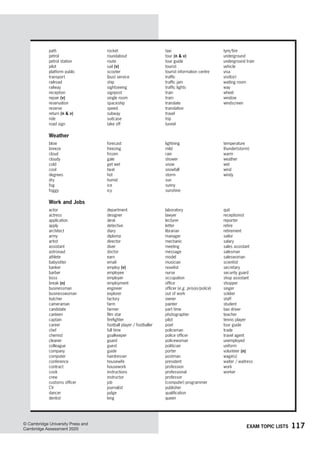
EXAM TOPIC LISTS
Clothes and Accessories
backpack go (with/together) perfume sweater
bag (phr v) plastic swimming costume
belt handbag pocket swimsuit
blouse handkerchief pullover take off
boot hat purse tie
bracelet jacket put on tights
button jeans raincoat tracksuit
cap jewellery / jewelry ring trainers
chain jumper sandal trousers
clothes kit scarf T-shirt
coat knit shirt try on
collar label shoe umbrella
cotton laundry shorts underpants
dress leather silk underwear
earring make-up size undress
fashion match (v) skirt uniform
fasten material sleeve(less) wallet
fit (v) necklace socks watch
fold (v) old-fashioned (adj) stripe wear (out)
get dressed pants suit wool(len)
glasses pattern sunglasses
glove
Colours
(dark/light/pale) gold orange silver
black golden pink yellow
blue green purple white
brown grey red
Communications and Technology
access
address
app
at!@
blog
blogger
by post
calculator
call (v)
call back
CD (player)
cell phone
chat
chat room
click (v)
computer
connect
connection
data
delete
dial
dial up
digital
digital camera
disc/disk
dot
download (n & v)
drag
DVD (player)
electronic(s)
email
engaged
enter
envelope
equipment
fax
file
hang up
hardware
headline
homepage
install
internet
invent
invention
IT
keyboard
laptop (computer)
machine
message
mobile phone
mouse
mouse mat
MP3 player
net
online
operator
parcel
password
PC
phone
photograph
photography
podcast
postcard
print
printer
program(me)
reply
ring
ring up
robot
screen
server
sign up
smartphone
social media
software
switch off
switch on
talk
telephone
text
text message
turn off
turn on
upload (n & v)
video clip
volume
web
web page
website
Education
absent
advanced
arithmetic
art
beginner
bell
biology
blackboard
board
book
bookshelf
break up
break(time)
certificate
chemistry
class
classroom
clever
coach
college
composition
course
curriculum
degree
desk
dictionary
diploma
drama
economics
elementary
essay
geography
EXAM TOPIC LISTS
102 © Cambridge University Press and Cambridge Assessment 2020 Photocopiable
Reading Part 1
Read the sentences about Reading Part 1. Are the sentences TRUE or FALSE?
1. In this part of the exam, you have to read short notices, signs and messages and choose the correct
meaning. ........................
2. The texts you read will all be the same kind of text. ........................
3. There are five texts and no example. ........................
4. There are three possible answers to choose from for each text. ........................
5. Sometimes there is a question before the three options, sometimes the three options complete the sentence
and sometimes there are just the three options. ........................
6. There is visual information, such as a picture, with every text. ........................
7. To understand the meaning, it is important to think about the situation in which each text would appear,
e.g. as a notice on a wall, or as an email. ........................
8. It is also important to think about the purpose of the text, e.g. who it is for and why someone has written it.
........................
Think about it
Reading Part 2
Read the information about Reading Part 2. Complete the information with the words in the box.
all eight five match people points suitable text
In Part 2, you have to (1) ........................ people to different products, places or activities. There are (2) ........................
short descriptions of people, saying what they each want, need or are interested in. There are (3) ........................
descriptions of products, places or activities, so there are three that you don’t need to match. It’s a good idea
to read the descriptions of the (4) ........................ first and note what each one is looking for. Each person
will mention three key (5) ........................ that they are looking for. Then you can read the descriptions of the
products, places or activities and find the one that is the most (6) ........................ for each person. Some
points are mentioned in more than one (7) ........................ , but it’s important to find the text that mentions
(8) ........................ the key points a person is looking for.
Think about it
THINK ABOUT IT
Practise vocabulary, grammar or functional language tested
in the exam using the additional tasks on the worksheet.
Use Think about it sections to check students understand
what they need to do for each part of the exam – great either
before or after attempting an exercise.
Help your students avoid the
most typical mistakes that
candidates make with Get
it right! Identify and correct
common errors made by
real Cambridge English: B1
Preliminary and Cambridge
English: B1 Preliminary for
Schools exam candidates.
What other features are there?
Exam tips provide practical strategies and advice on how to
approach the task.
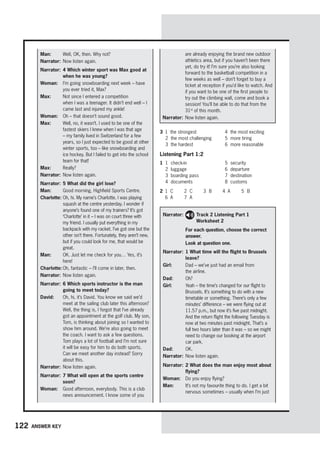
118 ANSWER KEY
Reading Part 1:1
1a 1 Is the sun shining at the moment?
2 Why are you studying English this year?
3 How often do they meet their friends?
4 Are you looking forward to next weekend?
5 Does she like watching films?
6 Where does your brother live?
1b 1 d 2 c 3 e 4 b 5 a 6 f
2 1 wake up, awake
2 have, morning
3 clean, routine
4 leave, late
5 go, buy
6 go, weekend
3 1 C 2 B 3 A 4 B 5 A
Reading Part 1:2
1 1 up
5 out
2 in
6 back
3 over
7 together
4 out
8 out
2 1 a 2 b 3 a 4 a
5 b 6 b 7 a 8 b
3 1 C 2 C 3 B 4 C 5 A
Reading Part 1:3
1 1 club
2 hobby
3 dancing
4 festival
5 sightseeing
6 galleries
7 sunbathing
8 magazine
9 photography
10 member
2 1 Do you agree that
2 not sure, because
3 What I mean is
4 that’s an interesting point
5 like I said
6 What do you think about this
7 going back to
8 On a completely different subject
3 1 C 2 A 3 B 4 A 5 B
Get it right!
I’m writing to you because last week I started a
new English course in the same school.
Reading Part 2:1
1 1 heart, beats
2 doctors, fit
3 dangerous, rugby
4 break, ambulance
5 sick, medicine
6 injury, rest
2 1 have to
2 shouldn’t
3 needn’t
4 mustn’t
5 ought to
6 should
3 1 C 2 D 3 E 4 H 5 G
Reading Part 2:2
1 1 drama
2 stage
3 order
4 horror
5 sculptures
6 videos
2 1 Where did you go on holiday last year?
2 No, she’s just left.
3 I’ve already done it.
4 When did you move to this town?
3 1 F 2 G 3 A 4 H 5 C
Reading Part 2:3
1 1 resort
2 facilities
3 accommodation
4 reservation
2 1 arrived
2 ’re / are having
3 ’ve / have already
done
4 went
5 haven’t seen
3 1 G 2 B 3 A 4 D 5 C
Get it right!
Yesterday I bought some clothes.
Reading Part 3:1
1 1 office
2 guest-house
3 prison
4 hospital
5 factory
6 cottage
2 1 the way to
2 Turn
3 in front
4 is it far
5 straight on
6 on
3 1 C 2 D 3 C 4 A 5 B
Reading Part 3:2
1 1 climate
2 public transport, pollution
3 rubbish, recycle
4 bottle bank
2 1 B
2 D
3 D
4 B
5 A
3 1 ’s / is going to rain
2 will be
3 ’s / is going to fall
4 will not / won’t mind
5 ’m / am going to fail
6 ’ll / will come
Reading Part 3:3
1 1 to
2 of
3 for
4 at
5 in
6 of
7 on
8 for
2 1 C 2 C 3 D 4 A 5 B
3 1 team
2 coach
3 competition
4 take part
5 win
6 stadium
7 competitors
8 trained
Get it right!
I’m sure that you will have a great holiday here.
Reading Part 4:1
1 1 Maths is my favourite subject.
2 Sam is often late for appointments.
3 Photography is a very popular hobby.
4 Mrs Edwards usually teaches us.
5 This work isn’t good enough.
6 Miss Jones isn’t as strict as Mr Brown.
7 The test was too difficult for me.
ANSWER KEY
Learn and
revise from
the official B1
Preliminary
and B1
Preliminary
for Schools
topic lists.
Access a
complete
Answer
key and
Audioscript.
8 © Cambridge University Press and
Cambridge Assessment 2020
EXAM OVERVIEW
Part Number of
questions
Number of
marks
Task type What do candidates have
to do?
Reading
1 5 5 3-option
multiple choice
Read five real-world notices,
messages and other short texts for the
main message.
2 5 5 Matching Match five descriptions of people to
eight short texts on a particular topic,
showing detailed comprehension.
3 5 5 4-option multiple
choice
Read a longer text for detailed
comprehension, gist, inference and global
meaning, as well as writer’s attitude and
opinion.
4 5 5 Gapped text Read a longer text from which five
sentences have been removed. Show
understanding of how a coherent and ­
well-
structured text is formed.
5 6 6 4-option multiple
choice cloze
Read a shorter text and choose the
correct vocabulary items to complete gaps.
An element of grammatical knowledge may
be tested, e.g. complementation.
6 6 6 Open cloze Read a shorter text and complete six
gaps using one word for each gap. Show
knowledge of grammatical structures,
phrasal verbs and fixed phrases.
Total 32 32
Part Number of
questions
Number of
marks
Task type What do candidates have
to do?
Writing
1 1 20 An email Write about 100 words, answering
the email and using the notes provided.
Candidates are assessed using four
subscales: Content, Communicative
Achievement, Organisation and Language.
2 1 20 Choice between
an article or a
story
Write about 100 words, answering the
question of their choosing. Candidates are
assessed using four subscales: Content,
Communicative Achievement, Organisation
and Language.
Total 2 40
Exam overview
Reading tasks
Writing tasks
45 mins
45 mins
9
© Cambridge University Press and
Cambridge Assessment 2020
Part Number of
questions
Number of
marks
Task type What do candidates have
to do?
Listening
1 7 7 3-option
multiple choice
Identify key information in seven short
monologues or dialogues and choose
the correct visual.
2 6 6 3-option
multiple choice
Listen to six short dialogues and
understand the gist of each.
3 6 6 Gap fill Listen to a monologue and complete
six gaps.
4 6 6 3-option multiple
choice
Listen to an interview for a detailed
understanding of meaning and to identify
attitudes and opinions.
Total 25 25
Part Timing Interaction Task type What do candidates have
to do?
Speaking
1 2 minutes Interlocutor
Candidate
Interlocutor asks
questions to
each
candidate in turn
Respond to questions, giving factual or
personal information.
2 3 minutes Candidate
extended turn
Extended turn Describe one colour photograph,
talking for about 1 minute.
3 4 minutes Candidate
Candidate
Discussion
task with visual
stimulus
Make and respond to suggestions,
discuss alternatives and negotiate
agreement.
4 3 minutes Candidate
Candidate
General
conversation
Discuss likes, dislikes, experiences,
opinions, habits, etc.
Total 30
Exam overview
Listening tasks
Speaking tasks
about 30 mins
12–17 mins
(plus 6 minutes to transfer answers)
Converting Cambridge English: B1 Preliminary and B1 Preliminary for Schools
practice test scores to Cambridge English Scale scores
10
Cambridge English: B1 Preliminary and B1 Preliminary for Schools are
now reporting results on the Cambridge English Scale. For these
exams, candidates receive an individual score for each of the four
skills – Reading, Writing, Listening and Speaking. In the live exams,
each of the skills is equally weighted, and a candidate’s overall score
is calculated by adding all of the individual scores together and
dividing by four (and then rounding to the nearest whole number).
A candidate’s grade and CEFR level are based on their performance
across the whole test, and there is no requirement to achieve a
minimum score in each paper.
The following tables can be used as guidance to help you convert
practice test scores to Cambridge English Scale scores.
Please note that these only apply when using official Cambridge
practice tests.
The conversion tables are intended to help you provide an
indication of your students’ readiness to take the relevant exam.
The scores you provide may not always reflect the results the
students may achieve in a Cambridge English live exam. They
should not be used to try to predict precise scores in the live
exam, but can be a useful diagnostic tool, indicating areas of
relative strength and weakness.
The scores needed on any given test to achieve the scores on the
Cambridge English Scale shown in the tables below will vary due
to a number of factors, so borderline scores need to be reviewed
carefully. The borderline is approximately three Cambridge English
scale score points above and below the score needed to achieve the
level, e.g. 137–143 for Level B1. Students who achieve only slightly
higher than the Cambridge English Scale score for a given level on
a practice test may not achieve that level in the live exam, and we
recommend that they continue working to improve so that they
reach the desired level.
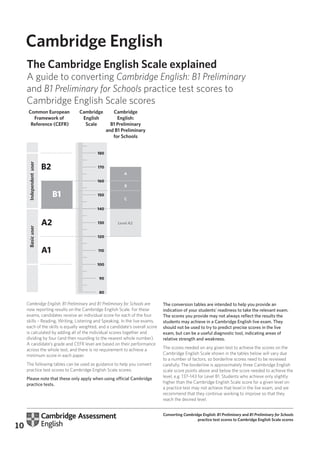
Common European
Framework of
Reference (CEFR)
Cambridge
English:
B1 Preliminary
and B1 Preliminary
for Schools
Cambridge
English
Scale
B1
B
C
A
90
80
100
110
120
130
140
150
160
170
180
190
200
210
Level A2
C2
C1
B2
A1
A2
Independent
user
Basic
user
The Cambridge English Scale explained
A guide to converting Cambridge English: B1 Preliminary
and B1 Preliminary for Schools practice test scores to
Cambridge English Scale scores
Converting Cambridge English: B1 Preliminary and B1 Preliminary for Schools
practice test scores to Cambridge English Scale scores
11
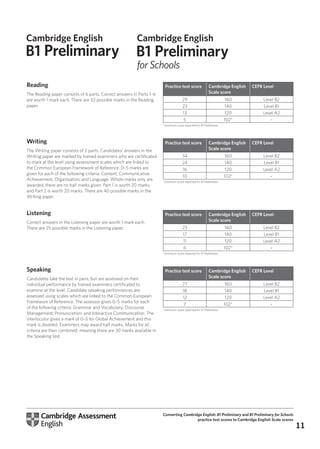
Practice test score Cambridge English
Scale score
CEFR Level
29 160 Level B2
23 140 Level B1
13 120 Level A2
5 102* -
*minimum score reported for B1 Preliminary
Practice test score Cambridge English
Scale score
CEFR Level
34 160 Level B2
24 140 Level B1
16 120 Level A2
10 102* -
*minimum score reported for B1 Preliminary
Practice test score Cambridge English
Scale score
CEFR Level
23 160 Level B2
17 140 Level B1
11 120 Level A2
6 102* -
*minimum score reported for B1 Preliminary
Practice test score Cambridge English
Scale score
CEFR Level
27 160 Level B2
18 140 Level B1
12 120 Level A2
7 102* -
*minimum score reported for B1 Preliminary
Reading
The Reading paper consists of 6 parts. Correct answers in Parts 1–6
are worth 1 mark each. There are 32 possible marks in the Reading
paper.
Writing
The Writing paper consists of 2 parts. Candidates’ answers in the
Writing paper are marked by trained examiners who are certificated
to mark at the level using assessment scales which are linked to
the Common European Framework of Reference. 0–5 marks are
given for each of the following criteria: Content; Communicative
Achievement; Organisation; and Language. Whole marks only are
awarded; there are no half marks given. Part 1 is worth 20 marks
and Part 2 is worth 20 marks. There are 40 possible marks in the
Writing paper.
Listening
Correct answers in the Listening paper are worth 1 mark each.
There are 25 possible marks in the Listening paper.
Speaking
Candidates take the test in pairs, but are assessed on their
individual performance by trained examiners certificated to
examine at the level. Candidate speaking performances are
assessed using scales which are linked to the Common European
Framework of Reference. The assessor gives 0–5 marks for each
of the following criteria: Grammar and Vocabulary; Discourse
Management; Pronunciation; and Interactive Communication. The
interlocutor gives a mark of 0–5 for Global Achievement and this
mark is doubled. Examiners may award half marks. Marks for all
criteria are then combined, meaning there are 30 marks available in
the Speaking test.
B1 B1
12 © Cambridge University Press and
Cambridge Assessment 2020
READING | PART 1 | 1
Reading PART 1 1
Daily life
Mostly a: You are definitely a creature of habit. You could try relaxing a bit and doing something different for a change.
Mostly b: Your habits and routines aren’t completely fixed. It’s great to have variety, but remember that routine can help
you to be organised.
Write questions. Use the present simple or present continuous.
1. the sun / shine / at the moment?
2. why / you / study / English / this year?
3. how often / they / meet / their friends?
4. you / look / forward / to / next weekend?
5. she / like / watching / films?
6. where / your brother / live?
Now match questions 1–6 in 1a to answers a–f.
a  Yes, either at the cinema or at home.
b 
Yes! I love Saturday and Sunday.
c 
Because it’s fun!
d  No, it’s cold and wet!
e  Every weekend.  
f       In London.      
1b
1a
2
Complete the quiz with the words in the box. Then answer the questions and read
the results.
awake buy clean go go have late
leave morning routine wake up weekend
1. Do you need an alarm clock to help you ............ in
the morning?
a) 
No, I’m usually ............ before my alarm goes off.
b)  
Yes. Without the alarm, I would just go on sleeping.
2. Do you always ............ the same thing for breakfast?
a)  
Yes, I don’t like making decisions in the ............ !
b) No, that would be boring!
3. Do you ever forget to ............ your teeth or brush
your hair in the morning?
a)  
No, they are part of my morning ............ , so I never
forget.
b) Yes, if I’m in a hurry.
4. Do you ............ home at the
same time every day for work or
college?
a)  
Yes, I don’t like being ............ .
b)  
No, sometimes I’m early and
sometimes I’m a bit late.
5. Do you ............ shopping on the same day each
week?
a)  
Yes, and I usually ............ the same things each
week.
b) No, it depends what I’m doing each week.
6. Do you usually ............ to bed at the same time
every night?
a)  
Yes, during the week, but not at the ............ of
course.
b) No, it depends what I’m doing each day.
Are you a creature of habit?
13
© Cambridge University Press and
Cambridge Assessment 2020
READING | PART 1 | 1
3
Look at the text in each question. What does it say? Choose the correct letter, A, B or C.
Bank opening hours
Monday – Friday 9 a.m. to 5 p.m.
Saturday – 9 a.m. to 11 a.m.
The cash machine outside is
in use 24 hours
1	
Thisweek’sfitnessclasswillbehalfanhourearlier,
at6.30p.m.,andinthesportshall,notthegym!Next
week’sclasswillbebackinthegymattheusualtime.
2
3	
4	
5	
A 
The fitness class will only last for half an hour
this week.
B 
There won’t be a fitness class next week.
C 
The fitness class will be somewhere different
this week.
What should Tara do?
A  buy coffee tomorrow
B  go shopping on her way home
C 
give Daisy some money to go to the supermarket
A 
You can’t go into the bank on Saturday
afternoons.
B 
The cash machine can only be used when the
bank is open.
C  The bank closes at the same time every day.
A 
Someone is mending the shower at the
moment.
B 
It isn’t possible to have a hot shower this
morning.
C  Max will have to take a cold shower tomorrow.
Why has Henry written the text?
A  to warn Mia that he may not be on time
B  to remind Mia about delays on the buses
C 
to ask which bus he should get to band practice
Tara, we’ve run out of
coffee! Can you get some
at the supermarket when
you’re coming back from
college this afternoon? I’ll
pay you back tomorrow.
Daisy
Max,
There’saproblemwiththeshower.Youcan’t
useitunlessyouwantacoldone!Someone’s
comingtofixitthisafternoon,soit’llbeOK
tomorrow.
Mum
Hi Mia,
I might be late for the band practice
tonight. I usually get the bus, but there are
lots of delays this week. See you later.
Henry
Exam task
• In this part, you read five short texts – for example, signs, notices and messages.
• You have to choose the option (A, B or C) that means the same as the short text.
Exam facts
14 © Cambridge University Press and
Cambridge Assessment 2020
READING | PART 1 | 2
Choose the correct words to complete the phrasal verbs.
1. I usually meet up / out / together with my friends at the weekend.
2. I’m tired, so I think I’ll stay up / in / into tonight.
3. Do you want to come out / over / away to my house later?
4. My family sometimes eat out / up / away. We like pizza restaurants.
5. Who does Max usually hang up / in / out with?
6. I was at a party last night and didn’t get back / out / to until late.
7. We often get in / out / together to watch a DVD.
8. Do you fancy going in / out / up tonight, maybe to the cinema?
Choose the best response.
1. I’ve bought you a ticket for the concert on Saturday.
a  Thank you. That’s very kind of you. b  Yes, please. That would be lovely.
2. Shall I meet you at the station?
a  It’s opposite the bus stop. b  Yes, good idea.
3. Do you fancy going ice skating on Friday?
a  I’m sorry, I can’t. I’m doing something else. b  Yes, it was great.
4. I’m sorry I’m late.
a  That’s OK. No problem. b  We can wait a bit longer.
5. Why don’t we go for a pizza later?
a  No, I don’t like it. b  Great idea!
6. Should I invite Emma to the party?
a  Yes, I’d love to. Thanks. b  No way! No one gets on with her.
7. Is it OK if my sister comes to the cinema with us?
a  Of course. That’s fine. b  It doesn’t matter.
8. Shall we meet up at the weekend?
a  No, sorry, I don’t want it. b  Yes, let’s do that.
2
1
Social interaction
Reading PART 1 2
15
© Cambridge University Press and
Cambridge Assessment 2020
READING | PART 1 | 2
• Read each short text and think about where and when you might see it.
• Read the options carefully. Don’t think an option is correct just because you see the same words
in the text.
• The correct answer has the same meaning as the text, but usually uses different words.
Exam tips
Exam task
3
Look at the text in each question. What does it say? Choose the correct letter, A, B or C.
	
2	
3	
4	
5	
What should Lucy do?
A 
get the bus to the football match with Emma
B 
ask Sam if he wants to come to the football
match
C 
meet Emma and Sam at the stadium at
5 o’clock
A  Guests should bring some food and drink.
B  Guests must dress up as a type of animal.
C 
Guests might win something if they wear a
costume.
You are invited to a
Jungle party on June 21 from 3 p.m.
Dress up in an animal costume if you want to –
a prize for the best one!
Food and drink provided.
Marcus
Don’t forget we’re going to the cinema this afternoon with
James. I’m not sure what film we’re going to see, but we can
decide when we get there.	 Jenna
Why has Jenna left a note for Marcus?
A  to remind him about an arrangement
B  to invite him to the cinema
C  to suggest a film which they could see
1
Music festival
15 August
Music includes rock and hip hop
Tickets:
£6 in advance
£8 on the day
A 
There will only be two types of music at
the festival.
B 
Some performances at the festival cost
more than others.
C 
Tickets are cheaper if you buy them before
the festival.
Lily,
Thanks for inviting me to your house next Saturday.
I’m afraid I can’t come because I’m going camping this
weekend. Maybe we can meet up when I get back?
Sara
Reply Forward
Why has Sara sent an email?
A  to accept Lily’s invitation
B  to ask Lily to go camping
C  to make an apology to Lily
Hi Lucy, The football match
starts at 5. I’m getting the
bus to the stadium. I’ll meet
you there at 4.30. Don’t
forget to invite Sam too.
Emma
16 © Cambridge University Press and
Cambridge Assessment 2020
READING | PART 1 | 3
Reading PART 1 3
Complete the speech bubbles with the words in the box.
club dancing festival galleries hobby magazine
member photography sightseeing sunbathing
Anna
Ilona
Ben
Lottie
Karl
Complete the dialogue with the phrases in the box.
do you agree that going back to like I said not sure, because
on a completely different subject that’s an interesting point
what do you think about this what I mean is
Sam: (1) ....................................................................................................
museums should be free for people to visit?
Ellie: I’m (2) ...............................................................................................
.............. they cost a lot of money to run. It seems fair that people should pay
something.
Sam: Yes, but museums shouldn’t only be for rich people. (3) .......................
.............................................................................. that everyone should be
able to visit them, even if they don’t have much money.
Ellie: Yes, (4) .................................................................................................... , and I agree with
you in some ways. But (5) .................................................................................................... before,
museums are expensive, and we can’t expect the government to pay the full cost. (6) ...........................
......................................................................... , Ana?
Ana: I’m not sure. I agree that someone has to pay to keep museums open, but (7) ...........................
......................................................................... what Sam said, it doesn’t seem fair that people who
don’t have much money can’t see these wonderful objects.
Sam: Thank you, Ana. (8) .................................................................................................... , do you
fancy watching a movie later?
2
1
Hobbies and leisure
I joined a chess (1) .......... last year and I really enjoy it now. It’s a great (2) ..........
because you have to really think about how to win. You also meet people.
I love (3) .......... to great music. My ideal weekend is going to a music (4) ..........
and seeing lots of new bands.
I love travel! My favourite activities are going (5) .......... and visiting museums and
art (6) ........ .
My ideal leisure activity is (7) .......... on a beach and reading a fashion (8) ........ .
So relaxing!
I’m quite a creative person. I bought a camera last year and took up (9) .......... . I’m not
interested in being a (10) .......... of a club, though. I’m quite happy to spend time on my own.
17
© Cambridge University Press and
Cambridge Assessment 2020
READING | PART 1 | 3
Get it right!
Look at the sentence below. Then try to correct the mistake.
I write to you because last week I started a new English course in the same school.
Exam task
3
Look at the text in each question. What does it say? Choose the correct letter, A, B or C.
1	
2	
3	
4
5	
Hi George, I’m going camping next
weekend, so can I borrow your tent? You
bought one last summer, didn’t you? If
you’ve got a small cooker, that would be
great, too. Thanks.
Josh
Why has Josh sent this message?
A 
to ask George to go camping with him
next weekend
B 
to tell George about a new tent he’s going
to buy
C 
to ask if George will lend him some
camping equipment
Ifyouenjoyplayingtheguitarandhanging outmaking
music,contactus,NeilandJoe.Noplanstoplayasaband -
wejustrelaxandplay!
Call 07796 245798
Call this number if you want to
A  play music with others
B  learn the guitar
C  join a band
A  The stamps are all very old.
B  Some of the stamps are very unusual.
C  You can buy just a few of the stamps.
Stamp collection for sale
Over 12,000 stamps from a
range of countries
Some antique and rare items
On offer as a collection only,
not as individual items
Subject: Picnic
Everyone welcome – just meet at the park at 2.30 on
Saturday. Bring something for the barbecue – drinks
provided. Bring your best pictures to share. See you there!
Tom
Reply Forward What should club members do?
A  come to the picnic with food to cook
B  take lots of photos at the picnic
C  tell Tom if they want to go to the picnic
To: Photography club members
A  There will be five workshops each week.
B 
You don’t have to be talented to go to the
workshops.
C 
The final workshop is on Saturday
15 September.
Art workshop
Saturdays 10.30 – 12.30
From 15 September for 5 weeks
Suitable for all abilities
18 © Cambridge University Press and
Cambridge Assessment 2020
READING | PART 2 | 1
Reading PART 2 1
Complete the statements with the words in the box.
ambulance beats break dangerous doctors fit
heart injury medicine rest rugby sick
1. If your ..................... is healthy, it usually ..................... around 70 times per minute.
2. According to ..................... , you should exercise for an hour a day to keep ..................... .
3. Horse-riding is a more ..................... sport than ..................... or football.
4. If you ..................... your arm, you should call an ..................... to take you to hospital immediately.
5. If you feel ..................... after eating something, you should go to a pharmacy to get some
..................... .
6. If an ..................... is painful, you should always ..................... the part of your body that’s hurt.
Choose the correct modal verbs to complete the health advice.
1. I’m sorry, you can’t see the doctor today. You have to / mustn’t make an appointment.
2. You don’t have to / shouldn’t eat if you have stomach ache, but it’s important to drink.
3. You needn’t / should worry – it isn’t a very serious operation.
4. It’s important to rest. You don’t have to / mustn’t do anything for a few days.
5. I think you’ve got a fever. You ought to / shouldn’t see a doctor.
6. You don’t have to / should drink lots if you have a cold or a sore throat.
2
1
Health, medicine and exercise
Exam task
3
The people below all want to join a sports class. On the next page there are descriptions of
eight classes. Decide which class would be the most suitable for the following people. For
1–5 write the correct letter A–H.
Chloe enjoys team sports but doesn’t want to play in competitions. She needs a
morning class. She doesn’t have much money and can’t afford to buy expensive
equipment.
1
Mike isn’t very fit. He would like to get fitter, but he finds exercise boring. He’s
looking for an evening class that is different every week. He’d also like to see how
he is improving over time.
2
Sofia loves sport but is recovering from a serious injury. She wants to train in the
afternoon with someone who understands her injury and can give her advice on
exercises she can do at home.
3
Jack is very fit and is planning a challenging 200 km run. He wants to train at least
twice a week and would like some personal training too. He wants to train indoors
and outdoors.
4
Tara takes sport seriously. She plays hockey and tennis and wants to improve her skills
and take part in competitions. She isn’t free from Monday to Friday.
5
19
© Cambridge University Press and
Cambridge Assessment 2020
READING | PART 2 | 1
• In this part, you read descriptions of five people.
• You also read eight texts on the same topic.
• You have to match what each person requires to one of the eight texts.
Exam facts
A Sport for life
Weekly sessions in seven different sports,
including squash, tennis and basketball. Do
your favourite sport or try new ones each
week. Classes take place on Thursdays
3–4 p.m. and Sundays 2–3.30 p.m. in Green
Park and in the Park Gym. We don’t believe
in winners and losers, just in having fun!
C  Active plus!
This is a great class for people who enjoy playing sport
with others in an informal way. Choose from a range of
sports, including 5-a-side football and hockey. Classes
are on Saturdays from 9–11 a.m. We provide balls,
hockey sticks, etc. and a monthly report on how your
fitness is improving.
E  Fitness for all
If you’re looking for a gentle, low-cost exercise
class, Fitness for all offers exercises to
improve your strength and confidence slowly.
Our trainers are qualified to help with individual
problems and can give you extra ideas to try
outside the class. No equipment necessary.
Classes: every Tuesday from 2 to 4 p.m.
G  Rising stars
We believe sports are for winners! We offer
training from professional sports coaches
to help you become a more successful
player. Choose from a range of team and
racket sports. Players are encouraged to join
local and national leagues. Classes: every
Saturday and Sunday, or book an individual
lesson with one of our trainers.
B  Top training
Our club offers individual training
sessions in the gym, with a personal
trainer. The class is ideal for people who
enjoy training alone and are keen to
improve their fitness, or people who have
particular difficulties with their fitness.
Classes: every morning 9–11 a.m.
D Water-cise!
Have fun and get fit at your local sports
centre! Classes every Tuesday and
Thursday from 6–8 p.m. No two classes
are the same! We organise regular
competitions and also offer individual
fitness checks every month, plus the
chance to gain progress certificates.
F Sport for all
This class is for people who want to take up
a sport such as football or tennis for the first
time. It’s a great way to get fit in the fresh
air. Classes start with training exercises,
followed by a game or small tournament.
Classes: every Tuesday and Thursday,
6–8 p.m. All equipment provided.
H  Go for it!
This is a class for people who want to push
themselves so they can compete against other
people or themselves! Training takes place every
Tuesday, Thursday and Saturday. Classes involve
a one-hour run in the park, followed by weight
training in the gym. Individual coaching and
advice on improving fitness at home are also
available.
Sports classes
20 © Cambridge University Press and
Cambridge Assessment 2020
READING | PART 2 | 2
Reading PART 2 2
Complete what the people say with the words in the box.
drama horror order sculptures stage videos
Lily	
“ I’m really into (1) .......... , so I love being in plays. It feels great being up on the (2) .......... in
front of lots of people. I don’t want to do it as a job, but it’s fun to do in your free time! ”
Jamie	
“ I often organise a movie night at the weekend. I invite a few friends and we (3) .......... a
takeaway. My favourite films are (4) .......... movies, especially really scary ones! ”
Rosie	

“ I’m quite creative, so I do a lot of art classes in my free time. I don’t like painting, but I love
making (5) .......... out of wood. I also make my own five-minute (6) .......... , which I put online
for friends to watch.”
Write the questions and answers. Use the present perfect or past simple.
1.	A: where / you go / on holiday / last year? ...................................................................................
	B: I went to Spain.
2. A: Is Martha still here?
	B: No, she / just / leave ..............................................................................................................
3. A: Don’t forget to order the tickets online.
	B: It’s OK. I / already / do / it ......................................................................................................
4.	A: when / you / move / to this town? ...........................................................................................
	B: It was about two years ago.
2
1
Free time
Exam task
3
The people below all want to find a new free-time activity. On the next page there are
descriptions of eight clubs. Decide which club would be the most suitable for the following
people. For 1–5 write the correct letter A–H.
2
Marco loves making things, and he enjoys meeting people from other cultures. He
would like to learn a skill that he can use outside the class.
3
Amina is interested in serious issues. She enjoys listening to talks and learning
about life in other countries. She would also like to discuss her ideas and opinions
with other people.
4
Niko enjoys going to different places and meeting people from different
backgrounds. He’s also keen to find out about the place where he lives. He’s
especially interested in history.
1
Emma loves using her imagination in a creative way. She loves working on projects
with other people, and she would like to visit places and see creative people at
work.
5
Erica is keen to help other people. She enjoys events where there are crowds
of people. She wants to learn skills she can use in a job when she finishes her
studies.
21
© Cambridge University Press and
Cambridge Assessment 2020
READING | PART 2 | 2
• Read the descriptions of the five people quickly and underline the most important information.
• The same information is often written using different words or phrases in the descriptions and
the texts.
• Make sure the text you choose matches all the requirements in the person’s description.
Exam tips
A Think!
Do you want to know more about international
events? We meet once a week for an informal
discussion. Each week we watch a film from
around the world and/or invite speakers
to help us understand recent events. At our
next meeting we are showing a film about
earthquake rescue teams.
C  Party Plus
At Party Plus, we are looking for new people to help us.
We organise street parties and concerts to raise money
for local charities. It’s challenging work, and you have to
work with a wide range of people, but you’ll have a lot to
offer future employers and you’ll make a difference!
E  Nature lovers
Are you interested in nature? Our group has
been exploring the wildlife of the city for over
100 years! We organise talks from experts on
the animals and plants around us. We also work
in small groups to think of ways to improve life
for the animals and people in our city!
G  A world of food
We can teach you to prepare delicious
dishes! Our trainers come from five
countries, and they love to share their
recipes and the history of their cultures. This
class will teach you how to create wonderful
food in your own kitchen. You never know,
you might decide to become a professional
chef one day!
B  Games and chat
We meet once a week to play computer games.
We give our views on new games and talk about
games past and present. We also organise trips to
game shows to see how designers come up with
new ideas and create new games. You’ll discover a
whole new world!
D  Come dine with me
We meet regularly to visit restaurants and
enjoy eating delicious food from all over
the world. We also invite chefs from other
countries to tell us about how food is grown
and prepared where they come from. There’s
usually quite a large group of us, so it’s a
wonderful way to meet people.
F Action!
We are a film club, but we don’t watch
films – we make them! We’re always
looking for new people with interesting
ideas. You will do activities in small
groups, so it’s a great way to learn new
skills and make friends. We also organise
regular trips to film studios to see how the
professionals do things.
H  City explorers
Get out and about with City explorers! We
explore our own city and produce information
guides so that visitors can enjoy it too. We also
produce maps of the city, past and present,
showing how it’s changed. We often get
together with groups from other towns and
cities to compare information and experiences.
Activity clubs
22 © Cambridge University Press and
Cambridge Assessment 2020
READING | PART 2 | 3
Reading PART 2 3
Complete the holiday advice with the words in the box.
accommodation facilities reservation resort
I’m going on holiday to Turkey in two weeks and staying at the Bright Sands holiday (1) ....................... .
I haven’t been before. Any advice?
• I went last year and loved it. It’s got great (2) ....................... , especially the swimming pools!
• If you’re expecting luxury (3) ....................... , you may be disappointed. But the rooms are all clean.
• If you booked online, check your (4) ....................... before you go. There was a problem with mine.
Complete the email with the correct form of the verbs in brackets. Use the present
continuous, past simple or present perfect.
2
1
Travel and holidays
Hi Beth,
Joe and I (1) ........................................ (arrive) in New York three days ago, and we
(2) ........................................ (have) a great time here. We (3) ........................................
(already / do) quite a lot. Yesterday we (4) ........................................ (go) up the Empire State
Building – amazing! We (5) ........................................ (not see) a show on Broadway yet, but
we’ve got tickets for tomorrow.
Abbie
Reply Forward
Exam task
3
The people below all want to go on holiday. On the next page there are descriptions of
eight holidays. Decide which holiday would be the most suitable for the following people.
For 1–5 write the correct letter A–H.
1
George wants a holiday with a big group of friends. They are into sports and want
to do different things every day. He doesn’t like boats, and some in the group have
young children.
2
Ana loves to be near the sea. She wants to visit different places, but she also wants
to keep away from holiday resorts. She enjoys being active and learning
new skills.
3
Harry just wants to relax and have fun by the sea. He loves going out and wants to
meet other people. He wants a cheap hotel and would prefer to pay for everything
together.
5
Greg doesn’t like crowded beaches and wants a peaceful holiday where there aren’t
many people. He enjoys walking in the countryside and is happy to spend some
time alone with a good book.
4
Jess wants to travel abroad and learn about a different way of life. She wants to
stay with local people, not in hotels. She would also like to see some
performances.
23
© Cambridge University Press and
Cambridge Assessment 2020
READING | PART 2 | 3
Get it right!
Look at the sentences below and choose the correct one.
Yesterday I've bought some clothes.
Yesterday I bought some clothes.
A  Golden Sands Beach Club
There’s lots to do at the Golden Sands Beach
Club in Mallorca. It’s a holiday you can afford.
Enjoy wonderful beaches and swimming in the
Mediterranean or take trips to nearby villages!
Then enjoy shows and make friends at the
social activities in the evening. All meals and
drinks are included in the price!
C  Forest camp
Get away from it all at Welldale Forest. Stay on a local
working farm or in cabins in the forest. Join in farm
life or explore the many paths through the forest with
our friendly guides. For those who prefer to relax,
you can just enjoy time on your own listening to the
sounds of the forest.
E Seaview Hotel
Enjoy a week at this wonderful, small,
luxury hotel in Spain. The price includes all
food and drinks, and the facilities include
a swimming pool, tennis courts and a
restaurant. We organise trips to plays and
concerts in the evenings. There’s also a
beach where you can sit quietly and relax
or read!
G  Active fun
Looking for an active holiday? This
wonderful busy holiday resort offers
tennis, swimming, golf and lots more.
There’s something for everyone. Lessons
are available, so you can learn something
new, whether you’re 5 years old or 55!
Fun for all the family! Price includes
accommodation and breakfast.
B  Making waves
Our learn-to-sail holiday in Greece will teach you all
the basics of sailing. You’ll be busy but will still have
time to enjoy the silence of the open sea. We stop
at a small harbour every night where you can enjoy
local food in small restaurants, before sleeping on
your boat. Price includes accommodation but not
food.
D  Culture shock
Get away from the usual tourist destinations
and visit India. On this tour, you’ll visit seven
cities, see the famous Taj Mahal and enjoy
time at a beach resort. You’ll stay with families
and experience daily life with them. A full
programme of cultural events includes some
amazing dance shows!
F Hotel on the sea
Enjoy two weeks of luxury on this cruise
around the Mediterranean visiting seven
popular destinations. Relax in the sunshine
by the ship’s swimming pool. You won’t get
bored, as there are cinemas, tennis courts
and a theatre on board, plus plenty of social
activities in the evening.
H On foot
Do you love walking? Try this walking tour in the
mountains of Italy. Each day, you will walk with an
experienced guide as part of a group of walkers,
then spend the night as guests of local people. It’s
a great way to see some beautiful countryside and
make new friends.
The best holidays
24 © Cambridge University Press and
Cambridge Assessment 2020
READING | PART 3 | 1
Reading PART 3 1
Put the letters into the correct order to make words. Then match them to the definitions.
oiffce psorin hlostipa ctotgae fcatyor gtues-hsoue
1. a room or building where people work at desks ........................
2. a small hotel that is not very expensive ........................
3. a building where people are sent if they have committed a crime ........................
4. a building where people go if they are ill ........................
5. a building where people make things, often using machines ........................
6. a small attractive house in the country ........................
1
Places and buildings
Choose the correct words to complete the mini dialogues.
2
Exam task
3
Read the text and the questions below. For each question, choose the correct answer.
Want to sleep under the sea? The company Planet Ocean
has plans for an exciting underwater hotel, which they
hope to build in locations all over the world.
The hotel won’t be large, with only 12 guest rooms,
plus a restaurant. Guests will get to the hotel in a
lift – so no diving or getting wet! The hotel will float
10 metres under the ocean, although it will be attached
to the sea bed to prevent it from moving too far.
Because it won’t be very deep under the water, the sun
will shine down and provide light. Guests will get great
close-up views of the fish and other sea creatures,
which won’t be bothered by the hotel and so won’t
make any effort to avoid it.
The hotel’s design, with clear plastic walls, means guests
will be able to see the sea and all the creatures that live
there around, above and below them in their rooms.
They will almost get the feeling that they are swimming
in the ocean. The luxury rooms will have a shower, TV
and even the internet. The restaurant will serve high-
quality meals. As you might expect, Planet Ocean want
to encourage people to eat less fish, so guests won’t
find any on the menu. What’s more surprising is that the
atmosphere will be silent, so guests will have to imagine
the sound of the ocean around them.
The hotel won’t be cheap to build and it won’t be cheap
to stay in. But the designers are especially proud of
the fact that it will be environmentally friendly. It will use
electricity, of course, but it will produce its own, and
won’t disturb ocean life at all. In fact, the designers
hope some sea creatures will build their homes on
parts of the building, which will bring real benefits to the
underwater world.
Planet Ocean’s future designs include a moving hotel. It
perhaps sounds like this will work in the same way as a
cruise ship, but this is not the case. In fact, rather than
moving between continents and countries, it will stay
within a single country’s waters, but only occasionally
change positions around its coast.
A hotel under the sea
1. A: 
Excuse me, can you tell me (1) the way to / how far for the station?
B: 
Yes, sure. (2) Take / Turn left at the traffic lights and you’ll see the station (3) in front / by
front of you.
2. A: Excuse me, (4) is it far / can you direct to the museum?
B: 
No. Just go (5) straight off / straight on for about half a kilometre and the museum is
(6) on / at your right.
25
© Cambridge University Press and
Cambridge Assessment 2020
READING | PART 3 | 1
• In this part, you read a text that includes feelings, attitudes and opinions.
• You have to choose the correct answer (A, B, C or D) for five questions.
Exam facts
1	 What do we learn about the hotel?
	A	Guests will have to swim down to get to it. 
	B	
Its lights will shine into the sea so guests can see the fish.
	C	It will only have a small number of rooms.
	D	
Fish and other sea creatures will be scared of it.
2	 What might guests find strange about staying at the hotel?
	A	swimming from their rooms into the ocean
	B	having ocean life in their room
	C	enjoying a meal of freshly caught fish
	D	being unable to hear the ocean
3	 What is the best thing about the hotel, according to the designers?
	A	It won’t cost much to build.
B	It won’t use much electricity.
C	It won’t cause any damage to the environment.
D	Fish and other sea creatures won’t come very close to it.
4	 Planet Ocean’s moving hotel will
	A	rarely move from one site to another.
	B	travel between various countries.
	C	be similar to a type of cruise ship.
D	
remain close to the coast of each continent.
5	 What might a guest in this hotel say?
A		 B
C	 D
It’s very expensive, but the
facilities are quite basic and the
windows are too small to see
outside.
Seeing the fish up close is
amazing, but it’s a shame that
the hotel disturbs sea life.
It’s a great idea, and I love the fact
that it can move around and travel to
different locations.
It’s great to stay in such a beautiful
hotel that is also good for the planet.
26 © Cambridge University Press and
Cambridge Assessment 2020
READING | PART 3 | 2
Reading PART 3 2
Complete the sentences with the words in the box.
bottle bank   climate   pollution   public transport   recycle   rubbish
1. I think that .................. change is a really serious problem and everyone needs to do more to
prevent it.
2. I use .................. such as buses and trains. I try to avoid driving because it causes air .................. .
3. I don’t throw paper into the .................. bin. I always .................. it, to reduce the number of trees
that are cut down.
4. I always take glass bottles to the .................. . It’s important to use glass again.
1
Environment
• The writer may be writing about their own experiences, or about someone or something else.
• The questions ask about the writer’s feelings and opinions, not what you think.
• To find the answer to the last question, you need to read in more than one place in the text.
Exam tips
Exam task
2
Read the text and the questions below. For each question, choose the correct answer.
Cruises are becoming more and more popular, with
around 20 million passengers per year now enjoying
holidays on board luxury ships. Many people see a
cruise as the perfect way to sit back and do nothing,
and enjoy time off work. Everything you could possibly
need is within easy reach. On board, there are shops,
theatres, cinemas, swimming pools and leisure centres.
There are more facilities, in fact, than most towns offer
their residents. It’s therefore easy to see why they are
so popular. But what is the effect on the environment of
this trend?
Although it usually takes less energy for a vehicle
to move through water than over land, cruise ships
are often huge, with the biggest ones carrying up
to 6,000 passengers. Moving such large vehicles
requires enormous engines, which burn as much as
300,000 litres of fuel a day. One scientist has calculated
that cruise ships create as much pollution as 5 million
cars going over the same distance. Because they are
out at sea, they also burn dirtier fuel that isn’t allowed
on land. Unfortunately, no government has control over
the amount of air pollution out at sea.
Cruises also produce huge amounts of rubbish, and cruise
ships aren’t usually good at recycling. Waste water from
showers and toilets is usually poured directly into the sea
– as much per day as from a small town. Waste food from
restaurants isn’t put into the sea, but still causes problems
when brought back to the land.
Cruise ships also cause difficulties in the cities where
they stop. Popular destinations can get five or six ships
per day, with thousands of tourists at a time. Good for
restaurants? No. Restaurant owners complain that the
visitors look around for a few hours and then return to
their ship to eat. What’s more, the crowds can put off
other tourists, who complain that the streets are too busy.
Some towns have banned cruise ships or put a limit on the
number that can stop at the same time. People who care
about the environment worry that as the cruise industry
continues to grow, so too will the issues for our planet.
The price of a perfect holiday?
27
© Cambridge University Press and
Cambridge Assessment 2020
READING | PART 3 | 2
Complete the sentences with the correct form of will or be going to and the verb in brackets.
1. Look at those dark clouds. It ..................................... (rain).
2. I hope the concert ..................................... (be) good tonight.
3. That ladder doesn’t look very safe. I’m sure she ..................................... (fall).
4. Why don’t you borrow Jack’s camera? I’m sure he ..................................... (not mind).
5. I haven’t done any revision. I just know that I ..................................... (fail) my exam!
6. Are you going into town now? I ..................................... (come) with you, if that’s OK.
3
1	 What is the writer trying to do in paragraph 1?
	A	
persuade people to go on cruise ships
	B	
explain why cruise ships have become so
popular
	C	
compare cruise ships with a typical holiday
resort
	D	
describe how the services cruise ships offer
have changed
2	 One reason cruise ships cause a lot of air
pollution is because
	A	
they carry large numbers of cars as well as
passengers.
	B	
their engines are not as efficient as those of
other ships.
	C	
it takes more energy to move through water
than over land.
	D	
they use types of fuel that are not permitted
on land.
3	 What do we learn about the waste products on
cruise ships?
	A	
All the waste products are carried back to shore.
	B	
Waste food is often thrown away at sea.
	C	
Most cruise ships recycle their waste products.
	D	
An enormous amount of the waste water
isn’t recycled.
4	 How do some people feel about the cruise ship
passengers who visit their cities?
	A	
surprised that they are rude to other
tourists
	B	
annoyed that they don’t spend money on
meals
	C	
happy that they fill up all the restaurants
	D 	
pleased to see so many visitors to the city
5	 Which best describes large cruise ships?
	A 
	B
	C
	D
They seem to offer ideal relaxing
holidays, but they aren’t environmentally
friendly.
They are becoming very popular and
they bring a lot of benefits, in spite of
their problems.

They used to cause a lot of pollution,
but things are improving now.
They cause pollution in the sea and on
land, so cities are planning to ban them
in the future.
28 © Cambridge University Press and
Cambridge Assessment 2020
READING | PART 3 | 3
Reading PART 3 3
Sport
Read the text and the questions below. For each question, choose the correct answer.
2
Exam task
Jamaica has produced some of the world’s best
athletes, including stars such as Usain Bolt and
Veronica Campbell-Brown. Is this success partly
due to one event – the Jamaica Schools’
Championships?
The four-day Championships have taken place
every year since 1910. Nearly 200 school
students take part in front of an audience of
over 30,000 people. The event is also shown
on live TV, and the whole country watches what
is sometimes called Jamaica’s mini-Olympics.
The competitors take it very seriously, and
they all want to win. Classmates and former
students also come to support and encourage
their schools.
School coach Dwayne Simpson has trained many
young stars. He believes the Championships have
an important role in the development of young
athletes. They are the biggest schools’ competition
in the world, he says, and other countries are now
looking to copy them. He also believes that the
Championships give young athletes a reason to
practise. They want to do well for their school, so
they work and train together as a team, so they
produce better results.
The Championships have turned many young students
into stars, but those who are most talented as adults
don’t always win as young teenagers. Olympic gold
medallist Usain Bolt, for example, failed to win a
single race at the Championships as an under-15
runner. Olympic champion Veronica Campbell-Brown
was always easily beaten in the lower-age groups
before finally winning as an older student.
Nathaniel Day, a young runner from Britain, has
studied and trained in Jamaica for the last two years.
‘Young athletes here get experience of being on TV
from the age of 12,’ he says, ‘so when they’re older,
they aren’t scared of big occasions and they perform
well. In the UK, athletes don’t perform in front of the
cameras until they’re adults, and sometimes they
find it hard to deal with.’ According to Nathaniel,
the Championships also give young athletes a goal.
‘Because it’s such a big event, it gives them an
idea of how exciting it is to perform in an Olympic
stadium. It helps them develop the ambition to
become champions.’
Athletics in Jamaica
Choose the correct preposition to follow each adjective.
1. Netball is similar with / of / to basketball.
2. You should be ashamed for / from / of yourself for
cheating in the game!
3. The city of Manchester is famous of / for / from its
football teams.
4. We were very surprised at / from / for the result.
5. Are you interested for / in / with keeping fit?
6. Hurry up – I’m tired of / from / with waiting for you!
7. I’m not very keen of / on / for sport.
8. Who is responsible for / with / about organising the event?
1
29
© Cambridge University Press and
Cambridge Assessment 2020
READING | PART 3 | 3
1	 What does the text say about the Championships?
A	
Thirty thousand people watch them on TV.
B 	
Young athletes take part just to have fun.
C	
They started over 100 years ago.
D	
Some former students take part.
2	 What does Dwayne Simpson say about the
Championships?
A	
Other countries should try to hold a similar
competition.
B	They have grown too big in recent years.
C	
They encourage young athletes to do
their best.
D	Schools are always keen to do well.
3	 In paragraph 4, what does the writer say about
Jamaica’s Olympic champions?
A	
They could beat even the oldest students in
some races.
B	
They occasionally lost races, but only to
much older students.
C	
They tried much harder after losing all their
races as teenagers.
D	
They took time to develop into world-class
athletes.
4	 According to Nathaniel Day, the event
A	helps young athletes get used to being filmed.
B	is more exciting than the Olympics.
C	
makes some young athletes feel nervous of
big occasions.
D	
is hard for some young competitors to
deal with.
5	 Which best describes the Jamaica Schools’
Championships?
A
B
C
D
Match the underlined words in the text to these definitions.
1. a group of people who work, train or
perform together .................
2. someone who teaches sports skills
.................
3. an event where people compete against
each other .................
4. join in with an event .................
5. be the best or get the best score in a game
or contest .................
6. a large building where sports events take
place .................
7. people who compete in a game or event
.................
8. taught sports skills to people .................
3
Look at the sentences below and choose the correct one.
I’m sure that you will have a great holiday here.
I’m sure that you have a great holiday here.
Get it right!
It’s an international competition which
prepares young athletes for the
Olympics.

It’s a local event which gives young
athletes the chance to perform in a
relaxed atmosphere.

It’s a huge social event which brings
people together to have fun.

It’s an important event which helps
young athletes to improve.
30 © Cambridge University Press and
Cambridge Assessment 2020
1
READING | PART 4 | 1
Reading PART 4 1
Put the words into the correct order to make sentences.
1. favourite / maths / my / subject / is
Maths
2. often / Sam / for / appointments / late / is
Sam
3. hobby / photography / popular / is / very / a
Photography
4. Mrs / usually / us / teaches / Edwards
Mrs
5. work / this / enough / isn’t / good
This
6. Mr Brown / strict / as / Miss Jones / as / isn’t
Miss Jones
7. too / test / the / for / was / difficult / me
The
8. work / checked / my / by / I / a friend / had
I
9. finished / we / eating / just / have
We
10. film / I / that / yet / seen / haven’t
I
1
Education
Exam task
2
Five sentences have been removed from the text on the next page. For each question,
choose the correct answer. There are three extra sentences which you do not need to use.
A	 So at least they can enjoy some parts of typical teenage life there.
B	 That means the school has become a tourist attraction too!
C	 These young players come here to train, of course.
D	 During the school day, therefore, they don’t go to some of these sessions.
E	 This has helped it to provide a better education for all its students.
F	 They are also expected to set a good example to younger students.
G	 Which is why there are far more of these students than ever before.
H	 After all, only the best ones go on to join the main team.
31
© Cambridge University Press and
Cambridge Assessment 2020
READING | PART 4 | 1
Find the words in the text to complete the collocation for each definition.
1. going to school ................ school
2. do what they really want to do follow their ................
3. continue to have good football careers ................ to have successful football careers
4. learn about lots of different subjects study a ................ of different subjects
5. do what is required by the rules ................ the rules
6. believe that they belong to the school ................ part of the school
7. show other people how to behave ................ a good example
8. give students better lessons and equipment ................ a better education
3
Can you imagine being a famous football star but still
attending school? That’s what some students at Ashton-
on-Mersey School in England do!
The school is about 7 km from Old Trafford, the
famous sports stadium that is home to Manchester
United Football Club. The club takes talented teenagers
from all over the world. (1).......... But even though
they are following their dreams of becoming sports
stars, football clubs recognise that education should
still be an important part of their lives. (2)..........
Although footballers can play professionally from the
age of 16, most don’t join professional teams until
they are older.
All football clubs have to make sure that players who are
under 18 are getting an education, but many choose to
do this by organising classes at the club. At Manchester
United, however, young players go to a normal school.
(3).......... That’s why at Ashton-on-Mersey School you
can see people who played against Arsenal or Liverpool
on Saturday sitting down to classes with all the other
students on Monday morning.
The Manchester United students have classes two days
a week and study a range of subjects. While attending,
they are encouraged to feel like they are part of the
school. They still follow the rules like all the other pupils
there. (4)..........
There are many benefits to the school from their
arrangement with Manchester United. The football club
has given money to the school. (5).......... Perhaps more
importantly, seeing successful young players in the school
can encourage younger students to try hard to do well and
achieve their own dreams. Successful players often return
to visit the school. When one French-speaking player came
back, the students were all keen to ask him questions
in French! Chatting to an international football star really
helped them improve their language skills.
Football stars at school
Exam facts
• In this part of the test, you read a text which had five gaps in it.
• Five sentences have been removed from the text.
• You have to read eight sentences and choose the correct sentence for each gap.
• There are always three extra sentences which you don’t need to use.
32 © Cambridge University Press and
Cambridge Assessment 2020
READING | PART 4 | 2
Reading PART 4 2
Match the descriptions to the places.
1. You can open an account here. a  charity shop
2. It’s often outdoors and you can often find bargains here. b  post office
3. The money you spend here helps other people. c bank
4. You go here to buy medicines and things for your health. d  department store
5. It might be self-service, or there might be a waiter. e market
6. You go here to keep fit. f  chemist
7. You go here to send a parcel. g  sports centre
8. You can buy clothes and other things in this big shop. h restaurant
Match a sentence from Column A with a sentence from Column B.
Column A	 Column B
1. The shop only opened three weeks ago. a 
They’re comfortable and quite reasonably
priced.
2. Customers had always complained about b Another is that it has new items on sale
the lack of staff. every week.
3. Many branches have closed in recent months. c 
Or maybe you prefer the popular stores
you see on most high streets.
4. I’ve always liked the clothes they sell. d 
So the company recently employed an
extra 20 people to deal with this problem.
5. One advantage is that the shop often opens e She said I could only try on a maximum of
until late. four things at a time.
6. Perhaps you only like shopping in small f  That’s why it still looks so new.
independent shops.
7. A sales assistant stopped me going into the g But it was worth it and looked good at the
changing room. wedding I went to last month.
8. I bought a dress there which was really h These changes are probably due to the rise
expensive. of internet shopping.
1
2
Shopping and services
• Read the whole text quickly before you choose sentences to fill the gaps.
• Use what comes before and after each gap to help you choose the correct sentence.
• Underline the words and phrases that tell you that your answer is right.
Exam tips
33
© Cambridge University Press and
Cambridge Assessment 2020
READING | PART 4 | 2
3
Exam task
Five sentences have been removed from the text below. For each question, choose the
­
correct answer. There are three extra sentences which you do not need to use.
A	 But it’s always best to book in advance.
B	 However, you will get this back if you buy any of the items you try on.
C	 So the prices are the same whether you use the service or not.
D	 This means you can take your time, even if the rest of the store is crowded.
E	 Exchanging your unwanted items in this way makes shopping so much simpler.
F	 Then perhaps one of our personal shoppers is what you’re looking for.
G	 Because of this, people generally find shopping less enjoyable than before.
H	 This allows our shopping expert to find clothes within your price range.
Do you love shopping but can never find clothes that
fit you or look nice? Or maybe you hate shopping
and just want to get it done quickly? (1)..........
They have helped hundreds of customers, both
men and women. People of all ages have enjoyed
the benefits of their service, and it doesn’t have to
be expensive. We charge a small amount for your
personal shopping appointment. (2).......... So you
will probably end up spending no more than if you
were shopping alone.
Before you look at any clothes, our personal shopper
will discuss with you what you are looking for. It’s a
good idea to think about money in advance and set
a limit on the amount you want to spend. (3)..........
All our personal shoppers are trained to know what
styles and colours will suit you best. Then comes
the enjoyable part! You sit back and relax while your
personal shopper looks at the huge choice of clothes
in our store and selects items for you to try on. One
advantage of having a personal shopper is that you
get your own private changing room. (4)..........
If you’re interested in trying our personal shopping
experience, why not come along to one of our
stores and talk to us? On days when the store is
quiet, one of our personal shoppers might be free to
help you there and then. (5).......... That way, you’ll
be sure you won’t be disappointed.
For this month only, if you book an appointment
with a personal shopper, we’re offering a 10%
discount on goods in all our store’s departments,
including electronic items such as computers and
tablets.
So what are you waiting for? Get yourself a new
look, and make shopping fun!
Could a personal shopper
help you?
34 © Cambridge University Press and
Cambridge Assessment 2020
READING | PART 4 | 3
Reading PART 4 3
Write the correct animal name for each definition.
bee  camel  cat  cow  dinosaur  dolphin  giraffe  lion  parrot  shark
1.	 a colourful bird that you can teach to talk	 ........................
2.	 an African animal that hunts and kills other animals 	 ........................
3.	 a big fish with very large teeth	 ........................
4.	 a friendly, intelligent animal that lives in the sea	 ........................
5.	 a large animal that lived a long time ago	 ........................
6.	 an insect that lives in large groups and makes honey	 ........................
7.	 an animal with a very long neck	 ........................
8.	 a farm animal that people keep for its milk	 ........................
9.	 a small animal with soft fur that people keep as a pet	 ........................
10.	 an animal used in the desert that doesn’t have to drink very often	 ........................
Complete the sentences with the adjectives in brackets in the correct order.
1.	 Lambs are ................................................ animals. (farm, small, white)
2.	 Their dog is brown with ................................................ spots. (black, round, small)
3.	 We saw some ................................................ birds. (African, tiny, colourful)
4.	 Bears are ................................................ animals. (shy, large, wild)
5.	 The puppy had ................................................ fur. (brown, lovely, soft)
6.	 We saw a butterfly with ................................................ wings. (shiny, small, blue)
2
1
The natural world
Look at the sentence below, then try to correct the mistake.
I have just bought a new, big lamp for my bedroom.
Get it right!
35
© Cambridge University Press and
Cambridge Assessment 2020
READING | PART 4 | 3
Five sentences have been removed from the text below. For each question, choose the correct
answer. There are three extra sentences which you do not need to use.
3
Exam task
A	 She realised after a while that they were bees flying after her.
B	 There were still a few bees in the room, but the cake had disappeared!
C	 She opened the door and saw a huge number of bees.
D	 The beekeeper told her that he couldn’t remove such a large swarm.
E	 She was very much looking forward to having a slice.
F	 He arrived just half an hour later.
G	 Although it wasn’t damaged, Lisa didn’t feel very hungry any more!
H	 The bees seemed to be attracted by the cake and followed her.
Most people enjoy seeing bees in gardens and
parks, but it can be scary when they’re flying
together in large numbers, and it can be even more
frightening if they come a bit too close!
A few years ago, Lisa Turnbull was in her home in
York. She had made a cake, which she had left on
the kitchen table. (1).......... But, as she opened
the window to help the cake cool more quickly,
she unfortunately didn’t notice the large number
of bees flying around in her back garden. Lisa left
the cake in the kitchen and went upstairs. A few
minutes later, she heard a loud noise coming from
her kitchen, so she went back downstairs. (2)..........
They had left their old home and were looking for
a new one. It seems that the queen bee, which
controls all the others, had fancied a bit of cake and
landed on it. She was followed by 15,000 others!
Lisa calmly closed the kitchen door and called a
local beekeeper, who removed the bees from her
cake. (3)......... Last summer, Jane Norton from
Manchester had a similar experience. She was
driving home from work when she noticed thousands
of insects following her car. (4).......... She stopped
the car, hoping that they would continue and leave
her in peace. However, they landed on it and stayed
there. Feeling rather nervous, Jane used her phone
to look online and find the phone number of a local
beekeeper. (5).......... It turned out that the queen
bee had flown into the boot of the car while Jane
was putting shopping into it. When she closed the
boot, the queen was stuck inside, so when she
drove off, the rest of the bees followed. Jane stayed
in her car until the beekeeper had safely removed
all the bees – which took over three hours! That’s a
good excuse for being late home!
Bees, bees, bees
36 © Cambridge University Press and
Cambridge Assessment 2020
1
READING | PART 5 | 1
Reading
Exam task
2
For each question, choose the correct answer.
Emma Watson
The actress Emma Watson grew up near Oxford in the south of England
and trained as an actress at the Stagecoach School in Oxford.
Although she had only acted in a few school plays, in 2001, she was lucky
enough to get the (1) ...................... of Hermione in the Harry Potter film
(2) ...................... . This was the part which first (3) ...................... her
famous. She appeared in all eight of the Harry Potter films from 2001 to
2011. After the Harry Potter films, Emma (4) ...................... to work in films, but also
(5) ...................... a few years studying English Literature at university. She acted while she studied,
and since 2012 she has continued to develop her career and has appeared in (6) ......................
very successful films.
Complete the reviews with the words in the box.
admission audience classical comedy exhibition
museum orchestra performed plays
What’s on this month?
Music in the Park
A concert of (1) ...................... music by Beethoven and Bach. It is (2) ...................... in Central Park
by the Berlin National (3) ...................... . Brilliant!
Two’s a Crowd
A wonderfully funny (4) ...................... at the Royal Theatre. I saw it last night, and the (5) ......................
loved it! It’s written by James Garland, who has also written several very good, serious (6) ...................... .
Animals in Art
A new (7) ...................... of animal paintings, which opens at the Victoria (8) ...................... next
Friday. Well worth a visit. (9) ...................... costs £3, but is free after 4 p.m.
1
Entertainment and media
PART 5 1
37
© Cambridge University Press and
Cambridge Assessment 2020
READING | PART 5 | 1
1	A title		 B person	 	 C role	 	 D hero
2	A set	 	 B series	 	 C group	 	 D collection
3	A produced	 	 B created 	 	 C caused	 	 D made
4	A continued	 	 B kept	 	 C stayed	 	 D remained
5	A passed	 	 B spent	 	 C gave	 	 D allowed
6	A several	 	 B plenty	 	 C lots	 	 D few
Write a short profile of a celebrity. Use the text in Exercise 2 as a model. Include:
•	 where the person was born or grew up
•	 how their career started
•	 how they became famous
•	 their main achievements
•	 what they are doing now
........................................................................................................................................................
........................................................................................................................................................
........................................................................................................................................................
........................................................................................................................................................
........................................................................................................................................................
........................................................................................................................................................
3
•	 In this part, you read a short text with six spaces in it.
•	 You have to choose the correct word (A, B, C or D) for each space.
Exam facts
38 © Cambridge University Press and
Cambridge Assessment 2020
READING | PART 5 | 2
Reading
Match the sentences to the transport words.
1. You sleep here when you travel on a cruise ship. a return ticket
2. This big vehicle carries goods on roads. b petrol station
3. You look through this when you are driving a car. c cabin
4. This allows you to go to a place and back home again. d hitchhike
5. You pay this when you travel on a bus or train. e windscreen
6. You can travel like this if you don’t want to pay. f motorway
7. You buy fuel for your car here. g lorry
8. You can drive very fast on this. h fare
1
Transport
PART 5 2
Choose the correct future verb forms in the speech bubbles.
1. Hurry up – our train leaves / will leave at 4.30, and we
need to get to the station!
2. I’ve found a great hotel online. I book / ’m going to book
it later today.
3. I ’ll travel / ’m travelling to New York tomorrow – I can’t wait!
4. Is your bag heavy? I ’ll carry / carry it for you.
5. The prices are probably going / will probably go up, so I think it’s better to book now.
6. The brochure looks amazing – I’m sure you have / ’re going to have a wonderful holiday!
7. Boarding starts / is starting 45 minutes before the flight.
8. I must go and pack my suitcase – I ’m leaving / ’ll leave for the airport in two hours!
2
39
© Cambridge University Press and
Cambridge Assessment 2020
READING | PART 5 | 2
For each question, choose the correct answer.
Travelling in the Glasgow area
The city of Glasgow has a modern underground rail network and plenty of buses and trains. It also
has a few other forms of transport. The ferry (1) ................... across the river Clyde between Yoker
and Renfrew is popular with tourists. There has been a ferry here for around 500 years. The
(2) ................... takes about half an hour and it’s an interesting way to see this part of the city.
For a longer boat ride, you could try one of the cruises on the Clyde. The cruises
(3) ................... at the Riverside Museum and sail down the river past some interesting historical
parts of the city. If you (4) ................... trying something more adventurous, you could travel to
the island of Mull on a seaplane. The (5) ................... are quite expensive, but it’s an experience
you won’t forget. Or why not try a helicopter flight? It’s not cheap, but you get an amazing
(6) ................... of the city.
1	A service		 B delivery	 C support	 D approach
2	A trip	 B travel	 C transport	 D route
3	A leave	 B depart	 C start	 D open
4	A fancy	 B want	 C hope	 D plan
5	A costs	 B fees	 C fares	 D charges
6	A scene	 B scenery	 C landscape	 D view
3
Exam task
• Read through the whole text first.
• Look at the words before and after each space.
• Try each option (A, B, C and D) in the space and decide which is correct. If you are not sure,
choose the one that sounds the best.
Exam tips
40 © Cambridge University Press and
Cambridge Assessment 2020
READING | PART 5 | 3
Reading
Complete the texts with the words in the box.
dry freezing heat humid ice lightning showers thunder
Extreme weather facts
Antarctica is one of the coldest places on earth, with
temperatures below (1) ..................... all year round.
The ground is covered in thick (2) ....................., but
there is actually very little new snowfall each year.
Lake Maracaibo in Venezuela is known as one of
the storm capitals of the world. You can see
(3) ..................... in the sky and hear
(4) ..................... on up to 250 days each year!
1
Weather
PART 5 3
Exam task
2
For each question, choose the correct answer.
Weather forecasts
People have always tried to predict the weather. In the past, people often watched the sky for
(1) ................... of how the weather was changing. A red sky at night, for example, suggested that
the (2) ................... day would be fine. Animals’ behaviour also provided information for forecasting
the weather. For example, if cows were lying down it meant it was (3) ................... to rain. Nowadays,
however, scientists use complicated computer models to produce weather forecasts that are much
more (4) ................... . They can say, for example, if there is a 20% or 30% chance of rain on
a particular day. They can also warn people if a storm is (5) ................... . This is important for
farmers and other people who work outside. It also helps ordinary people know whether they need to
(6) ................... an umbrella with them when they go out!
The Amazonian rainforest is one of the
wettest places on earth. It is hot and
(7) ..................... for most of the year,
with frequent (8) ..................... or longer
periods of rain.
The Lut Desert in Iran is one of the hottest
places on earth. Very little grows in the
extreme (5) ..................... . It’s also very
(6) ....................., with hardly any rain.
41
© Cambridge University Press and
Cambridge Assessment 2020
READING | PART 5 | 3
Complete the conditional sentences with the correct form of the verbs. Then decide whether
each sentence is a zero, first or second conditional. Write zero, first or second.
1. If we ................ (not have) a lot of rain here, the fields wouldn’t be so green. .......................
2. If lightning ................ (hit) a building, it doesn’t always damage it. .......................
3. They will be OK on the mountain if the weather ................ (stay) fine. .......................
4. If you see lightning, you usually ................ (hear) thunder soon after. .......................
5. I ................ (be) really scared if I found myself in the middle of a big storm. .......................
6. If you don’t get too close to the storm, you ................ (not be) in danger. .......................
7. We ................ (go) to the beach if it’s sunny. .......................
8. I would love to take photos of a storm if I ................ (have) a good camera. .......................
3
1	A marks		 B notices		 C signs		 D alarms	
2	A last		 B following		 C later		 D other	
3	A possible		 B likely		 C accepted		 D able	
4	A accurate		 B close		 C true		 D near	
5	A reaching		 B getting		 C going		 D approaching	
6	A bring		 B fetch		 C wear		 D take	
Get it right!
Look at the sentence below. Then try to correct any mistakes.
If I were you I will go to the countryside because it is a lovely place and it is very peaceful.
42 © Cambridge University Press and
Cambridge Assessment 2020
READING | PART 6 | 1
Reading 1
Match the words to the definitions.
1. colleague a  the son of your brother or sister
2. cousin b  someone who you study with at school or college
3. best friend c  your manager at work
4. classmate d  your aunt and uncle’s child
5. grandparent e  someone who gives the lessons at school or college
6. nephew f  your mum or dad’s mum or dad
7. boss g  someone who you work with
8. teacher h  the person you’re closest to, who’s usually not in your family
Use prepositions to fill in the gaps in these sentences. Use only ONE word in each gap.
1. The company I work ……... employs about 50 people.
2. Stella usually walks ……… school, but sometimes she gets the bus there.
3. My older sister is studying medicine ……… university.
4. Tony has lots of homework to do ………. school this evening, so he can’t go out.
5. There’s a new student in my class who comes ……… Spain.
6. The bus stop is just ……… front of the cinema.
7. I feel ill, so I’m staying at home today instead ……… going to school.
8. Fiona’s often late for school, but she’s ……… time today.
1a
1b
People
• In this part of the test, you read a short text which has six gaps in it.
• You have to put ONE word into each of the six gaps.
• The words you put in the gaps are usually grammatical words, not vocabulary. They may test
your knowledge of phrasal verbs or common phrases.
Exam facts
PART 6
PART 6
43
© Cambridge University Press and
Cambridge Assessment 2020
READING | PART 6 | 1
Write a short profile of someone in your family. Use the text in Exercise 2 as a model. Include:
• who the person is and their relationship to you
• what your relationship with them is like
• what they do (school, work, etc.) and what they are good at
• what you do with them when you’re together
........................................................................................................................................................
........................................................................................................................................................
........................................................................................................................................................
........................................................................................................................................................
........................................................................................................................................................
........................................................................................................................................................
........................................................................................................................................................
........................................................................................................................................................
3
Exam task
2
For each question, write the correct answer. Write ONE word for each gap.
In my blog post today, I want to tell you about my
big brother, Steve. He’s four years older (1) ………
me and he’s my only brother. I don’t have any
sisters. We get on well (2) ……… each other,
despite the difference in our ages. He’s in his final
year (3) ……… high school and he wants to study
languages when he goes to university next year.
He’s really good at learning new languages. He
(4) ……… already learned to speak three (English,
French and German) and wants to learn Russian and
Japanese too.
I (5) ……… miss him when he goes away next
year. We often do things together. Last week, for
example, we went to the cinema together. The film
we both wanted to see wasn’t on any more, so we
ended (6) ……… watching something that wasn’t
very good. But we had fun together anyway, like we
always do.
My big brother
44 © Cambridge University Press and
Cambridge Assessment 2020
READING | PART 6 | 2
PART 6
Reading 2
Health, medicine and exercise
Complete the short conversations using the correct auxiliary verb.
1. A:	 When …………… you start going running regularly?
	B:	 About two years ago.
2. A:	 What …………… these machines used for?
	B:	 They measure how fast your heart is beating.
3. A:	 How often …………… Helen go swimming these days?
	B:	 Three or four times a week.
4. A:	 How long …………… you had that bike?
	B:	 About three months.
5. A:	 Where …………… football first played?
	B:	 Some people think it was in the UK, others think it was in China.
6. A:	 When …………… you usually have lunch?
	B:	 At about 1 o’clock.
7. A:	 Unfortunately, two players …………… injured during the match.
	B:	 Oh no!
8. A:	 Keith …………… lost a lot of weight recently.
	B:	 Yes, about 10kg.
Use a word from the box to complete the sentences below.
diet blood patient temperature
prescription        gym rest   stress
1. I go to the ………… three times a week to do some exercise.
2. It’s important to avoid having lots of ………… in your life if you can.
3. My doctor gave me a ………… and the medicine’s making me feel better already.
4. It’s amazing how much doctors can find out just by testing a bit of your ………… .
5. I’ve improved my ………… and now eat things which are much healthier.
6. In my country, doctors only spend about ten minutes with each ………… .
7. I don’t feel well – I’ve got a high ………… and a headache.
8. The doctor told me to get plenty of ………… and to drink lots of water.
1b
1a
45
© Cambridge University Press and
Cambridge Assessment 2020
READING | PART 6 | 2
What advice would you give someone about eating a healthy diet? Write a paragraph below,
giving your ideas.
........................................................................................................................................................
........................................................................................................................................................
........................................................................................................................................................
........................................................................................................................................................
........................................................................................................................................................
........................................................................................................................................................
........................................................................................................................................................
........................................................................................................................................................
3
Exam task
2
For each question, write the correct answer. Write ONE word for each gap.
I have quite a healthy life these days, but I wasn’t
always so good! A few months (1) ………, I realised
that I needed to change my habits. I (2) ………
spending too much time online and not eating well.
I decided to do something (3) ……… it.
The first thing I changed was my diet. My parents
have always provided me with healthy meals, but I
often ate unhealthy snacks like crisps and sweets
in (4) ……… meals. I stopped doing this and
immediately lost some weight. Then I started to do
more exercise. (5) ……… of sitting at my laptop
all evening, I went out for a short run. I ran a little
further each week and feel so much better now!
I also realised that I wasn’t getting (6) ……… sleep
because of staying up late surfing the internet. I’ve
also decided to limit my time online. All this goes to
show – anyone can change!
Getting healthier
• Read the whole text quickly before you start writing words in the gaps.
• Then read the text more carefully and decide what kind of word (conjunction, preposition, etc.)
goes in each gap.
• Fill in the gaps and then read the text again to check that it makes sense.
Exam tips
46 © Cambridge University Press and
Cambridge Assessment 2020
READING | PART 6 | 3
PART 6
Reading 3
Clothes and accessories
Choose the correct word to complete the sentences about clothes and accessories.
1. Many women carry their purses and other items in a backpack / handbag.
2. I prefer T-shirts with long sleeves / buttons that cover up my arms.
3. Sally always carries an umbrella / uniform because it rains a lot where she lives.
4. That dress really suits / matches you!
5. Billy’s shirt suits / matches his trousers – they look great together.
6. Why don’t you try on / try out that dress if you like it so much?
7. Janet would love those shoes – can you remember what length / size she is?
8. That shirt holds / fits you really well.
Use ONE word in each gap to complete the sentences.
1. What you wear for a party depends ……… what kind of party it is.
2. I didn’t see anything I wanted to buy ……… first, but then I found a really nice top.
3. I usually iron my clothes at ……… same time as watching TV.
4. I tore a hole in my new T-shirt ……… accident.
5. The clothes shop is closed today ……… to a lack of staff.
6. My older brother loves fashion and spends at ……… £100 a month on clothes.
7. I’m really looking ……… to watching the fashion show.
8. My sister doesn’t like wearing skirts or dresses and ……… do I.
1b
1a
Get it right!
Look at the sentences below and choose the correct one.
I prefer going shopping with friends to going at my own.
I prefer going shopping with friends to going on my own.
47
© Cambridge University Press and
Cambridge Assessment 2020
READING | PART 6 | 3
Exam task
2
For each question, write the correct answer. Write ONE word for each gap.
I started making some of my own clothes last
year and I’m really enjoying it. It was my mum
(1) ……… first got me interested in learning to
sew because she makes a lot of her own things.
I started off by designing something quite simple
– a T-shirt. It wasn’t as easy (2) ……… I thought
it would be, and it took me quite a long time. I
was pleased (3) ……… the finished product,
though, and I enjoyed sewing it. I liked it so much,
(4) ……… fact, that I decided to study how to
make clothes at college. I signed (5) ……… for
a course earlier this year and started in July. So
far on the course, I’ve learned all about making
trousers and skirts and we’re going to start looking
at shirts quite soon. It’s great, and I’ve saved loads
(6) ……… money, as I’ve bought fewer clothes.
Making my clothes
Use a linking word from the box to complete the sentences.
but and because so despite or
1. The two friends went out without their coats ………………. the fact it was raining.
2. I could either wear my sandals ………………. these trainers. Which would be best?
3. They had some really nice trousers, ………………. I couldn’t find any nice shirts.
4. I couldn’t get the jumper I wanted ………………. I didn’t have enough money.
5. The weather was really warm, ………………. Anna decided to wear shorts and a T-shirt.
6. I’ve bought Mum a necklace for her birthday ……………… I’ve also got her a bracelet.
3
48 WRITING | PART 1 | 1
© Cambridge University Press and
Cambridge Assessment 2020
PART 1 1
Writing
Match the definitions to the words for clothes.
1. They’re a kind of jewellery. a collar
2. People wear this on the beach to go in the sea. b belt
3. You wear this under your other clothes. c kit
4. You wear these on your feet, especially in winter. d earrings
5. This is the part of a shirt that goes around your neck. e underwear
6. You might see these on dress or shirt material. f raincoat
7. These keep your hands warm. g boots
8. You might wear this if your trousers are too loose. h swimsuit
9. You might put this on in wet weather. i gloves
10. Footballers wear this to show which team they are playing for. j stripes
Read the email. Find:
1. the sentence which says why Josh is writing .................................................................................
2. the phrase Josh uses to apologise ...............................................................................................
3. the sentence which explains why he can’t go shopping on Saturday ................................................
4. the sentence which suggests when and where they could meet ......................................................
5. two linking words ........................................................................................................................
Subject:	 Shopping trip
Hi Liam,
I’m emailing you about the shopping trip we planned on Saturday. I’m afraid I can’t go
because I’m going to visit my sister in London. Maybe you could come round to my house on
Sunday and we could go into town together then?
Josh
Reply	 Forward
1
Shopping and services
2
49
WRITING | PART 1 | 1
© Cambridge University Press and
Cambridge Assessment 2020
• In this part of the test, you read an email from someone and some comments about the
­
information in the email.
• You have to reply to the email using the comments.
• You have to use all of the comments and write about 100 words.
Exam facts
Read this email from your English-speaking friend Blake and the notes you have made.
Reply	 Forward
From: Blake
Subject: New shopping centre
Hi!
Do you remember we talked about going to that new shopping centre? Well,
my brother says he’ll take us there this weekend if we want.
My brother can go on either day, so which day is better for you?
It’s actually my brother’s birthday soon, so I’d like to buy him present while
we’re there – what do you think I should get him?
There’s a cinema very near the shopping centre and ice skating too. We could
do one of those after we’ve finished shopping. Which would you prefer?
See you soon
Blake
Great!
Say
which day
Explain
to Blake
Suggest
Write your email to Blake, using all the notes, in about 100 words.
.......................................................................................................................................................
.......................................................................................................................................................
.......................................................................................................................................................
.......................................................................................................................................................
.......................................................................................................................................................
.......................................................................................................................................................
.......................................................................................................................................................
3
Exam task
50 WRITING | PART 1 | 2
© Cambridge University Press and
Cambridge Assessment 2020
Read about three problems with relationships. Complete the problems with the correct words.
annoying	 arguments	 ask	 disagree	 get on
in common	 relationship	 respect	 share	 similar
A 
I’m going camping with some friends this summer. I’ve got to share a tent with two other girls, but I
really don’t (1) ...................... with one of them. We don’t have anything (2) ......................, and I
find her really (3) ...................... ! What shall I do?
 Edith
B 
I love my family, but my brother and I (4) ...................... about everything. We often have
(5) ...................... and he doesn’t (6) ...................... my opinions at all. I’d like to have a better
(7) ...................... with him. What can I do?
 Adam
C 
There’s a girl that I talk to at the bus stop every morning. We (8) ...................... a lot of interests,
and I think we’re quite (9) ...................... in a lot of ways. I’d like to (10) ...................... her out,
but I’m scared she’ll say no. What should I do?
 Paul
Read part of an email that Emma receives and her reply. Find:
1. an informal phrase that Emma uses to start her email
2. the part of Emma’s email that answers her friend’s first question
3. the part that answers her friend’s second question
4. five short forms that Emma uses to make her email informal
5. five adjectives and one intensifying adverb that Emma uses to make her writing interesting
6. examples of the present simple, present continuous, past simple, will and would
7. two phrases that Emma uses to make suggestions
8. three linking words that Emma uses
9. an informal phrase that Emma uses to end her email
1
People and relationships
PART 1 2
Writing
2
Subject: RE: Friends
Hi Jodie,
I’m glad you’re enjoying Australia. The weather in your photos looks absolutely amazing!
I’m sure you’ll soon make friends. You love sport, so why don’t you join a sports club? That
would be a great way to meet people. As soon as you get to know some people, you could
organise a barbecue – that would be fun! I’ve got a few old friends from when I lived in
London. We stay in contact online. We send messages and photos to each other, and we try
to meet up when we can.
Take care and write soon!
Love,
Emma
Reply	 Forward
I’m spending a year studying in Australia. It’s great, but I’m really missing my friends back
home. How can I make new friends here? How do you keep in contact with old friends?
51
WRITING | PART 1 | 2
© Cambridge University Press and
Cambridge Assessment 2020
Read this email from your English-speaking friend Rowan and the notes you have made.
Reply	 Forward
Hi!
I’ve had a problem with my family recently and I want to ask your advice.
We had a big family party yesterday, but I had an argument about something
really silly with my cousin and we’ve stopped talking to each other. Has
anything like this ever happened to you?
What do you think I should do to make things better?
Should I wait a bit before I do anything, or should I try to do something
straightaway?
Thanks for your help and see you soon.
Rowan
Oh no!
Yes, and...
Say which
Explain
to Rowan
From: Rowan
Subject: Some advice
Write your email to Rowan, using all the notes, in about 100 words.
.......................................................................................................................................................
.......................................................................................................................................................
.......................................................................................................................................................
.......................................................................................................................................................
.......................................................................................................................................................
.......................................................................................................................................................
.......................................................................................................................................................
3
Exam task
•	 Read the email carefully, especially any questions you are asked.
•	 Read all four comments about the email and think about what they are asking you to do.
•	 Make sure you write about all of the comments in your reply.
Exam tips
52 WRITING | PART 1 | 3
© Cambridge University Press and
Cambridge Assessment 2020
PART 1 3
Writing
Choose the correct words to complete the sentences.
1. We had an awful holiday – the weather was amazing / terrible!
2. The strong winds blew / moved our fence down.
3. The snow usually starts to fall / drop in January.
4. It was a really depressed / miserable wet day!
5. My little sister is anxious / terrified of storms.
6. Let’s go outside while the sun is shining / lighting.
7. We were all brilliant / delighted when the sun came out.
8. We’ve had a lot of rain – I hope the river won’t flow / flood.
1
Weather
Choose the correct words to complete the text about the weather in Iceland.
(1) ............ it is situated in the far north of Europe,
Iceland’s climate is not as cold as you might expect.
The island (2) ............ attracts a large number of
tourists. From May to September, visitors can enjoy
daylight almost 24 hours a day. (3) ............ , it is
often cloudy for at least a part of each day, so don’t
expect 24-hour sunshine! There are frequent showers
(4) ............ , so it’s a good idea to bring a raincoat
with you. Winter is the time of long nights and colder
weather. There are (5) ............ frequent storms,
which can be frightening. You might think this would
stop the tourists from coming, (6) ............, in fact,
the country is still a popular destination in winter, (7) ............ of the bad weather. Visitors should bring
warm clothing and a swimsuit (8) ............ if they want to try a swim in one of the country’s natural hot
swimming pools, such as the famous Blue Lagoon.
1. A However B But		 C Although	
2. A also B and		 C as well	
3. A Despite B However		 C Although	
4. A too B also		 C and	
5. A also B as well		 C too	
6. A and B but		 C however	
7. A despite B however		 C in spite	
8. A addition B also		 C as well	
2
53
WRITING | PART 1 | 3
© Cambridge University Press and
Cambridge Assessment 2020
Read this email from your English-speaking friend Marley and the notes you have made.
Reply	 Forward
Hi!
I’m going on holiday to your country next month with my family.
What’s the weather like at that time of year?
I’m just planning what I need to take. What sort of clothes do you think I need
to take?
What do you think I should do while I’m there?
Thanks for your help.
Marley
Fantastic!
Explain
Suggest
Tell Marley
From: Marley
Subject: My holiday
Write your email to Marley, using all the notes, in about 100 words.
.......................................................................................................................................................
.......................................................................................................................................................
.......................................................................................................................................................
.......................................................................................................................................................
.......................................................................................................................................................
.......................................................................................................................................................
.......................................................................................................................................................
3
Exam task
Look at the sentences below and choose the correct one.
My mum also said me to take some T-shirts.
My mum also told me to take some T-shirts.
Get it right!
54 WRITING | PART 2 | 1
© Cambridge University Press and
Cambridge Assessment 2020
PART 2 1
Writing
Complete the two recipes with the words in the boxes.
add fresh fry onion roll serve spicy up
A
Cut (1) ................. some meat and an (2) ................. into very small pieces. You can do this in a
food mixer if you have one. (3) ................. salt and pepper, and some (4) ................. herbs and
form it into a round, flat shape. Grill this, or (5) ................. it in hot oil. (6) ................. it in a bread
(7) ................. , with tomato sauce or a hot, (8) ................. barbecue sauce.
boil butter cook cover saucepan smooth stir vegetables
B
Cut onions, carrots and other fresh (1) ................. into small pieces. Put them into a large
(2) ................. with a small amount of (3) ................. or oil. (4) ................. slowly for a few
minutes on a low heat, then (5) ................. with hot water, increase the heat and (6) .................
for about 45 minutes. Mix everything together in a food mixer until it is completely (7) ................. .
(8) ................. in a little fresh cream and pour into bowls. Serve with bread and butter.
1a
Food and drink
Now match each recipe to a description of the dish. There are two descriptions you don’t need.
1. a lovely vegetable soup for a tasty winter lunch .........
2. a wonderful dish of meat cooked in a fresh tomato sauce .........
3. a tasty, healthy burger .........
4. a delicious pie made with meat and fresh vegetables .........
Choose the correct alternative to complete the sentences.
1. Would you like a / some biscuit with your coffee?
2. Stir in the chocolate, then bake a / the cake for 45 minutes.
3. I’m a vegetarian, so I don’t eat - / the meat.
4. - / The French fries aren’t very healthy.
5. I’m afraid I haven’t got any / some orange juice.
6. There are plenty of / much dishes on the menu to choose from.
7. You don’t need to add much / many salt.
8. I’ve got any / some fish for dinner.
2
1b
55
WRITING | PART 2 | 1
© Cambridge University Press and
Cambridge Assessment 2020
You see this notice on an English-language website.
Do you have a favourite restaurant?
What makes it such a good place to eat? Is it the place, the food, the staff or all of these things?
What would make it even better?
Tell us about it!
Write an article answering these questions. We will publish the most interesting ones on
our website.
Articles wanted!
My favourite restaurant
Write your article in about 100 words.
.......................................................................................................................................................
.......................................................................................................................................................
.......................................................................................................................................................
.......................................................................................................................................................
.......................................................................................................................................................
.......................................................................................................................................................
.......................................................................................................................................................
.......................................................................................................................................................
3
Exam task
• In this part of the exam, you can choose from two different tasks.
• The first task is an article and the second task is a story.
• For the article, you read a notice and write an article using the information in the notice.
• For the story, you are given the first line and you must continue the story.
• You need to write about 100 words for both tasks.
• You only need to do ONE of the tasks!
Exam facts
56 WRITING | PART 2 | 2
© Cambridge University Press and
Cambridge Assessment 2020
PART 2 2
Writing
Read the story and answer the questions.
1. Which paragraph deals with the background to the main events?
2. Which paragraph includes the main events of the story?
3. Which paragraph includes a conclusion?
4. Underline two examples of the past continuous, and two examples of the past perfect.
5. Put boxes around three words that are used to order the events in the story.
6. Circle examples of adjectives and adverbs that make the story more interesting and exciting.
1
Entertainment and media
A
Last summer, a film company was making a film in my
town. I had always wanted to be in a film, so I applied to
be in a crowd scene. I was delighted when I was chosen!
B
The day of the filming arrived. First, they gave us our
costumes. Next, someone did our make-up and hair.
I stood there nervously while I was waiting for my scene.
It had to be perfect! We practised 20 times. Finally, the director was happy and we filmed it.
C
Unfortunately, I didn’t become a film star, but I met some famous actors and I had a fantastic day!
Three months later, I was very proud to watch the film that I had made!
My day as a film actor
2
Choose the correct verb forms to complete the sentences.
1. I didn’t perform well because I didn’t learn / hadn’t learned all my words properly.
2. Daniel Radcliffe played / was playing Harry in all the Harry Potter films.
3. She first appeared / was appearing on TV as an actor, and later she was given her own chat show.
4. I suddenly lost my voice while I sang / was singing on stage.
5. My sister went to drama school because she had always wanted / was always wanting to be an actor.
6. I met some famous singers when I was working / had worked at a music festival.
7. The star refused to answer when the interviewer asked / was asking him about his personal life.
8. Some friends took me to see an exciting new band that they were hearing / had heard about.
57
WRITING | PART 2 | 2
© Cambridge University Press and
Cambridge Assessment 2020
Your English teacher has asked you to write a story.
Your story must begin with this sentence.
I saw the advert for a talent show and decided to apply.
Write your story in about 100 words.
..................................................................................................................................................
..................................................................................................................................................
..................................................................................................................................................
..................................................................................................................................................
..................................................................................................................................................
..................................................................................................................................................
..................................................................................................................................................
..................................................................................................................................................
..................................................................................................................................................
..................................................................................................................................................
..................................................................................................................................................
..................................................................................................................................................
..................................................................................................................................................
..................................................................................................................................................
..................................................................................................................................................
3
Exam task
If you choose the story:
•	 Make sure your story begins with the sentence given in the instructions and it has a definite
ending.
•	 Try to use a variety of tenses and structures in your writing.
If you choose the article:
•	 Make sure you answer all of the questions in the notice when you write your article.
•	 Make sure your article has a clear introduction and ending.
Exam tips
58 WRITING | PART 2 | 3
© Cambridge University Press and
Cambridge Assessment 2020
PART 2 3
Writing
Choose the correct time expressions to complete the story.
I woke up early last Saturday morning. I was really
excited because I was going to Florida to visit my
uncle. I didn’t want to forget anything! (1) Then /
First, I packed my bags and checked the weight – no
­problem! (2) Then / After I made sure I had my tickets
and passport. (3) Before / Next, I called a taxi to
take me to the airport, and (4) later five minutes /
five ­
minutes later, it arrived. Everything was going
perfectly, but then we (5) suddenly / sudden hit a traffic jam on the road to the airport! (6) In time / By
the time we got to the airport, I was really anxious. I hadn’t flown on my own (7) before / first, and now
I was really late. (8) After / Later I’d gone through the security checks, I only had ten minutes to get to
the gate. (9) Earlier / Finally, I got onto the plane just in time, and was able to sit back and relax, and
begin to enjoy my holiday!
1
Travel and holidays

Read the stories of unlucky travellers. Complete the phrasal verbs with the correct form of
the words in the box. You can use the verbs more than once.
check get hold put set take
• When I arrived at the hotel, I got my passport out ready to (1) ................. in at Reception, but I
found that it didn’t exist – they were still building the hotel!
• Last month, I (2) ................. off booking my holiday for a few weeks because I was unsure of my
plans. When I finally booked, they had (3) ................. all the prices up!
• I was travelling to Edinburgh by train last year. The train arrived at the platform and I (4) .................
on. Unfortunately, I fell asleep, and when I finally (5) ................. off, nine hours later, I was in
Aberdeen – 200 km further north!
• I was staying in a hotel last month. On the day I was leaving, I forgot to set my alarm and I
(6) ................. out 15 minutes after the normal departure time. They charged me for an extra day!
• I was flying to New York last summer. The weather had been really nice for weeks, but on the day of
my flight there was suddenly a big storm. My flight finally (7) ................. off 16 hours late!
• A few weeks ago, I was driving to Manchester to meet some old friends for lunch. I (8) .................
off early, but I was (9) ................. up in traffic for five hours, so I missed the lunch! Luckily, I still
saw my friends!
2
59
WRITING | PART 2 | 3
© Cambridge University Press and
Cambridge Assessment 2020
You see this notice on an English-language website.
Where did you go? What did you do there?
How did you travel?
What made it so special?
Write an article answering these questions. We will publish the
most interesting ones on our website.
Articles wanted!
The best holiday I’ve ever had
Write your article in about 100 words.
.......................................................................................................................................................
.......................................................................................................................................................
.......................................................................................................................................................
.......................................................................................................................................................
.......................................................................................................................................................
.......................................................................................................................................................
.......................................................................................................................................................
.......................................................................................................................................................
3
Exam task
Get it right!
Look at the sentence below. Then try to correct the mistake.
He taught me much things which I didn’t know before.
60 LISTENING | PART 1 | 1
© Cambridge University Press and
Cambridge Assessment 2020
Listening PART 1 1
Complete the sentences with the correct form of do, go or play.
1. Have you ever ................ gymnastics?
2. I’m ................ tennis with my friends on Saturday.
3. My sister ................ horse-riding every weekend. She’s the best rider I know.
4. I ................ volleyball with friends last night. They’re much better than me!
5. Do you ................ yoga? I’ve heard it helps you to relax.
6. We ................ swimming in the river last Sunday – it was great.
7. I ................ a lot of athletics when I was young.
8. My friend Olly’s ................ skiing every weekend this winter.
1
Sport
1	 What did the man do at the sports centre yesterday?
A B C
2	 Which sport does the woman compete in?
A B C
3	 Where will the friends go running this evening?
A B C
4	 Which winter sport was Max good at when he was young?
A B C
2
Exam task
For each question, choose the correct answer.
Track 1
61
LISTENING | PART 1 | 1
© Cambridge University Press and
Cambridge Assessment 2020
5	 What did the girl lose?
A B C
6	 Which sports instructor is the man going to meet today?
A B C
7	 What will open at the sports centre soon?
A B C
Complete the sentences with the comparative or superlative form of the word in brackets.
1. My uncle’s one of ........................ (strong) people I know.
2. That was ........................ (challenging) race I’ve ever competed in.
3. Oliver and Joe can kick the ball hard, but Dan can kick it ........................ (hard).
4. That was ........................ (exciting) match I’ve seen this year.
5. I find boxing ........................ (tiring) than ice skating, but I’m quite good at both.
6. This year, my coach has arranged a ........................ (reasonable) training plan than last year.
3
Exam facts
• In this part, you listen to seven conversations or monologues.
• There are seven questions, each with three pictures.
• You have to choose the picture (A, B or C) that matches what the people say.
62 LISTENING | PART 1 | 2
© Cambridge University Press and
Cambridge Assessment 2020
Listening PART 1 2
Complete the text with the words in the box.
boarding pass check-in customs departure
destination documents      
luggage       
security
When you arrive at the airport, you go to the (1) ................ desk, where they weigh your (2) ................
and give you a (3) ................ so that you can get on the plane. You have to show them your travel
(4) ................ , such as a passport and airline ticket. Then you go through (5) ................ , where your
bags are looked at, to make sure you are not carrying anything dangerous in them. After this, you go to
the (6) ................ area, where you can have something to eat and drink while you wait for your plane.
When you land at your (7) ................ , you have to go through (8) ................ before you leave the
airport, where someone may check your bags to see what you are carrying.
1
Travel and holidays
1	 What time will the flight to Brussels leave?
A B C
2	 What does the man enjoy most about flying?
A B C
3	 Where will Maggie’s family stay on holiday this year?
A B C
2
Exam task
For each question, choose the correct answer.
Track 2
63
LISTENING | PART 1 | 2
© Cambridge University Press and
Cambridge Assessment 2020
4	 What has the woman left behind?
A B C
5	 What will the weather be like when the plane arrives?
A B C
6	 What was damaged during the journey?
A B C
7	 Where can you park your car for free?
A B C
Match 1–6 to a–f to make comparative sentences.
1.	 The train is not as	 a	 expensive hotels in it than that one.
2.	 Travelling by car is just as 	 b	 late as it sometimes is.
3.	 This brochure has much more	 c	 is busier than I realised.
4.	 The tour guide was 	 d	 boring as going by train.
5.	 Hong Kong 	 e	 crowded than the towns.
6.	 The villages on the coast are less 	 f	 more interesting than I expected.
3
•	 Read the questions very carefully. Underline the most important words in the question.
•	 The people will talk about what you can see in all three pictures, but only one is correct.
•	 The first time you listen, choose your answers. The second time you listen, check that your
answers are correct.
Exam tips
64 LISTENING | PART 1 | 3
© Cambridge University Press and
Cambridge Assessment 2020
Listening PART 1 3
Complete the words to match the definitions.
1. where a river drops from a high point to a low point w _ _ _ _ _ a _ _
2. the area of land next to the sea c _ _ _ t
3. a very large sea o _ e _ _
4. high rocks, often next to the sea c _ _ f _
5. a low area of land between hills with a river in it v _ _ _ _ y
6. there are seven of these large areas of land in the world c _ n _ _ _ _ _ _ s
7. a large forest in a very wet area r _ _ _ _ _ _ _ s _
8. a hole in the side of a hill or under the ground c _ _ _
1
The natural world
Choose the correct adverb.
1. The rain fell so heavily / angrily on the roof that it kept me awake all night!
2. Snow falls so softly / suddenly that you can’t hear it at all.
3. The sun shines happily / beautifully on the hills in the evening.
4. Ben shouted strongly / loudly to his friend who was lost in the fog.
5. The wind lightly / kindly moved the leaves on the trees.
6. The fox hid curiously / quietly in the cave all night.
2
1	 Which is the girl’s favourite photo?
A B C
2	 What should people not do?
A B C
3
Exam task
For each question, choose the correct answer.
Track 3
65
LISTENING | PART 1 | 3
© Cambridge University Press and
Cambridge Assessment 2020
3	 What has the woman studied in college this week?
A B C
4	 Where does the man prefer to swim?
A B C
5	 What did the students enjoy learning about in the lecture today?
A B C
6	 How did the family travel in Iceland?
A B C
7	 What did the friends learn about in the TV programme?
A B C
Look at the sentence below. Then try to correct the mistake.
It’s much more bigger than the old wardrobe.
Get it right!
66 LISTENING | PART 2 | 1
© Cambridge University Press and
Cambridge Assessment 2020
Listening PART 2 1
Complete the sentences using the words from the box.
play talk uniform trip classmates journey
1. I’m best friends with one of my ………………… .
2. Sometimes a speaker comes to our school to give a ………………… to the students.
3. My parents are coming to see me in the school ………………… tonight.
4. I’m glad we don’t have to wear a ………………… at our school.
5. My ………………… to school is quite long – it takes about 45 minutes.
6. I went on a school ………………… to a museum last month.
1
School life
2
Exam task
For each question, choose the correct answer.
Track 4
1	 You will hear two friends talking about a school
trip to a wildlife park. The boy thinks that
wildlife parks
2	 You will hear two friends discussing a talk they
went to. They agree that
3	 You will hear two friends talking about a new
classmate. What does the girl say about their
new classmate?
4	 You will hear two friends talking about a
college play they’re in. What does the boy
want the girl to do?
A	 help to save many rare animals.
B	 are great for teaching people about nature.
C	
should just have animals from places with
similar climates.
A	 the speaker was amusing.
B	 the information in the talk was useful.
C	
the pictures the speaker showed were
interesting.
A	 She seems quite shy.
B	 She works hard in lessons.
C	 She reminds her of someone.
A	 try to get him a part
B	 help him learn his lines
C	 give him advice about acting
67
LISTENING | PART 2 | 1
© Cambridge University Press and
Cambridge Assessment 2020
3a
3b
Complete the sentences using before, while, although, since, plus or unless.
1. I spend hours trying to learn things for exams, ………………. I rarely remember what I’ve read.
2. I can browse the internet for hours ………………. I realise how long I’ve been online.
3. Doing homework with friends is good fun, ………………. you can help each other too.
4. I’ve made loads of new friends ………………. I started my new school.
5. I’m planning to go to the cinema this weekend ………………. I get lots of homework.
6. ………………. I can see how doing homework benefits me, it’s not good to get too much.
What are the advantages and disadvantages of going to school? Write a paragraph with
your ideas.
....................................................................................................
....................................................................................................
....................................................................................................
....................................................................................................
........................................................................................................................................................
........................................................................................................................................................
........................................................................................................................................................
........................................................................................................................................................
• In this part of the test, you listen to six short conversations between people that know each other.
• You have to read each question and the three possible answers, A, B and C.
• You have to choose the answer that matches what the speakers say.
Exam facts
5	 You will hear two friends talking about school
uniforms. The girl thinks that school uniforms
6	 You will hear two friends talking about the
journey on a college trip. They agree that
A	 make life easier for parents.
B	 can be confusing for teachers.
C	 improve students’ behaviour.
A	 it was much quicker than they expected.
B	 there were plenty of refreshments.
C	 the other passengers were funny.
68 LISTENING | PART 2 | 2
© Cambridge University Press and
Cambridge Assessment 2020
Listening PART 2 2
Choose the correct verb to complete the sentences.
1. Could I borrow / lend your tablet this evening, please?
2. Do you and your family do / make many activities together in your free time?
3. I don’t like spending / wasting my free time, so I try and do lots of things.
4. Shall I bring / take my new computer game to your house tonight?
5. Don’t forget to tell / say Anna that we’ve changed the time that we’re meeting.
6. I’ve known / met some really nice people at this concert.
7. Will you learn / teach me how to play the guitar one day?
8. Hurry up! We don’t want to lose / miss the bus to the cinema.
1
Leisure activities
2
Exam task
For each question, choose the correct answer.
Track 5
1	 You will hear a girl telling her friend about a boat trip.
How does the girl feel about the boat trip?
A	 grateful it was so short
	B	 surprised the sea was so rough
	C	
disappointed it was so crowded
2	 You will hear a brother and sister talking about cooking.
What is the brother trying to do?
	A	 improve his sister’s confidence at cooking
	B	 encourage his sister to make him something
	C	
suggest that his sister should cook for their parents
3	 You will hear a girl telling a friend about a band she’s in.
The girl says that the singer
A	 is very confident on stage.
	B	 has an interesting singing style.
	C	 writes unusual songs.
4	 You will hear a girl telling her friend about a drama course she’s doing.
The girl feels
	A	 certain she will enjoy it.
	B	 confident she will do well on it.
	C	 pleased with the activities so far.
69
LISTENING | PART 2 | 2
© Cambridge University Press and
Cambridge Assessment 2020
5	 You will hear two friends talking about a book they’ve read.
What did the boy like best about it?
A	 It has an unusual main character.
	B	 There is lots of action in it.
	C	
The ending is a surprise.
6	 You will hear two friends talking about a TV talent show.
What do they think should change about the show?
	A	 the people who introduce it
	B	 the people who perform on it
	C	
the people who comment on the performers
3a
3b
Complete the sentences using but, though, too, and, because or so.
1. I practise playing the piano for one hour every day, ………………. I’m getting quite good.
2. I love playing video games – I don’t really enjoy board games ………………. .
3. Max really enjoys cooking and he loves painting ………………. .
4. Emily sees her best friend quite often ………………. they’re classmates and live near each other.
5. I’m going shopping ………………. seeing my grandparents this weekend.
6. Claire likes pop music ………………. she hates classical.
What are your favourite free-time activities, and why?
....................................................................................................
....................................................................................................
....................................................................................................
....................................................................................................
....................................................................................................
........................................................................................................................................................
........................................................................................................................................................
........................................................................................................................................................
• Read the questions and the options A, B and C very carefully.
• The people will talk about all three of the options, but only one of them is correct.
• The first time you listen, try to choose the correct answer. Check your answer the second time
you listen.
Exam tips
70 LISTENING | PART 2 | 3
© Cambridge University Press and
Cambridge Assessment 2020
Listening PART 2 3
1
Complete the table with the correct words for sports and equipment.
Sport Equipment
cricket (1) b _ _
tennis (2) r _ _ _ _ _
(3) s _ _ _ _ _ _ boat
football (4) g _ _ _
(5) b _ _ _ _ _ _ _ _ _ hoop
surfing (6) s _ _ _ _ _ _ _ _
(7) b _ _ _ _ _ gloves
Sports and games
2
Exam task
For each question, choose the correct answer.
Track 6
1	 You will hear two friends talking about going skiing.
The girl thinks that going skiing is
A	 less fun than a beach holiday.
	B	 too dangerous for her and her family.
	C	
only exciting for the first few days.
2	 You will hear two friends talking about professional football.
They agree that
	A	 footballers are paid too much.
	B	 the managers have a difficult job.
	C	
there should be less shown on TV.
3	 You will hear two friends talking about a cycling club.
The boy is
A	 suggesting that the girl goes on a ride with him.
	B	 persuading the girl to join the club.
	C	 describing where the members usually cycle to.
4	 You will hear two friends talking about a sailing course they did.
They enjoyed the course because
	A	 the equipment was high quality.
	B	 the instructor gave clear instructions.
	C	 the conditions were perfect for sailing.
71
LISTENING | PART 2 | 3
© Cambridge University Press and
Cambridge Assessment 2020
5	 You will hear two friends talking about a video game.
They think that it would be better if
A	 there were more levels.
	B	 the characters were more interesting.
	C	
it had better music.
6	 You will hear two friends talking about a basketball game they went to.
Why were they disappointed with it?
	A	 The game was boring.
	B	 Their favourite team lost.
	C	
A player they like got hurt.
3
Are the relative pronouns in these sentences correct? Correct the ones which are wrong.
1. Football and cricket are the sports who the greatest number of people play around the world.
2. People what go cycling are called cyclists.
3. The match which was on TV last night was watched by millions of people.
4. Whom tracksuit is this? You’ll need it for our sports lesson today.
5. People which go skiing must be quite brave as it can be dangerous.
6. The referee is the person that stops players breaking the rules of the game.
Look at the two sentences below. Which one is correct?
• The stadium that the match was played can hold 100,000 people.
• The stadium where the match was played can hold 100,000 people.
Get it right!
72 LISTENING | PART 3 | 1
© Cambridge University Press and
Cambridge Assessment 2020
Listening PART 3 1
Free time
1
Put the words into the correct order to make questions.
Then write your answers.
1.	 go / how / cinema / to / you / the / do / often / ?
	 ....................................................................
....................................................................
	 What kind of films do you like to watch?
	 ....................................................................
....................................................................
2.	 music / ever / you / festival / been / to /
have / a / ?
	 ....................................................................
....................................................................
	 What did you enjoy about it?
	 ....................................................................
....................................................................
3.	 reading / you / do / enjoy / ?
	 ....................................................................
....................................................................
	 What was the last book you read?
	 ....................................................................
....................................................................
4.	 exercise / last / you / any / did / weekend /
do / ?
	 ....................................................................
....................................................................
	 Do you prefer to exercise alone or with other
people?
	 ....................................................................
....................................................................
5.	 play / musical / you / a / instrument / can / ?
	 ....................................................................
....................................................................
	 Which instruments do you like the sound of?
	 ....................................................................
....................................................................
6.	 gamer / a / you / are / ?
	 ....................................................................
....................................................................
	 Why do you like gaming?
	 ....................................................................
....................................................................
73
LISTENING | PART 3 | 1
© Cambridge University Press and
Cambridge Assessment 2020
2
Exam task
For each question, write the correct answer in the gap. Write one or two words or
a number or a date or a time.
You will hear a film review programme on the radio.
The Film Review Programme
This week’s reviews
The film Jungle Fever is a (1) ................ about a family of tigers.
Actor Steve Wills plays a (2) ................ in his new film, Call It.
Swim! is about a man who wants to swim in a local (3) ................ .
Competition for listeners
Listeners can enter an online quiz at www. (4) ................ .co.uk.
Winners will receive (5) ................ tickets.
Entries must be received on (6) ................ by 2 p.m.
Track 7
Match each sentence 1–6 to the correct response a–f.
1. Come on! We’re late! a	 I’ll play with you, then.
2. Please call me when you get to the party. b	 I will!
3. Are you going to see the Mad Band at the weekend? c	 I’ll get you a new game, if you like.
4. Look! You’ve spilt coffee on the book you borrowed! d	 Don’t worry – we won’t miss the film!
5. I’m not sure what I’d like for my birthday. e	 Yes. Shall I buy you a ticket?
6. I’ll never get better at tennis on my own. f	 I’m sorry. I won’t do it again.
3
• In this part, you listen to one person talking.
• You have to complete six notes using words or numbers you hear.
Exam facts
74 LISTENING | PART 3 | 2
© Cambridge University Press and
Cambridge Assessment 2020
Listening PART 3 2
Shopping and services
1
Choose the correct alternatives. Then ask and answer with your partner.
1. How often do you buy / spend something new?
2. Do you enjoy looking at window displays / shows when you go shopping? Why? / Why not?
3. Would you rather pay / spend your money on clothes or on books and games?
4. Do you prefer shopping in department markets / stores or smaller shops? Why?
5. Do you like shopping alone / yourself or with friends and family? Why?
6. Do you enjoy buying gifts / loans for other people? What do you like about doing this?
Complete each sentence with have or get and the correct form of the verbs in the box.
Use one verb twice.
cut deliver paint repair wash
1. I ............ my hair ............ about once a month when it gets too long.
2. Hello, I’d like to ............ my bike ............ . The wheel is broken.
3. My grandma ............ all her shopping ............ to her door now.
4. My parents have just ............ the outside of their house ............ white.
5. We ............ the fence ............ after it was damaged in the storm.
6. I never ............ my car ............ for me – I always do it myself.
2
75
LISTENING | PART 3 | 2
© Cambridge University Press and
Cambridge Assessment 2020
3
Exam task
For each question, write the correct answer in the gap. Write one or two words or
a number or a date or a time.
You will hear part of a training session for people who are going to work as sales assistants in
a large shop.
Training session for new sales assistants
The training manager is called Mandy (1) .................. .
New assistants will work on the (2) .................. floor.
Part-time workers have a rest day on (3) .................. every week.
Workers who live in the town can use the store’s (4) .................. service for free.
The staff discount cannot be used to buy (5) .................. .
Assistants need to collect their (6) .................. on their first day.
Track 8
• You will hear different words or numbers that fit the space, but only one of them will be correct.
• Usually you only have to write one or two words in each space.
• You only need to write words you hear. You don’t need to change them.
Exam tips
76 LISTENING | PART 3 | 3
© Cambridge University Press and
Cambridge Assessment 2020
Listening PART 3 3
Health, medicine and exercise
1
Label the parts of the body.
2. ...........................
1. ...........................
3. ...........................
5. ...........................
6. ...........................
4. ...........................
2
Exam task
For each question, write the correct answer in the gap. Write one or two words or
a number or a date or a time.
You will hear a talk about an exercise class called Extreme Bootcamp.
Extreme Bootcamp
The (1) .................. use the name ‘bootcamp’ for soldiers’ training.
Extreme Bootcamp takes place on a (2) .................., so you can exercise and look at the river.
Members start each class at 6.30 a.m. by doing some (3) .................. .
Wear the same clothes as for other exercise classes, and bring good (4) .................. .
The next bootcamp starts on (5) .................. .
Contact Ellie (6) .................. for more information.
Track 9
77
LISTENING | PART 3 | 3
© Cambridge University Press and
Cambridge Assessment 2020
Complete the sentences with the correct form of the verb in brackets. Use -ing or to + infinitive.
1. Failing ................... (take) your tablets on time could cause problems.
2. Many people avoid ................... (visit) the dentist because they feel scared!
3. Can I suggest ................... (see) the doctor about the headaches you’re getting?
4. I’d recommend ................... (rest) your ankle for the next week until it mends.
5. I’m hoping ................... (get) the results of my X-ray this afternoon.
6. Did you manage ................... (pick up) my prescription from the pharmacy?
What can people do to live a healthy life? Write a short paragraph with your ideas.
................................................................................................................................................................
................................................................................................................................................................
................................................................................................................................................................
................................................................................................................................................................
................................................................................................................................................................
3a
3b
Look at the sentences below and choose the correct one.
I will spend a few days to go shopping.
I will spend a few days going shopping.
Get it right!
78 LISTENING | PART 4 | 1
© Cambridge University Press and
Cambridge Assessment 2020
Listening PART 4 1
Match an adjective from A to the adjective from B which has a similar meaning.
annoyed awful challenging funny intelligent
miserable nervous relaxed strange surprised
amazed amusing angry anxious calm
clever difficult terrible unhappy unusual
Now complete the sentences below with the adjective(s) you think fits best.
1. I was really ....................... when Ted said he was getting married – I never expected that!
2. I find maths really ....................... . I’m not very good at it!
A
B
1b
1a
Personal feelings
2
Exam task
 For each question, choose the correct answer.
You will hear an interview with a TV actress called Brittany Briers.
Track 10
1	 Brittany realised that she really enjoyed
acting when
2	 How did Brittany feel before her first theatre
performance?
A	 she played at being an actor at home.
B	 she attended some acting classes.
C	 she took part in a school play.
A	 worried about forgetting her lines
B	 anxious that she would use the
wrong accent
C	
nervous about appearing in front of a large
audience
79
LISTENING | PART 4 | 1
© Cambridge University Press and
Cambridge Assessment 2020
3
Choose the correct adjective, -ing or -ed, to complete the sentences.
1. I found the talk on butterflies pretty boring / bored. I nearly fell asleep!
2. I’m really confusing / confused about what to do – can you help me make a decision?
3. Toni failed her driving test again – she was so disappointing / disappointed.
4. Wow! That film was amazing / amazed! It was better than I thought it would be.
5. Do you find science interesting / interested?
6. I’m so exciting / excited – we’re going on holiday on Saturday!
• In this part, you listen to one or two people talking.
• You have to choose the correct answer (A, B or C) for six questions.
• Some questions will ask you about the speakers’ attitude and opinions.
Exam facts
3	 Why did Brittany move into TV acting?
4	 What does Brittany still find difficult about
screen acting?
5	 Brittany particularly enjoys
6	 What does Brittany dislike about being an
actor?
A	 She needed to earn more.
B	 She lost interest in theatre work.
C	 She wanted to try something new.
A	 having to repeat scenes
B	 learning to speak more quietly
C	 not having an audience
A	 receiving a new part to learn.
B	 attending special events for actors.
C	 seeing her new films for the first time.
A	 not having many holidays
B	 being recognised in the street
C	 starting work early in the morning
80 LISTENING | PART 4 | 2
© Cambridge University Press and
Cambridge Assessment 2020
Listening PART 4 2
1
Daily life
Complete the sentences with used to + infinitive, or the
past simple of the verbs in brackets.
1. My sister Sarah usually goes for a run in the park after
school, but yesterday she ............... (go) swimming instead.
2. I ............... (get up) very early every day when I was a kid.
3. My dad ............... (work) for a large company, but now he
runs his own business.
4. I didn’t ............... (watch) the news, but I hate to miss it now.
5. The first thing I did when I ............... (pass) my driving test
was visit my friend in Scotland.
6. Supermarkets ............... (close) on Sundays, but they’re
open all day now.
2
Exam task
 For each question, choose the correct answer.
You will hear an interview in which a businesswoman called Carla Smith is talking about her
life and work.
Track 11
1	 Why did Carla change the way she worked?
2	 What does Carla say about running her own
business?
3	 What changes has Carla made to her exercise
routine?
4	 How does Carla feel about her health and
eating habits?
5	 Where does Carla spend time with her sisters?
6	 Which time-saving idea does Carla find
efficient?
A	 She didn’t enjoy the work she did.
B	 She spent very little time at home.
C	 She had health problems.
A	 She continues to work a lot of hours.
B	 It allows her to take more holidays.
C	 She earns more than she used to.
A	 She does more exercise than she used to.
B	 She does a new kind of exercise now.
C	 She exercises at a different time of day.
A	 guilty about having too many snacks
B	 delighted that she has discovered
new foods
C	 surprised that she now feels so much
better
A	 in her own home
B	 at the cinema
C	 at the local pool
A	 checking emails on the way to work
B	 having a lot of similar clothes
C	 making lists of jobs to do
81
LISTENING | PART 4 | 2
© Cambridge University Press and
Cambridge Assessment 2020
Put the words into the correct order to make sentences.
1. always / college / for / used to / late / I / be
.............................................................................................
2. Zijin / exercise / didn’t / at / use to / all
.............................................................................................
3. son / teenager / as / my / a / get up / early / use to / didn’t
.............................................................................................
4. eat / vegetables / Stephanie / used to / never
.............................................................................................
5. used to / reply / immediately / emails / you / to
.............................................................................................
6. coffee / a lot of / drink / used to / Ahmed
.............................................................................................
Match sentences 1–6 in 3a to a–f below.
3b
3a
• Before you listen, read the questions and options carefully.
• The questions are in the order of the recording.
• Often you need to understand when something happened. Listen carefully to the words the
speakers use – are they talking about the past, present or future?
Exam tips
a	 but she’s very healthy now.
b	 but he drinks more water now.
c	 but he’s in a football team now.
d	 but you don’t do it as often now.
e	 but I make sure I’m on time now.
f	 but he gets up at 4 a.m. now!
82 LISTENING | PART 4 | 3
© Cambridge University Press and
Cambridge Assessment 2020
Listening PART 4 3
City life
1
Test your knowledge! Complete the compound nouns.
1. There’s usually a red one at the top and a green one at the bottom. Sometimes there’s an orange one.
t........................................ l........................................
2. This type of transport travels in dark tunnels.
u........................................ t........................................
3. This includes trains and buses. It’s used a lot by people who don’t have their own car.
p........................................ t........................................
4. You can find out about the attractions in the area you are visiting here.
t........................................ i........................................ c........................................
5. Lots of people in cities live in one of these. It has a lot of floors.
a........................................ b........................................
6. This is the middle of a very large town. It’s where most of the shops and businesses are.
c........................................ c........................................
2
Exam task
 For each question, choose the correct answer.
You will hear an interview with an architect called Scott Tenbury.
Track 12
1	 What does Scott say about his ‘capsule’
apartment in Japan?
2	 Scott says that the ‘upside-down’ house he
lived in
3	 How did Scott feel when he had to leave his
home in London?
4	 What does Scott enjoy about living in cities?
A	 It was too small for him to feel comfortable in.
B	 There was a lot of noise from nearby
apartments.
C	 He had to think carefully about where to
put things.
A	 wasn’t as exciting as he thought it would be.
B	 attracted a lot of interest from tourists.
C	 needed repairing regularly.
A	 disappointed that it had become so expensive
to live in
B	 pleased to escape the effects of the
weather
C	 amazed that so many people wanted to
buy it
A	 having access to facilities
B	 getting interesting jobs
C	 seeing lots of people
83
LISTENING | PART 4 | 3
© Cambridge University Press and
Cambridge Assessment 2020
3
Add a prefix or suffix from the box to complete each word in the sentences.
-ment un- dis- -ship -ful im- -ous -ation
1. The Eiffel Tower is an ........forgettable monument. It’s
beautiful!
2. The subway near my house is a bit danger......... . I never
go there alone at night.
3. What a wonder........ square to live in!
4. I find it a bit of a ........advantage living so far away
from work.
5. You live opposite that enormous depart........ store,
don’t you?
6. I live next to a big road. It’s ........possible to sleep with
all the traffic.
7. Excuse me. Could you give me some inform........ about
bus times?
8. Friend........ is very important – everyone needs friends.
Look at the sentences below and choose the correct one.
I remember the beautiful beaches where we used to play volleyball.
I remember the beautiful beaches where we were playing volleyball.
Get it right!
5	 What problem has Scott had with his ‘water
building’?
6	 Why would Scott like to design a railway
station?
A	 It’s hard to find the right colour for it.
B	 It’s difficult to build on water.
C	 It’s not easy to get the right shape.
A	 to create something people love
B	 to test his design skills
C	 to improve transport services
84 SPEAKING | PART 1 | 1
© Cambridge University Press and
Cambridge Assessment 2020
Speaking PART 1 1
Write the questions and ask a partner.
1. What | your name?
.................................................................................................
2. How old | you?
.................................................................................................
3. Where | you | live?
.................................................................................................
4. Do | you | English at college?
.................................................................................................
5. Who | live with?
.................................................................................................
1
2a
2b
Exam task
Now complete the examiner’s questions in Phase 2 of Part 1. Then listen
and check.
1	 Who do you ........................ most time with?
2	 What do you ........................ doing when you’re at home?
3	 What do you ........................ about your school or job?
4	 What ........................ you like to do in the future?
5	 When did you ........................ learning English? Do you enjoy it? Why? / Why not?
6	 Where did you ........................ up?
7	 What do you like about the town you ........................ in?
8	 Where would you like to live, if you ........................ the opportunity?
In pairs, ask and answer the questions.
Track 13
Daily life
85
SPEAKING | PART 1 | 1
© Cambridge University Press and
Cambridge Assessment 2020
3
Complete the family words. Use the descriptions to help you.
1. Your _ _ _ s _ _ is your aunt or uncle’s son or daughter.
2. If you are _ _ _ _ _ _ d, it means you have a husband or wife.
3. Two people, such as a boyfriend and girlfriend, are known as a _ _ u _ _ _.
4. There are usually several g _ _ _ r _ t _ _ _ _ in one family: younger people and older ones.
5. An _ _ _ _ v _ _ s _ _ _ is the day on which an important event happened in a previous year.
6. Your _ _ p _ _ _ is the son of your brother or sister.
• In this part, the examiner asks you questions about yourself.
• The questions are usually about your name, your daily routine, your likes and dislikes, where you
study or work, etc.
• You only speak to the examiner. You don’t speak to the other student.
Exam facts
To watch videos of the complete B1 Preliminary and B1 Preliminary for Schools Speaking tests, go to:
https://keyandpreliminary.cambridgeenglish.org/resources.htm
86 SPEAKING | PART 1 | 2
© Cambridge University Press and
Cambridge Assessment 2020
Match 1–8 to a–h to make questions about job skills.
1. Do you have good a	 organised person?
2. Are you a b	 good at solving problems?
3. How well do you c	 fast learner?
4. Are you an d	 communication skills?
5. Do you enjoy e	 at making decisions?
6. How good are you f	 working in a team?
7. Do you generally have a g	 manage your time?
8. Are you h	 positive attitude?
1
Speaking PART 1 2
2a
Exam task
Complete the examiner’s questions from Part 1. Then listen and check.
1	 Do you study or .................... ? What are you studying? / What do you do?
2	 Do you like your .................... or job? Why? / Why not?
3	 What is or was your .................... subject at school? What do or did you like most about it?
4	 Which .................... would you like to learn more about?
5	 What do you find .................... about learning English?
6	 How often do you use English .................... of your English classes?
7	 If you could have any .................... , what would you do and why?
8	 What is your greatest study or work .................... ?
In pairs, ask and answer the questions.
Track 14
2b
Work and education
87
SPEAKING | PART 1 | 2
© Cambridge University Press and
Cambridge Assessment 2020
Complete the sentences with the correct form of can or be able to.
1. My daughter .................... say the whole alphabet by the time she was three.
2. Which foreign languages .................... you speak?
3. Do you think you .................... finish the project by tomorrow evening?
4. Jenna has always .................... get work, despite not having many qualifications.
5. I .................... carry on working – I’m exhausted!
6. My brother .................... count until he was six, but he’s an accountant now.
• For the questions in Phase 1 of Part 1, you can give quite short answers (your name, whether
you work or study, what job you do, where you live, etc.) but avoid answering with only one word.
• In Phase 2 of Part 1, answer in more detail; try to give examples or reasons for your answers.
• Listen carefully to the examiner’s questions. If you don’t understand something, ask them to
repeat it.
Exam tips
3
To watch videos of the complete B1 Preliminary and B1 Preliminary for Schools Speaking tests, go to:
https://keyandpreliminary.cambridgeenglish.org/resources.htm
88 SPEAKING | PART 1 | 3
© Cambridge University Press and
Cambridge Assessment 2020
Match 1–6 to a–f to make sentences about hobbies.
1. I’m not keen on cycling because a  since the water’s warmer.
2. I don’t mind going to the gym, though b  it’s cheaper than buying them!
3. I love making things because c  because they’re fun.
4. I prefer team sports to individual ones d  it often rains where I live.
5. Although I’m not very good at it, I e  it’s a bit boring.
6. I’d rather swim indoors than in a lake f  quite like dancing.
Now complete the sentences so that they are true for you.
1. I’d rather ...............................................................................................................................
2. I’m not keen on ......................................................................................................................
3. I love ....................................................................................................................................
4. I don’t mind ...........................................................................................................................
1b
1a
Speaking PART 1 3
Hobbies and leisure
89
SPEAKING | PART 1 | 3
© Cambridge University Press and
Cambridge Assessment 2020
2a
Exam task
	 Complete the examiner’s questions. Then listen and check.
1	 What do you enjoy doing in your .................... ?
2	 Do you enjoy playing .................... ? Which ones?
3	 Do you prefer to watch sports rather than .................... in them?
4	 Do you enjoy .................... things with other people?
5	 What are the most popular sports or hobbies in your .................... ?
6	 What .................... would you most like to try?
7	 Have you ever tried any .................... sports? Did you enjoy it?
8	 How did you spend last .................... ?
In pairs, ask and answer the questions.
Track 15
2b
Complete the text with so, while, after, what’s more, at first and anyway.
3
Look at the sentence below. Then try to correct the mistake.
But it would be better if you can take part too.
Get it right!
To watch videos of the complete B1 Preliminary and B1 Preliminary for Schools Speaking tests, go to:
https://keyandpreliminary.cambridgeenglish.org/resources.htm
Last week, a friend of mine invited me to watch her doing her hobby. (1) .................... , I was confused:
why would she want me to do that? (2) .................... , I went along to the local theatre, where a band
was playing that night. I arrived early, (3) .................... I sat down and waited. (4) .................... I was
sitting there, my friend appeared on stage with a huge piece of paper, which she stuck to a board. That
was strange enough, but (5) .................... , when the band came on, she took out some paints and
brushes as well. As the band played, my friend painted to their music! (6) .................... they finished
playing, my friend showed the picture to the audience. It was amazing!
90 SPEAKING | PART 2 | 1
© Cambridge University Press and
Cambridge Assessment 2020
1
PART 2
speaking
Look at the picture and complete the sentences with an appropriate preposition.
1. Four people are cycling .......................... the road.
2. They are in .......................... of the traffic.
3. The cyclist .......................... of the others is wearing jeans.
4. The two cyclists behind him are riding .......................... two taxis.
5. The taxi .......................... the left is grey.
6. The driver of the grey taxi is looking .......................... ahead.
7. .......................... the taxis, there is a van.
8. We can’t see any passengers .......................... the taxis.
1
Match the questions and sentences 1–6 to the functions a–f.
1. Do you agree? a  interrupting politely
2. What do you think? b  asking whether someone has the same opinion
3. Sorry, can I say something? c disagreeing
4. I’m not sure about that. d  asking for someone’s opinion
5. Sorry, I’m not sure what you mean. e agreeing
6. Exactly! f  asking for meaning to be made clear
2
Transport
91
SPEAKING | PART 2 | 1
© Cambridge University Press and
Cambridge Assessment 2020
3a
Exam task
Work in pairs. One person is A and one person is B.
Listen to the examiner explaining the first part of the Part 2 task.
A, complete the first part of the task.
Track 16
3b Now listen to the examiner explaining the second part of the Part 2 task.
B, complete the second part of the task.
Track 17
• In Part 2, the examiner gives each of you a large colour photo.
• You have to describe what is happening in your photo and what else you can see.
• You each need to talk for about one minute.
Exam facts
Photograph 2
Photograph 1
92 SPEAKING | PART 2 | 2
© Cambridge University Press and
Cambridge Assessment 2020
2
PART 2
speaking
Look at the pictures of items you take on holiday. What do you think they are? Tell your
partner. Use the phrases in the box.
It could / may / might be ... It looks as if ... It looks like ... It’s possible ... It seems ...
1
Respond to the information in 1–8. Use the phrases in the box.
Are (you)?     Did (you)?     I see.     Is he / she?     Is that right?
No way!      Oh, really?    Oh, yeah?   
That’s (amazing)! Wow!
1. My uncle’s climbed Mount Everest.
2. I travelled around Japan by train last year.
3. My family always goes to the beach in summer.
4. I’m going on a camping trip to the jungle next month.
5. My friend goes on extreme sports holidays every winter.
6. My brother’s planning to travel around the world in a year.
7. I couldn’t ride a bike because I broke my leg.
8. My sister’s won a prize for one of her paintings.
2
a b
d
f
e
c
Travel and holidays
93
SPEAKING | PART 2 | 2
© Cambridge University Press and
Cambridge Assessment 2020
• In Part 2, describe who you can see, where they are and what they are doing. You can also
­
describe the clothes they are wearing. This includes other people you can see in the background.
Then describe other things in the background – for example, landscapes, buildings, vehicles, etc.
• Make sure you know how to describe position – for example, on the left, on the right, at the top,
at the bottom, above, below, etc.
• If you don’t know the word for something in the picture, don’t worry. You can try to explain what it
is using words you do know. You can also spend more time describing other things in the photo
that you find easier to talk about.
Exam tips
3a
Exam task
Work in pairs. One person is A and one person is B.
Listen to the examiner explaining the first part of the Part 2 task.
A, complete the first part of the task.
Track 18
3b Now listen to the examiner explaining the second part of the Part 2 task.
B, ­
complete the second part of the task.
Track 19
Photograph 1
Photograph 2
94 SPEAKING | PART 2 | 3
© Cambridge University Press and
Cambridge Assessment 2020
3
PART 2
speaking
Match the words in the box to items a–i in the house. What do you use them for?
basin
cooker
balcony
garage
gate
lamp
mirror
bookcase
stairs
1
2
Match 1–8 to a–h to complete the expressions.
1.	 I don’t know what	 a for the thing that …
2.	 I can’t remember the word	 b what I mean, it …
3.	 What do you	 c call it … ?
4.	 I can’t find the word I’m	 d it’s called!
5.	 I’m not sure this	 e is the right word, but …
6.	 What I	 f  looking for.
7.	 What’s the	 g mean is …
8.	 You know	 h name of the thing that …
a
b
c
d
e
f
g
h
i
House and home
95
SPEAKING | PART 2 | 3
© Cambridge University Press and
Cambridge Assessment 2020
Look at the sentences below. Then try to correct the mistake in each one.
I didn’t know that this city would so interesting.
It would be nice see The Merchant of Venice with Al Pacino.
Get it right!
3a
Exam task
Work in pairs. One person is A and one person is B.
 Listen to the examiner explaining the first part of the Part 2 task.
A, complete the first part of the task.
Track 20
3b Now listen to the examiner explaining the second part of the Part 2 task.
B, complete the second part of the task.
Track 21
Photograph 2
Photograph 1
96 SPEAKING | PARTS 3 AND 4 | 1
© Cambridge University Press and
Cambridge Assessment 2020
Complete the dialogue with the words in the box. There may be more than one correct
answer for each space.
as because could don’t would should since so
Sam:	 Let’s make a shopping list for our barbecue party on Saturday.
Carly:	OK. I think we (1) .......... get sausages (2) .......... everyone loves them!
Sam:	
Mm, but I (3) ............ think we should buy too many burgers – there were a lot left after
our last party.
Carly:	 True. We (4) ............ get some fish (5) ............ not everyone eats meat.
Sam:	 Yes, and how about getting some tasty vegetables?
Carly:	That (6) ............ be a good idea. And the children like chicken, (7) ............ let’s get
some of that.
Sam:	Great, and (8) ............ your parents like jacket potatoes, why don’t we cook some of
those as well?
Carly:	Perfect!
1
Look at the words in bold in these sentences.
Let’s buy Dad some new boots. Walking in the hills makes him feel relaxed!
Which word … ?
a	 shows that something / someone causes another thing to happen
b	 is used to make a suggestion
Now rewrite the sentences so they mean the same, using Let’s or the correct form of make.
1. I was late for the concert because there was a traffic jam.
The traffic jam ..................................................................................................................... .
2. Why don’t we go to that new bookshop in town this afternoon?
........................................................................................................................................... .
3. How about going to see the new James Bond film?
........................................................................................................................................... .
4. We were told we had to run 5 km by our basketball coach.
Our basketball coach ........................................................................................................... .
2a
2b
Speaking 1
Shopping
PARTS 3 AND 4
97
SPEAKING | PARTS 3 AND 4 | 1
© Cambridge University Press and
Cambridge Assessment 2020
Exam task
Listen to the examiner explaining the task for Part 3. Then talk with a partner for about
two minutes.
Presents for a 16-year-old friend
Now listen to the examiner asking the questions for the Part 4 task. Pause
the recording after each question. Work in pairs and discuss your answers to each of the
­
examiner’s questions together. Try to say as much as you can in answer to each question.
Track 22
3
Track 23
4
• In Part 3, the examiner describes a situation to you and shows you some pictures.
• You have to discuss your views and opinions with the other student.
• You will need to make suggestions and reply to the suggestions that the other student makes.
• In Part 4, the examiner will ask you questions about a similar topic to Part 3.
• These questions are mainly about your opinions and experience related to the Part 3 topic.
• The examiner may ask you the questions individually or encourage you to discuss the answers
together.
Exam facts
98 SPEAKING | PARTS 3 AND 4 | 2
© Cambridge University Press and
Cambridge Assessment 2020
Complete the dialogues with words from the box. Then, in pairs, ask and answer.
about don’t fancy have shall would
1.	A: What ........... we have for lunch?
B: I think we …
2.	A: How ........... getting a takeaway later?
	B: No, …
3. A: Which traditional dish from your country
........... you recommend trying?
B: You should …
4.	A: Why ........... we cook dinner for our
friends on Saturday?
	B: That’s …
5.	A: Let’s ........... a barbecue tonight!
	B: I’d rather …
6.	A: Do you ........... going to that new pizza
restaurant this evening?
	B: Why don’t we … ?
Complete the dialogue. Then, in pairs, take turns to be the waiter and the customer.
Customer:	Hello. (1) (Ask for a table.) ...................................................................................
...................................................................................................................................................
Waiter: Of course. Follow me. Here you are.
Customer: Thank you. (2) (Ask to see the menu.) ...................................................................
...................................................................................................................................................
Waiter: Here it is. Can I get you anything to drink while you decide?
Customer: (3) (Ask for two drinks, one for you and one for your friend.)
...................................................................................................................................................
Waiter: Are you ready to order?
Customer: Yes. (4) (Ask for two dishes, one for you and one for your friend.)
...................................................................................................................................................
Waiter: Is everything OK with your meal?
Customer: (5) (Say one dish is fine, but make a complaint about the other.)
...................................................................................................................................................
Waiter: Would you like any desserts or coffee?
Customer: (6) (Say no and ask for the bill.) ...........................................................................
...................................................................................................................................................
Waiter: Certainly. How would you like to pay?
Customer: (7) (Tell the waiter how you would like to pay.) .......................................................
...................................................................................................................................................
2
1
Speaking 2
Food and drink
PARTS 3 AND 4
99
SPEAKING | PARTS 3 AND 4 | 2
© Cambridge University Press and
Cambridge Assessment 2020
• In Part 3, show interest in what the other student is saying and respond to what they say.
• Look at the other student during the discussion, not the examiner.
• At the end of the discussion for Part 3, you should agree on a final decision with the other student.
• In Part 4, try not to give very short answers to the examiner’s questions.
• Discuss the answers to the Part 4 questions with your partner, if possible.
• If you don’t understand one of the questions, ask the examiner to repeat it.
Exam tips
Exam task
Listen to the examiner explaining the task for Part 3. Then talk with a partner for about
two minutes.
Types of food for a student party
Now listen to the examiner asking the questions for the Part 4 task. Pause the
recording after each question. Work in pairs and discuss your answers to each of the
examiner’s questions together. Try to say as much as you can in answer to each question.
Track 24
Track 25
4
3
100 SPEAKING | PARTS 3 AND 4 | 3
© Cambridge University Press and
Cambridge Assessment 2020
PARTS 3 AND 4
Speaking 3
Respond to statements 1–7. Use the phrases in the box.
I agree that …	 I believe …	 I feel that …	 I guess …
I have no doubt that …	 I’m absolutely certain that …	 I’m (not) sure that …
In my opinion …	 Personally, I (don’t) think that …	 To be honest …
1. Doing dangerous activities like motor-racing isn’t very responsible.
.............................................................................................................................................
2. Dancing’s one of the most sociable activities there is.
.............................................................................................................................................
3. If you keep your body fit, your mind will be healthy too.
.............................................................................................................................................
4. It’s really important to do activities apart from work or study.
.............................................................................................................................................
5. Hanging out with friends is as important as having hobbies.
.............................................................................................................................................
6. It’s important to spend some time each week just doing nothing.
.............................................................................................................................................
7. Playing computer games or watching TV is a waste of time.
.............................................................................................................................................
Choose the correct alternative.
1. I don’t want to swim outdoors today because it’s too / enough cold.
2. Wow! That was so / such a good film!
3. Jenny collects action figures – she’s got so / such many now that she’s got nowhere to put them.
4. I never seem to have too / enough free time.
5. Adam plays the guitar so / such well – he should be a professional musician.
6. I’m too / enough busy to go out tonight.
2
1
Free time
101
SPEAKING | PARTS 3 AND 4 | 3
© Cambridge University Press and
Cambridge Assessment 2020
Look at the sentences below and choose the correct one.
They are such pleasant people.
They are so pleasant people.
Get it right!
Exam task
	 Listen to the examiner explaining the task for Part 3. Then talk with a partner for about
two minutes.
Activities for a weekend away
	 Now listen to the examiner asking the questions for the Part 4 task. Pause the
recording after each question. Work in pairs and discuss your answers to each of the
examiner’s questions together. Try to say as much as you can in answer to each question.
Track 26
Track 27
4
3
102 © Cambridge University Press and Cambridge Assessment 2020
Reading Part 1
Read the sentences about Reading Part 1. Are the sentences TRUE or FALSE?
1. In this part of the exam, you have to read short notices, signs and messages and choose the correct
meaning. ........................
2. The texts you read will all be the same kind of text. ........................
3. There are five texts and no example. ........................
4. There are three possible answers to choose from for each text. ........................
5. Sometimes there is a question before the three options, sometimes the three options complete the sentence
and sometimes there are just the three options. ........................
6. There is visual information, such as a picture, with every text. ........................
7. To understand the meaning, it is important to think about the situation in which each text would appear,
e.g. as a notice on a wall, or as an email. ........................
8. It is also important to think about the purpose of the text, e.g. who it is for and why someone has written it.
........................
Think about it
Reading Part 2
Read the information about Reading Part 2. Complete the information with the words in the box.
all eight five match people points suitable text
In Part 2, you have to (1) ........................ people to different products, places or activities. There are (2) ........................
short descriptions of people, saying what they each want, need or are interested in. There are (3) ........................
descriptions of products, places or activities, so there are three that you don’t need to match. It’s a good idea
to read the descriptions of the (4) ........................ first and note what each one is looking for. Each person
will mention three key (5) ........................ that they are looking for. Then you can read the descriptions of the
products, places or activities and find the one that is the most (6) ........................ for each person. Some
points are mentioned in more than one (7) ........................ , but it’s important to find the text that mentions
(8) ........................ the key points a person is looking for.
Think about it
Think about it
103
© Cambridge University Press and Cambridge Assessment 2020
Reading Part 3
Read the sentences about Reading Part 3. Choose the correct words to complete the sentences.
1. There are ........................ multiple-choice questions. (five / ten)
2. There are ........................ options for each question. (three / four)
3. To answer the questions, you need to understand the writer’s ........................ and attitude, as well as the
information in the text. (opinion / background)
4. One of the questions is occasionally about the writer’s ........................ in writing a paragraph. (history / purpose)
5. The final question always asks about the ........................ meaning of the text. (global / detailed)
6. The first four questions might ask about ........................ information in the text or about the
writer’s feelings. (general / detailed)
7. The first four questions usually follow the ........................ of the information in the text. (order / meaning)
8. You need to find the answer for the ........................ question in several different paragraphs
in the text. (first / last)
Think about it
Reading Part 4
Read the sentences about Reading Part 4. Choose the correct words in the brackets to complete the
sentences.
1. In Part 4, you have to read a longer / shorter text.
2. There might be some / won’t be any unfamiliar vocabulary in the text.
3. The questions are in the form of five / ten sentences that have been removed from the text.
4. You need to understand the meaning and structure / title of the text to decide where the sentences go.
5. You have to / don’t have to understand every single word of the text.
6. There are also three / five extra sentences that do not fit anywhere in the text.
7. It’s important to read the information before / after / before and after each gap before choosing an answer.
8. It’s a good idea to read the text quickly before / after / before and after you choose your answers.
Think about it
Think about it
104 © Cambridge University Press and Cambridge Assessment 2020
Reading Part 5
Read the sentences about Reading Part 5. Which TWO sentences are false?
1. Part 5 is a short text with six gaps.
2. For each gap, there are four possible words to choose from.
3. For some gaps, there is more than one correct answer.
4. This part of the exam tests your vocabulary.
5. It’s a good idea to read the whole text first, before you choose the correct answers.
6. The options often have similar meanings, so you need to think about how the words are used in a sentence, as
well as their meanings.
7. The text may contain some high-level vocabulary.
8. It’s a good idea to read the text through when you have finished to see if it makes sense with the options you
have chosen.
Think about it
Reading Part 6
Use a word from the box to complete the sentences about Reading Part 6.
six different prepositions sense overall grammar blogs one
1. Part 6 is a short text with ....................... gaps.
2. You must put ....................... word into each gap.
3. This part of the test checks your knowledge of ....................... .
4. The missing words may be ....................... , articles, auxiliary and modal verbs, pronouns, etc.
5. The texts might be short articles, ....................... , reports, emails, etc.
6. Each gap needs a ....................... word, so you should never have the same word in more than one gap.
7. It’s a good idea to read the text through before you start to get an understanding of the .......................
meaning.
8. It’s also a good idea to read the text through when you have finished to see if it makes ....................... .
Think about it
Think about it
105
© Cambridge University Press and Cambridge Assessment 2020
Writing Part 1
Read the sentences about Writing Part 1. Are the sentences TRUE or FALSE? Correct the false
sentences.
1. In this task, you have to reply to an email. ...........
...................................................................................................................................................................
2. There are five comments that refer to what’s in the email. ...........
...................................................................................................................................................................
3. You must use all of the comments in your reply. ...........
...................................................................................................................................................................
4. You can write a paragraph about each of the comments. ...........
...................................................................................................................................................................
5. You must write about 150 words. ...........
...................................................................................................................................................................
6. You should organise your writing so it looks like a proper reply. ...........
	...................................................................................................................................................................
7. If you don’t respond to one or more of the comments, you will get a lower mark. ...........
...................................................................................................................................................................
8. You should put your name at the bottom of your reply. ...........
	...................................................................................................................................................................
Think about it
Writing Part 2
Read the information about Writing Part 2. Choose the correct words to complete the information.
In Part 2, you have to write about (1) 80 / 100 words. You can choose between writing an article or a
(2) story / report. For the article, you read information in a notice or announcement which lists (3) three or four /
eight or nine things that you must write about. You (4) must / don’t have to answer all these points in your
message. You (5) must / don’t have to explain things in your own words, so avoid just copying things from the
notice or announcement. For the other task, you are given the first (6) paragraph / sentence and you must continue
it. You (7) must / mustn’t try to do both tasks! If your answer is too short, you may get a (8) higher / lower mark for
the task.
Think about it
Think about it
106 © Cambridge University Press and Cambridge Assessment 2020
Listening Part 1
Read the information about Listening Part 1. Complete the information with the words in the box.
vocabulary pictures multiple-choice people mark recordings facts
In Preliminary Listening Part 1, you hear seven short (1) ........................ . For each recording, there is one
(2) ........................ question to answer, and there are three (3) ........................ , A, B and C. You choose the
correct picture to answer the question. The information you must listen for is based on (4) ........................ that
you hear in the recording. Sometimes you hear two (5) ........................ speaking, and sometimes you only hear
one. All the words you hear are from the Preliminary (6) ........................ list. You receive one (7) ........................
for each correct answer.
Think about it
Listening Part 2
Read the sentences about Listening Part 2. Are the sentences TRUE or FALSE?
1. In Part 2, you may hear two speakers or you may just hear one. ........................
2. Each recording is quite short, like in the recordings in Part 1. .........................
3. There are six multiple-choice questions to answer. ........................
4. For each question, there are four possible answers, A, B, C or D, for you to choose from. ........................
5. There are also pictures to help you choose an answer. ........................
6. There are two marks for each correct answer. ........................
7. For some questions, two correct answers are possible. ........................
Think about it
Think about it
107
© Cambridge University Press and Cambridge Assessment 2020
Listening Part 3
Read the sentences about Listening Part 3. Are the sentences TRUE or FALSE?
1. There are five gaps for you to complete in Part 3. ........................
2. You hear one person speaking in this part. ........................
3. You have to write a word or short phrase in each gap. ........................
4. You should try to spell the missing words correctly. ........................
5. You should try to write exactly the words you hear in the gaps. ........................
6. You get one mark for every word you write in a gap. ........................
So, if you write two words, you get two marks. ........................
7. Every sentence or note you read has a gap in it. ........................
Think about it
Listening Part 4
Match 1–8 to a–h to make sentences about Listening Part 4.
Think about it
a	 three possible answers.
b	 what the interviewee’s opinion is.
c	 choose either A, B or C.
d	 is correct.
e	 questions in this part of the test.
f	 an interview with someone.
g	
one mark for each correct answer.
h	 opinions and attitudes.
1. You answer six
2. Each question has
3. You hear
4. Sometimes you have to decide
5. To give your answers, you have to
6. Only one option for each question
7. You have to listen for the speakers’
8. You get
Think about it
108 © Cambridge University Press and Cambridge Assessment 2020
Speaking Part 1
Read the sentences about Speaking Part 1. Are the sentences TRUE or FALSE?
1. You should talk to your partner during this part of the test. .......................
2. You should give one-word answers. .......................
3. The examiner may ask you questions about where you’re from and what you do. .......................
4. There are two phases to this part of the test. .......................
5. You should ask your partner some questions about him / herself. .......................
6. It’s a good idea to practise answering personal questions before this part of the test. .......................
7. If you don’t understand a question, you can ask the examiner to repeat it. .......................
8. The examiner will ask you some general questions, such as what you like doing in your free time, or what you
enjoy about studying English. .......................
Think about it
Speaking Part 2
Think about it
Think about it
Match 1–8 to a–h to make sentences about Speaking Part 2.
a	 you can see in the picture.
b	 describe it using other words.
c	 until the examiner asks you to.
d	 about things or ideas which are not in the picture.
e	 a picture.
f	 the examiner assesses each of you individually.
g	 different picture from your partner.
h	 mistakes – just keep talking!
1. In Part 2, you have to describe
2. You will see a
3. You should describe everything
4. You should not talk
5. If there’s something you don’t know the word for,
6. Don’t stop talking
7. Don’t worry about making
8. Try not to compare yourself with your partner –
109
© Cambridge University Press and Cambridge Assessment 2020
Speaking Part 3
Think about it
Speaking Part 4
Complete each sentence about Speaking Part 4 by choosing the correct option.
5. It’s important to show that
a you know more than your partner about the topic.
b you are listening to what your partner is saying.
6. You should make sure that you
a talk as much as possible.
b give your partner a chance to speak.
7. Remember to
a 
talk about everything the examiner asks you to
talk about.
b 
give answers that are as short and simple as
possible.
8. You should try not to
a ask the examiner to repeat the instructions.
b 
sit in silence. If you need to, ask the examiner to
repeat the instructions.
1. In Part 4, you talk about
a the same topic as Part 3.
b the same topic as Part 2.
2. During Part 4, the examiner will ask
questions to
a you, or you and your partner.
b you or your partner separately.
3. You should
a ask your partner questions.
b wait for the examiner to ask you questions.
4. If you aren’t sure what to say next, you could
a ask your partner for their opinion.
b ask the examiner what to do.
Think about it
Think about it
Read the information about Speaking Part 3. Complete the information with the words in the box.
partner opportunity situation	 interested opinions stop ask pictures
In Part 3, the examiner will describe a (1) ....................... to you and your (2) ....................... . You should
listen carefully to make sure you understand what the examiner says. The examiner will ask you to look at some
(3) ....................... . The examiner will then (4) ....................... you to talk about the situation. Then, you have to
talk to your partner. Don’t forget to ask for his or her (5) ....................... . Remember to listen to what your partner
says, and show that you are (6) ....................... in what they have to say. Make sure you give your partner enough
(7) ....................... to speak, and interrupt politely if he / she talks too much. You should keep talking until the
examiner asks you to (8) ....................... .
110 © Cambridge University Press and
Cambridge Assessment 2020
EXAM topic lists
Clothes and Accessories
backpack	 go (with/together)	 perfume	 sweater
bag	 
(phr v)	 plastic	 swimming costume
belt handbag pocket swimsuit
blouse	 handkerchief	 pullover	 take off
boot hat purse tie
bracelet	 jacket	 put on	 tights
button jeans raincoat tracksuit
cap	 jewellery / jewelry	 ring	 trainers
chain jumper sandal trousers
clothes kit scarf T-shirt
coat	 knit	 shirt	 try on
collar label shoe umbrella
cotton laundry shorts underpants
dress leather silk underwear
earring make-up size undress
fashion match (v) skirt uniform
fasten	 material	 sleeve(less) wallet
fit (v) necklace socks watch
fold (v) old-fashioned (adj)	 stripe	 wear (out)
get dressed	 pants	 suit	 wool(len)
glasses pattern sunglasses
glove
Colours
(dark/light/pale) gold orange silver
black golden pink yellow
blue green purple white
brown grey red
Communications and Technology
access
address
app
at! @
blog
blogger
by post
calculator
call (v)
call back
CD (player)
cell phone
chat
chat room
click (v)
computer
connect
connection
data
delete
dial
dial up
digital
digital camera
disc/disk
dot
download (n  v)
drag
DVD (player)
electronic(s)
email
engaged
enter
envelope
equipment
fax
file
hang up
hardware
headline
homepage
install
internet
invent
invention
IT
keyboard
laptop (computer)
machine
message
mobile phone
mouse
mouse mat
MP3 player
net
online
operator
parcel
password
PC
phone
photograph
photography
podcast
postcard
print
printer
program(me)
reply
ring
ring up
robot
screen
server
sign up
smartphone
social media
software
switch off
switch on
talk
telephone
text
text message
turn off
turn on
upload (n  v)
video clip
volume
web
web page
website
Education
absent
advanced
arithmetic
art
beginner
bell
biology
blackboard
board
book
bookshelf
break up
break(time)
certificate
chemistry
class
classroom
clever
coach
college
composition
course
curriculum
degree
desk
dictionary
diploma
drama
economics
elementary
essay
geography
EXAM topic lists
111
© Cambridge University Press and
Cambridge Assessment 2020
handwriting
history
homework
information
instructions
instructor
intermediate
IT
know
laboratory (lab)
language
learn
lesson
level
library
mark
math(s)
mathematics
music
nature studies
note
notice board
pencil case
photography
physics
practice (n)
practise (v)
primary school
project
pupil
qualification
read
register
remember
research
rubber
ruler
school
science
secondary school
student
studies
study (v)
subject
teach
teacher
technology
term
test
university
Entertainment and Media
act (v)
action
actor
actress
ad
admission
adventure
advert
advertisement
app
art
article
audience
ballet
band
bestseller
board game
book
camera
card
cartoon
CD (player)
CD-ROM
celebrity
channel
chat show
chess
cinema
circus
classical music
comedy
comic
competition
concert
dance
dancer
disc
disco
display
DJ / disc jockey
documentary
drama
draw
drawing
DVD (player)
entrance
exhibition
exit
festival
film
film maker
film star
fireworks
folk music
fun
go out
group
guitar
guitarist
headline
headphones
hero
heroine
hip hop
hit song
horror
instrument
interval
interview(er)
jazz music
journalist
keyboard
laugh
listen to
look at
magazine
magic
MP3 player
museum
music
musician
news
newspaper
opera
orchestra
paint
painter
perform
performance
performer
play
podcast
poem
pop music
presenter
production
programme
quiz
recording
review
rock music
romantic
row
scene
screen
selfie
series
soap opera
soundtrack
stage
star
studio
talk show
television
thriller
video
Environment
bottle bank
climate change
gas (Am Eng)
litter
petrol (Br Eng)
pollution
prohibited
public transport
recycle
recycled
recycling
rubbish (bin)
traffic jam
volunteer (n)
Food and Drink
apple
bake (v)
banana
barbecue (n  v)
bean
biscuit
bitter (adj)
boil (v)
boiled
bottle
bowl
box
bread
break
breakfast
broccoli
bunch (of bananas)
burger
butter
cabbage
cafe
cafeteria
cake
can (of beans)
candy
canteen
carrot
cereal
cheese
chef
chicken
chilli
chips
chocolate
coconut
coffee
cola
cook (n  v)
cooker
cookie
corn
cream
cucumber
cup
curry
cut
delicious
dessert
diet
dinner
dish
drink
duck
eat
egg
fish
EXAM topic lists
112 © Cambridge University Press and
Cambridge Assessment 2020
flavour
flour
food
fork
French fries
fresh
fridge
fried
fruit
fruit juice
fry
frying pan
garlic
glass
grape
grill (n  v)
grilled
herbs
honey
hot
hungry
ice
ice cream
ingredients
jam
jug
juice
kitchen
knife
lamb
lemon
lemonade
lettuce
lunch
main course
meal
meat
melon
menu
microwave (n)
milk
mineral water
mushroom
oil
omelette
onion
orange
pan
pasta
pea
peach
peanut
pear
pepper
picnic
pie
piece of cake
pineapple
pizza
plate
potato
recipe
refreshments
rice
roast (v  adj)
roll
salad
salmon
salt
sandwich
sauce
saucepan
saucer
sausage
slice (n)
snack
soft drink
soup
sour
spicy
spinach
spoon
steak
strawberry
sugar
sweet (adj  n)
takeaway
taste
tasty
tea
thirsty
toast
tomato
tuna
turkey
vegetable
vegetarian
waiter
waitress
wash up
yog(h)urt
Health, Medicine and Exercise
accident danger head problem
ache dangerous headache recover
ambulance dead health rest (n  v)
ankle dentist hear run
appointment die heart shoulder
arm diet heel sick
aspirin doctor hospital skin
baby ear hurt soap
bandage	 earache	 ill	 sore throat
bleed (v) emergency illness stomach
blood (n)	 exercise	 injure	 stomach ache
body	 eye	 keep fit	 stress
bone face knee swim
brain fall leg tablet
break	 feel better/ill/sick	 lie down	 take exercise
breath fever medicine temperature
breathe finger nose thumb
check fit nurse tired
chemist flu operate toes
chin foot operation tooth
clean	 get better/worse	 pain	 toothache
cold (n)	 go jogging	 painful	 toothbrush
comb gym patient (n) walk
cough (n  v) gymnastics pharmacy well (adj)
cut hair pill
damage hand prescription
Hobbies and Leisure
barbecue
beach
bicycle
bike
camera
camp
camping
campsite
CD (player)
chess
club
collect(or)
collection
computer
cruise
dance
dancing
doll
draw
drawing
DVD (player)
facilities
fan
festival
fiction
gallery
go out
go shopping
guitar
hang out
hike
hire
hobby
holidays
ice skates
jogging
join in
keen on
keep fit
magazine
EXAM topic lists
113
© Cambridge University Press and
Cambridge Assessment 2020
member(ship)
model
museum
music
musician
nightlife
opening
hours
paint
painting
park
party
photograph
picnic
playground
quiz
rope
sculpture
sightseeing
slide
sunbathe
tent
torch
House and Home
accommodation
address
air conditioning
alarm (fire/car)
alarm clock
antique
apartment
armchair
balcony
basin
bath (tub)
bathroom
bed
bedroom
bell
bin
blanket
blind
block
(notice) board
bookcase
bookshelf
bowl
box
brush
bucket
bulb
candle
carpet
ceiling
cellar
central heating
chair
channel (with TV)
chest of drawers
clock
computer
cooker
cottage
cupboard
curtain
cushion
desk
digital (adj)
dining room
dish
dishwasher
door
downstairs
drawer
dustbin
duvet
DVD (player)
electric(al)
entrance
fan
flat
flatmate
floor
freezer
fridge
frying pan
furniture
garage
garden
gas
gate
grill
ground (floor)
hall
handle
heat (v)
heater
heating
hi-fi
home
house
housewife
housework
iron
jug
kettle
key
kitchen
ladder
lamp
laptop (computer)
lift
light
(clothes) line
living-room
lock
microwave (n)
mirror
mug
neighbour
oil
oven
pan
path
pillow
pipe
plant
plug
plug in
property
radio
refrigerator
remote control
rent
repair
roof
room
roommate
rubbish
safe (adj)
seat
sheet
shelf
shower
sink
sitting room
sofa
stairs
stay (v)
step
surround
switch
table
tap
telephone
television
toilet
towel
tower
toy
TV (screen/set)
upstairs (adv)
vase
video
wall
washing machine
window
Language
advanced elementary mention speak
answer email message talk
argue grammar pronounce tell
ask intermediate pronunciation translate
beginner joke question translation
chat letter say vocabulary
communicate mean sentence word
communication meaning shout
Personal Feelings, Opinions and Experiences (Adjectives)
able
afraid
alone
amazed
amazing
amusing
angry
annoyed
anxious
ashamed
awesome
awful
bad
beautiful
better
bored
boring
bossy
brave
brilliant
busy
calm
careful
challenging
charming
cheerful
clear
clever
confident
confused
confusing
cool
crazy
cruel
curious
cute
delighted
depressed
different
difficult
EXAM topic lists
114 © Cambridge University Press and
Cambridge Assessment 2020
disappointed
disappointing
easy
embarrassed
embarrassing
enjoyable
excellent
excited
exciting
famous
fantastic
favourite
fine
fit
fond
free
friendly
frightened
frightening
funny
generous
gentle
glad
good
great
guilty
happy
hard
healthy
heavy
high
hungry
important
impressed
intelligent
interested
interesting
jealous
keen
kind
lazy
lovely
lucky
mad
married
miserable
modern
negative
nervous
nice
noisy
normal
old
old-fashioned
ordinary
original
patient
personal
pleasant
poor
positive
pretty
quick
quiet
ready
real
realistic
reasonable
relaxed
reliable
relieved
rich
right
rude
sad
satisfied
serious
slim
slow
small
smart
soft
sorry
special
strange
strong
stupid
sure
surprised
sweet
tall
terrible
tired
true
typical
unable
unhappy
unusual
useful
well
wonderful
worried
wrong
young
Places: Buildings
apartment block /
 apartment
 building
bank
bookshop
bookstore
building
café
cafeteria
castle
cinema
clinic
club
college
cottage
department store
disco
elevator
entrance
exit
factory
flat
gallery
garage
grocery store
guest-house
hospital
hotel
house
library
lift
mall (shopping)
museum
office
palace
police station
pool
post office
prison
railway station
ruin
school
shop
sports centre
stadium
supermarket
swimming pool
theatre
tourist
information centre
tower
university
Places: Countryside
area field path sea
bay forest port seaside
beach harbour railway sky
campsite hill rainforest stream
canal island region valley
cliff lake river village
desert land rock waterfall
earth mountain sand wood
farm ocean scenery
Places: Town and City
apartment cashpoint park square
building	 city centre	 pavement	 station
airport	 corner	 petrol station	 street
booking office	 crossing	 playground	 subway
bridge crossroads road town
bus station	 fountain	 roundabout	 tunnel
bus stop	 market	 route	 turning
car park	 motorway	 shopping centre	 underground
cash machine	 monument	 (shopping) mall	 zoo
signpost	
EXAM topic lists
115
© Cambridge University Press and
Cambridge Assessment 2020
Services
bank	 doctor	 library	 swimming pool
café gallery	 museum	 theatre
cafeteria	 garage	 post office	 tourist information
cinema hairdresser restaurant
dentist	 hotel	 sports centre
Shopping
ad close (v)	 for sale	 receipt
advert	 closed	 go shopping	 reduce
advertise collect hire reduced
advertisement complain inexpensive rent
assistant cost (n  v) label reserve
bargain	 credit card	 logo	 return
bill customer luxury save
book damaged mall second-hand
buy dear money sell
cash	 department store	 order	 shop
cent	 deposit	 pay (for)	 shop assistant
change dollar penny shopper
cheap euro pound shopping
cheque exchange price spend
choose expensive reasonable supermarket
try on
Sport
athlete	 extreme sports	 net	 sport(s)
athletics	 (sports) facilities	 pitch (n)	 sports centre
badminton fishing play (v) squash
ball fitness point(s) stadium
baseball football practice (n) surf
basketball	 football player	 practise (v) surfboard
bat game prize surfboarding
bathing suit	 goal	 race	 surfing
beach	 goalkeeper	 race track	 swim
bicycle golf racing swimming
bike	 gym	 racket	 swimming costume
boat gymnastics reserve (n)	 swimming pool
boxing helmet rest (n  v) swimsuit
catch (v)	 high jump	 ride (n  v)	 table tennis
champion hit (v)	 rider	 take part
championship hockey riding team
changing room	 horse-riding	 rugby	 tennis
climb (v)	 ice hockey	 run (n  v)	 tennis player
climbing	 ice skates	 running	 throw (v)
club	 ice skating	 sail (n  v) ticket
coach (n) instructor sailing tired
compete jogging score track
competition	 join in	 sea	 tracksuit
competitor kick (v) season trainer(s)
contest kit shoot(ing) train(ing)
court	 league	 shorts	 versus / v.
cricket	 locker (room)	 skateboard	 volleyball
cycling	 long jump	 skating	 walk (v)
cyclist luck skiing watch (v)
dancing	 match	 snowboard	 water skiing
diving member snowboarding win
enter (a competition)	 motor-racing	 soccer	 workout
yoga
The Natural World
air
animal
autumn
beach
bee
bird
branch
bush
butterfly
cave
cliff
climate
coast
continent
country
countryside
desert
dolphin
donkey
duck
earth
east
elephant
environment
EXAM topic lists
116 © Cambridge University Press and
Cambridge Assessment 2020
environmental
explore(r)
fall (Am Eng)
farmland
field
fire
fish
flood
flower
forest
freeze
frog
fur
giraffe
grass
grow
hill
hot
ice
island
jungle
kangaroo
lake
land
leaf
lion
monkey
moon
mosquito
mountain
mouse / mice
nature
north
parrot
penguin
planet
plant
pollution
rabbit
rainforest
range
river
rock
sand
scenery
sea
shark
sky
south
space
species
spring
star
stone
summer
sun
sunrise
sunset
sunshine
tiger
tree
valley
water
waterfall
waves
west
wild
wildlife
winter
wood
wool
world
zebra
Time
afternoon evening monthly today
a.m. / p.m. half (past)	 morning	 tomorrow
ages (for ages) holidays	 night	 tonight
appointment hour noon week
approximately January – December	 o’clock	 weekday
autumn meeting past weekend
birthday midnight	 quarter (past / to)	 weekly
century minute second winter
clock moment	 spring	 working hours
daily Monday – Sunday	 summer	 year
date month time yesterday
diary
Travel and Transport
abroad
accommodation
(aero)/(air)plane
airline
airport
ambulance
announcement
arrival
arrive
astronaut
at sea
backpack
backpacker
backpacking
bag
baggage
bicycle / bike
board (v)
boarding pass
boat
border
bridge
brochure
bus
bus station
bus stop
by air
by land
by rail
by road
by sea
cab
cabin
canal
capital city
car
car alarm
car park
case
catch (v)
change (v)
charter
check in (v)
check-in (n)
check out (v)
coach
confirm
country
crossing
crossroads
currency
customs
cycle (n  v)
cyclist
delay
delayed
deliver
depart
departure
destination
direction
document(s)
dollar
double room
drive
driver
driving/driver’s licence
due
duty-free
embassy
euro
exchange rate
facilities
far
fare
ferry
flight
fly
foreign
fuel
garage
gas / gas station
  (Am Eng)
gate
guest
guide
guidebook
handlebars
harbour
helicopter
hitchhike
hotel
immigration
jet
journey
land (v)
leave
left
light
lorry
luggage
machine
map
mechanic
mirror
miss
motorbike
motorway
move
nationality
oil
on board
on business
on foot
on holiday
on time
on vacation
operator
overnight
park (v)
parking lot
parking space
passenger
passport
EXAM topic lists
117
© Cambridge University Press and
Cambridge Assessment 2020
path
petrol
petrol station
pilot
platform public
transport
railroad
railway
reception
repair (v)
reservation
reserve
return (n  v)
ride
road sign
rocket
roundabout
route
sail (v)
scooter
(bus) service
ship
sightseeing
signpost
single room
spaceship
speed
subway
suitcase
take off
taxi
tour (n  v)
tour guide
tourist
tourist information centre
traffic
traffic jam
traffic lights
train
tram
translate
translation
travel
trip
tunnel
tyre/tire
underground
underground train
vehicle
visa
visit(or)
waiting room
way
wheel
window
windscreen
Weather
blow
breeze
cloud
cloudy
cold
cool
degrees
dry
fog
foggy
forecast
freezing
frozen
gale
get wet
heat
hot
humid
ice
icy
lightning
mild
rain
shower
snow
snowfall
storm
sun
sunny
sunshine
temperature
thunder(storm)
warm
weather
wet
wind
windy
Work and Jobs
actor
actress
application
apply
architect
army
artist
assistant
astronaut
athlete
babysitter
banker
barber
boss
break (n)
businessman
businesswoman
butcher
cameraman
candidate
canteen
captain
career
chef
chemist
cleaner
colleague
company
computer
conference
contract
cook
crew
customs officer
CV
dancer
dentist
department
designer
desk
detective
diary
diploma
director
diver
doctor
earn
email
employ (v)
employee
employer
employment
engineer
explorer
factory
farm
farmer
film star
firefighter
football player / footballer
full time
goalkeeper
guard
guest
guide
hairdresser
housewife
housework
instructions
instructor
job
journalist
judge
king
laboratory
lawyer
lecturer
letter
librarian
manager
mechanic
meeting
message
model
musician
novelist
nurse
occupation
office
officer (e.g. prison/police)
out of work
owner
painter
part time
photographer
pilot
poet
policeman
police officer
policewoman
politician
porter
postman
president
profession
professional
professor
(computer) programmer
publisher
qualification
queen
quit
receptionist
reporter
retire
retirement
sailor
salary
sales assistant
salesman
saleswoman
scientist
secretary
security guard
shop assistant
shopper
singer
soldier
staff
student
taxi driver
teacher
tennis player
tour guide
trade
travel agent
unemployed
uniform
volunteer (n)
wage(s)
waiter / waitress
work
worker
EXAM topic lists
118 Answer key
Reading Part 1:1
1a	 1	 Is the sun shining at the moment?
2	 Why are you studying English this year?
3	 How often do they meet their friends?
4	 Are you looking forward to next weekend?
5	 Does she like watching films?
6	 Where does your brother live?
1b  1	d	 2	c	 3	e	 4	b	 5	a	 6	f
2	 1	 wake up, awake
2	 have, morning
3	 clean, routine
4	 leave, late
5	 go, buy
6	 go, weekend
3	  
1 C	 2	B	 3	A	 4	B	 5	A
Reading Part 1:2
1	 1	up
5	out
2	in
6	back
3	over
7	together
4	out
8	out
2	 1	a	 2	b	 3	a	 4	a	
5	b	 6	b	 7	a	 8	b
3	 1	C	 2	C	 3	B	 4	C	 5	A
Reading Part 1:3
1	 1	club
2	hobby
3	dancing
4	festival
5	sightseeing
6	galleries
7	sunbathing
8	magazine
9	photography
	10	member
2	 1	 Do you agree that
2	 not sure, because
3	 What I mean is
4	 that’s an interesting point
5	 like I said
6	 What do you think about this
7	 going back to
8	 On a completely different subject
3	 1	C	 2	A	 3	B	 4	A	 5	B
Get it right!
I’m writing to you because last week I started a
new English course in the same school.
Reading Part 2:1
1	 1	 heart, beats
2	 doctors, fit
3	 dangerous, rugby
4	 break, ambulance
5	 sick, medicine
6	 injury, rest
2	 1	 have to
2	shouldn’t
3	needn’t
4	mustn’t
5	 ought to
6	should
3	 1	C	 2	D	 3	E	 4	H	 5	G
Reading Part 2:2
1	 1	drama
2	stage
3	order
4	horror
5	sculptures
6	videos
2	 1	 Where did you go on holiday last year?
2	 No, she’s just left.
3	 I’ve already done it.
4	 When did you move to this town?
3	 1	F	 2	G	 3	A	 4	H	 5	C
Reading Part 2:3
1	 1	resort
2	facilities
3	accommodation
4	reservation
2	 1	arrived
2	 ’re / are having
3	
’ve / have already
done
4	went
5	 haven’t seen
3	 1	G	 2	B	 3	A	 4	D	 5	C
Get it right!
Yesterday I bought some clothes.
Reading Part 3:1
1	 1	office
2	guest-house
3	prison
4	hospital
5	factory
6	cottage
2	 1	 the way to
2	Turn
3	 in front
4	 is it far
5	 straight on
6	on
3	 1	C 2	D 3	C 4	A 5	B
Reading Part 3:2
1	 1	climate
2	 public transport, pollution
3	 rubbish, recycle
4	 bottle bank
2	 1	B
2	D
3	D
4	B
5	A
3	 1	 ’s / is going to rain
2	 will be
3	 ’s / is going to fall
4	 will not / won’t mind
5	 ’m / am going to fail
6	 ’ll / will come
Reading Part 3:3
1	 1	to
2	of
3	for
4	at
5	in
6	of
7	on
8	for
2	 1	C 2	C 3	D 4	A 5	B
3	 1	team
2	coach
3	competition
4	 take part
5	win
6	stadium
7	competitors
8	trained
Get it right!
I’m sure that you will have a great holiday here.
Reading Part 4:1
1	 1	 Maths is my favourite subject.
2	 Sam is often late for appointments.
3	 Photography is a very popular hobby.
4	 Mrs Edwards usually teaches us.
5	 This work isn’t good enough.
6	 Miss Jones isn’t as strict as Mr Brown.
7	 The test was too difficult for me.
Answer key
119
Answer key
3	 1	 didn’t have; second
2	 hits; zero
3	 stays; first
4	 hear; zero
5	 would be; second
6	 won’t be; first
7	 will go / ’ll go; first
8	 had; second
Get it right!
If I were you I would go to the countryside because it is a
lovely place and it is very peaceful.
Reading Part 6:1
1a	 1	G
2	D
3	H
4	B
5	F
6	A
7	C
8	E
1b	 1	
for / with 4	 after / for 7	of
2	to 5	from 8	on
3	at 6	in
2	 1	than 3	 at / of 5	will
2	with 4	has 6	up
3	 Students’ own answers
Reading Part 6:2
1a	 1	did
2	are
3	does
4	have
5	was
6	do
7	were
8	has
1b	1	gym
2	stress
3	prescription
4	blood
5	diet
6	patient
7	temperature
8	rest
2	 1	ago
2	was
3	about
4	between
5	Instead
6	 enough / much
3	 Students’ own answers
Reading Part 6:3
1a	1	handbag
2	sleeves
3	umbrella
4	suits
5	matches
6	 try on
7	size
8	fits
1b	 1	on
2	at
3	the
4	by
5	due
6	least
7	forward
8	 neither / nor
Get it right!
I prefer going shopping with friends to going on my own.
2	 1	 who / that
2	as
3	 with / by
4	in
5	up
6	of
3	1	despite
2	or
3	but
4	because
5	so
6	and
Writing Part 1:1
1	1	d
2	h
3	e
4	g
5	a
6	j
7	i
8	b
9	f
	10	c
2	 1	
I’m emailing you about the shopping trip we planned
on Saturday.
2	 I’m afraid I can’t go
3	
I’m afraid I can’t go because I’m going to visit my
sister in London.
8	 I had my work checked by a friend.
9	 We have just finished eating.
10	 I haven’t seen that film yet.
2	 1	C 2	H 3	A 4	F 5	E
3	 1	attending
2	dreams
3	 go on
4	range
5	follow
6	feel
7	set
8	provide
Reading Part 4:2
1	 1	c
2	e
3	a
4	f
5	h
6	g
7	b
8	d
2	1	F
2	D
3	H
4	A
5	B
6	C
7	E
8	G
3	1	F 2	B 3	H 4	D 5	A
Reading Part 4:3
1	1	parrot
2	lion
3	shark
4	dolphin
5	dinosaur
6	bee
7	giraffe
8	cow
9	cat
	10	camel
2	 1	 small, white, farm
2	 small, round, black
3	 tiny, colourful, African
4	 large, shy, wild
5	 lovely, soft, brown
6	 small, shiny, blue
Get it right!
I have just bought a big new lamp for my bedroom.
3	1	E 2	C 3	G 4	A 5	F
Reading Part 5:1
1	1	classical
2	performed
3	Orchestra
4	comedy
5	audience
6	plays
7	exhibition
8	Museum
9	Admission
2	1	C
2	B
3	D
4	A
5	B
6	A
3	 Students’ own answers
Reading Part 5:2
1	1	c
2	g
3	e
4	a
5	h
6	d
7	b
8	f
2	1	leaves
2	 ’m going to book
3	 ’m travelling
4	 ’ll carry
5	 will probably go
6	 ’re going to have
7	starts
8	 ’m leaving
3	1	A
2	A
3	C
4	A
5	C
6	D
Reading Part 5:3
1	1	freezing 4	thunder 7	humid
2	ice 5	heat 8	showers
3	lightning 6	dry
2	1	C
2	B
3	B
4	A
5	D
6	D
120 Answer key
4	
Maybe you could come round to my house on
Sunday and we could go into town together then?
5	 because, and
3	 Sample answer
Hi Blake
	
That’s great that your brother can take us to the new
shopping centre.
	
I play football on Saturday mornings, so Sunday is
better for me. It means we’ll have more time there if we
go on Sunday.
	
Your brother is really into cycling, isn’t he? A new bike’s
too expensive, of course, but how about getting him
some new gloves?
	
I’d prefer to go to the cinema. There’s a new film I’d
really like to see which is probably on, and I’m not very
good at ice skating, so I wouldn’t enjoy it much.
	
See you on Sunday then!
	Marek
Writing Part 1:2
1	 1	 get on
2	 in common
3	annoying
4	disagree
5	arguments
6	respect
7	relationship
8	share
9	similar
	10	ask
2	 1	 Hi Jodie
2	
You love sport, so why don’t you join a sports club?
That would be a great way to meet people. As soon
as you get to know some people, you could…
3	
I’ve got a few old friends from when I lived in London.
We stay in contact online. We send messages and
photos to each other, and we try to meet up when
we can.
4	 I’m, you’re, you’ll, don’t, I’ve
5	
glad, amazing, great, fun, old; absolutely
6	
present simple: the weather looks, you love, you get
to know, I’ve got, we stay, we send, we try;
		
present continuous: you’re enjoying; past simple: I
lived; will: you’ll; would: that would be a great way,
that would be fun
7	 why don’t you…? you could…
8	
so (why don’t you join…), as soon as (you get to
know…), and (we try to meet up…)
9	 Take care and write soon! Love,
3	 Sample answer
Hi Rowan
	
I’m so sorry to hear you’ve had a problem with your
cousin. It’s never nice when that happens.
	
Something similar happened to me once too. It’s OK
now, though, and we get on with each other really well
again.
	
I think you should contact your cousin and apologise.
I’m sure they did things wrong too, but just say sorry
for what you feel bad about. I think it will make things
better between you.
	
I think you should do this as soon as you can. It will get
harder the longer you leave it.
I hope that helps.
See you soon
	Delphine
Writing Part 1:3
1	1	terrible
2	blew
3	fall
4	miserable
5	terrified
6	shining
7	delighted
8	flood
2	1	C
2	A
3	B
4	A
5	A
6	B
7	C
8	C
3	 Sample answer
Hi Marley
	
That’s fantastic that you’re coming to Brazil. I hope
you’ll have time to come and see me.
	
In May, it’s quite warm and is often sunny for most of
the day, but there can be some rain too. It’s usually
about 25o
C during the day and about 20o
C at night.
	
I’d bring shorts and lots of T-shirts. A raincoat would be
good, but only if you’ve got one that’s quite light.
	
There are lots of interesting places to visit. Rio de Janeiro
is interesting and has lots of museums and galleries. The
rainforests in the east are also really nice to visit.
See you soon
	Jose
Get it right!
My mum also told me to take some T-shirts.
Writing Part 2:1
1a	A
1	up
2	onion
3	Add
4	fresh
5	fry
6	Serve
7	roll
8	spicy
	B
1	vegetables
2	saucepan
3	butter
4	Cook
5	cover
6	boil
7	smooth
8	Stir
1b	 A	
3  B	
1
2	1	a
2	the
3	–
4	–
5	any
6	 plenty of
7	much
8	some
3	 Sample answer
My favourite restaurant
	
There’s a great restaurant in my town called The Rabbit
and it’s my favourite place to eat. But what makes it so
great? Well, I’ll tell you!
	
The first thing, of course, is the food. It serves lots of
different dishes, all made from local ingredients, and
the chef is a real expert! The other staff who work there
are so friendly. It’s like eating with your own family! The
dining area is comfortable, but if the tables were a bit
further apart, it would be even better.
	
I go there about once a month. Maybe you should try it
too!
121
Answer key
Writing Part 2:2
1	 1	 paragraph A
2	 paragraph B
3	 paragraph C
4	
past continuous: was making, was waiting; past
perfect: had always wanted, had made
5	 First, Next, Finally
6	
delighted, nervously, perfect, happy, Unfortunately,
fantastic, proud
2	 1	 hadn’t learned
2	played
3	appeared
4	 was singing
5	 had always wanted
6	 was working
7	asked
8	 had heard
3	 Sample answer
	
I saw the advert for a talent show and decided to apply. Two
weeks later I received a reply saying my application had
been successful! I was going to sing on a real talent show! I
was really excited and at the same time really frightened.
	
I practised every day to get ready for the show. As I
walked on stage, I was so nervous I thought I was going to
die! But once I started singing, I started to relax.
	
Afterwards, I had to wait for the judges to decide. “And the
winner is…”. I closed my eyes for what seemed like days!
Me! It was me! I had won! It was the happiest day of my life!
Writing Part 2:3
1	1	First
2	Then
3	Next
4  five minutes later
5 suddenly
6  By the time
7	before
8	After
9	Finally
2	1	check
2	put
3	put
4 got
5 got
6 checked
7	took
8	set
9	held
3	 Sample answer
The best holiday I’ve ever had
	
The best holiday I’ve ever had was when I went to
Egypt. We spent one week looking at the amazing
historical sites and the second week by the sea.
	
We took a plane to Egypt and the flight took about five
hours. We stayed in the capital city, Cairo, for two days
and saw the Pyramids near there. Then we went on
a boat that travelled up the River Nile. We saw lots of
ancient places – they were all so special.
	
Then we went by bus to a place called Sharm El Sheikh.
It’s by the sea and we spent a great week swimming
and relaxing before flying home.
Get it right!
He taught me many things (which) I didn’t know before.
Listening Part 1:1
1	 1	done
2	 playing / going to play
3	goes
4	played
5	do
6	went
7	did
8	been
2	 1	
C	2	
A	3	
A	4	
C
5	B	 6	C	 7	B
Narrator: 
Track 1 Listening Part 1
Worksheet 1
	
For each question, choose the correct
answer.
Look at question one.
Narrator: 
1 What did the man do at the sports
centre yesterday?
Man:	 
I went along to that new sports centre
yesterday evening.
Woman:	 Oh, yeah? Is it any good?
Man:	 
Well, I haven’t become a member yet, but
they showed me around. It was pretty good.
I was thinking of joining so that I could do
diving lessons, but there’s no pool. So, I
don’t know.
Woman:	 
Oh, that’s a shame. Did you try any of the
facilities while you were there?
Man:	 
I did a quick workout in the gym at the sports
centre – the machines are great. You’d like it
’cos they have a running track outside.
Woman:	 Interesting! I’ll go and take a look.
Narrator:	Now listen again.
Narrator: 
2 Which sport does the woman
compete in?
Man:	 Are you into sport, Julie?
Julie:	 
Yeah, I’ve loved it since I was little and I’ve
competed in a few different things.
Man:	 Oh, really? Do you mean in team sports?
Julie:	 
Well, I play football, but only for fun with my
friends. I preferred baseball when I was at
school – I was quite good at it, and I almost
played in a national tournament once. But
no, I’m actually hoping to go out to Spain to
take part in the surfing championships next
month.
Man:	 
That sounds amazing! I wish you the best of
luck.
Julie:	 Thanks!
Narrator:	Now listen again.
Narrator: 
3 Where will the friends go running this
evening?
Man:	 
I’m not as fit as I used to be. I need to start
doing some training again.
Woman:	 
Well, why don’t you come for a run with
me this evening after college? I usually
set off from home around six o’clock. We
could go along a path through the woods
near college. Or we could go into the
countryside, which is what I do. There’s a
path by the river – it’s more peaceful than
running through the streets, and there are
some beautiful views.
122 Answer key
Man:	 Well, OK, then. Why not?
Narrator:	Now listen again.
Narrator:	
4 Which winter sport was Max good at
when he was young?
Woman:	 
I’m going snowboarding next week – have
you ever tried it, Max?
Max:	 
Not since I entered a competition
when I was a teenager. It didn’t end well – I
came last and injured my ankle!
Woman:	 Oh – that doesn’t sound good.
Max:	 
Well, no, it wasn’t. I used to be one of the
fastest skiers I knew when I was that age
– my family lived in Switzerland for a few
years, so I just expected to be good at other
winter sports, too – like snowboarding and
ice hockey. But I failed to get into the school
team for that!
Max:	 Really?
Narrator:	Now listen again.
Narrator:	5 What did the girl lose?
Man:	 Good morning, Highfield Sports Centre.
Charlotte:	
Oh, hi. My name’s Charlotte. I was playing
squash at the centre yesterday. I wonder if
anyone’s found one of my trainers? It’s got
‘Charlotte’ in it – I was on court three with
my friend. I usually put everything in my
backpack with my racket. I’ve got one but the
other isn’t there. Fortunately, they aren’t new,
but if you could look for me, that would be
great.
Man:	 
OK. Just let me check for you… Yes, it’s
here!
Charlotte:	Oh, fantastic – I’ll come in later, then.
Narrator:	Now listen again.
Narrator:	
6 Which sports instructor is the man
going to meet today?
David:	 
Oh, hi, it’s David. You know we said we’d
meet at the sailing club later this afternoon?
Well, the thing is, I forgot that I’ve already
got an appointment at the golf club. My son,
Tom, is thinking about joining so I wanted to
show him around. We’re also going to meet
the coach. I want to ask a few questions.
Tom plays a lot of football and I’m not sure
it will be easy for him to do both sports.
Can we meet another day instead? Sorry
about this.
Narrator:	Now listen again.
Narrator:	
7 What will open at the sports centre
soon?
Woman:	 
Good afternoon, everybody. This is a club
news announcement. I know some of you
are already enjoying the brand new outdoor
athletics area, but if you haven’t been there
yet, do try it! I’m sure you’re also looking
forward to the basketball competition in a
few weeks as well – don’t forget to buy a
ticket at reception if you’d like to watch. And
if you want to be one of the first people to
try out the climbing wall, come and book a
session! You’ll be able to do that from the
31st
of this month.
Narrator:	Now listen again.
Narrator: 
Track 2 Listening Part 1
Worksheet 2
	
For each question, choose the correct
answer.
	 Look at question one.
Narrator:	
1 What time will the flight to Brussels
leave?
Girl:	 
Dad – we’ve just had an email from
the airline.
Dad:	 Oh?
Girl:	 
Yeah – the time’s changed for our flight to
Brussels. It’s something to do with a new
timetable or something. There’s only a few
minutes’ difference – we were flying out at
11.57 p.m., but now it’s five past midnight.
And the return flight the following Tuesday is
now at two minutes past midnight. That’s a
full two hours later than it was – so we might
need to change our booking at the airport
car park.
Dad:	 OK.
Narrator:	Now listen again.
Narrator:	
2 What does the man enjoy most about
flying?
Woman:	 Do you enjoy flying?
Man:	 
It’s not my favourite thing to do. I get a bit
nervous sometimes – usually when I’m just
3	 1	 the strongest
	 2	 the most challenging
	 3	 the hardest
	 4	 the most exciting
	 5	 more tiring
	 6	 more reasonable
Listening Part 1:2
1	 1	check-in
	 2	luggage
	 3	 boarding pass
	 4	documents
	 5	security
	 6	departure
	 7	destination
	 8	customs
2	 1	C	 2	C	 3	B	 4	A	 5	B
	 6	A	 7	A
123
Answer key
getting on board and finding my seat. It’s
thinking about taking off – I’m not frightened
exactly, but I do feel a bit strange and
I’m not keen on that. Landing’s the most
exciting bit. I think it’s because there’s
usually a new place to explore. When I’m up
in the air during the flight, I just find it a bit
dull.
Narrator:	Now listen again.
Narrator:	
3 Where will Maggie’s family stay on
holiday this year?
Man:	 
Are you taking the family to Italy again on
holiday this year, Maggie?
Maggie:	 
Yeah – we were thinking about going back to
the same cottage we rented last summer, but
it’s already booked on the dates we wanted
to go, unfortunately. The kids really want to
go camping – there’s a fantastic site in the
same area with a pool and everything. But
it’s not really my thing, so we’ve reserved a
family room at the hotel next door instead –
there’s a pool there too and it’ll be much more
comfortable, so it’s the perfect solution!
Narrator:	Now listen again.
Narrator:	4 What has the woman left behind?
Woman:	 
Oh, no! I knew I’d leave something behind!
Man:	 
Don’t tell me you haven’t got our passports
– there isn’t enough time for us to go home
and come back again.
Woman:	 
They’re here, in my handbag. And we
checked in online before we left so there
are no tickets to worry about. It’s the
guidebooks. I was planning to bring a
couple, so I could do some reading on the
journey. I’m pretty sure I didn’t pack them, so
they’re probably still sitting on my desk.
Narrator:	Now listen again.
Narrator:	
5 What will the weather be like when
the plane arrives?
Woman:	 
Good morning, everyone. This is your
captain speaking. We’re currently flying at
around ten thousand metres and travelling
at 650 kilometres per hour. There’s hardly
any cloud around and the air is nice and
calm. So, the rest of the flight should be
smooth and much better than the rather
windy day we left behind in London. There’s
a little light rain in Madrid at the moment,
but you’ll be pleased to know that it should
be clear by the time we arrive in about an
hour.
Narrator:	Now listen again.
Narrator:	
6 What was damaged during the
journey?
Woman:	 How was your journey?
Man:	 
Well, the ferry was delayed but there’s a
good shop next to the harbour, so I bought
myself a new travel bag. I didn’t realise
at the time, but it’s torn at one end, so I’ll
have to return it. Fortunately, I haven’t put
anything in it.
Woman:	 Oh dear. How was the sea?
Man:	 
It was really windy, so the boat was moving
all over the place! The lady next to me
spilled coffee over some documents she
had – and I dropped my tablet. Fortunately,
it didn’t break.
Narrator:	Now listen again.
Narrator:	
7 Where can you park your car for free?
Man:	 
This is an announcement for the person who
has left a car outside the main entrance to
the building. The number is AC 4124. Please
return to your car and remove the vehicle
immediately, as parking is not allowed there.
There are spaces available in the car park
next to the station building, where there is
no charge. If there are no spaces left, please
park on the road at the front of the station.
Please note that there is a fee for parking
there. Thank you.
Narrator:	Now listen again.
3	 1	b	 2	d	 3	a	 4	f	 5	c	 6	e
Listening Part 1:3
1	1	waterfall
2	coast
3	ocean
4	cliff
5	valley
6	continents
7	rainforest
8	cave
2	1	heavily
2	softly
3	beautifully
4	loudly
5	lightly
6	quietly
3	 1	C	 2	C	 3	A	 4	A
5	B	 6	C	 7	A
Narrator: 
Track 3 Listening Part 1
Worksheet 3
	
For each question, choose the correct
answer.
Look at question one.
Narrator:	1 Which is the girl’s favourite photo?
Girl:	 Hi, Dad.
Dad:	 
Hi. You’ve been out a long time with your
granddad.
124 Answer key
Girl:	 
I know. We went for a drive. I took some
photos on my new phone – it’s got an
amazing camera.
Dad:	 
So a good day then! I remember those
pictures you took looking up at the cliffs
from the beach! And that great one of Sam
climbing on the rocks.
Girl:	 
Well, I’ve taken some even better ones today.
We stopped at this waterfall which was really
high. You can even go behind it – so I did and
I got a brilliant picture of it. It’s the best one
I’ve taken for ages. Look!
Narrator:	Now listen again.
Narrator:	2 What should people not do?
Woman:	 
Here we are in the national park. I must ask
you to stay on the paths – there are rare
plants here, and we don’t want anyone to
stand on them. Take your time and walk
slowly, so you can look at everything.
There’s a stream down to the right of the
path, but there’s a steep drop and the
bridge below isn’t safe, so don’t go down
there. We’ll get a chance to walk along and
even through the river later. We’ll also be
visiting some caves this afternoon.
Narrator:	Now listen again.
Narrator:	
3 What has the woman studied in
college this week?
Man:	 
Are you enjoying your geography course at
college?
Woman:	 
Yeah – I’ve found out all kinds of interesting
things. Last month we studied deserts. Did
you know there are different types? Some
are rock and some are sand. But now we’re
doing all about the coast. This week we’re
studying beaches. Today, we went on a trip
to a beach with cool patterns in the sand. I
really enjoyed it but last week’s was really
interesting. We studied plants that live near
the sea. Did you know some trees like to
grow in sand?
Narrator:	Now listen again.
Narrator:	
4 Where does the man prefer to swim?
Woman:	 You swim a lot, don’t you, Tim?
Tim:	 
Yeah – I really enjoy swimming outside
rather than in indoor pools. The water’s
cooler and fresher. I especially like moving
water like you get in rivers, but you have to
be careful. However, there aren’t any good
swimming rivers near here, so I usually
go to the lake. We’re a long way from the
sea here, so I haven’t any experience of
swimming there, but I’m looking forward to
giving it a try.
Narrator:	Now listen again.
Woman:	
5 What did the students enjoy learning
about in the lecture today?
Man:	 
What did you think of the lecture this
afternoon?
Woman:	 
Well, I never expected to study anything
about farming because we’ve done so much
about natural landscapes, you know, ones
that humans haven’t created.
Man:	 
It was just as good as studying the
rainforest and stuff like that, though, wasn’t
it?
Woman:	 
Yeah, I think I preferred it. It was easier to
understand.
Man:	 
I think we’re going to be studying the sea
next. I guess that’ll be good too. We’re
going to look at how bays and cliffs are
created, I think.
Narrator:	Now listen again.
Narrator:	
6 How did the family travel in Iceland?
Boy:	 How was your family trip to Iceland?
Girl:	 Brilliant!
Boy:	 What did you see?
Girl:	 
The scenery was amazing – there are hardly
any trees there and a lot of strange rock
shapes … You can go around the island
by bus with a tour guide. But my dad was
brave and decided to hire a car, so we went
around in that. We could get really close to
nature that way. One day, we picked up some
walkers and took them back to their hotel.
They were really tired, but told us some great
stories about how the land was created.
Narrator:	Now listen again.
Narrator:	
7 What did the friends learn about in
the TV programme?
Woman:	 
I watched an interesting programme about
the weather last night.
Man:	 
Oh, yeah, I saw that too. When it started it
showed lots of pictures of clouds, didn’t it?
So, I thought it was going to be about rain
and snow and stuff.
Woman:	 
Yeah – but it actually looked at wind, didn’t it
– and how it gets stronger and weaker and
everything as it travels.
Man:	 
Mmm, I liked the bit about sea breezes and
why it’s cooler on the coast even on a hot,
sunny day.
Narrator:	Now listen again.
Get it right!
It’s much bigger than the old wardrobe.
125
Answer key
Boy:	 Oh dear! You’ll upset her if you do.
Girl:	 
Don’t worry, I won’t! She seemed quite
quiet to begin with, like someone who’d
rather just get on with their work in class,
and finds it hard to talk to others and make
friends. She’s become much more sociable
quite quickly, though.
Boy:	 
Yes, and now she chats just as much as any
of us.
Girl:	 Possibly even more!
Narrator:	Now listen again.
Narrator:	
4 You will hear two friends talking about
a college play they’re in.
Boy:	 
Are you free one day after college this week?
Girl:	 Yes, on Wednesday. Why?
Boy:	 
Well, you know there’s the college play coming
up? And thanks to you, I got one of the best
roles – the one I really wanted …
Girl:	 Yes.
Boy:	 
There are some bits I’m not happy with. I
feel like I’m standing in the wrong position
and some of what I say doesn’t sound right.
It’d be really helpful to have another opinion,
but I know you’re busy.
Girl:	 
Not at all, and are you having trouble
remembering what you need to say?
Boy:	 
My character certainly says a lot, but I’ve
always been OK at remembering everything.
Narrator:	Now listen again.
Narrator:	
5 You will hear two friends talking
about school uniforms.
Boy:	 
I heard our school’s thinking of introducing
school uniforms.
Girl:	 
Really? It’d certainly make choosing what to
wear in the morning easier.
Boy:	 
And I suppose there’d be less washing for
me or my mum and dad to do.
Girl:	 
True, but then they’d need to iron our shirts,
which takes ages. I’d feel sorry for the staff,
though. They won’t know who’s who if we’re
all wearing the same thing.
Boy:	 
At least to begin with … I read that wearing
uniforms actually means students get into
trouble less often.
Girl:	 
I’ll believe that when I see it, though. How can
clothes change how you behave?
Narrator:	Now listen again.
Narrator:	
6 You will hear two friends talking
about the journey on a college trip.
Girl:	 
I thought the journey was going to be difficult.
Boy:	 
Me too. Normally, it takes hours because
the college always hires a really old, slow
bus.
Listening Part 2:1
1	1	classmates
2	talk
3	play
4	uniform
5	journey
6	trip
2	1	C
2	A
3	C
4	C
5	B
6	A
Narrator: 
Track 4 Listening Part 2,
Worksheet 1
	
For each question, choose the correct
answer.
Narrator:	
1 You will hear two friends talking about
a school trip to a wildlife park.
Girl:	 Did you enjoy the wildlife park?
Boy:	 
I thought it was OK. Though I’d prefer it if
places like that only had animals that feel at
home with the local weather, even if they’re
ones that are in danger. It seems unfair
keeping animals from hot countries in parks
where it’s cold.
Girl:	 
You couldn’t learn about animals from other
places then.
Boy:	 
True, but on the trip, most of them were so far
away it was impossible to study them properly.
Girl:	 
At least there were posters about all of the
animals.
Boy:	 
No one was actually reading them, though.
Narrator:	Now listen again.
Narrator:	
2 You will hear two friends discussing a
talk they went to.
Boy:	 
I enjoy it when the college organises talks
like that.
Girl:	 
Me too, and what the speaker was talking
about gave me some good ideas for my
science project.
Boy:	 
I’m doing mine on a very different topic,
actually. It was interesting, though. She’s
obviously done a lot of talks like this before
– she knows exactly how to get everyone’s
attention by including some funny stories as
well as the serious stuff.
Girl:	 
I couldn’t stop laughing at one of them. I
liked the photos of those old scientists in
her presentation.
Boy:	 
I’ve seen most of them before on the
internet, actually.
Narrator:	Now listen again.
Narrator:	
3 You will hear two friends talking
about a new classmate.
Boy:	 
What do you think of our new classmate?
Girl:	 
I like her. I keep wanting to call her by the
wrong name, though, because she looks a
bit like a girl at my running club.
126 Answer key
Girl:	 
The train took half the time, though. I wish
they’d had something to drink apart from
coffee and tea.
Boy:	 
Yes, and I was hoping to get a sandwich too
because I didn’t have time to make one this
morning. I’m not sure how much the other
people in our carriage enjoyed having thirty
college students travelling with them.
Girl:	 
They usually find it entertaining and start
chatting to everyone.
Boy:	 Not this time, though.
Narrator:	Now listen again.
Boy:	 
They like it when you cook and you’re very
good at it! I always manage to cook eggs for
too long, so they burn on the bottom and I
end up with something I don’t even want to
eat – then I have to throw it away. That won’t
happen if you do it, though.
Narrator:	Now listen again.
Narrator:	
3 You will hear a girl telling a friend
about a band she’s in.
Girl:	 Did I tell you I’ve joined a band?
Boy:	 
No, you didn’t. I suppose you play guitar …
Girl:	 
Of course! It’s great fun and we’ve got an
amazing singer.
Boy:	 
I don’t think I’d have enough courage to
stand up in front of people and sing.
Girl:	 
He’s only comfortable playing in front of
a few people at the moment. He’s getting
better, though. The way he sings sounds
nothing like any singer I’ve ever heard
before. I don’t know how he does it, but he
sings the songs I write so much better than
when I sing them.
Narrator:	Now listen again.
Narrator:	
4 You will hear a girl telling her friend
about a drama course she’s doing.
Girl:	 I’ve just started a drama course.
Boy:	 How’s it going?
Girl:	 
Good. I’ve only had one session and we spent
it doing the usual stuff for getting to know
each other. I hope what we do gets more
interesting as the course goes on.
Boy:	 
I’m sure it will. I didn’t know you were into
acting.
Girl:	 
Yes, but I’m not sure I’ll ever be any good at
it, even with this course. I just wanted to try,
and have fun while I’m doing it, and I’m sure
I will, whether I become a famous actor or
not.
Narrator:	Now listen again.
Narrator:	
5 You will hear two friends talking
about a book they’ve read.
Boy:	 
Have you finished that book we’re studying
in our literature class yet?
Girl:	 
Yes, last night. I stayed up late because I
couldn’t stop reading the last few pages. I
really didn’t expect the hero to be killed.
Boy:	 
I thought she might be. I read an interview
with the author who said some readers would
be disappointed by what happened at the end.
I’ve never read anything that had someone like
her as the hero, though. That’s what made it
so interesting. Most books rely on the story
and lots happening, but this was more about
her thoughts and feelings.
Narrator: 
Track 5 Listening Part 2,
Worksheet 2
	
For each question, choose the correct
answer.
Narrator:	
1 You will hear a girl telling her friend
about a boat trip.
Boy:	 How was the seaside?
Girl:	 
Great, thanks, except the boat trip I went on
with Mum.
Boy:	 
I thought you’d enjoy something like that.
Girl:	 
Normally, I would. I’m not like my dad, who
always feels ill whenever we go anywhere
near a boat. There were some big waves,
but that just adds to the excitement, and we
could see what it was going to be like before
we left. The boat had a really noisy engine,
though. All the people on board complained,
so we went back to the harbour not long after
we’d set off. I was so relieved!
Boy:	 Oh dear!
Narrator:	Now listen again.
Narrator:	
2 You will hear a brother and sister
talking about cooking.
Boy:	 What are you making?
Girl:	 
Just a fried egg. Mum and Dad have gone
out, so we have to get our own lunch.
Boy:	 I thought we were eating together first.
Girl:	 
They decided to leave earlier than planned.
I’d be happy to make them something if
they were here.
3a	 1	although
	 2	before
	 3	plus
	 4	since
	 5	unless
	 6	While
3b	 Students’ own answers
Listening Part 2:2
1	 1	borrow
	 2	do
	 3	wasting
	 4	bring
	 5	tell
	 6	met
	 7	teach
	 8	miss
2	1	A
	 2	B
	 3	B
	 4	A
	 5	A
	 6	C
127
Answer key
Girl:	 True!
Narrator:	Now listen again.
Narrator:	
6 You will hear two friends talking
about a TV talent show.
Girl:	 Talent Nation was good again last night.
Boy:	 
It was. There was the usual range of acts –
some were fantastic and others were awful.
Girl:	 
That’s what makes the show so interesting,
though. The terrible ones are just as
enjoyable as the good ones.
Boy:	 
Exactly, which can hardly be said about the
judges. What they say is supposed to be a
really amusing part of the show.
Girl:	 
I know. But most of it is really dull. You and I
could do a better job.
Boy:	 
True, but at least the presenters give some
interesting opinions about the performers.
Girl:	 I think so too.
Narrator:	Now listen again.
3a	 1	so
2	though
3	too
4	because
5	and
6	but
3b	 Students’ own answers
Listening Part 2:3
1	1	bat
2	racket
3	sailing
4	goal
5	basketball
6	surfboard
7	boxing
2	 1	C
2	B
3	A
4	C
5	B
6	A
Narrator:	
2 You will hear two friends talking
about professional football.
Boy:	 Did you see the match last night?
Girl:	 Of course.
Boy:	 
The TV presenters were complaining about
the mistakes the managers made with the
teams they chose and how they should play.
It must be impossible for them to get it right
every time.
Girl:	 
It’s easy if you’re watching on TV, but much
harder when you’ve actually got to make
those decisions yourself.
Boy:	 
Exactly. And footballers who get paid
millions of pounds a year should really listen
more to what managers tell them.
Girl:	 
I guess players earn it, with all the training
and stuff, but you should still do what you’re
told.
Narrator:	Now listen again.
Narrator:	
3 You will hear two friends talking
about a cycling club.
Girl:	 I’m getting my new bike on Saturday.
Boy:	 
Hey, great! I’d love to see it. Actually, a few
of us are going out with the club on Sunday. If
you could come, it’d be your first time since
becoming a member, wouldn’t it?
Girl:	 Yes, it would.
Boy:	 
It’ll be a great route. One of the most
experienced members has chosen it. It’s
the first time we’ve tried it and it looks really
interesting – there’s supposed to be some
fantastic scenery.
Girl:	 
I’d love to, but I promised my sister I’d help
her then with a homework project she’s got.
Boy:	 OK, another time, perhaps.
Narrator:	Now listen again.
Narrator:	
4 You will hear two friends talking about
a sailing course they did.
Boy:	 That sailing course was great.
Girl:	 
Yes. It was a good job I’d read a bit about
how to do it before I went, because I
couldn’t actually hear a lot of what the
teacher said.
Boy:	 
The sails made quite a lot of noise in the
wind, but there was just the right amount for
learning how to sail.
Girl:	 
And the waves were really small too, which
made things easier. I think the club needs to
spend some money on new boats, though.
The one I was in felt like it might fall to bits
at any moment.
Narrator:	Now listen again.
Narrator: 
Track 6 Listening Part 2,
Worksheet 3
	
For each question, choose the correct
answer.
Narrator:	
1 You will hear two friends talking
about going skiing.
Boy:	 Are you going skiing again this winter?
Girl:	 
Probably. It’s funny because we go every year
and then my parents spend the whole holiday
worrying about my brother and I getting hurt.
Falling over is part of the experience.
Boy:	 I wouldn’t fancy it.
Girl:	 
I wish we didn’t go for two weeks, though. I
love it to begin with but lose interest by the
end of the first week.
Boy:	 
You could go somewhere warm by the sea
in winter instead, like we do.
Girl:	 
I love spending time by the sea, but the
same thing happens. Before long, I just
want to go somewhere else!
Narrator:	Now listen again.
128 Answer key
3	 1	which / that
	 2	who
	 3	correct
	 4	Whose
	 5	who
	 6	correct
Get it right!
The stadium where the match was played can hold
100,000 people.
Listening Part 3:1
1	 1	 How often do you go to the cinema?
	 2	 Have you ever been to a music festival?
	 3	 Do you enjoy reading?
	 4	 Did you do any exercise last weekend?
	 5	 Can you play a musical instrument?
	 6	 Are you a gamer?
2	1	cartoon
	 2	chef
3	lake
4	movies
5	restaurant
6	 January 28th
3	1	d	 2	b	 3	e	 4	f	 5	c	 6	a
Listening Part 3:2
1	1	buy
	 2	displays
	 3	spend
4	stores
5	alone
6	gifts
Narrator:	
5 You will hear two friends talking
about a video game.
Girl:	 Have you tried playing City Driving yet?
Boy:	 
Yes, but I was a bit disappointed with it,
actually.
Girl:	 
Me too, with some of the things in it
anyway. The songs that play while you’re
driving add to the action at least.
Boy:	 
That’s true. It’s a shame that the creatures
you choose to drive the cars are so dull.
Girl:	 
They’re just like the ones in several other
games I know.
Boy:	 
I only got to the fifth stage of the game –
the racing itself was fairly exciting.
Girl:	 
I guess we won’t finish the game any time
soon – there are a hundred races altogether.
Narrator:	Now listen again.
Narrator:	
6 You will hear two friends talking about a
basketball game they went to.
Girl:	 
The game last night was a bit disappointing,
wasn’t it?
Boy:	 
It was. I can’t believe I’m saying this, but I
actually felt quite sorry for the other team.
Girl:	 
Me too. To lose by so much must feel awful.
Boy:	 
Especially as our star player was injured a
couple of weeks ago and couldn’t even take
part.
Girl:	 
I think it’s much more exciting to watch when
the two sides are about as good as each
other. Even if our team doesn’t win.
Boy:	 
I agree. It was almost like they were playing
a team from a much lower league last night.
Narrator:	Now listen again.
Narrator: 
Track 7 Listening Part 3
Worksheet 1
	
For each question, write the correct
answer in the gap. Write one or two words
or a number or a date or a time.

Look at questions 1 to 6 now. You have
20 seconds.
You will hear a film review programme on
the radio.
Man:	 Welcome to The Film Review Programme! Today
we’re reviewing some of this week’s new films.
	 
Let’s start with this week’s likely hit, Jungle Fever.
This is quite an unusual one! Some of you may
remember last year’s TV documentary film about
a family of tigers in India. Well, this is a cartoon
based on that programme and I can report that
it’s great fun for people of any age.
	 
Some of you will be excited to know that
actor Steve Wills is back on our screens! You’ll
remember him as action hero Marty Kay, but
in his new film, Call It, he actually plays a chef,
working in an Italian pizza takeaway in New York
City. Actor Jennifer Peckory plays his manager,
Jo-Jo, and romance is in the air!
	 Don’t miss Swim!, a comedy which takes a
look at learning to swim as an adult. It’s about
a 20-year-old man who wants to join in with
his friends when they swim in the lake near his
home. So, he goes to the local pool to take
lessons. Be prepared to laugh until it hurts!
	 
And now it’s competition time, so I hope you’ve
listened carefully and made some notes! If you
want to enter this month’s competition, just go
online and answer the ten questions in our quiz.
Go to www.movies.co.uk and select your answers.
	 
Last month, we gave out free cinema tickets
as a prize – this time we’re offering restaurant
tickets which you can use at a choice of
exciting places.
	 
You must complete your entry by January the
twenty-eighth. Make sure you’ve finished by
two p.m., when the competition closes. We’ll
announce the winners on the thirtieth of January
– and if you’re lucky, the prize will be yours by the
second week in February. Good luck and goodbye!
Narrator:	Now listen again.
129
Answer key
2	 1	 have / get; cut	 4	 had / got; painted
2	 have / get; repaired	 5	 had / got; repaired
3	 has / gets; delivered	 6	 have / get; washed
3	1	Hickets
2	ground
3	Thursday
4	bus
5	food
6	 ID card
Let’s get on with the training. Now …
Narrator:	Now listen again.
Narrator: 
Track 9 Listening Part 3
Worksheet 3
	
For each question, write the correct
answer in the gap. Write one or two
words or a number or a date or a time.
Look at questions 1 to 6 now. You have
20 seconds.
You will hear a talk about an exercise
class called Extreme Bootcamp.
Woman:	 
Hi, everyone. I’d like to tell you about a
new exercise class I’ve just tried. It’s called
‘Extreme Bootcamp’ and it’s hard but great fun!

What does ‘bootcamp’ mean? It’s actually a
word used by the army when they’re training
new soldiers. It’s nothing to do with what’s
on your feet. And believe me, it’s nothing
like a camping trip either! It’s a short course
of challenging physical training.

Most of us are used to exercising in the gym,
with nothing but TV screens or other people
to look at while we’re on the machines or
whatever. But Extreme Bootcamp is different
’cos you do the class on a bridge. It goes over
a river, so it’s nice to look at while you exercise.

You won’t like the sound of this, but the
class meets at 6.30 a.m. every weekday
for a month. It’s only for an hour, but class
members do lots in that time, beginning with
jogging to warm up. After that there’s some
weightlifting and jumping, and then you do
some more relaxing exercises at the end.

The clothes you should wear are pretty
much the same as you’d wear for any other
exercise class – so a T-shirt and shorts or a
tracksuit is fine. Oh, and wearing trainers is
a must, so do bring a good pair with you.

Bootcamp is good fun, I promise! If you’re
interested in joining the next one, there’s
a registration day on 17th
September –
though the first class won’t be until the 30th
.

The bootcamp’s run by Ellie Shawes and she
can give you more information, if you need
it. Her surname’s spelt S-H-A-W-E-S, and you
can contact her via the website. I’ve got her
Listening Part 3:3
1	1	chin	 3	heel	 5	knee
2	ankle	 4	thumb	 6	shoulder
2	1	army	 3	jogging	 5	30th
September
2	bridge	 4	trainers	 6	Shawes
Narrator: 
Track 8 Listening Part 3
Worksheet 2
	
For each question, write the correct
answer in the gap. Write one or two
words or a number or a date or a time.
	
Look at questions 1 to 6 now. You have
20 seconds.
	You will hear part of a training session
for people who are going to work as
sales assistants in a large shop.
Mandy:	 
Morning, everyone! Thanks for attending
this training session at our new department
store. You’ve all been offered jobs as sales
assistants, so well done and welcome! My
name’s Mandy Hickets – that’s H-I-C-K-E-T-S
– and I’m your training manager.

I’ll tell you a bit about how the store’s
organised. The top floor’s where the stock
room is – that’s where everything’s kept
before it goes out onto the shelves. The first
floor’s mainly clothing and the ground floor,
where you’ll work, is where we sell things like
make-up and electrical items.

Most of you are part-time staff, which
means you’ll work from Monday to Saturday,
either in the mornings or the afternoons.
Your rest day is Thursday. Full-time staff
take either a Tuesday or a Wednesday off –
you’ll find out which later today.

I know that some of you live out of town.
There’s a regular train service, as I’m sure
you already know, but we also operate a bus
service for those nearer by. There’s no charge
for this. There’s also a staff car park, though
you’ll need to pay a small monthly fee for this.

All staff get 25% discount on certain items
and services. You could have your hair cut in
our salon, for example, and you can use the
discount when the sales are on too, which
some stores don’t offer. I’m afraid there are
no discounts on food, however.

I believe you’ve already ordered your
uniforms and you’ll be able to collect those
at the end of today’s session. When you
arrive on your first day, please go to the
office, where you’ll pick up your ID card.
We provide keys for lockers, where you can
keep your personal items safe. These are
already in the locker doors, ready for use.
130 Answer key
learn some fresh skills?’ The extra money
was useful ’cos I was saving for a house –
I’d never take a job just for money, though.
Interviewer:	 
Is TV filming more difficult than stage acting?
Brittany:	 
It’s different. There’s no audience, no clapping.
That’s strange at first, though the director will
tell you when you’ve done well. Sometimes
you film the same bit over and over. That’s
annoying till you realise it’s important to
get it right. Then, in a theatre you have to
make sure people at the back can hear – on
screen that sounds like shouting. I have to
be reminded about that lots!
Interviewer:	
What do you love most about your job?
Brittany:	 
When a new TV series comes out and my
family get excited – I prefer not to watch
myself on screen and I’ve never been to
any actors’ events – though I wouldn’t
mind doing that one day. I get the real
excitement from picking up the envelope
containing my next role and I start reading
the lines straightaway.
Interviewer:	
Is there anything you don’t like about
being an actor?
Brittany:	 
Some people find it hard to deal with
being recognised in the street. That isn’t
my favourite part of the job, but I accept
it – most people are friendly. Getting up
before it’s light is something I’ve never
got used to, and I never will! But once a
series is finished, you can take a long
break, if you need to.
Narrator:	 Now listen again.
Narrator: 
Track 11 Listening Part 4
Worksheet 2
	
For each question, choose the
correct answer.
Look at questions 1 to 6 now. You
have 45 seconds.
You will hear an interview in which a
businesswoman called Carla Smith is
talking about her life and work.
Interviewer:	
This morning we’re talking to
businesswoman Carla Smith, who’s made
3	1	boring
	 2	confused
	 3	disappointed
	 4	amazing
	 5	interesting
	 6	excited
Listening Part 4:2
1	1	went
	 2	 used to get up / got up
	 3	 used to work
	 4	 use to watch
	 5	passed
	 6	 used to close
2	1	B	 2	A	 3	C	 4	C	 5	A	 6	B
Narrator: 
Track 10 Listening Part 4
Worksheet 1
	
For each question, choose the
correct answer.
Look at questions 1 to 6 now. You
have 45 seconds.
You will hear an interview with a TV
actress called Brittany Briers.
Interviewer:	
We’ve got TV actress Brittany Briers in
the studio. Brittany, how did you discover
your love of acting?
Brittany:	 
When I was twelve, Mum sent me to
drama classes – I was always trying to be
like TV characters at home, though I never
thought that was acting. The others in the
class were more experienced and that
made me nervous, but I learned enough to
act in a school play. Being on stage then
was definitely what got me interested!
Interviewer:	
What was your first professional theatre
performance like?
Brittany:	 
You’ll probably expect me to say I felt calm
’cos of my training. The opposite was
true! The person I played had an American
accent – I kept thinking I’d go back to my
own. I’m sure things like not remembering
your lines are embarrassing when there’s
a huge audience. I made sure that didn’t
happen.
Interviewer:	Later you went into TV acting. Why?
Brittany:	 
It wasn’t that I got bored of the theatre.
I was seen on stage by a director who
thought I was perfect for a TV series
he was making. I thought ‘Why not
phone number too, if you want it. OK, so has
anyone got any questions?
Narrator:	Now listen again.
3a	 1	to take
	 2	visiting
	 3	seeing
	 4	resting
	 5	 to get
	 6	 to pick up
3b	 Students’ own answers
Get it right!
I will spend a few days going shopping.
Listening Part 4:1
1a	 annoyed – angry
	 awful – terrible
	 challenging – difficult
	 funny – amusing
	 intelligent – clever
	 miserable – unhappy
	 nervous – anxious
	 relaxed – calm
	 strange – unusual
	 surprised – amazed
1b	 1	surprised / amazed	 2	 challenging / difficult
2	1	C	 2	B	 3	C	 4	B	 5	A	 6	C
131
Answer key
some changes to the way she lives her
life. Carla, the first thing you did was
change the way you worked. Why?
Carla:	 
I used to have a busy job – I worked for a
large technology firm. It was interesting,
so I never got stressed or needed time off
like some of my colleagues, who became ill.
The job was incredible. I travelled all over the
world. Then, suddenly I realised I was living
in hotels and I thought ‘You know what? I’d
like to spend more time in my own house!’
Interviewer:	And now you run your own business.
Carla:	 
Yes, and I choose which hours I work. I still
do long days – but I can stop when I want
to. I didn’t use to go on holidays often and
I still don’t – but that’s my choice instead
of my company’s. Some people who leave
big companies miss the big salaries, but
that doesn’t bother me.
Interviewer:	Do you do more exercise now?
Carla:	 
I spend about the same amount of time
exercising as I did before. However, instead
of doing it between work and dinner, I get
up at 5 a.m. and exercise then. I’m into
yoga, I have been for years, because it
relaxes my body and mind. I’ve never really
enjoyed team sports or athletics.
Interviewer:	What about food? Are you healthier now?
Carla:	 
Definitely! I never used to have lunch and
I ended up eating late and having too
much chocolate and crisps, which made
me feel bad. Now I cook everything from
fresh and it tastes so much nicer. I’m
less tired now and have loads of energy –
which was unexpected!
Interviewer:	 
Do you spend more time with family now, too?
Carla:	 
Yes, particularly my sisters. We’ve always
loved films – when we were teenagers
we used to go to the cinema every week.
That isn’t always possible now, so we
have film nights at my house instead.
There’s an outdoor pool in town and you
can swim and watch films there – we’re
going to try that soon.
Interviewer:	
You’re still a busy person – do you have
any time-saving advice?
Carla:	 
There are things people do like checking
emails or messages on the bus to work or
school and making a list of things to do the
next day, which are good ideas and can
sometimes save time. But the thing that
works well for me is having lots of clothes
which are the same, so you don’t have to
think about what to put on in the morning!
Narrator:	 Now listen again.
Narrator: 
Track 12 Listening Part 4
Worksheet 3
	
For each question, choose the correct
answer.
Look at questions 1 to 6 now. You
have 45 seconds.
You will hear an interview with an
architect called Scott Tenbury.
Interviewer:	 
Scott Tenbury, you’re an architect and
you’ve lived in some interesting buildings
for research. Tell us about the one in Japan.
Scott:	 
I had what’s called a ‘capsule’ in an apartment
block. It was one tiny room – I had to be
creative and use interesting ways of getting
everything I needed into the space. People
asked ‘Isn’t it a bit like living in prison?’ But
it’s nothing like that! And I never heard the
neighbours, despite living so close to them.
Interviewer:	
Interesting! You also once lived in what
you called an ‘upside-down’ house.
Scott:	 
That’s right. It looked like the roof was on
the ground and the front door was in the
air! All the rooms were in their usual place
inside, so it wasn’t that different to live in
it. That was a bit disappointing. It wasn’t
in an area that tourists visit, but I used to
see people taking photos of it from time
to time. They’d ask whether the house was
difficult to look after – it wasn’t at all.
Interviewer:	
You’ve also lived in a container in
London – one of those big metal boxes
which ships carry things in.
Scott:	 
Yes – in the city centre. Unfortunately, it had
a metal roof and when it rained, I couldn’t
hear the television! I wasn’t sorry to leave
that behind when I sold it. It took me a while
to sell it – although they’re small, they’re not
cheap, but I managed to sell it to a young
woman – she was an architect too.
3a	 1	I always used to be late for college.
2	 Zijin didn’t use to exercise at all.
3	
My son didn’t use to get up early as a teenager. /
As a teenager my son didn’t use to get up early.
4	 Stephanie never used to eat vegetables.
5	 You used to reply to emails immediately.
6	 Ahmed used to drink a lot of coffee.
3b	1	e	 2	c	 3	f	 4	a	 5	d	 6	b
Listening Part 4:3
1	 1	 traffic lights	 4	 tourist information centre
2	 underground train	 5	 apartment block / building
3	 public transport	 6	 city centre
2	1	C	 2	A	 3	B	 4	C	 5	A	 6	B
132 Answer key
Interviewer:	Have you always lived in cities?
Scott:	 
Yes, they’re wonderful. It’s great watching all
those people living their lives – doing similar
things in different ways! Many people like
going to restaurants, shopping centres – I’m
not bothered about all that. I work from home,
so could live anywhere, but I love cities.
Interviewer:	What are you designing at the moment?
Scott:	 
I’m working on my ‘water building’, trying
to make a box which appears to float on
the water – that’s going well. People have
been building on water for centuries, so
there are no difficulties there. I want it to
be the same grey-blue as the water – it
seems almost impossible, because water
changes so much with the light!
Interviewer:	 
What kind of building would you like to design?
Scott:	 
A railway station – one that’s on different
levels. A big monument to trains! It’s not
because I want people to say ‘Wow!’, but I’d
like the challenge of making something so
big and that does something useful, but is
beautiful to look at too.
Narrator:	 Now listen again.
Narrator: 
Track 13 Speaking Part 1,
Worksheet 1
1	 Who do you spend most time with?
2	 What do you enjoy doing when you’re at home?
3	 What do you like about your school or job?
4	 What would you like to do in the future?
5	
When did you start learning English? Do you enjoy it?
Why? / Why not?
6	 Where did you grow up?
7	 What do you like about the town you live in?
8	
Where would you like to live if you had the
opportunity?
2b	 Students’ own answers
3	1	cousin
	 2	married
	 3	couple
	 4	generations
	 5	anniversary
	 6	nephew
Speaking Part 1:2
1	1	d
	 2	c
	 3	g
	 4	a
	 5	f
	 6	e
	 7	h
	 8	b
2a	 1	work
	 2	school
	 3	favourite
	 4	subject
	 5	difficult
	 6	outside
	 7	job
	 8	ambition
Narrator: 
Track 15 Speaking Part 1,
Worksheet 3
1	 What do you enjoy doing in your free time?
2	 Do you enjoy playing sports? Which ones?
3	
Do you prefer to watch sports rather than take part
in them?
4	 Do you enjoy doing things with other people?
5	
What are the most popular sports or hobbies in your
country?
6	 What activities would you most like to try?
7	
Have you ever tried any extreme sports? Did you
enjoy it?
8	 How did you spend last weekend?
2b	 Students’ own answers
3	 1	 could / was able to
	 2	can
	 3	 will be able to / can
	 4	 been able to
	 5	
can’t / ’m not able
to / am not able to
	 6	
couldn’t / wasn’t
able to
Speaking Part 1:3
1a	1	d
	 2	e
	 3	b
	 4	c
	 5	f
	 6	a
1b	 Students’ own answers
2a	 1	free time
	 2	sports
	 3	 take part
	 4	doing
	 5	country
	 6	activities
	 7	extreme
	 8	weekend
3	1	unforgettable
	 2	dangerous
	 3	wonderful
	4	
disadvantage
	 5	department
	6	
impossible
	 7	information
	 8	friendship
Get it right!
I remember the beautiful beaches where we used to play
volleyball.
Speaking Part 1:1
1	 1	 What’s / What is your name?
	 2	 How old are you?
	 3	 Where do you live?
	 4	 Do you study / learn English at college?
	 5	 Who do you live with?
2a	 1	spend
	 2	enjoy
	 3	like
	 4	would
	 5	start
	 6	grow
	 7	live
	 8	had
Narrator: 
Track 14 Speaking Part 1,
Worksheet 2
1	
Do you study or work? What are you studying? /
What do you do?
2	 Do you like your school or job? Why? / Why not?
3	
What is or was your favourite subject at school?
What do or did you like most about it?
4	 Which subject would you like to learn more about?
5	 What do you find difficult about learning English?
6	
How often do you use English outside of your
English classes?
7	
If you could have any job, what would you do and
why?
8	 What is your greatest study or work ambition?
133
Answer key
2b	 Students’ own answers
3	 1	 At first
	 2	Anyway
	 3	so
	 4	While
	 5	 what’s more
	 6	After
Get it right!
But it would be better if you could take part too.
Speaking Part 2:1
1	 1	 along / down / on
	 2	 the middle
	 3	 in front / ahead
	 4	between
	 5	on
	 6	straight
	 7	Behind
	 8	in
2	 1	b
	 2	d
	 3	a
	 4	c
	 5	f
	 6	e
Narrator: 
Track 16 Speaking Part 2,
Worksheet 1
Narrator:	
Now I’d like each of you to talk on your
own about something. I’m going to give
each of you a photograph and I’d like
you to talk about it.
	 A, here is your photograph. It shows
people travelling. B, you just listen. A,
please tell us what you can see in the
photograph.
3a
each of you a photograph and I’d like
you to talk about it. A, here is your
photograph. It shows some people on
holiday. B, you just listen. A, please tell
us what you can see in the photograph.
Speaking Part 2:2
1	Example answers
	 1	 It looks like a pair of sunglasses.
	 2	 It might be a flip-flop / sandal.
	 3	 It’s possible it’s a travel plug / an adaptor.
	 4	 It seems to be a passport.
	 5	 It looks as if it’s a boarding pass.
	 6	 It could be headphones / earbuds / an mp3 player.
2	Example answers
	 1	 No way! / That’s amazing! / Wow!
	 2	 Did you? / Oh, really? / Wow!
	 3	 Do they? / Oh, really? / I see.
	 4	 Are you? / That’s amazing! / Oh, really? / Wow!
	 5	 Oh, really? / Oh, yeah? / That’s interesting.
	 6	 Oh, really? / Oh, yeah? / Is he?
	 7	 Did you? / Oh, really? / That’s a pity!
	 8	 Is that right? / That’s amazing! / Did she?
Narrator: 
Track 17 Speaking Part 2,
Worksheet 1
Narrator:	B, here is your photograph. It shows
someone learning how to do something.
A, you just listen. B, please tell us what
you can see in the photograph.
3b
3b
Narrator: 
Track 19 Speaking Part 2,
Worksheet 2
Narrator:	
B, here is your photograph. It shows
people arriving somewhere. A, you
just listen. B, please tell us what you
can see in the photograph.
Speaking Part 2:3
1	 a	gate
	 b	garage
	 c	balcony
	 d	bookcase
	 e	basin
	 f	mirror
	 g	cooker
	 h	stairs
	 i	lamp
2	1	d
	 2	a
	 3	c
	 4	f
	 5	e
	 6	g
	 7	h
	 8	b
3a
Narrator: 
Track 20 Speaking Part 2,
Worksheet 3
Narrator:	
Now I’d like each of you to talk on your
own about something. I’m going to
give each of you a photograph and I’d
like you to talk about it.
A, here is your photograph. It shows
some people spending time at home.
B, you just listen. A, please tell us
what you can see in the photograph.
3b
Narrator: 
Track 21 Speaking Part 2,
Worksheet 3
Narrator:	
B, here is your photograph. It shows
some people enjoying themselves
outdoors. A, you just listen. B,
please tell us what you can see in the
photograph.
Get it right!
I didn’t know that this city would be so interesting.
It would be nice to see The Merchant of Venice with
Al Pacino.
Speaking Parts 3 and 4:1
1	1	should
	 2	 because / as / since
	 3	don’t
	 4	 could / (should)
	 5	 because / as / since
	 6	would
	 7	so
	 8	 because / as / since
2a	 a	makes 	 b	Let’s
2b	 1	
The traffic jam made me late for the concert.
	 2	
Let’s go to that new bookshop in town this afternoon.
	 3	
Let’s go to (see) the new James Bond film.
	 4	
Our basketball coach made us run 5 km.
3a
Narrator: 
Track 18 Speaking Part 2,
Worksheet 2
Narrator:	 
Now I’d like each of you to talk on your
own about something. I’m going to give
134 Answer key
Speaking Parts 3 and 4:2
1	1	shall
2	about
3	would
4	don’t
5	have
6	fancy
2	Example answers
1	 Have you got a table (for two), please?
2	 Could I / we see the menu, please?
3	
Yes, please. I’ll have / I’d like a lemonade and my
friend will have / would like a coffee.
4	
I’ll have / I’d like the chicken salad and my friend will
have / would like a pizza.
5	
Yes, thank you. / It’s delicious! / I’m afraid the soup
is a little cold / too spicy. / There’s too much salt in
the soup.
6	 No, thank you. Can I / we have the bill, please?
7	 By credit card, please. I’ll / We’ll pay in cash.
3
Narrator: 
Track 22 Speaking Part 3,
Worksheet 1
Narrator:	
You're going to talk about something
together for about two minutes. I'm
going to describe a situation to you. A
girl is having her sixteenth birthday party
next week. Her friends want to buy her a
present, but they don’t have much money.
Here are some things they could buy her.
Talk together about the different presents
they could buy her and say which would
be best. All right? Now, talk together.
4
Narrator: 
Track 23 Speaking Part 4,
Worksheet 1
1	 What do you usually do on your birthday?
2	
What’s the best present you’ve ever received on
your birthday?
3	 Do you enjoy buying presents for other people?
4	
What was the last present you bought for someone?
5	
Do you think presents should only be for children
and not for adults?
3
Narrator: 
Track 24 Speaking Part 3,
Worksheet 2
Narrator:	
You're going to talk about something
together for about two minutes. I'm
going to describe a situation to you. A
group of students is having a party to
celebrate the end of the school year.
Each student has to bring some food.
Here are some types of food they could
bring. Talk together about the different
types of food the students could bring to
the party and say which would be best.
All right? Now, talk together.
Speaking Parts 3 and 4:3
1	Example answers
1	
I guess that some people don’t worry about
danger.
2	 To be honest, I don’t like dancing.
3	 I have no doubt that active people are healthier.
4	
I agree that it’s best to do something different, but
there isn’t always time.
5	
I feel that spending time with my friends is really
important.
6	 Personally, I find doing nothing really hard.
7	
In my opinion, I don’t think that they are a waste of
time. You can learn things from them.
2	 1	too
2	such
3	so
4	enough
5	so
6	too
Get it right!
They are such pleasant people.
4
Narrator: 
Track 25 Speaking Part 4,
Worksheet 2
1	
What food and drink do you especially enjoy
having at parties?
2	
When do you go to other people’s houses for a
meal?
3	 How often do you go out to eat in a restaurant?
4	 What kinds of things do you enjoy cooking?
5	
How important is it for people to eat healthy food?
3
Narrator: 
Track 26 Speaking Part 3,
Worksheet 3
Narrator:	
You're going to talk about something
together for about two minutes. I'm
going to describe a situation to you.
Two friends are going away for a
weekend. They want to try an exciting
new activity while they’re away. Here
are some new activities they could try.
Talk together about the new activities
they could try and say which would
be most exciting. All right? Now, talk
together.
4
Narrator: 
Track 27 Speaking Part 4,
Worksheet 3
1	 What do you enjoy doing in your free time?
2	 What did you do last weekend?
3	
Where do you usually go with your friends in
your free time?
4	
Do you prefer spending your free time indoors
or outside?
5	
Is it better to do lots of things in your free time
or to relax and do very little?
135
Answer key
Think about it
Reading Part 1
1	True
2	False
3	True
4	True
5	True
6	False
7	True
8	True
Reading Part 2
1	match
2	five
3	eight
4	people
5	points
6	suitable
7	text
8	all
Reading Part 3
1	five
2	four
3	opinion
4	purpose
5	global
6	detailed
7	order
8	last
Reading Part 4
1	longer
2	 might be some
3	five
4	structure
5	 don’t have to
6	three
7	 before and after
8	 before and after
Reading Part 5
False sentences: 3, 7
Reading Part 6
1	six
2	one
3	grammar
4	prepositions
5	blogs
6	different
7	overall
8	sense
Writing Part 1
1	True
2	 False – There are four comments.
3	True
4	True
5	 False – You need to write about 100 words.
6	True
7	True
8	True
Writing Part 2
1	100
2	story
3	 three or four
4	must
5	must
6	sentence
7	mustn’t
8	lower
Listening Part 1
1	recordings
2	multiple-choice
3	pictures
4	facts
5	people
6	vocabulary
7	mark
Listening Part 2
1	
False – All the items are dialogues, so you will hear
two speakers in each.
2	True
3	True
4	 False – There are three.
5	 False – All of the possible answers are written.
6	 False – There’s only one mark for each answer.
7	 False – Only one answer is correct.
Listening Part 3
1	False
2	True
3	True
4	True
5	True
6	 False; False
7	True
Listening Part 4
1	e
2	a
3	f
4	b
5	c
6	d
7	h
8	g
Speaking Part 1
1	False
2	False
3	True
4	True
5	False
6	True
7	True
8	True
Speaking Part 2
1	e
2	g
3	a
4	d
5	b
6	c
7	h
8	f
Speaking Part 3
1	situation
2	partner
3	pictures
4	ask
5	opinions
6	interested
7	opportunity
8	stop
Speaking Part 4
1	a
2	a
3	a
4	a
5	b
6	b
7	a
8	b
Acknowledgements
136
The authors and publishers acknowledge the following sources of copyright material and are grateful for
the permissions granted. While every effort has been made, it has not always been possible to identify
the sources of all the material used, or to trace all copyright holders. If any omissions are brought to
our notice, we will be happy to include the appropriate acknowledgements on reprinting and in the next
update to the digital edition, as applicable.
Keys: R = Reading, L = Listening, W = Writing, S = Speaking, P = Part
Photography
All the images are sourced from Getty Images.
RP1: ScottTalent/DigitalVision Vectors; David Lees/Taxi; zacky24/iStock/Getty Images plus; Paolo
Cordelli/Lonely Planet Images; RP2: Michael Blann/Stone; Neil Beckerman/Taxi; Design Pics; Dave and
Les Jacobs/Kolostock/Blend Images; Ogphoto/E+; Vesna Andjic/E+; moodboard/Brand X Pictures;
David Schaffer/Caiaimage; Justin Case/DigitalVision; Jacqueline Veissid/DigitalVision; Dougal Waters/
DigitalVision; Mike Harrington/The Image Bank; Peter Rutherhagen; Lane Oatey/Blue Jean Images; RP3:
monkeybusinessimages/iStock/Getty Images plus; RP4: Andrew Yates/AFP; The Washington Post;
UpperCut Images; Danita Delimont/Gallo Images/Getty Images Plus; Deb Alperin/Moment; RP5: Isa
Foltin/WireImage; Francois Guillot/AFP; Eastcott Momatiuk/The Image Bank; RP6: martinedoucet/E+;
sturti/E+; imagenavi; AntonioGuillem/iStock/Getty Images Plus; Fuse/Corbis; vgajic/E+; WP1: Marvin E.
Newman/Photographer’s Choice; Marion Nesje/Moment; WP2: andresr/E+; Steve Sands/Getty Images
Entertainment; Hill Street Studios LLC/DigitalVision; Stephen Simpson/Iconica; Mohamed Abdulla Sha-
feeg/Moment; LP2: DAJ; John Fedele; skynesher/E+; LP3: filadendron/E+; Erik Von Weber/The Image
Bank; zoranm/iStock/Getty Images Plus; Ryan McVay/DigitalVision; SolStock/E+; LP4: Ezra Bailey/
Iconica; Jekaterina Nikitina/Stone; Flashpop/DigitalVision; Jacek Chabraszewski/iStock/Getty Images
plus; Dennis Fischer Photography/Moment; SP1: Juanmonino/E+; Westend61; skynesher/E+; SP2: Oli
Scarff/Getty Images News; Brent Winebrenner/Lonely Planet Images; Sarma Ozols/The Image Bank;
Tom Fletcher/EyeEm; Ursula Alter/Photographer’s Choice; Charlie Drevstam; Nadine Funke/EyeEm;
bortonia/DigitalVision Vectors; Charlie Abad/Photononstops; Rob Stothard/Getty Images News; Xavier
Arnau/E+; Giordano Poloni/Ikon Images; KidStock/Blend Images; Hero Images; SP3: kali9/E+.
Illustrations
Daniel Limon; QBS.
Audio production by Hart McLeod, Cambridge and by DN and AE Strauss Ltd. Cambridge.
Acknowledgements

B1 exam booster

  • 1.
    Helen Chilton, SheilaDignen and Mark Little for B1 preliminary and B1 preliminary for schools WITH AUDIO For the revised exams from 2020 with answer key Second edition
  • 2.
    Cambridge University Press www.cambridge.org/elt CambridgeAssessment English www.cambridgeenglish.org Information on this title: www.cambridge.org/9781108682152 © Cambridge University Press and Cambridge Assessment 2020 This publication is in copyright. Subject to statutory exception and to the provisions of relevant collective licensing agreements, no reproduction of any part may take place without the written permission of Cambridge University Press. First published 2020 20 19 18 17 16 15 14 13 12 11 10 9 8 7 6 5 4 3 2 1 A catalogue record for this publication is available from the British Library ISBN 978-1-108-68215-2 Additional resources for this publication at www.cambridge.org/b1preliminarybooster The publishers have no responsibility for the persistence or accuracy of URLs for external or third-party internet websites referred to in this publication, and do not guarantee that any content on such websites is, or will remain, accurate or appropriate. Information regarding prices, travel timetables, and other factual information given in this work is correct at the time of first printing but the publishers do not guarantee the accuracy of such information thereafter. It is normally necessary for written permission for copying to be obtained in advance from a publisher. The normal requirements are waived here and it is not necessary to write to Cambridge University Press for permission for an individual teacher to make copies for use within his or her own classroom. Only those pages that carry the wording ‘© Cambridge University Press and Cambridge Assessment 2020 Photocopiable’ may be copied. Printed in Dubai by Oriental Press
  • 3.
    3 Contents CONTENTS Map of thebook Exam overview Think about it How to use the Exam Booster The Cambridge English Scale Exam topic lists Worksheets Answer key Reading Part 1 Reading Part 2 Reading Part 3 Reading Part 4 Reading Part 5 Reading Part 6 Writing Part 1 Writing Part 2 Listening Part 1 Listening Part 2 Listening Part 3 Listening Part 4 Speaking Part 1 Speaking Part 2 Speaking Parts 3 and 4 4 6 8 10 12 18 24 30 36 42 48 54 60 66 72 78 84 90 96 102 110 118
  • 4.
    4 MAP OF THEBOOK Reading 45 minutes Worksheet 1 Worksheet 2 Worksheet 3 Daily life Present simple and present continuous Making questions Social interaction Phrasal verbs (arrangements) Making arrangements Hobbies and leisure Talking about leisure activities Structuring a discussion Health, medicine and exercise Health vocabulary Opinions and advice Free time Talking about free time activities Present perfect and past simple Travel and holidays Holiday advice Present and past tenses Places and buildings Types of building Asking for and giving directions Environment Environment vocabulary Will and going to Sport Adjectives + preposition Sports definitions Education Word order Collocations Shopping and services Places in town Matching sentences The natural world Animals Word order of adjectives Entertainment and media Short reviews Writing a biography Transport Travel definitions Future forms review Weather Extreme weather and environments Conditionals People People definitions Prepositions Health, medicine and exercise Auxiliary verbs Health and fitness vocabulary Giving advice about diet Clothes and accessories Clothes and accessories vocabulary Linking words Writing 45 minutes Worksheet 1 Worksheet 2 Worksheet 3 Shopping and services Clothes vocabulary Writing an email People and relationships Relationships vocabulary Parts of an email Weather Strong adjectives and descriptive verbs Conjunctions Food and drink Food preparation words Articles, countable and uncountable quantifiers Entertainment and media Features of a story Narrative tenses Travel and holidays Time expressions Phrasal verbs (travel) Reading Part 1 p12 3-option multiple choice 5 questions 5 marks Reading Part 2 p18 Matching 5 questions 5 marks Reading Part 3 p24 4-option multiple choice 5 questions 5 marks Reading Part 4 p30 Gapped text 5 questions 5 marks Reading Part 5 p36 4-option multiple-choice cloze 6 questions 6 marks Map of the book Writing Part 1 p48 Replying to an email (about 100 words) 1 question 20 marks Writing Part 2 p54 Article or story (about 100 words) 1 question 20 marks Reading Part 6 p42 Open cloze 6 questions 6 marks
  • 5.
    5 Listening 30 minutes Worksheet 1Worksheet 2 Worksheet 3 Sport Do, go and play Comparatives and superlatives Travel and holidays Airport vocabulary Making comparisons The natural world Landscape vocabulary Adverbs School life School vocabulary Linking words Advantages and disadvantages of school Leisure activities Easily confused words Conjunctions Favourite free-time activities Sports and games Sports and games vocabulary Relative pronouns Free time Mixed-tense questions Offers and promises Shopping and services Shopping vocabulary Have/get something done Health, medicine and exercise Parts of the body -ing and to + infinitive Living a healthy life Personal feelings Adjectives -ing or -ed Daily life Used to and past simple Past and present routines City life Compound nouns Prefixes and suffixes Speaking 12 minutes Worksheet 1 Worksheet 2 Worksheet 3 Daily life Talking about you Family vocabulary Work and education Job skills vocabulary Modals of ability Hobbies and leisure Likes, dislikes and preferences Informal linking phrases Transport Prepositions of place Managing a conversation Travel and holidays Guessing information Expressing interest House and home Home vocabulary Paraphrasing Shopping Cause, effect and purpose Make and let Food and drink Asking for and making suggestions Ordering a meal Free time Discussing opinions So, such, too and enough Listening Part 1 p60 3-option multiple choice 7 short monologues/ dialogues 7 marks Listening Part 2 p66 3-option multiple choice 6 short conversations 6 marks / questions Listening Part 3 p72 Gap fill 6 questions 6 marks Listening Part 4 p78 3-option multiple choice 1 long interview 6 marks / questions Map of the book Speaking Part 1 p84 Examiner asks questions 2–3 minutes Speaking Part 2 p90 Describing a photo 2–3 minutes Speaking Parts 3 and 4 p96 Discussion task with pictures and general conversation 7 minutes Think about it p102 Exam topic lists p110 Answer key p118 For useful information about preparing for the B1 Preliminary and B1 Preliminary for Schools exams, go to: https://www.cambridgeenglish.org/exams-and-tests/preliminary-for-schools/ https://www.cambridgeenglish.org/exams-and-tests/preliminary/
  • 6.
    6 How to usethe Exam Booster HOW TO USE THE EXAM BOOSTER  Welcome to the Cambridge English 54 WRITING | PART 2 | 1 © Cambridge University Press and Cambridge Assessment 2020 Photocopiable PART 2 1 WRITING Complete the two recipes with the words in the boxes. add fresh fry onion roll serve spicy up A Cut (1) ................. some meat and an (2) ................. into very small pieces. You can do this in a food mixer if you have one. (3) ................. salt and pepper, and some (4) ................. herbs and form it into a round, flat shape. Grill this, or (5) ................. it in hot oil. (6) ................. it in a bread (7) ................. , with tomato sauce or a hot, (8) ................. barbecue sauce. boil butter cook cover saucepan smooth stir vegetables B Cut onions, carrots and other fresh (1) ................. into small pieces. Put them into a large (2) ................. with a small amount of (3) ................. or oil. (4) ................. slowly for a few minutes on a low heat, then (5) ................. with hot water, increase the heat and (6) ................. for about 45 minutes. Mix everything together in a food mixer until it is completely (7) ................. . (8) ................. in a little fresh cream and pour into bowls. Serve with bread and butter. 1a Food and drink Now match each recipe to a description of the dish. There are two descriptions you don’t need. 1. a lovely vegetable soup for a tasty winter lunch ......... 2. a wonderful dish of meat cooked in a fresh tomato sauce ......... 3. a tasty, healthy burger ......... 4. a delicious pie made with meat and fresh vegetables ......... Choose the correct alternative to complete the sentences. 1. Would you like a / some biscuit with your coffee? 2. Stir in the chocolate, then bake a / the cake for 45 minutes. 3. I’m a vegetarian, so I don’t eat - / the meat. 4. - / The French fries aren’t very healthy. 5. I’m afraid I haven’t got any / some orange juice. 6. There are plenty of / much dishes on the menu to choose from. 7. You don’t need to add much / many salt. 8. I’ve got any / some fish for dinner. 2 1b 73 LISTENING | PART 3 | 1 © Cambridge University Press and Cambridge Assessment 2020 Photocopiable 2 Exam task For each question, write the correct answer in the gap. Write one or two words or a number or a date or a time. You will hear a film review programme on the radio. The Film Review Programme This week’s reviews The film Jungle Fever is a (1) ................ about a family of tigers. Actor Steve Wills plays a (2) ................ in his new film, Call It. Swim! is about a man who wants to swim in a local (3) ................ . Competition for listeners Listeners can enter an online quiz at www. (4) ................ .co.uk. Winners will receive (5) ................ tickets. Entries must be received on (6) ................ by 2 p.m. Track 7 Match each sentence 1–6 to the correct response a–f. 1. Come on! We’re late! a I’ll play with you, then. 2. Please call me when you get to the party. b I will! 3. Are you going to see the Mad Band at the weekend? c I’ll get you a new game, if you like. 4. Look! You’ve spilt coffee on the book you borrowed! d Don’t worry – we won’t miss the film! 5. I’m not sure what I’d like for my birthday. e Yes. Shall I buy you a ticket? 6. I’ll never get better at tennis on my own. f I’m sorry. I won’t do it again. 3 • In this part, you listen to one person talking. • You have to complete six notes using words or numbers you hear. Exam facts What is the Exam Booster? The Exam Booster provides focused exam practice of all parts of the Cambridge English: B1 Preliminary and Cambridge English: B1 Preliminary for Schools exam. Prepare your students for the exam, ensuring they gain the confidence, skills and knowledge they need for exam day. How can I use it? • Pick and choose the areas you want to practise at any time • Use alongside a coursebook or on its own; in class or for homework • Photocopy worksheets for ease of use • Use it flexibly to best support your students How is it structured? The Exam Booster contains 15 sections which follow the order of the exam: Reading Parts 1–6, Writing Parts 1–2, Listening Parts 1–4 and finally Speaking Parts 1–4. Check exam paper, exam part and worksheet number at the top of each section. Cover a variety of topics from the exam. Topics are suitable for both Cambridge English: B1 Preliminary and Cambridge English: B1 Preliminary for Schools preparation. Find exam tasks easily. There are three worksheets for each exam part. Go to www.cambridge.org/ b1preliminarybooster to download the audio to your computer or device. Exam facts offer clear, concise information about the exercise type and number of questions.
  • 7.
    7 HOW TO USETHE EXAM BOOSTER 81 LISTENING | PART 4 | 2 © Cambridge University Press and Cambridge Assessment 2020 Photocopiable Put the words into the correct order to make sentences. 1. always / college / for / used to / late / I / be ............................................................................................. 2. Zijin / exercise / didn’t / at / use to / all ............................................................................................. 3. son / teenager / as / my / a / get up / early / use to / didn’t ............................................................................................. 4. eat / vegetables / Stephanie / used to / never ............................................................................................. 5. used to / reply / immediately / emails / you / to ............................................................................................. 6. coffee / a lot of / drink / used to / Ahmed ............................................................................................. Match sentences 1–6 in 3a to a–f below. 3b 3a • Before you listen, read the questions and options carefully. • The questions are in the order of the recording. • Often you need to understand when something happened. Listen carefully to the words the speakers use – are they talking about the past, present or future? Exam tips a but she’s very healthy now. b but he drinks more water now. c but he’s in a football team now. d but you don’t do it as often now. e but I make sure I’m on time now. f but he gets up at 4 a.m. now! 41 © Cambridge University Press and Cambridge Assessment 2020 Photocopiable READING | PART 5 | 3 Complete the conditional sentences with the correct form of the verbs. Then decide whether each sentence is a zero, first or second conditional. Write zero, first or second. 1. If we ................ (not have) a lot of rain here, the fields wouldn’t be so green. ....................... 2. If lightning ................ (hit) a building, it doesn’t always damage it. ....................... 3. They will be OK on the mountain if the weather ................ (stay) fine. ....................... 4. If you see lightning, you usually ................ (hear) thunder soon after. ....................... 5. I ................ (be) really scared if I found myself in the middle of a big storm. ....................... 6. If you don’t get too close to the storm, you ................ (not be) in danger. ....................... 7. We ................ (go) to the beach if it’s sunny. ....................... 8. I would love to take photos of a storm if I ................ (have) a good camera. ....................... 3 1 A marks B notices C signs D alarms 2 A last B following C later D other 3 A possible B likely C accepted D able 4 A accurate B close C true D near 5 A reaching B getting C going D approaching 6 A bring B fetch C wear D take Get it right! Look at the sentence below. Then try to correct any mistakes. If I were you I will go to the countryside because it is a lovely place and it is very peaceful. 110 © Cambridge University Press and Cambridge Assessment 2020 Photocopiable EXAM TOPIC LISTS Clothes and Accessories backpack go (with/together) perfume sweater bag (phr v) plastic swimming costume belt handbag pocket swimsuit blouse handkerchief pullover take off boot hat purse tie bracelet jacket put on tights button jeans raincoat tracksuit cap jewellery / jewelry ring trainers chain jumper sandal trousers clothes kit scarf T-shirt coat knit shirt try on collar label shoe umbrella cotton laundry shorts underpants dress leather silk underwear earring make-up size undress fashion match (v) skirt uniform fasten material sleeve(less) wallet fit (v) necklace socks watch fold (v) old-fashioned (adj) stripe wear (out) get dressed pants suit wool(len) glasses pattern sunglasses glove Colours (dark/light/pale) gold orange silver black golden pink yellow blue green purple white brown grey red Communications and Technology access address app at!@ blog blogger by post calculator call (v) call back CD (player) cell phone chat chat room click (v) computer connect connection data delete dial dial up digital digital camera disc/disk dot download (n & v) drag DVD (player) electronic(s) email engaged enter envelope equipment fax file hang up hardware headline homepage install internet invent invention IT keyboard laptop (computer) machine message mobile phone mouse mouse mat MP3 player net online operator parcel password PC phone photograph photography podcast postcard print printer program(me) reply ring ring up robot screen server sign up smartphone social media software switch off switch on talk telephone text text message turn off turn on upload (n & v) video clip volume web web page website Education absent advanced arithmetic art beginner bell biology blackboard board book bookshelf break up break(time) certificate chemistry class classroom clever coach college composition course curriculum degree desk dictionary diploma drama economics elementary essay geography EXAM TOPIC LISTS 102 © Cambridge University Press and Cambridge Assessment 2020 Photocopiable Reading Part 1 Read the sentences about Reading Part 1. Are the sentences TRUE or FALSE? 1. In this part of the exam, you have to read short notices, signs and messages and choose the correct meaning. ........................ 2. The texts you read will all be the same kind of text. ........................ 3. There are five texts and no example. ........................ 4. There are three possible answers to choose from for each text. ........................ 5. Sometimes there is a question before the three options, sometimes the three options complete the sentence and sometimes there are just the three options. ........................ 6. There is visual information, such as a picture, with every text. ........................ 7. To understand the meaning, it is important to think about the situation in which each text would appear, e.g. as a notice on a wall, or as an email. ........................ 8. It is also important to think about the purpose of the text, e.g. who it is for and why someone has written it. ........................ Think about it Reading Part 2 Read the information about Reading Part 2. Complete the information with the words in the box. all eight five match people points suitable text In Part 2, you have to (1) ........................ people to different products, places or activities. There are (2) ........................ short descriptions of people, saying what they each want, need or are interested in. There are (3) ........................ descriptions of products, places or activities, so there are three that you don’t need to match. It’s a good idea to read the descriptions of the (4) ........................ first and note what each one is looking for. Each person will mention three key (5) ........................ that they are looking for. Then you can read the descriptions of the products, places or activities and find the one that is the most (6) ........................ for each person. Some points are mentioned in more than one (7) ........................ , but it’s important to find the text that mentions (8) ........................ the key points a person is looking for. Think about it THINK ABOUT IT Practise vocabulary, grammar or functional language tested in the exam using the additional tasks on the worksheet. Use Think about it sections to check students understand what they need to do for each part of the exam – great either before or after attempting an exercise. Help your students avoid the most typical mistakes that candidates make with Get it right! Identify and correct common errors made by real Cambridge English: B1 Preliminary and Cambridge English: B1 Preliminary for Schools exam candidates. What other features are there? Exam tips provide practical strategies and advice on how to approach the task. 118 ANSWER KEY Reading Part 1:1 1a 1 Is the sun shining at the moment? 2 Why are you studying English this year? 3 How often do they meet their friends? 4 Are you looking forward to next weekend? 5 Does she like watching films? 6 Where does your brother live? 1b 1 d 2 c 3 e 4 b 5 a 6 f 2 1 wake up, awake 2 have, morning 3 clean, routine 4 leave, late 5 go, buy 6 go, weekend 3 1 C 2 B 3 A 4 B 5 A Reading Part 1:2 1 1 up 5 out 2 in 6 back 3 over 7 together 4 out 8 out 2 1 a 2 b 3 a 4 a 5 b 6 b 7 a 8 b 3 1 C 2 C 3 B 4 C 5 A Reading Part 1:3 1 1 club 2 hobby 3 dancing 4 festival 5 sightseeing 6 galleries 7 sunbathing 8 magazine 9 photography 10 member 2 1 Do you agree that 2 not sure, because 3 What I mean is 4 that’s an interesting point 5 like I said 6 What do you think about this 7 going back to 8 On a completely different subject 3 1 C 2 A 3 B 4 A 5 B Get it right! I’m writing to you because last week I started a new English course in the same school. Reading Part 2:1 1 1 heart, beats 2 doctors, fit 3 dangerous, rugby 4 break, ambulance 5 sick, medicine 6 injury, rest 2 1 have to 2 shouldn’t 3 needn’t 4 mustn’t 5 ought to 6 should 3 1 C 2 D 3 E 4 H 5 G Reading Part 2:2 1 1 drama 2 stage 3 order 4 horror 5 sculptures 6 videos 2 1 Where did you go on holiday last year? 2 No, she’s just left. 3 I’ve already done it. 4 When did you move to this town? 3 1 F 2 G 3 A 4 H 5 C Reading Part 2:3 1 1 resort 2 facilities 3 accommodation 4 reservation 2 1 arrived 2 ’re / are having 3 ’ve / have already done 4 went 5 haven’t seen 3 1 G 2 B 3 A 4 D 5 C Get it right! Yesterday I bought some clothes. Reading Part 3:1 1 1 office 2 guest-house 3 prison 4 hospital 5 factory 6 cottage 2 1 the way to 2 Turn 3 in front 4 is it far 5 straight on 6 on 3 1 C 2 D 3 C 4 A 5 B Reading Part 3:2 1 1 climate 2 public transport, pollution 3 rubbish, recycle 4 bottle bank 2 1 B 2 D 3 D 4 B 5 A 3 1 ’s / is going to rain 2 will be 3 ’s / is going to fall 4 will not / won’t mind 5 ’m / am going to fail 6 ’ll / will come Reading Part 3:3 1 1 to 2 of 3 for 4 at 5 in 6 of 7 on 8 for 2 1 C 2 C 3 D 4 A 5 B 3 1 team 2 coach 3 competition 4 take part 5 win 6 stadium 7 competitors 8 trained Get it right! I’m sure that you will have a great holiday here. Reading Part 4:1 1 1 Maths is my favourite subject. 2 Sam is often late for appointments. 3 Photography is a very popular hobby. 4 Mrs Edwards usually teaches us. 5 This work isn’t good enough. 6 Miss Jones isn’t as strict as Mr Brown. 7 The test was too difficult for me. ANSWER KEY Learn and revise from the official B1 Preliminary and B1 Preliminary for Schools topic lists. Access a complete Answer key and Audioscript.
  • 8.
    8 © CambridgeUniversity Press and Cambridge Assessment 2020 EXAM OVERVIEW Part Number of questions Number of marks Task type What do candidates have to do? Reading 1 5 5 3-option multiple choice Read five real-world notices, messages and other short texts for the main message. 2 5 5 Matching Match five descriptions of people to eight short texts on a particular topic, showing detailed comprehension. 3 5 5 4-option multiple choice Read a longer text for detailed comprehension, gist, inference and global meaning, as well as writer’s attitude and opinion. 4 5 5 Gapped text Read a longer text from which five sentences have been removed. Show understanding of how a coherent and ­ well- structured text is formed. 5 6 6 4-option multiple choice cloze Read a shorter text and choose the correct vocabulary items to complete gaps. An element of grammatical knowledge may be tested, e.g. complementation. 6 6 6 Open cloze Read a shorter text and complete six gaps using one word for each gap. Show knowledge of grammatical structures, phrasal verbs and fixed phrases. Total 32 32 Part Number of questions Number of marks Task type What do candidates have to do? Writing 1 1 20 An email Write about 100 words, answering the email and using the notes provided. Candidates are assessed using four subscales: Content, Communicative Achievement, Organisation and Language. 2 1 20 Choice between an article or a story Write about 100 words, answering the question of their choosing. Candidates are assessed using four subscales: Content, Communicative Achievement, Organisation and Language. Total 2 40 Exam overview Reading tasks Writing tasks 45 mins 45 mins
  • 9.
    9 © Cambridge UniversityPress and Cambridge Assessment 2020 Part Number of questions Number of marks Task type What do candidates have to do? Listening 1 7 7 3-option multiple choice Identify key information in seven short monologues or dialogues and choose the correct visual. 2 6 6 3-option multiple choice Listen to six short dialogues and understand the gist of each. 3 6 6 Gap fill Listen to a monologue and complete six gaps. 4 6 6 3-option multiple choice Listen to an interview for a detailed understanding of meaning and to identify attitudes and opinions. Total 25 25 Part Timing Interaction Task type What do candidates have to do? Speaking 1 2 minutes Interlocutor Candidate Interlocutor asks questions to each candidate in turn Respond to questions, giving factual or personal information. 2 3 minutes Candidate extended turn Extended turn Describe one colour photograph, talking for about 1 minute. 3 4 minutes Candidate Candidate Discussion task with visual stimulus Make and respond to suggestions, discuss alternatives and negotiate agreement. 4 3 minutes Candidate Candidate General conversation Discuss likes, dislikes, experiences, opinions, habits, etc. Total 30 Exam overview Listening tasks Speaking tasks about 30 mins 12–17 mins (plus 6 minutes to transfer answers)
  • 10.
    Converting Cambridge English:B1 Preliminary and B1 Preliminary for Schools practice test scores to Cambridge English Scale scores 10 Cambridge English: B1 Preliminary and B1 Preliminary for Schools are now reporting results on the Cambridge English Scale. For these exams, candidates receive an individual score for each of the four skills – Reading, Writing, Listening and Speaking. In the live exams, each of the skills is equally weighted, and a candidate’s overall score is calculated by adding all of the individual scores together and dividing by four (and then rounding to the nearest whole number). A candidate’s grade and CEFR level are based on their performance across the whole test, and there is no requirement to achieve a minimum score in each paper. The following tables can be used as guidance to help you convert practice test scores to Cambridge English Scale scores. Please note that these only apply when using official Cambridge practice tests. The conversion tables are intended to help you provide an indication of your students’ readiness to take the relevant exam. The scores you provide may not always reflect the results the students may achieve in a Cambridge English live exam. They should not be used to try to predict precise scores in the live exam, but can be a useful diagnostic tool, indicating areas of relative strength and weakness. The scores needed on any given test to achieve the scores on the Cambridge English Scale shown in the tables below will vary due to a number of factors, so borderline scores need to be reviewed carefully. The borderline is approximately three Cambridge English scale score points above and below the score needed to achieve the level, e.g. 137–143 for Level B1. Students who achieve only slightly higher than the Cambridge English Scale score for a given level on a practice test may not achieve that level in the live exam, and we recommend that they continue working to improve so that they reach the desired level. Common European Framework of Reference (CEFR) Cambridge English: B1 Preliminary and B1 Preliminary for Schools Cambridge English Scale B1 B C A 90 80 100 110 120 130 140 150 160 170 180 190 200 210 Level A2 C2 C1 B2 A1 A2 Independent user Basic user The Cambridge English Scale explained A guide to converting Cambridge English: B1 Preliminary and B1 Preliminary for Schools practice test scores to Cambridge English Scale scores
  • 11.
    Converting Cambridge English:B1 Preliminary and B1 Preliminary for Schools practice test scores to Cambridge English Scale scores 11 Practice test score Cambridge English Scale score CEFR Level 29 160 Level B2 23 140 Level B1 13 120 Level A2 5 102* - *minimum score reported for B1 Preliminary Practice test score Cambridge English Scale score CEFR Level 34 160 Level B2 24 140 Level B1 16 120 Level A2 10 102* - *minimum score reported for B1 Preliminary Practice test score Cambridge English Scale score CEFR Level 23 160 Level B2 17 140 Level B1 11 120 Level A2 6 102* - *minimum score reported for B1 Preliminary Practice test score Cambridge English Scale score CEFR Level 27 160 Level B2 18 140 Level B1 12 120 Level A2 7 102* - *minimum score reported for B1 Preliminary Reading The Reading paper consists of 6 parts. Correct answers in Parts 1–6 are worth 1 mark each. There are 32 possible marks in the Reading paper. Writing The Writing paper consists of 2 parts. Candidates’ answers in the Writing paper are marked by trained examiners who are certificated to mark at the level using assessment scales which are linked to the Common European Framework of Reference. 0–5 marks are given for each of the following criteria: Content; Communicative Achievement; Organisation; and Language. Whole marks only are awarded; there are no half marks given. Part 1 is worth 20 marks and Part 2 is worth 20 marks. There are 40 possible marks in the Writing paper. Listening Correct answers in the Listening paper are worth 1 mark each. There are 25 possible marks in the Listening paper. Speaking Candidates take the test in pairs, but are assessed on their individual performance by trained examiners certificated to examine at the level. Candidate speaking performances are assessed using scales which are linked to the Common European Framework of Reference. The assessor gives 0–5 marks for each of the following criteria: Grammar and Vocabulary; Discourse Management; Pronunciation; and Interactive Communication. The interlocutor gives a mark of 0–5 for Global Achievement and this mark is doubled. Examiners may award half marks. Marks for all criteria are then combined, meaning there are 30 marks available in the Speaking test. B1 B1
  • 12.
    12 © CambridgeUniversity Press and Cambridge Assessment 2020 READING | PART 1 | 1 Reading PART 1 1 Daily life Mostly a: You are definitely a creature of habit. You could try relaxing a bit and doing something different for a change. Mostly b: Your habits and routines aren’t completely fixed. It’s great to have variety, but remember that routine can help you to be organised. Write questions. Use the present simple or present continuous. 1. the sun / shine / at the moment? 2. why / you / study / English / this year? 3. how often / they / meet / their friends? 4. you / look / forward / to / next weekend? 5. she / like / watching / films? 6. where / your brother / live? Now match questions 1–6 in 1a to answers a–f. a  Yes, either at the cinema or at home. b  Yes! I love Saturday and Sunday. c  Because it’s fun! d  No, it’s cold and wet! e  Every weekend.   f       In London.       1b 1a 2 Complete the quiz with the words in the box. Then answer the questions and read the results. awake buy clean go go have late leave morning routine wake up weekend 1. Do you need an alarm clock to help you ............ in the morning? a) No, I’m usually ............ before my alarm goes off. b)   Yes. Without the alarm, I would just go on sleeping. 2. Do you always ............ the same thing for breakfast? a)   Yes, I don’t like making decisions in the ............ ! b) No, that would be boring! 3. Do you ever forget to ............ your teeth or brush your hair in the morning? a)   No, they are part of my morning ............ , so I never forget. b) Yes, if I’m in a hurry. 4. Do you ............ home at the same time every day for work or college? a)   Yes, I don’t like being ............ . b)   No, sometimes I’m early and sometimes I’m a bit late. 5. Do you ............ shopping on the same day each week? a)   Yes, and I usually ............ the same things each week. b) No, it depends what I’m doing each week. 6. Do you usually ............ to bed at the same time every night? a)   Yes, during the week, but not at the ............ of course. b) No, it depends what I’m doing each day. Are you a creature of habit?
  • 13.
    13 © Cambridge UniversityPress and Cambridge Assessment 2020 READING | PART 1 | 1 3 Look at the text in each question. What does it say? Choose the correct letter, A, B or C. Bank opening hours Monday – Friday 9 a.m. to 5 p.m. Saturday – 9 a.m. to 11 a.m. The cash machine outside is in use 24 hours 1 Thisweek’sfitnessclasswillbehalfanhourearlier, at6.30p.m.,andinthesportshall,notthegym!Next week’sclasswillbebackinthegymattheusualtime. 2 3 4 5 A  The fitness class will only last for half an hour this week. B  There won’t be a fitness class next week. C  The fitness class will be somewhere different this week. What should Tara do? A  buy coffee tomorrow B  go shopping on her way home C  give Daisy some money to go to the supermarket A  You can’t go into the bank on Saturday afternoons. B  The cash machine can only be used when the bank is open. C  The bank closes at the same time every day. A  Someone is mending the shower at the moment. B  It isn’t possible to have a hot shower this morning. C  Max will have to take a cold shower tomorrow. Why has Henry written the text? A  to warn Mia that he may not be on time B  to remind Mia about delays on the buses C  to ask which bus he should get to band practice Tara, we’ve run out of coffee! Can you get some at the supermarket when you’re coming back from college this afternoon? I’ll pay you back tomorrow. Daisy Max, There’saproblemwiththeshower.Youcan’t useitunlessyouwantacoldone!Someone’s comingtofixitthisafternoon,soit’llbeOK tomorrow. Mum Hi Mia, I might be late for the band practice tonight. I usually get the bus, but there are lots of delays this week. See you later. Henry Exam task • In this part, you read five short texts – for example, signs, notices and messages. • You have to choose the option (A, B or C) that means the same as the short text. Exam facts
  • 14.
    14 © CambridgeUniversity Press and Cambridge Assessment 2020 READING | PART 1 | 2 Choose the correct words to complete the phrasal verbs. 1. I usually meet up / out / together with my friends at the weekend. 2. I’m tired, so I think I’ll stay up / in / into tonight. 3. Do you want to come out / over / away to my house later? 4. My family sometimes eat out / up / away. We like pizza restaurants. 5. Who does Max usually hang up / in / out with? 6. I was at a party last night and didn’t get back / out / to until late. 7. We often get in / out / together to watch a DVD. 8. Do you fancy going in / out / up tonight, maybe to the cinema? Choose the best response. 1. I’ve bought you a ticket for the concert on Saturday. a  Thank you. That’s very kind of you. b  Yes, please. That would be lovely. 2. Shall I meet you at the station? a  It’s opposite the bus stop. b  Yes, good idea. 3. Do you fancy going ice skating on Friday? a  I’m sorry, I can’t. I’m doing something else. b  Yes, it was great. 4. I’m sorry I’m late. a  That’s OK. No problem. b  We can wait a bit longer. 5. Why don’t we go for a pizza later? a  No, I don’t like it. b  Great idea! 6. Should I invite Emma to the party? a  Yes, I’d love to. Thanks. b  No way! No one gets on with her. 7. Is it OK if my sister comes to the cinema with us? a  Of course. That’s fine. b  It doesn’t matter. 8. Shall we meet up at the weekend? a  No, sorry, I don’t want it. b  Yes, let’s do that. 2 1 Social interaction Reading PART 1 2
  • 15.
    15 © Cambridge UniversityPress and Cambridge Assessment 2020 READING | PART 1 | 2 • Read each short text and think about where and when you might see it. • Read the options carefully. Don’t think an option is correct just because you see the same words in the text. • The correct answer has the same meaning as the text, but usually uses different words. Exam tips Exam task 3 Look at the text in each question. What does it say? Choose the correct letter, A, B or C. 2 3 4 5 What should Lucy do? A  get the bus to the football match with Emma B  ask Sam if he wants to come to the football match C  meet Emma and Sam at the stadium at 5 o’clock A  Guests should bring some food and drink. B  Guests must dress up as a type of animal. C  Guests might win something if they wear a costume. You are invited to a Jungle party on June 21 from 3 p.m. Dress up in an animal costume if you want to – a prize for the best one! Food and drink provided. Marcus Don’t forget we’re going to the cinema this afternoon with James. I’m not sure what film we’re going to see, but we can decide when we get there. Jenna Why has Jenna left a note for Marcus? A  to remind him about an arrangement B  to invite him to the cinema C  to suggest a film which they could see 1 Music festival 15 August Music includes rock and hip hop Tickets: £6 in advance £8 on the day A  There will only be two types of music at the festival. B  Some performances at the festival cost more than others. C  Tickets are cheaper if you buy them before the festival. Lily, Thanks for inviting me to your house next Saturday. I’m afraid I can’t come because I’m going camping this weekend. Maybe we can meet up when I get back? Sara Reply Forward Why has Sara sent an email? A  to accept Lily’s invitation B  to ask Lily to go camping C  to make an apology to Lily Hi Lucy, The football match starts at 5. I’m getting the bus to the stadium. I’ll meet you there at 4.30. Don’t forget to invite Sam too. Emma
  • 16.
    16 © CambridgeUniversity Press and Cambridge Assessment 2020 READING | PART 1 | 3 Reading PART 1 3 Complete the speech bubbles with the words in the box. club dancing festival galleries hobby magazine member photography sightseeing sunbathing Anna Ilona Ben Lottie Karl Complete the dialogue with the phrases in the box. do you agree that going back to like I said not sure, because on a completely different subject that’s an interesting point what do you think about this what I mean is Sam: (1) .................................................................................................... museums should be free for people to visit? Ellie: I’m (2) ............................................................................................... .............. they cost a lot of money to run. It seems fair that people should pay something. Sam: Yes, but museums shouldn’t only be for rich people. (3) ....................... .............................................................................. that everyone should be able to visit them, even if they don’t have much money. Ellie: Yes, (4) .................................................................................................... , and I agree with you in some ways. But (5) .................................................................................................... before, museums are expensive, and we can’t expect the government to pay the full cost. (6) ........................... ......................................................................... , Ana? Ana: I’m not sure. I agree that someone has to pay to keep museums open, but (7) ........................... ......................................................................... what Sam said, it doesn’t seem fair that people who don’t have much money can’t see these wonderful objects. Sam: Thank you, Ana. (8) .................................................................................................... , do you fancy watching a movie later? 2 1 Hobbies and leisure I joined a chess (1) .......... last year and I really enjoy it now. It’s a great (2) .......... because you have to really think about how to win. You also meet people. I love (3) .......... to great music. My ideal weekend is going to a music (4) .......... and seeing lots of new bands. I love travel! My favourite activities are going (5) .......... and visiting museums and art (6) ........ . My ideal leisure activity is (7) .......... on a beach and reading a fashion (8) ........ . So relaxing! I’m quite a creative person. I bought a camera last year and took up (9) .......... . I’m not interested in being a (10) .......... of a club, though. I’m quite happy to spend time on my own.
  • 17.
    17 © Cambridge UniversityPress and Cambridge Assessment 2020 READING | PART 1 | 3 Get it right! Look at the sentence below. Then try to correct the mistake. I write to you because last week I started a new English course in the same school. Exam task 3 Look at the text in each question. What does it say? Choose the correct letter, A, B or C. 1 2 3 4 5 Hi George, I’m going camping next weekend, so can I borrow your tent? You bought one last summer, didn’t you? If you’ve got a small cooker, that would be great, too. Thanks. Josh Why has Josh sent this message? A  to ask George to go camping with him next weekend B  to tell George about a new tent he’s going to buy C  to ask if George will lend him some camping equipment Ifyouenjoyplayingtheguitarandhanging outmaking music,contactus,NeilandJoe.Noplanstoplayasaband - wejustrelaxandplay! Call 07796 245798 Call this number if you want to A  play music with others B  learn the guitar C  join a band A  The stamps are all very old. B  Some of the stamps are very unusual. C  You can buy just a few of the stamps. Stamp collection for sale Over 12,000 stamps from a range of countries Some antique and rare items On offer as a collection only, not as individual items Subject: Picnic Everyone welcome – just meet at the park at 2.30 on Saturday. Bring something for the barbecue – drinks provided. Bring your best pictures to share. See you there! Tom Reply Forward What should club members do? A  come to the picnic with food to cook B  take lots of photos at the picnic C  tell Tom if they want to go to the picnic To: Photography club members A  There will be five workshops each week. B  You don’t have to be talented to go to the workshops. C  The final workshop is on Saturday 15 September. Art workshop Saturdays 10.30 – 12.30 From 15 September for 5 weeks Suitable for all abilities
  • 18.
    18 © CambridgeUniversity Press and Cambridge Assessment 2020 READING | PART 2 | 1 Reading PART 2 1 Complete the statements with the words in the box. ambulance beats break dangerous doctors fit heart injury medicine rest rugby sick 1. If your ..................... is healthy, it usually ..................... around 70 times per minute. 2. According to ..................... , you should exercise for an hour a day to keep ..................... . 3. Horse-riding is a more ..................... sport than ..................... or football. 4. If you ..................... your arm, you should call an ..................... to take you to hospital immediately. 5. If you feel ..................... after eating something, you should go to a pharmacy to get some ..................... . 6. If an ..................... is painful, you should always ..................... the part of your body that’s hurt. Choose the correct modal verbs to complete the health advice. 1. I’m sorry, you can’t see the doctor today. You have to / mustn’t make an appointment. 2. You don’t have to / shouldn’t eat if you have stomach ache, but it’s important to drink. 3. You needn’t / should worry – it isn’t a very serious operation. 4. It’s important to rest. You don’t have to / mustn’t do anything for a few days. 5. I think you’ve got a fever. You ought to / shouldn’t see a doctor. 6. You don’t have to / should drink lots if you have a cold or a sore throat. 2 1 Health, medicine and exercise Exam task 3 The people below all want to join a sports class. On the next page there are descriptions of eight classes. Decide which class would be the most suitable for the following people. For 1–5 write the correct letter A–H. Chloe enjoys team sports but doesn’t want to play in competitions. She needs a morning class. She doesn’t have much money and can’t afford to buy expensive equipment. 1 Mike isn’t very fit. He would like to get fitter, but he finds exercise boring. He’s looking for an evening class that is different every week. He’d also like to see how he is improving over time. 2 Sofia loves sport but is recovering from a serious injury. She wants to train in the afternoon with someone who understands her injury and can give her advice on exercises she can do at home. 3 Jack is very fit and is planning a challenging 200 km run. He wants to train at least twice a week and would like some personal training too. He wants to train indoors and outdoors. 4 Tara takes sport seriously. She plays hockey and tennis and wants to improve her skills and take part in competitions. She isn’t free from Monday to Friday. 5
  • 19.
    19 © Cambridge UniversityPress and Cambridge Assessment 2020 READING | PART 2 | 1 • In this part, you read descriptions of five people. • You also read eight texts on the same topic. • You have to match what each person requires to one of the eight texts. Exam facts A Sport for life Weekly sessions in seven different sports, including squash, tennis and basketball. Do your favourite sport or try new ones each week. Classes take place on Thursdays 3–4 p.m. and Sundays 2–3.30 p.m. in Green Park and in the Park Gym. We don’t believe in winners and losers, just in having fun! C  Active plus! This is a great class for people who enjoy playing sport with others in an informal way. Choose from a range of sports, including 5-a-side football and hockey. Classes are on Saturdays from 9–11 a.m. We provide balls, hockey sticks, etc. and a monthly report on how your fitness is improving. E  Fitness for all If you’re looking for a gentle, low-cost exercise class, Fitness for all offers exercises to improve your strength and confidence slowly. Our trainers are qualified to help with individual problems and can give you extra ideas to try outside the class. No equipment necessary. Classes: every Tuesday from 2 to 4 p.m. G  Rising stars We believe sports are for winners! We offer training from professional sports coaches to help you become a more successful player. Choose from a range of team and racket sports. Players are encouraged to join local and national leagues. Classes: every Saturday and Sunday, or book an individual lesson with one of our trainers. B  Top training Our club offers individual training sessions in the gym, with a personal trainer. The class is ideal for people who enjoy training alone and are keen to improve their fitness, or people who have particular difficulties with their fitness. Classes: every morning 9–11 a.m. D Water-cise! Have fun and get fit at your local sports centre! Classes every Tuesday and Thursday from 6–8 p.m. No two classes are the same! We organise regular competitions and also offer individual fitness checks every month, plus the chance to gain progress certificates. F Sport for all This class is for people who want to take up a sport such as football or tennis for the first time. It’s a great way to get fit in the fresh air. Classes start with training exercises, followed by a game or small tournament. Classes: every Tuesday and Thursday, 6–8 p.m. All equipment provided. H  Go for it! This is a class for people who want to push themselves so they can compete against other people or themselves! Training takes place every Tuesday, Thursday and Saturday. Classes involve a one-hour run in the park, followed by weight training in the gym. Individual coaching and advice on improving fitness at home are also available. Sports classes
  • 20.
    20 © CambridgeUniversity Press and Cambridge Assessment 2020 READING | PART 2 | 2 Reading PART 2 2 Complete what the people say with the words in the box. drama horror order sculptures stage videos Lily “ I’m really into (1) .......... , so I love being in plays. It feels great being up on the (2) .......... in front of lots of people. I don’t want to do it as a job, but it’s fun to do in your free time! ” Jamie “ I often organise a movie night at the weekend. I invite a few friends and we (3) .......... a takeaway. My favourite films are (4) .......... movies, especially really scary ones! ” Rosie “ I’m quite creative, so I do a lot of art classes in my free time. I don’t like painting, but I love making (5) .......... out of wood. I also make my own five-minute (6) .......... , which I put online for friends to watch.” Write the questions and answers. Use the present perfect or past simple. 1. A: where / you go / on holiday / last year? ................................................................................... B: I went to Spain. 2. A: Is Martha still here? B: No, she / just / leave .............................................................................................................. 3. A: Don’t forget to order the tickets online. B: It’s OK. I / already / do / it ...................................................................................................... 4. A: when / you / move / to this town? ........................................................................................... B: It was about two years ago. 2 1 Free time Exam task 3 The people below all want to find a new free-time activity. On the next page there are descriptions of eight clubs. Decide which club would be the most suitable for the following people. For 1–5 write the correct letter A–H. 2 Marco loves making things, and he enjoys meeting people from other cultures. He would like to learn a skill that he can use outside the class. 3 Amina is interested in serious issues. She enjoys listening to talks and learning about life in other countries. She would also like to discuss her ideas and opinions with other people. 4 Niko enjoys going to different places and meeting people from different backgrounds. He’s also keen to find out about the place where he lives. He’s especially interested in history. 1 Emma loves using her imagination in a creative way. She loves working on projects with other people, and she would like to visit places and see creative people at work. 5 Erica is keen to help other people. She enjoys events where there are crowds of people. She wants to learn skills she can use in a job when she finishes her studies.
  • 21.
    21 © Cambridge UniversityPress and Cambridge Assessment 2020 READING | PART 2 | 2 • Read the descriptions of the five people quickly and underline the most important information. • The same information is often written using different words or phrases in the descriptions and the texts. • Make sure the text you choose matches all the requirements in the person’s description. Exam tips A Think! Do you want to know more about international events? We meet once a week for an informal discussion. Each week we watch a film from around the world and/or invite speakers to help us understand recent events. At our next meeting we are showing a film about earthquake rescue teams. C  Party Plus At Party Plus, we are looking for new people to help us. We organise street parties and concerts to raise money for local charities. It’s challenging work, and you have to work with a wide range of people, but you’ll have a lot to offer future employers and you’ll make a difference! E  Nature lovers Are you interested in nature? Our group has been exploring the wildlife of the city for over 100 years! We organise talks from experts on the animals and plants around us. We also work in small groups to think of ways to improve life for the animals and people in our city! G  A world of food We can teach you to prepare delicious dishes! Our trainers come from five countries, and they love to share their recipes and the history of their cultures. This class will teach you how to create wonderful food in your own kitchen. You never know, you might decide to become a professional chef one day! B  Games and chat We meet once a week to play computer games. We give our views on new games and talk about games past and present. We also organise trips to game shows to see how designers come up with new ideas and create new games. You’ll discover a whole new world! D  Come dine with me We meet regularly to visit restaurants and enjoy eating delicious food from all over the world. We also invite chefs from other countries to tell us about how food is grown and prepared where they come from. There’s usually quite a large group of us, so it’s a wonderful way to meet people. F Action! We are a film club, but we don’t watch films – we make them! We’re always looking for new people with interesting ideas. You will do activities in small groups, so it’s a great way to learn new skills and make friends. We also organise regular trips to film studios to see how the professionals do things. H  City explorers Get out and about with City explorers! We explore our own city and produce information guides so that visitors can enjoy it too. We also produce maps of the city, past and present, showing how it’s changed. We often get together with groups from other towns and cities to compare information and experiences. Activity clubs
  • 22.
    22 © CambridgeUniversity Press and Cambridge Assessment 2020 READING | PART 2 | 3 Reading PART 2 3 Complete the holiday advice with the words in the box. accommodation facilities reservation resort I’m going on holiday to Turkey in two weeks and staying at the Bright Sands holiday (1) ....................... . I haven’t been before. Any advice? • I went last year and loved it. It’s got great (2) ....................... , especially the swimming pools! • If you’re expecting luxury (3) ....................... , you may be disappointed. But the rooms are all clean. • If you booked online, check your (4) ....................... before you go. There was a problem with mine. Complete the email with the correct form of the verbs in brackets. Use the present continuous, past simple or present perfect. 2 1 Travel and holidays Hi Beth, Joe and I (1) ........................................ (arrive) in New York three days ago, and we (2) ........................................ (have) a great time here. We (3) ........................................ (already / do) quite a lot. Yesterday we (4) ........................................ (go) up the Empire State Building – amazing! We (5) ........................................ (not see) a show on Broadway yet, but we’ve got tickets for tomorrow. Abbie Reply Forward Exam task 3 The people below all want to go on holiday. On the next page there are descriptions of eight holidays. Decide which holiday would be the most suitable for the following people. For 1–5 write the correct letter A–H. 1 George wants a holiday with a big group of friends. They are into sports and want to do different things every day. He doesn’t like boats, and some in the group have young children. 2 Ana loves to be near the sea. She wants to visit different places, but she also wants to keep away from holiday resorts. She enjoys being active and learning new skills. 3 Harry just wants to relax and have fun by the sea. He loves going out and wants to meet other people. He wants a cheap hotel and would prefer to pay for everything together. 5 Greg doesn’t like crowded beaches and wants a peaceful holiday where there aren’t many people. He enjoys walking in the countryside and is happy to spend some time alone with a good book. 4 Jess wants to travel abroad and learn about a different way of life. She wants to stay with local people, not in hotels. She would also like to see some performances.
  • 23.
    23 © Cambridge UniversityPress and Cambridge Assessment 2020 READING | PART 2 | 3 Get it right! Look at the sentences below and choose the correct one. Yesterday I've bought some clothes. Yesterday I bought some clothes. A  Golden Sands Beach Club There’s lots to do at the Golden Sands Beach Club in Mallorca. It’s a holiday you can afford. Enjoy wonderful beaches and swimming in the Mediterranean or take trips to nearby villages! Then enjoy shows and make friends at the social activities in the evening. All meals and drinks are included in the price! C  Forest camp Get away from it all at Welldale Forest. Stay on a local working farm or in cabins in the forest. Join in farm life or explore the many paths through the forest with our friendly guides. For those who prefer to relax, you can just enjoy time on your own listening to the sounds of the forest. E Seaview Hotel Enjoy a week at this wonderful, small, luxury hotel in Spain. The price includes all food and drinks, and the facilities include a swimming pool, tennis courts and a restaurant. We organise trips to plays and concerts in the evenings. There’s also a beach where you can sit quietly and relax or read! G  Active fun Looking for an active holiday? This wonderful busy holiday resort offers tennis, swimming, golf and lots more. There’s something for everyone. Lessons are available, so you can learn something new, whether you’re 5 years old or 55! Fun for all the family! Price includes accommodation and breakfast. B  Making waves Our learn-to-sail holiday in Greece will teach you all the basics of sailing. You’ll be busy but will still have time to enjoy the silence of the open sea. We stop at a small harbour every night where you can enjoy local food in small restaurants, before sleeping on your boat. Price includes accommodation but not food. D  Culture shock Get away from the usual tourist destinations and visit India. On this tour, you’ll visit seven cities, see the famous Taj Mahal and enjoy time at a beach resort. You’ll stay with families and experience daily life with them. A full programme of cultural events includes some amazing dance shows! F Hotel on the sea Enjoy two weeks of luxury on this cruise around the Mediterranean visiting seven popular destinations. Relax in the sunshine by the ship’s swimming pool. You won’t get bored, as there are cinemas, tennis courts and a theatre on board, plus plenty of social activities in the evening. H On foot Do you love walking? Try this walking tour in the mountains of Italy. Each day, you will walk with an experienced guide as part of a group of walkers, then spend the night as guests of local people. It’s a great way to see some beautiful countryside and make new friends. The best holidays
  • 24.
    24 © CambridgeUniversity Press and Cambridge Assessment 2020 READING | PART 3 | 1 Reading PART 3 1 Put the letters into the correct order to make words. Then match them to the definitions. oiffce psorin hlostipa ctotgae fcatyor gtues-hsoue 1. a room or building where people work at desks ........................ 2. a small hotel that is not very expensive ........................ 3. a building where people are sent if they have committed a crime ........................ 4. a building where people go if they are ill ........................ 5. a building where people make things, often using machines ........................ 6. a small attractive house in the country ........................ 1 Places and buildings Choose the correct words to complete the mini dialogues. 2 Exam task 3 Read the text and the questions below. For each question, choose the correct answer. Want to sleep under the sea? The company Planet Ocean has plans for an exciting underwater hotel, which they hope to build in locations all over the world. The hotel won’t be large, with only 12 guest rooms, plus a restaurant. Guests will get to the hotel in a lift – so no diving or getting wet! The hotel will float 10 metres under the ocean, although it will be attached to the sea bed to prevent it from moving too far. Because it won’t be very deep under the water, the sun will shine down and provide light. Guests will get great close-up views of the fish and other sea creatures, which won’t be bothered by the hotel and so won’t make any effort to avoid it. The hotel’s design, with clear plastic walls, means guests will be able to see the sea and all the creatures that live there around, above and below them in their rooms. They will almost get the feeling that they are swimming in the ocean. The luxury rooms will have a shower, TV and even the internet. The restaurant will serve high- quality meals. As you might expect, Planet Ocean want to encourage people to eat less fish, so guests won’t find any on the menu. What’s more surprising is that the atmosphere will be silent, so guests will have to imagine the sound of the ocean around them. The hotel won’t be cheap to build and it won’t be cheap to stay in. But the designers are especially proud of the fact that it will be environmentally friendly. It will use electricity, of course, but it will produce its own, and won’t disturb ocean life at all. In fact, the designers hope some sea creatures will build their homes on parts of the building, which will bring real benefits to the underwater world. Planet Ocean’s future designs include a moving hotel. It perhaps sounds like this will work in the same way as a cruise ship, but this is not the case. In fact, rather than moving between continents and countries, it will stay within a single country’s waters, but only occasionally change positions around its coast. A hotel under the sea 1. A: Excuse me, can you tell me (1) the way to / how far for the station? B: Yes, sure. (2) Take / Turn left at the traffic lights and you’ll see the station (3) in front / by front of you. 2. A: Excuse me, (4) is it far / can you direct to the museum? B: No. Just go (5) straight off / straight on for about half a kilometre and the museum is (6) on / at your right.
  • 25.
    25 © Cambridge UniversityPress and Cambridge Assessment 2020 READING | PART 3 | 1 • In this part, you read a text that includes feelings, attitudes and opinions. • You have to choose the correct answer (A, B, C or D) for five questions. Exam facts 1 What do we learn about the hotel? A Guests will have to swim down to get to it. B Its lights will shine into the sea so guests can see the fish. C It will only have a small number of rooms. D Fish and other sea creatures will be scared of it. 2 What might guests find strange about staying at the hotel? A swimming from their rooms into the ocean B having ocean life in their room C enjoying a meal of freshly caught fish D being unable to hear the ocean 3 What is the best thing about the hotel, according to the designers? A It won’t cost much to build. B It won’t use much electricity. C It won’t cause any damage to the environment. D Fish and other sea creatures won’t come very close to it. 4 Planet Ocean’s moving hotel will A rarely move from one site to another. B travel between various countries. C be similar to a type of cruise ship. D remain close to the coast of each continent. 5 What might a guest in this hotel say? A B C D It’s very expensive, but the facilities are quite basic and the windows are too small to see outside. Seeing the fish up close is amazing, but it’s a shame that the hotel disturbs sea life. It’s a great idea, and I love the fact that it can move around and travel to different locations. It’s great to stay in such a beautiful hotel that is also good for the planet.
  • 26.
    26 © CambridgeUniversity Press and Cambridge Assessment 2020 READING | PART 3 | 2 Reading PART 3 2 Complete the sentences with the words in the box. bottle bank   climate   pollution   public transport   recycle   rubbish 1. I think that .................. change is a really serious problem and everyone needs to do more to prevent it. 2. I use .................. such as buses and trains. I try to avoid driving because it causes air .................. . 3. I don’t throw paper into the .................. bin. I always .................. it, to reduce the number of trees that are cut down. 4. I always take glass bottles to the .................. . It’s important to use glass again. 1 Environment • The writer may be writing about their own experiences, or about someone or something else. • The questions ask about the writer’s feelings and opinions, not what you think. • To find the answer to the last question, you need to read in more than one place in the text. Exam tips Exam task 2 Read the text and the questions below. For each question, choose the correct answer. Cruises are becoming more and more popular, with around 20 million passengers per year now enjoying holidays on board luxury ships. Many people see a cruise as the perfect way to sit back and do nothing, and enjoy time off work. Everything you could possibly need is within easy reach. On board, there are shops, theatres, cinemas, swimming pools and leisure centres. There are more facilities, in fact, than most towns offer their residents. It’s therefore easy to see why they are so popular. But what is the effect on the environment of this trend? Although it usually takes less energy for a vehicle to move through water than over land, cruise ships are often huge, with the biggest ones carrying up to 6,000 passengers. Moving such large vehicles requires enormous engines, which burn as much as 300,000 litres of fuel a day. One scientist has calculated that cruise ships create as much pollution as 5 million cars going over the same distance. Because they are out at sea, they also burn dirtier fuel that isn’t allowed on land. Unfortunately, no government has control over the amount of air pollution out at sea. Cruises also produce huge amounts of rubbish, and cruise ships aren’t usually good at recycling. Waste water from showers and toilets is usually poured directly into the sea – as much per day as from a small town. Waste food from restaurants isn’t put into the sea, but still causes problems when brought back to the land. Cruise ships also cause difficulties in the cities where they stop. Popular destinations can get five or six ships per day, with thousands of tourists at a time. Good for restaurants? No. Restaurant owners complain that the visitors look around for a few hours and then return to their ship to eat. What’s more, the crowds can put off other tourists, who complain that the streets are too busy. Some towns have banned cruise ships or put a limit on the number that can stop at the same time. People who care about the environment worry that as the cruise industry continues to grow, so too will the issues for our planet. The price of a perfect holiday?
  • 27.
    27 © Cambridge UniversityPress and Cambridge Assessment 2020 READING | PART 3 | 2 Complete the sentences with the correct form of will or be going to and the verb in brackets. 1. Look at those dark clouds. It ..................................... (rain). 2. I hope the concert ..................................... (be) good tonight. 3. That ladder doesn’t look very safe. I’m sure she ..................................... (fall). 4. Why don’t you borrow Jack’s camera? I’m sure he ..................................... (not mind). 5. I haven’t done any revision. I just know that I ..................................... (fail) my exam! 6. Are you going into town now? I ..................................... (come) with you, if that’s OK. 3 1 What is the writer trying to do in paragraph 1? A persuade people to go on cruise ships B explain why cruise ships have become so popular C compare cruise ships with a typical holiday resort D describe how the services cruise ships offer have changed 2 One reason cruise ships cause a lot of air pollution is because A they carry large numbers of cars as well as passengers. B their engines are not as efficient as those of other ships. C it takes more energy to move through water than over land. D they use types of fuel that are not permitted on land. 3 What do we learn about the waste products on cruise ships? A All the waste products are carried back to shore. B Waste food is often thrown away at sea. C Most cruise ships recycle their waste products. D An enormous amount of the waste water isn’t recycled. 4 How do some people feel about the cruise ship passengers who visit their cities? A surprised that they are rude to other tourists B annoyed that they don’t spend money on meals C happy that they fill up all the restaurants D pleased to see so many visitors to the city 5 Which best describes large cruise ships? A B C D They seem to offer ideal relaxing holidays, but they aren’t environmentally friendly. They are becoming very popular and they bring a lot of benefits, in spite of their problems. They used to cause a lot of pollution, but things are improving now. They cause pollution in the sea and on land, so cities are planning to ban them in the future.
  • 28.
    28 © CambridgeUniversity Press and Cambridge Assessment 2020 READING | PART 3 | 3 Reading PART 3 3 Sport Read the text and the questions below. For each question, choose the correct answer. 2 Exam task Jamaica has produced some of the world’s best athletes, including stars such as Usain Bolt and Veronica Campbell-Brown. Is this success partly due to one event – the Jamaica Schools’ Championships? The four-day Championships have taken place every year since 1910. Nearly 200 school students take part in front of an audience of over 30,000 people. The event is also shown on live TV, and the whole country watches what is sometimes called Jamaica’s mini-Olympics. The competitors take it very seriously, and they all want to win. Classmates and former students also come to support and encourage their schools. School coach Dwayne Simpson has trained many young stars. He believes the Championships have an important role in the development of young athletes. They are the biggest schools’ competition in the world, he says, and other countries are now looking to copy them. He also believes that the Championships give young athletes a reason to practise. They want to do well for their school, so they work and train together as a team, so they produce better results. The Championships have turned many young students into stars, but those who are most talented as adults don’t always win as young teenagers. Olympic gold medallist Usain Bolt, for example, failed to win a single race at the Championships as an under-15 runner. Olympic champion Veronica Campbell-Brown was always easily beaten in the lower-age groups before finally winning as an older student. Nathaniel Day, a young runner from Britain, has studied and trained in Jamaica for the last two years. ‘Young athletes here get experience of being on TV from the age of 12,’ he says, ‘so when they’re older, they aren’t scared of big occasions and they perform well. In the UK, athletes don’t perform in front of the cameras until they’re adults, and sometimes they find it hard to deal with.’ According to Nathaniel, the Championships also give young athletes a goal. ‘Because it’s such a big event, it gives them an idea of how exciting it is to perform in an Olympic stadium. It helps them develop the ambition to become champions.’ Athletics in Jamaica Choose the correct preposition to follow each adjective. 1. Netball is similar with / of / to basketball. 2. You should be ashamed for / from / of yourself for cheating in the game! 3. The city of Manchester is famous of / for / from its football teams. 4. We were very surprised at / from / for the result. 5. Are you interested for / in / with keeping fit? 6. Hurry up – I’m tired of / from / with waiting for you! 7. I’m not very keen of / on / for sport. 8. Who is responsible for / with / about organising the event? 1
  • 29.
    29 © Cambridge UniversityPress and Cambridge Assessment 2020 READING | PART 3 | 3 1 What does the text say about the Championships? A Thirty thousand people watch them on TV. B Young athletes take part just to have fun. C They started over 100 years ago. D Some former students take part. 2 What does Dwayne Simpson say about the Championships? A Other countries should try to hold a similar competition. B They have grown too big in recent years. C They encourage young athletes to do their best. D Schools are always keen to do well. 3 In paragraph 4, what does the writer say about Jamaica’s Olympic champions? A They could beat even the oldest students in some races. B They occasionally lost races, but only to much older students. C They tried much harder after losing all their races as teenagers. D They took time to develop into world-class athletes. 4 According to Nathaniel Day, the event A helps young athletes get used to being filmed. B is more exciting than the Olympics. C makes some young athletes feel nervous of big occasions. D is hard for some young competitors to deal with. 5 Which best describes the Jamaica Schools’ Championships? A B C D Match the underlined words in the text to these definitions. 1. a group of people who work, train or perform together ................. 2. someone who teaches sports skills ................. 3. an event where people compete against each other ................. 4. join in with an event ................. 5. be the best or get the best score in a game or contest ................. 6. a large building where sports events take place ................. 7. people who compete in a game or event ................. 8. taught sports skills to people ................. 3 Look at the sentences below and choose the correct one. I’m sure that you will have a great holiday here. I’m sure that you have a great holiday here. Get it right! It’s an international competition which prepares young athletes for the Olympics. It’s a local event which gives young athletes the chance to perform in a relaxed atmosphere. It’s a huge social event which brings people together to have fun. It’s an important event which helps young athletes to improve.
  • 30.
    30 © CambridgeUniversity Press and Cambridge Assessment 2020 1 READING | PART 4 | 1 Reading PART 4 1 Put the words into the correct order to make sentences. 1. favourite / maths / my / subject / is Maths 2. often / Sam / for / appointments / late / is Sam 3. hobby / photography / popular / is / very / a Photography 4. Mrs / usually / us / teaches / Edwards Mrs 5. work / this / enough / isn’t / good This 6. Mr Brown / strict / as / Miss Jones / as / isn’t Miss Jones 7. too / test / the / for / was / difficult / me The 8. work / checked / my / by / I / a friend / had I 9. finished / we / eating / just / have We 10. film / I / that / yet / seen / haven’t I 1 Education Exam task 2 Five sentences have been removed from the text on the next page. For each question, choose the correct answer. There are three extra sentences which you do not need to use. A So at least they can enjoy some parts of typical teenage life there. B That means the school has become a tourist attraction too! C These young players come here to train, of course. D During the school day, therefore, they don’t go to some of these sessions. E This has helped it to provide a better education for all its students. F They are also expected to set a good example to younger students. G Which is why there are far more of these students than ever before. H After all, only the best ones go on to join the main team.
  • 31.
    31 © Cambridge UniversityPress and Cambridge Assessment 2020 READING | PART 4 | 1 Find the words in the text to complete the collocation for each definition. 1. going to school ................ school 2. do what they really want to do follow their ................ 3. continue to have good football careers ................ to have successful football careers 4. learn about lots of different subjects study a ................ of different subjects 5. do what is required by the rules ................ the rules 6. believe that they belong to the school ................ part of the school 7. show other people how to behave ................ a good example 8. give students better lessons and equipment ................ a better education 3 Can you imagine being a famous football star but still attending school? That’s what some students at Ashton- on-Mersey School in England do! The school is about 7 km from Old Trafford, the famous sports stadium that is home to Manchester United Football Club. The club takes talented teenagers from all over the world. (1).......... But even though they are following their dreams of becoming sports stars, football clubs recognise that education should still be an important part of their lives. (2).......... Although footballers can play professionally from the age of 16, most don’t join professional teams until they are older. All football clubs have to make sure that players who are under 18 are getting an education, but many choose to do this by organising classes at the club. At Manchester United, however, young players go to a normal school. (3).......... That’s why at Ashton-on-Mersey School you can see people who played against Arsenal or Liverpool on Saturday sitting down to classes with all the other students on Monday morning. The Manchester United students have classes two days a week and study a range of subjects. While attending, they are encouraged to feel like they are part of the school. They still follow the rules like all the other pupils there. (4).......... There are many benefits to the school from their arrangement with Manchester United. The football club has given money to the school. (5).......... Perhaps more importantly, seeing successful young players in the school can encourage younger students to try hard to do well and achieve their own dreams. Successful players often return to visit the school. When one French-speaking player came back, the students were all keen to ask him questions in French! Chatting to an international football star really helped them improve their language skills. Football stars at school Exam facts • In this part of the test, you read a text which had five gaps in it. • Five sentences have been removed from the text. • You have to read eight sentences and choose the correct sentence for each gap. • There are always three extra sentences which you don’t need to use.
  • 32.
    32 © CambridgeUniversity Press and Cambridge Assessment 2020 READING | PART 4 | 2 Reading PART 4 2 Match the descriptions to the places. 1. You can open an account here. a  charity shop 2. It’s often outdoors and you can often find bargains here. b  post office 3. The money you spend here helps other people. c bank 4. You go here to buy medicines and things for your health. d  department store 5. It might be self-service, or there might be a waiter. e market 6. You go here to keep fit. f  chemist 7. You go here to send a parcel. g  sports centre 8. You can buy clothes and other things in this big shop. h restaurant Match a sentence from Column A with a sentence from Column B. Column A Column B 1. The shop only opened three weeks ago. a They’re comfortable and quite reasonably priced. 2. Customers had always complained about b Another is that it has new items on sale the lack of staff. every week. 3. Many branches have closed in recent months. c Or maybe you prefer the popular stores you see on most high streets. 4. I’ve always liked the clothes they sell. d So the company recently employed an extra 20 people to deal with this problem. 5. One advantage is that the shop often opens e She said I could only try on a maximum of until late. four things at a time. 6. Perhaps you only like shopping in small f  That’s why it still looks so new. independent shops. 7. A sales assistant stopped me going into the g But it was worth it and looked good at the changing room. wedding I went to last month. 8. I bought a dress there which was really h These changes are probably due to the rise expensive. of internet shopping. 1 2 Shopping and services • Read the whole text quickly before you choose sentences to fill the gaps. • Use what comes before and after each gap to help you choose the correct sentence. • Underline the words and phrases that tell you that your answer is right. Exam tips
  • 33.
    33 © Cambridge UniversityPress and Cambridge Assessment 2020 READING | PART 4 | 2 3 Exam task Five sentences have been removed from the text below. For each question, choose the ­ correct answer. There are three extra sentences which you do not need to use. A But it’s always best to book in advance. B However, you will get this back if you buy any of the items you try on. C So the prices are the same whether you use the service or not. D This means you can take your time, even if the rest of the store is crowded. E Exchanging your unwanted items in this way makes shopping so much simpler. F Then perhaps one of our personal shoppers is what you’re looking for. G Because of this, people generally find shopping less enjoyable than before. H This allows our shopping expert to find clothes within your price range. Do you love shopping but can never find clothes that fit you or look nice? Or maybe you hate shopping and just want to get it done quickly? (1).......... They have helped hundreds of customers, both men and women. People of all ages have enjoyed the benefits of their service, and it doesn’t have to be expensive. We charge a small amount for your personal shopping appointment. (2).......... So you will probably end up spending no more than if you were shopping alone. Before you look at any clothes, our personal shopper will discuss with you what you are looking for. It’s a good idea to think about money in advance and set a limit on the amount you want to spend. (3).......... All our personal shoppers are trained to know what styles and colours will suit you best. Then comes the enjoyable part! You sit back and relax while your personal shopper looks at the huge choice of clothes in our store and selects items for you to try on. One advantage of having a personal shopper is that you get your own private changing room. (4).......... If you’re interested in trying our personal shopping experience, why not come along to one of our stores and talk to us? On days when the store is quiet, one of our personal shoppers might be free to help you there and then. (5).......... That way, you’ll be sure you won’t be disappointed. For this month only, if you book an appointment with a personal shopper, we’re offering a 10% discount on goods in all our store’s departments, including electronic items such as computers and tablets. So what are you waiting for? Get yourself a new look, and make shopping fun! Could a personal shopper help you?
  • 34.
    34 © CambridgeUniversity Press and Cambridge Assessment 2020 READING | PART 4 | 3 Reading PART 4 3 Write the correct animal name for each definition. bee  camel  cat  cow  dinosaur  dolphin  giraffe  lion  parrot  shark 1. a colourful bird that you can teach to talk ........................ 2. an African animal that hunts and kills other animals ........................ 3. a big fish with very large teeth ........................ 4. a friendly, intelligent animal that lives in the sea ........................ 5. a large animal that lived a long time ago ........................ 6. an insect that lives in large groups and makes honey ........................ 7. an animal with a very long neck ........................ 8. a farm animal that people keep for its milk ........................ 9. a small animal with soft fur that people keep as a pet ........................ 10. an animal used in the desert that doesn’t have to drink very often ........................ Complete the sentences with the adjectives in brackets in the correct order. 1. Lambs are ................................................ animals. (farm, small, white) 2. Their dog is brown with ................................................ spots. (black, round, small) 3. We saw some ................................................ birds. (African, tiny, colourful) 4. Bears are ................................................ animals. (shy, large, wild) 5. The puppy had ................................................ fur. (brown, lovely, soft) 6. We saw a butterfly with ................................................ wings. (shiny, small, blue) 2 1 The natural world Look at the sentence below, then try to correct the mistake. I have just bought a new, big lamp for my bedroom. Get it right!
  • 35.
    35 © Cambridge UniversityPress and Cambridge Assessment 2020 READING | PART 4 | 3 Five sentences have been removed from the text below. For each question, choose the correct answer. There are three extra sentences which you do not need to use. 3 Exam task A She realised after a while that they were bees flying after her. B There were still a few bees in the room, but the cake had disappeared! C She opened the door and saw a huge number of bees. D The beekeeper told her that he couldn’t remove such a large swarm. E She was very much looking forward to having a slice. F He arrived just half an hour later. G Although it wasn’t damaged, Lisa didn’t feel very hungry any more! H The bees seemed to be attracted by the cake and followed her. Most people enjoy seeing bees in gardens and parks, but it can be scary when they’re flying together in large numbers, and it can be even more frightening if they come a bit too close! A few years ago, Lisa Turnbull was in her home in York. She had made a cake, which she had left on the kitchen table. (1).......... But, as she opened the window to help the cake cool more quickly, she unfortunately didn’t notice the large number of bees flying around in her back garden. Lisa left the cake in the kitchen and went upstairs. A few minutes later, she heard a loud noise coming from her kitchen, so she went back downstairs. (2).......... They had left their old home and were looking for a new one. It seems that the queen bee, which controls all the others, had fancied a bit of cake and landed on it. She was followed by 15,000 others! Lisa calmly closed the kitchen door and called a local beekeeper, who removed the bees from her cake. (3)......... Last summer, Jane Norton from Manchester had a similar experience. She was driving home from work when she noticed thousands of insects following her car. (4).......... She stopped the car, hoping that they would continue and leave her in peace. However, they landed on it and stayed there. Feeling rather nervous, Jane used her phone to look online and find the phone number of a local beekeeper. (5).......... It turned out that the queen bee had flown into the boot of the car while Jane was putting shopping into it. When she closed the boot, the queen was stuck inside, so when she drove off, the rest of the bees followed. Jane stayed in her car until the beekeeper had safely removed all the bees – which took over three hours! That’s a good excuse for being late home! Bees, bees, bees
  • 36.
    36 © CambridgeUniversity Press and Cambridge Assessment 2020 1 READING | PART 5 | 1 Reading Exam task 2 For each question, choose the correct answer. Emma Watson The actress Emma Watson grew up near Oxford in the south of England and trained as an actress at the Stagecoach School in Oxford. Although she had only acted in a few school plays, in 2001, she was lucky enough to get the (1) ...................... of Hermione in the Harry Potter film (2) ...................... . This was the part which first (3) ...................... her famous. She appeared in all eight of the Harry Potter films from 2001 to 2011. After the Harry Potter films, Emma (4) ...................... to work in films, but also (5) ...................... a few years studying English Literature at university. She acted while she studied, and since 2012 she has continued to develop her career and has appeared in (6) ...................... very successful films. Complete the reviews with the words in the box. admission audience classical comedy exhibition museum orchestra performed plays What’s on this month? Music in the Park A concert of (1) ...................... music by Beethoven and Bach. It is (2) ...................... in Central Park by the Berlin National (3) ...................... . Brilliant! Two’s a Crowd A wonderfully funny (4) ...................... at the Royal Theatre. I saw it last night, and the (5) ...................... loved it! It’s written by James Garland, who has also written several very good, serious (6) ...................... . Animals in Art A new (7) ...................... of animal paintings, which opens at the Victoria (8) ...................... next Friday. Well worth a visit. (9) ...................... costs £3, but is free after 4 p.m. 1 Entertainment and media PART 5 1
  • 37.
    37 © Cambridge UniversityPress and Cambridge Assessment 2020 READING | PART 5 | 1 1 A title B person C role D hero 2 A set B series C group D collection 3 A produced B created C caused D made 4 A continued B kept C stayed D remained 5 A passed B spent C gave D allowed 6 A several B plenty C lots D few Write a short profile of a celebrity. Use the text in Exercise 2 as a model. Include: • where the person was born or grew up • how their career started • how they became famous • their main achievements • what they are doing now ........................................................................................................................................................ ........................................................................................................................................................ ........................................................................................................................................................ ........................................................................................................................................................ ........................................................................................................................................................ ........................................................................................................................................................ 3 • In this part, you read a short text with six spaces in it. • You have to choose the correct word (A, B, C or D) for each space. Exam facts
  • 38.
    38 © CambridgeUniversity Press and Cambridge Assessment 2020 READING | PART 5 | 2 Reading Match the sentences to the transport words. 1. You sleep here when you travel on a cruise ship. a return ticket 2. This big vehicle carries goods on roads. b petrol station 3. You look through this when you are driving a car. c cabin 4. This allows you to go to a place and back home again. d hitchhike 5. You pay this when you travel on a bus or train. e windscreen 6. You can travel like this if you don’t want to pay. f motorway 7. You buy fuel for your car here. g lorry 8. You can drive very fast on this. h fare 1 Transport PART 5 2 Choose the correct future verb forms in the speech bubbles. 1. Hurry up – our train leaves / will leave at 4.30, and we need to get to the station! 2. I’ve found a great hotel online. I book / ’m going to book it later today. 3. I ’ll travel / ’m travelling to New York tomorrow – I can’t wait! 4. Is your bag heavy? I ’ll carry / carry it for you. 5. The prices are probably going / will probably go up, so I think it’s better to book now. 6. The brochure looks amazing – I’m sure you have / ’re going to have a wonderful holiday! 7. Boarding starts / is starting 45 minutes before the flight. 8. I must go and pack my suitcase – I ’m leaving / ’ll leave for the airport in two hours! 2
  • 39.
    39 © Cambridge UniversityPress and Cambridge Assessment 2020 READING | PART 5 | 2 For each question, choose the correct answer. Travelling in the Glasgow area The city of Glasgow has a modern underground rail network and plenty of buses and trains. It also has a few other forms of transport. The ferry (1) ................... across the river Clyde between Yoker and Renfrew is popular with tourists. There has been a ferry here for around 500 years. The (2) ................... takes about half an hour and it’s an interesting way to see this part of the city. For a longer boat ride, you could try one of the cruises on the Clyde. The cruises (3) ................... at the Riverside Museum and sail down the river past some interesting historical parts of the city. If you (4) ................... trying something more adventurous, you could travel to the island of Mull on a seaplane. The (5) ................... are quite expensive, but it’s an experience you won’t forget. Or why not try a helicopter flight? It’s not cheap, but you get an amazing (6) ................... of the city. 1 A service B delivery C support D approach 2 A trip B travel C transport D route 3 A leave B depart C start D open 4 A fancy B want C hope D plan 5 A costs B fees C fares D charges 6 A scene B scenery C landscape D view 3 Exam task • Read through the whole text first. • Look at the words before and after each space. • Try each option (A, B, C and D) in the space and decide which is correct. If you are not sure, choose the one that sounds the best. Exam tips
  • 40.
    40 © CambridgeUniversity Press and Cambridge Assessment 2020 READING | PART 5 | 3 Reading Complete the texts with the words in the box. dry freezing heat humid ice lightning showers thunder Extreme weather facts Antarctica is one of the coldest places on earth, with temperatures below (1) ..................... all year round. The ground is covered in thick (2) ....................., but there is actually very little new snowfall each year. Lake Maracaibo in Venezuela is known as one of the storm capitals of the world. You can see (3) ..................... in the sky and hear (4) ..................... on up to 250 days each year! 1 Weather PART 5 3 Exam task 2 For each question, choose the correct answer. Weather forecasts People have always tried to predict the weather. In the past, people often watched the sky for (1) ................... of how the weather was changing. A red sky at night, for example, suggested that the (2) ................... day would be fine. Animals’ behaviour also provided information for forecasting the weather. For example, if cows were lying down it meant it was (3) ................... to rain. Nowadays, however, scientists use complicated computer models to produce weather forecasts that are much more (4) ................... . They can say, for example, if there is a 20% or 30% chance of rain on a particular day. They can also warn people if a storm is (5) ................... . This is important for farmers and other people who work outside. It also helps ordinary people know whether they need to (6) ................... an umbrella with them when they go out! The Amazonian rainforest is one of the wettest places on earth. It is hot and (7) ..................... for most of the year, with frequent (8) ..................... or longer periods of rain. The Lut Desert in Iran is one of the hottest places on earth. Very little grows in the extreme (5) ..................... . It’s also very (6) ....................., with hardly any rain.
  • 41.
    41 © Cambridge UniversityPress and Cambridge Assessment 2020 READING | PART 5 | 3 Complete the conditional sentences with the correct form of the verbs. Then decide whether each sentence is a zero, first or second conditional. Write zero, first or second. 1. If we ................ (not have) a lot of rain here, the fields wouldn’t be so green. ....................... 2. If lightning ................ (hit) a building, it doesn’t always damage it. ....................... 3. They will be OK on the mountain if the weather ................ (stay) fine. ....................... 4. If you see lightning, you usually ................ (hear) thunder soon after. ....................... 5. I ................ (be) really scared if I found myself in the middle of a big storm. ....................... 6. If you don’t get too close to the storm, you ................ (not be) in danger. ....................... 7. We ................ (go) to the beach if it’s sunny. ....................... 8. I would love to take photos of a storm if I ................ (have) a good camera. ....................... 3 1 A marks B notices C signs D alarms 2 A last B following C later D other 3 A possible B likely C accepted D able 4 A accurate B close C true D near 5 A reaching B getting C going D approaching 6 A bring B fetch C wear D take Get it right! Look at the sentence below. Then try to correct any mistakes. If I were you I will go to the countryside because it is a lovely place and it is very peaceful.
  • 42.
    42 © CambridgeUniversity Press and Cambridge Assessment 2020 READING | PART 6 | 1 Reading 1 Match the words to the definitions. 1. colleague a  the son of your brother or sister 2. cousin b  someone who you study with at school or college 3. best friend c  your manager at work 4. classmate d  your aunt and uncle’s child 5. grandparent e  someone who gives the lessons at school or college 6. nephew f  your mum or dad’s mum or dad 7. boss g  someone who you work with 8. teacher h  the person you’re closest to, who’s usually not in your family Use prepositions to fill in the gaps in these sentences. Use only ONE word in each gap. 1. The company I work ……... employs about 50 people. 2. Stella usually walks ……… school, but sometimes she gets the bus there. 3. My older sister is studying medicine ……… university. 4. Tony has lots of homework to do ………. school this evening, so he can’t go out. 5. There’s a new student in my class who comes ……… Spain. 6. The bus stop is just ……… front of the cinema. 7. I feel ill, so I’m staying at home today instead ……… going to school. 8. Fiona’s often late for school, but she’s ……… time today. 1a 1b People • In this part of the test, you read a short text which has six gaps in it. • You have to put ONE word into each of the six gaps. • The words you put in the gaps are usually grammatical words, not vocabulary. They may test your knowledge of phrasal verbs or common phrases. Exam facts PART 6 PART 6
  • 43.
    43 © Cambridge UniversityPress and Cambridge Assessment 2020 READING | PART 6 | 1 Write a short profile of someone in your family. Use the text in Exercise 2 as a model. Include: • who the person is and their relationship to you • what your relationship with them is like • what they do (school, work, etc.) and what they are good at • what you do with them when you’re together ........................................................................................................................................................ ........................................................................................................................................................ ........................................................................................................................................................ ........................................................................................................................................................ ........................................................................................................................................................ ........................................................................................................................................................ ........................................................................................................................................................ ........................................................................................................................................................ 3 Exam task 2 For each question, write the correct answer. Write ONE word for each gap. In my blog post today, I want to tell you about my big brother, Steve. He’s four years older (1) ……… me and he’s my only brother. I don’t have any sisters. We get on well (2) ……… each other, despite the difference in our ages. He’s in his final year (3) ……… high school and he wants to study languages when he goes to university next year. He’s really good at learning new languages. He (4) ……… already learned to speak three (English, French and German) and wants to learn Russian and Japanese too. I (5) ……… miss him when he goes away next year. We often do things together. Last week, for example, we went to the cinema together. The film we both wanted to see wasn’t on any more, so we ended (6) ……… watching something that wasn’t very good. But we had fun together anyway, like we always do. My big brother
  • 44.
    44 © CambridgeUniversity Press and Cambridge Assessment 2020 READING | PART 6 | 2 PART 6 Reading 2 Health, medicine and exercise Complete the short conversations using the correct auxiliary verb. 1. A: When …………… you start going running regularly? B: About two years ago. 2. A: What …………… these machines used for? B: They measure how fast your heart is beating. 3. A: How often …………… Helen go swimming these days? B: Three or four times a week. 4. A: How long …………… you had that bike? B: About three months. 5. A: Where …………… football first played? B: Some people think it was in the UK, others think it was in China. 6. A: When …………… you usually have lunch? B: At about 1 o’clock. 7. A: Unfortunately, two players …………… injured during the match. B: Oh no! 8. A: Keith …………… lost a lot of weight recently. B: Yes, about 10kg. Use a word from the box to complete the sentences below. diet blood patient temperature prescription        gym rest   stress 1. I go to the ………… three times a week to do some exercise. 2. It’s important to avoid having lots of ………… in your life if you can. 3. My doctor gave me a ………… and the medicine’s making me feel better already. 4. It’s amazing how much doctors can find out just by testing a bit of your ………… . 5. I’ve improved my ………… and now eat things which are much healthier. 6. In my country, doctors only spend about ten minutes with each ………… . 7. I don’t feel well – I’ve got a high ………… and a headache. 8. The doctor told me to get plenty of ………… and to drink lots of water. 1b 1a
  • 45.
    45 © Cambridge UniversityPress and Cambridge Assessment 2020 READING | PART 6 | 2 What advice would you give someone about eating a healthy diet? Write a paragraph below, giving your ideas. ........................................................................................................................................................ ........................................................................................................................................................ ........................................................................................................................................................ ........................................................................................................................................................ ........................................................................................................................................................ ........................................................................................................................................................ ........................................................................................................................................................ ........................................................................................................................................................ 3 Exam task 2 For each question, write the correct answer. Write ONE word for each gap. I have quite a healthy life these days, but I wasn’t always so good! A few months (1) ………, I realised that I needed to change my habits. I (2) ……… spending too much time online and not eating well. I decided to do something (3) ……… it. The first thing I changed was my diet. My parents have always provided me with healthy meals, but I often ate unhealthy snacks like crisps and sweets in (4) ……… meals. I stopped doing this and immediately lost some weight. Then I started to do more exercise. (5) ……… of sitting at my laptop all evening, I went out for a short run. I ran a little further each week and feel so much better now! I also realised that I wasn’t getting (6) ……… sleep because of staying up late surfing the internet. I’ve also decided to limit my time online. All this goes to show – anyone can change! Getting healthier • Read the whole text quickly before you start writing words in the gaps. • Then read the text more carefully and decide what kind of word (conjunction, preposition, etc.) goes in each gap. • Fill in the gaps and then read the text again to check that it makes sense. Exam tips
  • 46.
    46 © CambridgeUniversity Press and Cambridge Assessment 2020 READING | PART 6 | 3 PART 6 Reading 3 Clothes and accessories Choose the correct word to complete the sentences about clothes and accessories. 1. Many women carry their purses and other items in a backpack / handbag. 2. I prefer T-shirts with long sleeves / buttons that cover up my arms. 3. Sally always carries an umbrella / uniform because it rains a lot where she lives. 4. That dress really suits / matches you! 5. Billy’s shirt suits / matches his trousers – they look great together. 6. Why don’t you try on / try out that dress if you like it so much? 7. Janet would love those shoes – can you remember what length / size she is? 8. That shirt holds / fits you really well. Use ONE word in each gap to complete the sentences. 1. What you wear for a party depends ……… what kind of party it is. 2. I didn’t see anything I wanted to buy ……… first, but then I found a really nice top. 3. I usually iron my clothes at ……… same time as watching TV. 4. I tore a hole in my new T-shirt ……… accident. 5. The clothes shop is closed today ……… to a lack of staff. 6. My older brother loves fashion and spends at ……… £100 a month on clothes. 7. I’m really looking ……… to watching the fashion show. 8. My sister doesn’t like wearing skirts or dresses and ……… do I. 1b 1a Get it right! Look at the sentences below and choose the correct one. I prefer going shopping with friends to going at my own. I prefer going shopping with friends to going on my own.
  • 47.
    47 © Cambridge UniversityPress and Cambridge Assessment 2020 READING | PART 6 | 3 Exam task 2 For each question, write the correct answer. Write ONE word for each gap. I started making some of my own clothes last year and I’m really enjoying it. It was my mum (1) ……… first got me interested in learning to sew because she makes a lot of her own things. I started off by designing something quite simple – a T-shirt. It wasn’t as easy (2) ……… I thought it would be, and it took me quite a long time. I was pleased (3) ……… the finished product, though, and I enjoyed sewing it. I liked it so much, (4) ……… fact, that I decided to study how to make clothes at college. I signed (5) ……… for a course earlier this year and started in July. So far on the course, I’ve learned all about making trousers and skirts and we’re going to start looking at shirts quite soon. It’s great, and I’ve saved loads (6) ……… money, as I’ve bought fewer clothes. Making my clothes Use a linking word from the box to complete the sentences. but and because so despite or 1. The two friends went out without their coats ………………. the fact it was raining. 2. I could either wear my sandals ………………. these trainers. Which would be best? 3. They had some really nice trousers, ………………. I couldn’t find any nice shirts. 4. I couldn’t get the jumper I wanted ………………. I didn’t have enough money. 5. The weather was really warm, ………………. Anna decided to wear shorts and a T-shirt. 6. I’ve bought Mum a necklace for her birthday ……………… I’ve also got her a bracelet. 3
  • 48.
    48 WRITING |PART 1 | 1 © Cambridge University Press and Cambridge Assessment 2020 PART 1 1 Writing Match the definitions to the words for clothes. 1. They’re a kind of jewellery. a collar 2. People wear this on the beach to go in the sea. b belt 3. You wear this under your other clothes. c kit 4. You wear these on your feet, especially in winter. d earrings 5. This is the part of a shirt that goes around your neck. e underwear 6. You might see these on dress or shirt material. f raincoat 7. These keep your hands warm. g boots 8. You might wear this if your trousers are too loose. h swimsuit 9. You might put this on in wet weather. i gloves 10. Footballers wear this to show which team they are playing for. j stripes Read the email. Find: 1. the sentence which says why Josh is writing ................................................................................. 2. the phrase Josh uses to apologise ............................................................................................... 3. the sentence which explains why he can’t go shopping on Saturday ................................................ 4. the sentence which suggests when and where they could meet ...................................................... 5. two linking words ........................................................................................................................ Subject: Shopping trip Hi Liam, I’m emailing you about the shopping trip we planned on Saturday. I’m afraid I can’t go because I’m going to visit my sister in London. Maybe you could come round to my house on Sunday and we could go into town together then? Josh Reply Forward 1 Shopping and services 2
  • 49.
    49 WRITING | PART1 | 1 © Cambridge University Press and Cambridge Assessment 2020 • In this part of the test, you read an email from someone and some comments about the ­ information in the email. • You have to reply to the email using the comments. • You have to use all of the comments and write about 100 words. Exam facts Read this email from your English-speaking friend Blake and the notes you have made. Reply Forward From: Blake Subject: New shopping centre Hi! Do you remember we talked about going to that new shopping centre? Well, my brother says he’ll take us there this weekend if we want. My brother can go on either day, so which day is better for you? It’s actually my brother’s birthday soon, so I’d like to buy him present while we’re there – what do you think I should get him? There’s a cinema very near the shopping centre and ice skating too. We could do one of those after we’ve finished shopping. Which would you prefer? See you soon Blake Great! Say which day Explain to Blake Suggest Write your email to Blake, using all the notes, in about 100 words. ....................................................................................................................................................... ....................................................................................................................................................... ....................................................................................................................................................... ....................................................................................................................................................... ....................................................................................................................................................... ....................................................................................................................................................... ....................................................................................................................................................... 3 Exam task
  • 50.
    50 WRITING |PART 1 | 2 © Cambridge University Press and Cambridge Assessment 2020 Read about three problems with relationships. Complete the problems with the correct words. annoying arguments ask disagree get on in common relationship respect share similar A I’m going camping with some friends this summer. I’ve got to share a tent with two other girls, but I really don’t (1) ...................... with one of them. We don’t have anything (2) ......................, and I find her really (3) ...................... ! What shall I do?  Edith B I love my family, but my brother and I (4) ...................... about everything. We often have (5) ...................... and he doesn’t (6) ...................... my opinions at all. I’d like to have a better (7) ...................... with him. What can I do?  Adam C There’s a girl that I talk to at the bus stop every morning. We (8) ...................... a lot of interests, and I think we’re quite (9) ...................... in a lot of ways. I’d like to (10) ...................... her out, but I’m scared she’ll say no. What should I do?  Paul Read part of an email that Emma receives and her reply. Find: 1. an informal phrase that Emma uses to start her email 2. the part of Emma’s email that answers her friend’s first question 3. the part that answers her friend’s second question 4. five short forms that Emma uses to make her email informal 5. five adjectives and one intensifying adverb that Emma uses to make her writing interesting 6. examples of the present simple, present continuous, past simple, will and would 7. two phrases that Emma uses to make suggestions 8. three linking words that Emma uses 9. an informal phrase that Emma uses to end her email 1 People and relationships PART 1 2 Writing 2 Subject: RE: Friends Hi Jodie, I’m glad you’re enjoying Australia. The weather in your photos looks absolutely amazing! I’m sure you’ll soon make friends. You love sport, so why don’t you join a sports club? That would be a great way to meet people. As soon as you get to know some people, you could organise a barbecue – that would be fun! I’ve got a few old friends from when I lived in London. We stay in contact online. We send messages and photos to each other, and we try to meet up when we can. Take care and write soon! Love, Emma Reply Forward I’m spending a year studying in Australia. It’s great, but I’m really missing my friends back home. How can I make new friends here? How do you keep in contact with old friends?
  • 51.
    51 WRITING | PART1 | 2 © Cambridge University Press and Cambridge Assessment 2020 Read this email from your English-speaking friend Rowan and the notes you have made. Reply Forward Hi! I’ve had a problem with my family recently and I want to ask your advice. We had a big family party yesterday, but I had an argument about something really silly with my cousin and we’ve stopped talking to each other. Has anything like this ever happened to you? What do you think I should do to make things better? Should I wait a bit before I do anything, or should I try to do something straightaway? Thanks for your help and see you soon. Rowan Oh no! Yes, and... Say which Explain to Rowan From: Rowan Subject: Some advice Write your email to Rowan, using all the notes, in about 100 words. ....................................................................................................................................................... ....................................................................................................................................................... ....................................................................................................................................................... ....................................................................................................................................................... ....................................................................................................................................................... ....................................................................................................................................................... ....................................................................................................................................................... 3 Exam task • Read the email carefully, especially any questions you are asked. • Read all four comments about the email and think about what they are asking you to do. • Make sure you write about all of the comments in your reply. Exam tips
  • 52.
    52 WRITING |PART 1 | 3 © Cambridge University Press and Cambridge Assessment 2020 PART 1 3 Writing Choose the correct words to complete the sentences. 1. We had an awful holiday – the weather was amazing / terrible! 2. The strong winds blew / moved our fence down. 3. The snow usually starts to fall / drop in January. 4. It was a really depressed / miserable wet day! 5. My little sister is anxious / terrified of storms. 6. Let’s go outside while the sun is shining / lighting. 7. We were all brilliant / delighted when the sun came out. 8. We’ve had a lot of rain – I hope the river won’t flow / flood. 1 Weather Choose the correct words to complete the text about the weather in Iceland. (1) ............ it is situated in the far north of Europe, Iceland’s climate is not as cold as you might expect. The island (2) ............ attracts a large number of tourists. From May to September, visitors can enjoy daylight almost 24 hours a day. (3) ............ , it is often cloudy for at least a part of each day, so don’t expect 24-hour sunshine! There are frequent showers (4) ............ , so it’s a good idea to bring a raincoat with you. Winter is the time of long nights and colder weather. There are (5) ............ frequent storms, which can be frightening. You might think this would stop the tourists from coming, (6) ............, in fact, the country is still a popular destination in winter, (7) ............ of the bad weather. Visitors should bring warm clothing and a swimsuit (8) ............ if they want to try a swim in one of the country’s natural hot swimming pools, such as the famous Blue Lagoon. 1. A However B But C Although 2. A also B and C as well 3. A Despite B However C Although 4. A too B also C and 5. A also B as well C too 6. A and B but C however 7. A despite B however C in spite 8. A addition B also C as well 2
  • 53.
    53 WRITING | PART1 | 3 © Cambridge University Press and Cambridge Assessment 2020 Read this email from your English-speaking friend Marley and the notes you have made. Reply Forward Hi! I’m going on holiday to your country next month with my family. What’s the weather like at that time of year? I’m just planning what I need to take. What sort of clothes do you think I need to take? What do you think I should do while I’m there? Thanks for your help. Marley Fantastic! Explain Suggest Tell Marley From: Marley Subject: My holiday Write your email to Marley, using all the notes, in about 100 words. ....................................................................................................................................................... ....................................................................................................................................................... ....................................................................................................................................................... ....................................................................................................................................................... ....................................................................................................................................................... ....................................................................................................................................................... ....................................................................................................................................................... 3 Exam task Look at the sentences below and choose the correct one. My mum also said me to take some T-shirts. My mum also told me to take some T-shirts. Get it right!
  • 54.
    54 WRITING |PART 2 | 1 © Cambridge University Press and Cambridge Assessment 2020 PART 2 1 Writing Complete the two recipes with the words in the boxes. add fresh fry onion roll serve spicy up A Cut (1) ................. some meat and an (2) ................. into very small pieces. You can do this in a food mixer if you have one. (3) ................. salt and pepper, and some (4) ................. herbs and form it into a round, flat shape. Grill this, or (5) ................. it in hot oil. (6) ................. it in a bread (7) ................. , with tomato sauce or a hot, (8) ................. barbecue sauce. boil butter cook cover saucepan smooth stir vegetables B Cut onions, carrots and other fresh (1) ................. into small pieces. Put them into a large (2) ................. with a small amount of (3) ................. or oil. (4) ................. slowly for a few minutes on a low heat, then (5) ................. with hot water, increase the heat and (6) ................. for about 45 minutes. Mix everything together in a food mixer until it is completely (7) ................. . (8) ................. in a little fresh cream and pour into bowls. Serve with bread and butter. 1a Food and drink Now match each recipe to a description of the dish. There are two descriptions you don’t need. 1. a lovely vegetable soup for a tasty winter lunch ......... 2. a wonderful dish of meat cooked in a fresh tomato sauce ......... 3. a tasty, healthy burger ......... 4. a delicious pie made with meat and fresh vegetables ......... Choose the correct alternative to complete the sentences. 1. Would you like a / some biscuit with your coffee? 2. Stir in the chocolate, then bake a / the cake for 45 minutes. 3. I’m a vegetarian, so I don’t eat - / the meat. 4. - / The French fries aren’t very healthy. 5. I’m afraid I haven’t got any / some orange juice. 6. There are plenty of / much dishes on the menu to choose from. 7. You don’t need to add much / many salt. 8. I’ve got any / some fish for dinner. 2 1b
  • 55.
    55 WRITING | PART2 | 1 © Cambridge University Press and Cambridge Assessment 2020 You see this notice on an English-language website. Do you have a favourite restaurant? What makes it such a good place to eat? Is it the place, the food, the staff or all of these things? What would make it even better? Tell us about it! Write an article answering these questions. We will publish the most interesting ones on our website. Articles wanted! My favourite restaurant Write your article in about 100 words. ....................................................................................................................................................... ....................................................................................................................................................... ....................................................................................................................................................... ....................................................................................................................................................... ....................................................................................................................................................... ....................................................................................................................................................... ....................................................................................................................................................... ....................................................................................................................................................... 3 Exam task • In this part of the exam, you can choose from two different tasks. • The first task is an article and the second task is a story. • For the article, you read a notice and write an article using the information in the notice. • For the story, you are given the first line and you must continue the story. • You need to write about 100 words for both tasks. • You only need to do ONE of the tasks! Exam facts
  • 56.
    56 WRITING |PART 2 | 2 © Cambridge University Press and Cambridge Assessment 2020 PART 2 2 Writing Read the story and answer the questions. 1. Which paragraph deals with the background to the main events? 2. Which paragraph includes the main events of the story? 3. Which paragraph includes a conclusion? 4. Underline two examples of the past continuous, and two examples of the past perfect. 5. Put boxes around three words that are used to order the events in the story. 6. Circle examples of adjectives and adverbs that make the story more interesting and exciting. 1 Entertainment and media A Last summer, a film company was making a film in my town. I had always wanted to be in a film, so I applied to be in a crowd scene. I was delighted when I was chosen! B The day of the filming arrived. First, they gave us our costumes. Next, someone did our make-up and hair. I stood there nervously while I was waiting for my scene. It had to be perfect! We practised 20 times. Finally, the director was happy and we filmed it. C Unfortunately, I didn’t become a film star, but I met some famous actors and I had a fantastic day! Three months later, I was very proud to watch the film that I had made! My day as a film actor 2 Choose the correct verb forms to complete the sentences. 1. I didn’t perform well because I didn’t learn / hadn’t learned all my words properly. 2. Daniel Radcliffe played / was playing Harry in all the Harry Potter films. 3. She first appeared / was appearing on TV as an actor, and later she was given her own chat show. 4. I suddenly lost my voice while I sang / was singing on stage. 5. My sister went to drama school because she had always wanted / was always wanting to be an actor. 6. I met some famous singers when I was working / had worked at a music festival. 7. The star refused to answer when the interviewer asked / was asking him about his personal life. 8. Some friends took me to see an exciting new band that they were hearing / had heard about.
  • 57.
    57 WRITING | PART2 | 2 © Cambridge University Press and Cambridge Assessment 2020 Your English teacher has asked you to write a story. Your story must begin with this sentence. I saw the advert for a talent show and decided to apply. Write your story in about 100 words. .................................................................................................................................................. .................................................................................................................................................. .................................................................................................................................................. .................................................................................................................................................. .................................................................................................................................................. .................................................................................................................................................. .................................................................................................................................................. .................................................................................................................................................. .................................................................................................................................................. .................................................................................................................................................. .................................................................................................................................................. .................................................................................................................................................. .................................................................................................................................................. .................................................................................................................................................. .................................................................................................................................................. 3 Exam task If you choose the story: • Make sure your story begins with the sentence given in the instructions and it has a definite ending. • Try to use a variety of tenses and structures in your writing. If you choose the article: • Make sure you answer all of the questions in the notice when you write your article. • Make sure your article has a clear introduction and ending. Exam tips
  • 58.
    58 WRITING |PART 2 | 3 © Cambridge University Press and Cambridge Assessment 2020 PART 2 3 Writing Choose the correct time expressions to complete the story. I woke up early last Saturday morning. I was really excited because I was going to Florida to visit my uncle. I didn’t want to forget anything! (1) Then / First, I packed my bags and checked the weight – no ­problem! (2) Then / After I made sure I had my tickets and passport. (3) Before / Next, I called a taxi to take me to the airport, and (4) later five minutes / five ­ minutes later, it arrived. Everything was going perfectly, but then we (5) suddenly / sudden hit a traffic jam on the road to the airport! (6) In time / By the time we got to the airport, I was really anxious. I hadn’t flown on my own (7) before / first, and now I was really late. (8) After / Later I’d gone through the security checks, I only had ten minutes to get to the gate. (9) Earlier / Finally, I got onto the plane just in time, and was able to sit back and relax, and begin to enjoy my holiday! 1 Travel and holidays Read the stories of unlucky travellers. Complete the phrasal verbs with the correct form of the words in the box. You can use the verbs more than once. check get hold put set take • When I arrived at the hotel, I got my passport out ready to (1) ................. in at Reception, but I found that it didn’t exist – they were still building the hotel! • Last month, I (2) ................. off booking my holiday for a few weeks because I was unsure of my plans. When I finally booked, they had (3) ................. all the prices up! • I was travelling to Edinburgh by train last year. The train arrived at the platform and I (4) ................. on. Unfortunately, I fell asleep, and when I finally (5) ................. off, nine hours later, I was in Aberdeen – 200 km further north! • I was staying in a hotel last month. On the day I was leaving, I forgot to set my alarm and I (6) ................. out 15 minutes after the normal departure time. They charged me for an extra day! • I was flying to New York last summer. The weather had been really nice for weeks, but on the day of my flight there was suddenly a big storm. My flight finally (7) ................. off 16 hours late! • A few weeks ago, I was driving to Manchester to meet some old friends for lunch. I (8) ................. off early, but I was (9) ................. up in traffic for five hours, so I missed the lunch! Luckily, I still saw my friends! 2
  • 59.
    59 WRITING | PART2 | 3 © Cambridge University Press and Cambridge Assessment 2020 You see this notice on an English-language website. Where did you go? What did you do there? How did you travel? What made it so special? Write an article answering these questions. We will publish the most interesting ones on our website. Articles wanted! The best holiday I’ve ever had Write your article in about 100 words. ....................................................................................................................................................... ....................................................................................................................................................... ....................................................................................................................................................... ....................................................................................................................................................... ....................................................................................................................................................... ....................................................................................................................................................... ....................................................................................................................................................... ....................................................................................................................................................... 3 Exam task Get it right! Look at the sentence below. Then try to correct the mistake. He taught me much things which I didn’t know before.
  • 60.
    60 LISTENING |PART 1 | 1 © Cambridge University Press and Cambridge Assessment 2020 Listening PART 1 1 Complete the sentences with the correct form of do, go or play. 1. Have you ever ................ gymnastics? 2. I’m ................ tennis with my friends on Saturday. 3. My sister ................ horse-riding every weekend. She’s the best rider I know. 4. I ................ volleyball with friends last night. They’re much better than me! 5. Do you ................ yoga? I’ve heard it helps you to relax. 6. We ................ swimming in the river last Sunday – it was great. 7. I ................ a lot of athletics when I was young. 8. My friend Olly’s ................ skiing every weekend this winter. 1 Sport 1 What did the man do at the sports centre yesterday? A B C 2 Which sport does the woman compete in? A B C 3 Where will the friends go running this evening? A B C 4 Which winter sport was Max good at when he was young? A B C 2 Exam task For each question, choose the correct answer. Track 1
  • 61.
    61 LISTENING | PART1 | 1 © Cambridge University Press and Cambridge Assessment 2020 5 What did the girl lose? A B C 6 Which sports instructor is the man going to meet today? A B C 7 What will open at the sports centre soon? A B C Complete the sentences with the comparative or superlative form of the word in brackets. 1. My uncle’s one of ........................ (strong) people I know. 2. That was ........................ (challenging) race I’ve ever competed in. 3. Oliver and Joe can kick the ball hard, but Dan can kick it ........................ (hard). 4. That was ........................ (exciting) match I’ve seen this year. 5. I find boxing ........................ (tiring) than ice skating, but I’m quite good at both. 6. This year, my coach has arranged a ........................ (reasonable) training plan than last year. 3 Exam facts • In this part, you listen to seven conversations or monologues. • There are seven questions, each with three pictures. • You have to choose the picture (A, B or C) that matches what the people say.
  • 62.
    62 LISTENING |PART 1 | 2 © Cambridge University Press and Cambridge Assessment 2020 Listening PART 1 2 Complete the text with the words in the box. boarding pass check-in customs departure destination documents       luggage        security When you arrive at the airport, you go to the (1) ................ desk, where they weigh your (2) ................ and give you a (3) ................ so that you can get on the plane. You have to show them your travel (4) ................ , such as a passport and airline ticket. Then you go through (5) ................ , where your bags are looked at, to make sure you are not carrying anything dangerous in them. After this, you go to the (6) ................ area, where you can have something to eat and drink while you wait for your plane. When you land at your (7) ................ , you have to go through (8) ................ before you leave the airport, where someone may check your bags to see what you are carrying. 1 Travel and holidays 1 What time will the flight to Brussels leave? A B C 2 What does the man enjoy most about flying? A B C 3 Where will Maggie’s family stay on holiday this year? A B C 2 Exam task For each question, choose the correct answer. Track 2
  • 63.
    63 LISTENING | PART1 | 2 © Cambridge University Press and Cambridge Assessment 2020 4 What has the woman left behind? A B C 5 What will the weather be like when the plane arrives? A B C 6 What was damaged during the journey? A B C 7 Where can you park your car for free? A B C Match 1–6 to a–f to make comparative sentences. 1. The train is not as a expensive hotels in it than that one. 2. Travelling by car is just as b late as it sometimes is. 3. This brochure has much more c is busier than I realised. 4. The tour guide was d boring as going by train. 5. Hong Kong e crowded than the towns. 6. The villages on the coast are less f more interesting than I expected. 3 • Read the questions very carefully. Underline the most important words in the question. • The people will talk about what you can see in all three pictures, but only one is correct. • The first time you listen, choose your answers. The second time you listen, check that your answers are correct. Exam tips
  • 64.
    64 LISTENING |PART 1 | 3 © Cambridge University Press and Cambridge Assessment 2020 Listening PART 1 3 Complete the words to match the definitions. 1. where a river drops from a high point to a low point w _ _ _ _ _ a _ _ 2. the area of land next to the sea c _ _ _ t 3. a very large sea o _ e _ _ 4. high rocks, often next to the sea c _ _ f _ 5. a low area of land between hills with a river in it v _ _ _ _ y 6. there are seven of these large areas of land in the world c _ n _ _ _ _ _ _ s 7. a large forest in a very wet area r _ _ _ _ _ _ _ s _ 8. a hole in the side of a hill or under the ground c _ _ _ 1 The natural world Choose the correct adverb. 1. The rain fell so heavily / angrily on the roof that it kept me awake all night! 2. Snow falls so softly / suddenly that you can’t hear it at all. 3. The sun shines happily / beautifully on the hills in the evening. 4. Ben shouted strongly / loudly to his friend who was lost in the fog. 5. The wind lightly / kindly moved the leaves on the trees. 6. The fox hid curiously / quietly in the cave all night. 2 1 Which is the girl’s favourite photo? A B C 2 What should people not do? A B C 3 Exam task For each question, choose the correct answer. Track 3
  • 65.
    65 LISTENING | PART1 | 3 © Cambridge University Press and Cambridge Assessment 2020 3 What has the woman studied in college this week? A B C 4 Where does the man prefer to swim? A B C 5 What did the students enjoy learning about in the lecture today? A B C 6 How did the family travel in Iceland? A B C 7 What did the friends learn about in the TV programme? A B C Look at the sentence below. Then try to correct the mistake. It’s much more bigger than the old wardrobe. Get it right!
  • 66.
    66 LISTENING |PART 2 | 1 © Cambridge University Press and Cambridge Assessment 2020 Listening PART 2 1 Complete the sentences using the words from the box. play talk uniform trip classmates journey 1. I’m best friends with one of my ………………… . 2. Sometimes a speaker comes to our school to give a ………………… to the students. 3. My parents are coming to see me in the school ………………… tonight. 4. I’m glad we don’t have to wear a ………………… at our school. 5. My ………………… to school is quite long – it takes about 45 minutes. 6. I went on a school ………………… to a museum last month. 1 School life 2 Exam task For each question, choose the correct answer. Track 4 1 You will hear two friends talking about a school trip to a wildlife park. The boy thinks that wildlife parks 2 You will hear two friends discussing a talk they went to. They agree that 3 You will hear two friends talking about a new classmate. What does the girl say about their new classmate? 4 You will hear two friends talking about a college play they’re in. What does the boy want the girl to do? A help to save many rare animals. B are great for teaching people about nature. C should just have animals from places with similar climates. A the speaker was amusing. B the information in the talk was useful. C the pictures the speaker showed were interesting. A She seems quite shy. B She works hard in lessons. C She reminds her of someone. A try to get him a part B help him learn his lines C give him advice about acting
  • 67.
    67 LISTENING | PART2 | 1 © Cambridge University Press and Cambridge Assessment 2020 3a 3b Complete the sentences using before, while, although, since, plus or unless. 1. I spend hours trying to learn things for exams, ………………. I rarely remember what I’ve read. 2. I can browse the internet for hours ………………. I realise how long I’ve been online. 3. Doing homework with friends is good fun, ………………. you can help each other too. 4. I’ve made loads of new friends ………………. I started my new school. 5. I’m planning to go to the cinema this weekend ………………. I get lots of homework. 6. ………………. I can see how doing homework benefits me, it’s not good to get too much. What are the advantages and disadvantages of going to school? Write a paragraph with your ideas. .................................................................................................... .................................................................................................... .................................................................................................... .................................................................................................... ........................................................................................................................................................ ........................................................................................................................................................ ........................................................................................................................................................ ........................................................................................................................................................ • In this part of the test, you listen to six short conversations between people that know each other. • You have to read each question and the three possible answers, A, B and C. • You have to choose the answer that matches what the speakers say. Exam facts 5 You will hear two friends talking about school uniforms. The girl thinks that school uniforms 6 You will hear two friends talking about the journey on a college trip. They agree that A make life easier for parents. B can be confusing for teachers. C improve students’ behaviour. A it was much quicker than they expected. B there were plenty of refreshments. C the other passengers were funny.
  • 68.
    68 LISTENING |PART 2 | 2 © Cambridge University Press and Cambridge Assessment 2020 Listening PART 2 2 Choose the correct verb to complete the sentences. 1. Could I borrow / lend your tablet this evening, please? 2. Do you and your family do / make many activities together in your free time? 3. I don’t like spending / wasting my free time, so I try and do lots of things. 4. Shall I bring / take my new computer game to your house tonight? 5. Don’t forget to tell / say Anna that we’ve changed the time that we’re meeting. 6. I’ve known / met some really nice people at this concert. 7. Will you learn / teach me how to play the guitar one day? 8. Hurry up! We don’t want to lose / miss the bus to the cinema. 1 Leisure activities 2 Exam task For each question, choose the correct answer. Track 5 1 You will hear a girl telling her friend about a boat trip. How does the girl feel about the boat trip? A grateful it was so short B surprised the sea was so rough C disappointed it was so crowded 2 You will hear a brother and sister talking about cooking. What is the brother trying to do? A improve his sister’s confidence at cooking B encourage his sister to make him something C suggest that his sister should cook for their parents 3 You will hear a girl telling a friend about a band she’s in. The girl says that the singer A is very confident on stage. B has an interesting singing style. C writes unusual songs. 4 You will hear a girl telling her friend about a drama course she’s doing. The girl feels A certain she will enjoy it. B confident she will do well on it. C pleased with the activities so far.
  • 69.
    69 LISTENING | PART2 | 2 © Cambridge University Press and Cambridge Assessment 2020 5 You will hear two friends talking about a book they’ve read. What did the boy like best about it? A It has an unusual main character. B There is lots of action in it. C The ending is a surprise. 6 You will hear two friends talking about a TV talent show. What do they think should change about the show? A the people who introduce it B the people who perform on it C the people who comment on the performers 3a 3b Complete the sentences using but, though, too, and, because or so. 1. I practise playing the piano for one hour every day, ………………. I’m getting quite good. 2. I love playing video games – I don’t really enjoy board games ………………. . 3. Max really enjoys cooking and he loves painting ………………. . 4. Emily sees her best friend quite often ………………. they’re classmates and live near each other. 5. I’m going shopping ………………. seeing my grandparents this weekend. 6. Claire likes pop music ………………. she hates classical. What are your favourite free-time activities, and why? .................................................................................................... .................................................................................................... .................................................................................................... .................................................................................................... .................................................................................................... ........................................................................................................................................................ ........................................................................................................................................................ ........................................................................................................................................................ • Read the questions and the options A, B and C very carefully. • The people will talk about all three of the options, but only one of them is correct. • The first time you listen, try to choose the correct answer. Check your answer the second time you listen. Exam tips
  • 70.
    70 LISTENING |PART 2 | 3 © Cambridge University Press and Cambridge Assessment 2020 Listening PART 2 3 1 Complete the table with the correct words for sports and equipment. Sport Equipment cricket (1) b _ _ tennis (2) r _ _ _ _ _ (3) s _ _ _ _ _ _ boat football (4) g _ _ _ (5) b _ _ _ _ _ _ _ _ _ hoop surfing (6) s _ _ _ _ _ _ _ _ (7) b _ _ _ _ _ gloves Sports and games 2 Exam task For each question, choose the correct answer. Track 6 1 You will hear two friends talking about going skiing. The girl thinks that going skiing is A less fun than a beach holiday. B too dangerous for her and her family. C only exciting for the first few days. 2 You will hear two friends talking about professional football. They agree that A footballers are paid too much. B the managers have a difficult job. C there should be less shown on TV. 3 You will hear two friends talking about a cycling club. The boy is A suggesting that the girl goes on a ride with him. B persuading the girl to join the club. C describing where the members usually cycle to. 4 You will hear two friends talking about a sailing course they did. They enjoyed the course because A the equipment was high quality. B the instructor gave clear instructions. C the conditions were perfect for sailing.
  • 71.
    71 LISTENING | PART2 | 3 © Cambridge University Press and Cambridge Assessment 2020 5 You will hear two friends talking about a video game. They think that it would be better if A there were more levels. B the characters were more interesting. C it had better music. 6 You will hear two friends talking about a basketball game they went to. Why were they disappointed with it? A The game was boring. B Their favourite team lost. C A player they like got hurt. 3 Are the relative pronouns in these sentences correct? Correct the ones which are wrong. 1. Football and cricket are the sports who the greatest number of people play around the world. 2. People what go cycling are called cyclists. 3. The match which was on TV last night was watched by millions of people. 4. Whom tracksuit is this? You’ll need it for our sports lesson today. 5. People which go skiing must be quite brave as it can be dangerous. 6. The referee is the person that stops players breaking the rules of the game. Look at the two sentences below. Which one is correct? • The stadium that the match was played can hold 100,000 people. • The stadium where the match was played can hold 100,000 people. Get it right!
  • 72.
    72 LISTENING |PART 3 | 1 © Cambridge University Press and Cambridge Assessment 2020 Listening PART 3 1 Free time 1 Put the words into the correct order to make questions. Then write your answers. 1. go / how / cinema / to / you / the / do / often / ? .................................................................... .................................................................... What kind of films do you like to watch? .................................................................... .................................................................... 2. music / ever / you / festival / been / to / have / a / ? .................................................................... .................................................................... What did you enjoy about it? .................................................................... .................................................................... 3. reading / you / do / enjoy / ? .................................................................... .................................................................... What was the last book you read? .................................................................... .................................................................... 4. exercise / last / you / any / did / weekend / do / ? .................................................................... .................................................................... Do you prefer to exercise alone or with other people? .................................................................... .................................................................... 5. play / musical / you / a / instrument / can / ? .................................................................... .................................................................... Which instruments do you like the sound of? .................................................................... .................................................................... 6. gamer / a / you / are / ? .................................................................... .................................................................... Why do you like gaming? .................................................................... ....................................................................
  • 73.
    73 LISTENING | PART3 | 1 © Cambridge University Press and Cambridge Assessment 2020 2 Exam task For each question, write the correct answer in the gap. Write one or two words or a number or a date or a time. You will hear a film review programme on the radio. The Film Review Programme This week’s reviews The film Jungle Fever is a (1) ................ about a family of tigers. Actor Steve Wills plays a (2) ................ in his new film, Call It. Swim! is about a man who wants to swim in a local (3) ................ . Competition for listeners Listeners can enter an online quiz at www. (4) ................ .co.uk. Winners will receive (5) ................ tickets. Entries must be received on (6) ................ by 2 p.m. Track 7 Match each sentence 1–6 to the correct response a–f. 1. Come on! We’re late! a I’ll play with you, then. 2. Please call me when you get to the party. b I will! 3. Are you going to see the Mad Band at the weekend? c I’ll get you a new game, if you like. 4. Look! You’ve spilt coffee on the book you borrowed! d Don’t worry – we won’t miss the film! 5. I’m not sure what I’d like for my birthday. e Yes. Shall I buy you a ticket? 6. I’ll never get better at tennis on my own. f I’m sorry. I won’t do it again. 3 • In this part, you listen to one person talking. • You have to complete six notes using words or numbers you hear. Exam facts
  • 74.
    74 LISTENING |PART 3 | 2 © Cambridge University Press and Cambridge Assessment 2020 Listening PART 3 2 Shopping and services 1 Choose the correct alternatives. Then ask and answer with your partner. 1. How often do you buy / spend something new? 2. Do you enjoy looking at window displays / shows when you go shopping? Why? / Why not? 3. Would you rather pay / spend your money on clothes or on books and games? 4. Do you prefer shopping in department markets / stores or smaller shops? Why? 5. Do you like shopping alone / yourself or with friends and family? Why? 6. Do you enjoy buying gifts / loans for other people? What do you like about doing this? Complete each sentence with have or get and the correct form of the verbs in the box. Use one verb twice. cut deliver paint repair wash 1. I ............ my hair ............ about once a month when it gets too long. 2. Hello, I’d like to ............ my bike ............ . The wheel is broken. 3. My grandma ............ all her shopping ............ to her door now. 4. My parents have just ............ the outside of their house ............ white. 5. We ............ the fence ............ after it was damaged in the storm. 6. I never ............ my car ............ for me – I always do it myself. 2
  • 75.
    75 LISTENING | PART3 | 2 © Cambridge University Press and Cambridge Assessment 2020 3 Exam task For each question, write the correct answer in the gap. Write one or two words or a number or a date or a time. You will hear part of a training session for people who are going to work as sales assistants in a large shop. Training session for new sales assistants The training manager is called Mandy (1) .................. . New assistants will work on the (2) .................. floor. Part-time workers have a rest day on (3) .................. every week. Workers who live in the town can use the store’s (4) .................. service for free. The staff discount cannot be used to buy (5) .................. . Assistants need to collect their (6) .................. on their first day. Track 8 • You will hear different words or numbers that fit the space, but only one of them will be correct. • Usually you only have to write one or two words in each space. • You only need to write words you hear. You don’t need to change them. Exam tips
  • 76.
    76 LISTENING |PART 3 | 3 © Cambridge University Press and Cambridge Assessment 2020 Listening PART 3 3 Health, medicine and exercise 1 Label the parts of the body. 2. ........................... 1. ........................... 3. ........................... 5. ........................... 6. ........................... 4. ........................... 2 Exam task For each question, write the correct answer in the gap. Write one or two words or a number or a date or a time. You will hear a talk about an exercise class called Extreme Bootcamp. Extreme Bootcamp The (1) .................. use the name ‘bootcamp’ for soldiers’ training. Extreme Bootcamp takes place on a (2) .................., so you can exercise and look at the river. Members start each class at 6.30 a.m. by doing some (3) .................. . Wear the same clothes as for other exercise classes, and bring good (4) .................. . The next bootcamp starts on (5) .................. . Contact Ellie (6) .................. for more information. Track 9
  • 77.
    77 LISTENING | PART3 | 3 © Cambridge University Press and Cambridge Assessment 2020 Complete the sentences with the correct form of the verb in brackets. Use -ing or to + infinitive. 1. Failing ................... (take) your tablets on time could cause problems. 2. Many people avoid ................... (visit) the dentist because they feel scared! 3. Can I suggest ................... (see) the doctor about the headaches you’re getting? 4. I’d recommend ................... (rest) your ankle for the next week until it mends. 5. I’m hoping ................... (get) the results of my X-ray this afternoon. 6. Did you manage ................... (pick up) my prescription from the pharmacy? What can people do to live a healthy life? Write a short paragraph with your ideas. ................................................................................................................................................................ ................................................................................................................................................................ ................................................................................................................................................................ ................................................................................................................................................................ ................................................................................................................................................................ 3a 3b Look at the sentences below and choose the correct one. I will spend a few days to go shopping. I will spend a few days going shopping. Get it right!
  • 78.
    78 LISTENING |PART 4 | 1 © Cambridge University Press and Cambridge Assessment 2020 Listening PART 4 1 Match an adjective from A to the adjective from B which has a similar meaning. annoyed awful challenging funny intelligent miserable nervous relaxed strange surprised amazed amusing angry anxious calm clever difficult terrible unhappy unusual Now complete the sentences below with the adjective(s) you think fits best. 1. I was really ....................... when Ted said he was getting married – I never expected that! 2. I find maths really ....................... . I’m not very good at it! A B 1b 1a Personal feelings 2 Exam task  For each question, choose the correct answer. You will hear an interview with a TV actress called Brittany Briers. Track 10 1 Brittany realised that she really enjoyed acting when 2 How did Brittany feel before her first theatre performance? A she played at being an actor at home. B she attended some acting classes. C she took part in a school play. A worried about forgetting her lines B anxious that she would use the wrong accent C nervous about appearing in front of a large audience
  • 79.
    79 LISTENING | PART4 | 1 © Cambridge University Press and Cambridge Assessment 2020 3 Choose the correct adjective, -ing or -ed, to complete the sentences. 1. I found the talk on butterflies pretty boring / bored. I nearly fell asleep! 2. I’m really confusing / confused about what to do – can you help me make a decision? 3. Toni failed her driving test again – she was so disappointing / disappointed. 4. Wow! That film was amazing / amazed! It was better than I thought it would be. 5. Do you find science interesting / interested? 6. I’m so exciting / excited – we’re going on holiday on Saturday! • In this part, you listen to one or two people talking. • You have to choose the correct answer (A, B or C) for six questions. • Some questions will ask you about the speakers’ attitude and opinions. Exam facts 3 Why did Brittany move into TV acting? 4 What does Brittany still find difficult about screen acting? 5 Brittany particularly enjoys 6 What does Brittany dislike about being an actor? A She needed to earn more. B She lost interest in theatre work. C She wanted to try something new. A having to repeat scenes B learning to speak more quietly C not having an audience A receiving a new part to learn. B attending special events for actors. C seeing her new films for the first time. A not having many holidays B being recognised in the street C starting work early in the morning
  • 80.
    80 LISTENING |PART 4 | 2 © Cambridge University Press and Cambridge Assessment 2020 Listening PART 4 2 1 Daily life Complete the sentences with used to + infinitive, or the past simple of the verbs in brackets. 1. My sister Sarah usually goes for a run in the park after school, but yesterday she ............... (go) swimming instead. 2. I ............... (get up) very early every day when I was a kid. 3. My dad ............... (work) for a large company, but now he runs his own business. 4. I didn’t ............... (watch) the news, but I hate to miss it now. 5. The first thing I did when I ............... (pass) my driving test was visit my friend in Scotland. 6. Supermarkets ............... (close) on Sundays, but they’re open all day now. 2 Exam task  For each question, choose the correct answer. You will hear an interview in which a businesswoman called Carla Smith is talking about her life and work. Track 11 1 Why did Carla change the way she worked? 2 What does Carla say about running her own business? 3 What changes has Carla made to her exercise routine? 4 How does Carla feel about her health and eating habits? 5 Where does Carla spend time with her sisters? 6 Which time-saving idea does Carla find efficient? A She didn’t enjoy the work she did. B She spent very little time at home. C She had health problems. A She continues to work a lot of hours. B It allows her to take more holidays. C She earns more than she used to. A She does more exercise than she used to. B She does a new kind of exercise now. C She exercises at a different time of day. A guilty about having too many snacks B delighted that she has discovered new foods C surprised that she now feels so much better A in her own home B at the cinema C at the local pool A checking emails on the way to work B having a lot of similar clothes C making lists of jobs to do
  • 81.
    81 LISTENING | PART4 | 2 © Cambridge University Press and Cambridge Assessment 2020 Put the words into the correct order to make sentences. 1. always / college / for / used to / late / I / be ............................................................................................. 2. Zijin / exercise / didn’t / at / use to / all ............................................................................................. 3. son / teenager / as / my / a / get up / early / use to / didn’t ............................................................................................. 4. eat / vegetables / Stephanie / used to / never ............................................................................................. 5. used to / reply / immediately / emails / you / to ............................................................................................. 6. coffee / a lot of / drink / used to / Ahmed ............................................................................................. Match sentences 1–6 in 3a to a–f below. 3b 3a • Before you listen, read the questions and options carefully. • The questions are in the order of the recording. • Often you need to understand when something happened. Listen carefully to the words the speakers use – are they talking about the past, present or future? Exam tips a but she’s very healthy now. b but he drinks more water now. c but he’s in a football team now. d but you don’t do it as often now. e but I make sure I’m on time now. f but he gets up at 4 a.m. now!
  • 82.
    82 LISTENING |PART 4 | 3 © Cambridge University Press and Cambridge Assessment 2020 Listening PART 4 3 City life 1 Test your knowledge! Complete the compound nouns. 1. There’s usually a red one at the top and a green one at the bottom. Sometimes there’s an orange one. t........................................ l........................................ 2. This type of transport travels in dark tunnels. u........................................ t........................................ 3. This includes trains and buses. It’s used a lot by people who don’t have their own car. p........................................ t........................................ 4. You can find out about the attractions in the area you are visiting here. t........................................ i........................................ c........................................ 5. Lots of people in cities live in one of these. It has a lot of floors. a........................................ b........................................ 6. This is the middle of a very large town. It’s where most of the shops and businesses are. c........................................ c........................................ 2 Exam task  For each question, choose the correct answer. You will hear an interview with an architect called Scott Tenbury. Track 12 1 What does Scott say about his ‘capsule’ apartment in Japan? 2 Scott says that the ‘upside-down’ house he lived in 3 How did Scott feel when he had to leave his home in London? 4 What does Scott enjoy about living in cities? A It was too small for him to feel comfortable in. B There was a lot of noise from nearby apartments. C He had to think carefully about where to put things. A wasn’t as exciting as he thought it would be. B attracted a lot of interest from tourists. C needed repairing regularly. A disappointed that it had become so expensive to live in B pleased to escape the effects of the weather C amazed that so many people wanted to buy it A having access to facilities B getting interesting jobs C seeing lots of people
  • 83.
    83 LISTENING | PART4 | 3 © Cambridge University Press and Cambridge Assessment 2020 3 Add a prefix or suffix from the box to complete each word in the sentences. -ment un- dis- -ship -ful im- -ous -ation 1. The Eiffel Tower is an ........forgettable monument. It’s beautiful! 2. The subway near my house is a bit danger......... . I never go there alone at night. 3. What a wonder........ square to live in! 4. I find it a bit of a ........advantage living so far away from work. 5. You live opposite that enormous depart........ store, don’t you? 6. I live next to a big road. It’s ........possible to sleep with all the traffic. 7. Excuse me. Could you give me some inform........ about bus times? 8. Friend........ is very important – everyone needs friends. Look at the sentences below and choose the correct one. I remember the beautiful beaches where we used to play volleyball. I remember the beautiful beaches where we were playing volleyball. Get it right! 5 What problem has Scott had with his ‘water building’? 6 Why would Scott like to design a railway station? A It’s hard to find the right colour for it. B It’s difficult to build on water. C It’s not easy to get the right shape. A to create something people love B to test his design skills C to improve transport services
  • 84.
    84 SPEAKING |PART 1 | 1 © Cambridge University Press and Cambridge Assessment 2020 Speaking PART 1 1 Write the questions and ask a partner. 1. What | your name? ................................................................................................. 2. How old | you? ................................................................................................. 3. Where | you | live? ................................................................................................. 4. Do | you | English at college? ................................................................................................. 5. Who | live with? ................................................................................................. 1 2a 2b Exam task Now complete the examiner’s questions in Phase 2 of Part 1. Then listen and check. 1 Who do you ........................ most time with? 2 What do you ........................ doing when you’re at home? 3 What do you ........................ about your school or job? 4 What ........................ you like to do in the future? 5 When did you ........................ learning English? Do you enjoy it? Why? / Why not? 6 Where did you ........................ up? 7 What do you like about the town you ........................ in? 8 Where would you like to live, if you ........................ the opportunity? In pairs, ask and answer the questions. Track 13 Daily life
  • 85.
    85 SPEAKING | PART1 | 1 © Cambridge University Press and Cambridge Assessment 2020 3 Complete the family words. Use the descriptions to help you. 1. Your _ _ _ s _ _ is your aunt or uncle’s son or daughter. 2. If you are _ _ _ _ _ _ d, it means you have a husband or wife. 3. Two people, such as a boyfriend and girlfriend, are known as a _ _ u _ _ _. 4. There are usually several g _ _ _ r _ t _ _ _ _ in one family: younger people and older ones. 5. An _ _ _ _ v _ _ s _ _ _ is the day on which an important event happened in a previous year. 6. Your _ _ p _ _ _ is the son of your brother or sister. • In this part, the examiner asks you questions about yourself. • The questions are usually about your name, your daily routine, your likes and dislikes, where you study or work, etc. • You only speak to the examiner. You don’t speak to the other student. Exam facts To watch videos of the complete B1 Preliminary and B1 Preliminary for Schools Speaking tests, go to: https://keyandpreliminary.cambridgeenglish.org/resources.htm
  • 86.
    86 SPEAKING |PART 1 | 2 © Cambridge University Press and Cambridge Assessment 2020 Match 1–8 to a–h to make questions about job skills. 1. Do you have good a organised person? 2. Are you a b good at solving problems? 3. How well do you c fast learner? 4. Are you an d communication skills? 5. Do you enjoy e at making decisions? 6. How good are you f working in a team? 7. Do you generally have a g manage your time? 8. Are you h positive attitude? 1 Speaking PART 1 2 2a Exam task Complete the examiner’s questions from Part 1. Then listen and check. 1 Do you study or .................... ? What are you studying? / What do you do? 2 Do you like your .................... or job? Why? / Why not? 3 What is or was your .................... subject at school? What do or did you like most about it? 4 Which .................... would you like to learn more about? 5 What do you find .................... about learning English? 6 How often do you use English .................... of your English classes? 7 If you could have any .................... , what would you do and why? 8 What is your greatest study or work .................... ? In pairs, ask and answer the questions. Track 14 2b Work and education
  • 87.
    87 SPEAKING | PART1 | 2 © Cambridge University Press and Cambridge Assessment 2020 Complete the sentences with the correct form of can or be able to. 1. My daughter .................... say the whole alphabet by the time she was three. 2. Which foreign languages .................... you speak? 3. Do you think you .................... finish the project by tomorrow evening? 4. Jenna has always .................... get work, despite not having many qualifications. 5. I .................... carry on working – I’m exhausted! 6. My brother .................... count until he was six, but he’s an accountant now. • For the questions in Phase 1 of Part 1, you can give quite short answers (your name, whether you work or study, what job you do, where you live, etc.) but avoid answering with only one word. • In Phase 2 of Part 1, answer in more detail; try to give examples or reasons for your answers. • Listen carefully to the examiner’s questions. If you don’t understand something, ask them to repeat it. Exam tips 3 To watch videos of the complete B1 Preliminary and B1 Preliminary for Schools Speaking tests, go to: https://keyandpreliminary.cambridgeenglish.org/resources.htm
  • 88.
    88 SPEAKING |PART 1 | 3 © Cambridge University Press and Cambridge Assessment 2020 Match 1–6 to a–f to make sentences about hobbies. 1. I’m not keen on cycling because a  since the water’s warmer. 2. I don’t mind going to the gym, though b  it’s cheaper than buying them! 3. I love making things because c  because they’re fun. 4. I prefer team sports to individual ones d  it often rains where I live. 5. Although I’m not very good at it, I e  it’s a bit boring. 6. I’d rather swim indoors than in a lake f  quite like dancing. Now complete the sentences so that they are true for you. 1. I’d rather ............................................................................................................................... 2. I’m not keen on ...................................................................................................................... 3. I love .................................................................................................................................... 4. I don’t mind ........................................................................................................................... 1b 1a Speaking PART 1 3 Hobbies and leisure
  • 89.
    89 SPEAKING | PART1 | 3 © Cambridge University Press and Cambridge Assessment 2020 2a Exam task Complete the examiner’s questions. Then listen and check. 1 What do you enjoy doing in your .................... ? 2 Do you enjoy playing .................... ? Which ones? 3 Do you prefer to watch sports rather than .................... in them? 4 Do you enjoy .................... things with other people? 5 What are the most popular sports or hobbies in your .................... ? 6 What .................... would you most like to try? 7 Have you ever tried any .................... sports? Did you enjoy it? 8 How did you spend last .................... ? In pairs, ask and answer the questions. Track 15 2b Complete the text with so, while, after, what’s more, at first and anyway. 3 Look at the sentence below. Then try to correct the mistake. But it would be better if you can take part too. Get it right! To watch videos of the complete B1 Preliminary and B1 Preliminary for Schools Speaking tests, go to: https://keyandpreliminary.cambridgeenglish.org/resources.htm Last week, a friend of mine invited me to watch her doing her hobby. (1) .................... , I was confused: why would she want me to do that? (2) .................... , I went along to the local theatre, where a band was playing that night. I arrived early, (3) .................... I sat down and waited. (4) .................... I was sitting there, my friend appeared on stage with a huge piece of paper, which she stuck to a board. That was strange enough, but (5) .................... , when the band came on, she took out some paints and brushes as well. As the band played, my friend painted to their music! (6) .................... they finished playing, my friend showed the picture to the audience. It was amazing!
  • 90.
    90 SPEAKING |PART 2 | 1 © Cambridge University Press and Cambridge Assessment 2020 1 PART 2 speaking Look at the picture and complete the sentences with an appropriate preposition. 1. Four people are cycling .......................... the road. 2. They are in .......................... of the traffic. 3. The cyclist .......................... of the others is wearing jeans. 4. The two cyclists behind him are riding .......................... two taxis. 5. The taxi .......................... the left is grey. 6. The driver of the grey taxi is looking .......................... ahead. 7. .......................... the taxis, there is a van. 8. We can’t see any passengers .......................... the taxis. 1 Match the questions and sentences 1–6 to the functions a–f. 1. Do you agree? a  interrupting politely 2. What do you think? b  asking whether someone has the same opinion 3. Sorry, can I say something? c disagreeing 4. I’m not sure about that. d  asking for someone’s opinion 5. Sorry, I’m not sure what you mean. e agreeing 6. Exactly! f  asking for meaning to be made clear 2 Transport
  • 91.
    91 SPEAKING | PART2 | 1 © Cambridge University Press and Cambridge Assessment 2020 3a Exam task Work in pairs. One person is A and one person is B. Listen to the examiner explaining the first part of the Part 2 task. A, complete the first part of the task. Track 16 3b Now listen to the examiner explaining the second part of the Part 2 task. B, complete the second part of the task. Track 17 • In Part 2, the examiner gives each of you a large colour photo. • You have to describe what is happening in your photo and what else you can see. • You each need to talk for about one minute. Exam facts Photograph 2 Photograph 1
  • 92.
    92 SPEAKING |PART 2 | 2 © Cambridge University Press and Cambridge Assessment 2020 2 PART 2 speaking Look at the pictures of items you take on holiday. What do you think they are? Tell your partner. Use the phrases in the box. It could / may / might be ... It looks as if ... It looks like ... It’s possible ... It seems ... 1 Respond to the information in 1–8. Use the phrases in the box. Are (you)?     Did (you)?     I see.     Is he / she?     Is that right? No way!      Oh, really?    Oh, yeah?    That’s (amazing)! Wow! 1. My uncle’s climbed Mount Everest. 2. I travelled around Japan by train last year. 3. My family always goes to the beach in summer. 4. I’m going on a camping trip to the jungle next month. 5. My friend goes on extreme sports holidays every winter. 6. My brother’s planning to travel around the world in a year. 7. I couldn’t ride a bike because I broke my leg. 8. My sister’s won a prize for one of her paintings. 2 a b d f e c Travel and holidays
  • 93.
    93 SPEAKING | PART2 | 2 © Cambridge University Press and Cambridge Assessment 2020 • In Part 2, describe who you can see, where they are and what they are doing. You can also ­ describe the clothes they are wearing. This includes other people you can see in the background. Then describe other things in the background – for example, landscapes, buildings, vehicles, etc. • Make sure you know how to describe position – for example, on the left, on the right, at the top, at the bottom, above, below, etc. • If you don’t know the word for something in the picture, don’t worry. You can try to explain what it is using words you do know. You can also spend more time describing other things in the photo that you find easier to talk about. Exam tips 3a Exam task Work in pairs. One person is A and one person is B. Listen to the examiner explaining the first part of the Part 2 task. A, complete the first part of the task. Track 18 3b Now listen to the examiner explaining the second part of the Part 2 task. B, ­ complete the second part of the task. Track 19 Photograph 1 Photograph 2
  • 94.
    94 SPEAKING |PART 2 | 3 © Cambridge University Press and Cambridge Assessment 2020 3 PART 2 speaking Match the words in the box to items a–i in the house. What do you use them for? basin cooker balcony garage gate lamp mirror bookcase stairs 1 2 Match 1–8 to a–h to complete the expressions. 1. I don’t know what a for the thing that … 2. I can’t remember the word b what I mean, it … 3. What do you c call it … ? 4. I can’t find the word I’m d it’s called! 5. I’m not sure this e is the right word, but … 6. What I f  looking for. 7. What’s the g mean is … 8. You know h name of the thing that … a b c d e f g h i House and home
  • 95.
    95 SPEAKING | PART2 | 3 © Cambridge University Press and Cambridge Assessment 2020 Look at the sentences below. Then try to correct the mistake in each one. I didn’t know that this city would so interesting. It would be nice see The Merchant of Venice with Al Pacino. Get it right! 3a Exam task Work in pairs. One person is A and one person is B.  Listen to the examiner explaining the first part of the Part 2 task. A, complete the first part of the task. Track 20 3b Now listen to the examiner explaining the second part of the Part 2 task. B, complete the second part of the task. Track 21 Photograph 2 Photograph 1
  • 96.
    96 SPEAKING |PARTS 3 AND 4 | 1 © Cambridge University Press and Cambridge Assessment 2020 Complete the dialogue with the words in the box. There may be more than one correct answer for each space. as because could don’t would should since so Sam: Let’s make a shopping list for our barbecue party on Saturday. Carly: OK. I think we (1) .......... get sausages (2) .......... everyone loves them! Sam: Mm, but I (3) ............ think we should buy too many burgers – there were a lot left after our last party. Carly: True. We (4) ............ get some fish (5) ............ not everyone eats meat. Sam: Yes, and how about getting some tasty vegetables? Carly: That (6) ............ be a good idea. And the children like chicken, (7) ............ let’s get some of that. Sam: Great, and (8) ............ your parents like jacket potatoes, why don’t we cook some of those as well? Carly: Perfect! 1 Look at the words in bold in these sentences. Let’s buy Dad some new boots. Walking in the hills makes him feel relaxed! Which word … ? a shows that something / someone causes another thing to happen b is used to make a suggestion Now rewrite the sentences so they mean the same, using Let’s or the correct form of make. 1. I was late for the concert because there was a traffic jam. The traffic jam ..................................................................................................................... . 2. Why don’t we go to that new bookshop in town this afternoon? ........................................................................................................................................... . 3. How about going to see the new James Bond film? ........................................................................................................................................... . 4. We were told we had to run 5 km by our basketball coach. Our basketball coach ........................................................................................................... . 2a 2b Speaking 1 Shopping PARTS 3 AND 4
  • 97.
    97 SPEAKING | PARTS3 AND 4 | 1 © Cambridge University Press and Cambridge Assessment 2020 Exam task Listen to the examiner explaining the task for Part 3. Then talk with a partner for about two minutes. Presents for a 16-year-old friend Now listen to the examiner asking the questions for the Part 4 task. Pause the recording after each question. Work in pairs and discuss your answers to each of the ­ examiner’s questions together. Try to say as much as you can in answer to each question. Track 22 3 Track 23 4 • In Part 3, the examiner describes a situation to you and shows you some pictures. • You have to discuss your views and opinions with the other student. • You will need to make suggestions and reply to the suggestions that the other student makes. • In Part 4, the examiner will ask you questions about a similar topic to Part 3. • These questions are mainly about your opinions and experience related to the Part 3 topic. • The examiner may ask you the questions individually or encourage you to discuss the answers together. Exam facts
  • 98.
    98 SPEAKING |PARTS 3 AND 4 | 2 © Cambridge University Press and Cambridge Assessment 2020 Complete the dialogues with words from the box. Then, in pairs, ask and answer. about don’t fancy have shall would 1. A: What ........... we have for lunch? B: I think we … 2. A: How ........... getting a takeaway later? B: No, … 3. A: Which traditional dish from your country ........... you recommend trying? B: You should … 4. A: Why ........... we cook dinner for our friends on Saturday? B: That’s … 5. A: Let’s ........... a barbecue tonight! B: I’d rather … 6. A: Do you ........... going to that new pizza restaurant this evening? B: Why don’t we … ? Complete the dialogue. Then, in pairs, take turns to be the waiter and the customer. Customer: Hello. (1) (Ask for a table.) ................................................................................... ................................................................................................................................................... Waiter: Of course. Follow me. Here you are. Customer: Thank you. (2) (Ask to see the menu.) ................................................................... ................................................................................................................................................... Waiter: Here it is. Can I get you anything to drink while you decide? Customer: (3) (Ask for two drinks, one for you and one for your friend.) ................................................................................................................................................... Waiter: Are you ready to order? Customer: Yes. (4) (Ask for two dishes, one for you and one for your friend.) ................................................................................................................................................... Waiter: Is everything OK with your meal? Customer: (5) (Say one dish is fine, but make a complaint about the other.) ................................................................................................................................................... Waiter: Would you like any desserts or coffee? Customer: (6) (Say no and ask for the bill.) ........................................................................... ................................................................................................................................................... Waiter: Certainly. How would you like to pay? Customer: (7) (Tell the waiter how you would like to pay.) ....................................................... ................................................................................................................................................... 2 1 Speaking 2 Food and drink PARTS 3 AND 4
  • 99.
    99 SPEAKING | PARTS3 AND 4 | 2 © Cambridge University Press and Cambridge Assessment 2020 • In Part 3, show interest in what the other student is saying and respond to what they say. • Look at the other student during the discussion, not the examiner. • At the end of the discussion for Part 3, you should agree on a final decision with the other student. • In Part 4, try not to give very short answers to the examiner’s questions. • Discuss the answers to the Part 4 questions with your partner, if possible. • If you don’t understand one of the questions, ask the examiner to repeat it. Exam tips Exam task Listen to the examiner explaining the task for Part 3. Then talk with a partner for about two minutes. Types of food for a student party Now listen to the examiner asking the questions for the Part 4 task. Pause the recording after each question. Work in pairs and discuss your answers to each of the examiner’s questions together. Try to say as much as you can in answer to each question. Track 24 Track 25 4 3
  • 100.
    100 SPEAKING |PARTS 3 AND 4 | 3 © Cambridge University Press and Cambridge Assessment 2020 PARTS 3 AND 4 Speaking 3 Respond to statements 1–7. Use the phrases in the box. I agree that … I believe … I feel that … I guess … I have no doubt that … I’m absolutely certain that … I’m (not) sure that … In my opinion … Personally, I (don’t) think that … To be honest … 1. Doing dangerous activities like motor-racing isn’t very responsible. ............................................................................................................................................. 2. Dancing’s one of the most sociable activities there is. ............................................................................................................................................. 3. If you keep your body fit, your mind will be healthy too. ............................................................................................................................................. 4. It’s really important to do activities apart from work or study. ............................................................................................................................................. 5. Hanging out with friends is as important as having hobbies. ............................................................................................................................................. 6. It’s important to spend some time each week just doing nothing. ............................................................................................................................................. 7. Playing computer games or watching TV is a waste of time. ............................................................................................................................................. Choose the correct alternative. 1. I don’t want to swim outdoors today because it’s too / enough cold. 2. Wow! That was so / such a good film! 3. Jenny collects action figures – she’s got so / such many now that she’s got nowhere to put them. 4. I never seem to have too / enough free time. 5. Adam plays the guitar so / such well – he should be a professional musician. 6. I’m too / enough busy to go out tonight. 2 1 Free time
  • 101.
    101 SPEAKING | PARTS3 AND 4 | 3 © Cambridge University Press and Cambridge Assessment 2020 Look at the sentences below and choose the correct one. They are such pleasant people. They are so pleasant people. Get it right! Exam task Listen to the examiner explaining the task for Part 3. Then talk with a partner for about two minutes. Activities for a weekend away Now listen to the examiner asking the questions for the Part 4 task. Pause the recording after each question. Work in pairs and discuss your answers to each of the examiner’s questions together. Try to say as much as you can in answer to each question. Track 26 Track 27 4 3
  • 102.
    102 © CambridgeUniversity Press and Cambridge Assessment 2020 Reading Part 1 Read the sentences about Reading Part 1. Are the sentences TRUE or FALSE? 1. In this part of the exam, you have to read short notices, signs and messages and choose the correct meaning. ........................ 2. The texts you read will all be the same kind of text. ........................ 3. There are five texts and no example. ........................ 4. There are three possible answers to choose from for each text. ........................ 5. Sometimes there is a question before the three options, sometimes the three options complete the sentence and sometimes there are just the three options. ........................ 6. There is visual information, such as a picture, with every text. ........................ 7. To understand the meaning, it is important to think about the situation in which each text would appear, e.g. as a notice on a wall, or as an email. ........................ 8. It is also important to think about the purpose of the text, e.g. who it is for and why someone has written it. ........................ Think about it Reading Part 2 Read the information about Reading Part 2. Complete the information with the words in the box. all eight five match people points suitable text In Part 2, you have to (1) ........................ people to different products, places or activities. There are (2) ........................ short descriptions of people, saying what they each want, need or are interested in. There are (3) ........................ descriptions of products, places or activities, so there are three that you don’t need to match. It’s a good idea to read the descriptions of the (4) ........................ first and note what each one is looking for. Each person will mention three key (5) ........................ that they are looking for. Then you can read the descriptions of the products, places or activities and find the one that is the most (6) ........................ for each person. Some points are mentioned in more than one (7) ........................ , but it’s important to find the text that mentions (8) ........................ the key points a person is looking for. Think about it Think about it
  • 103.
    103 © Cambridge UniversityPress and Cambridge Assessment 2020 Reading Part 3 Read the sentences about Reading Part 3. Choose the correct words to complete the sentences. 1. There are ........................ multiple-choice questions. (five / ten) 2. There are ........................ options for each question. (three / four) 3. To answer the questions, you need to understand the writer’s ........................ and attitude, as well as the information in the text. (opinion / background) 4. One of the questions is occasionally about the writer’s ........................ in writing a paragraph. (history / purpose) 5. The final question always asks about the ........................ meaning of the text. (global / detailed) 6. The first four questions might ask about ........................ information in the text or about the writer’s feelings. (general / detailed) 7. The first four questions usually follow the ........................ of the information in the text. (order / meaning) 8. You need to find the answer for the ........................ question in several different paragraphs in the text. (first / last) Think about it Reading Part 4 Read the sentences about Reading Part 4. Choose the correct words in the brackets to complete the sentences. 1. In Part 4, you have to read a longer / shorter text. 2. There might be some / won’t be any unfamiliar vocabulary in the text. 3. The questions are in the form of five / ten sentences that have been removed from the text. 4. You need to understand the meaning and structure / title of the text to decide where the sentences go. 5. You have to / don’t have to understand every single word of the text. 6. There are also three / five extra sentences that do not fit anywhere in the text. 7. It’s important to read the information before / after / before and after each gap before choosing an answer. 8. It’s a good idea to read the text quickly before / after / before and after you choose your answers. Think about it Think about it
  • 104.
    104 © CambridgeUniversity Press and Cambridge Assessment 2020 Reading Part 5 Read the sentences about Reading Part 5. Which TWO sentences are false? 1. Part 5 is a short text with six gaps. 2. For each gap, there are four possible words to choose from. 3. For some gaps, there is more than one correct answer. 4. This part of the exam tests your vocabulary. 5. It’s a good idea to read the whole text first, before you choose the correct answers. 6. The options often have similar meanings, so you need to think about how the words are used in a sentence, as well as their meanings. 7. The text may contain some high-level vocabulary. 8. It’s a good idea to read the text through when you have finished to see if it makes sense with the options you have chosen. Think about it Reading Part 6 Use a word from the box to complete the sentences about Reading Part 6. six different prepositions sense overall grammar blogs one 1. Part 6 is a short text with ....................... gaps. 2. You must put ....................... word into each gap. 3. This part of the test checks your knowledge of ....................... . 4. The missing words may be ....................... , articles, auxiliary and modal verbs, pronouns, etc. 5. The texts might be short articles, ....................... , reports, emails, etc. 6. Each gap needs a ....................... word, so you should never have the same word in more than one gap. 7. It’s a good idea to read the text through before you start to get an understanding of the ....................... meaning. 8. It’s also a good idea to read the text through when you have finished to see if it makes ....................... . Think about it Think about it
  • 105.
    105 © Cambridge UniversityPress and Cambridge Assessment 2020 Writing Part 1 Read the sentences about Writing Part 1. Are the sentences TRUE or FALSE? Correct the false sentences. 1. In this task, you have to reply to an email. ........... ................................................................................................................................................................... 2. There are five comments that refer to what’s in the email. ........... ................................................................................................................................................................... 3. You must use all of the comments in your reply. ........... ................................................................................................................................................................... 4. You can write a paragraph about each of the comments. ........... ................................................................................................................................................................... 5. You must write about 150 words. ........... ................................................................................................................................................................... 6. You should organise your writing so it looks like a proper reply. ........... ................................................................................................................................................................... 7. If you don’t respond to one or more of the comments, you will get a lower mark. ........... ................................................................................................................................................................... 8. You should put your name at the bottom of your reply. ........... ................................................................................................................................................................... Think about it Writing Part 2 Read the information about Writing Part 2. Choose the correct words to complete the information. In Part 2, you have to write about (1) 80 / 100 words. You can choose between writing an article or a (2) story / report. For the article, you read information in a notice or announcement which lists (3) three or four / eight or nine things that you must write about. You (4) must / don’t have to answer all these points in your message. You (5) must / don’t have to explain things in your own words, so avoid just copying things from the notice or announcement. For the other task, you are given the first (6) paragraph / sentence and you must continue it. You (7) must / mustn’t try to do both tasks! If your answer is too short, you may get a (8) higher / lower mark for the task. Think about it Think about it
  • 106.
    106 © CambridgeUniversity Press and Cambridge Assessment 2020 Listening Part 1 Read the information about Listening Part 1. Complete the information with the words in the box. vocabulary pictures multiple-choice people mark recordings facts In Preliminary Listening Part 1, you hear seven short (1) ........................ . For each recording, there is one (2) ........................ question to answer, and there are three (3) ........................ , A, B and C. You choose the correct picture to answer the question. The information you must listen for is based on (4) ........................ that you hear in the recording. Sometimes you hear two (5) ........................ speaking, and sometimes you only hear one. All the words you hear are from the Preliminary (6) ........................ list. You receive one (7) ........................ for each correct answer. Think about it Listening Part 2 Read the sentences about Listening Part 2. Are the sentences TRUE or FALSE? 1. In Part 2, you may hear two speakers or you may just hear one. ........................ 2. Each recording is quite short, like in the recordings in Part 1. ......................... 3. There are six multiple-choice questions to answer. ........................ 4. For each question, there are four possible answers, A, B, C or D, for you to choose from. ........................ 5. There are also pictures to help you choose an answer. ........................ 6. There are two marks for each correct answer. ........................ 7. For some questions, two correct answers are possible. ........................ Think about it Think about it
  • 107.
    107 © Cambridge UniversityPress and Cambridge Assessment 2020 Listening Part 3 Read the sentences about Listening Part 3. Are the sentences TRUE or FALSE? 1. There are five gaps for you to complete in Part 3. ........................ 2. You hear one person speaking in this part. ........................ 3. You have to write a word or short phrase in each gap. ........................ 4. You should try to spell the missing words correctly. ........................ 5. You should try to write exactly the words you hear in the gaps. ........................ 6. You get one mark for every word you write in a gap. ........................ So, if you write two words, you get two marks. ........................ 7. Every sentence or note you read has a gap in it. ........................ Think about it Listening Part 4 Match 1–8 to a–h to make sentences about Listening Part 4. Think about it a three possible answers. b what the interviewee’s opinion is. c choose either A, B or C. d is correct. e questions in this part of the test. f an interview with someone. g one mark for each correct answer. h opinions and attitudes. 1. You answer six 2. Each question has 3. You hear 4. Sometimes you have to decide 5. To give your answers, you have to 6. Only one option for each question 7. You have to listen for the speakers’ 8. You get Think about it
  • 108.
    108 © CambridgeUniversity Press and Cambridge Assessment 2020 Speaking Part 1 Read the sentences about Speaking Part 1. Are the sentences TRUE or FALSE? 1. You should talk to your partner during this part of the test. ....................... 2. You should give one-word answers. ....................... 3. The examiner may ask you questions about where you’re from and what you do. ....................... 4. There are two phases to this part of the test. ....................... 5. You should ask your partner some questions about him / herself. ....................... 6. It’s a good idea to practise answering personal questions before this part of the test. ....................... 7. If you don’t understand a question, you can ask the examiner to repeat it. ....................... 8. The examiner will ask you some general questions, such as what you like doing in your free time, or what you enjoy about studying English. ....................... Think about it Speaking Part 2 Think about it Think about it Match 1–8 to a–h to make sentences about Speaking Part 2. a you can see in the picture. b describe it using other words. c until the examiner asks you to. d about things or ideas which are not in the picture. e a picture. f the examiner assesses each of you individually. g different picture from your partner. h mistakes – just keep talking! 1. In Part 2, you have to describe 2. You will see a 3. You should describe everything 4. You should not talk 5. If there’s something you don’t know the word for, 6. Don’t stop talking 7. Don’t worry about making 8. Try not to compare yourself with your partner –
  • 109.
    109 © Cambridge UniversityPress and Cambridge Assessment 2020 Speaking Part 3 Think about it Speaking Part 4 Complete each sentence about Speaking Part 4 by choosing the correct option. 5. It’s important to show that a you know more than your partner about the topic. b you are listening to what your partner is saying. 6. You should make sure that you a talk as much as possible. b give your partner a chance to speak. 7. Remember to a talk about everything the examiner asks you to talk about. b give answers that are as short and simple as possible. 8. You should try not to a ask the examiner to repeat the instructions. b sit in silence. If you need to, ask the examiner to repeat the instructions. 1. In Part 4, you talk about a the same topic as Part 3. b the same topic as Part 2. 2. During Part 4, the examiner will ask questions to a you, or you and your partner. b you or your partner separately. 3. You should a ask your partner questions. b wait for the examiner to ask you questions. 4. If you aren’t sure what to say next, you could a ask your partner for their opinion. b ask the examiner what to do. Think about it Think about it Read the information about Speaking Part 3. Complete the information with the words in the box. partner opportunity situation interested opinions stop ask pictures In Part 3, the examiner will describe a (1) ....................... to you and your (2) ....................... . You should listen carefully to make sure you understand what the examiner says. The examiner will ask you to look at some (3) ....................... . The examiner will then (4) ....................... you to talk about the situation. Then, you have to talk to your partner. Don’t forget to ask for his or her (5) ....................... . Remember to listen to what your partner says, and show that you are (6) ....................... in what they have to say. Make sure you give your partner enough (7) ....................... to speak, and interrupt politely if he / she talks too much. You should keep talking until the examiner asks you to (8) ....................... .
  • 110.
    110 © CambridgeUniversity Press and Cambridge Assessment 2020 EXAM topic lists Clothes and Accessories backpack go (with/together) perfume sweater bag   (phr v) plastic swimming costume belt handbag pocket swimsuit blouse handkerchief pullover take off boot hat purse tie bracelet jacket put on tights button jeans raincoat tracksuit cap jewellery / jewelry ring trainers chain jumper sandal trousers clothes kit scarf T-shirt coat knit shirt try on collar label shoe umbrella cotton laundry shorts underpants dress leather silk underwear earring make-up size undress fashion match (v) skirt uniform fasten material sleeve(less) wallet fit (v) necklace socks watch fold (v) old-fashioned (adj) stripe wear (out) get dressed pants suit wool(len) glasses pattern sunglasses glove Colours (dark/light/pale) gold orange silver black golden pink yellow blue green purple white brown grey red Communications and Technology access address app at! @ blog blogger by post calculator call (v) call back CD (player) cell phone chat chat room click (v) computer connect connection data delete dial dial up digital digital camera disc/disk dot download (n v) drag DVD (player) electronic(s) email engaged enter envelope equipment fax file hang up hardware headline homepage install internet invent invention IT keyboard laptop (computer) machine message mobile phone mouse mouse mat MP3 player net online operator parcel password PC phone photograph photography podcast postcard print printer program(me) reply ring ring up robot screen server sign up smartphone social media software switch off switch on talk telephone text text message turn off turn on upload (n v) video clip volume web web page website Education absent advanced arithmetic art beginner bell biology blackboard board book bookshelf break up break(time) certificate chemistry class classroom clever coach college composition course curriculum degree desk dictionary diploma drama economics elementary essay geography EXAM topic lists
  • 111.
    111 © Cambridge UniversityPress and Cambridge Assessment 2020 handwriting history homework information instructions instructor intermediate IT know laboratory (lab) language learn lesson level library mark math(s) mathematics music nature studies note notice board pencil case photography physics practice (n) practise (v) primary school project pupil qualification read register remember research rubber ruler school science secondary school student studies study (v) subject teach teacher technology term test university Entertainment and Media act (v) action actor actress ad admission adventure advert advertisement app art article audience ballet band bestseller board game book camera card cartoon CD (player) CD-ROM celebrity channel chat show chess cinema circus classical music comedy comic competition concert dance dancer disc disco display DJ / disc jockey documentary drama draw drawing DVD (player) entrance exhibition exit festival film film maker film star fireworks folk music fun go out group guitar guitarist headline headphones hero heroine hip hop hit song horror instrument interval interview(er) jazz music journalist keyboard laugh listen to look at magazine magic MP3 player museum music musician news newspaper opera orchestra paint painter perform performance performer play podcast poem pop music presenter production programme quiz recording review rock music romantic row scene screen selfie series soap opera soundtrack stage star studio talk show television thriller video Environment bottle bank climate change gas (Am Eng) litter petrol (Br Eng) pollution prohibited public transport recycle recycled recycling rubbish (bin) traffic jam volunteer (n) Food and Drink apple bake (v) banana barbecue (n v) bean biscuit bitter (adj) boil (v) boiled bottle bowl box bread break breakfast broccoli bunch (of bananas) burger butter cabbage cafe cafeteria cake can (of beans) candy canteen carrot cereal cheese chef chicken chilli chips chocolate coconut coffee cola cook (n v) cooker cookie corn cream cucumber cup curry cut delicious dessert diet dinner dish drink duck eat egg fish EXAM topic lists
  • 112.
    112 © CambridgeUniversity Press and Cambridge Assessment 2020 flavour flour food fork French fries fresh fridge fried fruit fruit juice fry frying pan garlic glass grape grill (n v) grilled herbs honey hot hungry ice ice cream ingredients jam jug juice kitchen knife lamb lemon lemonade lettuce lunch main course meal meat melon menu microwave (n) milk mineral water mushroom oil omelette onion orange pan pasta pea peach peanut pear pepper picnic pie piece of cake pineapple pizza plate potato recipe refreshments rice roast (v adj) roll salad salmon salt sandwich sauce saucepan saucer sausage slice (n) snack soft drink soup sour spicy spinach spoon steak strawberry sugar sweet (adj n) takeaway taste tasty tea thirsty toast tomato tuna turkey vegetable vegetarian waiter waitress wash up yog(h)urt Health, Medicine and Exercise accident danger head problem ache dangerous headache recover ambulance dead health rest (n v) ankle dentist hear run appointment die heart shoulder arm diet heel sick aspirin doctor hospital skin baby ear hurt soap bandage earache ill sore throat bleed (v) emergency illness stomach blood (n) exercise injure stomach ache body eye keep fit stress bone face knee swim brain fall leg tablet break feel better/ill/sick lie down take exercise breath fever medicine temperature breathe finger nose thumb check fit nurse tired chemist flu operate toes chin foot operation tooth clean get better/worse pain toothache cold (n) go jogging painful toothbrush comb gym patient (n) walk cough (n v) gymnastics pharmacy well (adj) cut hair pill damage hand prescription Hobbies and Leisure barbecue beach bicycle bike camera camp camping campsite CD (player) chess club collect(or) collection computer cruise dance dancing doll draw drawing DVD (player) facilities fan festival fiction gallery go out go shopping guitar hang out hike hire hobby holidays ice skates jogging join in keen on keep fit magazine EXAM topic lists
  • 113.
    113 © Cambridge UniversityPress and Cambridge Assessment 2020 member(ship) model museum music musician nightlife opening hours paint painting park party photograph picnic playground quiz rope sculpture sightseeing slide sunbathe tent torch House and Home accommodation address air conditioning alarm (fire/car) alarm clock antique apartment armchair balcony basin bath (tub) bathroom bed bedroom bell bin blanket blind block (notice) board bookcase bookshelf bowl box brush bucket bulb candle carpet ceiling cellar central heating chair channel (with TV) chest of drawers clock computer cooker cottage cupboard curtain cushion desk digital (adj) dining room dish dishwasher door downstairs drawer dustbin duvet DVD (player) electric(al) entrance fan flat flatmate floor freezer fridge frying pan furniture garage garden gas gate grill ground (floor) hall handle heat (v) heater heating hi-fi home house housewife housework iron jug kettle key kitchen ladder lamp laptop (computer) lift light (clothes) line living-room lock microwave (n) mirror mug neighbour oil oven pan path pillow pipe plant plug plug in property radio refrigerator remote control rent repair roof room roommate rubbish safe (adj) seat sheet shelf shower sink sitting room sofa stairs stay (v) step surround switch table tap telephone television toilet towel tower toy TV (screen/set) upstairs (adv) vase video wall washing machine window Language advanced elementary mention speak answer email message talk argue grammar pronounce tell ask intermediate pronunciation translate beginner joke question translation chat letter say vocabulary communicate mean sentence word communication meaning shout Personal Feelings, Opinions and Experiences (Adjectives) able afraid alone amazed amazing amusing angry annoyed anxious ashamed awesome awful bad beautiful better bored boring bossy brave brilliant busy calm careful challenging charming cheerful clear clever confident confused confusing cool crazy cruel curious cute delighted depressed different difficult EXAM topic lists
  • 114.
    114 © CambridgeUniversity Press and Cambridge Assessment 2020 disappointed disappointing easy embarrassed embarrassing enjoyable excellent excited exciting famous fantastic favourite fine fit fond free friendly frightened frightening funny generous gentle glad good great guilty happy hard healthy heavy high hungry important impressed intelligent interested interesting jealous keen kind lazy lovely lucky mad married miserable modern negative nervous nice noisy normal old old-fashioned ordinary original patient personal pleasant poor positive pretty quick quiet ready real realistic reasonable relaxed reliable relieved rich right rude sad satisfied serious slim slow small smart soft sorry special strange strong stupid sure surprised sweet tall terrible tired true typical unable unhappy unusual useful well wonderful worried wrong young Places: Buildings apartment block /  apartment  building bank bookshop bookstore building café cafeteria castle cinema clinic club college cottage department store disco elevator entrance exit factory flat gallery garage grocery store guest-house hospital hotel house library lift mall (shopping) museum office palace police station pool post office prison railway station ruin school shop sports centre stadium supermarket swimming pool theatre tourist information centre tower university Places: Countryside area field path sea bay forest port seaside beach harbour railway sky campsite hill rainforest stream canal island region valley cliff lake river village desert land rock waterfall earth mountain sand wood farm ocean scenery Places: Town and City apartment cashpoint park square building city centre pavement station airport corner petrol station street booking office crossing playground subway bridge crossroads road town bus station fountain roundabout tunnel bus stop market route turning car park motorway shopping centre underground cash machine monument (shopping) mall zoo signpost EXAM topic lists
  • 115.
    115 © Cambridge UniversityPress and Cambridge Assessment 2020 Services bank doctor library swimming pool café gallery museum theatre cafeteria garage post office tourist information cinema hairdresser restaurant dentist hotel sports centre Shopping ad close (v) for sale receipt advert closed go shopping reduce advertise collect hire reduced advertisement complain inexpensive rent assistant cost (n v) label reserve bargain credit card logo return bill customer luxury save book damaged mall second-hand buy dear money sell cash department store order shop cent deposit pay (for) shop assistant change dollar penny shopper cheap euro pound shopping cheque exchange price spend choose expensive reasonable supermarket try on Sport athlete extreme sports net sport(s) athletics (sports) facilities pitch (n) sports centre badminton fishing play (v) squash ball fitness point(s) stadium baseball football practice (n) surf basketball football player practise (v) surfboard bat game prize surfboarding bathing suit goal race surfing beach goalkeeper race track swim bicycle golf racing swimming bike gym racket swimming costume boat gymnastics reserve (n) swimming pool boxing helmet rest (n v) swimsuit catch (v) high jump ride (n v) table tennis champion hit (v) rider take part championship hockey riding team changing room horse-riding rugby tennis climb (v) ice hockey run (n v) tennis player climbing ice skates running throw (v) club ice skating sail (n v) ticket coach (n) instructor sailing tired compete jogging score track competition join in sea tracksuit competitor kick (v) season trainer(s) contest kit shoot(ing) train(ing) court league shorts versus / v. cricket locker (room) skateboard volleyball cycling long jump skating walk (v) cyclist luck skiing watch (v) dancing match snowboard water skiing diving member snowboarding win enter (a competition) motor-racing soccer workout yoga The Natural World air animal autumn beach bee bird branch bush butterfly cave cliff climate coast continent country countryside desert dolphin donkey duck earth east elephant environment EXAM topic lists
  • 116.
    116 © CambridgeUniversity Press and Cambridge Assessment 2020 environmental explore(r) fall (Am Eng) farmland field fire fish flood flower forest freeze frog fur giraffe grass grow hill hot ice island jungle kangaroo lake land leaf lion monkey moon mosquito mountain mouse / mice nature north parrot penguin planet plant pollution rabbit rainforest range river rock sand scenery sea shark sky south space species spring star stone summer sun sunrise sunset sunshine tiger tree valley water waterfall waves west wild wildlife winter wood wool world zebra Time afternoon evening monthly today a.m. / p.m. half (past) morning tomorrow ages (for ages) holidays night tonight appointment hour noon week approximately January – December o’clock weekday autumn meeting past weekend birthday midnight quarter (past / to) weekly century minute second winter clock moment spring working hours daily Monday – Sunday summer year date month time yesterday diary Travel and Transport abroad accommodation (aero)/(air)plane airline airport ambulance announcement arrival arrive astronaut at sea backpack backpacker backpacking bag baggage bicycle / bike board (v) boarding pass boat border bridge brochure bus bus station bus stop by air by land by rail by road by sea cab cabin canal capital city car car alarm car park case catch (v) change (v) charter check in (v) check-in (n) check out (v) coach confirm country crossing crossroads currency customs cycle (n v) cyclist delay delayed deliver depart departure destination direction document(s) dollar double room drive driver driving/driver’s licence due duty-free embassy euro exchange rate facilities far fare ferry flight fly foreign fuel garage gas / gas station   (Am Eng) gate guest guide guidebook handlebars harbour helicopter hitchhike hotel immigration jet journey land (v) leave left light lorry luggage machine map mechanic mirror miss motorbike motorway move nationality oil on board on business on foot on holiday on time on vacation operator overnight park (v) parking lot parking space passenger passport EXAM topic lists
  • 117.
    117 © Cambridge UniversityPress and Cambridge Assessment 2020 path petrol petrol station pilot platform public transport railroad railway reception repair (v) reservation reserve return (n v) ride road sign rocket roundabout route sail (v) scooter (bus) service ship sightseeing signpost single room spaceship speed subway suitcase take off taxi tour (n v) tour guide tourist tourist information centre traffic traffic jam traffic lights train tram translate translation travel trip tunnel tyre/tire underground underground train vehicle visa visit(or) waiting room way wheel window windscreen Weather blow breeze cloud cloudy cold cool degrees dry fog foggy forecast freezing frozen gale get wet heat hot humid ice icy lightning mild rain shower snow snowfall storm sun sunny sunshine temperature thunder(storm) warm weather wet wind windy Work and Jobs actor actress application apply architect army artist assistant astronaut athlete babysitter banker barber boss break (n) businessman businesswoman butcher cameraman candidate canteen captain career chef chemist cleaner colleague company computer conference contract cook crew customs officer CV dancer dentist department designer desk detective diary diploma director diver doctor earn email employ (v) employee employer employment engineer explorer factory farm farmer film star firefighter football player / footballer full time goalkeeper guard guest guide hairdresser housewife housework instructions instructor job journalist judge king laboratory lawyer lecturer letter librarian manager mechanic meeting message model musician novelist nurse occupation office officer (e.g. prison/police) out of work owner painter part time photographer pilot poet policeman police officer policewoman politician porter postman president profession professional professor (computer) programmer publisher qualification queen quit receptionist reporter retire retirement sailor salary sales assistant salesman saleswoman scientist secretary security guard shop assistant shopper singer soldier staff student taxi driver teacher tennis player tour guide trade travel agent unemployed uniform volunteer (n) wage(s) waiter / waitress work worker EXAM topic lists
  • 118.
    118 Answer key ReadingPart 1:1 1a 1 Is the sun shining at the moment? 2 Why are you studying English this year? 3 How often do they meet their friends? 4 Are you looking forward to next weekend? 5 Does she like watching films? 6 Where does your brother live? 1b  1 d 2 c 3 e 4 b 5 a 6 f 2 1 wake up, awake 2 have, morning 3 clean, routine 4 leave, late 5 go, buy 6 go, weekend 3    1 C 2 B 3 A 4 B 5 A Reading Part 1:2 1 1 up 5 out 2 in 6 back 3 over 7 together 4 out 8 out 2 1 a 2 b 3 a 4 a 5 b 6 b 7 a 8 b 3 1 C 2 C 3 B 4 C 5 A Reading Part 1:3 1 1 club 2 hobby 3 dancing 4 festival 5 sightseeing 6 galleries 7 sunbathing 8 magazine 9 photography 10 member 2 1 Do you agree that 2 not sure, because 3 What I mean is 4 that’s an interesting point 5 like I said 6 What do you think about this 7 going back to 8 On a completely different subject 3 1 C 2 A 3 B 4 A 5 B Get it right! I’m writing to you because last week I started a new English course in the same school. Reading Part 2:1 1 1 heart, beats 2 doctors, fit 3 dangerous, rugby 4 break, ambulance 5 sick, medicine 6 injury, rest 2 1 have to 2 shouldn’t 3 needn’t 4 mustn’t 5 ought to 6 should 3 1 C 2 D 3 E 4 H 5 G Reading Part 2:2 1 1 drama 2 stage 3 order 4 horror 5 sculptures 6 videos 2 1 Where did you go on holiday last year? 2 No, she’s just left. 3 I’ve already done it. 4 When did you move to this town? 3 1 F 2 G 3 A 4 H 5 C Reading Part 2:3 1 1 resort 2 facilities 3 accommodation 4 reservation 2 1 arrived 2 ’re / are having 3 ’ve / have already done 4 went 5 haven’t seen 3 1 G 2 B 3 A 4 D 5 C Get it right! Yesterday I bought some clothes. Reading Part 3:1 1 1 office 2 guest-house 3 prison 4 hospital 5 factory 6 cottage 2 1 the way to 2 Turn 3 in front 4 is it far 5 straight on 6 on 3 1 C 2 D 3 C 4 A 5 B Reading Part 3:2 1 1 climate 2 public transport, pollution 3 rubbish, recycle 4 bottle bank 2 1 B 2 D 3 D 4 B 5 A 3 1 ’s / is going to rain 2 will be 3 ’s / is going to fall 4 will not / won’t mind 5 ’m / am going to fail 6 ’ll / will come Reading Part 3:3 1 1 to 2 of 3 for 4 at 5 in 6 of 7 on 8 for 2 1 C 2 C 3 D 4 A 5 B 3 1 team 2 coach 3 competition 4 take part 5 win 6 stadium 7 competitors 8 trained Get it right! I’m sure that you will have a great holiday here. Reading Part 4:1 1 1 Maths is my favourite subject. 2 Sam is often late for appointments. 3 Photography is a very popular hobby. 4 Mrs Edwards usually teaches us. 5 This work isn’t good enough. 6 Miss Jones isn’t as strict as Mr Brown. 7 The test was too difficult for me. Answer key
  • 119.
    119 Answer key 3 1 didn’t have; second 2 hits; zero 3 stays; first 4 hear; zero 5 would be; second 6 won’t be; first 7 will go / ’ll go; first 8 had; second Get it right! If I were you I would go to the countryside because it is a lovely place and it is very peaceful. Reading Part 6:1 1a 1 G 2 D 3 H 4 B 5 F 6 A 7 C 8 E 1b 1 for / with 4 after / for 7 of 2 to 5 from 8 on 3 at 6 in 2 1 than 3 at / of 5 will 2 with 4 has 6 up 3 Students’ own answers Reading Part 6:2 1a 1 did 2 are 3 does 4 have 5 was 6 do 7 were 8 has 1b 1 gym 2 stress 3 prescription 4 blood 5 diet 6 patient 7 temperature 8 rest 2 1 ago 2 was 3 about 4 between 5 Instead 6 enough / much 3 Students’ own answers Reading Part 6:3 1a 1 handbag 2 sleeves 3 umbrella 4 suits 5 matches 6 try on 7 size 8 fits 1b 1 on 2 at 3 the 4 by 5 due 6 least 7 forward 8 neither / nor Get it right! I prefer going shopping with friends to going on my own. 2 1 who / that 2 as 3 with / by 4 in 5 up 6 of 3 1 despite 2 or 3 but 4 because 5 so 6 and Writing Part 1:1 1 1 d 2 h 3 e 4 g 5 a 6 j 7 i 8 b 9 f 10 c 2 1 I’m emailing you about the shopping trip we planned on Saturday. 2 I’m afraid I can’t go 3 I’m afraid I can’t go because I’m going to visit my sister in London. 8 I had my work checked by a friend. 9 We have just finished eating. 10 I haven’t seen that film yet. 2 1 C 2 H 3 A 4 F 5 E 3 1 attending 2 dreams 3 go on 4 range 5 follow 6 feel 7 set 8 provide Reading Part 4:2 1 1 c 2 e 3 a 4 f 5 h 6 g 7 b 8 d 2 1 F 2 D 3 H 4 A 5 B 6 C 7 E 8 G 3 1 F 2 B 3 H 4 D 5 A Reading Part 4:3 1 1 parrot 2 lion 3 shark 4 dolphin 5 dinosaur 6 bee 7 giraffe 8 cow 9 cat 10 camel 2 1 small, white, farm 2 small, round, black 3 tiny, colourful, African 4 large, shy, wild 5 lovely, soft, brown 6 small, shiny, blue Get it right! I have just bought a big new lamp for my bedroom. 3 1 E 2 C 3 G 4 A 5 F Reading Part 5:1 1 1 classical 2 performed 3 Orchestra 4 comedy 5 audience 6 plays 7 exhibition 8 Museum 9 Admission 2 1 C 2 B 3 D 4 A 5 B 6 A 3 Students’ own answers Reading Part 5:2 1 1 c 2 g 3 e 4 a 5 h 6 d 7 b 8 f 2 1 leaves 2 ’m going to book 3 ’m travelling 4 ’ll carry 5 will probably go 6 ’re going to have 7 starts 8 ’m leaving 3 1 A 2 A 3 C 4 A 5 C 6 D Reading Part 5:3 1 1 freezing 4 thunder 7 humid 2 ice 5 heat 8 showers 3 lightning 6 dry 2 1 C 2 B 3 B 4 A 5 D 6 D
  • 120.
    120 Answer key 4 Maybeyou could come round to my house on Sunday and we could go into town together then? 5 because, and 3 Sample answer Hi Blake That’s great that your brother can take us to the new shopping centre. I play football on Saturday mornings, so Sunday is better for me. It means we’ll have more time there if we go on Sunday. Your brother is really into cycling, isn’t he? A new bike’s too expensive, of course, but how about getting him some new gloves? I’d prefer to go to the cinema. There’s a new film I’d really like to see which is probably on, and I’m not very good at ice skating, so I wouldn’t enjoy it much. See you on Sunday then! Marek Writing Part 1:2 1 1 get on 2 in common 3 annoying 4 disagree 5 arguments 6 respect 7 relationship 8 share 9 similar 10 ask 2 1 Hi Jodie 2 You love sport, so why don’t you join a sports club? That would be a great way to meet people. As soon as you get to know some people, you could… 3 I’ve got a few old friends from when I lived in London. We stay in contact online. We send messages and photos to each other, and we try to meet up when we can. 4 I’m, you’re, you’ll, don’t, I’ve 5 glad, amazing, great, fun, old; absolutely 6 present simple: the weather looks, you love, you get to know, I’ve got, we stay, we send, we try; present continuous: you’re enjoying; past simple: I lived; will: you’ll; would: that would be a great way, that would be fun 7 why don’t you…? you could… 8 so (why don’t you join…), as soon as (you get to know…), and (we try to meet up…) 9 Take care and write soon! Love, 3 Sample answer Hi Rowan I’m so sorry to hear you’ve had a problem with your cousin. It’s never nice when that happens. Something similar happened to me once too. It’s OK now, though, and we get on with each other really well again. I think you should contact your cousin and apologise. I’m sure they did things wrong too, but just say sorry for what you feel bad about. I think it will make things better between you. I think you should do this as soon as you can. It will get harder the longer you leave it. I hope that helps. See you soon Delphine Writing Part 1:3 1 1 terrible 2 blew 3 fall 4 miserable 5 terrified 6 shining 7 delighted 8 flood 2 1 C 2 A 3 B 4 A 5 A 6 B 7 C 8 C 3 Sample answer Hi Marley That’s fantastic that you’re coming to Brazil. I hope you’ll have time to come and see me. In May, it’s quite warm and is often sunny for most of the day, but there can be some rain too. It’s usually about 25o C during the day and about 20o C at night. I’d bring shorts and lots of T-shirts. A raincoat would be good, but only if you’ve got one that’s quite light. There are lots of interesting places to visit. Rio de Janeiro is interesting and has lots of museums and galleries. The rainforests in the east are also really nice to visit. See you soon Jose Get it right! My mum also told me to take some T-shirts. Writing Part 2:1 1a A 1 up 2 onion 3 Add 4 fresh 5 fry 6 Serve 7 roll 8 spicy B 1 vegetables 2 saucepan 3 butter 4 Cook 5 cover 6 boil 7 smooth 8 Stir 1b A 3  B 1 2 1 a 2 the 3 – 4 – 5 any 6 plenty of 7 much 8 some 3 Sample answer My favourite restaurant There’s a great restaurant in my town called The Rabbit and it’s my favourite place to eat. But what makes it so great? Well, I’ll tell you! The first thing, of course, is the food. It serves lots of different dishes, all made from local ingredients, and the chef is a real expert! The other staff who work there are so friendly. It’s like eating with your own family! The dining area is comfortable, but if the tables were a bit further apart, it would be even better. I go there about once a month. Maybe you should try it too!
  • 121.
    121 Answer key Writing Part2:2 1 1 paragraph A 2 paragraph B 3 paragraph C 4 past continuous: was making, was waiting; past perfect: had always wanted, had made 5 First, Next, Finally 6 delighted, nervously, perfect, happy, Unfortunately, fantastic, proud 2 1 hadn’t learned 2 played 3 appeared 4 was singing 5 had always wanted 6 was working 7 asked 8 had heard 3 Sample answer I saw the advert for a talent show and decided to apply. Two weeks later I received a reply saying my application had been successful! I was going to sing on a real talent show! I was really excited and at the same time really frightened. I practised every day to get ready for the show. As I walked on stage, I was so nervous I thought I was going to die! But once I started singing, I started to relax. Afterwards, I had to wait for the judges to decide. “And the winner is…”. I closed my eyes for what seemed like days! Me! It was me! I had won! It was the happiest day of my life! Writing Part 2:3 1 1 First 2 Then 3 Next 4  five minutes later 5 suddenly 6  By the time 7 before 8 After 9 Finally 2 1 check 2 put 3 put 4 got 5 got 6 checked 7 took 8 set 9 held 3 Sample answer The best holiday I’ve ever had The best holiday I’ve ever had was when I went to Egypt. We spent one week looking at the amazing historical sites and the second week by the sea. We took a plane to Egypt and the flight took about five hours. We stayed in the capital city, Cairo, for two days and saw the Pyramids near there. Then we went on a boat that travelled up the River Nile. We saw lots of ancient places – they were all so special. Then we went by bus to a place called Sharm El Sheikh. It’s by the sea and we spent a great week swimming and relaxing before flying home. Get it right! He taught me many things (which) I didn’t know before. Listening Part 1:1 1 1 done 2 playing / going to play 3 goes 4 played 5 do 6 went 7 did 8 been 2 1 C 2 A 3 A 4 C 5 B 6 C 7 B Narrator: Track 1 Listening Part 1 Worksheet 1 For each question, choose the correct answer. Look at question one. Narrator:  1 What did the man do at the sports centre yesterday? Man: I went along to that new sports centre yesterday evening. Woman: Oh, yeah? Is it any good? Man: Well, I haven’t become a member yet, but they showed me around. It was pretty good. I was thinking of joining so that I could do diving lessons, but there’s no pool. So, I don’t know. Woman: Oh, that’s a shame. Did you try any of the facilities while you were there? Man: I did a quick workout in the gym at the sports centre – the machines are great. You’d like it ’cos they have a running track outside. Woman: Interesting! I’ll go and take a look. Narrator: Now listen again. Narrator:  2 Which sport does the woman compete in? Man: Are you into sport, Julie? Julie: Yeah, I’ve loved it since I was little and I’ve competed in a few different things. Man: Oh, really? Do you mean in team sports? Julie: Well, I play football, but only for fun with my friends. I preferred baseball when I was at school – I was quite good at it, and I almost played in a national tournament once. But no, I’m actually hoping to go out to Spain to take part in the surfing championships next month. Man: That sounds amazing! I wish you the best of luck. Julie: Thanks! Narrator: Now listen again. Narrator:  3 Where will the friends go running this evening? Man: I’m not as fit as I used to be. I need to start doing some training again. Woman: Well, why don’t you come for a run with me this evening after college? I usually set off from home around six o’clock. We could go along a path through the woods near college. Or we could go into the countryside, which is what I do. There’s a path by the river – it’s more peaceful than running through the streets, and there are some beautiful views.
  • 122.
    122 Answer key Man: Well, OK, then. Why not? Narrator: Now listen again. Narrator: 4 Which winter sport was Max good at when he was young? Woman: I’m going snowboarding next week – have you ever tried it, Max? Max: Not since I entered a competition when I was a teenager. It didn’t end well – I came last and injured my ankle! Woman: Oh – that doesn’t sound good. Max: Well, no, it wasn’t. I used to be one of the fastest skiers I knew when I was that age – my family lived in Switzerland for a few years, so I just expected to be good at other winter sports, too – like snowboarding and ice hockey. But I failed to get into the school team for that! Max: Really? Narrator: Now listen again. Narrator: 5 What did the girl lose? Man: Good morning, Highfield Sports Centre. Charlotte: Oh, hi. My name’s Charlotte. I was playing squash at the centre yesterday. I wonder if anyone’s found one of my trainers? It’s got ‘Charlotte’ in it – I was on court three with my friend. I usually put everything in my backpack with my racket. I’ve got one but the other isn’t there. Fortunately, they aren’t new, but if you could look for me, that would be great. Man: OK. Just let me check for you… Yes, it’s here! Charlotte: Oh, fantastic – I’ll come in later, then. Narrator: Now listen again. Narrator: 6 Which sports instructor is the man going to meet today? David: Oh, hi, it’s David. You know we said we’d meet at the sailing club later this afternoon? Well, the thing is, I forgot that I’ve already got an appointment at the golf club. My son, Tom, is thinking about joining so I wanted to show him around. We’re also going to meet the coach. I want to ask a few questions. Tom plays a lot of football and I’m not sure it will be easy for him to do both sports. Can we meet another day instead? Sorry about this. Narrator: Now listen again. Narrator: 7 What will open at the sports centre soon? Woman: Good afternoon, everybody. This is a club news announcement. I know some of you are already enjoying the brand new outdoor athletics area, but if you haven’t been there yet, do try it! I’m sure you’re also looking forward to the basketball competition in a few weeks as well – don’t forget to buy a ticket at reception if you’d like to watch. And if you want to be one of the first people to try out the climbing wall, come and book a session! You’ll be able to do that from the 31st of this month. Narrator: Now listen again. Narrator: Track 2 Listening Part 1 Worksheet 2 For each question, choose the correct answer. Look at question one. Narrator: 1 What time will the flight to Brussels leave? Girl: Dad – we’ve just had an email from the airline. Dad: Oh? Girl: Yeah – the time’s changed for our flight to Brussels. It’s something to do with a new timetable or something. There’s only a few minutes’ difference – we were flying out at 11.57 p.m., but now it’s five past midnight. And the return flight the following Tuesday is now at two minutes past midnight. That’s a full two hours later than it was – so we might need to change our booking at the airport car park. Dad: OK. Narrator: Now listen again. Narrator: 2 What does the man enjoy most about flying? Woman: Do you enjoy flying? Man: It’s not my favourite thing to do. I get a bit nervous sometimes – usually when I’m just 3 1 the strongest 2 the most challenging 3 the hardest 4 the most exciting 5 more tiring 6 more reasonable Listening Part 1:2 1 1 check-in 2 luggage 3 boarding pass 4 documents 5 security 6 departure 7 destination 8 customs 2 1 C 2 C 3 B 4 A 5 B 6 A 7 A
  • 123.
    123 Answer key getting on boardand finding my seat. It’s thinking about taking off – I’m not frightened exactly, but I do feel a bit strange and I’m not keen on that. Landing’s the most exciting bit. I think it’s because there’s usually a new place to explore. When I’m up in the air during the flight, I just find it a bit dull. Narrator: Now listen again. Narrator: 3 Where will Maggie’s family stay on holiday this year? Man: Are you taking the family to Italy again on holiday this year, Maggie? Maggie: Yeah – we were thinking about going back to the same cottage we rented last summer, but it’s already booked on the dates we wanted to go, unfortunately. The kids really want to go camping – there’s a fantastic site in the same area with a pool and everything. But it’s not really my thing, so we’ve reserved a family room at the hotel next door instead – there’s a pool there too and it’ll be much more comfortable, so it’s the perfect solution! Narrator: Now listen again. Narrator: 4 What has the woman left behind? Woman: Oh, no! I knew I’d leave something behind! Man: Don’t tell me you haven’t got our passports – there isn’t enough time for us to go home and come back again. Woman: They’re here, in my handbag. And we checked in online before we left so there are no tickets to worry about. It’s the guidebooks. I was planning to bring a couple, so I could do some reading on the journey. I’m pretty sure I didn’t pack them, so they’re probably still sitting on my desk. Narrator: Now listen again. Narrator: 5 What will the weather be like when the plane arrives? Woman: Good morning, everyone. This is your captain speaking. We’re currently flying at around ten thousand metres and travelling at 650 kilometres per hour. There’s hardly any cloud around and the air is nice and calm. So, the rest of the flight should be smooth and much better than the rather windy day we left behind in London. There’s a little light rain in Madrid at the moment, but you’ll be pleased to know that it should be clear by the time we arrive in about an hour. Narrator: Now listen again. Narrator: 6 What was damaged during the journey? Woman: How was your journey? Man: Well, the ferry was delayed but there’s a good shop next to the harbour, so I bought myself a new travel bag. I didn’t realise at the time, but it’s torn at one end, so I’ll have to return it. Fortunately, I haven’t put anything in it. Woman: Oh dear. How was the sea? Man: It was really windy, so the boat was moving all over the place! The lady next to me spilled coffee over some documents she had – and I dropped my tablet. Fortunately, it didn’t break. Narrator: Now listen again. Narrator: 7 Where can you park your car for free? Man: This is an announcement for the person who has left a car outside the main entrance to the building. The number is AC 4124. Please return to your car and remove the vehicle immediately, as parking is not allowed there. There are spaces available in the car park next to the station building, where there is no charge. If there are no spaces left, please park on the road at the front of the station. Please note that there is a fee for parking there. Thank you. Narrator: Now listen again. 3 1 b 2 d 3 a 4 f 5 c 6 e Listening Part 1:3 1 1 waterfall 2 coast 3 ocean 4 cliff 5 valley 6 continents 7 rainforest 8 cave 2 1 heavily 2 softly 3 beautifully 4 loudly 5 lightly 6 quietly 3 1 C 2 C 3 A 4 A 5 B 6 C 7 A Narrator: Track 3 Listening Part 1 Worksheet 3 For each question, choose the correct answer. Look at question one. Narrator: 1 Which is the girl’s favourite photo? Girl: Hi, Dad. Dad: Hi. You’ve been out a long time with your granddad.
  • 124.
    124 Answer key Girl: I know. We went for a drive. I took some photos on my new phone – it’s got an amazing camera. Dad: So a good day then! I remember those pictures you took looking up at the cliffs from the beach! And that great one of Sam climbing on the rocks. Girl: Well, I’ve taken some even better ones today. We stopped at this waterfall which was really high. You can even go behind it – so I did and I got a brilliant picture of it. It’s the best one I’ve taken for ages. Look! Narrator: Now listen again. Narrator: 2 What should people not do? Woman: Here we are in the national park. I must ask you to stay on the paths – there are rare plants here, and we don’t want anyone to stand on them. Take your time and walk slowly, so you can look at everything. There’s a stream down to the right of the path, but there’s a steep drop and the bridge below isn’t safe, so don’t go down there. We’ll get a chance to walk along and even through the river later. We’ll also be visiting some caves this afternoon. Narrator: Now listen again. Narrator: 3 What has the woman studied in college this week? Man: Are you enjoying your geography course at college? Woman: Yeah – I’ve found out all kinds of interesting things. Last month we studied deserts. Did you know there are different types? Some are rock and some are sand. But now we’re doing all about the coast. This week we’re studying beaches. Today, we went on a trip to a beach with cool patterns in the sand. I really enjoyed it but last week’s was really interesting. We studied plants that live near the sea. Did you know some trees like to grow in sand? Narrator: Now listen again. Narrator: 4 Where does the man prefer to swim? Woman: You swim a lot, don’t you, Tim? Tim: Yeah – I really enjoy swimming outside rather than in indoor pools. The water’s cooler and fresher. I especially like moving water like you get in rivers, but you have to be careful. However, there aren’t any good swimming rivers near here, so I usually go to the lake. We’re a long way from the sea here, so I haven’t any experience of swimming there, but I’m looking forward to giving it a try. Narrator: Now listen again. Woman: 5 What did the students enjoy learning about in the lecture today? Man: What did you think of the lecture this afternoon? Woman: Well, I never expected to study anything about farming because we’ve done so much about natural landscapes, you know, ones that humans haven’t created. Man: It was just as good as studying the rainforest and stuff like that, though, wasn’t it? Woman: Yeah, I think I preferred it. It was easier to understand. Man: I think we’re going to be studying the sea next. I guess that’ll be good too. We’re going to look at how bays and cliffs are created, I think. Narrator: Now listen again. Narrator: 6 How did the family travel in Iceland? Boy: How was your family trip to Iceland? Girl: Brilliant! Boy: What did you see? Girl: The scenery was amazing – there are hardly any trees there and a lot of strange rock shapes … You can go around the island by bus with a tour guide. But my dad was brave and decided to hire a car, so we went around in that. We could get really close to nature that way. One day, we picked up some walkers and took them back to their hotel. They were really tired, but told us some great stories about how the land was created. Narrator: Now listen again. Narrator: 7 What did the friends learn about in the TV programme? Woman: I watched an interesting programme about the weather last night. Man: Oh, yeah, I saw that too. When it started it showed lots of pictures of clouds, didn’t it? So, I thought it was going to be about rain and snow and stuff. Woman: Yeah – but it actually looked at wind, didn’t it – and how it gets stronger and weaker and everything as it travels. Man: Mmm, I liked the bit about sea breezes and why it’s cooler on the coast even on a hot, sunny day. Narrator: Now listen again. Get it right! It’s much bigger than the old wardrobe.
  • 125.
    125 Answer key Boy: Ohdear! You’ll upset her if you do. Girl: Don’t worry, I won’t! She seemed quite quiet to begin with, like someone who’d rather just get on with their work in class, and finds it hard to talk to others and make friends. She’s become much more sociable quite quickly, though. Boy: Yes, and now she chats just as much as any of us. Girl: Possibly even more! Narrator: Now listen again. Narrator: 4 You will hear two friends talking about a college play they’re in. Boy: Are you free one day after college this week? Girl: Yes, on Wednesday. Why? Boy: Well, you know there’s the college play coming up? And thanks to you, I got one of the best roles – the one I really wanted … Girl: Yes. Boy: There are some bits I’m not happy with. I feel like I’m standing in the wrong position and some of what I say doesn’t sound right. It’d be really helpful to have another opinion, but I know you’re busy. Girl: Not at all, and are you having trouble remembering what you need to say? Boy: My character certainly says a lot, but I’ve always been OK at remembering everything. Narrator: Now listen again. Narrator: 5 You will hear two friends talking about school uniforms. Boy: I heard our school’s thinking of introducing school uniforms. Girl: Really? It’d certainly make choosing what to wear in the morning easier. Boy: And I suppose there’d be less washing for me or my mum and dad to do. Girl: True, but then they’d need to iron our shirts, which takes ages. I’d feel sorry for the staff, though. They won’t know who’s who if we’re all wearing the same thing. Boy: At least to begin with … I read that wearing uniforms actually means students get into trouble less often. Girl: I’ll believe that when I see it, though. How can clothes change how you behave? Narrator: Now listen again. Narrator: 6 You will hear two friends talking about the journey on a college trip. Girl: I thought the journey was going to be difficult. Boy: Me too. Normally, it takes hours because the college always hires a really old, slow bus. Listening Part 2:1 1 1 classmates 2 talk 3 play 4 uniform 5 journey 6 trip 2 1 C 2 A 3 C 4 C 5 B 6 A Narrator: Track 4 Listening Part 2, Worksheet 1 For each question, choose the correct answer. Narrator: 1 You will hear two friends talking about a school trip to a wildlife park. Girl: Did you enjoy the wildlife park? Boy: I thought it was OK. Though I’d prefer it if places like that only had animals that feel at home with the local weather, even if they’re ones that are in danger. It seems unfair keeping animals from hot countries in parks where it’s cold. Girl: You couldn’t learn about animals from other places then. Boy: True, but on the trip, most of them were so far away it was impossible to study them properly. Girl: At least there were posters about all of the animals. Boy: No one was actually reading them, though. Narrator: Now listen again. Narrator: 2 You will hear two friends discussing a talk they went to. Boy: I enjoy it when the college organises talks like that. Girl: Me too, and what the speaker was talking about gave me some good ideas for my science project. Boy: I’m doing mine on a very different topic, actually. It was interesting, though. She’s obviously done a lot of talks like this before – she knows exactly how to get everyone’s attention by including some funny stories as well as the serious stuff. Girl: I couldn’t stop laughing at one of them. I liked the photos of those old scientists in her presentation. Boy: I’ve seen most of them before on the internet, actually. Narrator: Now listen again. Narrator: 3 You will hear two friends talking about a new classmate. Boy: What do you think of our new classmate? Girl: I like her. I keep wanting to call her by the wrong name, though, because she looks a bit like a girl at my running club.
  • 126.
    126 Answer key Girl: The train took half the time, though. I wish they’d had something to drink apart from coffee and tea. Boy: Yes, and I was hoping to get a sandwich too because I didn’t have time to make one this morning. I’m not sure how much the other people in our carriage enjoyed having thirty college students travelling with them. Girl: They usually find it entertaining and start chatting to everyone. Boy: Not this time, though. Narrator: Now listen again. Boy: They like it when you cook and you’re very good at it! I always manage to cook eggs for too long, so they burn on the bottom and I end up with something I don’t even want to eat – then I have to throw it away. That won’t happen if you do it, though. Narrator: Now listen again. Narrator: 3 You will hear a girl telling a friend about a band she’s in. Girl: Did I tell you I’ve joined a band? Boy: No, you didn’t. I suppose you play guitar … Girl: Of course! It’s great fun and we’ve got an amazing singer. Boy: I don’t think I’d have enough courage to stand up in front of people and sing. Girl: He’s only comfortable playing in front of a few people at the moment. He’s getting better, though. The way he sings sounds nothing like any singer I’ve ever heard before. I don’t know how he does it, but he sings the songs I write so much better than when I sing them. Narrator: Now listen again. Narrator: 4 You will hear a girl telling her friend about a drama course she’s doing. Girl: I’ve just started a drama course. Boy: How’s it going? Girl: Good. I’ve only had one session and we spent it doing the usual stuff for getting to know each other. I hope what we do gets more interesting as the course goes on. Boy: I’m sure it will. I didn’t know you were into acting. Girl: Yes, but I’m not sure I’ll ever be any good at it, even with this course. I just wanted to try, and have fun while I’m doing it, and I’m sure I will, whether I become a famous actor or not. Narrator: Now listen again. Narrator: 5 You will hear two friends talking about a book they’ve read. Boy: Have you finished that book we’re studying in our literature class yet? Girl: Yes, last night. I stayed up late because I couldn’t stop reading the last few pages. I really didn’t expect the hero to be killed. Boy: I thought she might be. I read an interview with the author who said some readers would be disappointed by what happened at the end. I’ve never read anything that had someone like her as the hero, though. That’s what made it so interesting. Most books rely on the story and lots happening, but this was more about her thoughts and feelings. Narrator: Track 5 Listening Part 2, Worksheet 2 For each question, choose the correct answer. Narrator: 1 You will hear a girl telling her friend about a boat trip. Boy: How was the seaside? Girl: Great, thanks, except the boat trip I went on with Mum. Boy: I thought you’d enjoy something like that. Girl: Normally, I would. I’m not like my dad, who always feels ill whenever we go anywhere near a boat. There were some big waves, but that just adds to the excitement, and we could see what it was going to be like before we left. The boat had a really noisy engine, though. All the people on board complained, so we went back to the harbour not long after we’d set off. I was so relieved! Boy: Oh dear! Narrator: Now listen again. Narrator: 2 You will hear a brother and sister talking about cooking. Boy: What are you making? Girl: Just a fried egg. Mum and Dad have gone out, so we have to get our own lunch. Boy: I thought we were eating together first. Girl: They decided to leave earlier than planned. I’d be happy to make them something if they were here. 3a 1 although 2 before 3 plus 4 since 5 unless 6 While 3b Students’ own answers Listening Part 2:2 1 1 borrow 2 do 3 wasting 4 bring 5 tell 6 met 7 teach 8 miss 2 1 A 2 B 3 B 4 A 5 A 6 C
  • 127.
    127 Answer key Girl: True! Narrator: Nowlisten again. Narrator: 6 You will hear two friends talking about a TV talent show. Girl: Talent Nation was good again last night. Boy: It was. There was the usual range of acts – some were fantastic and others were awful. Girl: That’s what makes the show so interesting, though. The terrible ones are just as enjoyable as the good ones. Boy: Exactly, which can hardly be said about the judges. What they say is supposed to be a really amusing part of the show. Girl: I know. But most of it is really dull. You and I could do a better job. Boy: True, but at least the presenters give some interesting opinions about the performers. Girl: I think so too. Narrator: Now listen again. 3a 1 so 2 though 3 too 4 because 5 and 6 but 3b Students’ own answers Listening Part 2:3 1 1 bat 2 racket 3 sailing 4 goal 5 basketball 6 surfboard 7 boxing 2 1 C 2 B 3 A 4 C 5 B 6 A Narrator: 2 You will hear two friends talking about professional football. Boy: Did you see the match last night? Girl: Of course. Boy: The TV presenters were complaining about the mistakes the managers made with the teams they chose and how they should play. It must be impossible for them to get it right every time. Girl: It’s easy if you’re watching on TV, but much harder when you’ve actually got to make those decisions yourself. Boy: Exactly. And footballers who get paid millions of pounds a year should really listen more to what managers tell them. Girl: I guess players earn it, with all the training and stuff, but you should still do what you’re told. Narrator: Now listen again. Narrator: 3 You will hear two friends talking about a cycling club. Girl: I’m getting my new bike on Saturday. Boy: Hey, great! I’d love to see it. Actually, a few of us are going out with the club on Sunday. If you could come, it’d be your first time since becoming a member, wouldn’t it? Girl: Yes, it would. Boy: It’ll be a great route. One of the most experienced members has chosen it. It’s the first time we’ve tried it and it looks really interesting – there’s supposed to be some fantastic scenery. Girl: I’d love to, but I promised my sister I’d help her then with a homework project she’s got. Boy: OK, another time, perhaps. Narrator: Now listen again. Narrator: 4 You will hear two friends talking about a sailing course they did. Boy: That sailing course was great. Girl: Yes. It was a good job I’d read a bit about how to do it before I went, because I couldn’t actually hear a lot of what the teacher said. Boy: The sails made quite a lot of noise in the wind, but there was just the right amount for learning how to sail. Girl: And the waves were really small too, which made things easier. I think the club needs to spend some money on new boats, though. The one I was in felt like it might fall to bits at any moment. Narrator: Now listen again. Narrator: Track 6 Listening Part 2, Worksheet 3 For each question, choose the correct answer. Narrator: 1 You will hear two friends talking about going skiing. Boy: Are you going skiing again this winter? Girl: Probably. It’s funny because we go every year and then my parents spend the whole holiday worrying about my brother and I getting hurt. Falling over is part of the experience. Boy: I wouldn’t fancy it. Girl: I wish we didn’t go for two weeks, though. I love it to begin with but lose interest by the end of the first week. Boy: You could go somewhere warm by the sea in winter instead, like we do. Girl: I love spending time by the sea, but the same thing happens. Before long, I just want to go somewhere else! Narrator: Now listen again.
  • 128.
    128 Answer key 3 1 which / that 2 who 3 correct 4 Whose 5 who 6 correct Get it right! The stadium where the match was played can hold 100,000 people. Listening Part 3:1 1 1 How often do you go to the cinema? 2 Have you ever been to a music festival? 3 Do you enjoy reading? 4 Did you do any exercise last weekend? 5 Can you play a musical instrument? 6 Are you a gamer? 2 1 cartoon 2 chef 3 lake 4 movies 5 restaurant 6 January 28th 3 1 d 2 b 3 e 4 f 5 c 6 a Listening Part 3:2 1 1 buy 2 displays 3 spend 4 stores 5 alone 6 gifts Narrator: 5 You will hear two friends talking about a video game. Girl: Have you tried playing City Driving yet? Boy: Yes, but I was a bit disappointed with it, actually. Girl: Me too, with some of the things in it anyway. The songs that play while you’re driving add to the action at least. Boy: That’s true. It’s a shame that the creatures you choose to drive the cars are so dull. Girl: They’re just like the ones in several other games I know. Boy: I only got to the fifth stage of the game – the racing itself was fairly exciting. Girl: I guess we won’t finish the game any time soon – there are a hundred races altogether. Narrator: Now listen again. Narrator: 6 You will hear two friends talking about a basketball game they went to. Girl: The game last night was a bit disappointing, wasn’t it? Boy: It was. I can’t believe I’m saying this, but I actually felt quite sorry for the other team. Girl: Me too. To lose by so much must feel awful. Boy: Especially as our star player was injured a couple of weeks ago and couldn’t even take part. Girl: I think it’s much more exciting to watch when the two sides are about as good as each other. Even if our team doesn’t win. Boy: I agree. It was almost like they were playing a team from a much lower league last night. Narrator: Now listen again. Narrator: Track 7 Listening Part 3 Worksheet 1 For each question, write the correct answer in the gap. Write one or two words or a number or a date or a time. Look at questions 1 to 6 now. You have 20 seconds. You will hear a film review programme on the radio. Man: Welcome to The Film Review Programme! Today we’re reviewing some of this week’s new films. Let’s start with this week’s likely hit, Jungle Fever. This is quite an unusual one! Some of you may remember last year’s TV documentary film about a family of tigers in India. Well, this is a cartoon based on that programme and I can report that it’s great fun for people of any age. Some of you will be excited to know that actor Steve Wills is back on our screens! You’ll remember him as action hero Marty Kay, but in his new film, Call It, he actually plays a chef, working in an Italian pizza takeaway in New York City. Actor Jennifer Peckory plays his manager, Jo-Jo, and romance is in the air! Don’t miss Swim!, a comedy which takes a look at learning to swim as an adult. It’s about a 20-year-old man who wants to join in with his friends when they swim in the lake near his home. So, he goes to the local pool to take lessons. Be prepared to laugh until it hurts! And now it’s competition time, so I hope you’ve listened carefully and made some notes! If you want to enter this month’s competition, just go online and answer the ten questions in our quiz. Go to www.movies.co.uk and select your answers. Last month, we gave out free cinema tickets as a prize – this time we’re offering restaurant tickets which you can use at a choice of exciting places. You must complete your entry by January the twenty-eighth. Make sure you’ve finished by two p.m., when the competition closes. We’ll announce the winners on the thirtieth of January – and if you’re lucky, the prize will be yours by the second week in February. Good luck and goodbye! Narrator: Now listen again.
  • 129.
    129 Answer key 2 1 have / get; cut 4 had / got; painted 2 have / get; repaired 5 had / got; repaired 3 has / gets; delivered 6 have / get; washed 3 1 Hickets 2 ground 3 Thursday 4 bus 5 food 6 ID card Let’s get on with the training. Now … Narrator: Now listen again. Narrator: Track 9 Listening Part 3 Worksheet 3 For each question, write the correct answer in the gap. Write one or two words or a number or a date or a time. Look at questions 1 to 6 now. You have 20 seconds. You will hear a talk about an exercise class called Extreme Bootcamp. Woman: Hi, everyone. I’d like to tell you about a new exercise class I’ve just tried. It’s called ‘Extreme Bootcamp’ and it’s hard but great fun! What does ‘bootcamp’ mean? It’s actually a word used by the army when they’re training new soldiers. It’s nothing to do with what’s on your feet. And believe me, it’s nothing like a camping trip either! It’s a short course of challenging physical training. Most of us are used to exercising in the gym, with nothing but TV screens or other people to look at while we’re on the machines or whatever. But Extreme Bootcamp is different ’cos you do the class on a bridge. It goes over a river, so it’s nice to look at while you exercise. You won’t like the sound of this, but the class meets at 6.30 a.m. every weekday for a month. It’s only for an hour, but class members do lots in that time, beginning with jogging to warm up. After that there’s some weightlifting and jumping, and then you do some more relaxing exercises at the end. The clothes you should wear are pretty much the same as you’d wear for any other exercise class – so a T-shirt and shorts or a tracksuit is fine. Oh, and wearing trainers is a must, so do bring a good pair with you. Bootcamp is good fun, I promise! If you’re interested in joining the next one, there’s a registration day on 17th September – though the first class won’t be until the 30th . The bootcamp’s run by Ellie Shawes and she can give you more information, if you need it. Her surname’s spelt S-H-A-W-E-S, and you can contact her via the website. I’ve got her Listening Part 3:3 1 1 chin 3 heel 5 knee 2 ankle 4 thumb 6 shoulder 2 1 army 3 jogging 5 30th September 2 bridge 4 trainers 6 Shawes Narrator: Track 8 Listening Part 3 Worksheet 2 For each question, write the correct answer in the gap. Write one or two words or a number or a date or a time. Look at questions 1 to 6 now. You have 20 seconds. You will hear part of a training session for people who are going to work as sales assistants in a large shop. Mandy: Morning, everyone! Thanks for attending this training session at our new department store. You’ve all been offered jobs as sales assistants, so well done and welcome! My name’s Mandy Hickets – that’s H-I-C-K-E-T-S – and I’m your training manager. I’ll tell you a bit about how the store’s organised. The top floor’s where the stock room is – that’s where everything’s kept before it goes out onto the shelves. The first floor’s mainly clothing and the ground floor, where you’ll work, is where we sell things like make-up and electrical items. Most of you are part-time staff, which means you’ll work from Monday to Saturday, either in the mornings or the afternoons. Your rest day is Thursday. Full-time staff take either a Tuesday or a Wednesday off – you’ll find out which later today. I know that some of you live out of town. There’s a regular train service, as I’m sure you already know, but we also operate a bus service for those nearer by. There’s no charge for this. There’s also a staff car park, though you’ll need to pay a small monthly fee for this. All staff get 25% discount on certain items and services. You could have your hair cut in our salon, for example, and you can use the discount when the sales are on too, which some stores don’t offer. I’m afraid there are no discounts on food, however. I believe you’ve already ordered your uniforms and you’ll be able to collect those at the end of today’s session. When you arrive on your first day, please go to the office, where you’ll pick up your ID card. We provide keys for lockers, where you can keep your personal items safe. These are already in the locker doors, ready for use.
  • 130.
    130 Answer key learn somefresh skills?’ The extra money was useful ’cos I was saving for a house – I’d never take a job just for money, though. Interviewer: Is TV filming more difficult than stage acting? Brittany: It’s different. There’s no audience, no clapping. That’s strange at first, though the director will tell you when you’ve done well. Sometimes you film the same bit over and over. That’s annoying till you realise it’s important to get it right. Then, in a theatre you have to make sure people at the back can hear – on screen that sounds like shouting. I have to be reminded about that lots! Interviewer: What do you love most about your job? Brittany: When a new TV series comes out and my family get excited – I prefer not to watch myself on screen and I’ve never been to any actors’ events – though I wouldn’t mind doing that one day. I get the real excitement from picking up the envelope containing my next role and I start reading the lines straightaway. Interviewer: Is there anything you don’t like about being an actor? Brittany: Some people find it hard to deal with being recognised in the street. That isn’t my favourite part of the job, but I accept it – most people are friendly. Getting up before it’s light is something I’ve never got used to, and I never will! But once a series is finished, you can take a long break, if you need to. Narrator: Now listen again. Narrator: Track 11 Listening Part 4 Worksheet 2 For each question, choose the correct answer. Look at questions 1 to 6 now. You have 45 seconds. You will hear an interview in which a businesswoman called Carla Smith is talking about her life and work. Interviewer: This morning we’re talking to businesswoman Carla Smith, who’s made 3 1 boring 2 confused 3 disappointed 4 amazing 5 interesting 6 excited Listening Part 4:2 1 1 went 2 used to get up / got up 3 used to work 4 use to watch 5 passed 6 used to close 2 1 B 2 A 3 C 4 C 5 A 6 B Narrator: Track 10 Listening Part 4 Worksheet 1 For each question, choose the correct answer. Look at questions 1 to 6 now. You have 45 seconds. You will hear an interview with a TV actress called Brittany Briers. Interviewer: We’ve got TV actress Brittany Briers in the studio. Brittany, how did you discover your love of acting? Brittany: When I was twelve, Mum sent me to drama classes – I was always trying to be like TV characters at home, though I never thought that was acting. The others in the class were more experienced and that made me nervous, but I learned enough to act in a school play. Being on stage then was definitely what got me interested! Interviewer: What was your first professional theatre performance like? Brittany: You’ll probably expect me to say I felt calm ’cos of my training. The opposite was true! The person I played had an American accent – I kept thinking I’d go back to my own. I’m sure things like not remembering your lines are embarrassing when there’s a huge audience. I made sure that didn’t happen. Interviewer: Later you went into TV acting. Why? Brittany: It wasn’t that I got bored of the theatre. I was seen on stage by a director who thought I was perfect for a TV series he was making. I thought ‘Why not phone number too, if you want it. OK, so has anyone got any questions? Narrator: Now listen again. 3a 1 to take 2 visiting 3 seeing 4 resting 5 to get 6 to pick up 3b Students’ own answers Get it right! I will spend a few days going shopping. Listening Part 4:1 1a annoyed – angry awful – terrible challenging – difficult funny – amusing intelligent – clever miserable – unhappy nervous – anxious relaxed – calm strange – unusual surprised – amazed 1b 1 surprised / amazed 2 challenging / difficult 2 1 C 2 B 3 C 4 B 5 A 6 C
  • 131.
    131 Answer key some changesto the way she lives her life. Carla, the first thing you did was change the way you worked. Why? Carla: I used to have a busy job – I worked for a large technology firm. It was interesting, so I never got stressed or needed time off like some of my colleagues, who became ill. The job was incredible. I travelled all over the world. Then, suddenly I realised I was living in hotels and I thought ‘You know what? I’d like to spend more time in my own house!’ Interviewer: And now you run your own business. Carla: Yes, and I choose which hours I work. I still do long days – but I can stop when I want to. I didn’t use to go on holidays often and I still don’t – but that’s my choice instead of my company’s. Some people who leave big companies miss the big salaries, but that doesn’t bother me. Interviewer: Do you do more exercise now? Carla: I spend about the same amount of time exercising as I did before. However, instead of doing it between work and dinner, I get up at 5 a.m. and exercise then. I’m into yoga, I have been for years, because it relaxes my body and mind. I’ve never really enjoyed team sports or athletics. Interviewer: What about food? Are you healthier now? Carla: Definitely! I never used to have lunch and I ended up eating late and having too much chocolate and crisps, which made me feel bad. Now I cook everything from fresh and it tastes so much nicer. I’m less tired now and have loads of energy – which was unexpected! Interviewer: Do you spend more time with family now, too? Carla: Yes, particularly my sisters. We’ve always loved films – when we were teenagers we used to go to the cinema every week. That isn’t always possible now, so we have film nights at my house instead. There’s an outdoor pool in town and you can swim and watch films there – we’re going to try that soon. Interviewer: You’re still a busy person – do you have any time-saving advice? Carla: There are things people do like checking emails or messages on the bus to work or school and making a list of things to do the next day, which are good ideas and can sometimes save time. But the thing that works well for me is having lots of clothes which are the same, so you don’t have to think about what to put on in the morning! Narrator: Now listen again. Narrator: Track 12 Listening Part 4 Worksheet 3 For each question, choose the correct answer. Look at questions 1 to 6 now. You have 45 seconds. You will hear an interview with an architect called Scott Tenbury. Interviewer: Scott Tenbury, you’re an architect and you’ve lived in some interesting buildings for research. Tell us about the one in Japan. Scott: I had what’s called a ‘capsule’ in an apartment block. It was one tiny room – I had to be creative and use interesting ways of getting everything I needed into the space. People asked ‘Isn’t it a bit like living in prison?’ But it’s nothing like that! And I never heard the neighbours, despite living so close to them. Interviewer: Interesting! You also once lived in what you called an ‘upside-down’ house. Scott: That’s right. It looked like the roof was on the ground and the front door was in the air! All the rooms were in their usual place inside, so it wasn’t that different to live in it. That was a bit disappointing. It wasn’t in an area that tourists visit, but I used to see people taking photos of it from time to time. They’d ask whether the house was difficult to look after – it wasn’t at all. Interviewer: You’ve also lived in a container in London – one of those big metal boxes which ships carry things in. Scott: Yes – in the city centre. Unfortunately, it had a metal roof and when it rained, I couldn’t hear the television! I wasn’t sorry to leave that behind when I sold it. It took me a while to sell it – although they’re small, they’re not cheap, but I managed to sell it to a young woman – she was an architect too. 3a 1 I always used to be late for college. 2 Zijin didn’t use to exercise at all. 3 My son didn’t use to get up early as a teenager. / As a teenager my son didn’t use to get up early. 4 Stephanie never used to eat vegetables. 5 You used to reply to emails immediately. 6 Ahmed used to drink a lot of coffee. 3b 1 e 2 c 3 f 4 a 5 d 6 b Listening Part 4:3 1 1 traffic lights 4 tourist information centre 2 underground train 5 apartment block / building 3 public transport 6 city centre 2 1 C 2 A 3 B 4 C 5 A 6 B
  • 132.
    132 Answer key Interviewer: Haveyou always lived in cities? Scott: Yes, they’re wonderful. It’s great watching all those people living their lives – doing similar things in different ways! Many people like going to restaurants, shopping centres – I’m not bothered about all that. I work from home, so could live anywhere, but I love cities. Interviewer: What are you designing at the moment? Scott: I’m working on my ‘water building’, trying to make a box which appears to float on the water – that’s going well. People have been building on water for centuries, so there are no difficulties there. I want it to be the same grey-blue as the water – it seems almost impossible, because water changes so much with the light! Interviewer: What kind of building would you like to design? Scott: A railway station – one that’s on different levels. A big monument to trains! It’s not because I want people to say ‘Wow!’, but I’d like the challenge of making something so big and that does something useful, but is beautiful to look at too. Narrator: Now listen again. Narrator: Track 13 Speaking Part 1, Worksheet 1 1 Who do you spend most time with? 2 What do you enjoy doing when you’re at home? 3 What do you like about your school or job? 4 What would you like to do in the future? 5 When did you start learning English? Do you enjoy it? Why? / Why not? 6 Where did you grow up? 7 What do you like about the town you live in? 8 Where would you like to live if you had the opportunity? 2b Students’ own answers 3 1 cousin 2 married 3 couple 4 generations 5 anniversary 6 nephew Speaking Part 1:2 1 1 d 2 c 3 g 4 a 5 f 6 e 7 h 8 b 2a 1 work 2 school 3 favourite 4 subject 5 difficult 6 outside 7 job 8 ambition Narrator: Track 15 Speaking Part 1, Worksheet 3 1 What do you enjoy doing in your free time? 2 Do you enjoy playing sports? Which ones? 3 Do you prefer to watch sports rather than take part in them? 4 Do you enjoy doing things with other people? 5 What are the most popular sports or hobbies in your country? 6 What activities would you most like to try? 7 Have you ever tried any extreme sports? Did you enjoy it? 8 How did you spend last weekend? 2b Students’ own answers 3 1 could / was able to 2 can 3 will be able to / can 4 been able to 5 can’t / ’m not able to / am not able to 6 couldn’t / wasn’t able to Speaking Part 1:3 1a 1 d 2 e 3 b 4 c 5 f 6 a 1b Students’ own answers 2a 1 free time 2 sports 3 take part 4 doing 5 country 6 activities 7 extreme 8 weekend 3 1 unforgettable 2 dangerous 3 wonderful 4 disadvantage 5 department 6 impossible 7 information 8 friendship Get it right! I remember the beautiful beaches where we used to play volleyball. Speaking Part 1:1 1 1 What’s / What is your name? 2 How old are you? 3 Where do you live? 4 Do you study / learn English at college? 5 Who do you live with? 2a 1 spend 2 enjoy 3 like 4 would 5 start 6 grow 7 live 8 had Narrator: Track 14 Speaking Part 1, Worksheet 2 1 Do you study or work? What are you studying? / What do you do? 2 Do you like your school or job? Why? / Why not? 3 What is or was your favourite subject at school? What do or did you like most about it? 4 Which subject would you like to learn more about? 5 What do you find difficult about learning English? 6 How often do you use English outside of your English classes? 7 If you could have any job, what would you do and why? 8 What is your greatest study or work ambition?
  • 133.
    133 Answer key 2b Students’own answers 3 1 At first 2 Anyway 3 so 4 While 5 what’s more 6 After Get it right! But it would be better if you could take part too. Speaking Part 2:1 1 1 along / down / on 2 the middle 3 in front / ahead 4 between 5 on 6 straight 7 Behind 8 in 2 1 b 2 d 3 a 4 c 5 f 6 e Narrator: Track 16 Speaking Part 2, Worksheet 1 Narrator: Now I’d like each of you to talk on your own about something. I’m going to give each of you a photograph and I’d like you to talk about it. A, here is your photograph. It shows people travelling. B, you just listen. A, please tell us what you can see in the photograph. 3a each of you a photograph and I’d like you to talk about it. A, here is your photograph. It shows some people on holiday. B, you just listen. A, please tell us what you can see in the photograph. Speaking Part 2:2 1 Example answers 1 It looks like a pair of sunglasses. 2 It might be a flip-flop / sandal. 3 It’s possible it’s a travel plug / an adaptor. 4 It seems to be a passport. 5 It looks as if it’s a boarding pass. 6 It could be headphones / earbuds / an mp3 player. 2 Example answers 1 No way! / That’s amazing! / Wow! 2 Did you? / Oh, really? / Wow! 3 Do they? / Oh, really? / I see. 4 Are you? / That’s amazing! / Oh, really? / Wow! 5 Oh, really? / Oh, yeah? / That’s interesting. 6 Oh, really? / Oh, yeah? / Is he? 7 Did you? / Oh, really? / That’s a pity! 8 Is that right? / That’s amazing! / Did she? Narrator: Track 17 Speaking Part 2, Worksheet 1 Narrator: B, here is your photograph. It shows someone learning how to do something. A, you just listen. B, please tell us what you can see in the photograph. 3b 3b Narrator: Track 19 Speaking Part 2, Worksheet 2 Narrator: B, here is your photograph. It shows people arriving somewhere. A, you just listen. B, please tell us what you can see in the photograph. Speaking Part 2:3 1 a gate b garage c balcony d bookcase e basin f mirror g cooker h stairs i lamp 2 1 d 2 a 3 c 4 f 5 e 6 g 7 h 8 b 3a Narrator: Track 20 Speaking Part 2, Worksheet 3 Narrator: Now I’d like each of you to talk on your own about something. I’m going to give each of you a photograph and I’d like you to talk about it. A, here is your photograph. It shows some people spending time at home. B, you just listen. A, please tell us what you can see in the photograph. 3b Narrator: Track 21 Speaking Part 2, Worksheet 3 Narrator: B, here is your photograph. It shows some people enjoying themselves outdoors. A, you just listen. B, please tell us what you can see in the photograph. Get it right! I didn’t know that this city would be so interesting. It would be nice to see The Merchant of Venice with Al Pacino. Speaking Parts 3 and 4:1 1 1 should 2 because / as / since 3 don’t 4 could / (should) 5 because / as / since 6 would 7 so 8 because / as / since 2a a makes b Let’s 2b 1 The traffic jam made me late for the concert. 2 Let’s go to that new bookshop in town this afternoon. 3 Let’s go to (see) the new James Bond film. 4 Our basketball coach made us run 5 km. 3a Narrator: Track 18 Speaking Part 2, Worksheet 2 Narrator: Now I’d like each of you to talk on your own about something. I’m going to give
  • 134.
    134 Answer key SpeakingParts 3 and 4:2 1 1 shall 2 about 3 would 4 don’t 5 have 6 fancy 2 Example answers 1 Have you got a table (for two), please? 2 Could I / we see the menu, please? 3 Yes, please. I’ll have / I’d like a lemonade and my friend will have / would like a coffee. 4 I’ll have / I’d like the chicken salad and my friend will have / would like a pizza. 5 Yes, thank you. / It’s delicious! / I’m afraid the soup is a little cold / too spicy. / There’s too much salt in the soup. 6 No, thank you. Can I / we have the bill, please? 7 By credit card, please. I’ll / We’ll pay in cash. 3 Narrator: Track 22 Speaking Part 3, Worksheet 1 Narrator: You're going to talk about something together for about two minutes. I'm going to describe a situation to you. A girl is having her sixteenth birthday party next week. Her friends want to buy her a present, but they don’t have much money. Here are some things they could buy her. Talk together about the different presents they could buy her and say which would be best. All right? Now, talk together. 4 Narrator: Track 23 Speaking Part 4, Worksheet 1 1 What do you usually do on your birthday? 2 What’s the best present you’ve ever received on your birthday? 3 Do you enjoy buying presents for other people? 4 What was the last present you bought for someone? 5 Do you think presents should only be for children and not for adults? 3 Narrator: Track 24 Speaking Part 3, Worksheet 2 Narrator: You're going to talk about something together for about two minutes. I'm going to describe a situation to you. A group of students is having a party to celebrate the end of the school year. Each student has to bring some food. Here are some types of food they could bring. Talk together about the different types of food the students could bring to the party and say which would be best. All right? Now, talk together. Speaking Parts 3 and 4:3 1 Example answers 1 I guess that some people don’t worry about danger. 2 To be honest, I don’t like dancing. 3 I have no doubt that active people are healthier. 4 I agree that it’s best to do something different, but there isn’t always time. 5 I feel that spending time with my friends is really important. 6 Personally, I find doing nothing really hard. 7 In my opinion, I don’t think that they are a waste of time. You can learn things from them. 2 1 too 2 such 3 so 4 enough 5 so 6 too Get it right! They are such pleasant people. 4 Narrator: Track 25 Speaking Part 4, Worksheet 2 1 What food and drink do you especially enjoy having at parties? 2 When do you go to other people’s houses for a meal? 3 How often do you go out to eat in a restaurant? 4 What kinds of things do you enjoy cooking? 5 How important is it for people to eat healthy food? 3 Narrator: Track 26 Speaking Part 3, Worksheet 3 Narrator: You're going to talk about something together for about two minutes. I'm going to describe a situation to you. Two friends are going away for a weekend. They want to try an exciting new activity while they’re away. Here are some new activities they could try. Talk together about the new activities they could try and say which would be most exciting. All right? Now, talk together. 4 Narrator: Track 27 Speaking Part 4, Worksheet 3 1 What do you enjoy doing in your free time? 2 What did you do last weekend? 3 Where do you usually go with your friends in your free time? 4 Do you prefer spending your free time indoors or outside? 5 Is it better to do lots of things in your free time or to relax and do very little?
  • 135.
    135 Answer key Think aboutit Reading Part 1 1 True 2 False 3 True 4 True 5 True 6 False 7 True 8 True Reading Part 2 1 match 2 five 3 eight 4 people 5 points 6 suitable 7 text 8 all Reading Part 3 1 five 2 four 3 opinion 4 purpose 5 global 6 detailed 7 order 8 last Reading Part 4 1 longer 2 might be some 3 five 4 structure 5 don’t have to 6 three 7 before and after 8 before and after Reading Part 5 False sentences: 3, 7 Reading Part 6 1 six 2 one 3 grammar 4 prepositions 5 blogs 6 different 7 overall 8 sense Writing Part 1 1 True 2 False – There are four comments. 3 True 4 True 5 False – You need to write about 100 words. 6 True 7 True 8 True Writing Part 2 1 100 2 story 3 three or four 4 must 5 must 6 sentence 7 mustn’t 8 lower Listening Part 1 1 recordings 2 multiple-choice 3 pictures 4 facts 5 people 6 vocabulary 7 mark Listening Part 2 1 False – All the items are dialogues, so you will hear two speakers in each. 2 True 3 True 4 False – There are three. 5 False – All of the possible answers are written. 6 False – There’s only one mark for each answer. 7 False – Only one answer is correct. Listening Part 3 1 False 2 True 3 True 4 True 5 True 6 False; False 7 True Listening Part 4 1 e 2 a 3 f 4 b 5 c 6 d 7 h 8 g Speaking Part 1 1 False 2 False 3 True 4 True 5 False 6 True 7 True 8 True Speaking Part 2 1 e 2 g 3 a 4 d 5 b 6 c 7 h 8 f Speaking Part 3 1 situation 2 partner 3 pictures 4 ask 5 opinions 6 interested 7 opportunity 8 stop Speaking Part 4 1 a 2 a 3 a 4 a 5 b 6 b 7 a 8 b
  • 136.
    Acknowledgements 136 The authors andpublishers acknowledge the following sources of copyright material and are grateful for the permissions granted. While every effort has been made, it has not always been possible to identify the sources of all the material used, or to trace all copyright holders. If any omissions are brought to our notice, we will be happy to include the appropriate acknowledgements on reprinting and in the next update to the digital edition, as applicable. Keys: R = Reading, L = Listening, W = Writing, S = Speaking, P = Part Photography All the images are sourced from Getty Images. RP1: ScottTalent/DigitalVision Vectors; David Lees/Taxi; zacky24/iStock/Getty Images plus; Paolo Cordelli/Lonely Planet Images; RP2: Michael Blann/Stone; Neil Beckerman/Taxi; Design Pics; Dave and Les Jacobs/Kolostock/Blend Images; Ogphoto/E+; Vesna Andjic/E+; moodboard/Brand X Pictures; David Schaffer/Caiaimage; Justin Case/DigitalVision; Jacqueline Veissid/DigitalVision; Dougal Waters/ DigitalVision; Mike Harrington/The Image Bank; Peter Rutherhagen; Lane Oatey/Blue Jean Images; RP3: monkeybusinessimages/iStock/Getty Images plus; RP4: Andrew Yates/AFP; The Washington Post; UpperCut Images; Danita Delimont/Gallo Images/Getty Images Plus; Deb Alperin/Moment; RP5: Isa Foltin/WireImage; Francois Guillot/AFP; Eastcott Momatiuk/The Image Bank; RP6: martinedoucet/E+; sturti/E+; imagenavi; AntonioGuillem/iStock/Getty Images Plus; Fuse/Corbis; vgajic/E+; WP1: Marvin E. Newman/Photographer’s Choice; Marion Nesje/Moment; WP2: andresr/E+; Steve Sands/Getty Images Entertainment; Hill Street Studios LLC/DigitalVision; Stephen Simpson/Iconica; Mohamed Abdulla Sha- feeg/Moment; LP2: DAJ; John Fedele; skynesher/E+; LP3: filadendron/E+; Erik Von Weber/The Image Bank; zoranm/iStock/Getty Images Plus; Ryan McVay/DigitalVision; SolStock/E+; LP4: Ezra Bailey/ Iconica; Jekaterina Nikitina/Stone; Flashpop/DigitalVision; Jacek Chabraszewski/iStock/Getty Images plus; Dennis Fischer Photography/Moment; SP1: Juanmonino/E+; Westend61; skynesher/E+; SP2: Oli Scarff/Getty Images News; Brent Winebrenner/Lonely Planet Images; Sarma Ozols/The Image Bank; Tom Fletcher/EyeEm; Ursula Alter/Photographer’s Choice; Charlie Drevstam; Nadine Funke/EyeEm; bortonia/DigitalVision Vectors; Charlie Abad/Photononstops; Rob Stothard/Getty Images News; Xavier Arnau/E+; Giordano Poloni/Ikon Images; KidStock/Blend Images; Hero Images; SP3: kali9/E+. Illustrations Daniel Limon; QBS. Audio production by Hart McLeod, Cambridge and by DN and AE Strauss Ltd. Cambridge. Acknowledgements